Q321.Tidal Volume and Expiratory Reserve Volume of an athlete is 500 mL and 1000 mL, respectively. What will be his Expiratory Capacity if the Residual Volume is 1200 mL?
एक एथलीट का ज्वारीय आयतन (Tidal Volume) और निःश्वसन आरक्षित आयतन (Expiratory Reserve Volume) क्रमशः 500 mL और 1000 mL है। यदि उसका अवशिष्ट आयतन (Residual Volume) 1200 mL है, तो उसकी निःश्वसन क्षमता (Expiratory Capacity) क्या होगी?
- A1500 mL
- B1700 mL
- C2200 mL
- D2700 mL
Show answer
Concept: Expiratory capacity (EC) = total volume a person can expire after a normal inspiration = TV + ERV. Residual volume cannot be expired, so it is not included.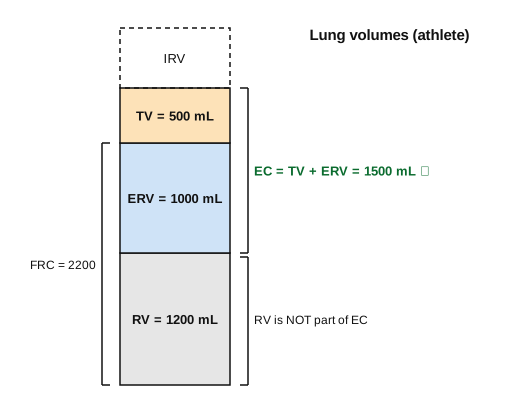
- EC = TV + ERV = 500 + 1000 = 1500 mL.
- RV = 1200 mL is a distractor: ERV + RV = 2200 mL is FRC (option C); TV + ERV + RV = 2700 mL (option D) is meaningless.
Short trick: Only FRC and TLC include RV (RV can never be breathed out). EC = TV + ERV; IC = TV + IRV; VC = IRV + TV + ERV.
Answer: (A) 1500 mL
अवधारणा: निःश्वसन क्षमता (EC) = सामान्य अंतःश्वसन के बाद व्यक्ति द्वारा निकाली जा सकने वाली कुल वायु = TV + ERV। अवशिष्ट आयतन बाहर नहीं निकाला जा सकता, अतः यह शामिल नहीं होता।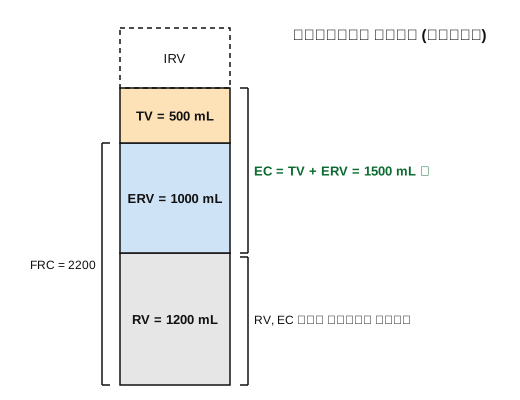
- EC = TV + ERV = 500 + 1000 = 1500 mL।
- RV = 1200 mL भ्रमित करने हेतु दिया है: ERV + RV = 2200 mL तो FRC है (विकल्प C); TV + ERV + RV = 2700 mL (विकल्प D) का कोई अर्थ नहीं।
शॉर्ट ट्रिक: केवल FRC और TLC में RV शामिल होता है (RV कभी बाहर नहीं निकलता)। EC = TV + ERV; IC = TV + IRV; VC = IRV + TV + ERV।
उत्तर: (A) 1500 mL
NEET UGBiologyBreathing and exchange of gases – respiratory volumes and capacitiesNEET UG 2019 · 5 May Shift 1
Q322.What is the fate of the male gametes discharged in the synergid?
सहायक कोशिका (synergid) में मुक्त किए गए नर युग्मकों का क्या भाग्य होता है?
- AOne fuses with egg other(s) degenerate (s) in the synergid.एक अंड से संलयित होता है, अन्य सहायक कोशिका में अपह्रासित हो जाते हैं।
- BAll fuse with the egg.सभी अंड से संलयित होते हैं।
- COne fuses with the egg, other(s) fuse(s) with synergid nucleus.एक अंड से संलयित होता है, अन्य सहायक कोशिका के केंद्रक से संलयित होते हैं।
- DOne fuses with the egg and other fuses with central cell nuclei.एक अंड से संलयित होता है और दूसरा केंद्रीय कोशिका के केंद्रकों से संलयित होता है।
Show answer
Concept: Double fertilisation (unique to angiosperms): the pollen tube releases two male gametes into a synergid.
- Male gamete 1 + egg → zygote (2n) – syngamy.
- Male gamete 2 + two polar nuclei of the central cell → PEN (3n) – triple fusion.
- (A) No gamete degenerates; (B) polyspermy does not occur; (C) synergid nucleus does not fuse – synergids degenerate.
Short trick: Two gametes, two fusions: "1 + 1 = 2n zygote; 1 + 2 = 3n PEN".
Answer: (D) One fuses with the egg and other fuses with central cell nuclei.
अवधारणा: द्वि-निषेचन (केवल आवृतबीजियों में): पराग नलिका दो नर युग्मक एक सहायक कोशिका में मुक्त करती है।
- नर युग्मक 1 + अंड → युग्मनज (2n) – युग्मक संलयन (syngamy)।
- नर युग्मक 2 + केंद्रीय कोशिका के दो ध्रुवीय केंद्रक → PEN (3n) – त्रिक संलयन (triple fusion)।
- (A) कोई युग्मक नष्ट नहीं होता; (B) बहुशुक्राणुता नहीं होती; (C) सहायक कोशिका का केंद्रक संलयित नहीं होता – सहायक कोशिकाएँ अपह्रासित हो जाती हैं।
शॉर्ट ट्रिक: दो युग्मक, दो संलयन: "1 + 1 = 2n युग्मनज; 1 + 2 = 3n PEN"।
उत्तर: (D) एक अंड से संलयित होता है और दूसरा केंद्रीय कोशिका के केंद्रकों से संलयित होता है।
NEET UGBiologySexual reproduction in flowering plants – double fertilisationNEET UG 2019 · 5 May Shift 1
Q323.What is the site of perception of photoperiod necessary for induction of flowering in plants?
पौधों में पुष्पन के प्रेरण के लिए आवश्यक दीप्तिकाल (photoperiod) के संवेदन का स्थल क्या है?
- ALateral budsपार्श्व कलिकाएँ
- BPulvinusपल्वाइनस (Pulvinus)
- CShoot apexप्ररोह शीर्ष
- DLeavesपत्तियाँ
Show answer
Concept: NCERT: the site of perception of light/dark duration is the leaves; a hormonal substance (florigen) moves from leaves to the shoot apex, which then changes into a floral apex.
- (A) Lateral buds – respond, but do not perceive photoperiod.
- (B) Pulvinus – for leaf movements (e.g. Mimosa), not photoperiod.
- (C) Shoot apex – site where flowers are formed (receives the stimulus), not where photoperiod is perceived.
- (D) Leaves – perceive photoperiod ✔ (phytochrome).
Short trick: "Leaf sees, apex flowers" – perception in leaf, response at apex.
Answer: (D) Leaves
अवधारणा: NCERT: प्रकाश/अंधकार की अवधि का संवेदन पत्तियाँ करती हैं; एक हॉर्मोनी पदार्थ (फ्लोरिजन) पत्तियों से प्ररोह शीर्ष तक जाता है, जो फिर पुष्पी शीर्ष में बदल जाता है।
- (A) पार्श्व कलिकाएँ – अनुक्रिया करती हैं, पर दीप्तिकाल का संवेदन नहीं करतीं।
- (B) पल्वाइनस – पत्ती की गतियों हेतु (जैसे Mimosa), दीप्तिकाल हेतु नहीं।
- (C) प्ररोह शीर्ष – जहाँ पुष्प बनते हैं (उद्दीपन ग्रहण करता है), दीप्तिकाल का संवेदन यहाँ नहीं होता।
- (D) पत्तियाँ – दीप्तिकाल का संवेदन ✔ (फाइटोक्रोम)।
शॉर्ट ट्रिक: "पत्ती देखती है, शीर्ष फूलता है" – संवेदन पत्ती में, अनुक्रिया शीर्ष पर।
उत्तर: (D) पत्तियाँ
NEET UGBiologyPlant growth and development – photoperiodismNEET UG 2019 · 5 May Shift 1
Q324.Select the correctly written scientific name of Mango which was first described by Carolus Linnaeus :
आम का सही लिखा गया वैज्ञानिक नाम चुनिए, जिसका वर्णन सर्वप्रथम कैरोलस लीनियस ने किया था :
- AMangifera indica Car. Linn.
- BMangifera indica Linn.
- CMangifera indica
- DMangifera Indica
Show answer
Concept: Binomial rules: genus starts with a capital, species epithet with a small letter, both italicised (or underlined); the name of the author who first described the species is written after the epithet in abbreviated, standard form – for Linnaeus it is "Linn." (or L.).
- (A) "Car. Linn." – not the standard author abbreviation.
- (B) Mangifera indica Linn. – correct ✔.
- (C) Correct binomial but the question asks for the name with the describing author.
- (D) Species epithet must begin with a small letter – "Indica" is wrong.
Short trick: Mango = Mangifera indica Linn. – NCERT example itself.
Answer: (B) Mangifera indica Linn.
अवधारणा: द्विनाम नियम: वंश का नाम बड़े अक्षर से, जाति-संकेत पद छोटे अक्षर से, दोनों तिरछे (italic) या रेखांकित; जिस वैज्ञानिक ने सर्वप्रथम वर्णन किया, उसका नाम संक्षिप्त मानक रूप में जाति-पद के बाद लिखा जाता है – लीनियस के लिए "Linn." (या L.)।
- (A) "Car. Linn." – मानक लेखक-संक्षेप नहीं है।
- (B) Mangifera indica Linn. – सही ✔।
- (C) द्विनाम सही है, पर प्रश्न वर्णनकर्ता लेखक सहित नाम पूछता है।
- (D) जाति-पद छोटे अक्षर से शुरू होना चाहिए – "Indica" गलत है।
शॉर्ट ट्रिक: आम = Mangifera indica Linn. – यही NCERT का उदाहरण है।
उत्तर: (B) Mangifera indica Linn.
NEET UGBiologyThe living world – binomial nomenclatureNEET UG 2019 · 5 May Shift 1
Q325.Following statements describe the characteristics of the enzyme Restriction Endonuclease. Identify the incorrect statement.
निम्नलिखित कथन प्रतिबंधन एंडोन्यूक्लिएज़ (Restriction Endonuclease) एंजाइम के लक्षणों का वर्णन करते हैं। गलत कथन पहचानिए।
- AThe enzyme cuts DNA molecule at identified position within the DNA.यह एंजाइम DNA अणु को DNA के भीतर पहचानी गई स्थिति पर काटता है।
- BThe enzyme binds DNA at specific sites and cuts only one of the two strands.यह एंजाइम DNA से विशिष्ट स्थलों पर बंधता है और दोनों में से केवल एक रज्जुक को काटता है।
- CThe enzyme cuts the sugar-phosphate backbone at specific sites on each strand.यह एंजाइम प्रत्येक रज्जुक पर विशिष्ट स्थलों पर शर्करा-फॉस्फेट आधार-स्तंभ को काटता है।
- DThe enzyme recognizes a specific palindromic nucleotide sequence in the DNA.यह एंजाइम DNA में एक विशिष्ट पैलिंड्रोमिक न्यूक्लियोटाइड अनुक्रम को पहचानता है।
Show answer
Concept: A restriction endonuclease inspects the DNA, binds at its specific palindromic recognition sequence and cuts each of the two strands of the double helix at specific points in the sugar-phosphate backbone.
- (A) True – cuts at a specific (identified) position.
- (B) Incorrect – it cuts both strands, not just one (that is why sticky ends form on both fragments).
- (C) True – phosphodiester bonds of the backbone are cut on each strand.
- (D) True – e.g. EcoRI recognises 5′-GAATTC-3′, a palindrome.
Short trick: Sticky ends need both strands cut slightly away from the centre of the palindrome – a single-strand cut makes only a nick.
Answer: (B) The enzyme binds DNA at specific sites and cuts only one of the two strands.
अवधारणा: प्रतिबंधन एंडोन्यूक्लिएज़ DNA की जाँच करता है, अपने विशिष्ट पैलिंड्रोमिक पहचान-अनुक्रम पर बंधता है और द्विकुंडली के दोनों रज्जुकों को शर्करा-फॉस्फेट आधार-स्तंभ में विशिष्ट बिंदुओं पर काटता है।
- (A) सत्य – विशिष्ट (पहचानी गई) स्थिति पर काटता है।
- (B) गलत – यह दोनों रज्जुकों को काटता है, केवल एक को नहीं (इसीलिए दोनों खंडों पर चिपचिपे सिरे बनते हैं)।
- (C) सत्य – प्रत्येक रज्जुक पर आधार-स्तंभ के फॉस्फोडाइएस्टर बंध कटते हैं।
- (D) सत्य – जैसे EcoRI 5′-GAATTC-3′ पहचानता है, जो पैलिंड्रोम है।
शॉर्ट ट्रिक: चिपचिपे सिरे तभी बनते हैं जब दोनों रज्जुक पैलिंड्रोम के केंद्र से थोड़ा हटकर कटें – एक रज्जुक कटने से केवल "निक" बनता है।
उत्तर: (B) यह एंजाइम DNA से विशिष्ट स्थलों पर बंधता है और दोनों में से केवल एक रज्जुक को काटता है।
NEET UGBiologyBiotechnology – restriction endonucleasesNEET UG 2019 · 5 May Shift 1
Q326.From evolutionary point of view, retention of the female gametophyte with developing young embryo on the parent sporophyte for some time, is first observed in :
विकासीय दृष्टिकोण से, जनक बीजाणुद्भिद पर विकसित होते हुए तरुण भ्रूण सहित मादा युग्मकोद्भिद का कुछ समय तक बने रहना, सर्वप्रथम किसमें देखा जाता है :
- ALiverwortsलिवरवर्ट
- BMossesमॉस
- CPteridophytesटेरिडोफाइट
- DGymnospermsअनावृतबीजी
Show answer
Concept: In heterosporous pteridophytes (Selaginella, Salvinia) the megaspore germinates into a female gametophyte while still retained on the parent sporophyte for variable periods, and the zygote develops into a young embryo within it. NCERT calls this event a precursor to the seed habit – an important step in evolution.
- (A), (B) Bryophytes – the dominant plant is the gametophyte; sporophyte depends on it, the reverse situation.
- (C) Pteridophytes – first to show this retention ✔.
- (D) Gymnosperms – fully developed seed habit, but this is not the first appearance.
Short trick: Heterospory (Selaginella, Salvinia) → retention → seed habit: "SS = Seed Start".
Answer: (C) Pteridophytes
अवधारणा: विषमबीजाणुक टेरिडोफाइट (Selaginella, Salvinia) में गुरुबीजाणु जनक बीजाणुद्भिद पर ही रहते हुए मादा युग्मकोद्भिद में अंकुरित होता है और युग्मनज उसी के भीतर तरुण भ्रूण में विकसित होता है। NCERT इसे बीज-स्वभाव का पूर्वगामी (precursor to seed habit) कहता है – विकास का एक महत्त्वपूर्ण चरण।
- (A), (B) ब्रायोफाइट – प्रमुख पौधा युग्मकोद्भिद है; बीजाणुद्भिद उस पर निर्भर – उल्टी स्थिति।
- (C) टेरिडोफाइट – यह प्रतिधारण सर्वप्रथम यहीं ✔।
- (D) अनावृतबीजी – पूर्ण विकसित बीज-स्वभाव, पर यह पहली उपस्थिति नहीं है।
शॉर्ट ट्रिक: विषमबीजाणुता (Selaginella, Salvinia) → प्रतिधारण → बीज-स्वभाव: "SS = Seed Start"।
उत्तर: (C) टेरिडोफाइट
NEET UGBiologyPlant kingdom – pteridophytes, precursor to seed habitNEET UG 2019 · 5 May Shift 1
Q327.In Antirrhinum (Snapdragon), a red flower was crossed with a white flower and in F1 generation pink flowers were obtained. When pink flowers were selfed, the F2 generation showed white, red and pink flowers. Choose the incorrect statement from the following :
Antirrhinum (स्नैपड्रैगन) में एक लाल पुष्प का एक सफेद पुष्प से संकरण कराया गया और F1 पीढ़ी में गुलाबी पुष्प प्राप्त हुए। जब गुलाबी पुष्पों का स्वपरागण कराया गया, तो F2 पीढ़ी में सफेद, लाल और गुलाबी पुष्प प्राप्त हुए। निम्नलिखित में से गलत कथन चुनिए :
- AThis experiment does not follow the Principle of Dominance.यह प्रयोग प्रभाविता के सिद्धांत का पालन नहीं करता।
- BPink colour in F1 is due to incomplete dominance.F1 में गुलाबी रंग अपूर्ण प्रभाविता के कारण है।
- CRatio of F2 is (Red) : (Pink) : (White)F2 का अनुपात (लाल) : (गुलाबी) : (सफेद) है
- DLaw of Segregation does not apply in this experimentइस प्रयोग में पृथक्करण का नियम लागू नहीं होता
Show answer
Concept: Incomplete dominance: neither allele (R or r) is completely dominant, so the heterozygote Rr shows an intermediate (pink) phenotype. The alleles still separate cleanly into gametes.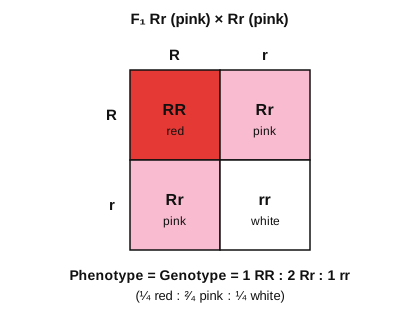
- (A) True – red is not dominant over white, so the law of dominance is not followed.
- (B) True – pink F1 (Rr) = incomplete dominance.
- (C) True – F2 = 1 RR red : 2 Rr pink : 1 rr white = ¼ : ²⁄₄ : ¼.
- (D) Incorrect – R and r segregate into separate gametes (that is why red and white reappear in F2); the law of segregation does apply.
Short trick: Law of segregation is universal for a monohybrid cross – only dominance changes. Reappearance of parental types in F2 = proof of segregation.
Answer: (D) Law of Segregation does not apply in this experiment
अवधारणा: अपूर्ण प्रभाविता: कोई भी युग्मविकल्पी (R या r) पूर्णतः प्रभावी नहीं होता, अतः विषमयुग्मजी Rr मध्यवर्ती (गुलाबी) लक्षणप्ररूप दिखाता है। युग्मविकल्पी फिर भी युग्मकों में स्पष्ट रूप से पृथक होते हैं।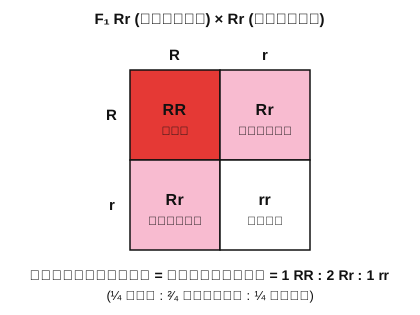
- (A) सत्य – लाल, सफेद पर प्रभावी नहीं, अतः प्रभाविता का नियम लागू नहीं होता।
- (B) सत्य – गुलाबी F1 (Rr) = अपूर्ण प्रभाविता।
- (C) सत्य – F2 = 1 RR लाल : 2 Rr गुलाबी : 1 rr सफेद = ¼ : ²⁄₄ : ¼।
- (D) गलत – R और r अलग-अलग युग्मकों में पृथक होते हैं (इसीलिए F2 में लाल और सफेद पुनः प्रकट होते हैं); पृथक्करण का नियम लागू होता है।
शॉर्ट ट्रिक: एकसंकर संकरण में पृथक्करण का नियम सार्वत्रिक है – केवल प्रभाविता बदलती है। F2 में जनक लक्षणों का पुनः प्रकट होना = पृथक्करण का प्रमाण।
उत्तर: (D) इस प्रयोग में पृथक्करण का नियम लागू नहीं होता
NEET UGBiologyPrinciples of inheritance – incomplete dominanceNEET UG 2019 · 5 May Shift 1
Q328.Conversion of glucose to glucose-6-phosphate, the first irreversible reaction of glycolysis, is catalyzed by
ग्लूकोज़ का ग्लूकोज़-6-फॉस्फेट में रूपांतरण, जो ग्लाइकोलिसिस की पहली अनुत्क्रमणीय अभिक्रिया है, किसके द्वारा उत्प्रेरित होता है
- AAldolaseएल्डोलेज़
- BHexokinaseहेक्सोकाइनेज़
- CEnolaseइनोलेज़
- DPhosphofructokinaseफॉस्फोफ्रक्टोकाइनेज़
Show answer
Concept: Glucose is phosphorylated by ATP to glucose-6-phosphate by hexokinase (step 1 of glycolysis).
- (A) Aldolase – splits fructose-1,6-bisphosphate into DHAP + PGAL.
- (B) Hexokinase – glucose → glucose-6-phosphate ✔.
- (C) Enolase – 2-PGA → PEP (removes water).
- (D) Phosphofructokinase – fructose-6-P → fructose-1,6-bisP (the second ATP-using step).
Short trick: "Kinase" adds phosphate from ATP; "hexo" = 6-carbon sugar → hexokinase phosphorylates glucose.
Answer: (B) Hexokinase
अवधारणा: ग्लूकोज़ ATP द्वारा हेक्सोकाइनेज़ की सहायता से ग्लूकोज़-6-फॉस्फेट में फॉस्फोरिलीकृत होता है (ग्लाइकोलिसिस का चरण 1)।
- (A) एल्डोलेज़ – फ्रक्टोज़-1,6-बिसफॉस्फेट को DHAP + PGAL में तोड़ता है।
- (B) हेक्सोकाइनेज़ – ग्लूकोज़ → ग्लूकोज़-6-फॉस्फेट ✔।
- (C) इनोलेज़ – 2-PGA → PEP (जल निकालता है)।
- (D) फॉस्फोफ्रक्टोकाइनेज़ – फ्रक्टोज़-6-P → फ्रक्टोज़-1,6-बिसP (दूसरा ATP-उपयोगी चरण)।
शॉर्ट ट्रिक: "काइनेज़" ATP से फॉस्फेट जोड़ता है; "हेक्सो" = 6-कार्बन शर्करा → हेक्सोकाइनेज़ ग्लूकोज़ को फॉस्फोरिलीकृत करता है।
उत्तर: (B) हेक्सोकाइनेज़
NEET UGBiologyRespiration in plants – glycolysisNEET UG 2019 · 5 May Shift 1
Q329.Drug called 'Heroin' is synthesized by
'हेरोइन' नामक ड्रग किसके द्वारा संश्लेषित होती है
- Amethylation of morphineमॉर्फीन के मेथिलीकरण
- Bacetylation of morphineमॉर्फीन के ऐसीटिलीकरण
- Cglycosylation of morphineमॉर्फीन के ग्लाइकोसिलीकरण
- Dnitration of morphineमॉर्फीन के नाइट्रीकरण
Show answer
Concept: NCERT: Heroin (smack) is chemically diacetylmorphine, a white, odourless, bitter crystalline compound obtained by acetylation of morphine (from latex of poppy, Papaver somniferum).
- Morphine has two –OH groups; both are acetylated → diacetylmorphine.
- Methylation of morphine gives codeine; glycosylation/nitration do not give heroin.
- Heroin is a depressant and slows down body functions.
Short trick: "Heroin = Di-Acetyl-Morphine" – "Hero takes DAM".
Answer: (B) acetylation of morphine
अवधारणा: NCERT: हेरोइन (स्मैक) रासायनिक रूप से डाइऐसीटिलमॉर्फीन है – एक सफेद, गंधहीन, कड़वा क्रिस्टलीय यौगिक जो मॉर्फीन (पोस्त Papaver somniferum के लेटेक्स से) के ऐसीटिलीकरण से प्राप्त होता है।
- मॉर्फीन में दो –OH समूह होते हैं; दोनों ऐसीटिलीकृत होते हैं → डाइऐसीटिलमॉर्फीन।
- मॉर्फीन के मेथिलीकरण से कोडीन बनता है; ग्लाइकोसिलीकरण/नाइट्रीकरण से हेरोइन नहीं बनती।
- हेरोइन एक अवसादक है और शरीर के कार्यों को धीमा करती है।
शॉर्ट ट्रिक: "हेरोइन = Di-Acetyl-Morphine" – "Hero takes DAM"।
उत्तर: (B) मॉर्फीन के ऐसीटिलीकरण
NEET UGBiologyHuman health and disease – drugs (opioids)NEET UG 2019 · 5 May Shift 1
Q330.Select the hormone-releasing Intra-Uterine Devices.
हॉर्मोन-मोचक अंतर्गर्भाशयी युक्तियाँ (Intra-Uterine Devices) चुनिए।
- AVaults, LNG-20वॉल्ट, LNG-20
- BMultiload 375, Progestasertमल्टीलोड 375, प्रोजेस्टासर्ट
- CProgestasert, LNG-20प्रोजेस्टासर्ट, LNG-20
- DLippes Loop, Multiload 375लिप्पीज़ लूप, मल्टीलोड 375
Show answer
Concept: NCERT classifies IUDs as: non-medicated (Lippes loop), copper-releasing (CuT, Cu7, Multiload 375) and hormone-releasing (Progestasert, LNG-20).
- (A) Vaults – a barrier (cap) method, not an IUD.
- (B) Multiload 375 – copper-releasing.
- (C) Progestasert, LNG-20 – both hormone-releasing ✔.
- (D) Lippes loop – non-medicated; Multiload 375 – copper.
Short trick: "Pro" + "LNG" (levonorgestrel) = progestogen → hormonal IUDs.
Answer: (C) Progestasert, LNG-20
अवधारणा: NCERT के अनुसार IUD: अऔषधीय (लिप्पीज़ लूप), ताँबा-मोचक (CuT, Cu7, मल्टीलोड 375) और हॉर्मोन-मोचक (प्रोजेस्टासर्ट, LNG-20)।
- (A) वॉल्ट – रोध (टोपी) विधि है, IUD नहीं।
- (B) मल्टीलोड 375 – ताँबा-मोचक।
- (C) प्रोजेस्टासर्ट, LNG-20 – दोनों हॉर्मोन-मोचक ✔।
- (D) लिप्पीज़ लूप – अऔषधीय; मल्टीलोड 375 – ताँबा।
शॉर्ट ट्रिक: "Pro" + "LNG" (लेवोनॉर्जेस्ट्रेल) = प्रोजेस्टोजन → हॉर्मोनी IUD।
उत्तर: (C) प्रोजेस्टासर्ट, LNG-20
NEET UGBiologyReproductive health – intra-uterine devicesNEET UG 2019 · 5 May Shift 1
Q331.A gene locus has two alleles A, a. If the frequency of dominant allele A is 0.4, then what will be the frequency of homozygous dominant, heterozygous and homozygous recessive individuals in the population?
एक जीन विस्थल पर दो युग्मविकल्पी A, a हैं। यदि प्रभावी युग्मविकल्पी A की आवृत्ति 0.4 है, तो समष्टि में समयुग्मजी प्रभावी, विषमयुग्मजी और समयुग्मजी अप्रभावी व्यष्टियों की आवृत्ति क्या होगी?
- A0.36(AA); 0.48(Aa); 0.16(aa)
- B0.16(AA); 0.24(Aa); 0.36(aa)
- C0.16(AA); 0.48(Aa); 0.36(aa)
- D0.16(AA); 0.36(Aa); 0.48(aa)
Show answer
Concept: Hardy-Weinberg: p + q = 1 and p2 + 2pq + q2 = 1.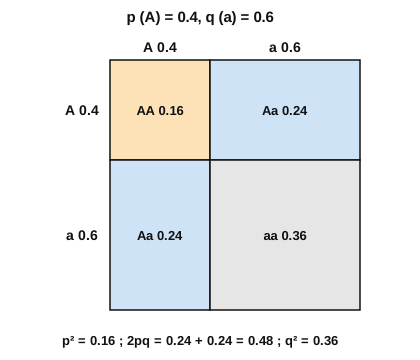
- p = 0.4 ⇒ q = 1 − 0.4 = 0.6.
- AA = p2 = 0.16; Aa = 2pq = 2 × 0.4 × 0.6 = 0.48; aa = q2 = 0.36.
- Check: 0.16 + 0.48 + 0.36 = 1.00 ✔. (B) uses pq instead of 2pq (sum 0.76); (A) swaps p and q; (D) swaps Aa and aa.
Short trick: Fix AA first: AA = p2 = 0.16 rules out (A); then Aa = 2pq = 0.48 picks (C) over (B) and (D).
Answer: (C) 0.16(AA); 0.48(Aa); 0.36(aa)
अवधारणा: हार्डी-वाइनबर्ग: p + q = 1 तथा p2 + 2pq + q2 = 1।
- p = 0.4 ⇒ q = 1 − 0.4 = 0.6।
- AA = p2 = 0.16; Aa = 2pq = 2 × 0.4 × 0.6 = 0.48; aa = q2 = 0.36।
- जाँच: 0.16 + 0.48 + 0.36 = 1.00 ✔। (B) में 2pq के स्थान पर pq लिया है (योग 0.76); (A) में p और q उलट दिए; (D) में Aa और aa उलट दिए।
शॉर्ट ट्रिक: पहले AA तय कीजिए: AA = p2 = 0.16 से (A) बाहर; फिर Aa = 2pq = 0.48 से (B) और (D) के स्थान पर (C)।
उत्तर: (C) 0.16(AA); 0.48(Aa); 0.36(aa)
NEET UGBiologyEvolution – Hardy-Weinberg principleNEET UG 2019 · 5 May Shift 1
Q332.Which of the following is true for Golden rice?
गोल्डन राइस (Golden rice) के लिए निम्नलिखित में से कौन-सा सत्य है?
- AIt is Vitamin A enriched, with a gene from daffodilयह विटामिन A से समृद्ध है, जिसमें डैफ़ोडिल का एक जीन है
- BIt is pest resistant, with a gene from Bacillus thuringiensisयह पीड़क-प्रतिरोधी है, जिसमें Bacillus thuringiensis का एक जीन है
- CIt is drought tolerant, developed using Agrobacterium vectorयह सूखा-सहिष्णु है, जिसे Agrobacterium वाहक द्वारा विकसित किया गया है
- DIt has yellow grains, because of a gene introduced from a primitive variety of riceइसके दाने पीले हैं, क्योंकि इसमें धान की एक आदिम किस्म से जीन प्रविष्ट किया गया है
Show answer
Concept: Golden rice is a transgenic rice enriched with β-carotene (pro-vitamin A); the gene for phytoene synthase came from daffodil (Narcissus), along with a bacterial gene.
- (A) Vitamin A enriched, daffodil gene ✔.
- (B) Pest resistance with Bt gene – that is Bt cotton/Bt brinjal, not golden rice.
- (C) It is not a drought-tolerant variety.
- (D) Yellow (golden) colour is due to β-carotene from transgenes, not a primitive rice gene.
Short trick: Golden = yellow β-carotene = Vitamin A; daffodil is a yellow flower → yellow gene.
Answer: (A) It is Vitamin A enriched, with a gene from daffodil
अवधारणा: गोल्डन राइस एक पारजीनी धान है जो β-कैरोटीन (प्रो-विटामिन A) से समृद्ध है; फाइटोईन सिंथेज़ का जीन डैफ़ोडिल (Narcissus) से तथा एक जीवाणु-जीन के साथ लिया गया।
- (A) विटामिन A समृद्ध, डैफ़ोडिल जीन ✔।
- (B) Bt जीन से पीड़क-प्रतिरोध – यह Bt कपास/Bt बैंगन है, गोल्डन राइस नहीं।
- (C) यह सूखा-सहिष्णु किस्म नहीं है।
- (D) पीला (सुनहरा) रंग पारजीनों से बने β-कैरोटीन के कारण है, किसी आदिम धान के जीन से नहीं।
शॉर्ट ट्रिक: गोल्डन = पीला β-कैरोटीन = विटामिन A; डैफ़ोडिल पीला फूल है → पीला जीन।
उत्तर: (A) यह विटामिन A से समृद्ध है, जिसमें डैफ़ोडिल का एक जीन है
NEET UGBiologyBiotechnology applications – Golden riceNEET UG 2019 · 5 May Shift 1
Q333.Pinus seed cannot germinate and established without fungal association. This is because :
Pinus का बीज कवक-सहचर्य के बिना अंकुरित एवं स्थापित नहीं हो सकता। इसका कारण है :
- Aits embryo is immature.इसका भ्रूण अपरिपक्व होता है।
- Bit has obligate association with mycorrhizae.इसका कवकमूल (mycorrhizae) के साथ अविकल्पी (obligate) सहचर्य होता है।
- Cit has very hard seed coat.इसका बीजावरण बहुत कठोर होता है।
- Dits seeds contain inhibitors that present germination.इसके बीजों में अंकुरण रोकने वाले संदमक होते हैं।
Show answer
Concept: NCERT (Microbes / Plant kingdom): roots of Pinus have an obligate mycorrhizal association – Pinus seeds cannot germinate and establish without the presence of mycorrhizae.
- Mycorrhizal fungus absorbs phosphorus and water from soil and passes them to the plant; the plant supplies sugars.
- (A), (C), (D) – immature embryo, hard seed coat or inhibitors are not the reason given for Pinus.
Short trick: Gymnosperm roots: Pinus → mycorrhiza (fungus); Cycas → coralloid roots (cyanobacteria).
Answer: (B) it has obligate association with mycorrhizae.
अवधारणा: NCERT: Pinus की जड़ों में अविकल्पी कवकमूल सहचर्य होता है – कवकमूल की उपस्थिति के बिना Pinus के बीज अंकुरित एवं स्थापित नहीं हो सकते।
- कवकमूल का कवक मृदा से फॉस्फोरस और जल अवशोषित कर पौधे को देता है; पौधा शर्करा देता है।
- (A), (C), (D) – अपरिपक्व भ्रूण, कठोर बीजावरण या संदमक Pinus के लिए दिया गया कारण नहीं है।
शॉर्ट ट्रिक: अनावृतबीजी जड़ें: Pinus → कवकमूल (कवक); Cycas → प्रवालाभ जड़ें (सायनोबैक्टीरिया)।
उत्तर: (B) इसका कवकमूल (mycorrhizae) के साथ अविकल्पी (obligate) सहचर्य होता है।
NEET UGBiologyBiological classification – mycorrhizaNEET UG 2019 · 5 May Shift 1
Q334.Which of the following features of genetic code does allow bacteria to produce human insulin by recombinant DNA technology?
आनुवंशिक कूट का निम्नलिखित में से कौन-सा लक्षण जीवाणुओं को पुनर्योगज DNA प्रौद्योगिकी द्वारा मानव इंसुलिन बनाने देता है?
- AGenetic code is not ambiguousआनुवंशिक कूट संदिग्ध (ambiguous) नहीं है
- BGenetic code is redundantआनुवंशिक कूट अपह्रासित (redundant) है
- CGenetic code is nearly universalआनुवंशिक कूट लगभग सार्वत्रिक है
- DGenetic code is specificआनुवंशिक कूट विशिष्ट है
Show answer
Concept: Because the code is nearly universal (e.g. UUU codes for phenylalanine in bacteria and humans alike), a human insulin gene inserted into E. coli is read by the bacterial machinery into the same amino-acid sequence.
- (A)/(D) Unambiguous/specific – one codon = one amino acid; true but not the reason a foreign gene works in a different organism.
- (B) Redundant (degenerate) – several codons for one amino acid; irrelevant here.
- (C) Nearly universal ✔ – the same dictionary in bacteria and humans.
Short trick: Gene from one species works in another → think "universal".
Answer: (C) Genetic code is nearly universal
अवधारणा: कूट लगभग सार्वत्रिक होने के कारण (जैसे UUU जीवाणु और मानव दोनों में फेनिलऐलानिन का कूट है), E. coli में प्रविष्ट मानव इंसुलिन जीन जीवाणु-तंत्र द्वारा उसी ऐमीनो अम्ल अनुक्रम में पढ़ा जाता है।
- (A)/(D) असंदिग्ध/विशिष्ट – एक कोडॉन = एक ऐमीनो अम्ल; सत्य है पर विदेशी जीन के दूसरे जीव में कार्य करने का कारण नहीं।
- (B) अपह्रासित – एक ऐमीनो अम्ल के लिए कई कोडॉन; यहाँ असंबद्ध।
- (C) लगभग सार्वत्रिक ✔ – जीवाणु और मानव में एक ही "शब्दकोश"।
शॉर्ट ट्रिक: एक जाति का जीन दूसरी जाति में कार्य करे → "सार्वत्रिक" सोचिए।
उत्तर: (C) आनुवंशिक कूट लगभग सार्वत्रिक है
NEET UGBiologyMolecular basis of inheritance – genetic codeNEET UG 2019 · 5 May Shift 1
Q335.Which of the following sexually transmitted diseases is not completely curable?
निम्नलिखित में से कौन-सा यौन संचारित रोग पूर्णतः उपचार-योग्य नहीं है?
- AGonorrhoeaसुजाक (Gonorrhoea)
- BGenital wartsजननिक मस्से (Genital warts)
- CGenital herpesजननिक हर्पीज़ (Genital herpes)
- DChlamydiasisक्लैमिडियता (Chlamydiasis)
Show answer
Concept: NCERT: "Except for hepatitis-B, genital herpes and HIV infections, other diseases are completely curable if detected early and treated properly."
- Genital herpes (Herpes simplex virus) – virus stays latent in nerve ganglia → not completely curable ✔.
- Gonorrhoea (Neisseria) and chlamydiasis (Chlamydia) – bacterial, curable with antibiotics.
- Genital warts – treatable/removable as per the NCERT list (curable group).
Short trick: Non-curable STIs = "H-H-H": Hepatitis-B, Herpes, HIV.
Answer: (C) Genital herpes
अवधारणा: NCERT: "हेपेटाइटिस-B, जननिक हर्पीज़ और HIV संक्रमणों को छोड़कर अन्य रोग शीघ्र पहचान और उचित उपचार से पूर्णतः ठीक हो सकते हैं।"
- जननिक हर्पीज़ (हर्पीज़ सिम्प्लेक्स वायरस) – वायरस तंत्रिका गुच्छिकाओं में सुप्त रहता है → पूर्णतः उपचार-योग्य नहीं ✔।
- सुजाक (Neisseria) और क्लैमिडियता (Chlamydia) – जीवाणुजनित, प्रतिजैविकों से ठीक होते हैं।
- जननिक मस्से – NCERT सूची के अनुसार उपचार-योग्य (ठीक होने वाले समूह में)।
शॉर्ट ट्रिक: उपचार-अयोग्य STI = "H-H-H": Hepatitis-B, Herpes, HIV।
उत्तर: (C) जननिक हर्पीज़ (Genital herpes)
NEET UGBiologyReproductive health – sexually transmitted infectionsNEET UG 2019 · 5 May Shift 1
Q336.Which of the following statements is incorrect?
निम्नलिखित में से कौन-सा कथन गलत है?
- AViroids lack a protein coat.वाइरॉइड में प्रोटीन आवरण नहीं होता।
- BViruses are obligate parasites.वायरस अविकल्पी परजीवी होते हैं।
- CInfective constituent in viruses is the protein coat.वायरस में संक्रामक घटक प्रोटीन आवरण होता है।
- DPrions consist of abnormally folded proteins.प्रिऑन असामान्य रूप से वलित प्रोटीनों से बने होते हैं।
Show answer
Concept: A virus = nucleoprotein: genetic material (RNA or DNA) + protein coat (capsid). The nucleic acid is infectious; the capsid only protects it.
- (A) True – viroids (potato spindle tuber disease) are free RNA without a protein coat.
- (B) True – viruses multiply only inside living host cells.
- (C) Incorrect – the infective part is the nucleic acid, not the protein coat (Hershey–Chase: only DNA enters the bacterium).
- (D) True – prions (BSE, CJD) are abnormally folded proteins.
Short trick: Hershey–Chase: radioactive 32P (DNA) entered the host, 35S (protein) stayed outside → nucleic acid infects.
Answer: (C) Infective constituent in viruses is the protein coat.
अवधारणा: वायरस = न्यूक्लियोप्रोटीन: आनुवंशिक पदार्थ (RNA या DNA) + प्रोटीन आवरण (कैप्सिड)। न्यूक्लिक अम्ल संक्रामक होता है; कैप्सिड केवल उसकी रक्षा करता है।
- (A) सत्य – वाइरॉइड (आलू का स्पिंडल ट्यूबर रोग) प्रोटीन आवरण-रहित मुक्त RNA हैं।
- (B) सत्य – वायरस केवल जीवित परपोषी कोशिकाओं के भीतर गुणन करते हैं।
- (C) गलत – संक्रामक भाग न्यूक्लिक अम्ल है, प्रोटीन आवरण नहीं (हर्शे–चेस: केवल DNA जीवाणु में प्रवेश करता है)।
- (D) सत्य – प्रिऑन (BSE, CJD) असामान्य रूप से वलित प्रोटीन हैं।
शॉर्ट ट्रिक: हर्शे–चेस: रेडियोसक्रिय 32P (DNA) परपोषी में गया, 35S (प्रोटीन) बाहर रहा → न्यूक्लिक अम्ल संक्रमित करता है।
उत्तर: (C) वायरस में संक्रामक घटक प्रोटीन आवरण होता है।
NEET UGBiologyBiological classification – viruses, viroids, prionsNEET UG 2019 · 5 May Shift 1
Q337.Match the following organisms with their respective characteristics :
| (a) Pila | (i) Flame cells |
| (b) Bombyx | (ii) Comb plates |
| (c) Pleurobrachia | (iii) Radula |
| (d) Taenia | (iv) Malpighian tubules |
Select the correct option from the following :
निम्नलिखित जीवों का उनके संबंधित लक्षणों से मिलान कीजिए :
| (a) Pila | (i) ज्वाला कोशिकाएँ (Flame cells) |
| (b) Bombyx | (ii) कंकत पट्टिकाएँ (Comb plates) |
| (c) Pleurobrachia | (iii) रेतीजिह्वा (Radula) |
| (d) Taenia | (iv) मैलपीगी नलिकाएँ (Malpighian tubules) |
नीचे दिए गए विकल्पों में से सही विकल्प चुनिए :
- A(a)-(iii), (b)-(ii), (c)-(i), (d)-(iv)
- B(a)-(iii), (b)-(iv), (c)-(ii), (d)-(i)
- C(a)-(ii), (b)-(iv), (c)-(iii), (d)-(i)
- D(a)-(iii), (b)-(ii), (c)-(iv), (d)-(i)
Show answer
Concept: Each organism shows the hallmark of its phylum.
- (a) Pila (apple snail, Mollusca) – rasping feeding organ radula → (iii).
- (b) Bombyx (silkworm, Arthropoda – insect) – excretion by Malpighian tubules → (iv).
- (c) Pleurobrachia (sea walnut, Ctenophora) – eight external rows of ciliated comb plates → (ii).
- (d) Taenia (tapeworm, Platyhelminthes) – flame cells for osmoregulation/excretion → (i).
- So a-iii, b-iv, c-ii, d-i → option (B).
Short trick: Radula = Mollusca, Comb plates = Ctenophora, Flame cells = flatworms, Malpighian tubules = insects. Once (a)-(iii) and (d)-(i) are fixed, only (B) and (D) remain; (b) cannot be "comb plates".
Answer: (B) (a)-(iii), (b)-(iv), (c)-(ii), (d)-(i)
अवधारणा: प्रत्येक जीव अपने संघ का विशिष्ट लक्षण दिखाता है।
- (a) Pila (सेब घोंघा, मोलस्का) – खुरचने वाला भोजन अंग रेतीजिह्वा → (iii)।
- (b) Bombyx (रेशम कीट, आर्थ्रोपोडा – कीट) – मैलपीगी नलिकाओं द्वारा उत्सर्जन → (iv)।
- (c) Pleurobrachia (समुद्री अखरोट, टीनोफोरा) – पक्ष्माभी कंकत पट्टिकाओं की आठ बाह्य पंक्तियाँ → (ii)।
- (d) Taenia (फीताकृमि, प्लैटीहेल्मिंथीज़) – परासरण-नियमन/उत्सर्जन हेतु ज्वाला कोशिकाएँ → (i)।
- अतः a-iii, b-iv, c-ii, d-i → विकल्प (B)।
शॉर्ट ट्रिक: रेतीजिह्वा = मोलस्का, कंकत पट्टिका = टीनोफोरा, ज्वाला कोशिका = चपटे कृमि, मैलपीगी नलिका = कीट। (a)-(iii) और (d)-(i) तय होते ही केवल (B) और (D) बचते हैं; (b) "कंकत पट्टिका" नहीं हो सकता।
उत्तर: (B) (a)-(iii), (b)-(iv), (c)-(ii), (d)-(i)
NEET UGBiologyAnimal kingdom – characteristic features of phylaNEET UG 2019 · 5 May Shift 1
Q338.Expressed Sequence Tags (ESTs) refers to :
व्यक्त अनुक्रम टैग (Expressed Sequence Tags, ESTs) से तात्पर्य है :
- AGenes expressed as RNARNA के रूप में व्यक्त होने वाले जीन
- BPolypeptide expressionपॉलिपेप्टाइड अभिव्यक्ति
- CDNA polymorphismDNA बहुरूपता
- DNovel DNA sequencesनए DNA अनुक्रम
Show answer
Concept: In the Human Genome Project, one approach identified all the genes that are expressed as RNA – called Expressed Sequence Tags (ESTs). The other approach was sequence annotation (sequencing the whole genome, coding and non-coding).
- (A) Genes expressed as RNA ✔ – NCERT definition.
- (B) Polypeptide expression – proteomics, not EST.
- (C) DNA polymorphism – basis of DNA fingerprinting (VNTRs, SNPs).
- (D) Novel sequences – not the meaning of EST.
Short trick: "Expressed" = transcribed into RNA (mRNA → cDNA tags).
Answer: (A) Genes expressed as RNA
अवधारणा: मानव जीनोम परियोजना में एक विधि में उन सभी जीनों की पहचान की गई जो RNA के रूप में व्यक्त होते हैं – इन्हें व्यक्त अनुक्रम टैग (EST) कहते हैं। दूसरी विधि अनुक्रम एनोटेशन थी (कोडिंग और नॉन-कोडिंग सहित पूरे जीनोम का अनुक्रमण)।
- (A) RNA के रूप में व्यक्त जीन ✔ – NCERT परिभाषा।
- (B) पॉलिपेप्टाइड अभिव्यक्ति – प्रोटियोमिक्स, EST नहीं।
- (C) DNA बहुरूपता – DNA फिंगरप्रिंटिंग का आधार (VNTR, SNP)।
- (D) नए अनुक्रम – EST का अर्थ नहीं।
शॉर्ट ट्रिक: "Expressed" = RNA में अनुलेखित (mRNA → cDNA टैग)।
उत्तर: (A) RNA के रूप में व्यक्त होने वाले जीन
NEET UGBiologyMolecular basis of inheritance – Human Genome Project (ESTs)NEET UG 2019 · 5 May Shift 1
Q339.Which is of the following statements is incorrect?
निम्नलिखित में से कौन-सा कथन गलत है?
- AMorels and truffles are edible delicacies.मोरेल और ट्रफल खाद्य स्वादिष्ट व्यंजन हैं।
- BClaviceps is a source of many alkaloids and LSD.Claviceps अनेक ऐल्कलॉइडों और LSD का स्रोत है।
- CConidia are produced exogenously and ascospores endogenously.कोनिडिया बहिर्जात रूप से और ऐस्कोबीजाणु अंतर्जात रूप से उत्पन्न होते हैं।
- DYeasts have filamentous bodies with long thread-like hyphae.यीस्ट के शरीर लंबे धागे-जैसे कवकतंतुओं वाले तंतुमय होते हैं।
Show answer
Concept: Fungi are filamentous (hyphae) except yeasts, which are unicellular.
- (A) True – morels and truffles (Ascomycetes) are edible delicacies.
- (B) True – Claviceps (ergot) yields alkaloids and LSD.
- (C) True – conidia are formed exogenously on conidiophores; ascospores endogenously in asci.
- (D) Incorrect – yeasts are unicellular, not filamentous.
Short trick: "Yeast is the lonely fungus" – one cell, no hyphae.
Answer: (D) Yeasts have filamentous bodies with long thread-like hyphae.
अवधारणा: कवक तंतुमय (कवकतंतु) होते हैं, यीस्ट को छोड़कर, जो एककोशिक होता है।
- (A) सत्य – मोरेल और ट्रफल (ऐस्कोमाइसीटीज़) खाद्य स्वादिष्ट व्यंजन हैं।
- (B) सत्य – Claviceps (अर्गट) से ऐल्कलॉइड और LSD मिलते हैं।
- (C) सत्य – कोनिडिया कोनिडियमधरों पर बहिर्जात रूप से; ऐस्कोबीजाणु ऐस्काई में अंतर्जात रूप से बनते हैं।
- (D) गलत – यीस्ट एककोशिक होते हैं, तंतुमय नहीं।
शॉर्ट ट्रिक: "यीस्ट अकेला कवक" – एक कोशिका, कोई कवकतंतु नहीं।
उत्तर: (D) यीस्ट के शरीर लंबे धागे-जैसे कवकतंतुओं वाले तंतुमय होते हैं।
NEET UGBiologyBiological classification – Kingdom FungiNEET UG 2019 · 5 May Shift 1
Q340.Match Column - I Column - II
| Column - I | Column - II |
|---|
| (a) Saprophyte | (i) Symbiotic association of fungi with plant roots |
| (b) Parasite | (ii) Decomposition of dead organic materials |
| (c) Lichens | (iii) Living on living plants or animals |
| (d) Mycorrhiza | (iv) Symbiotic association of algae and fungi |
Choose the correct answer from the option given below
कॉलम - I का कॉलम - II से मिलान कीजिए
| कॉलम - I | कॉलम - II |
|---|
| (a) मृतोपजीवी (Saprophyte) | (i) पादप जड़ों के साथ कवकों का सहजीवी सहचर्य |
| (b) परजीवी (Parasite) | (ii) मृत कार्बनिक पदार्थों का अपघटन |
| (c) लाइकेन (Lichens) | (iii) जीवित पौधों या जंतुओं पर रहना |
| (d) कवकमूल (Mycorrhiza) | (iv) शैवालों और कवकों का सहजीवी सहचर्य |
नीचे दिए गए विकल्पों में से सही उत्तर चुनिए
- A(a)-(i), (b)-(ii), (c)-(iii), (d)-(iv)
- B(a)-(iii), (b)-(ii), (c)-(i), (d)-(iv)
- C(a)-(ii), (b)-(i), (c)-(iii), (d)-(iv)
- D(a)-(ii), (b)-(iii), (c)-(iv), (d)-(i)
Show answer
Concept: Fungi show saprophytic, parasitic and symbiotic (lichen, mycorrhiza) modes of life.
- (a) Saprophyte – absorbs nutrients by decomposing dead organic matter → (ii).
- (b) Parasite – lives on living plants/animals → (iii).
- (c) Lichens – alga (phycobiont) + fungus (mycobiont) → (iv).
- (d) Mycorrhiza – fungus + roots of higher plants → (i).
- a-ii, b-iii, c-iv, d-i → option (D).
Short trick: "Lichen = Li-ALGA + fungus; Myco-RHIZA = fungus + ROOT (rhiza = root)."
Answer: (D) (a)-(ii), (b)-(iii), (c)-(iv), (d)-(i)
अवधारणा: कवकों में मृतोपजीवी, परजीवी और सहजीवी (लाइकेन, कवकमूल) जीवन-विधियाँ पाई जाती हैं।
- (a) मृतोपजीवी – मृत कार्बनिक पदार्थ का अपघटन करके पोषक अवशोषित करता है → (ii)।
- (b) परजीवी – जीवित पौधों/जंतुओं पर रहता है → (iii)।
- (c) लाइकेन – शैवाल (फाइकोबायंट) + कवक (माइकोबायंट) → (iv)।
- (d) कवकमूल – कवक + उच्च पादपों की जड़ें → (i)।
- a-ii, b-iii, c-iv, d-i → विकल्प (D)।
शॉर्ट ट्रिक: "लाइकेन = शैवाल + कवक; माइको-राइज़ा = कवक + जड़ (rhiza = जड़)।"
उत्तर: (D) (a)-(ii), (b)-(iii), (c)-(iv), (d)-(i)
NEET UGBiologyBiological classification – modes of nutrition in fungiNEET UG 2019 · 5 May Shift 1

