NEET UG · 2,240 questions

NEET UG 2015, 2016, 2017, 2018, 2019, 2020, 2021, 2022, 2023, 2024, 2025, 2026 PYQs

Real previous year questions, subject-wise. Try the question, then open the answer and the explanation in Hindi & English – free, no login.

Courses – airGurukul

560 questions in Physics.

Q321.
An iron rod of susceptibility 599 is subjected to a magnetising field of 1200 A m−1. The permeability of the material of the rod is : (μ0=4π×10−7 T m A−1)
599 प्रवृत्ति (susceptibility) वाली एक लोहे की छड़ को 1200 A m−1 के चुंबकन क्षेत्र में रखा जाता है। छड़ के पदार्थ की चुंबकशीलता (permeability) है : (μ0=4π×10−7 T m A−1)
  1. A2.4π×10−5 T m A−1
  2. B2.4π×10−7 T m A−1
  3. C2.4π×10−4 T m A−1
  4. D8.0×10−5 T m A−1
Show answer

Concept: μr=1+χ and μ=μ0μr.

  1. μr=1+599=600
  2. μ=4π×10−7×600=2400π×10−7=2.4π×10−4 T m A−1
  3. The field 1200 A m−1 is not needed.

Short trick: 4×600=2400 → 2.4×103×10−7=2.4×10⁻⁴; keep π.

Answer: (C) 2.4π×10−4 T m A−1

अवधारणा: μr=1+χ तथा μ=μ0μr।

  1. μr=1+599=600
  2. μ=4π×10−7×600=2400π×10−7=2.4π×10−4 T m A−1
  3. चुंबकन क्षेत्र 1200 A m−1 की आवश्यकता नहीं है।

शॉर्ट ट्रिक: 4×600=2400 → 2.4×103×10−7=2.4×10⁻⁴; π बनाए रखें।

उत्तर: (C) 2.4π×10−4 T m A−1

NEET UGPhysicsMagnetism and matter – permeabilityNEET UG 2020 · 13 Sep Shift 1
Q322.
Find the torque about the origin when a force of 3j^ N acts on a particle whose position vector is 2k^ m.
मूल बिंदु के परितः बल-आघूर्ण ज्ञात कीजिए जब 3j^ N का बल एक कण पर कार्य करता है जिसका स्थिति सदिश 2k^ m है।
  1. A−6i^ N m
  2. B6k^ N m
  3. C6i^ N m
  4. D6j^ N m
Show answer

Concept: τ→=r→×F→, with i^×j^=k^, j^×k^=i^, k^×i^=j^.

  1. τ→=2k^×3j^=6(k^×j^)
  2. k^×j^=−i^ (anticyclic order) ⇒ τ→=−6i^ N m

Short trick: Torque is ⊥ to both r→ (z) and F→ (y) ⇒ along x – only (A) or (C); order k→j is anticyclic ⇒ negative.

Answer: (A) −6i^ N m

अवधारणा: τ→=r→×F→, जहाँ i^×j^=k^, j^×k^=i^, k^×i^=j^।

  1. τ→=2k^×3j^=6(k^×j^)
  2. k^×j^=−i^ (विपरीत चक्रीय क्रम) ⇒ τ→=−6i^ N m

शॉर्ट ट्रिक: बल-आघूर्ण r→ (z) तथा F→ (y) दोनों के लंबवत ⇒ x-अक्ष के अनुदिश – केवल (A) या (C); क्रम k→j विपरीत चक्रीय ⇒ ऋणात्मक।

उत्तर: (A) −6i^ N m

NEET UGPhysicsRotational motion – torque as cross productNEET UG 2020 · 13 Sep Shift 1
Q323.
The average thermal energy for a mono-atomic gas is : (kB is Boltzmann constant and T, absolute temperature)
एकपरमाणुक गैस के लिए औसत तापीय ऊर्जा है : (kB बोल्ट्ज़मान नियतांक तथा T परम ताप है)
  1. A52kBT
  2. B72kBT
  3. C12kBT
  4. D32kBT
Show answer

Concept: Equipartition: each degree of freedom carries 12kBT per molecule.

  1. Monoatomic gas: only 3 translational degrees of freedom, f=3.
  2. Average energy =f2kBT=32kBT.
  3. 52kBT is for a rigid diatomic molecule, 72kBT for a diatomic one with vibration, 12kBT is per degree of freedom.

Short trick: Mono → 3/2, Di → 5/2, Di + vibration → 7/2.

Answer: (D) 32kBT

अवधारणा: समविभाजन: प्रत्येक स्वातंत्र्य कोटि (degree of freedom) प्रति अणु 12kBT ऊर्जा रखती है।

  1. एकपरमाणुक गैस: केवल 3 स्थानांतरीय स्वातंत्र्य कोटियाँ, f=3।
  2. औसत ऊर्जा =f2kBT=32kBT।
  3. 52kBT दृढ़ द्विपरमाणुक अणु के लिए, 72kBT कंपन सहित द्विपरमाणुक के लिए, 12kBT प्रति स्वातंत्र्य कोटि है।

शॉर्ट ट्रिक: एक → 3/2, द्वि → 5/2, द्वि + कंपन → 7/2।

उत्तर: (D) 32kBT

NEET UGPhysicsKinetic theory – equipartition of energyNEET UG 2020 · 13 Sep Shift 1
Q324.
Assume that light of wavelength 600 nm is coming from a star. The limit of resolution of telescope whose objective has a diameter of 2 m is :
मान लीजिए कि किसी तारे से 600 nm तरंगदैर्ध्य का प्रकाश आ रहा है। उस दूरदर्शक की विभेदन सीमा, जिसके अभिदृश्यक का व्यास 2 m है, होगी :
  1. A7.32×10−7 rad
  2. B6.00×10−7 rad
  3. C3.66×10−7 rad
  4. D1.83×10−7 rad
Show answer

Concept: Limit of resolution of a telescope Δθ=1.22λD.

  1. Δθ=1.22×600×10−92
  2. =1.22×300×10−9=3.66×10⁻⁷ rad

Short trick: λD=3×10⁻⁷; × 1.22 = 3.66. (A) forgets ÷2, (D) uses 0.61.

Answer: (C) 3.66×10⁻⁷ rad

अवधारणा: दूरदर्शक की विभेदन सीमा Δθ=1.22λD।

  1. Δθ=1.22×600×10−92
  2. =1.22×300×10−9=3.66×10⁻⁷ rad

शॉर्ट ट्रिक: λD=3×10⁻⁷; × 1.22 = 3.66। (A) में ÷2 भूल गए, (D) में 0.61 लिया गया।

उत्तर: (C) 3.66×10⁻⁷ rad

NEET UGPhysicsWave optics – resolving power of telescopeNEET UG 2020 · 13 Sep Shift 1
Q325.
Light with an average flux of 20 W/cm2 falls on a non-reflecting surface at normal incidence having surface area 20 cm2. The energy received by the surface during time span of 1 minute is :
20 W/cm2 औसत फ्लक्स वाला प्रकाश 20 cm2 पृष्ठ क्षेत्रफल वाले एक अपरावर्ती पृष्ठ पर अभिलंबवत आपतित होता है। 1 मिनट की समयावधि में पृष्ठ द्वारा प्राप्त ऊर्जा है :
  1. A24×103 J
  2. B48×103 J
  3. C10×103 J
  4. D12×103 J
Show answer

Concept: Energy = intensity × area × time (non-reflecting, normal incidence ⇒ all energy absorbed).

  1. Power =20 W/cm2×20 cm2=400 W
  2. E=400×60=24000 J=24×103 J

Short trick: Keep cm² with cm² – no SI conversion needed. Reflection would double momentum, not energy, so (B) is a trap.

Answer: (A) 24×103 J

अवधारणा: ऊर्जा = तीव्रता × क्षेत्रफल × समय (अपरावर्ती, अभिलंब आपतन ⇒ सारी ऊर्जा अवशोषित)।

  1. शक्ति =20 W/cm2×20 cm2=400 W
  2. E=400×60=24000 J=24×103 J

शॉर्ट ट्रिक: cm² को cm² के साथ रखें – SI में बदलने की आवश्यकता नहीं। परावर्तन संवेग को दोगुना करता है, ऊर्जा को नहीं, अतः (B) एक जाल है।

उत्तर: (A) 24×103 J

NEET UGPhysicsElectromagnetic waves – intensity and energyNEET UG 2020 · 13 Sep Shift 1
Q326.
The ratio of contributions made by the electric field and magnetic field components to the intensity of an electromagnetic wave is : (c = speed of electromagnetic waves)
किसी विद्युतचुंबकीय तरंग की तीव्रता में विद्युत क्षेत्र तथा चुंबकीय क्षेत्र घटकों के योगदानों का अनुपात है : (c = विद्युतचुंबकीय तरंगों की चाल)
  1. A1 : c
  2. B1 : c2
  3. Cc : 1
  4. D1 : 1
Show answer

Concept: Energy densities: uE=12ε0E2, uB=B22μ0, with E=cB and c2=1μ0ε0.

  1. uEuB=μ0ε0E2B2=μ0ε0c2=1
  2. Intensity = (energy density) × c, so contributions are in the ratio 1 : 1.

Short trick: NCERT: electric and magnetic fields share the energy of an EM wave equally.

Answer: (D) 1 : 1

अवधारणा: ऊर्जा घनत्व: uE=12ε0E2, uB=B22μ0, जहाँ E=cB तथा c2=1μ0ε0।

  1. uEuB=μ0ε0E2B2=μ0ε0c2=1
  2. तीव्रता = (ऊर्जा घनत्व) × c, अतः योगदानों का अनुपात 1 : 1 है।

शॉर्ट ट्रिक: NCERT: विद्युतचुंबकीय तरंग की ऊर्जा विद्युत व चुंबकीय क्षेत्रों में बराबर बँटती है।

उत्तर: (D) 1 : 1

NEET UGPhysicsElectromagnetic waves – energy sharing of E and BNEET UG 2020 · 13 Sep Shift 1
Q327.
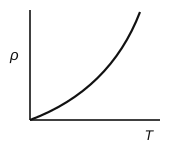
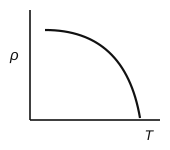
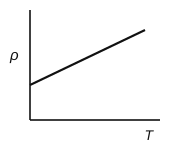
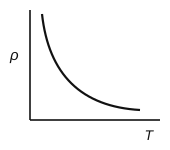
Which of the following graph represents the variation of resistivity (ρ) with temperature (T) for copper?
निम्नलिखित में से कौन-सा ग्राफ ताँबे के लिए ताप (T) के साथ प्रतिरोधकता (ρ) के परिवर्तन को निरूपित करता है?
  1. A
  2. B
  3. C
  4. D
Show answer

Concept: For metals like copper, ρ increases with T; at low T the rise is non-linear and ρ becomes very small near 0 K (NCERT figure of ρ vs T for copper).

  1. Copper is a metal ⇒ positive temperature coefficient ⇒ ρ increases with T: rules out (B) and (D) (falling curves, typical of semiconductors).
  2. Near absolute zero ρ of copper becomes very small and rises slowly, then increases faster – the curved graph starting near the origin, (A).
  3. (C) is the linear approximation ρT=ρ0[1+α(T−T0)], valid only over a limited range – not the full variation.

Short trick: Metal ⇒ rising curve; the NCERT copper graph bends upward from almost zero.

Answer: (A) Graph (A) – rising curve from near the origin

अवधारणा: ताँबे जैसी धातुओं के लिए ρ, T के साथ बढ़ता है; निम्न T पर यह वृद्धि अरैखिक है तथा 0 K के निकट ρ बहुत कम हो जाता है (ताँबे के ρ–T का NCERT चित्र)।

  1. ताँबा धातु है ⇒ धनात्मक ताप गुणांक ⇒ ρ, T के साथ बढ़ता है: (B) व (D) (घटते वक्र, अर्धचालकों जैसे) बाहर।
  2. परम शून्य के निकट ताँबे का ρ बहुत कम होता है और धीरे-धीरे, फिर तेज़ी से बढ़ता है – मूल बिंदु के पास से आरंभ होने वाला वक्र, (A)।
  3. (C) रैखिक सन्निकटन ρT=ρ0[1+α(T−T0)] है, जो केवल सीमित परास में मान्य है – पूर्ण परिवर्तन नहीं।

शॉर्ट ट्रिक: धातु ⇒ बढ़ता वक्र; NCERT का ताँबे वाला ग्राफ लगभग शून्य से ऊपर की ओर मुड़ता है।

उत्तर: (A) ग्राफ (A) – मूल बिंदु के निकट से बढ़ता वक्र

NEET UGPhysicsCurrent electricity – resistivity vs temperatureNEET UG 2020 · 13 Sep Shift 1
Q328.
The quantities of heat required to raise the temperature of two solid copper spheres of radii r1 and r2 (r1=1.5r2) through 1 K are in the ratio :
त्रिज्याओं r1 तथा r2 (r1=1.5r2) वाले ताँबे के दो ठोस गोलों का ताप 1 K बढ़ाने के लिए आवश्यक ऊष्मा की मात्राओं का अनुपात है :
  1. A32
  2. B53
  3. C278
  4. D94
Show answer

Concept: Q=msΔT; same material and same ΔT ⇒ Q∝m∝r3.

  1. Q1Q2=m1m2=(r1r2)3
  2. =(1.5)3=(32)3=278

Short trick: Solid sphere ⇒ volume ⇒ cube of radius. 94 (D) would be for a thin shell (∝ r²).

Answer: (C) 278

अवधारणा: Q=msΔT; समान पदार्थ तथा समान ΔT ⇒ Q∝m∝r3।

  1. Q1Q2=m1m2=(r1r2)3
  2. =(1.5)3=(32)3=278

शॉर्ट ट्रिक: ठोस गोला ⇒ आयतन ⇒ त्रिज्या का घन। 94 (D) पतले खोल (∝ r²) के लिए होता।

उत्तर: (C) 278

NEET UGPhysicsThermal properties – heat capacityNEET UG 2020 · 13 Sep Shift 1
Q329.
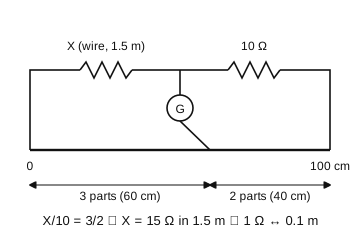
A resistance wire connected in the left gap of a metre bridge balances a 10 Ω resistance in the right gap at a point which divides the bridge wire in the ratio 3 : 2. If the length of the resistance wire is 1.5 m, then the length of 1 Ω of the resistance wire is :
मीटर सेतु के बाएँ अंतराल में जुड़ा एक प्रतिरोध तार दाएँ अंतराल में लगे 10 Ω प्रतिरोध को उस बिंदु पर संतुलित करता है जो सेतु तार को 3 : 2 के अनुपात में विभाजित करता है। यदि प्रतिरोध तार की लंबाई 1.5 m है, तो प्रतिरोध तार के 1 Ω की लंबाई है :
  1. A1.5×10−1 m
  2. B1.5×10−2 m
  3. C1.0×10−2 m
  4. D1.0×10−1 m
Show answer

Concept: Balanced metre bridge: XR=l100−l.

  1. X10=32 ⇒ X=15 Ω
  2. 15 Ω ↔ 1.5 m ⇒ 1 Ω ↔ 1.515=0.1 m =1.0×10⁻¹ m

Short trick: Resistance per metre = 15/1.5 = 10 Ω/m ⇒ 1 Ω in 0.1 m.

Answer: (D) 1.0×10⁻¹ m

अवधारणा: संतुलित मीटर सेतु: XR=l100−l।

  1. X10=32 ⇒ X=15 Ω
  2. 15 Ω ↔ 1.5 m ⇒ 1 Ω ↔ 1.515=0.1 m =1.0×10⁻¹ m

शॉर्ट ट्रिक: प्रति मीटर प्रतिरोध = 15/1.5 = 10 Ω/m ⇒ 1 Ω, 0.1 m में।

उत्तर: (D) 1.0×10⁻¹ m

NEET UGPhysicsCurrent electricity – metre bridgeNEET UG 2020 · 13 Sep Shift 1
Q330.
The increase in the width of the depletion region in a p-n junction diode is due to :
p-n संधि डायोड में ह्रासी क्षेत्र (depletion region) की चौड़ाई में वृद्धि का कारण है :
  1. Aboth forward bias and reverse biasअग्र अभिनति तथा पश्च अभिनति दोनों
  2. Bincrease in forward currentअग्र धारा में वृद्धि
  3. Cforward bias onlyकेवल अग्र अभिनति
  4. Dreverse bias onlyकेवल पश्च अभिनति
Show answer

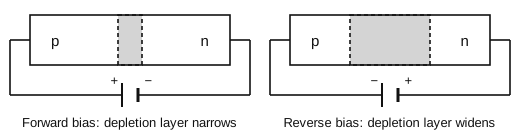
Concept: Reverse bias adds to the barrier potential and pulls majority carriers away from the junction; forward bias does the opposite.

  1. Reverse bias: holes pulled to the negative terminal, electrons to the positive ⇒ more uncovered ions ⇒ depletion layer widens.
  2. Forward bias (and larger forward current) reduces the barrier ⇒ depletion layer narrows – so (A), (B), (C) are wrong.

Short trick: Reverse = Raise barrier = wider depletion layer.

Answer: (D) reverse bias only

अवधारणा: पश्च अभिनति रोधिका विभव में जुड़ती है और बहुसंख्यक वाहकों को संधि से दूर खींचती है; अग्र अभिनति इसका विपरीत करती है।

  1. पश्च अभिनति: होल ऋण टर्मिनल की ओर, इलेक्ट्रॉन धन टर्मिनल की ओर खिंचते हैं ⇒ अधिक अनावृत आयन ⇒ ह्रासी परत चौड़ी।
  2. अग्र अभिनति (तथा अधिक अग्र धारा) रोधिका घटाती है ⇒ ह्रासी परत संकरी – अतः (A), (B), (C) गलत।

शॉर्ट ट्रिक: पश्च (Reverse) = रोधिका बढ़ाओ (Raise) = चौड़ी ह्रासी परत।

उत्तर: (D) केवल पश्च अभिनति

NEET UGPhysicsSemiconductors – p-n junction depletion regionNEET UG 2020 · 13 Sep Shift 1
Q331.
A 40 μF capacitor is connected to a 200 V, 50 Hz ac supply. The rms value of the current in the circuit is, nearly :
एक 40 μF संधारित्र 200 V, 50 Hz ac आपूर्ति से जुड़ा है। परिपथ में धारा का वर्ग माध्य मूल (rms) मान लगभग है :
  1. A2.5 A
  2. B25.1 A
  3. C1.7 A
  4. D2.05 A
Show answer

Concept: XC=1ωC, Irms=VrmsXC=VrmsωC.

  1. ω=2π×50=100π rad/s
  2. Irms=200×100π×40×10−6=0.8π
  3. Irms≈2.51 A ≈ 2.5 A

Short trick: I=VωC=200×314×40×10−6≈2.5 A.

Answer: (A) 2.5 A

अवधारणा: XC=1ωC, Irms=VrmsXC=VrmsωC।

  1. ω=2π×50=100π rad/s
  2. Irms=200×100π×40×10−6=0.8π
  3. Irms≈2.51 A ≈ 2.5 A

शॉर्ट ट्रिक: I=VωC=200×314×40×10−6≈2.5 A।

उत्तर: (A) 2.5 A

NEET UGPhysicsAlternating current – capacitive circuitNEET UG 2020 · 13 Sep Shift 1
Q332.
Taking into account of the significant figures, what is the value of 9.99 m − 0.0099 m?
सार्थक अंकों को ध्यान में रखते हुए, 9.99 m − 0.0099 m का मान क्या है?
  1. A9.980 m
  2. B9.9 m
  3. C9.9801 m
  4. D9.98 m
Show answer

Concept: In addition/subtraction, the result keeps as many decimal places as the term with the fewest decimal places.

  1. 9.99 − 0.0099 = 9.9801 (raw).
  2. 9.99 has 2 decimal places ⇒ round to 2 decimal places ⇒ 9.98 m.
  3. 9.980 and 9.9801 show false precision; 9.9 drops a valid digit.

Short trick: Add/subtract → count decimal places; multiply/divide → count significant figures.

Answer: (D) 9.98 m

अवधारणा: योग/व्यवकलन में परिणाम में उतने ही दशमलव स्थान रखे जाते हैं जितने न्यूनतम दशमलव स्थानों वाले पद में हैं।

  1. 9.99 − 0.0099 = 9.9801 (कच्चा मान)।
  2. 9.99 में 2 दशमलव स्थान ⇒ 2 दशमलव स्थानों तक पूर्णांकन ⇒ 9.98 m।
  3. 9.980 और 9.9801 झूठी परिशुद्धता दर्शाते हैं; 9.9 में एक वैध अंक छूट जाता है।

शॉर्ट ट्रिक: योग/व्यवकलन → दशमलव स्थान गिनें; गुणा/भाग → सार्थक अंक गिनें।

उत्तर: (D) 9.98 m

NEET UGPhysicsUnits and measurement – significant figuresNEET UG 2020 · 13 Sep Shift 1
Q333.
A charged particle having drift velocity of 7.5×10⁻⁴ m s−1 in an electric field of 3×10⁻¹⁰ V m−1, has a mobility in m2 V−1 s−1 of :
3×10⁻¹⁰ V m−1 के विद्युत क्षेत्र में 7.5×10⁻⁴ m s−1 अपवाह वेग वाले एक आवेशित कण की गतिशीलता (mobility), m2 V−1 s−1 में, है :
  1. A2.5×10−6
  2. B2.25×10−15
  3. C2.25×1015
  4. D2.5×106
Show answer

Concept: Mobility μ=vdE.

  1. μ=7.5×10−43×10−10
  2. =2.5×10⁶ m2V−1s−1

Short trick: Divide, don’t multiply: 10−4/10−10=10+6. (B)/(C) come from multiplying.

Answer: (D) 2.5×10⁶

अवधारणा: गतिशीलता μ=vdE।

  1. μ=7.5×10−43×10−10
  2. =2.5×10⁶ m2V−1s−1

शॉर्ट ट्रिक: भाग करें, गुणा नहीं: 10−4/10−10=10+6। (B)/(C) गुणा करने से आते हैं।

उत्तर: (D) 2.5×10⁶

NEET UGPhysicsCurrent electricity – drift velocity and mobilityNEET UG 2020 · 13 Sep Shift 1
Q334.
In a guitar, two strings A and B made of same material are slightly out of tune and produce beats of frequency 6 Hz. When tension in B is slightly decreased, the beat frequency increases to 7 Hz. If the frequency of A is 530 Hz, the original frequency of B will be :
एक गिटार में, समान पदार्थ से बनी दो डोरियाँ A और B थोड़ी बेसुरी हैं और 6 Hz आवृत्ति के विस्पंद उत्पन्न करती हैं। जब B में तनाव थोड़ा कम किया जाता है, तो विस्पंद आवृत्ति बढ़कर 7 Hz हो जाती है। यदि A की आवृत्ति 530 Hz है, तो B की मूल आवृत्ति होगी :
  1. A536 Hz
  2. B537 Hz
  3. C523 Hz
  4. D524 Hz
Show answer

Concept: For a string f=12LTμ ⇒ f∝T; beats = |fA−fB|.

  1. fB=530±6 = 536 Hz or 524 Hz.
  2. Decreasing tension lowers fB.
  3. If fB=536: lowering it brings it towards 530 ⇒ beats decrease ✗.
  4. If fB=524: lowering it moves it away from 530 ⇒ beats increase to 7 ✓ ⇒ fB=524 Hz.

Short trick: Beats increase when the changed source moves away from the other: fB goes down ⇒ it was already below 530.

Answer: (D) 524 Hz

अवधारणा: डोरी के लिए f=12LTμ ⇒ f∝T; विस्पंद = |fA−fB|।

  1. fB=530±6 = 536 Hz या 524 Hz।
  2. तनाव घटाने से fB घटती है।
  3. यदि fB=536: घटने पर यह 530 के निकट आएगी ⇒ विस्पंद घटेंगे ✗।
  4. यदि fB=524: घटने पर यह 530 से दूर जाएगी ⇒ विस्पंद बढ़कर 7 ✓ ⇒ fB=524 Hz।

शॉर्ट ट्रिक: विस्पंद तब बढ़ते हैं जब परिवर्तित स्रोत दूसरे से दूर जाता है: fB घटी ⇒ यह पहले से 530 से कम थी।

उत्तर: (D) 524 Hz

NEET UGPhysicsWaves – beatsNEET UG 2020 · 13 Sep Shift 1
Q335.
Two particles of mass 5 kg and 10 kg respectively are attached to the two ends of a rigid rod of length 1 m with negligible mass. The centre of mass of the system from the 5 kg particle is nearly at a distance of :
क्रमशः 5 kg और 10 kg द्रव्यमान के दो कण नगण्य द्रव्यमान की 1 m लंबी एक दृढ़ छड़ के दोनों सिरों से जुड़े हैं। 5 kg कण से निकाय के द्रव्यमान केंद्र की दूरी लगभग है :
  1. A67 cm
  2. B80 cm
  3. C33 cm
  4. D50 cm
Show answer

Concept: Taking the 5 kg particle at the origin, xcm=m1x1+m2x2m1+m2.

  1. xcm=5(0)+10(1)5+10=1015 m
  2. =0.667 m ≈ 67 cm (closer to the heavier mass).

Short trick: Distance from m1 = m2m1+m2L=23×100 cm. 33 cm (C) is the distance from the 10 kg particle.

Answer: (A) 67 cm

अवधारणा: 5 kg कण को मूल बिंदु पर लेने पर, xcm=m1x1+m2x2m1+m2।

  1. xcm=5(0)+10(1)5+10=1015 m
  2. =0.667 m ≈ 67 cm (भारी द्रव्यमान के अधिक निकट)।

शॉर्ट ट्रिक: m1 से दूरी = m2m1+m2L=23×100 cm। 33 cm (C), 10 kg कण से दूरी है।

उत्तर: (A) 67 cm

NEET UGPhysicsSystem of particles – centre of massNEET UG 2020 · 13 Sep Shift 1
Q336.
When a block of mass M is suspended by a long wire of length L, the length of the wire becomes (L + l). The elastic potential energy stored in the extended wire is:
जब M द्रव्यमान के एक गुटके को L लंबाई के एक लंबे तार से लटकाया जाता है, तो तार की लंबाई (L + l) हो जाती है। खिंचे हुए तार में संचित प्रत्यास्थ स्थितिज ऊर्जा है:
  1. AMgl
  2. BMgL
  3. C12Mgl
  4. D12MgL
Show answer

Concept: Energy stored in a stretched wire U=12×load×extension.

  1. Load (final tension) F=Mg; extension =l (not L).
  2. U=12Fl=12Mgl

Short trick: Force rises linearly from 0 to Mg, so average force is Mg/2 – hence the factor ½. Options with L are traps (L is original length, not extension).

Answer: (C) 12Mgl

अवधारणा: खिंचे तार में संचित ऊर्जा U=12×भार×प्रसार।

  1. भार (अंतिम तनाव) F=Mg; प्रसार =l (L नहीं)।
  2. U=12Fl=12Mgl

शॉर्ट ट्रिक: बल 0 से Mg तक रैखिक रूप से बढ़ता है, अतः औसत बल Mg/2 – इसीलिए ½ गुणक। L वाले विकल्प जाल हैं (L मूल लंबाई है, प्रसार नहीं)।

उत्तर: (C) 12Mgl

NEET UGPhysicsElasticity – elastic potential energyNEET UG 2019 · 5 May Shift 1
Q337.
A mass m is attached to a thin wire and whirled in a vertical circle. The wire is most likely to break when:
एक द्रव्यमान m को एक पतले तार से बाँधकर ऊर्ध्वाधर वृत्त में घुमाया जाता है। तार के टूटने की सबसे अधिक संभावना कब है?
  1. Athe mass is at the highest pointजब द्रव्यमान उच्चतम बिंदु पर हो
  2. Bthe wire is horizontalजब तार क्षैतिज हो
  3. Cthe mass is at the lowest pointजब द्रव्यमान निम्नतम बिंदु पर हो
  4. Dinclined at an angle of 60° from verticalजब तार ऊर्ध्वाधर से 60° के कोण पर झुका हो
Show answer

Concept: In a vertical circle, tension T=mv2r+mgcos⁡θ (θ measured from the lowest point).

  1. At the lowest point θ=0: T=mv2r+mg – here both terms are maximum (speed is also maximum).
  2. At the highest point T=mv2r−mg (minimum); horizontal: T=mv2r; at 60°: in between.

Short trick: Lowest point = maximum speed + weight acting along the string → maximum tension → wire snaps there.

Answer: (C) the mass is at the lowest point

अवधारणा: ऊर्ध्वाधर वृत्त में तनाव T=mv2r+mgcos⁡θ (θ निम्नतम बिंदु से मापा गया)।

  1. निम्नतम बिंदु पर θ=0: T=mv2r+mg – यहाँ दोनों पद अधिकतम हैं (चाल भी अधिकतम)।
  2. उच्चतम बिंदु पर T=mv2r−mg (न्यूनतम); क्षैतिज पर T=mv2r; 60° पर बीच का मान।

शॉर्ट ट्रिक: निम्नतम बिंदु = अधिकतम चाल + डोरी के अनुदिश भार → अधिकतम तनाव → तार वहीं टूटता है।

उत्तर: (C) जब द्रव्यमान निम्नतम बिंदु पर हो

NEET UGPhysicsCircular motion – vertical circleNEET UG 2019 · 5 May Shift 1
Q338.
Ionized hydrogen atoms and α-particles with same momenta enters perpendicular to a constant magnetic field, B. The ratio of their radii of their paths rH:rα will be :
समान संवेग वाले आयनित हाइड्रोजन परमाणु तथा α-कण एक नियत चुंबकीय क्षेत्र B में लंबवत प्रवेश करते हैं। उनके पथों की त्रिज्याओं का अनुपात rH:rα होगा :
  1. A2 : 1
  2. B1 : 2
  3. C4 : 1
  4. D1 : 4
Show answer

Concept: r=mvqB=pqB; for equal momentum r∝1q.

  1. qH=e (proton), qα=2e.
  2. rHrα=qαqH=2ee=2 → 2 : 1

Short trick: Same p and B → only charge matters; mass is irrelevant. α has double charge → half radius.

Answer: (A) 2 : 1

अवधारणा: r=mvqB=pqB; समान संवेग के लिए r∝1q।

  1. qH=e (प्रोटॉन), qα=2e।
  2. rHrα=qαqH=2ee=2 → 2 : 1

शॉर्ट ट्रिक: समान p और B → केवल आवेश महत्वपूर्ण; द्रव्यमान अप्रासंगिक। α का आवेश दोगुना → त्रिज्या आधी।

उत्तर: (A) 2 : 1

NEET UGPhysicsMoving charges – radius in magnetic fieldNEET UG 2019 · 5 May Shift 1
Q339.
Body A of mass 4m moving with speed u collides with another body B of mass 2m, at rest. The collision is head on and elastic in nature. After the collision the fraction of energy lost by the colliding body A is :
द्रव्यमान 4m का पिंड A, u चाल से गतिमान है तथा विरामावस्था में स्थित 2m द्रव्यमान के दूसरे पिंड B से संघट्ट करता है। संघट्ट सम्मुख (head on) तथा प्रत्यास्थ प्रकृति का है। संघट्ट के पश्चात संघट्टकारी पिंड A द्वारा खोई गई ऊर्जा का अंश है :
  1. A19
  2. B89
  3. C49
  4. D59
Show answer

Concept: 1-D elastic collision with B at rest: vA=m1−m2m1+m2u.

  1. vA=4m−2m4m+2mu=u3
  2. KE left with A =(13)2=19 of initial.
  3. Fraction lost =1−19=89

Short trick: Fraction transferred =4m1m2(m1+m2)2=4⋅4⋅236=89 – one line.

Answer: (B) 89

अवधारणा: B विराम में हो तब 1-D प्रत्यास्थ संघट्ट: vA=m1−m2m1+m2u।

  1. vA=4m−2m4m+2mu=u3
  2. A के पास शेष गतिज ऊर्जा =(13)2=19 (प्रारंभिक का)।
  3. खोया गया अंश =1−19=89

शॉर्ट ट्रिक: स्थानांतरित अंश =4m1m2(m1+m2)2=4⋅4⋅236=89 – एक पंक्ति में।

उत्तर: (B) 89

NEET UGPhysicsCollisions – elastic head-on collisionNEET UG 2019 · 5 May Shift 1
Q340.
In a double slit experiment, when light of wavelength 400 nm was used, the angular width of the first minima formed on a screen placed 1 m away, was found to be 0.2°. What will be the angular width of the first minima, if the entire experimental apparatus is immersed in water? (μwater=4/3)
एक द्वि-झिरी प्रयोग में 400 nm तरंगदैर्ध्य का प्रकाश प्रयुक्त करने पर 1 m दूर रखे पर्दे पर बने प्रथम निम्निष्ठ की कोणीय चौड़ाई 0.2° पाई गई। यदि संपूर्ण प्रायोगिक व्यवस्था को जल में डुबो दिया जाए, तो प्रथम निम्निष्ठ की कोणीय चौड़ाई क्या होगी? (μwater=4/3)
  1. A0.266°
  2. B0.15°
  3. C0.05°
  4. D0.1°
Show answer

Concept: Angular width θ=λd; in a medium λ→λμ, so θ→θμ.

  1. θw=θμ=0.2∘4/3
  2. θw=0.2×34=0.15∘

Short trick: Medium shrinks wavelength, so every angular spacing shrinks by μ. 0.266° (bigger) is the trap of multiplying by μ.

Answer: (B) 0.15°

अवधारणा: कोणीय चौड़ाई θ=λd; माध्यम में λ→λμ, अतः θ→θμ।

  1. θw=θμ=0.2∘4/3
  2. θw=0.2×34=0.15∘

शॉर्ट ट्रिक: माध्यम तरंगदैर्ध्य घटाता है, अतः हर कोणीय अंतराल μ गुना घटता है। 0.266° (बड़ा मान) μ से गुणा करने का जाल है।

उत्तर: (B) 0.15°

NEET UGPhysicsWave optics – YDSE in a mediumNEET UG 2019 · 5 May Shift 1