Q341.In which of the following devices, the eddy current effect is not used?
निम्नलिखित में से किस युक्ति में भँवर धारा (eddy current) प्रभाव का उपयोग नहीं होता?
- AInduction furnaceप्रेरण भट्टी (induction furnace)
- BMagnetic braking in trainरेलगाड़ी में चुंबकीय ब्रेक
- CElectromagnetविद्युत-चुंबक
- DElectric heaterविद्युत हीटर
Show answer
Concept: Eddy currents are induced in a conductor by a changing magnetic flux; NCERT lists induction furnace, magnetic braking, electromagnetic damping and speedometers as uses.
- Induction furnace – eddy currents heat the metal (used).
- Magnetic braking – eddy currents oppose motion (used).
- Electromagnet (its core, damping/ac uses) – eddy-current effects are involved (counted as used).
- Electric heater – works purely on Joule heating, , of a coil carrying current; no eddy currents.
Short trick: Heater = ohmic heating of its own current; nothing is induced. Remember NCERT list: furnace, brakes, damping, speedometer.
Answer: (D) Electric heater
अवधारणा: परिवर्ती चुंबकीय फ्लक्स से चालक में भँवर धाराएँ प्रेरित होती हैं; NCERT में प्रेरण भट्टी, चुंबकीय ब्रेक, विद्युत-चुंबकीय अवमंदन तथा स्पीडोमीटर इनके उपयोग बताए गए हैं।
- प्रेरण भट्टी – भँवर धाराएँ धातु को गर्म करती हैं (उपयोग)।
- चुंबकीय ब्रेक – भँवर धाराएँ गति का विरोध करती हैं (उपयोग)।
- विद्युत-चुंबक (क्रोड, अवमंदन/ac उपयोग) – भँवर धारा प्रभाव सम्मिलित (उपयोग माना गया)।
- विद्युत हीटर – केवल कुंडली की धारा के जूल तापन पर कार्य करता है; कोई भँवर धारा नहीं।
शॉर्ट ट्रिक: हीटर = अपनी ही धारा का ओमीय तापन; कुछ भी प्रेरित नहीं होता। NCERT सूची याद रखें: भट्टी, ब्रेक, अवमंदन, स्पीडोमीटर।
उत्तर: (D) विद्युत हीटर
NEET UGPhysicsElectromagnetic induction – eddy currentsNEET UG 2019 · 5 May Shift 1
Q342.A soap bubble, having radius of 1 mm, is blown from a detergent solution having a surface tension of N/m. The pressure inside the bubble equals at a point below the free surface of water in a container. Taking g = 10 m/s2, density of water = 103 kg/m3, the value of is :
N/m पृष्ठ तनाव वाले डिटर्जेंट विलयन से 1 mm त्रिज्या का एक साबुन का बुलबुला फुलाया जाता है। बुलबुले के भीतर का दाब, किसी पात्र में जल के मुक्त पृष्ठ से गहराई पर स्थित बिंदु के दाब के बराबर है। g = 10 m/s2 तथा जल का घनत्व = 103 kg/m3 लेने पर का मान है :
- A100 cm
- B10 cm
- C1 cm
- D0.5 cm
Show answer
Concept: A soap bubble has two free surfaces: excess pressure . At depth in water the excess over atmosphere is .
- Pa
- m cm
Short trick: Bubble → 4T/r, drop or air-bubble in liquid → 2T/r. Using 2T/r here gives 0.5 cm (the trap).
Answer: (C) 1 cm
अवधारणा: साबुन के बुलबुले के दो मुक्त पृष्ठ होते हैं: आधिक्य दाब । जल में गहराई पर वायुमंडल से अधिक दाब है।
- Pa
- m cm
शॉर्ट ट्रिक: बुलबुला → 4T/r, बूँद या द्रव में वायु-बुलबुला → 2T/r। यहाँ 2T/r लेने पर 0.5 cm (जाल) आता है।
उत्तर: (C) 1 cm
NEET UGPhysicsSurface tension – excess pressure in a soap bubbleNEET UG 2019 · 5 May Shift 1
Q343.Which colour of the light has the longest wavelength?
किस रंग के प्रकाश की तरंगदैर्ध्य सबसे अधिक होती है?
- ARedलाल
- BBlueनीला
- CGreenहरा
- DVioletबैंगनी
Show answer
Concept: Visible spectrum runs from violet (≈ 400 nm) to red (≈ 700 nm).
- Order of wavelength: Violet < Blue < Green < Yellow < Orange < Red.
- Red ≈ 620–700 nm is the longest; violet the shortest.
Short trick: VIBGYOR: wavelength increases from V to R (frequency decreases).
Answer: (A) Red
अवधारणा: दृश्य स्पेक्ट्रम बैंगनी (≈ 400 nm) से लाल (≈ 700 nm) तक फैला है।
- तरंगदैर्ध्य का क्रम: बैंगनी < नीला < हरा < पीला < नारंगी < लाल।
- लाल ≈ 620–700 nm सबसे लंबी; बैंगनी सबसे छोटी।
शॉर्ट ट्रिक: VIBGYOR: V से R की ओर तरंगदैर्ध्य बढ़ती है (आवृत्ति घटती है)।
उत्तर: (A) लाल
NEET UGPhysicsElectromagnetic spectrum – visible lightNEET UG 2019 · 5 May Shift 1
Q344.A disc of radius 2 m and mass 100 kg rolls on a horizontal floor. Its centre of mass has speed of 20 cm/s. How much work is needed to stop it?
2 m त्रिज्या तथा 100 kg द्रव्यमान की एक चकती क्षैतिज फर्श पर लोटनिक गति कर रही है। इसके द्रव्यमान केंद्र की चाल 20 cm/s है। इसे रोकने के लिए कितना कार्य आवश्यक है?
- A3 J
- B30 kJ
- C2 J
- D1 J
Show answer
Concept: Work needed = total KE of rolling ; for a disc .
- m/s
- J
- Work–energy theorem: work to stop = 3 J (radius is not needed).
Short trick: Rolling disc: J.
Answer: (A) 3 J
अवधारणा: आवश्यक कार्य = लोटनिक गति की कुल गतिज ऊर्जा ; चकती के लिए ।
- m/s
- J
- कार्य–ऊर्जा प्रमेय: रोकने के लिए कार्य = 3 J (त्रिज्या की आवश्यकता नहीं)।
शॉर्ट ट्रिक: लोटनिक चकती: J।
उत्तर: (A) 3 J
NEET UGPhysicsRotational motion – kinetic energy of rollingNEET UG 2019 · 5 May Shift 1
Q345.The displacement of a particle executing simple harmonic motion is given by
Then the amplitude of its oscillation is given by :
सरल आवर्त गति करते एक कण का विस्थापन
द्वारा दिया गया है। तब इसके दोलन का आयाम है :
- A
- B
- C
- D
Show answer
Concept: ; a constant term only shifts the mean position.
- , .
- The particle oscillates about with amplitude .
Short trick: Constant A₀ = new mean position, never part of amplitude. Two perpendicular-phase terms add like vectors.
Answer: (B)
अवधारणा: ; अचर पद केवल माध्य स्थिति को खिसकाता है।
- , ।
- कण के परितः आयाम से दोलन करता है।
शॉर्ट ट्रिक: अचर A₀ = नई माध्य स्थिति, आयाम का भाग नहीं। 90° कलान्तर वाले दो पद सदिशों की भाँति जुड़ते हैं।
उत्तर: (B)
NEET UGPhysicsOscillations – amplitude of SHMNEET UG 2019 · 5 May Shift 1
Q346.Two similar thin equi-convex lenses, of focal length f each, are kept coaxially in contact with each other such that the focal length of the combination is . When the space between the two lenses is filled with glycerin (which has the same refractive index ( = 1.5) as that of glass) then the equivalent focal length is . The ratio will be :
प्रत्येक f फोकस दूरी के दो समान पतले समोत्तल लेंस एक-दूसरे के संपर्क में समाक्षीय रखे हैं, जिससे संयोजन की फोकस दूरी है। जब दोनों लेंसों के बीच के स्थान को ग्लिसरीन (जिसका अपवर्तनांक ( = 1.5) काँच के समान है) से भर दिया जाता है, तो तुल्य फोकस दूरी हो जाती है। अनुपात होगा :
- A2 : 1
- B1 : 2
- C2 : 3
- D3 : 4
Show answer
Concept: Lens maker: . The glycerin gap forms an equi-concave lens of the same radii.
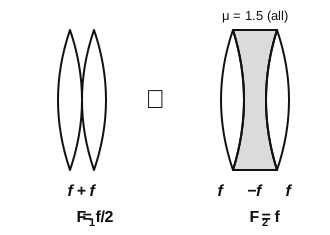
- Each glass lens: → . In contact: .
- Glycerin lens: .
- → .
Short trick: Same μ throughout → the glycerin concave lens exactly cancels one convex lens, leaving power of one lens.
Answer: (B) 1 : 2
अवधारणा: लेंस निर्माता सूत्र: । ग्लिसरीन का स्थान समान त्रिज्याओं वाला एक समअवतल लेंस बनाता है।
- प्रत्येक काँच लेंस: → । संपर्क में: ।
- ग्लिसरीन लेंस: ।
- → ।
शॉर्ट ट्रिक: पूरे में समान μ → ग्लिसरीन का अवतल लेंस एक उत्तल लेंस को ठीक निरस्त कर देता है, एक लेंस की क्षमता शेष रहती है।
उत्तर: (B) 1 : 2
NEET UGPhysicsRay optics – combination of lensesNEET UG 2019 · 5 May Shift 1
Q347.Increase in temperature of a gas filled in a container would lead to :
किसी पात्र में भरी गैस के ताप में वृद्धि से होगी :
- AIncrease in its massइसके द्रव्यमान में वृद्धि
- BIncrease in its kinetic energyइसकी गतिज ऊर्जा में वृद्धि
- CDecrease in its pressureइसके दाब में कमी
- DDecrease in intermolecular distanceअंतराअणुक दूरी में कमी
Show answer
Concept: Average KE per molecule – directly proportional to absolute temperature.
- Mass of gas in a closed container does not change – (A) wrong.
- KE ∝ T, so KE increases – (B) correct.
- At constant volume P ∝ T, so pressure increases, not decreases – (C) wrong.
- Container volume fixed → mean intermolecular distance unchanged – (D) wrong.
Short trick: Temperature is a measure of molecular KE – heating = faster molecules.
Answer: (B) Increase in its kinetic energy
अवधारणा: प्रति अणु औसत गतिज ऊर्जा – परम ताप के अनुक्रमानुपाती।
- बंद पात्र में गैस का द्रव्यमान नहीं बदलता – (A) गलत।
- KE ∝ T, अतः गतिज ऊर्जा बढ़ती है – (B) सही।
- नियत आयतन पर P ∝ T, अतः दाब बढ़ता है, घटता नहीं – (C) गलत।
- पात्र का आयतन नियत → औसत अंतराअणुक दूरी अपरिवर्तित – (D) गलत।
शॉर्ट ट्रिक: ताप अणुओं की गतिज ऊर्जा का माप है – गर्म करना = तेज़ अणु।
उत्तर: (B) इसकी गतिज ऊर्जा में वृद्धि
NEET UGPhysicsKinetic theory of gases – temperatureNEET UG 2019 · 5 May Shift 1
Q348.An electron is accelerated through a potential difference of 10,000 V. Its de Broglie wavelength is, (nearly) : kg
एक इलेक्ट्रॉन को 10,000 V के विभवान्तर से त्वरित किया जाता है। इसकी दे ब्रॉग्ली तरंगदैर्ध्य (लगभग) है : kg
- A m
- B m
- C m
- D12.2 nm
Show answer
Concept: , i.e. for an electron Å.
- Å Å
- m m
- Check: ; m
Short trick: Memorise Å – one division gives the answer.
Answer: (B) m
अवधारणा: , अर्थात इलेक्ट्रॉन के लिए Å।
- Å Å
- m m
- जाँच: ; m
शॉर्ट ट्रिक: Å याद रखें – एक भाग से उत्तर।
उत्तर: (B) m
NEET UGPhysicsDual nature – de Broglie wavelength of electronNEET UG 2019 · 5 May Shift 1
Q349.A copper rod of 88 cm and an aluminium rod of unknown length have their increase in length independent of increase in temperature. The length of aluminium rod is : and
88 cm लंबी ताँबे की छड़ तथा अज्ञात लंबाई की ऐलुमिनियम छड़ की लंबाइयों में वृद्धि, ताप में वृद्धि से स्वतंत्र है। ऐलुमिनियम छड़ की लंबाई है : तथा
- A6.8 cm
- B113.9 cm
- C88 cm
- D68 cm
Show answer
Concept: Difference in lengths stays constant when both rods expand equally: .
- cm
Short trick: : larger α → shorter rod, so answer must be < 88 cm; 88/2.2 = 40 makes it quick.
Answer: (D) 68 cm
अवधारणा: जब दोनों छड़ें बराबर प्रसारित हों, तो लंबाइयों का अंतर नियत रहता है: ।
- cm
शॉर्ट ट्रिक: : अधिक α → छोटी छड़, अतः उत्तर 88 cm से कम; 88/2.2 = 40 से तुरंत हल।
उत्तर: (D) 68 cm
NEET UGPhysicsThermal properties – linear expansionNEET UG 2019 · 5 May Shift 1
Q350.Pick the wrong answer in the context with rainbow.
इन्द्रधनुष के संदर्भ में गलत उत्तर चुनिए।
- AWhen the light rays undergo two internal reflections in a water drop, a secondary rainbow is formedजब प्रकाश किरणें जल की बूँद में दो आंतरिक परावर्तन करती हैं, तो द्वितीयक इन्द्रधनुष बनता है
- BThe order of colours is reversed in the secondary rainbowद्वितीयक इन्द्रधनुष में रंगों का क्रम उलट जाता है
- CAn observer can see a rainbow when his front is towards the sunप्रेक्षक इन्द्रधनुष तब देख सकता है जब उसका मुख सूर्य की ओर हो
- DRainbow is a combined effect of dispersion refraction and reflection of sunlightइन्द्रधनुष सूर्य के प्रकाश के विक्षेपण, अपवर्तन तथा परावर्तन का संयुक्त प्रभाव है
Show answer
Concept: A rainbow is seen only with the sun behind the observer (anti-solar point in front).
- (A) True – secondary rainbow: two internal reflections.
- (B) True – colours are reversed (red inside, violet outside).
- (C) Wrong – facing the sun you cannot see a rainbow; the sun must be at your back.
- (D) True – refraction + dispersion + internal reflection in drops.
Short trick: Back to the sun, face the rain.
Answer: (C) An observer can see a rainbow when his front is towards the sun
अवधारणा: इन्द्रधनुष तभी दिखता है जब सूर्य प्रेक्षक के पीछे हो (प्रति-सौर बिंदु सामने)।
- (A) सत्य – द्वितीयक इन्द्रधनुष: दो आंतरिक परावर्तन।
- (B) सत्य – रंग उलट जाते हैं (लाल भीतर, बैंगनी बाहर)।
- (C) गलत – सूर्य की ओर मुख करने पर इन्द्रधनुष नहीं दिखता; सूर्य पीठ के पीछे होना चाहिए।
- (D) सत्य – बूँदों में अपवर्तन + विक्षेपण + आंतरिक परावर्तन।
शॉर्ट ट्रिक: सूर्य को पीठ, वर्षा को मुख।
उत्तर: (C) प्रेक्षक इन्द्रधनुष तब देख सकता है जब उसका मुख सूर्य की ओर हो
NEET UGPhysicsRay optics – rainbowNEET UG 2019 · 5 May Shift 1
Q351.A body weighs 200 N on the surface of the earth. How much will it weigh half way down to the centre of the earth ?
एक पिंड का भार पृथ्वी के पृष्ठ पर 200 N है। पृथ्वी के केंद्र की ओर आधी दूरी नीचे जाने पर इसका भार कितना होगा?
- A150 N
- B200 N
- C250 N
- D100 N
Show answer
Concept: Inside the earth .
- →
- Weight N
Short trick: Inside a uniform earth g ∝ distance from centre: half the distance → half the weight.
Answer: (D) 100 N
अवधारणा: पृथ्वी के भीतर ।
- →
- भार N
शॉर्ट ट्रिक: एकसमान पृथ्वी के भीतर g ∝ केंद्र से दूरी: आधी दूरी → आधा भार।
उत्तर: (D) 100 N
NEET UGPhysicsGravitation – variation of g with depthNEET UG 2019 · 5 May Shift 1
Q352.Six similar bulbs are connected as shown in the figure with a DC source of emf E and zero internal resistance.
The ratio of power consumption by the bulbs when (i) all are glowing and (ii) in the situation when two from section A and one from section B are glowing, will be :
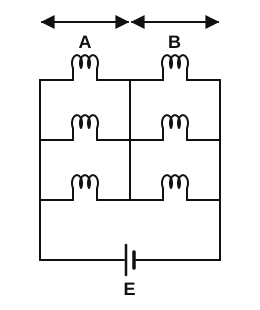
छह समान बल्ब, E विद्युत वाहक बल तथा शून्य आंतरिक प्रतिरोध वाले DC स्रोत से चित्रानुसार जुड़े हैं।
(i) जब सभी बल्ब जल रहे हों तथा (ii) जब खंड A से दो तथा खंड B से एक बल्ब जल रहा हो, इन दोनों स्थितियों में बल्बों द्वारा उपभुक्त शक्ति का अनुपात होगा :
- A4 : 9
- B9 : 4
- C1 : 2
- D2 : 1
Show answer
Concept: Each section is a parallel group; sections A and B are in series. .
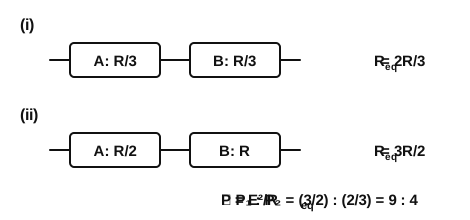
- (i) A: 3 bulbs in parallel , B: → ,
- (ii) A: 2 in parallel , B: 1 bulb → ,
Short trick: Same E → P ∝ 1/Req: ratio = (3R/2)/(2R/3) = 9/4. More bulbs in parallel → less R → more power, so (i) > (ii).
Answer: (B) 9 : 4
अवधारणा: प्रत्येक खंड एक समांतर समूह है; खंड A तथा B श्रेणी में हैं। ।
- (i) A: 3 बल्ब समांतर , B: → ,
- (ii) A: 2 समांतर , B: 1 बल्ब → ,
शॉर्ट ट्रिक: समान E → P ∝ 1/Req: अनुपात = (3R/2)/(2R/3) = 9/4। अधिक बल्ब समांतर में → कम R → अधिक शक्ति, अतः (i) > (ii)।
उत्तर: (B) 9 : 4
NEET UGPhysicsCurrent electricity – power in bulb combinationsNEET UG 2019 · 5 May Shift 1
Q353.For a p-type semiconductor, which of the following statements is true ?
p-प्रकार के अर्धचालक के लिए निम्नलिखित में से कौन-सा कथन सत्य है?
- AElectrons are the majority carriers and trivalent atoms are the dopants.इलेक्ट्रॉन बहुसंख्यक वाहक हैं तथा त्रिसंयोजी परमाणु अपमिश्रक हैं।
- BHoles are the majority carriers and trivalent atoms are the dopants.होल बहुसंख्यक वाहक हैं तथा त्रिसंयोजी परमाणु अपमिश्रक हैं।
- CHoles are the majority carriers and pentavalent atoms are the dopants.होल बहुसंख्यक वाहक हैं तथा पंचसंयोजी परमाणु अपमिश्रक हैं।
- DElectrons are the majority carriers and pentavalent atoms are the dopants.इलेक्ट्रॉन बहुसंख्यक वाहक हैं तथा पंचसंयोजी परमाणु अपमिश्रक हैं।
Show answer
Concept: p-type: Si/Ge doped with trivalent (acceptor) atoms like B, Al, In – each creates a hole.
- Majority carriers = holes; dopant = trivalent → (B).
- (A) mixes electron majority with trivalent dopant – wrong.
- (C) pentavalent dopants give n-type – wrong.
- (D) describes an n-type semiconductor – wrong.
Short trick: p = positive = holes = trivalent (3 → one bond short).
Answer: (B) Holes are the majority carriers and trivalent atoms are the dopants.
अवधारणा: p-प्रकार: Si/Ge में त्रिसंयोजी (ग्राही, acceptor) परमाणु जैसे B, Al, In मिलाए जाते हैं – प्रत्येक एक होल बनाता है।
- बहुसंख्यक वाहक = होल; अपमिश्रक = त्रिसंयोजी → (B)।
- (A) इलेक्ट्रॉन बहुसंख्यक को त्रिसंयोजी अपमिश्रक से जोड़ता है – गलत।
- (C) पंचसंयोजी अपमिश्रक n-प्रकार बनाते हैं – गलत।
- (D) n-प्रकार अर्धचालक का वर्णन है – गलत।
शॉर्ट ट्रिक: p = धनात्मक = होल = त्रिसंयोजी (3 → एक बंध कम)।
उत्तर: (B) होल बहुसंख्यक वाहक हैं तथा त्रिसंयोजी परमाणु अपमिश्रक हैं।
NEET UGPhysicsSemiconductors – p-type semiconductorNEET UG 2019 · 5 May Shift 1
Q354.Average velocity of a particle executing SHM in one complete vibration is :
सरल आवर्त गति करते कण का एक पूर्ण कंपन में औसत वेग है :
- A
- B
- C
- DZeroशून्य
Show answer
Concept: Average velocity = total displacement / time.
- In one complete vibration the particle returns to its starting point → displacement = 0.
- Average velocity = 0 / T = 0.
Short trick: Velocity ≠ speed: average speed over a cycle is , but average velocity is zero.
Answer: (D) Zero
अवधारणा: औसत वेग = कुल विस्थापन / समय।
- एक पूर्ण कंपन में कण अपने प्रारंभिक बिंदु पर लौट आता है → विस्थापन = 0।
- औसत वेग = 0 / T = 0।
शॉर्ट ट्रिक: वेग ≠ चाल: एक चक्र में औसत चाल है, परंतु औसत वेग शून्य।
उत्तर: (D) शून्य
NEET UGPhysicsOscillations – average velocity in SHMNEET UG 2019 · 5 May Shift 1
Q355.The unit of thermal conductivity is :
ऊष्मा चालकता का मात्रक है :
- A
- B
- C
- D
Show answer
Concept: Fourier law: → .
- Units:
- Options with J lack the time factor; W m K⁻¹ has wrong power of metre.
Short trick: Conductivity = power per (length × kelvin) → W m⁻¹ K⁻¹.
Answer: (D)
अवधारणा: फूरिए नियम: → ।
- मात्रक:
- J वाले विकल्पों में समय नहीं है; W m K⁻¹ में मीटर की घात गलत है।
शॉर्ट ट्रिक: चालकता = शक्ति प्रति (लंबाई × केल्विन) → W m⁻¹ K⁻¹।
उत्तर: (D)
NEET UGPhysicsThermal properties – unit of thermal conductivityNEET UG 2019 · 5 May Shift 1
Q356.A solid cylinder of mass 2 kg and radius 4 cm rotating about its axis at the rate of 3 rpm. The torque required to stop after revolutions is
2 kg द्रव्यमान तथा 4 cm त्रिज्या का एक ठोस बेलन अपनी अक्ष के परितः 3 rpm की दर से घूर्णन कर रहा है। परिक्रमणों के बाद इसे रोकने के लिए आवश्यक बल-आघूर्ण है
- A N m
- B N m
- C N m
- D N m
Show answer
Concept: and , with .
- kg m2
- rad/s; rad
- rad/s2
- N m
Short trick: Work–energy: ; the cancels, so the answer has no π – only (A) and (B) survive, and tiny I gives (A).
Answer: (A) N m
अवधारणा: तथा , जहाँ ।
- kg m2
- rad/s; परिक्रमण rad
- rad/s2
- N m
शॉर्ट ट्रिक: कार्य–ऊर्जा: ; कट जाता है, अतः उत्तर में π नहीं – केवल (A) व (B) बचते हैं, और बहुत छोटा I (A) देता है।
उत्तर: (A) N m
NEET UGPhysicsRotational motion – torque and angular retardationNEET UG 2019 · 5 May Shift 1
Q357.A force F = 20 + 10 y acts on a particle in y-direction where F is in newton and y in meter. Work done by this force to move the particle from y = 0 to y = 1 m is
y-दिशा में एक कण पर बल F = 20 + 10 y लगता है, जहाँ F न्यूटन में तथा y मीटर में है। कण को y = 0 से y = 1 m तक ले जाने में इस बल द्वारा किया गया कार्य है
- A30 J
- B5 J
- C25 J
- D20 J
Show answer
Concept: for a variable force.
- J
Short trick: Linear force → W = average force × distance = (20 + 30)/2 × 1 = 25 J.
Answer: (C) 25 J
अवधारणा: परिवर्ती बल के लिए ।
- J
शॉर्ट ट्रिक: रैखिक बल → W = औसत बल × दूरी = (20 + 30)/2 × 1 = 25 J।
उत्तर: (C) 25 J
NEET UGPhysicsWork, energy and power – work by variable forceNEET UG 2019 · 5 May Shift 1
Q358.Which of the following acts as a circuit protects device?
निम्नलिखित में से कौन परिपथ रक्षक युक्ति के रूप में कार्य करता है?
- AConductorचालक
- BInductorप्रेरक
- CSwitchस्विच
- DFuseफ्यूज़
Show answer
Concept: A fuse wire (low melting point, high resistivity alloy) melts when current exceeds its rating and breaks the circuit.
- Fuse – melts on overload/short-circuit, protecting appliances → correct.
- Conductor only carries current; inductor opposes change of current; switch is manual on/off – none of them protects automatically.
Short trick: Fuse = sacrificial weak link: it dies so the circuit survives.
Answer: (D) Fuse
अवधारणा: फ्यूज़ तार (कम गलनांक, उच्च प्रतिरोधकता वाली मिश्रधातु) धारा के निर्धारित मान से अधिक होने पर पिघलकर परिपथ तोड़ देता है।
- फ्यूज़ – अधिभार/लघु-परिपथ पर पिघलकर उपकरणों की रक्षा करता है → सही।
- चालक केवल धारा प्रवाहित करता है; प्रेरक धारा-परिवर्तन का विरोध करता है; स्विच हाथ से चालू/बंद होता है – कोई भी स्वतः रक्षा नहीं करता।
शॉर्ट ट्रिक: फ्यूज़ = बलिदानी कमज़ोर कड़ी: वह स्वयं नष्ट होकर परिपथ को बचाता है।
उत्तर: (D) फ्यूज़
NEET UGPhysicsCurrent electricity – circuit protectionNEET UG 2019 · 5 May Shift 1
Q359.In the circuits shown below, the readings of voltmeters and the ammeters will be
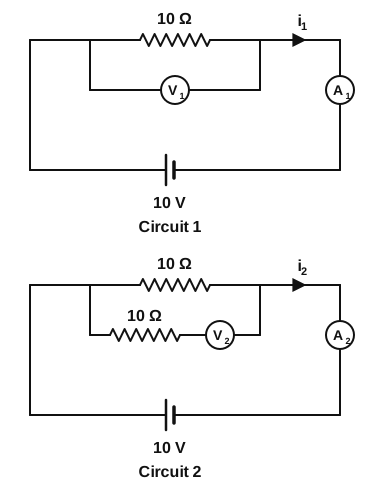
नीचे दर्शाए गए परिपथों में वोल्टमीटरों तथा अमीटरों के पाठ्यांक होंगे
- A and तथा
- B and तथा
- C and तथा
- D and तथा
Show answer
Concept: An ideal voltmeter has infinite resistance – no current flows through it or through anything in series with it.
- Circuit 1: A; reads across 10 Ω → V.
- Circuit 2: the branch (10 Ω + ) carries zero current, so the extra 10 Ω has no drop; A and reads the full 10 V across the parallel 10 Ω.
- Hence and .
Short trick: A resistor in series with an ideal voltmeter is "invisible" – zero current → zero drop.
Answer: (C) and
अवधारणा: आदर्श वोल्टमीटर का प्रतिरोध अनंत होता है – इसमें अथवा इसके श्रेणी में जुड़े किसी अवयव में धारा नहीं बहती।
- परिपथ 1: A; 10 Ω के सिरों पर → V।
- परिपथ 2: शाखा (10 Ω + ) में धारा शून्य है, अतः अतिरिक्त 10 Ω पर कोई विभवपात नहीं; A तथा समांतर 10 Ω के पूरे 10 V पढ़ता है।
- अतः तथा ।
शॉर्ट ट्रिक: आदर्श वोल्टमीटर के श्रेणी में जुड़ा प्रतिरोधक "अदृश्य" है – शून्य धारा → शून्य विभवपात।
उत्तर: (C) तथा
NEET UGPhysicsCurrent electricity – ideal voltmeter and ammeterNEET UG 2019 · 5 May Shift 1
Q360.A hollow metal sphere of radius R is uniformly charged. The electric field due to the sphere at a distance r from the centre
R त्रिज्या का एक खोखला धातु गोला एकसमान रूप से आवेशित है। केंद्र से r दूरी पर गोले के कारण विद्युत क्षेत्र
- AIncreases as r increases for r < R and for r > Rr < R तथा r > R दोनों के लिए r बढ़ने पर बढ़ता है
- BZero as r increases for r < R, decreases as r increases for r > Rr < R के लिए r बढ़ने पर शून्य रहता है, r > R के लिए r बढ़ने पर घटता है
- CZero as r increases for r < R, increases as r increases for r > Rr < R के लिए r बढ़ने पर शून्य रहता है, r > R के लिए r बढ़ने पर बढ़ता है
- DDecreases as r increases for r < R and for r > Rr < R तथा r > R दोनों के लिए r बढ़ने पर घटता है
Show answer
Concept: Gauss law: inside a charged conducting shell ; outside .
- r < R: enclosed charge = 0 → E = 0 everywhere inside.
- r > R: → decreases with r. Matches (B).
Short trick: Hollow/conducting sphere: "zero inside, inverse-square outside".
Answer: (B) Zero as r increases for r < R, decreases as r increases for r > R
अवधारणा: गाउस नियम: आवेशित चालक कोश के भीतर ; बाहर ।
- r < R: परिबद्ध आवेश = 0 → भीतर सर्वत्र E = 0।
- r > R: → r के साथ घटता है। (B) से मेल।
शॉर्ट ट्रिक: खोखला/चालक गोला: "भीतर शून्य, बाहर व्युत्क्रम-वर्ग"।
उत्तर: (B) r < R के लिए r बढ़ने पर शून्य रहता है, r > R के लिए r बढ़ने पर घटता है
NEET UGPhysicsElectrostatics – field of a charged spherical shellNEET UG 2019 · 5 May Shift 1

