Q361.Oxygen is not produced during photosynthesis by
निम्नलिखित में से किसके द्वारा प्रकाश-संश्लेषण के दौरान ऑक्सीजन उत्पन्न नहीं होती?
- ACycas
- BNostoc
- CGreen sulphur bacteriaहरे सल्फर जीवाणु
- DChara
Show answer
Concept: O2 in photosynthesis comes from splitting of water. Organisms that do not use H2O as the electron (hydrogen) donor do not release O2 (anoxygenic photosynthesis).
- Green sulphur bacteria use H2S as the hydrogen donor: CO2 + 2H2S → [CH2O] + H2O + 2S – sulphur, not oxygen, is released.
- (A) Cycas – gymnosperm, splits water → releases O2.
- (B) Nostoc – cyanobacterium with PS II, oxygenic.
- (D) Chara – green alga, oxygenic.
Short trick: Van Niel: purple & green sulphur bacteria give out S, not O2. Cyanobacteria are the only oxygen-releasing prokaryotes.
Answer: (C) Green sulphur bacteria
अवधारणा: प्रकाश-संश्लेषण में O2 जल के विघटन से आती है। जो जीव H2O को इलेक्ट्रॉन (हाइड्रोजन) दाता के रूप में प्रयोग नहीं करते, वे O2 नहीं छोड़ते (अनॉक्सीजनी प्रकाश-संश्लेषण)।
- हरे सल्फर जीवाणु हाइड्रोजन दाता के रूप में H2S का प्रयोग करते हैं: CO2 + 2H2S → [CH2O] + H2O + 2S – ऑक्सीजन नहीं, सल्फर मुक्त होता है।
- (A) Cycas – अनावृतबीजी, जल का विघटन करता है → O2 मुक्त करता है।
- (B) Nostoc – PS II युक्त सायनोबैक्टीरिया, ऑक्सीजनी।
- (D) Chara – हरा शैवाल, ऑक्सीजनी।
शॉर्ट ट्रिक: वान नील: बैंगनी व हरे सल्फर जीवाणु O2 नहीं, S छोड़ते हैं। सायनोबैक्टीरिया ही ऑक्सीजन छोड़ने वाले प्रोकैरियोट हैं।
उत्तर: (C) हरे सल्फर जीवाणु
NEET UGBiologyPhotosynthesis – anoxygenic photosynthesisNEET UG 2018 · 6 May Shift 1
Q362.Double fertilization is
द्विनिषेचन है
- AFusion of two male gametes with one eggएक अंड के साथ दो नर युग्मकों का संलयन
- BFusion of one male gamete with two polar nucleiदो ध्रुवीय केंद्रकों के साथ एक नर युग्मक का संलयन
- CFusion of two male gametes of a pollen tube with two different eggsएक पराग नलिका के दो नर युग्मकों का दो भिन्न अंडों के साथ संलयन
- DSyngamy and triple fusionयुग्मक संलयन (syngamy) और त्रिक संलयन
Show answer
Concept: In angiosperms the two male gametes released into the synergid perform two fusions in the same embryo sac – this is double fertilisation.
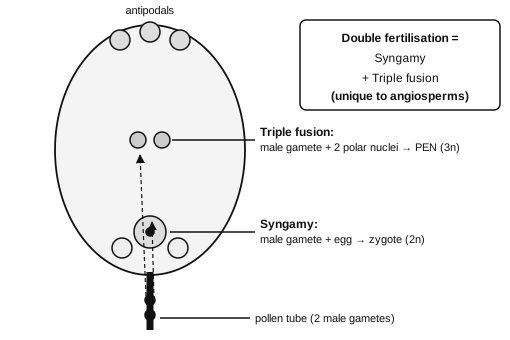
- Male gamete 1 + egg → zygote (2n) = syngamy.
- Male gamete 2 + two polar nuclei (central cell) → primary endosperm nucleus (3n) = triple fusion.
- (A) only one male gamete fuses with an egg – polyspermy is not normal. (B) is only triple fusion – half the event. (C) there is only one egg per embryo sac.
Short trick: Double = 2 fusions: Syngamy (2n) + Triple fusion (3n).
Answer: (D) Syngamy and triple fusion
अवधारणा: आवृतबीजियों में सहायक कोशिका में मुक्त हुए दोनों नर युग्मक एक ही भ्रूणकोष में दो संलयन करते हैं – यही द्विनिषेचन है।
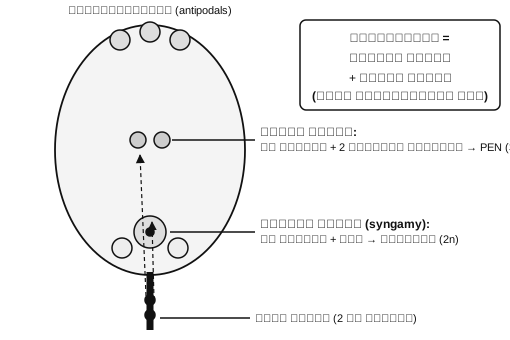
- नर युग्मक 1 + अंड → युग्मनज (2n) = युग्मक संलयन।
- नर युग्मक 2 + दो ध्रुवीय केंद्रक (केंद्रीय कोशिका) → प्राथमिक भ्रूणपोष केंद्रक (3n) = त्रिक संलयन।
- (A) अंड से केवल एक नर युग्मक संलयित होता है। (B) केवल त्रिक संलयन है – घटना का आधा भाग। (C) एक भ्रूणकोष में केवल एक अंड होता है।
शॉर्ट ट्रिक: द्वि = 2 संलयन: युग्मक संलयन (2n) + त्रिक संलयन (3n)।
उत्तर: (D) युग्मक संलयन और त्रिक संलयन
NEET UGBiologySexual reproduction in flowering plants – double fertilisationNEET UG 2018 · 6 May Shift 1
Q363.Which one of the following plants shows a very close relationship with a species of moth, where none of the two can complete its life cycle without the other?
निम्नलिखित में से कौन-सा पादप शलभ (moth) की एक जाति के साथ बहुत घनिष्ठ संबंध दर्शाता है, जहाँ दोनों में से कोई भी दूसरे के बिना अपना जीवन-चक्र पूरा नहीं कर सकता?
- ABananaकेला
- BYucca
- CHydrilla
- DViola
Show answer
Concept: Obligate mutualism – NCERT: “plant Yucca cannot complete its life cycle without a species of moth (Pronuba) and vice versa”.
- The moth pollinates the Yucca flower and lays its eggs in the ovary; larvae feed on some developing seeds.
- (A) Banana – parthenocarpic fruits, bat/bird pollination, no obligate moth.
- (C) Hydrilla – water-pollinated.
- (D) Viola – cleistogamous + chasmogamous flowers, self-pollination.
Short trick: Yucca–moth = “Y can't live without the other”.
Answer: (B) Yucca
अवधारणा: अविकल्पी सहोपकारिता – NCERT: “Yucca पादप शलभ (Pronuba) की एक जाति के बिना अपना जीवन-चक्र पूरा नहीं कर सकता और न ही शलभ पादप के बिना”।
- शलभ Yucca के पुष्प का परागण करता है और अंडाशय में अंडे देता है; लार्वा कुछ विकसित होते बीजों को खाते हैं।
- (A) केला – अनिषेकफलन, चमगादड़/पक्षी परागण; कोई अविकल्पी शलभ नहीं।
- (C) Hydrilla – जल-परागित।
- (D) Viola – अनुन्मील्य + उन्मील्य पुष्प, स्व-परागण।
शॉर्ट ट्रिक: Yucca–शलभ = “एक के बिना दूसरा नहीं”।
उत्तर: (B) Yucca
NEET UGBiologyOrganisms and populations – mutualism (plant–pollinator)NEET UG 2018 · 6 May Shift 1
Q364.Pollen grains can be stored for several years in liquid nitrogen having a temperature of
परागकणों को कई वर्षों तक द्रव नाइट्रोजन में संग्रहित किया जा सकता है, जिसका तापमान होता है
- A–196°C
- B–80°C
- C–120°C
- D–160°C
Show answer
Concept: Cryopreservation: liquid nitrogen boils at –196 °C (77 K); pollen stored in it remains viable for years and is used in pollen banks for crop breeding.
- Normal boiling point of N2 = 77 K = 77 – 273 = –196 °C.
- –80 °C is a deep-freezer / dry-ice range; –120 °C and –160 °C are not the temperature of liquid N2.
Short trick: 77 K → –196 °C; remember “196 = liquid N2”.
Answer: (A) –196°C
अवधारणा: निम्नताप परिरक्षण (cryopreservation): द्रव नाइट्रोजन –196 °C (77 K) पर उबलती है; इसमें रखे परागकण वर्षों तक जीवनक्षम रहते हैं और फसल प्रजनन हेतु पराग बैंकों में प्रयुक्त होते हैं।
- N2 का सामान्य क्वथनांक = 77 K = 77 – 273 = –196 °C।
- –80 °C डीप-फ्रीज़र / शुष्क बर्फ का परास है; –120 °C व –160 °C द्रव N2 का तापमान नहीं है।
शॉर्ट ट्रिक: 77 K → –196 °C; याद रखें “196 = द्रव N2”।
उत्तर: (A) –196°C
NEET UGBiologySexual reproduction in flowering plants – pollen storageNEET UG 2018 · 6 May Shift 1
Q365.Which of the following elements is responsible for maintaining turgor in cells?
निम्नलिखित में से कौन-सा तत्व कोशिकाओं में स्फीति (turgor) बनाए रखने के लिए उत्तरदायी है?
- APotassiumपोटैशियम
- BSodiumसोडियम
- CMagnesiumमैग्नीशियम
- DCalciumकैल्शियम
Show answer
Concept: NCERT: potassium helps to maintain an anion–cation balance in cells and is involved in protein synthesis, opening and closing of stomata, activation of enzymes and maintenance of the turgidity of cells.
- K+ is the chief osmoticum of plant cells; K+ influx into guard cells makes them turgid and opens stomata.
- (B) Sodium – needed in C4/CAM plants for PEP regeneration, water balance; not the turgor element in NCERT.
- (C) Magnesium – chlorophyll, ribosome structure, enzyme activator.
- (D) Calcium – middle lamella (calcium pectate), spindle formation.
Short trick: K keeps cells “Kool & turgid” – stomatal opening = K+ pump.
Answer: (A) Potassium
अवधारणा: NCERT: पोटैशियम कोशिकाओं में ऋणायन–धनायन संतुलन बनाए रखता है तथा प्रोटीन संश्लेषण, रंध्रों के खुलने-बंद होने, एंजाइमों के सक्रियण और कोशिकाओं की स्फीति बनाए रखने में भाग लेता है।
- K+ पादप कोशिकाओं का मुख्य परासरण सक्रिय आयन है; द्वार कोशिकाओं में K+ के प्रवेश से वे स्फीत होकर रंध्र खोलती हैं।
- (B) सोडियम – C4/CAM पादपों में PEP पुनर्जनन, जल संतुलन हेतु; NCERT में स्फीति वाला तत्व नहीं।
- (C) मैग्नीशियम – पर्णहरित, राइबोसोम संरचना, एंजाइम सक्रियक।
- (D) कैल्शियम – मध्य पटलिका (कैल्शियम पेक्टेट), तर्कु निर्माण।
शॉर्ट ट्रिक: K = स्फीति; रंध्र खुलना = K+ पंप।
उत्तर: (A) पोटैशियम
NEET UGBiologyMineral nutrition – role of potassiumNEET UG 2018 · 6 May Shift 1
Q366.What is the role of NAD+ in cellular respiration?
कोशिकीय श्वसन में NAD+ की क्या भूमिका है?
- AIt is a nucleotide source for ATP synthesis.यह ATP संश्लेषण के लिए न्यूक्लियोटाइड स्रोत है।
- BIt functions as an electron carrier.यह इलेक्ट्रॉन वाहक के रूप में कार्य करता है।
- CIt functions as an enzyme.यह एंजाइम के रूप में कार्य करता है।
- DIt is the final electron acceptor for anaerobic respiration.यह अवायवीय श्वसन के लिए अंतिम इलेक्ट्रॉन ग्राही है।
Show answer
Concept: NAD+ is a coenzyme (hydrogen/electron carrier). In glycolysis and Krebs cycle it accepts H+ + 2e– → NADH, which hands the electrons to the ETS.
- Each NADH oxidised in the ETS gives ≈ 3 ATP (older NCERT value), so NAD+ is a carrier, not a raw material.
- (A) ATP is made from ADP + Pi; NAD+ is not consumed as a nucleotide source.
- (C) It is a coenzyme helping dehydrogenases, not an enzyme itself.
- (D) Final electron acceptor in aerobic respiration is O2; in fermentation it is an organic molecule (pyruvate/acetaldehyde).
Short trick: NAD+ = “Nature's Auto Delivery” of electrons – a shuttle, never the final stop.
Answer: (B) It functions as an electron carrier.
अवधारणा: NAD+ एक सहएंजाइम (हाइड्रोजन/इलेक्ट्रॉन वाहक) है। ग्लाइकोलिसिस व क्रेब्स चक्र में यह H+ + 2e– ग्रहण करके NADH बनता है, जो इलेक्ट्रॉन ETS को सौंपता है।
- ETS में प्रत्येक NADH के ऑक्सीकरण से ≈ 3 ATP (पुराना NCERT मान) बनते हैं; अतः NAD+ वाहक है, कच्चा पदार्थ नहीं।
- (A) ATP, ADP + Pi से बनता है; NAD+ न्यूक्लियोटाइड स्रोत के रूप में व्यय नहीं होता।
- (C) यह डिहाइड्रोजिनेज़ का सहायक सहएंजाइम है, स्वयं एंजाइम नहीं।
- (D) वायवीय श्वसन में अंतिम इलेक्ट्रॉन ग्राही O2 है; किण्वन में कार्बनिक अणु (पाइरूवेट/ऐसीटैल्डिहाइड)।
शॉर्ट ट्रिक: NAD+ = इलेक्ट्रॉनों की “डिलीवरी गाड़ी” – शटल, अंतिम पड़ाव नहीं।
उत्तर: (B) यह इलेक्ट्रॉन वाहक के रूप में कार्य करता है।
NEET UGBiologyRespiration in plants – role of NAD⁺NEET UG 2018 · 6 May Shift 1
Q367.In which of the following forms is iron absorbed by plants?
पादपों द्वारा लौह (iron) किस रूप में अवशोषित किया जाता है?
- AFree elementमुक्त तत्व
- BFerrousफेरस
- CFerricफेरिक
- DBoth ferric and ferrousफेरिक और फेरस दोनों
Show answer
Concept: NCERT (Mineral Nutrition): “Plants obtain iron in the form of ferric ions (Fe3+).”
- The exam answer follows the NCERT line → ferric (Fe3+).
- (A) Iron is never taken up as free metal.
- (B) Ferrous alone is not the NCERT statement.
- (D) Physiologically roots of many plants reduce Fe3+ to Fe2+ at the root surface before uptake, but for NEET stick to the NCERT sentence – ferric.
Short trick: Iron is “Ferric” – For Exam remember NCERT: Fe3+.
Answer: (C) Ferric
अवधारणा: NCERT (खनिज पोषण): “पादप लौह को फेरिक आयनों (Fe3+) के रूप में प्राप्त करते हैं।”
- परीक्षा का उत्तर NCERT की पंक्ति पर आधारित है → फेरिक (Fe3+)।
- (A) लौह कभी मुक्त धातु के रूप में नहीं लिया जाता।
- (B) केवल फेरस NCERT का कथन नहीं है।
- (D) शरीरक्रियात्मक रूप से अनेक पादपों की जड़ें अवशोषण से पहले जड़ सतह पर Fe3+ को Fe2+ में अपचयित करती हैं, परंतु NEET के लिए NCERT का वाक्य – फेरिक – ही मानें।
शॉर्ट ट्रिक: लौह = “फेरिक” – परीक्षा में NCERT याद रखें: Fe3+।
उत्तर: (C) फेरिक
NEET UGBiologyMineral nutrition – form of iron absorbedNEET UG 2018 · 6 May Shift 1
Q368.Which of the following is commonly used as a vector for introducing a DNA fragment in human lymphocytes?
मानव लसीकाणुओं (lymphocytes) में DNA खंड प्रविष्ट कराने के लिए संवाहक (vector) के रूप में सामान्यतः किसका उपयोग किया जाता है?
- A phage फेज
- BTi plasmidTi प्लाज्मिड
- CRetrovirusरिट्रोवायरस
- DpBR 322
Show answer
Concept: Gene therapy for ADA deficiency (NCERT): lymphocytes from the patient's blood are grown in culture, a functional ADA cDNA is introduced using a retroviral vector, and the cells are returned to the patient.
- Retroviruses integrate their DNA copy into the host genome → stable expression in human cells.
- (A) λ phage infects only bacteria (E. coli).
- (B) Ti plasmid of Agrobacterium – vector for plant cells.
- (D) pBR322 – E. coli cloning plasmid.
Short trick: Match host: bacteria → pBR322/λ; plants → Ti; animals/humans → retrovirus.
Answer: (C) Retrovirus
अवधारणा: ADA न्यूनता की जीन चिकित्सा (NCERT): रोगी के रक्त से लसीकाणुओं को संवर्धन में उगाया जाता है, रिट्रोवायरस संवाहक द्वारा क्रियाशील ADA cDNA प्रविष्ट कराया जाता है और कोशिकाएँ रोगी में वापस डाली जाती हैं।
- रिट्रोवायरस अपनी DNA प्रति को परपोषी जीनोम में समाकलित करते हैं → मानव कोशिकाओं में स्थायी अभिव्यक्ति।
- (A) λ फेज केवल जीवाणुओं (E. coli) को संक्रमित करता है।
- (B) Agrobacterium का Ti प्लाज्मिड – पादप कोशिकाओं का संवाहक।
- (D) pBR322 – E. coli का क्लोनिंग प्लाज्मिड।
शॉर्ट ट्रिक: परपोषी मिलाएँ: जीवाणु → pBR322/λ; पादप → Ti; जंतु/मानव → रिट्रोवायरस।
उत्तर: (C) रिट्रोवायरस
NEET UGBiologyBiotechnology – gene therapy vectorsNEET UG 2018 · 6 May Shift 1
Q369.Use of bioresources by multinational companies and organisations without authorisation from the concerned country and its people is called
संबंधित देश और उसके लोगों की अनुमति के बिना बहुराष्ट्रीय कंपनियों और संगठनों द्वारा जैव-संसाधनों का उपयोग कहलाता है
- ABiodegradationजैव निम्नीकरण (Biodegradation)
- BBiopiracyबायोपाइरेसी (Biopiracy)
- CBio-infringementजैव-अतिलंघन (Bio-infringement)
- DBioexploitationजैव-शोषण (Bioexploitation)
Show answer
Concept: NCERT defines biopiracy as the use of bio-resources by multinational companies and other organisations without proper authorisation from the countries and people concerned, without compensatory payment.
- Examples: Basmati rice patent (1997), turmeric, neem.
- (A) Biodegradation – breakdown of matter by microbes.
- (C), (D) are not NCERT terms for this definition.
Short trick: “Piracy” = stealing without permission → bio-piracy.
Answer: (B) Biopiracy
अवधारणा: NCERT के अनुसार बायोपाइरेसी बहुराष्ट्रीय कंपनियों एवं अन्य संगठनों द्वारा संबंधित देशों और लोगों की उचित अनुमति तथा क्षतिपूर्ति भुगतान के बिना जैव-संसाधनों का उपयोग है।
- उदाहरण: बासमती चावल पेटेंट (1997), हल्दी, नीम।
- (A) जैव निम्नीकरण – सूक्ष्मजीवों द्वारा पदार्थों का अपघटन।
- (C), (D) इस परिभाषा के लिए NCERT के पद नहीं हैं।
शॉर्ट ट्रिक: “पाइरेसी” = बिना अनुमति चोरी → बायोपाइरेसी।
उत्तर: (B) बायोपाइरेसी
NEET UGBiologyBiotechnology applications – biopiracyNEET UG 2018 · 6 May Shift 1
Q370.In India, the organisation responsible for assessing the safety of introducing genetically modified organisms for public use is
भारत में, सार्वजनिक उपयोग हेतु आनुवंशिकतः रूपांतरित जीवों (GMO) को लाने की सुरक्षा का मूल्यांकन करने के लिए उत्तरदायी संगठन है
- AResearch Committee on Genetic Manipulation (RCGM)आनुवंशिक हेरफेर पर अनुसंधान समिति (RCGM)
- BCouncil for Scientific and Industrial Research (CSIR)वैज्ञानिक तथा औद्योगिक अनुसंधान परिषद (CSIR)
- CIndian Council of Medical Research (ICMR)भारतीय आयुर्विज्ञान अनुसंधान परिषद (ICMR)
- DGenetic Engineering Appraisal Committee (GEAC)जेनेटिक इंजीनियरिंग मूल्यांकन समिति (GEAC)
Show answer
Concept: NCERT: the Indian Government has set up the GEAC, which makes decisions regarding the validity of GM research and the safety of introducing GM-organisms for public services.
- GEAC (under the Ministry of Environment, Forest and Climate Change) approves large-scale use and environmental release of GMOs (e.g. Bt cotton).
- (A) RCGM – reviews lab-level research on GM, not public release.
- (B) CSIR – industrial/scientific research body.
- (C) ICMR – medical research body.
Short trick: Public release → Appraisal → GEAC.
Answer: (D) Genetic Engineering Appraisal Committee (GEAC)
अवधारणा: NCERT: भारत सरकार ने GEAC की स्थापना की है, जो GM अनुसंधान की वैधता तथा सार्वजनिक सेवाओं हेतु GM-जीवों को लाने की सुरक्षा के बारे में निर्णय लेती है।
- GEAC (पर्यावरण, वन एवं जलवायु परिवर्तन मंत्रालय के अधीन) GMO के बड़े पैमाने पर उपयोग और पर्यावरणीय विमोचन को स्वीकृति देती है (जैसे Bt कपास)।
- (A) RCGM – प्रयोगशाला स्तर के GM अनुसंधान की समीक्षा करती है, सार्वजनिक विमोचन की नहीं।
- (B) CSIR – औद्योगिक/वैज्ञानिक अनुसंधान संस्था।
- (C) ICMR – चिकित्सा अनुसंधान संस्था।
शॉर्ट ट्रिक: सार्वजनिक विमोचन → Appraisal (मूल्यांकन) → GEAC।
उत्तर: (D) जेनेटिक इंजीनियरिंग मूल्यांकन समिति (GEAC)
NEET UGBiologyBiotechnology – ethical issues (GEAC)NEET UG 2018 · 6 May Shift 1
Q371.The correct order of steps in Polymerase Chain Reaction (PCR) is
पॉलिमरेज़ श्रृंखला अभिक्रिया (PCR) में चरणों का सही क्रम है
- ADenaturation, Extension, Annealingविकृतीकरण, प्रसार, तापानुशीतन
- BAnnealing, Extension, Denaturationतापानुशीतन, प्रसार, विकृतीकरण
- CExtension, Denaturation, Annealingप्रसार, विकृतीकरण, तापानुशीतन
- DDenaturation, Annealing, Extensionविकृतीकरण, तापानुशीतन, प्रसार
Show answer
Concept: Each PCR cycle has three steps in a fixed logical order: the strands must separate before primers can bind, and primers must bind before the polymerase can extend them.
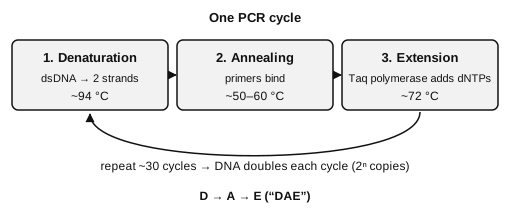
- Denaturation (~94 °C): H-bonds break, dsDNA → two single strands.
- Annealing (~50–60 °C): two primers bind to complementary 3′ ends of the template.
- Extension (~72 °C): thermostable Taq DNA polymerase extends the primers using dNTPs.
- Options (A), (B), (C) put annealing/extension before strand separation or extension before annealing – impossible.
Short trick: “DAE” – Denature, Anneal, Extend (hot → cool → warm).
Answer: (D) Denaturation, Annealing, Extension
अवधारणा: प्रत्येक PCR चक्र में तीन चरण निश्चित तार्किक क्रम में होते हैं: प्राइमर जुड़ने से पहले रज्जुकों का अलग होना आवश्यक है और पॉलिमरेज़ द्वारा प्रसार से पहले प्राइमरों का जुड़ना आवश्यक है।
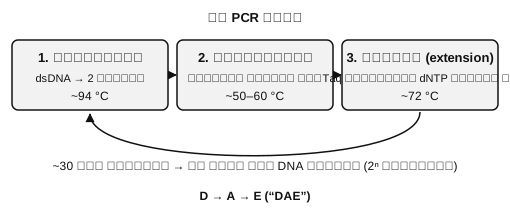
- विकृतीकरण (~94 °C): H-बंध टूटते हैं, dsDNA → दो एकल रज्जुक।
- तापानुशीतन (~50–60 °C): दो प्राइमर टेम्पलेट के पूरक 3′ सिरों से जुड़ते हैं।
- प्रसार (~72 °C): तापस्थायी Taq DNA पॉलिमरेज़ dNTP का उपयोग कर प्राइमरों को बढ़ाता है।
- विकल्प (A), (B), (C) में तापानुशीतन/प्रसार रज्जुक-पृथक्करण से पहले या प्रसार तापानुशीतन से पहले है – असंभव।
शॉर्ट ट्रिक: “DAE” – Denature, Anneal, Extend (गर्म → ठंडा → गुनगुना)।
उत्तर: (D) विकृतीकरण, तापानुशीतन, प्रसार
NEET UGBiologyBiotechnology – Polymerase Chain ReactionNEET UG 2018 · 6 May Shift 1
Q372.Select the correct match
सही सुमेलित युग्म चुनिए
- AT.H. Morgan - Transductionटी.एच. मॉर्गन - पारक्रमण (Transduction)
- BF2 × Recessive parent - Dihybrid crossF2 × अप्रभावी जनक - द्विसंकर क्रॉस
- CRibozyme - Nucleic acidराइबोज़ाइम - न्यूक्लिक अम्ल
- DG. Mendel - Transformationजी. मेंडल - रूपांतरण (Transformation)
Show answer
Concept: A ribozyme is a catalytic RNA (e.g. 23S rRNA acting as peptidyl transferase; RNase P) – RNA is a nucleic acid.
- (A) Morgan – linkage/recombination in Drosophila; transduction – Zinder & Lederberg.
- (B) Crossing F1 (not F2) with the recessive parent is a test cross, not a dihybrid cross.
- (D) Mendel – laws of inheritance; transformation – Griffith (1928).
Short trick: Ribozyme = RNA enzyme → still a nucleic acid.
Answer: (C) Ribozyme - Nucleic acid
अवधारणा: राइबोज़ाइम एक उत्प्रेरक RNA है (जैसे पेप्टिडिल ट्रांसफ़रेज़ के रूप में 23S rRNA; RNase P) – RNA एक न्यूक्लिक अम्ल है।
- (A) मॉर्गन – Drosophila में सहलग्नता/पुनर्योजन; पारक्रमण – ज़िंडर व लेडरबर्ग।
- (B) F1 (F2 नहीं) का अप्रभावी जनक से क्रॉस परीक्षार्थ संकरण (test cross) है, द्विसंकर क्रॉस नहीं।
- (D) मेंडल – वंशागति के नियम; रूपांतरण – ग्रिफ़िथ (1928)।
शॉर्ट ट्रिक: राइबोज़ाइम = RNA एंजाइम → फिर भी न्यूक्लिक अम्ल।
उत्तर: (C) राइबोज़ाइम - न्यूक्लिक अम्ल
NEET UGBiologyMolecular basis of inheritance – scientists and termsNEET UG 2018 · 6 May Shift 1
Q373.A ‘new’ variety of rice was patented by a foreign company, though such varieties have been present in India for a long time. This is related to
एक विदेशी कंपनी द्वारा चावल की एक ‘नई’ किस्म का पेटेंट कराया गया, यद्यपि ऐसी किस्में भारत में लंबे समय से मौजूद हैं। यह किससे संबंधित है?
- ALerma Rojoलर्मा रोजो
- BSharbati Sonoraशरबती सोनोरा
- CCo-667
- DBasmatiबासमती
Show answer
Concept: NCERT: In 1997 an American company got patent rights on Basmati rice through the US Patent and Trademark Office; it was derived from Indian farmers' varieties (27 documented Basmati varieties in India).
- (A) Lerma Rojo and (B) Sharbati Sonora – semi-dwarf wheat varieties of the Green Revolution.
- (C) Co-667 – a sugarcane variety.
Short trick: Rice + patent = Basmati; Lerma/Sonora = wheat; Co-667 = sugarcane.
Answer: (D) Basmati
अवधारणा: NCERT: 1997 में एक अमेरिकी कंपनी ने US पेटेंट एवं ट्रेडमार्क कार्यालय के माध्यम से बासमती चावल पर पेटेंट अधिकार प्राप्त किए; यह भारतीय किसानों की किस्मों से व्युत्पन्न था (भारत में बासमती की 27 प्रलेखित किस्में)।
- (A) लर्मा रोजो और (B) शरबती सोनोरा – हरित क्रांति की अर्ध-बौनी गेहूँ किस्में।
- (C) Co-667 – गन्ने की एक किस्म।
शॉर्ट ट्रिक: चावल + पेटेंट = बासमती; लर्मा/सोनोरा = गेहूँ; Co-667 = गन्ना।
उत्तर: (D) बासमती
NEET UGBiologyBiotechnology – biopiracy (Basmati patent)NEET UG 2018 · 6 May Shift 1
Q374.Which of the following pairs is wrongly matched?
निम्नलिखित में से कौन-सा युग्म गलत सुमेलित है?
- AXO type sex determination : GrasshopperXO प्रकार का लिंग निर्धारण : टिड्डा
- BABO blood grouping : Co-dominanceABO रुधिर वर्गीकरण : सहप्रभाविता
- CStarch synthesis in pea : Multiple allelesमटर में मंड (starch) संश्लेषण : बहुविकल्पी एलील
- DT.H. Morgan : Linkageटी.एच. मॉर्गन : सहलग्नता
Show answer
Concept: NCERT uses starch synthesis in pea as the example of pleiotropy/incomplete dominance – one gene (B/b) controls starch grain size and seed shape.
- BB → large starch grains, round seeds; bb → small grains, wrinkled seeds; Bb → round seeds but intermediate grain size. Only two alleles – not multiple alleles.
- (A) Grasshopper – XO type (male XO, female XX) – correct.
- (B) ABO – IA and IB co-dominant (also multiple alleles) – correct.
- (D) Morgan – linkage in Drosophila – correct.
Short trick: Pea starch = one gene, many effects (pleiotropy); multiple alleles = ABO.
Answer: (C) Starch synthesis in pea : Multiple alleles
अवधारणा: NCERT मटर में मंड संश्लेषण को बहुप्रभाविता/अपूर्ण प्रभाविता के उदाहरण के रूप में देता है – एक जीन (B/b) मंड कणों का आकार तथा बीज की आकृति दोनों नियंत्रित करता है।
- BB → बड़े मंड कण, गोल बीज; bb → छोटे कण, झुर्रीदार बीज; Bb → गोल बीज पर मध्यवर्ती कण आकार। केवल दो एलील – बहुविकल्पी एलील नहीं।
- (A) टिड्डा – XO प्रकार (नर XO, मादा XX) – सही।
- (B) ABO – IA व IB सहप्रभावी (बहुविकल्पी एलील भी) – सही।
- (D) मॉर्गन – Drosophila में सहलग्नता – सही।
शॉर्ट ट्रिक: मटर मंड = एक जीन, अनेक प्रभाव (बहुप्रभाविता); बहुविकल्पी एलील = ABO।
उत्तर: (C) मटर में मंड संश्लेषण : बहुविकल्पी एलील
NEET UGBiologyPrinciples of inheritance – genetics matchesNEET UG 2018 · 6 May Shift 1
Q375.Select the correct statement
सही कथन चुनिए
- ASpliceosomes take part in translationस्प्लाइसियोसोम अनुवादन (translation) में भाग लेते हैं
- BPunnett square was developed by a British scientistपनेट वर्ग एक ब्रिटिश वैज्ञानिक द्वारा विकसित किया गया था
- CFranklin Stahl coined the term ‘‘linkage’’फ्रैंकलिन स्टाल ने ‘‘सहलग्नता’’ (linkage) शब्द दिया
- DTransduction was discovered by S. Altmanपारक्रमण (transduction) की खोज एस. ऑल्टमैन ने की
Show answer
Concept: The Punnett square was devised by the British geneticist Reginald C. Punnett.
- (A) Spliceosomes remove introns during post-transcriptional processing (splicing), not translation.
- (C) The term linkage was coined by T.H. Morgan; Stahl (with Meselson) proved semi-conservative replication.
- (D) Transduction – Zinder and Lederberg (1952); Sidney Altman discovered catalytic RNA (ribozyme).
Short trick: Punnett – Punnett square, British geneticist; Altman = RNA enzyme; Morgan = linkage.
Answer: (B) Punnett square was developed by a British scientist
अवधारणा: पनेट वर्ग की रचना ब्रिटिश आनुवंशिकीविद् रेजिनाल्ड सी. पनेट ने की थी।
- (A) स्प्लाइसियोसोम अनुलेखन-पश्चात प्रसंस्करण (स्प्लाइसिंग) में इंट्रॉन हटाते हैं, अनुवादन में नहीं।
- (C) सहलग्नता शब्द टी.एच. मॉर्गन ने दिया; स्टाल ने (मेसेल्सन के साथ) अर्धसंरक्षी प्रतिकृतियन सिद्ध किया।
- (D) पारक्रमण – ज़िंडर व लेडरबर्ग (1952); सिडनी ऑल्टमैन ने उत्प्रेरक RNA (राइबोज़ाइम) खोजा।
शॉर्ट ट्रिक: Punnett – ब्रिटिश; ऑल्टमैन = RNA एंजाइम; मॉर्गन = सहलग्नता।
उत्तर: (B) पनेट वर्ग एक ब्रिटिश वैज्ञानिक द्वारा विकसित किया गया था
NEET UGBiologyPrinciples of inheritance – history of geneticsNEET UG 2018 · 6 May Shift 1
Q376.The experimental proof for semiconservative replication of DNA was first shown in a
DNA के अर्धसंरक्षी प्रतिकृतियन का प्रायोगिक प्रमाण सर्वप्रथम किसमें दिखाया गया था?
- APlantपादप
- BBacteriumजीवाणु
- CFungusकवक
- DVirusवायरस
Show answer
Concept: Meselson and Stahl (1958) grew Escherichia coli (a bacterium) in 15NH4Cl, shifted it to 14N medium and separated DNA by CsCl density-gradient centrifugation.
- Generation 1 → all hybrid (15N/14N) DNA; generation 2 → equal hybrid and light DNA → semi-conservative.
- (A) A plant proof came later – Taylor (1958) used Vicia faba with radioactive thymidine for chromosomes.
- (C), (D) – not the first proof.
Short trick: Meselson–Stahl → E. coli + heavy N; Taylor → Vicia faba.
Answer: (B) Bacterium
अवधारणा: मेसेल्सन और स्टाल (1958) ने Escherichia coli (एक जीवाणु) को 15NH4Cl में उगाया, फिर 14N माध्यम में स्थानांतरित किया और CsCl घनत्व-प्रवणता अपकेंद्रण द्वारा DNA अलग किया।
- पीढ़ी 1 → सारा DNA संकर (15N/14N); पीढ़ी 2 → संकर व हल्का DNA बराबर → अर्धसंरक्षी।
- (A) पादप में प्रमाण बाद में – टेलर (1958) ने रेडियोधर्मी थाइमिडीन से Vicia faba के गुणसूत्रों पर दिखाया।
- (C), (D) – पहला प्रमाण नहीं।
शॉर्ट ट्रिक: मेसेल्सन–स्टाल → E. coli + भारी N; टेलर → Vicia faba।
उत्तर: (B) जीवाणु
NEET UGBiologyMolecular basis of inheritance – Meselson–Stahl experimentNEET UG 2018 · 6 May Shift 1
Q377.Which of the following flowers only once in its life-time?
निम्नलिखित में से कौन अपने जीवनकाल में केवल एक बार पुष्पित होता है?
- AMangoआम
- BJackfruitकटहल
- CBamboo speciesबाँस की जातियाँ
- DPapayaपपीता
Show answer
Concept: NCERT: some bamboo species flower only once in their life-time, generally after 50–100 years, produce large numbers of fruits and die (monocarpic). Strobilanthus kunthiana flowers once in 12 years.
- (A) Mango, (B) Jackfruit and (D) Papaya are perennial polycarpic plants – they flower and fruit year after year.
Short trick: Bamboo – “Bloom once, Bye”; Neelakurinji – every 12 years.
Answer: (C) Bamboo species
अवधारणा: NCERT: बाँस की कुछ जातियाँ अपने जीवनकाल में केवल एक बार, सामान्यतः 50–100 वर्ष बाद, पुष्पित होती हैं, बड़ी संख्या में फल बनाकर मर जाती हैं (एकफलनी)। Strobilanthus kunthiana 12 वर्ष में एक बार पुष्पित होता है।
- (A) आम, (B) कटहल और (D) पपीता बहुवर्षी बहुफलनी पादप हैं – ये हर वर्ष पुष्प और फल देते हैं।
शॉर्ट ट्रिक: बाँस – “एक बार फूले, फिर विदा”; नीलकुरिंजी – हर 12 वर्ष।
उत्तर: (C) बाँस की जातियाँ
NEET UGBiologyReproduction in organisms – monocarpic plantsNEET UG 2018 · 6 May Shift 1
Q378.Offsets are produced by
भूस्तारिका (offsets) किसके द्वारा उत्पन्न होती हैं?
- AParthenocarpyअनिषेकफलन (Parthenocarpy)
- BMitotic divisionsसमसूत्री विभाजन
- CMeiotic divisionsअर्धसूत्री विभाजन
- DParthenogenesisअनिषेकजनन (Parthenogenesis)
Show answer
Concept: An offset (e.g. Eichhornia, Pistia) is a vegetative propagule – a short stolon-like branch; vegetative (asexual) reproduction involves only mitosis, so the offspring are clones.
- (A) Parthenocarpy – development of fruit without fertilisation (seedless banana).
- (C) Meiosis forms gametes/spores in sexual reproduction, not vegetative organs.
- (D) Parthenogenesis – development of an embryo from an unfertilised egg (honey-bee drones).
Short trick: Vegetative = clone = mitosis only.
Answer: (B) Mitotic divisions
अवधारणा: भूस्तारिका (जैसे Eichhornia, Pistia) एक कायिक प्रवर्ध है – छोटी उपरिभूस्तारी-जैसी शाखा; कायिक (अलैंगिक) जनन में केवल समसूत्री विभाजन होता है, अतः संतति क्लोन होती है।
- (A) अनिषेकफलन – निषेचन के बिना फल का विकास (बीजरहित केला)।
- (C) अर्धसूत्री विभाजन लैंगिक जनन में युग्मक/बीजाणु बनाता है, कायिक अंग नहीं।
- (D) अनिषेकजनन – अनिषेचित अंड से भ्रूण का विकास (मधुमक्खी के नर)।
शॉर्ट ट्रिक: कायिक = क्लोन = केवल समसूत्री विभाजन।
उत्तर: (B) समसूत्री विभाजन
NEET UGBiologyReproduction in organisms – vegetative propagationNEET UG 2018 · 6 May Shift 1
Q379.Select the correct match
सही सुमेलित युग्म चुनिए
- AMatthew Meselson and F. Stahl - Pisum sativumमैथ्यू मेसेल्सन और एफ. स्टाल - Pisum sativum
- BAlfred Hershey and Martha Chase - TMVअल्फ्रेड हर्शे और मार्था चेज़ - TMV
- CAlec Jeffreys - Streptococcus pneumoniaeएलेक जेफ्रीज़ - Streptococcus pneumoniae
- DFrancois Jacob and Jacques Monod - Lac operonफ्रांस्वा जैकब और जैक्स मोनोड - लैक ओपेरॉन
Show answer
Concept: Jacob and Monod (1961) proposed the operon model of gene regulation using the lac operon of E. coli.
- (A) Meselson & Stahl worked on E. coli, not pea.
- (B) Hershey & Chase used bacteriophage T2 (not TMV) to prove DNA is the genetic material.
- (C) Alec Jeffreys developed DNA fingerprinting (VNTR); S. pneumoniae – Griffith's transformation.
Short trick: Jacob–Monod = Just Milk sugar (lactose) → lac operon.
Answer: (D) Francois Jacob and Jacques Monod - Lac operon
अवधारणा: जैकब और मोनोड (1961) ने E. coli के lac ओपेरॉन के आधार पर जीन नियमन का ओपेरॉन मॉडल प्रस्तावित किया।
- (A) मेसेल्सन व स्टाल ने E. coli पर कार्य किया, मटर पर नहीं।
- (B) हर्शे व चेज़ ने DNA को आनुवंशिक पदार्थ सिद्ध करने में बैक्टीरियोफेज T2 (TMV नहीं) का प्रयोग किया।
- (C) एलेक जेफ्रीज़ ने DNA फिंगरप्रिंटिंग (VNTR) विकसित की; S. pneumoniae – ग्रिफ़िथ का रूपांतरण।
शॉर्ट ट्रिक: Jacob–Monod = दूध शर्करा (लैक्टोज़) → lac ओपेरॉन।
उत्तर: (D) फ्रांस्वा जैकब और जैक्स मोनोड - लैक ओपेरॉन
NEET UGBiologyMolecular basis of inheritance – scientists and discoveriesNEET UG 2018 · 6 May Shift 1
Q380.Which of the following has proved helpful in preserving pollen as fossils?
निम्नलिखित में से किसने परागकणों को जीवाश्म के रूप में परिरक्षित करने में सहायता की है?
- AOil contentतैलीय अंश
- BCellulosic intineसेलुलोसिक अंतःचोल (intine)
- CPollenkittपोलनकिट
- DSporopolleninस्पोरोपोलेनिन
Show answer
Concept: NCERT: the exine is made of sporopollenin, one of the most resistant organic materials known – it withstands high temperature, strong acids and alkali, and no enzyme can degrade it. Hence pollen is well preserved as fossils.
- (A) Oil content – no role in fossilisation.
- (B) Intine – thin inner layer of cellulose and pectin, easily degraded.
- (C) Pollenkitt – oily, sticky coat that helps in insect pollination.
Short trick: Sporopollenin = Super-Strong shield → fossils.
Answer: (D) Sporopollenin
अवधारणा: NCERT: बाह्यचोल (exine) स्पोरोपोलेनिन का बना होता है, जो ज्ञात सबसे प्रतिरोधी कार्बनिक पदार्थों में से एक है – यह उच्च ताप, प्रबल अम्ल व क्षार सह लेता है और कोई एंजाइम इसका अपघटन नहीं कर सकता। इसलिए परागकण जीवाश्म रूप में भली-भाँति परिरक्षित रहते हैं।
- (A) तैलीय अंश – जीवाश्मीकरण में कोई भूमिका नहीं।
- (B) अंतःचोल – सेलुलोस व पेक्टिन की पतली भीतरी परत, सरलता से अपघटित।
- (C) पोलनकिट – तैलीय, चिपचिपा आवरण जो कीट-परागण में सहायक है।
शॉर्ट ट्रिक: Sporopollenin = अत्यंत मज़बूत कवच → जीवाश्म।
उत्तर: (D) स्पोरोपोलेनिन
NEET UGBiologySexual reproduction in flowering plants – pollen wallNEET UG 2018 · 6 May Shift 1

