NEET UG · 2,240 questions

NEET UG 2015, 2016, 2017, 2018, 2019, 2020, 2021, 2022, 2023, 2024, 2025, 2026 PYQs

Real previous year questions, subject-wise. Try the question, then open the answer and the explanation in Hindi & English – free, no login.

Courses – airGurukul

200 questions in Botany.

Q21.
The type of conservation in which the threatened species are taken out from their natural habitat and placed in special setting where they can be protected and given special care is called
संरक्षण का वह प्रकार, जिसमें संकटग्रस्त जातियों को उनके प्राकृतिक आवास से बाहर निकालकर विशेष परिवेश में रखा जाता है जहाँ उनकी रक्षा और विशेष देखभाल की जा सके, कहलाता है:
  1. ABiodiversity conservationजैव विविधता संरक्षण
  2. BSemi-conservative methodअर्ध-संरक्षी विधि
  3. CSustainable developmentसतत (धारणीय) विकास
  4. Din-situ conservationस्वस्थाने (in-situ) संरक्षण
Show answer

Concept: Removing threatened species from their natural habitat and protecting them in special settings is ex situ (off-site) conservation, which is a method of biodiversity conservation.

  1. "Ex situ" is not given as an option. Of the four choices, only "Biodiversity conservation" covers this approach.
  2. (B) Semi-conservative is a term for DNA replication and has nothing to do with conservation of species.
  3. (C) Sustainable development is a general principle of resource use, not a type of conservation.
  4. (D) In situ means protection inside the natural habitat, which is the opposite of what the question describes.

Short trick: When the exact term (ex situ) is missing, eliminate the options that are clearly wrong and choose the broader category that contains it.

Answer: (A) Biodiversity conservation

अवधारणा: संकटग्रस्त जातियों को प्राकृतिक आवास से हटाकर विशेष परिवेश में सुरक्षित रखना बाह्यस्थाने (ex situ) संरक्षण है, जो जैव विविधता संरक्षण की एक विधि है।

  1. "Ex situ" विकल्पों में नहीं दिया गया है। चारों विकल्पों में से केवल "जैव विविधता संरक्षण" इस विधि को समाहित करता है।
  2. (B) अर्ध-संरक्षी शब्द DNA प्रतिकृतिकरण से संबंधित है, जातियों के संरक्षण से नहीं।
  3. (C) सतत विकास संसाधन-उपयोग का एक सामान्य सिद्धांत है, संरक्षण का प्रकार नहीं।
  4. (D) स्वस्थाने का अर्थ है प्राकृतिक आवास के अंदर रक्षा, जो प्रश्न में दिए विवरण का ठीक उल्टा है।

शॉर्ट ट्रिक: जब सटीक शब्द (ex situ) न हो, तो स्पष्ट रूप से गलत विकल्प हटाएँ और उस व्यापक श्रेणी को चुनें जिसमें वह शामिल है।

उत्तर: (A) जैव विविधता संरक्षण
NEET UGBotanyBiodiversity – conservationNEET UG 2024 · 5 May Shift 1
Q22.
Match List I with List II.
List-IList-II
A. Two or more alternative forms of a geneI. Back cross
B. Cross of F1 progeny with homozygous recessive parentII. Ploidy
C. Cross of F1 progeny with any of the parentsIII. Allele
D. Number of chromosome sets in plantIV. Test cross
Choose the correct answer from the options given below:
सूची-I का सूची-II से मिलान कीजिए।
सूची-Iसूची-II
A. किसी जीन के दो या अधिक वैकल्पिक रूपI. प्रतीप संकरण (Back cross)
B. F1 संतति का समयुग्मजी अप्रभावी जनक से संकरणII. सूत्रगुणता (Ploidy)
C. F1 संतति का किसी भी जनक से संकरणIII. युग्मविकल्पी (Allele)
D. पादप में गुणसूत्र समुच्चयों की संख्याIV. परीक्षार्थ संकरण (Test cross)
नीचे दिए गए विकल्पों में से सही उत्तर चुनिए:
  1. AA-II, B-I, C-III, D-IV
  2. BA-III, B-IV, C-I, D-II
  3. CA-IV, B-III, C-II, D-I
  4. DA-I, B-II, C-III, D-IV
Show answer

Concept: These are standard Mendelian terms.

  1. A → III: an allele is an alternative form of the same gene.
  2. B → IV: a test cross is F1 × homozygous recessive parent and reveals the unknown genotype.
  3. C → I: a back cross is F1 × either parent. A test cross is a special back cross.
  4. D → II: ploidy is the number of chromosome sets (n, 2n, 3n…).

Short trick: Every test cross is a back cross, but a back cross is a test cross only when the parent used is recessive.

Answer: (B) A-III, B-IV, C-I, D-II

अवधारणा: ये मेंडल के मानक पद हैं।

  1. A → III: युग्मविकल्पी एक ही जीन का वैकल्पिक रूप है।
  2. B → IV: परीक्षार्थ संकरण F1 × समयुग्मजी अप्रभावी जनक होता है और अज्ञात जीनोटाइप बताता है।
  3. C → I: प्रतीप संकरण F1 × कोई भी जनक है। परीक्षार्थ संकरण एक विशेष प्रतीप संकरण है।
  4. D → II: सूत्रगुणता गुणसूत्र समुच्चयों की संख्या है (n, 2n, 3n…)।

शॉर्ट ट्रिक: हर परीक्षार्थ संकरण एक प्रतीप संकरण है, पर प्रतीप संकरण तभी परीक्षार्थ होता है जब प्रयुक्त जनक अप्रभावी हो।

उत्तर: (B) A-III, B-IV, C-I, D-II

NEET UGBotanyPrinciples of inheritance – genetic termsNEET UG 2024 · 5 May Shift 1
Q23.
Formation of interfascicular cambium from fully developed parenchyma cells is an example for
पूर्ण विकसित मृदूतक (parenchyma) कोशिकाओं से अंतरापूलीय एधा (interfascicular cambium) का निर्माण किसका उदाहरण है?
  1. ARedifferentiationपुनर्विभेदन
  2. BDedifferentiationनिर्विभेदन (Dedifferentiation)
  3. CMaturationपरिपक्वन
  4. DDifferentiationविभेदन
Show answer

Concept: When differentiated living cells, which had lost the capacity to divide, regain that capacity, the process is called dedifferentiation.

  1. Parenchyma cells are permanent and do not divide. When they become interfascicular cambium they turn meristematic again, which is dedifferentiation.
  2. Redifferentiation is when the cells produced by such a meristem mature again into permanent cells, e.g. secondary xylem and phloem.
  3. Differentiation and maturation are the first change of meristematic cells into permanent ones.

Short trick: The prefix "De" means going back. A permanent cell going back to a dividing state is dedifferentiation. Cork cambium formation is another example.

Answer: (B) Dedifferentiation

अवधारणा: जब विभेदित जीवित कोशिकाएँ, जिन्होंने विभाजन क्षमता खो दी थी, उसे पुनः प्राप्त कर लेती हैं, तो इस प्रक्रिया को निर्विभेदन कहते हैं।

  1. मृदूतक कोशिकाएँ स्थायी होती हैं और विभाजित नहीं होतीं। अंतरापूलीय एधा बनने पर वे फिर विभज्योतकी हो जाती हैं, जो निर्विभेदन है।
  2. पुनर्विभेदन तब होता है जब ऐसे विभज्योतक से बनी कोशिकाएँ फिर स्थायी कोशिकाओं में परिपक्व होती हैं, जैसे द्वितीयक जाइलम और फ्लोएम।
  3. विभेदन और परिपक्वन विभज्योतकी कोशिकाओं का पहली बार स्थायी कोशिकाओं में बदलना है।

शॉर्ट ट्रिक: उपसर्ग "निर्/De" का अर्थ है पीछे लौटना। स्थायी कोशिका का फिर विभाजनशील बनना निर्विभेदन है। कॉर्क एधा का बनना भी इसका उदाहरण है।

उत्तर: (B) निर्विभेदन

NEET UGBotanyPlant growth – dedifferentiationNEET UG 2024 · 5 May Shift 1
Q24.
Spindle fibres attach to kinetochores of chromosomes during
तर्कु तंतु (spindle fibres) गुणसूत्रों के काइनेटोकोर से किस अवस्था में जुड़ते हैं?
  1. AMetaphaseमध्यावस्था (Metaphase)
  2. BAnaphaseपश्चावस्था (Anaphase)
  3. CTelophaseअंत्यावस्था (Telophase)
  4. DProphaseपूर्वावस्था (Prophase)
Show answer

Concept: NCERT: the key feature of metaphase is the attachment of spindle fibres to the kinetochores of chromosomes.

  1. Kinetochores are small disc-shaped structures on the surface of the centromere and serve as sites of spindle attachment.
  2. In metaphase, chromosomes attached to the spindle are aligned at the metaphase plate.
  3. Prophase: the spindle only begins to form. Anaphase: the centromeres split and chromatids separate. Telophase: the nuclear envelope reforms.

Short trick: Think Metaphase = Middle line-up + attachMent.

Answer: (A) Metaphase

अवधारणा: NCERT: मध्यावस्था की मुख्य विशेषता गुणसूत्रों के काइनेटोकोर से तर्कु तंतुओं का जुड़ना है।

  1. काइनेटोकोर गुणसूत्रबिंदु (centromere) की सतह पर छोटी चक्रिका जैसी संरचनाएँ हैं जहाँ तर्कु तंतु जुड़ते हैं।
  2. मध्यावस्था में तर्कु से जुड़े गुणसूत्र मध्यावस्था पट्टिका पर पंक्तिबद्ध होते हैं।
  3. पूर्वावस्था: तर्कु बनना केवल शुरू होता है। पश्चावस्था: गुणसूत्रबिंदु विभक्त होते हैं और अर्धगुणसूत्र अलग होते हैं। अंत्यावस्था: केंद्रक आवरण फिर बनता है।

शॉर्ट ट्रिक: मध्यावस्था = मध्य में पंक्ति + जुड़ाव।

उत्तर: (A) मध्यावस्था

NEET UGBotanyCell cycle – mitosisNEET UG 2024 · 5 May Shift 1
Q25.
In a plant, black seed color (BB/Bb) is dominant over white seed color (bb). In order to find out the genotype of the black seed plant, with which of the following genotype will you cross it?
एक पादप में काला बीज रंग (BB/Bb) सफ़ेद बीज रंग (bb) पर प्रभावी है। काले बीज वाले पादप का जीनोटाइप ज्ञात करने के लिए आप उसका संकरण किस जीनोटाइप से करेंगे?
  1. Abb
  2. BBb
  3. CBB/Bb
  4. DBB
Show answer

Concept: A test cross is a cross of a dominant-phenotype individual of unknown genotype with the homozygous recessive (bb) parent.

  1. If black is BB: BB × bb gives all Bb, so all seeds are black.
  2. If black is Bb: Bb × bb gives 1 Bb : 1 bb, so seeds are black : white = 1 : 1.
  3. The recessive parent shows its alleles directly in the progeny. Crossing with BB or Bb cannot clearly separate the two cases.

Short trick: For an unknown dominant, always cross with the recessive: all progeny dominant means homozygous, and a 1 : 1 ratio means heterozygous.

Answer: (A) bb

अवधारणा: परीक्षार्थ संकरण में अज्ञात जीनोटाइप वाले प्रभावी लक्षणप्ररूपी जीव का संकरण समयुग्मजी अप्रभावी (bb) जनक से किया जाता है।

  1. यदि काला BB है: BB × bb से सभी Bb मिलेंगे, अतः सभी बीज काले होंगे।
  2. यदि काला Bb है: Bb × bb से 1 Bb : 1 bb मिलेंगे, अतः काले : सफ़ेद = 1 : 1 होंगे।
  3. अप्रभावी जनक के युग्मविकल्पी संतति में सीधे दिखते हैं। BB या Bb से संकरण करने पर दोनों स्थितियों को स्पष्ट रूप से अलग नहीं किया जा सकता।

शॉर्ट ट्रिक: अज्ञात प्रभावी का संकरण हमेशा अप्रभावी से करें: सब प्रभावी आएँ तो समयुग्मजी, और 1 : 1 आए तो विषमयुग्मजी।

उत्तर: (A) bb

NEET UGBotanyPrinciples of inheritance – test crossNEET UG 2024 · 5 May Shift 1
Q26.
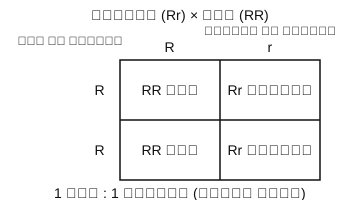
A pink flowered Snapdragon plant was crossed with a red flowered Snapdragon plant. What type of phenotype/s is/are expected in the progeny?
एक गुलाबी पुष्प वाले स्नैपड्रैगन (Snapdragon) पादप का संकरण लाल पुष्प वाले स्नैपड्रैगन पादप से कराया गया। संतति में किस प्रकार का/के लक्षणप्ररूप अपेक्षित है/हैं?
  1. ARed flowered as well as pink flowered plantsलाल पुष्प वाले तथा गुलाबी पुष्प वाले पादप
  2. BOnly pink flowered plantsकेवल गुलाबी पुष्प वाले पादप
  3. CRed, Pink as well as white flowered plantsलाल, गुलाबी तथा सफ़ेद पुष्प वाले पादप
  4. DOnly red flowered plantsकेवल लाल पुष्प वाले पादप
Show answer

Concept: Flower colour in snapdragon (Antirrhinum) shows incomplete dominance: RR is red, Rr is pink and rr is white.

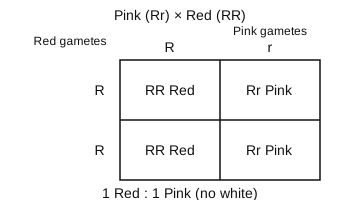
  1. Pink (Rr) × Red (RR).
  2. Gametes: R and r from the pink parent, R only from the red parent.
  3. Progeny: 1 RR (red) : 1 Rr (pink).
  4. No rr plant can form, so white is impossible. (B), (C) and (D) are therefore wrong.

Short trick: Under incomplete dominance, phenotype ratio = genotype ratio. Any cross with RR can never give white.

Answer: (A) Red flowered as well as pink flowered plants

अवधारणा: स्नैपड्रैगन (Antirrhinum) में पुष्प का रंग अपूर्ण प्रभाविता दर्शाता है: RR लाल, Rr गुलाबी और rr सफ़ेद।

  1. गुलाबी (Rr) × लाल (RR)।
  2. युग्मक: गुलाबी जनक से R और r, लाल जनक से केवल R।
  3. संतति: 1 RR (लाल) : 1 Rr (गुलाबी)।
  4. कोई rr पादप नहीं बन सकता, अतः सफ़ेद असंभव है। इसलिए (B), (C) और (D) गलत हैं।

शॉर्ट ट्रिक: अपूर्ण प्रभाविता में लक्षणप्ररूप अनुपात = जीनोटाइप अनुपात। RR वाले किसी भी संकरण से सफ़ेद कभी नहीं आ सकता।

उत्तर: (A) लाल तथा गुलाबी पुष्प वाले पादप

NEET UGBotanyPrinciples of inheritance – incomplete dominanceNEET UG 2024 · 5 May Shift 1
Q27.
Inhibition of Succinic dehydrogenase enzyme by malonate is a classical example of
मैलोनेट द्वारा सक्सिनिक डीहाइड्रोजिनेज़ एंजाइम का संदमन किसका उत्कृष्ट उदाहरण है?
  1. AFeedback inhibitionपुनर्भरण संदमन (Feedback inhibition)
  2. BCompetitive inhibitionस्पर्धी संदमन (Competitive inhibition)
  3. CEnzyme activationएंजाइम सक्रियण
  4. DCofactor inhibitionसहकारक संदमन
Show answer

Concept: A competitive inhibitor closely resembles the substrate in structure and competes with it for the enzyme's active site.

  1. Malonate (–OOC–CH2–COO–) resembles succinate (–OOC–CH2–CH2–COO–).
  2. It binds to the active site of succinic dehydrogenase, so succinate cannot bind and enzyme action falls.
  3. Feedback inhibition is inhibition by an end product, usually at an allosteric site, so it is not this case. Malonate does not activate the enzyme or act on a cofactor.

Short trick: Look-alike molecules compete. Malonate is the "mal-succinate" that occupies the succinate site.

Answer: (B) Competitive inhibition

अवधारणा: स्पर्धी संदमक की संरचना क्रियाधार (substrate) से बहुत मिलती है और वह एंजाइम के सक्रिय स्थल के लिए क्रियाधार से स्पर्धा करता है।

  1. मैलोनेट (–OOC–CH2–COO–) सक्सिनेट (–OOC–CH2–CH2–COO–) जैसा दिखता है।
  2. यह सक्सिनिक डीहाइड्रोजिनेज़ के सक्रिय स्थल से जुड़ता है, अतः सक्सिनेट नहीं जुड़ पाता और एंजाइम क्रिया घट जाती है।
  3. पुनर्भरण संदमन अंतिम उत्पाद द्वारा होता है, प्रायः ऐलोस्टेरिक स्थल पर, इसलिए यह वह स्थिति नहीं है। मैलोनेट एंजाइम को सक्रिय नहीं करता और न ही सहकारक पर कार्य करता है।

शॉर्ट ट्रिक: एक जैसे दिखने वाले अणु स्पर्धा करते हैं। मैलोनेट वह "नकली सक्सिनेट" है जो सक्सिनेट का स्थान घेर लेता है।

उत्तर: (B) स्पर्धी संदमन

NEET UGBotanyBiomolecules – enzyme inhibitionNEET UG 2024 · 5 May Shift 1
Q28.
Given below are two statements:
Statement I: Bt toxins are insect group specific and coded by a gene cryIAc.
Statement II: Bt toxin exists as inactive protoxin in B. thuringiensis. However, after ingestion by the insect the inactive protoxin gets converted into active form due to acidic pH of the insect gut.
In the light of the above statements, choose the correct answer from the options given below:
नीचे दो कथन दिए गए हैं:
कथन I: Bt विष कीट-समूह विशिष्ट होते हैं और जीन cryIAc द्वारा कोडित होते हैं।
कथन II: B. thuringiensis में Bt विष निष्क्रिय पूर्वविष (protoxin) के रूप में रहता है। परंतु कीट द्वारा निगले जाने के बाद, कीट की आहारनाल के अम्लीय pH के कारण निष्क्रिय पूर्वविष सक्रिय रूप में बदल जाता है।
उपर्युक्त कथनों के आलोक में, नीचे दिए गए विकल्पों में से सही उत्तर चुनिए:
  1. ABoth Statement I and Statement II are falseकथन I और कथन II दोनों असत्य हैं
  2. BStatement I is true but Statement II is falseकथन I सत्य है परन्तु कथन II असत्य है
  3. CStatement I is false but Statement II is trueकथन I असत्य है परन्तु कथन II सत्य है
  4. DBoth Statement I and Statement II are trueकथन I और कथन II दोनों सत्य हैं
Show answer

Concept: Bt toxin is a protoxin that is activated by the alkaline pH of the insect gut, which solubilises the crystals.

  1. Statement I – true. NCERT says most Bt toxins are insect-group specific, and the toxin is coded by genes such as cryIAc. cryIAc and cryIIAb control cotton bollworms.
  2. Statement II – false. The protoxin is activated by the alkaline pH of the gut, not an acidic pH. The active toxin binds to midgut epithelial cells, creates pores, and the cells swell, lyse and the insect dies.

Short trick: Remember "Alkaline Activates": two A's for Bt toxin.

Answer: (B) Statement I is true but Statement II is false

अवधारणा: Bt विष एक पूर्वविष है जो कीट की आहारनाल के क्षारीय pH से सक्रिय होता है; यही pH क्रिस्टलों को घोलता है।

  1. कथन I – सत्य। NCERT के अनुसार अधिकांश Bt विष कीट-समूह विशिष्ट होते हैं, और विष cryIAc जैसे जीनों द्वारा कोडित होता है। cryIAc और cryIIAb कपास के बॉलवर्म को नियंत्रित करते हैं।
  2. कथन II – असत्य। पूर्वविष आहारनाल के क्षारीय pH से सक्रिय होता है, अम्लीय से नहीं। सक्रिय विष मध्यांत्र की उपकला कोशिकाओं से जुड़कर छिद्र बनाता है, कोशिकाएँ फूलकर फट जाती हैं और कीट मर जाता है।

शॉर्ट ट्रिक: "Alkaline Activates" याद रखें: Bt विष के लिए दो A।

उत्तर: (B) कथन I सत्य है परन्तु कथन II असत्य है

NEET UGBotanyBiotechnology applications – Bt toxinNEET UG 2024 · 5 May Shift 1
Q29.
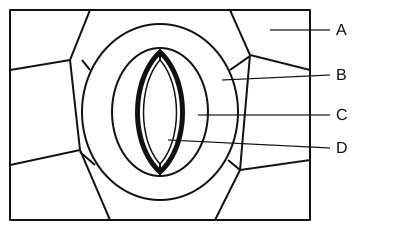
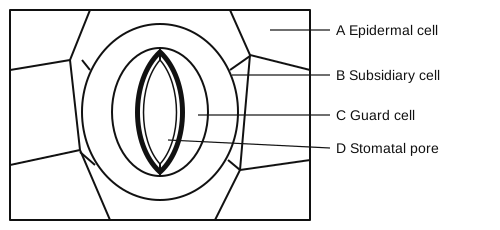
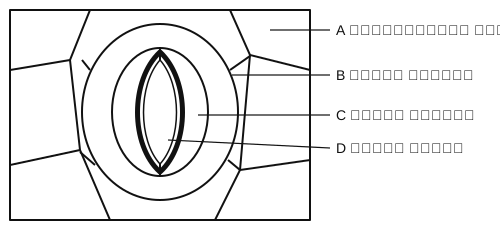
In the given figure, which component has thin outer walls and highly thickened inner walls?
दिए गए चित्र में किस घटक की बाहरी भित्ति पतली और भीतरी भित्ति अत्यधिक मोटी होती है?
  1. AD
  2. BA
  3. CB
  4. DC
Show answer

Concept: The guard cells of a stoma have thin outer walls (away from the pore) and highly thickened inner walls (towards the pore).

  1. A = epidermal cell, B = subsidiary cell, C = guard cell, D = stomatal aperture (pore).
  2. Only the guard cells have this uneven wall thickening. When they become turgid, the thin outer wall bulges outwards and the pore opens.
  3. C is the guard cell, which is option (D).

Short trick: The thick inner wall faces the pore, like a "lip" of the stomatal mouth. Mind the option order: C is option (D).

Answer: (D) C

अवधारणा: रंध्र की द्वार कोशिकाओं की बाहरी भित्ति (छिद्र से दूर) पतली और भीतरी भित्ति (छिद्र की ओर) अत्यधिक मोटी होती है।

  1. A = बाह्यत्वचीय कोशिका, B = सहायक कोशिका, C = द्वार कोशिका, D = रंध्र छिद्र।
  2. केवल द्वार कोशिकाओं में यह असमान भित्ति-स्थूलन होता है। स्फीत होने पर पतली बाहरी भित्ति बाहर की ओर फूलती है और छिद्र खुल जाता है।
  3. C द्वार कोशिका है, जो विकल्प (D) है।

शॉर्ट ट्रिक: मोटी भीतरी भित्ति छिद्र की ओर होती है, जैसे रंध्र-मुख का "होंठ"। विकल्प-क्रम पर ध्यान दें: C विकल्प (D) है।

उत्तर: (D) C

NEET UGBotanyAnatomy of flowering plants – stomatal apparatusNEET UG 2024 · 5 May Shift 1
Q30.
Which one of the following can be explained on the basis of Mendel's law of Dominance?
A. Out of one pair of factors one is dominant and the other is recessive.
B. Alleles do not show any expression and both the characters appear as such in F2 generation.
C. Factors occur in pairs in normal diploid plants.
D. The discrete unit controlling a particular character is called factor.
E. The expression of only one of the parental characters is found in a monohybrid cross.
Choose the correct answer from the options given below:
मेंडल के प्रभाविता के नियम के आधार पर निम्नलिखित में से किसकी व्याख्या की जा सकती है?
A. कारकों के एक युग्म में से एक प्रभावी और दूसरा अप्रभावी होता है।
B. युग्मविकल्पी कोई अभिव्यक्ति नहीं दर्शाते और दोनों लक्षण F2 पीढ़ी में ज्यों-के-त्यों प्रकट होते हैं।
C. सामान्य द्विगुणित पादपों में कारक युग्मों में होते हैं।
D. किसी विशेष लक्षण को नियंत्रित करने वाली विविक्त इकाई को कारक कहते हैं।
E. एकसंकर संकरण में जनकों के केवल एक लक्षण की अभिव्यक्ति मिलती है।
नीचे दिए गए विकल्पों में से सही उत्तर चुनिए:
  1. AA, C, D and E onlyकेवल A, C, D और E
  2. BB, C, and D onlyकेवल B, C और D
  3. CA, B, C, D and EA, B, C, D और E
  4. DA, B and C onlyकेवल A, B और C
Show answer

Concept: NCERT states the law of dominance in three parts: (i) characters are controlled by discrete units called factors, (ii) factors occur in pairs, and (iii) in a dissimilar pair, one member dominates (dominant) over the other (recessive). The law explains why only one parental character is expressed in the F1 of a monohybrid cross.

  1. D matches part (i), C matches part (ii), and A matches part (iii).
  2. E is the observation the law explains: only one parental character appears in the F1.
  3. B is wrong. Alleles do express themselves, and the dominant one masks the recessive. B does not follow from dominance.

Short trick: B is the odd statement out. The only option without B is (A).

Answer: (A) A, C, D and E only

अवधारणा: NCERT प्रभाविता के नियम को तीन भागों में बताती है: (i) लक्षण विविक्त इकाइयों द्वारा नियंत्रित होते हैं जिन्हें कारक कहते हैं, (ii) कारक युग्मों में होते हैं, और (iii) असमान युग्म में एक सदस्य (प्रभावी) दूसरे (अप्रभावी) पर प्रभावी होता है। यह नियम बताता है कि एकसंकर संकरण की F1 में जनकों का केवल एक लक्षण क्यों प्रकट होता है।

  1. D भाग (i) से, C भाग (ii) से और A भाग (iii) से मेल खाता है।
  2. E वह प्रेक्षण है जिसकी व्याख्या यह नियम करता है: F1 में जनकों का केवल एक लक्षण दिखता है।
  3. B गलत है। युग्मविकल्पी अभिव्यक्त होते हैं, और प्रभावी अप्रभावी को छिपा देता है। B प्रभाविता से नहीं निकलता।

शॉर्ट ट्रिक: B अलग कथन है। B रहित एकमात्र विकल्प (A) है।

उत्तर: (A) केवल A, C, D और E

NEET UGBotanyPrinciples of inheritance – law of dominanceNEET UG 2024 · 5 May Shift 1
Q31.
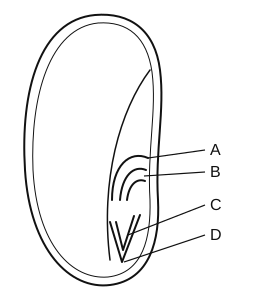
Identify the part of the seed from the given figure which is destined to form root when the seed germinates.
दिए गए चित्र में बीज के उस भाग को पहचानिए जो बीज के अंकुरण पर जड़ बनाता है।
  1. AB
  2. BC
  3. CD
  4. DA
Show answer

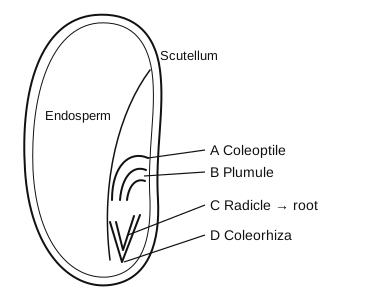
Concept: In a monocot seed (e.g. maize), the embryo axis has a plumule enclosed in the coleoptile at its upper end and a radicle enclosed in the coleorhiza at its lower end. The radicle forms the root.

  1. A = coleoptile (the outer sheath of the shoot tip) and B = plumule (the future shoot).
  2. C = radicle (the future root) and D = coleorhiza (the sheath around the radicle).
  3. The radicle, C, forms the root. C is option (B).

Short trick: Pair the words: rhiza = root sheath, so the radicle is inside it. ptile = shoot sheath, so the plumule is inside it. The inner of the lower pair (C) is the root.

Answer: (B) C

अवधारणा: एकबीजपत्री बीज (जैसे मक्का) में भ्रूणीय अक्ष के ऊपरी सिरे पर प्रांकुर चोल (coleoptile) में बंद प्रांकुर और निचले सिरे पर मूलांकुर चोल (coleorhiza) में बंद मूलांकुर होता है। मूलांकुर जड़ बनाता है।

  1. A = प्रांकुर चोल (प्ररोह-शीर्ष का बाहरी आवरण) और B = प्रांकुर (भावी प्ररोह)।
  2. C = मूलांकुर (भावी जड़) और D = मूलांकुर चोल (मूलांकुर का आवरण)।
  3. मूलांकुर C जड़ बनाता है। C विकल्प (B) है।

शॉर्ट ट्रिक: शब्दों का जोड़ा बनाएँ: rhiza = जड़ का आवरण, अतः मूलांकुर उसके अंदर; ptile = प्ररोह का आवरण, अतः प्रांकुर उसके अंदर। नीचे वाले जोड़े का भीतरी भाग (C) जड़ है।

उत्तर: (B) C

NEET UGBotanyMorphology of flowering plants – monocot seedNEET UG 2024 · 5 May Shift 1
Q32.
Auxin is used by gardeners to prepare weed-free lawns. But no damage is caused to grass as auxin
माली खरपतवार-मुक्त लॉन तैयार करने के लिए ऑक्सिन का उपयोग करते हैं। परंतु घास को कोई हानि नहीं होती, क्योंकि ऑक्सिन
  1. Apromotes abscission of mature leaves onlyकेवल परिपक्व पत्तियों के विलगन (abscission) को बढ़ाता है
  2. Bdoes not affect mature monocotyledon plantsपरिपक्व एकबीजपत्री पादपों को प्रभावित नहीं करता
  3. Ccan help in cell division in grasses, to produce growthघासों में कोशिका विभाजन में सहायता कर वृद्धि उत्पन्न करता है
  4. Dpromotes apical dominanceशीर्ष प्रभाविता को बढ़ाता है
Show answer

Concept: NCERT: 2,4-D, a synthetic auxin, is widely used to kill dicotyledonous weeds and does not affect mature monocotyledonous plants. Gardeners use it to prepare weed-free lawns.

  1. Grass is a monocot, so it is unaffected. Broad-leaved (dicot) weeds are killed.
  2. (A) and (D) are real auxin effects, but neither explains why grass is spared. (C) is a cytokinin role and is not the reason.

Short trick: Remember 2,4-D as "Destroys Dicots".

Answer: (B) does not affect mature monocotyledon plants

अवधारणा: NCERT: संश्लेषित ऑक्सिन 2,4-D का व्यापक उपयोग द्विबीजपत्री खरपतवार नष्ट करने में होता है और यह परिपक्व एकबीजपत्री पादपों को प्रभावित नहीं करता। माली इसी से खरपतवार-मुक्त लॉन बनाते हैं।

  1. घास एकबीजपत्री है, इसलिए उस पर प्रभाव नहीं पड़ता। चौड़ी पत्ती वाले (द्विबीजपत्री) खरपतवार नष्ट हो जाते हैं।
  2. (A) और (D) ऑक्सिन के वास्तविक प्रभाव हैं, पर इनमें से कोई भी नहीं बताता कि घास क्यों बचती है। (C) साइटोकाइनिन का कार्य है और यह कारण नहीं है।

शॉर्ट ट्रिक: 2,4-D को "Destroys Dicots" (द्विबीजपत्री नष्ट करे) से याद रखें।

उत्तर: (B) परिपक्व एकबीजपत्री पादपों को प्रभावित नहीं करता

NEET UGBotanyPlant growth regulators – auxin as weedicideNEET UG 2024 · 5 May Shift 1
Q33.
Given below are two statements:
Statement I: Chromosomes become gradually visible under light microscope during leptotene stage.
Statement II: The beginning of diplotene stage is recognized by dissolution of synaptonemal complex.
In the light of the above statements, choose the correct answer from the options given below:
नीचे दो कथन दिए गए हैं:
कथन I: लेप्टोटीन अवस्था में गुणसूत्र धीरे-धीरे प्रकाश सूक्ष्मदर्शी में दिखाई देने लगते हैं।
कथन II: डिप्लोटीन अवस्था का आरंभ सिनैप्टोनीमल सम्मिश्र (synaptonemal complex) के विघटन से पहचाना जाता है।
उपर्युक्त कथनों के आलोक में, नीचे दिए गए विकल्पों में से सही उत्तर चुनिए:
  1. ABoth Statement I and Statement II are falseकथन I और कथन II दोनों असत्य हैं
  2. BStatement I is true but Statement II is falseकथन I सत्य है परन्तु कथन II असत्य है
  3. CStatement I is false but Statement II is trueकथन I असत्य है परन्तु कथन II सत्य है
  4. DBoth Statement I and Statement II are trueकथन I और कथन II दोनों सत्य हैं
Show answer

Concept: The stages of prophase I are leptotene, zygotene, pachytene, diplotene and diakinesis.

  1. Statement I – true. In leptotene, chromosomes gradually become visible under the light microscope as compaction continues.
  2. Statement II – true. The start of diplotene is marked by dissolution of the synaptonemal complex. The homologues then begin to separate except at the chiasmata.

Short trick: The synaptonemal complex forms in Zygotene and dissolves in Diplotene. Think "Zip" in zygotene and "Divorce" in diplotene.

Answer: (D) Both Statement I and Statement II are true

अवधारणा: पूर्वावस्था I के चरण हैं: लेप्टोटीन, ज़ाइगोटीन, पैकीटीन, डिप्लोटीन और डायाकाइनेसिस।

  1. कथन I – सत्य। लेप्टोटीन में संघनन जारी रहने से गुणसूत्र धीरे-धीरे प्रकाश सूक्ष्मदर्शी में दिखने लगते हैं।
  2. कथन II – सत्य। डिप्लोटीन का आरंभ सिनैप्टोनीमल सम्मिश्र के विघटन से होता है। इसके बाद समजात गुणसूत्र काइऐज़्मा को छोड़कर अलग होने लगते हैं।

शॉर्ट ट्रिक: सिनैप्टोनीमल सम्मिश्र ज़ाइगोटीन में बनता है और डिप्लोटीन में घुलता है। ज़ाइगोटीन में "Zip" और डिप्लोटीन में "Divorce" सोचें।

उत्तर: (D) कथन I और कथन II दोनों सत्य हैं

NEET UGBotanyCell cycle – meiosis prophase INEET UG 2024 · 5 May Shift 1
Q34.
The capacity to generate a whole plant from any cell of the plant is called
पादप की किसी भी कोशिका से पूर्ण पादप उत्पन्न करने की क्षमता कहलाती है:
  1. AMicropropagationसूक्ष्मप्रवर्धन (Micropropagation)
  2. BDifferentiationविभेदन
  3. CSomatic hybridizationकायिक संकरण
  4. DTotipotencyपूर्णशक्तता (Totipotency)
Show answer

Concept: NCERT: the capacity to generate a whole plant from any cell or explant is called totipotency.

  1. Totipotency is the basis of tissue culture.
  2. Micropropagation is the technique that uses tissue culture to raise many plants quickly. It applies totipotency but is not the capacity itself.
  3. Differentiation is the maturation of cells, and somatic hybridisation is protoplast fusion.

Short trick: Toti = total. A cell with total potential can form a whole plant.

Answer: (D) Totipotency

अवधारणा: NCERT: किसी भी कोशिका या कर्तोतक (explant) से पूर्ण पादप उत्पन्न करने की क्षमता को पूर्णशक्तता कहते हैं।

  1. पूर्णशक्तता ऊतक संवर्धन का आधार है।
  2. सूक्ष्मप्रवर्धन वह तकनीक है जिसमें ऊतक संवर्धन से शीघ्र अनेक पादप उगाए जाते हैं। यह पूर्णशक्तता का उपयोग है, स्वयं वह क्षमता नहीं।
  3. विभेदन कोशिकाओं का परिपक्व होना है, और कायिक संकरण जीवद्रव्यक (protoplast) संलयन है।

शॉर्ट ट्रिक: पूर्ण + शक्तता: पूर्ण क्षमता वाली एक कोशिका पूरा पादप बना सकती है।

उत्तर: (D) पूर्णशक्तता

NEET UGBotanyBiotechnology – plant tissue cultureNEET UG 2024 · 5 May Shift 1
Q35.
Given below are two statements:
Statement I: Parenchyma is living but collenchyma is dead tissue.
Statement II: Gymnosperms lack xylem vessels but presence of xylem vessels is the characteristic of angiosperms.
In the light of the above statements, choose the correct answer from the options given below:
नीचे दो कथन दिए गए हैं:
कथन I: मृदूतक (Parenchyma) जीवित है परंतु स्थूलकोण ऊतक (collenchyma) मृत ऊतक है।
कथन II: अनावृतबीजियों में जाइलम वाहिकाएँ नहीं होतीं, परंतु जाइलम वाहिकाओं की उपस्थिति आवृतबीजियों का अभिलक्षण है।
उपर्युक्त कथनों के आलोक में, नीचे दिए गए विकल्पों में से सही उत्तर चुनिए:
  1. ABoth Statement I and Statement II are falseकथन I और कथन II दोनों असत्य हैं
  2. BStatement I is true but Statement II is falseकथन I सत्य है परन्तु कथन II असत्य है
  3. CStatement I is false but Statement II is trueकथन I असत्य है परन्तु कथन II सत्य है
  4. DBoth Statement I and Statement II are trueकथन I और कथन II दोनों सत्य हैं
Show answer

Concept: Parenchyma and collenchyma are both living simple permanent tissues. Sclerenchyma is the dead one. Vessels are a characteristic feature of angiosperms.

  1. Statement I – false. Collenchyma is living, with cellulose, hemicellulose and pectin thickening at the corners. Sclerenchyma is dead.
  2. Statement II – true. NCERT: "Gymnosperms lack vessels in their xylem." The presence of vessels is a characteristic feature of angiosperms.

Short trick: Of the three simple tissues, only Sclerenchyma is dead. Remember "S for Stone-dead".

Answer: (C) Statement I is false but Statement II is true

अवधारणा: मृदूतक और स्थूलकोण ऊतक दोनों जीवित सरल स्थायी ऊतक हैं। दृढ़ोतक (sclerenchyma) मृत होता है। वाहिकाएँ आवृतबीजियों का अभिलक्षण हैं।

  1. कथन I – असत्य। स्थूलकोण ऊतक जीवित होता है और उसके कोनों पर सेलुलोज़, हेमीसेलुलोज़ और पेक्टिन का स्थूलन होता है। दृढ़ोतक मृत होता है।
  2. कथन II – सत्य। NCERT: "अनावृतबीजियों के जाइलम में वाहिकाएँ नहीं होतीं।" वाहिकाओं की उपस्थिति आवृतबीजियों का अभिलक्षण है।

शॉर्ट ट्रिक: तीन सरल ऊतकों में से केवल दृढ़ोतक (Sclerenchyma) मृत है। "S for Stone-dead" याद रखें।

उत्तर: (C) कथन I असत्य है परन्तु कथन II सत्य है

NEET UGBotanyAnatomy of flowering plants – tissuesNEET UG 2024 · 5 May Shift 1
Q36.
Spraying sugarcane crop with which of the following plant growth regulators, increases the length of stem, thus, increasing the yield?
गन्ने की फसल पर निम्नलिखित में से किस पादप वृद्धि नियामक का छिड़काव करने से तने की लंबाई बढ़ती है और इस प्रकार उपज बढ़ती है?
  1. AGibberellinजिबरेलिन
  2. BCytokininसाइटोकाइनिन
  3. CAbscisic acidऐब्सिसिक अम्ल
  4. DAuxinऑक्सिन
Show answer

Concept: Gibberellins cause internode elongation. NCERT: spraying sugarcane with gibberellins increases the length of the stem and raises the yield by as much as 20 tonnes per acre.

  1. Sugarcane stores sugar in its stem, so a longer stem means more sugar.
  2. Cytokinin promotes cell division and delays senescence. ABA is a growth inhibitor. Auxin is used for rooting and as a weedicide, not for this purpose.

Short trick: Think GA = Grow tall: it lengthens sugarcane stems, makes grape stalks longer and causes bolting.

Answer: (A) Gibberellin

अवधारणा: जिबरेलिन पर्वसंधियों (internodes) का दीर्घीकरण करते हैं। NCERT: गन्ने पर जिबरेलिन के छिड़काव से तने की लंबाई बढ़ती है और उपज लगभग 20 टन प्रति एकड़ तक बढ़ जाती है।

  1. गन्ना अपने तने में शर्करा संचित करता है, अतः लंबे तने से अधिक शर्करा मिलती है।
  2. साइटोकाइनिन कोशिका विभाजन बढ़ाता है और जीर्णता को टालता है। ABA वृद्धि-संदमक है। ऑक्सिन जड़ निकालने और खरपतवारनाशी के रूप में प्रयुक्त होता है, इस कार्य के लिए नहीं।

शॉर्ट ट्रिक: GA = Grow tall: यह गन्ने का तना लंबा करता है, अंगूर का डंठल लंबा करता है और बोल्टिंग कराता है।

उत्तर: (A) जिबरेलिन

NEET UGBotanyPlant growth regulators – gibberellinsNEET UG 2024 · 5 May Shift 1
Q37.
Given below are two statements:
Statement I: In C3 plants, some O2 binds to RuBisCO, hence CO2 fixation is decreased.
Statement II: In C4 plants, mesophyll cells show very little photorespiration while bundle sheath cells do not show photorespiration.
In the light of the above statements, choose the correct answer from the options given below:
नीचे दो कथन दिए गए हैं:
कथन I: C3 पादपों में कुछ O2 RuBisCO से जुड़ जाती है, अतः CO2 स्थिरीकरण घट जाता है।
कथन II: C4 पादपों में पर्णमध्योतक (mesophyll) कोशिकाएँ बहुत कम प्रकाश-श्वसन दर्शाती हैं, जबकि पूलाच्छद (bundle sheath) कोशिकाएँ प्रकाश-श्वसन नहीं दर्शातीं।
उपर्युक्त कथनों के आलोक में, नीचे दिए गए विकल्पों में से सही उत्तर चुनिए:
  1. ABoth Statement I and Statement II are falseकथन I और कथन II दोनों असत्य हैं
  2. BStatement I is true but Statement II is falseकथन I सत्य है परन्तु कथन II असत्य है
  3. CStatement I is false but Statement II is trueकथन I असत्य है परन्तु कथन II सत्य है
  4. DBoth Statement I and Statement II are trueकथन I और कथन II दोनों सत्य हैं
Show answer

Concept: RuBisCO can act as an oxygenase. C3 plants therefore lose fixed carbon to photorespiration, while C4 plants avoid it.

  1. Statement I – true. In C3 plants some O2 binds to RuBisCO, giving 1 PGA + 1 phosphoglycolate, so CO2 fixation decreases.
  2. Statement II – false. In C4 plants the mesophyll cells have no RuBisCO (PEPcase fixes CO2), so they show no photorespiration at all. The bundle sheath cells have a high CO2 concentration, which minimises oxygenase activity. NCERT states that photorespiration does not occur in C4 plants.

Short trick: No RuBisCO in C4 mesophyll means no photorespiration there. Saying "very little" makes Statement II false.

Answer: (B) Statement I is true but Statement II is false

अवधारणा: RuBisCO ऑक्सीजिनेज़ की तरह भी कार्य कर सकता है। इसलिए C3 पादप स्थिर कार्बन प्रकाश-श्वसन में खोते हैं, जबकि C4 पादप इससे बचते हैं।

  1. कथन I – सत्य। C3 पादपों में कुछ O2 RuBisCO से जुड़ती है, जिससे 1 PGA + 1 फॉस्फोग्लाइकोलेट बनते हैं, अतः CO2 स्थिरीकरण घटता है।
  2. कथन II – असत्य। C4 पादपों में पर्णमध्योतक कोशिकाओं में RuBisCO होता ही नहीं (PEPcase CO2 स्थिर करता है), अतः वहाँ प्रकाश-श्वसन बिल्कुल नहीं होता। पूलाच्छद में CO2 की सांद्रता अधिक होती है, जिससे ऑक्सीजिनेज़ क्रिया न्यूनतम रहती है। NCERT कहती है कि C4 पादपों में प्रकाश-श्वसन नहीं होता।

शॉर्ट ट्रिक: C4 पर्णमध्योतक में RuBisCO नहीं, तो वहाँ प्रकाश-श्वसन भी नहीं। "बहुत कम" कहना कथन II को असत्य बनाता है।

उत्तर: (B) कथन I सत्य है परन्तु कथन II असत्य है

NEET UGBotanyPhotosynthesis – photorespirationNEET UG 2024 · 5 May Shift 1
Q38.
Match List I with List II.
List-IList-II
A. GLUT-4I. Hormone
B. InsulinII. Enzyme
C. TrypsinIII. Intercellular ground substance
D. CollagenIV. Enables glucose transport into cells
Choose the correct answer from the options given below:
सूची-I का सूची-II से मिलान कीजिए।
सूची-Iसूची-II
A. GLUT-4I. हॉर्मोन
B. इंसुलिनII. एंजाइम
C. ट्रिप्सिनIII. अंतरकोशिकीय आधार पदार्थ
D. कोलैजनIV. कोशिकाओं में ग्लूकोज़ के परिवहन को संभव बनाता है
नीचे दिए गए विकल्पों में से सही उत्तर चुनिए:
  1. AA-I, B-II, C-III, D-IV
  2. BA-II, B-III, C-IV, D-I
  3. CA-III, B-IV, C-I, D-II
  4. DA-IV, B-I, C-II, D-III
Show answer

Concept: This matches NCERT's table "Some proteins and their functions".

  1. A → IV: GLUT-4 enables glucose transport into cells.
  2. B → I: insulin is a hormone.
  3. C → II: trypsin is an enzyme (a protease).
  4. D → III: collagen is the intercellular ground substance.

Short trick: GLUT-4 goes with glucose. Only option (D) begins with A-IV.

Answer: (D) A-IV, B-I, C-II, D-III

अवधारणा: यह NCERT की तालिका "कुछ प्रोटीन और उनके कार्य" से मेल खाता है।

  1. A → IV: GLUT-4 कोशिकाओं में ग्लूकोज़ परिवहन संभव बनाता है।
  2. B → I: इंसुलिन एक हॉर्मोन है।
  3. C → II: ट्रिप्सिन एक एंजाइम (प्रोटिएज़) है।
  4. D → III: कोलैजन अंतरकोशिकीय आधार पदार्थ है।

शॉर्ट ट्रिक: GLUT-4 को glucose से जोड़ें। केवल विकल्प (D) A-IV से शुरू होता है।

उत्तर: (D) A-IV, B-I, C-II, D-III

NEET UGBotanyBiomolecules – proteins and functionsNEET UG 2024 · 5 May Shift 1
Q39.
Read the following statements and choose the set of correct statements:
In the members of Phaeophyceae,
A. Asexual reproduction occurs usually by biflagellate zoospores.
B. Sexual reproduction is by oogamous method only.
C. Stored food is in the form of carbohydrates which is either mannitol or laminarin.
D. The major pigments found are chlorophyll a, c and carotenoids and xanthophyll.
E. Vegetative cells have a cellulosic wall, usually covered on the outside by gelatinous coating of algin.
Choose the correct answer from the options given below:
निम्नलिखित कथनों को पढ़िए और सही कथनों का समुच्चय चुनिए:
फियोफाइसी के सदस्यों में,
A. अलैंगिक जनन प्रायः द्विकशाभिकी चलबीजाणुओं (biflagellate zoospores) द्वारा होता है।
B. लैंगिक जनन केवल विषमयुग्मकी (oogamous) विधि से होता है।
C. संचित भोजन कार्बोहाइड्रेट के रूप में होता है, जो मैनिटॉल या लैमिनेरिन होता है।
D. पाए जाने वाले मुख्य वर्णक क्लोरोफिल a, c तथा कैरोटिनॉइड और ज़ैंथोफिल हैं।
E. कायिक कोशिकाओं में सेलुलोज़ की भित्ति होती है, जो प्रायः बाहर से ऐल्जिन के जिलेटिनी आवरण से ढकी रहती है।
नीचे दिए गए विकल्पों में से सही उत्तर चुनिए:
  1. AB, C, D and E onlyकेवल B, C, D और E
  2. BA, C, D and E onlyकेवल A, C, D और E
  3. CA, B, C and E onlyकेवल A, B, C और E
  4. DA, B, C and D onlyकेवल A, B, C और D
Show answer

Concept: Features of brown algae (Phaeophyceae) from NCERT.

  1. A – true. Asexual reproduction is by pear-shaped biflagellate zoospores with two unequal, laterally attached flagella.
  2. B – false. Sexual reproduction may be isogamous, anisogamous or oogamous, not only oogamous.
  3. C – true. Food is stored as complex carbohydrates, laminarin or mannitol.
  4. D – true. The pigments are chlorophyll a, c, carotenoids and xanthophylls (fucoxanthin).
  5. E – true. The cellulosic wall is covered by a gelatinous coating of algin.

Short trick: The word "only" is a warning sign. B is the single false statement, and the option without B is (B).

Answer: (B) A, C, D and E only

अवधारणा: NCERT के अनुसार भूरे शैवाल (फियोफाइसी) के लक्षण।

  1. A – सत्य। अलैंगिक जनन नाशपाती के आकार के द्विकशाभिकी चलबीजाणुओं से होता है, जिनमें दो असमान, पार्श्व में जुड़े कशाभ होते हैं।
  2. B – असत्य। लैंगिक जनन समयुग्मकी, असमयुग्मकी या विषमयुग्मकी हो सकता है, केवल विषमयुग्मकी नहीं।
  3. C – सत्य। भोजन जटिल कार्बोहाइड्रेट, लैमिनेरिन या मैनिटॉल, के रूप में संचित होता है।
  4. D – सत्य। वर्णक क्लोरोफिल a, c, कैरोटिनॉइड और ज़ैंथोफिल (फ्यूकोज़ैंथिन) हैं।
  5. E – सत्य। सेलुलोज़ भित्ति ऐल्जिन के जिलेटिनी आवरण से ढकी होती है।

शॉर्ट ट्रिक: "केवल" शब्द चेतावनी का संकेत है। B एकमात्र असत्य कथन है, और B रहित विकल्प (B) है।

उत्तर: (B) केवल A, C, D और E

NEET UGBotanyPlant kingdom – PhaeophyceaeNEET UG 2024 · 5 May Shift 1
Q40.
Which of the following statements is correct regarding the process of replication in E. coli?
E. coli में प्रतिकृतिकरण की प्रक्रिया के संबंध में निम्नलिखित में से कौन-सा कथन सही है?
  1. AThe DNA dependent RNA polymerase catalyses polymerization in one direction, that is 5′ → 3′.DNA आश्रित RNA पॉलीमरेज़ एक ही दिशा में, अर्थात् 5′ → 3′ में, बहुलकीकरण उत्प्रेरित करता है।
  2. BThe DNA dependent DNA polymerase catalyses polymerization in 5′ → 3′ as well as 3′ → 5′ direction.DNA आश्रित DNA पॉलीमरेज़ 5′ → 3′ तथा 3′ → 5′ दोनों दिशाओं में बहुलकीकरण उत्प्रेरित करता है।
  3. CThe DNA dependent DNA polymerase catalyses polymerization in 5′ → 3′ direction.DNA आश्रित DNA पॉलीमरेज़ 5′ → 3′ दिशा में बहुलकीकरण उत्प्रेरित करता है।
  4. DThe DNA dependent DNA polymerase catalyses polymerization in one direction that is 3′ → 5′.DNA आश्रित DNA पॉलीमरेज़ एक ही दिशा में, अर्थात् 3′ → 5′ में, बहुलकीकरण उत्प्रेरित करता है।
Show answer

Concept: The main replication enzyme is DNA-dependent DNA polymerase. It catalyses polymerisation in one direction only, 5′ → 3′.

  1. (A) is about RNA polymerase, which carries out transcription, not replication, so it does not answer the question.
  2. (B) and (D) are wrong because polymerase cannot add nucleotides in the 3′ → 5′ direction.
  3. Since synthesis is only 5′ → 3′, the leading strand is continuous and the lagging strand is discontinuous (Okazaki fragments).

Short trick: New nucleotides are always added at the free 3′-OH end, so the chain grows 5′ → 3′.

Answer: (C) DNA dependent DNA polymerase, 5′ → 3′

अवधारणा: प्रतिकृतिकरण का मुख्य एंजाइम DNA आश्रित DNA पॉलीमरेज़ है। यह केवल एक दिशा, 5′ → 3′, में बहुलकीकरण उत्प्रेरित करता है।

  1. (A) RNA पॉलीमरेज़ के बारे में है, जो अनुलेखन करता है, प्रतिकृतिकरण नहीं; अतः यह प्रश्न का उत्तर नहीं है।
  2. (B) और (D) गलत हैं क्योंकि पॉलीमरेज़ 3′ → 5′ दिशा में न्यूक्लियोटाइड नहीं जोड़ सकता।
  3. संश्लेषण केवल 5′ → 3′ होने के कारण अग्रग रज्जुक सतत और पश्चगामी रज्जुक असतत (ओकाज़ाकी खंड) बनता है।

शॉर्ट ट्रिक: नए न्यूक्लियोटाइड सदा मुक्त 3′-OH सिरे पर जुड़ते हैं, अतः शृंखला 5′ → 3′ बढ़ती है।

उत्तर: (C) DNA आश्रित DNA पॉलीमरेज़, 5′ → 3′

NEET UGBotanyMolecular basis of inheritance – DNA replicationNEET UG 2024 · 5 May Shift 1