Q21.A unit positive point charge is taken slowly through an infinitesimally thin tube that is inside a charged dielectric sphere of radius R, having uniform positive charge density
, as shown in the figure. The initial and final positions of the charge are marked by A and B at distances 2R and 3R respectively, from the centre of the sphere. In this process, the magnitude of the total work done on the point charge is
.
The value of n is :
(
is the permittivity of vacuum)
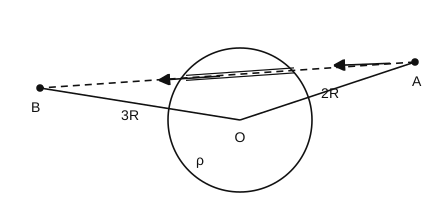
एक एकांक धनात्मक बिंदु आवेश को, चित्रानुसार एकसमान धनात्मक आवेश घनत्व
वाले त्रिज्या R के आवेशित परावैद्युत गोले के अंदर स्थित एक अतिसूक्ष्म पतली नलिका से होकर धीरे-धीरे ले जाया जाता है। आवेश की प्रारंभिक तथा अंतिम स्थितियाँ A और B से चिह्नित हैं, जो गोले के केंद्र से क्रमशः 2R और 3R दूरी पर हैं। इस प्रक्रम में बिंदु आवेश पर किए गए कुल कार्य का परिमाण
है।
n का मान है :
(
निर्वात की विद्युतशीलता है)
- A2
- B6
- C9
- D18
Show answer
Concept: Electrostatic force is conservative: work depends only on end points. Outside the sphere , .
- .
- .
- n = 18. The path through the sphere is irrelevant.
Short trick: ; at 2R it is half, at 3R one-third → difference .
Answer: (D) 18
अवधारणा: स्थिरवैद्युत बल संरक्षी है: कार्य केवल अंतिम बिंदुओं पर निर्भर है। गोले के बाहर , ।
- ।
- ।
- n = 18। गोले के भीतर से होकर जाने वाला पथ अप्रासंगिक है।
शॉर्ट ट्रिक: ; 2R पर आधा, 3R पर एक-तिहाई → अंतर ।
उत्तर: (D) 18
NEET UGPhysicsElectrostatic potential – work outside a charged sphereNEET UG 2026 · 21 Jun Shift 1
Q22.Consider three media P, Q and R with refractive indices 1, 1.25, and 1.5, respectively. The medium Q having a thickness of 5 cm is placed between extended media P and R as shown in the figure. An object O is placed at the centre of medium Q. If viewed from medium P near the normal direction, the apparent depth of O is
. For similar observation from medium R, the apparent depth is
. The value of
, in cm, is :
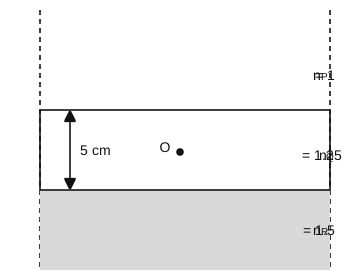
अपवर्तनांक क्रमशः 1, 1.25 और 1.5 वाले तीन माध्यमों P, Q और R पर विचार कीजिए। 5 cm मोटाई वाला माध्यम Q, चित्रानुसार विस्तारित माध्यमों P और R के बीच रखा है। एक वस्तु O माध्यम Q के केंद्र पर रखी है। यदि माध्यम P से लगभग अभिलंब दिशा में देखा जाए, तो O की आभासी गहराई
है। माध्यम R से इसी प्रकार देखने पर आभासी गहराई
है।
का मान, cm में, है :
- A0
- B1
- C2
- D3
Show answer
Concept: Near-normal viewing: apparent depth .
- O is at the centre, so real depth from either face = 2.5 cm.
- From P: cm.
- From R: cm.
- cm.
Short trick: Observer in denser medium sees the object farther; cm.
Answer: (B) 1
अवधारणा: लगभग अभिलंब दिशा से देखने पर: आभासी गहराई ।
- O केंद्र पर है, अतः किसी भी फलक से वास्तविक गहराई = 2.5 cm।
- P से: cm।
- R से: cm।
- cm।
शॉर्ट ट्रिक: सघन माध्यम में बैठे प्रेक्षक को वस्तु अधिक दूर दिखती है; cm।
उत्तर: (B) 1
NEET UGPhysicsRay optics – apparent depthNEET UG 2026 · 21 Jun Shift 1
Q23.A frictionless circular wire of unit radius is fixed on the horizontal plane. Two point particles of unit mass start moving simultaneously from point
with identical uniform angular speeds in opposite directions, and meet again at point
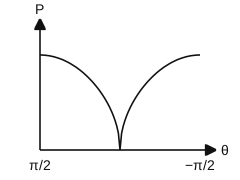
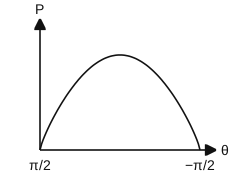
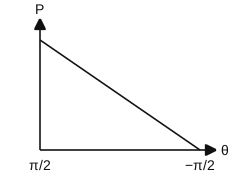
. During this time, which of the following figures schematically represent the magnitude of the total linear momentum P of the system, as a function of
?
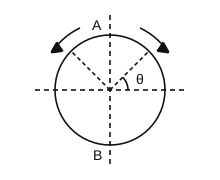
इकाई त्रिज्या का एक घर्षणरहित वृत्ताकार तार क्षैतिज तल पर स्थिर है। इकाई द्रव्यमान के दो बिंदु कण बिंदु
से एक साथ समान एकसमान कोणीय चालों से विपरीत दिशाओं में गति प्रारंभ करते हैं और बिंदु
पर पुनः मिलते हैं। इस अवधि में, निम्नलिखित में से कौन-सा चित्र
के फलन के रूप में निकाय के कुल रैखिक संवेग P के परिमाण को योजनाबद्ध रूप से निरूपित करता है?
- A
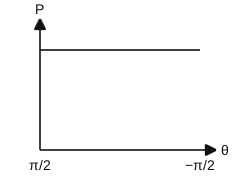
- B
- C
- D
Show answer
Concept: Add the two velocity vectors: the particles are mirror images about the vertical diameter, so horizontal components cancel and vertical components add.
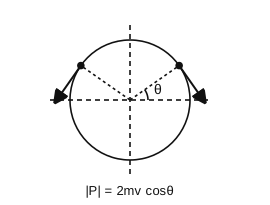
- Particle at angle has velocity tangent to the circle; its vertical component has magnitude .
- Total momentum (directed along the vertical diameter).
- At (A and B) P = 0; at P is maximum – a single smooth hump.
- (A) constant ✘, (B) zero in the middle ✘, (D) linear and non-zero at A ✘.
Short trick: At A both velocities are horizontal and opposite → P = 0; same at B. Only graph (C) is zero at both ends.
Answer: (C)
अवधारणा: दोनों वेग सदिशों को जोड़ें: दोनों कण ऊर्ध्वाधर व्यास के सापेक्ष दर्पण-प्रतिबिंब हैं, अतः क्षैतिज घटक निरस्त होते हैं और ऊर्ध्वाधर घटक जुड़ते हैं।
- कोण पर स्थित कण का वेग वृत्त की स्पर्शरेखा के अनुदिश है; इसके ऊर्ध्वाधर घटक का परिमाण है।
- कुल संवेग (ऊर्ध्वाधर व्यास के अनुदिश)।
- (A और B) पर P = 0; पर P अधिकतम – एक चिकना उभार।
- (A) नियत ✘, (B) बीच में शून्य ✘, (D) रैखिक तथा A पर शून्येतर ✘।
शॉर्ट ट्रिक: A पर दोनों वेग क्षैतिज और विपरीत हैं → P = 0; B पर भी यही। केवल ग्राफ (C) दोनों सिरों पर शून्य है।
उत्तर: (C)
NEET UGPhysicsSystem of particles – momentum of two particles on a circleNEET UG 2026 · 21 Jun Shift 1
Q24.The temperature of a metallic sphere of radius R is increased by a small amount . If the linear coefficient of thermal expansion of the metal is , the approximate increase in the volume of the sphere is :
त्रिज्या R के एक धात्विक गोले का ताप एक अल्प मात्रा से बढ़ाया जाता है। यदि धातु का रैखिक ऊष्मीय प्रसार गुणांक है, तो गोले के आयतन में लगभग वृद्धि है :
- A
- B
- C
- D
Show answer
Concept: Volume expansion coefficient ; .
- .
- .
Short trick: with → same result.
Answer: (C)
अवधारणा: आयतन प्रसार गुणांक ; ।
- ।
- ।
शॉर्ट ट्रिक: , जहाँ → वही परिणाम।
उत्तर: (C)
NEET UGPhysicsThermal properties – volume expansionNEET UG 2026 · 21 Jun Shift 1
Q25.A cylindrical cork of uniform density floats in a liquid of density . If the cork is depressed slightly and released, it oscillates harmonically with time period T. If the same cork floats in another liquid of density , then the similar oscillation has time period 2T. The value of is :
एकसमान घनत्व वाला एक बेलनाकार कॉर्क घनत्व के द्रव में तैरता है। यदि कॉर्क को थोड़ा दबाकर छोड़ दिया जाए, तो यह आवर्तकाल T से सरल आवर्त दोलन करता है। यदि वही कॉर्क घनत्व के दूसरे द्रव में तैरे, तो इसी प्रकार के दोलन का आवर्तकाल 2T है। का मान है :
- A4
- B2
- C1/2
- D1/4
Show answer
Concept: Extra depression x gives restoring force , so .
- .
- .
Short trick: Period doubles → "spring constant" must become one-fourth.
Answer: (D) 1/4
अवधारणा: अतिरिक्त धँसाव x से प्रत्यानयन बल मिलता है, अतः ।
- ।
- ।
शॉर्ट ट्रिक: आवर्तकाल दोगुना → "स्प्रिंग नियतांक" एक-चौथाई होना चाहिए।
उत्तर: (D) 1/4
NEET UGPhysicsOscillations – floating body SHMNEET UG 2026 · 21 Jun Shift 1
Q26.One main scale division of a Vernier calliper is equal to 1 mm and the number of divisions on the Vernier scale is 10. When both the jaws touch each other, the Vernier scale shifts to the left of zero of the main scale in such a way that Vernier division coincides with a division of the main scale. If this Vernier calliper measures the length of a wire to be 1 cm, the actual length of the wire is :
एक वर्नियर कैलिपर्स का एक मुख्य स्केल भाग 1 mm के बराबर है तथा वर्नियर स्केल पर भागों की संख्या 10 है। जब दोनों जबड़े एक-दूसरे को स्पर्श करते हैं, तो वर्नियर स्केल मुख्य स्केल के शून्य के बाईं ओर इस प्रकार खिसक जाता है कि वर्नियर का (चौथा) भाग मुख्य स्केल के किसी भाग से संपाती होता है। यदि यह वर्नियर कैलिपर्स किसी तार की लंबाई 1 cm मापता है, तो तार की वास्तविक लंबाई है :
- A0.60 cm
- B0.96 cm
- C1.00 cm
- D1.04 cm
Show answer
Concept: Least count = 1 MSD − 1 VSD = 0.1 mm. Vernier zero to the left of main-scale zero → negative zero error = −(N − k) × LC, where k is the coinciding vernier division.
- LC = 1 mm / 10 = 0.1 mm = 0.01 cm.
- Negative zero error = −(10 − 4) × 0.01 cm = −0.06 cm.
- True length = observed − zero error = 1.00 − (−0.06) = 1.06 cm.
- 1.06 cm is not among the options (1.04 cm would need the wrong rule "−4 × LC" with the sign also reversed).
Short trick: Negative zero error: count the vernier divisions after the coinciding one (10 − 4 = 6) and add 6 × LC to the reading.
Answer: Bonus – the correct length is 1.06 cm, which matches none of the four options; marks to all.
अवधारणा: अल्पतमांक = 1 MSD − 1 VSD = 0.1 mm। वर्नियर का शून्य मुख्य स्केल के शून्य के बाईं ओर → ऋणात्मक शून्यांक त्रुटि = −(N − k) × LC, जहाँ k संपाती वर्नियर भाग है।
- LC = 1 mm / 10 = 0.1 mm = 0.01 cm।
- ऋणात्मक शून्यांक त्रुटि = −(10 − 4) × 0.01 cm = −0.06 cm।
- वास्तविक लंबाई = प्रेक्षित − शून्यांक त्रुटि = 1.00 − (−0.06) = 1.06 cm।
- 1.06 cm किसी विकल्प में नहीं है (1.04 cm के लिए गलत नियम "−4 × LC" और चिह्न भी उलटना पड़ेगा)।
शॉर्ट ट्रिक: ऋणात्मक शून्यांक त्रुटि: संपाती भाग के बाद के वर्नियर भाग गिनें (10 − 4 = 6) और पाठ्यांक में 6 × LC जोड़ें।
उत्तर: बोनस – सही लंबाई 1.06 cm है, जो चारों में से किसी विकल्प से मेल नहीं खाती; सभी को अंक।
NEET UGPhysicsExperimental skills – vernier calliper zero errorNEET UG 2026 · 21 Jun Shift 1
Q27.A solid sphere A of radius R and mass M is attached at a point to a smaller solid sphere B of radius r < R and mass m < M. Assume that the line joining their centres lies along the horizontal. The moment of inertia of the system calculated about a vertical axis passing through the centre of A is
and that calculated about a vertical axis passing through the centre of B is
. The difference
is :
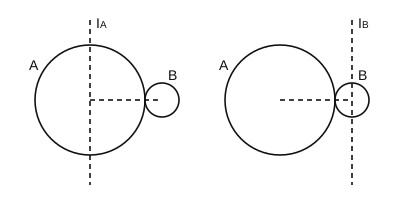
त्रिज्या R और द्रव्यमान M का एक ठोस गोला A, त्रिज्या r < R और द्रव्यमान m < M के एक छोटे ठोस गोले B से एक बिंदु पर जुड़ा है। मान लीजिए कि इनके केंद्रों को मिलाने वाली रेखा क्षैतिज है। A के केंद्र से गुजरने वाली ऊर्ध्वाधर अक्ष के परितः निकाय का जड़त्व आघूर्ण
है तथा B के केंद्र से गुजरने वाली ऊर्ध्वाधर अक्ष के परितः
है। अंतर
है :
- A
- B
- C
- D0
Show answer
Concept: Parallel axis theorem: ; centres are apart (spheres touch externally).
- .
- .
- (negative, since M > m).
Short trick: Own-centre terms cancel; only the "shifted" mass changes: .
Answer: (B)
अवधारणा: समांतर अक्ष प्रमेय: ; केंद्रों के बीच दूरी (गोले बाहर से स्पर्श करते हैं)।
- ।
- ।
- (ऋणात्मक, क्योंकि M > m)।
शॉर्ट ट्रिक: अपने-अपने केंद्र वाले पद कट जाते हैं; केवल "विस्थापित" द्रव्यमान बदलता है: ।
उत्तर: (B)
NEET UGPhysicsRotational motion – parallel axis theoremNEET UG 2026 · 21 Jun Shift 1
Q28.Consider a spring mass simple harmonic oscillator in one dimension. The mass of the particle is m kg and the spring constant is k . At a given instant, the extension of the spring is x meter and the speed of the particle is v . On the x-v plane, if the graph of v as a function of x is a circle, then the correct option is :
एक-विमीय स्प्रिंग-द्रव्यमान सरल आवर्ती दोलित्र पर विचार कीजिए। कण का द्रव्यमान m kg तथा स्प्रिंग नियतांक k है। किसी क्षण स्प्रिंग का विस्तार x मीटर तथा कण की चाल v है। x-v तल पर, यदि x के फलन के रूप में v का ग्राफ एक वृत्त है, तो सही विकल्प है :
- A
- B
- C
- D
Show answer
Concept: Energy conservation: – in general an ellipse in the x–v plane.
- Write as .
- It is a circle only if the two semi-axes are equal: (numerically, in the given units).
Short trick: → circle needs ω = 1 → k/m = 1.
Answer: (B)
अवधारणा: ऊर्जा संरक्षण: – सामान्यतः x–v तल में दीर्घवृत्त।
- इसे लिखें।
- यह वृत्त तभी होगा जब दोनों अर्ध-अक्ष बराबर हों: (दी गई इकाइयों में संख्यात्मक रूप से)।
शॉर्ट ट्रिक: → वृत्त के लिए ω = 1 → k/m = 1।
उत्तर: (B)
NEET UGPhysicsOscillations – phase-space (x–v) graph of SHMNEET UG 2026 · 21 Jun Shift 1
Q29.The lens combination as shown in the figure, consists of two lenses,
and
, of the focal lengths +10 cm and −10 cm, respectively. The position of the image formed is :
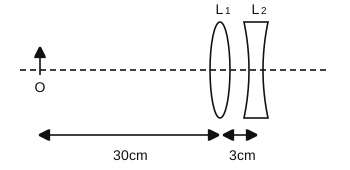
चित्र में दर्शाए गए लेंस संयोजन में फोकस दूरियों क्रमशः +10 cm तथा −10 cm वाले दो लेंस
और
हैं। बने प्रतिबिंब की स्थिति है :
- A20 cm to the left of the concave lensअवतल लेंस के 20 cm बाईं ओर
- B60 cm to the left of the concave lensअवतल लेंस के 60 cm बाईं ओर
- C30 cm to the right of the concave lensअवतल लेंस के 30 cm दाईं ओर
- D60 cm to the right of the concave lensअवतल लेंस के 60 cm दाईं ओर
Show answer
Concept: Lens formula applied lens by lens; the image of is the object for .
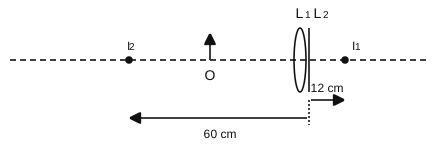
- : u = −30 cm, f = +10 cm → → v = +15 cm (15 cm right of ).
- This point is 15 − 3 = 12 cm to the right of → virtual object for : u = +12 cm.
- : → v = −60 cm.
- Final image is 60 cm to the left of the concave lens.
Short trick: Virtual object inside the focal length of a diverging lens always gives a virtual image on the incoming side.
Answer: (B) 60 cm to the left of the concave lens
अवधारणा: लेंस सूत्र एक-एक लेंस पर लगाएँ; का प्रतिबिंब के लिए वस्तु है।
- : u = −30 cm, f = +10 cm → → v = +15 cm ( के 15 cm दाईं ओर)।
- यह बिंदु के 15 − 3 = 12 cm दाईं ओर है → के लिए आभासी वस्तु: u = +12 cm।
- : → v = −60 cm।
- अंतिम प्रतिबिंब अवतल लेंस के 60 cm बाईं ओर है।
शॉर्ट ट्रिक: अपसारी लेंस की फोकस दूरी के भीतर आभासी वस्तु सदैव आपतन की ओर आभासी प्रतिबिंब देती है।
उत्तर: (B) अवतल लेंस के 60 cm बाईं ओर
NEET UGPhysicsRay optics – combination of lensesNEET UG 2026 · 21 Jun Shift 1
Q30.An ac voltage Volt is applied to a series LCR circuit. Then the current amplitude in this circuit is :
(Given : L = 10 mH, C = 25F, R = 100 )
एक श्रेणी LCR परिपथ पर प्रत्यावर्ती वोल्टता वोल्ट लगाई जाती है। तब इस परिपथ में धारा का आयाम है :
(दिया है : L = 10 mH, C = 25F, R = 100 )
- A2.2 A
- B5.5 A
- C11.0 A
- D22.0 A
Show answer
Concept: , .
- ; .
- .
- → resonance, Z = R = 100 Ω.
- A.
Short trick: Check → resonance at once.
Answer: (A) 2.2 A
अवधारणा: , ।
- ; ।
- ।
- → अनुनाद, Z = R = 100 Ω।
- A।
शॉर्ट ट्रिक: जाँचें → तुरंत अनुनाद।
उत्तर: (A) 2.2 A
NEET UGPhysicsAlternating current – series LCR at resonanceNEET UG 2026 · 21 Jun Shift 1
Q31.A thin horizontal disc is rotating about a vertical axis passing through its fixed centre O. Its angular momentum is
and
computed about points A and B, respectively, with OB = 2 × OA. The value of
is :
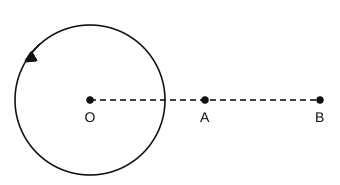
एक पतली क्षैतिज चकती अपने स्थिर केंद्र O से गुजरने वाली ऊर्ध्वाधर अक्ष के परितः घूर्णन कर रही है। बिंदुओं A और B के परितः परिकलित इसका कोणीय संवेग क्रमशः
और
है, जहाँ OB = 2 × OA है।
का मान है :
- A
- B
- C1
- D2
Show answer
Concept: About any point A: , where is the position of A from O and is the total linear momentum.
- The centre O is fixed, so the centre of mass is at rest: total linear momentum .
- Hence and likewise – independent of the reference point.
- ; the distances OA, OB do not matter.
Short trick: Pure rotation about a fixed centre of mass = "pure couple" of momentum → same L about every point.
Answer: (C) 1
अवधारणा: , जहाँ , O से A का स्थिति सदिश है तथा कुल रैखिक संवेग है।
- केंद्र O स्थिर है, अतः द्रव्यमान केंद्र विरामावस्था में है: कुल रैखिक संवेग ।
- अतः तथा इसी प्रकार – संदर्भ बिंदु से स्वतंत्र।
- ; दूरियाँ OA, OB का कोई महत्व नहीं।
शॉर्ट ट्रिक: स्थिर द्रव्यमान केंद्र के परितः शुद्ध घूर्णन = संवेग का "शुद्ध युग्म" → प्रत्येक बिंदु के परितः समान L।
उत्तर: (C) 1
NEET UGPhysicsRotational motion – angular momentum about different pointsNEET UG 2026 · 21 Jun Shift 1
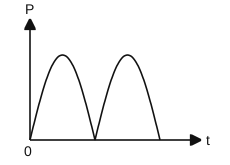
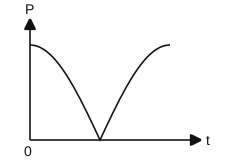
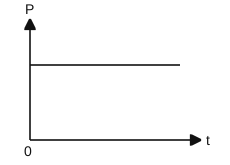
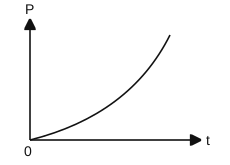
Q32.A conducting loop of finite resistance lies on the x-y plane. There is a constant magnetic field in the z direction. The area of the loop varies with time t, as in appropriate units. The figure that correctly indicates the qualitative behaviour of the power P dissipated in the loop as a function of time is :
परिमित प्रतिरोध का एक चालक लूप x-y तल में स्थित है। z दिशा में एक नियत चुम्बकीय क्षेत्र है। लूप का क्षेत्रफल समय t के साथ उपयुक्त इकाइयों में के अनुसार बदलता है। लूप में क्षयित शक्ति P के समय के फलन के रूप में गुणात्मक व्यवहार को सही रूप से दर्शाने वाला चित्र है :
- A
- B
- C
- D
Show answer
Concept: Faraday's law ; power .
- → .
- : maximum at t = 0, zero at , maximum again at .
- (B) starts at a maximum, falls to zero and rises again ✔. (A) starts from zero (that is ) ✘; (C) constant ✘; (D) ever-increasing ✘.
Short trick: Emf follows the slope of sin t, i.e. cos t – largest at t = 0. So P must start at its maximum.
Answer: (B)
अवधारणा: फैराडे का नियम ; शक्ति ।
- → ।
- : t = 0 पर अधिकतम, पर शून्य, पर पुनः अधिकतम।
- (B) अधिकतम से प्रारंभ होकर शून्य तक गिरता और फिर बढ़ता है ✔। (A) शून्य से प्रारंभ () ✘; (C) नियत ✘; (D) सतत बढ़ता ✘।
शॉर्ट ट्रिक: emf, sin t के ढाल अर्थात् cos t का अनुसरण करता है – t = 0 पर सबसे अधिक। अतः P अधिकतम से प्रारंभ होना चाहिए।
उत्तर: (B)
NEET UGPhysicsElectromagnetic induction – power in a loop with varying areaNEET UG 2026 · 21 Jun Shift 1
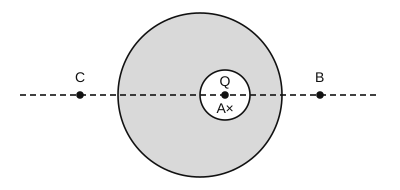
Q33.A point charge Q is placed inside a cavity within a solid isolated conducting sphere. Consider points A, B and C as shown in the figure, where the magnitudes of the electric fields are
,
and
, respectively. The points B and C are at the same distance from the center of the solid sphere. The correct option is :
एक ठोस विलगित चालक गोले के भीतर एक कोटर (cavity) में बिंदु आवेश Q रखा है। चित्र में दर्शाए बिंदुओं A, B और C पर विचार कीजिए, जहाँ विद्युत क्षेत्रों के परिमाण क्रमशः
,
और
हैं। बिंदु B और C ठोस गोले के केंद्र से समान दूरी पर हैं। सही विकल्प है :
- A,
- B,
- C,
- D,
Show answer
Concept: Charge Q in a cavity induces −Q on the cavity wall and +Q on the outer surface; the conductor shields the outside from the cavity details.
- A is inside the cavity, near Q: field of Q (plus cavity-wall charge) is not zero → .
- Outer +Q spreads uniformly on the spherical outer surface (the outside cannot "see" where Q sits in the cavity).
- Outside, about the sphere\'s centre → B and C at equal r give .
- (A), (C) wrongly make ; (D) wrongly makes the outside field depend on the cavity position.
Short trick: "Field inside the metal is zero; inside the cavity it is not; outside it is as if Q were at the centre."
Answer: (B) ,
अवधारणा: कोटर में रखा आवेश Q कोटर की दीवार पर −Q तथा बाहरी पृष्ठ पर +Q प्रेरित करता है; चालक बाहरी भाग को कोटर के विवरण से परिरक्षित करता है।
- A कोटर के भीतर Q के पास है: Q (तथा कोटर-दीवार के आवेश) का क्षेत्र शून्य नहीं → ।
- बाहरी +Q गोलीय बाहरी पृष्ठ पर एकसमान फैलता है (बाहर से यह पता नहीं चलता कि Q कोटर में कहाँ है)।
- बाहर, गोले के केंद्र के सापेक्ष → समान r पर स्थित B और C के लिए ।
- (A), (C) में लेना गलत है; (D) में बाहरी क्षेत्र को कोटर की स्थिति पर निर्भर मानना गलत है।
शॉर्ट ट्रिक: "धातु के अंदर क्षेत्र शून्य; कोटर के अंदर शून्य नहीं; बाहर ऐसा जैसे Q केंद्र पर हो।"
उत्तर: (B) ,
NEET UGPhysicsElectrostatics – charge inside cavity of a conductorNEET UG 2026 · 21 Jun Shift 1
Q34.Consider a fixed uniformly charged insulating sphere with radius R and total charge +Q. A point charge −q (q<<Q) with mass m is released from rest at a distance of 3R from the centre of the charged sphere. when the point charge reaches the surface of the sphere, its speed is :
( is the permittivity of vacuum, neglect gravitational forces).
त्रिज्या R तथा कुल आवेश +Q वाले एक स्थिर, एकसमान आवेशित विद्युतरोधी गोले पर विचार कीजिए। द्रव्यमान m वाले एक बिंदु आवेश −q (q<<Q) को आवेशित गोले के केंद्र से 3R दूरी पर विराम से छोड़ा जाता है। जब बिंदु आवेश गोले के पृष्ठ पर पहुँचता है, तो उसकी चाल है :
( निर्वात की विद्युतशीलता है, गुरुत्वीय बलों की उपेक्षा कीजिए)।
- A
- B
- C
- D
Show answer
Concept: Loss in electric PE = gain in KE: for a negative charge moving towards higher potential.
- .
- .
- .
Short trick: and .
Answer: (C)
अवधारणा: विद्युत स्थितिज ऊर्जा में कमी = गतिज ऊर्जा में वृद्धि: अधिक विभव की ओर जाते ऋण आवेश के लिए ।
- ।
- ।
- ।
शॉर्ट ट्रिक: तथा ।
उत्तर: (C)
NEET UGPhysicsElectrostatic potential – energy conservationNEET UG 2026 · 21 Jun Shift 1
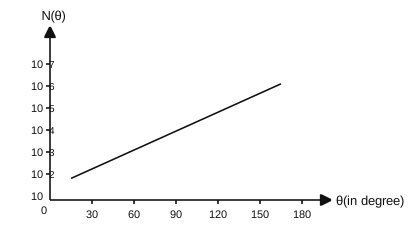
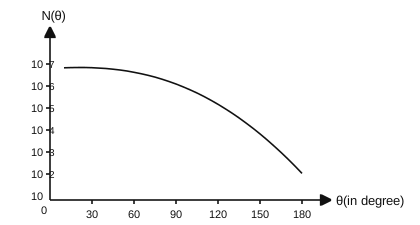
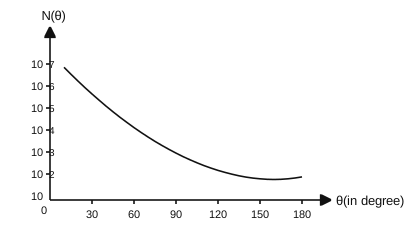
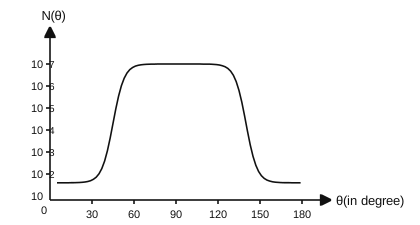
Q35.In Geiger-Marsden experiment, the number of scattered -particles is plotted as a function of scattering angle . Which of the following options represents the correct plot ?
गाइगर-मार्सडन प्रयोग में, प्रकीर्णित -कणों की संख्या को प्रकीर्णन कोण के फलन के रूप में आलेखित किया गया है। निम्नलिखित में से कौन-सा विकल्प सही आलेख को निरूपित करता है?
- A
- B
- C
- D
Show answer
Concept: Rutherford formula: .
- N is very large at small angles (most particles pass almost undeflected) and falls steeply as increases.
- On a log scale it drops by several orders of magnitude and flattens near 180° (where ).
- (C) matches. (A) increasing ✘; (B) nearly flat at small angles then falling ✘; (D) peak at intermediate angles ✘.
Short trick: "Few bounce back" – N must be highest at small θ and lowest (but non-zero) near 180°.
Answer: (C)
अवधारणा: रदरफोर्ड सूत्र: ।
- छोटे कोणों पर N बहुत अधिक है (अधिकांश कण लगभग बिना विचलन निकल जाते हैं) और बढ़ने पर तेज़ी से घटता है।
- लघुगणकीय स्केल पर यह कई कोटि घटता है और 180° के पास सपाट हो जाता है (जहाँ )।
- (C) मेल खाता है। (A) बढ़ता हुआ ✘; (B) छोटे कोणों पर लगभग सपाट फिर घटता ✘; (D) मध्य कोणों पर शिखर ✘।
शॉर्ट ट्रिक: "बहुत कम कण वापस लौटते हैं" – N छोटे θ पर सर्वाधिक तथा 180° के पास न्यूनतम (पर शून्येतर) होना चाहिए।
उत्तर: (C)
NEET UGPhysicsAtoms – Geiger–Marsden (Rutherford) scatteringNEET UG 2026 · 21 Jun Shift 1
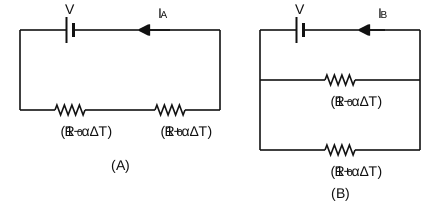
Q36.Consider two circuits, (A) and (B), each having two resistors. One of them has a positive temperature coefficient of resistance, +
, while the other one has a negative temperature of coefficient, −
, as shown in the figure. The current through these circuits are denoted by
and
. At initial temperature, the resistance of the two resistors is
. As the temperature is increased, the correct option that describes the variation of current in these circuits is :
दो परिपथों (A) और (B) पर विचार कीजिए, जिनमें प्रत्येक में दो प्रतिरोधक हैं। चित्रानुसार इनमें से एक का प्रतिरोध ताप गुणांक धनात्मक, +
, है जबकि दूसरे का ताप गुणांक ऋणात्मक, −
, है। इन परिपथों से प्रवाहित धाराएँ
और
से दर्शाई गई हैं। प्रारंभिक ताप पर दोनों प्रतिरोधकों का प्रतिरोध
है। ताप बढ़ाने पर, इन परिपथों में धारा के परिवर्तन को सही रूप से बताने वाला विकल्प है :
- A remains constant while increases नियत रहती है जबकि बढ़ती है
- B decreases while increases घटती है जबकि बढ़ती है
- C increases while decreases बढ़ती है जबकि घटती है
- Dboth and remain constant और दोनों नियत रहती हैं
Show answer
Concept: Series resistances add; parallel: .
- (A) series: → constant → constant.
- (B) parallel: → decreases.
- So increases.
Short trick: In parallel, the product falls while the sum stays 2R0 → RB falls; in series only the sum matters.
Answer: (A) remains constant while increases
अवधारणा: श्रेणी में प्रतिरोध जुड़ते हैं; समांतर में: ।
- (A) श्रेणी: → नियत → नियत।
- (B) समांतर: → घटता है।
- अतः बढ़ती है।
शॉर्ट ट्रिक: समांतर में गुणनफल घटता है जबकि योग 2R0 रहता है → RB घटता है; श्रेणी में केवल योग मायने रखता है।
उत्तर: (A) नियत रहती है जबकि बढ़ती है
NEET UGPhysicsCurrent electricity – temperature coefficient of resistanceNEET UG 2026 · 21 Jun Shift 1
Q37.Consider that , , b represent Stefan-Boltzmann constant, Boltzmann constant and Wien's displacement law constant, respectively. The dimension of is :
मान लीजिए , , b क्रमशः स्टीफन-बोल्ट्ज़मान नियतांक, बोल्ट्ज़मान नियतांक तथा वीन के विस्थापन नियम का नियतांक निरूपित करते हैं। की विमा है :
- A
- B
- C
- D
Show answer
Concept: Use defining relations: , , .
- .
- , so .
- .
- Product: .
Short trick: Mass cancels (σ and kB both have M1), K: −4 + 1 + 1 = −2 – only option (A) has K−2 with T−1.
Answer: (A)
अवधारणा: परिभाषित संबंध लें: , , ।
- ।
- , अतः ।
- ।
- गुणनफल: ।
शॉर्ट ट्रिक: द्रव्यमान कट जाता है (σ और kB दोनों में M1), K: −4 + 1 + 1 = −2 – केवल विकल्प (A) में T−1 के साथ K−2 है।
उत्तर: (A)
NEET UGPhysicsUnits and dimensionsNEET UG 2026 · 21 Jun Shift 1
Q38.An electromagnetic wave travelling in a lossless dielectric medium having a dielectric constant = 9, has the electric field, where is the amplitude and k is the wave vector. Among the following options, the incorrect choice is :
परावैद्युतांक = 9 वाले एक हानिरहित परावैद्युत माध्यम में चलती एक विद्युत-चुम्बकीय तरंग का विद्युत क्षेत्र है, जहाँ आयाम तथा k तरंग सदिश है। निम्नलिखित विकल्पों में से गलत विकल्प है :
- AThe speed of the electromagnetic wave inside the medium is माध्यम के अंदर विद्युत-चुम्बकीय तरंग की चाल है
- BThe wavelength of the electromagnetic wave inside the medium is 300 mमाध्यम के अंदर विद्युत-चुम्बकीय तरंग की तरंगदैर्ध्य 300 m है
- CThe magnetic field is given by the relation where v is the speed of the electromagnetic wave inside the mediumचुम्बकीय क्षेत्र संबंध द्वारा दिया जाता है, जहाँ v माध्यम के अंदर विद्युत-चुम्बकीय तरंग की चाल है
- DThe direction of propagation of the electromagnetic wave is along +zविद्युत-चुम्बकीय तरंग के संचरण की दिशा +z के अनुदिश है
Show answer
Concept: In a non-magnetic dielectric ; ; ; phase means travel along +z.
- → (A) is correct.
- Hz → m, not 300 m → (B) is incorrect.
- The magnetic field amplitude is , i.e. . As printed, (C) has , which is dimensionally wrong → (C) is also incorrect.
- → propagation along +z → (D) is correct.
- Two options, (B) and (C), are incorrect, so the question has two valid answers.
Short trick: 300 m is the free-space wavelength (c/f); inside the medium divide by .
Answer: Bonus – both (B) and (C) are incorrect statements; either choice is to be credited.
अवधारणा: अचुम्बकीय परावैद्युत में ; ; ; कला का अर्थ +z दिशा में गति।
- → (A) सही है।
- Hz → m, 300 m नहीं → (B) गलत है।
- चुम्बकीय क्षेत्र का आयाम है, अर्थात् । मुद्रित रूप में (C) में है, जो विमीय रूप से गलत है → (C) भी गलत है।
- → +z के अनुदिश संचरण → (D) सही है।
- दो विकल्प, (B) और (C), गलत हैं, अतः प्रश्न के दो मान्य उत्तर हैं।
शॉर्ट ट्रिक: 300 m मुक्त आकाश की तरंगदैर्ध्य (c/f) है; माध्यम में से भाग दें।
उत्तर: बोनस – (B) और (C) दोनों कथन गलत हैं; दोनों में से कोई भी चुनने पर अंक दिए जाने चाहिए।
NEET UGPhysicsElectromagnetic waves – wave in a dielectricNEET UG 2026 · 21 Jun Shift 1
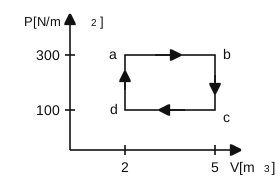
Q39.One mole of an ideal monatomic gas undergoes a cyclic process as shown in the figure. The total heat supplied to the gas is :
एक आदर्श एकपरमाणुक गैस का एक मोल चित्रानुसार एक चक्रीय प्रक्रम से गुजरता है। गैस को दी गई कुल ऊष्मा है :
- A400 J
- B500 J
- C600 J
- D800 J
Show answer
Concept: In a cycle , so net heat supplied = area enclosed on the P–V diagram (positive for a clockwise cycle).
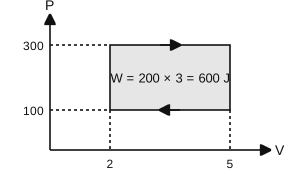
- Cycle a→b→c→d→a is clockwise → net work done by gas is positive.
- Area J.
- Net heat supplied Q = 600 J.
Short trick: Clockwise on P–V = engine = positive work; just multiply ΔP × ΔV of the rectangle.
Answer: (C) 600 J
अवधारणा: चक्र में , अतः दी गई कुल ऊष्मा = P–V आरेख पर घिरा क्षेत्रफल (दक्षिणावर्त चक्र के लिए धनात्मक)।
- चक्र a→b→c→d→a दक्षिणावर्त है → गैस द्वारा कुल कार्य धनात्मक।
- क्षेत्रफल J।
- दी गई कुल ऊष्मा Q = 600 J।
शॉर्ट ट्रिक: P–V पर दक्षिणावर्त = इंजन = धनात्मक कार्य; बस आयत का ΔP × ΔV गुणा करें।
उत्तर: (C) 600 J
NEET UGPhysicsThermodynamics – cyclic processNEET UG 2026 · 21 Jun Shift 1
Q40.Consider that an electron is revolving in an excited state of Hydrogen atom with velocity . The radius of the orbit is m. The value of x is :
[Take the mass of electron to be kg, charge of electron = C and ]
मान लीजिए हाइड्रोजन परमाणु की एक उत्तेजित अवस्था में एक इलेक्ट्रॉन वेग से परिक्रमा कर रहा है। कक्षा की त्रिज्या m है। x का मान है :
[इलेक्ट्रॉन का द्रव्यमान kg, इलेक्ट्रॉन का आवेश = C तथा लीजिए]
- A4
- B3
- C2
- D1
Show answer
Concept: Coulomb attraction supplies the centripetal force: .
- .
- .
- m → x = 1.
Short trick: Notice 9 × 2.56 = 23.04 appears in both numerator and denominator – they cancel to give exactly 10−9 m.
Answer: (D) 1
अवधारणा: कूलॉम आकर्षण अभिकेंद्र बल देता है: ।
- ।
- ।
- m → x = 1।
शॉर्ट ट्रिक: ध्यान दें 9 × 2.56 = 23.04 अंश और हर दोनों में है – ये कटकर ठीक 10−9 m देते हैं।
उत्तर: (D) 1
NEET UGPhysicsAtoms – electron orbit radiusNEET UG 2026 · 21 Jun Shift 1

