Q401.The magnetic potential energy stored in a certain inductor is 25 mJ, when the current in the inductor is 60 mA. This inductor is of inductance
किसी प्रेरक में संचित चुंबकीय स्थितिज ऊर्जा 25 mJ है, जब प्रेरक में धारा 60 mA है। इस प्रेरक का प्रेरकत्व है
- A1.389 H
- B138.88 H
- C0.138 H
- D13.89 H
Show answer
Concept: ⇒ .
- H
Short trick: ≈ 13.9 – the options differ only by powers of 10, so get the order right.
Answer: (D) 13.89 H
अवधारणा: ⇒ ।
- H
शॉर्ट ट्रिक: ≈ 13.9 – विकल्प केवल 10 की घातों में भिन्न हैं, अतः कोटि (order) सही रखें।
उत्तर: (D) 13.89 H
NEET UGPhysicsElectromagnetic induction – energy in an inductorNEET UG 2018 · 6 May Shift 1
Q402.An electron falls from rest through a vertical distance h in a uniform and vertically upward directed electric field E. The direction of electric field is now reversed, keeping its magnitude the same. A proton is allowed to fall from rest in it through the same vertical distance h. The time of fall of the electron, in comparison to the time of fall of the proton is
एक इलेक्ट्रॉन विराम से, एकसमान तथा ऊर्ध्वाधरतः ऊपर की ओर दिष्ट विद्युत क्षेत्र E में, ऊर्ध्वाधर दूरी h गिरता है। अब विद्युत क्षेत्र की दिशा उलट दी जाती है, परिमाण वही रखते हुए। एक प्रोटॉन को इसमें विराम से उसी ऊर्ध्वाधर दूरी h तक गिरने दिया जाता है। प्रोटॉन के गिरने के समय की तुलना में इलेक्ट्रॉन के गिरने का समय है
- A10 times greater10 गुना अधिक
- B5 times greater5 गुना अधिक
- CSmallerकम
- DEqualबराबर
Show answer
Concept: Both particles carry charge of magnitude e, and in each case the electric force is downward. Acceleration , and .
- ⇒
- ⇒ (about times smaller)
- Gravity (negligible vs eE) only adds the same g to both, so the electron still falls faster.
Short trick: Same force, lighter body ⇒ larger acceleration ⇒ shorter time. Ratios 10 or 5 cannot come from .
Answer: (C) Smaller
अवधारणा: दोनों कणों के आवेश का परिमाण e है, और दोनों स्थितियों में विद्युत बल नीचे की ओर है। त्वरण , तथा ।
- ⇒
- ⇒ (लगभग गुना कम)
- गुरुत्व (eE की तुलना में नगण्य) दोनों में समान g जोड़ता है, अतः इलेक्ट्रॉन फिर भी तेजी से गिरता है।
शॉर्ट ट्रिक: समान बल, हल्का पिंड ⇒ अधिक त्वरण ⇒ कम समय। 10 या 5 का अनुपात से नहीं आ सकता।
उत्तर: (C) कम
NEET UGPhysicsElectrostatics – motion of charges in uniform fieldNEET UG 2018 · 6 May Shift 1
Q403.The electrostatic force between the metal plates of an isolated parallel plate capacitor C having a charge Q and area A, is
आवेश Q तथा क्षेत्रफल A वाले एक विलगित समांतर प्लेट संधारित्र C की धातु प्लेटों के बीच स्थिरवैद्युत बल है
- AProportional to the square root of the distance between the platesप्लेटों के बीच की दूरी के वर्गमूल के अनुक्रमानुपाती
- BLinearly proportional to the distance between the platesप्लेटों के बीच की दूरी के रैखिकतः अनुक्रमानुपाती
- CIndependent of the distance between the platesप्लेटों के बीच की दूरी पर निर्भर नहीं
- DInversely proportional to the distance between the platesप्लेटों के बीच की दूरी के व्युत्क्रमानुपाती
Show answer
Concept: Isolated capacitor ⇒ Q constant. One plate is in the field of the other, , so .
- contains no d.
- Q and A are fixed, so F stays the same as d changes – (A), (B), (D) are wrong.
Short trick: Field of an infinite sheet does not depend on distance, so the plate force does not either (at constant Q).
Answer: (C) Independent of the distance between the plates
अवधारणा: विलगित संधारित्र ⇒ Q नियत। एक प्लेट दूसरी प्लेट के क्षेत्र में है, अतः ।
- में d नहीं है।
- Q और A नियत हैं, अतः d बदलने पर F नहीं बदलता – (A), (B), (D) गलत हैं।
शॉर्ट ट्रिक: अनंत चादर का क्षेत्र दूरी पर निर्भर नहीं करता, अतः (नियत Q पर) प्लेटों के बीच बल भी नहीं।
उत्तर: (C) प्लेटों के बीच की दूरी पर निर्भर नहीं
NEET UGPhysicsCapacitors – force between platesNEET UG 2018 · 6 May Shift 1
Q404.A tuning fork is used to produce resonance in a glass tube. The length of the air column in this tube can be adjusted by a variable piston. At room temperature of 27ºC two successive resonances are produced at 20 cm and 73 cm of column length. If the frequency of the tuning fork is 320 Hz, the velocity of sound in air at 27ºC is
एक काँच की नलिका में अनुनाद उत्पन्न करने के लिए एक स्वरित्र का उपयोग किया जाता है। इस नलिका में वायु स्तंभ की लंबाई एक परिवर्ती पिस्टन द्वारा समायोजित की जा सकती है। 27ºC के कमरे के ताप पर दो क्रमागत अनुनाद 20 cm तथा 73 cm स्तंभ लंबाई पर उत्पन्न होते हैं। यदि स्वरित्र की आवृत्ति 320 Hz है, तो 27ºC पर वायु में ध्वनि का वेग है
- A350 m/s
- B339 m/s
- C330 m/s
- D300 m/s
Show answer
Concept: Successive resonance lengths of a closed column differ by (end correction cancels).
- cm ⇒ m
- m/s ≈ 339 m/s
Short trick: – one line, and end correction never matters.
Answer: (B) 339 m/s
अवधारणा: बंद वायु स्तंभ की क्रमागत अनुनाद लंबाइयों का अंतर होता है (सिरा संशोधन कट जाता है)।
- cm ⇒ m
- m/s ≈ 339 m/s
शॉर्ट ट्रिक: – एक पंक्ति, और सिरा संशोधन की आवश्यकता ही नहीं।
उत्तर: (B) 339 m/s
NEET UGPhysicsWaves – resonance tubeNEET UG 2018 · 6 May Shift 1
Q405.A pendulum is hung from the roof of a sufficiently high building and is moving freely to and fro like a simple harmonic oscillator. The acceleration of the bob of the pendulum is 20 m/s2 at a distance of 5 m from the mean position. The time period of oscillation is
एक लोलक को पर्याप्त ऊँचे भवन की छत से लटकाया गया है और यह एक सरल आवर्त दोलक की भाँति स्वतंत्र रूप से इधर-उधर गति कर रहा है। माध्य स्थिति से 5 m की दूरी पर लोलक के गोलक का त्वरण 20 m/s2 है। दोलन का आवर्तकाल है
- A2 s
- B s
- C s
- D1 s
Show answer
Concept: In SHM and .
- ⇒ ⇒ rad/s
- s
Short trick: s.
Answer: (B) s
अवधारणा: सरल आवर्त गति में तथा ।
- ⇒ ⇒ rad/s
- s
शॉर्ट ट्रिक: s।
उत्तर: (B) s
NEET UGPhysicsOscillations – SHM of pendulumNEET UG 2018 · 6 May Shift 1
Q406.A metallic rod of mass per unit length 0.5 kg m–1 is lying horizontally on a smooth inclined plane which makes an angle of 30° with the horizontal. The rod is not allowed to slide down by flowing a current through it when a magnetic field of induction 0.25 T is acting on it in the vertical direction. The current flowing in the rod to keep it stationary is
प्रति एकांक लंबाई 0.5 kg m–1 द्रव्यमान वाली एक धातु की छड़, क्षैतिज से 30° का कोण बनाने वाले एक चिकने आनत तल पर क्षैतिजतः रखी है। ऊर्ध्वाधर दिशा में 0.25 T प्रेरण का चुंबकीय क्षेत्र लगाकर, छड़ में धारा प्रवाहित करके उसे नीचे फिसलने से रोका जाता है। छड़ को स्थिर रखने के लिए उसमें प्रवाहित धारा है
- A14.76 A
- B5.98 A
- C7.14 A
- D11.32 A
Show answer
Concept: Vertical B and horizontal rod ⇒ magnetic force is horizontal (pushed into the incline). Balance the components along the incline.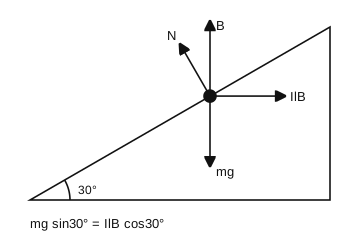
- Along incline:
- A
Short trick: Like a block on a smooth incline held by a horizontal push: ; here .
Answer: (D) 11.32 A
अवधारणा: ऊर्ध्वाधर B तथा क्षैतिज छड़ ⇒ चुंबकीय बल क्षैतिज है (आनत तल की ओर)। आनत तल के अनुदिश घटकों को संतुलित करें।
- आनत तल के अनुदिश:
- A
शॉर्ट ट्रिक: चिकने आनत तल पर क्षैतिज धक्के से रुके गुटके जैसा: ; यहाँ ।
उत्तर: (D) 11.32 A
NEET UGPhysicsMagnetic effects – force on current-carrying rod on inclineNEET UG 2018 · 6 May Shift 1
Q407.A thin diamagnetic rod is placed vertically between the poles of an electromagnet. When the current in the electromagnet is switched on, then the diamagnetic rod is pushed up, out of the horizontal magnetic field. Hence the rod gains gravitational potential energy. The work required to do this comes from
एक पतली प्रतिचुंबकीय छड़ एक विद्युत चुंबक के ध्रुवों के बीच ऊर्ध्वाधरतः रखी है। जब विद्युत चुंबक में धारा चालू की जाती है, तो प्रतिचुंबकीय छड़ क्षैतिज चुंबकीय क्षेत्र से बाहर, ऊपर की ओर धकेल दी जाती है। अतः छड़ गुरुत्वीय स्थितिज ऊर्जा प्राप्त करती है। इसके लिए आवश्यक कार्य आता है
- AThe lattice structure of the material of the rodछड़ के पदार्थ की जालक संरचना से
- BThe magnetic fieldचुंबकीय क्षेत्र से
- CThe current sourceधारा स्रोत से
- DThe induced electric field due to the changing magnetic fieldपरिवर्ती चुंबकीय क्षेत्र के कारण प्रेरित विद्युत क्षेत्र से
Show answer
Concept: Energy is conserved: the gain in the rod's potential energy must be supplied by some external source of energy.
- The magnetic field only stores/transfers energy; a static magnetic field does no net work itself – (B) is only the medium.
- The lattice of the rod supplies nothing – (A) wrong; the induced electric field exists only while switching and is itself driven by the source – (D) is not the origin.
- The battery/current source supplying the electromagnet provides the extra energy (extra work against the back emf as the rod moves).
Short trick: Ask "who pays the energy bill?" – always the source that drives the current.
Answer: (C) The current source
अवधारणा: ऊर्जा संरक्षित रहती है: छड़ की स्थितिज ऊर्जा में वृद्धि किसी बाह्य ऊर्जा स्रोत द्वारा ही दी जानी चाहिए।
- चुंबकीय क्षेत्र केवल ऊर्जा संचित/स्थानांतरित करता है; स्थिर चुंबकीय क्षेत्र स्वयं कोई कुल कार्य नहीं करता – (B) केवल माध्यम है।
- छड़ की जालक संरचना कोई ऊर्जा नहीं देती – (A) गलत; प्रेरित विद्युत क्षेत्र केवल स्विच करते समय होता है और स्वयं स्रोत से संचालित है – (D) मूल स्रोत नहीं।
- विद्युत चुंबक को धारा देने वाली बैटरी/धारा स्रोत अतिरिक्त ऊर्जा देता है (छड़ के खिसकने पर पश्च वि. वा. बल के विरुद्ध अतिरिक्त कार्य)।
शॉर्ट ट्रिक: पूछें "ऊर्जा का बिल कौन चुकाता है?" – सदैव वही स्रोत जो धारा चलाता है।
उत्तर: (C) धारा स्रोत से
NEET UGPhysicsMagnetism – diamagnetic rod, energy sourceNEET UG 2018 · 6 May Shift 1
Q408.An inductor 20 mH, a capacitor 100 F and a resistor 50 Ω are connected in series across a source of emf, V = 10 sin 314 t. The power loss in the circuit is
एक 20 mH का प्रेरक, एक 100 F का संधारित्र तथा एक 50 Ω का प्रतिरोधक, वि. वा. बल V = 10 sin 314 t वाले स्रोत के सिरों से श्रेणीक्रम में जुड़े हैं। परिपथ में शक्ति क्षय है
- A2.74 W
- B0.43 W
- C0.79 W
- D1.13 W
Show answer
Concept: Average power with , .
- Ω
- Ω
- Ω
- A
- W
Short trick: Upper bound check: without reactance W; reactance must cut it, so only 0.79 W or 0.43 W are possible – .
Answer: (C) 0.79 W
अवधारणा: औसत शक्ति , जहाँ , ।
- Ω
- Ω
- Ω
- A
- W
शॉर्ट ट्रिक: ऊपरी सीमा जाँच: प्रतिघात के बिना W; प्रतिघात इसे घटाता है, अतः केवल 0.79 W या 0.43 W संभव – ।
उत्तर: (C) 0.79 W
NEET UGPhysicsAlternating current – power in series LCRNEET UG 2018 · 6 May Shift 1
Q409.Current sensitivity of a moving coil galvanometer is 5 div/mA and its voltage sensitivity (angular deflection per unit voltage applied) is 20 div/V. The resistance of the galvanometer is
एक चल कुंडली धारामापी की धारा सुग्राहिता 5 div/mA तथा वोल्टता सुग्राहिता (प्रति एकांक आरोपित वोल्टता पर कोणीय विक्षेप) 20 div/V है। धारामापी का प्रतिरोध है
- A250 Ω
- B25 Ω
- C40 Ω
- D500 Ω
Show answer
Concept: , ⇒ .
- div/mA div/A
- Ω
Short trick: Convert mA to A first – forgetting it gives Ω, which is off by a factor of 1000.
Answer: (A) 250 Ω
अवधारणा: , ⇒ ।
- div/mA div/A
- Ω
शॉर्ट ट्रिक: पहले mA को A में बदलें – भूलने पर Ω आता है, जो 1000 गुना कम है।
उत्तर: (A) 250 Ω
NEET UGPhysicsMoving coil galvanometer – sensitivitiesNEET UG 2018 · 6 May Shift 1
Q410.A body initially at rest and sliding along a frictionless track from a height h (as shown in the figure) just completes a vertical circle of diameter AB = D. The height h is equal to
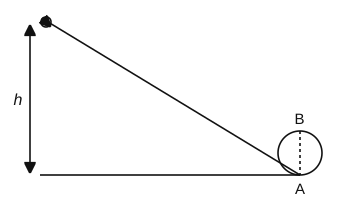
प्रारंभ में विराम में स्थित एक पिंड, ऊँचाई h से एक घर्षणरहित पथ पर फिसलते हुए (जैसा चित्र में दर्शाया गया है) व्यास AB = D वाले ऊर्ध्वाधर वृत्त को ठीक पूरा करता है। ऊँचाई h बराबर है
- A
- BD
- C
- D
Show answer
Concept: To just complete a vertical circle of radius R, the speed at the lowest point must be . Energy is conserved on a frictionless track.
- ⇒
- ⇒
Short trick: Remember "h = 2.5 R" for a loop-the-loop from rest; with diameter, .
Answer: (D)
अवधारणा: त्रिज्या R के ऊर्ध्वाधर वृत्त को ठीक पूरा करने के लिए निम्नतम बिंदु पर चाल होनी चाहिए। घर्षणरहित पथ पर ऊर्जा संरक्षित रहती है।
- ⇒
- ⇒
शॉर्ट ट्रिक: विराम से लूप के लिए "h = 2.5 R" याद रखें; व्यास के पदों में ।
उत्तर: (D)
NEET UGPhysicsWork–energy – vertical circleNEET UG 2018 · 6 May Shift 1
Q411.Three objects, A : (a solid sphere), B : (a thin circular disk) and C : (a circular ring), each have the same mass M and radius R. They all spin with the same angular speed about their own symmetry axes. The amounts of work (W) required to bring them to rest, would satisfy the relation
तीन वस्तुएँ, A : (एक ठोस गोला), B : (एक पतली वृत्ताकार चकती) तथा C : (एक वृत्ताकार वलय), प्रत्येक का द्रव्यमान M तथा त्रिज्या R समान है। ये सभी अपने-अपने सममिति अक्षों के परितः समान कोणीय चाल से घूर्णन कर रही हैं। इन्हें विराम में लाने के लिए आवश्यक कार्य (W) की मात्राएँ किस संबंध को संतुष्ट करेंगी?
- A
- B
- C
- D
Show answer
Concept: Work to stop = rotational KE ; with the same , .
- , ,
Short trick: More mass far from the axis ⇒ larger I: ring > disc > solid sphere.
Answer: (C)
अवधारणा: रोकने के लिए कार्य = घूर्णी गतिज ऊर्जा ; समान पर ।
- , ,
शॉर्ट ट्रिक: अक्ष से दूर अधिक द्रव्यमान ⇒ अधिक I: वलय > चकती > ठोस गोला।
उत्तर: (C)
NEET UGPhysicsRotational motion – rotational kinetic energyNEET UG 2018 · 6 May Shift 1
Q412.A moving block having mass m, collides with another stationary block having mass 4m. The lighter block comes to rest after collision. When the initial velocity of the lighter block is v, then the value of coefficient of restitution (e) will be
द्रव्यमान m का एक गतिमान गुटका, द्रव्यमान 4m के एक अन्य स्थिर गुटके से संघट्ट करता है। संघट्ट के बाद हल्का गुटका विराम में आ जाता है। जब हल्के गुटके का प्रारंभिक वेग v है, तब प्रत्यावस्थान गुणांक (e) का मान होगा
- A0.8
- B0.25
- C0.5
- D0.4
Show answer
Concept: Momentum is conserved; .
- ⇒
Short trick: When the striker stops, .
Answer: (B) 0.25
अवधारणा: संवेग संरक्षित रहता है; ।
- ⇒
शॉर्ट ट्रिक: जब टकराने वाला पिंड रुक जाए, ।
उत्तर: (B) 0.25
NEET UGPhysicsCollisions – coefficient of restitutionNEET UG 2018 · 6 May Shift 1
Q413.Which one of the following statements is incorrect?
निम्नलिखित में से कौन-सा कथन गलत है?
- AFrictional force opposes the relative motion.घर्षण बल आपेक्षिक गति का विरोध करता है।
- BLimiting value of static friction is directly proportional to normal reaction.स्थैतिक घर्षण का सीमांत मान अभिलंब प्रतिक्रिया के अनुक्रमानुपाती होता है।
- CRolling friction is smaller than sliding friction.लोटनिक घर्षण, सर्पी घर्षण से कम होता है।
- DCoefficient of sliding friction has dimensions of length.सर्पी घर्षण गुणांक की विमाएँ लंबाई की होती हैं।
Show answer
Concept: is a ratio of two forces, so it is dimensionless.
- (A) True – friction always opposes relative motion (or its tendency).
- (B) True – .
- (C) True – rolling friction ≪ sliding friction (why wheels and ball bearings are used).
- (D) False – μ has no dimensions, so this is the incorrect statement.
Short trick: Any "coefficient" defined as force/force (μ, e, refractive index …) is dimensionless.
Answer: (D) Coefficient of sliding friction has dimensions of length.
अवधारणा: दो बलों का अनुपात है, अतः यह विमाहीन है।
- (A) सत्य – घर्षण सदैव आपेक्षिक गति (या उसकी प्रवृत्ति) का विरोध करता है।
- (B) सत्य – ।
- (C) सत्य – लोटनिक घर्षण ≪ सर्पी घर्षण (इसीलिए पहिये और बॉल बेयरिंग प्रयुक्त होते हैं)।
- (D) असत्य – μ विमाहीन है, अतः यही गलत कथन है।
शॉर्ट ट्रिक: बल/बल के रूप में परिभाषित कोई भी "गुणांक" (μ, e, अपवर्तनांक …) विमाहीन होता है।
उत्तर: (D) सर्पी घर्षण गुणांक की विमाएँ लंबाई की होती हैं।
NEET UGPhysicsLaws of motion – frictionNEET UG 2018 · 6 May Shift 1
Q414.A toy car with charge q moves on a frictionless horizontal plane surface under the influence of a uniform electric field . Due to the force , its velocity increases from 0 to 6 m/s in one second duration. At that instant the direction of the field is reversed. The car continues to move for two more seconds under the influence of this field. The average velocity and the average speed of the toy car between 0 to 3 seconds are respectively
आवेश q वाली एक खिलौना कार, एकसमान विद्युत क्षेत्र के प्रभाव में एक घर्षणरहित क्षैतिज समतल पृष्ठ पर गति करती है। बल के कारण, एक सेकंड की अवधि में इसका वेग 0 से 6 m/s तक बढ़ जाता है। उसी क्षण क्षेत्र की दिशा उलट दी जाती है। कार इस क्षेत्र के प्रभाव में दो सेकंड और गति करती रहती है। 0 से 3 सेकंड के बीच खिलौना कार का औसत वेग तथा औसत चाल क्रमशः हैं
- A1 m/s, 3.5 m/s
- B1 m/s, 3 m/s
- C2 m/s, 4 m/s
- D1.5 m/s, 3 m/s
Show answer
Concept: Uniform acceleration of magnitude m/s², reversed at t = 1 s. Use the v–t graph: area = displacement.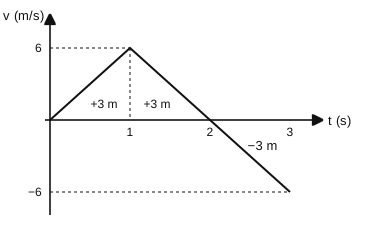
- 0–1 s: m
- 1–2 s: decelerates 6 → 0: m
- 2–3 s: moves back 0 → –6 m/s: m
- Displacement m ⇒ average velocity m/s
- Distance m ⇒ average speed m/s
Short trick: On the v–t graph the area splits into three equal parts of 3 m each: two above the axis (0–1 s, 1–2 s) and one below (2–3 s). Net = 3 m, total = 9 m.
Answer: (B) 1 m/s, 3 m/s
अवधारणा: परिमाण m/s² का एकसमान त्वरण, t = 1 s पर उलट जाता है। v–t ग्राफ लें: क्षेत्रफल = विस्थापन।
- 0–1 s: m
- 1–2 s: 6 → 0 तक मंदन: m
- 2–3 s: वापस 0 → –6 m/s: m
- विस्थापन m ⇒ औसत वेग m/s
- दूरी m ⇒ औसत चाल m/s
शॉर्ट ट्रिक: v–t ग्राफ पर क्षेत्रफल 3 m के तीन समान भागों में बँटता है: दो अक्ष के ऊपर (0–1 s, 1–2 s) तथा एक नीचे (2–3 s)। कुल विस्थापन = 3 m, कुल दूरी = 9 m।
उत्तर: (B) 1 m/s, 3 m/s
NEET UGPhysicsKinematics – average velocity and average speedNEET UG 2018 · 6 May Shift 1
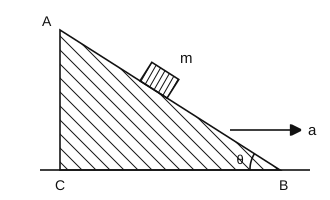
Q415.A block of mass m is placed on a smooth inclined wedge ABC of inclination
as shown in the figure. The wedge is given an acceleration 'a' towards the right. The relation between a and
for the block to remain stationary on the wedge is
द्रव्यमान m का एक गुटका, नति
वाले एक चिकने आनत वेज ABC पर चित्रानुसार रखा है। वेज को दाईं ओर त्वरण 'a' दिया जाता है। गुटके के वेज पर स्थिर रहने के लिए a तथा
के बीच संबंध है
- A
- B
- C
- D
Show answer
Concept: In the wedge frame the block feels a pseudo force to the left, plus mg and normal reaction N. Stationary ⇒ these balance.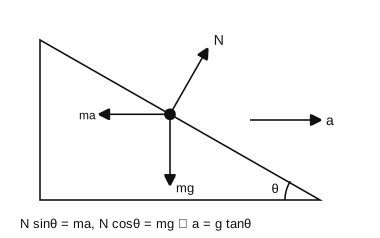
- Horizontal:
- Vertical:
- Divide: ⇒
Short trick: Resultant of g and the pseudo acceleration must be normal to the incline: .
Answer: (D)
अवधारणा: वेज के फ्रेम में गुटके पर बाईं ओर छद्म बल , तथा mg और अभिलंब प्रतिक्रिया N कार्य करते हैं। स्थिर ⇒ ये संतुलित हैं।
- क्षैतिज:
- ऊर्ध्वाधर:
- भाग देने पर: ⇒
शॉर्ट ट्रिक: g तथा छद्म त्वरण का परिणामी आनत तल के अभिलंबवत होना चाहिए: ।
उत्तर: (D)
NEET UGPhysicsLaws of motion – block on accelerating wedgeNEET UG 2018 · 6 May Shift 1
Q416.The moment of the force, at (2, 0, –3), about the point (2, –2, –2), is given by
बिंदु (2, 0, –3) पर लगे बल का, बिंदु (2, –2, –2) के परितः आघूर्ण है
- A
- B
- C
- D
Show answer
Concept: , where is the point about which the moment is taken.
Short trick: : check . (D): ✓; (A): .
Answer: (D)
अवधारणा: , जहाँ वह बिंदु है जिसके परितः आघूर्ण लिया जाता है।
शॉर्ट ट्रिक: : जाँचें। (D): ✓; (A): ।
उत्तर: (D)
NEET UGPhysicsRotational motion – torque (vector product)NEET UG 2018 · 6 May Shift 1
Q417.A student measured the diameter of a small steel ball using a screw gauge of least count 0.001 cm. The main scale reading is 5 mm and zero of circular scale division coincides with 25 divisions above the reference level. If screw gauge has a zero error of –0.004 cm, the correct diameter of the ball is
एक छात्र ने 0.001 cm अल्पतमांक वाले स्क्रू गेज से एक छोटी स्टील की गेंद का व्यास मापा। मुख्य पैमाने का पाठ्यांक 5 mm है तथा वृत्तीय पैमाने का शून्य, संदर्भ रेखा से 25 भाग ऊपर संपाती होता है। यदि स्क्रू गेज में –0.004 cm की शून्यांक त्रुटि है, तो गेंद का सही व्यास है
- A0.053 cm
- B0.525 cm
- C0.521 cm
- D0.529 cm
Show answer
Concept: Reading = MSR + (CSR × LC); correct value = reading – (zero error).
- Reading cm
- Correct cm
Short trick: Negative zero error ⇒ add its magnitude. 0.525 is the uncorrected trap; 0.521 is the wrong-sign trap.
Answer: (D) 0.529 cm
अवधारणा: पाठ्यांक = MSR + (CSR × अल्पतमांक); सही मान = पाठ्यांक – (शून्यांक त्रुटि)।
- पाठ्यांक cm
- सही cm
शॉर्ट ट्रिक: ऋणात्मक शून्यांक त्रुटि ⇒ उसका परिमाण जोड़ें। 0.525 बिना संशोधन का जाल है; 0.521 गलत चिह्न का जाल है।
उत्तर: (D) 0.529 cm
NEET UGPhysicsUnits and measurement – screw gauge with zero errorNEET UG 2018 · 6 May Shift 1
Q418.A solid sphere is rotating freely about its symmetry axis in free space. The radius of the sphere is increased keeping its mass same. Which of the following physical quantities would remain constant for the sphere?
एक ठोस गोला मुक्त आकाश में अपने सममिति अक्ष के परितः स्वतंत्र रूप से घूर्णन कर रहा है। गोले का द्रव्यमान समान रखते हुए उसकी त्रिज्या बढ़ा दी जाती है। गोले के लिए निम्नलिखित में से कौन-सी भौतिक राशि नियत रहेगी?
- ARotational kinetic energyघूर्णी गतिज ऊर्जा
- BMoment of inertiaजड़त्व आघूर्ण
- CAngular velocityकोणीय वेग
- DAngular momentumकोणीय संवेग
Show answer
Concept: In free space there is no external torque, so ⇒ L = constant.
- increases as R increases – (B) changes.
- constant ⇒ ω decreases – (C) changes.
- decreases as I increases – (A) changes.
- Only angular momentum stays constant.
Short trick: Ice-skater rule: change shape, L is conserved; I and ω trade off, KE changes.
Answer: (D) Angular momentum
अवधारणा: मुक्त आकाश में कोई बाह्य बल-आघूर्ण नहीं है, अतः ⇒ L नियत।
- , R बढ़ने पर बढ़ता है – (B) बदलता है।
- नियत ⇒ ω घटता है – (C) बदलता है।
- , I बढ़ने पर घटती है – (A) बदलती है।
- केवल कोणीय संवेग नियत रहता है।
शॉर्ट ट्रिक: आइस-स्केटर नियम: आकार बदलें, L संरक्षित; I और ω एक-दूसरे की भरपाई करते हैं, गतिज ऊर्जा बदलती है।
उत्तर: (D) कोणीय संवेग
NEET UGPhysicsRotational motion – conservation of angular momentumNEET UG 2018 · 6 May Shift 1
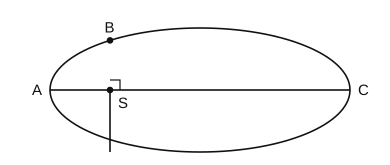
Q419.The kinetic energies of a planet in an elliptical orbit about the Sun, at positions A, B and C are K
A, K
B and K
C, respectively. AC is the major axis and SB is perpendicular to AC at the position of the Sun S as shown in the figure. Then
सूर्य के परितः दीर्घवृत्तीय कक्षा में एक ग्रह की स्थितियों A, B तथा C पर गतिज ऊर्जाएँ क्रमशः K
A, K
B तथा K
C हैं। AC दीर्घ अक्ष है तथा SB, सूर्य की स्थिति S पर AC के लंबवत है, जैसा चित्र में दर्शाया गया है। तब
- A
- B
- C
- D
Show answer
Concept: Angular momentum about the Sun is conserved ( = constant at A, C; and generally constant), so speed is greatest where the planet is closest to the Sun.
- S is nearer A than C, so A is the perihelion (nearest) and C the aphelion (farthest).
- Distances: SA < SB < SC ⇒ speeds (energy conservation: lower PE ⇒ higher KE).
Short trick: Closer to the Sun ⇒ faster ⇒ more KE (total energy fixed, PE more negative near the Sun).
Answer: (B)
अवधारणा: सूर्य के परितः कोणीय संवेग संरक्षित है ( = नियत, A, C पर; और सामान्यतः नियत), अतः ग्रह की चाल वहाँ अधिकतम है जहाँ वह सूर्य के सबसे निकट हो।
- S, C की तुलना में A के अधिक निकट है, अतः A उपसौर (perihelion) तथा C अपसौर (aphelion) है।
- दूरियाँ: SA < SB < SC ⇒ चालें (ऊर्जा संरक्षण: कम स्थितिज ऊर्जा ⇒ अधिक गतिज ऊर्जा)।
शॉर्ट ट्रिक: सूर्य के निकट ⇒ तेज ⇒ अधिक गतिज ऊर्जा (कुल ऊर्जा नियत, सूर्य के पास स्थितिज ऊर्जा अधिक ऋणात्मक)।
उत्तर: (B)
NEET UGPhysicsGravitation – Kepler's second law (kinetic energy in orbit)NEET UG 2018 · 6 May Shift 1
Q420.If the mass of the Sun were ten times smaller and the universal gravitational constant were ten times larger in magnitude, which of the following is not correct?
यदि सूर्य का द्रव्यमान दस गुना कम तथा सार्वत्रिक गुरुत्वाकर्षण नियतांक परिमाण में दस गुना अधिक हो, तो निम्नलिखित में से कौन-सा सही नहीं है?
- ATime period of a simple pendulum on the Earth would decreaseपृथ्वी पर सरल लोलक का आवर्तकाल घट जाएगा
- BWalking on the ground would become more difficultधरती पर चलना अधिक कठिन हो जाएगा
- CRaindrops will fall fasterवर्षा की बूँदें तेजी से गिरेंगी
- D'g' on the Earth will not changeपृथ्वी पर 'g' नहीं बदलेगा
Show answer
Concept: depends on the Earth's mass, not the Sun's. If G becomes 10G, g on Earth becomes 10g.
- (A) decreases – correct.
- (B) Weight increases tenfold, so walking is harder – correct.
- (C) Terminal velocity (and acceleration is larger), so raindrops fall faster – correct.
- (D) g does change (×10) – this statement is not correct.
Short trick: The Sun's mass is a red herring – only G enters at the Earth's surface.
Answer: (D) 'g' on the Earth will not change
अवधारणा: पृथ्वी के द्रव्यमान पर निर्भर करता है, सूर्य के नहीं। यदि G, 10G हो जाए, तो पृथ्वी पर g भी 10g हो जाएगा।
- (A) घटेगा – सही।
- (B) भार दस गुना बढ़ेगा, अतः चलना कठिन – सही।
- (C) सीमांत वेग (और त्वरण भी अधिक), अतः बूँदें तेजी से गिरेंगी – सही।
- (D) g बदलता है (×10) – यह कथन सही नहीं है।
शॉर्ट ट्रिक: सूर्य का द्रव्यमान केवल भ्रमित करने के लिए है – पृथ्वी की सतह पर में केवल G आता है।
उत्तर: (D) पृथ्वी पर 'g' नहीं बदलेगा
NEET UGPhysicsGravitation – dependence of g on GNEET UG 2018 · 6 May Shift 1

