Q421.Which of the following animals does not undergo metamorphosis?
निम्नलिखित में से कौन-सा प्राणी कायांतरण (metamorphosis) नहीं करता?
- AMothशलभ (Moth)
- BTunicateट्यूनिकेट
- CEarthwormकेंचुआ
- DStarfishतारामीन (Starfish)
Show answer
Concept: Metamorphosis = change of a larva into adult (indirect development). Earthworm development is direct – cocoon hatches into young worms, no larva.
- Moth: egg → caterpillar larva → pupa → adult (complete metamorphosis).
- Tunicate (Urochordata): free-swimming tadpole larva → sessile adult (retrogressive metamorphosis).
- Starfish: bilaterally symmetrical larva → radially symmetrical adult.
- Earthworm: direct development → no metamorphosis.
Short trick: Annelid earthworm hatches as a "mini-worm" – no larva, no metamorphosis.
Answer: (C) Earthworm
अवधारणा: कायांतरण = लार्वा का वयस्क में परिवर्तन (अप्रत्यक्ष परिवर्धन)। केंचुए में परिवर्धन प्रत्यक्ष है – कोकून से सीधे छोटे केंचुए निकलते हैं, कोई लार्वा नहीं।
- शलभ: अंडा → इल्ली लार्वा → प्यूपा → वयस्क (पूर्ण कायांतरण)।
- ट्यूनिकेट (यूरोकॉर्डेटा): तैरता टैडपोल लार्वा → स्थानबद्ध वयस्क (प्रतिगामी कायांतरण)।
- तारामीन: द्विपार्श्व सममित लार्वा → अरीय सममित वयस्क।
- केंचुआ: प्रत्यक्ष परिवर्धन → कोई कायांतरण नहीं।
शॉर्ट ट्रिक: केंचुआ "छोटे केंचुए" के रूप में ही निकलता है – न लार्वा, न कायांतरण।
उत्तर: (C) केंचुआ
NEET UGBiologyAnimal kingdom – development and metamorphosisNEET UG 2018 · 6 May Shift 1
Q422.Which of the following organisms are known as chief producers in the oceans?
निम्नलिखित में से कौन-से जीव महासागरों के मुख्य उत्पादक कहलाते हैं?
- ACyanobacteriaसायनोबैक्टीरिया
- BDiatomsडायटम
- CDinoflagellatesडाइनोफ्लैजिलेट
- DEuglenoidsयुग्लीनॉइड
Show answer
Concept: NCERT (Chrysophytes): "Diatoms are the chief 'producers' in the oceans."
- Diatoms are photosynthetic, extremely abundant planktonic protists with silica walls (their deposits = diatomaceous earth).
- Cyanobacteria are important but not called chief ocean producers in NCERT; dinoflagellates cause red tides; euglenoids are mostly freshwater.
Short trick: Diatoms = "D for Dominant producer" of oceans; also give diatomaceous earth.
Answer: (B) Diatoms
अवधारणा: NCERT (क्राइसोफाइट): "डायटम महासागरों के मुख्य 'उत्पादक' हैं।"
- डायटम प्रकाश-संश्लेषी, अत्यधिक संख्या में पाए जाने वाले प्लवकीय प्रोटिस्ट हैं जिनकी भित्ति सिलिका की होती है (इनके निक्षेप = डायटमी मृदा)।
- सायनोबैक्टीरिया महत्वपूर्ण हैं पर NCERT इन्हें महासागरों का मुख्य उत्पादक नहीं कहता; डाइनोफ्लैजिलेट लाल ज्वार बनाते हैं; युग्लीनॉइड अधिकतर अलवणजलीय हैं।
शॉर्ट ट्रिक: डायटम = महासागरों के प्रमुख उत्पादक; डायटमी मृदा भी इन्हीं से।
उत्तर: (B) डायटम
NEET UGBiologyBiological classification – Chrysophytes (diatoms)NEET UG 2018 · 6 May Shift 1
Q423.Which one of the following population interactions is widely used in medical science for the production of antibiotics?
निम्नलिखित में से कौन-सी समष्टि पारस्परिक क्रिया प्रतिजैविकों (antibiotics) के उत्पादन हेतु चिकित्सा विज्ञान में व्यापक रूप से उपयोग की जाती है?
- AParasitismपरजीविता
- BMutualismसहोपकारिता
- CCommensalismसहभोजिता
- DAmensalismअंतरजातीय परजीविता (Amensalism)
Show answer
Concept: Amensalism (0, −): one species is harmed while the other is unaffected – e.g. Penicillium secretes penicillin that kills bacteria; this antibiosis is exploited to make antibiotics.
- Penicillium gains nothing and loses nothing (0); bacteria are inhibited (−) → amensalism.
- Parasitism (+, −) and commensalism (+, 0) require one partner to benefit; mutualism (+, +) both benefit – none describes antibiotic action.
Short trick: Antibiotic = "Anti-bio-sis" = amensalism (0, −).
Answer: (D) Amensalism
अवधारणा: अंतरजातीय परजीविता/एमेन्सलिज़्म (0, −): एक जाति को हानि होती है, दूसरी अप्रभावित रहती है – जैसे Penicillium पेनिसिलिन स्रावित कर जीवाणुओं को मारता है; इसी प्रतिजीविता (antibiosis) का उपयोग प्रतिजैविक बनाने में होता है।
- Penicillium को न लाभ न हानि (0); जीवाणु बाधित (−) → एमेन्सलिज़्म।
- परजीविता (+, −) और सहभोजिता (+, 0) में एक साथी को लाभ होता है; सहोपकारिता (+, +) में दोनों को – कोई भी प्रतिजैविक क्रिया नहीं दर्शाता।
शॉर्ट ट्रिक: Antibiotic = "Anti-bio-sis" = एमेन्सलिज़्म (0, −)।
उत्तर: (D) अंतरजातीय परजीविता (Amensalism)
NEET UGBiologyOrganisms and populations – population interactionsNEET UG 2018 · 6 May Shift 1
Q424.All of the following are included in ‘ex-situ conservation’ except
निम्नलिखित में से एक को छोड़कर सभी ‘ex-situ (बाह्य-स्थाने) संरक्षण’ में सम्मिलित हैं
- ABotanical gardensवनस्पति उद्यान
- BSacred grovesपवित्र उपवन (Sacred groves)
- CWildlife safari parksवन्यजीव सफारी पार्क
- DSeed banksबीज बैंक
Show answer
Concept: Ex-situ = conservation outside the natural habitat (zoos, botanical gardens, safari parks, seed banks, cryopreservation). In-situ = in the natural habitat.
- Sacred groves are forest patches protected by tribal communities in their natural setting (e.g. Khasi & Jaintia hills, Aravalli) → in-situ.
- Botanical gardens, wildlife safari parks and seed banks all keep organisms away from their natural home → ex-situ.
Short trick: Sacred groves stay where God and nature put them → "in place" = in-situ.
Answer: (B) Sacred groves
अवधारणा: Ex-situ = प्राकृतिक आवास से बाहर संरक्षण (चिड़ियाघर, वनस्पति उद्यान, सफारी पार्क, बीज बैंक, निम्नताप परिरक्षण)। In-situ = प्राकृतिक आवास में ही।
- पवित्र उपवन जनजातीय समुदायों द्वारा अपने प्राकृतिक स्थान पर संरक्षित वन खंड हैं (जैसे खासी व जयंतिया पहाड़ियाँ, अरावली) → in-situ।
- वनस्पति उद्यान, वन्यजीव सफारी पार्क और बीज बैंक जीवों को उनके प्राकृतिक आवास से दूर रखते हैं → ex-situ।
शॉर्ट ट्रिक: पवित्र उपवन अपने स्थान पर ही रहते हैं → "स्व-स्थाने" = in-situ।
उत्तर: (B) पवित्र उपवन (Sacred groves)
NEET UGBiologyBiodiversity and conservation – ex-situ conservationNEET UG 2018 · 6 May Shift 1
Q425.Match the items given in
Column I with those in
Column II and select the
correct option given below :
| Column-I | Column-II |
|---|
| a. Eutrophication | i. UV-B radiation |
| b. Sanitary landfill | ii. Deforestation |
| c. Snow blindness | iii. Nutrient enrichment |
| d. Jhum cultivation | iv. Waste disposal |
स्तंभ I में दी गई मदों का
स्तंभ II की मदों से मिलान कीजिए और नीचे दिए गए विकल्पों में से
सही विकल्प चुनिए:
| स्तंभ-I | स्तंभ-II |
|---|
| a. सुपोषण (Eutrophication) | i. UV-B विकिरण |
| b. सैनिटरी लैंडफिल | ii. वनोन्मूलन |
| c. हिम अंधता (Snow blindness) | iii. पोषक समृद्धि |
| d. झूम खेती | iv. अपशिष्ट निपटान |
- Aa-iii, b-iv, c-i, d-ii
- Ba-i, b-iii, c-iv, d-ii
- Ca-ii, b-i, c-iii, d-iv
- Da-i, b-ii, c-iv, d-iii
Show answer
Concept: NCERT, Environmental Issues: each term links to one process.
- a. Eutrophication = natural ageing of a lake by nutrient enrichment → iii.
- b. Sanitary landfill = waste dumped in a depression and covered with soil daily → waste disposal → iv.
- c. Snow blindness = inflammation of cornea by high dose of UV-B → i.
- d. Jhum (slash-and-burn) cultivation in NE India → deforestation → ii.
- a-iii, b-iv, c-i, d-ii = (A).
Short trick: Lock one pair: snow blindness = UV-B (i). Only (A) has c-i.
Answer: (A) a-iii, b-iv, c-i, d-ii
अवधारणा: NCERT, पर्यावरण के मुद्दे: प्रत्येक पद एक प्रक्रिया से जुड़ा है।
- a. सुपोषण = पोषक समृद्धि द्वारा झील का प्राकृतिक बुढ़ापा → iii।
- b. सैनिटरी लैंडफिल = गड्ढे में कचरा डालकर प्रतिदिन मिट्टी से ढकना → अपशिष्ट निपटान → iv।
- c. हिम अंधता = UV-B की अधिक मात्रा से कॉर्निया का शोथ → i।
- d. झूम (काटो-जलाओ) खेती, पूर्वोत्तर भारत → वनोन्मूलन → ii।
- a-iii, b-iv, c-i, d-ii = (A)।
शॉर्ट ट्रिक: एक युग्म पक्का करें: हिम अंधता = UV-B (i)। केवल (A) में c-i है।
उत्तर: (A) a-iii, b-iv, c-i, d-ii
NEET UGBiologyEnvironmental issues – pollution and deforestationNEET UG 2018 · 6 May Shift 1
Q426.In a growing population of a country,
किसी देश की वर्धमान (बढ़ती) समष्टि में,
- Areproductive and pre-reproductive individuals are equal in number.जननक्षम और जनन-पूर्व व्यष्टि संख्या में बराबर होते हैं।
- Breproductive individuals are less than the post-reproductive individuals.जननक्षम व्यष्टि जनन-पश्च व्यष्टियों से कम होते हैं।
- Cpre-reproductive individuals are more than the reproductive individuals.जनन-पूर्व व्यष्टि जननक्षम व्यष्टियों से अधिक होते हैं।
- Dpre-reproductive individuals are less than the reproductive individuals.जनन-पूर्व व्यष्टि जननक्षम व्यष्टियों से कम होते हैं।
Show answer
Concept: Age pyramid shapes (NCERT): expanding (triangular, broad base) = growing; bell-shaped = stable; urn-shaped = declining.
- Growing population → broad base → pre-reproductive (young) individuals outnumber reproductive ones → (C).
- (A) Equal pre-reproductive and reproductive = bell shape → stable.
- (D) Fewer young than reproductive = urn shape → declining.
- (B) Reproductive fewer than post-reproductive is also a declining pattern.
Short trick: Triangle (wide base of kids) = growing; Bell = stable; Urn = declining.
Answer: (C) pre-reproductive individuals are more than the reproductive individuals.
अवधारणा: आयु पिरैमिड की आकृतियाँ (NCERT): प्रसारी (त्रिभुजाकार, चौड़ा आधार) = बढ़ती; घंटाकार = स्थिर; कलशाकार = घटती।
- बढ़ती समष्टि → चौड़ा आधार → जनन-पूर्व (युवा) व्यष्टि जननक्षम से अधिक → (C)।
- (A) जनन-पूर्व और जननक्षम बराबर = घंटाकार → स्थिर।
- (D) युवा जननक्षम से कम = कलशाकार → घटती।
- (B) जननक्षम का जनन-पश्च से कम होना भी घटती समष्टि का प्रतिरूप है।
शॉर्ट ट्रिक: त्रिभुज (बच्चों का चौड़ा आधार) = बढ़ती; घंटा = स्थिर; कलश = घटती।
उत्तर: (C) जनन-पूर्व व्यष्टि जननक्षम व्यष्टियों से अधिक होते हैं।
NEET UGBiologyOrganisms and populations – age pyramidsNEET UG 2018 · 6 May Shift 1
Q427.Which part of poppy plant is used to obtain the drug “Smack”?
पोस्त (poppy) पादप के किस भाग से औषध “स्मैक” प्राप्त की जाती है?
- ARootsजड़ें
- BLatexलेटेक्स (क्षीर)
- CFlowersपुष्प
- DLeavesपत्तियाँ
Show answer
Concept: NCERT: heroin (smack) = diacetylmorphine, obtained by acetylation of morphine, which is extracted from the latex of poppy plant Papaver somniferum.
- Unripe poppy capsules are cut → milky latex (opium) → morphine → acetylation → heroin/smack (white, odourless, bitter crystalline compound).
- Roots, flowers and leaves are not the source of opioids.
Short trick: Poppy → Latex → Morphine → Heroin: "PLMH".
Answer: (B) Latex
अवधारणा: NCERT: हेरोइन (स्मैक) = डाइऐसीटिलमॉर्फिन, जो मॉर्फिन के ऐसीटिलीकरण से बनती है; मॉर्फिन पोस्त पादप Papaver somniferum के लेटेक्स से निकाली जाती है।
- पोस्त के कच्चे संपुट (capsules) चीरकर दूधिया लेटेक्स (अफीम) → मॉर्फिन → ऐसीटिलीकरण → हेरोइन/स्मैक (सफेद, गंधहीन, कड़वा क्रिस्टलीय यौगिक)।
- जड़ें, पुष्प और पत्तियाँ ओपिऑइड का स्रोत नहीं हैं।
शॉर्ट ट्रिक: पोस्त → लेटेक्स → मॉर्फिन → हेरोइन।
उत्तर: (B) लेटेक्स (क्षीर)
NEET UGBiologyHuman health and disease – drug abuse (opioids)NEET UG 2018 · 6 May Shift 1
Q428.All of the following are part of an operon except
निम्नलिखित में से एक को छोड़कर सभी ओपेरॉन के भाग हैं
- Aan enhancerएक संवर्धक (enhancer)
- Bstructural genesसंरचनात्मक जीन
- Can operatorएक प्रचालक (operator)
- Da promoterएक उन्नायक (promoter)
Show answer
Concept: An operon (prokaryotic, e.g. lac operon) = promoter + operator + structural genes transcribed together (the regulator gene lies just outside).
- Promoter (RNA polymerase binding), operator (repressor binding) and structural genes (z, y, a) are all parts of the operon.
- Enhancers are distant regulatory sequences of eukaryotic genes – not part of a prokaryotic operon.
Short trick: Operon = "POS": Promoter, Operator, Structural genes. Enhancer = Eukaryote.
Answer: (A) an enhancer
अवधारणा: ओपेरॉन (प्रोकैरियोटी, जैसे lac ओपेरॉन) = उन्नायक + प्रचालक + संरचनात्मक जीन, जो एक साथ अनुलेखित होते हैं (नियामक जीन ठीक बाहर स्थित होता है)।
- उन्नायक (RNA पॉलिमरेज़ बंधन), प्रचालक (दमनकारी बंधन) और संरचनात्मक जीन (z, y, a) सभी ओपेरॉन के भाग हैं।
- संवर्धक (enhancer) यूकैरियोटी जीनों के दूरस्थ नियामक अनुक्रम हैं – प्रोकैरियोटी ओपेरॉन का भाग नहीं।
शॉर्ट ट्रिक: ओपेरॉन = "POS": Promoter, Operator, Structural genes। Enhancer = यूकैरियोट।
उत्तर: (A) एक संवर्धक (enhancer)
NEET UGBiologyMolecular basis of inheritance – lac operonNEET UG 2018 · 6 May Shift 1
Q429.A woman has an X-linked condition on one of her X chromosomes. This chromosome can be inherited by
एक स्त्री के एक X गुणसूत्र पर X-सहलग्न स्थिति है। यह गुणसूत्र किसके द्वारा वंशागत किया जा सकता है?
- AOnly grandchildrenकेवल पौत्र-पौत्रियाँ
- BOnly sonsकेवल पुत्र
- COnly daughtersकेवल पुत्रियाँ
- DBoth sons and daughtersपुत्र और पुत्रियाँ दोनों
Show answer
Concept: A mother gives one of her two X chromosomes to every child – sons receive X from mother (Y from father); daughters receive one X from each parent.
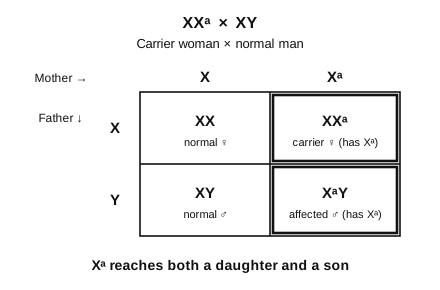
- Her ova carry either the normal X or the affected Xa (1 : 1).
- Xa + Y from father → son (shows the condition, being hemizygous); Xa + X from father → daughter (carrier, if the trait is recessive).
- So the chromosome can pass to both sons and daughters; "only" options are wrong.
Short trick: Father → X only to daughters; Mother → X to everyone.
Answer: (D) Both sons and daughters
अवधारणा: माता अपने दो X गुणसूत्रों में से एक प्रत्येक संतान को देती है – पुत्र को X माता से (Y पिता से); पुत्री को एक X प्रत्येक जनक से।
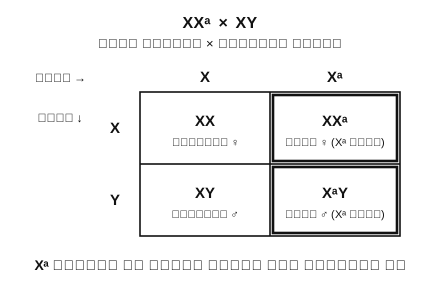
- उसके अंडाणुओं में सामान्य X या प्रभावित Xa होता है (1 : 1)।
- Xa + पिता का Y → पुत्र (अर्धयुग्मजी होने से रोगी); Xa + पिता का X → पुत्री (लक्षण अप्रभावी हो तो वाहक)।
- अतः यह गुणसूत्र पुत्र और पुत्री दोनों में जा सकता है; "केवल" वाले विकल्प गलत हैं।
शॉर्ट ट्रिक: पिता → X केवल पुत्रियों को; माता → X सभी को।
उत्तर: (D) पुत्र और पुत्रियाँ दोनों
NEET UGBiologyPrinciples of inheritance – sex-linked inheritanceNEET UG 2018 · 6 May Shift 1
Q430.According to Hugo de Vries, the mechanism of evolution is
ह्यूगो डी व्रीज़ के अनुसार, विकास की क्रियाविधि है
- APhenotypic variationsलक्षणप्ररूपी विभिन्नताएँ
- BSaltationसाल्टेशन (एकल-पद बृहत् उत्परिवर्तन)
- CMultiple step mutationsबहु-पदीय उत्परिवर्तन
- DMinor mutationsलघु उत्परिवर्तन
Show answer
Concept: Hugo de Vries (work on Oenothera lamarckiana): mutations are large, sudden and discontinuous; single-step large mutation = saltation is the cause of speciation (NCERT).
- Darwin believed in small, directional, continuous variations – not de Vries.
- De Vries: random, directionless, sudden big jumps → saltation → (B).
- "Multiple step" and "minor" mutations describe gradual change – the opposite of his view.
Short trick: de Vries = "Sudden Salt-jump" (saltation) on evening primrose.
Answer: (B) Saltation
अवधारणा: ह्यूगो डी व्रीज़ (Oenothera lamarckiana पर कार्य): उत्परिवर्तन बड़े, अचानक और असतत होते हैं; एकल-पद बृहत् उत्परिवर्तन = साल्टेशन जाति-उद्भवन का कारण है (NCERT)।
- डार्विन छोटी, दिशात्मक, सतत विभिन्नताओं में विश्वास करते थे – डी व्रीज़ नहीं।
- डी व्रीज़: यादृच्छिक, दिशाहीन, अचानक बड़ी छलांग → साल्टेशन → (B)।
- "बहु-पदीय" और "लघु" उत्परिवर्तन क्रमिक परिवर्तन दर्शाते हैं – उनके मत के विपरीत।
शॉर्ट ट्रिक: डी व्रीज़ = अचानक छलांग (साल्टेशन), इवनिंग प्रिमरोज़ पर।
उत्तर: (B) साल्टेशन (एकल-पद बृहत् उत्परिवर्तन)
NEET UGBiologyEvolution – mutation theoryNEET UG 2018 · 6 May Shift 1
Q431.AGGTATCGCAT is a sequence from the coding strand of a gene. What will be the corresponding sequence of the transcribed mRNA?
AGGTATCGCAT किसी जीन के कोडिंग रज्जुक (coding strand) का अनुक्रम है। अनुलेखित mRNA का संगत अनुक्रम क्या होगा?
- AACCUAUGCGAU
- BUGGTUTCGCAT
- CAGGUAUCGCAU
- DUCCAUAGCGUA
Show answer
Concept: mRNA is complementary to the template strand, hence has the same sequence as the coding strand, with U in place of T.
- Coding strand: A G G T A T C G C A T.
- Replace every T by U: A G G U A U C G C A U = AGGUAUCGCAU → (C).
- (D) is the complement (that would pair with the coding strand); (B) contains T, impossible in RNA; (A) is a wrong mix.
Short trick: Coding strand → mRNA: just "T → U", nothing else changes.
Answer: (C) AGGUAUCGCAU
अवधारणा: mRNA टेम्पलेट रज्जुक का पूरक होता है, अतः इसका अनुक्रम कोडिंग रज्जुक के समान होता है, केवल T के स्थान पर U।
- कोडिंग रज्जुक: A G G T A T C G C A T।
- प्रत्येक T को U से बदलें: A G G U A U C G C A U = AGGUAUCGCAU → (C)।
- (D) पूरक अनुक्रम है (जो कोडिंग रज्जुक से युग्मित होगा); (B) में T है, जो RNA में असंभव है; (A) गलत मिश्रण है।
शॉर्ट ट्रिक: कोडिंग रज्जुक → mRNA: केवल "T → U", और कुछ नहीं बदलता।
उत्तर: (C) AGGUAUCGCAU
NEET UGBiologyMolecular basis of inheritance – transcriptionNEET UG 2018 · 6 May Shift 1
Q432.Match the items given in Column I with those in Column II and select the correct option given below:
| Column I | Column II |
|---|
| a. Proliferative Phase | i. Breakdown of endometrial lining |
| b. Secretory Phase | ii. Follicular Phase |
| c. Menstruation | iii. Luteal Phase |
स्तंभ I में दी गई मदों का स्तंभ II की मदों से मिलान कीजिए और नीचे दिए गए विकल्पों में से सही विकल्प चुनिए:
| स्तंभ I | स्तंभ II |
|---|
| a. प्रचुरोद्भवन प्रावस्था (Proliferative Phase) | i. गर्भाशय-अंतःस्तर का विघटन |
| b. स्रावी प्रावस्था (Secretory Phase) | ii. पुटकीय प्रावस्था |
| c. आर्तव स्राव (Menstruation) | iii. पीतपिंड प्रावस्था |
- Aa-ii, b-iii, c-i
- Ba-i, b-iii, c-ii
- Ca-iii, b-ii, c-i
- Da-iii, b-i, c-ii
Show answer
Concept: Ovarian and uterine events run in parallel: follicular phase ↔ proliferative endometrium; luteal phase ↔ secretory endometrium; fall of progesterone → menstruation.
- a. Proliferative phase = follicular phase (estrogen from growing follicles regenerates endometrium) → ii.
- b. Secretory phase = luteal phase (progesterone from corpus luteum) → iii.
- c. Menstruation = breakdown of endometrial lining → i.
- a-ii, b-iii, c-i = (A).
Short trick: Follicle ↔ Proliferation (both "growth"); Luteal ↔ Secretory (progesterone).
Answer: (A) a-ii, b-iii, c-i
अवधारणा: अंडाशयी और गर्भाशयी घटनाएँ साथ-साथ चलती हैं: पुटकीय प्रावस्था ↔ प्रचुरोद्भवन; पीतपिंड प्रावस्था ↔ स्रावी अंतःस्तर; प्रोजेस्टेरोन घटने पर → आर्तव स्राव।
- a. प्रचुरोद्भवन प्रावस्था = पुटकीय प्रावस्था (बढ़ते पुटकों का एस्ट्रोजन अंतःस्तर का पुनर्जनन करता है) → ii।
- b. स्रावी प्रावस्था = पीतपिंड प्रावस्था (पीत पिंड का प्रोजेस्टेरोन) → iii।
- c. आर्तव स्राव = गर्भाशय-अंतःस्तर का विघटन → i।
- a-ii, b-iii, c-i = (A)।
शॉर्ट ट्रिक: पुटक ↔ प्रचुरोद्भवन (दोनों "वृद्धि"); पीतपिंड ↔ स्रावी (प्रोजेस्टेरोन)।
उत्तर: (A) a-ii, b-iii, c-i
NEET UGBiologyHuman reproduction – menstrual cycleNEET UG 2018 · 6 May Shift 1
Q433.Match the items given in Column I with those in Column II and select the correct option given below:
| Column I | Column II |
|---|
| a. Glycosuria | i. Accumulation of uric acid in joints |
| b. Gout | ii. Mass of crystallised salts within the kidney |
| c. Renal calculi | iii. Inflammation in glomeruli |
| d. Glomerular nephritis | iv. Presence of glucose in urine |
स्तंभ I में दी गई मदों का स्तंभ II की मदों से मिलान कीजिए और नीचे दिए गए विकल्पों में से सही विकल्प चुनिए:
| स्तंभ I | स्तंभ II |
|---|
| a. ग्लाइकोसूरिया | i. जोड़ों में यूरिक अम्ल का संचय |
| b. गाउट | ii. वृक्क में क्रिस्टलीकृत लवणों का पिंड |
| c. वृक्क अश्मरी (Renal calculi) | iii. गुच्छों (glomeruli) में शोथ |
| d. गुच्छ वृक्कशोथ (Glomerular nephritis) | iv. मूत्र में ग्लूकोस की उपस्थिति |
- Aa-ii, b-iii, c-i, d-iv
- Ba-i, b-ii, c-iii, d-iv
- Ca-iii, b-ii, c-iv, d-i
- Da-iv, b-i, c-ii, d-iii
Show answer
Concept: Name tells the disorder: -uria = in urine; -itis = inflammation; calculi = stones.
- a. Glycosuria = glucose in urine → iv.
- b. Gout = uric acid crystals in joints → i.
- c. Renal calculi = stone (crystallised salts, e.g. oxalates) in kidney → ii.
- d. Glomerulonephritis = inflammation of glomeruli → iii.
- a-iv, b-i, c-ii, d-iii = (D).
Short trick: Glyco + uria = sugar in urine → a-iv; only (D) has it.
Answer: (D) a-iv, b-i, c-ii, d-iii
अवधारणा: नाम से ही विकार पता चलता है: -यूरिया = मूत्र में; -इटिस = शोथ; अश्मरी = पथरी।
- a. ग्लाइकोसूरिया = मूत्र में ग्लूकोस → iv।
- b. गाउट = जोड़ों में यूरिक अम्ल क्रिस्टल → i।
- c. वृक्क अश्मरी = वृक्क में पथरी (क्रिस्टलीकृत लवण, जैसे ऑक्सलेट) → ii।
- d. गुच्छ वृक्कशोथ = गुच्छों का शोथ → iii।
- a-iv, b-i, c-ii, d-iii = (D)।
शॉर्ट ट्रिक: ग्लाइको + यूरिया = मूत्र में शर्करा → a-iv; केवल (D) में है।
उत्तर: (D) a-iv, b-i, c-ii, d-iii
NEET UGBiologyExcretory products – disordersNEET UG 2018 · 6 May Shift 1
Q434.Match the items given in Column I with those in Column II and select the correct option given below:
| Column I (Function) | Column II (Part of Excretory system) |
|---|
| a. Ultrafiltration | i. Henle's loop |
| b. Concentration of urine | ii. Ureter |
| c. Transport of urine | iii. Urinary bladder |
| d. Storage of urine | iv. Malpighian corpuscle |
| v. Proximal convoluted tubule |
स्तंभ I में दी गई मदों का स्तंभ II की मदों से मिलान कीजिए और नीचे दिए गए विकल्पों में से सही विकल्प चुनिए:
| स्तंभ I (कार्य) | स्तंभ II (उत्सर्जन तंत्र का भाग) |
|---|
| a. परानिस्यंदन (Ultrafiltration) | i. हेनले लूप |
| b. मूत्र का सांद्रण | ii. मूत्रवाहिनी |
| c. मूत्र का परिवहन | iii. मूत्राशय |
| d. मूत्र का संग्रह | iv. मैल्पीघियन कणिका |
| v. समीपस्थ संवलित नलिका |
- Aa-v, b-iv, c-i, d-ii
- Ba-iv, b-i, c-ii, d-iii
- Ca-iv, b-v, c-ii, d-iii
- Da-v, b-iv, c-i, d-iii
Show answer
Concept: Nephron division of labour (NCERT): glomerulus/Malpighian corpuscle filters, Henle's loop maintains medullary gradient (counter-current) for concentration, ureter carries, bladder stores.
- a. Ultrafiltration → Malpighian corpuscle (glomerulus + Bowman's capsule) → iv.
- b. Concentration of urine → Henle's loop (counter-current mechanism) → i.
- c. Transport of urine → ureter → ii.
- d. Storage of urine → urinary bladder → iii.
- PCT (v) is the distractor – it reabsorbs, does not filter. a-iv, b-i, c-ii, d-iii = (B).
Short trick: Follow urine's path: filter (corpuscle) → concentrate (loop) → carry (ureter) → store (bladder).
Answer: (B) a-iv, b-i, c-ii, d-iii
अवधारणा: नेफ्रॉन में कार्य-विभाजन (NCERT): गुच्छ/मैल्पीघियन कणिका निस्यंदन करती है, हेनले लूप सांद्रण हेतु अंतस्था प्रवणता (प्रतिधारा) बनाए रखता है, मूत्रवाहिनी परिवहन और मूत्राशय संग्रह करता है।
- a. परानिस्यंदन → मैल्पीघियन कणिका (गुच्छ + बोमन संपुट) → iv।
- b. मूत्र का सांद्रण → हेनले लूप (प्रतिधारा क्रियाविधि) → i।
- c. मूत्र का परिवहन → मूत्रवाहिनी → ii।
- d. मूत्र का संग्रह → मूत्राशय → iii।
- PCT (v) भ्रामक विकल्प है – यह पुनरवशोषण करती है, निस्यंदन नहीं। a-iv, b-i, c-ii, d-iii = (B)।
शॉर्ट ट्रिक: मूत्र का मार्ग: निस्यंदन (कणिका) → सांद्रण (लूप) → परिवहन (मूत्रवाहिनी) → संग्रह (मूत्राशय)।
उत्तर: (B) a-iv, b-i, c-ii, d-iii
NEET UGBiologyExcretory products – parts of the excretory systemNEET UG 2018 · 6 May Shift 1
Q435.Which of the following gastric cells indirectly help in erythropoiesis?
निम्नलिखित में से कौन-सी जठर कोशिकाएँ अप्रत्यक्ष रूप से रक्ताणु-उत्पत्ति (erythropoiesis) में सहायता करती हैं?
- AGoblet cellsगॉब्लेट कोशिकाएँ
- BMucous cellsश्लेष्म कोशिकाएँ
- CChief cellsमुख्य (Chief) कोशिकाएँ
- DParietal cellsभित्तीय (Parietal) कोशिकाएँ
Show answer
Concept: Parietal (oxyntic) cells secrete HCl and Castle's intrinsic factor (NCERT). Intrinsic factor is essential for absorption of vitamin B12, needed for RBC formation.
- Intrinsic factor → vitamin B12 absorption in ileum → normal erythropoiesis (its lack → pernicious anaemia).
- HCl also helps convert dietary Fe3+ to absorbable Fe2+.
- Chief (peptic) cells secrete pepsinogen; mucous/goblet cells secrete mucus – no role in RBC formation.
Short trick: Parietal = "P for Production of RBC help" – HCl + Intrinsic factor (B12).
Answer: (D) Parietal cells
अवधारणा: भित्तीय (ऑक्सिंटिक) कोशिकाएँ HCl और कैसल का नैज कारक (intrinsic factor) स्रावित करती हैं (NCERT)। नैज कारक विटामिन B12 के अवशोषण हेतु आवश्यक है, जो RBC निर्माण में लगता है।
- नैज कारक → शेषांत्र में विटामिन B12 का अवशोषण → सामान्य रक्ताणु-उत्पत्ति (कमी से → घातक अरक्तता)।
- HCl आहारीय Fe3+ को अवशोषणयोग्य Fe2+ में बदलने में भी सहायक है।
- मुख्य (पेप्टिक) कोशिकाएँ पेप्सिनोजन स्रावित करती हैं; श्लेष्म/गॉब्लेट कोशिकाएँ श्लेष्म – RBC निर्माण में कोई भूमिका नहीं।
शॉर्ट ट्रिक: भित्तीय कोशिका = HCl + नैज कारक (B12) → RBC।
उत्तर: (D) भित्तीय (Parietal) कोशिकाएँ
NEET UGBiologyDigestion and absorption – gastric glandsNEET UG 2018 · 6 May Shift 1
Q436.Match the items given in Column I with those in Column II and select the correct option given below:
| Column I | Column II |
|---|
| a. Fibrinogen | (i) Osmotic balance |
| b. Globulin | (ii) Blood clotting |
| c. Albumin | (iii) Defence mechanism |
स्तंभ I में दी गई मदों का स्तंभ II की मदों से मिलान कीजिए और नीचे दिए गए विकल्पों में से सही विकल्प चुनिए:
| स्तंभ I | स्तंभ II |
|---|
| a. फाइब्रिनोजन | (i) परासरणी संतुलन |
| b. ग्लोबुलिन | (ii) रुधिर स्कंदन |
| c. एल्बुमिन | (iii) रक्षा क्रियाविधि |
- Aa-(i), b-(iii), c-(ii)
- Ba-(i), b-(ii), c-(iii)
- Ca-(iii), b-(ii), c-(i)
- Da-(ii), b-(iii), c-(i)
Show answer
Concept: NCERT: fibrinogen – coagulation; globulins – defence mechanisms; albumins – osmotic balance.
- a. Fibrinogen → converted to fibrin → blood clotting → (ii).
- b. Globulin (γ-globulins = antibodies) → defence → (iii).
- c. Albumin → maintains colloidal osmotic pressure → (i).
- a-(ii), b-(iii), c-(i) = (D).
Short trick: "FGA = Clot, Combat, Osmo-control" in that order.
Answer: (D) a-(ii), b-(iii), c-(i)
अवधारणा: NCERT: फाइब्रिनोजन – स्कंदन; ग्लोबुलिन – रक्षा क्रियाविधि; एल्बुमिन – परासरणी संतुलन।
- a. फाइब्रिनोजन → फाइब्रिन में परिवर्तित → रुधिर स्कंदन → (ii)।
- b. ग्लोबुलिन (γ-ग्लोबुलिन = प्रतिरक्षी) → रक्षा → (iii)।
- c. एल्बुमिन → कोलॉइडी परासरण दाब बनाए रखता है → (i)।
- a-(ii), b-(iii), c-(i) = (D)।
शॉर्ट ट्रिक: F-G-A = थक्का, रक्षा, परासरण – इसी क्रम में।
उत्तर: (D) a-(ii), b-(iii), c-(i)
NEET UGBiologyBody fluids and circulation – plasma proteinsNEET UG 2018 · 6 May Shift 1
Q437.Which of the following is an occupational respiratory disorder?
निम्नलिखित में से कौन-सा एक व्यावसायिक श्वसन विकार है?
- ABotulismबोटुलिज़्म
- BSilicosisसिलिकोसिस
- CAnthracisएंथ्रेसिस
- DEmphysemaवातस्फीति (Emphysema)
Show answer
Concept: NCERT: in industries involving grinding or stone-breaking, long exposure to dust causes occupational respiratory disorders such as silicosis and asbestosis (lung fibrosis).
- Silicosis – inhalation of silica dust by stone-cutters/miners → fibrosis → occupational.
- Botulism – food poisoning by Clostridium botulinum toxin (not respiratory/occupational).
- Anthrax – infectious disease by Bacillus anthracis.
- Emphysema – mainly due to cigarette smoking, not occupation-specific.
Short trick: Occupational = dust of the job: SILica → SILicosis, ASBEStos → ASBEStosis.
Answer: (B) Silicosis
अवधारणा: NCERT: पत्थर पीसने या तोड़ने वाले उद्योगों में धूल के लंबे संपर्क से सिलिकोसिस और एस्बेस्टॉसिस जैसे व्यावसायिक श्वसन विकार (फेफड़ों का फाइब्रोसिस) होते हैं।
- सिलिकोसिस – पत्थर काटने वालों/खनिकों द्वारा सिलिका धूल का अंतःश्वसन → फाइब्रोसिस → व्यावसायिक।
- बोटुलिज़्म – Clostridium botulinum के आविष से खाद्य विषाक्तता (न श्वसन, न व्यावसायिक)।
- एंथ्रेक्स – Bacillus anthracis से संक्रामक रोग।
- वातस्फीति – मुख्यतः धूम्रपान से, व्यवसाय-विशिष्ट नहीं।
शॉर्ट ट्रिक: व्यावसायिक = काम की धूल: सिलिका → सिलिकोसिस, एस्बेस्टस → एस्बेस्टॉसिस।
उत्तर: (B) सिलिकोसिस
NEET UGBiologyBreathing and exchange of gases – occupational disordersNEET UG 2018 · 6 May Shift 1
Q438.Calcium is important in skeletal muscle contraction because it
कंकाल पेशी संकुचन में कैल्सियम महत्वपूर्ण है, क्योंकि यह
- ADetaches the myosin head from the actin filament.मायोसिन शीर्ष को एक्टिन तंतु से अलग करता है।
- BActivates the myosin ATPase by binding to it.मायोसिन ATPase से जुड़कर उसे सक्रिय करता है।
- CBinds to troponin to remove the masking of active sites on actin for myosin.ट्रोपोनिन से जुड़कर मायोसिन के लिए एक्टिन के सक्रिय स्थलों का आवरण हटाता है।
- DPrevents the formation of bonds between the myosin cross bridges and the actin filament.मायोसिन क्रॉस-ब्रिज और एक्टिन तंतु के बीच बंधों के बनने को रोकता है।
Show answer
Concept: Sliding filament theory (NCERT): Ca2+ released from the sarcoplasmic reticulum binds to troponin C on actin filaments and removes the masking of active sites for myosin.
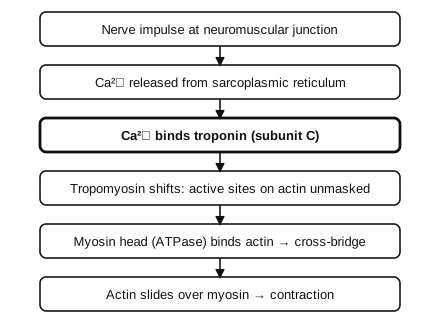
- Impulse → Ca2+ level rises in sarcoplasm → binds troponin → tropomyosin moves → active sites on F-actin exposed.
- Myosin head (an ATPase, energised by ATP hydrolysis) binds the exposed sites → cross-bridge → power stroke.
- (A) Detachment of myosin head needs a new ATP, not Ca2+. (B) Myosin ATPase activity is intrinsic to the head; Ca2+ does not bind myosin in skeletal muscle. (D) Ca2+ promotes, not prevents, cross-bridge formation.
Short trick: Ca2+ "unlocks the door" (troponin–tropomyosin lock on actin); ATP "releases the hand" (myosin head).
Answer: (C) Binds to troponin to remove the masking of active sites on actin for myosin.
अवधारणा: सर्पी तंतु सिद्धांत (NCERT): पेशीद्रव्यी जालिका से मुक्त Ca2+ एक्टिन तंतु पर ट्रोपोनिन C से जुड़ता है और मायोसिन के लिए सक्रिय स्थलों का आवरण हटाता है।
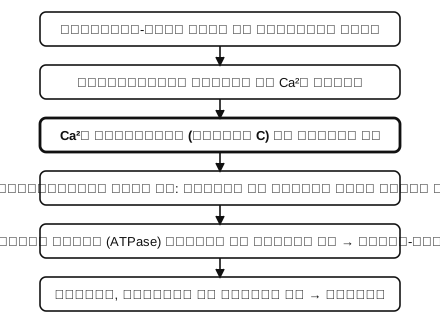
- आवेग → पेशीद्रव्य में Ca2+ स्तर बढ़ता है → ट्रोपोनिन से बंधन → ट्रोपोमायोसिन खिसकता है → F-एक्टिन के सक्रिय स्थल खुलते हैं।
- मायोसिन शीर्ष (एक ATPase, ATP जल-अपघटन से ऊर्जित) खुले स्थलों से जुड़ता है → क्रॉस-ब्रिज → शक्ति आघात।
- (A) मायोसिन शीर्ष के अलग होने हेतु नया ATP चाहिए, Ca2+ नहीं। (B) ATPase सक्रियता मायोसिन शीर्ष का अपना गुण है; कंकाल पेशी में Ca2+ मायोसिन से नहीं जुड़ता। (D) Ca2+ क्रॉस-ब्रिज बनने को बढ़ावा देता है, रोकता नहीं।
शॉर्ट ट्रिक: Ca2+ "ताला खोलता है" (एक्टिन पर ट्रोपोनिन–ट्रोपोमायोसिन का ताला); ATP "हाथ छुड़ाता है" (मायोसिन शीर्ष)।
उत्तर: (C) ट्रोपोनिन से जुड़कर मायोसिन के लिए एक्टिन के सक्रिय स्थलों का आवरण हटाता है।
NEET UGBiologyLocomotion and movement – mechanism of muscle contractionNEET UG 2018 · 6 May Shift 1
Q439.Nissl bodies are mainly composed of
निसल पिंड (Nissl bodies) मुख्य रूप से किनसे बने होते हैं?
- ANucleic acids and SERन्यूक्लिक अम्ल और SER
- BDNA and RNADNA और RNA
- CProteins and lipidsप्रोटीन और लिपिड
- DFree ribosomes and RERमुक्त राइबोसोम और RER
Show answer
Concept: Nissl's granules (in cyton and dendrites, absent in axon) are clusters of rough endoplasmic reticulum with free ribosomes – sites of protein synthesis.
- They stain with basic dyes because of ribosomal RNA, but structurally they are RER + free ribosomes → (D).
- They contain no SER (A), are not DNA (B) and are not lipid bodies (C).
Short trick: Nissl = protein factory of neuron → ribosomes + RER (both protein-makers).
Answer: (D) Free ribosomes and RER
अवधारणा: निसल कणिकाएँ (कोशिकाकाय और द्रुमिकाओं में, तंत्रिकाक्ष में अनुपस्थित) मुक्त राइबोसोम सहित खुरदरी अंतःप्रद्रव्यी जालिका के समूह हैं – प्रोटीन संश्लेषण के स्थल।
- राइबोसोमल RNA के कारण ये क्षारीय रंजकों से रंगती हैं, पर संरचना में ये RER + मुक्त राइबोसोम हैं → (D)।
- इनमें SER (A) नहीं, ये DNA (B) नहीं और लिपिड पिंड (C) भी नहीं हैं।
शॉर्ट ट्रिक: निसल = तंत्रिका कोशिका की प्रोटीन फैक्ट्री → राइबोसोम + RER।
उत्तर: (D) मुक्त राइबोसोम और RER
NEET UGBiologyStructural organisation in animals – neuron (Nissl granules)NEET UG 2018 · 6 May Shift 1
Q440.Which of these statements is incorrect?
इनमें से कौन-सा कथन गलत है?
- AGlycolysis operates as long as it is supplied with NAD that can pick up hydrogen atomsग्लाइकोलिसिस तब तक चलता है जब तक उसे हाइड्रोजन परमाणु ग्रहण करने वाला NAD मिलता रहता है
- BGlycolysis occurs in cytosolग्लाइकोलिसिस कोशिकाद्रव्य (cytosol) में होता है
- CEnzymes of TCA cycle are present in mitochondrial matrixTCA चक्र के एंजाइम माइटोकॉन्ड्रियल आधात्री (matrix) में उपस्थित होते हैं
- DOxidative phosphorylation takes place in outer mitochondrial membraneऑक्सीकरणी फॉस्फोरिलेशन माइटोकॉन्ड्रिया की बाह्य झिल्ली में होता है
Show answer
Concept: ETS and oxidative phosphorylation (complexes I–V, ATP synthase F0–F1) are located in the inner mitochondrial membrane.
- (A) Correct – glycolysis needs NAD+ to accept H; that is why NADH must be re-oxidised (by ETS or fermentation).
- (B) Correct – glycolysis is cytoplasmic.
- (C) Correct – TCA enzymes are in the matrix (except succinate dehydrogenase, on the inner membrane).
- (D) Incorrect – the outer membrane has no ETS/ATP synthase.
Short trick: Matrix = Krebs; Inner membrane = ETS + ATP synthase; Cytosol = glycolysis.
Answer: (D) Oxidative phosphorylation takes place in outer mitochondrial membrane
अवधारणा: ETS और ऑक्सीकरणी फॉस्फोरिलेशन (सम्मिश्र I–V, ATP सिंथेज़ F0–F1) माइटोकॉन्ड्रिया की आंतरिक झिल्ली में स्थित होते हैं।
- (A) सही – ग्लाइकोलिसिस में H ग्रहण करने हेतु NAD+ चाहिए; इसीलिए NADH का पुनः ऑक्सीकरण (ETS या किण्वन से) आवश्यक है।
- (B) सही – ग्लाइकोलिसिस कोशिकाद्रव्य में होता है।
- (C) सही – TCA एंजाइम आधात्री में हैं (सक्सिनेट डीहाइड्रोजिनेज़ को छोड़कर, जो आंतरिक झिल्ली पर है)।
- (D) गलत – बाह्य झिल्ली में ETS/ATP सिंथेज़ नहीं होते।
शॉर्ट ट्रिक: आधात्री = क्रेब्स; आंतरिक झिल्ली = ETS + ATP सिंथेज़; कोशिकाद्रव्य = ग्लाइकोलिसिस।
उत्तर: (D) ऑक्सीकरणी फॉस्फोरिलेशन माइटोकॉन्ड्रिया की बाह्य झिल्ली में होता है
NEET UGBiologyRespiration in plants – glycolysis, TCA and ETSNEET UG 2018 · 6 May Shift 1

