Q421.A solid sphere is in rolling motion. In rolling motion a body possesses translational kinetic energy (Kt) as well as rotational kinetic energy (Kr) simultaneously. The ratio Kt : (Kt + Kr) for the sphere is
एक ठोस गोला लोटनी गति में है। लोटनी गति में पिंड के पास एक साथ स्थानांतरीय गतिज ऊर्जा (Kt) तथा घूर्णी गतिज ऊर्जा (Kr) दोनों होती हैं। गोले के लिए अनुपात Kt : (Kt + Kr) है
- A10 : 7
- B5 : 7
- C7 : 10
- D2 : 5
Show answer
Concept: Rolling without slipping: , , with .
Short trick: With : .
Answer: (B) 5 : 7
अवधारणा: बिना फिसले लोटन: , , जहाँ ।
शॉर्ट ट्रिक: से: ।
उत्तर: (B) 5 : 7
NEET UGPhysicsRotational motion – rolling kinetic energyNEET UG 2018 · 6 May Shift 1
Q422.A small sphere of radius 'r' falls from rest in a viscous liquid. As a result, heat is produced due to viscous force. The rate of production of heat when the sphere attains its terminal velocity, is proportional to
त्रिज्या 'r' का एक छोटा गोला विराम से एक श्यान द्रव में गिरता है। परिणामस्वरूप श्यान बल के कारण ऊष्मा उत्पन्न होती है। जब गोला अपना सीमांत वेग प्राप्त कर लेता है, तब ऊष्मा उत्पादन की दर अनुक्रमानुपाती है
- Ar5
- Br2
- Cr3
- Dr4
Show answer
Concept: Rate of heat = power of viscous force . Terminal velocity .
Short trick: At terminal velocity, power = (net weight) × .
Answer: (A) r5
अवधारणा: ऊष्मा की दर = श्यान बल की शक्ति । सीमांत वेग ।
शॉर्ट ट्रिक: सीमांत वेग पर शक्ति = (कुल प्रभावी भार) × ।
उत्तर: (A) r5
NEET UGPhysicsFluids – viscosity and terminal velocityNEET UG 2018 · 6 May Shift 1
Q423.The power radiated by a black body is P and it radiates maximum energy at wavelength, . If the temperature of the black body is now changed so that it radiates maximum energy at wavelength , the power radiated by it becomes nP. The value of n is
एक कृष्णिका द्वारा विकिरित शक्ति P है और यह तरंगदैर्ध्य पर अधिकतम ऊर्जा विकिरित करती है। यदि अब कृष्णिका का ताप इस प्रकार बदला जाए कि यह तरंगदैर्ध्य पर अधिकतम ऊर्जा विकिरित करे, तो इसके द्वारा विकिरित शक्ति nP हो जाती है। n का मान है
- A
- B
- C
- D
Show answer
Concept: Wien: = constant; Stefan: .
- ⇒
Short trick: directly: ; λ falls ⇒ T rises ⇒ n > 1, so only (A) or (B).
Answer: (A)
अवधारणा: वीन: = नियत; स्टीफ़न: ।
- ⇒
शॉर्ट ट्रिक: सीधे : ; λ घटी ⇒ T बढ़ा ⇒ n > 1, अतः केवल (A) या (B)।
उत्तर: (A)
NEET UGPhysicsThermal radiation – Wien's law and Stefan's lawNEET UG 2018 · 6 May Shift 1
Q424.Two wires are made of the same material and have the same volume. The first wire has cross-sectional area A and the second wire has cross-sectional area 3A. If the length of the first wire is increased by on applying a force F, how much force is needed to stretch the second wire by the same amount?
दो तार एक ही पदार्थ के बने हैं तथा उनका आयतन समान है। पहले तार का अनुप्रस्थ-काट क्षेत्रफल A तथा दूसरे तार का अनुप्रस्थ-काट क्षेत्रफल 3A है। यदि बल F लगाने पर पहले तार की लंबाई बढ़ जाती है, तो दूसरे तार को उतना ही खींचने के लिए कितने बल की आवश्यकता होगी?
- A4 F
- B6 F
- C9 F
- DF
Show answer
Concept: . Same volume ⇒ , so the wire of area 3A has length .
- Wire 1:
- Wire 2:
- Equal extensions ⇒
Short trick: For the same volume, ; area ×3 ⇒ force ×9.
Answer: (C) 9 F
अवधारणा: । समान आयतन ⇒ , अतः 3A क्षेत्रफल वाले तार की लंबाई है।
- तार 1:
- तार 2:
- समान प्रसार ⇒
शॉर्ट ट्रिक: समान आयतन के लिए ; क्षेत्रफल ×3 ⇒ बल ×9।
उत्तर: (C) 9 F
NEET UGPhysicsElasticity – Young's modulus, wires of same volumeNEET UG 2018 · 6 May Shift 1
Q425.A sample of 0.1 g of water at 100°C and normal pressure () requires 54 cal of heat energy to convert to steam at 100°C. If the volume of the steam produced is 167.1 cc, the change in internal energy of the sample, is
100°C तथा सामान्य दाब () पर 0.1 g जल के एक नमूने को 100°C पर भाप में बदलने के लिए 54 cal ऊष्मा ऊर्जा की आवश्यकता होती है। यदि उत्पन्न भाप का आयतन 167.1 cc है, तो नमूने की आंतरिक ऊर्जा में परिवर्तन है
- A42.2 J
- B208.7 J
- C104.3 J
- D84.5 J
Show answer
Concept: First law: .
- J
- J (volume of 0.1 g of water ≈ 0.1 cc is negligible)
- J ≈ 208.7 J
Short trick: Most of the latent heat goes into internal energy; must be a bit less than 226 J – only 208.7 J fits.
Answer: (B) 208.7 J
अवधारणा: प्रथम नियम: ।
- J
- J (0.1 g जल का आयतन ≈ 0.1 cc, नगण्य)
- J ≈ 208.7 J
शॉर्ट ट्रिक: गुप्त ऊष्मा का अधिकांश भाग आंतरिक ऊर्जा में जाता है; , 226 J से थोड़ा कम होना चाहिए – केवल 208.7 J उपयुक्त है।
उत्तर: (B) 208.7 J
NEET UGPhysicsThermodynamics – first law, change in internal energyNEET UG 2018 · 6 May Shift 1
Q426.A potentiometer is an accurate and versatile device to make electrical measurements of E.M.F, because the method involves :
विभवमापी (potentiometer) विद्युत वाहक बल (E.M.F) के विद्युत मापन के लिए एक यथार्थ तथा बहुउपयोगी युक्ति है, क्योंकि इस विधि में निहित है :
- ACellsसेल
- BPotential gradientsविभव प्रवणता
- CA condition of no current flow through the galvanometerगैल्वेनोमीटर से कोई धारा प्रवाहित न होने की स्थिति
- DA combination of cells, galvanometer and resistancesसेलों, गैल्वेनोमीटर तथा प्रतिरोधों का संयोजन
Show answer
Concept: A potentiometer is a null-deflection method: at the balance point no current is drawn from the cell being measured.
- At balance, the galvanometer shows zero deflection, so the test cell supplies no current.
- With zero current there is no drop across the internal resistance, so the reading equals the true emf (not the terminal voltage).
- (A), (B) and (D) are parts/ingredients of every such circuit (a voltmeter set-up also has them); they are not the reason for its accuracy.
Short trick: Accuracy of potentiometer = "null method" = zero current through galvanometer at balance.
Answer: (C) A condition of no current flow through the galvanometer
अवधारणा: विभवमापी एक शून्य-विक्षेप (null) विधि है: संतुलन बिंदु पर मापे जाने वाले सेल से कोई धारा नहीं ली जाती।
- संतुलन पर गैल्वेनोमीटर में शून्य विक्षेप होता है, अतः परीक्षण सेल कोई धारा नहीं देता।
- धारा शून्य होने से आंतरिक प्रतिरोध पर कोई विभवपात नहीं होता, अतः पाठ्यांक वास्तविक emf के बराबर होता है (टर्मिनल वोल्टता नहीं)।
- (A), (B) व (D) तो हर ऐसे परिपथ के भाग हैं (वोल्टमीटर व्यवस्था में भी होते हैं); ये इसकी यथार्थता का कारण नहीं हैं।
शॉर्ट ट्रिक: विभवमापी की यथार्थता = "शून्य विधि" = संतुलन पर गैल्वेनोमीटर से शून्य धारा।
उत्तर: (C) गैल्वेनोमीटर से कोई धारा प्रवाहित न होने की स्थिति
NEET UGPhysicsCurrent electricity – potentiometerNEET UG 2017 · 7 May Shift 1
Q427.A gas mixture consists of 2 moles of O2 and 4 moles of Ar at temperature T. Neglecting all vibrational modes, the total internal energy of the system is
एक गैस मिश्रण में ताप T पर O2 के 2 मोल तथा Ar के 4 मोल हैं। सभी कम्पन विधाओं (vibrational modes) की उपेक्षा करते हुए, निकाय की कुल आंतरिक ऊर्जा है
- A4 RT
- B15 RT
- C9 RT
- D11 RT
Show answer
Concept: ; diatomic O2 (no vibration) has f = 5, monatomic Ar has f = 3.
- O2:
- Ar:
Short trick: Internal energy = (sum of n·f)/2 × RT = (2×5 + 4×3)/2 RT = 22/2 RT.
Answer: (D) 11 RT
अवधारणा: ; द्विपरमाणुक O2 (कम्पन रहित) के लिए f = 5, एकपरमाणुक Ar के लिए f = 3।
- O2:
- Ar:
शॉर्ट ट्रिक: आंतरिक ऊर्जा = (n·f का योग)/2 × RT = (2×5 + 4×3)/2 RT = 22/2 RT।
उत्तर: (D) 11 RT
NEET UGPhysicsKinetic theory – internal energy of gas mixtureNEET UG 2017 · 7 May Shift 1
Q428.Radioactive material 'A' has decay constant '8λ' and material 'B' has decay constant 'λ'. Initially they have same number of nuclei. After what time, the ratio of number of nuclei of material 'B' to that 'A' will be ?
रेडियोऐक्टिव पदार्थ 'A' का क्षय नियतांक '8λ' तथा पदार्थ 'B' का क्षय नियतांक 'λ' है। प्रारम्भ में दोनों में नाभिकों की संख्या समान है। कितने समय पश्चात् पदार्थ 'B' के नाभिकों की संख्या का 'A' के नाभिकों की संख्या से अनुपात होगा?
- A
- B
- C
- D
Show answer
Concept: . With equal , the ratio of the two samples depends only on the difference of decay constants.
- For every , (A decays faster, so B is always the larger sample).
- Setting gives – a negative time, which is impossible.
- Only the reversed ratio gives (option (B)), but that is not what the question asks.
Short trick: Faster-decaying sample (A) is always smaller, so B : A can never fall below 1 – a ratio of 1/e is impossible for B : A.
Answer: Bonus – as printed (B : A = 1/e) no positive time exists; none of the options is correct. (Reading it as A : B = 1/e would give (B) .)
अवधारणा: । समान होने पर दोनों नमूनों का अनुपात केवल क्षय नियतांकों के अंतर पर निर्भर करता है।
- प्रत्येक के लिए (A तेजी से क्षयित होता है, अतः B सदैव बड़ा नमूना रहता है)।
- रखने पर मिलता है – ऋणात्मक समय, जो असंभव है।
- केवल उल्टा अनुपात लेने पर (विकल्प (B)) आता है, परन्तु प्रश्न यह नहीं पूछता।
शॉर्ट ट्रिक: तेजी से क्षयित होने वाला नमूना (A) सदैव छोटा रहता है, अतः B : A कभी 1 से कम नहीं हो सकता – 1/e अनुपात असंभव है।
उत्तर: बोनस – जैसा छपा है (B : A = 1/e) उसके लिए कोई धनात्मक समय संभव नहीं; कोई भी विकल्प सही नहीं है। (A : B पढ़ने पर (B) आता।)
NEET UGPhysicsNuclei – radioactive decay lawNEET UG 2017 · 7 May Shift 1
Q429.A U tube with both ends open to the atmosphere, is partially filled with water. Oil, which is immiscible with water, is poured into one side until it stands at a distance of 10 mm above the water level on the other side. Meanwhile the water rises by 65 mm from its original level (see diagram). The density of the oil is
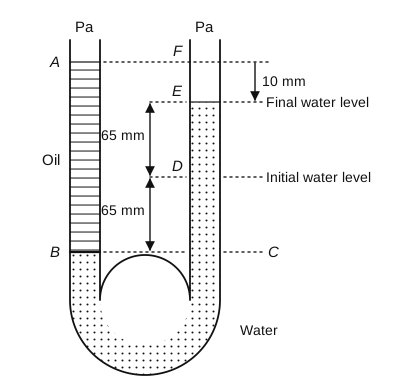
दोनों सिरों पर वायुमण्डल के लिए खुली एक U-नली में आंशिक रूप से जल भरा है। जल में अमिश्रणीय तेल को एक ओर तब तक डाला जाता है जब तक कि वह दूसरी ओर के जल तल से 10 mm ऊपर तक न आ जाए। इस बीच जल अपने मूल तल से 65 mm ऊपर उठ जाता है (आरेख देखिए)। तेल का घनत्व है
- A650 kg m–3
- B425 kg m–3
- C800 kg m–3
- D928 kg m–3
Show answer
Concept: Pressures at the same horizontal level in the same continuous liquid (water) are equal: p(B) = p(C).
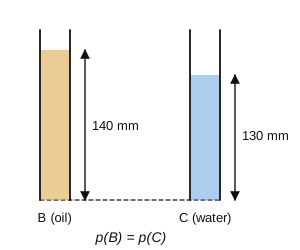
- Water rises 65 mm on the right, so it falls 65 mm on the left: oil–water interface B is 65 + 65 = 130 mm below the final water level E.
- Oil column height = 130 + 10 = 140 mm; water column above C = 130 mm.
Short trick: ρ_oil/ρ_water = (water column)/(oil column) = 130/140 – just under 1000, so only 928 fits.
Answer: (D) 928 kg m–3
अवधारणा: एक ही सतत द्रव (जल) में समान क्षैतिज तल पर दाब बराबर होते हैं: p(B) = p(C)।
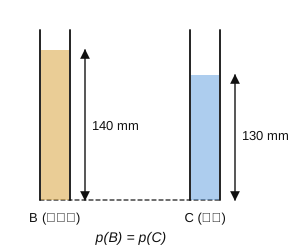
- दाईं ओर जल 65 mm ऊपर उठता है, अतः बाईं ओर 65 mm नीचे जाता है: तेल–जल अंतरापृष्ठ B अंतिम जल तल E से 65 + 65 = 130 mm नीचे है।
- तेल स्तम्भ की ऊँचाई = 130 + 10 = 140 mm; C के ऊपर जल स्तम्भ = 130 mm।
शॉर्ट ट्रिक: ρ_तेल/ρ_जल = (जल स्तम्भ)/(तेल स्तम्भ) = 130/140 – 1000 से थोड़ा कम, अतः केवल 928 उपयुक्त है।
उत्तर: (D) 928 kg m–3
NEET UGPhysicsMechanical properties of fluids – U-tube manometerNEET UG 2017 · 7 May Shift 1
Q430.A 250-Turn rectangular coil of length 2.1 cm and width 1.25 cm carries a current of 85 μA and subjected to a magnetic field of strength 0.85 T. Work done for rotating the coil by 180° against the torque is
लम्बाई 2.1 cm तथा चौड़ाई 1.25 cm की 250 फेरों वाली एक आयताकार कुण्डली में 85 μA धारा प्रवाहित हो रही है तथा इस पर 0.85 T तीव्रता का चुंबकीय क्षेत्र आरोपित है। बल-आघूर्ण के विरुद्ध कुण्डली को 180° घुमाने में किया गया कार्य है
- A9.1 μJ
- B4.55 μJ
- C2.3 μJ
- D1.15 μJ
Show answer
Concept: ; from the stable position () to , with .
- The nearest option is 9.1 μJ; (B), (C), (D) are 1/2, 1/4, 1/8 of it (missing the factor 2 and more).
Short trick: Rotating by 180° against the torque always costs 2MB – twice MB, never MB/2.
Answer: (A) 9.1 μJ
अवधारणा: ; स्थायी स्थिति () से तक, जहाँ ।
- निकटतम विकल्प 9.1 μJ है; (B), (C), (D) इसके 1/2, 1/4, 1/8 हैं (गुणक 2 आदि छूट जाने पर)।
शॉर्ट ट्रिक: बल-आघूर्ण के विरुद्ध 180° घुमाने में सदैव 2MB कार्य लगता है – MB का दोगुना, कभी MB/2 नहीं।
उत्तर: (A) 9.1 μJ
NEET UGPhysicsMoving charges and magnetism – work done on a current loopNEET UG 2017 · 7 May Shift 1
Q431.The de-Broglie wavelength of a neutron in thermal equilibrium with heavy water at a temperature T (Kelvin) and mass m, is
ताप T (केल्विन) पर भारी जल के साथ तापीय साम्य में स्थित द्रव्यमान m वाले एक न्यूट्रॉन का दे-ब्रॉग्ली तरंगदैर्ध्य है
- A
- B
- C
- D
Show answer
Concept: and a thermal particle has average KE .
Short trick: Thermal particle: λ = h/√(3mkT) – the "3" comes from 3/2 kT; no factor 2 survives in the numerator.
Answer: (B)
अवधारणा: तथा तापीय कण की औसत गतिज ऊर्जा ।
शॉर्ट ट्रिक: तापीय कण: λ = h/√(3mkT) – "3", 3/2 kT से आता है; अंश में कोई गुणक 2 नहीं बचता।
उत्तर: (B)
NEET UGPhysicsDual nature of matter – de Broglie wavelength of thermal neutronNEET UG 2017 · 7 May Shift 1
Q432.One end of string of length l is connected to a particle of mass 'm' and the other end is connected to a small peg on a smooth horizontal table. If the particle moves in circle with speed 'v', the net force on the particle (directed towards center) will be (T represents the tension in the string)
लम्बाई l की एक डोरी का एक सिरा द्रव्यमान 'm' के एक कण से तथा दूसरा सिरा एक चिकनी क्षैतिज मेज़ पर लगी एक छोटी खूँटी से जुड़ा है। यदि कण 'v' चाल से वृत्त में गति करता है, तो कण पर (केन्द्र की ओर निर्देशित) नेट बल होगा (T डोरी में तनाव दर्शाता है)
- AT
- B
- C
- DZeroशून्य
Show answer
Concept: On a smooth horizontal table, weight and normal reaction cancel; the only horizontal force is the tension, which itself provides the centripetal force.
- Net force toward centre = T (the only radial force).
- This net force equals ; "centripetal force" is not an extra force to add or subtract, so (B) and (C) double-count it.
- It cannot be zero (D), since the velocity keeps changing direction.
Short trick: Centripetal force is a role, not a new force – here the tension plays that role.
Answer: (A) T
अवधारणा: चिकनी क्षैतिज मेज़ पर भार तथा अभिलम्ब प्रतिक्रिया संतुलित हो जाते हैं; केवल क्षैतिज बल तनाव है, जो स्वयं अभिकेन्द्र बल प्रदान करता है।
- केन्द्र की ओर नेट बल = T (एकमात्र त्रिज्य बल)।
- यही नेट बल के बराबर है; "अभिकेन्द्र बल" कोई अतिरिक्त बल नहीं जिसे जोड़ा या घटाया जाए, अतः (B) व (C) इसे दो बार गिनते हैं।
- यह शून्य (D) नहीं हो सकता, क्योंकि वेग की दिशा लगातार बदल रही है।
शॉर्ट ट्रिक: अभिकेन्द्र बल एक भूमिका है, नया बल नहीं – यहाँ तनाव यह भूमिका निभाता है।
उत्तर: (A) T
NEET UGPhysicsCircular motion – centripetal forceNEET UG 2017 · 7 May Shift 1
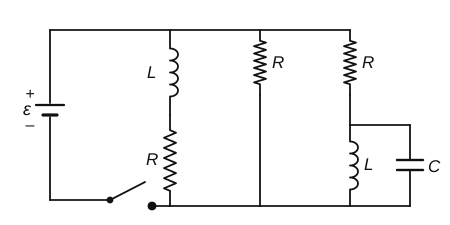
Q433.Figure shows a circuit contains three identical resistors with resistance
R = 9.0 Ω each, two identical inductors with inductance
L = 2.0 mH each, and an ideal battery with emf ε = 18 V. The current '
i' through the battery just after the switch closed is
चित्र में एक परिपथ दर्शाया गया है जिसमें प्रत्येक
R = 9.0 Ω प्रतिरोध वाले तीन सर्वसम प्रतिरोधक, प्रत्येक
L = 2.0 mH प्रेरकत्व वाले दो सर्वसम प्रेरक तथा emf ε = 18 V की एक आदर्श बैटरी है। स्विच बंद करने के ठीक बाद बैटरी से प्रवाहित धारा '
i' है
- A2 mA
- B0.2 A
- C2 A
- D0 ampere0 ऐम्पियर
Show answer
Concept: Just after closing: an inductor opposes any sudden change, so it carries zero current (open); an uncharged capacitor has zero voltage, so it acts as a short (plain wire).
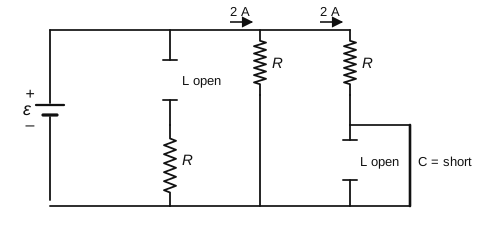
- Branch 1 (L in series with R): the inductor is open → current 0.
- Branch 2 (R alone): .
- Branch 3 (R in series with L ∥ C): the uncharged capacitor shorts the parallel L–C pair, so only R remains → .
- Battery current – this value is not among the options. 2 A results only if the capacitor branch is (wrongly) treated as open.
Short trick: At t = 0⁺: L → open, uncharged C → wire; at t = ∞: L → wire, C → open.
Answer: Bonus – the circuit as drawn gives i = 4 A at t = 0⁺; none of the options is correct.
अवधारणा: स्विच बंद करने के ठीक बाद: प्रेरक धारा में अचानक परिवर्तन का विरोध करता है, अतः उसमें शून्य धारा होती है (खुला परिपथ); अनावेशित संधारित्र पर शून्य वोल्टता होती है, अतः वह लघुपथ (सामान्य तार) की तरह कार्य करता है।
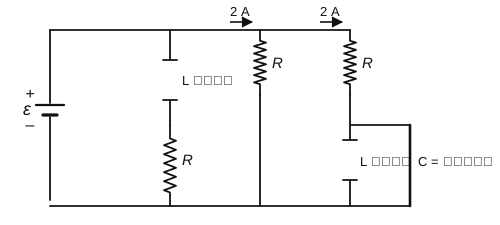
- शाखा 1 (L, R के श्रेणी में): प्रेरक खुला → धारा 0।
- शाखा 2 (केवल R): ।
- शाखा 3 (R के श्रेणी में L ∥ C): अनावेशित संधारित्र समांतर L–C युग्म को लघुपथित कर देता है, केवल R बचता है → ।
- बैटरी धारा – यह मान विकल्पों में नहीं है। 2 A तभी आता है जब संधारित्र शाखा को (गलत रूप से) खुला माना जाए।
शॉर्ट ट्रिक: t = 0⁺ पर: L → खुला, अनावेशित C → तार; t = ∞ पर: L → तार, C → खुला।
उत्तर: बोनस – दर्शाए गए परिपथ से t = 0⁺ पर i = 4 A आता है; कोई भी विकल्प सही नहीं है।
NEET UGPhysicsElectromagnetic induction – LR/LC circuit just after switchingNEET UG 2017 · 7 May Shift 1
Q434.The x and y coordinates of the particle at any time are x = 5t – 2t2 and y = 10t respectively, where x and y are in meters and t in seconds. The acceleration of the particle at t = 2 s is
किसी कण के किसी भी समय पर x तथा y निर्देशांक क्रमशः x = 5t – 2t2 तथा y = 10t हैं, जहाँ x व y मीटर में तथा t सेकण्ड में है। t = 2 s पर कण का त्वरण है
- A0
- B5 m/s2
- C–4 m/s2
- D–8 m/s2
Show answer
Concept: Acceleration components are second time-derivatives of the coordinates.
- Acceleration = m/s² – constant, the same at t = 2 s.
Short trick: Only the t² term survives two differentiations: a = 2 × (coefficient of t²) = 2 × (–2) = –4.
Answer: (C) –4 m/s2
अवधारणा: त्वरण घटक, निर्देशांकों के समय के सापेक्ष द्वितीय अवकलज होते हैं।
- त्वरण = m/s² – नियत, t = 2 s पर भी यही।
शॉर्ट ट्रिक: दो बार अवकलन के बाद केवल t² पद बचता है: a = 2 × (t² का गुणांक) = 2 × (–2) = –4।
उत्तर: (C) –4 m/s2
NEET UGPhysicsMotion in a plane – acceleration from coordinatesNEET UG 2017 · 7 May Shift 1
Q435.Suppose the charge of a proton and an electron differ slightly. One of them is –e, the other is (e + Δe). If the net of electrostatic force and gravitational force between two hydrogen atoms placed at a distance d (much greater than atomic size) apart is zero, then Δe is of the order of [Given mass of hydrogen mh = 1.67 × 10⁻²⁷ kg]
मान लीजिए प्रोटॉन तथा इलेक्ट्रॉन के आवेश में थोड़ा अंतर है। इनमें से एक –e है, दूसरा (e + Δe) है। यदि दूरी d (परमाणु आकार से बहुत अधिक) पर रखे दो हाइड्रोजन परमाणुओं के बीच स्थिरवैद्युत बल तथा गुरुत्वाकर्षण बल का परिणामी शून्य है, तो Δe की कोटि है [दिया है हाइड्रोजन का द्रव्यमान mh = 1.67 × 10⁻²⁷ kg]
- A10–20 C
- B10–23 C
- C10–37 C
- D10–47 C
Show answer
Concept: Each H atom carries net charge Δe; electrostatic repulsion must balance gravitational attraction.
- ( cancels)
- → order C
Short trick: C.
Answer: (C) 10–37 C
अवधारणा: प्रत्येक H परमाणु पर नेट आवेश Δe है; स्थिरवैद्युत प्रतिकर्षण को गुरुत्वाकर्षण आकर्षण से संतुलित होना चाहिए।
- ( कट जाता है)
- → कोटि C
शॉर्ट ट्रिक: C।
उत्तर: (C) 10–37 C
NEET UGPhysicsElectrostatics – Coulomb force vs gravitationNEET UG 2017 · 7 May Shift 1
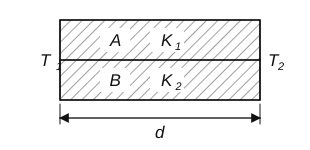
Q436.Two rods
A and
B of different materials are welded together as shown in figure. Their thermal conductivities are
K1 and
K2. The thermal conductivity of the composite rod will be
भिन्न पदार्थों की दो छड़ें
A तथा
B चित्रानुसार आपस में जोड़ी (वेल्ड की) गई हैं। इनकी ऊष्मा चालकताएँ
K1 तथा
K2 हैं। संयुक्त छड़ की ऊष्मा चालकता होगी
- A
- B
- C
- D
Show answer
Concept: The rods lie side by side between the same ends T1, T2 → they conduct in parallel; heat currents add.
- Composite rod of area 2A:
Short trick: Equal-area rods in parallel → simple average of K; in series (equal lengths) → 2K₁K₂/(K₁+K₂).
Answer: (A)
अवधारणा: छड़ें समान सिरों T1, T2 के बीच साथ-साथ रखी हैं → ये समांतर क्रम में चालन करती हैं; ऊष्मा धाराएँ जुड़ती हैं।
- क्षेत्रफल 2A वाली संयुक्त छड़:
शॉर्ट ट्रिक: समान क्षेत्रफल की समांतर छड़ें → K का सामान्य औसत; श्रेणी में (समान लम्बाई) → 2K₁K₂/(K₁+K₂)।
उत्तर: (A)
NEET UGPhysicsThermal properties – conduction through rods in parallelNEET UG 2017 · 7 May Shift 1
Q437.The diagrams below show regions of equipotentials.
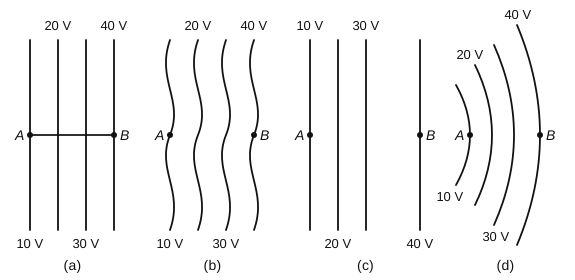
A positive charge is moved from
A to
B in each diagram.
नीचे दिए गए आरेख समविभव क्षेत्रों को दर्शाते हैं।
प्रत्येक आरेख में एक धनावेश को
A से
B तक ले जाया जाता है।
- AMaximum work is required to move q in figure (c).चित्र (c) में q को ले जाने में अधिकतम कार्य की आवश्यकता होती है।
- BIn all the four cases the work done is the same.चारों स्थितियों में किया गया कार्य समान है।
- CMinimum work is required to move q in figure (a).चित्र (a) में q को ले जाने में न्यूनतम कार्य की आवश्यकता होती है।
- DMaximum work is required to move q in figure (b).चित्र (b) में q को ले जाने में अधिकतम कार्य की आवश्यकता होती है।
Show answer
Concept: Electrostatic work depends only on end-point potentials: – not on path, shape or spacing of equipotentials.
- In every figure A lies on the 10 V surface and B on the 40 V surface.
- in (a), (b), (c) and (d).
- So (A), (C), (D), which claim different works, are wrong.
Short trick: Conservative field → only start and end potentials matter; crowded or curved lines change E, not ΔV.
Answer: (B) In all the four cases the work done is the same.
अवधारणा: स्थिरवैद्युत कार्य केवल अंतिम बिन्दुओं के विभव पर निर्भर करता है: – पथ, आकृति या समविभव पृष्ठों की दूरी पर नहीं।
- प्रत्येक चित्र में A, 10 V पृष्ठ पर तथा B, 40 V पृष्ठ पर है।
- (a), (b), (c) व (d) सभी में ।
- अतः भिन्न कार्य बताने वाले (A), (C), (D) गलत हैं।
शॉर्ट ट्रिक: संरक्षी क्षेत्र → केवल प्रारम्भिक व अंतिम विभव मायने रखते हैं; सघन या वक्र रेखाएँ E बदलती हैं, ΔV नहीं।
उत्तर: (B) चारों स्थितियों में किया गया कार्य समान है।
NEET UGPhysicsElectrostatic potential – work across equipotentialsNEET UG 2017 · 7 May Shift 1
Q438.The ratio of wavelengths of the last line of Balmer series and the last line of Lyman series is
बामर श्रेणी की अंतिम रेखा तथा लाइमन श्रेणी की अंतिम रेखा के तरंगदैर्ध्यों का अनुपात है
- A2
- B1
- C4
- D0.5
Show answer
Concept: The last line (series limit) corresponds to a transition from : .
- Balmer ():
- Lyman ():
Short trick: Series-limit wavelength ∝ n_f² → Balmer : Lyman = 2² : 1² = 4.
Answer: (C) 4
अवधारणा: अंतिम रेखा (श्रेणी सीमा) से संक्रमण के संगत है: ।
- बामर ():
- लाइमन ():
शॉर्ट ट्रिक: श्रेणी-सीमा तरंगदैर्ध्य ∝ n_f² → बामर : लाइमन = 2² : 1² = 4।
उत्तर: (C) 4
NEET UGPhysicsAtoms – hydrogen spectrum series limitsNEET UG 2017 · 7 May Shift 1
Q439.Young's double slit experiment is first performed in air and then in a medium other than air. It is found that 8th bright fringe in the medium lies where 5th dark fringe lies in air. The refractive index of the medium is nearly
यंग का द्वि-झिरी प्रयोग पहले वायु में तथा फिर वायु के अतिरिक्त किसी अन्य माध्यम में किया जाता है। यह पाया जाता है कि माध्यम में 8वीं दीप्त फ्रिंज वहाँ स्थित है जहाँ वायु में 5वीं अदीप्त फ्रिंज स्थित है। माध्यम का अपवर्तनांक लगभग है
- A1.25
- B1.59
- C1.69
- D1.78
Show answer
Concept: In a medium λ becomes λ/μ, so fringe positions shrink by μ. Bright: ; dark (air): .
- 5th dark in air:
- 8th bright in medium:
Short trick: nth dark = (n – ½) fringe widths: 4.5 β_air = 8 β_medium → μ = 8/4.5.
Answer: (D) 1.78
अवधारणा: माध्यम में λ, λ/μ हो जाता है, अतः फ्रिंजों की स्थितियाँ μ गुना सिकुड़ जाती हैं। दीप्त: ; अदीप्त (वायु): ।
- वायु में 5वीं अदीप्त:
- माध्यम में 8वीं दीप्त:
शॉर्ट ट्रिक: nवीं अदीप्त = (n – ½) फ्रिंज चौड़ाई: 4.5 β_वायु = 8 β_माध्यम → μ = 8/4.5।
उत्तर: (D) 1.78
NEET UGPhysicsWave optics – YDSE in a mediumNEET UG 2017 · 7 May Shift 1
Q440.A particle executes linear simple harmonic motion with an amplitude of 3 cm. When the particle is at 2 cm from the mean position, the magnitude of its velocity is equal to that of its acceleration. Then its time period in seconds is
एक कण 3 cm आयाम से रैखिक सरल आवर्त गति करता है। जब कण माध्य स्थिति से 2 cm पर है, तब उसके वेग का परिमाण उसके त्वरण के परिमाण के बराबर है। तब इसका आवर्तकाल (सेकण्ड में) है
- A
- B
- C
- D
Show answer
Concept: In SHM and .
- rad/s
- s
Short trick: v = a ⇒ ω = √(A² – x²)/x = √5/2, so T = 2π·x/√(A² – x²).
Answer: (C)
अवधारणा: सरल आवर्त गति में तथा ।
- rad/s
- s
शॉर्ट ट्रिक: v = a ⇒ ω = √(A² – x²)/x = √5/2, अतः T = 2π·x/√(A² – x²)।
उत्तर: (C)
NEET UGPhysicsOscillations – SHM velocity and accelerationNEET UG 2017 · 7 May Shift 1

