Q441.Thermodynamic processes are indicated in the following diagram.
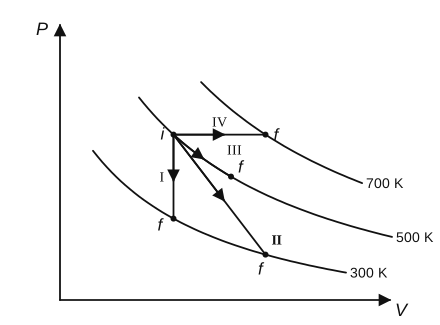
Match the following
| Column-1 | Column-2 |
|---|
| P. Process I | a. Adiabatic |
| Q. Process II | b. Isobaric |
| R. Process III | c. Isochoric |
| S. Process IV | d. Isothermal |
निम्नलिखित आरेख में ऊष्मागतिक प्रक्रम दर्शाए गए हैं।
निम्नलिखित का मिलान कीजिए
| स्तम्भ-1 | स्तम्भ-2 |
|---|
| P. प्रक्रम I | a. रुद्धोष्म (Adiabatic) |
| Q. प्रक्रम II | b. समदाबी (Isobaric) |
| R. प्रक्रम III | c. समआयतनी (Isochoric) |
| S. प्रक्रम IV | d. समतापी (Isothermal) |
- AP → a, Q → c, R → d, S → b
- BP → c, Q → a, R → d, S → b
- CP → c, Q → d, R → b, S → a
- DP → d, Q → b, R → a, S → c
Show answer
Concept: On a P–V diagram: vertical line = constant V, horizontal line = constant P, along an isotherm = constant T, steeper than an isotherm while crossing to a lower isotherm = adiabatic.
- I: vertical (V constant) → isochoric (c).
- II: steeper than the isotherm, from 500 K to 300 K → adiabatic expansion (a).
- III: stays on the 500 K curve → isothermal (d).
- IV: horizontal (P constant) → isobaric (b).
- P → c, Q → a, R → d, S → b.
Short trick: Only one option starts with P → c and also has Q → a.
Answer: (B) P → c, Q → a, R → d, S → b
अवधारणा: P–V आरेख पर: ऊर्ध्वाधर रेखा = नियत V, क्षैतिज रेखा = नियत P, समतापी वक्र के अनुदिश = नियत T, समतापी से अधिक ढलवाँ तथा निम्न ताप वक्र तक जाने वाला = रुद्धोष्म।
- I: ऊर्ध्वाधर (V नियत) → समआयतनी (c)।
- II: समतापी से अधिक ढलवाँ, 500 K से 300 K तक → रुद्धोष्म प्रसार (a)।
- III: 500 K वक्र पर ही रहता है → समतापी (d)।
- IV: क्षैतिज (P नियत) → समदाबी (b)।
- P → c, Q → a, R → d, S → b।
शॉर्ट ट्रिक: केवल एक विकल्प P → c से शुरू होकर Q → a भी रखता है।
उत्तर: (B) P → c, Q → a, R → d, S → b
NEET UGPhysicsThermodynamics – identifying processes on a P–V diagramNEET UG 2017 · 7 May Shift 1
Q442.A capacitor is charged by a battery. The battery is removed and another identical uncharged capacitor is connected in parallel. The total electrostatic energy of resulting system
एक संधारित्र को बैटरी द्वारा आवेशित किया जाता है। बैटरी हटा दी जाती है तथा एक अन्य सर्वसम अनावेशित संधारित्र को समांतर क्रम में जोड़ा जाता है। परिणामी निकाय की कुल स्थिरवैद्युत ऊर्जा
- AIncreases by a factor of 44 गुना बढ़ जाती है
- BDecreases by a factor of 22 गुना घट जाती है
- CRemains the sameसमान रहती है
- DIncreases by a factor of 22 गुना बढ़ जाती है
Show answer
Concept: With the battery removed, charge is conserved: .
- Initially .
- In parallel with an identical capacitor: , charge still Q.
- – the other half is lost as heat/radiation in the connecting wires.
Short trick: Isolated charge Q shared between equal capacitors → energy halves (U ∝ 1/C at fixed Q).
Answer: (B) Decreases by a factor of 2
अवधारणा: बैटरी हटाने पर आवेश संरक्षित रहता है: ।
- प्रारम्भ में ।
- सर्वसम संधारित्र के समांतर में: , आवेश अब भी Q।
- – शेष आधी ऊर्जा संयोजी तारों में ऊष्मा/विकिरण के रूप में नष्ट होती है।
शॉर्ट ट्रिक: पृथक आवेश Q को समान संधारित्रों में बाँटने पर → ऊर्जा आधी (नियत Q पर U ∝ 1/C)।
उत्तर: (B) 2 गुना घट जाती है
NEET UGPhysicsCapacitors – energy on sharing chargeNEET UG 2017 · 7 May Shift 1
Q443.The photoelectric threshold wavelength of silver is 3250 × 10–10 m. The velocity of the electron ejected from a silver surface by ultraviolet light of wavelength 2536 × 10–10 m is
(Given h = 4.14 × 10⁻¹⁵ eVs and c = 3 × 10⁸ ms–1)
चाँदी की प्रकाश-विद्युत देहली तरंगदैर्ध्य 3250 × 10–10 m है। तरंगदैर्ध्य 2536 × 10–10 m के पराबैंगनी प्रकाश द्वारा चाँदी के पृष्ठ से उत्सर्जित इलेक्ट्रॉन का वेग है
(दिया है h = 4.14 × 10⁻¹⁵ eVs तथा c = 3 × 10⁸ ms–1)
- A≈ 6 × 10⁵ ms–1
- B≈ 0.6 × 10⁶ ms–1
- C≈ 61 × 103 ms–1
- D≈ 0.3 × 10⁶ ms–1
Show answer
Concept: Einstein's equation: .
- Options (A) 6 × 10⁵ and (B) 0.6 × 10⁶ are the same number, so both are correct; (C) and (D) are wrong.
Short trick: Write every option in one form: 6×10⁵ = 0.6×10⁶ – two identical values means two correct choices.
Answer: Bonus – (A) and (B) are numerically identical (≈ 6 × 10⁵ m s–1), so two options are correct.
अवधारणा: आइन्सटीन का समीकरण: ।
- विकल्प (A) 6 × 10⁵ तथा (B) 0.6 × 10⁶ एक ही संख्या हैं, अतः दोनों सही हैं; (C) व (D) गलत हैं।
शॉर्ट ट्रिक: सभी विकल्पों को एक ही रूप में लिखिए: 6×10⁵ = 0.6×10⁶ – दो समान मान अर्थात् दो सही विकल्प।
उत्तर: बोनस – (A) तथा (B) संख्यात्मक रूप से समान हैं (≈ 6 × 10⁵ m s–1), अतः दो विकल्प सही हैं।
NEET UGPhysicsDual nature – photoelectric effectNEET UG 2017 · 7 May Shift 1
Q444.A physical quantity of the dimensions of length that can be formed out of c, G and is [c is velocity of light, G is universal constant of gravitation and e is charge]
c, G तथा से बनाई जा सकने वाली लम्बाई की विमा वाली भौतिक राशि है [c प्रकाश का वेग, G सार्वत्रिक गुरुत्वाकर्षण नियतांक तथा e आवेश है]
- A
- B
- C
- D
Show answer
Concept: → ; ; .
- : – mass cancels.
- Divide by : ✓ → option (A).
- (B) gives ; (C) still contains mass; (D) gives .
Short trick: Mass can vanish only through the product G·e²/4πε₀ – rules out (C); then fix powers of c to kill T.
Answer: (A)
अवधारणा: → ; ; ।
- : – द्रव्यमान कट जाता है।
- से भाग देने पर: ✓ → विकल्प (A)।
- (B) से ; (C) में द्रव्यमान बचा रहता है; (D) से ।
शॉर्ट ट्रिक: द्रव्यमान केवल गुणनफल G·e²/4πε₀ से ही हट सकता है – (C) बाहर; फिर T हटाने के लिए c की घात तय करें।
उत्तर: (A)
NEET UGPhysicsUnits and measurements – dimensional analysisNEET UG 2017 · 7 May Shift 1
Q445.Two cars moving in opposite directions approach each other with speed of 22 m/s and 16.5 m/s respectively. The driver of the first car blows a horn having a frequency 400 Hz. The frequency heard by the driver of the second car is [velocity of sound 340 m/s]
विपरीत दिशाओं में गतिमान दो कारें क्रमशः 22 m/s तथा 16.5 m/s की चाल से एक-दूसरे की ओर आ रही हैं। पहली कार का चालक 400 Hz आवृत्ति का हॉर्न बजाता है। दूसरी कार के चालक द्वारा सुनी गई आवृत्ति है [ध्वनि का वेग 340 m/s]
- A350 Hz
- B361 Hz
- C411 Hz
- D448 Hz
Show answer
Concept: Source and observer approaching: .
- m/s (first car, source), m/s (second car, observer).
- Hz
Short trick: Approaching → frequency must rise above 400 Hz: only 411 or 448; relative speed 38.5 m/s ≈ 11% of 340 → ≈ 448.
Answer: (D) 448 Hz
अवधारणा: स्रोत तथा प्रेक्षक एक-दूसरे की ओर आते हुए: ।
- m/s (पहली कार, स्रोत), m/s (दूसरी कार, प्रेक्षक)।
- Hz
शॉर्ट ट्रिक: पास आते हुए → आवृत्ति 400 Hz से अधिक: केवल 411 या 448; आपेक्षिक चाल 38.5 m/s ≈ 340 का 11% → ≈ 448।
उत्तर: (D) 448 Hz
NEET UGPhysicsWaves – Doppler effectNEET UG 2017 · 7 May Shift 1
Q446.In a common emitter transistor amplifier the audio signal voltage across the collector is 3 V. The resistance of collector is 3 kΩ. If current gain is 100 and the base resistance is 2 kΩ, the voltage and power gain of the amplifier is
एक उभयनिष्ठ उत्सर्जक ट्रांजिस्टर प्रवर्धक में संग्राहक के सिरों पर श्रव्य सिग्नल वोल्टता 3 V है। संग्राहक का प्रतिरोध 3 kΩ है। यदि धारा लब्धि 100 तथा आधार प्रतिरोध 2 kΩ है, तो प्रवर्धक की वोल्टता लब्धि तथा शक्ति लब्धि है
- A200 and 1000200 तथा 1000
- B15 and 20015 तथा 200
- C150 and 15000150 तथा 15000
- D20 and 200020 तथा 2000
Show answer
Concept: CE amplifier: voltage gain ; power gain .
- Power gain
- The 3 V signal value is not needed.
Short trick: Power gain = current gain × voltage gain → must equal 100 × A_V; only 150 & 15000 satisfy it.
Answer: (C) 150 and 15000
अवधारणा: CE प्रवर्धक: वोल्टता लब्धि ; शक्ति लब्धि ।
- शक्ति लब्धि
- 3 V सिग्नल मान की आवश्यकता नहीं है।
शॉर्ट ट्रिक: शक्ति लब्धि = धारा लब्धि × वोल्टता लब्धि → 100 × A_V होना चाहिए; केवल 150 व 15000 संतुष्ट करते हैं।
उत्तर: (C) 150 तथा 15000
NEET UGPhysicsSemiconductor electronics – CE amplifier gainsNEET UG 2017 · 7 May Shift 1
Q447.Which one of the following represents forward bias diode?
निम्नलिखित में से कौन-सा अग्र बायस (forward bias) में डायोड को निरूपित करता है?
- A

- B

- C

- D

Show answer
Concept: A diode is forward biased when its p-side (anode, triangle side) is at a higher potential than its n-side (cathode, bar side). In every figure the anode is on the left.
- (A) 0 V on the left, –2 V on the right: anode higher → forward bias ✓
- (B) –4 V vs –3 V: anode lower → reverse bias
- (C) –2 V vs +2 V: anode lower → reverse bias
- (D) 3 V vs 5 V: anode lower → reverse bias
Short trick: Arrow of the diode symbol points from high to low potential when it conducts – need V(left) > V(right).
Answer: (A) 0 V on the anode side, –2 V on the other side
अवधारणा: डायोड अग्र बायस में तब होता है जब उसका p-भाग (ऐनोड, त्रिभुज वाला सिरा) n-भाग (कैथोड, पट्टी वाला सिरा) से उच्च विभव पर हो। प्रत्येक चित्र में ऐनोड बाईं ओर है।
- (A) बाईं ओर 0 V, दाईं ओर –2 V: ऐनोड उच्च → अग्र बायस ✓
- (B) –4 V बनाम –3 V: ऐनोड निम्न → पश्च बायस
- (C) –2 V बनाम +2 V: ऐनोड निम्न → पश्च बायस
- (D) 3 V बनाम 5 V: ऐनोड निम्न → पश्च बायस
शॉर्ट ट्रिक: चालन के समय डायोड प्रतीक का तीर उच्च से निम्न विभव की ओर इंगित करता है – V(बायाँ) > V(दायाँ) चाहिए।
उत्तर: (A) ऐनोड की ओर 0 V, दूसरी ओर –2 V
NEET UGPhysicsSemiconductor electronics – forward bias of p–n junctionNEET UG 2017 · 7 May Shift 1
Q448.A spring of force constant k is cut into lengths of ratio 1 : 2 : 3. They are connected in series and the new force constant is k′. Then they are connected in parallel and force constant is k′′. Then k′ : k′′ is
बल नियतांक k की एक स्प्रिंग को 1 : 2 : 3 अनुपात की लम्बाइयों में काटा जाता है। इन्हें श्रेणी क्रम में जोड़ने पर नया बल नियतांक k′ है। फिर इन्हें समांतर क्रम में जोड़ने पर बल नियतांक k′′ है। तब k′ : k′′ है
- A1 : 6
- B1 : 9
- C1 : 11
- D1 : 14
Show answer
Concept: For a given spring, (kl = constant).
- Pieces of length l/6, 2l/6, 3l/6 →
- Series: (the original spring rebuilt)
- Parallel:
Short trick: Rejoining the pieces in series always gives back k; parallel = sum of 6, 3, 2.
Answer: (C) 1 : 11
अवधारणा: किसी दी गई स्प्रिंग के लिए (kl = नियत)।
- l/6, 2l/6, 3l/6 लम्बाई के टुकड़े →
- श्रेणी: (मूल स्प्रिंग पुनः बन गई)
- समांतर:
शॉर्ट ट्रिक: टुकड़ों को श्रेणी में जोड़ने पर सदैव k वापस मिलता है; समांतर = 6, 3, 2 का योग।
उत्तर: (C) 1 : 11
NEET UGPhysicsOscillations – spring combinationsNEET UG 2017 · 7 May Shift 1
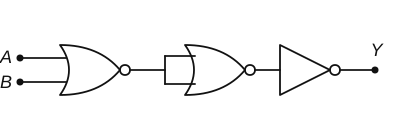
Q449.The given electrical network is equivalent to
दिया गया विद्युत नेटवर्क तुल्य है
- AAND gateAND गेट
- BOR gateOR गेट
- CNOR gateNOR गेट
- DNOT gateNOT गेट
Show answer
Concept: A NOR gate with both inputs joined acts as a NOT gate; two NOTs in a row cancel.
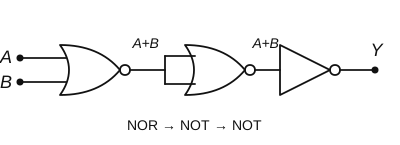
- First NOR: output .
- Second NOR with shorted inputs = NOT: output .
- Final NOT: → NOR gate.
Short trick: NOR → NOT → NOT: the two NOTs cancel, leaving the first NOR.
Answer: (C) NOR gate
अवधारणा: दोनों निवेश जुड़े होने पर NOR गेट, NOT गेट की तरह कार्य करता है; लगातार दो NOT एक-दूसरे को निरस्त कर देते हैं।
- पहला NOR: निर्गत ।
- जुड़े निवेशों वाला दूसरा NOR = NOT: निर्गत ।
- अंतिम NOT: → NOR गेट।
शॉर्ट ट्रिक: NOR → NOT → NOT: दोनों NOT निरस्त, पहला NOR बचता है।
उत्तर: (C) NOR गेट
NEET UGPhysicsSemiconductor electronics – logic gatesNEET UG 2017 · 7 May Shift 1
Q450.The acceleration due to gravity at a height 1 km above the earth is the same as at a depth d below the surface of earth. Then
पृथ्वी से 1 km ऊँचाई पर गुरुत्वीय त्वरण, पृथ्वी के पृष्ठ से d गहराई पर गुरुत्वीय त्वरण के समान है। तब
- A km
- Bd = 1 km
- C km
- Dd = 2 km
Show answer
Concept: For h, d ≪ R: , .
- Equate:
- km
Short trick: g falls twice as fast going up as going down (near the surface) → d = 2h.
Answer: (D) d = 2 km
अवधारणा: h, d ≪ R के लिए: , ।
- बराबर रखने पर:
- km
शॉर्ट ट्रिक: पृष्ठ के निकट ऊपर जाने पर g, नीचे जाने की तुलना में दोगुनी तेजी से घटता है → d = 2h।
उत्तर: (D) d = 2 km
NEET UGPhysicsGravitation – variation of g with height and depthNEET UG 2017 · 7 May Shift 1
Q451.Which of the following statements are correct?
(a) Centre of mass of a body always coincides with the centre of gravity of the body.
(b) Centre of mass of a body is the point at which the total gravitational torque on the body is zero
(c) A couple on a body produce both translational and rotational motion in a body.
(d) Mechanical advantage greater than one means that small effort can be used to lift a large load.
निम्नलिखित में से कौन-से कथन सही हैं?
(a) किसी पिण्ड का द्रव्यमान केन्द्र सदैव उसके गुरुत्व केन्द्र के संपाती होता है।
(b) किसी पिण्ड का द्रव्यमान केन्द्र वह बिन्दु है जिसके परितः पिण्ड पर कुल गुरुत्वीय बल-आघूर्ण शून्य होता है
(c) किसी पिण्ड पर बल-युग्म, पिण्ड में स्थानान्तरीय तथा घूर्णी दोनों गतियाँ उत्पन्न करता है।
(d) एक से अधिक यांत्रिक लाभ का अर्थ है कि अल्प आयास (effort) द्वारा बड़े भार को उठाया जा सकता है।
- A(b) and (d)(b) तथा (d)
- B(a) and (b)(a) तथा (b)
- C(b) and (c)(b) तथा (c)
- D(c) and (d)(c) तथा (d)
Show answer
Concept: CM and CG coincide only when g is uniform over the body; a couple has zero net force; MA = load/effort.
- (a) False – for a large body in non-uniform g, CM and CG differ ("always" is wrong).
- (b) Taken as correct – for a body in uniform g, the gravitational torque about the CM (= CG) is zero.
- (c) False – a couple has zero resultant force, so it produces only rotation, no translation.
- (d) True – MA = load/effort > 1 means effort is less than load.
- Correct pair: (b) and (d).
Short trick: Any option containing (a) or (c) is out → only (b) and (d) remain.
Answer: (A) (b) and (d)
अवधारणा: द्रव्यमान केन्द्र तथा गुरुत्व केन्द्र तभी संपाती होते हैं जब पिण्ड पर g एकसमान हो; बल-युग्म का परिणामी बल शून्य होता है; यांत्रिक लाभ = भार/आयास।
- (a) असत्य – असमान g में बड़े पिण्ड के लिए CM तथा CG भिन्न होते हैं ("सदैव" गलत है)।
- (b) सही माना गया – एकसमान g में पिण्ड के CM (= CG) के परितः गुरुत्वीय बल-आघूर्ण शून्य होता है।
- (c) असत्य – बल-युग्म का परिणामी बल शून्य है, अतः यह केवल घूर्णन उत्पन्न करता है, स्थानान्तरण नहीं।
- (d) सत्य – यांत्रिक लाभ = भार/आयास > 1 का अर्थ है आयास भार से कम है।
- सही युग्म: (b) तथा (d)।
शॉर्ट ट्रिक: (a) या (c) वाला हर विकल्प बाहर → केवल (b) तथा (d) बचता है।
उत्तर: (A) (b) तथा (d)
NEET UGPhysicsSystem of particles – centre of mass, couple, mechanical advantageNEET UG 2017 · 7 May Shift 1
Q452.A Carnot engine having an efficiency of as heat engine, is used as a refrigerator. If the work done on the system is 10 J, the amount of energy absorbed from the reservoir at lower temperature is
ऊष्मा इंजन के रूप में दक्षता वाले एक कार्नो इंजन को प्रशीतित्र के रूप में उपयोग किया जाता है। यदि निकाय पर किया गया कार्य 10 J है, तो निम्न ताप वाले भण्डार से अवशोषित ऊर्जा की मात्रा है
- A1 J
- B90 J
- C99 J
- D100 J
Show answer
Concept: For a reversible engine run backwards: coefficient of performance .
- J
Short trick: η = 1/10 → engine: of every 10 J from the hot body, 1 J is work and 9 J go to the cold body; reversed with W = 10 J → Q₂ = 90 J.
Answer: (B) 90 J
अवधारणा: उत्क्रमणीय इंजन को उल्टा चलाने पर: कार्य-निष्पादन गुणांक ।
- J
शॉर्ट ट्रिक: η = 1/10 → इंजन: गर्म भण्डार से प्रति 10 J में 1 J कार्य तथा 9 J ठण्डे भण्डार को; उल्टा चलाने पर W = 10 J → Q₂ = 90 J।
उत्तर: (B) 90 J
NEET UGPhysicsThermodynamics – Carnot engine as refrigeratorNEET UG 2017 · 7 May Shift 1
Q453.If θ1 and θ2 be the apparent angles of dip observed in two vertical planes at right angles to each other, then the true angle of dip θ is given by
यदि परस्पर लम्बवत् दो ऊर्ध्वाधर तलों में प्रेक्षित आभासी नति कोण θ1 तथा θ2 हों, तो वास्तविक नति कोण θ दिया जाता है
- Acot2θ = cot2θ1 + cot2θ2
- Btan2θ = tan2θ1 + tan2θ2
- Ccot2θ = cot2θ1 – cot2θ2
- Dtan2θ = tan2θ1 – tan2θ2
Show answer
Concept: In a vertical plane at angle α to the meridian, the vertical component V is unchanged but the horizontal component becomes H cos α: .
- , (planes at 90°)
- Square and add:
Short trick: cot θ = H/V – horizontal components add as perpendicular vectors → cot² adds.
Answer: (A) cot2θ = cot2θ1 + cot2θ2
अवधारणा: याम्योत्तर से α कोण पर स्थित ऊर्ध्वाधर तल में ऊर्ध्व घटक V अपरिवर्तित रहता है परन्तु क्षैतिज घटक H cos α हो जाता है: ।
- , (तल परस्पर 90° पर)
- वर्ग करके जोड़ने पर:
शॉर्ट ट्रिक: cot θ = H/V – क्षैतिज घटक लम्बवत् सदिशों की तरह जुड़ते हैं → cot² जुड़ते हैं।
उत्तर: (A) cot2θ = cot2θ1 + cot2θ2
NEET UGPhysicsMagnetism and matter – apparent dipNEET UG 2017 · 7 May Shift 1
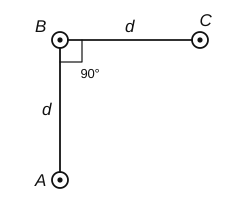
Q454.An arrangement of three parallel straight wires placed perpendicular to plane of paper carrying same current '
I' along the same direction is shown in Fig. Magnitude of force per unit length on the middle wire '
B' is given by
कागज़ के तल के लम्बवत् रखे, एक ही दिशा में समान धारा '
I' वाले तीन समांतर सीधे तारों की व्यवस्था चित्र में दर्शाई गई है। मध्य तार '
B' पर प्रति एकांक लम्बाई बल का परिमाण है
- A
- B
- C
- D
Show answer
Concept: Parallel currents attract with force per unit length .
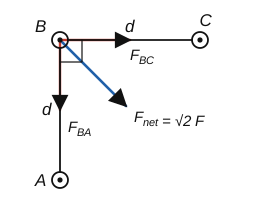
- B is pulled toward C and toward A, each with .
- The two forces are at 90°:
Short trick: Two equal perpendicular forces → √2 times one; √2/2 = 1/√2.
Answer: (D)
अवधारणा: समांतर धाराएँ प्रति एकांक लम्बाई बल से आकर्षित करती हैं।
- B, C की ओर तथा A की ओर, प्रत्येक बल से खिंचता है।
- दोनों बल परस्पर 90° पर हैं:
शॉर्ट ट्रिक: दो समान लम्बवत् बल → एक बल का √2 गुना; √2/2 = 1/√2।
उत्तर: (D)
NEET UGPhysicsMoving charges – force between parallel currentsNEET UG 2017 · 7 May Shift 1
Q455.Two astronauts are floating in gravitational free space after having lost contact with their spaceship. The two will:
अपने अंतरिक्षयान से संपर्क टूट जाने के पश्चात् दो अंतरिक्ष यात्री गुरुत्व मुक्त आकाश में तैर रहे हैं। वे दोनों:
- AKeep floating at the same distance between themअपने बीच समान दूरी रखते हुए तैरते रहेंगे
- BMove towards each otherएक-दूसरे की ओर गति करेंगे
- CMove away from each otherएक-दूसरे से दूर गति करेंगे
- DWill become stationaryस्थिर हो जाएँगे
Show answer
Concept: "Gravitation-free space" means no external field, but the two astronauts still attract each other by Newton's law of gravitation.
- The only force on each is their mutual attraction .
- Hence they slowly accelerate towards each other.
- (A) and (D) ignore this force; (C) would need a repulsion, which gravity never gives.
Short trick: Gravity between masses never switches off – it is always attractive.
Answer: (B) Move towards each other
अवधारणा: "गुरुत्व मुक्त आकाश" का अर्थ है कोई बाह्य क्षेत्र नहीं, परन्तु दोनों अंतरिक्ष यात्री न्यूटन के गुरुत्वाकर्षण नियम से एक-दूसरे को फिर भी आकर्षित करते हैं।
- प्रत्येक पर एकमात्र बल उनका पारस्परिक आकर्षण है।
- अतः वे धीरे-धीरे एक-दूसरे की ओर त्वरित होते हैं।
- (A) व (D) इस बल की उपेक्षा करते हैं; (C) के लिए प्रतिकर्षण चाहिए, जो गुरुत्व कभी नहीं देता।
शॉर्ट ट्रिक: द्रव्यमानों के बीच गुरुत्व कभी समाप्त नहीं होता – यह सदैव आकर्षी है।
उत्तर: (B) एक-दूसरे की ओर गति करेंगे
NEET UGPhysicsGravitation – mutual attractionNEET UG 2017 · 7 May Shift 1
Q456.In an electromagnetic wave in free space the root mean square value of the electric field is Erms = 6 V/m. The peak value of the magnetic field is
मुक्त आकाश में एक विद्युतचुंबकीय तरंग में विद्युत क्षेत्र का वर्ग माध्य मूल मान Erms = 6 V/m है। चुंबकीय क्षेत्र का शिखर मान है
- A1.41 × 10–8 T
- B2.83 × 10–8 T
- C0.70 × 10–8 T
- D4.23 × 10–8 T
Show answer
Concept: In an EM wave (for rms and for peak values alike); .
- T
- T
Short trick: E₀ = 6√2 V/m → B₀ = E₀/c = 2√2 × 10⁻⁸ T.
Answer: (B) 2.83 × 10⁻⁸ T
अवधारणा: विद्युतचुंबकीय तरंग में (rms तथा शिखर दोनों मानों के लिए); ।
- T
- T
शॉर्ट ट्रिक: E₀ = 6√2 V/m → B₀ = E₀/c = 2√2 × 10⁻⁸ T।
उत्तर: (B) 2.83 × 10⁻⁸ T
NEET UGPhysicsElectromagnetic waves – field amplitudesNEET UG 2017 · 7 May Shift 1
Q457.The bulk modulus of a spherical object is 'B'. If it is subjected to uniform pressure 'p', the fractional decrease in radius is
एक गोलीय वस्तु का आयतन प्रत्यास्थता गुणांक 'B' है। यदि इस पर एकसमान दाब 'p' आरोपित किया जाए, तो त्रिज्या में भिन्नात्मक कमी है
- A
- B
- C
- D
Show answer
Concept: and for a sphere .
Short trick: Fractional change in r is one-third of fractional change in volume.
Answer: (D)
अवधारणा: तथा गोले के लिए ।
शॉर्ट ट्रिक: r में भिन्नात्मक परिवर्तन, आयतन के भिन्नात्मक परिवर्तन का एक-तिहाई होता है।
उत्तर: (D)
NEET UGPhysicsMechanical properties of solids – bulk modulusNEET UG 2017 · 7 May Shift 1
Q458.The ratio of resolving powers of an optical microscope for two wavelengths λ1 = 4000 Å and λ2 = 6000 Å is
दो तरंगदैर्ध्यों λ1 = 4000 Å तथा λ2 = 6000 Å के लिए एक प्रकाशिक सूक्ष्मदर्शी की विभेदन क्षमताओं का अनुपात है
- A8 : 27
- B9 : 4
- C3 : 2
- D16 : 81
Show answer
Concept: Resolving power of a microscope .
Short trick: Shorter λ resolves better, linearly: 4000 vs 6000 → 3 : 2 (no squares or cubes).
Answer: (C) 3 : 2
अवधारणा: सूक्ष्मदर्शी की विभेदन क्षमता ।
शॉर्ट ट्रिक: कम λ बेहतर विभेदन देता है, रैखिक रूप से: 4000 बनाम 6000 → 3 : 2 (कोई वर्ग या घन नहीं)।
उत्तर: (C) 3 : 2
NEET UGPhysicsRay optics – resolving power of microscopeNEET UG 2017 · 7 May Shift 1
Q459.Consider a drop of rain water having mass 1 g falling from a height of 1 km. It hits the ground with a speed of 50 m/s. Take g constant with a value 10 m/s2. The work done by the (i) gravitational force and the (ii) resistive force of air is
1 g द्रव्यमान की वर्षा जल की एक बूँद 1 km ऊँचाई से गिर रही है। यह 50 m/s की चाल से धरती से टकराती है। g को 10 m/s2 मान के साथ नियत लीजिए। (i) गुरुत्वीय बल तथा (ii) वायु के प्रतिरोधी बल द्वारा किया गया कार्य है
- A(i) – 10 J (ii) –8.25 J
- B(i) 1.25 J (ii) –8.25 J
- C(i) 100 J (ii) 8.75 J
- D(i) 10 J (ii) –8.75 J
Show answer
Concept: Work–energy theorem: .
- J
- J
- J
Short trick: Gravity does positive work on a falling body (rules out (A)); air resistance always does negative work (rules out (C)).
Answer: (D) (i) 10 J (ii) –8.75 J
अवधारणा: कार्य-ऊर्जा प्रमेय: ।
- J
- J
- J
शॉर्ट ट्रिक: गिरते पिण्ड पर गुरुत्व धनात्मक कार्य करता है ((A) बाहर); वायु प्रतिरोध सदैव ऋणात्मक कार्य करता है ((C) बाहर)।
उत्तर: (D) (i) 10 J (ii) –8.75 J
NEET UGPhysicsWork, energy and power – work–energy theoremNEET UG 2017 · 7 May Shift 1
Q460.A spherical black body with a radius of 12 cm radiates 450 watt power at 500 K. If the radius were halved and the temperature doubled, the power radiated in watt would be
12 cm त्रिज्या की एक गोलीय कृष्णिका 500 K पर 450 वाट शक्ति विकिरित करती है। यदि त्रिज्या आधी तथा ताप दोगुना कर दिया जाए, तो विकिरित शक्ति (वाट में) होगी
- A225
- B450
- C1000
- D1800
Show answer
Concept: .
- W
Short trick: Halving R → ×1/4; doubling T → ×16; net ×4.
Answer: (D) 1800
अवधारणा: ।
- W
शॉर्ट ट्रिक: R आधा → ×1/4; T दोगुना → ×16; कुल ×4।
उत्तर: (D) 1800
NEET UGPhysicsThermal properties – Stefan–Boltzmann lawNEET UG 2017 · 7 May Shift 1

