Q521.
Artificial selection to obtain cows yielding higher milk output represents
अधिक दूध देने वाली गायें प्राप्त करने हेतु कृत्रिम वरण किसे निरूपित करता है?
- AStabilizing selection as it stabilizes this character in the populationस्थायीकारी वरण, क्योंकि यह समष्टि में इस लक्षण को स्थिर करता है
- BDirectional as it pushes the mean of the character in one directionदिशात्मक, क्योंकि यह लक्षण के माध्य को एक दिशा में धकेलता है
- CDisruptive as it splits the population into two one yielding higher output and the other lower outputविदारक, क्योंकि यह समष्टि को दो भागों में बाँटता है – एक अधिक उत्पादन वाला और दूसरा कम उत्पादन वाला
- DStabilizing followed by disruptive as it stabilizes the population to produce higher yielding cowsस्थायीकारी के बाद विदारक, क्योंकि यह समष्टि को अधिक उपज वाली गायें उत्पन्न करने हेतु स्थिर करता है
Show answer
Concept: In selection, the distribution curve of a trait shifts depending on which individuals are favoured. Breeders always pick the highest-yielding cows, so the population mean moves towards higher milk yield – directional selection.
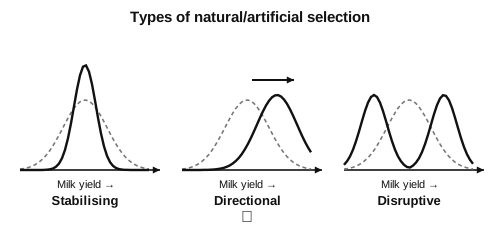
- (B) ✔ One extreme (high yield) favoured → peak shifts in one direction.
- (A) ✘ Stabilising favours the mean value and narrows the curve.
- (C) ✘ Disruptive favours both extremes giving two peaks – breeders do not keep low-yielders.
- (D) ✘ No such combined process is involved.
Short trick: Ask “which individuals are kept?” – only one end → directional; middle → stabilising; both ends → disruptive.
Answer: (B) Directional
अवधारणा: वरण में, किन जीवों को वरीयता मिलती है इसके अनुसार लक्षण का वितरण वक्र खिसकता है। प्रजनक सदैव सबसे अधिक दूध देने वाली गायें चुनते हैं, अतः समष्टि का माध्य अधिक दूध-उत्पादन की ओर बढ़ता है – दिशात्मक वरण।
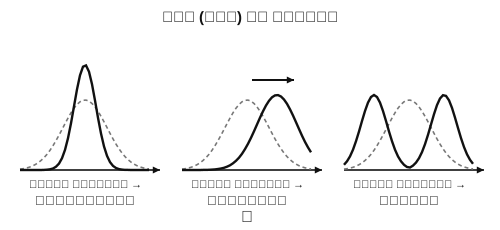
- (B) ✔ एक छोर (अधिक उत्पादन) को वरीयता → शिखर एक दिशा में खिसकता है।
- (A) ✘ स्थायीकारी वरण माध्य मान को वरीयता देता है और वक्र को संकरा करता है।
- (C) ✘ विदारक वरण दोनों छोरों को वरीयता देकर दो शिखर बनाता है – प्रजनक कम उत्पादन वाली गायें नहीं रखते।
- (D) ✘ ऐसी कोई संयुक्त प्रक्रिया शामिल नहीं है।
शॉर्ट ट्रिक: पूछें “कौन-से जीव रखे गए?” – केवल एक छोर → दिशात्मक; मध्य → स्थायीकारी; दोनों छोर → विदारक।
उत्तर: (B) दिशात्मक