Q541.4.0 g of a gas occupies 22.4 liters at NTP. The specific heat capacity of the gas at constant volume is 5.0 J K−1 mol−1. If the speed of sound in this gas at NTP is 952 m s−1, then the heat capacity at constant pressure is
(Take gas constant R = 8.3 J K−1 mol−1)
4.0 g गैस NTP पर 22.4 लीटर आयतन घेरती है। नियत आयतन पर गैस की विशिष्ट ऊष्मा धारिता 5.0 J K−1 mol−1 है। यदि NTP पर इस गैस में ध्वनि की चाल 952 m s−1 है, तो नियत दाब पर ऊष्मा धारिता है
(गैस नियतांक R = 8.3 J K−1 mol−1 लें)
- A8.5 J K−1 mol−1
- B8.0 J K−1 mol−1
- C7.5 J K−1 mol−1
- D7.0 J K−1 mol−1
Show answer
Concept: Laplace: gives γ; then .
- 22.4 L at NTP = 1 mol ⇒ M = 4 g mol−1 = 4 × 10⁻³ kg mol−1.
- .
- J K−1 mol−1.
Short trick: Use the speed data, not Cv + R (= 13.3, not in options) – the data are meant to be used through γ: Cp = γCv.
Answer: (B) 8.0 J K−1 mol−1
अवधारणा: लाप्लास: से γ मिलता है; फिर ।
- NTP पर 22.4 L = 1 mol ⇒ M = 4 g mol−1 = 4 × 10⁻³ kg mol−1।
- ।
- J K−1 mol−1।
शॉर्ट ट्रिक: चाल के आँकड़े का प्रयोग करें, Cv + R का नहीं (= 13.3, विकल्पों में नहीं) – आँकड़ों का प्रयोग γ के माध्यम से करना है: Cp = γCv।
उत्तर: (B) 8.0 J K−1 mol−1
NEET UGPhysicsThermodynamics/Kinetic theory – speed of sound and C<sub>p</sub>NEET UG 2015 · 25 Jul Shift 1
Q542.A series R-C circuit is connected to an alternating voltage source. Consider two situations:
(a) When capacitor is air filled.
(b) When capacitor is mica filled.
Current through resistor is i and voltage across capacitor is V then:
एक श्रेणी R-C परिपथ एक प्रत्यावर्ती वोल्टता स्रोत से जुड़ा है। दो स्थितियों पर विचार कीजिए:
(a) जब संधारित्र में वायु भरी है।
(b) जब संधारित्र में अभ्रक (mica) भरा है।
प्रतिरोधक से धारा i तथा संधारित्र के सिरों पर वोल्टता V है, तब:
- A
- B
- C
- D
Show answer
Concept: ; , .
- Mica (K > 1) increases C ⇒ Cb > Ca ⇒ XC decreases.
- Impedance decreases ⇒ ib > ia ⇒ (D) wrong.
- decreases as C increases ⇒ Va > Vb – (C); (A), (B) wrong.
Short trick: Bigger C = smaller "resistance" XC ⇒ capacitor takes a smaller share of the voltage (potential-divider logic).
Answer: (C)
अवधारणा: ; , ।
- अभ्रक (K > 1) C बढ़ाता है ⇒ Cb > Ca ⇒ XC घटता है।
- प्रतिबाधा घटती है ⇒ ib > ia ⇒ (D) गलत।
- , C बढ़ने पर घटता है ⇒ Va > Vb – (C); (A), (B) गलत।
शॉर्ट ट्रिक: बड़ा C = छोटा "प्रतिरोध" XC ⇒ संधारित्र को वोल्टता का छोटा हिस्सा मिलता है (विभव-विभाजक तर्क)।
उत्तर: (C)
NEET UGPhysicsAlternating current – series RC circuit with dielectricNEET UG 2015 · 25 Jul Shift 1
Q543.A plank with a box on it at one end is gradually raised about the other end. As the angle of inclination with the horizontal reaches 30°, the box starts to slip and slides 4.0 m down the plank in 4.0 s. The coefficients of static and kinetic friction between the box and the plank will be, respectively:
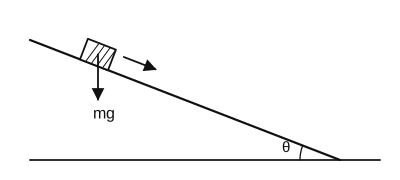
एक तख्ते के एक सिरे पर एक बक्सा रखा है और तख्ते को दूसरे सिरे के परितः धीरे-धीरे ऊपर उठाया जाता है। जैसे ही क्षैतिज से झुकाव कोण 30° होता है, बक्सा फिसलना शुरू कर देता है तथा 4.0 s में तख्ते पर 4.0 m नीचे खिसक जाता है। बक्से तथा तख्ते के बीच स्थैतिक तथा गतिज घर्षण गुणांक क्रमशः होंगे:
- A0.4 and 0.30.4 तथा 0.3
- B0.6 and 0.60.6 तथा 0.6
- C0.6 and 0.50.6 तथा 0.5
- D0.5 and 0.60.5 तथा 0.6
Show answer
Concept: Slipping just begins at the angle of repose: μs = tan θ. While sliding: a = g(sin θ − μk cos θ).
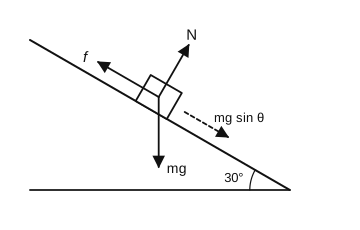
- .
- From rest: m s−2.
- (g = 10 m s−2).
Short trick: μk must be less than μs – instantly removes (B) and (D); tan 30° ≈ 0.58 removes (A).
Answer: (C) 0.6 and 0.5
अवधारणा: फिसलना विश्राम कोण पर ठीक शुरू होता है: μs = tan θ। फिसलते समय: a = g(sin θ − μk cos θ)।
- ।
- विराम से: m s−2।
- (g = 10 m s−2)।
शॉर्ट ट्रिक: μk, μs से कम होना चाहिए – (B) व (D) तुरंत बाहर; tan 30° ≈ 0.58 से (A) बाहर।
उत्तर: (C) 0.6 तथा 0.5
NEET UGPhysicsLaws of motion – static and kinetic friction on inclineNEET UG 2015 · 25 Jul Shift 1
Q544.Two stones of masses m and 2 m are whirled in horizontal circles, the heavier one in a radius and the lighter one in radius r. The tangential speed of lighter stone is n times that of the value of heavier stone when they experience same centripetal forces. The value of n is:
द्रव्यमान m तथा 2 m के दो पत्थरों को क्षैतिज वृत्तों में घुमाया जाता है, भारी पत्थर को त्रिज्या में तथा हल्के पत्थर को r त्रिज्या में। जब वे समान अभिकेंद्र बलों का अनुभव करते हैं, तब हल्के पत्थर की स्पर्शरेखीय चाल भारी पत्थर की चाल की n गुनी है। n का मान है:
- A1
- B2
- C3
- D4
Show answer
Concept: Centripetal force .
- Lighter: ; heavier: .
- Equal forces ⇒ ⇒ n = 2.
Short trick: m/r for the heavy stone is 2m/(r/2) = 4 × (m/r) ⇒ v² ratio 4 ⇒ v ratio 2.
Answer: (B) 2
अवधारणा: अभिकेंद्र बल ।
- हल्का: ; भारी: ।
- बल समान ⇒ ⇒ n = 2।
शॉर्ट ट्रिक: भारी पत्थर के लिए m/r = 2m/(r/2) = 4 × (m/r) ⇒ v² का अनुपात 4 ⇒ v का अनुपात 2।
उत्तर: (B) 2
NEET UGPhysicsCircular motion – centripetal forceNEET UG 2015 · 25 Jul Shift 1
Q545.The coefficient of performance of a refrigerator is 5. If the temperature inside freezer is −20°C, the temperature of the surroundings to which it rejects heat is:
एक प्रशीतित्र (refrigerator) का कार्य-निष्पादन गुणांक 5 है। यदि फ्रीज़र के अंदर का ताप −20°C है, तो परिवेश का ताप, जिसमें यह ऊष्मा त्यागता है, है:
- A21°C
- B31°C
- C41°C
- D11°C
Show answer
Concept: For an ideal (Carnot) refrigerator: (temperatures in kelvin).
- TC = −20 + 273 = 253 K.
- K.
- TH ≈ 303.6 − 273 = 30.6°C ≈ 31°C.
Short trick: TH = TC(1 + 1/β) = 253 × 1.2 = 303.6 K – one multiplication.
Answer: (B) 31°C
अवधारणा: आदर्श (कार्नो) प्रशीतित्र के लिए: (ताप केल्विन में)।
- TC = −20 + 273 = 253 K।
- K।
- TH ≈ 303.6 − 273 = 30.6°C ≈ 31°C।
शॉर्ट ट्रिक: TH = TC(1 + 1/β) = 253 × 1.2 = 303.6 K – केवल एक गुणा।
उत्तर: (B) 31°C
NEET UGPhysicsThermodynamics – refrigerator coefficient of performanceNEET UG 2015 · 25 Jul Shift 1
Q546.An ideal gas is compressed to half its initial volume by means of several processes. Which of the process results in the maximum work done on the gas?
एक आदर्श गैस को कई प्रक्रमों द्वारा उसके प्रारंभिक आयतन के आधे तक संपीडित किया जाता है। निम्नलिखित में से कौन-सा प्रक्रम गैस पर अधिकतम कार्य किए जाने का परिणाम देता है?
- AIsothermalसमतापी
- BAdiabaticरुद्धोष्म
- CIsobaricसमदाबी
- DIsochoricसमआयतनिक
Show answer
Concept: Work done on the gas = area under the P–V curve between V and V/2.
- Isochoric: volume cannot change ⇒ the compression is impossible / W = 0 – (D) wrong.
- Isobaric: P stays at P0 ⇒ smallest area.
- Isothermal: P rises as 1/V; adiabatic: P rises as 1/Vγ (steeper, γ > 1) ⇒ adiabatic curve lies highest ⇒ largest area.
- Order: Wadiabatic > Wisothermal > Wisobaric.
Short trick: For compression the steepest curve (adiabatic) encloses the most area; for expansion it is the reverse (isobaric most).
Answer: (B) Adiabatic
अवधारणा: गैस पर किया गया कार्य = V तथा V/2 के बीच P–V वक्र के नीचे का क्षेत्रफल।
- समआयतनिक: आयतन बदल ही नहीं सकता ⇒ संपीडन असंभव / W = 0 – (D) गलत।
- समदाबी: P, P0 पर रहता है ⇒ सबसे कम क्षेत्रफल।
- समतापी: P, 1/V के अनुसार बढ़ता है; रुद्धोष्म: P, 1/Vγ के अनुसार (अधिक तीव्र, γ > 1) ⇒ रुद्धोष्म वक्र सबसे ऊपर ⇒ सबसे अधिक क्षेत्रफल।
- क्रम: Wरुद्धोष्म > Wसमतापी > Wसमदाबी।
शॉर्ट ट्रिक: संपीडन में सबसे तीव्र वक्र (रुद्धोष्म) सबसे अधिक क्षेत्रफल घेरता है; प्रसार में इसका उलटा (समदाबी अधिकतम)।
उत्तर: (B) रुद्धोष्म
NEET UGPhysicsThermodynamics – work done in compression processesNEET UG 2015 · 25 Jul Shift 1
Q547.A ball is thrown vertically downwards from a height of 20 m with an initial velocity . It collides with the ground, loses 50 percent of its energy in collision and rebounds to the same height. The initial velocity is: (Take g = 10 m s−2)
एक गेंद 20 m की ऊँचाई से प्रारंभिक वेग के साथ ऊर्ध्वाधरतः नीचे की ओर फेंकी जाती है। यह भूमि से टकराती है, टक्कर में अपनी 50 प्रतिशत ऊर्जा खो देती है तथा उसी ऊँचाई तक वापस उछलती है। प्रारंभिक वेग है: (g = 10 m s−2 लें)
- A10 m s−1
- B14 m s−1
- C20 m s−1
- D28 m s−1
Show answer
Concept: Energy conservation before and after the impact; half the KE at the ground is lost.
- After impact it rises 20 m ⇒ KE just after = mgh = m × 10 × 20 = 200m J.
- This is 50% of KE just before ⇒ KE before = 400m J.
- KE before = ½mv0² + mgh ⇒ 400m = ½mv0² + 200m ⇒ v0² = 400 ⇒ v0 = 20 m s−1.
Short trick: Lost energy (50%) = gained energy above 20 m ⇒ ½mv0² = mgh ⇒ v0 = √(2gh) = 20 m/s.
Answer: (C) 20 m s−1
अवधारणा: टक्कर से पहले व बाद ऊर्जा संरक्षण; भूमि पर गतिज ऊर्जा का आधा भाग नष्ट हो जाता है।
- टक्कर के बाद यह 20 m ऊपर जाती है ⇒ ठीक बाद गतिज ऊर्जा = mgh = m × 10 × 20 = 200m J।
- यह ठीक पहले की गतिज ऊर्जा का 50% है ⇒ पहले की गतिज ऊर्जा = 400m J।
- पहले की गतिज ऊर्जा = ½mv0² + mgh ⇒ 400m = ½mv0² + 200m ⇒ v0² = 400 ⇒ v0 = 20 m s−1।
शॉर्ट ट्रिक: नष्ट ऊर्जा (50%) = 20 m से ऊपर अतिरिक्त ऊर्जा ⇒ ½mv0² = mgh ⇒ v0 = √(2gh) = 20 m/s।
उत्तर: (C) 20 m s−1
NEET UGPhysicsWork, energy and power – energy loss in collisionNEET UG 2015 · 25 Jul Shift 1
Q548.On a frictionless surface, a block of mass M moving at speed v collides elastically with another block of same mass M which is initially at rest. After collision the first block moves at an angle θ to its initial direction and has a speed . The second block’s speed after the collision is:
एक घर्षणरहित पृष्ठ पर, चाल v से गतिमान द्रव्यमान M का एक गुटका, प्रारंभ में विरामावस्था में स्थित समान द्रव्यमान M के दूसरे गुटके से प्रत्यास्थ टक्कर करता है। टक्कर के पश्चात पहला गुटका अपनी प्रारंभिक दिशा से θ कोण पर चाल से गति करता है। टक्कर के पश्चात दूसरे गुटके की चाल है:
- A
- B
- C
- D
Show answer
Concept: Elastic collision of equal masses (one at rest): momentum and KE conservation ⇒ the two final velocities are perpendicular, so .
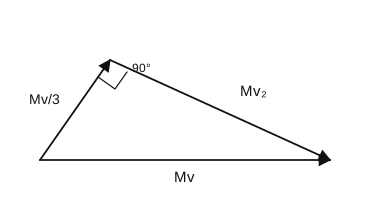
- KE: .
- .
Short trick: Equal masses + elastic = right-angled triangle of velocities; Pythagoras finishes it. (D) > v is impossible.
Answer: (B)
अवधारणा: समान द्रव्यमानों की प्रत्यास्थ टक्कर (एक विराम में): संवेग व गतिज ऊर्जा संरक्षण ⇒ दोनों अंतिम वेग परस्पर लंबवत, अतः ।
- गतिज ऊर्जा: ।
- ।
शॉर्ट ट्रिक: समान द्रव्यमान + प्रत्यास्थ = वेगों का समकोण त्रिभुज; पाइथागोरस से उत्तर। (D) > v असंभव है।
उत्तर: (B)
NEET UGPhysicsWork, energy and power – 2D elastic collision of equal massesNEET UG 2015 · 25 Jul Shift 1
Q549.If potential (in volts) in a region is expressed as , the electric field (in N/C) at point (1, 1, 0) is:
यदि किसी क्षेत्र में विभव (वोल्ट में) द्वारा व्यक्त किया जाता है, तो बिंदु (1, 1, 0) पर विद्युत क्षेत्र (N/C में) है:
- A
- B
- C
- D
Show answer
Concept: .
- , , .
- At (1, 1, 0): 6, 5, 2.
- N/C.
Short trick: Only (C) has the k-component equal to 2y = 2 at y = 1.
Answer: (C)
अवधारणा: ।
- , , ।
- (1, 1, 0) पर: 6, 5, 2।
- N/C।
शॉर्ट ट्रिक: केवल (C) में k-घटक 2y = 2 (y = 1 पर) है।
उत्तर: (C)
NEET UGPhysicsElectrostatic potential – field from potential (gradient)NEET UG 2015 · 25 Jul Shift 1
Q550.Two slits in Young’s experiment have widths in the ratio 1 : 25. The ratio of intensity at the maxima and minima in the interference pattern, is:
यंग के प्रयोग में दो झिरियों की चौड़ाइयों का अनुपात 1 : 25 है। व्यतिकरण पैटर्न में उच्चिष्ठ तथा निम्निष्ठ पर तीव्रताओं का अनुपात, है:
- A
- B
- C
- D
Show answer
Concept: Intensity ∝ slit width; amplitude ∝ √I; .
- I1 : I2 = 1 : 25 ⇒ a1 : a2 = 1 : 5.
- .
Short trick: Imax/Imin is always > 1 – (A), (D) out at once; (C) 121/49 comes from wrongly using 11:7.
Answer: (B)
अवधारणा: तीव्रता ∝ झिरी की चौड़ाई; आयाम ∝ √I; ।
- I1 : I2 = 1 : 25 ⇒ a1 : a2 = 1 : 5।
- ।
शॉर्ट ट्रिक: Imax/Imin सदैव > 1 – (A), (D) तुरंत बाहर; (C) 121/49 गलती से 11:7 लेने पर आता है।
उत्तर: (B)
NEET UGPhysicsWave optics – YDSE intensity ratio from slit widthsNEET UG 2015 · 25 Jul Shift 1
Q551.The heart of a man pumps 5 litres of blood through the arteries per minute at a pressure of 150 mm of mercury. If the density of mercury be kg/m3 and g = 10 m/s2 then the power of heart in watt is:
एक व्यक्ति का हृदय पारे के 150 mm दाब पर प्रति मिनट 5 लीटर रक्त धमनियों से पंप करता है। यदि पारे का घनत्व kg/m3 तथा g = 10 m/s2 हो, तो हृदय की शक्ति वाट में है:
- A1.50
- B1.70
- C2.35
- D3.0
Show answer
Concept: Power of a pump = pressure × volume flow rate, P = p (dV/dt).
- p = ρgh = 13.6 × 103 × 10 × 0.150 = 2.04 × 10⁴ Pa.
- dV/dt = 5 L min−1 = m3 s−1.
- Power = W.
Short trick: pV per minute: 20400 × 0.005 = 102 J per minute ⇒ 102/60 = 1.7 W.
Answer: (B) 1.70
अवधारणा: पंप की शक्ति = दाब × आयतन प्रवाह दर, P = p (dV/dt)।
- p = ρgh = 13.6 × 103 × 10 × 0.150 = 2.04 × 10⁴ Pa।
- dV/dt = 5 L min−1 = m3 s−1।
- शक्ति = W।
शॉर्ट ट्रिक: प्रति मिनट pV: 20400 × 0.005 = 102 J प्रति मिनट ⇒ 102/60 = 1.7 W।
उत्तर: (B) 1.70
NEET UGPhysicsFluid mechanics – power of the heart (pressure × flow rate)NEET UG 2015 · 25 Jul Shift 1
Q552.A proton and an alpha particle both enter a region of uniform magnetic field B, moving at right angles to the field B. If the radius of circular orbits for both the particles is equal and the kinetic energy acquired by proton is 1 MeV, the energy acquired by the alpha particle will be:
एक प्रोटॉन तथा एक ऐल्फा कण दोनों, एकसमान चुंबकीय क्षेत्र B वाले क्षेत्र में क्षेत्र B के लंबवत गति करते हुए प्रवेश करते हैं। यदि दोनों कणों की वृत्तीय कक्षाओं की त्रिज्या समान है तथा प्रोटॉन द्वारा अर्जित गतिज ऊर्जा 1 MeV है, तो ऐल्फा कण द्वारा अर्जित ऊर्जा होगी:
- A1 MeV
- B4 MeV
- C0.5 MeV
- D1.5 MeV
Show answer
Concept: , so for same r and B, .
- Proton: q = e, m = mp; alpha: q = 2e, m = 4mp.
- .
- Kα = 1 MeV.
Short trick: q²/m: proton 1/1, alpha 4/4 – identical, so same energy.
Answer: (A) 1 MeV
अवधारणा: , अतः समान r व B के लिए ।
- प्रोटॉन: q = e, m = mp; ऐल्फा: q = 2e, m = 4mp।
- ।
- Kα = 1 MeV।
शॉर्ट ट्रिक: q²/m: प्रोटॉन 1/1, ऐल्फा 4/4 – समान, अतः समान ऊर्जा।
उत्तर: (A) 1 MeV
NEET UGPhysicsMoving charges – circular motion in magnetic fieldNEET UG 2015 · 25 Jul Shift 1
Q553.The input signal given to a CE amplifier having a voltage gain of 150 is . The corresponding output signal will be:
150 वोल्टता लब्धि वाले एक CE प्रवर्धक को दिया गया निवेशी संकेत है। संगत निर्गत संकेत होगा:
- A
- B
- C
- D
Show answer
Concept: A CE amplifier multiplies the amplitude by the voltage gain and shifts the phase by π (180°).
- Amplitude: 150 × 2 = 300 V ⇒ (C), (D) wrong.
- Phase: ⇒ ; (B) misses the phase reversal.
Short trick: CE = "Changes Everything": amplitude × gain and phase + π; frequency (15) never changes.
Answer: (A)
अवधारणा: CE प्रवर्धक आयाम को वोल्टता लब्धि से गुणा करता है तथा कला में π (180°) का परिवर्तन करता है।
- आयाम: 150 × 2 = 300 V ⇒ (C), (D) गलत।
- कला: ⇒ ; (B) में कला उत्क्रमण छूट गया है।
शॉर्ट ट्रिक: CE: आयाम × लब्धि तथा कला + π; आवृत्ति (15) कभी नहीं बदलती।
उत्तर: (A)
NEET UGPhysicsSemiconductors – CE amplifier phase reversalNEET UG 2015 · 25 Jul Shift 1
Q554.If dimensions of critical velocity of a liquid flowing through a tube are expressed as , where η, ρ and r are the coefficient of viscosity of liquid, density of liquid and radius of the tube respectively, then the values of x, y and z are given by:
यदि किसी नली से बहते द्रव के क्रांतिक वेग की विमाएँ के रूप में व्यक्त की जाती हैं, जहाँ η, ρ तथा r क्रमशः द्रव का श्यानता गुणांक, द्रव का घनत्व तथा नली की त्रिज्या हैं, तो x, y तथा z के मान हैं:
- A1, 1, 1
- B1, −1, −1
- C−1, −1, 1
- D−1, −1, −1
Show answer
Concept: Equate dimensions: [η] = M L−1 T−1, [ρ] = M L−3, [r] = L, [v] = L T−1.
- .
- T: −x = −1 ⇒ x = 1. M: x + y = 0 ⇒ y = −1.
- L: −x − 3y + z = 1 ⇒ −1 + 3 + z = 1 ⇒ z = −1.
- Indeed (Reynolds number is dimensionless).
Short trick: Reynolds number Re = ρvr/η is dimensionless ⇒ v ∝ η ρ−1 r−1 directly.
Answer: (B) 1, −1, −1
अवधारणा: विमाओं की तुलना करें: [η] = M L−1 T−1, [ρ] = M L−3, [r] = L, [v] = L T−1।
- ।
- T: −x = −1 ⇒ x = 1। M: x + y = 0 ⇒ y = −1।
- L: −x − 3y + z = 1 ⇒ −1 + 3 + z = 1 ⇒ z = −1।
- वास्तव में (रेनॉल्ड्स संख्या विमाहीन है)।
शॉर्ट ट्रिक: रेनॉल्ड्स संख्या Re = ρvr/η विमाहीन है ⇒ सीधे v ∝ η ρ−1 r−1।
उत्तर: (B) 1, −1, −1
NEET UGPhysicsUnits and measurements – dimensional analysis (critical velocity)NEET UG 2015 · 25 Jul Shift 1
Q555.A circuit contains an ammeter, a battery of 30 V and a resistance 40.8 ohm all connected in series. If the ammeter has coil of resistance 480 ohm and a shunt of 20 ohm, the reading in the ammeter will be:
एक परिपथ में एक ऐमीटर, 30 V की एक बैटरी तथा 40.8 ओम का एक प्रतिरोध, सभी श्रेणीक्रम में जुड़े हैं। यदि ऐमीटर की कुंडली का प्रतिरोध 480 ओम तथा शंट 20 ओम का है, तो ऐमीटर का पाठ्यांक होगा:
- A1 A
- B0.5 A
- C0.25 A
- D2 A
Show answer
Concept: An ammeter = galvanometer coil with a shunt in parallel; it reads the total current through it.
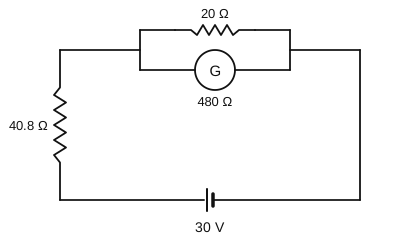
- .
- A.
Short trick: 40.8 + 19.2 = 60 – the numbers are chosen to give a round total.
Answer: (B) 0.5 A
अवधारणा: ऐमीटर = गैल्वेनोमीटर कुंडली जिसके समांतर शंट जुड़ा है; यह अपने से होकर जाने वाली कुल धारा पढ़ता है।
- ।
- A।
शॉर्ट ट्रिक: 40.8 + 19.2 = 60 – संख्याएँ पूर्ण योग देने के लिए चुनी गई हैं।
उत्तर: (B) 0.5 A
NEET UGPhysicsCurrent electricity – ammeter with shunt in a circuitNEET UG 2015 · 25 Jul Shift 1
Q556.Water rises to a height ‘h’ in capillary tube. If the length of capillary tube above the surface of water is made less than ‘h’, then:
केशनली में जल ‘h’ ऊँचाई तक चढ़ता है। यदि जल की सतह के ऊपर केशनली की लंबाई ‘h’ से कम कर दी जाए, तो:
- AWater does not rise at allजल बिल्कुल नहीं चढ़ता
- BWater rises upto the tip of capillary tube and then starts overflowing like a fountainजल केशनली के सिरे तक चढ़ता है और फिर फव्वारे की तरह बहने लगता है
- CWater rises upto the top of capillary tube and stays there without overflowingजल केशनली के शीर्ष तक चढ़ता है और बिना बहे वहीं रुक जाता है
- DWater rises upto a point a little below the top and stays thereजल शीर्ष से थोड़ा नीचे एक बिंदु तक चढ़ता है और वहीं रुक जाता है
Show answer
Concept: Capillary rise , i.e. = constant, where R = r/cosθ is the radius of the meniscus.
- Water rises to the top (A, D wrong).
- At the top it cannot go higher; the meniscus flattens (R increases) so that h′R′ = hR is satisfied with h′ < h.
- No overflow: a fountain would need energy from nowhere – perpetual motion is impossible (B wrong).
Short trick: Short capillary ⇒ "radius adjusts, water never overflows".
Answer: (C) Water rises upto the top of capillary tube and stays there without overflowing
अवधारणा: केशिका उन्नयन , अर्थात = नियत, जहाँ R = r/cosθ नवचंद्रक (meniscus) की त्रिज्या है।
- जल शीर्ष तक चढ़ता है ((A), (D) गलत)।
- शीर्ष पर यह और ऊपर नहीं जा सकता; नवचंद्रक चपटा हो जाता है (R बढ़ता है) ताकि h′ < h के साथ h′R′ = hR संतुष्ट हो।
- बहाव नहीं: फव्वारे के लिए कहीं से ऊर्जा चाहिए – सतत गति असंभव है ((B) गलत)।
शॉर्ट ट्रिक: छोटी केशनली ⇒ "त्रिज्या समायोजित होती है, जल कभी नहीं बहता"।
उत्तर: (C) जल केशनली के शीर्ष तक चढ़ता है और बिना बहे वहीं रुक जाता है
NEET UGPhysicsMechanical properties of fluids – capillary tube of insufficient lengthNEET UG 2015 · 25 Jul Shift 1
Q557.In an astronomical telescope in normal adjustment a straight black line of the length L is drawn on inside part of objective lens. The eye-piece forms a real image of this line. The length of this image is I. The magnification of the telescope is:
सामान्य समायोजन में एक खगोलीय दूरदर्शक के अभिदृश्यक लेंस के भीतरी भाग पर लंबाई L की एक सीधी काली रेखा खींची जाती है। नेत्रिका इस रेखा का वास्तविक प्रतिबिंब बनाती है। इस प्रतिबिंब की लंबाई I है। दूरदर्शक का आवर्धन है:
- A
- B
- C
- D
Show answer
Concept: Normal adjustment: tube length = fo + fe, magnifying power . The line on the objective is an object for the eyepiece at distance fo + fe.
- Eyepiece: u = −(fo + fe), f = fe ⇒ ⇒ .
- Size ratio .
- .
Short trick: The image of the objective formed by the eyepiece is the "exit pupil": objective size / exit-pupil size = magnifying power.
Answer: (A)
अवधारणा: सामान्य समायोजन: नली की लंबाई = fo + fe, आवर्धन क्षमता । अभिदृश्यक पर खींची रेखा, नेत्रिका के लिए fo + fe दूरी पर स्थित वस्तु है।
- नेत्रिका: u = −(fo + fe), f = fe ⇒ ⇒ ।
- आकार अनुपात ।
- ।
शॉर्ट ट्रिक: नेत्रिका द्वारा बना अभिदृश्यक का प्रतिबिंब "निकास पुतली" (exit pupil) है: अभिदृश्यक का आकार / निकास पुतली का आकार = आवर्धन क्षमता।
उत्तर: (A)
NEET UGPhysicsRay optics – astronomical telescope (image of objective by eyepiece)NEET UG 2015 · 25 Jul Shift 1
Q558.The value of coefficient of volume expansion of glycerin is . The fractional change in the density of glycerin for a rise of 40°C in its temperature is:
ग्लिसरीन का आयतन प्रसार गुणांक है। इसके ताप में 40°C की वृद्धि होने पर ग्लिसरीन के घनत्व में भिन्नात्मक परिवर्तन है:
- A0.010
- B0.015
- C0.020
- D0.025
Show answer
Concept: Mass fixed: ρV = constant ⇒ (for small changes).
- .
- (a decrease of 2%).
Short trick: Fractional density change = fractional volume change = γΔT.
Answer: (C) 0.020
अवधारणा: द्रव्यमान नियत: ρV = नियत ⇒ (छोटे परिवर्तनों के लिए)।
- ।
- (2% की कमी)।
शॉर्ट ट्रिक: घनत्व में भिन्नात्मक परिवर्तन = आयतन में भिन्नात्मक परिवर्तन = γΔT।
उत्तर: (C) 0.020
NEET UGPhysicsThermal properties of matter – change in density on heatingNEET UG 2015 · 25 Jul Shift 1
Q559.A photoelectric surface is illuminated successively by monochromatic light of wavelength λ and . If the maximum kinetic energy of the emitted photoelectrons in the second case is 3 times that in the first case, the work function of the surface of the material is:
(h = Planck’s constant, c = speed of light)
एक प्रकाश-विद्युत पृष्ठ को क्रमशः λ तथा तरंगदैर्ध्य के एकवर्णी प्रकाश से प्रदीप्त किया जाता है। यदि दूसरी स्थिति में उत्सर्जित प्रकाश-इलेक्ट्रॉनों की अधिकतम गतिज ऊर्जा पहली स्थिति की 3 गुनी है, तो पदार्थ के पृष्ठ का कार्य-फलन है:
(h = प्लांक नियतांक, c = प्रकाश की चाल)
- A
- B
- C
- D
Show answer
Concept: Einstein's equation: .
- Case 1: . Case 2: .
- : .
- .
Short trick: Let E = hc/λ: 2E − φ = 3(E − φ) ⇒ φ = E/2. (C), (D) ≥ E would give K1 ≤ 0 – impossible.
Answer: (B)
अवधारणा: आइंस्टाइन का समीकरण: ।
- स्थिति 1: । स्थिति 2: ।
- : ।
- ।
शॉर्ट ट्रिक: मान लें E = hc/λ: 2E − φ = 3(E − φ) ⇒ φ = E/2। (C), (D) ≥ E होने पर K1 ≤ 0 – असंभव।
उत्तर: (B)
NEET UGPhysicsDual nature – photoelectric equation, work functionNEET UG 2015 · 25 Jul Shift 1
Q560.A beam of light consisting of red, green and blue colours is incident on a right angled prism. The refractive index of the material of the prism for the above red, green and blue wavelengths are 1.39, 1.44 and 1.47 respectively.
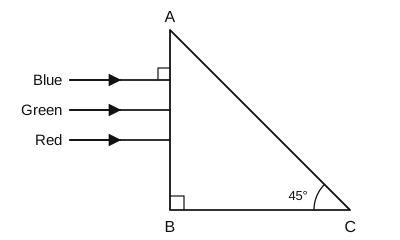
The prism will:
लाल, हरे तथा नीले रंगों से युक्त प्रकाश का एक पुंज एक समकोण प्रिज़्म पर आपतित होता है। उपर्युक्त लाल, हरे तथा नीले तरंगदैर्ध्यों के लिए प्रिज़्म के पदार्थ का अपवर्तनांक क्रमशः 1.39, 1.44 तथा 1.47 है।
प्रिज़्म:
- ASeparate the red colour part from the green and blue coloursलाल रंग के भाग को हरे तथा नीले रंगों से अलग करेगा
- BSeparate the blue colour part from the red and green coloursनीले रंग के भाग को लाल तथा हरे रंगों से अलग करेगा
- CSeparate all the three colours from one anotherतीनों रंगों को एक-दूसरे से अलग करेगा
- DNot separate the three colours at allतीनों रंगों को बिल्कुल अलग नहीं करेगा
Show answer
Concept: Light enters face AB normally (no deviation) and meets face AC at i = 45°. TIR occurs if i > θc, i.e. if .
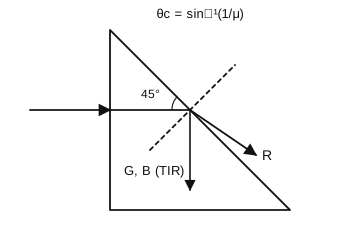
- Red: μ = 1.39 < 1.414 ⇒ θc > 45° ⇒ refracts out through AC.
- Green 1.44 and blue 1.47 > 1.414 ⇒ θc < 45° ⇒ totally internally reflected (go down towards BC together).
- So red is separated from green + blue – (A). Blue is not separated alone (B wrong); green and blue stay together (C wrong); a separation does occur (D wrong).
Short trick: Compare each μ with √2 ≈ 1.414 for a 45° face: below √2 escapes, above √2 reflects.
Answer: (A) Separate the red colour part from the green and blue colours
अवधारणा: प्रकाश फलक AB पर अभिलंबवत प्रवेश करता है (कोई विचलन नहीं) तथा फलक AC पर i = 45° पर पहुँचता है। पूर्ण आंतरिक परावर्तन तब होता है जब i > θc, अर्थात ।
- लाल: μ = 1.39 < 1.414 ⇒ θc > 45° ⇒ AC से अपवर्तित होकर बाहर निकलता है।
- हरा 1.44 तथा नीला 1.47 > 1.414 ⇒ θc < 45° ⇒ पूर्ण आंतरिक परावर्तित (साथ-साथ BC की ओर नीचे जाते हैं)।
- अतः लाल, हरे + नीले से अलग होता है – (A)। केवल नीला अलग नहीं होता ((B) गलत); हरा व नीला साथ रहते हैं ((C) गलत); पृथक्करण होता है ((D) गलत)।
शॉर्ट ट्रिक: 45° फलक के लिए प्रत्येक μ की तुलना √2 ≈ 1.414 से करें: √2 से कम निकल जाता है, अधिक परावर्तित होता है।
उत्तर: (A) लाल रंग के भाग को हरे तथा नीले रंगों से अलग करेगा
NEET UGPhysicsRay optics – total internal reflection in a right-angled prismNEET UG 2015 · 25 Jul Shift 1

