NEET UG · 2,240 questions

NEET UG 2015, 2016, 2017, 2018, 2019, 2020, 2021, 2022, 2023, 2024, 2025, 2026 PYQs

Real previous year questions, subject-wise. Try the question, then open the answer and the explanation in Hindi & English – free, no login.

Courses – airGurukul

720 questions in Biology.

Q561.
Fertilization in humans is practically feasible only if:
मनुष्यों में निषेचन व्यावहारिक रूप से तभी संभव है जब:
  1. AThe sperms are transported into vagina just after the release of ovum in fallopian tubeअंडवाहिनी (फैलोपियन नलिका) में अंडाणु मुक्त होने के ठीक बाद शुक्राणु योनि में पहुँचाए जाएँ
  2. BThe ovum and sperms are transported simultaneously to ampullary – isthmic junction of the fallopian tubeअंडाणु और शुक्राणु एक साथ फैलोपियन नलिका के तुंबिका–संकीर्ण पथ संधि (ampullary–isthmic junction) तक पहुँचें
  3. CThe ovum and sperms are transported simultaneously to ampullary – isthmic junction of the cervixअंडाणु और शुक्राणु एक साथ गर्भाशय-ग्रीवा के तुंबिका–संकीर्ण पथ संधि तक पहुँचें
  4. DThe sperms are transported into cervix within 48 hrs. of release of ovum in uterusगर्भाशय में अंडाणु मुक्त होने के 48 घंटे के भीतर शुक्राणु गर्भाशय-ग्रीवा में पहुँचाए जाएँ
Show answer

Concept: NCERT (Human Reproduction): fertilisation can only occur if the ovum and sperms are transported simultaneously to the ampullary–isthmic junction of the fallopian tube.

  1. NCERT line, word for word → (B).
  2. (A) Timing alone in vagina is not enough; both gametes must meet at the ampullary–isthmic junction.
  3. (C) Ampulla and isthmus are parts of the fallopian tube, not of the cervix.
  4. (D) The ovum is released from the ovary into the fallopian tube, not into the uterus.

Short trick: Fertilisation site = ampullary–isthmic junction of the oviduct; ampulla & isthmus belong only to the tube.

Answer: (B) The ovum and sperms are transported simultaneously to ampullary – isthmic junction of the fallopian tube

अवधारणा: NCERT (मानव जनन): निषेचन तभी हो सकता है जब अंडाणु और शुक्राणु एक साथ फैलोपियन नलिका के तुंबिका–संकीर्ण पथ संधि तक पहुँचें।

  1. NCERT की पंक्ति, शब्दशः → (B)।
  2. (A) केवल योनि में समय पर पहुँचना पर्याप्त नहीं; दोनों युग्मकों का तुंबिका–संकीर्ण पथ संधि पर मिलना आवश्यक है।
  3. (C) तुंबिका और संकीर्ण पथ फैलोपियन नलिका के भाग हैं, गर्भाशय-ग्रीवा के नहीं।
  4. (D) अंडाणु अंडाशय से फैलोपियन नलिका में मुक्त होता है, गर्भाशय में नहीं।

शॉर्ट ट्रिक: निषेचन स्थल = अंडवाहिनी की तुंबिका–संकीर्ण पथ संधि; तुंबिका व संकीर्ण पथ केवल नलिका के भाग हैं।

उत्तर: (B) अंडाणु और शुक्राणु एक साथ फैलोपियन नलिका के तुंबिका–संकीर्ण पथ संधि तक पहुँचें
NEET UGBiologyHuman reproduction – fertilisationNEET UG 2016 · 1 May Shift 1
Q562.
Asthma may be attributed to:
दमा (Asthma) का कारण हो सकता है:
  1. ABacterial infection of the lungsफुफ्फुसों का जीवाणु संक्रमण
  2. BAllergic reaction of the mast cells in the lungsफुफ्फुसों में मास्ट कोशिकाओं की एलर्जी अभिक्रिया
  3. CInflammation of the tracheaश्वासनली की सूजन
  4. DAccumulation of fluid in the lungफुफ्फुस में द्रव का संचय
Show answer

Concept: NCERT: asthma is difficulty in breathing causing wheezing due to inflammation of bronchi and bronchioles; it is an allergy – allergens trigger mast cells to release histamine and serotonin.

  1. Allergen + IgE on mast cells → histamine → bronchial smooth-muscle spasm → asthma → (B).
  2. (A) Bacterial infection of lungs = pneumonia.
  3. (C) Asthma involves bronchi/bronchioles, not primarily the trachea.
  4. (D) Fluid in lungs = pulmonary oedema (or pneumonia exudate).

Short trick: Allergy = mast cells + histamine + IgE; asthma is a respiratory allergy.

Answer: (B) Allergic reaction of the mast cells in the lungs

अवधारणा: NCERT: दमा में श्वसनी और श्वसनिकाओं की सूजन के कारण साँस लेने में कठिनाई और घरघराहट होती है; यह एक एलर्जी है – एलर्जन मास्ट कोशिकाओं से हिस्टामिन व सेरोटोनिन मुक्त कराते हैं।

  1. एलर्जन + मास्ट कोशिकाओं पर IgE → हिस्टामिन → श्वसनी की चिकनी पेशियों में ऐंठन → दमा → (B)।
  2. (A) फुफ्फुसों का जीवाणु संक्रमण = न्यूमोनिया।
  3. (C) दमा मुख्यतः श्वसनी/श्वसनिकाओं में होता है, श्वासनली में नहीं।
  4. (D) फुफ्फुस में द्रव = फुफ्फुसीय शोफ (या न्यूमोनिया का स्राव)।

शॉर्ट ट्रिक: एलर्जी = मास्ट कोशिकाएँ + हिस्टामिन + IgE; दमा श्वसन तंत्र की एलर्जी है।

उत्तर: (B) फुफ्फुसों में मास्ट कोशिकाओं की एलर्जी अभिक्रिया

NEET UGBiologyBreathing and exchange of gases – asthmaNEET UG 2016 · 1 May Shift 1
Q563.
The avena curvature is used for bioassay of:
एवेना (Avena) वक्रता परीक्षण का उपयोग किसके जैव-आमापन (bioassay) के लिए किया जाता है?
  1. AABA
  2. BGA3
  3. CIAA
  4. DEthyleneएथिलीन
Show answer

Concept: Avena curvature test (F.W. Went, 1928): an agar block containing auxin placed on one side of a decapitated oat coleoptile causes curvature proportional to auxin concentration – the classic bioassay of auxin (IAA).

  1. Avena coleoptile curvature ∝ auxin → IAA → (C).
  2. (A) ABA – bioassay e.g. stomatal closure / inhibition of seed germination.
  3. (B) GA3 – bioassay e.g. dwarf maize/pea elongation, α-amylase in barley endosperm.
  4. (D) Ethylene – triple response of pea seedlings.

Short trick: Went → Avena → Auxin (all “A”-words; IAA is the natural auxin).

Answer: (C) IAA

अवधारणा: एवेना वक्रता परीक्षण (एफ.डब्ल्यू. वेन्ट, 1928): ऑक्सिन युक्त ऐगार ब्लॉक को कटे हुए जई प्रांकुरचोल के एक ओर रखने पर ऑक्सिन की सांद्रता के अनुपात में वक्रता होती है – यह ऑक्सिन (IAA) का पारंपरिक जैव-आमापन है।

  1. एवेना प्रांकुरचोल की वक्रता ∝ ऑक्सिन → IAA → (C)।
  2. (A) ABA – जैव-आमापन, जैसे रंध्र बंद होना / बीज अंकुरण का निरोध।
  3. (B) GA3 – जैव-आमापन, जैसे बौने मक्का/मटर का दीर्घीकरण, जौ भ्रूणपोष में α-एमाइलेज़।
  4. (D) एथिलीन – मटर नवोद्भिद की त्रिक अनुक्रिया।

शॉर्ट ट्रिक: वेन्ट → एवेना → ऑक्सिन (सब “A”-शब्द; IAA प्राकृतिक ऑक्सिन है)।

उत्तर: (C) IAA

NEET UGBiologyPlant growth regulators – bioassayNEET UG 2016 · 1 May Shift 1
Q564.
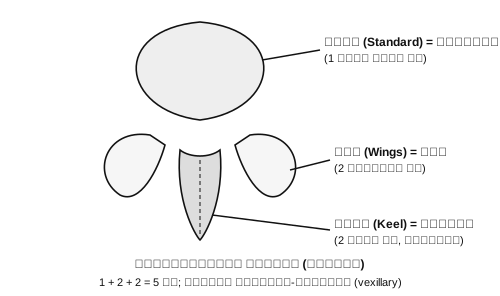
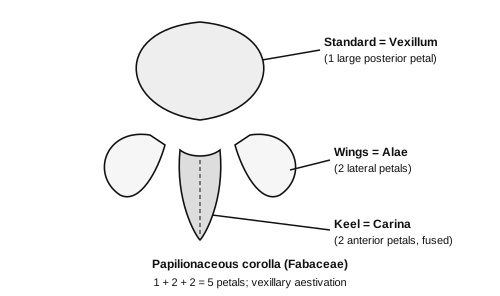
The standard petal of papilionaceous corolla is also called:
पैपिलियोनेसी दलपुंज के मानक (standard) दल को और किस नाम से जाना जाता है?
  1. ACarinaकैरिना (Carina)
  2. BPappusपैपस (Pappus)
  3. CVexillumवेक्सिलम (Vexillum)
  4. DCoronaकोरोना (Corona)
Show answer

Concept: NCERT (Fabaceae): papilionaceous corolla has five petals – one large posterior standard (vexillum), two lateral wings (alae) and two anterior petals fused to form the keel (carina); aestivation is vexillary.

  1. Standard = vexillum → (C).
  2. (A) Carina = keel (two anterior fused petals).
  3. (B) Pappus = hairy/scaly modified calyx of Asteraceae (sunflower family).
  4. (D) Corona = crown-like outgrowth of perianth (e.g. Narcissus, passion flower).

Short trick: Vexillum = Very big top petal; Alae = Arms (wings); Carina = Canoe-shaped keel.

Answer: (C) Vexillum

अवधारणा: NCERT (फैबेसी): पैपिलियोनेसी दलपुंज में पाँच दल होते हैं – एक बड़ा पश्च ध्वज (वेक्सिलम), दो पार्श्व पंख (एली) तथा दो अग्र दल जो जुड़कर नौतल (कैरिना) बनाते हैं; पुष्पदल-विन्यास ध्वजिक (vexillary) होता है।

  1. मानक/ध्वज = वेक्सिलम → (C)।
  2. (A) कैरिना = नौतल (दो अग्र संयुक्त दल)।
  3. (B) पैपस = ऐस्टरेसी (सूरजमुखी कुल) का रोमिल/शल्की रूपांतरित बाह्यदलपुंज।
  4. (D) कोरोना = परिदलपुंज का मुकुट-समान उद्वर्ध (जैसे Narcissus, कृष्णकमल)।

शॉर्ट ट्रिक: Vexillum = Very बड़ा ऊपरी दल; Alae = भुजाएँ (पंख); Carina = नाव-आकार नौतल।

उत्तर: (C) वेक्सिलम

NEET UGBiologyMorphology of flowering plants – Fabaceae corollaNEET UG 2016 · 1 May Shift 1
Q565.
Tricarpellary, syncarpous gynoecium is found in flowers of:
त्रिअंडपी, युक्तांडपी जायांग किसके पुष्पों में पाया जाता है?
  1. ALiliaceaeलिलिएसी
  2. BSolanaceaeसोलैनेसी
  3. CFabaceaeफैबेसी
  4. DPoaceaeपोएसी
Show answer

Concept: NCERT (Liliaceae): gynoecium tricarpellary, syncarpous, ovary superior, trilocular with axile placentation – floral formula Br ⊕ ⚥ P(3+3) A3+3 G(3).

  1. Monocot family → parts in threes → tricarpellary syncarpous → Liliaceae → (A).
  2. (B) Solanaceae – bicarpellary, syncarpous, obliquely placed ovary.
  3. (C) Fabaceae – monocarpellary.
  4. (D) Poaceae – usually described as monocarpellary (or tricarpellary with one functional carpel), unilocular ovary with a single ovule – not the NCERT example.

Short trick: Floral formula carpels: Fabaceae G1, Solanaceae G(2), Liliaceae G(3) – “1-2-3: Pea, Potato, Lily”.

Answer: (A) Liliaceae

अवधारणा: NCERT (लिलिएसी): जायांग त्रिअंडपी, युक्तांडपी, अंडाशय ऊर्ध्ववर्ती, त्रिकोष्ठकी तथा स्तंभीय बीजांडन्यास – पुष्प सूत्र Br ⊕ ⚥ P(3+3) A3+3 G(3)।

  1. एकबीजपत्री कुल → भाग तीन-तीन में → त्रिअंडपी युक्तांडपी → लिलिएसी → (A)।
  2. (B) सोलैनेसी – द्विअंडपी, युक्तांडपी, तिरछा स्थित अंडाशय।
  3. (C) फैबेसी – एकाअंडपी।
  4. (D) पोएसी – सामान्यतः एकाअंडपी (या एक क्रियाशील अंडप वाला त्रिअंडपी), एककोष्ठकी अंडाशय, एक बीजांड – NCERT का उदाहरण नहीं।

शॉर्ट ट्रिक: पुष्प सूत्र में अंडप: फैबेसी G1, सोलैनेसी G(2), लिलिएसी G(3) – “1-2-3: मटर, आलू, लिली”।

उत्तर: (A) लिलिएसी

NEET UGBiologyMorphology of flowering plants – familiesNEET UG 2016 · 1 May Shift 1
Q566.
One of the major components of cell wall of most fungi is:
अधिकांश कवकों की कोशिका भित्ति का एक प्रमुख घटक है:
  1. AChitinकाइटिन
  2. BPeptidoglycanपेप्टिडोग्लाइकन
  3. CCelluloseसेलुलोज़
  4. DHemicelluloseहेमीसेलुलोज़
Show answer

Concept: NCERT (Biological Classification): the cell wall of fungi is composed of chitin and polysaccharides.

  1. Fungal wall = chitin (polymer of N-acetylglucosamine) → (A).
  2. (B) Peptidoglycan (murein) – bacterial cell wall.
  3. (C) Cellulose – cell wall of plants and most algae.
  4. (D) Hemicellulose – plant cell-wall matrix.

Short trick: Fungi and insects share chitin (N-acetylglucosamine); bacteria – peptidoglycan; plants – cellulose.

Answer: (A) Chitin

अवधारणा: NCERT (जीव जगत का वर्गीकरण): कवकों की कोशिका भित्ति काइटिन और पॉलिसैकेराइडों की बनी होती है।

  1. कवक भित्ति = काइटिन (N-ऐसीटिलग्लूकोसैमीन का बहुलक) → (A)।
  2. (B) पेप्टिडोग्लाइकन (म्यूरिन) – जीवाणु कोशिका भित्ति।
  3. (C) सेलुलोज़ – पादपों और अधिकांश शैवालों की कोशिका भित्ति।
  4. (D) हेमीसेलुलोज़ – पादप कोशिका भित्ति का आधात्री पदार्थ।

शॉर्ट ट्रिक: कवक और कीट दोनों में काइटिन (N-ऐसीटिलग्लूकोसैमीन); जीवाणु – पेप्टिडोग्लाइकन; पादप – सेलुलोज़।

उत्तर: (A) काइटिन

NEET UGBiologyBiological classification – fungiNEET UG 2016 · 1 May Shift 1
Q567.
Select the incorrect statement:
गलत कथन का चयन कीजिए:
  1. AFSH stimulates the sertoli cells which help in spermiogenesisFSH सर्टोली कोशिकाओं को उद्दीप्त करता है जो शुक्राणुजनन (spermiogenesis) में सहायता करती हैं
  2. BLH triggers ovulation in ovaryLH अंडाशय में अंडोत्सर्ग को प्रेरित करता है
  3. CLH and FSH decrease gradually during the follicular phaseपुटकीय प्रावस्था के दौरान LH और FSH धीरे-धीरे कम होते हैं
  4. DLH triggers secretion of androgens from the Leydig cellsLH लेडिग कोशिकाओं से एंड्रोजन के स्रावण को प्रेरित करता है
Show answer

Concept: NCERT (Menstrual cycle): during the follicular phase the secretion of gonadotropins (LH and FSH) increases gradually, reaching an LH surge at mid-cycle (≈ 14th day) that induces ovulation.

  1. (A) Correct – FSH acts on Sertoli cells, which help in spermiogenesis.
  2. (B) Correct – the LH surge triggers ovulation.
  3. (C) Incorrect – LH and FSH rise, not fall, during the follicular phase → answer.
  4. (D) Correct – LH (ICSH) stimulates Leydig cells to secrete androgens.

Short trick: Follicular phase = “build-up” – FSH, LH and oestrogen all climb to the mid-cycle peak.

Answer: (C) LH and FSH decrease gradually during the follicular phase

अवधारणा: NCERT (आर्तव चक्र): पुटकीय प्रावस्था में गोनैडोट्रॉपिनों (LH और FSH) का स्रावण धीरे-धीरे बढ़ता है और चक्र के मध्य (≈ 14वें दिन) LH का उछाल (surge) अंडोत्सर्ग को प्रेरित करता है।

  1. (A) सही – FSH सर्टोली कोशिकाओं पर कार्य करता है, जो शुक्राणुजनन में सहायता करती हैं।
  2. (B) सही – LH उछाल अंडोत्सर्ग को प्रेरित करता है।
  3. (C) गलत – पुटकीय प्रावस्था में LH और FSH बढ़ते हैं, घटते नहीं → उत्तर।
  4. (D) सही – LH (ICSH) लेडिग कोशिकाओं को एंड्रोजन स्रावित करने हेतु उद्दीप्त करता है।

शॉर्ट ट्रिक: पुटकीय प्रावस्था = “बढ़त” – FSH, LH और एस्ट्रोजन सभी मध्य-चक्र शिखर तक बढ़ते हैं।

उत्तर: (C) पुटकीय प्रावस्था के दौरान LH और FSH धीरे-धीरे कम होते हैं

NEET UGBiologyHuman reproduction – hormonesNEET UG 2016 · 1 May Shift 1
Q568.
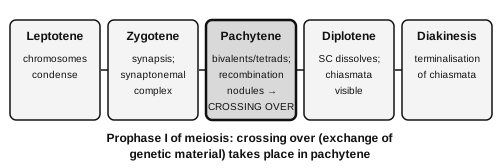
In meiosis crossing over is initiated at:
अर्धसूत्री विभाजन में जीन विनिमय (crossing over) किस अवस्था में प्रारंभ होता है?
  1. APachyteneपैकीटीन
  2. BLeptoteneलेप्टोटीन
  3. CZygoteneजाइगोटीन
  4. DDiploteneडिप्लोटीन
Show answer

Concept: NCERT: in pachytene, bivalents appear as tetrads, recombination nodules appear, and crossing over (exchange of genetic material between non-sister chromatids of homologous chromosomes) occurs.

  1. Crossing over takes place in pachytene → (A).
  2. (B) Leptotene – chromosomes only begin to condense.
  3. (C) Zygotene – synapsis and formation of the synaptonemal complex (pairing, not exchange).
  4. (D) Diplotene – the synaptonemal complex dissolves and chiasmata, the result of crossing over, become visible.

Short trick: Order “Lady Zebra Pays Daily Dues” (Lepto-Zygo-Pachy-Diplo-Diakinesis): Zygo = pairing, Pachy = crossing over, Diplo = chiasmata seen.

Answer: (A) Pachytene

अवधारणा: NCERT: पैकीटीन में युगली चतुष्क के रूप में दिखाई देते हैं, पुनर्योजन ग्रंथिकाएँ प्रकट होती हैं तथा जीन विनिमय (समजात गुणसूत्रों के असहोदर अर्धगुणसूत्रों के बीच आनुवंशिक पदार्थ का आदान-प्रदान) होता है।

  1. जीन विनिमय पैकीटीन में होता है → (A)।
  2. (B) लेप्टोटीन – गुणसूत्रों का संघनन केवल प्रारंभ होता है।
  3. (C) जाइगोटीन – सूत्रयुग्मन तथा सिनैप्टोनीमल सम्मिश्र का निर्माण (युग्मन, विनिमय नहीं)।
  4. (D) डिप्लोटीन – सिनैप्टोनीमल सम्मिश्र विघटित होता है और जीन विनिमय का परिणाम, काएज़्मेटा, दिखाई देते हैं।

शॉर्ट ट्रिक: क्रम “Lady Zebra Pays Daily Dues” (लेप्टो-जाइगो-पैकी-डिप्लो-डायकाइनेसिस): जाइगो = युग्मन, पैकी = जीन विनिमय, डिप्लो = काएज़्मेटा दिखाई देते हैं।

उत्तर: (A) पैकीटीन

NEET UGBiologyCell cycle – meiosis prophase INEET UG 2016 · 1 May Shift 1
Q569.
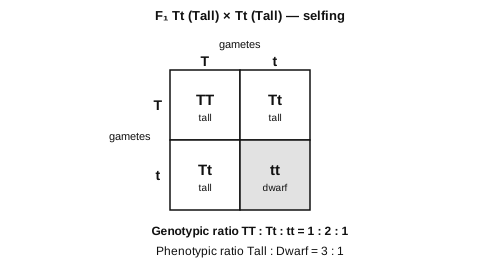
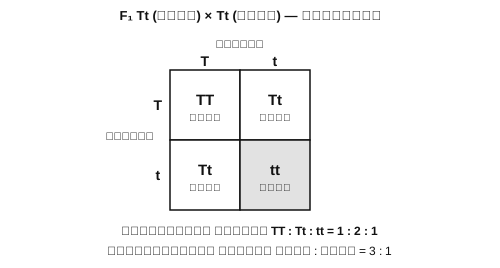
A tall true breeding garden pea plant is crossed with a dwarf true breeding garden pea plant. When the F1 plants were selfed the resulting genotypes were in the ratio
एक लंबे शुद्ध प्रजनन (true breeding) उद्यान मटर पौधे का एक बौने शुद्ध प्रजनन उद्यान मटर पौधे से संकरण कराया गया। जब F1 पौधों का स्वपरागण कराया गया तो प्राप्त जीनप्ररूप किस अनुपात में थे?
  1. A1 : 2 : 1 :: Tall homozygous : Tall heterozygous : Dwarf1 : 2 : 1 :: लंबा समयुग्मजी : लंबा विषमयुग्मजी : बौना
  2. B1 : 2 : 1 :: Tall heterozygous : Tall homozygous : Dwarf1 : 2 : 1 :: लंबा विषमयुग्मजी : लंबा समयुग्मजी : बौना
  3. C3 : 1 :: Tall : Dwarf3 : 1 :: लंबा : बौना
  4. D3 : 1 :: Dwarf : Tall3 : 1 :: बौना : लंबा
Show answer

Concept: Monohybrid cross: TT × tt → F1 all Tt (tall). Selfing Tt × Tt gives F2 genotypes TT : Tt : tt = 1 : 2 : 1.

  1. Gametes of each F1 parent: T and t (½ each).
  2. Punnett square → 1 TT (tall homozygous) : 2 Tt (tall heterozygous) : 1 tt (dwarf) → (A).
  3. (B) Swaps the classes – it is the heterozygous tall that occurs twice, not the homozygous.
  4. (C) 3 : 1 is the phenotypic ratio, but the question asks for genotypes.
  5. (D) Wrong direction even for phenotypes – tall is dominant.

Short trick: Monohybrid: genotype 1 : 2 : 1 (middle “2” is always the heterozygote), phenotype 3 : 1.

Answer: (A) 1 : 2 : 1 :: Tall homozygous : Tall heterozygous : Dwarf

अवधारणा: एकसंकर संकरण: TT × tt → F1 सभी Tt (लंबे)। Tt × Tt स्वपरागण से F2 जीनप्ररूप TT : Tt : tt = 1 : 2 : 1 मिलते हैं।

  1. प्रत्येक F1 जनक के युग्मक: T और t (प्रत्येक ½)।
  2. पनेट वर्ग → 1 TT (लंबा समयुग्मजी) : 2 Tt (लंबा विषमयुग्मजी) : 1 tt (बौना) → (A)।
  3. (B) वर्गों को उलट देता है – दो बार विषमयुग्मजी लंबा आता है, समयुग्मजी नहीं।
  4. (C) 3 : 1 लक्षणप्ररूपी अनुपात है, जबकि प्रश्न जीनप्ररूप पूछता है।
  5. (D) लक्षणप्ररूप के लिए भी उलटा – लंबापन प्रभावी है।

शॉर्ट ट्रिक: एकसंकर: जीनप्ररूप 1 : 2 : 1 (बीच का “2” सदैव विषमयुग्मजी), लक्षणप्ररूप 3 : 1।

उत्तर: (A) 1 : 2 : 1 :: लंबा समयुग्मजी : लंबा विषमयुग्मजी : बौना

NEET UGBiologyPrinciples of inheritance – monohybrid crossNEET UG 2016 · 1 May Shift 1
Q570.
Which of the following is the most important cause of animals and plants being driven to extinction ?
प्राणियों और पादपों के विलुप्त होने का सबसे महत्वपूर्ण कारण निम्नलिखित में से कौन-सा है?
  1. AOver – exploitationअति-दोहन
  2. BAlien species invasionविदेशी जातियों का आक्रमण
  3. CHabitat loss and fragmentationआवास की क्षति तथा विखंडन
  4. DCo – extinctionsसह-विलुप्तता
Show answer

Concept: NCERT (Biodiversity and Conservation): of the “Evil Quartet”, habitat loss and fragmentation is the most important cause driving animals and plants to extinction.

  1. Example: tropical rain forests once covered 14% of land, now no more than 6% → (C).
  2. (A) Over-exploitation (Steller’s sea cow, passenger pigeon) – important, but not the most important.
  3. (B) Alien species invasion (Nile perch in Lake Victoria, Parthenium, Lantana) – a cause, not the chief one.
  4. (D) Co-extinction (host–parasite, plant–pollinator) – the least of the four.

Short trick: Evil Quartet = “HOAC”: Habitat loss (No. 1), Over-exploitation, Alien species, Co-extinction.

Answer: (C) Habitat loss and fragmentation

अवधारणा: NCERT (जैव विविधता एवं संरक्षण): “दुष्ट चौकड़ी” (Evil Quartet) में आवास की क्षति तथा विखंडन प्राणियों और पादपों को विलुप्ति की ओर ले जाने का सबसे महत्वपूर्ण कारण है।

  1. उदाहरण: उष्णकटिबंधीय वर्षा वन कभी 14% स्थल पर थे, अब 6% से अधिक नहीं → (C)।
  2. (A) अति-दोहन (स्टेलर समुद्री गाय, यात्री कबूतर) – महत्वपूर्ण, पर सबसे महत्वपूर्ण नहीं।
  3. (B) विदेशी जातियों का आक्रमण (विक्टोरिया झील में नील पर्च, Parthenium, Lantana) – एक कारण, प्रमुख नहीं।
  4. (D) सह-विलुप्तता (परपोषी–परजीवी, पादप–परागणकर्ता) – चारों में सबसे कम।

शॉर्ट ट्रिक: दुष्ट चौकड़ी = “HOAC”: H आवास क्षति (नंबर 1), O अति-दोहन, A विदेशी जातियाँ, C सह-विलुप्तता।

उत्तर: (C) आवास की क्षति तथा विखंडन

NEET UGBiologyBiodiversity – causes of lossNEET UG 2016 · 1 May Shift 1
Q571.
Which one of the following is a characteristic feature of cropland ecosystem?
निम्नलिखित में से कौन-सा फसल-भूमि (cropland) पारितंत्र का अभिलाक्षणिक गुण है?
  1. AAbsence of soil organismsमृदा जीवों की अनुपस्थिति
  2. BLeast genetic diversityन्यूनतम आनुवंशिक विविधता
  3. CAbsence of weedsखरपतवारों की अनुपस्थिति
  4. DEcological successionपारिस्थितिक अनुक्रमण
Show answer

Concept: A cropland is a man-made monoculture – one crop variety, often genetically uniform, is grown over the whole field.

  1. Monoculture → least genetic diversity → (B).
  2. (A) Soil organisms (bacteria, fungi, earthworms) are abundant in cropland soil.
  3. (C) Weeds are always present; that is why weeding is needed.
  4. (D) Succession is prevented by repeated ploughing, sowing and harvesting – the system is kept at an early stage.

Short trick: Cropland = monoculture → minimum diversity; succession “reset” every season.

Answer: (B) Least genetic diversity

अवधारणा: फसल-भूमि मानव-निर्मित एकल-फसली (monoculture) तंत्र है – पूरे खेत में एक ही, प्रायः आनुवंशिक रूप से समान, फसल किस्म उगाई जाती है।

  1. एकल-फसल → न्यूनतम आनुवंशिक विविधता → (B)।
  2. (A) फसल-भूमि की मृदा में मृदा जीव (जीवाणु, कवक, केंचुए) प्रचुर होते हैं।
  3. (C) खरपतवार सदैव उपस्थित रहते हैं; इसीलिए निराई करनी पड़ती है।
  4. (D) बार-बार जुताई, बुवाई और कटाई से अनुक्रमण रुक जाता है – तंत्र प्रारंभिक अवस्था में ही रहता है।

शॉर्ट ट्रिक: फसल-भूमि = एकल-फसल → न्यूनतम विविधता; अनुक्रमण हर मौसम में “रीसेट”।

उत्तर: (B) न्यूनतम आनुवंशिक विविधता

NEET UGBiologyEcosystem – agro-ecosystemNEET UG 2016 · 1 May Shift 1
Q572.
Changes in GnRH pulse frequency in females is controlled by circulating levels of:
स्त्रियों में GnRH स्पंद आवृत्ति (pulse frequency) में परिवर्तन किसके परिसंचारी स्तरों द्वारा नियंत्रित होता है?
  1. AEstrogen and progesteroneएस्ट्रोजन और प्रोजेस्टेरॉन
  2. BEstrogen and inhibinएस्ट्रोजन और इनहिबिन
  3. CProgesterone onlyकेवल प्रोजेस्टेरॉन
  4. DProgesterone and inhibinप्रोजेस्टेरॉन और इनहिबिन
Show answer

Concept: The hypothalamic GnRH pulse generator is regulated by ovarian steroid feedback: oestrogen and progesterone act on the hypothalamus to change GnRH pulse frequency.

  1. High progesterone (luteal phase) slows GnRH pulses; oestrogen (with low progesterone) speeds them, favouring LH – so both steroids control frequency → (A).
  2. (B)/(D) Inhibin acts directly on the anterior pituitary to suppress FSH; it does not alter hypothalamic GnRH pulse frequency.
  3. (C) Progesterone alone is incomplete – oestrogen is equally involved.

Short trick: Hypothalamus ← steroids (oestrogen, progesterone); pituitary FSH ← inhibin (a protein).

Answer: (A) Estrogen and progesterone

अवधारणा: हाइपोथैलेमस का GnRH स्पंद-जनित्र अंडाशयी स्टेरॉयडों के पुनर्भरण से नियंत्रित होता है: एस्ट्रोजन और प्रोजेस्टेरॉन हाइपोथैलेमस पर कार्य कर GnRH स्पंद आवृत्ति बदलते हैं।

  1. उच्च प्रोजेस्टेरॉन (पीतपिंड प्रावस्था) GnRH स्पंदों को धीमा करता है; एस्ट्रोजन (कम प्रोजेस्टेरॉन के साथ) उन्हें तेज करता है, जिससे LH बढ़ता है – अतः दोनों स्टेरॉयड आवृत्ति नियंत्रित करते हैं → (A)।
  2. (B)/(D) इनहिबिन सीधे अग्र पीयूष पर कार्य कर FSH को दबाता है; यह हाइपोथैलेमस की GnRH स्पंद आवृत्ति नहीं बदलता।
  3. (C) केवल प्रोजेस्टेरॉन अधूरा है – एस्ट्रोजन भी समान रूप से शामिल है।

शॉर्ट ट्रिक: हाइपोथैलेमस ← स्टेरॉयड (एस्ट्रोजन, प्रोजेस्टेरॉन); पीयूष FSH ← इनहिबिन (एक प्रोटीन)।

उत्तर: (A) एस्ट्रोजन और प्रोजेस्टेरॉन

NEET UGBiologyHuman reproduction – hormonal feedbackNEET UG 2016 · 1 May Shift 1
Q573.
Which of the following is not a feature of the plasmids?
निम्नलिखित में से कौन-सा प्लाज़्मिडों का लक्षण नहीं है?
  1. AIndependent replicationस्वतंत्र प्रतिकृतियन
  2. BCircular structureवृत्ताकार संरचना
  3. CTransferableस्थानांतरणीय
  4. DSingle – strandedएकल-रज्जुकी
Show answer

Concept: NCERT: plasmids are autonomously replicating, circular, extra-chromosomal double-stranded DNA molecules of bacteria.

  1. (A) Feature – they replicate independently of the chromosomal DNA.
  2. (B) Feature – circular.
  3. (C) Feature – can be transferred between bacteria (conjugation/transformation).
  4. (D) Not a feature – plasmids are double-stranded → answer.

Short trick: Plasmid = small, circular, ds, extra-chromosomal, self-replicating DNA – the vector of choice (pBR322).

Answer: (D) Single – stranded

अवधारणा: NCERT: प्लाज़्मिड जीवाणुओं के स्वायत्त प्रतिकृतियन करने वाले, वृत्ताकार, गुणसूत्र-बाह्य द्वि-रज्जुकी DNA अणु हैं।

  1. (A) लक्षण है – गुणसूत्रीय DNA से स्वतंत्र प्रतिकृतियन।
  2. (B) लक्षण है – वृत्ताकार।
  3. (C) लक्षण है – जीवाणुओं के बीच स्थानांतरित हो सकते हैं (संयुग्मन/रूपांतरण)।
  4. (D) लक्षण नहीं – प्लाज़्मिड द्वि-रज्जुकी होते हैं → उत्तर।

शॉर्ट ट्रिक: प्लाज़्मिड = छोटा, वृत्ताकार, द्वि-रज्जुकी, गुणसूत्र-बाह्य, स्व-प्रतिकृतिक DNA – पसंदीदा वाहक (pBR322)।

उत्तर: (D) एकल-रज्जुकी

NEET UGBiologyBiotechnology – plasmidsNEET UG 2016 · 1 May Shift 1
Q574.
Which of the following features is not present in Periplaneta americana?
निम्नलिखित में से कौन-सा लक्षण Periplaneta americana में नहीं पाया जाता?
  1. ASchizocoelom as body cavityदेहगुहा के रूप में दीर्णगुहा (schizocoelom)
  2. BIndeterminate and radial cleavage during embryonic developmentभ्रूणीय परिवर्धन में अनिर्धारी तथा अरीय विदलन
  3. CExoskeleton composed of N – acetylglucosamineN – ऐसीटिलग्लूकोसैमीन से बना बाह्यकंकाल
  4. DMetamerically segmented bodyविखंडीय (मेटामेरिक) रूप से खंडित शरीर
Show answer

Concept: Cockroach is an arthropod – a protostome schizocoelomate. Protostomes show spiral, determinate cleavage; radial, indeterminate cleavage is the deuterostome (echinoderm, chordate) pattern.

  1. (A) Present – the coelom arises by splitting of mesoderm (schizocoelom); in adults it is filled with haemolymph (haemocoel).
  2. (B) Not present – radial, indeterminate cleavage belongs to deuterostomes → answer.
  3. (C) Present – exoskeleton of chitin, a polymer of N-acetylglucosamine.
  4. (D) Present – body divided into similar segments (metameric segmentation).

Short trick: Protostome = Spiral + Determinate + Schizocoel; Deuterostome = Radial + Indeterminate + Enterocoel.

Answer: (B) Indeterminate and radial cleavage during embryonic development

अवधारणा: कॉकरोच एक संधिपाद है – प्रोटोस्टोम दीर्णगुहिक (schizocoelomate)। प्रोटोस्टोम में सर्पिल, निर्धारी विदलन होता है; अरीय, अनिर्धारी विदलन ड्यूटेरोस्टोम (एकाइनोडर्म, कॉर्डेट) का प्रतिरूप है।

  1. (A) उपस्थित – देहगुहा मध्यजनस्तर के विदलन से बनती है (दीर्णगुहा); वयस्क में यह हीमोलिम्फ से भरी होती है (हीमोसील)।
  2. (B) अनुपस्थित – अरीय, अनिर्धारी विदलन ड्यूटेरोस्टोम का लक्षण है → उत्तर।
  3. (C) उपस्थित – काइटिन का बाह्यकंकाल, जो N-ऐसीटिलग्लूकोसैमीन का बहुलक है।
  4. (D) उपस्थित – शरीर समान खंडों में विभाजित (विखंडीय खंडीभवन)।

शॉर्ट ट्रिक: प्रोटोस्टोम = सर्पिल + निर्धारी + दीर्णगुहा; ड्यूटेरोस्टोम = अरीय + अनिर्धारी + आंत्रगुहा।

उत्तर: (B) भ्रूणीय परिवर्धन में अनिर्धारी तथा अरीय विदलन

NEET UGBiologyAnimal kingdom – cockroach / protostome featuresNEET UG 2016 · 1 May Shift 1
Q575.
In higher vertebrates, the immune system can distinguish self – cells and non – self. If this property is lost due to genetic abnormality and it attacks self – cells, then it leads to:
उच्च कशेरुकियों में प्रतिरक्षा तंत्र स्व-कोशिकाओं (self) और पर (non-self) में भेद कर सकता है। यदि आनुवंशिक असामान्यता के कारण यह गुण समाप्त हो जाए और यह स्व-कोशिकाओं पर आक्रमण करे, तो इसका परिणाम होगा:
  1. AAllergic responseएलर्जी अनुक्रिया
  2. BGraft rejectionनिरोप (ग्राफ्ट) अस्वीकृति
  3. CAuto – immune diseaseस्व-प्रतिरक्षा रोग
  4. DActive immunityसक्रिय प्रतिरक्षा
Show answer

Concept: NCERT (Human Health and Disease): memory-based acquired immunity distinguishes foreign organisms from self cells; sometimes, due to genetic and other unknown reasons, the body attacks self cells – this is autoimmunity (e.g. rheumatoid arthritis).

  1. Loss of self/non-self discrimination → attack on self cells → autoimmune disease → (C).
  2. (A) Allergy = exaggerated response to harmless foreign allergens (pollen, dust).
  3. (B) Graft rejection = normal response against a foreign (non-self) tissue.
  4. (D) Active immunity = antibodies produced by the host against an antigen – normal, protective.

Short trick: Auto = self → body vs. body. Examples: rheumatoid arthritis, type-1 diabetes, myasthenia gravis.

Answer: (C) Auto – immune disease

अवधारणा: NCERT (मानव स्वास्थ्य तथा रोग): स्मृति-आधारित उपार्जित प्रतिरक्षा बाहरी जीवों और स्व-कोशिकाओं में भेद करती है; कभी-कभी आनुवंशिक एवं अन्य अज्ञात कारणों से शरीर अपनी ही कोशिकाओं पर आक्रमण करता है – यह स्व-प्रतिरक्षा है (जैसे रूमेटॉइड आर्थराइटिस)।

  1. स्व/पर भेद की क्षमता समाप्त → स्व-कोशिकाओं पर आक्रमण → स्व-प्रतिरक्षा रोग → (C)।
  2. (A) एलर्जी = हानिरहित बाहरी एलर्जनों (परागकण, धूल) के प्रति अतिरंजित अनुक्रिया।
  3. (B) निरोप अस्वीकृति = बाहरी (पर) ऊतक के विरुद्ध सामान्य अनुक्रिया।
  4. (D) सक्रिय प्रतिरक्षा = प्रतिजन के विरुद्ध परपोषी द्वारा बनी प्रतिरक्षियाँ – सामान्य, रक्षात्मक।

शॉर्ट ट्रिक: Auto = स्वयं → शरीर बनाम शरीर। उदाहरण: रूमेटॉइड आर्थराइटिस, टाइप-1 मधुमेह, मायस्थीनिया ग्रेविस।

उत्तर: (C) स्व-प्रतिरक्षा रोग

NEET UGBiologyHuman health – immunityNEET UG 2016 · 1 May Shift 1
Q576.
Column – IColumn – II
(a) Dominance(i) Many genes govern a single character
(b) Codominance(ii) In a heterozygous organism only one allele expresses itself
(c) Pleiotropy(iii) In a heterozygous organism both alleles express themselves fully
(d) Polygenic inheritance(iv) A single gene influences many characters
स्तंभ – Iस्तंभ – II
(a) प्रभाविता (Dominance)(i) अनेक जीन एक ही लक्षण को नियंत्रित करते हैं
(b) सहप्रभाविता (Codominance)(ii) विषमयुग्मजी जीव में केवल एक युग्मविकल्पी (allele) स्वयं को अभिव्यक्त करता है
(c) बहुप्रभाविता (Pleiotropy)(iii) विषमयुग्मजी जीव में दोनों युग्मविकल्पी स्वयं को पूर्णतः अभिव्यक्त करते हैं
(d) बहुजीनी वंशागति (Polygenic inheritance)(iv) एक ही जीन अनेक लक्षणों को प्रभावित करता है
  1. A(a)-(ii), (b)-(i), (c)-(iv), (d)-(iii)
  2. B(a)-(ii), (b)-(iii), (c)-(iv), (d)-(i)
  3. C(a)-(iv), (b)-(i), (c)-(ii), (d)-(iii)
  4. D(a)-(iv), (b)-(iii), (c)-(i), (d)-(ii)
Show answer

Concept: Definitions (NCERT, Principles of Inheritance and Variation).

  1. (a) Dominance – in a heterozygote only one allele (the dominant one) expresses itself → (ii).
  2. (b) Codominance – both alleles express fully in the heterozygote (ABO: IAIB = AB) → (iii).
  3. (c) Pleiotropy – a single gene influences many characters (phenylketonuria) → (iv).
  4. (d) Polygenic inheritance – many genes govern a single character (human skin colour, height) → (i).
  5. So a-ii, b-iii, c-iv, d-i → (B). (A) and (C) wrongly give codominance as (i); (C) and (D) wrongly give dominance as (iv).

Short trick: Pleio = “more” effects from one gene; Poly-genic = many genes, one trait. Fixing a-ii alone leaves only (A)/(B); b-iii picks (B).

Answer: (B) (a)-(ii), (b)-(iii), (c)-(iv), (d)-(i)

अवधारणा: परिभाषाएँ (NCERT, वंशागति तथा विविधता के सिद्धांत)।

  1. (a) प्रभाविता – विषमयुग्मजी में केवल एक युग्मविकल्पी (प्रभावी) अभिव्यक्त होता है → (ii)।
  2. (b) सहप्रभाविता – विषमयुग्मजी में दोनों युग्मविकल्पी पूर्णतः अभिव्यक्त होते हैं (ABO: IAIB = AB) → (iii)।
  3. (c) बहुप्रभाविता – एक जीन अनेक लक्षणों को प्रभावित करता है (फिनाइलकीटोनूरिया) → (iv)।
  4. (d) बहुजीनी वंशागति – अनेक जीन एक लक्षण को नियंत्रित करते हैं (मानव त्वचा का रंग, लंबाई) → (i)।
  5. अतः a-ii, b-iii, c-iv, d-i → (B)। (A) और (C) सहप्रभाविता को गलत ढंग से (i) देते हैं; (C) और (D) प्रभाविता को गलत ढंग से (iv) देते हैं।

शॉर्ट ट्रिक: Pleio = एक जीन से “अधिक” प्रभाव; Poly-genic = अनेक जीन, एक लक्षण। केवल a-ii तय करने से (A)/(B) बचते हैं; b-iii से (B)।

उत्तर: (B) (a)-(ii), (b)-(iii), (c)-(iv), (d)-(i)

NEET UGBiologyPrinciples of inheritance – patternsNEET UG 2016 · 1 May Shift 1
Q577.
Joint Forest Management Concept was introduced in India during:
संयुक्त वन प्रबंधन (Joint Forest Management) की अवधारणा भारत में किस दशक में प्रारंभ की गई?
  1. A1960s1960 का दशक
  2. B1970s1970 का दशक
  3. C1980s1980 का दशक
  4. D1990s1990 का दशक
Show answer

Concept: NCERT (Environmental Issues): the Government of India introduced the concept of Joint Forest Management (JFM) in the 1980s to work closely with local communities for protecting and managing forests (National Forest Policy 1988).

  1. JFM – 1980s (1988 policy; guidelines 1990) → (C).
  2. In return, communities get benefits of various forest products (fruits, gum, rubber, medicine) and the forest is managed sustainably.
  3. (A), (B), (D) – wrong decades; the Chipko movement was 1974 (1970s) and the Amrita Devi award links to the 1731 Bishnoi episode.

Short trick: JFM ↔ 1980s; Chipko ↔ 1974; Bishnoi (Amrita Devi) ↔ 1731.

Answer: (C) 1980s

अवधारणा: NCERT (पर्यावरण के मुद्दे): भारत सरकार ने वनों की रक्षा और प्रबंधन में स्थानीय समुदायों के साथ मिलकर कार्य करने हेतु 1980 के दशक में संयुक्त वन प्रबंधन (JFM) की अवधारणा प्रारंभ की (राष्ट्रीय वन नीति 1988)।

  1. JFM – 1980 का दशक (1988 नीति; दिशानिर्देश 1990) → (C)।
  2. इसके बदले समुदायों को विभिन्न वन उत्पादों (फल, गोंद, रबर, औषधि) का लाभ मिलता है और वन का सतत प्रबंधन होता है।
  3. (A), (B), (D) – गलत दशक; चिपको आंदोलन 1974 (1970 का दशक) में हुआ और अमृता देवी पुरस्कार 1731 की बिश्नोई घटना से जुड़ा है।

शॉर्ट ट्रिक: JFM ↔ 1980 का दशक; चिपको ↔ 1974; बिश्नोई (अमृता देवी) ↔ 1731।

उत्तर: (C) 1980 का दशक

NEET UGBiologyBiodiversity – conservation (people’s participation)NEET UG 2016 · 1 May Shift 1
Q578.
Pick out the correct statements:
(i) Hemophilia is a sex – linked recessive disease
(ii) Down’s syndrome is due to aneuploidy
(iii) Phenylketonuria is an autosomal recessive gene disorder
(iv) Sickle cell anaemia is an X – linked recessive gene disorder
सही कथनों को चुनिए:
(i) हीमोफीलिया एक लिंग-सहलग्न अप्रभावी रोग है
(ii) डाउन सिंड्रोम असुगुणिता (aneuploidy) के कारण होता है
(iii) फिनाइलकीटोनूरिया एक अलिंगसूत्री (autosomal) अप्रभावी जीन विकार है
(iv) दात्र कोशिका अरक्तता (Sickle cell anaemia) एक X – सहलग्न अप्रभावी जीन विकार है
  1. A(i) and (iv) are correct(i) और (iv) सही हैं
  2. B(ii) and (iv) are correct(ii) और (iv) सही हैं
  3. C(i), (iii) and (iv) are correct(i), (iii) और (iv) सही हैं
  4. D(i), (ii) and (iii) are correct(i), (ii) और (iii) सही हैं
Show answer

Concept: NCERT Mendelian and chromosomal disorders.

  1. (i) Correct – haemophilia is X-linked (sex-linked) recessive.
  2. (ii) Correct – Down’s syndrome = trisomy 21, an aneuploidy (gain of one chromosome).
  3. (iii) Correct – phenylketonuria is an autosomal recessive inborn error of metabolism (no phenylalanine hydroxylase).
  4. (iv) Incorrect – sickle-cell anaemia is autosomal recessive (HbS gene on chromosome 11; Glu → Val at 6th position of β-globin), not X-linked.
  5. Correct set = (i), (ii), (iii) → (D). Every other option contains (iv).

Short trick: Only haemophilia and colour blindness are X-linked in NCERT; thalassaemia, sickle-cell and PKU are all autosomal recessive.

Answer: (D) (i), (ii) and (iii) are correct

अवधारणा: NCERT मेंडेलीय तथा गुणसूत्रीय विकार।

  1. (i) सही – हीमोफीलिया X-सहलग्न (लिंग-सहलग्न) अप्रभावी है।
  2. (ii) सही – डाउन सिंड्रोम = ट्राइसोमी 21, एक असुगुणिता (एक गुणसूत्र की वृद्धि)।
  3. (iii) सही – फिनाइलकीटोनूरिया अलिंगसूत्री अप्रभावी जन्मजात उपापचयी त्रुटि है (फिनाइलऐलानीन हाइड्रॉक्सिलेज़ का अभाव)।
  4. (iv) गलत – दात्र कोशिका अरक्तता अलिंगसूत्री अप्रभावी है (HbS जीन गुणसूत्र 11 पर; β-ग्लोबिन के 6वें स्थान पर Glu → Val), X-सहलग्न नहीं।
  5. सही समूह = (i), (ii), (iii) → (D)। अन्य सभी विकल्पों में (iv) है।

शॉर्ट ट्रिक: NCERT में केवल हीमोफीलिया और वर्णांधता X-सहलग्न हैं; थैलेसीमिया, दात्र कोशिका और PKU सभी अलिंगसूत्री अप्रभावी हैं।

उत्तर: (D) (i), (ii) और (iii) सही हैं

NEET UGBiologyPrinciples of inheritance – genetic disordersNEET UG 2016 · 1 May Shift 1
Q579.
Which one of the following statements is wrong?
निम्नलिखित में से कौन-सा कथन गलत है?
  1. ACyanobacteria are also called blue – green algaeसायनोबैक्टीरिया को नील-हरित शैवाल भी कहते हैं
  2. BGolden algae are also called desmidsसुनहरे शैवालों (golden algae) को डेस्मिड भी कहते हैं
  3. CEubacteria are also called false bacteriaयूबैक्टीरिया को असत्य (false) जीवाणु भी कहते हैं
  4. DPhycomycetes are also called algal fungiफाइकोमाइसिटीज़ को शैवाल कवक (algal fungi) भी कहते हैं
Show answer

Concept: NCERT (Biological Classification) names.

  1. (A) Correct – cyanobacteria = blue-green algae.
  2. (B) Correct as per NCERT – chrysophytes include diatoms and golden algae (desmids).
  3. (C) Wrong – eubacteria are the “true bacteria” (eu = true); they are not false bacteria → answer.
  4. (D) Correct – phycomycetes are called algal fungi.

Short trick: Eu = true (eukaryote, eubacteria); “false” never goes with eu-.

Answer: (C) Eubacteria are also called false bacteria

अवधारणा: NCERT (जीव जगत का वर्गीकरण) के नाम।

  1. (A) सही – सायनोबैक्टीरिया = नील-हरित शैवाल।
  2. (B) NCERT के अनुसार सही – क्राइसोफाइट में डायटम और सुनहरे शैवाल (डेस्मिड) आते हैं।
  3. (C) गलत – यूबैक्टीरिया “सत्य जीवाणु” (eu = सत्य) हैं; असत्य जीवाणु नहीं → उत्तर।
  4. (D) सही – फाइकोमाइसिटीज़ को शैवाल कवक कहते हैं।

शॉर्ट ट्रिक: Eu = सत्य (यूकैरियोट, यूबैक्टीरिया); “असत्य” कभी eu- के साथ नहीं आता।

उत्तर: (C) यूबैक्टीरिया को असत्य जीवाणु भी कहते हैं

NEET UGBiologyBiological classification – kingdomsNEET UG 2016 · 1 May Shift 1
Q580.
Proximal end of the filament of stamen is attached to the:
पुंकेसर के तंतु (filament) का समीपस्थ (proximal) सिरा किससे जुड़ा होता है?
  1. AAntherपरागकोश
  2. BConnectiveयोजी (Connective)
  3. CPlacentaबीजांडासन (Placenta)
  4. DThalamus or petalपुष्पासन (थैलेमस) अथवा दल
Show answer

Concept: A stamen = filament + anther. The proximal end of the filament is attached to the thalamus or the petal (epipetalous); the distal end bears the bilobed anther (lobes joined by the connective).

  1. Proximal (base) → thalamus or petal → (D).
  2. (A) Anther is at the distal end.
  3. (B) Connective joins the two anther lobes at the distal end.
  4. (C) Placenta is in the ovary, bearing ovules – not related to stamens.

Short trick: Proximal = near the base (thalamus/petal); Distal = far tip (anther).

Answer: (D) Thalamus or petal

अवधारणा: पुंकेसर = तंतु + परागकोश। तंतु का समीपस्थ सिरा पुष्पासन अथवा दल (दललग्न) से जुड़ा होता है; दूरस्थ सिरे पर द्विपालित परागकोश होता है (पालियाँ योजी से जुड़ी)।

  1. समीपस्थ (आधार) → पुष्पासन अथवा दल → (D)।
  2. (A) परागकोश दूरस्थ सिरे पर होता है।
  3. (B) योजी दूरस्थ सिरे पर परागकोश की दोनों पालियों को जोड़ता है।
  4. (C) बीजांडासन अंडाशय में होता है, जिस पर बीजांड लगे होते हैं – पुंकेसर से संबंधित नहीं।

शॉर्ट ट्रिक: समीपस्थ = आधार के पास (पुष्पासन/दल); दूरस्थ = दूर का सिरा (परागकोश)।

उत्तर: (D) पुष्पासन अथवा दल

NEET UGBiologyMorphology of flowering plants – androeciumNEET UG 2016 · 1 May Shift 1