NEET UG · 2,240 questions

NEET UG 2015, 2016, 2017, 2018, 2019, 2020, 2021, 2022, 2023, 2024, 2025, 2026 PYQs

Real previous year questions, subject-wise. Try the question, then open the answer and the explanation in Hindi & English – free, no login.

Courses – airGurukul

200 questions in Botany.

Q41.
Identify the step in tricarboxylic acid cycle, which does not involve oxidation of substrate.
ट्राइकार्बोक्सिलिक अम्ल चक्र के उस चरण को पहचानिए जिसमें क्रियाधार (substrate) का ऑक्सीकरण नहीं होता।
  1. ASuccinic acid → Malic acidसक्सिनिक अम्ल → मैलिक अम्ल
  2. BSuccinyl-CoA → Succinic acidसक्सिनिल-CoA → सक्सिनिक अम्ल
  3. CIsocitrate → α-ketoglutaric acidआइसोसाइट्रेट → α-कीटोग्लूटैरिक अम्ल
  4. DMalic acid → Oxaloacetic acidमैलिक अम्ल → ऑक्सैलोऐसीटिक अम्ल
Show answer

Concept: In the TCA cycle, oxidation (dehydrogenation) happens at four steps that give 3 NADH + 1 FADH2. Succinyl-CoA → succinic acid is a substrate-level phosphorylation that gives GTP and involves no oxidation.

  1. Isocitrate → α-ketoglutarate: NAD+ → NADH, an oxidative decarboxylation.
  2. α-Ketoglutarate → succinyl-CoA: NAD+ → NADH.
  3. Succinyl-CoA → succinate: GDP → GTP, with no electron removal.
  4. Succinate → fumarate: FAD → FADH2. Fumarate + H2O → malate is hydration.
  5. Malate → OAA: NAD+ → NADH.
  6. Option (A), succinic → malic, passes through the FAD step, so it is an oxidation.
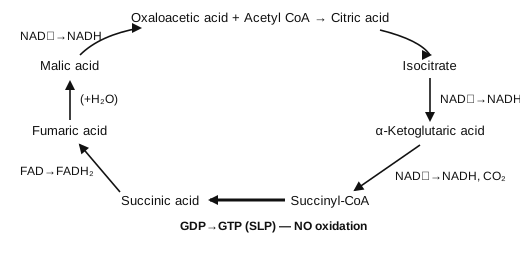
Short trick: In the Krebs cycle the GTP step (SLP) is the "no-oxidation" step.

Answer: (B) Succinyl-CoA → Succinic acid

अवधारणा: TCA चक्र में ऑक्सीकरण (विहाइड्रोजनीकरण) चार चरणों में होता है, जिनसे 3 NADH + 1 FADH2 मिलते हैं। सक्सिनिल-CoA → सक्सिनिक अम्ल क्रियाधार-स्तरीय फॉस्फोरिलीकरण है, जिससे GTP बनता है; इसमें कोई ऑक्सीकरण नहीं होता।

  1. आइसोसाइट्रेट → α-कीटोग्लूटैरेट: NAD+ → NADH, एक ऑक्सीकारी विकार्बोक्सिलीकरण।
  2. α-कीटोग्लूटैरेट → सक्सिनिल-CoA: NAD+ → NADH।
  3. सक्सिनिल-CoA → सक्सिनेट: GDP → GTP, कोई इलेक्ट्रॉन नहीं निकलता।
  4. सक्सिनेट → फ्यूमैरेट: FAD → FADH2। फ्यूमैरेट + H2O → मैलेट जलयोजन है।
  5. मैलेट → OAA: NAD+ → NADH।
  6. विकल्प (A), सक्सिनिक → मैलिक, FAD वाले चरण से होकर जाता है, अतः यह ऑक्सीकरण है।
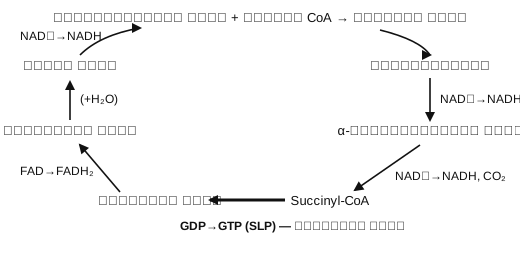
शॉर्ट ट्रिक: क्रेब्स चक्र में GTP वाला चरण (SLP) ही "ऑक्सीकरण-रहित" चरण है।

उत्तर: (B) सक्सिनिल-CoA → सक्सिनिक अम्ल
NEET UGBotanyRespiration in plants – Krebs cycleNEET UG 2024 · 5 May Shift 1
Q42.
Match List I with List II.
List-IList-II
A. Robert MayI. Species-Area relationship
B. Alexander von HumboldtII. Long term ecosystem experiment using out door plots
C. Paul EhrlichIII. Global species diversity at about 7 million
D. David TilmanIV. Rivet popper hypothesis
Choose the correct answer from the options given below:
सूची-I का सूची-II से मिलान कीजिए।
सूची-Iसूची-II
A. रॉबर्ट मेI. जाति-क्षेत्र संबंध
B. अलेक्ज़ेंडर वॉन हम्बोल्टII. बाहरी भूखंडों (outdoor plots) पर दीर्घकालीन पारितंत्र प्रयोग
C. पॉल एर्लिकIII. वैश्विक जाति विविधता लगभग 70 लाख
D. डेविड टिलमैनIV. रिवेट पॉपर परिकल्पना
नीचे दिए गए विकल्पों में से सही उत्तर चुनिए:
  1. AA-III, B-I, C-IV, D-II
  2. BA-I, B-III, C-II, D-IV
  3. CA-III, B-IV, C-II, D-I
  4. DA-II, B-III, C-I, D-IV
Show answer

Concept: These are NCERT's scientists in the biodiversity chapter.

  1. A → III: Robert May estimated global species diversity at about 7 million.
  2. B → I: Alexander von Humboldt gave the species-area relationship (log S = log C + Z log A).
  3. C → IV: Paul Ehrlich proposed the rivet popper hypothesis.
  4. D → II: David Tilman ran long-term ecosystem experiments using outdoor plots and showed that more species give more stability.

Short trick: May = "Many" species (7 million), and Humboldt = Area. These two alone fix option (A).

Answer: (A) A-III, B-I, C-IV, D-II

अवधारणा: ये NCERT के जैव विविधता अध्याय के वैज्ञानिक हैं।

  1. A → III: रॉबर्ट मे ने वैश्विक जाति विविधता लगभग 70 लाख (7 million) आँकी।
  2. B → I: अलेक्ज़ेंडर वॉन हम्बोल्ट ने जाति-क्षेत्र संबंध दिया (log S = log C + Z log A)।
  3. C → IV: पॉल एर्लिक ने रिवेट पॉपर परिकल्पना दी।
  4. D → II: डेविड टिलमैन ने बाहरी भूखंडों पर दीर्घकालीन पारितंत्र प्रयोग किए और दिखाया कि अधिक जातियों से अधिक स्थिरता मिलती है।

शॉर्ट ट्रिक: May = "Many" जातियाँ (70 लाख), और Humboldt = क्षेत्र (Area)। इन्हीं दो से विकल्प (A) तय हो जाता है।

उत्तर: (A) A-III, B-I, C-IV, D-II

NEET UGBotanyBiodiversity – scientists and conceptsNEET UG 2024 · 5 May Shift 1
Q43.
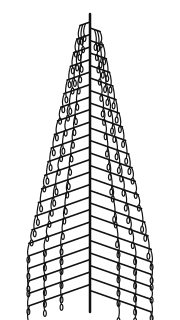
Identify the correct description about given figure.
दिए गए चित्र के संबंध में सही विवरण को पहचानिए।
  1. AWater pollinated flowers showing stamens with mucilaginous covering.श्लेष्मी आवरण युक्त पुंकेसर दर्शाते जल-परागित पुष्प।
  2. BCleistogamous flowers showing Endogamy.अंतःप्रजनन (Endogamy) दर्शाते अनुन्मील्य (cleistogamous) पुष्प।
  3. CCompact inflorescence showing complete autogamyपूर्ण स्वयुग्मन (autogamy) दर्शाता सघन पुष्पक्रम।
  4. DWind pollinated plant inflorescence showing flowers with well exposed stamens.भली-भाँति अनावृत पुंकेसरों वाले पुष्प दर्शाता वायु-परागित पादप का पुष्पक्रम।
Show answer

Concept: Wind-pollinated flowers have well-exposed stamens, so the pollen is easily dispersed by wind currents. They are often packed into an inflorescence, e.g. the tassel of corn.

  1. The figure shows a feathery inflorescence with many small flowers whose stamens hang out on long filaments. This is the typical wind-pollination adaptation.
  2. (A) Water-pollinated flowers have a mucilage coat on the pollen and are submerged or on the water surface. That is not what the figure shows.
  3. (B) and (C) Cleistogamous flowers never open, so their stamens are not exposed. That rules out autogamy in a closed flower.

Short trick: Exposed, dangling stamens plus a feathery inflorescence point to wind pollination. Think of maize tassels and grasses.

Answer: (D) Wind pollinated plant inflorescence showing flowers with well exposed stamens.

अवधारणा: वायु-परागित पुष्पों के पुंकेसर भली-भाँति अनावृत होते हैं, जिससे परागकण आसानी से वायु धाराओं में बिखर जाते हैं। ये प्रायः पुष्पक्रम में सघन रूप से व्यवस्थित होते हैं, जैसे मक्का का टैसल (tassel)।

  1. चित्र में पंखनुमा पुष्पक्रम है जिसमें अनेक छोटे पुष्प हैं और उनके पुंकेसर लंबे पुंतंतुओं पर लटके हैं। यह वायु परागण का विशिष्ट अनुकूलन है।
  2. (A) जल-परागित पुष्पों में परागकणों पर श्लेष्मी आवरण होता है और वे जल में डूबे या जल-सतह पर होते हैं। चित्र में यह नहीं दिखता।
  3. (B) और (C) अनुन्मील्य पुष्प कभी खुलते नहीं, अतः उनके पुंकेसर अनावृत नहीं होते। इसलिए बंद पुष्प का स्वयुग्मन यहाँ लागू नहीं होता।

शॉर्ट ट्रिक: अनावृत, लटकते पुंकेसर और पंखनुमा पुष्पक्रम वायु परागण का संकेत हैं। मक्का के टैसल और घासें याद करें।

उत्तर: (D) भली-भाँति अनावृत पुंकेसरों वाले पुष्प दर्शाता वायु-परागित पादप का पुष्पक्रम

NEET UGBotanySexual reproduction in flowering plants – wind pollinationNEET UG 2024 · 5 May Shift 1
Q44.
In an ecosystem if the Net Primary Productivity (NPP) of first trophic level is 100x(kcal m−2)yr−1, what would be the GPP (Gross Primary Productivity) of the third trophic level of the same ecosystem?
किसी पारितंत्र में यदि प्रथम पोषी स्तर की शुद्ध प्राथमिक उत्पादकता (NPP) 100x(kcal m−2)yr−1 है, तो उसी पारितंत्र के तृतीय पोषी स्तर की सकल प्राथमिक उत्पादकता (GPP) क्या होगी?
  1. Ax(kcal m−2)yr−1
  2. B10x(kcal m−2)yr−1
  3. C100x3x(kcal m−2)yr−1
  4. Dx10(kcal m−2)yr−1
Show answer

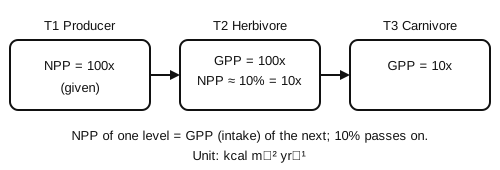
Concept: The NPP of one trophic level is the energy available to, i.e. the gross intake (GPP) of, the next level. Only about 10% of a level's gross intake remains as its net production (Lindeman's 10% law).

  1. GPP of the 2nd trophic level = NPP of the 1st = 100x.
  2. NPP of the 2nd trophic level ≈ 10% of 100x = 10x.
  3. GPP of the 3rd trophic level = NPP of the 2nd = 10x kcal m−2 yr−1.

Short trick: Going from level 1's NPP to level 3's GPP takes only one 10% step, not two. So divide by 10 once: 100x → 10x.

Answer: (B) 10x(kcal m−2)yr−1

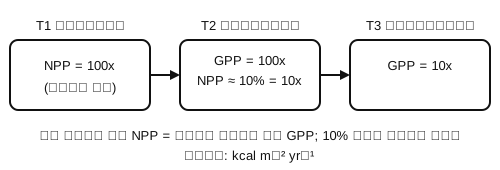
अवधारणा: किसी पोषी स्तर की NPP अगले स्तर को उपलब्ध ऊर्जा, अर्थात् उसका सकल अंतर्ग्रहण (GPP), होती है। किसी स्तर के सकल अंतर्ग्रहण का केवल लगभग 10% उसका शुद्ध उत्पादन बनता है (लिंडेमान का 10% नियम)।

  1. द्वितीय पोषी स्तर की GPP = प्रथम की NPP = 100x।
  2. द्वितीय पोषी स्तर की NPP ≈ 100x का 10% = 10x।
  3. तृतीय पोषी स्तर की GPP = द्वितीय की NPP = 10x kcal m−2 yr−1।

शॉर्ट ट्रिक: स्तर 1 की NPP से स्तर 3 की GPP तक केवल एक 10% चरण है, दो नहीं। अतः एक बार 10 से भाग दें: 100x → 10x।

उत्तर: (B) 10x(kcal m−2)yr−1

NEET UGBotanyEcosystem – productivity and energy flowNEET UG 2024 · 5 May Shift 1
Q45.
Match List I with List II.
List-IList-II
A. RoseI. Twisted aestivation
B. PeaII. Perigynous flower
C. CottonIII. Drupe
D. MangoIV. Marginal placentation
Choose the correct answer from the options given below:
सूची-I का सूची-II से मिलान कीजिए।
सूची-Iसूची-II
A. गुलाबI. व्यावर्तित (Twisted) पुष्पदल विन्यास
B. मटरII. परिजायांगी पुष्प
C. कपासIII. अष्ठिल फल (Drupe)
D. आमIV. सीमांत (Marginal) बीजांडन्यास
नीचे दिए गए विकल्पों में से सही उत्तर चुनिए:
  1. AA-I, B-II, C-III, D-IV
  2. BA-IV, B-III, C-II, D-I
  3. CA-II, B-III, C-IV, D-I
  4. DA-II, B-IV, C-I, D-III
Show answer

Concept: These are NCERT examples from the morphology chapter.

  1. A → II: rose has a perigynous flower.
  2. B → IV: pea (Fabaceae) has marginal placentation.
  3. C → I: cotton (and china rose, lady's finger) has twisted aestivation.
  4. D → III: mango is a drupe, a fruit with a stony endocarp.

Short trick: Mango → drupe, Pea → Marginal, and Cotton → twisted, "like a Cotton thread". Option (D) has all three.

Answer: (D) A-II, B-IV, C-I, D-III

अवधारणा: ये आकारिकी अध्याय के NCERT उदाहरण हैं।

  1. A → II: गुलाब का पुष्प परिजायांगी होता है।
  2. B → IV: मटर (फैबेसी) में सीमांत बीजांडन्यास होता है।
  3. C → I: कपास (तथा गुड़हल, भिंडी) में व्यावर्तित पुष्पदल विन्यास होता है।
  4. D → III: आम अष्ठिल फल (drupe) है, जिसका अंतःफलभित्ति कठोर होता है।

शॉर्ट ट्रिक: आम → अष्ठिल, मटर → सीमांत, और कपास → व्यावर्तित, "कपास के धागे जैसा मुड़ा"। विकल्प (D) में तीनों हैं।

उत्तर: (D) A-II, B-IV, C-I, D-III

NEET UGBotanyMorphology of flowering plants – families and featuresNEET UG 2024 · 5 May Shift 1
Q46.
Match List I with List II.
List-I
(Types of Stamens)
List-II
(Example)
A. MonoadelphousI. Citrus
B. DiadelphousII. Pea
C. PolyadelphousIII. Lily
D. EpiphyllousIV. China-rose
Choose the correct answer from the options given below:
सूची-I का सूची-II से मिलान कीजिए।
सूची-I
(पुंकेसरों के प्रकार)
सूची-II
(उदाहरण)
A. एकसंघी (Monoadelphous)I. सिट्रस (नींबू वंश)
B. द्विसंघी (Diadelphous)II. मटर
C. बहुसंघी (Polyadelphous)III. लिली
D. परिदललग्न (Epiphyllous)IV. गुड़हल (China-rose)
नीचे दिए गए विकल्पों में से सही उत्तर चुनिए:
  1. AA-IV, B-I, C-II, D-III
  2. BA-I, B-II, C-IV, D-III
  3. CA-III, B-I, C-IV, D-II
  4. DA-IV, B-II, C-I, D-III
Show answer

Concept: Stamens fused by their filaments into one, two or more bundles are called mono-, di- or polyadelphous. Stamens attached to the perianth are called epiphyllous.

  1. A → IV: china-rose is monoadelphous (one bundle).
  2. B → II: pea is diadelphous (two bundles, 9 + 1).
  3. C → I: citrus is polyadelphous (more than two bundles).
  4. D → III: lily is epiphyllous (attached to the tepals).

Short trick: Mono = China-rose with its single staminal tube, and Di = Pea's (9)+1. Only option (D) has both.

Answer: (D) A-IV, B-II, C-I, D-III

अवधारणा: पुंतंतुओं द्वारा एक, दो या अधिक समूहों में जुड़े पुंकेसरों को क्रमशः एकसंघी, द्विसंघी या बहुसंघी कहते हैं। परिदलपुंज से जुड़े पुंकेसर परिदललग्न (epiphyllous) कहलाते हैं।

  1. A → IV: गुड़हल एकसंघी है (एक समूह)।
  2. B → II: मटर द्विसंघी है (दो समूह, 9 + 1)।
  3. C → I: सिट्रस बहुसंघी है (दो से अधिक समूह)।
  4. D → III: लिली परिदललग्न है (परिदलों से जुड़े)।

शॉर्ट ट्रिक: एकसंघी = एक पुंकेसरी नलिका वाला गुड़हल, और द्विसंघी = मटर का (9)+1। दोनों केवल विकल्प (D) में हैं।

उत्तर: (D) A-IV, B-II, C-I, D-III

NEET UGBotanyMorphology of flowering plants – androeciumNEET UG 2024 · 5 May Shift 1
Q47.
Which of the following are fused in somatic hybridization involving two varieties of plants?
पादपों की दो किस्मों के बीच कायिक संकरण में निम्नलिखित में से किनका संलयन कराया जाता है?
  1. ASomatic embryosकायिक भ्रूण
  2. BProtoplastsजीवद्रव्यक (Protoplasts)
  3. CPollensपरागकण
  4. DCallusकैलस
Show answer

Concept: In somatic hybridisation, protoplasts isolated from two plant varieties are fused to form a hybrid protoplast. The hybrid is then grown into a new plant, e.g. the pomato.

  1. The cell wall is first digested by enzymes (cellulase and pectinase) to release the naked protoplasts.
  2. The fused protoplasts are cultured to raise somatic hybrids.
  3. Somatic embryos and callus are products of tissue culture, not units of fusion. Fusion of pollen would be sexual, not somatic.

Short trick: "Somatic" means body cells, and "hybrid" means fusion. Body cells without their walls are protoplasts.

Answer: (B) Protoplasts

अवधारणा: कायिक संकरण में पादपों की दो किस्मों से पृथक किए गए जीवद्रव्यकों का संलयन कराकर संकर जीवद्रव्यक बनाया जाता है। फिर उससे नया पादप उगाया जाता है, जैसे पोमैटो।

  1. पहले एंजाइमों (सेलुलेज़ और पेक्टिनेज़) से कोशिका भित्ति को पचाकर नग्न जीवद्रव्यक प्राप्त किए जाते हैं।
  2. संलयित जीवद्रव्यकों का संवर्धन करके कायिक संकर उगाए जाते हैं।
  3. कायिक भ्रूण और कैलस ऊतक संवर्धन के उत्पाद हैं, संलयन की इकाइयाँ नहीं। परागकणों का संलयन लैंगिक होगा, कायिक नहीं।

शॉर्ट ट्रिक: "कायिक" का अर्थ है शरीर की कोशिकाएँ, और "संकरण" का अर्थ है संलयन। भित्ति-रहित शरीर कोशिकाएँ जीवद्रव्यक हैं।

उत्तर: (B) जीवद्रव्यक

NEET UGBotanyBiotechnology – somatic hybridisationNEET UG 2024 · 5 May Shift 1
Q48.
Match List I with List II.
List-IList-II
A. Frederick GriffithI. Genetic code
B. Francois Jacob & Jacque MonodII. Semi-conservative mode of DNA replication
C. Har Gobind KhoranaIII. Transformation
D. Meselson & StahlIV. Lac operon
Choose the correct answer from the options given below:
सूची-I का सूची-II से मिलान कीजिए।
सूची-Iसूची-II
A. फ्रेडरिक ग्रिफिथI. आनुवंशिक कूट
B. फ्रांस्वा जैकब और जैक मोनॉडII. DNA प्रतिकृतिकरण की अर्ध-संरक्षी विधि
C. हरगोविंद खुरानाIII. रूपांतरण (Transformation)
D. मेसेल्सन और स्टालIV. lac ओपेरॉन
नीचे दिए गए विकल्पों में से सही उत्तर चुनिए:
  1. AA-III, B-IV, C-I, D-II
  2. BA-II, B-III, C-IV, D-I
  3. CA-IV, B-I, C-II, D-III
  4. DA-III, B-II, C-I, D-IV
Show answer

Concept: These are landmark experiments in molecular biology.

  1. A → III: Griffith (1928) showed transformation in Streptococcus pneumoniae.
  2. B → IV: Jacob and Monod elucidated the lac operon.
  3. C → I: Har Gobind Khorana helped decipher the genetic code by synthesising RNA with defined base combinations.
  4. D → II: Meselson and Stahl (1958) proved semi-conservative replication using 15N.

Short trick: Griffith goes with transformation and Meselson-Stahl with semi-conservative replication. Only option (A) has both.

Answer: (A) A-III, B-IV, C-I, D-II

अवधारणा: ये आण्विक जीवविज्ञान के ऐतिहासिक प्रयोग हैं।

  1. A → III: ग्रिफिथ (1928) ने Streptococcus pneumoniae में रूपांतरण दर्शाया।
  2. B → IV: जैकब और मोनॉड ने lac ओपेरॉन की व्याख्या की।
  3. C → I: हरगोविंद खुराना ने निश्चित क्षार संयोजन वाले RNA का संश्लेषण करके आनुवंशिक कूट को समझने में योगदान दिया।
  4. D → II: मेसेल्सन और स्टाल (1958) ने 15N का उपयोग करके अर्ध-संरक्षी प्रतिकृतिकरण सिद्ध किया।

शॉर्ट ट्रिक: ग्रिफिथ को रूपांतरण से और मेसेल्सन-स्टाल को अर्ध-संरक्षी प्रतिकृतिकरण से जोड़ें। दोनों केवल विकल्प (A) में हैं।

उत्तर: (A) A-III, B-IV, C-I, D-II

NEET UGBotanyMolecular basis of inheritance – scientistsNEET UG 2024 · 5 May Shift 1
Q49.
The DNA present in chloroplast is
हरितलवक (chloroplast) में उपस्थित DNA होता है:
  1. ACircular, double strandedवृत्ताकार, द्विरज्जुकी
  2. BLinear, single strandedरैखिक, एकरज्जुकी
  3. CCircular, single strandedवृत्ताकार, एकरज्जुकी
  4. DLinear, double strandedरैखिक, द्विरज्जुकी
Show answer

Concept: NCERT: the stroma of the chloroplast contains small, double-stranded circular DNA molecules and 70S ribosomes.

  1. This is like prokaryotic DNA, which supports the endosymbiotic origin of chloroplasts from cyanobacteria.
  2. Mitochondria likewise have circular double-stranded DNA.
  3. Linear double-stranded DNA is found in the eukaryotic nucleus. Single-stranded DNA occurs in some viruses, e.g. φX174.

Short trick: Think Chloroplast = Circular = like Cyanobacteria, and double-stranded like all cellular DNA.

Answer: (A) Circular, double stranded

अवधारणा: NCERT: हरितलवक के स्ट्रोमा में छोटे, द्विरज्जुकी वृत्ताकार DNA अणु और 70S राइबोसोम होते हैं।

  1. यह असीमकेंद्रकी (prokaryotic) DNA जैसा है, जो सायनोबैक्टीरिया से हरितलवक की अंतःसहजीवी उत्पत्ति का समर्थन करता है।
  2. माइटोकॉन्ड्रिया में भी वृत्ताकार द्विरज्जुकी DNA होता है।
  3. रैखिक द्विरज्जुकी DNA ससीमकेंद्रकी केंद्रक में मिलता है। एकरज्जुकी DNA कुछ विषाणुओं में होता है, जैसे φX174।

शॉर्ट ट्रिक: Chloroplast = Circular = Cyanobacteria जैसा, और सभी कोशिकीय DNA की तरह द्विरज्जुकी।

उत्तर: (A) वृत्ताकार, द्विरज्जुकी

NEET UGBotanyCell: the unit of life – chloroplastNEET UG 2024 · 5 May Shift 1
Q50.
Match List I with List II.
List-IList-II
A. Citric acid cycleI. Cytoplasm
B. GlycolysisII. Mitochondrial matrix
C. Electron transport systemIII. Intermembrane space of mitochondria
D. Proton gradientIV. Inner mitochondrial membrane
Choose the correct answer from the options given below:
सूची-I का सूची-II से मिलान कीजिए।
सूची-Iसूची-II
A. सिट्रिक अम्ल चक्रI. कोशिकाद्रव्य
B. ग्लाइकोलिसिसII. माइटोकॉन्ड्रियल आधात्री (matrix)
C. इलेक्ट्रॉन परिवहन तंत्रIII. माइटोकॉन्ड्रिया का अंतराझिल्ली अवकाश
D. प्रोटॉन प्रवणताIV. माइटोकॉन्ड्रिया की आंतरिक झिल्ली
नीचे दिए गए विकल्पों में से सही उत्तर चुनिए:
  1. AA-II, B-I, C-IV, D-III
  2. BA-III, B-IV, C-I, D-II
  3. CA-IV, B-III, C-II, D-I
  4. DA-I, B-II, C-III, D-IV
Show answer

Concept: Each step of aerobic respiration takes place in a specific compartment.

  1. A → II: the citric acid (Krebs) cycle takes place in the mitochondrial matrix.
  2. B → I: glycolysis takes place in the cytoplasm.
  3. C → IV: the ETS complexes I–IV are located in the inner mitochondrial membrane.
  4. D → III: protons are pumped into the intermembrane space, which builds the proton gradient that drives ATP synthase (F0–F1).

Short trick: Glycolysis is in the cytoplasm because it is the "outside" step. Of the options, only (A) has B-I.

Answer: (A) A-II, B-I, C-IV, D-III

अवधारणा: वायवीय श्वसन का प्रत्येक चरण एक विशिष्ट कक्ष में होता है।

  1. A → II: सिट्रिक अम्ल (क्रेब्स) चक्र माइटोकॉन्ड्रियल आधात्री में होता है।
  2. B → I: ग्लाइकोलिसिस कोशिकाद्रव्य में होता है।
  3. C → IV: ETS के सम्मिश्र I–IV माइटोकॉन्ड्रिया की आंतरिक झिल्ली में स्थित होते हैं।
  4. D → III: प्रोटॉन अंतराझिल्ली अवकाश में पंप होते हैं, जिससे प्रोटॉन प्रवणता बनती है जो ATP सिंथेज़ (F0–F1) को चलाती है।

शॉर्ट ट्रिक: ग्लाइकोलिसिस कोशिकाद्रव्य में होता है क्योंकि यह "बाहरी" चरण है। विकल्पों में केवल (A) में B-I है।

उत्तर: (A) A-II, B-I, C-IV, D-III

NEET UGBotanyRespiration in plants – sites of reactionsNEET UG 2024 · 5 May Shift 1
Q51.
Given below are two statements:
Statement I: The forces generated by transpiration can lift a xylem-sized column of water over 130 meters height.
Statement II: Transpiration cools leaf surfaces sometimes 10 to 15 degrees, by evaporating cooling.
In the light of the above statements, choose the most appropriate answer from the options given below:
नीचे दो कथन दिए गए हैं:
कथन I: वाष्पोत्सर्जन द्वारा उत्पन्न बल जाइलम-आकार के जल स्तंभ को 130 मीटर से अधिक ऊँचाई तक उठा सकते हैं।
कथन II: वाष्पोत्सर्जन, वाष्पीकरणीय शीतलन (evaporative cooling) द्वारा पत्ती की सतहों को कभी-कभी 10 से 15 डिग्री तक ठंडा कर देता है।
उपर्युक्त कथनों के आलोक में, नीचे दिए गए विकल्पों में से सबसे उपयुक्त उत्तर चुनिए:
  1. ABoth Statement I and Statement II are correct.कथन I और कथन II दोनों सही हैं।
  2. BBoth Statement I and Statement II are not correct.कथन I और कथन II दोनों सही नहीं हैं।
  3. CStatement I is correct but Statement II is incorrect.कथन I सही है परंतु कथन II गलत है।
  4. DStatement I is incorrect but Statement II is correct.कथन I गलत है परंतु कथन II सही है।
Show answer

Concept: NCERT lists the purposes of transpiration: it creates transpiration pull, supplies water for photosynthesis, carries minerals and cools the leaf.

  1. Statement I – NCERT: "the forces generated by transpiration can create pressures sufficient to lift a xylem-sized column of water over 130 metres high" → correct.
  2. Statement II – NCERT: transpiration "cools leaf surfaces, sometimes 10 to 15 degrees, by evaporative cooling" → correct.
  3. So both statements are correct.

Short trick: Two numbers to remember from the transpiration page: 130 m lift and 10–15 degrees cooling – both are NCERT lines, so both statements are true.

Answer: (A) Both Statement I and Statement II are correct.

अवधारणा: NCERT में वाष्पोत्सर्जन के उद्देश्य दिए हैं: यह वाष्पोत्सर्जन खिंचाव बनाता है, प्रकाश-संश्लेषण के लिए जल देता है, खनिज पहुँचाता है और पत्ती को ठंडा करता है।

  1. कथन I – NCERT: "वाष्पोत्सर्जन द्वारा उत्पन्न बल इतना दाब बना सकते हैं कि जाइलम-आकार का जल स्तंभ 130 मीटर से अधिक ऊँचाई तक उठ सके" → सही।
  2. कथन II – NCERT: वाष्पोत्सर्जन वाष्पीकरणीय शीतलन द्वारा पत्ती की सतह को "कभी-कभी 10 से 15 डिग्री" तक ठंडा करता है → सही।
  3. अतः दोनों कथन सही हैं।

शॉर्ट ट्रिक: वाष्पोत्सर्जन वाले पृष्ठ की दो संख्याएँ याद रखें: 130 मीटर उठान और 10–15 डिग्री शीतलन – दोनों NCERT की पंक्तियाँ हैं, इसलिए दोनों कथन सत्य हैं।

उत्तर: (A) कथन I और कथन II दोनों सही हैं।

NEET UGBotanyTransport in plants – transpirationNEET UG 2023 · 7 May Shift 1
Q52.
In gene gun method used to introduce alien DNA into host cells, microparticles of _______ metal are used.
परपोषी कोशिकाओं में विजातीय DNA प्रवेश कराने के लिए प्रयुक्त जीन गन विधि में _______ धातु के सूक्ष्मकण प्रयोग किए जाते हैं।
  1. ACopperताँबा (Copper)
  2. BZincजस्ता (Zinc)
  3. CTungsten or goldटंगस्टन या स्वर्ण (Tungsten or gold)
  4. DSilverचाँदी (Silver)
Show answer

Concept: Biolistics (gene gun): cells are bombarded with high-velocity micro-particles of gold or tungsten coated with DNA.

  1. The metal must be dense (to penetrate the cell wall) and chemically inert (not toxic to the cell).
  2. Gold and tungsten satisfy both, so NCERT names them.
  3. Copper, zinc and silver are reactive/toxic to cells – not used.

Short trick: Gene Gun uses Gold (or Tungsten) – "G for G".

Answer: (C) Tungsten or gold

अवधारणा: बायोलिस्टिक्स (जीन गन): कोशिकाओं पर DNA से लेपित स्वर्ण या टंगस्टन के उच्च वेग वाले सूक्ष्मकणों की बौछार की जाती है।

  1. धातु भारी (कोशिका भित्ति भेदने हेतु) तथा रासायनिक रूप से निष्क्रिय (कोशिका के लिए विषैली न हो) होनी चाहिए।
  2. स्वर्ण और टंगस्टन दोनों शर्तें पूरी करते हैं, इसलिए NCERT इन्हीं का नाम देती है।
  3. ताँबा, जस्ता और चाँदी क्रियाशील/कोशिका के लिए विषैले हैं – प्रयोग नहीं होते।

शॉर्ट ट्रिक: जीन Gun में Gold (या टंगस्टन) – "G के साथ G"।

उत्तर: (C) टंगस्टन या स्वर्ण

NEET UGBotanyBiotechnology – gene transfer methodsNEET UG 2023 · 7 May Shift 1
Q53.
Given below are two statements: One is labelled as Assertion A and the other is labelled as Reason R:
Assertion A: The first stage of gametophyte in the life cycle of moss is protonema stage.
Reason R: Protonema develops directly from spores produced in capsule.
In the light of the above statements, choose the most appropriate answer from the options given below:
नीचे दो कथन दिए गए हैं: एक को अभिकथन (Assertion) A और दूसरे को कारण (Reason) R के रूप में अंकित किया गया है:
अभिकथन A: मॉस के जीवन चक्र में युग्मकोद्भिद् की प्रथम अवस्था प्रोटोनिमा (protonema) अवस्था है।
कारण R: प्रोटोनिमा, संपुटिका (capsule) में बने बीजाणुओं से सीधे विकसित होता है।
उपर्युक्त कथनों के आलोक में, नीचे दिए गए विकल्पों में से सबसे उपयुक्त उत्तर चुनिए:
  1. ABoth A and R are correct and R is the correct explanation of A.A और R दोनों सही हैं तथा R, A की सही व्याख्या है।
  2. BBoth A and R are correct but R is NOT the correct explanation of A.A और R दोनों सही हैं परंतु R, A की सही व्याख्या नहीं है।
  3. CA is correct but R is not correct.A सही है परंतु R सही नहीं है।
  4. DA is not correct but R is correct.A सही नहीं है परंतु R सही है।
Show answer

Concept: Moss gametophyte has two stages – protonema (first) and leafy stage (second); NCERT: "the first stage is the protonema stage, which develops directly from a spore".

  1. A is true – protonema is the first, creeping, green, branched filamentous stage.
  2. R is true – the haploid spore formed by meiosis in the capsule germinates straight into protonema.
  3. Because the spore germinates directly into protonema, protonema is the first gametophytic stage → R explains A.

Short trick: Moss: Spore → Protonema → Leafy stage (bud from protonema). The very first thing a spore makes is protonema.

Answer: (A) Both A and R are correct and R is the correct explanation of A.

अवधारणा: मॉस के युग्मकोद्भिद् की दो अवस्थाएँ होती हैं – प्रोटोनिमा (प्रथम) और पर्णिल अवस्था (द्वितीय); NCERT: "प्रथम अवस्था प्रोटोनिमा है, जो सीधे बीजाणु से विकसित होती है"।

  1. A सत्य – प्रोटोनिमा प्रथम, रेंगने वाली, हरी, शाखित तंतुमय अवस्था है।
  2. R सत्य – संपुटिका में अर्धसूत्रण से बना अगुणित बीजाणु सीधे प्रोटोनिमा में अंकुरित होता है।
  3. चूँकि बीजाणु सीधे प्रोटोनिमा बनाता है, इसलिए प्रोटोनिमा प्रथम युग्मकोद्भिद् अवस्था है → R, A की व्याख्या करता है।

शॉर्ट ट्रिक: मॉस: बीजाणु → प्रोटोनिमा → पर्णिल अवस्था (प्रोटोनिमा की कलिका से)। बीजाणु सबसे पहले प्रोटोनिमा ही बनाता है।

उत्तर: (A) A और R दोनों सही हैं तथा R, A की सही व्याख्या है।

NEET UGBotanyPlant kingdom – bryophytes (moss)NEET UG 2023 · 7 May Shift 1
Q54.
Unequivocal proof that DNA is the genetic material was first proposed by
DNA ही आनुवंशिक पदार्थ है, इसका असंदिग्ध (unequivocal) प्रमाण सर्वप्रथम किसने दिया?
  1. AFrederick Griffithफ्रेडरिक ग्रिफिथ
  2. BAlfred Hershey and Martha Chaseअल्फ्रेड हर्शे और मार्था चेज़
  3. CAvery, MacLeod and McCartyएवरी, मैकलॉयड और मैकार्टी
  4. DWilkins and Franklinविल्किन्स और फ्रैंकलिन
Show answer

Concept: NCERT: "The unequivocal proof that DNA is the genetic material came from the experiments of Alfred Hershey and Martha Chase (1952)" using radioactive bacteriophages.

  1. Hershey–Chase: phage with 32P-DNA gave radioactive bacteria; 35S-protein did not → DNA enters and is the genetic material.
  2. Griffith (1928) – only showed a "transforming principle"; did not identify it.
  3. Avery, MacLeod, McCarty (1933–44) – showed DNA is the transforming principle, but not all biologists were convinced.
  4. Wilkins and Franklin – X-ray diffraction data of DNA structure.

Short trick: Griffith = transformation; Avery = "it is DNA"; Hershey–Chase = unequivocal proof (Blender experiment).

Answer: (B) Alfred Hershey and Martha Chase

अवधारणा: NCERT: "DNA के आनुवंशिक पदार्थ होने का असंदिग्ध प्रमाण अल्फ्रेड हर्शे और मार्था चेज़ (1952) के प्रयोगों से मिला", जिन्होंने रेडियोधर्मी जीवाणुभोजी प्रयोग किए।

  1. हर्शे–चेज़: 32P-DNA वाले फेज से जीवाणु रेडियोधर्मी हुए; 35S-प्रोटीन वाले से नहीं → DNA भीतर जाता है और वही आनुवंशिक पदार्थ है।
  2. ग्रिफिथ (1928) – केवल "रूपांतरण सिद्धांत" दिखाया; उसकी पहचान नहीं की।
  3. एवरी, मैकलॉयड, मैकार्टी (1933–44) – दिखाया कि रूपांतरण कारक DNA है, पर सभी जीववैज्ञानिक आश्वस्त नहीं हुए।
  4. विल्किन्स और फ्रैंकलिन – DNA संरचना के X-किरण विवर्तन आँकड़े।

शॉर्ट ट्रिक: ग्रिफिथ = रूपांतरण; एवरी = "यह DNA है"; हर्शे–चेज़ = असंदिग्ध प्रमाण (ब्लेंडर प्रयोग)।

उत्तर: (B) अल्फ्रेड हर्शे और मार्था चेज़

NEET UGBotanyMolecular basis of inheritance – DNA as genetic materialNEET UG 2023 · 7 May Shift 1
Q55.
The thickness of ozone in a column of air in the atmosphere is measured in terms of:
वायुमंडल में वायु के एक स्तंभ में ओज़ोन की मोटाई किस इकाई में मापी जाती है?
  1. ADobson unitsडॉबसन इकाई (Dobson units)
  2. BDecibelsडेसिबल (Decibels)
  3. CDecameterडेकामीटर (Decameter)
  4. DKilobaseकिलोबेस (Kilobase)
Show answer

Concept: NCERT: "The thickness of the ozone in a column of air from the ground to the top of the atmosphere is measured in terms of Dobson units (DU)."

  1. Dobson unit – ozone column thickness → correct.
  2. Decibel – unit of sound (noise) level.
  3. Decameter – unit of length (10 m).
  4. Kilobase – length of nucleic acid (1000 bases).

Short trick: Dobson for the Dome of ozone; dB is for noise, kb for DNA.

Answer: (A) Dobson units

अवधारणा: NCERT: "भूमि से वायुमंडल के शीर्ष तक वायु के एक स्तंभ में ओज़ोन की मोटाई डॉबसन इकाई (DU) में मापी जाती है।"

  1. डॉबसन इकाई – ओज़ोन स्तंभ की मोटाई → सही।
  2. डेसिबल – ध्वनि (शोर) स्तर की इकाई।
  3. डेकामीटर – लंबाई की इकाई (10 m)।
  4. किलोबेस – न्यूक्लिक अम्ल की लंबाई (1000 क्षारक)।

शॉर्ट ट्रिक: ओज़ोन के Dome के लिए Dobson; dB शोर के लिए, kb DNA के लिए।

उत्तर: (A) डॉबसन इकाई

NEET UGBotanyEnvironmental issues – ozone depletionNEET UG 2023 · 7 May Shift 1
Q56.
In tissue experiments, leaf mesophyll cells are put in a culture medium to form callus. This phenomenon may be called as:
ऊतक प्रयोगों में, पत्ती की पर्णमध्योतक (mesophyll) कोशिकाओं को संवर्धन माध्यम में रखकर कैलस बनाया जाता है। इस परिघटना को कहा जा सकता है:
  1. ADifferentiationविभेदन (Differentiation)
  2. BDedifferentiationनिर्विभेदन (Dedifferentiation)
  3. CDevelopmentपरिवर्धन (Development)
  4. DSenescenceजीर्णता (Senescence)
Show answer

Concept: Differentiated living cells that have lost the capacity to divide can regain it – this is dedifferentiation (NCERT, Plant Growth and Development).

  1. Mesophyll cells are mature, differentiated, non-dividing cells.
  2. In culture they start dividing again and form an undifferentiated mass – callus → regaining division = dedifferentiation.
  3. Differentiation – cells mature to perform a specific function (opposite process).
  4. Development – all changes in the life cycle; senescence – ageing.

Short trick: Mature cell → callus = DE-differentiation (going back); callus → plantlet = RE-differentiation.

Answer: (B) Dedifferentiation

अवधारणा: विभेदित जीवित कोशिकाएँ, जिनकी विभाजन क्षमता समाप्त हो चुकी है, पुनः विभाजन क्षमता प्राप्त कर सकती हैं – यह निर्विभेदन है (NCERT, पादप वृद्धि एवं परिवर्धन)।

  1. पर्णमध्योतक कोशिकाएँ परिपक्व, विभेदित, अविभाजी कोशिकाएँ हैं।
  2. संवर्धन में ये पुनः विभाजित होकर अविभेदित पिंड – कैलस – बनाती हैं → विभाजन क्षमता लौटना = निर्विभेदन।
  3. विभेदन – कोशिकाएँ विशिष्ट कार्य हेतु परिपक्व होती हैं (उल्टी प्रक्रिया)।
  4. परिवर्धन – जीवन चक्र के सभी परिवर्तन; जीर्णता – बुढ़ापा।

शॉर्ट ट्रिक: परिपक्व कोशिका → कैलस = निर्विभेदन (वापस जाना); कैलस → पादपक = पुनःविभेदन।

उत्तर: (B) निर्विभेदन

NEET UGBotanyPlant growth – dedifferentiationNEET UG 2023 · 7 May Shift 1
Q57.
Large, colourful, fragrant flowers with nectar are seen in:
बड़े, रंगीन, सुगंधित तथा मकरंद युक्त पुष्प किनमें देखे जाते हैं?
  1. Ainsect pollinated plantsकीट परागित पौधों में
  2. Bbird pollinated plantsपक्षी परागित पौधों में
  3. Cbat pollinated plantsचमगादड़ परागित पौधों में
  4. Dwind pollinated plantsवायु परागित पौधों में
Show answer

Concept: NCERT: "Majority of insect-pollinated flowers are large, colourful, fragrant and rich in nectar" – rewards and signals for insects.

  1. Insects are attracted by colour and fragrance and rewarded with nectar/pollen → correct.
  2. Bird-pollinated flowers are bright (often red) but usually not fragrant (birds have poor smell).
  3. Bat-pollinated flowers are dull/whitish, open at night, with strong musty odour.
  4. Wind-pollinated flowers are small, inconspicuous, without colour, scent or nectar.

Short trick: All four features (large + colour + fragrance + nectar) together = insects (entomophily).

Answer: (A) insect pollinated plants

अवधारणा: NCERT: "अधिकांश कीट-परागित पुष्प बड़े, रंगीन, सुगंधित तथा मकरंद से भरपूर होते हैं" – ये कीटों के लिए संकेत और पुरस्कार हैं।

  1. कीट रंग व सुगंध से आकर्षित होते हैं और मकरंद/पराग पुरस्कार में पाते हैं → सही।
  2. पक्षी-परागित पुष्प चमकीले (प्रायः लाल) होते हैं पर सामान्यतः सुगंधित नहीं (पक्षियों की घ्राण शक्ति कम)।
  3. चमगादड़-परागित पुष्प फीके/सफेद, रात में खिलने वाले तथा तीव्र बासी गंध वाले होते हैं।
  4. वायु-परागित पुष्प छोटे, अप्रकट, बिना रंग, गंध या मकरंद के होते हैं।

शॉर्ट ट्रिक: चारों लक्षण एक साथ (बड़ा + रंग + सुगंध + मकरंद) = कीट (कीटपरागण)।

उत्तर: (A) कीट परागित पौधों में

NEET UGBotanySexual reproduction in flowering plants – pollinationNEET UG 2023 · 7 May Shift 1
Q58.
Frequency of recombination between gene pairs on some chromosome as a measure of the distance between genes to map their position on chromosome, was used for the first time by
एक ही गुणसूत्र पर जीन युग्मों के बीच पुनर्योजन की आवृत्ति को जीनों के बीच की दूरी के माप के रूप में प्रयोग कर गुणसूत्र पर उनकी स्थिति का मानचित्रण सर्वप्रथम किसने किया?
  1. AThomas Hunt Morganथॉमस हंट मॉर्गन
  2. BSutton and Boveriसटन और बोवेरी
  3. CAlfred Sturtevantअल्फ्रेड स्टुरटेवेंट
  4. DHenkingहेंकिंग
Show answer

Concept: NCERT: "Alfred Sturtevant used the frequency of recombination between gene pairs on the same chromosome as a measure of the distance between genes and 'mapped' their position on the chromosome."

  1. Sturtevant (Morgan's student) made the first genetic map → correct.
  2. Morgan – discovered linkage and coined "recombination" in Drosophila, but did not map.
  3. Sutton and Boveri – chromosomal theory of inheritance.
  4. Henking – discovered the X-body during spermatogenesis in insects.

Short trick: Sturtevant = Started mapping; 1% recombination = 1 map unit (centiMorgan).

Answer: (C) Alfred Sturtevant

अवधारणा: NCERT: "अल्फ्रेड स्टुरटेवेंट ने एक ही गुणसूत्र पर जीन युग्मों के बीच पुनर्योजन आवृत्ति को जीनों के बीच की दूरी के माप के रूप में प्रयोग कर उनकी स्थिति का 'मानचित्रण' किया।"

  1. स्टुरटेवेंट (मॉर्गन के शिष्य) ने प्रथम आनुवंशिक मानचित्र बनाया → सही।
  2. मॉर्गन – ड्रोसोफिला में सहलग्नता खोजी और "पुनर्योजन" शब्द दिया, पर मानचित्रण नहीं किया।
  3. सटन और बोवेरी – वंशागति का गुणसूत्रीय सिद्धांत।
  4. हेंकिंग – कीटों के शुक्राणुजनन में X-काय की खोज।

शॉर्ट ट्रिक: Sturtevant = मानचित्रण Start; 1% पुनर्योजन = 1 मानचित्र इकाई (सेंटीमॉर्गन)।

उत्तर: (C) अल्फ्रेड स्टुरटेवेंट

NEET UGBotanyPrinciples of inheritance – linkage and gene mappingNEET UG 2023 · 7 May Shift 1
Q59.
Which of the following stages of meiosis involves division of centromere?
अर्धसूत्री विभाजन की निम्नलिखित में से किस अवस्था में गुणसूत्रबिंदु (centromere) का विभाजन होता है?
  1. AMetaphase Iमध्यावस्था I
  2. BMetaphase IIमध्यावस्था II
  3. CAnaphase IIपश्चावस्था II
  4. DTelophaseअंत्यावस्था
Show answer

Concept: NCERT: "Anaphase II begins with the simultaneous splitting of the centromere of each chromosome (which was holding the sister chromatids together)."

  1. Meiosis I (anaphase I) separates homologous chromosomes – centromeres do NOT split; sister chromatids stay together.
  2. Metaphase I and II – chromosomes only align at the equator.
  3. In anaphase II the centromere splits and sister chromatids move to opposite poles → correct.
  4. Telophase – nuclear envelope re-forms; no centromere division.

Short trick: Centromere splits only when sister chromatids separate: anaphase of mitosis and anaphase II of meiosis.

Answer: (C) Anaphase II

अवधारणा: NCERT: "पश्चावस्था II का आरंभ प्रत्येक गुणसूत्र के गुणसूत्रबिंदु (जो संतति अर्धगुणसूत्रों को जोड़े रखता है) के एक साथ विभाजन से होता है।"

  1. अर्धसूत्रण I (पश्चावस्था I) में समजात गुणसूत्र अलग होते हैं – गुणसूत्रबिंदु नहीं टूटते; संतति अर्धगुणसूत्र साथ रहते हैं।
  2. मध्यावस्था I और II – गुणसूत्र केवल मध्यरेखा पर संरेखित होते हैं।
  3. पश्चावस्था II में गुणसूत्रबिंदु विभाजित होकर संतति अर्धगुणसूत्र विपरीत ध्रुवों पर जाते हैं → सही।
  4. अंत्यावस्था – केंद्रक आवरण पुनः बनता है; गुणसूत्रबिंदु विभाजन नहीं।

शॉर्ट ट्रिक: गुणसूत्रबिंदु तभी टूटता है जब संतति अर्धगुणसूत्र अलग हों: समसूत्रण की पश्चावस्था और अर्धसूत्रण की पश्चावस्था II।

उत्तर: (C) पश्चावस्था II

NEET UGBotanyCell cycle – meiosisNEET UG 2023 · 7 May Shift 1
Q60.
What is the role of RNA polymerase III in the process of transcription in Eukaryotes?
यूकैरियोट में अनुलेखन (transcription) की प्रक्रिया में RNA पॉलीमरेज़ III की क्या भूमिका है?
  1. ATranscription of rRNAs (28S, 18S and 5.8S)rRNAs (28S, 18S और 5.8S) का अनुलेखन
  2. BTranscription of tRNA, 5S rRNA and snRNAtRNA, 5S rRNA और snRNA का अनुलेखन
  3. CTranscription of precursor of mRNAmRNA के पूर्ववर्ती (precursor) का अनुलेखन
  4. DTranscription of only snRNAsकेवल snRNAs का अनुलेखन
Show answer

Concept: Eukaryotes have three RNA polymerases in the nucleus (NCERT): Pol I – rRNAs (28S, 18S, 5.8S); Pol II – hnRNA (precursor of mRNA); Pol III – tRNA, 5S rRNA and snRNAs.

  1. Option (A) is the job of RNA polymerase I.
  2. Option (C) is the job of RNA polymerase II (hnRNA).
  3. Option (D) is incomplete – Pol III makes snRNAs but also tRNA and 5S rRNA.
  4. Option (B) is the full role of RNA polymerase III → correct.

Short trick: "1-2-3 = r-m-t": Pol I → rRNA, Pol II → mRNA (hnRNA), Pol III → tRNA (+5S rRNA, snRNA). Small RNAs go to the biggest number.

Answer: (B) Transcription of tRNA, 5S rRNA and snRNA

अवधारणा: यूकैरियोट के केंद्रक में तीन RNA पॉलीमरेज़ होते हैं (NCERT): Pol I – rRNAs (28S, 18S, 5.8S); Pol II – hnRNA (mRNA का पूर्ववर्ती); Pol III – tRNA, 5S rRNA और snRNAs।

  1. विकल्प (A) RNA पॉलीमरेज़ I का कार्य है।
  2. विकल्प (C) RNA पॉलीमरेज़ II (hnRNA) का कार्य है।
  3. विकल्प (D) अधूरा है – Pol III snRNAs के साथ tRNA और 5S rRNA भी बनाता है।
  4. विकल्प (B) RNA पॉलीमरेज़ III की पूर्ण भूमिका है → सही।

शॉर्ट ट्रिक: "1-2-3 = r-m-t": Pol I → rRNA, Pol II → mRNA (hnRNA), Pol III → tRNA (+5S rRNA, snRNA)। छोटे RNA सबसे बड़ी संख्या को।

उत्तर: (B) tRNA, 5S rRNA और snRNA का अनुलेखन

NEET UGBotanyMolecular basis of inheritance – transcription in eukaryotesNEET UG 2023 · 7 May Shift 1