NEET UG · 2,240 questions

NEET UG 2015, 2016, 2017, 2018, 2019, 2020, 2021, 2022, 2023, 2024, 2025, 2026 PYQs

Real previous year questions, subject-wise. Try the question, then open the answer and the explanation in Hindi & English – free, no login.

Courses – airGurukul

560 questions in Physics.

Q41.
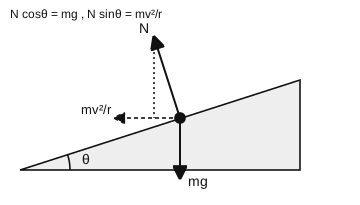
A car travels on a circular racetrack of radius 50 m, which is banked at an angle θ. If the car travels at a speed 10 m s−1, then the wear and tear on its tyres is minimum. Taking the acceleration due to gravity to be 10 m s−2, the value of θ is :
एक कार त्रिज्या 50 m के वृत्ताकार रेसट्रैक पर चलती है, जो कोण θ पर बंकित है। यदि कार 10 m s−1 की चाल से चलती है, तो उसके टायरों की घिसावट न्यूनतम होती है। गुरुत्वीय त्वरण 10 m s−2 लेते हुए, θ का मान है :
  1. Atan−1⁡(15)
  2. Btan−1⁡(25)
  3. Ctan−1⁡(3/2)
  4. Dtan−1⁡(23)
Show answer

Concept: Minimum wear means no friction is needed: the normal reaction alone provides the centripetal force, tan⁡θ=v2rg.

  1. Ncos⁡θ=mg and Nsin⁡θ=mv2r.
  2. tan⁡θ=10250×10=100500=15.
  3. θ=tan−1⁡(15).

Short trick: "Optimum (design) speed" ⇔ friction zero ⇔ tan⁡θ=v2/rg.

Answer: (A) tan−1⁡(15)

अवधारणा: न्यूनतम घिसावट का अर्थ है घर्षण की आवश्यकता नहीं: केवल अभिलंब प्रतिक्रिया अभिकेंद्र बल देती है, tan⁡θ=v2rg।

  1. Ncos⁡θ=mg तथा Nsin⁡θ=mv2r।
  2. tan⁡θ=10250×10=100500=15।
  3. θ=tan−1⁡(15)।

शॉर्ट ट्रिक: "इष्टतम (डिज़ाइन) चाल" ⇔ घर्षण शून्य ⇔ tan⁡θ=v2/rg।

उत्तर: (A) tan−1⁡(15)

NEET UGPhysicsCircular motion – banking of roadsNEET UG 2026 · 21 Jun Shift 1
Q42.
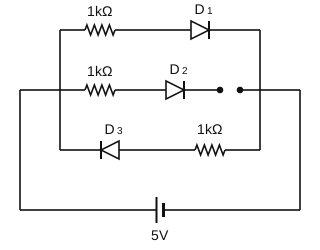
Three identical p-n junction diodes D1, D2 and D3 are connected across a battery as shown in the figure. If the width of the depletion regions of D1, D2 and D3 are W1, W2 and W3, respectively, then the correct option is :
तीन सर्वसम p-n संधि डायोड D1, D2 और D3 चित्रानुसार एक बैटरी के सिरों पर जुड़े हैं। यदि D1, D2 और D3 के अवक्षय क्षेत्रों की चौड़ाइयाँ क्रमशः W1, W2 और W3 हैं, तो सही विकल्प है :
  1. AW1>W2>W3
  2. BW3=W1>W2
  3. CW3>W2>W1
  4. DW2>W1=W3
Show answer

Concept: Forward bias narrows the depletion layer, reverse bias widens it; an unbiased diode keeps its equilibrium width.

  1. The longer plate (left) is the positive terminal, so the left node is at higher potential.
  2. D1: anode on the left (positive side) → forward biased → narrowest, W1 smallest.
  3. D2: its branch is broken (open gap) → no bias → equilibrium width W2.
  4. D3: anode on the right (negative side) → reverse biased → widest, W3 largest.
  5. Hence W3>W2>W1.

Short trick: Order: reverse > unbiased > forward.

Answer: (C) W3>W2>W1

अवधारणा: अग्र अभिनति अवक्षय परत को पतला करती है, पश्च अभिनति चौड़ा करती है; अनभिनत डायोड अपनी साम्य चौड़ाई रखता है।

  1. लंबी प्लेट (बाईं) धन टर्मिनल है, अतः बायाँ संधि-बिंदु उच्च विभव पर है।
  2. D1: ऐनोड बाईं ओर (धन पक्ष) → अग्र अभिनत → सबसे पतली, W1 न्यूनतम।
  3. D2: इसकी शाखा टूटी है (खुला अंतराल) → कोई अभिनति नहीं → साम्य चौड़ाई W2।
  4. D3: ऐनोड दाईं ओर (ऋण पक्ष) → पश्च अभिनत → सबसे चौड़ी, W3 अधिकतम।
  5. अतः W3>W2>W1।

शॉर्ट ट्रिक: क्रम: पश्च > अनभिनत > अग्र।

उत्तर: (C) W3>W2>W1

NEET UGPhysicsSemiconductors – depletion width under biasNEET UG 2026 · 21 Jun Shift 1
Q43.
The following table presents the part of the electromagnetic spectrum and their corresponding major applications.
Part of the electromagnetic spectrumApplications
PMicrowaveIFor purifying the water
QUV raysIIFor warming the food
RGamma raysIIIFor AM and FM communication systems
SRadio waveIVFor treating the Cancer cells
The correct option is :
निम्नलिखित सारणी विद्युत-चुम्बकीय स्पेक्ट्रम के भाग तथा उनके संगत प्रमुख अनुप्रयोग प्रस्तुत करती है।
विद्युत-चुम्बकीय स्पेक्ट्रम का भागअनुप्रयोग
Pसूक्ष्म तरंग (Microwave)Iजल शुद्ध करने के लिए
Qपराबैंगनी (UV) किरणेंIIभोजन गर्म करने के लिए
Rगामा किरणेंIIIAM और FM संचार व्यवस्थाओं के लिए
Sरेडियो तरंगIVकैंसर कोशिकाओं के उपचार के लिए
सही विकल्प है :
  1. AP-I, Q-II, R-III, S-IV
  2. BP-I, Q-IV, R-II, S-III
  3. CP-II, Q-I, R-IV, S-III
  4. DP-II, Q-IV, R-III, S-I
Show answer

Concept: NCERT uses of EM waves: microwave ovens, UV for sterilising water, gamma rays in radiotherapy, radio waves for AM/FM broadcasting.

  1. P Microwave → warming food (II).
  2. Q UV rays → purifying water (I).
  3. R Gamma rays → treating cancer cells (IV).
  4. S Radio waves → AM and FM communication (III).
  5. P-II, Q-I, R-IV, S-III. (A) and (B) start with P-I ✘; (D) puts gamma rays in communication ✘.

Short trick: "Micro-oven, UV-clean, Gamma-cure, Radio-tune."

Answer: (C) P-II, Q-I, R-IV, S-III

अवधारणा: NCERT में विद्युत-चुम्बकीय तरंगों के उपयोग: सूक्ष्म तरंग ओवन, जल निर्जर्मीकरण हेतु UV, विकिरण चिकित्सा में गामा किरणें, AM/FM प्रसारण हेतु रेडियो तरंगें।

  1. P सूक्ष्म तरंग → भोजन गर्म करना (II)।
  2. Q पराबैंगनी किरणें → जल शुद्ध करना (I)।
  3. R गामा किरणें → कैंसर कोशिकाओं का उपचार (IV)।
  4. S रेडियो तरंगें → AM और FM संचार (III)।
  5. P-II, Q-I, R-IV, S-III। (A) और (B) P-I से प्रारंभ होते हैं ✘; (D) गामा किरणों को संचार में रखता है ✘।

शॉर्ट ट्रिक: "माइक्रो-ओवन, UV-सफाई, गामा-इलाज, रेडियो-ट्यून।"

उत्तर: (C) P-II, Q-I, R-IV, S-III

NEET UGPhysicsElectromagnetic waves – spectrum and applicationsNEET UG 2026 · 21 Jun Shift 1
Q44.
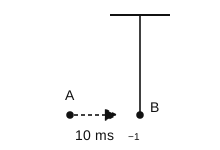
Bob B of mass m at rest is hanging vertically from the ceiling via a massless string of length 10 m, as shown in the figure. Point mass A of mass m travelling horizontally with speed 10 m s−1 hits bob B elastically. The bob B rises h meter after the collision. Taking the acceleration due to gravity g = 10 m s−2 and neglecting the size of the bob, the value of h is :
द्रव्यमान m का गोलक B विराम में, चित्रानुसार 10 m लंबाई की द्रव्यमानरहित डोरी द्वारा छत से ऊर्ध्वाधर लटका है। द्रव्यमान m का बिंदु द्रव्यमान A, 10 m s−1 की चाल से क्षैतिज रूप से चलते हुए गोलक B से प्रत्यास्थ रूप से टकराता है। संघट्ट के बाद गोलक B, h मीटर ऊपर उठता है। गुरुत्वीय त्वरण g = 10 m s−2 लेते हुए तथा गोलक के आकार की उपेक्षा करते हुए, h का मान है :
  1. A8
  2. B7
  3. C5
  4. D2.5
Show answer

Concept: Head-on elastic collision of equal masses exchanges velocities; then energy conservation for the bob.

  1. After collision A stops and B moves with 10 m s−1.
  2. h=v22g=10020=5 m.
  3. Since h = 5 m < l = 10 m, the bob swings up to 5 m without the string going slack – valid.

Short trick: Equal masses + elastic = velocity swap → h = v²/2g.

Answer: (C) 5

अवधारणा: समान द्रव्यमानों का आमने-सामने प्रत्यास्थ संघट्ट वेगों का आदान-प्रदान करता है; फिर गोलक के लिए ऊर्जा संरक्षण।

  1. संघट्ट के बाद A रुक जाता है और B, 10 m s−1 से चलता है।
  2. h=v22g=10020=5 m।
  3. चूँकि h = 5 m < l = 10 m, गोलक डोरी के ढीले हुए बिना 5 m तक उठता है – मान्य।

शॉर्ट ट्रिक: समान द्रव्यमान + प्रत्यास्थ = वेगों की अदला-बदली → h = v²/2g।

उत्तर: (C) 5

NEET UGPhysicsCollisions – elastic collision and pendulum riseNEET UG 2026 · 21 Jun Shift 1
Q45.
An ideal gas is made of polyatomic molecules. Each of the molecules has three translational, three rotational and f number of vibrational modes. If the ratio of heat capacities CP/CV of the gas is 8/7, then the value of f is :
एक आदर्श गैस बहुपरमाणुक अणुओं से बनी है। प्रत्येक अणु में तीन स्थानांतरीय, तीन घूर्णी तथा f कंपनिक विधाएँ (vibrational modes) हैं। यदि गैस की ऊष्मा धारिताओं का अनुपात CP/CV = 8/7 है, तो f का मान है :
  1. A4
  2. B3
  3. C2
  4. D1
Show answer

Concept: Each translational/rotational mode contributes 12R to CV; each vibrational mode contributes R (KE + PE).

  1. CV=32R+32R+fR=(3+f)R, CP=(4+f)R.
  2. γ=4+f3+f=87⇒28+7f=24+8f⇒f=4.

Short trick: γ=1+13+f=1+17 → 3 + f = 7 → f = 4.

Answer: (A) 4

अवधारणा: प्रत्येक स्थानांतरीय/घूर्णी विधा CV में 12R देती है; प्रत्येक कंपनिक विधा R देती है (गतिज + स्थितिज)।

  1. CV=32R+32R+fR=(3+f)R, CP=(4+f)R।
  2. γ=4+f3+f=87⇒28+7f=24+8f⇒f=4।

शॉर्ट ट्रिक: γ=1+13+f=1+17 → 3 + f = 7 → f = 4।

उत्तर: (A) 4

NEET UGPhysicsKinetic theory – degrees of freedom and γNEET UG 2026 · 21 Jun Shift 1
Q46.
A parallel plate capacitor made of circular plates is being charged such that the surface charge density on its plates is increasing at a constant rate with time. The magnetic field arising due to displacement current is:
वृत्ताकार प्लेटों से बने एक समांतर प्लेट संधारित्र को इस प्रकार आवेशित किया जा रहा है कि उसकी प्लेटों पर पृष्ठ आवेश घनत्व समय के साथ नियत दर से बढ़ रहा है। विस्थापन धारा (displacement current) के कारण उत्पन्न चुंबकीय क्षेत्र है:
  1. ANon-zero everywhere with maximum at the imaginary cylindrical surface connecting peripheries of the platesसर्वत्र शून्येतर, तथा प्लेटों की परिधियों को जोड़ने वाले काल्पनिक बेलनाकार पृष्ठ पर अधिकतम
  2. BZero between the plates and non-zero outsideप्लेटों के बीच शून्य और बाहर शून्येतर
  3. CZero at all placesसभी स्थानों पर शून्य
  4. DConstant between the plates and zero outside the platesप्लेटों के बीच नियत और प्लेटों के बाहर शून्य
Show answer

Concept: Ampere–Maxwell law: ∮B→⋅dl→=μ0ε0dΦEdt in the gap. Constant dσ/dt gives a constant displacement current density Jd=ε0dEdt=dσdt.

  1. Inside the gap (r<R): B⋅2πr=μ0Jdπr2⇒B=μ0Jdr2, which grows linearly with r.
  2. Outside (r>R): whole displacement current Id=JdπR2 is enclosed, so B=μ0Id2πr, which falls as 1/r.
  3. Hence B rises up to r=R and then decreases: it is maximum on the cylindrical surface through the plate edges and non-zero inside and outside.
  4. B is wrong (field exists between plates), C is wrong (Id≠0), D is wrong (field is neither constant inside nor zero outside).

Short trick: Same as the field of a long straight current-carrying wire of radius R: ∝ r inside, ∝ 1/r outside, peak at the surface.

Answer: (A) Non-zero everywhere, maximum at the cylindrical surface through the plate peripheries

अवधारणा: एम्पियर–मैक्सवेल नियम: प्लेटों के बीच ∮B→⋅dl→=μ0ε0dΦEdt। नियत dσ/dt से विस्थापन धारा घनत्व Jd=ε0dEdt=dσdt नियत रहता है।

  1. प्लेटों के बीच (r<R): B⋅2πr=μ0Jdπr2⇒B=μ0Jdr2, अर्थात r के साथ रैखिक रूप से बढ़ता है।
  2. बाहर (r>R): पूरी विस्थापन धारा Id=JdπR2 परिबद्ध है, अतः B=μ0Id2πr, जो 1/r के अनुसार घटता है।
  3. अतः B, r=R तक बढ़ता है फिर घटता है: प्लेटों के किनारों से गुजरने वाले बेलनाकार पृष्ठ पर अधिकतम तथा अंदर-बाहर दोनों जगह शून्येतर।
  4. B गलत (प्लेटों के बीच क्षेत्र है), C गलत (Id≠0), D गलत (अंदर नियत नहीं और बाहर शून्य नहीं)।

शॉर्ट ट्रिक: R त्रिज्या के लंबे धारावाही तार जैसा: अंदर ∝ r, बाहर ∝ 1/r, सतह पर अधिकतम।

उत्तर: (A) सर्वत्र शून्येतर, प्लेटों की परिधि वाले बेलनाकार पृष्ठ पर अधिकतम

NEET UGPhysicsEM waves – displacement currentNEET UG 2025 · 4 May Shift 1
Q47.
An electric dipole with dipole moment 5×10⁻⁶ C m is aligned with the direction of a uniform electric field of magnitude 4×10⁵ N/C. The dipole is then rotated through an angle of 60∘ with respect to the electric field. The change in the potential energy of the dipole is:
5×10⁻⁶ C m द्विध्रुव आघूर्ण वाला एक विद्युत द्विध्रुव 4×10⁵ N/C परिमाण के एकसमान विद्युत क्षेत्र की दिशा में संरेखित है। फिर द्विध्रुव को विद्युत क्षेत्र के सापेक्ष 60∘ कोण से घुमाया जाता है। द्विध्रुव की स्थितिज ऊर्जा में परिवर्तन है:
  1. A1.2 J
  2. B1.5 J
  3. C0.8 J
  4. D1.0 J
Show answer

Concept: U=−pEcos⁡θ, so ΔU=pE(cos⁡θ1−cos⁡θ2).

  1. pE=5×10−6×4×105=2 J.
  2. ΔU=pE(cos⁡0∘−cos⁡60∘)=2(1−12)=1.0 J (increase).

Short trick: From θ = 0 to 60°, ΔU = pE/2 directly.

Answer: (D) 1.0 J

अवधारणा: U=−pEcos⁡θ, अतः ΔU=pE(cos⁡θ1−cos⁡θ2)।

  1. pE=5×10−6×4×105=2 J।
  2. ΔU=pE(cos⁡0∘−cos⁡60∘)=2(1−12)=1.0 J (वृद्धि)।

शॉर्ट ट्रिक: θ = 0 से 60° तक घुमाने पर सीधे ΔU = pE/2।

उत्तर: (D) 1.0 J

NEET UGPhysicsElectric dipole – potential energyNEET UG 2025 · 4 May Shift 1
Q48.
A ball of mass 0.5 kg is dropped from a height of 40 m. The ball hits the ground and rises to a height of 10 m. The impulse imparted to the ball during its collision with the ground is (Take g=9.8 m/s2)
0.5 kg द्रव्यमान की एक गेंद 40 m की ऊँचाई से गिराई जाती है। गेंद भूमि से टकराकर 10 m की ऊँचाई तक ऊपर उठती है। भूमि से संघट्ट के दौरान गेंद को दिया गया आवेग है (g=9.8 m/s2 लें)
  1. A0
  2. B84 NS
  3. C21 NS
  4. D7 NS
Show answer

Concept: Impulse = change in momentum J=m(vf−vi), taking directions into account; v=2gh.

  1. Speed just before impact: v1=2×9.8×40=28 m/s (downward).
  2. Speed just after impact: v2=2×9.8×10=14 m/s (upward).
  3. Taking upward positive: J=0.5[14−(−28)]=0.5×42=21 N s.

Short trick: Velocity reverses, so speeds ADD: J = m(v₁ + v₂).

Answer: (C) 21 N s

अवधारणा: आवेग = संवेग में परिवर्तन J=m(vf−vi), दिशा का ध्यान रखते हुए; v=2gh।

  1. टक्कर से ठीक पहले चाल: v1=2×9.8×40=28 m/s (नीचे की ओर)।
  2. टक्कर के ठीक बाद चाल: v2=2×9.8×10=14 m/s (ऊपर की ओर)।
  3. ऊपर को धनात्मक लेने पर: J=0.5[14−(−28)]=0.5×42=21 N s।

शॉर्ट ट्रिक: वेग की दिशा उलटती है, इसलिए चालें जुड़ती हैं: J = m(v₁ + v₂)।

उत्तर: (C) 21 N s

NEET UGPhysicsImpulse and momentumNEET UG 2025 · 4 May Shift 1
Q49.
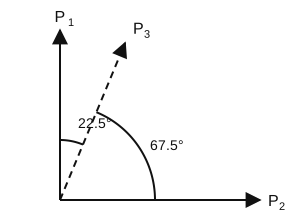
The intensity of transmitted light when a polaroid sheet, placed between two crossed polaroids at 22.5∘ from the polarization axis of one of the polaroid, is (I0 is the intensity of polarized light after passing through the first polaroid):
दो क्रॉसित पोलेरॉइडों के बीच एक पोलेरॉइड शीट को किसी एक पोलेरॉइड के ध्रुवण अक्ष से 22.5∘ पर रखा जाता है। पारगमित प्रकाश की तीव्रता है (I0 पहले पोलेरॉइड से गुजरने के बाद ध्रुवित प्रकाश की तीव्रता है):
  1. AI08
  2. BI016
  3. CI02
  4. DI04
Show answer

Concept: Malus' law I=I0cos2⁡θ at each polaroid. Crossed polaroids are at 90∘, so the middle sheet makes 22.5∘ with the first and 67.5∘ with the last.

  1. After the middle sheet: I1=I0cos2⁡22.5∘.
  2. After the last polaroid: I2=I0cos2⁡22.5∘cos2⁡67.5∘=I0(cos⁡22.5∘sin⁡22.5∘)2.
  3. =I0(sin⁡45∘2)2=I0×18=I08.

Short trick: For crossed polaroids with a sheet at θ in between: I = (I₀/4) sin²2θ. Here sin²45° = 1/2 → I₀/8.

Answer: (A) I08

अवधारणा: प्रत्येक पोलेरॉइड पर मैलस का नियम I=I0cos2⁡θ। क्रॉसित पोलेरॉइड 90∘ पर हैं, अतः बीच की शीट पहले से 22.5∘ तथा अंतिम से 67.5∘ बनाती है।

  1. बीच की शीट के बाद: I1=I0cos2⁡22.5∘।
  2. अंतिम पोलेरॉइड के बाद: I2=I0cos2⁡22.5∘cos2⁡67.5∘=I0(cos⁡22.5∘sin⁡22.5∘)2।
  3. =I0(sin⁡45∘2)2=I0×18=I08।

शॉर्ट ट्रिक: क्रॉसित पोलेरॉइडों के बीच θ पर शीट हो तो: I = (I₀/4) sin²2θ। यहाँ sin²45° = 1/2 → I₀/8।

उत्तर: (A) I08

NEET UGPhysicsWave optics – polarisation (Malus law)NEET UG 2025 · 4 May Shift 1
Q50.
The kinetic energies of two similar cars A and B are 100 J and 225 J respectively. On applying breaks, car A stops after 1000 m and car B stops after 1500 m. If FA and FB are the forces applied by the breaks on cars A and B respectively, then the ratio FAFB is
दो समान कारों A और B की गतिज ऊर्जाएँ क्रमशः 100 J और 225 J हैं। ब्रेक लगाने पर कार A, 1000 m के बाद तथा कार B, 1500 m के बाद रुकती है। यदि कारों A और B पर ब्रेकों द्वारा लगाए गए बल क्रमशः FA और FB हैं, तो अनुपात FAFB है
  1. A13
  2. B12
  3. C32
  4. D23
Show answer

Concept: Work–energy theorem: braking work Fs= initial KE, so F=Ks.

  1. FA=1001000=0.1 N.
  2. FB=2251500=0.15 N.
  3. FAFB=0.10.15=23.

Short trick: F_A/F_B = (K_A/K_B)(s_B/s_A) = (4/9)(3/2) = 2/3.

Answer: (D) 23

अवधारणा: कार्य–ऊर्जा प्रमेय: ब्रेक द्वारा किया गया कार्य Fs= प्रारंभिक गतिज ऊर्जा, अतः F=Ks।

  1. FA=1001000=0.1 N।
  2. FB=2251500=0.15 N।
  3. FAFB=0.10.15=23।

शॉर्ट ट्रिक: F_A/F_B = (K_A/K_B)(s_B/s_A) = (4/9)(3/2) = 2/3।

उत्तर: (D) 23

NEET UGPhysicsWork–energy theoremNEET UG 2025 · 4 May Shift 1
Q51.
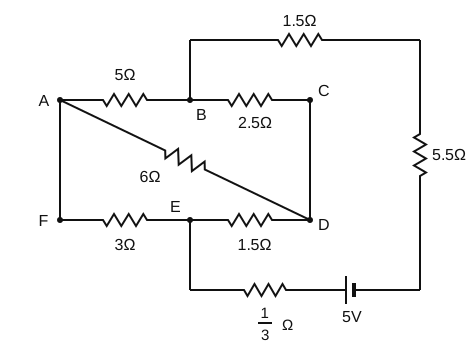
The current passing through the battery in the given circuit, is:
दिए गए परिपथ में बैटरी से गुजरने वाली धारा है:
  1. A2.5 A
  2. B1.5 A
  3. C2.0 A
  4. D0.5 A
Show answer

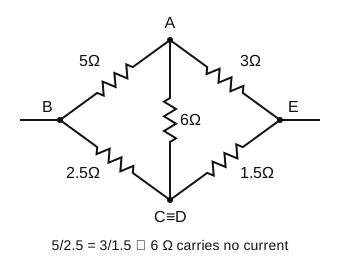
Concept: Battery is connected across B and E. Between B and E the network is a Wheatstone bridge; if it is balanced, the bridge arm carries no current.

  1. C–D and A–F are plain wires, so C ≡ D and A ≡ F. Arms: B–A = 5 Ω, A–E = 3 Ω, B–D = 2.5 Ω, D–E = 1.5 Ω; bridge A–D = 6 Ω.
  2. Balance check: 52.5=31.5=2 ✓, so the 6 Ω carries no current.
  3. RBE=(5+3)∥(2.5+1.5)=8×48+4=83 Ω.
  4. Total: R=83+1.5+5.5+13=10 Ω.
  5. I=510=0.5 A.

Short trick: Spot the balanced bridge (product of opposite arms equal: 5 × 1.5 = 2.5 × 3) and delete the middle resistor.

Answer: (D) 0.5 A

अवधारणा: बैटरी B और E के बीच जुड़ी है। B और E के बीच का जाल एक व्हीटस्टोन सेतु है; संतुलित होने पर सेतु भुजा में धारा नहीं बहती।

  1. C–D और A–F सामान्य तार हैं, अतः C ≡ D तथा A ≡ F। भुजाएँ: B–A = 5 Ω, A–E = 3 Ω, B–D = 2.5 Ω, D–E = 1.5 Ω; सेतु A–D = 6 Ω।
  2. संतुलन जाँच: 52.5=31.5=2 ✓, अतः 6 Ω में धारा शून्य।
  3. RBE=(5+3)∥(2.5+1.5)=8×48+4=83 Ω।
  4. कुल: R=83+1.5+5.5+13=10 Ω।
  5. I=510=0.5 A।

शॉर्ट ट्रिक: संतुलित सेतु पहचानें (आमने-सामने की भुजाओं का गुणनफल बराबर: 5 × 1.5 = 2.5 × 3) और बीच का प्रतिरोध हटा दें।

उत्तर: (D) 0.5 A

NEET UGPhysicsCurrent electricity – Wheatstone bridgeNEET UG 2025 · 4 May Shift 1
Q52.
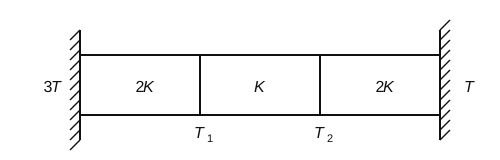
Three identical heat conducting rods are connected in series as shown in the figure. The rods on the sides have thermal conductivity 2K while that in the middle has thermal conductivity K. The left end of the combination is maintained at temperature 3T and the right end at T. The rods are thermally insulated from outside. In steady state, temperature at the left junction is T1 and that at the right junction is T2. The ratio T1T2 is
तीन सर्वसम ऊष्मा चालक छड़ें चित्रानुसार श्रेणीक्रम में जुड़ी हैं। किनारे वाली छड़ों की ऊष्मा चालकता 2K तथा बीच वाली की K है। संयोजन का बायाँ सिरा 3T तथा दायाँ सिरा T ताप पर रखा गया है। छड़ें बाहर से ऊष्मीय रूप से विलगित हैं। स्थायी अवस्था में बाएँ संधि का ताप T1 तथा दाएँ संधि का ताप T2 है। अनुपात T1T2 है
  1. A53
  2. B54
  3. C32
  4. D43
Show answer

Concept: Thermal resistance R=LkA; in series the same heat current flows, so temperature drop ∝ thermal resistance.

  1. Resistances: side rods L2KA=r each, middle LKA=2r; total 4r.
  2. Total drop 3T−T=2T shared as r:2r:r → drops T2, T, T2.
  3. T1=3T−T2=5T2, T2=T1−T=3T2.
  4. T1T2=53.

Short trick: Treat it like resistors in series: ΔT divides in the ratio of L/k.

Answer: (A) 53

अवधारणा: ऊष्मीय प्रतिरोध R=LkA; श्रेणीक्रम में समान ऊष्मा धारा बहती है, अतः तापांतर ∝ ऊष्मीय प्रतिरोध।

  1. प्रतिरोध: किनारे वाली छड़ें L2KA=r प्रत्येक, बीच वाली LKA=2r; कुल 4r।
  2. कुल तापांतर 3T−T=2T का बँटवारा r:2r:r में → T2, T, T2।
  3. T1=3T−T2=5T2, T2=T1−T=3T2।
  4. T1T2=53।

शॉर्ट ट्रिक: श्रेणी प्रतिरोधों की तरह सोचें: ΔT, L/k के अनुपात में बँटता है।

उत्तर: (A) 53

NEET UGPhysicsThermal conduction – rods in seriesNEET UG 2025 · 4 May Shift 1
Q53.
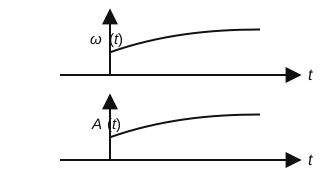
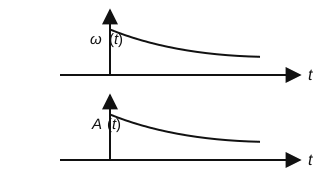
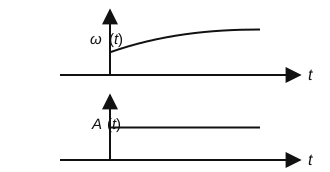
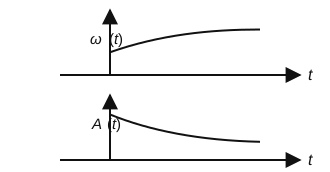
In an oscillating spring mass system, a spring is connected to a box filled with sand. As the box oscillates, sand leaks slowly out of the box vertically so that the average frequency ω(t) and average amplitude A(t) of the system change with the time t. Which one of the following options schematically depicts these changes correctly?
एक दोलनशील स्प्रिंग–द्रव्यमान निकाय में स्प्रिंग, रेत से भरे एक डिब्बे से जुड़ी है। डिब्बे के दोलन करते समय रेत धीरे-धीरे डिब्बे से ऊर्ध्वाधर रूप से रिसती है, जिससे निकाय की औसत आवृत्ति ω(t) और औसत आयाम A(t) समय t के साथ बदलते हैं। निम्नलिखित में से कौन-सा विकल्प इन परिवर्तनों को सही रूप से दर्शाता है?
  1. A
  2. B
  3. C
  4. D
Show answer

Concept: ω=k/m; sand leaving with the box's own velocity carries away kinetic energy, so the oscillation energy 12kA2 falls.

  1. Mass decreases → ω=k/m increases, levelling off once the sand is nearly gone.
  2. Lost sand takes energy 12v2|dm|; averaging over a cycle, kAdA=kA24mdm⇒A∝m1/4, so A decreases as m decreases.
  3. So ω(t) rises and A(t) falls, both gradually flattening → graph (D).
  4. A: amplitude cannot grow; B: ω cannot fall when mass falls; C: amplitude is not constant because energy leaves with the sand.

Short trick: Lighter box → faster (ω ↑); energy leaks with sand → smaller swing (A ↓).

Answer: (D) ω increasing, A decreasing

अवधारणा: ω=k/m; डिब्बे के वेग से ही निकलती रेत अपने साथ गतिज ऊर्जा ले जाती है, अतः दोलन ऊर्जा 12kA2 घटती है।

  1. द्रव्यमान घटता है → ω=k/m बढ़ता है, और रेत लगभग खत्म होने पर स्थिर हो जाता है।
  2. निकली रेत ऊर्जा 12v2|dm| ले जाती है; एक चक्र पर औसत लेने पर kAdA=kA24mdm⇒A∝m1/4, अतः m घटने पर A घटता है।
  3. अतः ω(t) बढ़ता है और A(t) घटता है, दोनों धीरे-धीरे समतल होते हैं → ग्राफ (D)।
  4. A: आयाम नहीं बढ़ सकता; B: द्रव्यमान घटने पर ω नहीं घट सकता; C: रेत के साथ ऊर्जा निकलती है, अतः आयाम नियत नहीं।

शॉर्ट ट्रिक: हल्का डिब्बा → तेज़ दोलन (ω ↑); रेत के साथ ऊर्जा बाहर → छोटा आयाम (A ↓)।

उत्तर: (D) ω बढ़ता, A घटता

NEET UGPhysicsOscillations – spring–mass system with variable massNEET UG 2025 · 4 May Shift 1
Q54.
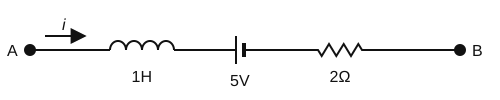
AB is a part of an electrical circuit (see figure). The potential difference "VA−VB", at the instant when current i=2 A and is increasing at a rate of 1 amp/second is:
AB एक विद्युत परिपथ का भाग है (चित्र देखें)। जिस क्षण धारा i=2 A है और 1 ऐम्पियर/सेकंड की दर से बढ़ रही है, उस क्षण विभवांतर "VA−VB" है:
  1. A9 volt9 वोल्ट
  2. B10 volt10 वोल्ट
  3. C5 volt5 वोल्ट
  4. D6 volt6 वोल्ट
Show answer

Concept: Walk from A to B along the current: drop Ldidt across the inductor, drop of emf going from + to − of the cell, drop iR across the resistor.

  1. Inductor: Ldidt=1×1=1 V.
  2. Cell (long plate/+ on A side): 5 V drop.
  3. Resistor: iR=2×2=4 V.
  4. VA−VB=1+5+4=10 V.

Short trick: An inductor with increasing current behaves like an opposing cell of emf L di/dt.

Answer: (B) 10 V

अवधारणा: धारा की दिशा में A से B तक चलें: प्रेरक पर Ldidt का पतन, सेल के + से − जाने पर emf का पतन, प्रतिरोध पर iR का पतन।

  1. प्रेरक: Ldidt=1×1=1 V।
  2. सेल (लंबी प्लेट/+ A की ओर): 5 V पतन।
  3. प्रतिरोध: iR=2×2=4 V।
  4. VA−VB=1+5+4=10 V।

शॉर्ट ट्रिक: बढ़ती धारा वाला प्रेरक L di/dt emf वाले विरोधी सेल की तरह व्यवहार करता है।

उत्तर: (B) 10 V

NEET UGPhysicsElectromagnetic induction – self-inductance (KVL)NEET UG 2025 · 4 May Shift 1
Q55.
A particle of mass m is moving around the origin with a constant force F pulling it towards the origin. If Bohr model is used to describe its motion, the radius of the nth orbit and the particle's speed v in the orbit depend on n as
द्रव्यमान m का एक कण मूलबिंदु के चारों ओर घूम रहा है, तथा एक नियत बल F उसे मूलबिंदु की ओर खींच रहा है। यदि इसकी गति का वर्णन बोर मॉडल से किया जाए, तो n वीं कक्षा की त्रिज्या तथा कक्षा में कण की चाल v की n पर निर्भरता है
  1. Ar∝n23; v∝n13
  2. Br∝n43; v∝n−13
  3. Cr∝n13; v∝n13
  4. Dr∝n13; v∝n23
Show answer

Concept: Bohr quantisation mvr=nh2π together with the centripetal condition mv2r=F (constant).

  1. From quantisation: v=nh2πmr.
  2. Substitute: mr⋅n2h24π2m2r2=F⇒r3∝n2⇒r∝n2/3.
  3. v∝nr∝nn2/3=n1/3.

Short trick: Check: v² = Fr/m ⇒ v∝r∝n1/3, consistent.

Answer: (A) r∝n2/3; v∝n1/3

अवधारणा: बोर क्वांटीकरण mvr=nh2π तथा अभिकेंद्र शर्त mv2r=F (नियत)।

  1. क्वांटीकरण से: v=nh2πmr।
  2. प्रतिस्थापित करने पर: mr⋅n2h24π2m2r2=F⇒r3∝n2⇒r∝n2/3।
  3. v∝nr∝nn2/3=n1/3।

शॉर्ट ट्रिक: जाँच: v² = Fr/m ⇒ v∝r∝n1/3, संगत।

उत्तर: (A) r∝n2/3; v∝n1/3

NEET UGPhysicsBohr model – central constant forceNEET UG 2025 · 4 May Shift 1
Q56.
In some appropriate units, time (t) and position (x) relation of a moving particle is given by t=x2+x. The acceleration of the particle is
किन्हीं उपयुक्त मात्रकों में, एक गतिमान कण के समय (t) और स्थिति (x) का संबंध t=x2+x द्वारा दिया गया है। कण का त्वरण है
  1. A+2(x+1)3
  2. B+22x+1
  3. C−2(x+2)3
  4. D−2(2x+1)3
Show answer

Concept: v=dxdt=1dt/dx and a=dvdt=vdvdx.

  1. dtdx=2x+1⇒v=12x+1.
  2. dvdx=−2(2x+1)2.
  3. a=vdvdx=12x+1⋅(−2(2x+1)2)=−2(2x+1)3.

Short trick: Shortcut: a = −(d²t/dx²)·v³ = −2/(2x+1)³.

Answer: (D) −2(2x+1)3

अवधारणा: v=dxdt=1dt/dx तथा a=dvdt=vdvdx।

  1. dtdx=2x+1⇒v=12x+1।
  2. dvdx=−2(2x+1)2।
  3. a=vdvdx=12x+1⋅(−2(2x+1)2)=−2(2x+1)3।

शॉर्ट ट्रिक: शॉर्टकट: a = −(d²t/dx²)·v³ = −2/(2x+1)³।

उत्तर: (D) −2(2x+1)3

NEET UGPhysicsKinematics – acceleration from t(x)NEET UG 2025 · 4 May Shift 1
Q57.
A model for quantized motion of an electron in a uniform magnetic field B states that the flux passing through the orbit of the electron is n(he) where n is an integer, h is Planck's constant and e is the magnitude of electron's charge. According to the model, the magnetic moment of an electron in its lowest energy state will be (m is the mass of the eletron)
एकसमान चुंबकीय क्षेत्र B में इलेक्ट्रॉन की क्वांटित गति का एक मॉडल बताता है कि इलेक्ट्रॉन की कक्षा से गुजरने वाला फ्लक्स n(he) है, जहाँ n एक पूर्णांक, h प्लांक नियतांक तथा e इलेक्ट्रॉन के आवेश का परिमाण है। इस मॉडल के अनुसार निम्नतम ऊर्जा अवस्था में इलेक्ट्रॉन का चुंबकीय आघूर्ण होगा (m इलेक्ट्रॉन का द्रव्यमान है)
  1. AheBπm
  2. BheB2πm
  3. Cheπm
  4. Dhe2πm
Show answer

Concept: Orbit magnetic moment μ=IA=evr2; in field B, r=mveB; flux Φ=Bπr2=nhe.

  1. Lowest state n=1: πr2=heB.
  2. v=eBrm⇒μ=e2⋅eBrm⋅r=e2B2mr2.
  3. μ=e2B2m⋅hπeB=he2πm.

Short trick: μ = (e/2m)·L-type result; B cancels, so eliminate options A and B at once.

Answer: (D) he2πm

अवधारणा: कक्षा का चुंबकीय आघूर्ण μ=IA=evr2; क्षेत्र B में r=mveB; फ्लक्स Φ=Bπr2=nhe।

  1. निम्नतम अवस्था n=1: πr2=heB।
  2. v=eBrm⇒μ=e2⋅eBrm⋅r=e2B2mr2।
  3. μ=e2B2m⋅hπeB=he2πm।

शॉर्ट ट्रिक: B निरस्त हो जाता है, इसलिए विकल्प A और B तुरंत हटाएँ।

उत्तर: (D) he2πm

NEET UGPhysicsMoving charges – magnetic moment of orbiting electronNEET UG 2025 · 4 May Shift 1
Q58.
A microscope has an objective of focal length 2 cm, eyepiece of focal length 4 cm and the tube length of 40 cm. If the distance of distinct vision of eye is 25 cm, the magnification in the microscope is
एक सूक्ष्मदर्शी के अभिदृश्यक की फोकस दूरी 2 cm, नेत्रिका की फोकस दूरी 4 cm तथा नली की लंबाई 40 cm है। यदि नेत्र की स्पष्ट दृष्टि की न्यूनतम दूरी 25 cm है, तो सूक्ष्मदर्शी का आवर्धन है
  1. A150
  2. B250
  3. C100
  4. D125
Show answer

Concept: Compound microscope (normal adjustment, NCERT): m≈Lfo⋅Dfe.

  1. Lfo=402=20.
  2. Dfe=254=6.25.
  3. m=20×6.25=125.
  4. (At near point it would be 20×7.25=145, not in options; so the normal-adjustment value 125 is intended.)

Short trick: Default to final image at infinity unless "near point" is stated.

Answer: (D) 125

अवधारणा: संयुक्त सूक्ष्मदर्शी (सामान्य समायोजन, NCERT): m≈Lfo⋅Dfe।

  1. Lfo=402=20।
  2. Dfe=254=6.25।
  3. m=20×6.25=125।
  4. (निकट बिंदु पर यह 20×7.25=145 होता, जो विकल्पों में नहीं है; अतः सामान्य समायोजन का मान 125 अभीष्ट है।)

शॉर्ट ट्रिक: जब तक "निकट बिंदु" न कहा हो, अंतिम प्रतिबिंब अनंत पर मानें।

उत्तर: (D) 125

NEET UGPhysicsRay optics – compound microscopeNEET UG 2025 · 4 May Shift 1
Q59.
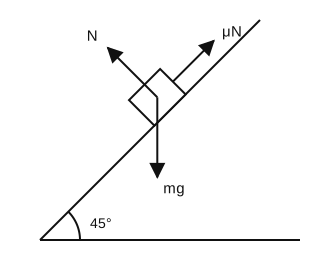
There are two inclined surfaces of equal length (L) and same angle of inclination 45∘ with the horizontal. One of them is rough and the other is perfectly smooth. A given body takes 2 times as much time to slide down on rough surface than on the smooth surface. The coefficient of kinetic friction (μk) between the object and the rough surface is close to
समान लंबाई (L) तथा क्षैतिज से समान झुकाव कोण 45∘ वाले दो आनत पृष्ठ हैं। इनमें से एक खुरदरा तथा दूसरा पूर्णतः चिकना है। कोई पिंड खुरदरे पृष्ठ पर फिसलने में चिकने पृष्ठ की तुलना में 2 गुना समय लेता है। पिंड और खुरदरे पृष्ठ के बीच गतिज घर्षण गुणांक (μk) लगभग है
  1. A0.5
  2. B0.75
  3. C0.25
  4. D0.40
Show answer

Concept: From rest over the same length L=12at2, so a∝1t2. Smooth: gsin⁡θ; rough: g(sin⁡θ−μcos⁡θ).

  1. trough=2tsmooth⇒arough=asmooth4.
  2. g(sin⁡θ−μcos⁡θ)=gsin⁡θ4⇒μ=34tan⁡θ.
  3. At 45∘: μ=34=0.75.

Short trick: Formula: μ = (1 − 1/n²) tanθ for time ratio n. n = 2 → 3/4.

Answer: (B) 0.75

अवधारणा: विराम से समान लंबाई के लिए L=12at2, अतः a∝1t2। चिकना: gsin⁡θ; खुरदरा: g(sin⁡θ−μcos⁡θ)।

  1. trough=2tsmooth⇒arough=asmooth4।
  2. g(sin⁡θ−μcos⁡θ)=gsin⁡θ4⇒μ=34tan⁡θ।
  3. 45∘ पर: μ=34=0.75।

शॉर्ट ट्रिक: सूत्र: समय अनुपात n हो तो μ = (1 − 1/n²) tanθ। n = 2 → 3/4।

उत्तर: (B) 0.75

NEET UGPhysicsLaws of motion – friction on inclined planeNEET UG 2025 · 4 May Shift 1
Q60.
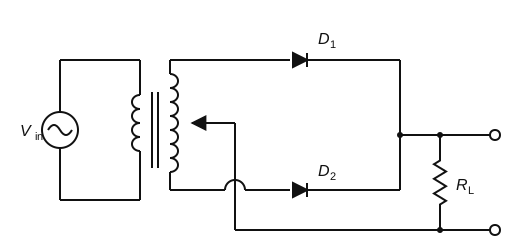
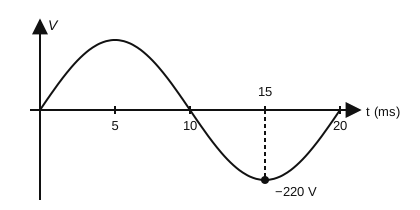
A full wave rectifier circuit with diodes (D1) and (D2) is shown in the figure. If input supply voltage Vin=220sin⁡(100πt) volt, then at t = 15 m sec
डायोडों (D1) और (D2) वाला एक पूर्ण तरंग दिष्टकारी परिपथ चित्र में दिखाया गया है। यदि निवेशी वोल्टता Vin=220sin⁡(100πt) वोल्ट है, तो t = 15 m sec पर
  1. AD1 and D2 both are forward biasedD1 और D2 दोनों अग्र अभिनत (forward biased) हैं
  2. BD1 and D2 both are reverse biasedD1 और D2 दोनों पश्च अभिनत (reverse biased) हैं
  3. CD1 is forward biased, D2 is reverse biasedD1 अग्र अभिनत है, D2 पश्च अभिनत है
  4. DD1 is reverse biased, D2 is forward biasedD1 पश्च अभिनत है, D2 अग्र अभिनत है
Show answer

Concept: In a centre-tap full wave rectifier exactly one diode conducts in each half cycle. Which one conducts depends on the polarity of the secondary ends, which depends on the winding sense of the transformer.

  1. ω=100π⇒T=2πω=20 ms.
  2. At t=15 ms: Vin=220sin⁡(1.5π)=−220 V (negative peak).
  3. With the usual convention (top of secondary positive in the positive half), in the negative half the lower end is positive: D2 forward, D1 reverse → (D).
  4. But the figure gives no dot/polarity marking for the secondary winding, so the opposite winding sense is equally possible, giving D1 forward, D2 reverse → (C).
  5. A and B are impossible: the two diodes are always in opposite states. Since both C and D are defensible, the question is treated as having two correct options.

Short trick: One diode ON, the other OFF – always. Which one needs the winding polarity.

Answer: Bonus – both (C) and (D) are correct as printed (winding polarity not specified); marks for either.

अवधारणा: केंद्र-निष्कासी (centre-tap) पूर्ण तरंग दिष्टकारी में प्रत्येक अर्ध-चक्र में ठीक एक डायोड चालन करता है। कौन-सा करेगा, यह द्वितीयक के सिरों की ध्रुवता पर, अर्थात ट्रांसफॉर्मर की कुंडली की लपेट-दिशा पर निर्भर है।

  1. ω=100π⇒T=2πω=20 ms।
  2. t=15 ms पर: Vin=220sin⁡(1.5π)=−220 V (ऋणात्मक शिखर)।
  3. सामान्य परिपाटी (धनात्मक अर्ध में द्वितीयक का ऊपरी सिरा धनात्मक) से ऋणात्मक अर्ध में निचला सिरा धनात्मक: D2 अग्र, D1 पश्च → (D)।
  4. परंतु चित्र में द्वितीयक कुंडली की ध्रुवता/डॉट नहीं दी गई है, अतः विपरीत लपेट-दिशा भी संभव है, जिससे D1 अग्र, D2 पश्च → (C)।
  5. A और B असंभव हैं: दोनों डायोड सदैव विपरीत अवस्था में रहते हैं। C और D दोनों उचित होने से प्रश्न के दो सही विकल्प माने गए।

शॉर्ट ट्रिक: एक डायोड ON, दूसरा OFF – हमेशा। कौन-सा, यह कुंडली की ध्रुवता से तय होता है।

उत्तर: बोनस – छपे रूप में (C) और (D) दोनों सही (कुंडली की ध्रुवता नहीं दी गई); किसी के लिए भी अंक।

NEET UGPhysicsSemiconductor electronics – full wave rectifierNEET UG 2025 · 4 May Shift 1