NEET UG · 2,240 questions

NEET UG 2015, 2016, 2017, 2018, 2019, 2020, 2021, 2022, 2023, 2024, 2025, 2026 PYQs

Real previous year questions, subject-wise. Try the question, then open the answer and the explanation in Hindi & English – free, no login.

Courses – airGurukul

720 questions in Biology.

Q61.
How many theca are present in each lobe of a typical bilobed angiosperm anther ?
एक प्रारूपिक द्विपालित आवृतबीजी परागकोश की प्रत्येक पालि में कितने कोष्ठ (theca) होते हैं?
  1. A2
  2. B6
  3. C8
  4. D12
Show answer

Concept: A typical angiosperm anther is bilobed and each lobe has two theca, i.e., it is dithecous (NCERT).

  1. Anther = 2 lobes.
  2. Each lobe = 2 theca → anther is dithecous (4 theca in all).
  3. Each theca has a microsporangium → anther is tetrasporangiate (4 microsporangia).

Short trick: "2-2-4": 2 lobes × 2 theca = 4 microsporangia (tetrasporangiate).

Answer: (A) 2

अवधारणा: एक प्रारूपिक आवृतबीजी परागकोश द्विपालित होता है और प्रत्येक पालि में दो कोष्ठ होते हैं, अर्थात यह द्विकोष्ठी (dithecous) होता है (NCERT)।

  1. परागकोश = 2 पालियाँ।
  2. प्रत्येक पालि = 2 कोष्ठ → परागकोश द्विकोष्ठी (कुल 4 कोष्ठ)।
  3. प्रत्येक कोष्ठ में एक लघुबीजाणुधानी → परागकोश चतुर्बीजाणुधानीय (4 लघुबीजाणुधानियाँ)।

शॉर्ट ट्रिक: "2-2-4": 2 पालियाँ × 2 कोष्ठ = 4 लघुबीजाणुधानियाँ।

उत्तर: (A) 2
NEET UGBiologySexual reproduction in flowering plants – antherNEET UG 2026 · 21 Jun Shift 1
Q62.
Muscle contraction is initiated by a signal sent by the central nervous system by the release of ________.
पेशी संकुचन केंद्रीय तंत्रिका तंत्र द्वारा भेजे गए संकेत से ________ के मोचन द्वारा प्रारंभ होता है।
  1. Aacetyl cholineऐसीटिल कोलीन
  2. Bacetyl coenzyme Aऐसीटिल कोएंज़ाइम A
  3. Ccyclic guanine monophosphateचक्रीय ग्वानीन मोनोफॉस्फेट
  4. Dcyclic adenine monophosphateचक्रीय एडेनीन मोनोफॉस्फेट
Show answer

Concept: NCERT: a neural signal reaching the neuromuscular junction releases the neurotransmitter acetylcholine, which generates an action potential in the sarcolemma.

  1. Motor neuron signal → neuromuscular junction → acetylcholine released.
  2. Action potential spreads → Ca2+ released from sarcoplasmic reticulum → binds troponin → actin sites exposed → cross bridges → contraction.
  3. Acetyl CoA – metabolic intermediate (Krebs cycle).
  4. cGMP and cAMP – second messengers of hormones, not the neuromuscular signal.

Short trick: Neuromuscular junction = "ACh-junction". Signal chain: ACh → AP → Ca2+ → troponin → sliding.

Answer: (A) acetyl choline

अवधारणा: NCERT: तंत्रिका-पेशी संधि पर पहुँचा तंत्रिका संकेत तंत्रिकाप्रेषी ऐसीटिल कोलीन मुक्त करता है, जो सार्कोलेमा में क्रिया विभव उत्पन्न करता है।

  1. प्रेरक तंत्रिका का संकेत → तंत्रिका-पेशी संधि → ऐसीटिल कोलीन मुक्त।
  2. क्रिया विभव फैलता है → सार्कोप्लाज़्मिक जालिका से Ca2+ मुक्त → ट्रोपोनिन से बंधन → ऐक्टिन स्थल अनावृत → क्रॉस ब्रिज → संकुचन।
  3. ऐसीटिल CoA – उपापचयी मध्यवर्ती (क्रेब्स चक्र)।
  4. cGMP और cAMP – हॉर्मोनों के द्वितीयक संदेशवाहक, तंत्रिका-पेशी संकेत नहीं।

शॉर्ट ट्रिक: तंत्रिका-पेशी संधि = "ACh संधि"। क्रम: ACh → क्रिया विभव → Ca2+ → ट्रोपोनिन → सर्पण।

उत्तर: (A) ऐसीटिल कोलीन

NEET UGBiologyLocomotion – mechanism of muscle contractionNEET UG 2026 · 21 Jun Shift 1
Q63.
Which of the following statements about lac-operon is correct?
लैक-ओपेरॉन के बारे में निम्नलिखित में से कौन-सा कथन सही है?
  1. AGene i is constitutively expressedजीन i निर्बाध रूप से (constitutively) अभिव्यक्त होता है
  2. BLactose activates repressor to bind to the operatorलैक्टोज़ दमनकर्ता को ऑपरेटर से बंधने हेतु सक्रिय करता है
  3. CGenes i, z, y and a share single common promoterजीन i, z, y और a एक ही उभयनिष्ठ उन्नायक (promoter) साझा करते हैं
  4. DGalactose can act as an inducer of lac operonगैलेक्टोज़ लैक ओपेरॉन के प्रेरक के रूप में कार्य कर सकता है
Show answer

Concept: In the lac operon the regulatory gene i codes for the repressor and is expressed constitutively (always); lactose (allolactose) is the inducer that inactivates the repressor.

  1. (A) Correct – i gene has its own promoter and is transcribed all the time.
  2. (B) Wrong – lactose binds the repressor and inactivates it, so it cannot bind the operator.
  3. (C) Wrong – z, y, a share one promoter (polycistronic); i is a separate unit with its own promoter.
  4. (D) Wrong – the inducer is lactose (allolactose), not galactose.

Short trick: "i = inhibitor gene, always ON"; inducer lactose switches the operon ON by switching the repressor OFF.

Answer: (A) Gene i is constitutively expressed

अवधारणा: लैक ओपेरॉन में नियामक जीन i दमनकर्ता (repressor) का कूटन करता है और निर्बाध रूप से (constitutively, हर समय) अभिव्यक्त होता है; लैक्टोज़ (एलोलैक्टोज़) प्रेरक है जो दमनकर्ता को निष्क्रिय करता है।

  1. (A) सही – i जीन का अपना उन्नायक होता है और यह हर समय अनुलेखित होता है।
  2. (B) गलत – लैक्टोज़ दमनकर्ता से बंधकर उसे निष्क्रिय करता है, जिससे वह ऑपरेटर से नहीं बंध पाता।
  3. (C) गलत – z, y, a एक उन्नायक साझा करते हैं (बहुसिस्ट्रॉनी); i अपने उन्नायक वाली अलग इकाई है।
  4. (D) गलत – प्रेरक लैक्टोज़ (एलोलैक्टोज़) है, गैलेक्टोज़ नहीं।

शॉर्ट ट्रिक: "i = निरोधक जीन, सदा चालू"; प्रेरक लैक्टोज़ दमनकर्ता को बंद करके ओपेरॉन को चालू करता है।

उत्तर: (A) जीन i निर्बाध रूप से (constitutively) अभिव्यक्त होता है

NEET UGBiologyMolecular basis of inheritance – lac operonNEET UG 2026 · 21 Jun Shift 1
Q64.
Which of the following in female gametophyte of an angiosperm helps in guiding the pollen tube for fertilizing the eggs ?
आवृतबीजी के मादा युग्मकोद्भिद में निम्नलिखित में से कौन अंडों के निषेचन हेतु पराग नलिका के मार्गदर्शन में सहायता करता है?
  1. AAntipodalsप्रतिमुखी कोशिकाएँ
  2. BSynergidsसहायक कोशिकाएँ (synergids)
  3. CCentral cellsकेंद्रीय कोशिकाएँ
  4. DPolar nucleusध्रुवीय केंद्रक
Show answer

Concept: Synergids have a special cellular thickening at the micropylar tip called the filiform apparatus, which guides the pollen tube into the synergid.

  1. Synergids (2, at micropylar end with the egg) → filiform apparatus → guide pollen tube.
  2. Antipodals – 3 cells at chalazal end, no role in guidance.
  3. Central cell with polar nuclei – fuses with second male gamete to form PEN (endosperm).

Short trick: Synergid = Satellite navigator – filiform apparatus = "GPS" for the pollen tube.

Answer: (B) Synergids

अवधारणा: सहायक कोशिकाओं के बीजांडद्वारी सिरे पर एक विशेष कोशिकीय स्थूलन होता है जिसे तंतुरूप समुच्चय (filiform apparatus) कहते हैं; यह पराग नलिका को सहायक कोशिका में मार्गदर्शित करता है।

  1. सहायक कोशिकाएँ (2, अंड के साथ बीजांडद्वारी सिरे पर) → तंतुरूप समुच्चय → पराग नलिका का मार्गदर्शन।
  2. प्रतिमुखी कोशिकाएँ – निभागीय सिरे पर 3 कोशिकाएँ, मार्गदर्शन में भूमिका नहीं।
  3. ध्रुवीय केंद्रकों वाली केंद्रीय कोशिका – दूसरे नर युग्मक से संलयन कर PEN (भ्रूणपोष) बनाती है।

शॉर्ट ट्रिक: सहायक कोशिका = पराग नलिका का "GPS" – तंतुरूप समुच्चय।

उत्तर: (B) सहायक कोशिकाएँ

NEET UGBiologySexual reproduction in flowering plants – embryo sacNEET UG 2026 · 21 Jun Shift 1
Q65.
Which of the following plant produces non-albuminous seeds ?
निम्नलिखित में से कौन-सा पादप अभ्रूणपोषी (non-albuminous) बीज उत्पन्न करता है?
  1. AWheatगेहूँ
  2. BMaizeमक्का
  3. CBarleyजौ
  4. DPeaमटर
Show answer

Concept: Non-albuminous (exalbuminous) seeds have no residual endosperm – it is consumed during embryo development (e.g. pea, groundnut). Albuminous seeds retain endosperm (wheat, maize, barley, castor).

  1. Wheat, maize, barley – cereals with persistent endosperm → albuminous.
  2. Pea – food stored in cotyledons, endosperm fully used → non-albuminous.

Short trick: Cereals + castor = albuminous; "Pea and Groundnut" (pulses) = non-albuminous.

Answer: (D) Pea

अवधारणा: अभ्रूणपोषी बीजों में अवशिष्ट भ्रूणपोष नहीं होता – यह भ्रूण विकास के दौरान पूरी तरह उपयोग हो जाता है (जैसे मटर, मूँगफली)। भ्रूणपोषी बीजों में भ्रूणपोष शेष रहता है (गेहूँ, मक्का, जौ, अरंड)।

  1. गेहूँ, मक्का, जौ – स्थायी भ्रूणपोष वाले अनाज → भ्रूणपोषी।
  2. मटर – भोजन बीजपत्रों में संचित, भ्रूणपोष पूरी तरह प्रयुक्त → अभ्रूणपोषी।

शॉर्ट ट्रिक: अनाज + अरंड = भ्रूणपोषी; "मटर और मूँगफली" (दालें) = अभ्रूणपोषी।

उत्तर: (D) मटर

NEET UGBiologySeed – albuminous and non-albuminousNEET UG 2026 · 21 Jun Shift 1
Q66.
If the diploid chromosome number of typical angiosperm is 36, what would be the chromosome number in its endosperm ?
यदि किसी प्रारूपिक आवृतबीजी का द्विगुणित गुणसूत्र संख्या 36 है, तो उसके भ्रूणपोष में गुणसूत्र संख्या क्या होगी?
  1. A18
  2. B36
  3. C54
  4. D72
Show answer

Concept: Endosperm is triploid (3n): formed by fusion of a male gamete (n) with two polar nuclei (n + n) – triple fusion.

  1. 2n = 36 → n = 18.
  2. Endosperm = 3n = 3 × 18 = 54.

Short trick: Endosperm = diploid number × 1.5 → 36 × 1.5 = 54.

Answer: (C) 54

अवधारणा: भ्रूणपोष त्रिगुणित (3n) होता है: नर युग्मक (n) का दो ध्रुवीय केंद्रकों (n + n) से संलयन – त्रिक संलयन।

  1. 2n = 36 → n = 18।
  2. भ्रूणपोष = 3n = 3 × 18 = 54।

शॉर्ट ट्रिक: भ्रूणपोष = द्विगुणित संख्या × 1.5 → 36 × 1.5 = 54।

उत्तर: (C) 54

NEET UGBiologyDouble fertilisation – endosperm ploidyNEET UG 2026 · 21 Jun Shift 1
Q67.
Which of the following statements about the reabsorption process in Henle's loop are correct?
(a) The descending limb of Henle's loop is permeable to water but almost impermeable to electrolytes.
(b) Urine gets concentrated in Henle's loop.
(c) Reabsorption of Na+ and water takes place in Henle's loop.
(d) Active or passive transport of electrolytes occurs in the ascending limb of Henle's loop.
Choose the correct answer from the options given below :
हेनले लूप में पुनरावशोषण प्रक्रिया के बारे में निम्नलिखित में से कौन-से कथन सही हैं?
(a) हेनले लूप की अवरोही भुजा जल के लिए पारगम्य परंतु विद्युत-अपघट्यों के लिए लगभग अपारगम्य है।
(b) हेनले लूप में मूत्र सांद्रित होता है।
(c) हेनले लूप में Na+ और जल का पुनरावशोषण होता है।
(d) हेनले लूप की आरोही भुजा में विद्युत-अपघट्यों का सक्रिय या निष्क्रिय परिवहन होता है।
नीचे दिए गए विकल्पों में से सही उत्तर चुनिए :
  1. A(a) and (b) onlyकेवल (a) और (b)
  2. B(b), (c) and (d) onlyकेवल (b), (c) और (d)
  3. C(a), (b) and (c) onlyकेवल (a), (b) और (c)
  4. D(a), (b) and (d) onlyकेवल (a), (b) और (d)
Show answer

Concept: NCERT: reabsorption in Henle's loop is minimum. The descending limb is permeable to water but almost impermeable to electrolytes – this concentrates the filtrate as it moves down. The ascending limb is impermeable to water but allows transport of electrolytes actively or passively.

  1. (a) Correct – NCERT line.
  2. (b) Correct – water leaves the descending limb into the hyperosmotic medulla, so the filtrate (urine) becomes concentrated in the loop.
  3. (c) Incorrect as framed – NCERT says reabsorption in Henle's loop is minimum; major Na+ + water reabsorption is in PCT (and DCT/collecting duct).
  4. (d) Correct – NCERT line for the ascending limb.

Short trick: Descending = "Drinks water out", Ascending = "All salts out". Loop = minimum reabsorption → drop (c).

Answer: (D) (a), (b) and (d) only

अवधारणा: NCERT: हेनले लूप में पुनरावशोषण न्यूनतम होता है। अवरोही भुजा जल के लिए पारगम्य परंतु विद्युत-अपघट्यों के लिए लगभग अपारगम्य है – इससे नीचे जाते समय निस्यंद सांद्रित होता है। आरोही भुजा जल के लिए अपारगम्य है परंतु विद्युत-अपघट्यों का सक्रिय या निष्क्रिय परिवहन होने देती है।

  1. (a) सही – NCERT पंक्ति।
  2. (b) सही – अवरोही भुजा से जल अतिपरासरी मध्यांश में निकल जाता है, अतः लूप में निस्यंद (मूत्र) सांद्रित होता है।
  3. (c) दिए गए रूप में गलत – NCERT के अनुसार हेनले लूप में पुनरावशोषण न्यूनतम है; Na+ + जल का मुख्य पुनरावशोषण PCT (तथा DCT/संग्राहक नलिका) में होता है।
  4. (d) सही – आरोही भुजा के लिए NCERT पंक्ति।

शॉर्ट ट्रिक: अवरोही = "जल बाहर", आरोही = "लवण बाहर"। लूप = न्यूनतम पुनरावशोषण → (c) हटाएँ।

उत्तर: (D) केवल (a), (b) और (d)

NEET UGBiologyExcretion – Henle's loopNEET UG 2026 · 21 Jun Shift 1
Q68.
Which of the following is the correct order of arrangement of vertebrate column from the head to toe?
सिर से पैर की ओर कशेरुक दंड की व्यवस्था का सही क्रम निम्नलिखित में से कौन-सा है?
  1. ACervical vertebra, thoracic vertebra, sacrum, lumbar vertebraग्रीवा कशेरुका, वक्षीय कशेरुका, त्रिक, कटि कशेरुका
  2. BSacrum, lumbar vertebra, thoracic vertebra, cervical vertebraत्रिक, कटि कशेरुका, वक्षीय कशेरुका, ग्रीवा कशेरुका
  3. CCervical vertebra, lumbar vertebra, thoracic vertebra, sacrumग्रीवा कशेरुका, कटि कशेरुका, वक्षीय कशेरुका, त्रिक
  4. DCervical vertebra, thoracic vertebra, lumbar vertebra, sacrumग्रीवा कशेरुका, वक्षीय कशेरुका, कटि कशेरुका, त्रिक
Show answer

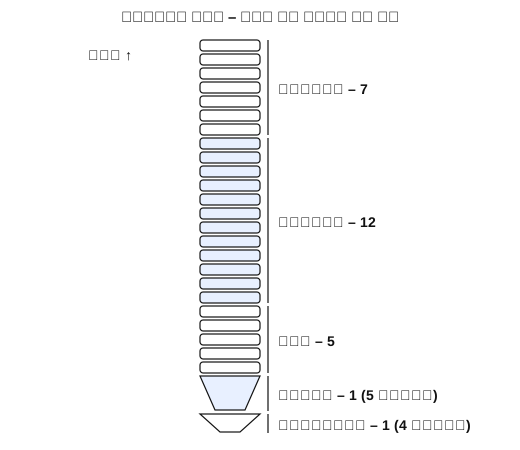
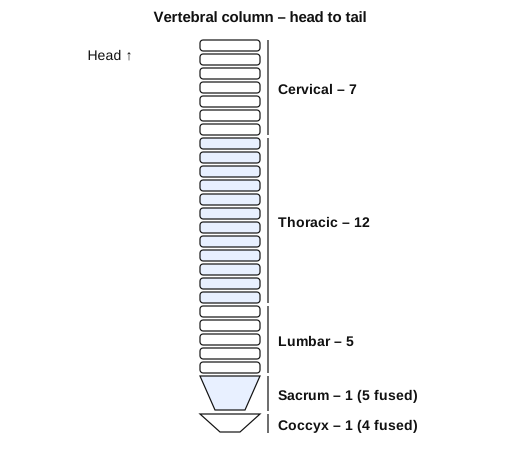
Concept: Human vertebral column: 26 serially arranged units – cervical (7), thoracic (12), lumbar (5), sacral (1, fused) and coccygeal (1, fused) from the skull downwards.

  1. Neck → cervical; chest (rib-bearing) → thoracic; lower back → lumbar; pelvis → sacrum.
  2. Option (B) is the reverse (toe to head); (A) and (C) mix up lumbar/thoracic/sacrum positions.

Short trick: Formula "C7 T12 L5 S1 C1" – "Breakfast at 7, lunch at 12, dinner at 5".

Answer: (D) Cervical vertebra, thoracic vertebra, lumbar vertebra, sacrum

अवधारणा: मानव कशेरुक दंड: खोपड़ी से नीचे की ओर 26 क्रमिक इकाइयाँ – ग्रीवा (7), वक्षीय (12), कटि (5), त्रिक (1, जुड़ी हुई) तथा अनुत्रिक (1, जुड़ी हुई)।

  1. गर्दन → ग्रीवा; वक्ष (पसलियाँ जुड़ी) → वक्षीय; पीठ का निचला भाग → कटि; श्रोणि → त्रिक।
  2. विकल्प (B) उल्टा क्रम (पैर से सिर) है; (A) और (C) में कटि/वक्षीय/त्रिक की स्थिति गड़बड़ है।

शॉर्ट ट्रिक: सूत्र "C7 T12 L5 S1 C1" – "नाश्ता 7 बजे, दोपहर का भोजन 12 बजे, रात्रि भोजन 5 बजे"।

उत्तर: (D) ग्रीवा कशेरुका, वक्षीय कशेरुका, कटि कशेरुका, त्रिक

NEET UGBiologyLocomotion – vertebral columnNEET UG 2026 · 21 Jun Shift 1
Q69.
Which of the following is not evidence for evolution?
निम्नलिखित में से कौन विकास का प्रमाण नहीं है?
  1. AConvergent evolution of traits like wings of birds and butterfliesपक्षियों और तितलियों के पंखों जैसे लक्षणों का अभिसारी विकास
  2. BPaleontological evidence from fossil recordsजीवाश्म अभिलेखों से प्राप्त जीवाश्मिकीय प्रमाण
  3. CEmbryological support for evolution as proposed by Ernst Heckelअर्नस्ट हेकल द्वारा प्रस्तावित विकास का भ्रूणविज्ञानीय समर्थन
  4. DDivergent evolution of anatomical structures such as forelimbsअग्रपाद जैसी शारीरिक संरचनाओं का अपसारी विकास
Show answer

Concept: NCERT: embryological support for evolution proposed by Ernst Heckel (all vertebrate embryos pass through a vestigial gill-slit stage) was disapproved on careful study by Karl Ernst von Baer – so it is not accepted evidence.

  1. (A) Analogous organs (wings of birds and butterflies) – convergent evolution – accepted evidence.
  2. (B) Fossils in rock strata – paleontological evidence – accepted.
  3. (C) Heckel's embryological support – rejected by von Baer (embryos never pass through adult stages of other animals) → not evidence.
  4. (D) Homologous forelimbs – divergent evolution – accepted.

Short trick: NCERT keyword: "Heckel – disapproved by von Baer".

Answer: (C) Embryological support for evolution as proposed by Ernst Heckel

अवधारणा: NCERT: अर्नस्ट हेकल द्वारा प्रस्तावित विकास का भ्रूणविज्ञानीय समर्थन (सभी कशेरुकी भ्रूण अवशेषी क्लोम-दरार अवस्था से गुजरते हैं) को कार्ल अर्नस्ट वॉन बेयर ने सावधानीपूर्वक अध्ययन के बाद अस्वीकार कर दिया – अतः यह मान्य प्रमाण नहीं है।

  1. (A) समरूप अंग (पक्षियों और तितलियों के पंख) – अभिसारी विकास – मान्य प्रमाण।
  2. (B) शैल स्तरों में जीवाश्म – जीवाश्मिकीय प्रमाण – मान्य।
  3. (C) हेकल का भ्रूणविज्ञानीय समर्थन – वॉन बेयर द्वारा अस्वीकृत (भ्रूण कभी अन्य जंतुओं की वयस्क अवस्थाओं से नहीं गुजरते) → प्रमाण नहीं।
  4. (D) समजात अग्रपाद – अपसारी विकास – मान्य।

शॉर्ट ट्रिक: NCERT मुख्य शब्द: "हेकल – वॉन बेयर द्वारा अस्वीकृत"।

उत्तर: (C) अर्नस्ट हेकल द्वारा प्रस्तावित विकास का भ्रूणविज्ञानीय समर्थन

NEET UGBiologyEvolution – evidencesNEET UG 2026 · 21 Jun Shift 1
Q70.
Given below are two statements :
Statement I : Modern Homo sapiens arose in Australia and moved across continents.
Statement II : Homo sapiens arose around 75000 to 10000 years ago.
In the light of the above statements, choose the most appropriate answer from the options given below :
नीचे दो कथन दिए गए हैं :
कथन I : आधुनिक Homo sapiens ऑस्ट्रेलिया में उत्पन्न हुआ और महाद्वीपों में फैल गया।
कथन II : Homo sapiens लगभग 75000 से 10000 वर्ष पहले उत्पन्न हुआ।
उपरोक्त कथनों के आलोक में, नीचे दिए गए विकल्पों में से सबसे उपयुक्त उत्तर चुनिए :
  1. ABoth Statement I and Statement II are correctकथन I और कथन II दोनों सही हैं
  2. BBoth Statement I and Statement II are incorrectकथन I और कथन II दोनों गलत हैं
  3. CStatement I is correct but Statement II is incorrectकथन I सही है लेकिन कथन II गलत है
  4. DStatement I is incorrect but Statement II is correctकथन I गलत है लेकिन कथन II सही है
Show answer

Concept: NCERT: Homo sapiens arose in Africa and moved across continents; during the ice age between 75,000–10,000 years ago modern Homo sapiens arose.

  1. Statement I – incorrect: the place of origin is Africa, not Australia.
  2. Statement II – correct as per NCERT (75,000–10,000 years ago, during the ice age).

Short trick: "Out of Africa" – not Australia. Cave paintings ~18,000 years ago; agriculture ~10,000 years ago.

Answer: (D) Statement I is incorrect but Statement II is correct

अवधारणा: NCERT: Homo sapiens अफ्रीका में उत्पन्न हुआ और महाद्वीपों में फैल गया; हिमयुग के दौरान 75,000–10,000 वर्ष पहले आधुनिक Homo sapiens का उद्भव हुआ।

  1. कथन I – गलत: उत्पत्ति स्थान अफ्रीका है, ऑस्ट्रेलिया नहीं।
  2. कथन II – NCERT के अनुसार सही (75,000–10,000 वर्ष पहले, हिमयुग के दौरान)।

शॉर्ट ट्रिक: "अफ्रीका से बाहर" – ऑस्ट्रेलिया नहीं। गुफा चित्र ~18,000 वर्ष पहले; कृषि ~10,000 वर्ष पहले।

उत्तर: (D) कथन I गलत है लेकिन कथन II सही है

NEET UGBiologyEvolution – origin of modern manNEET UG 2026 · 21 Jun Shift 1
Q71.
Consider a population of 10 million cells. Given the per-capita birth rate of 0.002 (per unit time) and the per-capita death rate of 0.002 (per unit time), the expected number of cells after 10 generations is ________.
10 मिलियन कोशिकाओं की एक समष्टि पर विचार कीजिए। प्रति व्यक्ति जन्म दर 0.002 (प्रति इकाई समय) और प्रति व्यक्ति मृत्यु दर 0.002 (प्रति इकाई समय) दी गई है, 10 पीढ़ियों के बाद कोशिकाओं की अपेक्षित संख्या ________ है।
  1. A1 million1 मिलियन
  2. B5 million5 मिलियन
  3. C10 million10 मिलियन
  4. D100 million100 मिलियन
Show answer

Concept: Exponential growth: dNdt=rN, where intrinsic rate r=b−d.

  1. r=0.002−0.002=0.
  2. dNdt=0×N=0 → no change in population size.
  3. After 10 generations N = 10 million (zero population growth).

Short trick: Birth rate = death rate → population stays constant, whatever the time.

Answer: (C) 10 million

अवधारणा: चरघातांकी वृद्धि: dNdt=rN, जहाँ स्वाभाविक वृद्धि दर r=b−d।

  1. r=0.002−0.002=0।
  2. dNdt=0×N=0 → समष्टि आकार में कोई परिवर्तन नहीं।
  3. 10 पीढ़ियों के बाद N = 10 मिलियन (शून्य समष्टि वृद्धि)।

शॉर्ट ट्रिक: जन्म दर = मृत्यु दर → समय कितना भी हो, समष्टि स्थिर रहती है।

उत्तर: (C) 10 मिलियन

NEET UGBiologyOrganisms and populations – population growthNEET UG 2026 · 21 Jun Shift 1
Q72.
During PCR, primers bind to the DNA strands in the ______ step.
PCR के दौरान, प्राइमर DNA रज्जुकों से ______ चरण में बंधते हैं।
  1. Adenaturationविकृतीकरण (denaturation)
  2. Bextensionप्रसार (extension)
  3. Cannealingतापानुशीतन (annealing)
  4. Dligationबंधन (ligation)
Show answer

Concept: PCR has three steps per cycle: denaturation (~94 °C, strands separate) → annealing (~50–60 °C, primers bind to complementary sequences) → extension (~72 °C, Taq polymerase extends primers).

  1. Denaturation – heat separates the two DNA strands.
  2. Annealing – primers hybridise (bind) to the single strands → answer.
  3. Extension – Taq polymerase synthesises new strand.
  4. Ligation – joining by DNA ligase; not a PCR step.

Short trick: "D-A-E" = Denature, Attach primers (Anneal), Extend.

Answer: (C) annealing

अवधारणा: PCR के प्रत्येक चक्र में तीन चरण: विकृतीकरण (~94 °C, रज्जुक अलग) → तापानुशीतन (~50–60 °C, प्राइमर पूरक अनुक्रमों से बंधते हैं) → प्रसार (~72 °C, Taq पॉलीमरेज़ प्राइमरों को बढ़ाता है)।

  1. विकृतीकरण – ताप से DNA के दोनों रज्जुक अलग होते हैं।
  2. तापानुशीतन – प्राइमर एकल रज्जुकों से संकरित (बंधित) होते हैं → उत्तर।
  3. प्रसार – Taq पॉलीमरेज़ नया रज्जुक संश्लेषित करता है।
  4. बंधन – DNA लाइगेज़ द्वारा जोड़ना; PCR का चरण नहीं।

शॉर्ट ट्रिक: "D-A-E" = विकृतीकरण (Denature), प्राइमर जोड़ना (Anneal), प्रसार (Extend)।

उत्तर: (C) तापानुशीतन (annealing)

NEET UGBiologyBiotechnology – PCRNEET UG 2026 · 21 Jun Shift 1
Q73.
Given below are two statements : one is labelled as Assertion A and the other is labelled as Reason R.
Assertion A : The logistic growth model of populations is considered more realistic than the exponential growth model.
Reason R : Resources are finite.
In the light of the above statements, choose the most appropriate answer from the options given below :
नीचे दो कथन दिए गए हैं : एक को अभिकथन A तथा दूसरे को कारण R कहा गया है।
अभिकथन A : समष्टियों का संभार तंत्र (logistic) वृद्धि मॉडल चरघातांकी वृद्धि मॉडल की तुलना में अधिक यथार्थवादी माना जाता है।
कारण R : संसाधन सीमित हैं।
उपरोक्त कथनों के आलोक में, नीचे दिए गए विकल्पों में से सबसे उपयुक्त उत्तर चुनिए :
  1. ABoth A and R are correct and R is the correct explanation of AA और R दोनों सही हैं तथा R, A की सही व्याख्या है
  2. BBoth A and R are correct but R is not the correct explanation of AA और R दोनों सही हैं लेकिन R, A की सही व्याख्या नहीं है
  3. CA is correct but R is not correctA सही है लेकिन R सही नहीं है
  4. DA is not correct but R is correctA सही नहीं है लेकिन R सही है
Show answer

Concept: Exponential growth assumes unlimited resources (J-curve). In nature resources are finite, so growth levels off at carrying capacity K – logistic (Verhulst-Pearl) S-curve: dNdt=rN(K−NK).

  1. A – correct: NCERT calls logistic growth "a more realistic one".
  2. R – correct: no population has unlimited resources; this limits growth.
  3. Finite resources are exactly why the logistic model (with K) is more realistic → R explains A.

Short trick: Finite resources → K → S-curve → realistic. Unlimited → J-curve → unrealistic.

Answer: (A) Both A and R are correct and R is the correct explanation of A

अवधारणा: चरघातांकी वृद्धि असीमित संसाधन मानती है (J-वक्र)। प्रकृति में संसाधन सीमित हैं, अतः वृद्धि वहन क्षमता K पर स्थिर हो जाती है – संभार तंत्र (वरहुल्स्ट-पर्ल) S-वक्र: dNdt=rN(K−NK)।

  1. A – सही: NCERT संभार तंत्र वृद्धि को "अधिक यथार्थवादी" कहता है।
  2. R – सही: किसी समष्टि के पास असीमित संसाधन नहीं होते; यह वृद्धि को सीमित करता है।
  3. संसाधनों का सीमित होना ही कारण है कि संभार तंत्र मॉडल (K सहित) अधिक यथार्थवादी है → R, A की व्याख्या करता है।

शॉर्ट ट्रिक: सीमित संसाधन → K → S-वक्र → यथार्थवादी। असीमित → J-वक्र → अयथार्थवादी।

उत्तर: (A) A और R दोनों सही हैं तथा R, A की सही व्याख्या है

NEET UGBiologyOrganisms and populations – growth modelsNEET UG 2026 · 21 Jun Shift 1
Q74.
Adaptive radiation in placental mammals and Australian Marsupials leading to similarity between distant species is an example of ________.
अपरा स्तनधारियों और ऑस्ट्रेलियाई मार्सुपियलों में अनुकूली विकिरण, जिससे दूरस्थ जातियों के बीच समानता उत्पन्न होती है, ________ का उदाहरण है।
  1. Adivergent evolutionअपसारी विकास
  2. Bconvergent evolutionअभिसारी विकास
  3. Cfounder effectसंस्थापक प्रभाव
  4. Dgenetic driftआनुवंशिक विचलन
Show answer

Concept: NCERT: when more than one adaptive radiation appears to have occurred in an isolated geographical area (representing different habitats), one can call this convergent evolution – e.g. placental mammals in Australia resembling corresponding marsupials (placental wolf vs Tasmanian wolf).

  1. Unrelated (distant) lineages becoming similar → convergent evolution.
  2. Divergent evolution – related forms become different (e.g. Darwin's finches, homologous forelimbs).
  3. Founder effect and genetic drift – chance changes in allele frequency, not adaptive similarity.

Short trick: Similar look, different ancestry = convergent ("come together"); same ancestry, different look = divergent.

Answer: (B) convergent evolution

अवधारणा: NCERT: जब किसी पृथक भौगोलिक क्षेत्र (विभिन्न आवासों) में एक से अधिक अनुकूली विकिरण हुए प्रतीत हों, तो इसे अभिसारी विकास कहा जा सकता है – जैसे ऑस्ट्रेलिया के अपरा स्तनधारी, संबंधित मार्सुपियलों के समान (अपरा भेड़िया बनाम तस्मानियाई भेड़िया)।

  1. असंबंधित (दूरस्थ) वंशक्रमों का समान हो जाना → अभिसारी विकास।
  2. अपसारी विकास – संबंधित रूप भिन्न हो जाते हैं (जैसे डार्विन की फिंच, समजात अग्रपाद)।
  3. संस्थापक प्रभाव और आनुवंशिक विचलन – अलील आवृत्ति में संयोगवश परिवर्तन, अनुकूली समानता नहीं।

शॉर्ट ट्रिक: रूप समान, पूर्वज भिन्न = अभिसारी ("पास आना"); पूर्वज समान, रूप भिन्न = अपसारी।

उत्तर: (B) अभिसारी विकास

NEET UGBiologyEvolution – adaptive radiationNEET UG 2026 · 21 Jun Shift 1
Q75.
Which of the following are secondary lymphoid organs ?
(a) Bone marrow
(b) Tonsils
(c) Spleen
(d) Thymus
Choose the correct answer from the options given below :
निम्नलिखित में से कौन-से द्वितीयक लसीकाभ अंग हैं?
(a) अस्थि मज्जा
(b) टॉन्सिल
(c) प्लीहा
(d) थाइमस
नीचे दिए गए विकल्पों में से सही उत्तर चुनिए :
  1. A(a) and (b) onlyकेवल (a) और (b)
  2. B(b) and (c) onlyकेवल (b) और (c)
  3. C(b) and (d) onlyकेवल (b) और (d)
  4. D(a) and (d) onlyकेवल (a) और (d)
Show answer

Concept: Primary lymphoid organs (where lymphocytes are produced/mature): bone marrow and thymus. Secondary lymphoid organs (where lymphocytes meet antigens and proliferate): spleen, lymph nodes, tonsils, Peyer's patches, appendix, MALT.

  1. (a) Bone marrow – primary.
  2. (b) Tonsils – secondary.
  3. (c) Spleen – secondary.
  4. (d) Thymus – primary.
  5. Hence (b) and (c) only.

Short trick: Primary = "Bone & Thymus" (make B and T cells). Everything else is secondary.

Answer: (B) (b) and (c) only

अवधारणा: प्राथमिक लसीकाभ अंग (जहाँ लसीकाणु बनते/परिपक्व होते हैं): अस्थि मज्जा और थाइमस। द्वितीयक लसीकाभ अंग (जहाँ लसीकाणु प्रतिजनों से मिलते और प्रचुरोद्भवन करते हैं): प्लीहा, लसीका ग्रंथियाँ, टॉन्सिल, पेयर पैच, परिशेषिका, MALT।

  1. (a) अस्थि मज्जा – प्राथमिक।
  2. (b) टॉन्सिल – द्वितीयक।
  3. (c) प्लीहा – द्वितीयक।
  4. (d) थाइमस – प्राथमिक।
  5. अतः केवल (b) और (c)।

शॉर्ट ट्रिक: प्राथमिक = "अस्थि मज्जा (B) और थाइमस (T)" – B और T कोशिकाएँ बनाते हैं। शेष सब द्वितीयक।

उत्तर: (B) केवल (b) और (c)

NEET UGBiologyHuman health and disease – lymphoid organsNEET UG 2026 · 21 Jun Shift 1
Q76.
Which of the following hormone is not secreted by human placenta ?
निम्नलिखित में से कौन-सा हॉर्मोन मानव अपरा द्वारा स्रावित नहीं होता?
  1. AhCG
  2. BEstrogenएस्ट्रोजन
  3. CProgesteroneप्रोजेस्टेरॉन
  4. DLH
Show answer

Concept: NCERT: placenta acts as an endocrine tissue and produces human chorionic gonadotropin (hCG), human placental lactogen (hPL), estrogens, progestogens, etc.

  1. hCG, estrogen and progesterone – all secreted by the placenta.
  2. LH is secreted by the anterior pituitary, not by the placenta.

Short trick: Placenta list "C-L-E-P": hCG, hPL, Estrogen, Progestogen (+ relaxin by ovary late in pregnancy). LH = pituitary.

Answer: (D) LH

अवधारणा: NCERT: अपरा एक अंतःस्रावी ऊतक के रूप में कार्य करती है और ह्यूमन कोरियोनिक गोनैडोट्रॉपिन (hCG), ह्यूमन अपरा लैक्टोजन (hPL), एस्ट्रोजन, प्रोजेस्टोजन आदि उत्पन्न करती है।

  1. hCG, एस्ट्रोजन और प्रोजेस्टेरॉन – तीनों अपरा द्वारा स्रावित।
  2. LH अग्र पीयूष ग्रंथि द्वारा स्रावित होता है, अपरा द्वारा नहीं।

शॉर्ट ट्रिक: अपरा सूची: hCG, hPL, एस्ट्रोजन, प्रोजेस्टोजन (+ गर्भावस्था के अंत में अंडाशय से रिलैक्सिन)। LH = पीयूष ग्रंथि।

उत्तर: (D) LH

NEET UGBiologyHuman reproduction – placental hormonesNEET UG 2026 · 21 Jun Shift 1
Q77.
Which of the following enzymes synthesizes precursor mRNA ?
निम्नलिखित में से कौन-सा एंज़ाइम पूर्ववर्ती mRNA का संश्लेषण करता है?
  1. ARNA polymerase IRNA पॉलीमरेज़ I
  2. BRNA polymerase IIRNA पॉलीमरेज़ II
  3. CRNA polymerase IIIRNA पॉलीमरेज़ III
  4. DDNA polymeraseDNA पॉलीमरेज़
Show answer

Concept: In eukaryotes there are three RNA polymerases in the nucleus (NCERT).

  1. RNA polymerase I – rRNAs (28S, 18S, 5.8S).
  2. RNA polymerase II – precursor of mRNA, the heterogeneous nuclear RNA (hnRNA) → answer.
  3. RNA polymerase III – tRNA, 5S rRNA and snRNAs.
  4. DNA polymerase – DNA replication, not transcription.

Short trick: "I-II-III = r-m-t" – "1 ribosomal, 2 messenger, 3 transfer" (pol II = the only one making mRNA/hnRNA).

Answer: (B) RNA polymerase II

अवधारणा: यूकैरियोट्स के केंद्रक में तीन RNA पॉलीमरेज़ होते हैं (NCERT)।

  1. RNA पॉलीमरेज़ I – rRNA (28S, 18S, 5.8S)।
  2. RNA पॉलीमरेज़ II – mRNA का पूर्ववर्ती, विषमांगी केंद्रकीय RNA (hnRNA) → उत्तर।
  3. RNA पॉलीमरेज़ III – tRNA, 5S rRNA तथा snRNA।
  4. DNA पॉलीमरेज़ – DNA प्रतिकृतीयन, अनुलेखन नहीं।

शॉर्ट ट्रिक: "I-II-III = r-m-t" – "1 राइबोसोमल, 2 मैसेंजर, 3 ट्रांसफर" याद रखें।

उत्तर: (B) RNA पॉलीमरेज़ II

NEET UGBiologyMolecular basis of inheritance – transcriptionNEET UG 2026 · 21 Jun Shift 1
Q78.
Given below are two statements :
Statement I : Plasmids are autonomously replicating DNA.
Statement II : Plasmids are extrachromosomal DNA.
In the light of the above statements, choose the most appropriate answer from the options given below :
नीचे दो कथन दिए गए हैं :
कथन I : प्लाज़्मिड स्वायत्त रूप से प्रतिकृति बनाने वाले DNA हैं।
कथन II : प्लाज़्मिड गुणसूत्रबाह्य (extrachromosomal) DNA हैं।
उपरोक्त कथनों के आलोक में, नीचे दिए गए विकल्पों में से सबसे उपयुक्त उत्तर चुनिए :
  1. ABoth Statement I and Statement II are correctकथन I और कथन II दोनों सही हैं
  2. BBoth Statement I and Statement II are incorrectकथन I और कथन II दोनों गलत हैं
  3. CStatement I is correct but Statement II is incorrectकथन I सही है लेकिन कथन II गलत है
  4. DStatement I is incorrect but Statement II is correctकथन I गलत है लेकिन कथन II सही है
Show answer

Concept: NCERT: plasmids are autonomously replicating circular extra-chromosomal DNA found in bacteria.

  1. Statement I – correct: plasmids have their own ori and replicate independently of the chromosomal DNA.
  2. Statement II – correct: they lie outside the bacterial chromosome (extrachromosomal).

Short trick: One NCERT line covers both: "autonomously replicating circular extra-chromosomal DNA".

Answer: (A) Both statements are correct

अवधारणा: NCERT: प्लाज़्मिड जीवाणुओं में पाए जाने वाले स्वायत्त रूप से प्रतिकृति बनाने वाले वृत्ताकार गुणसूत्रबाह्य DNA हैं।

  1. कथन I – सही: प्लाज़्मिड में अपना ori होता है और वे गुणसूत्री DNA से स्वतंत्र रूप से प्रतिकृति बनाते हैं।
  2. कथन II – सही: वे जीवाणु गुणसूत्र के बाहर होते हैं (गुणसूत्रबाह्य)।

शॉर्ट ट्रिक: एक ही NCERT पंक्ति दोनों को सही बताती है: "स्वायत्त प्रतिकृतीयन करने वाला वृत्ताकार गुणसूत्रबाह्य DNA"।

उत्तर: (A) दोनों कथन सही हैं

NEET UGBiologyBiotechnology – plasmidsNEET UG 2026 · 21 Jun Shift 1
Q79.
For a person with blood group 'O', which of the following is not a possible combination of parents' blood group genotypes ?
रक्त समूह 'O' वाले व्यक्ति के लिए, निम्नलिखित में से कौन-सा माता-पिता के रक्त समूह जीनोटाइप का संभव संयोजन नहीं है?
  1. AFather : IAi and Mother : IBiपिता : IAi और माता : IBi
  2. BFather : IAi and Mother : IAiपिता : IAi और माता : IAi
  3. CFather : IBi and Mother : IBiपिता : IBi और माता : IBi
  4. DFather : IAIB and Mother : IAiपिता : IAIB और माता : IAi
Show answer

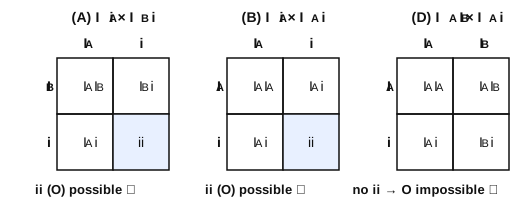
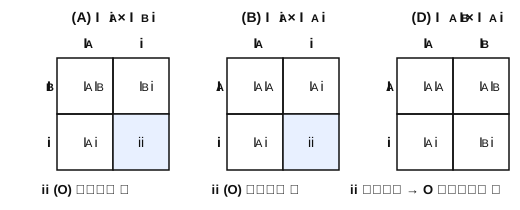
Concept: Blood group O has genotype ii – the child must receive one recessive i allele from each parent.

  1. (A) IAi × IBi → ¼ ii possible.
  2. (B) IAi × IAi → ¼ ii possible.
  3. (C) IBi × IBi → ¼ ii possible.
  4. (D) Father IAIB has no i allele → children can only be IAIA, IAi, IAIB, IBi → never O.

Short trick: An AB parent can never have an O child (and an O parent can never have an AB child).

Answer: (D) Father : IAIB and Mother : IAi

अवधारणा: रक्त समूह O का जीनोटाइप ii है – संतान को प्रत्येक जनक से एक अप्रभावी i अलील मिलना आवश्यक है।

  1. (A) IAi × IBi → ¼ ii संभव।
  2. (B) IAi × IAi → ¼ ii संभव।
  3. (C) IBi × IBi → ¼ ii संभव।
  4. (D) पिता IAIB में i अलील नहीं है → संतानें केवल IAIA, IAi, IAIB, IBi हो सकती हैं → कभी O नहीं।

शॉर्ट ट्रिक: AB जनक की संतान कभी O नहीं हो सकती (और O जनक की संतान कभी AB नहीं)।

उत्तर: (D) पिता : IAIB और माता : IAi

NEET UGBiologyPrinciples of inheritance – ABO blood groupsNEET UG 2026 · 21 Jun Shift 1
Q80.
Given below are two statements : one is labelled as Assertion A and the other is labelled as Reason R.
Assertion A : Forelimbs of human and bats are homologous.
Reason R : Forelimbs of humans and bats have similar anatomical structure.
In the light of the above statements, choose the most appropriate answer from the options given below :
नीचे दो कथन दिए गए हैं : एक को अभिकथन A तथा दूसरे को कारण R कहा गया है।
अभिकथन A : मनुष्य और चमगादड़ के अग्रपाद समजात हैं।
कारण R : मनुष्यों और चमगादड़ों के अग्रपादों की शारीरिक संरचना समान है।
उपरोक्त कथनों के आलोक में, नीचे दिए गए विकल्पों में से सबसे उपयुक्त उत्तर चुनिए :
  1. ABoth A and R are correct and R is the correct explanation of AA और R दोनों सही हैं तथा R, A की सही व्याख्या है
  2. BBoth A and R are true, but R is not the correct explanation of AA और R दोनों सत्य हैं, लेकिन R, A की सही व्याख्या नहीं है
  3. CA is true but R is falseA सत्य है लेकिन R असत्य है
  4. DA is false but R is trueA असत्य है लेकिन R सत्य है
Show answer

Concept: Homologous organs have the same basic anatomical structure and origin but may perform different functions (divergent evolution).

  1. A – correct: forelimbs of whales, bats, cheetah and human are homologous (NCERT).
  2. R – correct: they share the same bones – humerus, radius, ulna, carpals, metacarpals, phalanges.
  3. Similar anatomical structure is the very basis of calling them homologous → R explains A.

Short trick: Homologous = Have same Hardware (bones), different job. Analogous = same job, different hardware.

Answer: (A) Both A and R are correct and R is the correct explanation of A

अवधारणा: समजात अंगों की मूल शारीरिक संरचना और उत्पत्ति समान होती है परंतु वे भिन्न कार्य कर सकते हैं (अपसारी विकास)।

  1. A – सही: व्हेल, चमगादड़, चीता और मनुष्य के अग्रपाद समजात हैं (NCERT)।
  2. R – सही: इनमें समान अस्थियाँ होती हैं – ह्यूमरस, रेडियस, अल्ना, कार्पल, मेटाकार्पल, फैलेंजेस।
  3. समान शारीरिक संरचना ही इन्हें समजात कहने का आधार है → R, A की व्याख्या करता है।

शॉर्ट ट्रिक: समजात = समान "हार्डवेयर" (अस्थियाँ), भिन्न कार्य। समरूप = समान कार्य, भिन्न "हार्डवेयर"।

उत्तर: (A) A और R दोनों सही हैं तथा R, A की सही व्याख्या है

NEET UGBiologyEvolution – homologous organsNEET UG 2026 · 21 Jun Shift 1