Q61.Which of the following statements are true?
A. Unlike Ga that has a very high melting point, Cs has a very low melting point
B. On Pauling scale, the electronegativity values of N and Cl are not the same.
C. Ar, K+, Cl–, Ca2+, and S2– are all isoelectronic species.
D. The correct order of the first ionization enthalpies of Na, Mg, Al, and Si is Si > Al > Mg > Na.
E. The atomic radius of Cs is greater than that of Li and Rb.
Choose the correct answer from the options given below
निम्नलिखित में से कौन-से कथन सत्य हैं?
A. Ga, जिसका गलनांक बहुत उच्च है, के विपरीत Cs का गलनांक बहुत निम्न है
B. पॉलिंग पैमाने पर N और Cl के विद्युत-ऋणात्मकता मान समान नहीं हैं।
C. Ar, K+, Cl–, Ca2+ तथा S2– सभी समइलेक्ट्रॉनिक स्पीशीज़ हैं।
D. Na, Mg, Al तथा Si की प्रथम आयनन एन्थैल्पी का सही क्रम Si > Al > Mg > Na है।
E. Cs की परमाणु त्रिज्या Li तथा Rb से अधिक है।
नीचे दिए गए विकल्पों में से सही उत्तर चुनिए :
- AC and D onlyकेवल C और D
- BA, C, and E onlyकेवल A, C और E
- CA, B, and E onlyकेवल A, B और E
- DC and E onlyकेवल C और E
Show answer
Concept: Check each statement against NCERT data on melting points, Pauling electronegativity, electron count, ionisation enthalpy and atomic radius.
- A – false: Ga has a very low melting point (303 K, melts in the hand); Cs also melts low (≈ 302 K).
- B – false: on the Pauling scale both N and Cl have electronegativity 3.0 (the same).
- C – true: Ar 18, K+ 19–1, Cl– 17+1, Ca2+ 20–2, S2– 16+2 → all have 18 electrons.
- D – false: correct order is Si > Mg > Al > Na (Mg 3s2 is more stable than Al 3s23p1).
- E – true: radius increases down group 1, Li < Na < K < Rb < Cs.
- True statements: C and E.
Short trick: IE1 of period 3 dips at Al (after Mg) and at S (after P) – any order putting Al above Mg is wrong.
Answer: (D) C and E only
अवधारणा: प्रत्येक कथन को गलनांक, पॉलिंग विद्युत-ऋणात्मकता, इलेक्ट्रॉन संख्या, आयनन एन्थैल्पी व परमाणु त्रिज्या के NCERT आँकड़ों से जाँचिए।
- A – असत्य: Ga का गलनांक बहुत निम्न है (303 K, हाथ में पिघल जाता है); Cs भी निम्न ताप (≈ 302 K) पर पिघलता है।
- B – असत्य: पॉलिंग पैमाने पर N और Cl दोनों की विद्युत-ऋणात्मकता 3.0 (समान) है।
- C – सत्य: Ar 18, K+ 19–1, Cl– 17+1, Ca2+ 20–2, S2– 16+2 → सभी में 18 इलेक्ट्रॉन।
- D – असत्य: सही क्रम Si > Mg > Al > Na है (Mg 3s2, Al 3s23p1 से अधिक स्थायी)।
- E – सत्य: वर्ग 1 में नीचे त्रिज्या बढ़ती है, Li < Na < K < Rb < Cs।
- सत्य कथन: C और E।
शॉर्ट ट्रिक: आवर्त 3 में IE1, Al पर (Mg के बाद) और S पर (P के बाद) घटती है – Al को Mg से ऊपर रखने वाला कोई भी क्रम गलत है।
उत्तर: (D) केवल C और E
NEET UGChemistryClassification of elements – periodic propertiesNEET UG 2025 · 4 May Shift 1
Q62.The standard heat of formation, in kcal/mol of Ba2+ is :
[Given: standard heat of formation of SO42– ion (aq) = –216 kcal/mol, standard heat of crystallisation of BaSO4(s) = –4.5 kcal/mol, standard heat of formation of BaSO4(s) = –349 kcal/mol]
Ba2+ की मानक संभवन ऊष्मा (kcal/mol में) है :
[दिया है: SO42– आयन (aq) की मानक संभवन ऊष्मा = –216 kcal/mol, BaSO4(s) की मानक क्रिस्टलन ऊष्मा = –4.5 kcal/mol, BaSO4(s) की मानक संभवन ऊष्मा = –349 kcal/mol]
- A+133.0
- B+220.5
- C–128.5
- D–133.0
Show answer
Concept: Crystallisation: Ba2+(aq) + SO42–(aq) → BaSO4(s); ΔHcryst = ΣΔfH(products) – ΣΔfH(reactants).
- –4.5 = ΔfH(BaSO4) – [ΔfH(Ba2+) + ΔfH(SO42–)]
- –4.5 = –349 – [x + (–216)]
- x = –349 + 216 + 4.5 = –128.5 kcal/mol.
Short trick: ΔfH(cation) = ΔfH(salt) – ΔHcryst – ΔfH(anion): –349 + 4.5 + 216.
Answer: (C) –128.5
अवधारणा: क्रिस्टलन: Ba2+(aq) + SO42–(aq) → BaSO4(s); ΔHcryst = ΣΔfH(उत्पाद) – ΣΔfH(अभिकारक)।
- –4.5 = ΔfH(BaSO4) – [ΔfH(Ba2+) + ΔfH(SO42–)]
- –4.5 = –349 – [x + (–216)]
- x = –349 + 216 + 4.5 = –128.5 kcal/mol।
शॉर्ट ट्रिक: ΔfH(धनायन) = ΔfH(लवण) – ΔHcryst – ΔfH(ऋणायन): –349 + 4.5 + 216।
उत्तर: (C) –128.5
NEET UGChemistryThermodynamics – enthalpy of formation of ions (Hess’s law)NEET UG 2025 · 4 May Shift 1
Q63.Match List-I with List-II
| List-I (Example) | List-II (Type of Solution) |
|---|
| A. Humidity | I. Solid in solid |
| B. Alloys | II. Liquid in gas |
| C. Amalgams | III. Solid in gas |
| D. Smoke | IV. Liquid in solid |
Choose the correct answer from the options given below :
सूची-I का सूची-II से मिलान कीजिए।
| सूची-I (उदाहरण) | सूची-II (विलयन का प्रकार) |
|---|
| A. आर्द्रता | I. ठोस में ठोस |
| B. मिश्रधातुएँ | II. गैस में द्रव |
| C. अमलगम (पारदमिश्रण) | III. गैस में ठोस |
| D. धुआँ | IV. ठोस में द्रव |
नीचे दिए गए विकल्पों में से सही उत्तर चुनिए :
- AA-III, B-I, C-IV, D-II
- BA-III, B-II, C-I, D-IV
- CA-II, B-IV, C-I, D-III
- DA-II, B-I, C-IV, D-III
Show answer
Concept: Type of solution is named “solute in solvent”; the solvent is the component present in larger amount and decides the physical state.
- Humidity: water (liquid) dispersed in air (gas) → liquid in gas – II.
- Alloys (e.g. brass): metal in metal → solid in solid – I.
- Amalgam (Hg in Na/Ag etc.): liquid mercury in solid metal → liquid in solid – IV.
- Smoke: solid carbon particles in air → solid in gas – III.
Short trick: Amalgam always has mercury (the only liquid metal) ⇒ liquid in solid; humidity is water vapour/droplets in air ⇒ liquid in gas.
Answer: (D) A-II, B-I, C-IV, D-III
अवधारणा: विलयन के प्रकार का नाम “विलेय, विलायक में” होता है; विलायक अधिक मात्रा वाला घटक होता है और भौतिक अवस्था वही तय करता है।
- आर्द्रता: वायु (गैस) में जल (द्रव) → गैस में द्रव – II।
- मिश्रधातु (जैसे पीतल): धातु में धातु → ठोस में ठोस – I।
- अमलगम (Na/Ag आदि में Hg): ठोस धातु में द्रव पारा → ठोस में द्रव – IV।
- धुआँ: वायु में ठोस कार्बन कण → गैस में ठोस – III।
शॉर्ट ट्रिक: अमलगम में सदैव पारा (एकमात्र द्रव धातु) होता है ⇒ ठोस में द्रव; आर्द्रता वायु में जल है ⇒ गैस में द्रव।
उत्तर: (D) A-II, B-I, C-IV, D-III
NEET UGChemistrySolutions – types of solutionsNEET UG 2025 · 4 May Shift 1
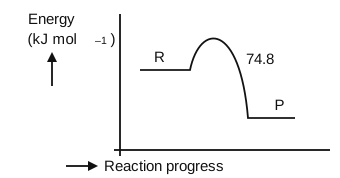
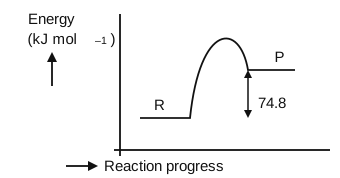
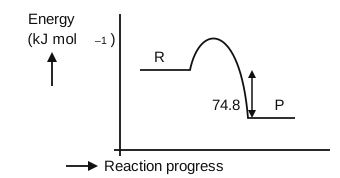
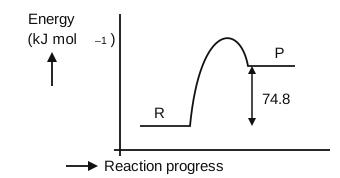
Q64.C(s) + 2H2(g) → CH4(g); ΔH = –74.8 kJ mol–1
Which of the following diagrams gives an accurate representation of the above reaction?
[R → reactants; P → products]
C(s) + 2H2(g) → CH4(g); ΔH = –74.8 kJ mol–1
निम्नलिखित में से कौन-सा आरेख उपरोक्त अभिक्रिया का सही निरूपण करता है?
[R → अभिकारक; P → उत्पाद]
- A
- B
- C
- D
Show answer
Concept: ΔH = HP – HR. A negative ΔH (exothermic) means products lie BELOW reactants, and ΔH is the vertical gap between the R and P levels.
- ΔH = –74.8 kJ mol–1 ⇒ P must be 74.8 kJ mol–1 lower than R.
- (B) and (D) show P above R – endothermic, rejected.
- (A) has P below R but marks 74.8 at the peak side, i.e. not as the R–P gap – does not show ΔH.
- (C) shows P below R with the 74.8 kJ mol–1 double arrow exactly between the two levels – correct.
Short trick: Exothermic = “downhill” from R to P, and ΔH is always measured between the flat R and P lines, never from the hump.
Answer: (C) Diagram (C)
अवधारणा: ΔH = HP – HR। ऋणात्मक ΔH (ऊष्माक्षेपी) का अर्थ है उत्पाद, अभिकारकों से नीचे होते हैं, और ΔH, R व P स्तरों के बीच का ऊर्ध्वाधर अंतर है।
- ΔH = –74.8 kJ mol–1 ⇒ P, R से 74.8 kJ mol–1 नीचे होना चाहिए।
- (B) और (D) में P, R से ऊपर है – ऊष्माशोषी, अस्वीकार।
- (A) में P, R से नीचे है परन्तु 74.8 शिखर के पास अंकित है, R–P अंतर के रूप में नहीं – ΔH नहीं दर्शाता।
- (C) में P, R से नीचे है और 74.8 kJ mol–1 का द्वि-तीर ठीक दोनों स्तरों के बीच है – सही।
शॉर्ट ट्रिक: ऊष्माक्षेपी = R से P तक “ढलान नीचे”, और ΔH सदैव समतल R व P रेखाओं के बीच मापा जाता है, शिखर से नहीं।
उत्तर: (C) आरेख (C)
NEET UGChemistryThermodynamics – energy profile of an exothermic reactionNEET UG 2025 · 4 May Shift 1
Q65.Sugar ‘X’
A. is found in honey
B. is a keto sugar.
C. exists in α and β – anomeric forms
D. is laevorotatory
‘X’ is
शर्करा ‘X’
A. शहद में पाई जाती है
B. एक कीटो शर्करा है।
C. α तथा β – ऐनोमरी रूपों में पाई जाती है
D. वामावर्त-घूर्णक (laevorotatory) है
‘X’ है
- AMaltoseमाल्टोस
- BSucroseसुक्रोस
- CD-GlucoseD-ग्लूकोस
- DD-FructoseD-फ्रक्टोस
Show answer
Concept: D-(–)-Fructose is a ketohexose found free in honey and fruits; it forms α- and β-D-fructofuranose anomers.
- Keto sugar: only fructose among the options has a C=O at C-2 – maltose and glucose are aldoses; sucrose is a non-reducing disaccharide.
- Laevorotatory: fructose is (–); glucose and maltose are (+); sucrose is (+).
- Honey contains free fructose (and glucose) – all four clues fit only D-fructose.
Short trick: “Fructose = fruit/honey, keto, left-handed (–)”; invert sugar turns laevo because fructose (–92°) beats glucose (+52.5°).
Answer: (D) D-Fructose
अवधारणा: D-(–)-फ्रक्टोस एक कीटोहेक्सोस है जो शहद व फलों में मुक्त रूप में मिलता है; यह α- तथा β-D-फ्रक्टोफ्यूरानोस ऐनोमर बनाता है।
- कीटो शर्करा: विकल्पों में केवल फ्रक्टोस में C-2 पर C=O है – माल्टोस व ग्लूकोस ऐल्डोस हैं; सुक्रोस अनपचायी डाइसैकेराइड है।
- वामावर्त-घूर्णक: फ्रक्टोस (–) है; ग्लूकोस, माल्टोस व सुक्रोस (+) हैं।
- शहद में मुक्त फ्रक्टोस (व ग्लूकोस) होता है – चारों संकेत केवल D-फ्रक्टोस पर लागू होते हैं।
शॉर्ट ट्रिक: “फ्रक्टोस = फल/शहद, कीटो, बायाँ (–)”; प्रतीप शर्करा वामावर्ती इसलिए है क्योंकि फ्रक्टोस (–92°), ग्लूकोस (+52.5°) पर भारी पड़ता है।
उत्तर: (D) D-फ्रक्टोस
NEET UGChemistryBiomolecules – carbohydrates (fructose)NEET UG 2025 · 4 May Shift 1
Q66.Total number of possible isomers (both structural as well as stereoisomers) of cyclic ethers of molecular formula C4H8O is :
आण्विक सूत्र C4H8O वाले चक्रीय ईथरों के संभावित समावयवियों (संरचनात्मक तथा त्रिविम दोनों) की कुल संख्या है :
- A10
- B11
- C6
- D8
Show answer
Concept: A cyclic ether has the oxygen inside the ring. C4H8O (one degree of unsaturation) gives 5-, 4- and 3-membered O-rings; count stereoisomers for each chiral or cis/trans case.
- 5-membered: tetrahydrofuran → 1.
- 4-membered (oxetanes): 2-methyloxetane (chiral, R/S) → 2; 3-methyloxetane → 1.
- 3-membered (oxiranes): 2-ethyloxirane (R/S) → 2; 2,2-dimethyloxirane → 1; 2,3-dimethyloxirane → cis (meso) 1 + trans (pair of enantiomers) 2 = 3.
- Total = 1 + 3 + 6 = 10.
- Methoxycyclopropane (CH3O–C3H5) has O outside the ring – it is an ether of a cyclic hydrocarbon, not a cyclic ether, so it is not counted (counting it gives the trap answer 11).
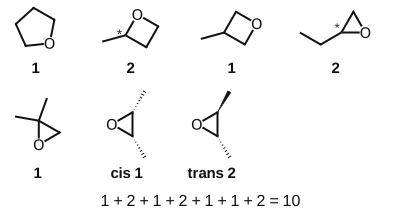
Short trick: Ring sizes 5 → 4 → 3 give 1 + 3 + 6; the oxygen must be a ring atom.
Answer: (A) 10
अवधारणा: चक्रीय ईथर में ऑक्सीजन वलय के अंदर होती है। C4H8O (एक असंतृप्तता) से 5-, 4- तथा 3-सदस्यीय O-वलय बनते हैं; प्रत्येक किरेल या समपक्ष/विपक्ष स्थिति के लिए त्रिविम समावयवी गिनिए।
- 5-सदस्यीय: टेट्राहाइड्रोफ्यूरान → 1।
- 4-सदस्यीय (ऑक्सीटेन): 2-मेथिलऑक्सीटेन (किरेल, R/S) → 2; 3-मेथिलऑक्सीटेन → 1।
- 3-सदस्यीय (ऑक्सिरेन): 2-एथिलऑक्सिरेन (R/S) → 2; 2,2-डाइमेथिलऑक्सिरेन → 1; 2,3-डाइमेथिलऑक्सिरेन → समपक्ष (मीसो) 1 + विपक्ष (प्रतिबिंबरूपी युग्म) 2 = 3।
- कुल = 1 + 3 + 6 = 10।
- मेथॉक्सीसाइक्लोप्रोपेन (CH3O–C3H5) में O वलय के बाहर है – यह चक्रीय हाइड्रोकार्बन का ईथर है, चक्रीय ईथर नहीं, अतः गिना नहीं जाता (इसे गिनने पर भ्रामक उत्तर 11 आता है)।
शॉर्ट ट्रिक: वलय आकार 5 → 4 → 3 से 1 + 3 + 6; ऑक्सीजन वलय का परमाणु होनी चाहिए।
उत्तर: (A) 10
NEET UGChemistryIsomerism – cyclic ethers of C<sub>4</sub>H<sub>8</sub>ONEET UG 2025 · 4 May Shift 1
Q67.For the reaction A(g) ⇌ 2B(g), the backward reaction rate constant is higher than the forward reaction rate constant by a factor of 2500, at 1000 K.
[Given: R = 0.0831 L atm mol–1 K–1] Kp for the reaction at 1000 K is
अभिक्रिया A(g) ⇌ 2B(g) के लिए 1000 K पर पश्च अभिक्रिया का वेग स्थिरांक अग्र अभिक्रिया के वेग स्थिरांक से 2500 गुना अधिक है।
[दिया है: R = 0.0831 L atm mol–1 K–1] 1000 K पर अभिक्रिया का Kp है
- A0.033
- B0.021
- C83.1
- D2.077 × 105
Show answer
Concept: At equilibrium Kc = kf/kb, and Kp = Kc(RT)Δng.
- kb = 2500 kf ⇒ Kc = 1/2500 = 4 × 10⁻⁴ mol L–1.
- Δng = 2 – 1 = 1.
- RT = 0.0831 × 1000 = 83.1 L atm mol–1.
- Kp = 4 × 10–4 × 83.1 = 0.0332 ≈ 0.033.
Short trick: Kp = 83.1/2500 directly – divide, don’t multiply (2.077 × 10⁵ is 83.1 × 2500, the trap).
Answer: (A) 0.033
अवधारणा: साम्यावस्था पर Kc = kf/kb, तथा Kp = Kc(RT)Δng।
- kb = 2500 kf ⇒ Kc = 1/2500 = 4 × 10⁻⁴ mol L–1।
- Δng = 2 – 1 = 1।
- RT = 0.0831 × 1000 = 83.1 L atm mol–1।
- Kp = 4 × 10–4 × 83.1 = 0.0332 ≈ 0.033।
शॉर्ट ट्रिक: सीधे Kp = 83.1/2500 – भाग दीजिए, गुणा नहीं (2.077 × 105 = 83.1 × 2500 भ्रामक विकल्प है)।
उत्तर: (A) 0.033
NEET UGChemistryEquilibrium – K<sub>c</sub> from rate constants and K<sub>p</sub>NEET UG 2025 · 4 May Shift 1
Q68.The ratio of the wavelengths of the light absorbed by a Hydrogen atom when it undergoes n = 2 → n = 3 and n = 4 → n = 6 transitions, respectively, is
जब हाइड्रोजन परमाणु क्रमशः n = 2 → n = 3 तथा n = 4 → n = 6 संक्रमण करता है, तब अवशोषित प्रकाश की तरंगदैर्ध्यों का अनुपात है
- A
- B
- C
- D
Show answer
Concept: , so λ is inversely proportional to the bracket.
- For 2 → 3: .
- For 4 → 6: .
- .
Short trick: n = 4 → 6 is n = 2 → 3 with every n doubled ⇒ bracket ÷ 4 ⇒ λ × 4; so λ1 : λ2 = 1 : 4.
Answer: (B)
अवधारणा: , अतः λ कोष्ठक के मान के व्युत्क्रमानुपाती है।
- 2 → 3 के लिए: ।
- 4 → 6 के लिए: ।
- ।
शॉर्ट ट्रिक: n = 4 → 6, n = 2 → 3 का ही दोगुना रूप है ⇒ कोष्ठक ÷ 4 ⇒ λ × 4; अतः λ1 : λ2 = 1 : 4।
उत्तर: (B)
NEET UGChemistryStructure of atom – hydrogen spectrum (Rydberg formula)NEET UG 2025 · 4 May Shift 1
Q69.If the molar conductivity (Λm) of a 0.050 mol L–1 solution of a monobasic weak acid is 90 S cm2 mol–1, its extent (degree) of dissociation will be
[Assume Λ°+ = 349.6 S cm2 mol–1 and Λ°– = 50.4 S cm2 mol–1]
यदि एक एकक्षारकी दुर्बल अम्ल के 0.050 mol L–1 विलयन की मोलर चालकता (Λm) 90 S cm2 mol–1 है, तो इसके वियोजन की मात्रा (degree of dissociation) होगी
[मान लीजिए Λ°+ = 349.6 S cm2 mol–1 तथा Λ°– = 50.4 S cm2 mol–1]
- A0.225
- B0.215
- C0.115
- D0.125
Show answer
Concept: For a weak electrolyte α = Λm/Λ°m, with Λ°m = Λ°+ + Λ°– (Kohlrausch’s law).
- Λ°m = 349.6 + 50.4 = 400 S cm2 mol–1.
- α = 90/400 = 0.225.
- The concentration 0.050 mol L–1 is not needed for α (it would be used only to find Ka = cα2/(1 – α)).
Short trick: H+ (349.6) + CH3COO–-type anion (50.4) = 400 – a round number; just divide.
Answer: (A) 0.225
अवधारणा: दुर्बल विद्युत-अपघट्य के लिए α = Λm/Λ°m, जहाँ Λ°m = Λ°+ + Λ°– (कोलराउश नियम)।
- Λ°m = 349.6 + 50.4 = 400 S cm2 mol–1।
- α = 90/400 = 0.225।
- सांद्रता 0.050 mol L–1 की α के लिए आवश्यकता नहीं (इसका उपयोग केवल Ka = cα2/(1 – α) ज्ञात करने में होता)।
शॉर्ट ट्रिक: H+ (349.6) + ऋणायन (50.4) = 400 – गोल संख्या; बस भाग दीजिए।
उत्तर: (A) 0.225
NEET UGChemistryElectrochemistry – degree of dissociation from molar conductivityNEET UG 2025 · 4 May Shift 1
Q70.5 moles of liquid X and 10 moles of liquid Y make a solution having a vapour pressure of 70 torr. The vapour pressures of pure X and Y are 63 torr and 78 torr respectively. Which of the following is true regarding the described solution?
द्रव X के 5 मोल तथा द्रव Y के 10 मोल मिलकर एक विलयन बनाते हैं जिसका वाष्प दाब 70 torr है। शुद्ध X तथा Y के वाष्प दाब क्रमशः 63 torr तथा 78 torr हैं। वर्णित विलयन के संबंध में निम्नलिखित में से कौन-सा सत्य है?
- AThe solution is ideal.विलयन आदर्श है।
- BThe solution has volume greater than the sum of individual volumes.विलयन का आयतन अलग-अलग आयतनों के योग से अधिक है।
- CThe solution shows positive deviation.विलयन धनात्मक विचलन दर्शाता है।
- DThe solution shows negative deviation.विलयन ऋणात्मक विचलन दर्शाता है।
Show answer
Concept: Raoult’s law: Pideal = xXP°X + xYP°Y. Observed P lower than this ⇒ negative deviation.
- xX = 5/15 = 1/3, xY = 10/15 = 2/3.
- Pideal = 63 × 1/3 + 78 × 2/3 = 21 + 52 = 73 torr.
- Observed 70 torr < 73 torr ⇒ negative deviation (stronger X–Y attractions).
- Negative deviation goes with ΔVmix < 0 and ΔHmix < 0, so (B) “volume greater” and (C) are wrong; (A) ideal is wrong because 70 ≠ 73.
Short trick: Pobs < PRaoult ⇒ negative (volume shrinks, heat released); Pobs > PRaoult ⇒ positive.
Answer: (D) The solution shows negative deviation.
अवधारणा: राउल्ट नियम: Pआदर्श = xXP°X + xYP°Y। प्रेक्षित P इससे कम ⇒ ऋणात्मक विचलन।
- xX = 5/15 = 1/3, xY = 10/15 = 2/3।
- Pआदर्श = 63 × 1/3 + 78 × 2/3 = 21 + 52 = 73 torr।
- प्रेक्षित 70 torr < 73 torr ⇒ ऋणात्मक विचलन (X–Y आकर्षण अधिक प्रबल)।
- ऋणात्मक विचलन में ΔVमिश्रण < 0 तथा ΔHमिश्रण < 0 होते हैं, अतः (B) “आयतन अधिक” और (C) गलत हैं; (A) आदर्श गलत है क्योंकि 70 ≠ 73।
शॉर्ट ट्रिक: Pप्रेक्षित < Pराउल्ट ⇒ ऋणात्मक (आयतन घटता, ऊष्मा निकलती); Pप्रेक्षित > Pराउल्ट ⇒ धनात्मक।
उत्तर: (D) विलयन ऋणात्मक विचलन दर्शाता है।
NEET UGChemistrySolutions – Raoult’s law and deviationsNEET UG 2025 · 4 May Shift 1
Q71.Among the following, choose the ones with equal number of atoms.
A. 212 g of Na2CO3(s) [molar mass = 106 g]
B. 248 g of Na2O(s) [molar mass = 62 g].
C. 240 g of NaOH(s) [molar mass = 40 g]
D. 12 g of H2(g) [molar mass = 2 g]
E. 220 g of CO2(g) [molar mass = 44 g]
Choose the correct answer from the options given below :
निम्नलिखित में से समान संख्या में परमाणुओं वाले विकल्प चुनिए।
A. 212 g Na2CO3(s) [मोलर द्रव्यमान = 106 g]
B. 248 g Na2O(s) [मोलर द्रव्यमान = 62 g]।
C. 240 g NaOH(s) [मोलर द्रव्यमान = 40 g]
D. 12 g H2(g) [मोलर द्रव्यमान = 2 g]
E. 220 g CO2(g) [मोलर द्रव्यमान = 44 g]
नीचे दिए गए विकल्पों में से सही उत्तर चुनिए :
- AB, C, and D onlyकेवल B, C और D
- BB, D, and E onlyकेवल B, D और E
- CA, B, and C onlyकेवल A, B और C
- DA, B, and D onlyकेवल A, B और D
Show answer
Concept: Number of atoms = moles × atoms per formula unit × NA.
- A: 212/106 = 2 mol × 6 atoms = 12 NA.
- B: 248/62 = 4 mol × 3 atoms = 12 NA.
- C: 240/40 = 6 mol × 3 atoms = 18 NA.
- D: 12/2 = 6 mol × 2 atoms = 12 NA.
- E: 220/44 = 5 mol × 3 atoms = 15 NA.
- Equal (12 NA): A, B and D.
Short trick: Compute “moles × atomicity” only – NA is common and cancels.
Answer: (D) A, B, and D only
अवधारणा: परमाणुओं की संख्या = मोल × प्रति सूत्र इकाई परमाणु × NA।
- A: 212/106 = 2 mol × 6 परमाणु = 12 NA।
- B: 248/62 = 4 mol × 3 परमाणु = 12 NA।
- C: 240/40 = 6 mol × 3 परमाणु = 18 NA।
- D: 12/2 = 6 mol × 2 परमाणु = 12 NA।
- E: 220/44 = 5 mol × 3 परमाणु = 15 NA।
- समान (12 NA): A, B और D।
शॉर्ट ट्रिक: केवल “मोल × परमाणुकता” निकालिए – NA सबमें उभयनिष्ठ है।
उत्तर: (D) केवल A, B और D
NEET UGChemistrySome basic concepts – mole concept (number of atoms)NEET UG 2025 · 4 May Shift 1
Q72.Which of the following are paramagnetic?
A. [NiCl4]2– B. Ni(CO)4
C. [Ni(CN)4]2– D. [Ni(H2O)6]2+
E. Ni(PPh3)4
Choose the correct answer from the options given below:
निम्नलिखित में से कौन-से अनुचुंबकीय हैं?
A. [NiCl4]2– B. Ni(CO)4
C. [Ni(CN)4]2– D. [Ni(H2O)6]2+
E. Ni(PPh3)4
नीचे दिए गए विकल्पों में से सही उत्तर चुनिए :
- AA and D onlyकेवल A और D
- BA, D and E onlyकेवल A, D और E
- CA and C onlyकेवल A और C
- DB and E onlyकेवल B और E
Show answer
Concept: Ni(II) is d8: weak-field ligands keep 2 unpaired electrons (tetrahedral sp3 or octahedral sp3d2); strong-field CN– pairs them (square planar dsp2). Ni(0) is d10 → always diamagnetic.
- A. [NiCl4]2–: Ni2+ d8, Cl– weak, tetrahedral → 2 unpaired → paramagnetic.
- B. Ni(CO)4: Ni(0) 3d10, tetrahedral → diamagnetic.
- C. [Ni(CN)4]2–: CN– strong → dsp2 square planar, all paired → diamagnetic.
- D. [Ni(H2O)6]2+: d8 octahedral, t2g6eg2 → 2 unpaired → paramagnetic.
- E. Ni(PPh3)4: Ni(0) d10 → diamagnetic.
Short trick: Ni(0) complexes and [Ni(CN)4]2– are the classic diamagnetic trio; [NiCl4]2– is the classic paramagnetic tetrahedral one.
Answer: (A) A and D only
अवधारणा: Ni(II) d8 है: दुर्बल क्षेत्र लिगन्ड 2 अयुग्मित इलेक्ट्रॉन बनाए रखते हैं (चतुष्फलकीय sp3 या अष्टफलकीय sp3d2); प्रबल क्षेत्र CN– इन्हें युग्मित कर देता है (वर्ग समतली dsp2)। Ni(0) d10 है → सदैव प्रतिचुंबकीय।
- A. [NiCl4]2–: Ni2+ d8, Cl– दुर्बल, चतुष्फलकीय → 2 अयुग्मित → अनुचुंबकीय।
- B. Ni(CO)4: Ni(0) 3d10, चतुष्फलकीय → प्रतिचुंबकीय।
- C. [Ni(CN)4]2–: CN– प्रबल → dsp2 वर्ग समतली, सभी युग्मित → प्रतिचुंबकीय।
- D. [Ni(H2O)6]2+: d8 अष्टफलकीय, t2g6eg2 → 2 अयुग्मित → अनुचुंबकीय।
- E. Ni(PPh3)4: Ni(0) d10 → प्रतिचुंबकीय।
शॉर्ट ट्रिक: Ni(0) संकुल तथा [Ni(CN)4]2– क्लासिक प्रतिचुंबकीय हैं; [NiCl4]2– क्लासिक अनुचुंबकीय चतुष्फलकीय संकुल है।
उत्तर: (A) केवल A और D
NEET UGChemistryCoordination compounds – magnetic behaviour (VBT/CFT)NEET UG 2025 · 4 May Shift 1
Q73.If the half-life (t1/2) for a first order reaction is 1 minute, then the time required for 99.9% completion of the reaction is closest to
यदि किसी प्रथम कोटि अभिक्रिया की अर्ध-आयु (t1/2) 1 मिनट है, तो अभिक्रिया के 99.9% पूर्ण होने में लगने वाला समय निकटतम है
- A5 minutes5 मिनट
- B10 minutes10 मिनट
- C2 minutes2 मिनट
- D4 minutes4 मिनट
Show answer
Concept: For first order, and .
- 99.9% complete ⇒ [A] = 0.001[A]0 ⇒ log 1000 = 3.
- .
- t = 10 × 1 min = 10 minutes.
Short trick: t99% ≈ 2 × t90% ≈ 6.64 t½; t99.9% ≈ 10 t½ (since 210 = 1024 ≈ 1000).
Answer: (B) 10 minutes
अवधारणा: प्रथम कोटि के लिए तथा ।
- 99.9% पूर्ण ⇒ [A] = 0.001[A]0 ⇒ log 1000 = 3।
- ।
- t = 10 × 1 मिनट = 10 मिनट।
शॉर्ट ट्रिक: t99% ≈ 6.64 t½; t99.9% ≈ 10 t½ (क्योंकि 210 = 1024 ≈ 1000)।
उत्तर: (B) 10 मिनट
NEET UGChemistryChemical kinetics – half-life of first-order reactionNEET UG 2025 · 4 May Shift 1
Q74.Energy and radius of Bohr Orbit of He+ and Li2+ are
[Given RH = 2.18 × 10⁻¹⁸ J, a0 = 52.9 pm]
He+ तथा Li2+ की बोर कक्षा की ऊर्जा एवं त्रिज्या हैं
[दिया है RH = 2.18 × 10⁻¹⁸ J, a0 = 52.9 pm]
- AEn(Li2+) = –19.62 × 10⁻¹⁶ J; rn(Li2+) = 17.6 pm, En(He+) = 8.72 × 10⁻¹⁶ J, rn(He+) = 26.4 pm
- BEn(Li2+) = –8.72 × 10⁻¹⁶ J; rn(Li2+) = 17.6 pm, En(He+) = –19.62 × 10⁻¹⁶ J, rn(He+) = 17.6 pm
- CEn(Li2+) = –19.62 × 10⁻¹⁸ J; rn(Li2+) = 17.6 pm, En(He+) = –8.72 × 10⁻¹⁸ J, rn(He+) = 26.4 pm
- DEn(Li2+) = –8.72 × 10⁻¹⁸ J; rn(Li2+) = 26.4 pm, En(He+) = –19.62 × 10⁻¹⁸ J, rn(He+) = 17.6 pm
Show answer
Concept: For a one-electron species (first orbit, n = 1): En = –RHZ2/n2 and rn = a0n2/Z.
- Li2+ (Z = 3): E = –2.18 × 10–18 × 9 = –19.62 × 10⁻¹⁸ J; r = 52.9/3 = 17.6 pm.
- He+ (Z = 2): E = –2.18 × 10–18 × 4 = –8.72 × 10⁻¹⁸ J; r = 52.9/2 = 26.4 pm.
- (A), (B) use 10–16 (wrong power; (A) even has positive energy); (D) swaps the two ions.
Short trick: Energy grows with Z2 (more negative), radius shrinks with Z – the heavier-charged Li2+ gets the bigger |E| and smaller r.
Answer: (C) En(Li2+) = –19.62 × 10⁻¹⁸ J; rn(Li2+) = 17.6 pm, En(He+) = –8.72 × 10⁻¹⁸ J, rn(He+) = 26.4 pm
अवधारणा: एक-इलेक्ट्रॉन स्पीशीज़ (प्रथम कक्षा, n = 1) के लिए: En = –RHZ2/n2 तथा rn = a0n2/Z।
- Li2+ (Z = 3): E = –2.18 × 10–18 × 9 = –19.62 × 10⁻¹⁸ J; r = 52.9/3 = 17.6 pm।
- He+ (Z = 2): E = –2.18 × 10–18 × 4 = –8.72 × 10⁻¹⁸ J; r = 52.9/2 = 26.4 pm।
- (A), (B) में 10–16 (गलत घात; (A) में तो ऊर्जा धनात्मक भी है); (D) में दोनों आयन उलट दिए गए हैं।
शॉर्ट ट्रिक: ऊर्जा Z2 के साथ (अधिक ऋणात्मक) बढ़ती है, त्रिज्या Z के साथ घटती है – अधिक आवेश वाले Li2+ का |E| बड़ा और r छोटा।
उत्तर: (C) En(Li2+) = –19.62 × 10⁻¹⁸ J; rn(Li2+) = 17.6 pm, En(He+) = –8.72 × 10⁻¹⁸ J, rn(He+) = 26.4 pm
NEET UGChemistryStructure of atom – Bohr model for hydrogen-like ionsNEET UG 2025 · 4 May Shift 1
Q75.Among the given compounds I-III, the correct order of bond dissociation energy of C–H bond marked with * is
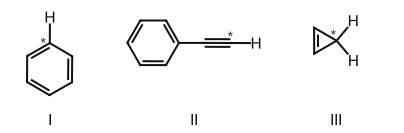
दिए गए यौगिकों I-III में, * से चिह्नित C–H आबंध की आबंध वियोजन ऊर्जा का सही क्रम है
- AIII > II > I
- BII > III > I
- CII > I > III
- DI > II > III
Show answer
Concept: C–H bond strength rises with the s-character of carbon (sp > sp2 > sp3), and falls when the radical formed is stabilised.
- II: alkynyl C–H on sp carbon (50% s) → shortest, strongest bond; the alkynyl radical is very unstable → highest BDE.
- I: aryl C–H on sp2 carbon (33% s); phenyl radical is σ-type, not resonance-stabilised → high BDE.
- III: the CH2 of cyclopropene is sp3 (25% s) and allylic → lowest BDE.
- Order: II > I > III.
Short trick: “More s, more strength”: ≡C–H > =C–H (aryl/vinyl) > sp3 C–H (especially allylic/benzylic).
Answer: (C) II > I > III
अवधारणा: C–H आबंध की प्रबलता कार्बन के s-लक्षण के साथ बढ़ती है (sp > sp2 > sp3), और बनने वाला मूलक स्थायी हो तो घटती है।
- II: sp कार्बन (50% s) पर ऐल्काइनिल C–H → सबसे छोटा, सबसे प्रबल आबंध; ऐल्काइनिल मूलक बहुत अस्थायी → सर्वाधिक BDE।
- I: sp2 कार्बन (33% s) पर ऐरिल C–H; फ़ेनिल मूलक σ-प्रकार का है, अनुनाद-स्थायी नहीं → उच्च BDE।
- III: साइक्लोप्रोपीन का CH2, sp3 (25% s) व ऐलिलिक है → न्यूनतम BDE।
- क्रम: II > I > III।
शॉर्ट ट्रिक: “अधिक s, अधिक प्रबलता”: ≡C–H > =C–H (ऐरिल/वाइनिल) > sp3 C–H (विशेषकर ऐलिलिक/बेन्ज़िलिक)।
उत्तर: (C) II > I > III
NEET UGChemistryHydrocarbons – C–H bond dissociation energy and hybridisationNEET UG 2025 · 4 May Shift 1
Q76.Dalton’s Atomic theory could not explain which of the following?
डाल्टन का परमाणु सिद्धांत निम्नलिखित में से किसकी व्याख्या नहीं कर सका?
- ALaw of multiple proportionगुणित अनुपात का नियम
- BLaw of gaseous volumeगैसीय आयतन का नियम
- CLaw of conservation of massद्रव्यमान संरक्षण का नियम
- DLaw of constant proportionस्थिर अनुपात का नियम
Show answer
Concept: Dalton’s theory was built to explain the mass laws of chemical combination; it treated gases as atoms, not molecules.
- Conservation of mass, constant proportions and multiple proportions all follow from indivisible atoms combining in whole-number ratios – explained.
- Gay-Lussac’s law of gaseous volumes (e.g. 1 vol H2 + 1 vol Cl2 → 2 vol HCl) needs half-atoms in Dalton’s picture – it could be explained only after Avogadro introduced molecules.
Short trick: Dalton explains all “mass” laws; the only “volume” law needed Avogadro.
Answer: (B) Law of gaseous volume
अवधारणा: डाल्टन का सिद्धांत रासायनिक संयोजन के द्रव्यमान-नियमों की व्याख्या के लिए बना था; इसमें गैसों को अणु नहीं, परमाणु माना गया था।
- द्रव्यमान संरक्षण, स्थिर अनुपात तथा गुणित अनुपात – तीनों अविभाज्य परमाणुओं के पूर्णांक अनुपात में संयोजन से निकलते हैं – व्याख्या हो गई।
- गे-लुसैक का गैसीय आयतन नियम (जैसे 1 आयतन H2 + 1 आयतन Cl2 → 2 आयतन HCl) डाल्टन के मॉडल में आधे परमाणु माँगता है – इसकी व्याख्या आवोगाद्रो द्वारा अणु की संकल्पना देने के बाद ही हो सकी।
शॉर्ट ट्रिक: डाल्टन सभी “द्रव्यमान” नियम समझाता है; एकमात्र “आयतन” नियम के लिए आवोगाद्रो चाहिए।
उत्तर: (B) गैसीय आयतन का नियम
NEET UGChemistrySome basic concepts – Dalton’s atomic theoryNEET UG 2025 · 4 May Shift 1
Q77.Identify the correct orders against the property mentioned
A. H2O > NH3 > CHCl3 – dipole moment
B. XeF4 > XeO3 > XeF2 – number of lone pairs on central atom
C. O–H > C–H > N–O – bond length
D. N2 > O2 > H2 – bond enthalpy
Choose the answer from the options given below :
उल्लिखित गुणधर्म के सापेक्ष सही क्रम पहचानिए
A. H2O > NH3 > CHCl3 – द्विध्रुव आघूर्ण
B. XeF4 > XeO3 > XeF2 – केंद्रीय परमाणु पर एकाकी युग्मों की संख्या
C. O–H > C–H > N–O – आबंध लंबाई
D. N2 > O2 > H2 – आबंध एन्थैल्पी
नीचे दिए गए विकल्पों में से उत्तर चुनिए :
- AA, C onlyकेवल A, C
- BB, C onlyकेवल B, C
- CA, D onlyकेवल A, D
- DB, D onlyकेवल B, D
Show answer
Concept: Use standard data: μ (D), VSEPR lone pairs, covalent bond lengths and bond enthalpies.
- A – correct: μ(H2O) 1.85 D > μ(NH3) 1.47 D > μ(CHCl3) ≈ 1.04 D.
- B – wrong: lone pairs XeF2 3 > XeF4 2 > XeO3 1 (order given is reversed in part).
- C – wrong: O–H 96 pm < C–H 109 pm; N–O ≈ 136 pm is the longest, not the shortest.
- D – correct: N≡N 946 > O=O 498 > H–H 436 kJ mol–1.
- Correct orders: A and D.
Short trick: Bond enthalpy follows bond order first (triple > double > single); X–H bond length grows with the size of X (O–H < N–H < C–H).
Answer: (C) A, D only
अवधारणा: मानक आँकड़े प्रयोग कीजिए: μ (D), VSEPR एकाकी युग्म, सहसंयोजी आबंध लंबाइयाँ तथा आबंध एन्थैल्पी।
- A – सही: μ(H2O) 1.85 D > μ(NH3) 1.47 D > μ(CHCl3) ≈ 1.04 D।
- B – गलत: एकाकी युग्म XeF2 3 > XeF4 2 > XeO3 1 (दिया गया क्रम आंशिक रूप से उलटा है)।
- C – गलत: O–H 96 pm < C–H 109 pm; N–O ≈ 136 pm सबसे लंबा है, सबसे छोटा नहीं।
- D – सही: N≡N 946 > O=O 498 > H–H 436 kJ mol–1।
- सही क्रम: A और D।
शॉर्ट ट्रिक: आबंध एन्थैल्पी पहले आबंध कोटि पर चलती है (त्रिआबंध > द्विआबंध > एकल); X–H आबंध लंबाई X के आकार के साथ बढ़ती है (O–H < N–H < C–H)।
उत्तर: (C) केवल A, D
NEET UGChemistryChemical bonding – dipole moment, lone pairs, bond length, bond enthalpyNEET UG 2025 · 4 May Shift 1
Q78.Match List I with List II.
| List I (Name of Vitamin) | List II (Deficiency disease) |
|---|
| A. Vitamin B12 | I. Cheilosis |
| B. Vitamin D | II. Convulsions |
| C. Vitamin B2 | III. Rickets |
| D. Vitamin B6 | IV. Pernicious anaemia |
Choose the correct answer from the options given below:
सूची I का सूची II से मिलान कीजिए।
| सूची I (विटामिन का नाम) | सूची II (अल्पता रोग) |
|---|
| A. विटामिन B12 | I. कीलोसिस (Cheilosis) |
| B. विटामिन D | II. ऐंठन (Convulsions) |
| C. विटामिन B2 | III. रिकेट्स (सूखा रोग) |
| D. विटामिन B6 | IV. प्रणाशी रक्ताल्पता (Pernicious anaemia) |
नीचे दिए गए विकल्पों में से सही उत्तर चुनिए :
- AA-II, B-III, C-I, D-IV
- BA-IV, B-III, C-II, D-I
- CA-I, B-III, C-II, D-IV
- DA-IV, B-III, C-I, D-II
Show answer
Concept: NCERT table of vitamins and their deficiency diseases.
- Vitamin B12 (cobalamin) → pernicious anaemia – A-IV.
- Vitamin D → rickets (children), osteomalacia (adults) – B-III.
- Vitamin B2 (riboflavin) → cheilosis (cracks at mouth corners), digestive disorders – C-I.
- Vitamin B6 (pyridoxine) → convulsions – D-II.
Short trick: “B2 – lips (cheilosis), B6 – fits (convulsions), B12 – blood (pernicious anaemia), D – bones (rickets)”.
Answer: (D) A-IV, B-III, C-I, D-II
अवधारणा: विटामिन एवं उनके अल्पता रोगों की NCERT तालिका।
- विटामिन B12 (कोबालैमिन) → प्रणाशी रक्ताल्पता – A-IV।
- विटामिन D → रिकेट्स (बच्चों में), ऑस्टियोमैलेशिया (वयस्कों में) – B-III।
- विटामिन B2 (राइबोफ्लेविन) → कीलोसिस (मुँह के कोनों का फटना), पाचन विकार – C-I।
- विटामिन B6 (पिरिडॉक्सिन) → ऐंठन (convulsions) – D-II।
शॉर्ट ट्रिक: “B2 – होंठ (कीलोसिस), B6 – दौरे (ऐंठन), B12 – रक्त (प्रणाशी रक्ताल्पता), D – हड्डियाँ (रिकेट्स)”।
उत्तर: (D) A-IV, B-III, C-I, D-II
NEET UGChemistryBiomolecules – vitamins and deficiency diseasesNEET UG 2025 · 4 May Shift 1
Q79.The correct order of decreasing basic strength of the given amine is :
दी गई ऐमीनों की क्षारकीय सामर्थ्य के घटते क्रम का सही क्रम है :
- AN-ethylethanamine > ethanamine > N-methylaniline > benzenamineN-एथिलएथेनामीन > एथेनामीन > N-मेथिलऐनिलीन > बेन्ज़ेनामीन
- BBenzenamine > ethanamine > N-methylaniline > N-ethylethanamineबेन्ज़ेनामीन > एथेनामीन > N-मेथिलऐनिलीन > N-एथिलएथेनामीन
- CN-methylaniline > benzenamine > ethanamine > N-ethylethanamineN-मेथिलऐनिलीन > बेन्ज़ेनामीन > एथेनामीन > N-एथिलएथेनामीन
- DN-ethylethanamine > ethanamine > benzenamine > N-methylanilineN-एथिलएथेनामीन > एथेनामीन > बेन्ज़ेनामीन > N-मेथिलऐनिलीन
Show answer
Concept: Alkyl groups (+I) raise the electron density on N; an aryl ring delocalises the N lone pair and lowers basicity. In water, 2° alkylamine > 1° alkylamine for ethyl groups.
- N-Ethylethanamine (C2H5)2NH, pKb 3.00 – strongest.
- Ethanamine C2H5NH2, pKb 3.29.
- N-Methylaniline C6H5NHCH3, pKb 9.30 – lone pair in resonance but CH3 (+I) helps a little.
- Benzenamine (aniline) C6H5NH2, pKb 9.38 – weakest.
- (B), (C) put aryl amines above alkyl amines; (D) puts aniline above N-methylaniline – all wrong.
Short trick: Alkyl amines ≫ aryl amines; within each pair the extra alkyl on N wins.
Answer: (A) N-ethylethanamine > ethanamine > N-methylaniline > benzenamine
अवधारणा: ऐल्किल समूह (+I) N पर इलेक्ट्रॉन घनत्व बढ़ाते हैं; ऐरिल वलय N के एकाकी युग्म को विस्थानित कर क्षारकता घटाता है। जल में एथिल समूहों के लिए 2° ऐल्किलऐमीन > 1° ऐल्किलऐमीन।
- N-एथिलएथेनामीन (C2H5)2NH, pKb 3.00 – सबसे प्रबल।
- एथेनामीन C2H5NH2, pKb 3.29।
- N-मेथिलऐनिलीन C6H5NHCH3, pKb 9.30 – एकाकी युग्म अनुनाद में है परन्तु CH3 (+I) थोड़ी सहायता करता है।
- बेन्ज़ेनामीन (ऐनिलीन) C6H5NH2, pKb 9.38 – सबसे दुर्बल।
- (B), (C) ऐरिल ऐमीनों को ऐल्किल ऐमीनों से ऊपर रखते हैं; (D) ऐनिलीन को N-मेथिलऐनिलीन से ऊपर रखता है – सभी गलत।
शॉर्ट ट्रिक: ऐल्किल ऐमीन ≫ ऐरिल ऐमीन; प्रत्येक जोड़े में N पर अतिरिक्त ऐल्किल वाला जीतता है।
उत्तर: (A) N-एथिलएथेनामीन > एथेनामीन > N-मेथिलऐनिलीन > बेन्ज़ेनामीन
NEET UGChemistryAmines – basic strengthNEET UG 2025 · 4 May Shift 1
Q80.The correct order of the wavelength of light absorbed by the following complexes is,
A. [Co(NH3)6]3+
B. [Co(CN)6]3–
C. [Cu(H2O)4]2+
D. [Ti(H2O)6]3+
Choose the correct answer from the options given below:
निम्नलिखित संकुलों द्वारा अवशोषित प्रकाश की तरंगदैर्ध्य का सही क्रम है,
A. [Co(NH3)6]3+
B. [Co(CN)6]3–
C. [Cu(H2O)4]2+
D. [Ti(H2O)6]3+
नीचे दिए गए विकल्पों में से सही उत्तर चुनिए :
- AC < D < A < B
- BC < A < D < B
- CB < D < A < C
- DB < A < D < C
Show answer
Concept: Absorbed wavelength λ = hc/Δ: the larger the crystal-field splitting Δ, the shorter the wavelength absorbed. Δ rises with ligand strength (CN– > NH3 > H2O) and with metal oxidation state.
- B. [Co(CN)6]3–: Co(III) + strongest ligand CN– → largest Δ → shortest λ (UV/≈ 310 nm, pale yellow).
- A. [Co(NH3)6]3+: Co(III) + NH3 → large Δ (λ ≈ 475 nm, yellow-orange).
- D. [Ti(H2O)6]3+: Ti(III) + H2O → smaller Δ (λ ≈ 498 nm, purple).
- C. [Cu(H2O)4]2+: +2 metal, weak H2O → smallest Δ (λ ≈ 600–800 nm, blue colour seen).
- Increasing λ: B < A < D < C.
Short trick: Strongest-field complex absorbs the shortest λ; the blue Cu2+ aqua ion absorbs red/orange (longest λ).
Answer: (D) B < A < D < C
अवधारणा: अवशोषित तरंगदैर्ध्य λ = hc/Δ: क्रिस्टल-क्षेत्र विपाटन Δ जितना बड़ा, अवशोषित तरंगदैर्ध्य उतनी छोटी। Δ लिगन्ड प्रबलता (CN– > NH3 > H2O) तथा धातु की ऑक्सीकरण अवस्था के साथ बढ़ता है।
- B. [Co(CN)6]3–: Co(III) + सबसे प्रबल लिगन्ड CN– → सबसे बड़ा Δ → सबसे छोटी λ (UV/≈ 310 nm, हल्का पीला)।
- A. [Co(NH3)6]3+: Co(III) + NH3 → बड़ा Δ (λ ≈ 475 nm, पीला-नारंगी)।
- D. [Ti(H2O)6]3+: Ti(III) + H2O → छोटा Δ (λ ≈ 498 nm, बैंगनी)।
- C. [Cu(H2O)4]2+: +2 धातु, दुर्बल H2O → सबसे छोटा Δ (λ ≈ 600–800 nm, नीला रंग दिखता है)।
- बढ़ती λ: B < A < D < C।
शॉर्ट ट्रिक: सबसे प्रबल क्षेत्र वाला संकुल सबसे छोटी λ अवशोषित करता है; नीला Cu2+ जलीय आयन लाल/नारंगी (सबसे लंबी λ) अवशोषित करता है।
उत्तर: (D) B < A < D < C
NEET UGChemistryCoordination compounds – crystal field splitting and colourNEET UG 2025 · 4 May Shift 1

