Q61.A uniform rod of mas 20 kg and length 5 m leans against a smooth vertical wall making an angle of with it. The other end rests on a rough horizontal floor. The friction force that the floor exerts on the rod is (take )
20 kg द्रव्यमान तथा 5 m लंबाई की एक एकसमान छड़ एक चिकनी ऊर्ध्वाधर दीवार से का कोण बनाते हुए टिकी है। इसका दूसरा सिरा खुरदरे क्षैतिज फर्श पर टिका है। फर्श द्वारा छड़ पर लगाया गया घर्षण बल है ( लें)
- A200 N
- B N
- C100 N
- D N
Show answer
Concept: Equilibrium: gives (wall reaction); torque about the foot gives .
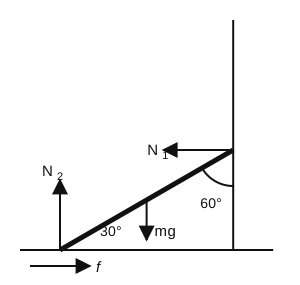
- Rod makes with the wall → top is at height m; centre of mass is at horizontal distance from the foot.
- Torque about foot: .
- N.
- N.
Short trick: f = (mg/2) tanα, α = angle with the wall.
Answer: (D) N
अवधारणा: संतुलन: से (दीवार की प्रतिक्रिया); पाद (foot) के परितः बल-आघूर्ण से ।
- छड़ दीवार से बनाती है → ऊपरी सिरे की ऊँचाई m; द्रव्यमान केंद्र की पाद से क्षैतिज दूरी ।
- पाद के परितः आघूर्ण: ।
- N।
- N।
शॉर्ट ट्रिक: f = (mg/2) tanα, α = दीवार से कोण।
उत्तर: (D) N
NEET UGPhysicsRotational equilibrium – ladder against wallNEET UG 2025 · 4 May Shift 1
Q62.Two identical charged conducting spheres A and B have their centres separated by a certain distance. Charge on each sphere is q and the force of repulsion between them is F. A third identical uncharged conducting sphere is brought in contact with sphere A first and then with B and finally removed from both. New force of repulsion between spheres A and B (Radii of A and B are negligible compared to the distance of separation so that for calculating force between them they can be considered as point charges) is best given as :
दो सर्वसम आवेशित चालक गोलों A और B के केंद्र एक निश्चित दूरी पर हैं। प्रत्येक गोले पर आवेश q है तथा उनके बीच प्रतिकर्षण बल F है। एक तीसरा सर्वसम अनावेशित चालक गोला पहले A से, फिर B से स्पर्श कराकर दोनों से हटा लिया जाता है। A और B के बीच नया प्रतिकर्षण बल है (A और B की त्रिज्याएँ उनकी दूरी की तुलना में नगण्य हैं, अतः बल की गणना के लिए उन्हें बिंदु आवेश माना जा सकता है):
- A
- B
- C
- D
Show answer
Concept: Identical conductors in contact share the total charge equally; .
- C touches A: each gets .
- C touches B: each gets .
- .
Short trick: Halve, then average: q/2 and 3q/4 → product 3/8.
Answer: (B)
अवधारणा: सर्वसम चालक संपर्क में कुल आवेश बराबर बाँटते हैं; ।
- C, A को छूता है: प्रत्येक पर ।
- C, B को छूता है: प्रत्येक पर ।
- ।
शॉर्ट ट्रिक: पहले आधा, फिर औसत: q/2 और 3q/4 → गुणनफल 3/8।
उत्तर: (B)
NEET UGPhysicsElectrostatics – Coulomb's law and charge sharingNEET UG 2025 · 4 May Shift 1
Q63.Two cities X and Y are connected by a regular bus service with a bus leaving in either direction every T min. A girl is driving scotty with a speed of 60 km/h in the direction X to Y notices that a bus goes past her every 30 minutes in the direction of her motion, and every 10 minutes in the opposite direction. Choose the correct option for the period T of the bus service and the speed (assumed constant) of the buses.
दो शहर X और Y एक नियमित बस सेवा से जुड़े हैं, जिसमें प्रत्येक दिशा में हर T मिनट पर एक बस चलती है। X से Y की दिशा में 60 km/h की चाल से स्कूटी चला रही एक लड़की देखती है कि उसकी गति की दिशा में हर 30 मिनट पर तथा विपरीत दिशा में हर 10 मिनट पर एक बस उसके पास से गुजरती है। बस सेवा की अवधि T तथा बसों की (नियत मानी गई) चाल के लिए सही विकल्प चुनिए।
- A10 min, 90 km/h
- B15 min, 120 km/h
- C9 min, 40 km/h
- D25 min, 100 km/h
Show answer
Concept: Successive buses are a fixed distance km apart; the gap is covered at the relative speed.
- Same direction: ; opposite: .
- Equate: km/h.
- km, and min.
Short trick: Check options: (120−60)·½ = (120+60)·⅙ = 30 km and 120·15/60 = 30 ✓.
Answer: (B) 15 min, 120 km/h
अवधारणा: क्रमागत बसों के बीच निश्चित दूरी km है; यह दूरी आपेक्षिक चाल से तय होती है।
- समान दिशा: ; विपरीत दिशा: ।
- बराबर करने पर: km/h।
- km, तथा min।
शॉर्ट ट्रिक: विकल्प जाँचें: (120−60)·½ = (120+60)·⅙ = 30 km और 120·15/60 = 30 ✓।
उत्तर: (B) 15 min, 120 km/h
NEET UGPhysicsRelative velocity – bus problemNEET UG 2025 · 4 May Shift 1
Q64.A container has two chambers of volumes litres and litres separated by a partition made of a thermal insulator. The chambers contains and moles of ideal gas at pressure atm and atm, respectively. When the partition is removed, the mixture attains an equilibrium pressure of:
एक पात्र में आयतन लीटर और लीटर के दो कक्ष हैं, जो ऊष्मारोधी पदार्थ के विभाजक से अलग हैं। कक्षों में क्रमशः और मोल आदर्श गैस atm तथा atm दाब पर है। विभाजक हटाने पर मिश्रण का साम्य दाब हो जाता है:
- A1.4 atm
- B1.8 atm
- C1.3 atm
- D1.6 atm
Show answer
Concept: Isolated system: total internal energy is conserved. For an ideal gas , so is conserved.
- .
- atm.
Short trick: Pressure after mixing = volume-weighted average of pressures (mole numbers not needed).
Answer: (D) 1.6 atm
अवधारणा: विलगित निकाय: कुल आंतरिक ऊर्जा संरक्षित। आदर्श गैस के लिए , अतः संरक्षित।
- ।
- atm।
शॉर्ट ट्रिक: मिश्रण के बाद दाब = दाबों का आयतन-भारित औसत (मोल संख्या की आवश्यकता नहीं)।
उत्तर: (D) 1.6 atm
NEET UGPhysicsKinetic theory – mixing of gasesNEET UG 2025 · 4 May Shift 1
Q65.De-Broglie wavelength of an electron obtaining in the n = 2 state of hydrogen atom is close to (Given Bohr radius = 0.052 nm)
हाइड्रोजन परमाणु की n = 2 अवस्था में इलेक्ट्रॉन की दे-ब्रॉग्ली तरंगदैर्घ्य लगभग है (दिया है: बोर त्रिज्या = 0.052 nm)
- A1.67 nm
- B2.67 nm
- C0.067 nm
- D0.67 nm
Show answer
Concept: Bohr condition and , so .
- nm.
- nm ≈ 0.67 nm.
Short trick: λ = 2πn·a₀ = 2π × 2 × 0.052 ≈ 0.65 nm.
Answer: (D) 0.67 nm
अवधारणा: बोर शर्त तथा , अतः ।
- nm।
- nm ≈ 0.67 nm।
शॉर्ट ट्रिक: λ = 2πn·a₀ = 2π × 2 × 0.052 ≈ 0.65 nm।
उत्तर: (D) 0.67 nm
NEET UGPhysicsAtoms – de Broglie wavelength in Bohr orbitNEET UG 2025 · 4 May Shift 1
Q66.To an ac power supply of 220V at 50 Hz, a resistor of 20, a capacitor of reactance 25 and an inductor of reactance 45 are connected in series. The corresponding current in the circuit and the phase angle between the current and the voltage is, respectively -
50 Hz पर 220V की एक ac आपूर्ति से 20 का प्रतिरोधक, 25 प्रतिघात का संधारित्र तथा 45 प्रतिघात का प्रेरक श्रेणीक्रम में जुड़े हैं। परिपथ में धारा तथा धारा और वोल्टता के बीच कलांतर क्रमशः हैं -
- A1.56 A and 1.56 A और
- B1.56 A and 1.56 A और
- C7.8 A and 7.8 A और
- D7.8 A and 7.8 A और
Show answer
Concept: , , .
- .
- .
- A.
- .
Short trick: R = net reactance ⇒ φ = 45° and Z = R√2 instantly.
Answer: (D) 7.8 A and
अवधारणा: , , ।
- ।
- ।
- A।
- ।
शॉर्ट ट्रिक: R = कुल प्रतिघात ⇒ तुरंत φ = 45° और Z = R√2।
उत्तर: (D) 7.8 A और
NEET UGPhysicsAlternating current – series LCRNEET UG 2025 · 4 May Shift 1
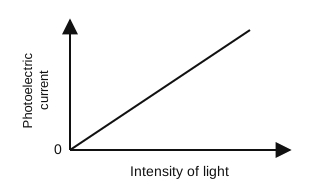
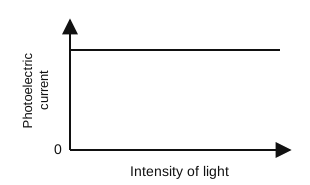
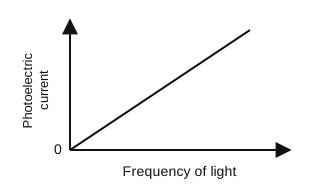
Q67.Which of the following options represent the variation of photoelectric current with property of light shown on the x-axis?
निम्नलिखित में से कौन-सा विकल्प x-अक्ष पर दर्शाए गए प्रकाश के गुण के साथ प्रकाश-विद्युत धारा (photoelectric current) के परिवर्तन को दर्शाता है?
- A
- B
- C
- D
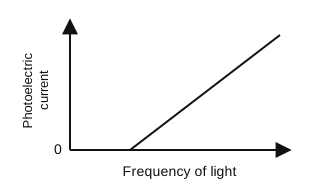
Show answer
Concept: For frequency above threshold, (saturation) photocurrent ∝ number of photons per second ∝ intensity; it does not depend on frequency (frequency only decides whether emission occurs and the KE of electrons).
- (A) current vs intensity – straight line through origin: correct (current ∝ intensity).
- (B) current independent of intensity – wrong.
- (C) current rising linearly with frequency from zero – wrong: no emission below and above it current does not grow with .
- (D) linear rise after threshold – this shape belongs to stopping potential / max KE vs frequency, not to current.
Short trick: Intensity → how MANY electrons (current); frequency → how FAST (KE, stopping potential).
Answer: (A) Photoelectric current ∝ intensity (straight line through origin)
अवधारणा: देहली आवृत्ति से अधिक आवृत्ति पर (संतृप्त) प्रकाश-विद्युत धारा ∝ प्रति सेकंड फोटॉनों की संख्या ∝ तीव्रता; यह आवृत्ति पर निर्भर नहीं करती (आवृत्ति केवल यह तय करती है कि उत्सर्जन होगा या नहीं तथा इलेक्ट्रॉनों की गतिज ऊर्जा)।
- (A) धारा बनाम तीव्रता – मूलबिंदु से गुजरती सरल रेखा: सही (धारा ∝ तीव्रता)।
- (B) धारा तीव्रता से स्वतंत्र – गलत।
- (C) आवृत्ति के साथ शून्य से रैखिक बढ़ती धारा – गलत: से नीचे उत्सर्जन नहीं होता और उसके ऊपर धारा के साथ नहीं बढ़ती।
- (D) देहली के बाद रैखिक वृद्धि – यह आकृति निरोधी विभव / अधिकतम गतिज ऊर्जा बनाम आवृत्ति की है, धारा की नहीं।
शॉर्ट ट्रिक: तीव्रता → कितने इलेक्ट्रॉन (धारा); आवृत्ति → कितनी तेज़ी (गतिज ऊर्जा, निरोधी विभव)।
उत्तर: (A) प्रकाश-विद्युत धारा ∝ तीव्रता (मूलबिंदु से सरल रेखा)
NEET UGPhysicsDual nature – photoelectric currentNEET UG 2025 · 4 May Shift 1
Q68.A pipe open at both ends has a fundamental frequency f in air. The pipe is now dipped vertically in a water drum to half of its length. The fundamental frequency of the air column is now equal to:
दोनों सिरों पर खुले एक पाइप की वायु में मूल आवृत्ति f है। अब पाइप को पानी के ड्रम में ऊर्ध्वाधर रूप से उसकी आधी लंबाई तक डुबोया जाता है। अब वायु स्तंभ की मूल आवृत्ति बराबर है:
- A
- B
- C
- D
Show answer
Concept: Open pipe: ; closed pipe: .
- Initially open pipe of length : .
- After dipping, air column of length closed at the water surface: .
Short trick: Halving length doubles f, closing one end halves it – net no change.
Answer: (D)
अवधारणा: खुला पाइप: ; बंद पाइप: ।
- प्रारंभ में लंबाई का खुला पाइप: ।
- डुबोने के बाद लंबा वायु स्तंभ जो पानी की सतह पर बंद है: ।
शॉर्ट ट्रिक: लंबाई आधी करने से f दुगुनी, एक सिरा बंद करने से आधी – कुल कोई परिवर्तन नहीं।
उत्तर: (D)
NEET UGPhysicsWaves – organ pipesNEET UG 2025 · 4 May Shift 1
Q69.Two identical point masses P and Q, suspended from two separate massless springs of spring constant and , respectively, oscillate vertically. If their maximum speeds are the same, the ratio of the amplitude of mass Q to the amplitude of mass P is:
दो सर्वसम बिंदु द्रव्यमान P और Q, क्रमशः और स्प्रिंग नियतांक वाली दो अलग-अलग द्रव्यमानरहित स्प्रिंगों से लटके हुए ऊर्ध्वाधर दोलन करते हैं। यदि उनकी अधिकतम चालें समान हैं, तो द्रव्यमान Q के आयाम का द्रव्यमान P के आयाम से अनुपात है:
- A
- B
- C
- D
Show answer
Concept: with .
- .
- .
Short trick: Same v_max ⇒ A ∝ 1/√k: stiffer spring, smaller amplitude.
Answer: (B)
अवधारणा: जहाँ ।
- ।
- ।
शॉर्ट ट्रिक: समान v_max ⇒ A ∝ 1/√k: कठोर स्प्रिंग, छोटा आयाम।
उत्तर: (B)
NEET UGPhysicsSHM – maximum speed and amplitudeNEET UG 2025 · 4 May Shift 1
Q70.The output (Y) of the given logic implementation is similar to the output of an/a ____ gate.
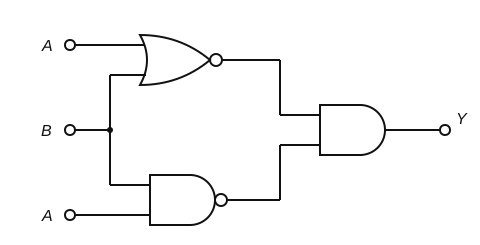
दिए गए लॉजिक परिपथ का निर्गत (Y) किस गेट के निर्गत के समान है?
- AOR
- BNOR
- CAND
- DNAND
Show answer
Concept: Upper gate is NOR, lower gate is NAND, both feed an AND gate. Use De Morgan: , .
- .
- → NOR.
- Truth check: (0,0)→1·1 = 1; (0,1)→0; (1,0)→0; (1,1)→0 – the NOR table.
Short trick: Whenever NOR output is 1, NAND output is also 1, so ANDing with NAND changes nothing.
Answer: (B) NOR
अवधारणा: ऊपर का गेट NOR, नीचे का NAND है, दोनों AND गेट को निवेश देते हैं। डी-मॉर्गन: , ।
- ।
- → NOR।
- सत्यता सारणी: (0,0)→1·1 = 1; (0,1)→0; (1,0)→0; (1,1)→0 – यही NOR सारणी है।
शॉर्ट ट्रिक: जब भी NOR का निर्गत 1 है, NAND का भी 1 है; अतः NAND के साथ AND करने से कुछ नहीं बदलता।
उत्तर: (B) NOR
NEET UGPhysicsSemiconductor electronics – logic gatesNEET UG 2025 · 4 May Shift 1
Q71.An oxygen cylinder of volume 30 litre has 18.20 moles of oxygen. After some oxygen is withdrawn from the cylinder, its gauge pressure drops to 11 atmospheric pressure at temperatures C. The mass of the oxygen withdrawn from the cylinder is nearly equal to:
[Given, J mol K, and molecular mass of O2 = 32, 1 atm pressure = N/m]
30 लीटर आयतन के एक ऑक्सीजन सिलिंडर में 18.20 मोल ऑक्सीजन है। सिलिंडर से कुछ ऑक्सीजन निकालने के बाद C ताप पर इसका गेज दाब घटकर 11 वायुमंडलीय दाब हो जाता है। सिलिंडर से निकाली गई ऑक्सीजन का द्रव्यमान लगभग है:
[दिया है, J mol K, O2 का अणु द्रव्यमान = 32, 1 atm दाब = N/m]
- A0.116 kg
- B0.156 kg
- C0.125 kg
- D0.144 kg
Show answer
Concept: . The given 18.20 mol corresponds to the cylinder's stated (gauge) reading used directly in , so the final 11 atm is used the same way.
- mol.
- Moles withdrawn mol.
- Mass g kg.
Short trick: Δm = 32·(18.20 − 13.33) g; 13.33 = 11 × 30.3/25. (If 1 atm is added to convert gauge to absolute, one gets ≈ 0.117 kg – the paper keeps the same convention as the 18.20 mol data.)
Answer: (B) 0.156 kg
अवधारणा: । दिए गए 18.20 मोल सिलिंडर के बताए गए (गेज) पाठ्यांक को सीधे में रखकर मिलते हैं, अतः अंतिम 11 atm को भी उसी प्रकार प्रयोग करें।
- मोल।
- निकाले गए मोल मोल।
- द्रव्यमान g kg।
शॉर्ट ट्रिक: Δm = 32·(18.20 − 13.33) g; 13.33 = 11 × 30.3/25। (गेज को निरपेक्ष बनाने हेतु 1 atm जोड़ें तो ≈ 0.117 kg आता है – प्रश्न 18.20 मोल वाले आँकड़े की ही परिपाटी रखता है।)
उत्तर: (B) 0.156 kg
NEET UGPhysicsKinetic theory – ideal gas equationNEET UG 2025 · 4 May Shift 1
Q72.In a certain camera, a combination of four similar thin convex lenses are arranged axially in contact. Then the power of the combination and the total magnification in comparison to the power (p) and magnification (m) for each lens will be, respectively -
किसी कैमरे में चार समान पतले उत्तल लेंसों का संयोजन अक्षीय रूप से संपर्क में व्यवस्थित है। तब प्रत्येक लेंस की क्षमता (p) तथा आवर्धन (m) की तुलना में संयोजन की क्षमता तथा कुल आवर्धन क्रमशः होंगे -
- A and और
- B and और
- C and और
- D and और
Show answer
Concept: For thin lenses in contact powers add: For a system of lenses the image of one is the object for the next, so magnifications multiply.
- (eliminates B and D).
- (eliminates C).
Short trick: Powers ADD, magnifications MULTIPLY.
Answer: (A) and
अवधारणा: संपर्क में पतले लेंसों की क्षमताएँ जुड़ती हैं: लेंस-निकाय में एक का प्रतिबिंब अगले का बिंब बनता है, अतः आवर्धन गुणा होते हैं।
- (B और D हटते हैं)।
- (C हटता है)।
शॉर्ट ट्रिक: क्षमताएँ जुड़ती हैं, आवर्धन गुणा होते हैं।
उत्तर: (A) और
NEET UGPhysicsRay optics – lenses in contactNEET UG 2025 · 4 May Shift 1
Q73.Two gases A and B are filed at the same pressure in separate cylinders with movable pistons of radius and , respectively. On supplying an equal amount of heat to both the systems reversibly under constant pressure, the pistons of gas A and B are displaced by 16 cm and 9 cm, respectively. If the change in their internal energy is the same, then the ratio is equal to
दो गैसें A और B समान दाब पर अलग-अलग सिलिंडरों में भरी हैं जिनके गतिशील पिस्टनों की त्रिज्याएँ क्रमशः और हैं। नियत दाब पर दोनों निकायों को उत्क्रमणीय रूप से समान ऊष्मा देने पर गैस A और B के पिस्टन क्रमशः 16 cm और 9 cm विस्थापित होते हैं। यदि उनकी आंतरिक ऊर्जा में परिवर्तन समान है, तो अनुपात बराबर है
- A
- B
- C
- D
Show answer
Concept: First law . Equal and equal ⇒ equal work .
- .
- .
Short trick: Same work ⇒ r² ∝ 1/x ⇒ r ratio = √(9/16).
Answer: (D)
अवधारणा: ऊष्मागतिकी का प्रथम नियम । समान और समान ⇒ समान कार्य ।
- ।
- ।
शॉर्ट ट्रिक: समान कार्य ⇒ r² ∝ 1/x ⇒ त्रिज्या अनुपात = √(9/16)।
उत्तर: (D)
NEET UGPhysicsThermodynamics – isobaric processNEET UG 2025 · 4 May Shift 1
Q74.A balloon is made of a material of surface tension S and its inflation outlet (from where gas is filled in it) has small area A. It is filled with a gas of density and takes a spherical shape of radius R. When the gas is allowed to flow freely out of it, its radius r changes from R to 0 (zero) in time T. If the speed of gas coming out of the balloon depends on r as and then
एक गुब्बारा पृष्ठ तनाव S वाले पदार्थ से बना है और उसके भरण-मुख (जहाँ से गैस भरी जाती है) का क्षेत्रफल A छोटा है। इसमें घनत्व की गैस भरी है और यह त्रिज्या R का गोलाकार ले लेता है। जब गैस को स्वतंत्र रूप से बाहर निकलने दिया जाता है, तो इसकी त्रिज्या r समय T में R से 0 (शून्य) हो जाती है। यदि गुब्बारे से निकलने वाली गैस की चाल , r पर के रूप में निर्भर है तथा है, तो
- A
- B
- C
- D
Show answer
Concept: Excess pressure inside the balloon drives the gas out; Bernoulli: . Volume outflow rate .
- , so .
- (up to constants).
- .
- Dimension check: , , → overall ✓.
Short trick: From dimensions alone: α + γ = 0 and −2α = 1 ⇒ α = −½, γ = +½; only option A has γ = +½ with α = −½.
Answer: (A)
अवधारणा: गुब्बारे के अंदर आधिक्य दाब गैस को बाहर धकेलता है; बर्नूली: । आयतन बहिःप्रवाह दर ।
- , अतः ।
- (नियतांकों को छोड़कर)।
- ।
- विमीय जाँच: , , → कुल ✓।
शॉर्ट ट्रिक: केवल विमाओं से: α + γ = 0 तथा −2α = 1 ⇒ α = −½, γ = +½; केवल विकल्प A में α = −½ के साथ γ = +½ है।
उत्तर: (A)
NEET UGPhysicsFluids – surface tension, efflux and dimensionsNEET UG 2025 · 4 May Shift 1
Q75.A bob of heavy mass m is suspended by a light string of length
. The bob is given a horizontal velocity
as shown in figure. If the string gets slack at some point P making an angle
from the horizontal, the ratio of the speed
of the bob at point P to its initial speed
is:
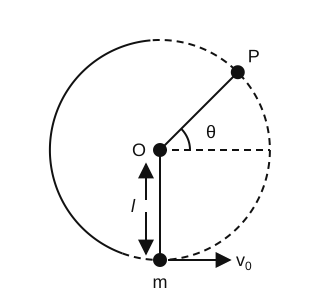
द्रव्यमान m का एक भारी गोलक लंबाई
की हल्की डोरी से लटका है। गोलक को चित्रानुसार क्षैतिज वेग
दिया जाता है। यदि डोरी, क्षैतिज से
कोण बनाने वाले किसी बिंदु P पर ढीली हो जाती है, तो बिंदु P पर गोलक की चाल
का उसकी प्रारंभिक चाल
से अनुपात है:
- A
- B
- C
- D
Show answer
Concept: String slackens where tension becomes zero: the radial component of gravity alone supplies the centripetal force. Then use energy conservation.
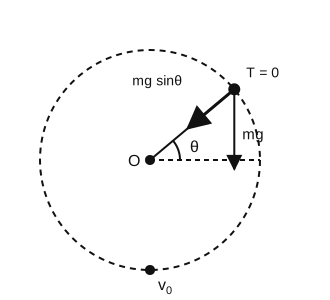
- At P (angle above horizontal), gravity component towards O is ; with : .
- Height of P above the lowest point: . Energy: .
- .
Short trick: Angle from the HORIZONTAL ⇒ sinθ terms (from the vertical it would become cosθ – the trap in option A).
Answer: (B)
अवधारणा: जहाँ तनाव शून्य होता है वहाँ डोरी ढीली होती है: केवल गुरुत्व का त्रिज्य घटक अभिकेंद्र बल देता है। फिर ऊर्जा संरक्षण लगाएँ।
- P पर (क्षैतिज से ऊपर कोण), O की ओर गुरुत्व घटक ; लेकर: ।
- निम्नतम बिंदु से P की ऊँचाई: । ऊर्जा: ।
- ।
शॉर्ट ट्रिक: कोण क्षैतिज से ⇒ sinθ पद (ऊर्ध्वाधर से होता तो cosθ – विकल्प A का जाल)।
उत्तर: (B)
NEET UGPhysicsCircular motion – vertical circle (string slackens)NEET UG 2025 · 4 May Shift 1
Q76.A physical quantity P is related to four observations a, b, c and d as follows:
The percentage errors of measurement in a, b, c and d are 1%, 3%, 2% and 4% respectively. The percentage errors in the quantity P is
एक भौतिक राशि P चार प्रेक्षणों a, b, c और d से इस प्रकार संबंधित है:
a, b, c और d के मापन में प्रतिशत त्रुटियाँ क्रमशः 1%, 3%, 2% और 4% हैं। राशि P में प्रतिशत त्रुटि है
- A13 %
- B15 %
- C10 %
- D2 %
Show answer
Concept: For : (errors always add).
- .
- .
Short trick: Multiply each % error by |power| and add – never subtract.
Answer: (A) 13 %
अवधारणा: के लिए: (त्रुटियाँ सदैव जुड़ती हैं)।
- ।
- ।
शॉर्ट ट्रिक: प्रत्येक % त्रुटि को |घात| से गुणा कर जोड़ें – कभी घटाएँ नहीं।
उत्तर: (A) 13 %
NEET UGPhysicsUnits and measurements – error propagationNEET UG 2025 · 4 May Shift 1
Q77.The Sun rotates around its centre once in 27 days. What will be the period of revolution if the Sun were to expand to twice its present radius without any external influence? Assume the Sun to be a sphere of uniform density.
सूर्य अपने केंद्र के परितः 27 दिनों में एक बार घूर्णन करता है। यदि बिना किसी बाह्य प्रभाव के सूर्य अपनी वर्तमान त्रिज्या का दुगुना फैल जाए, तो घूर्णन का आवर्तकाल क्या होगा? सूर्य को एकसमान घनत्व का गोला मानें।
- A115 days115 दिन
- B108 days108 दिन
- C100 days100 दिन
- D105 days105 दिन
Show answer
Concept: No external torque ⇒ constant; , ⇒ .
- .
- days.
Short trick: Radius ×2 ⇒ period ×4.
Answer: (B) 108 days
अवधारणा: बाह्य बल-आघूर्ण शून्य ⇒ नियत; , ⇒ ।
- ।
- दिन।
शॉर्ट ट्रिक: त्रिज्या ×2 ⇒ आवर्तकाल ×4।
उत्तर: (B) 108 दिन
NEET UGPhysicsRotational motion – conservation of angular momentumNEET UG 2025 · 4 May Shift 1
Q78.The radius of Martian orbit around the Sun is about 4 times the radius of the orbit of Mercury. The Martain year is 687 Earth days. Then which of the following is the length of 1 year on Mercury?
सूर्य के चारों ओर मंगल की कक्षा की त्रिज्या बुध की कक्षा की त्रिज्या की लगभग 4 गुनी है। मंगल का एक वर्ष 687 पृथ्वी-दिनों का है। तब बुध पर 1 वर्ष की लंबाई निम्नलिखित में से कौन-सी है?
- A172 earth days172 पृथ्वी-दिन
- B124 earth days124 पृथ्वी-दिन
- C88 earth days88 पृथ्वी-दिन
- D225 earth days225 पृथ्वी-दिन
Show answer
Concept: Kepler's third law: ⇒ .
- .
- days ≈ 88 earth days (closest option).
Short trick: ; and 88 days is the well-known Mercury year.
Answer: (C) 88 earth days
अवधारणा: केप्लर का तृतीय नियम: ⇒ ।
- ।
- दिन ≈ 88 पृथ्वी-दिन (निकटतम विकल्प)।
शॉर्ट ट्रिक: ; और बुध का वर्ष प्रसिद्ध रूप से 88 दिन है।
उत्तर: (C) 88 पृथ्वी-दिन
NEET UGPhysicsGravitation – Kepler's third lawNEET UG 2025 · 4 May Shift 1
Q79.A wire of resistance R is cut into 8 equal pieces. From these pieces two equivalent resistances are made by adding four of these together in parallel. Then these two sets are added in series. The net effective resistance of the combination is:
प्रतिरोध R के एक तार को 8 बराबर टुकड़ों में काटा जाता है। इन टुकड़ों में से चार-चार को समांतर में जोड़कर दो तुल्य प्रतिरोध बनाए जाते हैं। फिर इन दोनों समूहों को श्रेणीक्रम में जोड़ा जाता है। संयोजन का कुल प्रभावी प्रतिरोध है:
- A
- B
- C
- D
Show answer
Concept: Resistance ∝ length: each piece is ; equal resistors in parallel give .
- Each parallel set: .
- Two sets in series: .
Short trick: R_eq = R × (2/8) × (1/4) = R/16.
Answer: (A)
अवधारणा: प्रतिरोध ∝ लंबाई: प्रत्येक टुकड़ा ; समान प्रतिरोध समांतर में देते हैं।
- प्रत्येक समांतर समूह: ।
- दोनों समूह श्रेणी में: ।
शॉर्ट ट्रिक: R_eq = R × (2/8) × (1/4) = R/16।
उत्तर: (A)
NEET UGPhysicsCurrent electricity – combination of resistancesNEET UG 2025 · 4 May Shift 1
Q80.A photon and an electron (mass m) have the same energy E. The ratio of their de Broglie wavelengths is: (c is the speed of light)
एक फोटॉन और एक इलेक्ट्रॉन (द्रव्यमान m) की ऊर्जा समान E है। उनकी दे-ब्रॉग्ली तरंगदैर्घ्यों का अनुपात है: (c प्रकाश की चाल है)
- A
- B
- C
- D
Show answer
Concept: Photon: . Electron (non-relativistic): .
- .
Short trick: Ratio must be dimensionless: c·√(m/E) is (speed)/(speed) ✓; C and D fail the dimension test (C is a speed, D is speed × momentum), and B is just the reciprocal of the correct ratio.
Answer: (A)
अवधारणा: फोटॉन: । इलेक्ट्रॉन (अनापेक्षिकीय): ।
- ।
शॉर्ट ट्रिक: अनुपात विमाहीन होना चाहिए: c·√(m/E) = (चाल)/(चाल) ✓; C और D विमीय जाँच में असफल (C एक चाल है, D चाल × संवेग है), तथा B सही अनुपात का केवल व्युत्क्रम है।
उत्तर: (A)
NEET UGPhysicsDual nature – de Broglie wavelength of photon and electronNEET UG 2025 · 4 May Shift 1

