Q101.Which of the following genetically engineered organisms was used by Eli Lilly to prepare human insulin?
एली लिली (Eli Lilly) द्वारा मानव इंसुलिन तैयार करने के लिए निम्नलिखित में से किस आनुवंशिकतः रूपान्तरित जीव का उपयोग किया गया था?
- AVirusविषाणु
- BPhageजीवाणुभोजी (Phage)
- CBacteriumजीवाणु
- DYeastयीस्ट
Show answer
Concept: In 1983 Eli Lilly prepared two DNA sequences for the A and B chains of human insulin and introduced them into plasmids of E. coli (a bacterium) to produce the chains separately.
- The A and B chains were produced in E. coli, extracted and joined by disulphide bonds to form human insulin (Humulin).
- Virus/phage: used as vectors at most, not as the producing organism here.
- Yeast: used by some later processes, but not in Eli Lilly’s original product described in NCERT.
Short trick: Eli Lilly → E. coli: both start with “E”.
Answer: (C) Bacterium
अवधारणा: 1983 में एली लिली ने मानव इंसुलिन की A और B श्रृंखलाओं के लिए दो DNA अनुक्रम तैयार कर उन्हें E. coli (एक जीवाणु) के प्लाज्मिड में प्रविष्ट कराया, जिससे श्रृंखलाएँ अलग-अलग बनीं।
- A और B श्रृंखलाएँ E. coli में बनाकर निकाली गईं और डाइसल्फ़ाइड बन्धों द्वारा जोड़कर मानव इंसुलिन (ह्यूम्युलिन) बनाया गया।
- विषाणु/जीवाणुभोजी: अधिकतम वाहक के रूप में प्रयुक्त, यहाँ उत्पादक जीव नहीं।
- यीस्ट: कुछ बाद की प्रक्रियाओं में प्रयुक्त, परन्तु NCERT में वर्णित एली लिली के मूल उत्पाद में नहीं।
शॉर्ट ट्रिक: एली लिली → E. coli: दोनों “E” से शुरू।
उत्तर: (C) जीवाणु
NEET UGBiologyBiotechnology applications – genetically engineered insulinNEET UG 2025 · 4 May Shift 1
Q102.Given below are two statements: one is labelled as Assertion (A) and the other labelled as Reason (R).
Assertion (A): All vertebrates are chordates but all chordates are not vertebrate.
Reason (R): The members of subphylum vertebrata possess notochord during the embryonic period, the notochord is replaced by a cartilaginous or bony vertebral column in adults.
In the light of the above statements, choose the correct answer from the options given below:
नीचे दो कथन दिए गए हैं: एक को अभिकथन (Assertion) (A) और दूसरे को कारण (Reason) (R) के रूप में चिह्नित किया गया है।
अभिकथन (A): सभी कशेरुकी रज्जुकी हैं परन्तु सभी रज्जुकी कशेरुकी नहीं हैं।
कारण (R): उपसंघ वर्टिब्रेटा के सदस्यों में भ्रूणीय अवस्था में पृष्ठरज्जु (notochord) होता है, जो वयस्क में उपास्थिल या अस्थिल कशेरुक दण्ड द्वारा प्रतिस्थापित हो जाता है।
उपर्युक्त कथनों के आलोक में, नीचे दिए गए विकल्पों में से सही उत्तर चुनिए:
- AA is true but R is falseA सही है परन्तु R गलत है
- BA is false but R is trueA गलत है परन्तु R सही है
- CBoth A and R are true and R is the correct explanation of A.A और R दोनों सही हैं तथा R, A की सही व्याख्या है
- DBoth A and R are true and R is not the correct explanation of A.A और R दोनों सही हैं परन्तु R, A की सही व्याख्या नहीं है
Show answer
Concept: NCERT: “Members of subphylum Vertebrata possess notochord during the embryonic period. The notochord is replaced by a cartilaginous or bony vertebral column in the adult. Thus all vertebrates are chordates but all chordates are not vertebrates.”
- A is true: urochordates and cephalochordates have a notochord but no vertebral column.
- R is true: in vertebrates the embryonic notochord is replaced by a vertebral column.
- R explains A: possession of a notochord makes vertebrates chordates; replacement by vertebral column is the extra feature non-vertebrate chordates lack.
Short trick: NCERT ends R with “Thus all vertebrates are chordates…” – a “thus” means R explains A.
Answer: (C) Both A and R are true and R is the correct explanation of A.
अवधारणा: NCERT: “उपसंघ वर्टिब्रेटा के सदस्यों में भ्रूणीय अवस्था में पृष्ठरज्जु होता है, जो वयस्क में उपास्थिल या अस्थिल कशेरुक दण्ड से प्रतिस्थापित हो जाता है। इसीलिए सभी कशेरुकी रज्जुकी हैं परन्तु सभी रज्जुकी कशेरुकी नहीं हैं।”
- A सही है: यूरोकॉर्डेटा और सेफैलोकॉर्डेटा में पृष्ठरज्जु होता है परन्तु कशेरुक दण्ड नहीं।
- R सही है: कशेरुकियों में भ्रूणीय पृष्ठरज्जु कशेरुक दण्ड द्वारा प्रतिस्थापित हो जाता है।
- R, A की व्याख्या करता है: पृष्ठरज्जु होने से कशेरुकी रज्जुकी हैं; कशेरुक दण्ड द्वारा प्रतिस्थापन वह अतिरिक्त लक्षण है जो अकशेरुकी रज्जुकियों में नहीं होता।
शॉर्ट ट्रिक: NCERT में R के बाद “इसीलिए सभी कशेरुकी रज्जुकी हैं…” आता है – “इसीलिए” का अर्थ है R, A की व्याख्या है।
उत्तर: (C) A और R दोनों सही हैं तथा R, A की सही व्याख्या है
NEET UGBiologyAnimal kingdom – chordates and vertebratesNEET UG 2025 · 4 May Shift 1
Q103.What is the main function of the spindle fiber during mitosis?
समसूत्री विभाजन के दौरान तर्कु तन्तु (spindle fibre) का मुख्य कार्य क्या है?
- ATo repair damaged DNAक्षतिग्रस्त DNA की मरम्मत करना
- BTo regulate cell growthकोशिका वृद्धि का नियमन करना
- CTo separate the chromosomesगुणसूत्रों को अलग करना
- DTo synthesize new DNAनए DNA का संश्लेषण करना
Show answer
Concept: Spindle fibres (microtubules from centrosomes) attach to kinetochores of chromosomes in metaphase and pull the sister chromatids to opposite poles in anaphase.
- Separation of chromosomes (chromatids) is the main job of spindle fibres → (C).
- DNA repair and DNA synthesis occur mainly in interphase (S phase) by enzymes, not spindle fibres.
- Cell growth is regulated in G1/G2 by checkpoints, not by the spindle.
Short trick: Spindle = “rope” that pulls chromatids apart.
Answer: (C) To separate the chromosomes
अवधारणा: तर्कु तन्तु (तारककेन्द्र से निकली सूक्ष्मनलिकाएँ) मध्यावस्था में गुणसूत्रों के काइनेटोकोर से जुड़कर पश्चावस्था में सिस्टर क्रोमैटिडों को विपरीत ध्रुवों की ओर खींचते हैं।
- गुणसूत्रों (क्रोमैटिडों) को अलग करना तर्कु तन्तुओं का मुख्य कार्य है → (C)।
- DNA की मरम्मत और DNA संश्लेषण मुख्यतः अन्तरावस्था (S प्रावस्था) में एंजाइमों द्वारा होते हैं, तर्कु तन्तुओं द्वारा नहीं।
- कोशिका वृद्धि का नियमन G1/G2 में जाँच-बिन्दुओं द्वारा होता है, तर्कु द्वारा नहीं।
शॉर्ट ट्रिक: तर्कु = “रस्सी” जो क्रोमैटिडों को खींचकर अलग करती है।
उत्तर: (C) गुणसूत्रों को अलग करना
NEET UGBiologyCell cycle and cell division – mitosisNEET UG 2025 · 4 May Shift 1
Q104.Match
List-I with
List-II.
| List-I | List-II |
|---|
| A. Alfred Hershey and Martha | I. Streptococcus pneumoniae |
| B. Euchromatin | II. Densely packed and dark-stained |
| C. Frederick Griffith | III. Loosely packed and light-stained |
| D. Heterochromatin | IV. DNA as genetic material confirmation |
Choose the
correct answer from the options given below:
सूची-I का
सूची-II से मिलान कीजिए।
| सूची-I | सूची-II |
|---|
| A. अल्फ्रेड हर्शे और मार्था | I. Streptococcus pneumoniae |
| B. यूक्रोमैटिन | II. सघन रूप से संवेष्टित एवं गहरा अभिरंजित |
| C. फ्रेडरिक ग्रिफ़िथ | III. ढीला संवेष्टित एवं हल्का अभिरंजित |
| D. हेटेरोक्रोमैटिन | IV. आनुवंशिक पदार्थ के रूप में DNA की पुष्टि |
नीचे दिए गए विकल्पों में से सही उत्तर चुनिए:
- AA-IV, B-III, C-I, D-II
- BA-III, B-II, C-IV, D-I
- CA-II, B-IV, C-I, D-III
- DA-IV, B-II, C-I, D-III
Show answer
Concept: Hershey–Chase (1952) proved DNA is the genetic material; Griffith (1928) worked with Streptococcus pneumoniae; euchromatin is loose/light, heterochromatin dense/dark.
- A. Hershey and Chase – blender experiment with 32P/35S-labelled phages → DNA confirmed as genetic material → IV.
- B. Euchromatin – loosely packed, stains light, transcriptionally active → III.
- C. Griffith – transformation in Streptococcus pneumoniae (S and R strains) → I.
- D. Heterochromatin – densely packed, stains dark, inactive → II.
- A-IV, B-III, C-I, D-II = (A). Option (D) swaps eu- and heterochromatin; (B), (C) misplace the scientists.
Short trick: Eu = “Eu-sy going”: loose and light; Hetero = heavy and dark.
Answer: (A) A-IV, B-III, C-I, D-II
अवधारणा: हर्शे–चेज़ (1952) ने सिद्ध किया कि DNA आनुवंशिक पदार्थ है; ग्रिफ़िथ (1928) ने Streptococcus pneumoniae पर कार्य किया; यूक्रोमैटिन ढीला/हल्का, हेटेरोक्रोमैटिन सघन/गहरा।
- A. हर्शे और चेज़ – 32P/35S चिह्नित जीवाणुभोजियों से ब्लेंडर प्रयोग → DNA आनुवंशिक पदार्थ सिद्ध → IV।
- B. यूक्रोमैटिन – ढीला संवेष्टित, हल्का अभिरंजित, अनुलेखन में सक्रिय → III।
- C. ग्रिफ़िथ – Streptococcus pneumoniae (S व R प्रभेद) में रूपान्तरण → I।
- D. हेटेरोक्रोमैटिन – सघन संवेष्टित, गहरा अभिरंजित, निष्क्रिय → II।
- A-IV, B-III, C-I, D-II = (A)। विकल्प (D) में यू- और हेटेरोक्रोमैटिन उलटे हैं; (B), (C) में वैज्ञानिक गलत जुड़े हैं।
शॉर्ट ट्रिक: यू = “आसान”: ढीला और हल्का; हेटेरो = भारी और गहरा।
उत्तर: (A) A-IV, B-III, C-I, D-II
NEET UGBiologyMolecular basis of inheritance – DNA as genetic material, chromatinNEET UG 2025 · 4 May Shift 1
Q105.Match
List-I with
List-II.
| List-I | List-II |
|---|
| A. Adenosine | I. Nitrogen base |
| B. Adenylic acid | II. Nucleotide |
| C. Adenine | III. Nucleoside |
| D. Alanine | IV. Amino acid |
Choose the option with all correct matches.
सूची-I का
सूची-II से मिलान कीजिए।
| सूची-I | सूची-II |
|---|
| A. एडेनोसीन | I. नाइट्रोजन क्षार |
| B. एडेनिलिक अम्ल | II. न्यूक्लियोटाइड |
| C. एडेनीन | III. न्यूक्लियोसाइड |
| D. एलानीन | IV. अमीनो अम्ल |
सभी सही मिलानों वाला विकल्प चुनिए।
- AA-III, B-II, C-I, D-IV
- BA-II, B-III, C-I, D-IV
- CA-III, B-IV, C-II, D-I
- DA-III, B-II, C-IV, D-I
Show answer
Concept: Nitrogen base + sugar = nucleoside; nucleoside + phosphate = nucleotide (NCERT, Biomolecules).
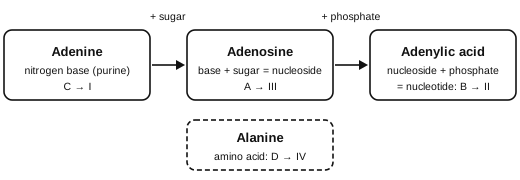
- C. Adenine – a purine nitrogen base → I.
- A. Adenosine – adenine + ribose sugar → nucleoside → III.
- B. Adenylic acid – adenosine + phosphate → nucleotide → II.
- D. Alanine – an amino acid (R = CH3) → IV.
- A-III, B-II, C-I, D-IV = (A).
Short trick: Ending tells the class: -ine = base, -osine = nucleoside, -ylic acid = nucleotide (adenine → adenosine → adenylic acid).
Answer: (A) A-III, B-II, C-I, D-IV
अवधारणा: नाइट्रोजन क्षार + शर्करा = न्यूक्लियोसाइड; न्यूक्लियोसाइड + फॉस्फेट = न्यूक्लियोटाइड (NCERT, जैव अणु)।
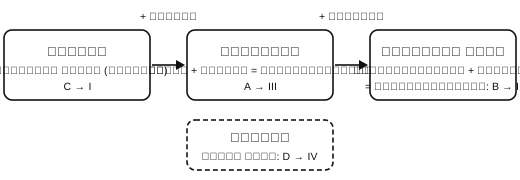
- C. एडेनीन – प्यूरीन नाइट्रोजन क्षार → I।
- A. एडेनोसीन – एडेनीन + राइबोज़ शर्करा → न्यूक्लियोसाइड → III।
- B. एडेनिलिक अम्ल – एडेनोसीन + फॉस्फेट → न्यूक्लियोटाइड → II।
- D. एलानीन – एक अमीनो अम्ल (R = CH3) → IV।
- A-III, B-II, C-I, D-IV = (A)।
शॉर्ट ट्रिक: अन्त्य से वर्ग पहचानें: -ईन = क्षार, -ओसीन = न्यूक्लियोसाइड, -इलिक अम्ल = न्यूक्लियोटाइड (एडेनीन → एडेनोसीन → एडेनिलिक अम्ल)।
उत्तर: (A) A-III, B-II, C-I, D-IV
NEET UGBiologyBiomolecules – nucleosides, nucleotides, amino acidsNEET UG 2025 · 4 May Shift 1
Q106.In frog, the Renal system is a special venous connection that acts to link:
मेंढक में, रीनल (वृक्क) तंत्र एक विशेष शिरीय संयोजन है जो जोड़ता है:
- AKidney and intestineवृक्क और आँत
- BKidney and lower part of bodyवृक्क और शरीर का निचला भाग
- CLiver and intestineयकृत और आँत
- DLiver and Kidneyयकृत और वृक्क
Show answer
Concept: Frog has two portal systems: the hepatic portal system (liver ↔ intestine) and the renal portal system (kidney ↔ lower parts of the body).
- Renal portal system: veins from the hind limbs/lower body drain into the kidneys before reaching the heart → (B).
- Liver–intestine link is the hepatic portal system → (C) describes the other system.
- (A) and (D): no such special venous connections exist.
Short trick: Renal = Rear (lower body); Hepatic = Hungry gut (intestine).
Answer: (B) Kidney and lower part of body
अवधारणा: मेंढक में दो निवाहिका तंत्र होते हैं: यकृत निवाहिका तंत्र (यकृत ↔ आँत) और वृक्क निवाहिका तंत्र (वृक्क ↔ शरीर के निचले भाग)।
- वृक्क निवाहिका तंत्र: पश्च पादों/निचले शरीर की शिराएँ हृदय तक पहुँचने से पहले वृक्कों में जाती हैं → (B)।
- यकृत–आँत का संयोजन यकृत निवाहिका तंत्र है → (C) दूसरे तंत्र का वर्णन है।
- (A) और (D): ऐसे कोई विशेष शिरीय संयोजन नहीं होते।
शॉर्ट ट्रिक: वृक्क = शरीर का पिछला/निचला भाग; यकृत = आँत।
उत्तर: (B) वृक्क और शरीर का निचला भाग
NEET UGBiologyStructural organisation in animals – frog circulationNEET UG 2025 · 4 May Shift 1
Q107.Which of the following are the post-transcriptional events in an eukaryotic cell?
A. Transport of pre-mRNA to cytoplasm prior to splicing
B. Removing of introns and joining of exons
C. Addition of methyl group at 5′ end of hnRNA.
D. Addition of adenine residues at 3′ end of hnRNA.
E. Base pairing of two complementary RNAs.
Choose the correct answer from the options given below:
किसी सुकेन्द्रकी कोशिका में निम्नलिखित में से कौन-सी अनुलेखन-पश्च (post-transcriptional) घटनाएँ हैं?
A. स्प्लाइसिंग से पूर्व pre-mRNA का कोशिकाद्रव्य में परिवहन
B. इंट्रॉनों को हटाना और एक्सॉनों को जोड़ना
C. hnRNA के 5′ सिरे पर मेथिल समूह का योग।
D. hnRNA के 3′ सिरे पर एडेनीन अवशेषों का योग।
E. दो पूरक RNA का क्षार युग्मन।
नीचे दिए गए विकल्पों में से सही उत्तर चुनिए:
- AB, C, E onlyकेवल B, C, E
- BC, D, E onlyकेवल C, D, E
- CA, B, C onlyकेवल A, B, C
- DB, C, D onlyकेवल B, C, D
Show answer
Concept: In eukaryotes the primary transcript (hnRNA) is processed in the nucleus by splicing, capping and tailing before the mature mRNA leaves for the cytoplasm.
- B – correct: splicing removes introns and joins exons.
- C – correct: capping adds methyl guanosine triphosphate (a methylated cap) at the 5′ end.
- D – correct: tailing adds 200–300 adenylate residues (poly-A tail) at the 3′ end.
- A – incorrect: only fully processed mRNA is transported to the cytoplasm, after splicing.
- E – incorrect: pairing of complementary RNAs (dsRNA) is the basis of RNA interference, a gene-silencing event, not RNA processing.
Short trick: Processing = “S-C-T”: Splicing, Capping, Tailing → B, C, D.
Answer: (D) B, C, D only
अवधारणा: सुकेन्द्रकियों में प्राथमिक अनुलेख (hnRNA) का केन्द्रक में स्प्लाइसिंग, कैपिंग और टेलिंग द्वारा प्रक्रमण होता है, तभी परिपक्व mRNA कोशिकाद्रव्य में जाता है।
- B – सही: स्प्लाइसिंग में इंट्रॉन हटाए जाते हैं और एक्सॉन जोड़े जाते हैं।
- C – सही: कैपिंग में 5′ सिरे पर मेथिल ग्वानोसीन ट्राइफॉस्फेट (मेथिलित कैप) जोड़ी जाती है।
- D – सही: टेलिंग में 3′ सिरे पर 200–300 एडेनिलेट अवशेष (पॉली-A पूँछ) जोड़े जाते हैं।
- A – गलत: केवल पूर्णतः प्रक्रमित mRNA ही स्प्लाइसिंग के बाद कोशिकाद्रव्य में भेजा जाता है।
- E – गलत: पूरक RNA का युग्मन (dsRNA) RNA व्यतिकरण (RNAi) का आधार है, जो जीन-निष्क्रियण है, RNA प्रक्रमण नहीं।
शॉर्ट ट्रिक: प्रक्रमण = “S-C-T”: स्प्लाइसिंग, कैपिंग, टेलिंग → B, C, D।
उत्तर: (D) केवल B, C, D
NEET UGBiologyMolecular basis of inheritance – RNA processingNEET UG 2025 · 4 May Shift 1
Q108.Polymerase chain reaction (PCR) amplifies DNA following the equation
पॉलीमरेज़ श्रृंखला अभिक्रिया (PCR) DNA का प्रवर्धन किस समीकरण के अनुसार करती है?
- A2n + 1
- B2N2
- CN2
- D2n
Show answer
Concept: Each PCR cycle (denaturation → annealing → extension) doubles the number of DNA molecules.
- After 1 cycle: 2 copies; 2 cycles: 4; 3 cycles: 8 → after n cycles: 2n copies from one template.
- e.g. 30 cycles → 230 ≈ 109 copies (about a billion).
- 2n + 1, 2N2 and N2 grow far too slowly – they are not doubling series.
Short trick: Doubling every cycle = powers of 2 → 2n.
Answer: (D) 2n
अवधारणा: PCR का प्रत्येक चक्र (विकृतीकरण → तापानुशीतन → विस्तार) DNA अणुओं की संख्या दोगुनी कर देता है।
- 1 चक्र के बाद: 2 प्रतियाँ; 2 चक्र: 4; 3 चक्र: 8 → n चक्रों के बाद एक टेम्पलेट से 2n प्रतियाँ।
- जैसे 30 चक्र → 230 ≈ 109 प्रतियाँ (लगभग एक अरब)।
- 2n + 1, 2N2 और N2 बहुत धीरे बढ़ते हैं – ये दोगुनी होने वाली श्रेणियाँ नहीं हैं।
शॉर्ट ट्रिक: हर चक्र में दोगुना = 2 की घात → 2n।
उत्तर: (D) 2n
NEET UGBiologyBiotechnology principles – PCRNEET UG 2025 · 4 May Shift 1
Q109.Given below are two statements: One is labelled as Assertion (A) and the other is labelled as Reason (R).
Assertion (A): Both wind and water pollinated flowers are not very colourful and do not produce nectar.
Reason (R): The flowers produce enormous amount of pollen grains in wind and water pollinated flowers.
In the light of the above statements, choose the correct answer from the options given below:
नीचे दो कथन दिए गए हैं: एक को अभिकथन (Assertion) (A) और दूसरे को कारण (Reason) (R) के रूप में चिह्नित किया गया है।
अभिकथन (A): वायु और जल दोनों द्वारा परागित पुष्प बहुत रंगीन नहीं होते और मकरन्द (nectar) उत्पन्न नहीं करते।
कारण (R): वायु और जल द्वारा परागित पुष्प अत्यधिक मात्रा में परागकण उत्पन्न करते हैं।
उपर्युक्त कथनों के आलोक में, नीचे दिए गए विकल्पों में से सही उत्तर चुनिए:
- AA is true but R is falseA सही है परन्तु R गलत है
- BA is false but R is trueA गलत है परन्तु R सही है
- CBoth A and R are true and R is the correct explanation of AA और R दोनों सही हैं तथा R, A की सही व्याख्या है
- DBoth A and R are true but R is NOT the correct explanation of AA और R दोनों सही हैं परन्तु R, A की सही व्याख्या नहीं है
Show answer
Concept: NCERT: “Both wind and water pollinated flowers are not very colourful and do not produce nectar.” Colour and nectar are rewards meant to attract animal pollinators.
- A is true – abiotic agents (wind, water) need no attraction, so colour and nectar are absent.
- R is true – such flowers produce pollen in enormous amounts to compensate for the heavy loss of pollen during transfer.
- R does not explain A: lack of colour/nectar is because no animal has to be attracted, not because much pollen is made.
Short trick: Ask “why no colour?” – answer is “nobody to attract”, not “lots of pollen”. Two true facts, no link → (D).
Answer: (D) Both A and R are true but R is NOT the correct explanation of A
अवधारणा: NCERT: “वायु और जल दोनों द्वारा परागित पुष्प बहुत रंगीन नहीं होते और मकरन्द उत्पन्न नहीं करते।” रंग और मकरन्द प्राणी परागणकर्ताओं को आकर्षित करने के लिए पुरस्कार हैं।
- A सही है – अजैविक कारकों (वायु, जल) को आकर्षित करने की आवश्यकता नहीं, अतः रंग और मकरन्द अनुपस्थित होते हैं।
- R सही है – स्थानान्तरण के दौरान परागकणों की भारी क्षति की पूर्ति के लिए ऐसे पुष्प अत्यधिक परागकण उत्पन्न करते हैं।
- R, A की व्याख्या नहीं करता: रंग/मकरन्द का अभाव इसलिए है कि किसी प्राणी को आकर्षित नहीं करना, इसलिए नहीं कि अधिक परागकण बनते हैं।
शॉर्ट ट्रिक: पूछिए “रंग क्यों नहीं?” – उत्तर “आकर्षित करने को कोई नहीं”, न कि “अधिक परागकण”। दो सही तथ्य, कोई सम्बन्ध नहीं → (D)।
उत्तर: (D) A और R दोनों सही हैं परन्तु R, A की सही व्याख्या नहीं है
NEET UGBiologySexual reproduction in flowering plants – pollinationNEET UG 2025 · 4 May Shift 1
Q110.Epiphytes that are growing on a mango branch is an example of which of the following?
आम की शाखा पर उगने वाले अधिपादप (epiphytes) निम्नलिखित में से किसका उदाहरण हैं?
- APredationपरभक्षण (Predation)
- BAmensalismअसहभोजिता (Amensalism)
- CCommensalismसहभोजिता (Commensalism)
- DMutualismसहोपकारिता (Mutualism)
Show answer
Concept: Commensalism (+, 0): one species benefits and the other is neither benefited nor harmed. NCERT example: an orchid growing as an epiphyte on a mango branch.
- Epiphyte gains support and better access to sunlight (+); the mango tree gains nothing and loses nothing (0) → commensalism.
- Predation (+, −): one kills/eats the other – not the case.
- Amensalism (−, 0): one is harmed, other unaffected – the mango is not harmed.
- Mutualism (+, +): both benefit – the mango gets no benefit.
Short trick: NCERT pair to remember: orchid on mango and barnacles on whale = commensalism.
Answer: (C) Commensalism
अवधारणा: सहभोजिता (+, 0): एक जाति को लाभ होता है और दूसरी को न लाभ न हानि। NCERT उदाहरण: आम की शाखा पर अधिपादप के रूप में उगने वाला ऑर्किड।
- अधिपादप को आधार और अधिक सूर्य-प्रकाश मिलता है (+); आम के वृक्ष को न लाभ न हानि (0) → सहभोजिता।
- परभक्षण (+, −): एक दूसरे को मारकर खाता है – यह स्थिति नहीं।
- असहभोजिता (−, 0): एक को हानि, दूसरा अप्रभावित – आम को हानि नहीं होती।
- सहोपकारिता (+, +): दोनों को लाभ – आम को कोई लाभ नहीं।
शॉर्ट ट्रिक: याद रखें NCERT युग्म: आम पर ऑर्किड और व्हेल पर बार्नेकल = सहभोजिता।
उत्तर: (C) सहभोजिता (Commensalism)
NEET UGBiologyOrganisms and populations – population interactionsNEET UG 2025 · 4 May Shift 1
Q111.Find the correct statements:
A. In human pregnancy, the major organ systems are formed at the end of 12 weeks.
B. In human pregnancy, the major organ systems are formed at the end of 8 weeks.
C. In human pregnancy heart is formed after one month of gestation.
D. In human pregnancy, limbs and digits develop by the end of second month.
E. In human pregnancy the appearance of hair is usually observed in the fifth month.
Choose the correct answer from the options given below:
सही कथन ज्ञात कीजिए:
A. मानव सगर्भता में प्रमुख अंग-तंत्र 12 सप्ताह के अन्त तक बन जाते हैं।
B. मानव सगर्भता में प्रमुख अंग-तंत्र 8 सप्ताह के अन्त तक बन जाते हैं।
C. मानव सगर्भता में गर्भावधि के एक माह बाद हृदय बन जाता है।
D. मानव सगर्भता में दूसरे माह के अन्त तक पाद और अंगुलियाँ विकसित हो जाती हैं।
E. मानव सगर्भता में बालों का प्रकटन सामान्यतः पाँचवें माह में देखा जाता है।
नीचे दिए गए विकल्पों में से सही उत्तर चुनिए:
- AB, C, D and E onlyकेवल B, C, D और E
- BA, C, D and E onlyकेवल A, C, D और E
- CA and E onlyकेवल A और E
- DB and C onlyकेवल B और C
Show answer
Concept: NCERT timeline of human foetal development: 1 month – heart; 2 months – limbs and digits; 12 weeks (first trimester) – most major organ systems; 5 months – first movements and hair on head; 24 weeks – body hair, eyelids separate.
- A – correct: major organ systems are formed by the end of 12 weeks.
- B – incorrect: 8 weeks (2 months) is when limbs and digits develop, not the organ systems.
- C – correct: heart is formed after one month.
- D – correct: limbs and digits by the end of the second month.
- E – correct: hair appears on the head in the fifth month.
Short trick: “1-2-3-5”: 1 month heart, 2 months limbs, 3 months (12 weeks) organs, 5 months hair & movement.
Answer: (B) A, C, D and E only
अवधारणा: NCERT के अनुसार मानव भ्रूण परिवर्धन की समय-रेखा: 1 माह – हृदय; 2 माह – पाद और अंगुलियाँ; 12 सप्ताह (प्रथम त्रैमास) – अधिकांश प्रमुख अंग-तंत्र; 5 माह – प्रथम गतियाँ और सिर पर बाल; 24 सप्ताह – शरीर पर बाल, पलकें अलग।
- A – सही: प्रमुख अंग-तंत्र 12 सप्ताह के अन्त तक बन जाते हैं।
- B – गलत: 8 सप्ताह (2 माह) पर पाद व अंगुलियाँ विकसित होती हैं, अंग-तंत्र नहीं।
- C – सही: एक माह बाद हृदय बन जाता है।
- D – सही: दूसरे माह के अन्त तक पाद और अंगुलियाँ।
- E – सही: पाँचवें माह में सिर पर बाल दिखते हैं।
शॉर्ट ट्रिक: “1-2-3-5”: 1 माह हृदय, 2 माह पाद, 3 माह (12 सप्ताह) अंग-तंत्र, 5 माह बाल व गति।
उत्तर: (B) केवल A, C, D और E
NEET UGBiologyHuman reproduction – embryonic developmentNEET UG 2025 · 4 May Shift 1
Q112.Identify the part of a bio-reactor which is used as a foam braker from the given figure.
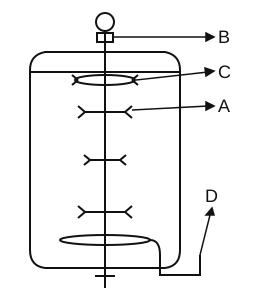
दिए गए चित्र से जैव-रिएक्टर (bio-reactor) के उस भाग को पहचानिए जो फेन-भंजक (foam breaker) के रूप में प्रयुक्त होता है।
- AD
- BC
- CA
- DB
Show answer
Concept: In a stirred-tank bioreactor (NCERT) the foam breaker is a flat disc fixed on the stirrer shaft at the top of the vessel, just below the lid, which breaks the foam formed during aeration.
- B – motor/drive at the top of the shaft (outside the vessel).
- C – the flat disc at the top inside the vessel → foam breaker.
- A – the flat-bladed impeller (stirrer) that mixes the contents.
- D – the sterile air inlet leading to the sparger at the bottom.
Short trick: Foam rises to the top → the foam breaker is the topmost part inside the vessel.
Answer: (B) C
अवधारणा: विलोडित-टंकी जैव-रिएक्टर (NCERT) में फेन-भंजक, विलोडक शाफ्ट पर पात्र के शीर्ष पर ढक्कन के ठीक नीचे लगी एक चपटी चकती होती है, जो वातन के दौरान बने फेन (झाग) को तोड़ती है।
- B – शाफ्ट के शीर्ष पर मोटर/चालक (पात्र के बाहर)।
- C – पात्र के भीतर शीर्ष पर चपटी चकती → फेन-भंजक।
- A – चपटे फलकों वाला प्रणोदक (impeller/विलोडक) जो सामग्री को मिलाता है।
- D – निर्जीवाणुक वायु प्रवेश, जो तली पर स्पार्जर तक जाता है।
शॉर्ट ट्रिक: फेन ऊपर उठता है → फेन-भंजक पात्र के भीतर सबसे ऊपर वाला भाग है।
उत्तर: (B) C
NEET UGBiologyBiotechnology principles – bioreactorNEET UG 2025 · 4 May Shift 1
Q113.Frogs respire in water by skin and buccal cavity and on land by skin, buccal cavity and lungs.
Choose the correct answer from the following:
मेंढक जल में त्वचा और मुख-गुहा द्वारा तथा स्थल पर त्वचा, मुख-गुहा और फुफ्फुसों द्वारा श्वसन करते हैं।
निम्नलिखित में से सही उत्तर चुनिए:
- AThe statement is false for water and but true for landकथन जल के लिए असत्य परन्तु स्थल के लिए सत्य है
- BThe statement is false for both the environmentकथन दोनों पर्यावरणों के लिए असत्य है
- CThe statement is true for water but false for landकथन जल के लिए सत्य परन्तु स्थल के लिए असत्य है
- DThe statement is true for both the environmentकथन दोनों पर्यावरणों के लिए सत्य है
Show answer
Concept: NCERT: “Frogs respire on land and in the water by two different methods. In water, skin acts as aquatic respiratory organ (cutaneous respiration)… On land, the buccal cavity, skin and lungs act as the respiratory organs.”
- In water: only the skin (cutaneous respiration) – buccal cavity is not listed → the “water” part is false.
- On land: skin, buccal cavity and lungs → the “land” part is true.
- Hence the statement is false for water but true for land.
Short trick: Water = skin only; Land = 3 organs (skin + buccal + lungs).
Answer: (A) The statement is false for water and but true for land
अवधारणा: NCERT: “मेंढक स्थल और जल में दो भिन्न विधियों से श्वसन करते हैं। जल में त्वचा जलीय श्वसन अंग का कार्य करती है (त्वचीय श्वसन)… स्थल पर मुख-गुहा, त्वचा और फुफ्फुस श्वसन अंगों का कार्य करते हैं।”
- जल में: केवल त्वचा (त्वचीय श्वसन) – मुख-गुहा नहीं → कथन का “जल” वाला भाग असत्य।
- स्थल पर: त्वचा, मुख-गुहा और फुफ्फुस → “स्थल” वाला भाग सत्य।
- अतः कथन जल के लिए असत्य परन्तु स्थल के लिए सत्य है।
शॉर्ट ट्रिक: जल = केवल त्वचा; स्थल = 3 अंग (त्वचा + मुख-गुहा + फुफ्फुस)।
उत्तर: (A) कथन जल के लिए असत्य परन्तु स्थल के लिए सत्य है
NEET UGBiologyStructural organisation in animals – frog respirationNEET UG 2025 · 4 May Shift 1
Q114.Consider the following statements regarding function of adrenal medullary hormones:
A. It causes pupillary constriction
B. It is a hyperglycemic hormone
C. It causes piloerection
D. It increases strength of heart contraction
Choose the correct answer from the options given below:
अधिवृक्क मध्यांश के हॉर्मोनों के कार्य के सम्बन्ध में निम्नलिखित कथनों पर विचार कीजिए:
A. यह पुतली का संकुचन करता है
B. यह अतिग्लूकोज़रक्तता (hyperglycemic) हॉर्मोन है
C. यह रोमांच (piloerection) करता है
D. यह हृदय संकुचन की शक्ति बढ़ाता है
नीचे दिए गए विकल्पों में से सही उत्तर चुनिए:
- AA, C and D Onlyकेवल A, C और D
- BD Onlyकेवल D
- CC and D Onlyकेवल C और D
- DB, C and D Onlyकेवल B, C और D
Show answer
Concept: Adrenaline and noradrenaline are “emergency (3F – fight, flight, fright) hormones”: they cause pupillary dilation, piloerection, sweating, raise heart beat and strength of contraction, and increase blood glucose (glycogenolysis).
- A – incorrect: they cause pupillary dilation, not constriction.
- B – correct: they stimulate glycogen breakdown → hyperglycemia.
- C – correct: piloerection (raising of hair).
- D – correct: increased heart beat and strength of heart contraction.
Short trick: Think of a scared cat: wide pupils, hair standing, heart racing, sugar ready → no constriction.
Answer: (D) B, C and D Only
अवधारणा: एड्रीनेलिन और नॉरएड्रीनेलिन “आपातकालीन (3F – लड़ो, भागो, डरो) हॉर्मोन” हैं: ये पुतली का फैलाव, रोमांच, पसीना, हृदय-स्पन्दन व संकुचन-शक्ति में वृद्धि तथा रक्त ग्लूकोज़ में वृद्धि (ग्लाइकोजेन-अपघटन) करते हैं।
- A – गलत: ये पुतली का फैलाव करते हैं, संकुचन नहीं।
- B – सही: ये ग्लाइकोजेन के अपघटन को प्रेरित करते हैं → अतिग्लूकोज़रक्तता।
- C – सही: रोमांच (बाल खड़े होना)।
- D – सही: हृदय-स्पन्दन और हृदय संकुचन की शक्ति में वृद्धि।
शॉर्ट ट्रिक: डरी हुई बिल्ली सोचिए: फैली पुतलियाँ, खड़े बाल, तेज़ धड़कन, तैयार शर्करा → संकुचन नहीं।
उत्तर: (D) केवल B, C और D
NEET UGBiologyChemical coordination – adrenal medulla (catecholamines)NEET UG 2025 · 4 May Shift 1
Q115.Read the following statements on plant growth and development.
A. Parthenocarpy can be induced by auxins.
B. Plant growth regulators can be involved in promotion as well as inhibition of growth.
C. Dedifferentiation is a pre-requisite for re-differentiation.
D. Abscisic acid is a plant growth promoter.
E. Apical dominance promotes the growth of lateral buds.
Choose the option with all correct statements.
पादप वृद्धि एवं परिवर्धन पर निम्नलिखित कथनों को पढ़िए।
A. अनिषेकफलन (parthenocarpy) ऑक्सिन द्वारा प्रेरित किया जा सकता है।
B. पादप वृद्धि नियामक वृद्धि के संवर्धन तथा संदमन दोनों में सम्मिलित हो सकते हैं।
C. विविभेदन (dedifferentiation) पुनर्विभेदन (redifferentiation) की पूर्वापेक्षा है।
D. एब्सिसिक अम्ल एक पादप वृद्धि संवर्धक है।
E. शीर्ष प्रभाविता पार्श्व कलिकाओं की वृद्धि को बढ़ावा देती है।
सभी सही कथनों वाला विकल्प चुनिए।
- AA, D, E onlyकेवल A, D, E
- BB, D, E onlyकेवल B, D, E
- CA, B, C onlyकेवल A, B, C
- DA, C, E onlyकेवल A, C, E
Show answer
Concept: PGRs are broadly growth promoters (auxins, gibberellins, cytokinins) and growth inhibitors (ABA, ethylene largely).
- A – correct: auxins induce parthenocarpy (e.g. in tomatoes).
- B – correct: PGRs can promote as well as inhibit growth (promoters and inhibitors).
- C – correct: cells that have dedifferentiated (regained capacity to divide) later lose it again and mature – redifferentiation follows dedifferentiation.
- D – incorrect: ABA is a growth inhibitor (“stress hormone”).
- E – incorrect: apical dominance (auxin from the shoot apex) inhibits lateral buds; decapitation removes it.
Short trick: Spot the two “opposites”: ABA = inhibitor, apical dominance = suppresses laterals → drop D, E → A, B, C.
Answer: (C) A, B, C only
अवधारणा: पादप वृद्धि नियामक मुख्यतः वृद्धि संवर्धक (ऑक्सिन, जिबरेलिन, साइटोकाइनिन) और वृद्धि संदमक (ABA, अधिकांशतः एथिलीन) होते हैं।
- A – सही: ऑक्सिन अनिषेकफलन प्रेरित करते हैं (जैसे टमाटर में)।
- B – सही: पादप वृद्धि नियामक वृद्धि का संवर्धन और संदमन दोनों कर सकते हैं।
- C – सही: विविभेदित (पुनः विभाजन क्षमता प्राप्त) कोशिकाएँ बाद में यह क्षमता खोकर परिपक्व होती हैं – पुनर्विभेदन, विविभेदन के बाद ही होता है।
- D – गलत: ABA वृद्धि संदमक (“तनाव हॉर्मोन”) है।
- E – गलत: शीर्ष प्रभाविता (प्ररोह शीर्ष का ऑक्सिन) पार्श्व कलिकाओं की वृद्धि को रोकती है; शीर्ष काटने पर यह हट जाती है।
शॉर्ट ट्रिक: दो “उलटे” कथन पकड़ें: ABA = संदमक, शीर्ष प्रभाविता = पार्श्व कलिकाओं को दबाती है → D, E हटाएँ → A, B, C।
उत्तर: (C) केवल A, B, C
NEET UGBiologyPlant growth and development – PGRsNEET UG 2025 · 4 May Shift 1
Q116.Which of the following hormones released from the pituitary is actually synthesized in the hypothalamus?
पीयूष ग्रन्थि से मुक्त होने वाले निम्नलिखित हॉर्मोनों में से कौन-सा वास्तव में हाइपोथैलेमस में संश्लेषित होता है?
- AFollicle-stimulating hormone (FSH)पुटक-प्रेरक हॉर्मोन (FSH)
- BAdrenocorticotropic hormone (ACTH)एड्रीनोकॉर्टिकोट्रॉपिक हॉर्मोन (ACTH)
- CLuteinizing hormone (LH)ल्यूटिनाइज़िंग हॉर्मोन (LH)
- DAnti-diuretic hormone (ADH)प्रतिमूत्रल हॉर्मोन (ADH)
Show answer
Concept: The neurohypophysis (pars nervosa) only stores and releases oxytocin and vasopressin (ADH), which are actually synthesised by neurosecretory cells of the hypothalamus.
- ADH (vasopressin) – made in hypothalamus, transported along axons, released from posterior pituitary → (D).
- FSH, LH, ACTH – synthesised and secreted by the adenohypophysis (pars distalis) itself.
Short trick: Posterior pituitary is a “storehouse”, not a “factory”: Oxytocin + Vasopressin (“OV”).
Answer: (D) Anti-diuretic hormone (ADH)
अवधारणा: न्यूरोहाइपोफ़ाइसिस (पार्स नर्वोसा) केवल ऑक्सीटोसिन और वैसोप्रेसिन (ADH) का संग्रह व मोचन करता है; इनका वास्तविक संश्लेषण हाइपोथैलेमस की तन्त्रिका-स्रावी कोशिकाओं में होता है।
- ADH (वैसोप्रेसिन) – हाइपोथैलेमस में बनता है, तन्त्रिकाक्षों द्वारा ले जाया जाता है और पश्च पीयूष से मुक्त होता है → (D)।
- FSH, LH, ACTH – एडिनोहाइपोफ़ाइसिस (पार्स डिस्टेलिस) स्वयं संश्लेषित व स्रावित करता है।
शॉर्ट ट्रिक: पश्च पीयूष “भण्डार” है, “कारखाना” नहीं: Oxytocin + Vasopressin (“OV”)।
उत्तर: (D) प्रतिमूत्रल हॉर्मोन (ADH)
NEET UGBiologyChemical coordination – hypothalamus and posterior pituitaryNEET UG 2025 · 4 May Shift 1
Q117.Which of the following is an example of non-distilled alcoholic beverage produced by yeast?
निम्नलिखित में से कौन-सा यीस्ट द्वारा उत्पादित अनासवित (non-distilled) ऐल्कोहॉली पेय का उदाहरण है?
- ABeerबीयर
- BRumरम
- CWhiskyव्हिस्की
- DBrandyब्रांडी
Show answer
Concept: Saccharomyces cerevisiae (brewer’s yeast) ferments malted cereals and fruit juices. Wine and beer are produced without distillation; whisky, brandy and rum are produced by distillation of the fermented broth.
- Beer – fermented malted barley, not distilled → (A).
- Rum (from molasses), whisky (from grains) and brandy (from wine/fruit) – all distilled.
Short trick: “Wine & Beer – Without Boiling-off (distillation)”.
Answer: (A) Beer
अवधारणा: Saccharomyces cerevisiae (ब्रूअर यीस्ट) माल्टित अनाज और फलों के रस का किण्वन करता है। वाइन और बीयर आसवन के बिना बनाए जाते हैं; व्हिस्की, ब्रांडी और रम किण्वित घोल के आसवन से बनते हैं।
- बीयर – किण्वित माल्टित जौ, आसवित नहीं → (A)।
- रम (शीरे से), व्हिस्की (अनाज से) और ब्रांडी (वाइन/फल से) – सभी आसवित।
शॉर्ट ट्रिक: “वाइन और बीयर – बिना आसवन”।
उत्तर: (A) बीयर
NEET UGBiologyMicrobes in human welfare – fermented beveragesNEET UG 2025 · 4 May Shift 1
Q118.What is the pattern of inheritance for polygenic trait?
बहुजीनी (polygenic) लक्षण की वंशागति का प्रतिरूप क्या है?
- AAutosomal dominant patternअलिंगसूत्री प्रभावी प्रतिरूप
- BX-linked recessive inheritance patternX-सहलग्न अप्रभावी वंशागति प्रतिरूप
- CMendelian inheritance patternमेण्डलीय वंशागति प्रतिरूप
- DNon-mendelian inheritance patternअमेण्डलीय (Non-Mendelian) वंशागति प्रतिरूप
Show answer
Concept: Polygenic traits (e.g. human skin colour, height) are controlled by three or more genes with additive effects and are influenced by environment; they show continuous variation and a bell-shaped distribution instead of clear Mendelian ratios.
- One character controlled by many genes with cumulative effect – does not give 3:1 or 9:3:3:1 phenotypic ratios → treated as a non-Mendelian pattern (deviation from Mendel).
- Autosomal dominant and X-linked recessive are single-gene (monogenic) patterns – wrong.
- Mendelian pattern: one gene – one trait with discrete phenotypes – not true of polygenic traits.
Short trick: Many genes + continuous variation (skin colour) = not Mendel’s neat ratios.
Answer: (D) Non-mendelian inheritance pattern
अवधारणा: बहुजीनी लक्षण (जैसे मानव त्वचा का रंग, लम्बाई) तीन या अधिक जीनों द्वारा योगात्मक प्रभाव से नियन्त्रित होते हैं और पर्यावरण से प्रभावित होते हैं; इनमें स्पष्ट मेण्डलीय अनुपात के स्थान पर सतत विभिन्नता और घण्टी-आकार वितरण मिलता है।
- एक लक्षण अनेक जीनों के संचयी प्रभाव से नियन्त्रित – 3:1 या 9:3:3:1 लक्षणप्रारूपी अनुपात नहीं देता → अमेण्डलीय प्रतिरूप (मेण्डल से विचलन) माना जाता है।
- अलिंगसूत्री प्रभावी और X-सहलग्न अप्रभावी एकल-जीन (एकजीनी) प्रतिरूप हैं – गलत।
- मेण्डलीय प्रतिरूप: एक जीन – एक लक्षण, स्पष्ट लक्षणप्रारूप – बहुजीनी लक्षणों पर लागू नहीं।
शॉर्ट ट्रिक: अनेक जीन + सतत विभिन्नता (त्वचा का रंग) = मेण्डल के स्पष्ट अनुपात नहीं।
उत्तर: (D) अमेण्डलीय वंशागति प्रतिरूप
NEET UGBiologyPrinciples of inheritance – polygenic inheritanceNEET UG 2025 · 4 May Shift 1
Q119.Match
List-I and
List-II.
| List-I | List-II |
|---|
| A. Head | I. Enzymes |
| B. Middle piece | II. Sperm motility |
| C. Acrosome | III. Energy |
| D. Tail | IV. Genetic material |
Choose the correct answer from the options given below:
सूची-I का
सूची-II से मिलान कीजिए।
| सूची-I | सूची-II |
|---|
| A. शीर्ष | I. एंजाइम |
| B. मध्य भाग | II. शुक्राणु गतिशीलता |
| C. अग्रपिण्डक (Acrosome) | III. ऊर्जा |
| D. पूँछ | IV. आनुवंशिक पदार्थ |
नीचे दिए गए विकल्पों में से सही उत्तर चुनिए:
- AA-III, B-IV, C-II, D-I
- BA-III, B-II, C-I, D-IV
- CA-IV, B-III, C-I, D-II
- DA-IV, B-III, C-II, D-I
Show answer
Concept: A sperm has head, neck, middle piece and tail; each part has a specific job (NCERT, Human Reproduction).
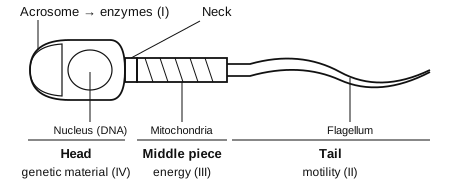
- A. Head – contains the elongated haploid nucleus = genetic material → IV.
- B. Middle piece – numerous mitochondria → energy for movement → III.
- C. Acrosome – cap-like structure with enzymes (sperm lysins) that help fertilisation → I.
- D. Tail – flagellum → sperm motility → II.
- A-IV, B-III, C-I, D-II = (C).
Short trick: Read the sperm from front to back: Enzymes → DNA → Energy → Engine (tail).
Answer: (C) A-IV, B-III, C-I, D-II
अवधारणा: शुक्राणु में शीर्ष, ग्रीवा, मध्य भाग और पूँछ होते हैं; प्रत्येक भाग का विशिष्ट कार्य है (NCERT, मानव जनन)।
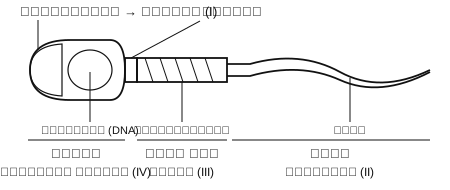
- A. शीर्ष – लम्बा अगुणित केन्द्रक = आनुवंशिक पदार्थ → IV।
- B. मध्य भाग – अनेक सूत्रकणिकाएँ → गति के लिए ऊर्जा → III।
- C. अग्रपिण्डक – टोपी-जैसी संरचना जिसमें निषेचन में सहायक एंजाइम (शुक्राणु लाइसिन) होते हैं → I।
- D. पूँछ – कशाभ → शुक्राणु गतिशीलता → II।
- A-IV, B-III, C-I, D-II = (C)।
शॉर्ट ट्रिक: शुक्राणु को आगे से पीछे पढ़ें: एंजाइम → DNA → ऊर्जा → इंजन (पूँछ)।
उत्तर: (C) A-IV, B-III, C-I, D-II
NEET UGBiologyHuman reproduction – structure of spermNEET UG 2025 · 4 May Shift 1
Q120.Which of the following is an example of a zygomorphic flower?
निम्नलिखित में से कौन-सा एकव्याससममित (zygomorphic) पुष्प का उदाहरण है?
- APeaमटर
- BChilliमिर्च
- CPetunia
- DDatura
Show answer
Concept: Zygomorphic flower: can be divided into two similar halves only in one particular vertical plane (NCERT examples: pea, gulmohur, bean, Cassia). Actinomorphic: radial symmetry (mustard, Datura, chilli).
- Pea – papilionaceous corolla (standard, wings, keel) → bilateral symmetry → zygomorphic.
- Chilli, Petunia, Datura – Solanaceae flowers with radial symmetry → actinomorphic.
Short trick: Fabaceae (pea, bean, gulmohur, Cassia) = Zygomorphic; Solanaceae = actinomorphic.
Answer: (A) Pea
अवधारणा: एकव्याससममित पुष्प: केवल एक विशेष ऊर्ध्वाधर तल से दो समान भागों में बाँटा जा सकता है (NCERT उदाहरण: मटर, गुलमोहर, सेम, Cassia)। त्रिज्यसममित (actinomorphic): अरीय सममिति (सरसों, Datura, मिर्च)।
- मटर – पैपिलियोनेसी दलपुंज (ध्वज, पंख, नौतल) → द्विपार्श्व सममिति → एकव्याससममित।
- मिर्च, Petunia, Datura – सोलेनेसी के अरीय सममित पुष्प → त्रिज्यसममित।
शॉर्ट ट्रिक: फैबेसी (मटर, सेम, गुलमोहर, Cassia) = एकव्याससममित; सोलेनेसी = त्रिज्यसममित।
उत्तर: (A) मटर
NEET UGBiologyMorphology of flowering plants – symmetry of flowerNEET UG 2025 · 4 May Shift 1

