Q101.Two bodies A and B of same mass undergo completely inelastic one-dimensional collision. The body A moves with velocity while body B is at rest before collision. The velocity of the system after collision is . The ratio is:
समान द्रव्यमान की दो वस्तुएँ A और B पूर्णतः अप्रत्यास्थ एकविमीय संघट्ट करती हैं। संघट्ट से पहले वस्तु A वेग से गतिमान है जबकि वस्तु B विरामावस्था में है। संघट्ट के बाद निकाय का वेग है। अनुपात है:
- A2 : 1
- B4 : 1
- C1 : 4
- D1 : 2
Show answer
Concept: In a perfectly inelastic collision the bodies stick together; linear momentum is conserved.
Short trick: Equal masses, one at rest, sticking together → common velocity is half.
Answer: (A) 2 : 1
अवधारणा: पूर्णतः अप्रत्यास्थ संघट्ट में वस्तुएँ आपस में चिपक जाती हैं; रैखिक संवेग संरक्षित रहता है।
शॉर्ट ट्रिक: समान द्रव्यमान, एक विराम में, चिपक जाएँ → उभयनिष्ठ वेग आधा।
उत्तर: (A) 2 : 1
NEET UGPhysicsLaws of motion – perfectly inelastic collisionNEET UG 2024 · 5 May Shift 1
Q102.Given below are two statements: One is labelled as Assertion A and the other is labelled as Reason R.
Assertion A: The potential (V) at any axial point, at 2 m distance (r) from the centre of the dipole of dipole moment vector of magnitude, C m, is V
(Take SI units)
Reason R: , where r is the distance of any axial point, situated at 2 m from the centre of the dipole.
In the light of the above statements, choose the correct answer from the options given below:
नीचे दो कथन दिए गए हैं: एक को अभिकथन A और दूसरे को कारण R कहा गया है।
अभिकथन A: द्विध्रुव आघूर्ण सदिश , जिसका परिमाण C m है, वाले द्विध्रुव के केंद्र से 2 m दूरी (r) पर किसी अक्षीय बिंदु पर विभव (V) V है
( SI मात्रक लीजिए)
कारण R: , जहाँ r द्विध्रुव के केंद्र से 2 m पर स्थित किसी अक्षीय बिंदु की दूरी है।
उपर्युक्त कथनों के आलोक में नीचे दिए गए विकल्पों में से सही उत्तर चुनिए:
- ABoth A and R are true and R is NOT the correct explanation of A.A और R दोनों सत्य हैं तथा R, A की सही व्याख्या नहीं है।
- BA is true but R is falseA सत्य है परंतु R असत्य है
- CA is false but R is trueA असत्य है परंतु R सत्य है
- DBoth A and R are true and R is the correct explanation of A.A और R दोनों सत्य हैं तथा R, A की सही व्याख्या है।
Show answer
Concept: Potential of a short dipole: ; on the axis θ = 0° or 180°, so (no factor 2).
- V → A is true.
- R uses – the factor 2 belongs to the axial field , not to potential → R is false.
- (With R’s formula V would be ±1.8 × 10⁴ V, which contradicts A.)
Short trick: Dipole on axis: E has “2P/r³”, V has “P/r²”. Mixing them is the usual trap.
Answer: (B) A is true but R is false
अवधारणा: लघु द्विध्रुव का विभव: ; अक्ष पर θ = 0° या 180°, अतः (गुणक 2 नहीं)।
- V → A सत्य है।
- R में लिया है – गुणक 2 अक्षीय क्षेत्र में आता है, विभव में नहीं → R असत्य है।
- (R के सूत्र से V = ±1.8 × 10⁴ V आता, जो A के विपरीत है।)
शॉर्ट ट्रिक: अक्ष पर द्विध्रुव: E में “2P/r³”, V में “P/r²”। इन्हें मिलाना सामान्य जाल है।
उत्तर: (B) A सत्य है परंतु R असत्य है
NEET UGPhysicsElectric dipole – axial potential (Assertion–Reason)NEET UG 2024 · 5 May Shift 1
Q103.The terminal voltage of the battery, whose emf is 10 V and internal resistance 1 Ω, when connected through an external resistance of 4 Ω as shown in the figure is:
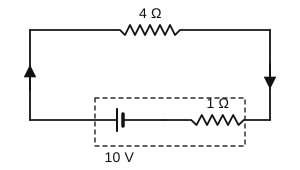
जिस बैटरी का विद्युत वाहक बल (emf) 10 V तथा आंतरिक प्रतिरोध 1 Ω है, उसे चित्रानुसार 4 Ω के बाह्य प्रतिरोध से जोड़ने पर उसकी टर्मिनल वोल्टता है:
- A6 V
- B8 V
- C10 V
- D4 V
Show answer
Concept: and terminal voltage (while discharging).
- A
- V
- Check: V.
Short trick: Voltage divides in ratio of resistances: V = ε·R/(R + r) = 10 × 4/5 = 8 V.
Answer: (B) 8 V
अवधारणा: तथा टर्मिनल वोल्टता (निरावेशन के समय)।
- A
- V
- जाँच: V।
शॉर्ट ट्रिक: वोल्टता प्रतिरोधों के अनुपात में बँटती है: V = ε·R/(R + r) = 10 × 4/5 = 8 V।
उत्तर: (B) 8 V
NEET UGPhysicsCurrent electricity – terminal voltageNEET UG 2024 · 5 May Shift 1
Q104.A particle moving with uniform speed in a circular path maintains:
वृत्तीय पथ पर एकसमान चाल से गतिमान कोई कण बनाए रखता है:
- AConstant accelerationनियत त्वरण
- BConstant velocity but varying accelerationनियत वेग परंतु परिवर्ती त्वरण
- CVarying velocity and varying accelerationपरिवर्ती वेग और परिवर्ती त्वरण
- DConstant velocity.नियत वेग।
Show answer
Concept: In uniform circular motion speed is constant but the velocity is always tangential and the acceleration always points to the centre.
- Velocity direction keeps turning → velocity varies (B, D wrong).
- Centripetal acceleration has constant magnitude but rotating direction → acceleration varies (A wrong).
- Hence both velocity and acceleration vary.
Short trick: Vectors change if only their direction changes. In UCM only the magnitudes (speed, ) are constant.
Answer: (C) Varying velocity and varying acceleration
अवधारणा: एकसमान वृत्तीय गति में चाल नियत रहती है परंतु वेग सदैव स्पर्शरेखीय होता है और त्वरण सदैव केंद्र की ओर होता है।
- वेग की दिशा लगातार बदलती है → वेग परिवर्ती (B, D गलत)।
- अभिकेंद्र त्वरण का परिमाण नियत पर दिशा घूमती है → त्वरण परिवर्ती (A गलत)।
- अतः वेग और त्वरण दोनों परिवर्ती हैं।
शॉर्ट ट्रिक: केवल दिशा बदलने पर भी सदिश बदल जाता है। UCM में केवल परिमाण (चाल, ) नियत हैं।
उत्तर: (C) परिवर्ती वेग और परिवर्ती त्वरण
NEET UGPhysicsMotion in a plane – uniform circular motionNEET UG 2024 · 5 May Shift 1
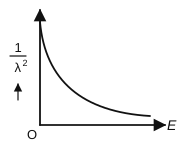
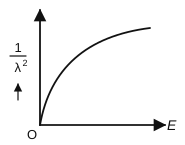
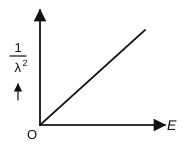
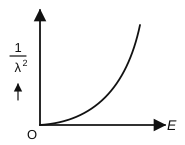
Q105.The graph which shows the variation of and its kinetic energy, E is (where λ is de Broglie wavelength of a free particle):
वह ग्राफ जो तथा गतिज ऊर्जा E के बीच परिवर्तन दर्शाता है (जहाँ λ किसी मुक्त कण की दे ब्रॉग्ली तरंगदैर्ध्य है):
- A
- B
- C
- D
Show answer
Concept: for a free (non-relativistic) particle.
- This is of the form y = kx → a straight line through the origin with positive slope.
- (A) is a 1/x-type curve, (B) a √x-type curve, (D) an x²-type curve – all wrong.
Short trick: λ ∝ 1/√E → 1/λ² ∝ E: “square the relation and it becomes linear”.
Answer: (C) Straight line through the origin
अवधारणा: मुक्त (अनापेक्षिकीय) कण के लिए ।
- यह y = kx के रूप में है → मूलबिंदु से गुजरती धनात्मक ढाल वाली सरल रेखा।
- (A) 1/x प्रकार का वक्र, (B) √x प्रकार का वक्र, (D) x² प्रकार का वक्र – सभी गलत।
शॉर्ट ट्रिक: λ ∝ 1/√E → 1/λ² ∝ E: “संबंध का वर्ग करो, रैखिक बन जाएगा”।
उत्तर: (C) मूलबिंदु से गुजरती सरल रेखा
NEET UGPhysicsDual nature – de Broglie wavelength vs kinetic energyNEET UG 2024 · 5 May Shift 1
Q106.A light ray enters through a right angled prism at point P with the angle of incidence 30° as shown in figure. It travels through the prism parallel to its base BC and emerges along the face AC. The refractive index of the prism is:
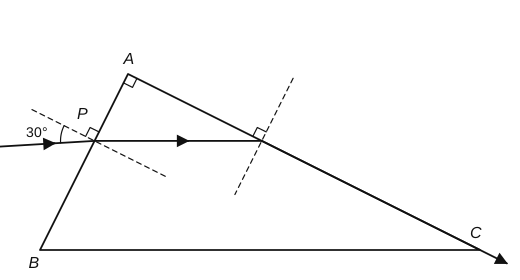
एक प्रकाश किरण चित्रानुसार एक समकोण प्रिज़्म में बिंदु P पर 30° आपतन कोण से प्रवेश करती है। यह प्रिज़्म में उसके आधार BC के समांतर चलती है और फलक AC के अनुदिश (along) निर्गत होती है। प्रिज़्म का अपवर्तनांक है:
- A
- B
- C
- D
Show answer
Concept: Emerging along face AC means grazing emergence: the angle of incidence on AC equals the critical angle, . In a prism .
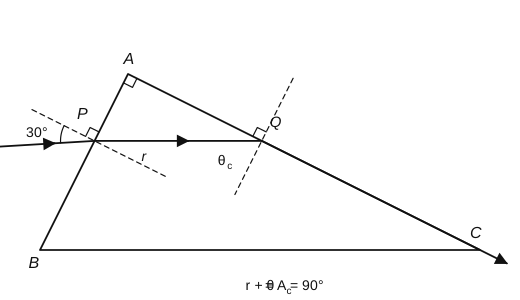
- Here A = 90°, → .
- Snell at P: .
Short trick: μ must be > 1, so (B), (C), (D) (all < 1) are impossible – only (A) survives without any working.
Answer: (A)
अवधारणा: फलक AC के अनुदिश निर्गत होने का अर्थ है स्पर्शी निर्गमन: AC पर आपतन कोण = क्रांतिक कोण, । प्रिज़्म में ।
- यहाँ A = 90°, → ।
- P पर स्नेल का नियम: ।
शॉर्ट ट्रिक: μ का मान 1 से अधिक होना चाहिए, अतः (B), (C), (D) (सभी < 1) असंभव – बिना गणना के केवल (A) बचता है।
उत्तर: (A)
NEET UGPhysicsRay optics – refraction through a prism, critical angleNEET UG 2024 · 5 May Shift 1
Q107.A wheel of a bullock cart is rolling on a level road as shown in the figure below. If its linear speed is v in the direction shown, which one of the following options is correct (P and Q are any highest and lowest points on the wheel, respectively)?
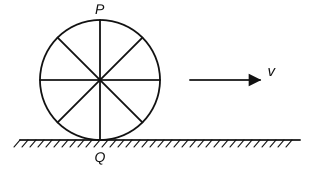
एक बैलगाड़ी का पहिया नीचे दिए चित्रानुसार समतल सड़क पर लुढ़क रहा है। यदि दर्शाई गई दिशा में इसकी रैखिक चाल v है, तो निम्नलिखित में से कौन-सा विकल्प सही है (P और Q क्रमशः पहिये के उच्चतम और निम्नतम बिंदु हैं)?
- APoint P moves faster than point Qबिंदु P, बिंदु Q से तेज़ चलता है
- BBoth the points P and Q move with equal speedबिंदु P और Q दोनों समान चाल से चलते हैं
- CPoint P has zero speedबिंदु P की चाल शून्य है
- DPoint P moves slower than point Qबिंदु P, बिंदु Q से धीमा चलता है
Show answer
Concept: In pure rolling ; velocity of a point = velocity of centre + rotational velocity .
- Top point P: .
- Contact point Q: .
- So P moves fastest and Q is momentarily at rest → (A); (B), (C), (D) wrong.
Short trick: Rolling wheel: top 2v, centre v, bottom 0 – the reason spokes look blurred at the top in photographs.
Answer: (A) Point P moves faster than point Q
अवधारणा: शुद्ध लोटनिक गति में ; किसी बिंदु का वेग = केंद्र का वेग + घूर्णी वेग ।
- शीर्ष बिंदु P: ।
- संपर्क बिंदु Q: ।
- अतः P सबसे तेज़ और Q क्षणिक विराम में → (A); (B), (C), (D) गलत।
शॉर्ट ट्रिक: लुढ़कता पहिया: शीर्ष 2v, केंद्र v, तली 0 – इसी कारण तस्वीरों में ऊपर की तीलियाँ धुंधली दिखती हैं।
उत्तर: (A) बिंदु P, बिंदु Q से तेज़ चलता है
NEET UGPhysicsRotational motion – rolling without slippingNEET UG 2024 · 5 May Shift 1
Q108.A thermodynamic system is taken through the cycle abcda. The work done by the gas along the path bc is:
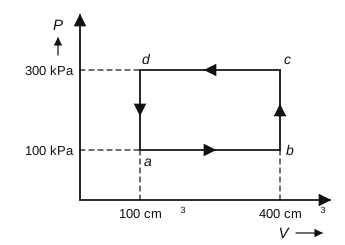
एक ऊष्मागतिक निकाय को चक्र abcda से ले जाया जाता है। पथ bc के अनुदिश गैस द्वारा किया गया कार्य है:
- A30 J
- B−90 J
- C−60 J
- DZeroशून्य
Show answer
Concept: Work by a gas = area under the P–V curve; if V does not change (isochoric), W = 0.
- Along bc, V stays 400 cm³ while P rises 100 → 300 kPa (vertical line).
- .
- (For comparison: J, J – the distractors.)
Short trick: Vertical line on P–V diagram ⇒ zero work, whatever the pressure change.
Answer: (D) Zero
अवधारणा: गैस द्वारा कार्य = P–V वक्र के नीचे का क्षेत्रफल; यदि V न बदले (समआयतनिक), तो W = 0।
- bc के अनुदिश V = 400 cm³ नियत रहता है जबकि P 100 → 300 kPa बढ़ता है (ऊर्ध्वाधर रेखा)।
- ।
- (तुलना हेतु: J, J – ये भ्रामक विकल्प हैं।)
शॉर्ट ट्रिक: P–V आरेख पर ऊर्ध्वाधर रेखा ⇒ कार्य शून्य, दाब कितना भी बदले।
उत्तर: (D) शून्य
NEET UGPhysicsThermodynamics – work in a cyclic processNEET UG 2024 · 5 May Shift 1
Q109.In an ideal transformer, the turns ratio is . The ratio is equal to (the symbols carry their usual meaning):
एक आदर्श ट्रांसफ़ॉर्मर में फेरों का अनुपात है। अनुपात बराबर है (प्रतीकों के सामान्य अर्थ हैं):
- A2 : 1
- B1 : 1
- C1 : 4
- D1 : 2
Show answer
Concept: For an ideal transformer .
- (step-up transformer).
Short trick: Voltage follows turns; current goes inversely. More secondary turns → step-up.
Answer: (A) 2 : 1
अवधारणा: आदर्श ट्रांसफ़ॉर्मर के लिए ।
- (उच्चायी / step-up ट्रांसफ़ॉर्मर)।
शॉर्ट ट्रिक: वोल्टता फेरों के अनुपात में, धारा व्युत्क्रम में। द्वितीयक में अधिक फेरे → उच्चायी।
उत्तर: (A) 2 : 1
NEET UGPhysicsAlternating current – ideal transformerNEET UG 2024 · 5 May Shift 1
Q110.A thin flat circular disc of radius 4.5 cm is placed gently over the surface of water. If surface tension of water is , then the excess force required to take it away from the surface is:
4.5 cm त्रिज्या की एक पतली सपाट वृत्ताकार चकती को जल की सतह पर धीरे से रखा जाता है। यदि जल का पृष्ठ तनाव है, तो इसे सतह से अलग करने के लिए आवश्यक अतिरिक्त बल है:
- A198 N
- B1.98 mN
- C99 N
- D19.8 mN
Show answer
Concept: A thin disc lying on water is held only along its rim (one contact line, length ): .
- N
- mN
Short trick: Disc on surface → one circumference (2πR); a ring pulled out of liquid → two circumferences (4πR).
Answer: (D) 19.8 mN
अवधारणा: जल पर रखी पतली चकती केवल अपनी परिधि (एक संपर्क रेखा, लंबाई ) पर पकड़ी रहती है: ।
- N
- mN
शॉर्ट ट्रिक: सतह पर चकती → एक परिधि (2πR); द्रव से खींची गई वलय → दो परिधियाँ (4πR)।
उत्तर: (D) 19.8 mN
NEET UGPhysicsMechanical properties of fluids – surface tension forceNEET UG 2024 · 5 May Shift 1
Q111.The maximum elongation of a steel wire of 1 m length if the elastic limit of steel and its Young’s modulus, respectively, are and , is
1 m लंबे स्टील के तार का अधिकतम दैर्ध्य-वृद्धि (elongation) क्या है, यदि स्टील की प्रत्यास्थता सीमा तथा यंग गुणांक क्रमशः और हैं?
- A0.4 mm
- B40 mm
- C8 mm
- D4 mm
Show answer
Concept: Within the elastic limit, stress = Y × strain, i.e. ; maximum ΔL when stress = elastic limit.
- m = 4 mm
Short trick: Strain = 8×10⁸ / 2×10¹¹ = 4×10⁻³; for a 1 m wire, ΔL = 4 mm directly.
Answer: (D) 4 mm
अवधारणा: प्रत्यास्थता सीमा के भीतर प्रतिबल = Y × विकृति, अर्थात् ; अधिकतम ΔL तब जब प्रतिबल = प्रत्यास्थता सीमा।
- m = 4 mm
शॉर्ट ट्रिक: विकृति = 8×10⁸ / 2×10¹¹ = 4×10⁻³; 1 m तार के लिए सीधे ΔL = 4 mm।
उत्तर: (D) 4 mm
NEET UGPhysicsMechanical properties of solids – Young’s modulusNEET UG 2024 · 5 May Shift 1
Q112.The mass of a planet is th that of the earth and its diameter is half that of the earth. The acceleration due to gravity on that planet is:
किसी ग्रह का द्रव्यमान पृथ्वी के द्रव्यमान का वाँ भाग है तथा उसका व्यास पृथ्वी के व्यास का आधा है। उस ग्रह पर गुरुत्वीय त्वरण है:
- A
- B
- C
- D
Show answer
Concept: .
Short trick: Mass ÷10 and radius ÷2 → g × (4/10) = 0.4 g.
Answer: (C)
अवधारणा: ।
शॉर्ट ट्रिक: द्रव्यमान ÷10 और त्रिज्या ÷2 → g × (4/10) = 0.4 g।
उत्तर: (C)
NEET UGPhysicsGravitation – acceleration due to gravity on a planetNEET UG 2024 · 5 May Shift 1
Q113.In a vernier calipers, divisions of vernier scale coincide with N divisions of main scale. If 1 MSD represents 0.1 mm, the vernier constant (in cm) is:
एक वर्नियर कैलिपर्स में वर्नियर पैमाने के भाग मुख्य पैमाने के N भागों के संपाती हैं। यदि 1 MSD = 0.1 mm है, तो वर्नियर स्थिरांक (cm में) है:
- A
- B100 N
- C
- D10 N
Show answer
Concept: Vernier constant (least count) = 1 MSD − 1 VSD.
- VC
- mm cm cm
Short trick: VC = (value of 1 MSD) ÷ (number of VSD) – here 0.01 cm ÷ (N + 1). Options (B)–(D) grow with N, which is absurd for a least count.
Answer: (A)
अवधारणा: वर्नियर स्थिरांक (अल्पतमांक) = 1 MSD − 1 VSD।
- VC
- mm cm cm
शॉर्ट ट्रिक: VC = (1 MSD का मान) ÷ (VSD की संख्या) – यहाँ 0.01 cm ÷ (N + 1)। विकल्प (B)–(D) N के साथ बढ़ते हैं, जो अल्पतमांक के लिए असंगत है।
उत्तर: (A)
NEET UGPhysicsUnits and measurements – vernier constantNEET UG 2024 · 5 May Shift 1
Q114.Given below are two statements:
Statement I: Atoms are electrically neutral as they contain equal number of positive and negative charges.
Statement II: Atoms of each element are stable and emit their characteristic spectrum.
In the light of the above statements, choose the most appropriate answer from the options given below:
नीचे दो कथन दिए गए हैं:
कथन I: परमाणु विद्युत रूप से उदासीन होते हैं क्योंकि उनमें धनात्मक और ऋणात्मक आवेशों की संख्या समान होती है।
कथन II: प्रत्येक तत्व के परमाणु स्थायी होते हैं और अपना अभिलाक्षणिक स्पेक्ट्रम उत्सर्जित करते हैं।
उपर्युक्त कथनों के आलोक में नीचे दिए गए विकल्पों में से सबसे उपयुक्त उत्तर चुनिए:
- ABoth Statement I and Statement II are incorrect.कथन I और कथन II दोनों गलत हैं।
- BStatement I is correct but Statement II is incorrect.कथन I सही है परंतु कथन II गलत है।
- CStatement I is incorrect but Statement II is correctकथन I गलत है परंतु कथन II सही है
- DBoth Statement I and Statement II are correctकथन I और कथन II दोनों सही हैं
Show answer
Concept: An atom has Z protons and Z electrons; it emits its characteristic line spectrum only when it is excited and de-excites – a stable atom in its ground state does not radiate.
- Statement I: equal positive (protons) and negative (electrons) charge → net charge zero → correct.
- Statement II: a stable (ground-state) atom does not emit; emission needs excitation (heating, electric discharge). The statement links stability with emission → incorrect.
- Hence I correct, II incorrect.
Short trick: “Stable atom = no radiation” (Bohr’s postulate). Spectrum appears only on jumping down from an excited state.
Answer: (B) Statement I is correct but Statement II is incorrect.
अवधारणा: परमाणु में Z प्रोटॉन और Z इलेक्ट्रॉन होते हैं; यह अपना अभिलाक्षणिक रेखिल स्पेक्ट्रम तभी उत्सर्जित करता है जब यह उत्तेजित होकर निम्न अवस्था में लौटे – मूल अवस्था का स्थायी परमाणु विकिरण नहीं करता।
- कथन I: समान धन (प्रोटॉन) और ऋण (इलेक्ट्रॉन) आवेश → कुल आवेश शून्य → सही।
- कथन II: स्थायी (मूल अवस्था का) परमाणु उत्सर्जन नहीं करता; उत्सर्जन हेतु उत्तेजन (गर्म करना, विद्युत विसर्जन) आवश्यक है। कथन स्थायित्व को उत्सर्जन से जोड़ता है → गलत।
- अतः I सही, II गलत।
शॉर्ट ट्रिक: “स्थायी परमाणु = कोई विकिरण नहीं” (बोर अभिधारणा)। स्पेक्ट्रम केवल उत्तेजित अवस्था से नीचे आने पर बनता है।
उत्तर: (B) कथन I सही है परंतु कथन II गलत है।
NEET UGPhysicsAtoms – neutrality and spectra (statements)NEET UG 2024 · 5 May Shift 1
Q115.A horizontal force 10 N is applied to a block A as shown in figure. The mass of blocks A and B are 2 kg and 3 kg, respectively. The blocks slide over a frictionless surface. The force exerted by block A on block B is:
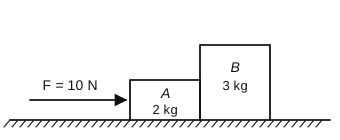
चित्रानुसार एक गुटके A पर 10 N का क्षैतिज बल लगाया जाता है। गुटकों A और B के द्रव्यमान क्रमशः 2 kg और 3 kg हैं। गुटके घर्षणरहित सतह पर फिसलते हैं। गुटके A द्वारा गुटके B पर लगाया गया बल है:
- A4 N
- B6 N
- C10 N
- DZeroशून्य
Show answer
Concept: Both blocks move together with ; the contact force N alone accelerates B.
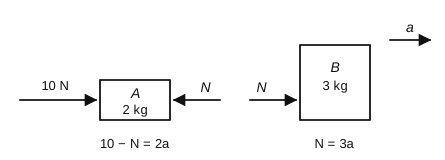
- For B: N
- Check with A: N.
Short trick: Contact force = F × (mass being pushed)/(total mass) = 10 × 3/5 = 6 N.
Answer: (B) 6 N
अवधारणा: दोनों गुटके एक साथ से त्वरित होते हैं; केवल संपर्क बल N ही B को त्वरित करता है।
- B के लिए: N
- A से जाँच: N।
शॉर्ट ट्रिक: संपर्क बल = F × (धकेला जा रहा द्रव्यमान)/(कुल द्रव्यमान) = 10 × 3/5 = 6 N।
उत्तर: (B) 6 N
NEET UGPhysicsLaws of motion – contact force between blocksNEET UG 2024 · 5 May Shift 1
Q116.The quantities which have the same dimensions as those of solid angle are:
वे राशियाँ जिनकी विमाएँ घन कोण (solid angle) की विमाओं के समान हैं:
- AStress and angleप्रतिबल और कोण
- BStrain and arcविकृति और चाप
- CAngular speed and stressकोणीय चाल और प्रतिबल
- DStrain and angleविकृति और कोण
Show answer
Concept: Solid angle is a ratio → dimensionless .
- Strain = ΔL/L → dimensionless; plane angle = arc/radius → dimensionless.
- Stress , arc [L], angular speed are not dimensionless → (A), (B), (C) wrong.
Short trick: Any “ratio of same kind of quantities” (strain, angle, solid angle, refractive index, relative density) is dimensionless.
Answer: (D) Strain and angle
अवधारणा: घन कोण एक अनुपात है → विमाहीन ।
- विकृति = ΔL/L → विमाहीन; समतल कोण = चाप/त्रिज्या → विमाहीन।
- प्रतिबल , चाप [L], कोणीय चाल विमाहीन नहीं → (A), (B), (C) गलत।
शॉर्ट ट्रिक: “समान प्रकार की राशियों का अनुपात” (विकृति, कोण, घन कोण, अपवर्तनांक, आपेक्षिक घनत्व) सदैव विमाहीन होता है।
उत्तर: (D) विकृति और कोण
NEET UGPhysicsUnits and dimensions – dimensionless quantitiesNEET UG 2024 · 5 May Shift 1
Q117.The moment of inertia of a thin rod about an axis passing through its mid point and perpendicular to the rod is . The length of the 400 g rod is nearly:
एक पतली छड़ का उसके मध्य बिंदु से गुजरने वाली तथा छड़ के लंबवत अक्ष के परितः जड़त्व आघूर्ण है। 400 g की इस छड़ की लंबाई लगभग है:
- A17.5 cm
- B20.7 cm
- C72.0 cm
- D8.5 cm
Show answer
Concept: Thin rod about the perpendicular axis through its centre: .
- cm
Short trick: Option (C) 72.0 is L², not L – a classic trap.
Answer: (D) 8.5 cm
अवधारणा: पतली छड़, केंद्र से गुजरने वाली लंबवत अक्ष के परितः: ।
- cm
शॉर्ट ट्रिक: विकल्प (C) 72.0, L² है, L नहीं – सामान्य जाल।
उत्तर: (D) 8.5 cm
NEET UGPhysicsRotational motion – moment of inertia of a rodNEET UG 2024 · 5 May Shift 1
Q118.Consider the following statements A and B and identify the correct answer:
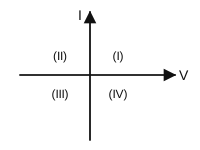
A. For a solar cell, the I-V characteristic lies in the IV quadrant of the given graph.
B. In a reverse biased pn junction diode, the current measured in (μA), is due to majority charge carriers.
निम्नलिखित कथनों A और B पर विचार कीजिए तथा सही उत्तर पहचानिए:
A. सौर सेल के लिए I-V अभिलक्षण दिए गए ग्राफ़ के IV चतुर्थांश में होता है।
B. पश्च बायसित (reverse biased) pn संधि डायोड में मापी गई धारा (μA में) बहुसंख्यक आवेश वाहकों के कारण होती है।
- AA is incorrect but B is correctA गलत है परंतु B सही है
- BBoth A and B are correctA और B दोनों सही हैं
- CBoth A and B are incorrectA और B दोनों गलत हैं
- DA is correct but B is incorrect.A सही है परंतु B गलत है।
Show answer
Concept: A solar cell supplies power: V positive while current flows opposite (I negative) → fourth quadrant. Reverse-bias current is the drift of thermally generated minority carriers.
- A: the solar-cell I–V curve is drawn in the IV quadrant (V > 0, I < 0) → correct.
- B: in reverse bias the barrier stops majority carriers; the small μA current is due to minority carriers → incorrect.
Short trick: Generator devices (solar cell) live in quadrant IV; reverse current = “minority μA”.
Answer: (D) A is correct but B is incorrect.
अवधारणा: सौर सेल शक्ति प्रदान करता है: V धनात्मक जबकि धारा विपरीत दिशा में (I ऋणात्मक) → चतुर्थ चतुर्थांश। पश्च बायस धारा ऊष्मीय रूप से उत्पन्न अल्पसंख्यक वाहकों के अपवाह से होती है।
- A: सौर सेल का I–V वक्र IV चतुर्थांश (V > 0, I < 0) में खींचा जाता है → सही।
- B: पश्च बायस में विभव प्राचीर बहुसंख्यक वाहकों को रोक देता है; छोटी μA धारा अल्पसंख्यक वाहकों के कारण है → गलत।
शॉर्ट ट्रिक: जनित्र जैसी युक्तियाँ (सौर सेल) चतुर्थांश IV में; पश्च धारा = “अल्पसंख्यक μA”।
उत्तर: (D) A सही है परंतु B गलत है।
NEET UGPhysicsSemiconductor electronics – solar cell and reverse biasNEET UG 2024 · 5 May Shift 1
Q119.A wire of length ‘’ and resistance 100 Ω is divided into 10 equal parts. The first 5 parts are connected in series while the next 5 parts are connected in parallel. The two combinations are again connected in series. The resistance of this final combination is:
‘’ लंबाई और 100 Ω प्रतिरोध के एक तार को 10 बराबर भागों में बाँटा जाता है। पहले 5 भागों को श्रेणी में तथा अगले 5 भागों को समांतर में जोड़ा जाता है। फिर दोनों संयोजनों को श्रेणी में जोड़ा जाता है। इस अंतिम संयोजन का प्रतिरोध है:
- A52 Ω
- B55 Ω
- C60 Ω
- D26 Ω
Show answer
Concept: R ∝ length, so each tenth has R/10; n equal resistors: series nR₀, parallel R₀/n.
- Each part .
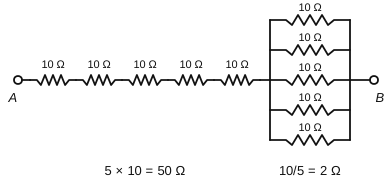
- Series part: ; parallel part: .
- Total .
Short trick: Answer must be just above 50 Ω (series part) – only 52 Ω fits.
Answer: (A) 52 Ω
अवधारणा: R ∝ लंबाई, अतः प्रत्येक दसवें भाग का प्रतिरोध R/10; n समान प्रतिरोध: श्रेणी में nR₀, समांतर में R₀/n।
- प्रत्येक भाग ।
- श्रेणी भाग: ; समांतर भाग: ।
- कुल ।
शॉर्ट ट्रिक: उत्तर 50 Ω (श्रेणी भाग) से थोड़ा अधिक होना चाहिए – केवल 52 Ω उपयुक्त है।
उत्तर: (A) 52 Ω
NEET UGPhysicsCurrent electricity – series and parallel resistorsNEET UG 2024 · 5 May Shift 1
Q120.If m represents the motion of a particle executing simple harmonic motion, the amplitude and time period of motion, respectively, are:
यदि m सरल आवर्त गति करते किसी कण की गति को निरूपित करता है, तो गति का आयाम और आवर्तकाल क्रमशः हैं:
- A5 m, 2 s
- B5 cm, 1 s
- C5 m, 1 s
- D5 cm, 2 s
Show answer
Concept: Compare with ; .
- Amplitude A = 5 m (unit given as m).
- s.
Short trick: ω = π always means T = 2 s. Units: the equation is in metres, so “cm” options go out.
Answer: (A) 5 m, 2 s
अवधारणा: से तुलना कीजिए; ।
- आयाम A = 5 m (मात्रक m दिया है)।
- s।
शॉर्ट ट्रिक: ω = π का अर्थ सदैव T = 2 s। मात्रक: समीकरण मीटर में है, अतः “cm” वाले विकल्प हट जाते हैं।
उत्तर: (A) 5 m, 2 s
NEET UGPhysicsOscillations – SHM equationNEET UG 2024 · 5 May Shift 1

