Q161.A metal wire has mass g, radius mm and length cm. The maximum possible percentage error in the measurement of density will nearly be:
एक धातु के तार का द्रव्यमान g, त्रिज्या mm तथा लम्बाई cm है। घनत्व के मापन में अधिकतम संभावित प्रतिशत त्रुटि लगभग होगी:
- A1.2%
- B1.3%
- C1.6%
- D1.4%
Show answer
Concept: (relative errors add, powers multiply).
- Total = 0.5 + 0.667 + 0.4 = 1.567% ≈ 1.6%
Short trick: Write each as a percentage first (0.5, 0.33×2, 0.4) and add – the radius term is doubled because r is squared.
Answer: (C) 1.6%
अवधारणा: (आपेक्षिक त्रुटियाँ जुड़ती हैं, घात से गुणा होती हैं)।
- कुल = 0.5 + 0.667 + 0.4 = 1.567% ≈ 1.6%
शॉर्ट ट्रिक: पहले प्रत्येक को प्रतिशत में लिखें (0.5, 0.33×2, 0.4) और जोड़ें – त्रिज्या का पद दुगुना होता है क्योंकि r का वर्ग है।
उत्तर: (C) 1.6%
NEET UGPhysicsUnits and measurements – propagation of errorsNEET UG 2023 · 7 May Shift 1
Q162.The equivalent capacitance of the system shown in the following circuit is:
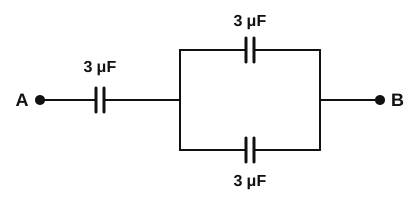
निम्नलिखित परिपथ में दर्शाए गए निकाय की तुल्य धारिता है:
- A
- B
- C
- D
Show answer
Concept: Parallel: ; series: .
- The two 3 μF capacitors between the junctions are in parallel:
- This 6 μF is in series with the first 3 μF:
Short trick: Series result is always smaller than the smallest capacitor (3 μF) → only 2 μF fits.
Answer: (A)
अवधारणा: समांतर: ; श्रेणी: ।
- संधियों के बीच के दो 3 μF संधारित्र समांतर में हैं:
- यह 6 μF पहले 3 μF के साथ श्रेणी में है:
शॉर्ट ट्रिक: श्रेणी संयोजन का परिणाम सबसे छोटे संधारित्र (3 μF) से भी कम होता है → केवल 2 μF उपयुक्त।
उत्तर: (A)
NEET UGPhysicsElectrostatics – combination of capacitorsNEET UG 2023 · 7 May Shift 1
Q163.Two bodies of mass m and 9m are placed at a distance R. The gravitational potential on the line joining the bodies where the gravitational field equals zero, will be (G = gravitational constant):
द्रव्यमान m तथा 9m के दो पिंड R दूरी पर रखे हैं। पिंडों को मिलाने वाली रेखा पर उस बिंदु पर गुरुत्वीय विभव, जहाँ गुरुत्वीय क्षेत्र शून्य है, होगा (G = गुरुत्वाकर्षण नियतांक):
- A
- B
- C
- D
Show answer
Concept: Field is zero where the two pulls balance; potential is a scalar sum (it is not zero there).
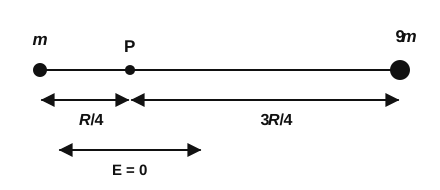
- At distance x from m:
Short trick: Neutral point divides R in ratio → R/4 and 3R/4.
Answer: (C)
अवधारणा: जहाँ दोनों आकर्षण संतुलित हों वहाँ क्षेत्र शून्य होता है; विभव अदिश योग है (वहाँ शून्य नहीं)।
- m से x दूरी पर:
शॉर्ट ट्रिक: उदासीन बिंदु R को के अनुपात में बाँटता है → R/4 और 3R/4।
उत्तर: (C)
NEET UGPhysicsGravitation – neutral point and gravitational potentialNEET UG 2023 · 7 May Shift 1
Q164.The venturi-meter works on:
वेंचुरी-मीटर किस पर कार्य करता है?
- AHuygens’s principleहाइगेंस का सिद्धांत
- BBernoulli’s principleबर्नौली का सिद्धांत
- CThe principle of parallel axesसमांतर अक्षों का सिद्धांत
- DThe principle of perpendicular axesलंबवत अक्षों का सिद्धांत
Show answer
Concept: A venturi-meter measures flow speed from the pressure difference between the wide and narrow parts of a tube – Bernoulli’s principle with the equation of continuity.
- At the narrow throat speed is higher, so pressure is lower ( = constant).
- Huygens’s principle is for wavefronts (optics); parallel/perpendicular axes theorems are for moment of inertia.
Short trick: Venturi-meter, atomizer, aerofoil lift, blowing-off roofs – all Bernoulli.
Answer: (B) Bernoulli’s principle
अवधारणा: वेंचुरी-मीटर नली के चौड़े और संकरे भागों के दाबान्तर से प्रवाह चाल मापता है – बर्नौली सिद्धांत तथा सांतत्य समीकरण।
- संकरे भाग (कंठ) पर चाल अधिक, अतः दाब कम ( = नियत)।
- हाइगेंस सिद्धांत तरंगाग्रों (प्रकाशिकी) के लिए है; समांतर/लंबवत अक्ष प्रमेय जड़त्व आघूर्ण के लिए हैं।
शॉर्ट ट्रिक: वेंचुरी-मीटर, कणित्र (atomizer), वायुयान पंख का उत्थापन, छतों का उड़ना – सब बर्नौली।
उत्तर: (B) बर्नौली का सिद्धांत
NEET UGPhysicsMechanical properties of fluids – Bernoulli’s principleNEET UG 2023 · 7 May Shift 1
Q165.The half life of a radioactive substance is 20 minutes. In how much time, the activity of substance drops to of its initial value?
एक रेडियोधर्मी पदार्थ की अर्ध-आयु 20 मिनट है। कितने समय में पदार्थ की सक्रियता अपने प्रारंभिक मान की वाँ भाग रह जाएगी?
- A20 minutes20 मिनट
- B40 minutes40 मिनट
- C60 minutes60 मिनट
- D80 minutes80 मिनट
Show answer
Concept: After n half-lives, .
Short trick: 1 → ½ → ¼ → ⅛ → 1/16: four halvings × 20 min = 80 min.
Answer: (D) 80 minutes
अवधारणा: n अर्ध-आयु के बाद ।
शॉर्ट ट्रिक: 1 → ½ → ¼ → ⅛ → 1/16: चार बार आधा × 20 मिनट = 80 मिनट।
उत्तर: (D) 80 मिनट
NEET UGPhysicsNuclei – radioactive decay and half-lifeNEET UG 2023 · 7 May Shift 1
Q166.A football player is moving southward and suddenly turns eastward with the same speed to avoid an opponent. The force that acts on the player while turning is:
एक फुटबॉल खिलाड़ी दक्षिण की ओर दौड़ रहा है और प्रतिद्वंद्वी से बचने के लिए अचानक समान चाल से पूर्व की ओर मुड़ जाता है। मुड़ते समय खिलाड़ी पर लगने वाला बल है:
- AAlong Eastwardपूर्व की ओर
- BAlong Northwardउत्तर की ओर
- CAlong North-Eastउत्तर-पूर्व की ओर
- DAlong South-Westदक्षिण-पश्चिम की ओर
Show answer
Concept: , so the force is along the change in momentum .
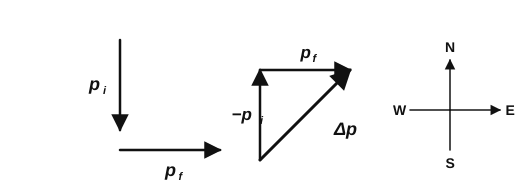
- Take East = , North = . (south), (east)
- points midway between East and North → North-East.
Short trick: : East + North = North-East.
Answer: (C) Along North-East
अवधारणा: , अतः बल संवेग परिवर्तन की दिशा में होता है।
- पूर्व = , उत्तर = लें। (दक्षिण), (पूर्व)
- पूर्व और उत्तर के ठीक बीच → उत्तर-पूर्व।
शॉर्ट ट्रिक: : पूर्व + उत्तर = उत्तर-पूर्व।
उत्तर: (C) उत्तर-पूर्व की ओर
NEET UGPhysicsLaws of motion – force as rate of change of momentumNEET UG 2023 · 7 May Shift 1
Q167.The errors in the measurement which arise due to unpredictable fluctuations in temperature and voltage supply are:
ताप तथा वोल्टता आपूर्ति में अप्रत्याशित उतार-चढ़ाव के कारण मापन में उत्पन्न होने वाली त्रुटियाँ हैं:
- AInstrumental errorsयंत्रीय त्रुटियाँ
- BPersonal errorsव्यक्तिगत त्रुटियाँ
- CLeast count errorsअल्पतमांक त्रुटियाँ
- DRandom errorsयादृच्छिक त्रुटियाँ
Show answer
Concept: NCERT: random errors occur irregularly and arise from random and unpredictable fluctuations in experimental conditions (temperature, voltage supply, mechanical vibrations).
- Instrumental errors come from imperfect design/calibration (systematic).
- Personal errors come from the observer’s bias or carelessness (systematic).
- Least count errors come from the resolution of the instrument.
- Unpredictable fluctuations → random errors.
Short trick: “Unpredictable / fluctuation / irregular” = random; reduce them by taking many readings and averaging.
Answer: (D) Random errors
अवधारणा: NCERT: यादृच्छिक त्रुटियाँ अनियमित होती हैं और प्रायोगिक परिस्थितियों (ताप, वोल्टता आपूर्ति, यांत्रिक कंपन) में यादृच्छिक, अप्रत्याशित उतार-चढ़ाव से उत्पन्न होती हैं।
- यंत्रीय त्रुटियाँ अपूर्ण बनावट/अंशांकन से आती हैं (क्रमबद्ध)।
- व्यक्तिगत त्रुटियाँ प्रेक्षक के पूर्वाग्रह या असावधानी से आती हैं (क्रमबद्ध)।
- अल्पतमांक त्रुटियाँ यंत्र की विभेदन क्षमता से आती हैं।
- अप्रत्याशित उतार-चढ़ाव → यादृच्छिक त्रुटियाँ।
शॉर्ट ट्रिक: “अप्रत्याशित / उतार-चढ़ाव / अनियमित” = यादृच्छिक; अनेक पाठ्यांक लेकर औसत करने से घटती हैं।
उत्तर: (D) यादृच्छिक त्रुटियाँ
NEET UGPhysicsUnits and measurements – types of errorsNEET UG 2023 · 7 May Shift 1
Q168.The angular acceleration of a body, moving along the circumference of a circle, is:
वृत्त की परिधि पर गतिमान किसी पिंड का कोणीय त्वरण होता है:
- AAlong the radius, away from centreत्रिज्या के अनुदिश, केंद्र से दूर
- BAlong the radius towards the centreत्रिज्या के अनुदिश, केंद्र की ओर
- CAlong the tangent to its positionअपनी स्थिति पर स्पर्शरेखा के अनुदिश
- DAlong the axis of rotationघूर्णन अक्ष के अनुदिश
Show answer
Concept: is an axial vector along the axis (right-hand rule); for a fixed axis is also along the axis.
- Radially inward is the centripetal (linear) acceleration, not angular.
- Tangential direction is that of linear velocity / tangential acceleration.
- Radially outward is no acceleration of uniform/non-uniform circular motion.
- Angular velocity and angular acceleration lie along the axis of rotation.
Short trick: Angular quantities (ω, α, τ, L) point along the axis; linear ones (v, at, ac) lie in the plane of the circle.
Answer: (D) Along the axis of rotation
अवधारणा: अक्ष के अनुदिश एक अक्षीय सदिश है (दक्षिण-हस्त नियम); स्थिर अक्ष के लिए भी अक्ष के अनुदिश होता है।
- त्रिज्यतः भीतर की ओर अभिकेंद्र (रैखिक) त्वरण है, कोणीय नहीं।
- स्पर्शरेखीय दिशा रैखिक वेग / स्पर्शरेखीय त्वरण की है।
- त्रिज्यतः बाहर की ओर वृत्तीय गति का कोई त्वरण नहीं होता।
- कोणीय वेग और कोणीय त्वरण घूर्णन अक्ष के अनुदिश होते हैं।
शॉर्ट ट्रिक: कोणीय राशियाँ (ω, α, τ, L) अक्ष के अनुदिश; रैखिक राशियाँ (v, at, ac) वृत्त के तल में।
उत्तर: (D) घूर्णन अक्ष के अनुदिश
NEET UGPhysicsRotational motion – angular acceleration as a vectorNEET UG 2023 · 7 May Shift 1
Q169.A full wave rectifier circuit consists of two p-n junction diodes, a centre-tapped transformer, capacitor and a load resistance. Which of these components remove the ac ripple from the rectified output?
एक पूर्ण तरंग दिष्टकारी परिपथ में दो p-n संधि डायोड, एक केंद्र-निष्कासित (centre-tapped) ट्रांसफॉर्मर, संधारित्र तथा एक लोड प्रतिरोध है। इनमें से कौन-सा घटक दिष्टकृत निर्गत से ac ऊर्मिका (ripple) को हटाता है?
- AA centre-tapped transformerकेंद्र-निष्कासित ट्रांसफॉर्मर
- Bp-n junction diodesp-n संधि डायोड
- CCapacitorसंधारित्र
- DLoad resistanceलोड प्रतिरोध
Show answer
Concept: A capacitor connected across the load acts as a filter: it charges at peaks and discharges slowly between them, smoothing out the ripple.
- Transformer only provides the two out-of-phase ac voltages.
- Diodes convert ac to pulsating dc (rectification), they do not smooth it.
- Load resistance just consumes the output.
- Capacitor filter removes the ac ripple.
Short trick: Diode rectifies, capacitor filters (“C for Cleaning ripple”).
Answer: (C) Capacitor
अवधारणा: लोड के समांतर जुड़ा संधारित्र फ़िल्टर का काम करता है: यह शिखरों पर आवेशित होकर बीच में धीरे-धीरे निरावेशित होता है, जिससे ऊर्मिका समतल हो जाती है।
- ट्रांसफॉर्मर केवल दो विपरीत कला वाली ac वोल्टताएँ देता है।
- डायोड ac को स्पंदमान dc में बदलते हैं (दिष्टकरण), समतल नहीं करते।
- लोड प्रतिरोध केवल निर्गत का उपभोग करता है।
- संधारित्र फ़िल्टर ac ऊर्मिका को हटाता है।
शॉर्ट ट्रिक: डायोड दिष्टकरण करता है, संधारित्र फ़िल्टर करता है।
उत्तर: (C) संधारित्र
NEET UGPhysicsSemiconductor electronics – rectifier and filterNEET UG 2023 · 7 May Shift 1
Q170.The ratio of radius of gyration of a solid sphere of mass M and radius R about its own axis to the radius of gyration of the thin hollow sphere of same mass and radius about its axis is:
द्रव्यमान M तथा त्रिज्या R के एक ठोस गोले की अपनी अक्ष के परितः घूर्णन त्रिज्या का, समान द्रव्यमान और त्रिज्या के पतले खोखले गोले की उसकी अक्ष के परितः घूर्णन त्रिज्या से अनुपात है:
- A3 : 5
- B5 : 3
- C2 : 5
- D5 : 2
Show answer
Concept: .
- Solid sphere:
- Hollow sphere:
- 3 : 5 is the ratio of (or of I), not of K; 5 : 3, 2 : 5 and 5 : 2 are also not equal to .
Short trick: Ratio of K = square root of ratio of I: .
Answer: Bonus – the correct ratio is , which is not among the options as given; marks to all.
अवधारणा: ।
- ठोस गोला:
- खोखला गोला:
- 3 : 5 तो (या I) का अनुपात है, K का नहीं; 5 : 3, 2 : 5 और 5 : 2 भी के बराबर नहीं।
शॉर्ट ट्रिक: K का अनुपात = I के अनुपात का वर्गमूल: ।
उत्तर: बोनस – सही अनुपात है, जो दिए गए विकल्पों में नहीं है; सभी को अंक।
NEET UGPhysicsRotational motion – radius of gyrationNEET UG 2023 · 7 May Shift 1
Q171.The magnitude and direction of the current in the following circuit is
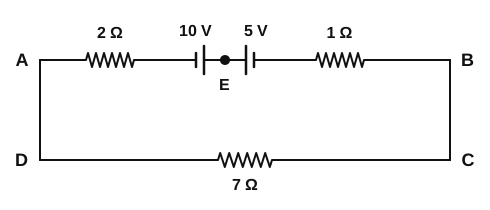
निम्नलिखित परिपथ में धारा का परिमाण तथा दिशा है
- A0.2 A from B to A through E0.2 A, B से A की ओर E से होकर
- B0.5 A from A to B through E0.5 A, A से B की ओर E से होकर
- C A from A to B through E A, A से B की ओर E से होकर
- D1.5 A from B to A through E1.5 A, B से A की ओर E से होकर
Show answer
Concept: In a single loop, cells facing each other subtract: ; current flows in the direction set by the larger cell.
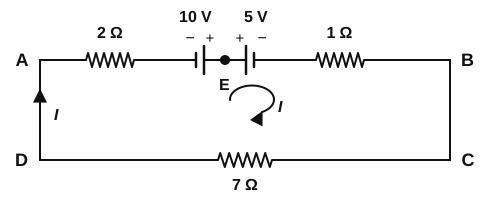
- Both cells have their positive plates (long lines) towards E, so they oppose each other. Net emf = 10 − 5 = 5 V.
- Total resistance = 2 + 1 + 7 = 10 Ω ⇒
- The 10 V cell wins; it pushes current out of its + plate, i.e. from A towards E and on to B (then B → C → D → A).
Short trick: Opposing cells: subtract emfs, add resistances; direction = the way the bigger cell pushes. Only 0.5 A matches 5/10.
Answer: (B) 0.5 A from A to B through E
अवधारणा: एकल पाश में आमने-सामने जुड़े सेल घटते हैं: ; धारा बड़े सेल द्वारा निर्धारित दिशा में बहती है।
- दोनों सेलों की धन प्लेटें (लंबी रेखाएँ) E की ओर हैं, अतः वे एक-दूसरे का विरोध करते हैं। कुल वि.वा.बल = 10 − 5 = 5 V।
- कुल प्रतिरोध = 2 + 1 + 7 = 10 Ω ⇒
- 10 V का सेल प्रबल है; यह अपनी + प्लेट से धारा बाहर भेजता है, अर्थात् A से E की ओर और आगे B तक (फिर B → C → D → A)।
शॉर्ट ट्रिक: विरोधी सेल: वि.वा.बल घटाएँ, प्रतिरोध जोड़ें; दिशा = बड़ा सेल जिधर धकेले। केवल 0.5 A ही 5/10 से मेल खाता है।
उत्तर: (B) 0.5 A, A से B की ओर E से होकर
NEET UGPhysicsCurrent electricity – Kirchhoff’s loop law (opposing cells)NEET UG 2023 · 7 May Shift 1
Q172.An ac source is connected to a capacitor C. Due to decrease in its operating frequency:
एक ac स्रोत संधारित्र C से जुड़ा है। इसकी प्रचालन आवृत्ति घटाने के कारण:
- ACapacitive reactance decreasesधारितीय प्रतिघात घटता है
- BDisplacement current increasesविस्थापन धारा बढ़ती है
- CDisplacement current decreasesविस्थापन धारा घटती है
- DCapacitive reactance remains constantधारितीय प्रतिघात नियत रहता है
Show answer
Concept: ; the conduction current in the wires equals the displacement current between the plates, .
- f decreases ⇒ increases (so (A) and (D) are wrong).
- decreases ⇒ displacement current also decreases (so (B) is wrong).
Short trick: Capacitor “blocks” low frequency: lower f → larger → smaller current, conduction and displacement alike.
Answer: (C) Displacement current decreases
अवधारणा: ; तारों में चालन धारा प्लेटों के बीच की विस्थापन धारा के बराबर होती है, ।
- f घटने पर बढ़ता है (अतः (A) और (D) गलत)।
- घटती है ⇒ विस्थापन धारा भी घटती है (अतः (B) गलत)।
शॉर्ट ट्रिक: संधारित्र निम्न आवृत्ति को “रोकता” है: कम f → अधिक → कम धारा, चालन और विस्थापन दोनों।
उत्तर: (C) विस्थापन धारा घटती है
NEET UGPhysicsElectromagnetic waves – displacement current in capacitorNEET UG 2023 · 7 May Shift 1
Q173.The net magnetic flux through any closed surface is:
किसी भी बंद पृष्ठ से गुजरने वाला कुल चुम्बकीय फ्लक्स है:
- AZeroशून्य
- BPositiveधनात्मक
- CInfinityअनंत
- DNegativeऋणात्मक
Show answer
Concept: Gauss’s law for magnetism: , because isolated magnetic poles (monopoles) do not exist.
- Magnetic field lines are closed loops; every line that enters a closed surface also leaves it.
- Hence net flux is zero – never positive, negative or infinite.
Short trick: No magnetic monopole ⇒ no “magnetic charge” enclosed ⇒ flux = 0.
Answer: (A) Zero
अवधारणा: चुम्बकत्व के लिए गाउस का नियम: , क्योंकि पृथक चुम्बकीय ध्रुव (एकल ध्रुव) नहीं होते।
- चुम्बकीय क्षेत्र रेखाएँ बंद लूप होती हैं; बंद पृष्ठ में प्रवेश करने वाली प्रत्येक रेखा बाहर भी निकलती है।
- अतः कुल फ्लक्स शून्य है – कभी धनात्मक, ऋणात्मक या अनंत नहीं।
शॉर्ट ट्रिक: चुम्बकीय एकल ध्रुव नहीं ⇒ परिबद्ध “चुम्बकीय आवेश” नहीं ⇒ फ्लक्स = 0।
उत्तर: (A) शून्य
NEET UGPhysicsMagnetism – Gauss’s law for magnetismNEET UG 2023 · 7 May Shift 1
Q174.In a plane electromagnetic wave travelling in free space, the electric field component oscillates sinusoidally at a frequency of Hz and amplitude . Then the amplitude of oscillating magnetic field is: (Speed of light in free space )
मुक्त आकाश में गतिमान एक समतल विद्युत-चुम्बकीय तरंग में विद्युत क्षेत्र घटक Hz आवृत्ति तथा आयाम से ज्यावक्रीय रूप से दोलन करता है। तब दोलनशील चुम्बकीय क्षेत्र का आयाम है: (मुक्त आकाश में प्रकाश की चाल )
- A T
- B T
- C T
- D T
Show answer
Concept: In an em wave (frequency is not needed).
Short trick: Frequency is a distractor; just divide E by c: 48/3 = 16 → 1.6 × 10⁻⁷ T.
Answer: (C) T
अवधारणा: विद्युत-चुम्बकीय तरंग में (आवृत्ति की आवश्यकता नहीं)।
शॉर्ट ट्रिक: आवृत्ति भ्रामक है; बस E को c से भाग दें: 48/3 = 16 → 1.6 × 10⁻⁷ T।
उत्तर: (C) T
NEET UGPhysicsElectromagnetic waves – relation between E and BNEET UG 2023 · 7 May Shift 1
Q175.The potential energy of a long spring when stretched by 2 cm is U. If the spring is stretched by 8 cm, potential energy stored in it will be:
एक लंबी स्प्रिंग को 2 cm खींचने पर उसकी स्थितिज ऊर्जा U है। यदि स्प्रिंग को 8 cm खींचा जाए, तो उसमें संचित स्थितिज ऊर्जा होगी:
- A2U
- B4U
- C8U
- D16U
Show answer
Concept: Spring potential energy .
Short trick: Extension × 4 ⇒ energy × 4² = 16.
Answer: (D) 16U
अवधारणा: स्प्रिंग की स्थितिज ऊर्जा ।
शॉर्ट ट्रिक: खिंचाव × 4 ⇒ ऊर्जा × 4² = 16।
उत्तर: (D) 16U
NEET UGPhysicsWork, energy and power – spring potential energyNEET UG 2023 · 7 May Shift 1
Q176.A bullet from a gun is fired on a rectangular wooden block with velocity u. When bullet travels 24 cm through the block along its length horizontally, velocity of bullet becomes . Then it further penetrates into the block in the same direction before coming to rest exactly at the other end of the block. The total length of the block is:
बन्दूक से एक गोली वेग u से एक आयताकार लकड़ी के गुटके पर दागी जाती है। जब गोली गुटके में उसकी लम्बाई के अनुदिश क्षैतिजतः 24 cm चलती है, तो गोली का वेग हो जाता है। फिर यह उसी दिशा में गुटके में और आगे धँसती है तथा ठीक गुटके के दूसरे सिरे पर विरामावस्था में आ जाती है। गुटके की कुल लम्बाई है:
- A27 cm
- B24 cm
- C28 cm
- D30 cm
Show answer
Concept: Constant retardation: , so distance loss of .
- First part:
- Second part:
- Total length = 24 + 3 = 27 cm
Short trick: Distance ∝ drop in : first drop ↔ 24 cm; remaining ↔ 24/8 = 3 cm.
Answer: (A) 27 cm
अवधारणा: नियत मंदन: , अतः दूरी में कमी।
- पहला भाग:
- दूसरा भाग:
- कुल लम्बाई = 24 + 3 = 27 cm
शॉर्ट ट्रिक: दूरी ∝ में कमी: पहली कमी ↔ 24 cm; शेष ↔ 24/8 = 3 cm।
उत्तर: (A) 27 cm
NEET UGPhysicsKinematics – uniformly retarded motionNEET UG 2023 · 7 May Shift 1
Q177.A satellite is orbiting just above the surface of the earth with period T. If d is the density of the earth and G is the universal constant of gravitation, the quantity represents:
एक उपग्रह पृथ्वी के पृष्ठ के ठीक ऊपर आवर्तकाल T से परिक्रमा कर रहा है। यदि d पृथ्वी का घनत्व तथा G सार्वत्रिक गुरुत्वाकर्षण नियतांक है, तो राशि निरूपित करती है:
- AT
- B
- C
- D
Show answer
Concept: For an orbit of radius R: , with .
Short trick: Dimension check: has units (since ), so is a time squared → .
Answer: (B)
अवधारणा: R त्रिज्या की कक्षा के लिए: , जहाँ ।
शॉर्ट ट्रिक: विमीय जाँच: का मात्रक है (क्योंकि ), अतः समय का वर्ग है → ।
उत्तर: (B)
NEET UGPhysicsGravitation – satellite near earth’s surfaceNEET UG 2023 · 7 May Shift 1
Q178.The radius of inner most orbit of hydrogen atom is m. What is the radius of third allowed orbit of hydrogen atom?
हाइड्रोजन परमाणु की सबसे भीतरी कक्षा की त्रिज्या m है। हाइड्रोजन परमाणु की तीसरी अनुमत कक्षा की त्रिज्या क्या है?
- A0.53 Å
- B1.06 Å
- C1.59 Å
- D4.77 Å
Show answer
Concept: Bohr model: (for hydrogen, Z = 1).
Short trick: 0.53 Å × 9 = 4.77 Å. (1.59 Å would be the wrong “× 3” – radius goes as , not n.)
Answer: (D) 4.77 Å
अवधारणा: बोर मॉडल: (हाइड्रोजन के लिए Z = 1)।
शॉर्ट ट्रिक: 0.53 Å × 9 = 4.77 Å। (1.59 Å गलत “× 3” से आता है – त्रिज्या के अनुसार बदलती है, n के नहीं।)
उत्तर: (D) 4.77 Å
NEET UGPhysicsAtoms – Bohr radiusNEET UG 2023 · 7 May Shift 1
Q179.The net impedance of circuit (as shown in figure) will be
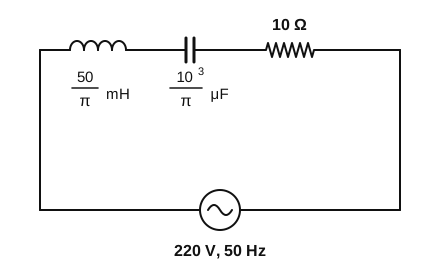
परिपथ (चित्र में दर्शाए अनुसार) की कुल प्रतिबाधा होगी
- A
- B
- C
- D
Show answer
Concept: , , .
Short trick: The π in L and C cancels the π in : , .
Answer: (C)
अवधारणा: , , ।
शॉर्ट ट्रिक: L और C में का π, के π को काट देता है: , ।
उत्तर: (C)
NEET UGPhysicsAlternating current – impedance of series LCRNEET UG 2023 · 7 May Shift 1
Q180.The x-t graph of a particle performing simple harmonic motion is shown in the figure. The acceleration of the particle at t = 2 s is:
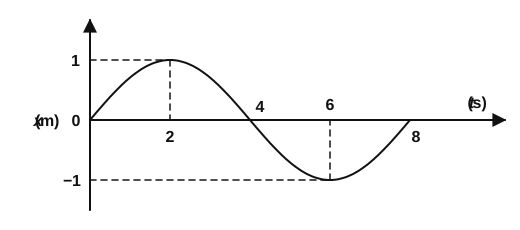
सरल आवर्त गति करते हुए एक कण का x-t ग्राफ़ चित्र में दर्शाया गया है। t = 2 s पर कण का त्वरण है:
- A
- B
- C
- D
Show answer
Concept: In SHM .
- From the graph: A = 1 m, T = 8 s ⇒
- At t = 2 s the particle is at the positive extreme: x = +1 m
Short trick: At an extreme, |a| = ω²A and it points back to the mean position: at x = +A it is negative.
Answer: (D)
अवधारणा: सरल आवर्त गति में ।
- ग्राफ़ से: A = 1 m, T = 8 s ⇒
- t = 2 s पर कण धनात्मक चरम स्थिति पर है: x = +1 m
शॉर्ट ट्रिक: चरम स्थिति पर |a| = ω²A और यह माध्य स्थिति की ओर होता है: x = +A पर ऋणात्मक।
उत्तर: (D)
NEET UGPhysicsOscillations – SHM from x–t graphNEET UG 2023 · 7 May Shift 1

