Q1.V, O, K, L, S and J are sitting around a circular table facing the centre. L is the immediate neighbour of both O and S. V is sitting second to the left of L. K is sitting to the immediate right of O. O is sitting to the immediate right of L. Who is sitting to the immediate right of J?
V, O, K, L, S और J एक वृत्ताकार मेज़ के चारों ओर केंद्र की ओर मुख करके बैठे हैं। L, O और S दोनों का निकटतम पड़ोसी है। V, L के बाएँ से दूसरे स्थान पर बैठा है। K, O के ठीक दाएँ बैठा है। O, L के ठीक दाएँ बैठा है। J के ठीक दाएँ कौन बैठा है?
- AK
- BS
- CV
- DL
Show answer
Concept: Facing the centre: left = clockwise, right = anticlockwise.
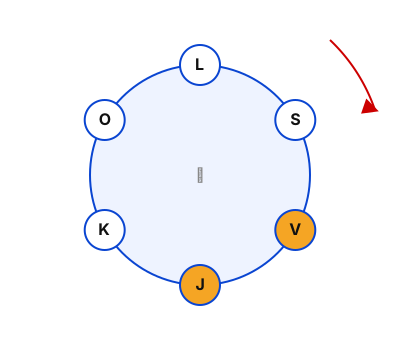
- Fix L at the top. O is immediate right of L (anticlockwise), so S (other neighbour of L) is immediate left.
- K is immediate right of O.
- V is second to the left of L (two seats clockwise); J takes the last seat.
- Clockwise from L: L, S, V, J, K, O. Immediate right of J (anticlockwise) is V.
Short trick: Place the 'immediate' clues first (O, K), then the 'second to' clue — the empty seat goes to J automatically.
Answer: (C) V
अवधारणा: केंद्र की ओर मुख होने पर: बायाँ = दक्षिणावर्त, दायाँ = वामावर्त।
- L को ऊपर रखें। O, L के ठीक दाएँ (वामावर्त) है, अतः S (L का दूसरा पड़ोसी) ठीक बाएँ है।
- K, O के ठीक दाएँ है।
- V, L के बाएँ से दूसरा (दो स्थान दक्षिणावर्त); बचा स्थान J का।
- दक्षिणावर्त क्रम: L, S, V, J, K, O. J के ठीक दाएँ (वामावर्त) V है।
शॉर्ट ट्रिक: पहले 'ठीक' वाले संकेत (O, K) रखें, फिर 'दूसरा' वाला — खाली स्थान स्वतः J का।
उत्तर: (C) V
RRB ALP CBT 1General Intelligence and ReasoningCircular seating arrangementRRB ALP CBT 1 2025 · 11 Mar Shift 1
Q2.Refer to the following number, symbol series and answer the question. Counting to be done from left to right only. All numbers are single-digit numbers.
(Left) 5 % 3 + 8 1 8 \ / % 6 1 1 1 + # % 3 7 9 > (Right)
How many such symbols are there each of which is immediately preceded by a number and also immediately followed by a number?
निम्नलिखित संख्या, प्रतीक श्रृंखला को देखें और प्रश्न का उत्तर दें। गिनती केवल बाएँ से दाएँ की जानी है। सभी संख्याएँ एकल-अंकीय संख्याएँ हैं।
(बाएँ) 5 % 3 + 8 1 8 \ / % 6 1 1 1 + # % 3 7 9 > (दाएँ)
ऐसे कितने प्रतीक हैं जिनमें से प्रत्येक के ठीक पहले एक संख्या है और ठीक बाद भी एक संख्या है?
- ATwoदो
- BOneएक
- CThreeतीन
- DNoneकोई नहीं
Show answer
Concept: Check each symbol's immediate neighbours: pattern Number – Symbol – Number.
- 5 % 3 ✔
- 3 + 8 ✔
- 8 \ / , / % , 6 ... 1 + # , # % 3 – all fail.
- Count = 2.
Short trick: Scan only symbols whose left neighbour is a digit; then just check the right neighbour.
Answer: (A) Two
अवधारणा: हर प्रतीक के ठीक पहले व बाद वाले पद देखें: पैटर्न संख्या – प्रतीक – संख्या।
- 5 % 3 ✔
- 3 + 8 ✔
- 8 \ /, / %, 1 + #, # % 3 – सभी असफल।
- गिनती = 2.
शॉर्ट ट्रिक: केवल उन प्रतीकों को देखें जिनके बाएँ अंक है; फिर केवल दायाँ पड़ोसी जाँचें।
उत्तर: (A) दो
RRB ALP CBT 1General Intelligence and ReasoningNumber–symbol seriesRRB ALP CBT 1 2025 · 11 Mar Shift 1
Q3.Seven boxes, A, Z, W, O, P, Q and L are kept one over the other but not necessarily in the same order. Q is kept immediately above A. O is kept immediately above W. Only L is kept above Z. Only two boxes are kept above Q. O is not kept at the third position from the bottom. How many boxes are kept between P and L?
सात बक्से A, Z, W, O, P, Q और L एक के ऊपर एक रखे हैं, परंतु आवश्यक नहीं कि इसी क्रम में हों। Q को A के ठीक ऊपर रखा गया है। O को W के ठीक ऊपर रखा गया है। Z के ऊपर केवल L रखा गया है। Q के ऊपर केवल दो बक्से रखे गए हैं। O को नीचे से तीसरे स्थान पर नहीं रखा गया है। P और L के बीच कितने बक्से रखे गए हैं?
- A1
- B3
- C5
- D2
Show answer
Concept: Fix the definite positions first, then place the pairs.
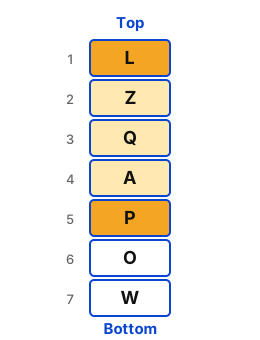
- Only L above Z → L = 1, Z = 2 (from top).
- Only two above Q → Q = 3, so A = 4.
- O–W pair fits in 5-6 or 6-7; O is not 3rd from bottom (position 5) → O = 6, W = 7, P = 5.
- Between P (5) and L (1): Z, Q, A = 3 boxes.
Short trick: Boxes between positions p and q = |p − q| − 1 = 5 − 1 − 1 = 3.
Answer: (B) 3
अवधारणा: पहले निश्चित स्थान तय करें, फिर जोड़ियाँ रखें।
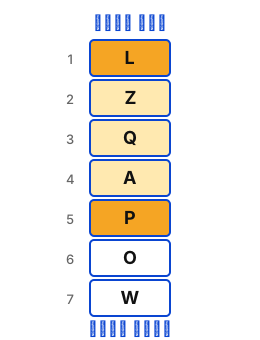
- Z के ऊपर केवल L → L = 1, Z = 2 (ऊपर से)।
- Q के ऊपर केवल दो → Q = 3, अतः A = 4.
- O–W जोड़ी 5-6 या 6-7 पर; O नीचे से तीसरा (स्थान 5) नहीं → O = 6, W = 7, P = 5.
- P (5) और L (1) के बीच: Z, Q, A = 3 बक्से।
शॉर्ट ट्रिक: स्थान p और q के बीच बक्से = |p − q| − 1 = 5 − 1 − 1 = 3.
उत्तर: (B) 3
RRB ALP CBT 1General Intelligence and ReasoningBox stacking puzzleRRB ALP CBT 1 2025 · 11 Mar Shift 1
Q4.Refer to the following letter, symbol series and answer the question that follows. Counting to be done from left to right only.
(Left) K O * © I % X © V € £ # U B $ D * # L © A U (Right)
How many such symbol are there, each of which is immediately preceded by a letter and also immediately followed by a symbol?
निम्नलिखित अक्षर, प्रतीक श्रृंखला को देखें और नीचे दिए गए प्रश्न का उत्तर दें। गिनती केवल बाएँ से दाएँ की जानी है।
(बाएँ) K O * © I % X © V € £ # U B $ D * # L © A U (दाएँ)
ऐसे कितने प्रतीक हैं, जिनमें से प्रत्येक के ठीक पहले एक अक्षर है और ठीक बाद भी एक प्रतीक है?
- A3
- B5
- C4
- D2
Show answer
Concept: Look for the pattern Letter – Symbol – Symbol.
- O * © ✔
- V € £ ✔
- D * # ✔
- I % X, X © V, B $ D, L © A – fail.
- Count = 3.
Short trick: Find every pair of adjacent symbols; then check if the first one has a letter before it.
Answer: (A) 3
अवधारणा: पैटर्न अक्षर – प्रतीक – प्रतीक खोजें।
- O * © ✔
- V € £ ✔
- D * # ✔
- I % X, X © V, B $ D, L © A – असफल।
- गिनती = 3.
शॉर्ट ट्रिक: सभी लगातार दो प्रतीकों की जोड़ी ढूँढें; फिर देखें कि पहले प्रतीक से पहले अक्षर है या नहीं।
उत्तर: (A) 3
RRB ALP CBT 1General Intelligence and ReasoningLetter–symbol seriesRRB ALP CBT 1 2025 · 11 Mar Shift 1
Q5.In a certain code language,
A # B means ‘A is the daughter of B’,
A % B means ‘A is the father of B’,
A - B means ‘A is the son of B’,
A @ B means ‘A is the sister of B’.
Based on the above, how is S related to U if ‘S - M @ H # Y % U’?
एक निश्चित कूट भाषा में,
A # B का अर्थ है ‘A, B की पुत्री है’,
A % B का अर्थ है ‘A, B का पिता है’,
A - B का अर्थ है ‘A, B का पुत्र है’,
A @ B का अर्थ है ‘A, B की बहन है’।
उपरोक्त के आधार पर, यदि ‘S - M @ H # Y % U’ है, तो S का U से क्या संबंध है?
- ABrother's sonभाई का पुत्र
- BSister's sonबहन का पुत्र
- CFatherपिता
- DBrotherभाई
Show answer
Concept: Decode each symbol from left to right and draw the family tree.
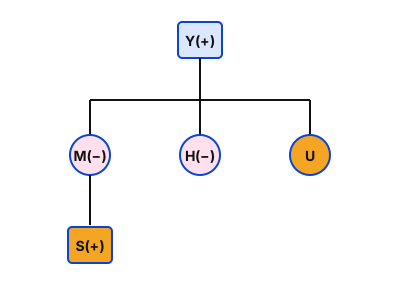
- S - M: S is the son of M.
- M @ H: M is the sister of H.
- H # Y: H is the daughter of Y; Y % U: Y is the father of U.
- So M, H and U are siblings; S is the son of M, i.e. U's sister's son.
Short trick: M is female (sister) and S is her son → 'sister's son' is the only option with a female link.
Answer: (B) Sister's son
अवधारणा: बाएँ से दाएँ हर प्रतीक को डिकोड करके वंश-वृक्ष बनाएँ।
- S - M: S, M का पुत्र है।
- M @ H: M, H की बहन है।
- H # Y: H, Y की पुत्री है; Y % U: Y, U का पिता है।
- अतः M, H, U भाई-बहन हैं; S, M का पुत्र अर्थात U की बहन का पुत्र।
शॉर्ट ट्रिक: M महिला (बहन) है और S उसका पुत्र → 'बहन का पुत्र' ही उपयुक्त है।
उत्तर: (B) बहन का पुत्र
RRB ALP CBT 1General Intelligence and ReasoningCoded blood relationsRRB ALP CBT 1 2025 · 11 Mar Shift 1
Q6.Refer to the following letter, symbol series and answer the question that follows. Counting to be done from left to right only.
(Left) Y E @ H £ # A D K > X N B $ + A C U * % M $ Z (Right)
How many such symbols are there, each of which are immediately preceded by a letter and immediately followed by a symbol?
निम्नलिखित अक्षर, प्रतीक श्रृंखला को देखें और नीचे दिए गए प्रश्न का उत्तर दें। गिनती केवल बाएँ से दाएँ की जानी है।
(बाएँ) Y E @ H £ # A D K > X N B $ + A C U * % M $ Z (दाएँ)
ऐसे कितने प्रतीक हैं, जिनमें से प्रत्येक के ठीक पहले एक अक्षर है और ठीक बाद एक प्रतीक है?
- AThreeतीन
- BOneएक
- CTwoदो
- DFourचार
Show answer
Concept: Pattern required: Letter – Symbol – Symbol.
- H £ # ✔
- B $ + ✔
- U * % ✔
- E @ H, K > X, M $ Z – fail.
- Count = 3.
Short trick: Only symbol pairs (£#, $+, *%) can qualify — check the letter before each pair.
Answer: (A) Three
अवधारणा: आवश्यक पैटर्न: अक्षर – प्रतीक – प्रतीक।
- H £ # ✔
- B $ + ✔
- U * % ✔
- E @ H, K > X, M $ Z – असफल।
- गिनती = 3.
शॉर्ट ट्रिक: केवल प्रतीक-जोड़ियाँ (£#, $+, *%) योग्य हो सकती हैं — हर जोड़ी से पहले अक्षर देखें।
उत्तर: (A) तीन
RRB ALP CBT 1General Intelligence and ReasoningLetter–symbol seriesRRB ALP CBT 1 2025 · 11 Mar Shift 1
Q7.What should come in place of the question mark (?) in the given series?
82 85 95 112 136 ?
दी गई श्रृंखला में प्रश्न चिह्न (?) के स्थान पर क्या आना चाहिए?
82 85 95 112 136 ?
- A153
- B167
- C174
- D160
Show answer
Concept: Check differences; they form an AP.
- Differences: 3, 10, 17, 24 (each +7).
- Next difference = 31 → 136 + 31 = 167.
Short trick: Unit digit check: 136 + 31 ends in 7 → only 167 fits.
Answer: (B) 167
अवधारणा: अंतर देखें; वे समांतर श्रेणी में हैं।
- अंतर: 3, 10, 17, 24 (हर बार +7)।
- अगला अंतर = 31 → 136 + 31 = 167.
शॉर्ट ट्रिक: इकाई अंक: 136 + 31 का अंतिम अंक 7 → केवल 167.
उत्तर: (B) 167
RRB ALP CBT 1General Intelligence and ReasoningNumber series – second differenceRRB ALP CBT 1 2025 · 11 Mar Shift 1
Q8.If ‘A’ stands for ‘÷’, ‘B’ stands for ‘×’, ‘C’ stands for ‘+’ and ‘D’ stands for ‘−’, then what will come in place of the question mark (?) in the following equation?
104 A 4 D 3 B 9 C 12 = ?
यदि ‘A’ का अर्थ ‘÷’, ‘B’ का अर्थ ‘×’, ‘C’ का अर्थ ‘+’ और ‘D’ का अर्थ ‘−’ है, तो निम्नलिखित समीकरण में प्रश्न चिह्न (?) के स्थान पर क्या आएगा?
104 A 4 D 3 B 9 C 12 = ?
- A5
- B34
- C11
- D20
Show answer
Concept: Substitute, then apply BODMAS.
- 104 ÷ 4 − 3 × 9 + 12
- = 26 − 27 + 12 = 11
Short trick: Do ÷ and × first: 26 and 27; then 26 − 27 = −1, −1 + 12 = 11.
Answer: (C) 11
अवधारणा: प्रतिस्थापित करें, फिर BODMAS लागू करें।
- 104 ÷ 4 − 3 × 9 + 12
- = 26 − 27 + 12 = 11
शॉर्ट ट्रिक: पहले ÷ और ×: 26 और 27; फिर 26 − 27 = −1, −1 + 12 = 11.
उत्तर: (C) 11
RRB ALP CBT 1General Intelligence and ReasoningMathematical operations – symbol substitutionRRB ALP CBT 1 2025 · 11 Mar Shift 1
Q9.In a code language, 'PEN' is coded as 9 and 'WOLF' is coded as 16. How will 'ISLAND' be coded in the same language?
एक कूट भाषा में, 'PEN' को 9 और 'WOLF' को 16 के रूप में कूटबद्ध किया जाता है। उसी भाषा में 'ISLAND' को कैसे कूटबद्ध किया जाएगा?
- A18
- B24
- C36
- D42
Show answer
Concept: Code = (number of letters)².
- PEN: 3 letters → 3² = 9.
- WOLF: 4 letters → 4² = 16.
- ISLAND: 6 letters → 6² = 36.
Short trick: When codes are perfect squares (9, 16), test the letter count first.
Answer: (C) 36
अवधारणा: कूट = (अक्षरों की संख्या)²।
- PEN: 3 अक्षर → 3² = 9.
- WOLF: 4 अक्षर → 4² = 16.
- ISLAND: 6 अक्षर → 6² = 36.
शॉर्ट ट्रिक: जब कूट पूर्ण वर्ग हों (9, 16), पहले अक्षरों की संख्या जाँचें।
उत्तर: (C) 36
RRB ALP CBT 1General Intelligence and ReasoningCoding – number of lettersRRB ALP CBT 1 2025 · 11 Mar Shift 1
Q10.A, B, C, D, E and F are sitting around a circular table, facing the centre. B sits third to the left of F. D sits to the immediate left of A. C sits second to the left of B. What is the position of A with respect to E?
A, B, C, D, E और F एक वृत्ताकार मेज़ के चारों ओर केंद्र की ओर मुख करके बैठे हैं। B, F के बाएँ से तीसरे स्थान पर बैठा है। D, A के ठीक बाएँ बैठा है। C, B के बाएँ से दूसरे स्थान पर बैठा है। E के सापेक्ष A का स्थान क्या है?
- ASecond to the leftबाएँ से दूसरा
- BThird to the leftबाएँ से तीसरा
- CImmediate rightठीक दाएँ
- DSecond to the rightदाएँ से दूसरा
Show answer
Concept: Facing the centre: left = clockwise.
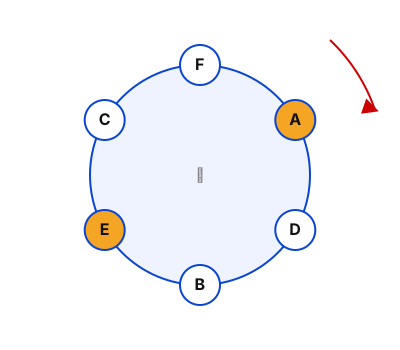
- F at top; B third to the left of F → B opposite F.
- C second to the left of B.
- Remaining seats (F's left side) hold A, D and E; D immediately left of A → order clockwise from F: F, A, D, B, E, C.
- From E, moving left (clockwise): C, F, A → A is third to the left of E.
Short trick: In 6 seats, 'third to the left' = 'third to the right' = opposite seat. A and E are opposite, so only 'Third to the left' fits.
Answer: (B) Third to the left
अवधारणा: केंद्र की ओर मुख: बायाँ = दक्षिणावर्त।
- F ऊपर; B, F के बाएँ से तीसरा → B, F के सामने।
- C, B के बाएँ से दूसरा।
- शेष स्थानों पर A, D, E; D, A के ठीक बाएँ → F से दक्षिणावर्त: F, A, D, B, E, C.
- E से बाएँ (दक्षिणावर्त): C, F, A → A, E के बाएँ से तीसरा।
शॉर्ट ट्रिक: 6 स्थानों में 'बाएँ से तीसरा' = 'दाएँ से तीसरा' = ठीक सामने। A और E आमने-सामने हैं।
उत्तर: (B) बाएँ से तीसरा
RRB ALP CBT 1General Intelligence and ReasoningCircular seating arrangementRRB ALP CBT 1 2025 · 11 Mar Shift 1
Q11.Select the pair which follows the same pattern as that followed by the two pairs given below. Both pairs follow the same pattern.
GNP : KRU
COK : GSP
उस युग्म का चयन कीजिए जो उसी पैटर्न का अनुसरण करता है जिसका अनुसरण नीचे दिए गए दो युग्मों द्वारा किया जाता है। दोनों युग्म समान पैटर्न का अनुसरण करते हैं।
GNP : KRU
COK : GSP
- AVIQ : ZNV
- BHDL : LJQ
- CHNR : LTW
- DVAM : ZER
Show answer
Concept: Find the shift of each letter position.
- GNP → KRU: +4, +4, +5.
- COK → GSP: +4, +4, +5.
- VAM → ZER: V+4 = Z, A+4 = E, M+5 = R ✔ (others give +4, +5/+6 patterns).
Short trick: Check only the 2nd letter (+4): VIQ→N (+5), HDL→J (+6), HNR→T (+6) fail at once.
Answer: (D) VAM : ZER
अवधारणा: हर अक्षर का खिसकाव ज्ञात करें।
- GNP → KRU: +4, +4, +5.
- COK → GSP: +4, +4, +5.
- VAM → ZER: V+4 = Z, A+4 = E, M+5 = R ✔ (बाकी में +5/+6 आता है)।
शॉर्ट ट्रिक: केवल दूसरा अक्षर (+4) जाँचें: VIQ→N (+5), HDL→J (+6), HNR→T (+6) तुरंत बाहर।
उत्तर: (D) VAM : ZER
RRB ALP CBT 1General Intelligence and ReasoningLetter analogyRRB ALP CBT 1 2025 · 11 Mar Shift 1
Q12.Refer to the following number and symbol series and answer the question that follows. Counting to be done from left to right only.
(Left) 3 ^ 5 # 6 £ 1 $ @ 8 % 7 * 4 ≺ Ω 9 2 (Right)
How many such symbols are there each of which is immediately preceded by a number and also immediately followed by another number?
निम्नलिखित संख्या और प्रतीक श्रृंखला को देखें और नीचे दिए गए प्रश्न का उत्तर दें। गिनती केवल बाएँ से दाएँ की जानी है।
(बाएँ) 3 ^ 5 # 6 £ 1 $ @ 8 % 7 * 4 ≺ Ω 9 2 (दाएँ)
ऐसे कितने प्रतीक हैं जिनमें से प्रत्येक के ठीक पहले एक संख्या है और ठीक बाद भी एक अन्य संख्या है?
- AThreeतीन
- BTwoदो
- COneएक
- DMore than threeतीन से अधिक
Show answer
Concept: Pattern: Number – Symbol – Number.
- 3 ^ 5 ✔, 5 # 6 ✔, 6 £ 1 ✔, 8 % 7 ✔, 7 * 4 ✔.
- 1 $ @, 4 ≺ Ω – fail.
- Count = 5, i.e. more than three.
Short trick: Stop counting once you reach 4 — the answer is already 'More than three'.
Answer: (D) More than three
अवधारणा: पैटर्न: संख्या – प्रतीक – संख्या।
- 3 ^ 5 ✔, 5 # 6 ✔, 6 £ 1 ✔, 8 % 7 ✔, 7 * 4 ✔.
- 1 $ @, 4 ≺ Ω – असफल।
- गिनती = 5, अर्थात तीन से अधिक।
शॉर्ट ट्रिक: 4 तक गिनती पहुँचते ही रुकें — उत्तर 'तीन से अधिक'।
उत्तर: (D) तीन से अधिक
RRB ALP CBT 1General Intelligence and ReasoningNumber–symbol seriesRRB ALP CBT 1 2025 · 11 Mar Shift 1
Q13.Below are given two sets of numbers. In each set of numbers, a certain mathematical operation on first number results in the second number. Similarly, certain mathematical operation on second number results in the third number and so on. Which of the given options follows the same set of operations as in question?
(NOTE – A two/three digit number cannot be broken into individual digits for operations e.g. if 37 is followed by 10, the operation cannot be 3+7 as a two digit number cannot be broken into individual digits)
4 - 8 - 10 - 12 ; 3 - 6 - 8 - 10
नीचे संख्याओं के दो समुच्चय दिए गए हैं। संख्याओं के प्रत्येक समुच्चय में, पहली संख्या पर एक निश्चित गणितीय संक्रिया से दूसरी संख्या प्राप्त होती है। इसी प्रकार, दूसरी संख्या पर निश्चित गणितीय संक्रिया से तीसरी संख्या प्राप्त होती है और इसी तरह आगे भी। दिए गए विकल्पों में से कौन-सा विकल्प प्रश्न के समान संक्रियाओं के समुच्चय का अनुसरण करता है?
(नोट – संक्रियाओं के लिए दो/तीन अंकों की संख्या को अलग-अलग अंकों में नहीं तोड़ा जा सकता, उदाहरण के लिए यदि 37 के बाद 10 आता है, तो संक्रिया 3+7 नहीं हो सकती क्योंकि दो अंकों की संख्या को अलग-अलग अंकों में नहीं तोड़ा जा सकता)
4 - 8 - 10 - 12 ; 3 - 6 - 8 - 10
- A7 - 14 - 16 - 20
- B10 - 20 - 22 - 26
- C9 - 18 - 20 - 24
- D1 - 2 - 4 - 6
Show answer
Concept: Identify the chain of operations from the given sets.
- 4 ×2 = 8, +2 = 10, +2 = 12; 3 ×2 = 6, +2 = 8, +2 = 10.
- Rule: ×2, +2, +2.
- 1 ×2 = 2, +2 = 4, +2 = 6 ✔ (others end with +4).
Short trick: All options satisfy ×2 and the first +2; just check the last step (+2).
Answer: (D) 1 - 2 - 4 - 6
अवधारणा: दिए गए समुच्चयों से संक्रियाओं की श्रृंखला पहचानें।
- 4 ×2 = 8, +2 = 10, +2 = 12; 3 ×2 = 6, +2 = 8, +2 = 10.
- नियम: ×2, +2, +2.
- 1 ×2 = 2, +2 = 4, +2 = 6 ✔ (बाकी में अंतिम चरण +4)।
शॉर्ट ट्रिक: सभी विकल्प ×2 और पहला +2 मानते हैं; केवल अंतिम चरण (+2) जाँचें।
उत्तर: (D) 1 - 2 - 4 - 6
RRB ALP CBT 1General Intelligence and ReasoningNumber set operationsRRB ALP CBT 1 2025 · 11 Mar Shift 1
Q14.If ‘+’ means ‘−’, ‘−’ means ‘×’, ‘×’ means ‘÷’, ‘÷’ means ‘+’, then what will come in place of the question mark (?) in the following equation?
188 ÷ 11 − 16 + 234 × 18 = ?
यदि ‘+’ का अर्थ ‘−’, ‘−’ का अर्थ ‘×’, ‘×’ का अर्थ ‘÷’, ‘÷’ का अर्थ ‘+’ है, तो निम्नलिखित समीकरण में प्रश्न चिह्न (?) के स्थान पर क्या आएगा?
188 ÷ 11 − 16 + 234 × 18 = ?
- A351
- B360
- C343
- D328
Show answer
Concept: Replace the signs, then apply BODMAS.
- 188 + 11 × 16 − 234 ÷ 18
- = 188 + 176 − 13 = 351
Short trick: Unit digit: 8 + 6 − 3 = 11 → ends in 1 → only 351.
Answer: (A) 351
अवधारणा: चिह्न बदलें, फिर BODMAS लागू करें।
- 188 + 11 × 16 − 234 ÷ 18
- = 188 + 176 − 13 = 351
शॉर्ट ट्रिक: इकाई अंक: 8 + 6 − 3 = 11 → अंत में 1 → केवल 351.
उत्तर: (A) 351
RRB ALP CBT 1General Intelligence and ReasoningMathematical operations – symbol interchangeRRB ALP CBT 1 2025 · 11 Mar Shift 1
Q15.Based on the English alphabetical order, three of the following four letter-cluster pairs are alike in a certain way and thus form a group. Which letter-cluster pair DOES NOT belong to that group? (Note: The odd one out is not based on the number of consonants/vowels or their position in the letter-cluster.)
अंग्रेज़ी वर्णमाला क्रम के आधार पर, निम्नलिखित चार अक्षर-समूह युग्मों में से तीन किसी निश्चित प्रकार से एकसमान हैं और इस प्रकार एक समूह बनाते हैं। कौन-सा अक्षर-समूह युग्म उस समूह से संबंधित नहीं है? (नोट: असंगत अक्षर-समूह, उस अक्षर-समूह में व्यंजनों/स्वरों की संख्या या उनके स्थान पर आधारित नहीं है।)
- AKG - HD
- BPL - MI
- CHD - EA
- DJF - HT
Show answer
Concept: Compare letter gaps within and across each pair.
- KG - HD: K−4 = G, H−4 = D, K−3 = H.
- PL - MI and HD - EA follow the same (−4, −4, −3).
- JF - HT: J−4 = F but H−4 ≠ T → odd one.
Short trick: Second cluster's letters should both be 3 behind the first's: T is ahead of F, so JF-HT is out instantly.
Answer: (D) JF - HT
अवधारणा: हर युग्म के भीतर और बीच अक्षर-अंतर की तुलना करें।
- KG - HD: K−4 = G, H−4 = D, K−3 = H.
- PL - MI और HD - EA भी (−4, −4, −3)।
- JF - HT: J−4 = F परंतु H−4 ≠ T → असंगत।
शॉर्ट ट्रिक: दूसरे समूह के अक्षर पहले से 3 पीछे होने चाहिए: T, F से आगे है, अतः JF-HT तुरंत अलग।
उत्तर: (D) JF - HT
RRB ALP CBT 1General Intelligence and ReasoningOdd letter-cluster pairRRB ALP CBT 1 2025 · 11 Mar Shift 1
Q16.FVWQ is related to RHIC in a certain way based on the English alphabetical order. In the same way, BRSM is related to NDEY. To which of the given options is LBCW related, following the same logic?
अंग्रेज़ी वर्णमाला क्रम के आधार पर FVWQ एक निश्चित प्रकार से RHIC से संबंधित है। उसी प्रकार, BRSM, NDEY से संबंधित है। समान तर्क का अनुसरण करते हुए, LBCW दिए गए विकल्पों में से किससे संबंधित है?
- AXINO
- BXNOI
- CXDSA
- DXOKI
Show answer
Concept: Each letter moves the same number of places (cyclic).
- F → R, V → H, W → I, Q → C: each +12.
- B → N, R → D, S → E, M → Y: each +12.
- L+12 = X, B+12 = N, C+12 = O, W+12 = I → XNOI.
Short trick: +12 ≡ −14; B and C are consecutive, so their codes must be consecutive (N, O) → only XNOI.
Answer: (B) XNOI
अवधारणा: हर अक्षर समान स्थान आगे बढ़ता है (चक्रीय)।
- F → R, V → H, W → I, Q → C: हर एक +12.
- B → N, R → D, S → E, M → Y: हर एक +12.
- L+12 = X, B+12 = N, C+12 = O, W+12 = I → XNOI.
शॉर्ट ट्रिक: B, C लगातार हैं, अतः उनके कूट भी लगातार (N, O) होंगे → केवल XNOI.
उत्तर: (B) XNOI
RRB ALP CBT 1General Intelligence and ReasoningLetter analogyRRB ALP CBT 1 2025 · 11 Mar Shift 1
Q17.A question is followed by two statements numbered (I) and (II). You have to decide whether the data provided in the statements are sufficient to answer the question. Read both the statements and decide the appropriate answer.
Q. Four boys – Gaurav, Himanshu, Ishan, and Kunal – have different heights. Who is the shortest?
(I) Ishan is taller than Gaurav but shorter than Kunal.
(II) Himanshu is taller than Gaurav but shorter than Ishan.
एक प्रश्न के बाद दो कथन (I) और (II) दिए गए हैं। आपको यह तय करना है कि कथनों में दिए गए आँकड़े प्रश्न का उत्तर देने के लिए पर्याप्त हैं या नहीं। दोनों कथनों को पढ़ें और उपयुक्त उत्तर चुनें।
प्रश्न: चार लड़के – गौरव, हिमांशु, ईशान और कुणाल – की ऊँचाइयाँ अलग-अलग हैं। सबसे छोटा कौन है?
(I) ईशान, गौरव से लंबा है परंतु कुणाल से छोटा है।
(II) हिमांशु, गौरव से लंबा है परंतु ईशान से छोटा है।
- AData in Statement II alone is sufficient to answer the question while data in Statement I is notकेवल कथन II के आँकड़े प्रश्न का उत्तर देने के लिए पर्याप्त हैं, जबकि कथन I के आँकड़े पर्याप्त नहीं हैं
- BData in both statements I and II together are NOT sufficient to answer the questionकथन I और II दोनों के आँकड़े मिलकर भी प्रश्न का उत्तर देने के लिए पर्याप्त नहीं हैं
- CData in both statements I and II together (and not statement I alone or statement II alone) are sufficient to answer the questionकथन I और II दोनों के आँकड़े मिलकर (न कि अकेले कथन I या अकेले कथन II) प्रश्न का उत्तर देने के लिए पर्याप्त हैं
- DData in Statement I alone is sufficient to answer the question while data in Statement II is notकेवल कथन I के आँकड़े प्रश्न का उत्तर देने के लिए पर्याप्त हैं, जबकि कथन II के आँकड़े पर्याप्त नहीं हैं
Show answer
Concept: Test each statement alone, then together.
- I: Gaurav < Ishan < Kunal — Himanshu unknown ✘.
- II: Gaurav < Himanshu < Ishan — Kunal unknown ✘.
- I + II: Gaurav < Himanshu < Ishan < Kunal → Gaurav is the shortest ✔.
Short trick: Each statement mentions only 3 of the 4 boys, so neither alone can decide.
Answer: (C) Both statements together are sufficient
अवधारणा: प्रत्येक कथन अकेले, फिर दोनों साथ जाँचें।
- I: गौरव < ईशान < कुणाल — हिमांशु अज्ञात ✘.
- II: गौरव < हिमांशु < ईशान — कुणाल अज्ञात ✘.
- I + II: गौरव < हिमांशु < ईशान < कुणाल → गौरव सबसे छोटा ✔.
शॉर्ट ट्रिक: हर कथन में 4 में से केवल 3 लड़के हैं, अतः कोई अकेला पर्याप्त नहीं।
उत्तर: (C) दोनों कथन मिलकर पर्याप्त
RRB ALP CBT 1General Intelligence and ReasoningData sufficiency – rankingRRB ALP CBT 1 2025 · 11 Mar Shift 1
Q18.In a race, five participants, A, B, C, D, and E, finished with different timings. A finished ahead of B but behind E. C did not finish last. Only one participant finished later than D. E finished second. Who among them finished first?
एक दौड़ में, पाँच प्रतिभागी A, B, C, D और E ने अलग-अलग समय पर दौड़ पूरी की। A ने B से पहले लेकिन E के बाद दौड़ पूरी की। C अंतिम स्थान पर नहीं रहा। केवल एक प्रतिभागी ने D के बाद दौड़ पूरी की। E दूसरे स्थान पर रहा। उनमें से किसने सबसे पहले दौड़ पूरी की?
- AB
- BC
- CA
- DD
Show answer
Concept: Place the fixed ranks first.
- E = 2nd; only one after D → D = 4th.
- E < A < B in order → A = 3rd, B = 5th.
- Remaining 1st place → C (C is not last ✔).
Short trick: A and B are both after E (2nd), D is 4th → the 1st place can only be C.
Answer: (B) C
अवधारणा: पहले निश्चित स्थान रखें।
- E = दूसरा; D के बाद केवल एक → D = चौथा।
- E, A, B क्रम में → A = तीसरा, B = पाँचवाँ।
- शेष पहला स्थान → C (C अंतिम नहीं ✔)।
शॉर्ट ट्रिक: A, B दोनों E (दूसरा) के बाद, D चौथा → पहला स्थान केवल C.
उत्तर: (B) C
RRB ALP CBT 1General Intelligence and ReasoningRanking / orderRRB ALP CBT 1 2025 · 11 Mar Shift 1
Q19.What should come in place of the question mark (?) in the given series based on the English alphabetical order?
MOP FHI YAB RTU ?
अंग्रेज़ी वर्णमाला क्रम के आधार पर दी गई श्रृंखला में प्रश्न चिह्न (?) के स्थान पर क्या आना चाहिए?
MOP FHI YAB RTU ?
- AKMU
- BKMJ
- CKNM
- DKMN
Show answer
Concept: Track first letters and the internal gaps.
- First letters: M, F, Y, R → each −7 → K.
- Inside each cluster: +2, +1 (MOP, FHI…) → K, M, N.
Short trick: Internal pattern +2, +1 alone eliminates KMU, KMJ, KNM.
Answer: (D) KMN
अवधारणा: पहले अक्षर और भीतरी अंतर देखें।
- पहले अक्षर: M, F, Y, R → हर बार −7 → K.
- हर समूह के भीतर: +2, +1 → K, M, N.
शॉर्ट ट्रिक: केवल भीतरी पैटर्न +2, +1 से KMU, KMJ, KNM बाहर।
उत्तर: (D) KMN
RRB ALP CBT 1General Intelligence and ReasoningLetter seriesRRB ALP CBT 1 2025 · 11 Mar Shift 1
Q20.Select the set in which the numbers are related in the same way as are the numbers of the following sets.
(NOTE: Operations should be performed on the whole numbers, without breaking down the numbers into their constituent digits. E.g. 13 – Operations on 13 such as adding/subtracting/multiplying to 13 can be performed. Breaking down 13 into 1 and 3 and then performing mathematical operations on 1 and 3 is not allowed.)
(3, 40, 42)
(1, 59, 63)
उस समुच्चय का चयन कीजिए जिसमें संख्याएँ उसी प्रकार संबंधित हैं जिस प्रकार निम्नलिखित समुच्चयों की संख्याएँ संबंधित हैं।
(नोट: संख्याओं को उनके घटक अंकों में तोड़े बिना, संक्रियाएँ पूर्ण संख्याओं पर की जानी चाहिए। उदाहरण के लिए 13 – 13 पर संक्रियाएँ जैसे 13 में जोड़ना/घटाना/गुणा करना आदि किया जा सकता है। 13 को 1 और 3 में तोड़कर फिर 1 और 3 पर गणितीय संक्रियाएँ करने की अनुमति नहीं है।)
(3, 40, 42)
(1, 59, 63)
- A(4, 54, 56)
- B(8, 89, 90)
- C(3, 41, 45)
- D(7, 74, 72)
Show answer
Concept: Find a rule linking all three numbers.
- (3, 40, 42): 40 − 3 + 5 = 42.
- (1, 59, 63): 59 − 1 + 5 = 63. Rule: third = second − first + 5.
- (7, 74, 72): 74 − 7 + 5 = 72 ✔; (4, 54, 56) → 55, (8, 89, 90) → 86, (3, 41, 45) → 43 ✘.
Short trick: Equivalent check: first + (third − second) = 5 → 7 + (−2) = 5 ✔.
Answer: (D) (7, 74, 72)
अवधारणा: तीनों संख्याओं को जोड़ने वाला नियम खोजें।
- (3, 40, 42): 40 − 3 + 5 = 42.
- (1, 59, 63): 59 − 1 + 5 = 63. नियम: तीसरी = दूसरी − पहली + 5.
- (7, 74, 72): 74 − 7 + 5 = 72 ✔; बाकी: 55, 86, 43 ✘.
शॉर्ट ट्रिक: समतुल्य जाँच: पहली + (तीसरी − दूसरी) = 5 → 7 + (−2) = 5 ✔.
उत्तर: (D) (7, 74, 72)
RRB ALP CBT 1General Intelligence and ReasoningNumber triadsRRB ALP CBT 1 2025 · 11 Mar Shift 1

