Q301.Among five people named V, W, X, Y and Z, each have a certain age. Y is four times the age of X. V is two times the age of X. Y is five times the age of W. The age of W is 12. If Z is thrice the age of V, what is the age of Z?
V, W, X, Y और Z नाम के पाँच व्यक्तियों में से प्रत्येक की एक निश्चित आयु है। Y की आयु X की आयु की चार गुनी है। V की आयु X की आयु की दोगुनी है। Y की आयु W की आयु की पाँच गुनी है। W की आयु 12 है। यदि Z की आयु V की आयु की तीन गुनी है, तो Z की आयु क्या है?
- A90
- B75
- C89
- D85
Show answer
Concept: Start from the known age and move along the chain.
- W = 12 → Y = 5 × 12 = 60.
- Y = 4X → X = 15.
- V = 2X = 30 → Z = 3V = 90.
Short trick: Z = 3 × 2 × X = 6X = 6 × (5 × 12 ÷ 4) = 6 × 15 = 90.
Answer: (A) 90
अवधारणा: ज्ञात आयु से शुरू करके शृंखला में आगे बढ़ें।
- W = 12 → Y = 5 × 12 = 60.
- Y = 4X → X = 15.
- V = 2X = 30 → Z = 3V = 90.
शॉर्ट ट्रिक: Z = 6X = 6 × 15 = 90.
उत्तर: (A) 90
RRB ALP CBT 1General Intelligence and ReasoningAge chainRRB ALP CBT 1 2025 · 16 Feb Shift 3
Q302.Refer to the following letter series and answer the question that follows. Counting to be done from left to right only.
(Left) K N C G I N F Z X I J X M N W T K K S V V (Right)
How many such consonants are there, each of which is immediately preceded by a vowel and also immediately followed by a consonant?
निम्नलिखित अक्षर श्रृंखला को देखें और नीचे दिए गए प्रश्न का उत्तर दें। गिनती केवल बाएँ से दाएँ की जानी है।
(बाएँ) K N C G I N F Z X I J X M N W T K K S V V (दाएँ)
ऐसे कितने व्यंजन हैं जिनमें से प्रत्येक के ठीक पहले एक स्वर है और ठीक बाद एक व्यंजन है?
- AThreeतीन
- BTwoदो
- CNoneकोई नहीं
- DOneएक
Show answer
Concept: Start from each vowel and look at the next two letters.
- Vowels: I (5th) and I (10th).
- I N F → N is a consonant preceded by vowel I and followed by consonant F ✓.
- I J X → J preceded by I and followed by X ✓.
Short trick: Only letters right after a vowel can qualify – there are only 2 vowels, so the answer is at most 2; both work.
Answer: (B) Two
अवधारणा: प्रत्येक स्वर से शुरू करके अगले दो अक्षर देखें।
- स्वर: I (5वाँ) और I (10वाँ)।
- I N F → N व्यंजन, पहले स्वर I, बाद में व्यंजन F ✓.
- I J X → J, पहले I और बाद में X ✓.
शॉर्ट ट्रिक: केवल स्वर के ठीक बाद वाले अक्षर योग्य हो सकते हैं – स्वर केवल 2 हैं, दोनों मान्य।
उत्तर: (B) दो
RRB ALP CBT 1General Intelligence and ReasoningLetter series – position conditionsRRB ALP CBT 1 2025 · 16 Feb Shift 3
Q303.A, B, C, D, E, F and G are sitting around a circular table, facing the centre.
F sits third to the left of A. C sits second to the left of D. Only A sits between E and C. B is not an immediate neighbour of F.
How many people sit between D and E when counted from the right of E?
A, B, C, D, E, F और G एक वृत्ताकार मेज के चारों ओर केंद्र की ओर मुख करके बैठे हैं।
F, A के बाएँ से तीसरे स्थान पर बैठा है। C, D के बाएँ से दूसरे स्थान पर बैठा है। E और C के बीच केवल A बैठा है। B, F का निकटतम पड़ोसी नहीं है।
E के दाएँ से गिनने पर D और E के बीच कितने व्यक्ति बैठे हैं?
- A2
- B3
- C1
- D4
Show answer
Concept: Facing the centre, left = clockwise and right = anticlockwise.
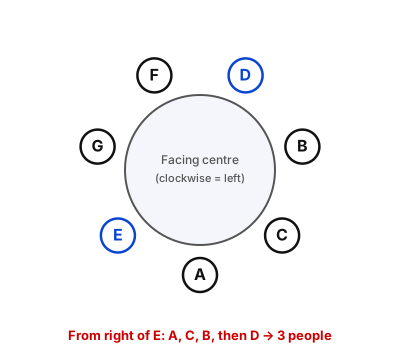
- Only A between E and C → E, A, C consecutive.
- C is 2nd to the left of D and F is 3rd to the left of A – this fixes clockwise order A, E, G, F, D, B, C (B not next to F ✓).
- Counting to the right (anticlockwise) of E: A, C, B and then D.
Short trick: Between D and E from E's right = A, C, B → 3; the other way would be G, F → 2 (not asked).
Answer: (B) 3
अवधारणा: केंद्र की ओर मुख: बाएँ = दक्षिणावर्त, दाएँ = वामावर्त।
- E और C के बीच केवल A → E, A, C लगातार।
- C, D के बाएँ से दूसरा और F, A के बाएँ से तीसरा → दक्षिणावर्त क्रम A, E, G, F, D, B, C (B, F के पास नहीं ✓)।
- E के दाएँ (वामावर्त) गिनें: A, C, B, फिर D.
शॉर्ट ट्रिक: E के दाएँ से D और E के बीच = A, C, B → 3; दूसरी ओर G, F → 2 (यह नहीं पूछा)।
उत्तर: (B) 3
RRB ALP CBT 1General Intelligence and ReasoningCircular seating arrangementRRB ALP CBT 1 2025 · 16 Feb Shift 3
Q304.In a certain code language,
'A + B' means 'A is the daughter of B',
'A – B' means 'A is the father of B',
'A × B' means 'A is the son of B' and
'A ÷ B' means 'A is the sister of B'.
Based on the above, how is Q related to P if 'Q × M + V – J ÷ P'?
एक निश्चित कूट भाषा में,
'A + B' का अर्थ है 'A, B की पुत्री है',
'A – B' का अर्थ है 'A, B का पिता है',
'A × B' का अर्थ है 'A, B का पुत्र है' और
'A ÷ B' का अर्थ है 'A, B की बहन है'।
उपरोक्त के आधार पर, यदि 'Q × M + V – J ÷ P' है, तो Q का P से क्या संबंध है?
- ASister's husbandबहन का पति
- BFatherपिता
- CBrotherभाई
- DSister's sonबहन का पुत्र
Show answer
Concept: Decode each symbol pair from left to right and build the tree.
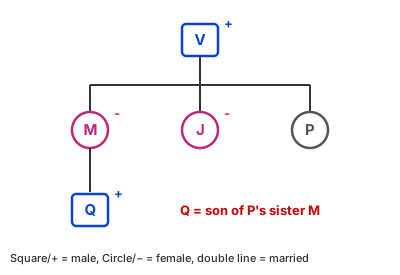
- Q × M: Q is the son of M.
- M + V: M is the daughter of V.
- V – J: V is the father of J; J ÷ P: J is the sister of P.
- So M, J, P are children of V → M is P's sister; Q is M's son → Q is P's sister's son.
Short trick: Since M and P share the father V, M (a daughter) is P's sister – her son is P's sister's son (nephew).
Answer: (D) Sister's son
अवधारणा: बाएँ से दाएँ प्रत्येक चिह्न-युग्म को डिकोड करें और वंश-वृक्ष बनाएँ।
- Q × M: Q, M का पुत्र है।
- M + V: M, V की पुत्री है।
- V – J: V, J का पिता है; J ÷ P: J, P की बहन है।
- अतः M, J, P तीनों V की संतान → M, P की बहन; Q, M का पुत्र → Q, P की बहन का पुत्र।
शॉर्ट ट्रिक: M और P का पिता एक ही (V), M पुत्री है → P की बहन; उसका पुत्र = P की बहन का पुत्र (भांजा)।
उत्तर: (D) बहन का पुत्र
RRB ALP CBT 1General Intelligence and ReasoningCoded blood relationRRB ALP CBT 1 2025 · 16 Feb Shift 3
Q305.In this question, a question is followed by two statements numbered (I) and (II). You have to decide whether the data provided in the statements are sufficient to answer the question. Read both the statements and decide the appropriate answer.
Among the five poles—I, N, C, H, and L—each having a different height, which pole is the shortest?
(I) L is shorter than N. H is shorter than I.
(II) H is taller than L.
इस प्रश्न में, एक प्रश्न के बाद दो कथन (I) और (II) दिए गए हैं। आपको यह तय करना है कि कथनों में दिए गए आँकड़े प्रश्न का उत्तर देने के लिए पर्याप्त हैं या नहीं। दोनों कथनों को पढ़ें और उपयुक्त उत्तर चुनें।
पाँच खंभों—I, N, C, H और L—में से प्रत्येक की ऊँचाई अलग-अलग है, सबसे छोटा खंभा कौन-सा है?
(I) L, N से छोटा है। H, I से छोटा है।
(II) H, L से ऊँचा है।
- AData in statement I alone is sufficient to answer the question while data in statement II is notकेवल कथन I के आँकड़े प्रश्न का उत्तर देने के लिए पर्याप्त हैं, जबकि कथन II के आँकड़े पर्याप्त नहीं हैं
- BBoth statements I and II together (and not statement I alone or statement II alone) are sufficient to answer the questionकथन I और II दोनों मिलकर (न कि अकेला कथन I या अकेला कथन II) प्रश्न का उत्तर देने के लिए पर्याप्त हैं
- CData in statement II alone is sufficient to answer the question while data in statement I is notकेवल कथन II के आँकड़े प्रश्न का उत्तर देने के लिए पर्याप्त हैं, जबकि कथन I के आँकड़े पर्याप्त नहीं हैं
- DBoth statements I and II together are NOT sufficient to answer the questionकथन I और II दोनों मिलकर भी प्रश्न का उत्तर देने के लिए पर्याप्त नहीं हैं
Show answer
Concept: Every pole must be placed relative to the candidate for the shortest.
- (I): L < N, H < I – two separate pairs; shortest unknown.
- (II): L < H – alone not enough.
- Together: L < H < I and L < N, so L is shorter than N, H, I – but C is never compared.
Short trick: Scan for a pole never mentioned: C is missing → 'not sufficient' even together.
Answer: (D) Both statements I and II together are NOT sufficient
अवधारणा: सबसे छोटे के उम्मीदवार की तुलना हर खंभे से होनी चाहिए।
- (I): L < N, H < I – दो अलग युग्म; सबसे छोटा अज्ञात।
- (II): L < H – अकेला पर्याप्त नहीं।
- दोनों: L < H < I और L < N, अतः L, N, H, I से छोटा – पर C की कोई तुलना नहीं।
शॉर्ट ट्रिक: देखें कौन-सा खंभा कहीं नहीं आया: C → दोनों मिलकर भी पर्याप्त नहीं।
उत्तर: (D) कथन I और II दोनों मिलकर भी पर्याप्त नहीं
RRB ALP CBT 1General Intelligence and ReasoningData sufficiency – shortest poleRRB ALP CBT 1 2025 · 16 Feb Shift 3
Q306.In a code language, 'AGENT' is coded as GAHTN and 'ADOPT' is coded as DARTP. How will 'DRINK' be coded in the same language?
एक कूट भाषा में, 'AGENT' को GAHTN और 'ADOPT' को DARTP के रूप में कूटबद्ध किया जाता है। उसी भाषा में 'DRINK' को कैसे कूटबद्ध किया जाएगा?
- ASEKNM
- BSDLKM
- CREKNL
- DRDLKN
Show answer
Concept: Swap letters 1-2, middle letter +3, swap letters 4-5.
- AGENT: AG → GA, E+3 = H, NT → TN → GAHTN.
- ADOPT: AD → DA, O+3 = R, PT → TP → DARTP.
- DRINK: DR → RD, I+3 = L, NK → KN → RDLKN.
Short trick: Only the first two letters: DR → RD leaves options C, D; middle I+3 = L → RDLKN.
Answer: (D) RDLKN
अवधारणा: अक्षर 1-2 की अदला-बदली, बीच का अक्षर +3, अक्षर 4-5 की अदला-बदली।
- AGENT: AG → GA, E+3 = H, NT → TN → GAHTN.
- ADOPT: AD → DA, O+3 = R, PT → TP → DARTP.
- DRINK: DR → RD, I+3 = L, NK → KN → RDLKN.
शॉर्ट ट्रिक: पहले दो अक्षर: DR → RD → विकल्प C, D; बीच का I+3 = L → RDLKN.
उत्तर: (D) RDLKN
RRB ALP CBT 1General Intelligence and ReasoningCoding – swap and shiftRRB ALP CBT 1 2025 · 16 Feb Shift 3
Q307.Refer to the following letter series and answer the question that follows. Counting to be done from left to right only.
(Left) O Q K K M I W K M F A F Y U T U B H T X S (Right)
How many such consonants are there, each of which is immediately preceded by a vowel and also immediately followed by a vowel?
निम्नलिखित अक्षर श्रृंखला को देखें और नीचे दिए गए प्रश्न का उत्तर दें। गिनती केवल बाएँ से दाएँ की जानी है।
(बाएँ) O Q K K M I W K M F A F Y U T U B H T X S (दाएँ)
ऐसे कितने व्यंजन हैं जिनमें से प्रत्येक के ठीक पहले एक स्वर है और ठीक बाद भी एक स्वर है?
- ANoneकोई नहीं
- BThreeतीन
- COneएक
- DTwoदो
Show answer
Concept: Look for the pattern vowel – consonant – vowel.
- Vowels: O, I, A, U, U.
- Check neighbours: …F A F Y… (Y is not a vowel), …Y U T U B… → T has U on both sides ✓.
- Only one such consonant (T).
Short trick: Find two vowels with exactly one letter between them: only U _ U → 1.
Answer: (C) One
अवधारणा: स्वर – व्यंजन – स्वर का क्रम खोजें।
- स्वर: O, I, A, U, U.
- पड़ोसी जाँचें: …F A F Y… (Y स्वर नहीं), …Y U T U B… → T के दोनों ओर U ✓.
- ऐसा केवल एक व्यंजन (T)।
शॉर्ट ट्रिक: ऐसे दो स्वर खोजें जिनके बीच ठीक एक अक्षर हो: केवल U _ U → 1.
उत्तर: (C) एक
RRB ALP CBT 1General Intelligence and ReasoningLetter series – position conditionsRRB ALP CBT 1 2025 · 16 Feb Shift 3
Q308.What should come in place of ? in the given series?
98 110 123 137 152 ?
दी गई श्रृंखला में ? के स्थान पर क्या आना चाहिए?
98 110 123 137 152 ?
- A168
- B169
- C167
- D170
Show answer
Concept: Differences increase by 1.
- Differences: +12, +13, +14, +15.
- Next difference +16 → 152 + 16 = 168.
Short trick: Write the gaps under the series – consecutive numbers 12, 13, 14, 15 → next 16.
Answer: (A) 168
अवधारणा: अंतर 1-1 बढ़ते हैं।
- अंतर: +12, +13, +14, +15.
- अगला अंतर +16 → 152 + 16 = 168.
शॉर्ट ट्रिक: अंतर 12, 13, 14, 15 लगातार हैं → अगला 16.
उत्तर: (A) 168
RRB ALP CBT 1General Intelligence and ReasoningNumber series – increasing differenceRRB ALP CBT 1 2025 · 16 Feb Shift 3
Q309.Refer to the following letter, symbol series and answer the question that follows. Counting to be done from left to right only.
(Left) N % Q E A L & M @ B & F > £ N H * # < L % P (Right)
How many such symbols are there, each of which are immediately preceded by a letter and immediately followed by a symbol?
निम्नलिखित अक्षर, प्रतीक श्रृंखला को देखें और नीचे दिए गए प्रश्न का उत्तर दें। गिनती केवल बाएँ से दाएँ की जानी है।
(बाएँ) N % Q E A L & M @ B & F > £ N H * # < L % P (दाएँ)
ऐसे कितने प्रतीक हैं जिनमें से प्रत्येक के ठीक पहले एक अक्षर है और ठीक बाद एक प्रतीक है?
- AThreeतीन
- BOneएक
- CTwoदो
- DNoneकोई नहीं
Show answer
Concept: Look for the pattern letter – symbol – symbol.
- Symbols with a letter before them: %(after N), &(after L), @(after M), &(after B), >(after F), *(after H), %(after L).
- Of these, followed by a symbol: F > £ ✓ and H * # ✓.
- Count = 2.
Short trick: Find two symbols side by side, then check whether a letter stands just before the first: >£ (F ✓), *# (H ✓), #< (* ✗).
Answer: (C) Two
अवधारणा: अक्षर – प्रतीक – प्रतीक का क्रम खोजें।
- जिन प्रतीकों के ठीक पहले अक्षर है: %(N के बाद), &(L), @(M), &(B), >(F), *(H), %(L).
- इनमें से जिनके बाद प्रतीक है: F > £ ✓ और H * # ✓.
- संख्या = 2.
शॉर्ट ट्रिक: साथ-साथ आए दो प्रतीक खोजें, फिर पहले प्रतीक से ठीक पहले अक्षर देखें: >£ (F ✓), *# (H ✓), #< (* ✗).
उत्तर: (C) दो
RRB ALP CBT 1General Intelligence and ReasoningLetter-symbol seriesRRB ALP CBT 1 2025 · 16 Feb Shift 3
Q310.What should come in place of the question mark (?) in the given series?
17 28 39 50 61 72 ?
दी गई श्रृंखला में प्रश्न चिह्न (?) के स्थान पर क्या आना चाहिए?
17 28 39 50 61 72 ?
- A81
- B87
- C85
- D83
Show answer
Concept: Each term is 11 more than the previous one.
- 28 − 17 = 11, 39 − 28 = 11, … , 72 − 61 = 11.
- Next: 72 + 11 = 83.
Short trick: Unit digits go 7, 8, 9, 0, 1, 2 → next ends in 3 → only 83.
Answer: (D) 83
अवधारणा: प्रत्येक पद पिछले से 11 अधिक है।
- 28 − 17 = 11, 39 − 28 = 11, … , 72 − 61 = 11.
- अगला: 72 + 11 = 83.
शॉर्ट ट्रिक: इकाई अंक 7, 8, 9, 0, 1, 2 → अगला 3 पर समाप्त → केवल 83.
उत्तर: (D) 83
RRB ALP CBT 1General Intelligence and ReasoningNumber series – constant differenceRRB ALP CBT 1 2025 · 16 Feb Shift 3
Q311.This question is based on the five, three-digit numbers given below.
(Left) 627 458 347 491 567 (Right)
(Example- 697 – First digit = 6, second digit = 9 and third digit = 7)
What will be the resultant if the second digit of the second highest number is added to the third digit of the lowest number?
यह प्रश्न नीचे दी गई पाँच, तीन-अंकीय संख्याओं पर आधारित है।
(बाएँ) 627 458 347 491 567 (दाएँ)
(उदाहरण- 697 – पहला अंक = 6, दूसरा अंक = 9 और तीसरा अंक = 7)
यदि दूसरी सबसे बड़ी संख्या के दूसरे अंक को सबसे छोटी संख्या के तीसरे अंक में जोड़ा जाए, तो परिणाम क्या होगा?
- A11
- B13
- C12
- D14
Show answer
Concept: Arrange the numbers in order, then pick the required digits.
- Descending: 627 > 567 > 491 > 458 > 347.
- Second highest = 567 → second digit 6.
- Lowest = 347 → third digit 7. Sum = 6 + 7 = 13.
Short trick: Compare only first digits: 6, 5, 4, 4, 3 → 2nd highest 567, lowest 347.
Answer: (B) 13
अवधारणा: संख्याओं को क्रम में रखें, फिर आवश्यक अंक चुनें।
- घटते क्रम में: 627 > 567 > 491 > 458 > 347.
- दूसरी सबसे बड़ी = 567 → दूसरा अंक 6.
- सबसे छोटी = 347 → तीसरा अंक 7. योग = 6 + 7 = 13.
शॉर्ट ट्रिक: केवल पहले अंक देखें: 6, 5, 4, 4, 3 → दूसरी बड़ी 567, सबसे छोटी 347.
उत्तर: (B) 13
RRB ALP CBT 1General Intelligence and ReasoningNumber arrangement – digitsRRB ALP CBT 1 2025 · 16 Feb Shift 3
Q312.Refer to the following number, symbol series and answer the question that follows. Counting to be done from left to right only. All numbers are single-digit numbers.
(Left) ? + > * 1 + 7 & ^ 1 ^ 7 2 8 ? & > # ? 4 @ (Right)
How many such numbers are there, each of which is immediately preceded by another number and also immediately followed by a symbol?
निम्नलिखित संख्या, प्रतीक श्रृंखला को देखें और नीचे दिए गए प्रश्न का उत्तर दें। गिनती केवल बाएँ से दाएँ की जानी है। सभी संख्याएँ एक-अंकीय हैं।
(बाएँ) ? + > * 1 + 7 & ^ 1 ^ 7 2 8 ? & > # ? 4 @ (दाएँ)
ऐसी कितनी संख्याएँ हैं जिनमें से प्रत्येक के ठीक पहले एक अन्य संख्या है और ठीक बाद एक प्रतीक है?
- AThreeतीन
- BFourचार
- COneएक
- DTwoदो
Show answer
Concept: Look for the pattern number – number – symbol.
- Pairs of adjacent numbers: 7 2, 2 8.
- 7 2 8: 2 is followed by 8 (a number) ✗; 2 8 ?: 8 is followed by ? (a symbol) ✓.
- Count = 1.
Short trick: Only a run of digits can give 'number before number' – the single run 7 2 8 gives exactly its last digit → 1.
Answer: (C) One
अवधारणा: संख्या – संख्या – प्रतीक का क्रम खोजें।
- लगातार संख्याओं के जोड़े: 7 2, 2 8.
- 7 2 8: 2 के बाद 8 (संख्या) ✗; 2 8 ?: 8 के बाद ? (प्रतीक) ✓.
- संख्या = 1.
शॉर्ट ट्रिक: केवल अंकों की लगातार कड़ी (7 2 8) ही योग्य – उसका अंतिम अंक → 1.
उत्तर: (C) एक
RRB ALP CBT 1General Intelligence and ReasoningNumber-symbol seriesRRB ALP CBT 1 2025 · 16 Feb Shift 3
Q313.Based on the English alphabetical order, three of the following four letter-clusters are alike in a certain way and thus form a group. Which letter-cluster DOES NOT belong to that group? (Note: The odd one out is not based on the number of consonants/vowels or their position in the letter-cluster.)
अंग्रेजी वर्णमाला क्रम के आधार पर, निम्नलिखित चार अक्षर-समूहों में से तीन किसी निश्चित प्रकार से एकसमान हैं और इस प्रकार एक समूह बनाते हैं। कौन-सा अक्षर-समूह उस समूह से संबंधित नहीं है?
(नोट: असंगत का निर्धारण व्यंजनों/स्वरों की संख्या या अक्षर-समूह में उनके स्थान के आधार पर नहीं है।)
- AOSV
- BGKN
- CLOS
- DTXA
Show answer
Concept: Find the gaps between consecutive letters.
| OSV | +4 | +3 |
| GKN | +4 | +3 |
| TXA | +4 | +3 (X→Y→Z→A) |
| LOS | +3 | +4 |
Short trick: Three follow +4, +3; LOS reverses it (+3, +4).
Answer: (C) LOS
अवधारणा: क्रमागत अक्षरों के बीच का अंतर ज्ञात करें।
| OSV | +4 | +3 |
| GKN | +4 | +3 |
| TXA | +4 | +3 (X→Y→Z→A) |
| LOS | +3 | +4 |
शॉर्ट ट्रिक: तीन में +4, +3; LOS में उल्टा (+3, +4).
उत्तर: (C) LOS
RRB ALP CBT 1General Intelligence and ReasoningOdd one out – letter gapsRRB ALP CBT 1 2025 · 16 Feb Shift 3
Q314.Soham starts from Point A and drives 59 km towards west. He then takes a left turn, drives 67 km, turns left and drives 67 km. He then takes a left turn and drives 78 km. He takes a final left turn, drives 8 km and stops at Point P. How far (shortest distance) and towards which direction should he drive in order to reach Point A again? (All turns are 90 degrees turns only unless specified)
सोहम बिंदु A से शुरू करता है और पश्चिम की ओर 59 km गाड़ी चलाता है। फिर वह बाएँ मुड़ता है, 67 km चलाता है, बाएँ मुड़ता है और 67 km चलाता है। फिर वह बाएँ मुड़ता है और 78 km चलाता है। वह अंतिम बार बाएँ मुड़ता है, 8 km चलाता है और बिंदु P पर रुक जाता है। बिंदु A पर फिर से पहुँचने के लिए उसे कितनी दूर (न्यूनतम दूरी) और किस दिशा में गाड़ी चलानी चाहिए? (जब तक निर्दिष्ट न हो, सभी मोड़ केवल 90 डिग्री के हैं)
- A10 km to the south10 km दक्षिण की ओर
- B13 km to the south13 km दक्षिण की ओर
- C11 km to the south11 km दक्षिण की ओर
- D12 km to the north12 km उत्तर की ओर
Show answer
Concept: Take A as origin; add east-west and north-south moves separately.
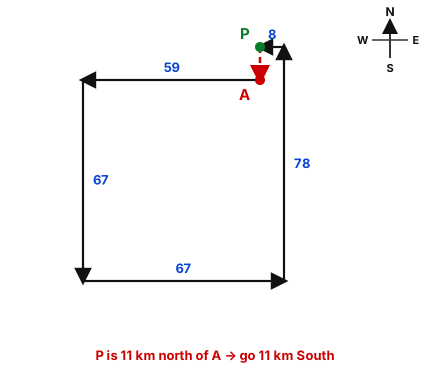
- West 59; left → South 67; left → East 67; left → North 78; left → West 8.
- East-west: −59 + 67 − 8 = 0.
- North-south: −67 + 78 = +11 → P is 11 km north of A.
- To return: 11 km towards the South.
Short trick: Net E-W cancels (59 + 8 = 67), so only N-S matters: 78 − 67 = 11 north → go south.
Answer: (C) 11 km to the south
अवधारणा: A को मूल बिंदु मानें; पूर्व-पश्चिम और उत्तर-दक्षिण गतियाँ अलग-अलग जोड़ें।
- पश्चिम 59; बाएँ → दक्षिण 67; बाएँ → पूर्व 67; बाएँ → उत्तर 78; बाएँ → पश्चिम 8.
- पूर्व-पश्चिम: −59 + 67 − 8 = 0.
- उत्तर-दक्षिण: −67 + 78 = +11 → P, A से 11 km उत्तर में।
- वापस जाने के लिए: 11 km दक्षिण की ओर।
शॉर्ट ट्रिक: पूर्व-पश्चिम कट जाता है (59 + 8 = 67), केवल उत्तर-दक्षिण: 78 − 67 = 11 उत्तर → दक्षिण जाएँ।
उत्तर: (C) 11 km दक्षिण की ओर
RRB ALP CBT 1General Intelligence and ReasoningDirection senseRRB ALP CBT 1 2025 · 16 Feb Shift 3
Q315.Refer to the following series and answer the question (All numbers are single digit numbers only. Counting to be done from left to right.)
(Left) 3 7 2 6 2 7 3 8 7 3 7 6 4 2 4 5 4 9 5 7 7 2 4 (Right)
How many such even digits are there each of which is immediately preceded by an odd digit and also immediately followed by an even digit?
निम्नलिखित श्रृंखला को देखें और प्रश्न का उत्तर दें (सभी संख्याएँ केवल एक-अंकीय हैं। गिनती बाएँ से दाएँ की जानी है।)
(बाएँ) 3 7 2 6 2 7 3 8 7 3 7 6 4 2 4 5 4 9 5 7 7 2 4 (दाएँ)
ऐसे कितने सम अंक हैं जिनमें से प्रत्येक के ठीक पहले एक विषम अंक है और ठीक बाद एक सम अंक है?
- AThreeतीन
- BNoneकोई नहीं
- CTwoदो
- DOneएक
Show answer
Concept: Look for the pattern odd – even – even.
- 7 2 6 ✓ (2 after 7, before 6).
- 7 6 4 ✓ (6 after 7, before 4).
- 7 2 4 ✓ (last three digits). Others like 3 8 7, 5 4 9 fail.
- Count = 3.
Short trick: Scan for every even digit right after an odd digit, then just look one step ahead.
Answer: (A) Three
अवधारणा: विषम – सम – सम का क्रम खोजें।
- 7 2 6 ✓ (2 के पहले 7, बाद में 6)।
- 7 6 4 ✓ (6 के पहले 7, बाद में 4)।
- 7 2 4 ✓ (अंतिम तीन अंक)। 3 8 7, 5 4 9 आदि नहीं।
- संख्या = 3.
शॉर्ट ट्रिक: विषम के ठीक बाद आने वाला हर सम अंक खोजें, फिर केवल अगला अंक देखें।
उत्तर: (A) तीन
RRB ALP CBT 1General Intelligence and ReasoningNumber series – position conditionsRRB ALP CBT 1 2025 · 16 Feb Shift 3
Q316.In a certain code language, ‘HATS’ is coded as ‘2743’ and ‘AHUS’ is coded as ‘7483’. What is the code for ‘U’ in the given code language?
एक निश्चित कूट भाषा में, 'HATS' को '2743' और 'AHUS' को '7483' लिखा जाता है। दी गई कूट भाषा में 'U' का कूट क्या है?
- A4
- B7
- C8
- D3
Show answer
Concept: Letters common to both words share the common digits.
- HATS = 2743, AHUS = 7483.
- Common letters H, A, S ↔ common digits 7, 4, 3.
- Remaining: T = 2 and U = 8.
Short trick: Remove common digits from AHUS's code (7, 4, 3) → leftover 8 is U.
Answer: (C) 8
अवधारणा: दोनों शब्दों के उभयनिष्ठ अक्षरों के कूट भी उभयनिष्ठ होते हैं।
- HATS = 2743, AHUS = 7483.
- उभयनिष्ठ अक्षर H, A, S ↔ उभयनिष्ठ अंक 7, 4, 3.
- शेष: T = 2 और U = 8.
शॉर्ट ट्रिक: AHUS के कूट से उभयनिष्ठ अंक (7, 4, 3) हटाएँ → बचा 8 = U.
उत्तर: (C) 8
RRB ALP CBT 1General Intelligence and ReasoningCoding – common lettersRRB ALP CBT 1 2025 · 16 Feb Shift 3
Q317.Namit starts from Point A and drives 26 km towards the east. He then takes a left turn, drives 25 km, turns left and drives 33 km. He then takes a left turn and drives 35 km. He takes a final left turn, drives 7 km and stops at Point P. How far (shortest distance) and towards which direction should he drive in order to reach Point A again? (All turns are 90-degree turns only unless specified.)
नमित बिंदु A से शुरू करता है और पूर्व की ओर 26 km गाड़ी चलाता है। फिर वह बाएँ मुड़ता है, 25 km चलाता है, बाएँ मुड़ता है और 33 km चलाता है। फिर वह बाएँ मुड़ता है और 35 km चलाता है। वह अंतिम बार बाएँ मुड़ता है, 7 km चलाता है और बिंदु P पर रुक जाता है। बिंदु A पर फिर से पहुँचने के लिए उसे कितनी दूर (न्यूनतम दूरी) और किस दिशा में गाड़ी चलानी चाहिए? (जब तक निर्दिष्ट न हो, सभी मोड़ केवल 90 डिग्री के हैं।)
- A11 km to the North11 km उत्तर की ओर
- B10 km to the North10 km उत्तर की ओर
- C12 km to the South12 km दक्षिण की ओर
- D13 km to the South13 km दक्षिण की ओर
Show answer
Concept: Take A as origin; add east-west and north-south moves separately.
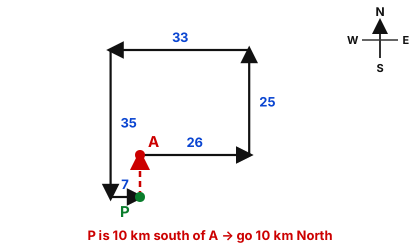
- East 26; left → North 25; left → West 33; left → South 35; left → East 7.
- East-west: 26 − 33 + 7 = 0.
- North-south: 25 − 35 = −10 → P is 10 km south of A.
- To return: 10 km towards the North.
Short trick: E-W: 26 + 7 = 33 cancels; N-S: 35 − 25 = 10 south → go north.
Answer: (B) 10 km to the North
अवधारणा: A को मूल बिंदु मानें; पूर्व-पश्चिम और उत्तर-दक्षिण गतियाँ अलग-अलग जोड़ें।
- पूर्व 26; बाएँ → उत्तर 25; बाएँ → पश्चिम 33; बाएँ → दक्षिण 35; बाएँ → पूर्व 7.
- पूर्व-पश्चिम: 26 − 33 + 7 = 0.
- उत्तर-दक्षिण: 25 − 35 = −10 → P, A से 10 km दक्षिण में।
- वापस जाने के लिए: 10 km उत्तर की ओर।
शॉर्ट ट्रिक: पूर्व-पश्चिम: 26 + 7 = 33 कट जाता है; उत्तर-दक्षिण: 35 − 25 = 10 दक्षिण → उत्तर जाएँ।
उत्तर: (B) 10 km उत्तर की ओर
RRB ALP CBT 1General Intelligence and ReasoningDirection senseRRB ALP CBT 1 2025 · 16 Feb Shift 3
Q318.Select the set in which the numbers are related in the same way as are the numbers of the given sets.
(NOTE: Operations should be performed on the whole numbers, without breaking down the numbers into their constituent digits. E.g. 13 – Operations on 13 such as adding to/subtracting from/multiplying with 13 can be performed. Breaking down 13 into 1 and 3 and then performing mathematical operations on 1 and 3 is not allowed.)
(29, 116, 348)
(22, 88, 264)
उस समुच्चय का चयन कीजिए जिसमें संख्याएँ उसी प्रकार संबंधित हैं जिस प्रकार दिए गए समुच्चयों की संख्याएँ संबंधित हैं।
(नोट: संक्रियाएँ संख्याओं को उनके घटक अंकों में तोड़े बिना, पूर्ण संख्याओं पर की जानी चाहिए। उदाहरण: 13 – 13 पर संक्रियाएँ जैसे 13 में जोड़ना/घटाना/गुणा करना आदि की जा सकती हैं। 13 को 1 और 3 में तोड़कर फिर 1 और 3 पर गणितीय संक्रियाएँ करने की अनुमति नहीं है।)
(29, 116, 348)
(22, 88, 264)
- A(26, 104, 332)
- B(17, 68, 204)
- C(15, 60, 120)
- D(21, 94, 252)
Show answer
Concept: Second = first × 4; third = second × 3.
- , ; , .
- (B) , ✓. (A) ; (C) ; (D) .
Short trick: Third = first × 12: 17 × 12 = 204 ✓ in one step.
Answer: (B) (17, 68, 204)
अवधारणा: दूसरी = पहली × 4; तीसरी = दूसरी × 3.
- , ; , .
- (B) , ✓. (A) ; (C) ; (D) .
शॉर्ट ट्रिक: तीसरी = पहली × 12: 17 × 12 = 204 ✓.
उत्तर: (B) (17, 68, 204)
RRB ALP CBT 1General Intelligence and ReasoningNumber analogy – setsRRB ALP CBT 1 2025 · 16 Feb Shift 3
Q319.If ‘A’ stands for ‘÷’, ‘B’ stands for ‘×’, ‘C’ stands for ‘+’ and ‘D’ stands for ‘−’, then what will come in place of the question mark (?) in the following equation?
75 A 3 D 14 C 9 B 4 = ?
यदि 'A' का अर्थ '÷', 'B' का अर्थ '×', 'C' का अर्थ '+' और 'D' का अर्थ '−' है, तो निम्नलिखित समीकरण में प्रश्न चिह्न (?) के स्थान पर क्या आएगा?
75 A 3 D 14 C 9 B 4 = ?
- A47
- B59
- C63
- D31
Show answer
Concept: Replace letters by signs, then apply BODMAS.
- .
- .
Short trick: Do ÷ and × first: 25 and 36; then 25 + 36 − 14 = 47.
Answer: (A) 47
अवधारणा: अक्षरों के स्थान पर चिह्न रखें, फिर BODMAS लगाएँ।
- .
- .
शॉर्ट ट्रिक: पहले ÷ और ×: 25 और 36; फिर 25 + 36 − 14 = 47.
उत्तर: (A) 47
RRB ALP CBT 1General Intelligence and ReasoningMathematical operations – symbol substitutionRRB ALP CBT 1 2025 · 16 Feb Shift 3
Q320.What should come in place of the question mark (?) in the given series based on the English alphabetical order?
HBU NHA TNG ZTM ?
अंग्रेजी वर्णमाला क्रम के आधार पर दी गई श्रृंखला में प्रश्न चिह्न (?) के स्थान पर क्या आना चाहिए?
HBU NHA TNG ZTM ?
- AFXS
- BFDR
- CFSE
- DFZS
Show answer
Concept: Each letter of a term moves +6 to give the next term.
- 1st letters: H, N, T, Z → +6 → F (cyclic).
- 2nd letters: B, H, N, T → +6 → Z.
- 3rd letters: U, A, G, M → +6 → S.
Short trick: Middle letter T + 6 = Z decides at once → FZS.
Answer: (D) FZS
अवधारणा: प्रत्येक पद का हर अक्षर +6 बढ़कर अगला पद देता है।
- पहले अक्षर: H, N, T, Z → +6 → F (चक्रीय)।
- दूसरे अक्षर: B, H, N, T → +6 → Z.
- तीसरे अक्षर: U, A, G, M → +6 → S.
शॉर्ट ट्रिक: बीच का अक्षर T + 6 = Z → सीधे FZS.
उत्तर: (D) FZS
RRB ALP CBT 1General Intelligence and ReasoningLetter seriesRRB ALP CBT 1 2025 · 16 Feb Shift 3

