Q21.Based on the English alphabetical order, three of the following four letter-cluster pairs are alike in a certain way and thus form a group. Which letter-cluster pair DOES NOT belong to that group? (Note: The odd one out is not based on the number of consonants/vowels or their position in the letter-cluster.)
अंग्रेज़ी वर्णमाला क्रम के आधार पर, निम्नलिखित चार अक्षर-समूह युग्मों में से तीन किसी निश्चित प्रकार से एकसमान हैं और इस प्रकार एक समूह बनाते हैं। कौन-सा अक्षर-समूह युग्म उस समूह से संबंधित नहीं है? (नोट: असंगत अक्षर-समूह, उस अक्षर-समूह में व्यंजनों/स्वरों की संख्या या उनके स्थान पर आधारित नहीं है।)
- AEG-JM
- BBD-FI
- CKM-PS
- DFH-KN
Show answer
Concept: Check the gap inside each cluster and between the first letters.
- EG-JM: +2 | +3, E→J = +5.
- KM-PS: +2 | +3, K→P = +5. FH-KN: +2 | +3, F→K = +5.
- BD-FI: +2 | +3 but B→F = +4 → odd.
Short trick: Internal gaps are identical everywhere, so test the jump between clusters (+5).
Answer: (B) BD-FI
अवधारणा: हर समूह के भीतर का अंतर और पहले अक्षरों का अंतर देखें।
- EG-JM: +2 | +3, E→J = +5.
- KM-PS: +2 | +3, K→P = +5. FH-KN: +2 | +3, F→K = +5.
- BD-FI: +2 | +3 परंतु B→F = +4 → असंगत।
शॉर्ट ट्रिक: भीतरी अंतर सब में समान, इसलिए समूहों के बीच छलाँग (+5) जाँचें।
उत्तर: (B) BD-FI
RRB ALP CBT 1General Intelligence and ReasoningOdd letter-cluster pairRRB ALP CBT 1 2025 · 11 Mar Shift 1
Q22.Read the given statements and conclusions carefully. Assuming that the information given in the statements is true, even if it appears to be at variance with commonly known facts, decide which of the given conclusions logically follow(s) from the statements.
Statements:
Some whales are sharks.
Some sharks are dolphins.
Conclusions:
(I) No shark is a whale.
(II) Some whales are dolphins.
दिए गए कथनों और निष्कर्षों को ध्यानपूर्वक पढ़ें। यह मानते हुए कि कथनों में दी गई जानकारी सत्य है, भले ही वह सामान्य रूप से ज्ञात तथ्यों से भिन्न प्रतीत होती हो, निर्णय लें कि दिए गए निष्कर्षों में से कौन-सा/कौन-से निष्कर्ष कथनों का तार्किक रूप से अनुसरण करता है/करते हैं।
कथन:
कुछ व्हेल, शार्क हैं।
कुछ शार्क, डॉल्फ़िन हैं।
निष्कर्ष:
(I) कोई शार्क, व्हेल नहीं है।
(II) कुछ व्हेल, डॉल्फ़िन हैं।
- ABoth conclusions (I) and (II) follow.दोनों निष्कर्ष (I) और (II) अनुसरण करते हैं।
- BNeither conclusion (I) nor (II) follows.न तो निष्कर्ष (I) और न ही (II) अनुसरण करता है।
- COnly conclusion (II) follows.केवल निष्कर्ष (II) अनुसरण करता है।
- DOnly conclusion (I) follows.केवल निष्कर्ष (I) अनुसरण करता है।
Show answer
Concept: Some + Some gives no definite conclusion between the end terms.
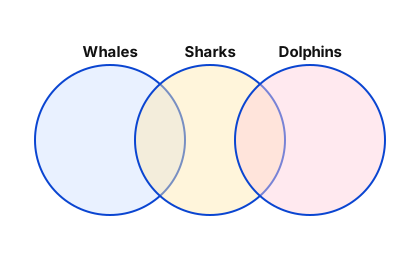
- I: 'Some whales are sharks' directly contradicts 'No shark is a whale' ✘.
- II: Whales and dolphins are linked only through 'some' sharks — not certain ✘ (see the diagram: they need not overlap).
Short trick: Rule: Some + Some = No conclusion.
Answer: (B) Neither conclusion (I) nor (II) follows.
अवधारणा: कुछ + कुछ से अंतिम पदों के बीच कोई निश्चित निष्कर्ष नहीं।
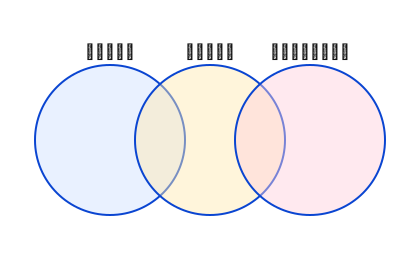
- I: 'कुछ व्हेल शार्क हैं' सीधे 'कोई शार्क व्हेल नहीं' का खंडन करता है ✘.
- II: व्हेल और डॉल्फ़िन केवल 'कुछ' शार्क से जुड़े — निश्चित नहीं ✘ (आरेख देखें)।
शॉर्ट ट्रिक: नियम: कुछ + कुछ = कोई निष्कर्ष नहीं।
उत्तर: (B) न तो निष्कर्ष (I) और न ही (II) अनुसरण करता है।
RRB ALP CBT 1General Intelligence and ReasoningSyllogismRRB ALP CBT 1 2025 · 11 Mar Shift 1
Q23.Each of A, B, C, D, S, T and U has an exam on a different day of a week starting from Monday and ending on Sunday of the same week. No one has an exam before A. Only three people have their exams between A and U. Only one person has the exam between U and B. T has the exam on Wednesday. C has the exam on one of the days after S but on one of the days before D. On which day of the week does C have the exam?
A, B, C, D, S, T और U में से प्रत्येक की परीक्षा एक ही सप्ताह के सोमवार से शुरू होकर रविवार को समाप्त होने वाले सप्ताह के अलग-अलग दिन है। A से पहले किसी की परीक्षा नहीं है। A और U के बीच केवल तीन व्यक्तियों की परीक्षाएँ हैं। U और B के बीच केवल एक व्यक्ति की परीक्षा है। T की परीक्षा बुधवार को है। C की परीक्षा S के बाद वाले दिनों में से किसी एक दिन, लेकिन D से पहले वाले दिनों में से किसी एक दिन है। C की परीक्षा सप्ताह के किस दिन है?
- ASaturdayशनिवार
- BTuesdayमंगलवार
- CMondayसोमवार
- DThursdayगुरुवार
Show answer
Concept: Fix definite days first.
- A = Monday; three between A and U → U = Friday.
- One between U and B → B = Wednesday or Sunday; T is Wednesday → B = Sunday.
- Tue, Thu, Sat left for S < C < D → S = Tue, C = Thu, D = Sat.
Short trick: C is the middle of three remaining days (Tue, Thu, Sat) → Thursday.
Answer: (D) Thursday
अवधारणा: पहले निश्चित दिन तय करें।
- A = सोमवार; A और U के बीच तीन → U = शुक्रवार।
- U और B के बीच एक → B = बुधवार या रविवार; T बुधवार → B = रविवार।
- मंगल, गुरु, शनि बचे, S < C < D → S = मंगल, C = गुरु, D = शनि।
शॉर्ट ट्रिक: शेष तीन दिनों (मंगल, गुरु, शनि) में C बीच वाला → गुरुवार।
उत्तर: (D) गुरुवार
RRB ALP CBT 1General Intelligence and ReasoningDay-based schedulingRRB ALP CBT 1 2025 · 11 Mar Shift 1
Q24.Seven boxes, A, D, J, K, M, O and S are kept one over the other but not necessarily in the same order. Only one box is kept between K and J. D is kept immediately above O. Only one box is kept between D and K. A is kept immediately above M. D is kept immediately below M. J is placed on one of the positions below M. A is placed at the top. Which box is kept between K and J?
सात बक्से A, D, J, K, M, O और S एक के ऊपर एक रखे हैं, परंतु आवश्यक नहीं कि इसी क्रम में हों। K और J के बीच केवल एक बक्सा रखा है। D को O के ठीक ऊपर रखा गया है। D और K के बीच केवल एक बक्सा रखा है। A को M के ठीक ऊपर रखा गया है। D को M के ठीक नीचे रखा गया है। J को M के नीचे वाले स्थानों में से किसी एक पर रखा गया है। A को सबसे ऊपर रखा गया है। K और J के बीच कौन-सा बक्सा रखा गया है?
- AD
- BA
- CS
- DO
Show answer
Concept: Start from the top box and chain the 'immediately' clues.
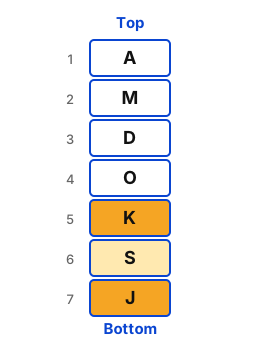
- A = 1, M = 2, D = 3, O = 4 (A over M over D over O).
- One box between D and K → K = 5.
- One box between K and J → J = 7 (3 is taken); S = 6 is between K and J.
Short trick: Once A-M-D-O fill 1–4, K and J must take 5 and 7 → the only leftover, S, sits between them.
Answer: (C) S
अवधारणा: सबसे ऊपर वाले बक्से से शुरू करके 'ठीक' वाले संकेत जोड़ें।
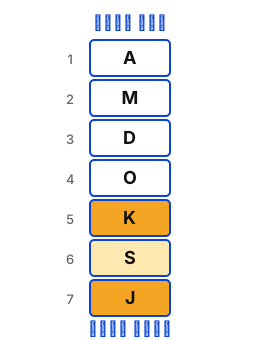
- A = 1, M = 2, D = 3, O = 4.
- D और K के बीच एक → K = 5.
- K और J के बीच एक → J = 7 (3 भरा है); S = 6, K और J के बीच।
शॉर्ट ट्रिक: A-M-D-O के 1–4 भरने पर K, J को 5 और 7 → बचा S उनके बीच।
उत्तर: (C) S
RRB ALP CBT 1General Intelligence and ReasoningBox stacking puzzleRRB ALP CBT 1 2025 · 11 Mar Shift 1
Q25.Kanika starts from point P and walks for 2 m towards the west. She takes a left turn and walks for 3 m. Then she takes a left turn again and walks for 2 m. Then she takes a right turn and walks for 2 m. Once more she takes a right turn and walks for 7 m. Then she takes a right turn and walks for 5 m and stops at point Q. Towards which direction should she walk in order to reach point P again? (All turns are 90-degree turns only unless specified.)
कनिका बिंदु P से शुरू करती है और पश्चिम की ओर 2 m चलती है। वह बाएँ मुड़ती है और 3 m चलती है। फिर वह फिर से बाएँ मुड़ती है और 2 m चलती है। फिर वह दाएँ मुड़ती है और 2 m चलती है। एक बार फिर वह दाएँ मुड़ती है और 7 m चलती है। फिर वह दाएँ मुड़ती है और 5 m चलकर बिंदु Q पर रुक जाती है। बिंदु P पर फिर से पहुँचने के लिए उसे किस दिशा में चलना चाहिए? (जब तक निर्दिष्ट न हो, सभी मोड़ केवल 90 डिग्री के हैं।)
- ASouthदक्षिण
- BNorthउत्तर
- CEastपूर्व
- DWestपश्चिम
Show answer
Concept: Track coordinates with P = (0, 0), East = +x, North = +y.
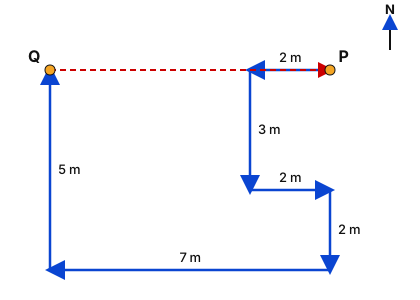
- West 2 → (−2, 0); left = South 3 → (−2, −3); left = East 2 → (0, −3).
- Right = South 2 → (0, −5); right = West 7 → (−7, −5); right = North 5 → Q (−7, 0).
- Q is 7 m west of P → she must walk East.
Short trick: Net N–S: −3 − 2 + 5 = 0; net E–W: −2 + 2 − 7 = −7 (west) → go East.
Answer: (C) East
अवधारणा: P = (0, 0), पूर्व = +x, उत्तर = +y लेकर निर्देशांक देखें।
- पश्चिम 2 → (−2, 0); बाएँ = दक्षिण 3 → (−2, −3); बाएँ = पूर्व 2 → (0, −3).
- दाएँ = दक्षिण 2 → (0, −5); दाएँ = पश्चिम 7 → (−7, −5); दाएँ = उत्तर 5 → Q (−7, 0).
- Q, P से 7 m पश्चिम → उसे पूर्व की ओर चलना होगा।
शॉर्ट ट्रिक: शुद्ध उ–द: −3 − 2 + 5 = 0; शुद्ध पू–प: −7 (पश्चिम) → पूर्व जाएँ।
उत्तर: (C) पूर्व
RRB ALP CBT 1General Intelligence and ReasoningDirection senseRRB ALP CBT 1 2025 · 11 Mar Shift 1
Q26.What should come in place of the question mark (?) in the given series based on the English alphabetical order?
RPE YWL FDS MKZ ?
अंग्रेज़ी वर्णमाला क्रम के आधार पर दी गई श्रृंखला में प्रश्न चिह्न (?) के स्थान पर क्या आना चाहिए?
RPE YWL FDS MKZ ?
- ATGR
- BTRG
- CTHY
- DTGU
Show answer
Concept: Each position moves +7 (cyclic).
- 1st letters: R, Y, F, M → T.
- 2nd letters: P, W, D, K → R.
- 3rd letters: E, L, S, Z → G. Answer TRG.
Short trick: Within each cluster, 1st − 2 = 2nd (R→P, Y→W): T − 2 = R → only TRG.
Answer: (B) TRG
अवधारणा: हर स्थान +7 (चक्रीय) बढ़ता है।
- पहले अक्षर: R, Y, F, M → T.
- दूसरे अक्षर: P, W, D, K → R.
- तीसरे अक्षर: E, L, S, Z → G. उत्तर TRG.
शॉर्ट ट्रिक: हर समूह में पहला − 2 = दूसरा: T − 2 = R → केवल TRG.
उत्तर: (B) TRG
RRB ALP CBT 1General Intelligence and ReasoningLetter seriesRRB ALP CBT 1 2025 · 11 Mar Shift 1
Q27.In the following number-pairs, the second number is obtained by applying certain mathematical operation(s) to the first number. Which numbers should replace X and Y, so that the pattern followed by the two numbers on the left side of :: is the same as that on the right side of ::?
(NOTE: Operations should be performed on the whole numbers, without breaking down the numbers into their constituent digits. E.g. 13 – Operations on 13 such as adding to/subtracting from/multiplying with 13 can be performed. Breaking down 13 into 1 and 3 and then performing mathematical operations on 1 and 3 is not allowed.)
X : 126 :: 21 : Y
निम्नलिखित संख्या-युग्मों में, दूसरी संख्या पहली संख्या पर कुछ गणितीय संक्रिया/संक्रियाएँ लागू करके प्राप्त की जाती है। X और Y के स्थान पर कौन-सी संख्याएँ आनी चाहिए ताकि :: के बाईं ओर की दो संख्याओं का पैटर्न :: के दाईं ओर के पैटर्न के समान हो?
(नोट: संख्याओं को उनके घटक अंकों में तोड़े बिना, संक्रियाएँ पूर्ण संख्याओं पर की जानी चाहिए। उदाहरण के लिए 13 – 13 पर संक्रियाएँ जैसे 13 में जोड़ना/से घटाना/से गुणा करना आदि किया जा सकता है। 13 को 1 और 3 में तोड़कर फिर 1 और 3 पर गणितीय संक्रियाएँ करने की अनुमति नहीं है।)
X : 126 :: 21 : Y
- AX = 16, Y = 574
- BX = 19, Y = 365
- CX = 14, Y = 441
- DX = 12, Y = 207
Show answer
Concept: Test each option for one common rule.
- Try X = 12, Y = 207: (12 + 2) × 9 = 126 and (21 + 2) × 9 = 207 ✔.
- Other options: (16 + 2) × 9 = 162, (19 + 2) × 9 = 189, (14 + 2) × 9 = 144 ≠ 126 ✘.
Short trick: 126 and 207 are both multiples of 9 (digit sum 9) → rule ×9 is natural: 126/9 = 14 = 12 + 2, 207/9 = 23 = 21 + 2.
Answer: (D) X = 12, Y = 207
अवधारणा: प्रत्येक विकल्प में एक समान नियम जाँचें।
- X = 12, Y = 207: (12 + 2) × 9 = 126 और (21 + 2) × 9 = 207 ✔.
- अन्य: 162, 189, 144 ≠ 126 ✘.
शॉर्ट ट्रिक: 126 और 207 दोनों 9 के गुणज → 126/9 = 14 = 12 + 2, 207/9 = 23 = 21 + 2.
उत्तर: (D) X = 12, Y = 207
RRB ALP CBT 1General Intelligence and ReasoningNumber analogyRRB ALP CBT 1 2025 · 11 Mar Shift 1
Q28.Farooque starts from Point A and drives 26 km towards East. He then takes a right turn, drives 17 km, turns right and drives 32 km. He then takes a right turn and drives 22 km. He takes a final right turn, drives 6 km and stops at Point P. How far (shortest distance) and towards which direction should he drive in order to reach Point A again? (All turns are 90-degree turns only, unless specified.)
फ़ारूक़ बिंदु A से शुरू करता है और पूर्व की ओर 26 km गाड़ी चलाता है। फिर वह दाएँ मुड़ता है, 17 km चलाता है, दाएँ मुड़ता है और 32 km चलाता है। फिर वह दाएँ मुड़ता है और 22 km चलाता है। वह अंतिम बार दाएँ मुड़ता है, 6 km चलाता है और बिंदु P पर रुक जाता है। बिंदु A पर फिर से पहुँचने के लिए उसे कितनी दूरी (न्यूनतम दूरी) और किस दिशा में गाड़ी चलानी चाहिए? (जब तक निर्दिष्ट न हो, सभी मोड़ केवल 90 डिग्री के हैं।)
- A6 km to the Southदक्षिण की ओर 6 km
- B5 km to the Southदक्षिण की ओर 5 km
- C5 km to the Northउत्तर की ओर 5 km
- D6 km to the Northउत्तर की ओर 6 km
Show answer
Concept: Add east–west and north–south moves separately.
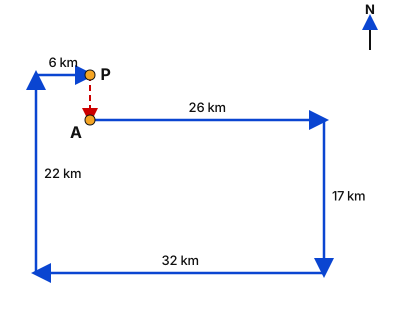
- East 26 → (26, 0); right = South 17 → (26, −17); right = West 32 → (−6, −17).
- Right = North 22 → (−6, 5); right = East 6 → P (0, 5).
- P is 5 km north of A → drive 5 km to the South.
Short trick: E–W: 26 − 32 + 6 = 0; N–S: 22 − 17 = 5 north → 5 km South.
Answer: (B) 5 km to the South
अवधारणा: पूर्व–पश्चिम और उत्तर–दक्षिण गतियाँ अलग-अलग जोड़ें।
- पूर्व 26 → (26, 0); दाएँ = दक्षिण 17 → (26, −17); दाएँ = पश्चिम 32 → (−6, −17).
- दाएँ = उत्तर 22 → (−6, 5); दाएँ = पूर्व 6 → P (0, 5).
- P, A से 5 km उत्तर → दक्षिण की ओर 5 km चलाना होगा।
शॉर्ट ट्रिक: पू–प: 26 − 32 + 6 = 0; उ–द: 22 − 17 = 5 उत्तर → 5 km दक्षिण।
उत्तर: (B) दक्षिण की ओर 5 km
RRB ALP CBT 1General Intelligence and ReasoningDirection sense – distanceRRB ALP CBT 1 2025 · 11 Mar Shift 1
Q29.KK 8 is related to NH -5 in a certain way. In the same way, VO 3 is related to YL -10. To which of the given options is RT 12 related, following the same logic?
KK 8 एक निश्चित प्रकार से NH -5 से संबंधित है। उसी प्रकार, VO 3, YL -10 से संबंधित है। समान तर्क का अनुसरण करते हुए, RT 12 दिए गए विकल्पों में से किससे संबंधित है?
- AUR -1
- BUQ -1
- CVQ -1
- DVQ -3
Show answer
Concept: Handle letters and number separately.
- K → N (+3), K → H (−3), 8 → −5 (−13).
- V → Y (+3), O → L (−3), 3 → −10 (−13).
- R+3 = U, T−3 = Q, 12 − 13 = −1 → UQ -1.
Short trick: Number part −1 leaves UR, UQ, VQ; R+3 = U removes VQ; T−3 = Q picks UQ.
Answer: (B) UQ -1
अवधारणा: अक्षर और संख्या अलग-अलग देखें।
- K → N (+3), K → H (−3), 8 → −5 (−13).
- V → Y (+3), O → L (−3), 3 → −10 (−13).
- R+3 = U, T−3 = Q, 12 − 13 = −1 → UQ -1.
शॉर्ट ट्रिक: संख्या −1 से UR, UQ, VQ; R+3 = U से VQ बाहर; T−3 = Q → UQ.
उत्तर: (B) UQ -1
RRB ALP CBT 1General Intelligence and ReasoningAlphanumeric analogyRRB ALP CBT 1 2025 · 11 Mar Shift 1
Q30.A question is followed by two statements numbered (I) and (II). You have to decide whether the data provided in the statements are sufficient to answer the question. Read both the statements and select the most appropriate answer.
Question:
Among 5 poles, I, L, O, M and D each having a different height, which pole is the tallest?
Statements:
(I) L is taller than D. D is shorter than only one pole.
(II) I is shorter than O but taller than M.
एक प्रश्न के बाद दो कथन (I) और (II) दिए गए हैं। आपको यह तय करना है कि कथनों में दिए गए आँकड़े प्रश्न का उत्तर देने के लिए पर्याप्त हैं या नहीं। दोनों कथनों को पढ़ें और सबसे उपयुक्त उत्तर चुनें।
प्रश्न:
5 खंभों I, L, O, M और D में, जिनमें से प्रत्येक की ऊँचाई अलग-अलग है, कौन-सा खंभा सबसे ऊँचा है?
कथन:
(I) L, D से ऊँचा है। D केवल एक खंभे से छोटा है।
(II) I, O से छोटा है परंतु M से ऊँचा है।
- AData in both statements I and II together (and not statement I alone or statement II alone) are sufficient to answer the question.कथन I और II दोनों के आँकड़े मिलकर (न कि अकेले कथन I या अकेले कथन II) प्रश्न का उत्तर देने के लिए पर्याप्त हैं।
- BData in statement II alone is sufficient to answer the question while data in statement I is not.केवल कथन II के आँकड़े प्रश्न का उत्तर देने के लिए पर्याप्त हैं, जबकि कथन I के आँकड़े पर्याप्त नहीं हैं।
- CData in both statements I and II together are not sufficient to answer the question.कथन I और II दोनों के आँकड़े मिलकर भी प्रश्न का उत्तर देने के लिए पर्याप्त नहीं हैं।
- DData in statement I alone is sufficient to answer the question while data in statement II is not.केवल कथन I के आँकड़े प्रश्न का उत्तर देने के लिए पर्याप्त हैं, जबकि कथन II के आँकड़े पर्याप्त नहीं हैं।
Show answer
Concept: Check each statement alone first.
- I: D is shorter than only one pole → D is 2nd tallest; L is taller than D → L is the tallest ✔.
- II: O > I > M says nothing about L and D ✘.
Short trick: 'Shorter than only one' = 2nd; whoever is taller than it is 1st.
Answer: (D) Statement I alone is sufficient
अवधारणा: पहले प्रत्येक कथन अकेले जाँचें।
- I: D केवल एक से छोटा → D दूसरा सबसे ऊँचा; L, D से ऊँचा → L सबसे ऊँचा ✔.
- II: O > I > M से L और D के बारे में कुछ नहीं ✘.
शॉर्ट ट्रिक: 'केवल एक से छोटा' = दूसरा; जो उससे ऊँचा है वही पहला।
उत्तर: (D) केवल कथन I पर्याप्त
RRB ALP CBT 1General Intelligence and ReasoningData sufficiency – rankingRRB ALP CBT 1 2025 · 11 Mar Shift 1
Q31.If ‘A’ stands for ‘÷’, ‘B’ stands for ‘×’, ‘C’ stands for ‘+’ and ‘D’ stands for ‘−’, what will come in place of the question mark (?) in the following equation?
8 D 46 A 46 B 40 C 47 = ?
यदि ‘A’ का अर्थ ‘÷’, ‘B’ का अर्थ ‘×’, ‘C’ का अर्थ ‘+’ और ‘D’ का अर्थ ‘−’ है, तो निम्नलिखित समीकरण में प्रश्न चिह्न (?) के स्थान पर क्या आएगा?
8 D 46 A 46 B 40 C 47 = ?
- A16
- B17
- C13
- D15
Show answer
Concept: Substitute and apply BODMAS.
- 8 − 46 ÷ 46 × 40 + 47
- = 8 − 1 × 40 + 47 = 8 − 40 + 47 = 15
Short trick: 46 ÷ 46 = 1 → the middle term is just 40: 8 + 47 − 40 = 15.
Answer: (D) 15
अवधारणा: प्रतिस्थापित करें और BODMAS लागू करें।
- 8 − 46 ÷ 46 × 40 + 47
- = 8 − 40 + 47 = 15
शॉर्ट ट्रिक: 46 ÷ 46 = 1 → बीच का पद 40: 8 + 47 − 40 = 15.
उत्तर: (D) 15
RRB ALP CBT 1General Intelligence and ReasoningMathematical operations – symbol substitutionRRB ALP CBT 1 2025 · 11 Mar Shift 1
Q32.Read the given statement(s) and conclusions carefully. Assuming that the information given in the statements is true, even if it appears to be at variance with commonly known facts, decide which of the given conclusions logically follow(s) from the statement(s).
Statements:
Some pencils are swans.
No vultures are pencils.
Conclusions:
(I) No vultures are swans.
(II) Some swans are not vultures.
दिए गए कथन/कथनों और निष्कर्षों को ध्यानपूर्वक पढ़ें। यह मानते हुए कि कथनों में दी गई जानकारी सत्य है, भले ही वह सामान्य रूप से ज्ञात तथ्यों से भिन्न प्रतीत होती हो, निर्णय लें कि दिए गए निष्कर्षों में से कौन-सा/कौन-से निष्कर्ष कथन/कथनों का तार्किक रूप से अनुसरण करता है/करते हैं।
कथन:
कुछ पेंसिलें, हंस हैं।
कोई गिद्ध, पेंसिल नहीं है।
निष्कर्ष:
(I) कोई गिद्ध, हंस नहीं है।
(II) कुछ हंस, गिद्ध नहीं हैं।
- AOnly conclusion (II) follows.केवल निष्कर्ष (II) अनुसरण करता है।
- BOnly conclusion (I) follows.केवल निष्कर्ष (I) अनुसरण करता है।
- CNeither conclusion (I) nor (II) follows.न तो निष्कर्ष (I) और न ही (II) अनुसरण करता है।
- DBoth conclusions (I) and (II) follow.दोनों निष्कर्ष (I) और (II) अनुसरण करते हैं।
Show answer
Concept: Some A are B + No C is A ⇒ Some B are not C.
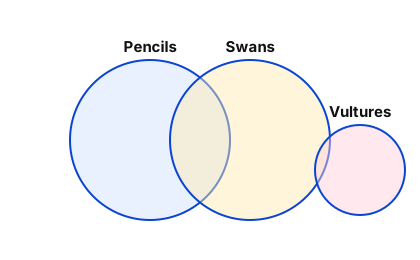
- The swans that are pencils can never be vultures → 'Some swans are not vultures' ✔ (II).
- Vultures may still overlap with the other swans → 'No vultures are swans' is not certain ✘ (I).
Short trick: Rule: Some + No = 'Some not' (in the direction of the 'some' term).
Answer: (A) Only conclusion (II) follows.
अवधारणा: कुछ A, B हैं + कोई C, A नहीं ⇒ कुछ B, C नहीं हैं।
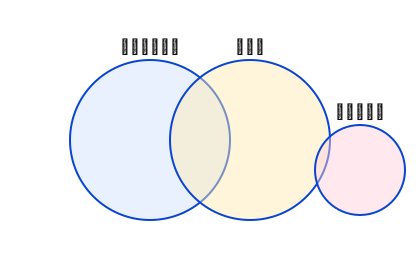
- जो हंस पेंसिल हैं वे कभी गिद्ध नहीं हो सकते → 'कुछ हंस गिद्ध नहीं हैं' ✔ (II).
- गिद्ध अन्य हंसों से मिल सकते हैं → 'कोई गिद्ध हंस नहीं' निश्चित नहीं ✘ (I).
शॉर्ट ट्रिक: नियम: कुछ + कोई नहीं = 'कुछ नहीं' ('कुछ' वाले पद की दिशा में)।
उत्तर: (A) केवल निष्कर्ष (II) अनुसरण करता है।
RRB ALP CBT 1General Intelligence and ReasoningSyllogismRRB ALP CBT 1 2025 · 11 Mar Shift 1
Q33.Refer to the following letter series and answer the question that follows. Counting to be done from left to right only.
(Left) S W L V F E D N M B H I O P L M J U H B N V F R T Y G B V C D E W (Right)
How many letters are there in the English alphabetical series between the letter which is third from right end and the letter that is third from left end?
निम्नलिखित अक्षर श्रृंखला को देखें और नीचे दिए गए प्रश्न का उत्तर दें। गिनती केवल बाएँ से दाएँ की जानी है।
(बाएँ) S W L V F E D N M B H I O P L M J U H B N V F R T Y G B V C D E W (दाएँ)
अंग्रेज़ी वर्णमाला श्रृंखला में दाएँ छोर से तीसरे अक्षर और बाएँ छोर से तीसरे अक्षर के बीच कितने अक्षर हैं?
- A7
- B4
- C6
- D9
Show answer
Concept: Locate both letters, then count letters between them in A–Z.
- Third from the left end: S, W, L → L.
- Third from the right end: W, E, D → D.
- Between D (4) and L (12): 12 − 4 − 1 = 7 letters (E, F, G, H, I, J, K).
Short trick: Letters between positions p and q = |p − q| − 1.
Answer: (A) 7
अवधारणा: दोनों अक्षर खोजें, फिर A–Z में उनके बीच के अक्षर गिनें।
- बाएँ छोर से तीसरा: S, W, L → L.
- दाएँ छोर से तीसरा: W, E, D → D.
- D (4) और L (12) के बीच: 12 − 4 − 1 = 7 अक्षर (E, F, G, H, I, J, K)।
शॉर्ट ट्रिक: स्थान p और q के बीच अक्षर = |p − q| − 1.
उत्तर: (A) 7
RRB ALP CBT 1General Intelligence and ReasoningLetter series – positionRRB ALP CBT 1 2025 · 11 Mar Shift 1
Q34.Based on the English alphabetical order, three of the following four letter-clusters are alike in a certain way and thus form a group. Which letter-cluster DOES NOT belong to that group? (Note: The odd one out is not based on the number of consonants/vowels or their position in the letter-cluster.)
अंग्रेज़ी वर्णमाला क्रम के आधार पर, निम्नलिखित चार अक्षर-समूहों में से तीन किसी निश्चित प्रकार से एकसमान हैं और इस प्रकार एक समूह बनाते हैं। कौन-सा अक्षर-समूह उस समूह से संबंधित नहीं है? (नोट: असंगत अक्षर-समूह, उस अक्षर-समूह में व्यंजनों/स्वरों की संख्या या उनके स्थान पर आधारित नहीं है।)
- ATYX
- BOTS
- CFHJ
- DCHG
Show answer
Concept: Find the gap pattern within each cluster.
- TYX: +5, −1. OTS: +5, −1. CHG: +5, −1.
- FHJ: +2, +2 → odd.
Short trick: Only FHJ is in increasing order; the other three go up then step back.
Answer: (C) FHJ
अवधारणा: प्रत्येक समूह के भीतर अंतर का पैटर्न देखें।
- TYX: +5, −1. OTS: +5, −1. CHG: +5, −1.
- FHJ: +2, +2 → असंगत।
शॉर्ट ट्रिक: केवल FHJ बढ़ते क्रम में; बाकी तीन ऊपर जाकर एक कदम पीछे।
उत्तर: (C) FHJ
RRB ALP CBT 1General Intelligence and ReasoningOdd letter-clusterRRB ALP CBT 1 2025 · 11 Mar Shift 1
Q35.P and Q are married to each other. P is the father of M. M is the husband of T. Q is the mother of L. L is the mother of O. How is L related to M?
P और Q एक-दूसरे से विवाहित हैं। P, M का पिता है। M, T का पति है। Q, L की माता है। L, O की माता है। L का M से क्या संबंध है?
- AWifeपत्नी
- BSisterबहन
- CBrotherभाई
- DHusbandपति
Show answer
Concept: Build the family tree; use gender clues.
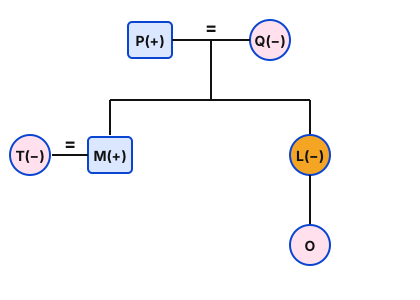
- P (father) and Q (mother) are a couple; M and L are both their children.
- M is a husband → male; L is a mother → female.
- So L is M's sister.
Short trick: Same parents + L is female → Sister.
Answer: (B) Sister
अवधारणा: वंश-वृक्ष बनाएँ; लिंग संकेतों का उपयोग करें।
- P (पिता) और Q (माता) दंपती; M और L दोनों उनकी संतान।
- M पति है → पुरुष; L माता है → महिला।
- अतः L, M की बहन है।
शॉर्ट ट्रिक: समान माता-पिता + L महिला → बहन।
उत्तर: (B) बहन
RRB ALP CBT 1General Intelligence and ReasoningBlood relationsRRB ALP CBT 1 2025 · 11 Mar Shift 1
Q36.In a certain code language, ‘DASH’ is coded as ‘8465’ and ‘HADE’ is coded as ‘5862’. What is the code for ‘E’ in the given code language?
एक निश्चित कूट भाषा में, ‘DASH’ को ‘8465’ और ‘HADE’ को ‘5862’ के रूप में कूटबद्ध किया जाता है। दी गई कूट भाषा में ‘E’ का कूट क्या है?
- A2
- B6
- C5
- D8
Show answer
Concept: Common letters share common digits (order may be jumbled).
- Common letters D, A, H ↔ common digits 8, 6, 5.
- DASH leftover: S ↔ 4; HADE leftover: E ↔ 2.
Short trick: The unique letter of a word gets the unique digit of its code.
Answer: (A) 2
अवधारणा: उभयनिष्ठ अक्षरों के कूट उभयनिष्ठ अंक (क्रम बदला हो सकता है)।
- उभयनिष्ठ अक्षर D, A, H ↔ उभयनिष्ठ अंक 8, 6, 5.
- DASH में बचा: S ↔ 4; HADE में बचा: E ↔ 2.
शॉर्ट ट्रिक: शब्द का अनोखा अक्षर उसके कूट का अनोखा अंक लेता है।
उत्तर: (A) 2
RRB ALP CBT 1General Intelligence and ReasoningCoding – common lettersRRB ALP CBT 1 2025 · 11 Mar Shift 1
Q37.Refer to the following letter, symbol series and answer the question.
(Left) R T % & V B M > < Y P L + A # ^ & ? A S P I % + E # A @ Q B T G & + % C ? (Right)
If all the symbols are dropped from the series, which of the following will be fifth from the right?
निम्नलिखित अक्षर, प्रतीक श्रृंखला को देखें और प्रश्न का उत्तर दें।
(बाएँ) R T % & V B M > < Y P L + A # ^ & ? A S P I % + E # A @ Q B T G & + % C ? (दाएँ)
यदि श्रृंखला से सभी प्रतीक हटा दिए जाएँ, तो निम्नलिखित में से कौन-सा दाएँ से पाँचवाँ होगा?
- AM
- BY
- CQ
- DB
Show answer
Concept: Drop all symbols and count from the right.
- Letters from the right end: C (1), G (2), T (3), B (4), Q (5).
- Fifth from the right = Q.
Short trick: Only the right end matters — rewrite just the last few letters.
Answer: (C) Q
अवधारणा: सभी प्रतीक हटाकर दाएँ से गिनें।
- दाएँ छोर से अक्षर: C (1), G (2), T (3), B (4), Q (5).
- दाएँ से पाँचवाँ = Q.
शॉर्ट ट्रिक: केवल दायाँ छोर देखें — अंतिम कुछ अक्षर ही लिखें।
उत्तर: (C) Q
RRB ALP CBT 1General Intelligence and ReasoningLetter–symbol seriesRRB ALP CBT 1 2025 · 11 Mar Shift 1
Q38.Each vowel in the word CERTAIN is changed to the letter immediately following it in the English alphabetical order and each consonant is changed to the letter immediately preceding it in the English alphabetical order. Which of the following letters will appear exactly twice in the group of letters thus formed?
शब्द CERTAIN में प्रत्येक स्वर को अंग्रेज़ी वर्णमाला क्रम में उसके ठीक बाद वाले अक्षर में बदल दिया जाता है और प्रत्येक व्यंजन को अंग्रेज़ी वर्णमाला क्रम में उसके ठीक पहले वाले अक्षर में बदल दिया जाता है। इस प्रकार बने अक्षरों के समूह में निम्नलिखित में से कौन-सा अक्षर ठीक दो बार आएगा?
- AS
- BQ
- CJ
- DB
Show answer
Concept: Vowel → next letter, consonant → previous letter.
- C→B, E→F, R→Q, T→S, A→B, I→J, N→M.
- New group: B F Q S B J M → B appears twice.
Short trick: B can come from A (vowel +1) and from C (consonant −1) — CERTAIN has both.
Answer: (D) B
अवधारणा: स्वर → अगला अक्षर, व्यंजन → पिछला अक्षर।
- C→B, E→F, R→Q, T→S, A→B, I→J, N→M.
- नया समूह: B F Q S B J M → B दो बार।
शॉर्ट ट्रिक: B, A (स्वर +1) और C (व्यंजन −1) दोनों से बनता है — CERTAIN में दोनों हैं।
उत्तर: (D) B
RRB ALP CBT 1General Intelligence and ReasoningLetter transformationRRB ALP CBT 1 2025 · 11 Mar Shift 1
Q39.Each of G, H, I, J, K, L and M has an exam on a different day of a week starting from Monday and ending on Sunday of the same week. L has an exam on Saturday. Only two persons have exam between G and L. Only one person has exam between G and I but I's exam is not on the first day. Only two persons have exams between J and I. K has exam immediately before J. H's exam is not on the last day. On which day does H have the exam?
G, H, I, J, K, L और M में से प्रत्येक की परीक्षा एक ही सप्ताह के सोमवार से शुरू होकर रविवार को समाप्त होने वाले सप्ताह के अलग-अलग दिन है। L की परीक्षा शनिवार को है। G और L के बीच केवल दो व्यक्तियों की परीक्षा है। G और I के बीच केवल एक व्यक्ति की परीक्षा है लेकिन I की परीक्षा पहले दिन नहीं है। J और I के बीच केवल दो व्यक्तियों की परीक्षाएँ हैं। K की परीक्षा J से ठीक पहले है। H की परीक्षा अंतिम दिन नहीं है। H की परीक्षा किस दिन है?
- AThursdayगुरुवार
- BMondayसोमवार
- CSundayरविवार
- DTuesdayमंगलवार
Show answer
Concept: Fix the definite days and work outward.
- L = Saturday; two between G and L → G = Wednesday.
- One between G and I, I not Monday → I = Friday.
- Two between J and I → J = Tuesday; K just before J → K = Monday.
- Thursday and Sunday remain for H and M; H not on the last day → H = Thursday.
Short trick: Use a 7-slot strip Mon–Sun and fill L, G, I, J, K in one pass.
Answer: (A) Thursday
अवधारणा: निश्चित दिन तय करके आगे बढ़ें।
- L = शनिवार; G और L के बीच दो → G = बुधवार।
- G और I के बीच एक, I सोमवार नहीं → I = शुक्रवार।
- J और I के बीच दो → J = मंगलवार; K, J से ठीक पहले → K = सोमवार।
- गुरुवार और रविवार H, M के लिए; H अंतिम दिन नहीं → H = गुरुवार।
शॉर्ट ट्रिक: सोम–रवि के 7 खाने बनाकर एक बार में L, G, I, J, K भरें।
उत्तर: (A) गुरुवार
RRB ALP CBT 1General Intelligence and ReasoningDay-based schedulingRRB ALP CBT 1 2025 · 11 Mar Shift 1
Q40.What should come in place of ? in the given series?
31 32 34 38 46 ?
दी गई श्रृंखला में ? के स्थान पर क्या आना चाहिए?
31 32 34 38 46 ?
- A62
- B63
- C61
- D64
Show answer
Concept: Differences are powers of 2.
- Differences: 1, 2, 4, 8 → next 16.
- 46 + 16 = 62.
Short trick: Each difference doubles: 8 × 2 = 16.
Answer: (A) 62
अवधारणा: अंतर 2 की घातें हैं।
- अंतर: 1, 2, 4, 8 → अगला 16.
- 46 + 16 = 62.
शॉर्ट ट्रिक: हर अंतर दोगुना: 8 × 2 = 16.
उत्तर: (A) 62
RRB ALP CBT 1General Intelligence and ReasoningNumber series – doubling differencesRRB ALP CBT 1 2025 · 11 Mar Shift 1

