Q401.Based on the English alphabetical order, three of the following four letter-cluster pairs are alike in a certain way and thus form a group. Which letter-cluster pair DOES NOT belong to that group? (Note: The odd one out is not based on the number of consonants/vowels or their position in the letter-cluster.)
अंग्रेजी वर्णमाला क्रम के आधार पर, निम्नलिखित चार अक्षर-समूह युग्मों में से तीन किसी निश्चित प्रकार से एकसमान हैं और इस प्रकार एक समूह बनाते हैं। कौन-सा अक्षर-समूह युग्म उस समूह से संबंधित नहीं है? (ध्यान दें: असंगत का निर्धारण अक्षर-समूह में व्यंजनों/स्वरों की संख्या या उनके स्थान के आधार पर नहीं है।)
- APT - MR
- BEI - BF
- CNR - KO
- DJN - GK
Show answer
Concept: Compare the letter gaps inside each cluster and between the two clusters of a pair.
- EI – BF: E→I = +4, B→F = +4; E→B = −3, I→F = −3.
- NR – KO: +4, +4; −3, −3.
- JN – GK: +4, +4; −3, −3.
- PT – MR: P→T = +4 but M→R = +5 (T→R is only −2).
Short trick: Just check the second cluster: BF, KO, GK all have gap +4; MR has gap +5 → odd.
Answer: (A) PT - MR
अवधारणा: प्रत्येक समूह के अंदर तथा युग्म के दोनों समूहों के बीच अक्षरों का अंतर देखें।
- EI – BF: E→I = +4, B→F = +4; E→B = −3, I→F = −3.
- NR – KO: +4, +4; −3, −3.
- JN – GK: +4, +4; −3, −3.
- PT – MR: P→T = +4 पर M→R = +5 (T→R केवल −2)।
शॉर्ट ट्रिक: केवल दूसरा समूह देखें: BF, KO, GK में अंतर +4 है; MR में +5 → असंगत।
उत्तर: (A) PT - MR
RRB ALP CBT 1General Intelligence and ReasoningOdd one out – letter-cluster pairsRRB ALP CBT 1 2025 · 13 Feb Shift 1
Q402.This question is based on the five, three-digit numbers given below.
(Left) 567 154 264 614 328 (Right)
(Example- 697 – First digit = 6, second digit = 9 and third digit = 7)
What will be the resultant if third digit of the highest number is added to the second digit of lowest number?
यह प्रश्न नीचे दी गई पाँच, तीन अंकों वाली संख्याओं पर आधारित है।
(बाएँ) 567 154 264 614 328 (दाएँ)
(उदाहरण- 697 – पहला अंक = 6, दूसरा अंक = 9 और तीसरा अंक = 7)
यदि सबसे बड़ी संख्या के तीसरे अंक को सबसे छोटी संख्या के दूसरे अंक में जोड़ा जाए, तो परिणाम क्या होगा?
- A5
- B6
- C9
- D8
Show answer
Concept: Identify the highest and lowest numbers, then pick the asked digits.
- Highest = 614 → third digit = 4.
- Lowest = 154 → second digit = 5.
- 4 + 5 = 9
Short trick: Compare only the first digits: 6 is largest (614), 1 is smallest (154).
Answer: (C) 9
अवधारणा: सबसे बड़ी और सबसे छोटी संख्या पहचानें, फिर पूछे गए अंक लें।
- सबसे बड़ी = 614 → तीसरा अंक = 4.
- सबसे छोटी = 154 → दूसरा अंक = 5.
- 4 + 5 = 9
शॉर्ट ट्रिक: केवल पहले अंक की तुलना करें: 6 सबसे बड़ा (614), 1 सबसे छोटा (154)।
उत्तर: (C) 9
RRB ALP CBT 1General Intelligence and ReasoningNumber arrangement – digit operationsRRB ALP CBT 1 2025 · 13 Feb Shift 1
Q403.Ashutosh starts from Point A and drives 19 km towards West. He then takes a left turn, drives 9 km, turns left and drives 26 km. He then takes a left turn and drives 19 km. He takes a final left turn, drives 7 km and stops at Point P. How far (shortest distance) and towards which direction should he drive in order to reach Point A again? (All turns are 90-degree turns only, unless specified.)
आशुतोष बिंदु A से शुरू करता है और पश्चिम की ओर 19 km गाड़ी चलाता है। फिर वह बाएँ मुड़ता है, 9 km गाड़ी चलाता है, बाएँ मुड़ता है और 26 km गाड़ी चलाता है। फिर वह बाएँ मुड़ता है और 19 km गाड़ी चलाता है। वह अंतिम बार बाएँ मुड़ता है, 7 km गाड़ी चलाता है और बिंदु P पर रुक जाता है। बिंदु A पर फिर से पहुँचने के लिए उसे कितनी दूर (न्यूनतम दूरी) और किस दिशा में गाड़ी चलानी चाहिए? (जब तक निर्दिष्ट न किया जाए, सभी मोड़ केवल 90 डिग्री के मोड़ हैं।)
- A10 km to the Northउत्तर की ओर 10 km
- B11 km to the Northउत्तर की ओर 11 km
- C11 km to the Southदक्षिण की ओर 11 km
- D10 km to the Southदक्षिण की ओर 10 km
Show answer
Concept: Take A = (0, 0); East = +x, North = +y. A left turn from West faces South, and so on.
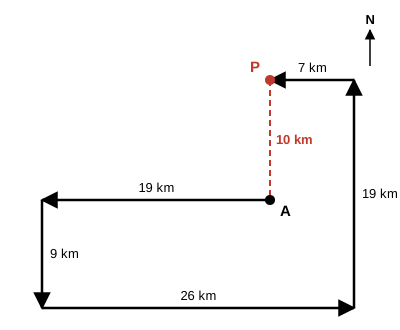
- West 19 → (−19, 0); left → South 9 → (−19, −9)
- left → East 26 → (7, −9); left → North 19 → (7, 10)
- left → West 7 → P = (0, 10)
- P is 10 km North of A → drive 10 km South.
Short trick: Net x = −19 + 26 − 7 = 0; net y = −9 + 19 = +10 → P is straight 10 km north of A.
Answer: (D) 10 km to the South
अवधारणा: A = (0, 0) लें; पूर्व = +x, उत्तर = +y. पश्चिम की ओर से बाएँ मुड़ने पर दक्षिण दिशा, इत्यादि।
- पश्चिम 19 → (−19, 0); बाएँ → दक्षिण 9 → (−19, −9)
- बाएँ → पूर्व 26 → (7, −9); बाएँ → उत्तर 19 → (7, 10)
- बाएँ → पश्चिम 7 → P = (0, 10)
- P, A से 10 km उत्तर में है → 10 km दक्षिण की ओर जाना होगा।
शॉर्ट ट्रिक: कुल x = −19 + 26 − 7 = 0; कुल y = −9 + 19 = +10 → P, A के ठीक 10 km उत्तर में।
उत्तर: (D) दक्षिण की ओर 10 km
RRB ALP CBT 1General Intelligence and ReasoningDirection sense – shortest distanceRRB ALP CBT 1 2025 · 13 Feb Shift 1
Q404.A, G, H, P, S and Y live on six different floors of the same building. The lowermost floor in the building is numbered 1, the floor above it is numbered 2 and so on till the topmost floor is numbered 6. Only three people live between Y and H, where Y lives below H. G lives on an odd-numbered floor and immediately above Y. S lives on one of the floors below A and on one of the floors above P. Who lives on floor numbered 5?
A, G, H, P, S और Y एक ही इमारत की छह अलग-अलग मंजिलों पर रहते हैं। इमारत की सबसे निचली मंजिल की संख्या 1 है, उसके ऊपर वाली मंजिल की संख्या 2 है और इसी प्रकार सबसे ऊपरी मंजिल की संख्या 6 है। Y और H के बीच केवल तीन लोग रहते हैं, जहाँ Y, H से नीचे रहता है। G एक विषम संख्या वाली मंजिल पर और Y के ठीक ऊपर रहता है। S, A से नीचे की किसी एक मंजिल पर और P से ऊपर की किसी एक मंजिल पर रहता है। मंजिल संख्या 5 पर कौन रहता है?
- AY
- BG
- CP
- DA
Show answer
Concept: Fix the pair with the most definite gap first (Y–H), then use the odd-floor clue.
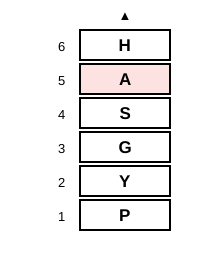
- Three people between Y and H, Y below H → (Y1, H5) or (Y2, H6).
- G is on an odd floor immediately above Y → Y = 2, G = 3, H = 6 (Y1 gives G = 2, even ✗).
- Left floors 1, 4, 5 for P, S, A with P < S < A → P = 1, S = 4, A = 5.
Short trick: “G odd and just above Y” forces Y even → Y = 2 immediately.
Answer: (D) A
अवधारणा: पहले सबसे निश्चित अंतर वाली जोड़ी (Y–H) तय करें, फिर विषम मंजिल वाला संकेत लगाएँ।
- Y और H के बीच तीन लोग, Y नीचे → (Y1, H5) या (Y2, H6).
- G विषम मंजिल पर, Y के ठीक ऊपर → Y = 2, G = 3, H = 6 (Y1 से G = 2 सम ✗).
- बची मंजिलें 1, 4, 5: P < S < A → P = 1, S = 4, A = 5.
शॉर्ट ट्रिक: “G विषम और Y के ठीक ऊपर” से Y सम होगा → तुरंत Y = 2.
उत्तर: (D) A
RRB ALP CBT 1General Intelligence and ReasoningFloor puzzleRRB ALP CBT 1 2025 · 13 Feb Shift 1
Q405.What will come in place of the question mark (?) in the following equation, if '+' and '÷' are interchanged and '-' and 'x' are interchanged?
243 + 9 x 4 - 19 ÷ 200 = ?
यदि '+' और '÷' को आपस में बदल दिया जाए तथा '-' और 'x' को आपस में बदल दिया जाए, तो निम्नलिखित समीकरण में प्रश्न चिह्न (?) के स्थान पर क्या आएगा?
243 + 9 x 4 - 19 ÷ 200 = ?
- A156
- B149
- C144
- D151
Show answer
Concept: Swap the signs first, then apply BODMAS.
- + ↔ ÷ and − ↔ ×: 243 ÷ 9 − 4 × 19 + 200
- = 27 − 76 + 200
- = 151
Short trick: Unit digit check: 7 − 6 + 0 → ends in 1 → only 151.
Answer: (D) 151
अवधारणा: पहले चिह्न बदलें, फिर BODMAS लगाएँ।
- + ↔ ÷ तथा − ↔ ×: 243 ÷ 9 − 4 × 19 + 200
- = 27 − 76 + 200
- = 151
शॉर्ट ट्रिक: इकाई अंक: 7 − 6 + 0 → अंत में 1 → केवल 151.
उत्तर: (D) 151
RRB ALP CBT 1General Intelligence and ReasoningMathematical operations – sign interchangeRRB ALP CBT 1 2025 · 13 Feb Shift 1
Q406.Below are given two sets of numbers. In each set of numbers, a certain mathematical operation on first number results in the second number. Similarly, certain mathematical operation on second number results in the third number and so on. Which of the given options follows the same set of operations as in question?
(NOTE – A two/three digit number cannot be broken into individual digits for operations e.g. if 37 is followed by 10, the operation cannot be 3+7 as a two digit number cannot be broken into individual digits)
2 - 4 - 16 - 32 ; 3 - 6 - 36 - 72
नीचे संख्याओं के दो समुच्चय दिए गए हैं। संख्याओं के प्रत्येक समुच्चय में, पहली संख्या पर एक निश्चित गणितीय संक्रिया करने से दूसरी संख्या प्राप्त होती है। इसी प्रकार, दूसरी संख्या पर एक निश्चित गणितीय संक्रिया करने से तीसरी संख्या प्राप्त होती है और इसी प्रकार आगे भी। दिए गए विकल्पों में से कौन-सा विकल्प प्रश्न के समान संक्रियाओं के समुच्चय का अनुसरण करता है?
(ध्यान दें: दो/तीन अंकों की संख्या को संक्रियाओं के लिए अलग-अलग अंकों में नहीं तोड़ा जा सकता, उदाहरण के लिए, यदि 37 के बाद 10 है, तो संक्रिया 3+7 नहीं हो सकती क्योंकि दो अंकों की संख्या को अलग-अलग अंकों में नहीं तोड़ा जा सकता)
2 - 4 - 16 - 32 ; 3 - 6 - 36 - 72
- A6 - 12 - 144 - 248
- B5 - 10 - 100 - 200
- C1 - 2 - 4 - 16
- D9 - 18 - 36 - 72
Show answer
Concept: Find the step-by-step operations from the given sets.
- 2 × 2 = 4, 4² = 16, 16 × 2 = 32
- 3 × 2 = 6, 6² = 36, 36 × 2 = 72
- Pattern: ×2, square, ×2
- 5 × 2 = 10, 10² = 100, 100 × 2 = 200 ✓
Short trick: Last term = 2 × third term: only 100 → 200 (B) and 36 → 72 (D) pass; D fails 18² ≠ 36.
Answer: (B) 5 - 10 - 100 - 200
अवधारणा: दिए गए समुच्चयों से क्रमवार संक्रियाएँ ज्ञात करें।
- 2 × 2 = 4, 4² = 16, 16 × 2 = 32
- 3 × 2 = 6, 6² = 36, 36 × 2 = 72
- पैटर्न: ×2, वर्ग, ×2
- 5 × 2 = 10, 10² = 100, 100 × 2 = 200 ✓
शॉर्ट ट्रिक: अंतिम पद = 2 × तीसरा पद: केवल B और D; D में 18² ≠ 36.
उत्तर: (B) 5 - 10 - 100 - 200
RRB ALP CBT 1General Intelligence and ReasoningNumber set – operation patternRRB ALP CBT 1 2025 · 13 Feb Shift 1
Q407.If 1 is added to each odd digit and 2 is subtracted from each even digit in the number 3615487, which of the following digits will be second from the left?
यदि संख्या 3615487 में प्रत्येक विषम अंक में 1 जोड़ा जाए और प्रत्येक सम अंक में से 2 घटाया जाए, तो निम्नलिखित में से कौन-सा अंक बाएँ से दूसरा होगा?
- A4
- B3
- C2
- D8
Show answer
Concept: Odd digit → +1, even digit → −2.
Short trick: Only the 2nd digit is asked: 6 is even → 6 − 2 = 4.
Answer: (A) 4
अवधारणा: विषम अंक → +1, सम अंक → −2.
शॉर्ट ट्रिक: केवल दूसरा अंक पूछा है: 6 सम → 6 − 2 = 4.
उत्तर: (A) 4
RRB ALP CBT 1General Intelligence and ReasoningDigit operationsRRB ALP CBT 1 2025 · 13 Feb Shift 1
Q408.Based on the English alphabetical order, three of the following four letter-clusters are alike in a certain way and thus form a group. Which letter-cluster DOES NOT belong to that group?
(Note: The odd one out is not based on the number of consonants/vowels or their position in the letter-cluster.)
अंग्रेजी वर्णमाला क्रम के आधार पर, निम्नलिखित चार अक्षर-समूहों में से तीन किसी निश्चित प्रकार से एकसमान हैं और इस प्रकार एक समूह बनाते हैं। कौन-सा अक्षर-समूह उस समूह से संबंधित नहीं है?
(ध्यान दें: असंगत का निर्धारण अक्षर-समूह में व्यंजनों/स्वरों की संख्या या उनके स्थान के आधार पर नहीं है।)
- ALPS
- BQTW
- CGKN
- DBFI
Show answer
Concept: Check the gaps between consecutive letters.
- LPS: L(12) +4 P(16) +3 S(19)
- GKN: +4, +3; BFI: +4, +3
- QTW: Q(17) +3 T(20) +3 W(23) ✗
Short trick: Only the first gap differs: QT = 3, all others = 4.
Answer: (B) QTW
अवधारणा: क्रमागत अक्षरों के बीच अंतर देखें।
- LPS: L(12) +4 P(16) +3 S(19)
- GKN: +4, +3; BFI: +4, +3
- QTW: Q(17) +3 T(20) +3 W(23) ✗
शॉर्ट ट्रिक: केवल पहला अंतर देखें: QT = 3, बाकी सब = 4.
उत्तर: (B) QTW
RRB ALP CBT 1General Intelligence and ReasoningOdd one out – letter clustersRRB ALP CBT 1 2025 · 13 Feb Shift 1
Q409.What should come in place of the question mark (?) in the given series based on the English alphabetical order?
QGY OFW MEU KDS ?
अंग्रेजी वर्णमाला क्रम के आधार पर दी गई श्रृंखला में प्रश्न चिह्न (?) के स्थान पर क्या आना चाहिए?
QGY OFW MEU KDS ?
- AIDQ
- BICQ
- CICR
- DIDR
Show answer
Concept: Treat each letter position as a separate series.
- 1st: Q, O, M, K → −2 → I
- 2nd: G, F, E, D → −1 → C
- 3rd: Y, W, U, S → −2 → Q
Short trick: 2nd letter must be C (G, F, E, D, C) → only ICQ / ICR; 3rd −2 from S = Q.
Answer: (B) ICQ
अवधारणा: प्रत्येक स्थान के अक्षर को अलग श्रृंखला मानें।
- पहला: Q, O, M, K → −2 → I
- दूसरा: G, F, E, D → −1 → C
- तीसरा: Y, W, U, S → −2 → Q
शॉर्ट ट्रिक: दूसरा अक्षर C होना चाहिए → ICQ / ICR; तीसरा S − 2 = Q.
उत्तर: (B) ICQ
RRB ALP CBT 1General Intelligence and ReasoningLetter seriesRRB ALP CBT 1 2025 · 13 Feb Shift 1
Q410.Two sets of numbers are given below. In each set of numbers, a certain mathematical operation on the first number results in the second number. Similarly, certain mathematical operation on the second number results in the third number and so on. Which of the given options follows the same set of operations as in the given sets? (NOTE – A two/three digit number cannot be broken into individual digits for operations e.g. if 37 is followed by 10, the operation cannot be 3+7 as a two digit number cannot be broken into individual digits)
18 - 23 - 33 - 165
39 - 44 - 54 - 270
नीचे संख्याओं के दो समुच्चय दिए गए हैं। संख्याओं के प्रत्येक समुच्चय में, पहली संख्या पर एक निश्चित गणितीय संक्रिया करने से दूसरी संख्या प्राप्त होती है। इसी प्रकार, दूसरी संख्या पर एक निश्चित गणितीय संक्रिया करने से तीसरी संख्या प्राप्त होती है और इसी प्रकार आगे भी। दिए गए विकल्पों में से कौन-सा विकल्प दिए गए समुच्चयों के समान संक्रियाओं के समुच्चय का अनुसरण करता है?
(ध्यान दें: दो/तीन अंकों की संख्या को संक्रियाओं के लिए अलग-अलग अंकों में नहीं तोड़ा जा सकता, उदाहरण के लिए, यदि 37 के बाद 10 है, तो संक्रिया 3+7 नहीं हो सकती क्योंकि दो अंकों की संख्या को अलग-अलग अंकों में नहीं तोड़ा जा सकता)
18 - 23 - 33 - 165
39 - 44 - 54 - 270
- A50 - 55 - 65 - 325
- B39 - 49 - 49 - 245
- C28 - 39 - 48 - 144
- D7 - 17 - 17 - 34
Show answer
Concept: Find the operations from the given sets.
- 18 + 5 = 23, 23 + 10 = 33, 33 × 5 = 165
- 39 + 5 = 44, 44 + 10 = 54, 54 × 5 = 270
- Pattern: +5, +10, ×5 → 50 + 5 = 55, 55 + 10 = 65, 65 × 5 = 325 ✓
Short trick: First step must be +5: only option A (50 → 55) satisfies it.
Answer: (A) 50 - 55 - 65 - 325
अवधारणा: दिए गए समुच्चयों से संक्रियाएँ ज्ञात करें।
- 18 + 5 = 23, 23 + 10 = 33, 33 × 5 = 165
- 39 + 5 = 44, 44 + 10 = 54, 54 × 5 = 270
- पैटर्न: +5, +10, ×5 → 50 → 55 → 65 → 325 ✓
शॉर्ट ट्रिक: पहला चरण +5 होना चाहिए: केवल विकल्प A (50 → 55)।
उत्तर: (A) 50 - 55 - 65 - 325
RRB ALP CBT 1General Intelligence and ReasoningNumber set – operation patternRRB ALP CBT 1 2025 · 13 Feb Shift 1
Q411.Refer to the following letter series and answer the question that follows. Counting to be done from left to right only.
(Left) L W X W X J S I X D V H T T Z B R P C W B (Right)
How many such consonants are there, each of which is immediately preceded by a consonant and also immediately followed by a vowel?
निम्नलिखित अक्षर श्रृंखला को देखें और उसके बाद आने वाले प्रश्न का उत्तर दें। गिनती केवल बाएँ से दाएँ की जानी है।
(बाएँ) L W X W X J S I X D V H T T Z B R P C W B (दाएँ)
ऐसे कितने व्यंजन हैं, जिनमें से प्रत्येक के ठीक पहले एक व्यंजन है और ठीक बाद एक स्वर है?
- AOneएक
- BNoneकोई नहीं
- CMore than threeतीन से अधिक
- DTwoदो
Show answer
Concept: Locate the vowels first; then test the letter just before each vowel.
- The only vowel in the series is I (… J S I X …).
- Letter before I = S (consonant); letter before S = J (consonant) ✓.
- So only S qualifies.
Short trick: Count = number of vowels whose two-back and one-back letters are consonants → only “J S I”.
Answer: (A) One
अवधारणा: पहले स्वर ढूँढें; फिर प्रत्येक स्वर से ठीक पहले वाला अक्षर जाँचें।
- श्रृंखला में केवल एक स्वर I है (… J S I X …)।
- I से पहले S (व्यंजन); S से पहले J (व्यंजन) ✓.
- अतः केवल S मान्य है।
शॉर्ट ट्रिक: केवल “J S I” समूह मिलता है → एक।
उत्तर: (A) एक
RRB ALP CBT 1General Intelligence and ReasoningLetter series – position countingRRB ALP CBT 1 2025 · 13 Feb Shift 1
Q412.What should come in place of the question mark (?) in the given series?
214 201 190 181 174 ?
दी गई श्रृंखला में प्रश्न चिह्न (?) के स्थान पर क्या आना चाहिए?
214 201 190 181 174 ?
- A165
- B169
- C171
- D167
Show answer
Concept: Look at successive differences.
- 214 − 13 = 201, 201 − 11 = 190, 190 − 9 = 181, 181 − 7 = 174
- Next: 174 − 5 = 169
Short trick: Differences are odd numbers decreasing by 2: 13, 11, 9, 7, 5.
Answer: (B) 169
अवधारणा: क्रमागत अंतर देखें।
- 214 − 13 = 201, 201 − 11 = 190, 190 − 9 = 181, 181 − 7 = 174
- अगला: 174 − 5 = 169
शॉर्ट ट्रिक: अंतर 2-2 घटते विषम अंक: 13, 11, 9, 7, 5.
उत्तर: (B) 169
RRB ALP CBT 1General Intelligence and ReasoningNumber series – differencesRRB ALP CBT 1 2025 · 13 Feb Shift 1
Q413.KNVG is related to QIZD in a certain way based on the English alphabetical order. In the same way, HMSE is related to NHWB. To which of the following is GIUH related, following the same logic?
अंग्रेजी वर्णमाला क्रम के आधार पर KNVG एक निश्चित प्रकार से QIZD से संबंधित है। उसी प्रकार, HMSE, NHWB से संबंधित है। समान तर्क का अनुसरण करते हुए, GIUH निम्नलिखित में से किससे संबंधित है?
- ANDXE
- BNEYD
- CMDYE
- DMEXD
Show answer
Concept: Find the shift for each letter position.
- K→Q +6, N→I −5, V→Z +4, G→D −3
- H→N +6, M→H −5, S→W +4, E→B −3
- G+6 = M, I−5 = D, U+4 = Y, H−3 = E → MDYE
Short trick: First letter G + 6 = M → only C or D; last H − 3 = E → C.
Answer: (C) MDYE
अवधारणा: प्रत्येक स्थान के अक्षर का अंतर ज्ञात करें।
- K→Q +6, N→I −5, V→Z +4, G→D −3
- H→N +6, M→H −5, S→W +4, E→B −3
- G+6 = M, I−5 = D, U+4 = Y, H−3 = E → MDYE
शॉर्ट ट्रिक: पहला अक्षर G + 6 = M → C या D; अंतिम H − 3 = E → C.
उत्तर: (C) MDYE
RRB ALP CBT 1General Intelligence and ReasoningLetter analogy – codingRRB ALP CBT 1 2025 · 13 Feb Shift 1
Q414.Refer to the following number, symbol series and answer the question. Counting to be done from left to right only. All numbers are single-digit numbers.
(Left) $ ^ < 9 * @ \ # ? 2 6 @ 2 \ % ^ & / 2 8 % (Right)
How many such symbols are there each of which is immediately preceded by a number and also immediately followed by another symbol?
निम्नलिखित संख्या, प्रतीक श्रृंखला को देखें और प्रश्न का उत्तर दें। गिनती केवल बाएँ से दाएँ की जानी है। सभी संख्याएँ एक अंक वाली संख्याएँ हैं।
(बाएँ) $ ^ < 9 * @ \ # ? 2 6 @ 2 \ % ^ & / 2 8 % (दाएँ)
ऐसे कितने प्रतीक हैं, जिनमें से प्रत्येक के ठीक पहले एक संख्या है और ठीक बाद एक अन्य प्रतीक है?
- ANoneकोई नहीं
- BThreeतीन
- CTwoदो
- DOneएक
Show answer
Concept: Look at every number and check the two elements right after it: (number, symbol, symbol).
- 9 * @ → * ✓
- 2 6 → ✗; 6 @ 2 → ✗
- 2 \ % → \ ✓
- 2 8 → ✗; 8 % (end) → ✗
Short trick: Scan only the numbers (9, 2, 6, 2, 2, 8) – there are just six checks.
Answer: (C) Two
अवधारणा: प्रत्येक संख्या के बाद के दो तत्व जाँचें: (संख्या, प्रतीक, प्रतीक)।
- 9 * @ → * ✓
- 2 6 → ✗; 6 @ 2 → ✗
- 2 \ % → \ ✓
- 2 8 → ✗; 8 % (अंत) → ✗
शॉर्ट ट्रिक: केवल संख्याएँ (9, 2, 6, 2, 2, 8) देखें – कुल छह जाँचें।
उत्तर: (C) दो
RRB ALP CBT 1General Intelligence and ReasoningSymbol series – position countingRRB ALP CBT 1 2025 · 13 Feb Shift 1
Q415.Seven boxes, A, B, C, D, E, F and G, are kept one over the other but not necessarily in the same order. A is kept third from the top. Only one box is kept between A and D but D is not kept on the top. Only two boxes are kept between C and D. Only one box is kept between B and E and E is immediately above G. Which box is second from the top?
सात बॉक्स, A, B, C, D, E, F और G, एक के ऊपर एक रखे गए हैं लेकिन जरूरी नहीं कि इसी क्रम में हों। A को ऊपर से तीसरे स्थान पर रखा गया है। A और D के बीच केवल एक बॉक्स रखा गया है लेकिन D को सबसे ऊपर नहीं रखा गया है। C और D के बीच केवल दो बॉक्स रखे गए हैं। B और E के बीच केवल एक बॉक्स रखा गया है और E को G के ठीक ऊपर रखा गया है। ऊपर से दूसरे स्थान पर कौन-सा बॉक्स है?
- AE
- BC
- CG
- DD
Show answer
Concept: Number positions 1 (top) to 7 (bottom).
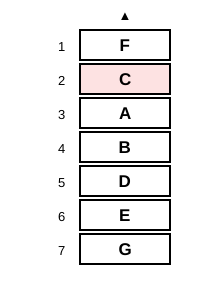
- A = 3; one box between A and D, D not on top → D = 5.
- Two boxes between C and D → C = 2 (8 does not exist).
- Free: 1, 4, 6, 7. E immediately above G → E = 6, G = 7; one box between B and E → B = 4.
- F = 1.
Short trick: C must be 2 or 8 from D = 5 → C = 2 directly answers the question.
Answer: (B) C
अवधारणा: स्थान 1 (सबसे ऊपर) से 7 (सबसे नीचे) तक मानें।
- A = 3; A और D के बीच एक बॉक्स, D सबसे ऊपर नहीं → D = 5.
- C और D के बीच दो बॉक्स → C = 2.
- खाली: 1, 4, 6, 7. E, G के ठीक ऊपर → E = 6, G = 7; B और E के बीच एक → B = 4.
- F = 1.
शॉर्ट ट्रिक: D = 5 से C = 2 या 8 → C = 2 ही उत्तर है।
उत्तर: (B) C
RRB ALP CBT 1General Intelligence and ReasoningBox stacking puzzleRRB ALP CBT 1 2025 · 13 Feb Shift 1
Q416.Based on the English alphabetical order, three of the following four letter-clusters are alike in a certain way and thus form a group. Which letter-cluster DOES NOT belong to that group? (Note: The odd one out is not based on the number of consonants/vowels or their position in the letter-cluster.)
अंग्रेजी वर्णमाला क्रम के आधार पर, निम्नलिखित चार अक्षर-समूहों में से तीन किसी निश्चित प्रकार से एकसमान हैं और इस प्रकार एक समूह बनाते हैं। कौन-सा अक्षर-समूह उस समूह से संबंधित नहीं है? (ध्यान दें: असंगत का निर्धारण अक्षर-समूह में व्यंजनों/स्वरों की संख्या या उनके स्थान के आधार पर नहीं है।)
- AJQL
- BMTP
- CQXS
- DOVQ
Show answer
Concept: Check the gaps between consecutive letters.
- JQL: J(10) +7 Q(17) −5 L(12)
- QXS: +7, −5; OVQ: +7, −5
- MTP: M(13) +7 T(20) −4 P(16) ✗
Short trick: Third letter = first letter + 2 in JQL (J→L), QXS (Q→S), OVQ (O→Q); MTP has M→P = +3.
Answer: (B) MTP
अवधारणा: क्रमागत अक्षरों का अंतर देखें।
- JQL: J(10) +7 Q(17) −5 L(12)
- QXS: +7, −5; OVQ: +7, −5
- MTP: M(13) +7 T(20) −4 P(16) ✗
शॉर्ट ट्रिक: तीसरा अक्षर = पहला + 2: J→L, Q→S, O→Q; पर M→P = +3.
उत्तर: (B) MTP
RRB ALP CBT 1General Intelligence and ReasoningOdd one out – letter clustersRRB ALP CBT 1 2025 · 13 Feb Shift 1
Q417.What will come in the place of ‘?’ in the following equation, if ‘+’ and ‘-‘ are interchanged and ‘×’ and ‘÷’ are interchanged?
22 ÷ 11 × 11 + 50 - 32 = ?
यदि '+' और '-' को आपस में बदल दिया जाए तथा '×' और '÷' को आपस में बदल दिया जाए, तो निम्नलिखित समीकरण में '?' के स्थान पर क्या आएगा?
22 ÷ 11 × 11 + 50 - 32 = ?
- A6
- B5
- C2
- D4
Show answer
Concept: Interchange the signs, then BODMAS.
- + ↔ − and × ↔ ÷: 22 × 11 ÷ 11 − 50 + 32
- = 22 − 50 + 32
- = 4
Short trick: × 11 ÷ 11 cancel → 22 − 50 + 32 = 4.
Answer: (D) 4
अवधारणा: चिह्न बदलें, फिर BODMAS।
- + ↔ − तथा × ↔ ÷: 22 × 11 ÷ 11 − 50 + 32
- = 22 − 50 + 32
- = 4
शॉर्ट ट्रिक: × 11 ÷ 11 कट जाते हैं → 22 − 50 + 32 = 4.
उत्तर: (D) 4
RRB ALP CBT 1General Intelligence and ReasoningMathematical operations – sign interchangeRRB ALP CBT 1 2025 · 13 Feb Shift 1
Q418.Select the triad which follows the same pattern as that followed by the two triads given below. Both triads follow the same pattern.
JNS – NRW – RVA
LPU – PTY – TXC
उस त्रिक का चयन कीजिए जो उसी पैटर्न का अनुसरण करता है जिसका अनुसरण नीचे दिए गए दो त्रिक करते हैं। दोनों त्रिक एक ही पैटर्न का अनुसरण करते हैं।
JNS – NRW – RVA
LPU – PTY – TXC
- AUYD – YCH – CGL
- BMQV – QUZ – VZE
- CUYD – YCI – CGL
- DRVA – VZE – ZDH
Show answer
Concept: Each letter moves +4 from one cluster to the next; inside a cluster the gaps are +4, +5.
- JNS → NRW → RVA: every letter +4.
- UYD: U +4 Y +5 D ✓; UYD +4 → YCH ✓; YCH +4 → CGL ✓
- C (YCI) fails: D + 4 = H, not I. B: MQV +4 = QUZ but QUZ +4 = UYD, not VZE.
Short trick: Check only the last letters: D → H → L (+4, +4) appears only in A.
Answer: (A) UYD – YCH – CGL
अवधारणा: एक समूह से अगले समूह में प्रत्येक अक्षर +4; समूह के अंदर अंतर +4, +5.
- JNS → NRW → RVA: प्रत्येक अक्षर +4.
- UYD: U +4 Y +5 D ✓; UYD +4 → YCH ✓; YCH +4 → CGL ✓
- C (YCI) गलत: D + 4 = H, I नहीं। B: QUZ +4 = UYD, VZE नहीं।
शॉर्ट ट्रिक: केवल अंतिम अक्षर देखें: D → H → L (+4, +4) केवल A में।
उत्तर: (A) UYD – YCH – CGL
RRB ALP CBT 1General Intelligence and ReasoningLetter triads – patternRRB ALP CBT 1 2025 · 13 Feb Shift 1
Q419.Each of A, C, I, M, O, Q and W has an exam on a different day of a week starting from Monday and ending on Sunday of the same week.
A has an exam on Saturday. Only 4 people have exams between M and O, neither of whom has an exam on Monday. I has an exam immediately after Q, and W has an exam immediately before Q. O has an exam after I.
How many people have exams after I?
A, C, I, M, O, Q और W में से प्रत्येक की परीक्षा सप्ताह के एक अलग दिन है, जो सोमवार से शुरू होकर उसी सप्ताह के रविवार को समाप्त होता है।
A की परीक्षा शनिवार को है। M और O के बीच केवल 4 लोगों की परीक्षाएँ हैं, उनमें से किसी की भी परीक्षा सोमवार को नहीं है। I की परीक्षा Q के ठीक बाद है, और W की परीक्षा Q के ठीक पहले है। O की परीक्षा I के बाद है।
I के बाद कितने लोगों की परीक्षाएँ हैं?
- A2
- B1
- C3
- D4
Show answer
Concept: Place the fixed person first, then the pair with a definite gap.
| Mon | Tue | Wed | Thu | Fri | Sat | Sun |
|---|
| C | M | W | Q | I | A | O |
- A = Saturday. M and O have 4 people between them, none on Monday → Tue & Sun.
- W, Q, I are consecutive in that order; only Wed–Thu–Fri is free → W = Wed, Q = Thu, I = Fri; C = Mon.
- O after I → O = Sun, M = Tue.
- After I (Fri): A (Sat), O (Sun) → 2 people.
Short trick: Gap of 5 days without Monday → only Tue–Sun.
Answer: (A) 2
अवधारणा: पहले निश्चित व्यक्ति को रखें, फिर निश्चित अंतर वाली जोड़ी।
| सोम | मंगल | बुध | गुरु | शुक्र | शनि | रवि |
|---|
| C | M | W | Q | I | A | O |
- A = शनिवार। M और O के बीच 4 लोग, कोई सोमवार को नहीं → मंगल और रवि।
- W, Q, I क्रमागत; केवल बुध–गुरु–शुक्र खाली → W = बुध, Q = गुरु, I = शुक्र; C = सोम।
- O, I के बाद → O = रवि, M = मंगल।
- I (शुक्र) के बाद: A (शनि), O (रवि) → 2 लोग।
शॉर्ट ट्रिक: सोमवार के बिना 5 दिन का अंतर → केवल मंगल–रवि।
उत्तर: (A) 2
RRB ALP CBT 1General Intelligence and ReasoningScheduling puzzle – days of weekRRB ALP CBT 1 2025 · 13 Feb Shift 1
Q420.In a certain code language, ‘buy some food’ is coded as ‘lr tp nx’ and ‘food is tasty’ is coded as ‘nx ze jq’. How is ‘food’ coded in the given language?
एक निश्चित कूट भाषा में, 'buy some food' को 'lr tp nx' के रूप में कूटबद्ध किया जाता है और 'food is tasty' को 'nx ze jq' के रूप में कूटबद्ध किया जाता है। दी गई भाषा में 'food' को किस प्रकार कूटबद्ध किया जाता है?
- Anx
- Blr
- Cjq
- Dtp
Show answer
Concept: A word common to two sentences has the code common to both.
- “food” is in both sentences.
- Common code in “lr tp nx” and “nx ze jq” = nx.
Short trick: Common word ↔ common code.
Answer: (A) nx
अवधारणा: दो वाक्यों में समान शब्द का कोड भी दोनों में समान होता है।
- “food” दोनों वाक्यों में है।
- “lr tp nx” और “nx ze jq” में समान कोड = nx.
शॉर्ट ट्रिक: समान शब्द ↔ समान कोड।
उत्तर: (A) nx
RRB ALP CBT 1General Intelligence and ReasoningCoding–decoding – common wordRRB ALP CBT 1 2025 · 13 Feb Shift 1

