Q41.Megaphones, loudhailers, horns and musical instruments like trumpets and shehnais are designed to:
मेगाफोन, लाउडहेलर, हॉर्न और तुरही तथा शहनाई जैसे वाद्य यंत्र किस लिए डिज़ाइन किए जाते हैं?
- AAbsorb sound wavesध्वनि तरंगों को अवशोषित करने के लिए
- BSend sound in a specific directionध्वनि को एक विशिष्ट दिशा में भेजने के लिए
- CSpread sound equally in all directionsध्वनि को सभी दिशाओं में समान रूप से फैलाने के लिए
- DReduce the loudness of soundध्वनि की प्रबलता कम करने के लिए
Show answer
Concept: These devices work on multiple reflection of sound.
- They have a tube followed by a conical (flared) opening.
- Sound waves reflect again and again from the walls of the tube/cone and come out together in the forward direction.
- So the sound is sent mainly towards the audience without spreading in all directions.
Short trick: "Megaphone = mega-focus": the cone directs sound forward. (Stethoscope and curved hall ceilings also use multiple reflection.)
Answer: (B) Send sound in a specific direction
अवधारणा: ये उपकरण ध्वनि के बहुल परावर्तन पर कार्य करते हैं।
- इनमें एक नली और उसके आगे शंकु के आकार का खुला मुँह होता है।
- ध्वनि तरंगें नली/शंकु की दीवारों से बार-बार परावर्तित होकर आगे की दिशा में एक साथ निकलती हैं।
- अतः ध्वनि सभी दिशाओं में न फैलकर मुख्यतः श्रोताओं की ओर जाती है।
शॉर्ट ट्रिक: "मेगाफोन = शंकु से दिशा": शंकु ध्वनि को आगे की ओर दिशा देता है। (स्टेथोस्कोप व सभागार की वक्र छत भी बहुल परावर्तन पर आधारित।)
उत्तर: (B) ध्वनि को एक विशिष्ट दिशा में भेजना
RRB ALP CBT 1General ScienceSound – multiple reflection of soundRRB ALP CBT 1 2025 · 17 Feb Shift 2
Q42.The distance between the pole and the principal focus of a spherical mirror is called:
गोलीय दर्पण के ध्रुव और मुख्य फोकस के बीच की दूरी क्या कहलाती है?
- AFocal lengthफोकस दूरी
- BMagnificationआवर्धन
- CRadius of curvatureवक्रता त्रिज्या
- DApertureद्वारक
Show answer
Concept: Pole (P) is the centre of the mirror surface; principal focus (F) lies on the principal axis.
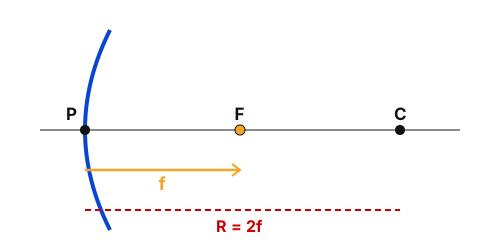
- PF = focal length (f).
- PC = radius of curvature (R) = 2f.
- Aperture = diameter of the reflecting surface; magnification = image height ÷ object height.
Short trick: "P to F = f; P to C = R = 2f" – F is exactly midway between P and C.
Answer: (A) Focal length
अवधारणा: ध्रुव (P) दर्पण की सतह का मध्य बिंदु है; मुख्य फोकस (F) मुख्य अक्ष पर होता है।
- PF = फोकस दूरी (f)।
- PC = वक्रता त्रिज्या (R) = 2f।
- द्वारक = परावर्तक सतह का व्यास; आवर्धन = प्रतिबिंब की ऊँचाई ÷ वस्तु की ऊँचाई।
शॉर्ट ट्रिक: "P से F = f; P से C = R = 2f" – F, P और C के ठीक बीच में।
उत्तर: (A) फोकस दूरी
RRB ALP CBT 1General ScienceLight – spherical mirror termsRRB ALP CBT 1 2025 · 17 Feb Shift 2
Q43.Which of the following processes is responsible for the transportation of soluble products formed by photosynthesis in different parts of plant?
पौधे के विभिन्न भागों में प्रकाश संश्लेषण द्वारा बने घुलनशील उत्पादों के परिवहन के लिए निम्नलिखित में से कौन-सा प्रक्रम उत्तरदायी है?
- ATranspirationवाष्पोत्सर्जन
- BAssimilationस्वांगीकरण
- CTerminationसमापन
- DTranslocationस्थानांतरण
Show answer
Concept: Movement of food (sugars) made in leaves to other parts is called translocation.
- It occurs through phloem (sieve tubes, companion cells).
- It uses energy (ATP) and can move food both upward and downward.
- Transpiration = loss of water vapour from leaves (xylem pull), not food transport.
Short trick: "Phloem = Food, Xylem = Water" – Food moves by TransLOCATION (food changes LOCATION).
Answer: (D) Translocation
अवधारणा: पत्तियों में बने भोजन (शर्करा) का अन्य भागों तक जाना स्थानांतरण (ट्रांसलोकेशन) कहलाता है।
- यह फ्लोएम (चालनी नलिकाएँ, सहचर कोशिकाएँ) द्वारा होता है।
- इसमें ऊर्जा (ATP) लगती है और भोजन ऊपर-नीचे दोनों दिशाओं में जा सकता है।
- वाष्पोत्सर्जन = पत्तियों से जल वाष्प का निकलना, भोजन परिवहन नहीं।
शॉर्ट ट्रिक: "फ्लोएम = भोजन, ज़ाइलम = जल" – भोजन का स्थान बदलना = स्थानांतरण।
उत्तर: (D) स्थानांतरण
RRB ALP CBT 1General SciencePlant transport – translocation in phloemRRB ALP CBT 1 2025 · 17 Feb Shift 2
Q44.For an echo to be heard clearly, the reflecting surface should be at least how far from the listener? (Take speed of sound ≈ 340 m/s)
स्पष्ट प्रतिध्वनि सुनने के लिए परावर्तक सतह श्रोता से कम से कम कितनी दूरी पर होनी चाहिए? (ध्वनि की चाल ≈ 340 m/s लें)
- A50 m
- B17 m
- C100 m
- D34 m
Show answer
Concept: The sensation of sound persists in our brain for about 0.1 s, so the echo must return after at least 0.1 s.
- Total path (to the wall and back) m
- Minimum distance m
Short trick: Distance : m. (34 m is the round trip – a common trap.)
Answer: (B) 17 m
अवधारणा: ध्वनि की संवेदना हमारे मस्तिष्क में लगभग 0.1 s तक रहती है, अतः प्रतिध्वनि कम से कम 0.1 s बाद लौटनी चाहिए।
- कुल पथ (दीवार तक और वापस) m
- न्यूनतम दूरी m
शॉर्ट ट्रिक: दूरी m। (34 m आने-जाने की दूरी है – सामान्य जाल।)
उत्तर: (B) 17 m
RRB ALP CBT 1General ScienceSound – echoRRB ALP CBT 1 2025 · 17 Feb Shift 2
Q45.If the energy of an electron in the second orbit of hydrogen is −3.4 eV, what is the energy in the fourth orbit?
यदि हाइड्रोजन की दूसरी कक्षा में इलेक्ट्रॉन की ऊर्जा −3.4 eV है, तो चौथी कक्षा में ऊर्जा क्या है?
- A−1.7 eV
- B−6.8 eV
- C−13.6 eV
- D−0.85 eV
Show answer
Concept: In hydrogen, eV, i.e. .
- eV
- Check: eV ✓
Short trick: Doubling n divides energy by 4: −3.4 → −0.85. Energy stays negative and gets closer to 0 in higher orbits.
Answer: (D) −0.85 eV
अवधारणा: हाइड्रोजन में eV, अर्थात् ।
- eV
- जाँच: eV ✓
शॉर्ट ट्रिक: n दोगुना → ऊर्जा 4 से भाग: −3.4 → −0.85। ऊँची कक्षाओं में ऊर्जा ऋणात्मक रहते हुए 0 के निकट जाती है।
उत्तर: (D) −0.85 eV
RRB ALP CBT 1General ScienceAtomic structure – Bohr model energy levelsRRB ALP CBT 1 2025 · 17 Feb Shift 2
Q46.The cilia in the upper respiratory tract primarily help in:
ऊपरी श्वसन पथ में उपस्थित पक्ष्माभ (सिलिया) मुख्य रूप से किसमें सहायता करते हैं?
- AAbsorbing oxygenऑक्सीजन को अवशोषित करने में
- BGas exchangeगैसों के विनिमय में
- CPumping blood to lungsफेफड़ों तक रक्त पंप करने में
- DRemoving harmful particles from inhaled airअंदर ली गई वायु से हानिकारक कणों को हटाने में
Show answer
Concept: The nasal passage and trachea are lined with mucus and hair-like cilia.
- Mucus traps dust, pollen and germs in the inhaled air.
- Cilia beat rhythmically and push this mucus up towards the throat, where it is swallowed or coughed out.
- Gas exchange happens only in the alveoli – not in the upper tract.
Short trick: "Cilia = cleaners / brooms" of the airway; "Alveoli = exchange".
Answer: (D) Removing harmful particles from inhaled air
अवधारणा: नासिका मार्ग और श्वासनली के भीतर श्लेष्मा और बाल जैसे पक्ष्माभ (सिलिया) होते हैं।
- श्लेष्मा अंदर ली गई वायु की धूल, परागकण और रोगाणुओं को फँसा लेती है।
- सिलिया लयबद्ध गति से इस श्लेष्मा को गले की ओर धकेलते हैं, जहाँ से यह निगल ली जाती है या खाँसी से बाहर निकलती है।
- गैस विनिमय केवल कूपिकाओं (एल्वियोलाई) में होता है।
शॉर्ट ट्रिक: "सिलिया = श्वास मार्ग की झाड़ू"; "कूपिकाएँ = विनिमय"।
उत्तर: (D) अंदर ली गई वायु से हानिकारक कणों को हटाना
RRB ALP CBT 1General ScienceHuman respiratory system – cilia and mucusRRB ALP CBT 1 2025 · 17 Feb Shift 2
Q47.Why do we feel cool after applying water on our skin in summer?
गर्मियों में त्वचा पर पानी लगाने के बाद हमें ठंडक क्यों महसूस होती है?
- AEvaporation of water absorbs heat from the skin surfaceपानी का वाष्पीकरण त्वचा की सतह से ऊष्मा अवशोषित करता है
- BWater reduces sweat formation and retains body heatपानी पसीने के निर्माण को कम करता है और शरीर की ऊष्मा को बनाए रखता है
- CWater increases body temperature by absorbing sunlightपानी सूर्य के प्रकाश को अवशोषित करके शरीर का तापमान बढ़ाता है
- DCondensation of water releases energy on the skin surfaceपानी का संघनन त्वचा की सतह पर ऊर्जा मुक्त करता है
Show answer
Concept: Evaporation causes cooling.
- To change from liquid to vapour, water needs latent heat of vaporisation.
- It takes this heat from the skin, so the skin temperature falls and we feel cool.
- Same reason: sweating, earthen pot (matka) cooling, wet cloth on forehead.
Short trick: "Evaporation steals heat" – the escaping molecules carry away energy; condensation does the opposite (releases heat).
Answer: (A) Evaporation of water absorbs heat from the skin surface
अवधारणा: वाष्पीकरण से शीतलन होता है।
- द्रव से वाष्प बनने के लिए पानी को वाष्पन की गुप्त ऊष्मा चाहिए।
- यह ऊष्मा वह त्वचा से लेता है, जिससे त्वचा का तापमान घटता है और ठंडक लगती है।
- इसी कारण: पसीना आना, मटके का पानी ठंडा होना, माथे पर गीली पट्टी।
शॉर्ट ट्रिक: "वाष्पीकरण ऊष्मा चुराता है" – संघनन इसका उल्टा (ऊष्मा मुक्त करता है)।
उत्तर: (A) पानी का वाष्पीकरण त्वचा की सतह से ऊष्मा अवशोषित करता है
RRB ALP CBT 1General ScienceMatter – evaporation causes coolingRRB ALP CBT 1 2025 · 17 Feb Shift 2
Q48.On the basis of function, the plasma membrane is ________ in nature.
कार्य के आधार पर, प्लाज़्मा झिल्ली की प्रकृति ________ होती है।
- Asemi-permeableअर्ध-पारगम्य
- Bselectively permeableचयनात्मक पारगम्य
- Cfully permeableपूर्ण पारगम्य
- Dfully non-permeableपूर्ण अपारगम्य
Show answer
Concept: The plasma membrane controls what enters and leaves the cell.
- It allows some substances (water, O, CO) to pass freely and regulates others (ions, glucose) using carrier proteins.
- Because it actively "chooses", it is called selectively permeable.
- Semi-permeable is a physical term (e.g. an artificial membrane letting only solvent pass); cell wall is fully permeable.
Short trick: "Plasma membrane = Security guard – it SELECTS who enters"; cell wall = open gate (fully permeable).
Answer: (B) selectively permeable
अवधारणा: प्लाज़्मा झिल्ली नियंत्रित करती है कि कोशिका में क्या आए और क्या बाहर जाए।
- यह कुछ पदार्थों (जल, O, CO) को स्वतंत्र रूप से जाने देती है और अन्य (आयन, ग्लूकोज़) को वाहक प्रोटीन द्वारा नियंत्रित करती है।
- चूँकि यह "चुनाव" करती है, इसे चयनात्मक पारगम्य कहते हैं।
- अर्ध-पारगम्य एक भौतिक पद है (केवल विलायक को जाने देने वाली झिल्ली); कोशिका भित्ति पूर्ण पारगम्य है।
शॉर्ट ट्रिक: "प्लाज़्मा झिल्ली = सुरक्षा गार्ड – चुनकर अंदर जाने देती है"; कोशिका भित्ति = खुला द्वार।
उत्तर: (B) चयनात्मक पारगम्य
RRB ALP CBT 1General ScienceCell biology – plasma membraneRRB ALP CBT 1 2025 · 17 Feb Shift 2
Q49.When a sound is produced, what travels through the medium?
जब ध्वनि उत्पन्न होती है, तो माध्यम में से होकर क्या गति करता है?
- ABoth the particles and the disturbanceकण और विक्षोभ दोनों
- BNeither particles nor disturbanceन तो कण और न ही विक्षोभ
- CThe particles of the mediumमाध्यम के कण
- DThe disturbance created by the sound sourceध्वनि स्रोत द्वारा उत्पन्न विक्षोभ
Show answer
Concept: Sound is a mechanical wave: particles only vibrate about their mean positions; the disturbance (energy) moves forward.
- A vibrating source compresses and rarefies the nearby layer of medium
- Each particle passes the disturbance to the next and returns to its place
- So the disturbance travels, not the particles
Short trick: Memory hook: a "Mexican wave" in a stadium – the wave goes round, the people stay in their seats.
Answer: (D) The disturbance created by the sound source
अवधारणा: ध्वनि यांत्रिक तरंग है: कण केवल अपनी माध्य स्थिति के इधर-उधर कंपन करते हैं; विक्षोभ (ऊर्जा) आगे बढ़ता है।
- कंपित स्रोत पास की परत में संपीडन और विरलन बनाता है
- प्रत्येक कण विक्षोभ अगले कण को देकर अपनी जगह लौट आता है
- अतः विक्षोभ चलता है, कण नहीं
शॉर्ट ट्रिक: याद रखें: स्टेडियम की "मैक्सिकन वेव" – लहर घूमती है, लोग अपनी सीट पर रहते हैं।
उत्तर: (D) ध्वनि स्रोत द्वारा उत्पन्न विक्षोभ
RRB ALP CBT 1General ScienceSound – propagationRRB ALP CBT 1 2025 · 17 Feb Shift 1
Q50.A machine does 1000 J of work in 5 seconds. Its power is:
एक मशीन 5 सेकंड में 1000 J कार्य करती है। उसकी शक्ति है:
- A500 W
- B100 W
- C50 W
- D200 W
Show answer
Concept: Power = work ÷ time (SI unit watt = J/s).
- W
Short trick: "Power is the speed of doing work" – just divide.
Answer: (D) 200 W
अवधारणा: शक्ति = कार्य ÷ समय (SI मात्रक वाट = J/s)।
- W
शॉर्ट ट्रिक: "शक्ति = कार्य करने की दर" – सीधा भाग दें।
उत्तर: (D) 200 W
RRB ALP CBT 1General ScienceWork, energy and powerRRB ALP CBT 1 2025 · 17 Feb Shift 1
Q51.The reaction of sodium hydrogen carbonate upon heating produces:
सोडियम हाइड्रोजन कार्बोनेट को गर्म करने पर होने वाली अभिक्रिया से बनता है:
- ASodium chloride, water, and hydrogen gas under normal heatingसामान्य तापन पर सोडियम क्लोराइड, जल और हाइड्रोजन गैस
- BSodium hydroxide, oxygen, and carbon monoxide at high temperatureउच्च ताप पर सोडियम हाइड्रॉक्साइड, ऑक्सीजन और कार्बन मोनोऑक्साइड
- CSodium carbonate, water, and carbon dioxide gas during cookingखाना पकाने के दौरान सोडियम कार्बोनेट, जल और कार्बन डाइऑक्साइड गैस
- DSodium sulfate, hydrogen, and carbon dioxide when strongly heatedतीव्र तापन पर सोडियम सल्फेट, हाइड्रोजन और कार्बन डाइऑक्साइड
Show answer
Concept: Sodium hydrogen carbonate (baking soda) decomposes on heating.
- The CO2 released makes cakes/bread soft and spongy – hence its use in cooking
Short trick: Hook: "baking soda → soda ash + water + fizz (CO2)". Any option without CO2 and Na2CO3 is out.
Answer: (C) Sodium carbonate, water, and carbon dioxide gas during cooking
अवधारणा: सोडियम हाइड्रोजन कार्बोनेट (बेकिंग सोडा) गर्म करने पर विघटित होता है।
- निकली CO2 केक/ब्रेड को फूला और मुलायम बनाती है – इसलिए खाना पकाने में उपयोग
शॉर्ट ट्रिक: याद रखें: "बेकिंग सोडा → सोडियम कार्बोनेट + पानी + CO2 (बुलबुले)"।
उत्तर: (C) सोडियम कार्बोनेट, जल और कार्बन डाइऑक्साइड गैस
RRB ALP CBT 1General ScienceChemistry – baking sodaRRB ALP CBT 1 2025 · 17 Feb Shift 1
Q52.On reaching an organ or tissue, arteries divide into smaller and smaller vessels. The smallest vessels have walls that are one cell thick and are called:
किसी अंग या ऊतक तक पहुँचने पर धमनियाँ छोटी और छोटी वाहिकाओं में विभाजित हो जाती हैं। सबसे छोटी वाहिकाओं की भित्तियाँ एक कोशिका मोटी होती हैं और इन्हें कहा जाता है:
- Acapillariesकेशिकाएँ
- Bveinsशिराएँ
- Carteriesधमनियाँ
- Darteriolesधमनिकाएँ
Show answer
Concept: Arteries → arterioles → capillaries; capillary walls are one cell thick.
- The thin wall lets O2, nutrients and CO2 diffuse between blood and tissue cells
- Capillaries then join to form venules → veins
Short trick: Hook: "capillary = hair-like" (Latin capillus = hair) – thinnest vessel, one-cell wall.
Answer: (A) capillaries
अवधारणा: धमनी → धमनिका → केशिका; केशिकाओं की भित्ति एक कोशिका मोटी होती है।
- पतली भित्ति से रक्त और ऊतक कोशिकाओं के बीच O2, पोषक तत्व और CO2 का विसरण होता है
- केशिकाएँ मिलकर शिरिकाएँ → शिराएँ बनाती हैं
शॉर्ट ट्रिक: याद रखें: "केशिका = केश (बाल) जैसी" – सबसे पतली, एक कोशिका भित्ति।
उत्तर: (A) केशिकाएँ
RRB ALP CBT 1General ScienceHuman circulatory systemRRB ALP CBT 1 2025 · 17 Feb Shift 1
Q53.Which of the following is commonly known as the Indian bee?
निम्नलिखित में से किसे सामान्यतः भारतीय मधुमक्खी के नाम से जाना जाता है?
- AApis mellifera
- BApis cerana indica
- CApis florea
- DApis dorsata
Show answer
Concept: Apis cerana indica is the common Indian bee (Indian hive bee).
- Apis dorsata – rock bee; Apis florea – little bee
- Apis mellifera – Italian/European bee (high honey yield, used commercially)
Short trick: Hook: "indica = India" – the name itself says Indian bee.
Answer: (B) Apis cerana indica
अवधारणा: Apis cerana indica सामान्य भारतीय मधुमक्खी है।
- Apis dorsata – रॉक बी (सारंग); Apis florea – छोटी मधुमक्खी
- Apis mellifera – इटैलियन/यूरोपीय मधुमक्खी (अधिक शहद उत्पादन)
शॉर्ट ट्रिक: याद रखें: "indica = इंडिया" – नाम में ही भारत है।
उत्तर: (B) Apis cerana indica
RRB ALP CBT 1General ScienceBiology – apicultureRRB ALP CBT 1 2025 · 17 Feb Shift 1
Q54.Which of the following functions of mitochondria makes it a powerhouse of the cell?
माइटोकॉन्ड्रिया का निम्नलिखित में से कौन-सा कार्य इसे कोशिका का बिजलीघर बनाता है?
- AGeneration of ATPATP का निर्माण
- BGeneration of NADPHNADPH का निर्माण
- CGeneration of heatऊष्मा का निर्माण
- DGeneration of enzymesएंजाइमों का निर्माण
Show answer
Concept: Mitochondria carry out aerobic respiration and make ATP, the energy currency of the cell.
- Krebs cycle (matrix) and electron transport chain (inner membrane) produce ATP
- NADPH is mainly made in chloroplasts (photosynthesis)
Short trick: Hook: "Mito = Power plant, ATP = electricity bill".
Answer: (A) Generation of ATP
अवधारणा: माइटोकॉन्ड्रिया वायवीय श्वसन करके ATP बनाते हैं – कोशिका की ऊर्जा मुद्रा।
- क्रेब्स चक्र (मैट्रिक्स) और इलेक्ट्रॉन परिवहन तंत्र (भीतरी झिल्ली) से ATP बनता है
- NADPH मुख्यतः क्लोरोप्लास्ट में (प्रकाश संश्लेषण) बनता है
शॉर्ट ट्रिक: याद रखें: "माइटो = बिजलीघर, ATP = बिजली"।
उत्तर: (A) ATP का निर्माण
RRB ALP CBT 1General ScienceCell – mitochondriaRRB ALP CBT 1 2025 · 17 Feb Shift 1
Q55.Which of the following statements correctly defines refraction of light?
निम्नलिखित में से कौन-सा कथन प्रकाश के अपवर्तन को सही ढंग से परिभाषित करता है?
- ABending of light when it falls on a mirrorदर्पण पर पड़ने पर प्रकाश का मुड़ना
- BChange in direction of light when it passes from one medium to anotherप्रकाश का एक माध्यम से दूसरे माध्यम में जाने पर दिशा परिवर्तन
- CScattering of light by air moleculesवायु के अणुओं द्वारा प्रकाश का प्रकीर्णन
- DSplitting of light into seven coloursप्रकाश का सात रंगों में विभाजन
Show answer
Concept: Refraction = change in direction of light when it passes obliquely from one medium to another, because its speed changes.
- Mirror → reflection; air molecules → scattering; prism splitting → dispersion
- Rarer → denser: bends towards the normal
Short trick: Hook: "Re-fraction = from one medium to another".
Answer: (B) Change in direction of light when it passes from one medium to another
अवधारणा: अपवर्तन = प्रकाश का एक माध्यम से दूसरे माध्यम में तिरछा जाने पर दिशा परिवर्तन, क्योंकि उसकी चाल बदलती है।
- दर्पण → परावर्तन; वायु के अणु → प्रकीर्णन; प्रिज़्म से सात रंग → विक्षेपण
- विरल → सघन: अभिलंब की ओर मुड़ता है
शॉर्ट ट्रिक: याद रखें: "अपवर्तन = माध्यम बदला, दिशा बदली"।
उत्तर: (B) प्रकाश का एक माध्यम से दूसरे माध्यम में जाने पर दिशा परिवर्तन
RRB ALP CBT 1General ScienceLight – refractionRRB ALP CBT 1 2025 · 17 Feb Shift 1
Q56.Why is a colloid considered stable?
कोलॉइड को स्थायी क्यों माना जाता है?
- AIts particles dissolve completely in the dispersion medium.इसके कण परिक्षेपण माध्यम में पूर्णतः घुल जाते हैं।
- BIts particles can be separated easily by filtration.इसके कणों को छानकर आसानी से अलग किया जा सकता है।
- CIts particles do not settle down when left undisturbed.इसके कण अविचलित छोड़ने पर नीचे नहीं बैठते।
- DIts particles react chemically with the dispersion medium.इसके कण परिक्षेपण माध्यम के साथ रासायनिक अभिक्रिया करते हैं।
Show answer
Concept: Colloidal particles (1–1000 nm) are too small to settle under gravity; Brownian motion and like charges keep them dispersed.
- They do not dissolve completely (that is a true solution)
- They pass through filter paper, so filtration cannot separate them
- They do not react with the medium
Short trick: Hook: "Milk never settles like muddy water" – colloid stable, suspension unstable.
Answer: (C) Its particles do not settle down when left undisturbed.
अवधारणा: कोलॉइडी कण (1–1000 nm) इतने छोटे होते हैं कि गुरुत्व से नीचे नहीं बैठते; ब्राउनियन गति और समान आवेश उन्हें बिखरा रखते हैं।
- वे पूर्णतः नहीं घुलते (वह वास्तविक विलयन है)
- वे फ़िल्टर पेपर से निकल जाते हैं, इसलिए छानकर अलग नहीं होते
- वे माध्यम से अभिक्रिया नहीं करते
शॉर्ट ट्रिक: याद रखें: "दूध गंदे पानी की तरह नहीं बैठता" – कोलॉइड स्थायी, निलंबन अस्थायी।
उत्तर: (C) इसके कण अविचलित छोड़ने पर नीचे नहीं बैठते।
RRB ALP CBT 1General ScienceColloids – stabilityRRB ALP CBT 1 2025 · 17 Feb Shift 1
Q57.If an object is placed between infinity and the pole (P) in front of a convex mirror, what type of image will be formed?
यदि किसी वस्तु को उत्तल दर्पण के सामने अनंत और ध्रुव (P) के बीच रखा जाए, तो किस प्रकार का प्रतिबिंब बनेगा?
- AReal, inverted, and enlargedवास्तविक, उल्टा और आवर्धित
- BReal, inverted, and diminishedवास्तविक, उल्टा और छोटा
- CVirtual, erect, and diminished (smaller in size)आभासी, सीधा और छोटा (आकार में छोटा)
- DReal, erect, and same size as the objectवास्तविक, सीधा और वस्तु के समान आकार का
Show answer
Concept: A convex mirror always forms a virtual, erect and diminished image behind the mirror, between P and F, wherever the object is.
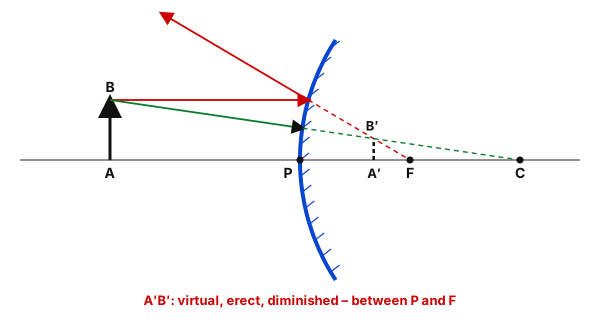
- A ray parallel to the axis reflects as if coming from F (behind the mirror).
- A ray aimed at C reflects back along itself.
- The reflected rays diverge; their backward extensions meet behind the mirror → virtual, erect, smaller image.
Short trick: Convex = 'Always V-E-D' (Virtual, Erect, Diminished) – that is why it is used as a rear-view mirror.
Answer: (C) Virtual, erect, and diminished
अवधारणा: उत्तल दर्पण वस्तु कहीं भी हो, सदैव दर्पण के पीछे P और F के बीच आभासी, सीधा और छोटा प्रतिबिंब बनाता है।
- मुख्य अक्ष के समांतर किरण परावर्तन के बाद F (दर्पण के पीछे) से आती प्रतीत होती है।
- C की ओर जाने वाली किरण उसी मार्ग से लौटती है।
- परावर्तित किरणें अपसारित होती हैं; उनके पीछे के विस्तार दर्पण के पीछे मिलते हैं → आभासी, सीधा, छोटा प्रतिबिंब।
शॉर्ट ट्रिक: उत्तल = 'सदा आ-सी-छो' (आभासी, सीधा, छोटा) – इसी कारण वाहनों में पीछे देखने का दर्पण उत्तल होता है।
उत्तर: (C) आभासी, सीधा और छोटा
RRB ALP CBT 1General ScienceImage formation – convex mirrorRRB ALP CBT 1 2025 · 16 Feb Shift 3
Q58.The double-layered covering of the nucleus is called as ______
केंद्रक के दोहरी परत वाले आवरण को ______ कहा जाता है।
- ACell wallकोशिका भित्ति
- BNuclear membraneकेंद्रक झिल्ली
- CChromatin wallक्रोमैटिन भित्ति
- DPlasma membraneप्लाज्मा झिल्ली
Show answer
Concept: The nucleus is bounded by a double-layered nuclear membrane (nuclear envelope) with pores.
- The nuclear membrane separates the nucleus from the cytoplasm.
- Its pores allow movement of RNA and proteins in and out.
- Cell wall and plasma membrane cover the whole cell, not the nucleus; 'chromatin wall' does not exist.
Short trick: Memory hook: Nucleus → Nuclear membrane (double layer, with pores) – the name itself tells the answer.
Answer: (B) Nuclear membrane
अवधारणा: केंद्रक, छिद्रयुक्त दोहरी परत वाली केंद्रक झिल्ली (केंद्रकीय आवरण) से घिरा होता है।
- केंद्रक झिल्ली केंद्रक को कोशिकाद्रव्य से अलग करती है।
- इसके छिद्रों से RNA और प्रोटीन अंदर-बाहर आते-जाते हैं।
- कोशिका भित्ति और प्लाज्मा झिल्ली पूरी कोशिका को ढकती हैं, केंद्रक को नहीं; 'क्रोमैटिन भित्ति' नाम की कोई संरचना नहीं है।
शॉर्ट ट्रिक: याद रखें: केंद्रक → केंद्रक झिल्ली (दोहरी परत, छिद्रयुक्त)।
उत्तर: (B) केंद्रक झिल्ली
RRB ALP CBT 1General ScienceCell – nucleusRRB ALP CBT 1 2025 · 16 Feb Shift 3
Q59.Which of the following substance groups represents the non-biodegradable substances?
निम्नलिखित में से कौन-सा पदार्थ-समूह जैव-अनिम्नीकरणीय (non-biodegradable) पदार्थों को दर्शाता है?
- APlastic bubble pack, regular milk packets, medicine plastic bottlesप्लास्टिक बबल पैक, सामान्य दूध के पैकेट, दवा की प्लास्टिक बोतलें
- BSpoilt food, vegetable peels, used tea leavesखराब भोजन, सब्जियों के छिलके, इस्तेमाल की गई चाय की पत्ती
- CGrasses, spoilt food, vegetable peelsघास, खराब भोजन, सब्जियों के छिलके
- DVegetable peels, flowers, paperसब्जियों के छिलके, फूल, कागज
Show answer
Concept: Non-biodegradable substances cannot be broken down by microbes (bacteria, fungi) in a reasonable time.
- Plastic bubble pack, plastic milk packets and plastic medicine bottles are all plastics → non-biodegradable.
- Food, peels, tea leaves, grass, flowers and paper are organic → biodegradable.
Short trick: Memory hook: 'If it was never alive (plastic, polythene, glass, metal), microbes cannot eat it.'
Answer: (A) Plastic bubble pack, regular milk packets, medicine plastic bottles
अवधारणा: जैव-अनिम्नीकरणीय पदार्थ सूक्ष्मजीवों (जीवाणु, कवक) द्वारा उचित समय में अपघटित नहीं होते।
- प्लास्टिक बबल पैक, दूध के प्लास्टिक पैकेट और दवा की प्लास्टिक बोतलें – सभी प्लास्टिक → जैव-अनिम्नीकरणीय।
- भोजन, छिलके, चाय पत्ती, घास, फूल और कागज जैविक हैं → जैव-निम्नीकरणीय।
शॉर्ट ट्रिक: याद रखें: 'जो कभी जीवित नहीं था (प्लास्टिक, पॉलीथीन, काँच, धातु), उसे सूक्ष्मजीव नहीं खा सकते।'
उत्तर: (A) प्लास्टिक बबल पैक, दूध के पैकेट, दवा की प्लास्टिक बोतलें
RRB ALP CBT 1General ScienceEnvironment – biodegradable wasteRRB ALP CBT 1 2025 · 16 Feb Shift 3
Q60.Which of the following equations correctly relates the resistance (R) of a conductor to its length (l), area of cross-section (A), and resistivity (ρ)?
निम्नलिखित में से कौन-सा समीकरण किसी चालक के प्रतिरोध (R) का उसकी लंबाई (l), अनुप्रस्थ काट के क्षेत्रफल (A) और प्रतिरोधकता (ρ) से सही संबंध दर्शाता है?
- AR=l/ρA
- BR=ρl/A
- CR=A/ρl
- DR=ρA/l
Show answer
Concept: Resistance is directly proportional to length and inversely proportional to area of cross-section: .
- (longer wire, more collisions of electrons).
- (thicker wire, more paths for current).
- Constant of proportionality is resistivity (unit Ω m).
Short trick: Unit check: Ω = (Ω m)(m)/m² ✓ only for ρl/A. Hook: 'Long and thin → high R'.
Answer: (B) R = ρl/A
अवधारणा: प्रतिरोध लंबाई के अनुक्रमानुपाती और अनुप्रस्थ काट के क्षेत्रफल के व्युत्क्रमानुपाती होता है: .
- (लंबा तार, इलेक्ट्रॉनों की अधिक टक्कर)।
- (मोटा तार, धारा के लिए अधिक मार्ग)।
- आनुपातिकता स्थिरांक प्रतिरोधकता (मात्रक Ω m) है।
शॉर्ट ट्रिक: मात्रक जाँच: Ω = (Ω m)(m)/m² ✓ केवल ρl/A में। याद रखें: 'लंबा और पतला → अधिक R'।
उत्तर: (B) R = ρl/A
RRB ALP CBT 1General ScienceElectricity – resistivityRRB ALP CBT 1 2025 · 16 Feb Shift 3

