Q61.Which breed of cattle is primarily used for dairy purposes in India?
भारत में मुख्य रूप से डेयरी (दुग्ध उत्पादन) के लिए मवेशियों की किस नस्ल का उपयोग किया जाता है?
- ASahiwalसाहीवाल
- BOngoleओंगोल
- CGirगिर
- DKankrejकांकरेज
Show answer
Concept: Indian cattle breeds are grouped as milch (dairy), draught and dual-purpose.
- Milch (dairy) breeds: Sahiwal, Gir, Red Sindhi, Rathi.
- Draught breeds: Ongole (also dual), Nagori, Hallikar, Amritmahal.
- Dual-purpose: Kankrej, Tharparkar, Hariana.
- Sahiwal (Punjab region) is regarded as the best indigenous dairy breed – but Gir (Gujarat) is also a dairy breed, so as printed two options (A and C) are correct.
Short trick: Hook for milch breeds: 'SaGiRed' – Sahiwal, Gir, Red Sindhi.
Answer: (A) and (C) Sahiwal and Gir – both are dairy (milch) breeds
अवधारणा: भारतीय मवेशी नस्लें दुधारू, भारवाही और द्वि-उद्देशीय में बाँटी जाती हैं।
- दुधारू (डेयरी) नस्लें: साहीवाल, गिर, रेड सिंधी, राठी।
- भारवाही नस्लें: ओंगोल (द्वि-उद्देशीय भी), नागोरी, हल्लीकर, अमृतमहल।
- द्वि-उद्देशीय: कांकरेज, थारपारकर, हरियाणा।
- साहीवाल सर्वश्रेष्ठ देशी दुधारू नस्ल मानी जाती है – परंतु गिर (गुजरात) भी दुधारू नस्ल है, अतः छपे रूप में दो विकल्प (A और C) सही हैं।
शॉर्ट ट्रिक: दुधारू नस्लें याद रखें: 'साहीगिरेड' – साहीवाल, गिर, रेड सिंधी।
उत्तर: (A) और (C) साहीवाल और गिर – दोनों दुधारू नस्लें हैं
RRB ALP CBT 1General ScienceAnimal husbandry – cattle breedsRRB ALP CBT 1 2025 · 16 Feb Shift 3
Q62.The ability of the eye lens to adjust its focal length to see objects clearly at different distances is called:
अलग-अलग दूरियों पर रखी वस्तुओं को स्पष्ट देखने के लिए नेत्र लेंस की अपनी फोकस दूरी को समायोजित करने की क्षमता कहलाती है:
- APower of accommodationसमंजन क्षमता
- BPower of convergenceअभिसरण क्षमता
- CRange of visionदृष्टि परास
- DPersistence of visionदृष्टि निर्बंध (दृष्टि की स्थिरता)
Show answer
Concept: The ciliary muscles change the curvature (and hence focal length) of the eye lens – this ability is the power of accommodation.
- Distant object: ciliary muscles relax, lens thin, focal length large.
- Near object: ciliary muscles contract, lens thick, focal length small.
- Range: near point 25 cm to far point infinity for a normal eye.
Short trick: Hook: 'Accommodate = adjust' – the lens adjusts itself.
Answer: (A) Power of accommodation
अवधारणा: पक्ष्माभी पेशियाँ नेत्र लेंस की वक्रता (और फोकस दूरी) बदलती हैं – इस क्षमता को समंजन क्षमता कहते हैं।
- दूर की वस्तु: पक्ष्माभी पेशियाँ शिथिल, लेंस पतला, फोकस दूरी अधिक।
- निकट की वस्तु: पेशियाँ संकुचित, लेंस मोटा, फोकस दूरी कम।
- सामान्य नेत्र: निकट बिंदु 25 cm, दूर बिंदु अनंत।
शॉर्ट ट्रिक: याद रखें: 'समंजन = समायोजन' – लेंस स्वयं को समायोजित करता है।
उत्तर: (A) समंजन क्षमता
RRB ALP CBT 1General ScienceHuman eye – accommodationRRB ALP CBT 1 2025 · 16 Feb Shift 3
Q63.When a positively charged alpha particle is passed through a thin gold foil, most of the particles pass straight through without deflection. Based on Thomson’s model of the atom, which of the following best explains this observation?
जब धनावेशित अल्फा कण को सोने की पतली पन्नी से गुजारा जाता है, तो अधिकांश कण बिना विक्षेपित हुए सीधे निकल जाते हैं। थॉमसन के परमाणु मॉडल के आधार पर, निम्नलिखित में से कौन-सा कथन इस प्रेक्षण की सबसे अच्छी व्याख्या करता है?
- AThe positive charge and mass are concentrated at the centre of the atom.धनावेश और द्रव्यमान परमाणु के केंद्र में संकेंद्रित होते हैं।
- BThe atom contains a small, dense nucleus that repels alpha particles.परमाणु में एक छोटा, सघन नाभिक होता है जो अल्फा कणों को प्रतिकर्षित करता है।
- CThe positive charge is uniformly distributed throughout the atom, and electrons are embedded in it.धनावेश पूरे परमाणु में समान रूप से वितरित होता है और इलेक्ट्रॉन उसमें धँसे रहते हैं।
- DElectrons revolve around the nucleus in fixed orbits.इलेक्ट्रॉन नाभिक के चारों ओर निश्चित कक्षाओं में घूमते हैं।
Show answer
Concept: Thomson's 'plum-pudding' model: positive charge spread uniformly through the atom with electrons embedded in it.
- Because the positive charge is spread out (not concentrated), there is no strong repelling centre in this model.
- So, according to Thomson's picture, alpha particles would pass almost undeflected.
- Options A and B describe Rutherford's nucleus; D describes Bohr's orbits.
Short trick: Hook: Thomson = 'watermelon' – red pulp (positive) everywhere, seeds (electrons) embedded.
Answer: (C) The positive charge is uniformly distributed throughout the atom, and electrons are embedded in it.
अवधारणा: थॉमसन का 'प्लम-पुडिंग' मॉडल: धनावेश पूरे परमाणु में समान रूप से फैला है और इलेक्ट्रॉन उसमें धँसे हैं।
- धनावेश फैला हुआ है (संकेंद्रित नहीं), अतः इस मॉडल में कोई प्रबल प्रतिकर्षी केंद्र नहीं है।
- इसलिए थॉमसन के अनुसार अल्फा कण लगभग बिना विक्षेपण के निकल जाएँगे।
- विकल्प A और B रदरफोर्ड के नाभिक का, तथा D बोर की कक्षाओं का वर्णन है।
शॉर्ट ट्रिक: याद रखें: थॉमसन = 'तरबूज' – लाल गूदा (धनावेश) हर जगह, बीज (इलेक्ट्रॉन) धँसे हुए।
उत्तर: (C) धनावेश पूरे परमाणु में समान रूप से वितरित है और इलेक्ट्रॉन उसमें धँसे हैं।
RRB ALP CBT 1General ScienceStructure of atom – Thomson's modelRRB ALP CBT 1 2025 · 16 Feb Shift 3
Q64.What happens at the boiling point of a liquid?
किसी द्रव के क्वथनांक पर क्या होता है?
- AParticles remain fixed and do not move at all.कण स्थिर रहते हैं और बिल्कुल भी गति नहीं करते।
- BParticles expand slightly and remain in liquid form.कण थोड़ा फैलते हैं और द्रव अवस्था में ही रहते हैं।
- CParticles lose energy and move closer together.कण ऊर्जा खोते हैं और एक-दूसरे के निकट आ जाते हैं।
- DParticles gain enough energy to change into vapour.कण इतनी ऊर्जा प्राप्त कर लेते हैं कि वाष्प में बदल जाते हैं।
Show answer
Concept: At the boiling point, particles of the liquid gain enough energy (latent heat of vaporisation) to overcome attractive forces and change into vapour.
- Temperature stays constant during boiling – the heat supplied is used as latent heat.
- Particles move faster and farther apart, not closer.
- Boiling occurs throughout the liquid, unlike evaporation which is a surface process.
Short trick: Hook: 'Boil = particles break free' – energy in, attraction out.
Answer: (D) Particles gain enough energy to change into vapour.
अवधारणा: क्वथनांक पर द्रव के कण इतनी ऊर्जा (वाष्पन की गुप्त ऊष्मा) प्राप्त कर लेते हैं कि वे आकर्षण बलों को पार कर वाष्प में बदल जाते हैं।
- क्वथन के दौरान ताप स्थिर रहता है – दी गई ऊष्मा गुप्त ऊष्मा के रूप में उपयोग होती है।
- कण तेज़ गति करते हैं और दूर होते हैं, पास नहीं आते।
- क्वथन पूरे द्रव में होता है, जबकि वाष्पन केवल सतह पर।
शॉर्ट ट्रिक: याद रखें: 'उबलना = कणों का मुक्त होना' – ऊर्जा अंदर, आकर्षण बाहर।
उत्तर: (D) कण इतनी ऊर्जा प्राप्त कर लेते हैं कि वाष्प में बदल जाते हैं।
RRB ALP CBT 1General ScienceStates of matter – boilingRRB ALP CBT 1 2025 · 16 Feb Shift 3
Q65.If the frequency of a sound wave increases and the speed remains constant, its wavelength will:
यदि किसी ध्वनि तरंग की आवृत्ति बढ़ जाती है और चाल स्थिर रहती है, तो उसकी तरंगदैर्ध्य:
- Aincreaseबढ़ जाएगी
- Bbecome zeroशून्य हो जाएगी
- Cremain the sameसमान रहेगी
- Ddecreaseघट जाएगी
Show answer
Concept: Wave speed .
- If is constant, , i.e. .
- So when frequency increases, wavelength decreases.
Short trick: Constant speed ⇒ f and λ are inverse partners: one up, the other down (like a see-saw).
Answer: (D) decrease
अवधारणा: तरंग की चाल ।
- स्थिर हो तो , अर्थात ।
- अतः आवृत्ति बढ़ने पर तरंगदैर्ध्य घटती है।
शॉर्ट ट्रिक: चाल स्थिर ⇒ f और λ व्युत्क्रमानुपाती — एक ऊपर तो दूसरा नीचे (सी-सॉ की तरह)।
उत्तर: (D) घट जाएगी
RRB ALP CBT 1General ScienceWaves – v = fλRRB ALP CBT 1 2025 · 16 Feb Shift 2
Q66.Which type of cell has very small vacuoles?
किस प्रकार की कोशिका में बहुत छोटी रिक्तिकाएँ होती हैं?
- APlant cellपादप कोशिका
- BBacterial cellजीवाणु कोशिका
- CFungal cellकवक कोशिका
- DAnimal cellजंतु कोशिका
Show answer
Concept: Vacuoles are storage sacs; their size differs in plant and animal cells.
- Plant cells have one large central vacuole (up to 50–90% of cell volume) giving turgidity.
- Animal cells have small and few (or temporary) vacuoles.
Short trick: Memory hook: “Plant = Pool (big vacuole), Animal = drops (tiny vacuoles)”.
Answer: (D) Animal cell
अवधारणा: रिक्तिकाएँ भंडारण थैलियाँ हैं; पादप और जंतु कोशिका में इनका आकार अलग होता है।
- पादप कोशिका में एक बड़ी केंद्रीय रिक्तिका होती है जो स्फीति देती है।
- जंतु कोशिका में रिक्तिकाएँ छोटी और कम होती हैं।
शॉर्ट ट्रिक: याद रखें: “पादप = तालाब (बड़ी रिक्तिका), जंतु = बूँदें (छोटी रिक्तिकाएँ)”।
उत्तर: (D) जंतु कोशिका
RRB ALP CBT 1General ScienceCell – vacuolesRRB ALP CBT 1 2025 · 16 Feb Shift 2
Q67.The colour of scattered light depends on the size of the scattering particles. Very fine particles scatter mainly which colour of light?
प्रकीर्णित प्रकाश का रंग प्रकीर्णन करने वाले कणों के आकार पर निर्भर करता है। अत्यंत सूक्ष्म कण मुख्य रूप से किस रंग के प्रकाश का प्रकीर्णन करते हैं?
- ABlue lightनीला प्रकाश
- BRed lightलाल प्रकाश
- CGreen lightहरा प्रकाश
- DYellow lightपीला प्रकाश
Show answer
Concept: Very fine particles (smaller than wavelength) scatter shorter wavelengths more (Rayleigh: intensity ∝ ).
- Blue has a shorter wavelength than red/yellow/green, so it is scattered most.
- Hence the sky looks blue; larger particles scatter all colours (white clouds).
Short trick: Hook: “Tiny particles – tiny wavelength – blue”; big particles – white.
Answer: (A) Blue light
अवधारणा: अत्यंत सूक्ष्म कण छोटी तरंगदैर्ध्य को अधिक प्रकीर्णित करते हैं (रैले: तीव्रता ∝ )।
- नीले रंग की तरंगदैर्ध्य लाल/पीले/हरे से कम है, इसलिए यह सबसे अधिक प्रकीर्णित होता है।
- इसी कारण आकाश नीला दिखता है; बड़े कण सभी रंग प्रकीर्णित करते हैं (सफ़ेद बादल)।
शॉर्ट ट्रिक: याद रखें: “छोटे कण – छोटी तरंगदैर्ध्य – नीला”; बड़े कण – सफ़ेद।
उत्तर: (A) नीला प्रकाश
RRB ALP CBT 1General ScienceLight – scatteringRRB ALP CBT 1 2025 · 16 Feb Shift 2
Q68.What is the product when ethanol reacts with sodium?
एथेनॉल की सोडियम के साथ अभिक्रिया का उत्पाद क्या है?
- ASodium ethoxide and hydrogen gas evolve during the reaction with ethanol.एथेनॉल के साथ अभिक्रिया में सोडियम एथॉक्साइड और हाइड्रोजन गैस निकलती है।
- BSodium hydroxide and oxygen gas evolve during the reaction with ethanol.एथेनॉल के साथ अभिक्रिया में सोडियम हाइड्रॉक्साइड और ऑक्सीजन गैस निकलती है।
- CSodium oxide and water evolve during the reaction with ethanol only.केवल एथेनॉल के साथ अभिक्रिया में सोडियम ऑक्साइड और जल निकलते हैं।
- DSodium carbonate and hydrogen gas evolve during the reaction with ethanol.एथेनॉल के साथ अभिक्रिया में सोडियम कार्बोनेट और हाइड्रोजन गैस निकलती है।
Show answer
Concept:
- Sodium replaces H of the –OH group, forming sodium ethoxide.
- Hydrogen gas is evolved (burns with a pop sound) – a test for alcohols.
Short trick: Like Na + water gives NaOH + H₂, Na + ethanol gives NaOEt + H₂ — “active metal + –OH → H₂”.
Answer: (A) Sodium ethoxide and hydrogen gas
अवधारणा:
- सोडियम –OH के H को प्रतिस्थापित कर सोडियम एथॉक्साइड बनाता है।
- हाइड्रोजन गैस निकलती है (पॉप ध्वनि के साथ जलती है)।
शॉर्ट ट्रिक: जैसे Na + जल → NaOH + H₂, वैसे Na + एथेनॉल → NaOEt + H₂ — “सक्रिय धातु + –OH → H₂”।
उत्तर: (A) सोडियम एथॉक्साइड और हाइड्रोजन गैस
RRB ALP CBT 1General ScienceCarbon compounds – ethanol + sodiumRRB ALP CBT 1 2025 · 16 Feb Shift 2
Q69.When an object is placed at infinity in front of a convex lens, the image formed is:
जब किसी वस्तु को उत्तल लेंस के सामने अनंत पर रखा जाता है, तो बनने वाला प्रतिबिंब होता है:
- AReal, inverted, and at the focusवास्तविक, उल्टा और फोकस पर
- BReal, erect, and at 2Fवास्तविक, सीधा और 2F पर
- CVirtual, erect, and at infinityआभासी, सीधा और अनंत पर
- DVirtual, inverted, and at the focusआभासी, उल्टा और फोकस पर
Show answer
Concept: Rays from an object at infinity arrive parallel to the principal axis.
- A convex lens converges parallel rays to its principal focus F.
- The image is real, inverted and highly diminished (point-sized), at F.
Short trick: Hook: “Infinity ⇄ Focus” — object at ∞ gives image at F, object at F gives image at ∞.
Answer: (A) Real, inverted, and at the focus
अवधारणा: अनंत पर रखी वस्तु से किरणें मुख्य अक्ष के समांतर आती हैं।
- उत्तल लेंस समांतर किरणों को मुख्य फोकस F पर अभिसरित करता है।
- प्रतिबिंब वास्तविक, उल्टा और अत्यधिक छोटा (बिंदु आकार) F पर बनता है।
शॉर्ट ट्रिक: याद रखें: “अनंत ⇄ फोकस” — वस्तु ∞ पर तो प्रतिबिंब F पर, वस्तु F पर तो प्रतिबिंब ∞ पर।
उत्तर: (A) वास्तविक, उल्टा और फोकस पर
RRB ALP CBT 1General ScienceLenses – convex lens imageRRB ALP CBT 1 2025 · 16 Feb Shift 2
Q70.Which of the following option is INCORRECT about plasma membrane?
प्लाज्मा झिल्ली के बारे में निम्नलिखित में से कौन-सा विकल्प गलत है?
- AIt is outermost covering of the cellयह कोशिका का सबसे बाहरी आवरण है
- BPlasma membrane is made up of lipid and proteinप्लाज्मा झिल्ली लिपिड और प्रोटीन से बनी होती है
- CIt is selectively permeableयह वरणात्मक पारगम्य है
- DIt is rigid in natureयह प्रकृति में दृढ़ (कठोर) होती है
Show answer
Concept: Plasma membrane is a thin, flexible lipid–protein layer that controls entry and exit.
- It is the outermost layer of animal cells, made of lipids and proteins, and selectively permeable – A, B, C are correct.
- It is flexible (allows endocytosis); the rigid layer is the cell wall of plants.
Short trick: Hook: “Membrane = flexible gatekeeper; Wall = rigid guard”.
Answer: (D) It is rigid in nature
अवधारणा: प्लाज्मा झिल्ली एक पतली, लचीली लिपिड–प्रोटीन परत है जो पदार्थों के आवागमन को नियंत्रित करती है।
- यह कोशिका की बाहरी परत है, लिपिड और प्रोटीन से बनी, वरणात्मक पारगम्य है — A, B, C सही।
- यह लचीली होती है (एंडोसाइटोसिस संभव); दृढ़ परत पादपों की कोशिका भित्ति है।
शॉर्ट ट्रिक: याद रखें: “झिल्ली = लचीला द्वारपाल; भित्ति = कठोर रक्षक”।
उत्तर: (D) यह प्रकृति में दृढ़ होती है
RRB ALP CBT 1General ScienceCell – plasma membraneRRB ALP CBT 1 2025 · 16 Feb Shift 2
Q71.Substances degraded easily by the biological processes are called as ________.
जैविक प्रक्रमों द्वारा आसानी से अपघटित होने वाले पदार्थ ________ कहलाते हैं।
- ASoft materialमृदु पदार्थ
- BBiodegradableजैव निम्नीकरणीय
- CHard materialकठोर पदार्थ
- DNon-biodegradableजैव अनिम्नीकरणीय
Show answer
Concept: Substances broken down by microbes (bacteria, fungi) are biodegradable.
- Examples: vegetable peels, paper, cotton, cow dung.
- Plastic, glass, DDT are non-biodegradable.
Short trick: Hook: “Bio-degradable = broken by bio (living) agents”.
Answer: (B) Biodegradable
अवधारणा: जो पदार्थ सूक्ष्मजीवों (जीवाणु, कवक) द्वारा अपघटित होते हैं, वे जैव निम्नीकरणीय हैं।
- उदाहरण: सब्ज़ियों के छिलके, कागज़, सूती कपड़ा, गोबर।
- प्लास्टिक, काँच, DDT जैव अनिम्नीकरणीय हैं।
शॉर्ट ट्रिक: याद रखें: “जैव-निम्नीकरणीय = जीवों द्वारा तोड़ा गया”।
उत्तर: (B) जैव निम्नीकरणीय
RRB ALP CBT 1General ScienceEnvironment – biodegradableRRB ALP CBT 1 2025 · 16 Feb Shift 2
Q72.When a drop of ink is placed in water, it spreads evenly without stirring. What does this demonstrate?
जब पानी में स्याही की एक बूँद डाली जाती है, तो वह बिना हिलाए समान रूप से फैल जाती है। यह क्या प्रदर्शित करता है?
- AParticles are at restकण विराम अवस्था में हैं
- BParticles are heavy and settle downकण भारी हैं और नीचे बैठ जाते हैं
- CParticles of matter are constantly movingद्रव्य के कण निरंतर गतिशील रहते हैं
- DWater reacts with inkपानी स्याही के साथ अभिक्रिया करता है
Show answer
Concept: Spreading of ink in water without stirring is diffusion.
- Diffusion happens because particles of matter are continuously moving and intermix.
- It is faster in hot water (particles have more kinetic energy).
Short trick: Hook: “Diffusion = particles dancing on their own”.
Answer: (C) Particles of matter are constantly moving
अवधारणा: बिना हिलाए स्याही का पानी में फैलना विसरण है।
- विसरण इसलिए होता है क्योंकि द्रव्य के कण निरंतर गति करते और आपस में मिलते रहते हैं।
- गर्म पानी में यह तेज़ होता है (कणों की गतिज ऊर्जा अधिक)।
शॉर्ट ट्रिक: याद रखें: “विसरण = कणों का अपने-आप नाचना”।
उत्तर: (C) द्रव्य के कण निरंतर गतिशील रहते हैं
RRB ALP CBT 1General ScienceMatter – particles in motion (diffusion)RRB ALP CBT 1 2025 · 16 Feb Shift 2
Q73.Which of the following effects of smoking was observed in terms of respiration?
श्वसन के संदर्भ में धूम्रपान का निम्नलिखित में से कौन-सा प्रभाव देखा गया?
- APromotion of cilia in upper respiratory tractऊपरी श्वसन पथ में पक्ष्माभों (सिलिया) को बढ़ावा
- BDestruction of cilia in upper respiratory tractऊपरी श्वसन पथ में पक्ष्माभों (सिलिया) का नष्ट होना
- CPromotion of cilia in lower respiratory tractनिचले श्वसन पथ में पक्ष्माभों (सिलिया) को बढ़ावा
- DDestruction of cilia in lower respiratory tractनिचले श्वसन पथ में पक्ष्माभों (सिलिया) का नष्ट होना
Show answer
Concept: Cilia lining the upper respiratory tract (nose, trachea, bronchi) sweep dust and germs out; smoke destroys them.
- Hair-like cilia in the upper respiratory tract push mucus with trapped dust and germs out of the airway.
- Tobacco smoke damages and destroys these cilia, so dust, smoke particles and germs enter the lungs.
- Result: chronic cough, infections, bronchitis and higher risk of lung cancer.
Short trick: Smoke = 'sweepers' (cilia) killed at the entrance (upper tract) – the gatekeepers fall first.
Answer: (B) Destruction of cilia in upper respiratory tract
अवधारणा: ऊपरी श्वसन पथ (नाक, श्वासनली, श्वसनी) के पक्ष्माभ धूल और रोगाणुओं को बाहर धकेलते हैं; धुआँ इन्हें नष्ट कर देता है।
- ऊपरी श्वसन पथ के बाल जैसे पक्ष्माभ धूल व रोगाणुओं वाले श्लेष्म को वायुमार्ग से बाहर धकेलते हैं।
- तंबाकू का धुआँ इन पक्ष्माभों को नष्ट कर देता है, जिससे धूल, धुएँ के कण और रोगाणु फेफड़ों में पहुँच जाते हैं।
- परिणाम: लगातार खाँसी, संक्रमण, ब्रॉन्काइटिस और फेफड़ों के कैंसर का अधिक खतरा।
शॉर्ट ट्रिक: धुआँ = प्रवेश-द्वार (ऊपरी पथ) के 'सफ़ाईकर्मी' (सिलिया) सबसे पहले नष्ट।
उत्तर: (B) ऊपरी श्वसन पथ में पक्ष्माभों (सिलिया) का नष्ट होना
RRB ALP CBT 1General ScienceEffects of smoking on respirationRRB ALP CBT 1 2025 · 16 Feb Shift 1
Q74.If an object is placed between the centre of curvature (C) and the focus (F) of a concave mirror, what type of image will be formed?
यदि किसी वस्तु को अवतल दर्पण के वक्रता केंद्र (C) और फोकस (F) के बीच रखा जाए, तो किस प्रकार का प्रतिबिंब बनेगा?
- ADiminished, real, and invertedछोटा, वास्तविक और उल्टा
- BHighly enlarged and virtualअत्यधिक बड़ा और आभासी
- CSame size, real, and uprightसमान आकार का, वास्तविक और सीधा
- DEnlarged, real, and invertedबड़ा, वास्तविक और उल्टा
Show answer
Concept: For an object between C and F of a concave mirror, the image forms beyond C.
- Ray parallel to the axis reflects through F; ray through F reflects parallel to the axis.
- The reflected rays actually meet beyond C, below the axis → image is real and inverted.
- The image distance is more than the object distance → image is enlarged.
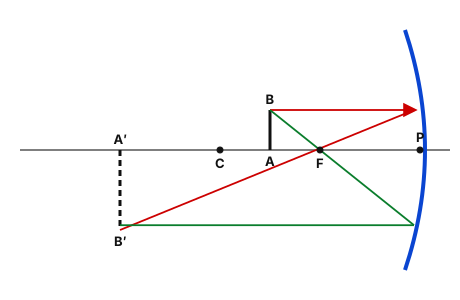
Short trick: Object and image swap: object beyond C ↔ image between F and C. So object between C and F → image beyond C, enlarged, real, inverted.
Answer: (D) Enlarged, real, and inverted
अवधारणा: अवतल दर्पण के C और F के बीच रखी वस्तु का प्रतिबिंब C से परे बनता है।
- अक्ष के समांतर किरण परावर्तन के बाद F से गुज़रती है; F से जाने वाली किरण परावर्तन के बाद अक्ष के समांतर हो जाती है।
- परावर्तित किरणें वास्तव में C से परे अक्ष के नीचे मिलती हैं → प्रतिबिंब वास्तविक और उल्टा।
- प्रतिबिंब की दूरी वस्तु की दूरी से अधिक → प्रतिबिंब बड़ा।
शॉर्ट ट्रिक: वस्तु और प्रतिबिंब की अदला-बदली: वस्तु C से परे ↔ प्रतिबिंब F और C के बीच। अतः वस्तु C और F के बीच → प्रतिबिंब C से परे, बड़ा, वास्तविक, उल्टा।
उत्तर: (D) बड़ा, वास्तविक और उल्टा
RRB ALP CBT 1General ScienceImage formation by concave mirrorRRB ALP CBT 1 2025 · 16 Feb Shift 1
Q75.A ball is dropped from a height and falls freely for 2 seconds. Its average speed during this time is: (Consider: acceleration due to gravity =10 m/s2)
एक गेंद को किसी ऊँचाई से गिराया जाता है और वह 2 सेकंड तक मुक्त रूप से गिरती है। इस दौरान उसकी औसत चाल कितनी है? (गुरुत्वीय त्वरण = 10 m/s2 मानें)
- A20 m/s
- B10 m/s
- C5 m/s
- D15 m/s
Show answer
Concept: Average speed = total distance ÷ total time; in uniform acceleration from rest it equals (u + v)/2.
- Distance in 2 s: m.
- Average speed = 20 ÷ 2 = 10 m/s.
- Check: v = gt = 20 m/s; (0 + 20)/2 = 10 m/s ✓.
Short trick: From rest, average speed = = 10 × 2 ÷ 2 = 10 m/s.
Answer: (B) 10 m/s
अवधारणा: औसत चाल = कुल दूरी ÷ कुल समय; विरामावस्था से एकसमान त्वरण में यह (u + v)/2 के बराबर होती है।
- 2 s में दूरी: m।
- औसत चाल = 20 ÷ 2 = 10 m/s।
- जाँच: v = gt = 20 m/s; (0 + 20)/2 = 10 m/s ✓।
शॉर्ट ट्रिक: विराम से, औसत चाल = = 10 × 2 ÷ 2 = 10 m/s।
उत्तर: (B) 10 m/s
RRB ALP CBT 1General ScienceFree fall – average speedRRB ALP CBT 1 2025 · 16 Feb Shift 1
Q76.When a living plant cell loses water through osmosis, what happens to the cell contents?
जब एक जीवित पादप कोशिका परासरण द्वारा जल खोती है, तो कोशिका की सामग्री का क्या होता है?
- AThey remain unchangedवे अपरिवर्तित रहती हैं
- BThey dissolveवे घुल जाती हैं
- CThey swell and burstवे फूलकर फट जाती हैं
- DThey contract and move away from the cell wallवे सिकुड़कर कोशिका भित्ति से दूर हट जाती हैं
Show answer
Concept: In a hypertonic solution a plant cell loses water by osmosis – this is plasmolysis.
- Water moves out of the vacuole and cytoplasm to the more concentrated outside solution.
- The protoplast shrinks, but the rigid cell wall keeps its shape.
- So the cell contents contract and pull away from the cell wall.
Short trick: Plasmo-LYSIS = protoplasm 'lets go' of the wall; swelling and bursting happens only to animal cells (no wall) in water.
Answer: (D) They contract and move away from the cell wall
अवधारणा: अतिपरासारी (hypertonic) विलयन में पादप कोशिका परासरण द्वारा जल खोती है – इसे जीवद्रव्यकुंचन कहते हैं।
- जल रिक्तिका और कोशिकाद्रव्य से बाहर अधिक सांद्र विलयन की ओर जाता है।
- जीवद्रव्य सिकुड़ जाता है, पर कठोर कोशिका भित्ति अपना आकार बनाए रखती है।
- अतः कोशिका की सामग्री सिकुड़कर कोशिका भित्ति से दूर हट जाती है।
शॉर्ट ट्रिक: जीवद्रव्य 'कुंचन' = सिकुड़ना; फूलकर फटना केवल जल में रखी जंतु कोशिका (भित्ति रहित) में होता है।
उत्तर: (D) वे सिकुड़कर कोशिका भित्ति से दूर हट जाती हैं
RRB ALP CBT 1General SciencePlasmolysisRRB ALP CBT 1 2025 · 16 Feb Shift 1
Q77.The gravitational potential energy of an object depends on what?
किसी वस्तु की गुरुत्वीय स्थितिज ऊर्जा किस पर निर्भर करती है?
- AIts acceleration onlyकेवल उसके त्वरण पर
- BIts velocity and massउसके वेग और द्रव्यमान पर
- CIts speed onlyकेवल उसकी चाल पर
- DIts mass and heightउसके द्रव्यमान और ऊँचाई पर
Show answer
Concept: Gravitational PE near the earth: .
- m = mass of the object, h = height above the reference level, g = constant (≈ 9.8 m/s²).
- PE does not depend on velocity, speed or acceleration of the object (those affect kinetic energy, ).
- So it depends on mass and height.
Short trick: Potential = Position: 'P for Position' → height; Kinetic = Kinetic motion → speed.
Answer: (D) Its mass and height
अवधारणा: पृथ्वी के निकट गुरुत्वीय स्थितिज ऊर्जा: ।
- m = वस्तु का द्रव्यमान, h = संदर्भ तल से ऊँचाई, g = नियतांक (≈ 9.8 m/s²)।
- स्थितिज ऊर्जा वस्तु के वेग, चाल या त्वरण पर निर्भर नहीं करती (ये गतिज ऊर्जा को प्रभावित करते हैं)।
- अतः यह द्रव्यमान और ऊँचाई पर निर्भर करती है।
शॉर्ट ट्रिक: स्थितिज = स्थिति (ऊँचाई); गतिज = गति (चाल)।
उत्तर: (D) उसके द्रव्यमान और ऊँचाई पर
RRB ALP CBT 1General ScienceGravitational potential energyRRB ALP CBT 1 2025 · 16 Feb Shift 1
Q78.Match the columns.
| Epithelial Tissue | Location |
|---|
| I | Cuboidal Epithelium | A. | Lining of intestine |
| II | Columnar Epithelium | B. | Skin |
| III | Squamous Epithelium | C. | Lining of kidney tubules |
स्तंभों का मिलान करें।
| उपकला ऊतक | स्थान |
|---|
| I | घनाकार उपकला | A. | आंत का अस्तर |
| II | स्तंभाकार उपकला | B. | त्वचा |
| III | शल्की उपकला | C. | वृक्क नलिकाओं का अस्तर |
- AI-A; II-B; III-C
- BI-A; II-C; III-B
- CI-C; II-A; III-B
- DI-B; II-C; III-A
Show answer
Concept: Shape of epithelial cells matches their job.
- Cuboidal epithelium – cube-shaped cells that absorb/secrete: lining of kidney tubules (and salivary-gland ducts) → I-C.
- Columnar epithelium – tall cells for absorption: lining of the intestine → II-A.
- Squamous epithelium – flat, thin cells; stratified squamous forms the skin → III-B.
Short trick: C-K-C: Cuboidal = Kidney; Columnar = Canal (intestine); Squamous = Skin (both start with S).
Answer: (C) I-C; II-A; III-B
अवधारणा: उपकला कोशिकाओं की आकृति उनके कार्य के अनुसार होती है।
- घनाकार उपकला – घन जैसी कोशिकाएँ जो अवशोषण/स्राव करती हैं: वृक्क नलिकाओं (और लार ग्रंथि की वाहिनियों) का अस्तर → I-C।
- स्तंभाकार उपकला – लंबी कोशिकाएँ जो अवशोषण करती हैं: आंत का अस्तर → II-A।
- शल्की उपकला – चपटी, पतली कोशिकाएँ; स्तरित शल्की उपकला से त्वचा बनती है → III-B।
शॉर्ट ट्रिक: याद रखें: घनाकार = गुर्दा (वृक्क); स्तंभाकार = आंत; शल्की = त्वचा (Squamous = Skin)।
उत्तर: (C) I-C; II-A; III-B
RRB ALP CBT 1General ScienceEpithelial tissues and locationRRB ALP CBT 1 2025 · 16 Feb Shift 1
Q79.To neutralise excess acidity in the stomach, one can take:
पेट में अतिरिक्त अम्लता को उदासीन करने के लिए, कोई क्या ले सकता है?
- ALemon juiceनींबू का रस
- BAntacids like Mg(OH)₂Mg(OH)₂ जैसे प्रतिअम्ल (एंटासिड)
- CHCl solutionHCl विलयन
- DVinegarसिरका
Show answer
Concept: Excess HCl in the stomach is neutralised by a mild base (antacid).
- Milk of magnesia, Mg(OH)₂, is a mild base.
- Mg(OH)₂ + 2HCl → MgCl₂ + 2H₂O (neutralisation).
- Lemon juice, HCl and vinegar are acids – they would increase acidity.
Short trick: Acid trouble → take a base: 'Milk of Magnesia' = Mg(OH)₂. Eliminate all sour options.
Answer: (B) Antacids like Mg(OH)₂
अवधारणा: पेट में अतिरिक्त HCl को एक दुर्बल क्षार (प्रतिअम्ल) से उदासीन किया जाता है।
- मिल्क ऑफ़ मैग्नीशिया, Mg(OH)₂, एक दुर्बल क्षार है।
- Mg(OH)₂ + 2HCl → MgCl₂ + 2H₂O (उदासीनीकरण)।
- नींबू का रस, HCl और सिरका अम्ल हैं – ये अम्लता बढ़ाएँगे।
शॉर्ट ट्रिक: अम्ल की समस्या → क्षार लें: 'मिल्क ऑफ़ मैग्नीशिया' = Mg(OH)₂। सभी खट्टे विकल्प हटाएँ।
उत्तर: (B) Mg(OH)₂ जैसे प्रतिअम्ल (एंटासिड)
RRB ALP CBT 1General ScienceAcids, bases – antacidsRRB ALP CBT 1 2025 · 16 Feb Shift 1
Q80.Which of the following observations supports that matter is made of small particles?
निम्नलिखित में से कौन-सा प्रेक्षण इस बात का समर्थन करता है कि द्रव्य छोटे-छोटे कणों से बना है?
- AOil floats above the surface after gentle stirring.धीरे से हिलाने के बाद तेल सतह के ऊपर तैरता है।
- BChalk powder remains visible even after mixing.मिलाने के बाद भी चॉक का चूर्ण दिखाई देता रहता है।
- CSugar dissolves in water without change in level.चीनी जल में घुल जाती है और जल-स्तर में कोई परिवर्तन नहीं होता।
- DSand settles at the bottom when mixed with water.जल में मिलाने पर रेत तली में बैठ जाती है।
Show answer
Concept: Matter is made of tiny particles with spaces between them.
- When sugar dissolves, its particles spread into the spaces between water particles.
- Hence the water level does not rise noticeably – evidence of small particles and inter-particle spaces.
- Oil floating, chalk staying visible and sand settling show insolubility/density, not particle nature.
Short trick: 'Disappears but level stays' = particles hide in the gaps – the classic NCERT Class 9 activity.
Answer: (C) Sugar dissolves in water without change in level.
अवधारणा: द्रव्य छोटे-छोटे कणों से बना है जिनके बीच रिक्त स्थान होते हैं।
- चीनी घुलने पर उसके कण जल के कणों के बीच के रिक्त स्थानों में फैल जाते हैं।
- इसलिए जल-स्तर में उल्लेखनीय वृद्धि नहीं होती – यह छोटे कणों और कणों के बीच रिक्त स्थान का प्रमाण है।
- तेल का तैरना, चॉक का दिखना और रेत का बैठना अविलेयता/घनत्व दर्शाते हैं, कणीय प्रकृति नहीं।
शॉर्ट ट्रिक: 'घुल गई पर स्तर वही' = कण रिक्त स्थानों में छिप गए – NCERT कक्षा 9 की प्रसिद्ध गतिविधि।
उत्तर: (C) चीनी जल में घुल जाती है और जल-स्तर में कोई परिवर्तन नहीं होता।
RRB ALP CBT 1General ScienceParticulate nature of matterRRB ALP CBT 1 2025 · 16 Feb Shift 1

