Q101.Read the given statements and conclusions carefully. Assuming that the information given in the statements is true, even if it appears to be at variance with commonly known facts, decide which of the given conclusions logically follow(s) from the statements.
Statements:
Some Indians are Americans.
Some Americans are Russians.
Conclusions:
(I) No Russian is an American.
(II) All Indians are Russians.
दिए गए कथनों और निष्कर्षों को ध्यानपूर्वक पढ़ें। यह मानते हुए कि कथनों में दी गई जानकारी सत्य है, भले ही वह सामान्यतः ज्ञात तथ्यों से भिन्न प्रतीत होती हो, निर्णय लें कि दिए गए निष्कर्षों में से कौन-सा/से निष्कर्ष कथनों का तार्किक रूप से अनुसरण करता है/करते हैं।
कथन:
कुछ भारतीय अमेरिकी हैं।
कुछ अमेरिकी रूसी हैं।
निष्कर्ष:
(I) कोई भी रूसी अमेरिकी नहीं है।
(II) सभी भारतीय रूसी हैं।
- AOnly conclusion (I) follows.केवल निष्कर्ष (I) अनुसरण करता है।
- BOnly conclusion (II) follows.केवल निष्कर्ष (II) अनुसरण करता है।
- CNeither conclusion (I) nor (II) follows.न तो निष्कर्ष (I) और न ही (II) अनुसरण करता है।
- DBoth conclusions (I) and (II) follow.निष्कर्ष (I) और (II) दोनों अनुसरण करते हैं।
Show answer
Concept: Two “Some” statements give no definite link between the end terms.
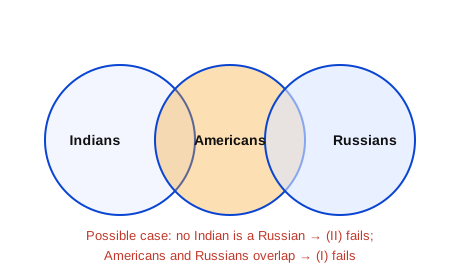
- (I) “No Russian is American” directly contradicts “Some Americans are Russians” ✗
- (II) “All Indians are Russians” – Indians and Russians are not connected definitely ✗
- A possible diagram where both fail is shown above.
Short trick: Some + Some ⇒ no conclusion between the end terms; and a conclusion opposite to a statement can never follow.
Answer: (C) Neither conclusion (I) nor (II) follows.
अवधारणा: दो “कुछ” कथनों से छोर के पदों में कोई निश्चित संबंध नहीं बनता।
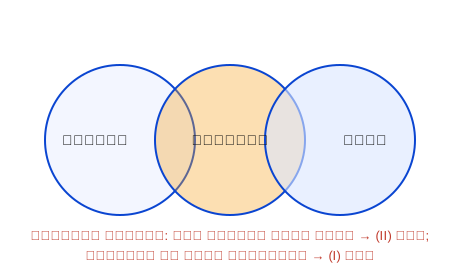
- (I) “कोई रूसी अमेरिकी नहीं” सीधे “कुछ अमेरिकी रूसी हैं” का विरोधी है ✗
- (II) “सभी भारतीय रूसी हैं” – भारतीय और रूसी निश्चित रूप से जुड़े नहीं ✗
- ऊपर एक संभावित आरेख दिखाया गया है जिसमें दोनों गलत हैं।
शॉर्ट ट्रिक: कुछ + कुछ ⇒ छोर के पदों में कोई निष्कर्ष नहीं; और कथन के विपरीत निष्कर्ष कभी अनुसरण नहीं करता।
उत्तर: (C) न तो निष्कर्ष (I) और न ही (II) अनुसरण करता है।
RRB ALP CBT 1General Intelligence and ReasoningSyllogism – “Some” statementsRRB ALP CBT 1 2025 · 18 Feb Shift 2
Q102.Seven people, A, B, C, D, E, F and G, are sitting around a circular table facing the centre. E sits second to the left of A. G sits third to the right of E and second to the left of C. F sits third to left of B. How many people sit between C and A when counted from the left of C?
सात व्यक्ति, A, B, C, D, E, F और G, केंद्र की ओर मुख करके एक वृत्ताकार मेज़ के चारों ओर बैठे हैं। E, A के बाईं ओर दूसरे स्थान पर बैठा है। G, E के दाईं ओर तीसरे स्थान पर और C के बाईं ओर दूसरे स्थान पर बैठा है। F, B के बाईं ओर तीसरे स्थान पर बैठा है। C के बाईं ओर से गिनने पर C और A के बीच कितने व्यक्ति बैठे हैं?
- ATwoदो
- BNoneकोई नहीं
- COneएक
- DThreeतीन
Show answer
Concept: Facing the centre: left = clockwise, right = anticlockwise. Number seats 0–6 clockwise.
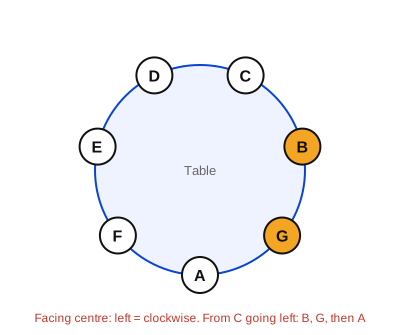
- A = 0; E second to the left of A → E = 2.
- G third to the right of E → G = 6; G second to the left of C → C = 4.
- F third to the left of B: only B = 5, F = 1 works; D = 3.
- From C going left (clockwise): B, G, then A → two persons between.
Short trick: G is 2nd to the left of C and A is just next to G → between C and A on the left side: B and G = 2.
Answer: (A) Two
अवधारणा: केंद्र की ओर मुख: बायाँ = दक्षिणावर्त, दायाँ = वामावर्त। स्थानों को 0–6 दक्षिणावर्त क्रमांकित करें।
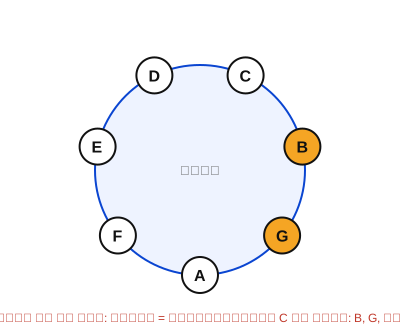
- A = 0; E, A के बाएँ दूसरा → E = 2।
- G, E के दाएँ तीसरा → G = 6; G, C के बाएँ दूसरा → C = 4।
- F, B के बाएँ तीसरा: केवल B = 5, F = 1 संभव; D = 3।
- C से बाएँ (दक्षिणावर्त): B, G, फिर A → बीच में दो व्यक्ति।
शॉर्ट ट्रिक: G, C के बाएँ दूसरा और A, G के ठीक बाद → C और A के बीच B और G = 2।
उत्तर: (A) दो
RRB ALP CBT 1General Intelligence and ReasoningCircular seating – facing centreRRB ALP CBT 1 2025 · 18 Feb Shift 2
Q103.41 is related to 165 following a certain logic. Following the same logic, 18 is related to 73. To which of the given options is 122 related, following the same logic?
(NOTE: Operations should be performed on the whole numbers, without breaking down the numbers into their constituent digits. E.g. 13 – Operations on 13 such as adding/subtracting/multiplying to 13 can be performed. Breaking down 13 into 1 and 3 and then performing mathematical operations on 1 and 3 is not allowed.)
एक निश्चित तर्क के अनुसार 41, 165 से संबंधित है। उसी तर्क के अनुसार 18, 73 से संबंधित है। उसी तर्क के अनुसार 122 दिए गए विकल्पों में से किससे संबंधित है?
(नोट: संक्रियाएँ पूर्ण संख्याओं पर की जानी चाहिए, संख्याओं को उनके घटक अंकों में तोड़े बिना। उदाहरण के लिए 13 – 13 पर संक्रियाएँ जैसे 13 में जोड़ना/घटाना/गुणा करना आदि किया जा सकता है। 13 को 1 और 3 में तोड़कर फिर 1 और 3 पर गणितीय संक्रियाएँ करने की अनुमति नहीं है।)
- A489
- B492
- C495
- D487
Show answer
Concept: Find one rule for both given pairs.
- ✓; ✓
- .
Short trick: 4 × 122 = 488 → answer must be 488 + 1 = 489 (only option ending in 9 just above 488).
Answer: (A) 489
अवधारणा: दोनों युग्मों पर एक नियम।
- ✓; ✓
- ।
शॉर्ट ट्रिक: 4 × 122 = 488 → 488 + 1 = 489।
उत्तर: (A) 489
RRB ALP CBT 1General Intelligence and ReasoningNumber analogyRRB ALP CBT 1 2025 · 18 Feb Shift 2
Q104.In a certain code language, ‘CROW’ is coded as ‘2916’ and ‘WORK’ is coded as ‘6152’. What is the code for ‘K’ in the given code language?
एक निश्चित कूट भाषा में, 'CROW' को '2916' के रूप में और 'WORK' को '6152' के रूप में कूटबद्ध किया जाता है। दी गई कूट भाषा में 'K' के लिए कूट क्या है?
- A6
- B1
- C5
- D2
Show answer
Concept: Letters common to both words take the digits common to both codes.
- CROW = {2, 9, 1, 6}; WORK = {6, 1, 5, 2}.
- Common letters R, O, W ↔ common digits 2, 1, 6.
- Left-over: C = 9 and K = 5.
Short trick: K appears only in WORK; the only digit of 6152 not in 2916 is 5.
Answer: (C) 5
अवधारणा: दोनों शब्दों के उभयनिष्ठ अक्षरों के कूट भी उभयनिष्ठ होते हैं।
- CROW = {2, 9, 1, 6}; WORK = {6, 1, 5, 2}।
- उभयनिष्ठ R, O, W ↔ 2, 1, 6।
- शेष: C = 9 और K = 5।
शॉर्ट ट्रिक: K केवल WORK में है; 6152 का वह अंक जो 2916 में नहीं → 5।
उत्तर: (C) 5
RRB ALP CBT 1General Intelligence and ReasoningCoding – common lettersRRB ALP CBT 1 2025 · 18 Feb Shift 2
Q105.Based on the English alphabetical order, three of the following four letter-cluster pairs are alike in a certain way and thus form a group. Which letter-cluster pair DOES NOT belong to that group? (Note: The odd one out is not based on the number of consonants/vowels or their position in the letter-cluster.)
अंग्रेज़ी वर्णमाला क्रम के आधार पर, निम्नलिखित चार अक्षर-समूह युग्मों में से तीन किसी प्रकार से एकसमान हैं और इस प्रकार एक समूह बनाते हैं। कौन-सा अक्षर-समूह युग्म उस समूह से संबंधित नहीं है? (नोट: असंगत का निर्धारण व्यंजनों/स्वरों की संख्या या अक्षर-समूह में उनके स्थान पर आधारित नहीं है।)
- AHL−JN
- BNR−OV
- CMQ−OS
- DTX−VZ
Show answer
Concept: Check the gaps inside and between the clusters.
- HL−JN: H+4=L, H+2=J, J+4=N.
- MQ−OS and TX−VZ: same +4, +2, +4.
- NR−OV: N+4=R but N+1=O, O+7=V ✗
Short trick: Compare first letters only: H→J, M→O, T→V are +2, but N→O is +1.
Answer: (B) NR−OV
अवधारणा: क्लस्टर के भीतर और बीच के अंतर जाँचें।
- HL−JN: H+4=L, H+2=J, J+4=N।
- MQ−OS और TX−VZ: वही +4, +2, +4।
- NR−OV: N+4=R पर N+1=O, O+7=V ✗
शॉर्ट ट्रिक: केवल पहले अक्षर देखें: H→J, M→O, T→V में +2, पर N→O में +1।
उत्तर: (B) NR−OV
RRB ALP CBT 1General Intelligence and ReasoningOdd one out – letter pairsRRB ALP CBT 1 2025 · 18 Feb Shift 2
Q106.Select the pair which follows the same pattern as that followed by the two pairs given below. Both pairs follow the same pattern.
GPI : IMK
NQJ : PNL
वह युग्म चुनिए जो उसी पैटर्न का अनुसरण करता है जिसका अनुसरण नीचे दिए गए दो युग्म करते हैं। दोनों युग्म एक ही पैटर्न का अनुसरण करते हैं।
GPI : IMK
NQJ : PNL
- ACZS : EWU
- BSRL : UOM
- CKKE : MHF
- DAVU : CRW
Show answer
Concept: Rule: 1st +2, 2nd −3, 3rd +2.
- GPI → IMK: G+2=I, P−3=M, I+2=K ✓; NQJ → PNL ✓
- CZS → EWU: C+2=E, Z−3=W, S+2=U ✓
- Others fail, e.g. SRL → UOM (L+1), KKE → MHF (E+1).
Short trick: Check only the 3rd letter (+2): S→U ✓, L→M ✗, E→F ✗, U→W ✓; then 2nd letter (−3): V→R ✗ → CZS : EWU.
Answer: (A) CZS : EWU
अवधारणा: नियम: पहला +2, दूसरा −3, तीसरा +2।
- GPI → IMK: G+2=I, P−3=M, I+2=K ✓; NQJ → PNL ✓
- CZS → EWU: C+2=E, Z−3=W, S+2=U ✓
- अन्य असफल, जैसे SRL → UOM (L+1), KKE → MHF (E+1)।
शॉर्ट ट्रिक: पहले तीसरा अक्षर (+2) जाँचें, फिर दूसरा (−3) → CZS : EWU।
उत्तर: (A) CZS : EWU
RRB ALP CBT 1General Intelligence and ReasoningLetter pair analogyRRB ALP CBT 1 2025 · 18 Feb Shift 2
Q107.Among five people named V, W, X, Y and Z, each have a certain age. X is thrice the age of V. The age of V is 12. Y is half the age of Z. W is twice the age of Y. If Z's age is equal to the age of X, what is the age of W?
V, W, X, Y और Z नाम के पाँच व्यक्तियों में से प्रत्येक की एक निश्चित आयु है। X की आयु V की आयु की तीन गुनी है। V की आयु 12 है। Y की आयु Z की आयु की आधी है। W की आयु Y की आयु की दोगुनी है। यदि Z की आयु X की आयु के बराबर है, तो W की आयु क्या है?
- A35
- B36
- C42
- D54
Show answer
Concept: Work from the given value step by step.
- V = 12 → X = 3 × 12 = 36.
- Z = X = 36 → Y = 36 ÷ 2 = 18.
- W = 2 × Y = 36.
Short trick: W = 2Y and Y = Z/2 ⇒ W = Z = X = 36.
Answer: (B) 36
अवधारणा: दिए गए मान से क्रमशः आगे बढ़ें।
- V = 12 → X = 36।
- Z = X = 36 → Y = 18।
- W = 2 × Y = 36।
शॉर्ट ट्रिक: W = 2Y और Y = Z/2 ⇒ W = Z = X = 36।
उत्तर: (B) 36
RRB ALP CBT 1General Intelligence and ReasoningAge relationsRRB ALP CBT 1 2025 · 18 Feb Shift 2
Q108.If ‘P’ stands for ‘×’, ‘Q’ stands for ‘÷’, ‘R’ stands for ‘−’ and ‘S’ stands for ‘+’, then what will come in place of the question mark (?) in the following equation?
(60 Q 4) P 6 R 10 P 3 = ?
यदि 'P' का अर्थ '×', 'Q' का अर्थ '÷', 'R' का अर्थ '−' और 'S' का अर्थ '+' है, तो निम्नलिखित समीकरण में प्रश्न चिह्न (?) के स्थान पर क्या आएगा?
(60 Q 4) P 6 R 10 P 3 = ?
- A60
- B40
- C80
- D45
Show answer
Concept: Replace letters by operators, then BODMAS.
- (60 ÷ 4) × 6 − 10 × 3
- = 15 × 6 − 30 = 90 − 30 = 60.
Short trick: Bracket first: 15 × 6 = 90; then 90 − 30.
Answer: (A) 60
अवधारणा: अक्षरों को चिह्नों से बदलें, फिर BODMAS।
- (60 ÷ 4) × 6 − 10 × 3
- = 90 − 30 = 60।
शॉर्ट ट्रिक: पहले कोष्ठक: 15 × 6 = 90; फिर 90 − 30।
उत्तर: (A) 60
RRB ALP CBT 1General Intelligence and ReasoningSymbol substitutionRRB ALP CBT 1 2025 · 18 Feb Shift 2
Q109.If ‘A’ stands for ‘÷’, ‘B’ stands for ‘x’, ‘C’ stands for ‘+’ and ‘D’ stands for ‘-’, what will come in place of the question mark (?) in the following equation?
75 C 112 A 7 B 4 D 40 = ?
यदि 'A' का अर्थ '÷', 'B' का अर्थ '×', 'C' का अर्थ '+' और 'D' का अर्थ '-' है, तो निम्नलिखित समीकरण में प्रश्न चिह्न (?) के स्थान पर क्या आएगा?
75 C 112 A 7 B 4 D 40 = ?
- A99
- B94
- C97
- D98
Show answer
Concept: Replace letters by operators, then BODMAS.
- 75 + 112 ÷ 7 × 4 − 40
- 112 ÷ 7 = 16; 16 × 4 = 64.
- 75 + 64 − 40 = 99.
Short trick: Do ÷ and × left to right before + and −.
Answer: (A) 99
अवधारणा: अक्षरों को चिह्नों से बदलें, फिर BODMAS।
- 75 + 112 ÷ 7 × 4 − 40
- 112 ÷ 7 = 16; 16 × 4 = 64।
- 75 + 64 − 40 = 99।
शॉर्ट ट्रिक: + और − से पहले ÷ और × बाएँ से दाएँ।
उत्तर: (A) 99
RRB ALP CBT 1General Intelligence and ReasoningSymbol substitutionRRB ALP CBT 1 2025 · 18 Feb Shift 2
Q110.Based on the English alphabetical order, three of the following four letter-cluster pairs are alike in a certain way and thus form a group. Which letter-cluster pair DOES NOT belong to that group? (Note: The odd one out is not based on the number of consonants/vowels or their position in the letter-cluster.)
अंग्रेज़ी वर्णमाला क्रम के आधार पर, निम्नलिखित चार अक्षर-समूह युग्मों में से तीन किसी प्रकार से एकसमान हैं और इस प्रकार एक समूह बनाते हैं। कौन-सा अक्षर-समूह युग्म उस समूह से संबंधित नहीं है? (नोट: असंगत का निर्धारण व्यंजनों/स्वरों की संख्या या अक्षर-समूह में उनके स्थान पर आधारित नहीं है।)
- AIJ-KL
- BAB-CA
- CEF-GH
- DMN-OP
Show answer
Concept: Valid pairs are four consecutive letters split as two pairs.
- IJ-KL, EF-GH, MN-OP: I J K L, E F G H, M N O P ✓
- AB-CA: after C should come D, not A ✗
Short trick: Read each pair as one 4-letter run – AB-CA breaks the run.
Answer: (B) AB-CA
अवधारणा: सही युग्म चार क्रमागत अक्षर हैं जो दो जोड़ों में बँटे हैं।
- IJ-KL, EF-GH, MN-OP: क्रमागत ✓
- AB-CA: C के बाद D आना चाहिए, A नहीं ✗
शॉर्ट ट्रिक: हर युग्म को 4 अक्षरों की लगातार पंक्ति की तरह पढ़ें – AB-CA टूटता है।
उत्तर: (B) AB-CA
RRB ALP CBT 1General Intelligence and ReasoningOdd one out – consecutive lettersRRB ALP CBT 1 2025 · 18 Feb Shift 2
Q111.Each of T, R, O, U, B, L and E has an exam on a different day of a week starting from Monday and ending on Sunday of the same week. Only three people have exam between L and T. Only three people have exam between U and O. B has exam on some day before E and on some day after R. Only O has exam after T. How many people have exam after B?
T, R, O, U, B, L और E में से प्रत्येक की एक ही सप्ताह के सोमवार से शुरू होकर रविवार को समाप्त होने वाले अलग-अलग दिन परीक्षा है। L और T के बीच केवल तीन व्यक्तियों की परीक्षा है। U और O के बीच केवल तीन व्यक्तियों की परीक्षा है। B की परीक्षा E से पहले किसी दिन और R के बाद किसी दिन है। T के बाद केवल O की परीक्षा है। B के बाद कितने व्यक्तियों की परीक्षा है?
- ATwoदो
- BThreeतीन
- CFourचार
- DOneएक
Show answer
Concept: Start with the clue that fixes positions absolutely.
- Only O after T → T = Saturday, O = Sunday.
- Three between L and T → L = Tuesday; three between U and O → U = Wednesday.
- R < B < E on the free days Mon, Thu, Fri → R = Mon, B = Thu, E = Fri.
| Mon | Tue | Wed | Thu | Fri | Sat | Sun |
|---|
| R | L | U | B | E | T | O |
- After B: E, T, O → 3.
Short trick: “Only O after T” fixes the last two days at once; the rest follows by counting gaps.
Answer: (B) Three
अवधारणा: उस संकेत से शुरू करें जो स्थान को पूर्ण रूप से तय करता है।
- T के बाद केवल O → T = शनिवार, O = रविवार।
- L और T के बीच तीन → L = मंगलवार; U और O के बीच तीन → U = बुधवार।
- R < B < E खाली दिनों सोम, गुरु, शुक्र पर → R = सोम, B = गुरु, E = शुक्र।
| सोम | मंगल | बुध | गुरु | शुक्र | शनि | रवि |
|---|
| R | L | U | B | E | T | O |
- B के बाद: E, T, O → 3।
शॉर्ट ट्रिक: “T के बाद केवल O” से अंतिम दो दिन तुरंत तय; शेष अंतर गिनकर।
उत्तर: (B) तीन
RRB ALP CBT 1General Intelligence and ReasoningDay-based schedulingRRB ALP CBT 1 2025 · 18 Feb Shift 2
Q112.Based on the English alphabetical order, three of the following four letter-clusters are alike in a certain way and thus form a group. Which letter-cluster DOES NOT belong to that group?
(Note: The odd one out is not based on the number of consonants/vowels or their position in the letter-cluster.)
अंग्रेज़ी वर्णमाला क्रम के आधार पर, निम्नलिखित चार अक्षर-समूहों में से तीन किसी प्रकार से एकसमान हैं और इस प्रकार एक समूह बनाते हैं। कौन-सा अक्षर-समूह उस समूह से संबंधित नहीं है?
(नोट: असंगत का निर्धारण व्यंजनों/स्वरों की संख्या या अक्षर-समूह में उनके स्थान पर आधारित नहीं है।)
- AMRY
- BJOU
- CQVB
- DDIO
Show answer
Concept: Check the gaps between consecutive letters.
- JOU: J+5=O, O+6=U. QVB: Q+5=V, V+6=B (wrap). DIO: D+5=I, I+6=O.
- MRY: M+5=R, R+7=Y ✗
Short trick: All begin with +5; just test the second gap (+6) – MRY gives +7.
Answer: (A) MRY
अवधारणा: क्रमागत अक्षरों के बीच अंतर जाँचें।
- JOU: +5, +6। QVB: +5, +6 (चक्र)। DIO: +5, +6।
- MRY: M+5=R, R+7=Y ✗
शॉर्ट ट्रिक: सभी में पहला अंतर +5; केवल दूसरा (+6) जाँचें – MRY में +7।
उत्तर: (A) MRY
RRB ALP CBT 1General Intelligence and ReasoningOdd one out – letter gapsRRB ALP CBT 1 2025 · 18 Feb Shift 2
Q113.Seven boxes, M, N, O, P, Q, R and S, are kept one over the other but not necessarily in the same order. O is kept third from the top. Only two boxes are kept between O and Q. P is kept immediately above Q. M is kept immediately below R. N is not kept at the lowermost position. Which box is fourth from the bottom?
सात बक्से, M, N, O, P, Q, R और S, एक के ऊपर एक रखे गए हैं लेकिन ज़रूरी नहीं कि इसी क्रम में हों। O ऊपर से तीसरे स्थान पर रखा है। O और Q के बीच केवल दो बक्से रखे हैं। P, Q के ठीक ऊपर रखा है। M, R के ठीक नीचे रखा है। N सबसे नीचे के स्थान पर नहीं रखा है। नीचे से चौथा बक्सा कौन-सा है?
- AQ
- BP
- CN
- DM
Show answer
Concept: Number positions from the top (1 = top, 7 = bottom).
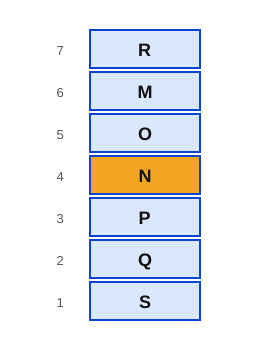
- O = 3; two between O and Q → Q = 6; P just above Q → P = 5.
- R just above M: free 1, 2, 4, 7 → R = 1, M = 2.
- N not at bottom → N = 4, S = 7.
- 4th from bottom = 4th from top (7 boxes) = N.
Short trick: With 7 items, 4th from bottom = 4th from top – just find who is at position 4.
Answer: (C) N
अवधारणा: स्थान ऊपर से क्रमांकित करें (1 = सबसे ऊपर, 7 = सबसे नीचे)।
- O = 3; O और Q के बीच दो → Q = 6; P, Q के ठीक ऊपर → P = 5।
- R, M के ठीक ऊपर: खाली 1, 2, 4, 7 → R = 1, M = 2।
- N सबसे नीचे नहीं → N = 4, S = 7।
- नीचे से चौथा = ऊपर से चौथा (7 बक्से) = N।
शॉर्ट ट्रिक: 7 वस्तुओं में नीचे से चौथा = ऊपर से चौथा – बस स्थान 4 देखें।
उत्तर: (C) N
RRB ALP CBT 1General Intelligence and ReasoningBox stackingRRB ALP CBT 1 2025 · 18 Feb Shift 2
Q114.What should come in place of the question mark (?) in the given series?
192 185 198 191 204 197 210 ?
दी गई शृंखला में प्रश्न चिह्न (?) के स्थान पर क्या आना चाहिए?
192 185 198 191 204 197 210 ?
- A205
- B201
- C206
- D203
Show answer
Concept: Differences alternate: −7, +13.
- 192 −7 185 +13 198 −7 191 +13 204 −7 197 +13 210 −7 → 203.
Short trick: Alternate terms: 185, 191, 197 → next 203 (+6 each).
Answer: (D) 203
अवधारणा: अंतर एकांतर: −7, +13।
- 192 −7 185 +13 198 −7 191 +13 204 −7 197 +13 210 −7 → 203।
शॉर्ट ट्रिक: एकांतर पद: 185, 191, 197 → अगला 203 (+6)।
उत्तर: (D) 203
RRB ALP CBT 1General Intelligence and ReasoningNumber series – alternatingRRB ALP CBT 1 2025 · 18 Feb Shift 2
Q115.Each vowel in the word PRINTED is changed to the letter immediately following it in the English alphabetical order and each consonant is changed to the letter immediately preceding it in the English alphabetical order. Which of the following letters will be third from the left in the new group of letters thus formed?
शब्द PRINTED में प्रत्येक स्वर को अंग्रेज़ी वर्णमाला क्रम में उसके ठीक बाद वाले अक्षर से और प्रत्येक व्यंजन को अंग्रेज़ी वर्णमाला क्रम में उसके ठीक पहले वाले अक्षर से बदल दिया जाता है। इस प्रकार बने अक्षरों के नए समूह में बाएँ से तीसरा अक्षर निम्नलिखित में से कौन-सा होगा?
- AJ
- BS
- CM
- DF
Show answer
Concept: Vowel → next letter; consonant → previous letter.
- P R I N T E D → O Q J M S F C.
- 3rd from the left = J.
Short trick: Only the 3rd letter matters: I is a vowel → I + 1 = J.
Answer: (A) J
अवधारणा: स्वर → अगला अक्षर; व्यंजन → पिछला अक्षर।
- P R I N T E D → O Q J M S F C।
- बाएँ से तीसरा = J।
शॉर्ट ट्रिक: केवल तीसरा अक्षर देखें: I स्वर है → I + 1 = J।
उत्तर: (A) J
RRB ALP CBT 1General Intelligence and ReasoningLetter coding – vowel/consonant shiftRRB ALP CBT 1 2025 · 18 Feb Shift 2
Q116.Refer to the following letter series and answer the question that follows. Counting to be done from left to right only.
(Left) Y D A U L K E I C B A O O A N M I Q F U E L (Right)
How many such consonants are there, each of which is immediately preceded by a consonant and also immediately followed by a vowel?
निम्नलिखित अक्षर शृंखला को देखें और उसके बाद दिए गए प्रश्न का उत्तर दें। गिनती केवल बाएँ से दाएँ की जानी है।
(बाएँ) Y D A U L K E I C B A O O A N M I Q F U E L (दाएँ)
ऐसे कितने व्यंजन हैं, जिनमें से प्रत्येक के ठीक पहले एक व्यंजन है और ठीक बाद एक स्वर भी है?
- A4
- B8
- C5
- D7
Show answer
Concept: Pattern needed: Consonant – Consonant – Vowel.
- Y D A ✓, L K E ✓, C B A ✓, N M I ✓, Q F U ✓
- Count = 5.
Short trick: Look at each vowel and check the two letters before it are both consonants.
Answer: (C) 5
अवधारणा: आवश्यक पैटर्न: व्यंजन – व्यंजन – स्वर।
- Y D A ✓, L K E ✓, C B A ✓, N M I ✓, Q F U ✓
- संख्या = 5।
शॉर्ट ट्रिक: हर स्वर से पहले के दो अक्षर देखें – दोनों व्यंजन हों तो गिनें।
उत्तर: (C) 5
RRB ALP CBT 1General Intelligence and ReasoningLetter series – consonant conditionsRRB ALP CBT 1 2025 · 18 Feb Shift 2
Q117.What should come in place of ? in the given series?
56 68 87 113 146 ?
दी गई शृंखला में ? के स्थान पर क्या आना चाहिए?
56 68 87 113 146 ?
- A188
- B185
- C187
- D186
Show answer
Concept: First differences increase by 7.
- Differences: 12, 19, 26, 33 → next 40.
- 146 + 40 = 186.
Short trick: Second difference constant (7) → next difference = 33 + 7 = 40.
Answer: (D) 186
अवधारणा: पहले अंतर 7 से बढ़ते हैं।
- अंतर: 12, 19, 26, 33 → अगला 40।
- 146 + 40 = 186।
शॉर्ट ट्रिक: द्वितीय अंतर स्थिर (7) → अगला अंतर = 40।
उत्तर: (D) 186
RRB ALP CBT 1General Intelligence and ReasoningNumber series – second differencesRRB ALP CBT 1 2025 · 18 Feb Shift 2
Q118.In a certain code language, ‘HALT’ is coded as ‘6928’ and ‘GHAT’ is coded as ‘4862’. What is the code for ‘G’ in the given code language?
एक निश्चित कूट भाषा में, 'HALT' को '6928' के रूप में और 'GHAT' को '4862' के रूप में कूटबद्ध किया जाता है। दी गई कूट भाषा में 'G' के लिए कूट क्या है?
- A6
- B8
- C4
- D2
Show answer
Concept: Common letters ↔ common digits.
- HALT = {6, 9, 2, 8}; GHAT = {4, 8, 6, 2}.
- H, A, T ↔ 6, 2, 8; L = 9 and G = 4.
Short trick: G is only in GHAT; the digit of 4862 missing in 6928 is 4.
Answer: (C) 4
अवधारणा: उभयनिष्ठ अक्षर ↔ उभयनिष्ठ अंक।
- HALT = {6, 9, 2, 8}; GHAT = {4, 8, 6, 2}।
- H, A, T ↔ 6, 2, 8; L = 9 और G = 4।
शॉर्ट ट्रिक: G केवल GHAT में; 4862 का वह अंक जो 6928 में नहीं → 4।
उत्तर: (C) 4
RRB ALP CBT 1General Intelligence and ReasoningCoding – common lettersRRB ALP CBT 1 2025 · 18 Feb Shift 2
Q119.Refer to the following number, symbol series and answer the question. Counting to be done from left to right only. All numbers are single-digit numbers.
(Left) @ 8 1 < 2 + + > 6 # \ * 7 & + * * 3 3 $ 2 (Right)
How many such numbers are there each of which is immediately preceded by a symbol and also immediately followed by a symbol?
निम्नलिखित संख्या, प्रतीक शृंखला को देखें और प्रश्न का उत्तर दें। गिनती केवल बाएँ से दाएँ की जानी है। सभी संख्याएँ एक-अंकीय संख्याएँ हैं।
(बाएँ) @ 8 1 < 2 + + > 6 # \ * 7 & + * * 3 3 $ 2 (दाएँ)
ऐसी कितनी संख्याएँ हैं जिनमें से प्रत्येक के ठीक पहले एक प्रतीक है और ठीक बाद भी एक प्रतीक है?
- ATwoदो
- BOneएक
- CThreeतीन
- DNoneकोई नहीं
Show answer
Concept: Pattern needed: Symbol – Number – Symbol.
- < 2 + ✓, > 6 # ✓, * 7 & ✓
- 8 1 and 3 3 are adjacent numbers; last 2 has nothing after it.
- Count = 3.
Short trick: Skip every number that has another number beside it – only isolated numbers can qualify.
Answer: (C) Three
अवधारणा: आवश्यक पैटर्न: प्रतीक – संख्या – प्रतीक।
- < 2 + ✓, > 6 # ✓, * 7 & ✓
- 8 1 और 3 3 सटी संख्याएँ हैं; अंतिम 2 के बाद कुछ नहीं।
- संख्या = 3।
शॉर्ट ट्रिक: जिस संख्या के बगल में दूसरी संख्या हो उसे छोड़ दें – केवल अकेली संख्याएँ योग्य हैं।
उत्तर: (C) तीन
RRB ALP CBT 1General Intelligence and ReasoningNumber–symbol seriesRRB ALP CBT 1 2025 · 18 Feb Shift 2
Q120.Refer to the following number and symbol series and answer the question that follows. (All numbers are single-digit numbers only.)
(Left) 3 ^ 5 # 6 £ 1 $ @ 8 % 7 * 4 ≺ Ω 9 2 (Right)
If all the symbols are dropped from the series, which of the following will be fifth from the left?
निम्नलिखित संख्या और प्रतीक शृंखला को देखें और उसके बाद दिए गए प्रश्न का उत्तर दें। (सभी संख्याएँ केवल एक-अंकीय संख्याएँ हैं।)
(बाएँ) 3 ^ 5 # 6 £ 1 $ @ 8 % 7 * 4 ≺ Ω 9 2 (दाएँ)
यदि शृंखला से सभी प्रतीक हटा दिए जाएँ, तो निम्नलिखित में से कौन-सा बाएँ से पाँचवाँ होगा?
- A8
- B7
- C1
- D4
Show answer
Concept: Write only the numbers in order.
- Numbers: 3, 5, 6, 1, 8, 7, 4, 9, 2.
- 5th from the left = 8.
Short trick: Count numbers only while scanning: 3(1) 5(2) 6(3) 1(4) 8(5) – stop at 8.
Answer: (A) 8
अवधारणा: केवल संख्याएँ क्रम में लिखें।
- संख्याएँ: 3, 5, 6, 1, 8, 7, 4, 9, 2।
- बाएँ से 5वीं = 8।
शॉर्ट ट्रिक: पढ़ते हुए केवल संख्याएँ गिनें: 3(1) 5(2) 6(3) 1(4) 8(5)।
उत्तर: (A) 8
RRB ALP CBT 1General Intelligence and ReasoningNumber–symbol series – dropping symbolsRRB ALP CBT 1 2025 · 18 Feb Shift 2

