Q161.Based on the English alphabetical order, three of the following four letter-clusters are alike in a certain way and thus form a group. Which letter-cluster DOES NOT belong to that group? (Note: The odd one out is not based on the number of consonants/vowels or their position in the letter-cluster.)
अंग्रेजी वर्णमाला क्रम के आधार पर, निम्नलिखित चार अक्षर-समूहों में से तीन किसी प्रकार से एक समान हैं और इस प्रकार एक समूह बनाते हैं। कौन-सा अक्षर-समूह उस समूह से संबंधित नहीं है? (नोट: असंगत अक्षर-समूह, उस अक्षर-समूह में व्यंजनों/स्वरों की संख्या या उनके स्थान पर आधारित नहीं है।)
- AYAC
- BPRU
- CNPS
- DJLO
Show answer
Concept: Check the gaps between consecutive letters (with wrap-around Z→A).
| Cluster | Gaps |
| YAC | +2, +2 |
| PRU | +2, +3 |
| NPS | +2, +3 |
| JLO | +2, +3 |
- Three clusters follow +2, +3; YAC follows +2, +2.
Short trick: Only the last gap differs – check just 2nd→3rd letter: C−A = 2 while U−R = S−P = O−L = 3.
Answer: (A) YAC
अवधारणा: क्रमागत अक्षरों के बीच का अंतर देखें (Z के बाद A)।
| समूह | अंतर |
| YAC | +2, +2 |
| PRU | +2, +3 |
| NPS | +2, +3 |
| JLO | +2, +3 |
- तीन समूह +2, +3 का पालन करते हैं; YAC में +2, +2 है।
शॉर्ट ट्रिक: केवल दूसरे→तीसरे अक्षर का अंतर देखें: C−A = 2 जबकि बाकी में 3।
उत्तर: (A) YAC
RRB ALP CBT 1General Intelligence and ReasoningClassification – letter clustersRRB ALP CBT 1 2025 · 17 Feb Shift 3
Q162.A question is followed by two statements numbered (I) and (II). You have to decide whether the data provided in the statements are sufficient to answer the question. Read both the statements and select the most appropriate answer.
Question:
Among 5 poles, I, L, O, M and D each having a different height, which pole is the tallest? Statements:
(I) I is taller than M but shorter than D. I is shorter than only one pole.
(II) M is taller than L.
एक प्रश्न के बाद दो कथन (I) और (II) दिए गए हैं। आपको यह निर्णय लेना है कि कथनों में दिए गए आँकड़े प्रश्न का उत्तर देने के लिए पर्याप्त हैं या नहीं। दोनों कथनों को पढ़िए और सबसे उपयुक्त उत्तर चुनिए।
प्रश्न:
5 खंभों I, L, O, M और D में से प्रत्येक की ऊँचाई अलग-अलग है। सबसे ऊँचा खंभा कौन-सा है?
कथन:
(I) I, M से ऊँचा है लेकिन D से छोटा है। I केवल एक खंभे से छोटा है।
(II) M, L से ऊँचा है।
- AData in both statements I and II together are not sufficient to answer the question.कथन I और II दोनों के आँकड़े मिलकर भी प्रश्न का उत्तर देने के लिए पर्याप्त नहीं हैं।
- BData in statement I alone is sufficient to answer the question while data in statement II is not.केवल कथन I के आँकड़े प्रश्न का उत्तर देने के लिए पर्याप्त हैं, जबकि कथन II के आँकड़े पर्याप्त नहीं हैं।
- CData in statement II alone is sufficient to answer the question while data in statement I is not.केवल कथन II के आँकड़े प्रश्न का उत्तर देने के लिए पर्याप्त हैं, जबकि कथन I के आँकड़े पर्याप्त नहीं हैं।
- DData in both statements I and II together (and not statement I alone or statement II alone) are sufficient to answer the question.कथन I और II दोनों के आँकड़े मिलकर (न कि केवल कथन I या केवल कथन II) प्रश्न का उत्तर देने के लिए पर्याप्त हैं।
Show answer
Concept: Check each statement alone first.
- (I): I is shorter than only one pole ⇒ I is 2nd tallest. D is taller than I ⇒ D is that one pole ⇒ D is the tallest. Sufficient.
- (II): only M > L – nothing about the tallest. Not sufficient.
Short trick: "Shorter than only one" = 2nd rank; whoever is taller than it is the top.
Answer: (B) Statement I alone is sufficient
अवधारणा: पहले प्रत्येक कथन को अकेले जाँचें।
- (I): I केवल एक खंभे से छोटा है ⇒ I दूसरा सबसे ऊँचा है। D, I से ऊँचा है ⇒ D सबसे ऊँचा। पर्याप्त।
- (II): केवल M > L – सबसे ऊँचे के बारे में कुछ नहीं। पर्याप्त नहीं।
शॉर्ट ट्रिक: "केवल एक से छोटा" = दूसरा स्थान; उससे ऊँचा = सबसे ऊँचा।
उत्तर: (B) केवल कथन I पर्याप्त है
RRB ALP CBT 1General Intelligence and ReasoningData sufficiency – rankingRRB ALP CBT 1 2025 · 17 Feb Shift 3
Q163.Based on the English alphabetical order, three of the following four letter-cluster pairs are alike in a certain way and thus form a group. Which letter-cluster pair DOES NOT belong to that group? (Note: The odd one out is not based on the number of consonants/vowels or their position in the letter-cluster.)
अंग्रेजी वर्णमाला क्रम के आधार पर, निम्नलिखित चार अक्षर-समूह युग्मों में से तीन किसी प्रकार से एक समान हैं और इस प्रकार एक समूह बनाते हैं। कौन-सा अक्षर-समूह युग्म उस समूह से संबंधित नहीं है? (नोट: असंगत अक्षर-समूह, उस अक्षर-समूह में व्यंजनों/स्वरों की संख्या या उनके स्थान पर आधारित नहीं है।)
- APL - KG
- BMI - LP
- COK - JF
- DKG - FB
Show answer
Concept: Compare each letter of the first cluster with the matching letter of the second.
| Pair | 1st letter | 2nd letter |
| PL - KG | P−5=K | L−5=G |
| MI - LP | M−1=L | I+7=P |
| OK - JF | O−5=J | K−5=F |
| KG - FB | K−5=F | G−5=B |
- Three pairs follow −5, −5; MI - LP does not.
Short trick: Odd one is the only pair whose second cluster moves the opposite way (I→P goes forward).
Answer: (B) MI - LP
अवधारणा: पहले समूह के प्रत्येक अक्षर की तुलना दूसरे समूह के संगत अक्षर से करें।
| युग्म | पहला अक्षर | दूसरा अक्षर |
| PL - KG | P−5=K | L−5=G |
| MI - LP | M−1=L | I+7=P |
| OK - JF | O−5=J | K−5=F |
| KG - FB | K−5=F | G−5=B |
- तीन युग्म −5, −5 का पालन करते हैं; MI - LP नहीं।
शॉर्ट ट्रिक: केवल MI - LP में दूसरा अक्षर आगे बढ़ता है (I→P)।
उत्तर: (B) MI - LP
RRB ALP CBT 1General Intelligence and ReasoningClassification – letter pairsRRB ALP CBT 1 2025 · 17 Feb Shift 3
Q164.S, T, U, V, W, X and Y live on seven different floors of the same building. The lowermost floor in the building is numbered 1, the floor above it is numbered 2 and so on till the topmost floor is numbered 7. U lives on the fourth floor. Only two persons live between U and V. T lives immediately below V. W lives immediately above X but X does not live on the lowermost floor. S does not live on the lowermost floor. On which floor number does S live?
S, T, U, V, W, X और Y एक ही इमारत की सात अलग-अलग मंजिलों पर रहते हैं। इमारत की सबसे निचली मंजिल की संख्या 1 है, उसके ऊपर वाली मंजिल की संख्या 2 है और इसी प्रकार सबसे ऊपरी मंजिल की संख्या 7 है। U चौथी मंजिल पर रहता है। U और V के बीच केवल दो व्यक्ति रहते हैं। T, V के ठीक नीचे रहता है। W, X के ठीक ऊपर रहता है लेकिन X सबसे निचली मंजिल पर नहीं रहता है। S सबसे निचली मंजिल पर नहीं रहता है। S किस मंजिल पर रहता है?
- AFloor Number 3मंजिल संख्या 3
- BFloor Number 5मंजिल संख्या 5
- CFloor Number 1मंजिल संख्या 1
- DFloor Number 2मंजिल संख्या 2
Show answer
Concept: Fix the definite person first, then the "only two between" cases.
- U = 4 ⇒ V = 1 or 7. T is immediately below V ⇒ V cannot be 1 ⇒ V = 7, T = 6.
- X–W pair (W just above X), X ≠ 1: only free consecutive floors are 2–3 ⇒ X = 2, W = 3.
- Floors 1 and 5 left for S and Y; S ≠ 1 ⇒ S = 5, Y = 1.
Short trick: "Immediately below V" kills V = 1 at once – always test the extreme floor first.
Answer: (B) Floor Number 5
अवधारणा: पहले निश्चित व्यक्ति रखें, फिर "केवल दो के बीच" वाले मामले।
- U = 4 ⇒ V = 1 या 7। T, V के ठीक नीचे ⇒ V = 1 संभव नहीं ⇒ V = 7, T = 6।
- X–W युग्म (W, X के ठीक ऊपर), X ≠ 1: खाली लगातार मंजिलें केवल 2–3 ⇒ X = 2, W = 3।
- मंजिल 1 और 5 पर S और Y; S ≠ 1 ⇒ S = 5, Y = 1।
शॉर्ट ट्रिक: "V के ठीक नीचे" से V = 1 तुरंत बाहर – हमेशा पहले छोर वाली मंजिल जाँचें।
उत्तर: (B) मंजिल संख्या 5
RRB ALP CBT 1General Intelligence and ReasoningFloor puzzle – 7 floorsRRB ALP CBT 1 2025 · 17 Feb Shift 3
Q165.In a certain code language,
'S + T' means ‘S is the father of T’,
'S - T' means ‘S is the brother of T’,
'S x T' means ‘S is the wife of T’ and
'S ÷ T' means ‘S is the sister of T’.
Based on the above, how is M related to Q if ‘M - N ÷ O + P x Q’?
एक निश्चित कूट भाषा में,
'S + T' का अर्थ है 'S, T का पिता है',
'S - T' का अर्थ है 'S, T का भाई है',
'S x T' का अर्थ है 'S, T की पत्नी है' और
'S ÷ T' का अर्थ है 'S, T की बहन है'।
उपरोक्त के आधार पर, यदि 'M - N ÷ O + P x Q' है, तो M का Q से क्या संबंध है?
- AWife's mother's brotherपत्नी की माँ का भाई
- BMother's brotherमाँ का भाई
- CWife's father's brotherपत्नी के पिता का भाई
- DFatherपिता
Show answer
Concept: Decode left to right and draw the tree.
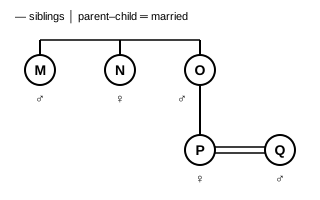
- M − N: M is brother of N.
- N ÷ O: N is sister of O ⇒ M is also brother of O.
- O + P: O is father of P.
- P × Q: P is wife of Q ⇒ O is Q's wife's father.
- M = brother of Q's wife's father.
Short trick: Read from Q backwards: Q → wife (P) → her father (O) → his brother (M).
Answer: (C) Wife's father's brother
अवधारणा: बाएँ से दाएँ कूट खोलें और वंश-वृक्ष बनाएँ।
- M − N: M, N का भाई है।
- N ÷ O: N, O की बहन है ⇒ M, O का भी भाई है।
- O + P: O, P का पिता है।
- P × Q: P, Q की पत्नी है ⇒ O, Q की पत्नी का पिता है।
- M = Q की पत्नी के पिता का भाई।
शॉर्ट ट्रिक: Q से उल्टा पढ़ें: Q → पत्नी (P) → उसके पिता (O) → उनके भाई (M)।
उत्तर: (C) पत्नी के पिता का भाई
RRB ALP CBT 1General Intelligence and ReasoningBlood relation – codedRRB ALP CBT 1 2025 · 17 Feb Shift 3
Q166.MXEL is related to OZHP in a certain way based on the English alphabetical order. In the same way, VRHB is related to XTKF. To which of the given options is QOJA related, following the same logic?
अंग्रेजी वर्णमाला क्रम के आधार पर MXEL एक निश्चित प्रकार से OZHP से संबंधित है। उसी प्रकार, VRHB, XTKF से संबंधित है। समान तर्क का अनुसरण करते हुए, QOJA दिए गए विकल्पों में से किससे संबंधित है?
- ATQLF
- BSQME
- CSOME
- DTRLE
Show answer
Concept: Find the shift for each position.
- M→O +2, X→Z +2, E→H +3, L→P +4.
- V→X +2, R→T +2, H→K +3, B→F +4 (same).
- Q+2 = S, O+2 = Q, J+3 = M, A+4 = E ⇒ SQME.
Short trick: Use only the 2nd letter: O+2 = Q ⇒ options B/D; 1st letter Q+2 = S ⇒ B.
Answer: (B) SQME
अवधारणा: प्रत्येक स्थान का विस्थापन ज्ञात करें।
- M→O +2, X→Z +2, E→H +3, L→P +4।
- VRHB→XTKF में भी +2, +2, +3, +4।
- Q+2 = S, O+2 = Q, J+3 = M, A+4 = E ⇒ SQME।
शॉर्ट ट्रिक: दूसरा अक्षर O+2 = Q ⇒ B/D; पहला अक्षर Q+2 = S ⇒ B।
उत्तर: (B) SQME
RRB ALP CBT 1General Intelligence and ReasoningAnalogy – letter shiftRRB ALP CBT 1 2025 · 17 Feb Shift 3
Q167.Based on the English alphabetical order, three of the following four letter-clusters are alike in a certain way and thus form a group. Which letter-cluster DOES NOT belong to that group? (Note: The odd one out is not based on the number of consonants/vowels or their position in the letter-cluster.)
अंग्रेजी वर्णमाला क्रम के आधार पर, निम्नलिखित चार अक्षर-समूहों में से तीन किसी प्रकार से एक समान हैं और इस प्रकार एक समूह बनाते हैं। कौन-सा अक्षर-समूह उस समूह से संबंधित नहीं है? (नोट: असंगत अक्षर-समूह, उस अक्षर-समूह में व्यंजनों/स्वरों की संख्या या उनके स्थान पर आधारित नहीं है।)
- AOGD
- BJBY
- CASP
- DRIF
Show answer
Concept: Find the gaps (moving backward, with wrap-around).
| Cluster | Gaps |
| OGD | −8, −3 |
| JBY | −8, −3 (B→Y wraps) |
| ASP | −8 (A→S wraps), −3 |
| RIF | −9, −3 |
- RIF breaks the −8 step.
Short trick: Last gap is −3 in all; just check 1st→2nd: only R→I is −9.
Answer: (D) RIF
अवधारणा: अंतर ज्ञात करें (पीछे की ओर, Z↔A घुमाव सहित)।
| समूह | अंतर |
| OGD | −8, −3 |
| JBY | −8, −3 |
| ASP | −8, −3 |
| RIF | −9, −3 |
- RIF में −8 का नियम टूटता है।
शॉर्ट ट्रिक: सब में अंतिम अंतर −3 है; केवल पहला अंतर देखें: R→I = −9।
उत्तर: (D) RIF
RRB ALP CBT 1General Intelligence and ReasoningClassification – letter clustersRRB ALP CBT 1 2025 · 17 Feb Shift 3
Q168.Two sets of numbers are given below. In each set of numbers, certain mathematical operation(s) on the first number result(s) in the second number. Similarly, certain mathematical operation(s) on the second number result(s) in the third number and so on. Which of the given options follows the same set of operations as in the given sets? (NOTE: Operations should be performed on the whole numbers, without breaking down the numbers into their constituent digits. E.g. 13 – Operations on 13 such as adding to/subtracting from/multiplying with 13 can be performed. Breaking down 13 into 1 and 3 and then performing mathematical operations on 1 and 3 is not allowed.)
3 – 9 – 81 – 66 ; 5 – 25 – 625 – 610
नीचे संख्याओं के दो समुच्चय दिए गए हैं। संख्याओं के प्रत्येक समुच्चय में, पहली संख्या पर निश्चित गणितीय संक्रिया(एँ) करने पर दूसरी संख्या प्राप्त होती है। इसी प्रकार, दूसरी संख्या पर निश्चित गणितीय संक्रिया(एँ) करने पर तीसरी संख्या प्राप्त होती है और इसी प्रकार आगे भी। दिए गए विकल्पों में से कौन-सा विकल्प, दिए गए समुच्चयों के समान संक्रियाओं के समुच्चय का अनुसरण करता है? (नोट: संख्याओं को उनके घटक अंकों में तोड़े बिना, पूर्ण संख्याओं पर संक्रियाएँ की जानी चाहिए। उदाहरण के लिए, 13 – 13 पर संक्रियाएँ जैसे 13 में जोड़ना/घटाना/गुणा करना आदि किया जा सकता है। 13 को 1 और 3 में तोड़कर फिर 1 और 3 पर गणितीय संक्रियाएँ करने की अनुमति नहीं है।)
3 – 9 – 81 – 66 ; 5 – 25 – 625 – 610
- A2 – 4 – 16 – 21
- B9 – 81 – 6588 – 6573
- C4 – 16 – 256 – 241
- D7 – 49 – 2150 – 2250
Show answer
Concept: Find the rule from the given sets.
- 3 → 9 (square) → 81 (square) → 66 (−15).
- 5 → 25 → 625 → 610: same rule.
- Check C: 4² = 16, 16² = 256, 256 − 15 = 241 ✓.
- A: 16 − 15 ≠ 21; B: 81² = 6561 ≠ 6588; D: 49² = 2401 ≠ 2150.
Short trick: Last step is always −15: only C has 3rd − 4th = 15 (256 − 241).
Answer: (C) 4 – 16 – 256 – 241
अवधारणा: दिए गए समुच्चयों से नियम ज्ञात करें।
- 3 → 9 (वर्ग) → 81 (वर्ग) → 66 (−15)।
- 5 → 25 → 625 → 610: वही नियम।
- C जाँचें: 4² = 16, 16² = 256, 256 − 15 = 241 ✓।
- A: 16 − 15 ≠ 21; B: 81² = 6561 ≠ 6588; D: 49² = 2401 ≠ 2150।
शॉर्ट ट्रिक: अंतिम चरण हमेशा −15: केवल C में तीसरी − चौथी = 15।
उत्तर: (C) 4 – 16 – 256 – 241
RRB ALP CBT 1General Intelligence and ReasoningNumber operations – setsRRB ALP CBT 1 2025 · 17 Feb Shift 3
Q169.In a certain code language,
'A - B' means 'A is the daughter of B',
'A / B' means 'A is the son of B',
'A * B' means 'A is the wife of B' and
'A + B' means 'A is the husband of B'.
Based on the above, how is T related to Z if 'T / L + H - Z'?
एक निश्चित कूट भाषा में,
'A - B' का अर्थ है 'A, B की पुत्री है',
'A / B' का अर्थ है 'A, B का पुत्र है',
'A * B' का अर्थ है 'A, B की पत्नी है' और
'A + B' का अर्थ है 'A, B का पति है'।
उपरोक्त के आधार पर, यदि 'T / L + H - Z' है, तो T का Z से क्या संबंध है?
- ADaughter's daughterपुत्री की पुत्री
- BDaughter's sonपुत्री का पुत्र
- CFatherपिता
- DMotherमाता
Show answer
Concept: Decode and draw the tree.
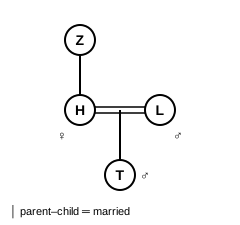
- T / L: T is son of L.
- L + H: L is husband of H ⇒ T is son of H too.
- H − Z: H is daughter of Z.
- So T is the son of Z's daughter.
Short trick: Chain: Z → daughter H → her son T = daughter's son (grandson).
Answer: (B) Daughter's son
अवधारणा: कूट खोलें और वंश-वृक्ष बनाएँ।
- T / L: T, L का पुत्र है।
- L + H: L, H का पति है ⇒ T, H का भी पुत्र है।
- H − Z: H, Z की पुत्री है।
- अतः T, Z की पुत्री का पुत्र है।
शॉर्ट ट्रिक: श्रृंखला: Z → पुत्री H → उसका पुत्र T = पुत्री का पुत्र (नाती)।
उत्तर: (B) पुत्री का पुत्र
RRB ALP CBT 1General Intelligence and ReasoningBlood relation – codedRRB ALP CBT 1 2025 · 17 Feb Shift 3
Q170.In a certain code language, ‘TRAP’ is coded as ‘7486’ and ‘CART’ is coded as ‘8274’. What is the code for ‘C’ in the given code language?
एक निश्चित कूट भाषा में, 'TRAP' को '7486' लिखा जाता है और 'CART' को '8274' लिखा जाता है। उस कूट भाषा में 'C' का कूट क्या है?
- A7
- B2
- C4
- D8
Show answer
Concept: Common letters share common digits (order is jumbled).
- TRAP = 7486, CART = 8274.
- Common letters T, R, A ↔ common digits 7, 4, 8.
- Leftover in CART: C ↔ leftover digit 2.
Short trick: Cancel common digits: {8,2,7,4} − {7,4,8} = 2.
Answer: (B) 2
अवधारणा: उभयनिष्ठ अक्षरों के कूट भी उभयनिष्ठ अंक होते हैं (क्रम बदला हुआ)।
- TRAP = 7486, CART = 8274।
- उभयनिष्ठ अक्षर T, R, A ↔ उभयनिष्ठ अंक 7, 4, 8।
- CART में बचा C ↔ बचा अंक 2।
शॉर्ट ट्रिक: उभयनिष्ठ अंक काटें: {8,2,7,4} − {7,4,8} = 2।
उत्तर: (B) 2
RRB ALP CBT 1General Intelligence and ReasoningCoding – common lettersRRB ALP CBT 1 2025 · 17 Feb Shift 3
Q171.Select the set in which the numbers are related in the same way as are the numbers of the following sets.
(NOTE : Operations should be performed on the whole numbers, without breaking down the numbers into its constituent digits. E.g. 13 – Operations on 13 such as adding / subtracting /multiplying etc. to 13 can be performed. Breaking down 13 into 1 and 3 and then performing mathematical operations on 1 and 3 is not allowed.)
(10, 5, 60)
(9, 6, 64)
उस समुच्चय का चयन कीजिए जिसमें संख्याएँ उसी प्रकार संबंधित हैं जिस प्रकार निम्नलिखित समुच्चयों की संख्याएँ संबंधित हैं।
(नोट: संख्याओं को उनके घटक अंकों में तोड़े बिना, पूर्ण संख्याओं पर संक्रियाएँ की जानी चाहिए। उदाहरण के लिए, 13 – 13 पर संक्रियाएँ जैसे 13 में जोड़ना/घटाना/गुणा करना आदि किया जा सकता है। 13 को 1 और 3 में तोड़कर फिर 1 और 3 पर गणितीय संक्रियाएँ करने की अनुमति नहीं है।)
(10, 5, 60)
(9, 6, 64)
- A(17, 5, 85)
- B(11, 6, 86)
- C(12, 4, 58)
- D(8, 9, 62)
Show answer
Concept: Third number = first × second + 10.
- 10 × 5 + 10 = 60 ✓; 9 × 6 + 10 = 64 ✓.
- A: 17×5+10 = 95 ✗; B: 11×6+10 = 76 ✗; C: 12×4+10 = 58 ✓; D: 8×9+10 = 82 ✗.
Short trick: Subtract product from 3rd number: 60−50 = 64−54 = 10; only C gives 58−48 = 10.
Answer: (C) (12, 4, 58)
अवधारणा: तीसरी संख्या = पहली × दूसरी + 10।
- 10 × 5 + 10 = 60 ✓; 9 × 6 + 10 = 64 ✓।
- A: 95 ✗; B: 76 ✗; C: 12×4+10 = 58 ✓; D: 82 ✗।
शॉर्ट ट्रिक: तीसरी संख्या − गुणनफल = 10; केवल C में 58 − 48 = 10।
उत्तर: (C) (12, 4, 58)
RRB ALP CBT 1General Intelligence and ReasoningNumber analogy – triadsRRB ALP CBT 1 2025 · 17 Feb Shift 3
Q172.Refer to the following letter series and answer the question that follows. Counting to be done from left to right only.
(Left) T S I C X Z O A K L N T E W A K O D F H A G U K (Right)
How many such consonants are there, each of which is immediately preceded by a vowel and also immediately followed by a vowel?
निम्नलिखित अक्षर श्रृंखला को देखिए और उसके बाद दिए गए प्रश्न का उत्तर दीजिए। गिनती केवल बाएँ से दाएँ की जानी है।
(बाएँ) T S I C X Z O A K L N T E W A K O D F H A G U K (दाएँ)
ऐसे कितने व्यंजन हैं, जिनमें से प्रत्येक के ठीक पहले एक स्वर है और ठीक बाद में भी एक स्वर है?
- ANoneकोई नहीं
- BTwoदो
- CThreeतीन
- DOneएक
Show answer
Concept: Pattern needed: vowel – consonant – vowel.
- Scan for V-C-V triplets: E W A, A K O, A G U.
- Others fail, e.g. I C X (X not vowel), O A K L (L not vowel).
- Count = 3.
Short trick: Look only at each vowel and see if the letter two places ahead is also a vowel with a consonant between.
Answer: (C) Three
अवधारणा: आवश्यक पैटर्न: स्वर – व्यंजन – स्वर।
- स्वर-व्यंजन-स्वर त्रिक: E W A, A K O, A G U।
- बाकी असफल, जैसे I C X, A K L।
- संख्या = 3।
शॉर्ट ट्रिक: प्रत्येक स्वर से दो स्थान आगे देखें – वहाँ भी स्वर हो और बीच में व्यंजन।
उत्तर: (C) तीन
RRB ALP CBT 1General Intelligence and ReasoningLetter series – countingRRB ALP CBT 1 2025 · 17 Feb Shift 3
Q173.Each letter in the word PERSON is changed to the second letter following it in the English alphabetical order, and then all the letters thus formed are arranged in the English alphabetical order. Which letter will be fifth from the right in the new group of letters formed?
शब्द PERSON के प्रत्येक अक्षर को अंग्रेजी वर्णमाला क्रम में उसके बाद आने वाले दूसरे अक्षर से बदल दिया जाता है, और फिर इस प्रकार बने सभी अक्षरों को अंग्रेजी वर्णमाला क्रम में व्यवस्थित किया जाता है। अक्षरों के इस नए समूह में दाएँ से पाँचवाँ अक्षर कौन-सा होगा?
- AE
- BQ
- CT
- DP
Show answer
Concept: Shift +2 then sort.
- P→R, E→G, R→T, S→U, O→Q, N→P ⇒ R G T U Q P.
- Sorted: G P Q R T U.
- 5th from right = 2nd from left (6 letters) = P.
Short trick: 5th from right of 6 letters = 2nd from left – just find the second smallest new letter.
Answer: (D) P
अवधारणा: +2 करें फिर क्रम में लगाएँ।
- P→R, E→G, R→T, S→U, O→Q, N→P ⇒ R G T U Q P।
- क्रम में: G P Q R T U।
- दाएँ से 5वाँ = बाएँ से दूसरा = P।
शॉर्ट ट्रिक: 6 अक्षरों में दाएँ से 5वाँ = बाएँ से दूसरा।
उत्तर: (D) P
RRB ALP CBT 1General Intelligence and ReasoningLetter shifting and arrangementRRB ALP CBT 1 2025 · 17 Feb Shift 3
Q174.Two sets of numbers are given below. In each set of numbers, a certain mathematical operation on the first number results in the second number. Similarly, certain mathematical operation on the second number results in the third number and so on. Which of the given options follows the same set of operations as in the given sets? (NOTE – A two/three digit number cannot be broken into individual digits for operations e.g. if 37 is followed by 10, the operation cannot be 3+7 as a two digit number cannot be broken into individual digits)
14 - 84 - 86 - 82
15 - 90 - 92 - 88
नीचे संख्याओं के दो समुच्चय दिए गए हैं। संख्याओं के प्रत्येक समुच्चय में, पहली संख्या पर एक निश्चित गणितीय संक्रिया करने पर दूसरी संख्या प्राप्त होती है। इसी प्रकार, दूसरी संख्या पर निश्चित गणितीय संक्रिया करने पर तीसरी संख्या प्राप्त होती है और इसी प्रकार आगे भी। दिए गए विकल्पों में से कौन-सा विकल्प, दिए गए समुच्चयों के समान संक्रियाओं के समुच्चय का अनुसरण करता है? (नोट – दो/तीन अंकों की संख्या को संक्रियाओं के लिए अलग-अलग अंकों में नहीं तोड़ा जा सकता, उदाहरण के लिए यदि 37 के बाद 10 आता है, तो संक्रिया 3+7 नहीं हो सकती क्योंकि दो अंकों की संख्या को अलग-अलग अंकों में नहीं तोड़ा जा सकता)
14 - 84 - 86 - 82
15 - 90 - 92 - 88
- A34 - 70 - 79 - 78
- B22 - 90 - 100 - 99
- C37 - 298 - 299 - 287
- D8 - 48 - 50 - 46
Show answer
Concept: Rule: ×6, +2, −4.
- 14×6 = 84, +2 = 86, −4 = 82 ✓; 15×6 = 90, 92, 88 ✓.
- D: 8×6 = 48, +2 = 50, −4 = 46 ✓.
- A: 34×6 = 204 ✗; B: 22×6 = 132 ✗; C: 37×6 = 222 ✗.
Short trick: Last two steps +2, −4 ⇒ 4th = 2nd − 2. Only D: 48 − 2 = 46.
Answer: (D) 8 - 48 - 50 - 46
अवधारणा: नियम: ×6, +2, −4।
- 14×6 = 84, +2 = 86, −4 = 82 ✓; 15 वाले में भी यही।
- D: 8×6 = 48, 50, 46 ✓।
- A, B, C में पहला चरण ×6 नहीं है।
शॉर्ट ट्रिक: चौथी संख्या = दूसरी − 2; केवल D: 48 − 2 = 46।
उत्तर: (D) 8 - 48 - 50 - 46
RRB ALP CBT 1General Intelligence and ReasoningNumber operations – setsRRB ALP CBT 1 2025 · 17 Feb Shift 3
Q175.This question is based on the following words:
FAT HOG NIP LUX
In each of the words, each vowel is changed to the letter immediately following it in the English alphabetical order and each consonant is changed to the letter immediately preceding it in the English alphabetical order. In how many letter-clusters thus formed, will no vowel appear?
यह प्रश्न निम्नलिखित शब्दों पर आधारित है:
FAT HOG NIP LUX
प्रत्येक शब्द में, प्रत्येक स्वर को अंग्रेजी वर्णमाला क्रम में उसके ठीक बाद वाले अक्षर से बदल दिया जाता है और प्रत्येक व्यंजन को अंग्रेजी वर्णमाला क्रम में उसके ठीक पहले वाले अक्षर से बदल दिया जाता है। इस प्रकार बने कितने अक्षर-समूहों में कोई स्वर नहीं आएगा?
- ANoneकोई नहीं
- BOneएक
- CTwoदो
- DThreeतीन
Show answer
Concept: Vowel → +1, consonant → −1.
| Word | New | Vowel? |
| FAT | E B S | E – yes |
| HOG | G P F | no |
| NIP | M J O | O – yes |
| LUX | K V W | no |
- Clusters without a vowel: GPF and KVW = 2.
Short trick: A vowel can appear only from consonants F (→E), J (→I), P (→O), V (→U), B (→A); FAT has F, NIP has P ⇒ 2 have vowels, 2 do not.
Answer: (C) Two
अवधारणा: स्वर → +1, व्यंजन → −1।
| शब्द | नया | स्वर? |
| FAT | E B S | E – हाँ |
| HOG | G P F | नहीं |
| NIP | M J O | O – हाँ |
| LUX | K V W | नहीं |
- बिना स्वर वाले समूह: GPF और KVW = 2।
शॉर्ट ट्रिक: स्वर केवल F, J, P, V, B व्यंजनों से बनता है; FAT में F, NIP में P ⇒ 2 में स्वर, 2 में नहीं।
उत्तर: (C) दो
RRB ALP CBT 1General Intelligence and ReasoningLetter coding – vowels and consonantsRRB ALP CBT 1 2025 · 17 Feb Shift 3
Q176.Select the pair which follows the same pattern as that followed by the two pairs given below. Both pairs follow the same pattern.
FPD : ENB
RUN : QSL
उस युग्म का चयन कीजिए जो उसी पैटर्न का अनुसरण करता है जिसका अनुसरण नीचे दिए गए दो युग्म करते हैं। दोनों युग्म एक ही पैटर्न का अनुसरण करते हैं।
FPD : ENB
RUN : QSL
- AALM : BNP
- BWHX : VEU
- CZYB : YTZ
- DKFQ : JDO
Show answer
Concept: Position-wise shift.
- F→E −1, P→N −2, D→B −2; R→Q −1, U→S −2, N→L −2.
- D: K→J −1, F→D −2, Q→O −2 ✓.
- A: +1…; B: H→E −3 ✗; C: Y→T −5 ✗.
Short trick: First letter must go back by 1: only B (W→V), C (Z→Y), D (K→J); 2nd letter −2 only in D.
Answer: (D) KFQ : JDO
अवधारणा: स्थान-वार विस्थापन।
- F→E −1, P→N −2, D→B −2; RUN→QSL में भी −1, −2, −2।
- D: K→J −1, F→D −2, Q→O −2 ✓।
- B: H→E −3 ✗; C: Y→T −5 ✗; A: आगे की ओर ✗।
शॉर्ट ट्रिक: पहला अक्षर −1: B, C, D; दूसरा अक्षर −2 केवल D में।
उत्तर: (D) KFQ : JDO
RRB ALP CBT 1General Intelligence and ReasoningLetter-pair analogyRRB ALP CBT 1 2025 · 17 Feb Shift 3
Q177.In a certain code language, ‘TASH’ is coded as ‘6348’ and ‘BAHT’ is coded as ‘8653’. What is the code for ‘B’ in the given code language?
एक निश्चित कूट भाषा में, 'TASH' को '6348' लिखा जाता है और 'BAHT' को '8653' लिखा जाता है। उस कूट भाषा में 'B' का कूट क्या है?
- A6
- B5
- C8
- D3
Show answer
Concept: Common letters ↔ common digits.
- TASH = 6348, BAHT = 8653.
- Common letters T, A, H ↔ common digits 6, 3, 8.
- B ↔ remaining digit 5.
Short trick: {8,6,5,3} − {6,3,8} = 5.
Answer: (B) 5
अवधारणा: उभयनिष्ठ अक्षर ↔ उभयनिष्ठ अंक।
- TASH = 6348, BAHT = 8653।
- उभयनिष्ठ T, A, H ↔ 6, 3, 8।
- B ↔ बचा अंक 5।
शॉर्ट ट्रिक: {8,6,5,3} − {6,3,8} = 5।
उत्तर: (B) 5
RRB ALP CBT 1General Intelligence and ReasoningCoding – common lettersRRB ALP CBT 1 2025 · 17 Feb Shift 3
Q178.Refer to the given number, symbol series and answer the question that follows. Counting to be done from left to right only. (All numbers are single digit numbers only) (Left) 6 £ 2 @ % 7 8 # 1 3 * 9 $ & 4 ^ ≺ 5 (Right)
How many such symbols are there each of which is immediately preceded by an odd number but not immediately followed by an even number?
दी गई संख्या, प्रतीक श्रृंखला को देखिए और उसके बाद दिए गए प्रश्न का उत्तर दीजिए। गिनती केवल बाएँ से दाएँ की जानी है। (सभी संख्याएँ केवल एक अंक वाली संख्याएँ हैं)
(बाएँ) 6 £ 2 @ % 7 8 # 1 3 * 9 $ & 4 ^ ≺ 5 (दाएँ)
ऐसे कितने प्रतीक हैं जिनमें से प्रत्येक के ठीक पहले एक विषम संख्या है लेकिन ठीक बाद में सम संख्या नहीं है?
- AOneएक
- BNoneकोई नहीं
- CTwoदो
- DThreeतीन
Show answer
Concept: Find symbols with an odd number just before them, then reject those followed by an even number.
- Symbols preceded by an odd digit: 3 * 9 and 9 $ &.
- * is followed by 9 (odd) ✓; $ is followed by & (not even) ✓.
- # is preceded by 8 (even) – rejected. Count = 2.
Short trick: Start from odd digits (7, 1, 3, 9, 5) and look only at the next symbol – only 3 and 9 have a symbol after them.
Answer: (C) Two
अवधारणा: पहले वे प्रतीक खोजें जिनके ठीक पहले विषम संख्या है, फिर जिनके बाद सम संख्या है उन्हें हटाएँ।
- विषम अंक के बाद प्रतीक: 3 * 9 और 9 $ &।
- * के बाद 9 (विषम) ✓; $ के बाद & (सम नहीं) ✓।
- # के पहले 8 (सम) – अस्वीकार। संख्या = 2।
शॉर्ट ट्रिक: विषम अंकों (7, 1, 3, 9, 5) से शुरू करें – केवल 3 और 9 के बाद प्रतीक है।
उत्तर: (C) दो
RRB ALP CBT 1General Intelligence and ReasoningNumber–symbol series countingRRB ALP CBT 1 2025 · 17 Feb Shift 3
Q179.Among five people named V, W, X, Y and Z, each have a certain age. The age of X is 12. V is four times the age of Z. Y is half the age of V. W is thrice the age of X. If Z is one ninth the age of W, what is the age of Y?
V, W, X, Y और Z नाम के पाँच व्यक्तियों में से प्रत्येक की एक निश्चित आयु है। X की आयु 12 है। V की आयु, Z की आयु की चार गुनी है। Y की आयु, V की आयु की आधी है। W की आयु, X की आयु की तीन गुनी है। यदि Z की आयु, W की आयु का नौवाँ भाग है, तो Y की आयु कितनी है?
- A12
- B8
- C6
- D10
Show answer
Concept: Work along the chain from the known value.
- X = 12 ⇒ W = 3 × 12 = 36.
- Z = 36 ÷ 9 = 4 ⇒ V = 4 × 4 = 16.
- Y = 16 ÷ 2 = 8.
Short trick: Y = ½ × 4 × Z = 2Z = 2 × (36/9) = 8.
Answer: (B) 8
अवधारणा: ज्ञात मान से श्रृंखला में आगे बढ़ें।
- X = 12 ⇒ W = 36।
- Z = 36 ÷ 9 = 4 ⇒ V = 16।
- Y = 16 ÷ 2 = 8।
शॉर्ट ट्रिक: Y = 2Z = 2 × 4 = 8।
उत्तर: (B) 8
RRB ALP CBT 1General Intelligence and ReasoningAge-based puzzleRRB ALP CBT 1 2025 · 17 Feb Shift 3
Q180.Each of A, C, I, M, O, Q and W has an exam on a different day of a week starting from Monday and ending on Sunday of the same week.
W has an exam on Friday. Exactly 3 people have exams between A and M, neither of whom has an exam on Sunday. Q has an exam immediately after I. O has an exam immediately before M. How many people have exams after Q?
A, C, I, M, O, Q और W में से प्रत्येक की परीक्षा सोमवार से शुरू होकर उसी सप्ताह के रविवार को समाप्त होने वाले सप्ताह के अलग-अलग दिन है।
W की परीक्षा शुक्रवार को है। A और M के बीच ठीक 3 व्यक्तियों की परीक्षाएँ हैं, इन दोनों में से किसी की भी परीक्षा रविवार को नहीं है। Q की परीक्षा, I के ठीक बाद है। O की परीक्षा, M के ठीक पहले है। Q के बाद कितने व्यक्तियों की परीक्षाएँ हैं?
- A3
- B2
- C1
- D4
Show answer
Concept: Number days Mon = 1 … Sun = 7; W = 5.
- A and M are 4 days apart, neither on 7, neither on 5 ⇒ {A, M} = {2, 6}.
- O is just before M: if M = 6 then O = 5 (W) ✗ ⇒ M = 2 (Tue), O = 1 (Mon), A = 6 (Sat).
- Free days 3, 4, 7: I–Q consecutive ⇒ I = 3, Q = 4, C = 7.
| Mon | Tue | Wed | Thu | Fri | Sat | Sun |
| O | M | I | Q | W | A | C |
- After Q (Thu): W, A, C = 3.
Short trick: Gap-4 pairs avoiding Fri & Sun leave only Tue–Sat; "O before M" forces M = Tue.
Answer: (A) 3
अवधारणा: दिन संख्या: सोम = 1 … रवि = 7; W = 5।
- A और M में 4 दिन का अंतर, कोई 7 या 5 पर नहीं ⇒ {A, M} = {2, 6}।
- O, M के ठीक पहले: M = 6 हो तो O = 5 (W) ✗ ⇒ M = 2, O = 1, A = 6।
- खाली दिन 3, 4, 7: I–Q लगातार ⇒ I = 3, Q = 4, C = 7।
| सोम | मंगल | बुध | गुरु | शुक्र | शनि | रवि |
| O | M | I | Q | W | A | C |
- Q (गुरुवार) के बाद: W, A, C = 3।
शॉर्ट ट्रिक: 4 दिन के अंतर वाले युग्मों में शुक्र और रवि हटाने पर केवल मंगल–शनि बचता है।
उत्तर: (A) 3
RRB ALP CBT 1General Intelligence and ReasoningScheduling puzzle – days of weekRRB ALP CBT 1 2025 · 17 Feb Shift 3

