Q201.Refer to the following number and symbol series and answer the question that follows. Counting to be done from left to right only.
(Left) 6 @ $ 1 8 # 9 % ≺ 2 4 ⋟ 3 ^ 5 & 7 (Right)
How many such symbols are there, each of which is immediately preceded by a number and also immediately followed by another number?
निम्नलिखित संख्या और प्रतीक श्रृंखला को देखिए और नीचे दिए गए प्रश्न का उत्तर दीजिए। गिनती केवल बाएँ से दाएँ की जानी है।
(बाएँ) 6 @ $ 1 8 # 9 % ≺ 2 4 ⋟ 3 ^ 5 & 7 (दाएँ)
ऐसे कितने प्रतीक हैं, जिनमें से प्रत्येक के ठीक पहले एक संख्या है और ठीक बाद भी एक अन्य संख्या है?
- AThreeतीन
- BOneएक
- CMore than threeतीन से अधिक
- DTwoदो
Show answer
Concept: Look for the pattern Number – Symbol – Number.
- Series: 6 @ $ 1 8 # 9 % ≺ 2 4 ⋟ 3 ^ 5 & 7.
- Valid: 8 # 9, 4 ⋟ 3, 3 ^ 5, 5 & 7 → 4 symbols.
- @, $, % and ≺ each touch another symbol, so they do not count.
- 4 is more than three.
Trick: Scan only the symbols and check both neighbours of each.
Answer: (C) More than three
अवधारणा: पैटर्न संख्या – प्रतीक – संख्या खोजें।
- श्रृंखला: 6 @ $ 1 8 # 9 % ≺ 2 4 ⋟ 3 ^ 5 & 7।
- मान्य: 8 # 9, 4 ⋟ 3, 3 ^ 5, 5 & 7 → 4 प्रतीक।
- @, $, % और ≺ किसी प्रतीक से सटे हैं, अतः नहीं गिने जाते।
- 4, तीन से अधिक है।
ट्रिक: केवल प्रतीकों को देखें और हर प्रतीक के दोनों पड़ोसी जाँचें।
उत्तर: (C) तीन से अधिक
RRB NTPC Graduate CBT 1General Intelligence and ReasoningSymbol–Number SeriesRRB NTPC Graduate CBT 1 2024 · 21 Jun Shift 3
Q202.What should come in place of the question mark (?) in the given series based on the English alphabetical order?
FRO RDA DPM PBY ?
अंग्रेज़ी वर्णमाला क्रम के आधार पर दी गई श्रृंखला में प्रश्न चिह्न (?) के स्थान पर क्या आना चाहिए?
FRO RDA DPM PBY ?
- ABKN
- BBNK
- CBHY
- DHBU
Show answer
Concept: Each letter moves positions (cycling after Z).
- First letters: F(6) → R(18) → D(4) → P(16) → B(2) → N(14).
- Second letters: R → D → P → B → N.
- Third letters: O(15) → A(1) → M(13) → Y(25) → K(11).
- Next term = BNK.
Trick: and give the same letter; also each term's 2nd letter becomes the next term's 1st.
Answer: (B) BNK
अवधारणा: हर अक्षर स्थान आगे (Z के बाद फिर A से)।
- पहले अक्षर: F(6) → R(18) → D(4) → P(16) → B(2) → N(14)।
- दूसरे अक्षर: R → D → P → B → N।
- तीसरे अक्षर: O(15) → A(1) → M(13) → Y(25) → K(11)।
- अगला पद = BNK।
ट्रिक: और समान अक्षर देते हैं; हर पद का दूसरा अक्षर अगले पद का पहला बनता है।
उत्तर: (B) BNK
RRB NTPC Graduate CBT 1General Intelligence and ReasoningLetter SeriesRRB NTPC Graduate CBT 1 2024 · 21 Jun Shift 3
Q203.In a certain code language,
A + B means ‘A is the son of B’,
A – B means ‘A is the sister of B’,
A x B means ‘A is the wife of B’ and
A ÷ B means ‘A is the father of B’.
Based on the above, how is E related to K if ‘E ÷ F + G – H x K’?
एक निश्चित कूट भाषा में,
A + B का अर्थ है ‘A, B का पुत्र है’,
A – B का अर्थ है ‘A, B की बहन है’,
A x B का अर्थ है ‘A, B की पत्नी है’ और
A ÷ B का अर्थ है ‘A, B का पिता है’।
उपरोक्त के आधार पर, यदि ‘E ÷ F + G – H x K’ है, तो E का K से क्या संबंध है?
- AWife's brother's sonपत्नी के भाई का पुत्र
- BWife's sister's husbandपत्नी की बहन का पति
- CWife's sister's sonपत्नी की बहन का पुत्र
- DWife's brother's wifeपत्नी के भाई की पत्नी
Show answer
Concept: Decode each symbol from left to right.
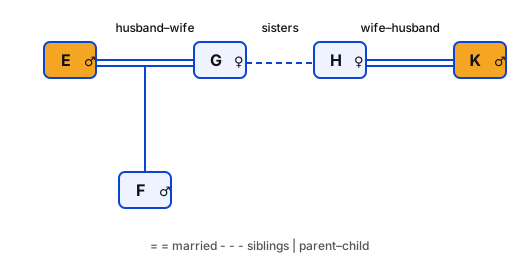
- E ÷ F: E is the father of F. F + G: F is the son of G, so G is F's mother, i.e. E's wife.
- G – H: G is the sister of H. H × K: H is the wife of K.
- So K's wife is H, H's sister is G, and G's husband is E.
- E is K's wife's sister's husband.
Trick: Draw the couples with double lines – the relation reads straight off the chart.
Answer: (B) Wife's sister's husband
अवधारणा: हर प्रतीक को बाएँ से दाएँ डिकोड करें।
- E ÷ F: E, F का पिता। F + G: F, G का पुत्र; अतः G, F की माँ यानी E की पत्नी।
- G – H: G, H की बहन। H × K: H, K की पत्नी।
- अतः K की पत्नी H, H की बहन G, और G का पति E।
- E, K की पत्नी की बहन का पति है।
ट्रिक: पति-पत्नी को दोहरी रेखा से जोड़ें – संबंध चार्ट से सीधे पढ़ें।
उत्तर: (B) पत्नी की बहन का पति
RRB NTPC Graduate CBT 1General Intelligence and ReasoningBlood Relations – CodedRRB NTPC Graduate CBT 1 2024 · 21 Jun Shift 3
Q204.A, B, L, M, S, T and Z are sitting around a circular table facing the centre. Only one person sits between B and L when counted from the left of L. S sits third to the right of Z. M sits third to the left of T. S sits to the immediate right of M. A is not an immediate neighbour of M. How many people sit between A and L when counted from the right of A?
A, B, L, M, S, T और Z एक वृत्ताकार मेज़ के चारों ओर केंद्र की ओर मुख करके बैठे हैं। L के बाएँ से गिनने पर B और L के बीच केवल एक व्यक्ति बैठा है। S, Z के दाएँ से तीसरे स्थान पर बैठा है। M, T के बाएँ से तीसरे स्थान पर बैठा है। S, M के ठीक दाएँ बैठा है। A, M का निकटतम पड़ोसी नहीं है। A के दाएँ से गिनने पर A और L के बीच कितने व्यक्ति बैठे हैं?
- A2
- B4
- C3
- D1
Show answer
Concept: For people facing the centre, 'right' is anticlockwise and 'left' is clockwise.
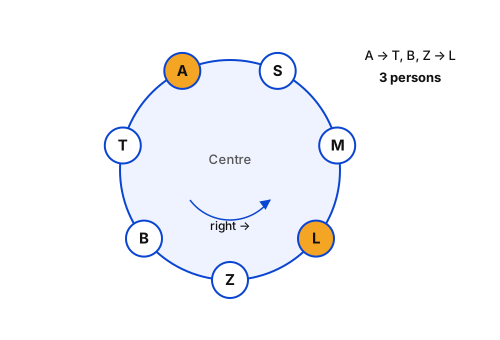
- Fix Z. S is third to the right of Z; M is immediately left of S; T is third to the right of M.
- Remaining seats for A, B, L: two seats beside Z and the seat between S and T.
- B is second to the left of L. If A sat next to Z on M's side, A would neighbour M – not allowed. So A sits between S and T, L between Z and M, B between T and Z.
- From A going right: T, B, Z, then L → 3 people.
Trick: Place the chain Z → M → S → T first; only three seats remain to test.
Answer: (C) 3
अवधारणा: केंद्र की ओर मुख वालों के लिए 'दाएँ' = घड़ी की विपरीत दिशा, 'बाएँ' = घड़ी की दिशा।
- Z को स्थिर करें। S, Z के दाएँ तीसरा; M, S के ठीक बाएँ; T, M के दाएँ तीसरा।
- A, B, L के लिए बचे स्थान: Z के दोनों ओर और S व T के बीच।
- B, L के बाएँ दूसरा है। यदि A, M की ओर Z के पास बैठे तो वह M का पड़ोसी बनेगा – मना है। अतः A, S और T के बीच; L, Z और M के बीच; B, T और Z के बीच।
- A से दाएँ गिनें: T, B, Z, फिर L → 3 व्यक्ति।
ट्रिक: पहले Z → M → S → T की श्रृंखला बैठाएँ; केवल तीन स्थान जाँचने बचते हैं।
उत्तर: (C) 3
RRB NTPC Graduate CBT 1General Intelligence and ReasoningCircular Seating ArrangementRRB NTPC Graduate CBT 1 2024 · 21 Jun Shift 3
Q205.Which of the given letter-clusters should replace # and % so that the pattern and relationship followed between the letter-cluster pair on the left side of :: is the same as that on the right side of ::?
# : ZTW :: NHK : %
दिए गए अक्षर-समूहों में से कौन-सा # और % को प्रतिस्थापित करे ताकि :: के बाईं ओर के अक्षर-समूह युग्म के बीच का पैटर्न और संबंध वही हो जो :: के दाईं ओर है?
# : ZTW :: NHK : %
- A# = UGF, % = SPR
- B# = UKH, % = OHY
- C# = UOR, % = SMP
- D# = UPL, % = TYF
Show answer
Concept: Find the rule from the complete pair and apply it to both sides of ::.
- Option C: UOR → ZTW: U+5=Z, O+5=T, R+5=W.
- NHK → SMP: N+5=S, H+5=M, K+5=P – same rule .
- Other options do not give a single consistent rule on both sides.
Trick: Test each option on the left pair first; the moment it fails, drop it.
Answer: (C) # = UOR, % = SMP
अवधारणा: पूरी जोड़ी से नियम खोजें और :: के दोनों ओर लागू करें।
- विकल्प C: UOR → ZTW: U+5=Z, O+5=T, R+5=W।
- NHK → SMP: N+5=S, H+5=M, K+5=P – वही नियम ।
- अन्य विकल्प दोनों ओर एक समान नियम नहीं देते।
ट्रिक: हर विकल्प पहले बाईं जोड़ी पर जाँचें; विफल होते ही छोड़ दें।
उत्तर: (C) # = UOR, % = SMP
RRB NTPC Graduate CBT 1General Intelligence and ReasoningLetter AnalogyRRB NTPC Graduate CBT 1 2024 · 21 Jun Shift 3
Q206.P, A, R, T, L and Y live on six different floors of the same building. The lowermost floor in the building is numbered 1, the floor above it, number 2 and so on till the topmost floor is numbered 6. No one lives below R. Only A lives above T. Only two people live between R and P. Y lives on an even numbered floor. R lives on the lowermost floor. How many people live between L and A?
P, A, R, T, L और Y एक ही इमारत की छह अलग-अलग मंज़िलों पर रहते हैं। इमारत की सबसे निचली मंज़िल की संख्या 1 है, उसके ऊपर वाली मंज़िल की संख्या 2 है और इसी प्रकार सबसे ऊपरी मंज़िल की संख्या 6 है। R के नीचे कोई नहीं रहता है। T के ऊपर केवल A रहता है। R और P के बीच केवल दो व्यक्ति रहते हैं। Y एक सम संख्या वाली मंज़िल पर रहता है। R सबसे निचली मंज़िल पर रहता है। L और A के बीच कितने व्यक्ति रहते हैं?
- AZeroशून्य
- BThreeतीन
- CTwoदो
- DOneएक
Show answer
Concept: Fill the definite clues first.
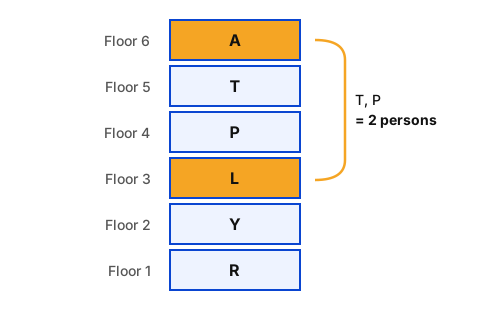
- R lives on floor 1.
- Only A above T → A = 6, T = 5.
- Only two between R (1) and P → P = 4.
- Y on an even floor → Y = 2 (4 and 6 are taken), so L = 3.
- Between L (3) and A (6): T and P → two people.
Trick: 'Only X above Y' → X on the top floor, Y just below it.
Answer: (C) Two
अवधारणा: पहले निश्चित सूचनाएँ भरें।
- R मंज़िल 1 पर।
- केवल A, T के ऊपर → A = 6, T = 5।
- R (1) और P के बीच केवल दो → P = 4।
- Y सम मंज़िल पर → Y = 2 (4 और 6 भरे हैं), अतः L = 3।
- L (3) और A (6) के बीच: T और P → दो व्यक्ति।
ट्रिक: 'केवल X, Y के ऊपर' → X सबसे ऊपर, Y ठीक नीचे।
उत्तर: (C) दो
RRB NTPC Graduate CBT 1General Intelligence and ReasoningFloor PuzzleRRB NTPC Graduate CBT 1 2024 · 21 Jun Shift 3
Q207.Mr. PQR starts from Point A and drives 9 km towards the north. He then takes a right turn, drives 11 km, turns right and drives 17 km. He then takes a right turn and drives 12 km. He takes a final right turn, drives 8 km and stops at Point P. How far (shortest distance) and in which direction should he drive in order to reach Point A again? (All turns are 90-degree turns only unless specified)
श्री PQR, बिंदु A से चलना शुरू करते हैं और उत्तर की ओर 9 km गाड़ी चलाते हैं। फिर वे दाएँ मुड़ते हैं, 11 km गाड़ी चलाते हैं, दाएँ मुड़ते हैं और 17 km गाड़ी चलाते हैं। फिर वे दाएँ मुड़ते हैं और 12 km गाड़ी चलाते हैं। वे अंतिम बार दाएँ मुड़ते हैं, 8 km गाड़ी चलाते हैं और बिंदु P पर रुक जाते हैं। फिर से बिंदु A पर पहुँचने के लिए उन्हें कितनी दूर (न्यूनतम दूरी) और किस दिशा में गाड़ी चलानी चाहिए? (जब तक निर्दिष्ट न किया जाए, सभी मोड़ केवल 90 डिग्री के मोड़ हैं)
- A5 km to the westपश्चिम की ओर 5 km
- B7 km to the eastपूर्व की ओर 7 km
- C1 km to the eastपूर्व की ओर 1 km
- D3 km to the westपश्चिम की ओर 3 km
Show answer
Concept: Take A as origin; East = +x, North = +y.
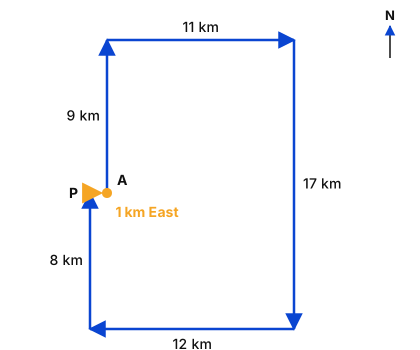
- North 9 → (0, 9); right = East 11 → (11, 9).
- Right = South 17 → (11, −8); right = West 12 → (−1, −8).
- Right = North 8 → P(−1, 0).
- P is 1 km West of A, so he must drive 1 km to the East.
Trick: Net E–W: ; net N–S: .
Answer: (C) 1 km to the east
अवधारणा: A को मूल बिंदु मानें; पूर्व = +x, उत्तर = +y।
- उत्तर 9 → (0, 9); दाएँ = पूर्व 11 → (11, 9)।
- दाएँ = दक्षिण 17 → (11, −8); दाएँ = पश्चिम 12 → (−1, −8)।
- दाएँ = उत्तर 8 → P(−1, 0)।
- P, A से 1 km पश्चिम है, अतः उसे 1 km पूर्व जाना होगा।
ट्रिक: पूर्व–पश्चिम: ; उत्तर–दक्षिण: ।
उत्तर: (C) 1 km पूर्व की ओर
RRB NTPC Graduate CBT 1General Intelligence and ReasoningDirection and DistanceRRB NTPC Graduate CBT 1 2024 · 21 Jun Shift 3
Q208.Read the given statements and conclusions carefully. Assuming that the information given in the statements is true, even if it appears to be at variance with commonly known facts, decide which of the given conclusion(s) logically follow(s) from the statements.
Statements:
All letters are message.
Some messages are emails.
No email is a post.
Conclusions:
(I) No letter is a post.
(II) Some emails are letters.
दिए गए कथनों और निष्कर्षों को ध्यानपूर्वक पढ़िए। यह मानते हुए कि कथनों में दी गई जानकारी सत्य है, भले ही वह सामान्यतः ज्ञात तथ्यों से भिन्न प्रतीत होती हो, निर्णय कीजिए कि दिए गए निष्कर्षों में से कौन-सा/से निष्कर्ष तार्किक रूप से कथनों का अनुसरण करता है/करते हैं।
कथन:
सभी पत्र, संदेश हैं।
कुछ संदेश, ईमेल हैं।
कोई ईमेल, डाक नहीं है।
निष्कर्ष:
(I) कोई पत्र, डाक नहीं है।
(II) कुछ ईमेल, पत्र हैं।
- ABoth conclusions (I) and (II) followनिष्कर्ष (I) और (II) दोनों अनुसरण करते हैं
- BNeither conclusion (I) nor (II) followsन तो निष्कर्ष (I) और न ही (II) अनुसरण करता है
- COnly conclusion (II) followsकेवल निष्कर्ष (II) अनुसरण करता है
- DOnly conclusion (I) followsकेवल निष्कर्ष (I) अनुसरण करता है
Show answer
Concept: A conclusion follows only if it is true in every possible diagram.
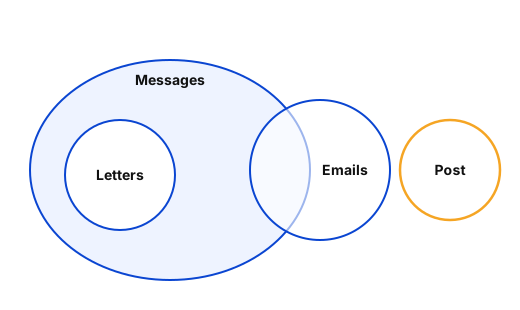
- All letters are messages; some messages are emails; no email is a post.
- Letters may lie in the part of 'messages' outside 'emails', so 'Some emails are letters' is not certain – (II) fails.
- Post is barred only from emails; letters may still overlap post, so 'No letter is a post' is not certain – (I) fails.
Trick: 'Some' linking through the middle term (messages) never gives a definite link between letters and emails.
Answer: (B) Neither conclusion (I) nor (II) follows
अवधारणा: निष्कर्ष तभी निकलता है जब वह हर संभव आरेख में सत्य हो।
- सभी letters, messages हैं; कुछ messages, emails हैं; कोई email, post नहीं।
- Letters, messages के उस भाग में हो सकते हैं जो emails से बाहर है, अतः 'कुछ emails, letters हैं' निश्चित नहीं – (II) असत्य।
- Post केवल emails से अलग है; letters का post से मेल संभव है, अतः 'कोई letter, post नहीं' निश्चित नहीं – (I) असत्य।
ट्रिक: मध्य पद (messages) से जुड़ा 'कुछ' letters और emails के बीच निश्चित संबंध नहीं देता।
उत्तर: (B) न तो निष्कर्ष (I) और न ही (II) निकलता है
RRB NTPC Graduate CBT 1General Intelligence and ReasoningSyllogismRRB NTPC Graduate CBT 1 2024 · 21 Jun Shift 3
Q209.Which of the following letter-number clusters will replace the question mark (?) in the given series to make it logically complete?
NR25 MQ36 LP47 KO58 ?
निम्नलिखित में से कौन-सा अक्षर-संख्या समूह दी गई श्रृंखला में प्रश्न चिह्न (?) को प्रतिस्थापित करके उसे तार्किक रूप से पूर्ण करेगा?
NR25 MQ36 LP47 KO58 ?
- AJM68
- BJN69
- CJN68
- DJM69
Show answer
Concept: Treat the two letters and the number separately.
- 1st letter: N, M, L, K → J ().
- 2nd letter: R, Q, P, O → N ().
- Number: 25, 36, 47, 58 → 69 ().
- Next term = JN69.
Trick: Number +11 rules out JM68, JN68; letter −1 rules out JM69.
Answer: (B) JN69
अवधारणा: दोनों अक्षरों और संख्या को अलग-अलग देखें।
- पहला अक्षर: N, M, L, K → J ()।
- दूसरा अक्षर: R, Q, P, O → N ()।
- संख्या: 25, 36, 47, 58 → 69 ()।
- अगला पद = JN69।
ट्रिक: संख्या +11 से JM68, JN68 बाहर; अक्षर −1 से JM69 बाहर।
उत्तर: (B) JN69
RRB NTPC Graduate CBT 1General Intelligence and ReasoningAlphanumeric SeriesRRB NTPC Graduate CBT 1 2024 · 21 Jun Shift 3
Q210.If 1 is added to each odd digit and 1 is subtracted from each even digit in the number 2637458, what will be the sum of the greatest and the smallest digits in the new number thus formed?
यदि संख्या 2637458 में प्रत्येक विषम अंक में 1 जोड़ा जाए और प्रत्येक सम अंक में से 1 घटाया जाए, तो इस प्रकार बनी नई संख्या में सबसे बड़े और सबसे छोटे अंक का योग क्या होगा?
- A9
- B8
- C11
- D10
Show answer
Concept: Change each digit by its own rule: odd , even .
- Number: 2 6 3 7 4 5 8.
- New: 1 5 4 8 3 6 7.
- Greatest digit , smallest ; sum .
Trick: Odd digits rise and even digits fall, so check 7 → 8 (largest) and 2 → 1 (smallest) directly.
Answer: (A) 9
अवधारणा: हर अंक पर नियम लगाएँ: विषम , सम ।
- संख्या: 2 6 3 7 4 5 8।
- नई संख्या: 1 5 4 8 3 6 7।
- सबसे बड़ा अंक , सबसे छोटा ; योग ।
ट्रिक: विषम बढ़ते हैं, सम घटते हैं; सीधे 7 → 8 (सबसे बड़ा) और 2 → 1 (सबसे छोटा) देखें।
उत्तर: (A) 9
RRB NTPC Graduate CBT 1General Intelligence and ReasoningNumber OperationsRRB NTPC Graduate CBT 1 2024 · 21 Jun Shift 3
Q211.Mr. Helux starts from Point A and drives 18 km towards the West. He then takes a left turn, drives 6 km, turns right and drives 21 km. He then takes a right turn and drives 18 km. He takes a final right turn, drives 39 km and stops at Point P. How far (shortest distance) and towards which direction should he drive in order to reach Point A again? (All turns are 90 degrees turns only unless specified.)
श्री हेलक्स बिंदु A से चलना शुरू करते हैं और पश्चिम की ओर 18 km गाड़ी चलाते हैं। फिर वे बाएँ मुड़ते हैं, 6 km गाड़ी चलाते हैं, दाएँ मुड़ते हैं और 21 km गाड़ी चलाते हैं। फिर वे दाएँ मुड़ते हैं और 18 km गाड़ी चलाते हैं। वे अंतिम बार दाएँ मुड़ते हैं, 39 km गाड़ी चलाते हैं और बिंदु P पर रुक जाते हैं। पुनः बिंदु A तक पहुँचने के लिए उन्हें कितनी दूरी (न्यूनतम दूरी) तक और किस दिशा में गाड़ी चलानी चाहिए? (जब तक निर्दिष्ट न किया जाए, सभी मोड़ केवल 90 डिग्री के मोड़ हैं।)
- A12 km to the Southदक्षिण की ओर 12 km
- B16 km to the Eastपूर्व की ओर 16 km
- C19 km to the Northउत्तर की ओर 19 km
- D10 km to the Westपश्चिम की ओर 10 km
Show answer
Concept: Track the position with East–West and North–South totals; a left turn while facing West means facing South, a right turn means facing North.
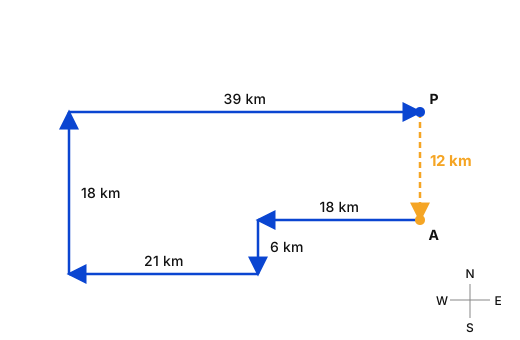
- West 18, left (South) 6, right (West) 21 → he is 39 km West and 6 km South of A.
- Right (North) 18 → 6 km South becomes 12 km North; right (East) 39 → East–West offset becomes 0.
- So P is exactly 12 km North of A; to return he must drive 12 km towards the South.
Trick: Net E–W: ; net N–S: North → go back South.
Answer: (A) 12 km to the South
अवधारणा: पूर्व–पश्चिम और उत्तर–दक्षिण की कुल दूरी अलग-अलग जोड़ें; पश्चिम की ओर मुँह हो तो बायाँ मोड़ = दक्षिण, दायाँ मोड़ = उत्तर।
- पश्चिम 18, बाएँ (दक्षिण) 6, दाएँ (पश्चिम) 21 → वह A से 39 km पश्चिम और 6 km दक्षिण में है।
- दाएँ (उत्तर) 18 → अब 12 km उत्तर; दाएँ (पूर्व) 39 → पूर्व–पश्चिम दूरी 0।
- अतः P, A से ठीक 12 km उत्तर में है; वापस जाने के लिए 12 km दक्षिण की ओर जाना होगा।
ट्रिक: शुद्ध E–W: ; शुद्ध N–S: उत्तर → वापसी दक्षिण की ओर।
उत्तर: (A) 12 km दक्षिण की ओर
RRB NTPC Graduate CBT 1General Intelligence and ReasoningDirection and DistanceRRB NTPC Graduate CBT 1 2024 · 21 Jun Shift 2
Q212.Read the given statements and conclusions carefully. Assuming that the information given in the statements is true, even if it appears to be at variance with commonly known facts, decide which of the given conclusion(s) logically follow(s) from the statements.
Statements:
All induction are stove.
Some stove are oven.
Some oven are tandoor.
Conclusions:
(I) Some tandoor are induction.
(II) Some oven are induction.
दिए गए कथनों और निष्कर्षों को ध्यानपूर्वक पढ़िए। यह मानते हुए कि कथनों में दी गई जानकारी सत्य है, भले ही वह सामान्यतः ज्ञात तथ्यों से भिन्न प्रतीत होती हो, निर्णय कीजिए कि दिए गए निष्कर्षों में से कौन-सा/से निष्कर्ष कथनों का तार्किक रूप से अनुसरण करता है/करते हैं।
कथन:
सभी इंडक्शन, स्टोव हैं।
कुछ स्टोव, ओवन हैं।
कुछ ओवन, तंदूर हैं।
निष्कर्ष:
(I) कुछ तंदूर, इंडक्शन हैं।
(II) कुछ ओवन, इंडक्शन हैं।
- ANeither conclusion (I) nor (II) followsन तो निष्कर्ष (I) और न ही (II) अनुसरण करता है
- BBoth conclusions (I) and (II) followनिष्कर्ष (I) और (II) दोनों अनुसरण करते हैं
- COnly conclusion (I) followsकेवल निष्कर्ष (I) अनुसरण करता है
- DOnly conclusion (II) followsकेवल निष्कर्ष (II) अनुसरण करता है
Show answer
Concept: A conclusion follows only if it is true in every possible Venn diagram of the statements.
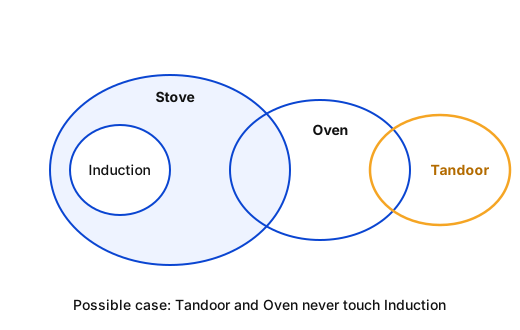
- Induction lies inside Stove; Oven meets Stove only in “some” part – that part may lie outside Induction.
- Tandoor meets Oven only in “some” part, so it need not touch Induction → (I) Some tandoor are induction: not certain.
- Oven may overlap only the non-induction part of Stove → (II) Some oven are induction: not certain.
Trick: “Some + Some” or “All + Some” never gives a definite “some” link to the first term.
Answer: (A) Neither conclusion (I) nor (II) follows
अवधारणा: निष्कर्ष तभी अनुसरण करता है जब वह कथनों के हर संभव वेन आरेख में सत्य हो।
- Induction पूरा Stove के अंदर है; Oven केवल Stove के “कुछ” भाग से मिलता है – वह भाग Induction के बाहर भी हो सकता है।
- Tandoor केवल Oven के “कुछ” भाग से मिलता है, Induction को छूना ज़रूरी नहीं → (I) निश्चित नहीं।
- Oven केवल Stove के non-induction भाग से मिल सकता है → (II) भी निश्चित नहीं।
ट्रिक: “कुछ + कुछ” या “सभी + कुछ” से पहले पद के साथ कोई निश्चित “कुछ” संबंध नहीं बनता।
उत्तर: (A) न तो (I) और न ही (II) अनुसरण करता है
RRB NTPC Graduate CBT 1General Intelligence and ReasoningSyllogismRRB NTPC Graduate CBT 1 2024 · 21 Jun Shift 2
Q213.What should come in place of the question mark (?) in the given series?
6 13 25 42 64 ?
दी गई श्रृंखला में प्रश्न चिह्न (?) के स्थान पर क्या आना चाहिए?
6 13 25 42 64 ?
- A86
- B96
- C91
- D81
Show answer
Concept: Check the differences between consecutive terms.
- Differences: , , ,
- The differences rise by 5: next difference
Trick: Second differences constant (5) → keep adding 5 to the last gap.
Answer: (C)
अवधारणा: क्रमागत पदों का अंतर देखें।
- अंतर: , , ,
- अंतर 5-5 बढ़ रहा है: अगला अंतर
ट्रिक: दूसरा अंतर स्थिर (5) → अंतिम अंतर में 5 जोड़ते जाएँ।
उत्तर: (C)
RRB NTPC Graduate CBT 1General Intelligence and ReasoningNumber SeriesRRB NTPC Graduate CBT 1 2024 · 21 Jun Shift 2
Q214.In a certain code language,
'A + B' means ‘A is the father of B’
'A – B' means ‘A is the daughter of B’
'A x B' means ‘A is the son of B’
'A ÷ B' means ‘A is the wife of B’
Based on the above, how is P related to T if ‘P + Q x R – S ÷ T’?
एक निश्चित कूट भाषा में,
'A + B' का अर्थ है ‘A, B का पिता है’
'A – B' का अर्थ है ‘A, B की पुत्री है’
'A x B' का अर्थ है ‘A, B का पुत्र है’
'A ÷ B' का अर्थ है ‘A, B की पत्नी है’
उपर्युक्त के आधार पर, यदि ‘P + Q x R – S ÷ T’ है, तो P का T से क्या संबंध है?
- ADaughter's husbandपुत्री का पति
- BSon's wife's brotherपुत्र की पत्नी का भाई
- CWife's brother's sonपत्नी के भाई का पुत्र
- DDaughter's sonपुत्री का पुत्र
Show answer
Concept: Decode each symbol step by step and draw the family tree.
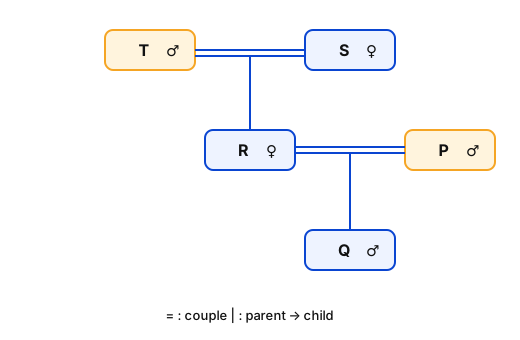
- P + Q: P is the father of Q. Q × R: Q is the son of R, so R is Q’s mother (wife of P).
- R – S: R is the daughter of S. S ÷ T: S is the wife of T, so T is R’s father.
- R is T’s daughter and P is R’s husband → P is T’s daughter’s husband (son-in-law).
Trick: Go from T downwards: T → daughter R → her husband P.
Answer: (A) Daughter's husband
अवधारणा: प्रत्येक चिह्न का अर्थ क्रम से लगाएँ और परिवार वृक्ष बनाएँ।
- P + Q: P, Q का पिता है। Q × R: Q, R का पुत्र है, अतः R, Q की माँ (P की पत्नी) है।
- R – S: R, S की पुत्री है। S ÷ T: S, T की पत्नी है, अतः T, R का पिता है।
- R, T की पुत्री है और P उसका पति → P, T की पुत्री का पति (दामाद) है।
ट्रिक: T से नीचे चलें: T → पुत्री R → उसका पति P।
उत्तर: (A) पुत्री का पति (Daughter's husband)
RRB NTPC Graduate CBT 1General Intelligence and ReasoningBlood Relation – CodedRRB NTPC Graduate CBT 1 2024 · 21 Jun Shift 2
Q215.In a certain code language, ‘talk to him’ is coded as ‘yd hp mu’ and ‘when you talk’ is coded as ‘nc mu bt’. How is ‘talk’ coded in the given language?
एक निश्चित कूट भाषा में, ‘talk to him’ को ‘yd hp mu’ के रूप में कूटबद्ध किया जाता है और ‘when you talk’ को ‘nc mu bt’ के रूप में कूटबद्ध किया जाता है। उसी भाषा में ‘talk’ को किस प्रकार कूटबद्ध किया जाता है?
- Ayd
- Bnc
- Cbt
- Dmu
Show answer
Concept: A word common to two sentences has the code common to both coded sentences.
- ‘talk to him’ → ‘yd hp mu’; ‘when you talk’ → ‘nc mu bt’
- Common word: talk; common code: mu
- So talk = mu.
Trick: Match the common word with the common code – order of codes does not matter.
Answer: (D) mu
अवधारणा: दो वाक्यों में उभयनिष्ठ शब्द का कोड दोनों कोडित वाक्यों में उभयनिष्ठ होता है।
- ‘talk to him’ → ‘yd hp mu’; ‘when you talk’ → ‘nc mu bt’
- उभयनिष्ठ शब्द: talk; उभयनिष्ठ कोड: mu
- अतः talk = mu।
ट्रिक: उभयनिष्ठ शब्द ↔ उभयनिष्ठ कोड – कोड का क्रम मायने नहीं रखता।
उत्तर: (D) mu
RRB NTPC Graduate CBT 1General Intelligence and ReasoningCoding–Decoding (Words)RRB NTPC Graduate CBT 1 2024 · 21 Jun Shift 2
Q216.Which of the following letter-number clusters will replace the question mark (?) in the given series to make it logically complete?
JN28 IM40 HL52 GK64 ?
निम्नलिखित में से कौन-सा अक्षर-संख्या समूह दी गई श्रृंखला में प्रश्न चिह्न (?) का स्थान लेकर उसे तार्किक रूप से पूर्ण करेगा?
JN28 IM40 HL52 GK64 ?
- AFI76
- BFJ77
- CFI77
- DFJ76
Show answer
Concept: Treat the first letter, second letter and number as three separate series.
- First letters: J, I, H, G → each −1 → F
- Second letters: N, M, L, K → each −1 → J
- Numbers: 28, 40, 52, 64 → each →
Trick: Both letters move back 1; number → FJ76.
Answer: (D) FJ76
अवधारणा: पहला अक्षर, दूसरा अक्षर और संख्या – तीनों को अलग श्रृंखला मानें।
- पहले अक्षर: J, I, H, G → हर बार −1 → F
- दूसरे अक्षर: N, M, L, K → हर बार −1 → J
- संख्याएँ: 28, 40, 52, 64 → हर बार →
ट्रिक: दोनों अक्षर 1 पीछे; संख्या → FJ76।
उत्तर: (D) FJ76
RRB NTPC Graduate CBT 1General Intelligence and ReasoningLetter–Number SeriesRRB NTPC Graduate CBT 1 2024 · 21 Jun Shift 2
Q217.What will come in place of the question mark (?) in the following equation if '÷' and '−' are interchanged and '×' and '+' are interchanged?
4320 − 96 × 37 + 21 ÷ 372 = ?
यदि '÷' और '−' को आपस में बदल दिया जाए तथा '×' और '+' को आपस में बदल दिया जाए, तो निम्नलिखित समीकरण में प्रश्न चिह्न (?) के स्थान पर क्या आएगा?
4320 − 96 × 37 + 21 ÷ 372 = ?
- A822
- B450
- C1350
- D733
Show answer
Concept: Swap the signs first, then solve using BODMAS.
- Swap ÷ ↔ − and × ↔ +:
- ,
Trick: Write the new expression fully before calculating – most errors come from half-swapped signs.
Answer: (B)
अवधारणा: पहले चिह्न बदलें, फिर BODMAS से हल करें।
- ÷ ↔ − और × ↔ + बदलने पर:
- ,
ट्रिक: गणना से पहले नया व्यंजक पूरा लिख लें – आधे बदले चिह्नों से ही गलती होती है।
उत्तर: (B)
RRB NTPC Graduate CBT 1General Intelligence and ReasoningMathematical OperationsRRB NTPC Graduate CBT 1 2024 · 21 Jun Shift 2
Q218.Which of the given letter-clusters should replace # and % so that the pattern and relationship followed between the letter-cluster pair on the left side of :: is the same as that on the right side of ::?
# : QVS :: GLI : %
दिए गए अक्षर-समूहों में से कौन-सा # और % को प्रतिस्थापित करेगा, ताकि :: के बाईं ओर के अक्षर-समूह युग्म के बीच जो पैटर्न और संबंध है, वही :: के दाईं ओर के अक्षर-समूह युग्म के बीच भी हो?
# : QVS :: GLI : %
- A# = LPQ, % = LKP
- B# = LQN, % = LQN
- C# = PMN, % = PJY
- D# = KOJ, % = HGT
Show answer
Concept: Find the letter-shift that turns the left term into the right term in each pair.
- GLI → %: try +5 on each letter: G+5 = L, L+5 = Q, I+5 = N → % = LQN.
- Then # → QVS must also be +5: L+5 = Q, Q+5 = V, N+5 = S → # = LQN.
- Only option (B) gives # = LQN and % = LQN.
Trick: Check one option at a time with the same +5 rule on both sides.
Answer: (B) # = LQN, % = LQN
अवधारणा: हर जोड़ी में बाएँ पद को दाएँ पद में बदलने वाला अक्षर-अंतर खोजें।
- GLI → %: हर अक्षर में +5: G+5 = L, L+5 = Q, I+5 = N → % = LQN।
- तब # → QVS में भी +5: L+5 = Q, Q+5 = V, N+5 = S → # = LQN।
- केवल विकल्प (B) में # = LQN और % = LQN है।
ट्रिक: दोनों ओर एक ही +5 नियम से विकल्प जाँचें।
उत्तर: (B) # = LQN, % = LQN
RRB NTPC Graduate CBT 1General Intelligence and ReasoningLetter AnalogyRRB NTPC Graduate CBT 1 2024 · 21 Jun Shift 2
Q219.Refer to the number and symbol series given below and answer the question that follows. Counting to be done from left to right only.
(NOTE: All numbers are single digit numbers only.)
(Left) 9 # 2 6 7 © 6 8 & © $ & 3 9 1 7 $ 5 # @ * 4 (Right)
How many such numbers are there, each of which is immediately preceded by a symbol and also immediately followed by a symbol?
नीचे दी गई संख्या और प्रतीक श्रृंखला को देखिए और उसके बाद दिए गए प्रश्न का उत्तर दीजिए। गिनती केवल बाएँ से दाएँ की जानी है।
(नोट: सभी संख्याएँ केवल एकल अंक वाली संख्याएँ हैं।)
(बाएँ) 9 # 2 6 7 © 6 8 & © $ & 3 9 1 7 $ 5 # @ * 4 (दाएँ)
ऐसी कितनी संख्याएँ हैं, जिनमें से प्रत्येक के ठीक पहले एक प्रतीक है और ठीक बाद भी एक प्रतीक है?
- A0
- B2
- C3
- D1
Show answer
Concept: Look for the pattern symbol – number – symbol.
- Series: 9 # 2 6 7 © 6 8 & © $ & 3 9 1 7 $ 5 # @ * 4
- # 2 6 (6 is a number), & 3 9 (9 is a number) – not valid.
- Only $ 5 # fits → count = 1.
Trick: Scan only the numbers that come right after a symbol, then check the next element.
Answer: (D) 1
अवधारणा: प्रतीक – संख्या – प्रतीक का पैटर्न खोजें।
- श्रृंखला: 9 # 2 6 7 © 6 8 & © $ & 3 9 1 7 $ 5 # @ * 4
- # 2 6 (6 संख्या), & 3 9 (9 संख्या) – मान्य नहीं।
- केवल $ 5 # सही → संख्या = 1।
ट्रिक: केवल प्रतीक के ठीक बाद आने वाली संख्याएँ देखें, फिर अगला तत्व जाँचें।
उत्तर: (D) 1
RRB NTPC Graduate CBT 1General Intelligence and ReasoningNumber–Symbol SeriesRRB NTPC Graduate CBT 1 2024 · 21 Jun Shift 2
Q220.Mr C starts from Point A and drives 5 km towards the West. He then takes a right turn, drives 11 km, turns right and drives 3 km. He then takes a left turn and drives 4 km. He then takes a right turn, drives 3 km. He then takes a final right turn drives 15 km and stops at Point B. How far (shortest distance) and towards which direction should he drive in order to reach Point A again? (All turns are 90 degrees turns only unless specified)
श्री C बिंदु A से चलना शुरू करते हैं और पश्चिम की ओर 5 km गाड़ी चलाते हैं। फिर वे दाएँ मुड़ते हैं, 11 km गाड़ी चलाते हैं, दाएँ मुड़ते हैं और 3 km गाड़ी चलाते हैं। फिर वे बाएँ मुड़ते हैं और 4 km गाड़ी चलाते हैं। फिर वे दाएँ मुड़ते हैं, 3 km गाड़ी चलाते हैं। फिर वे अंतिम बार दाएँ मुड़ते हैं, 15 km गाड़ी चलाते हैं और बिंदु B पर रुक जाते हैं। पुनः बिंदु A तक पहुँचने के लिए उन्हें कितनी दूरी (न्यूनतम दूरी) तक और किस दिशा में गाड़ी चलानी चाहिए? (जब तक निर्दिष्ट न किया जाए, सभी मोड़ केवल 90 डिग्री के मोड़ हैं)
- A1 km towards the Westपश्चिम की ओर 1 km
- B1 km towards the Eastपूर्व की ओर 1 km
- C1 km towards the Northउत्तर की ओर 1 km
- D3 km towards the Southदक्षिण की ओर 3 km
Show answer
Concept: Add up East–West and North–South movements separately.
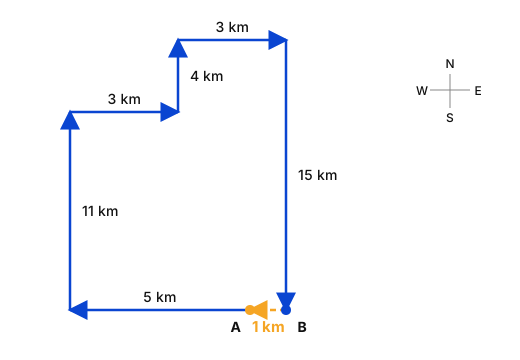
- West 5, right (North) 11, right (East) 3, left (North) 4, right (East) 3, right (South) 15.
- East–West: → 1 km East. North–South: .
- B is 1 km East of A, so he must drive 1 km towards the West.
Trick: North–South cancels () → only the East–West gap of 1 km remains.
Answer: (A) 1 km towards the West
अवधारणा: पूर्व–पश्चिम और उत्तर–दक्षिण गतियों को अलग-अलग जोड़ें।
- पश्चिम 5, दाएँ (उत्तर) 11, दाएँ (पूर्व) 3, बाएँ (उत्तर) 4, दाएँ (पूर्व) 3, दाएँ (दक्षिण) 15।
- पूर्व–पश्चिम: → 1 km पूर्व। उत्तर–दक्षिण: ।
- B, A से 1 km पूर्व में है, अतः 1 km पश्चिम की ओर जाना होगा।
ट्रिक: उत्तर–दक्षिण कट जाता है () → केवल 1 km का पूर्व–पश्चिम अंतर बचता है।
उत्तर: (A) 1 km पश्चिम की ओर
RRB NTPC Graduate CBT 1General Intelligence and ReasoningDirection and DistanceRRB NTPC Graduate CBT 1 2024 · 21 Jun Shift 2

