Q2261.A water tank can be filled in 40 minutes by using 43 pipes of the same capacity. In how many minutes (rounded off to two decimal places) will the water tank be filled if we use 9 pipes of the same capacity as above?
समान क्षमता वाले 43 पाइपों का उपयोग करके एक पानी की टंकी को 40 मिनट में भरा जा सकता है। यदि हम उपर्युक्त के समान क्षमता वाले 9 पाइपों का उपयोग करें, तो पानी की टंकी कितने मिनट (दो दशमलव स्थानों तक पूर्णांकित) में भरेगी?
- A191.11
- B196.95
- C200.02
- D189.13
Show answer
Concept: Number of identical pipes and time are inversely proportional: .
- minutes
Trick: More pipes → less time; just multiply and divide: .
Answer: (A)
अवधारणा: समान नलों की संख्या और समय व्युत्क्रमानुपाती हैं: ।
- मिनट
ट्रिक: ज़्यादा नल → कम समय; सीधे ।
उत्तर: (A)
RRB NTPC Graduate CBT 1MathematicsPipes and CisternsRRB NTPC Graduate CBT 1 2024 · 16 Jun Shift 2
Q2262.The ratio of 76 hours to 7 days is:
76 घंटे का 7 दिन से अनुपात है:
- A76 : 7
- B19 : 42
- C22 : 43
- D21 : 48
Show answer
Concept: Before taking a ratio, both quantities must be in the same unit.
- ; divide by 4:
Trick: Always convert days to hours first: 1 day = 24 h.
Answer: (B)
अवधारणा: अनुपात लेने से पहले दोनों राशियाँ एक ही इकाई में होनी चाहिए।
- ; 4 से भाग:
ट्रिक: पहले दिन को घंटों में बदलें: 1 दिन = 24 घंटे।
उत्तर: (B)
RRB NTPC Graduate CBT 1MathematicsRatio – Same UnitsRRB NTPC Graduate CBT 1 2024 · 16 Jun Shift 2
Q2263.Find the value of .
का मान ज्ञात कीजिए।
- A25
- B15
- C20
- D12
Show answer
Concept: Simplify nested roots from the innermost root outward.
Trick: Each step should give a perfect square: 169, then 225.
Answer: (B) 15
अवधारणा: नेस्टेड वर्गमूल को सबसे अंदर वाले मूल से बाहर की ओर हल करें।
ट्रिक: हर चरण में पूर्ण वर्ग बनता है: 169, फिर 225।
उत्तर: (B) 15
RRB NTPC Graduate CBT 1MathematicsSimplification – Nested Square RootsRRB NTPC Graduate CBT 1 2024 · 16 Jun Shift 2
Q2264.Shivam’s salary is ₹12,000 per month. He spends ₹4,000 on house rent and ₹1,500 on bills, and the rest of the amount is his monthly savings. Find his savings (in ₹) in a year, if in the month of his birthday, he spent all his monthly savings on birthday
celebrations.
शिवम का वेतन ₹12,000 प्रति माह है। वह ₹4,000 मकान किराए पर और ₹1,500 बिलों पर खर्च करता है, और शेष राशि उसकी मासिक बचत है। एक वर्ष में उसकी बचत (₹ में) ज्ञात कीजिए, यदि अपने जन्मदिन वाले महीने में उसने अपनी पूरी मासिक बचत जन्मदिन के
उत्सव पर खर्च कर दी।
- A58,500
- B78,000
- C71,500
- D65,000
Show answer
Concept: Monthly saving = salary − expenses; the birthday month adds no saving.
- Monthly saving =
- Savings are made in only months.
- Yearly saving =
Trick: Do not take 12 months – one month's saving is fully spent.
Answer: (C) ₹71,500
अवधारणा: मासिक बचत = वेतन − खर्च; जन्मदिन वाले महीने में कोई बचत नहीं।
- मासिक बचत =
- बचत केवल महीनों में।
- वार्षिक बचत =
ट्रिक: 12 महीने न लें – एक महीने की बचत पूरी खर्च हो गई।
उत्तर: (C) ₹71,500
RRB NTPC Graduate CBT 1MathematicsArithmetic – SavingsRRB NTPC Graduate CBT 1 2024 · 16 Jun Shift 2
Q2265.A tower stands vertically on the ground. From a point on the ground which is 27.6 m away from the foot of the tower, the angle of elevation of the top of the tower is found to be 45°. Find the height of the tower.
एक मीनार भूमि पर ऊर्ध्वाधर खड़ी है। भूमि पर मीनार के पाद से 27.6 m दूर स्थित एक बिंदु से, मीनार के शिखर का उन्नयन कोण 45° पाया जाता है। मीनार की ऊँचाई ज्ञात कीजिए।
- A28.6 m
- B27.6 m
- C29.6 m
- D26.6 m
Show answer
Concept: In the right triangle formed, .
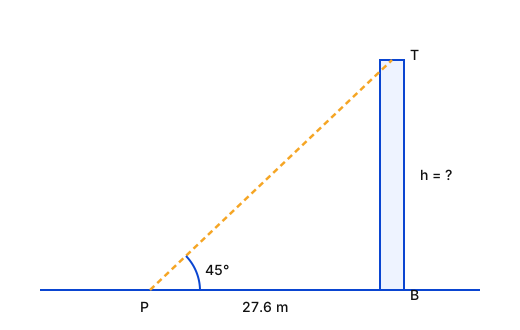
Trick: At , height = distance from the foot.
Answer: (B)
अवधारणा: बने समकोण त्रिभुज में ।
ट्रिक: पर ऊँचाई = पाद से दूरी।
उत्तर: (B)
RRB NTPC Graduate CBT 1MathematicsHeights and DistancesRRB NTPC Graduate CBT 1 2024 · 16 Jun Shift 2
Q2266.A quadratic equation x2 + 3x + k = 0 has a discriminant equal to 9. What is the value of k?
एक द्विघात समीकरण x2 + 3x + k = 0 का विविक्तकर (discriminant) 9 के बराबर है। k का मान क्या है?
- A−1
- B1
- C2
- D0
Show answer
Concept: For , discriminant .
- Here :
Trick: already, so must be → .
Answer: (D) 0
अवधारणा: के लिए विविक्तकर (discriminant) ।
- यहाँ :
ट्रिक: पहले से है, अतः → ।
उत्तर: (D) 0
RRB NTPC Graduate CBT 1MathematicsQuadratic Equations – DiscriminantRRB NTPC Graduate CBT 1 2024 · 16 Jun Shift 2
Q2267.Three numbers are in the ratio 1 : 9 : 7, and their LCM is 6930. Their HCF is:
तीन संख्याएँ 1 : 9 : 7 के अनुपात में हैं, और उनका LCM 6930 है। उनका HCF है:
- A116
- B110
- C101
- D109
Show answer
Concept: If numbers are in ratio (co-prime parts), they are with HCF and LCM .
- Numbers:
- = HCF
Trick: HCF = .
Answer: (B) 110
अवधारणा: यदि संख्याएँ के अनुपात में हों, तो वे हैं; HCF और LCM ।
- संख्याएँ:
- = HCF
ट्रिक: HCF = ।
उत्तर: (B) 110
RRB NTPC Graduate CBT 1MathematicsHCF and LCM – RatioRRB NTPC Graduate CBT 1 2024 · 16 Jun Shift 2
Q2268.The equivalent fraction of 1.222... is:
1.222... की तुल्य भिन्न है:
- A
- B
- C
- D
Show answer
Concept: For a pure recurring decimal, .
Trick: (whole number − non-repeating part, over 9).
Answer: (A)
अवधारणा: शुद्ध आवर्ती दशमलव के लिए ।
ट्रिक: (पूरी संख्या − अनावर्ती भाग, बटा 9)।
उत्तर: (A)
RRB NTPC Graduate CBT 1MathematicsRecurring DecimalsRRB NTPC Graduate CBT 1 2024 · 16 Jun Shift 2
Q2269.A runner covers 5 km, 8 km, 6 km, 7 km, and 9 km in five races. What is the average distance covered per race?
एक धावक पाँच दौड़ों में 5 km, 8 km, 6 km, 7 km और 9 km की दूरी तय करता है। प्रति दौड़ तय की गई औसत दूरी कितनी है?
- A6 km
- B8 km
- C7 km
- D5 km
Show answer
Concept:
- Sum
- Average
Trick: 5, 6, 7, 8, 9 are consecutive → average = middle value 7.
Answer: (C)
अवधारणा:
- योग
- औसत
ट्रिक: 5, 6, 7, 8, 9 क्रमागत हैं → औसत = बीच का मान 7।
उत्तर: (C)
RRB NTPC Graduate CBT 1MathematicsAverageRRB NTPC Graduate CBT 1 2024 · 16 Jun Shift 2
Q2270.The value of 891 × 909 is:
891 × 909 का मान है:
- A809919
- B811232
- C809126
- D811716
Show answer
Concept: Use .
Trick: Both numbers are equally far (9) from 900 → square of 900 minus square of 9. Last digits: ends in 9.
Answer: (A) 809919
अवधारणा: सर्वसमिका का उपयोग करें।
ट्रिक: दोनों संख्याएँ 900 से बराबर (9) दूर → 900 का वर्ग − 9 का वर्ग। इकाई अंक: ।
उत्तर: (A) 809919
RRB NTPC Graduate CBT 1MathematicsAlgebraic Identities – MultiplicationRRB NTPC Graduate CBT 1 2024 · 16 Jun Shift 2
Q2271.If ‘A’ stands for ‘÷’, ‘B’ stands for ‘×’, ‘C’ stands for ‘+’ and ‘D’ stands for ‘−’, then what will come in place of the question mark (?) in the following equation?
19 B 4 D 7 B 8 C 32 D 11 B 2 = ?
यदि 'A' का अर्थ '÷', 'B' का अर्थ '×', 'C' का अर्थ '+' और 'D' का अर्थ '−' है, तो निम्नलिखित समीकरण में प्रश्न चिह्न (?) के स्थान पर क्या आएगा?
19 B 4 D 7 B 8 C 32 D 11 B 2 = ?
- A48
- B22
- C30
- D16
Show answer
Concept: Replace the letters by the signs and solve using BODMAS.
- Replace:
- Multiplications first:
- Left to right:
Trick: Do all × and ÷ first, then add all positives () and subtract all negatives (): .
Answer: (C) 30
अवधारणा: अक्षरों के स्थान पर चिह्न रखकर BODMAS से हल करें।
- प्रतिस्थापन:
- पहले गुणा:
- बाएँ से दाएँ:
ट्रिक: पहले × और ÷, फिर सभी धनात्मक जोड़ें () और सभी ऋणात्मक घटाएँ (): ।
उत्तर: (C) 30
RRB NTPC Graduate CBT 1General Intelligence and ReasoningMathematical operationsRRB NTPC Graduate CBT 1 2024 · 16 Jun Shift 2
Q2272.In a certain code language, ‘ROME’ is coded as ‘7245’ and ‘TURN’ is coded as ‘5689’. What is the code for ‘R’ in the given code language?
एक निश्चित कूट भाषा में, 'ROME' को '7245' के रूप में कूटबद्ध किया जाता है और 'TURN' को '5689' के रूप में कूटबद्ध किया जाता है। दी गई कूट भाषा में 'R' के लिए कूट क्या है?
- A9
- B5
- C2
- D7
Show answer
Concept: A letter common to two words gets the digit common to both codes.
- ROME → 7245 and TURN → 5689.
- The only letter common to both words is R.
- The only digit common to both codes is 5, so R = 5.
Trick: Match common letter with common digit – no need to decode the other letters.
Answer: (B) 5
अवधारणा: दो शब्दों में उभयनिष्ठ अक्षर को दोनों कोडों में उभयनिष्ठ अंक मिलता है।
- ROME → 7245 और TURN → 5689।
- दोनों शब्दों में केवल R उभयनिष्ठ है।
- दोनों कोडों में केवल 5 उभयनिष्ठ है, अतः R = 5।
ट्रिक: उभयनिष्ठ अक्षर ↔ उभयनिष्ठ अंक; बाकी अक्षर खोलने की ज़रूरत नहीं।
उत्तर: (B) 5
RRB NTPC Graduate CBT 1General Intelligence and ReasoningCoding-decoding – common lettersRRB NTPC Graduate CBT 1 2024 · 16 Jun Shift 2
Q2273.Select the triad that follows the same pattern as that followed by the two triads given below. Both triads follow the same pattern.
CX-GB-KF
GB-KF-OJ
उस त्रिक का चयन कीजिए जो उसी पैटर्न का अनुसरण करता है जिसका अनुसरण नीचे दिए गए दो त्रिक करते हैं। दोनों त्रिक एक ही पैटर्न का अनुसरण करते हैं।
CX-GB-KF
GB-KF-OJ
- APK-TO-WS
- BWR-AV-EZ
- CLG-PK-SO
- DFA-JE-NJ
Show answer
Concept: Each letter moves +4 from one cluster to the next.
- CX → GB → KF: C+4=G, G+4=K; X+4=B, B+4=F.
- WR → AV → EZ: W+4=A, A+4=E; R+4=V, V+4=Z ✓
- Others fail, e.g. FA-JE-NJ: E+4=I, not J.
Trick: Check just the second letters: X→B→F (+4); only R→V→Z also goes +4.
Answer: (B) WR-AV-EZ
अवधारणा: हर अक्षर अगले समूह में +4 आगे बढ़ता है।
- CX → GB → KF: C+4=G, G+4=K; X+4=B, B+4=F।
- WR → AV → EZ: W+4=A, A+4=E; R+4=V, V+4=Z ✓
- अन्य गलत, जैसे FA-JE-NJ: E+4=I, J नहीं।
ट्रिक: केवल दूसरे अक्षर देखें: X→B→F (+4); R→V→Z भी +4।
उत्तर: (B) WR-AV-EZ
RRB NTPC Graduate CBT 1General Intelligence and ReasoningLetter triads – analogyRRB NTPC Graduate CBT 1 2024 · 16 Jun Shift 2
Q2274.In a certain code language, ‘ROPE’ is coded as ‘5391’ and ‘OILY’ is coded as ‘2458’. What is the code for ‘O’ in the given code language?
एक निश्चित कूट भाषा में, 'ROPE' को '5391' के रूप में कूटबद्ध किया जाता है और 'OILY' को '2458' के रूप में कूटबद्ध किया जाता है। दी गई कूट भाषा में 'O' के लिए कूट क्या है?
- A8
- B5
- C3
- D2
Show answer
Concept: A letter common to two words gets the digit common to both codes.
- ROPE → 5391 and OILY → 2458.
- The only common letter is O.
- The only common digit is 5, so O = 5.
Trick: Common letter ↔ common digit.
Answer: (B) 5
अवधारणा: दो शब्दों में उभयनिष्ठ अक्षर को दोनों कोडों में उभयनिष्ठ अंक मिलता है।
- ROPE → 5391 और OILY → 2458।
- केवल O उभयनिष्ठ अक्षर है।
- केवल 5 उभयनिष्ठ अंक है, अतः O = 5।
ट्रिक: उभयनिष्ठ अक्षर ↔ उभयनिष्ठ अंक।
उत्तर: (B) 5
RRB NTPC Graduate CBT 1General Intelligence and ReasoningCoding-decoding – common lettersRRB NTPC Graduate CBT 1 2024 · 16 Jun Shift 2
Q2275.Which of the following letter-clusters should replace # and % so that the pattern and relationship followed between the letter-cluster pair on the left side of :: is the same as that on the right side of :: ?
# : LIN :: DAF : %
निम्नलिखित में से कौन-से अक्षर-समूह # और % को प्रतिस्थापित करेंगे ताकि :: के बाईं ओर के अक्षर-समूह युग्म के बीच अनुसरण किया गया पैटर्न और संबंध वही हो जो :: के दाईं ओर के अक्षर-समूह युग्म के बीच है?
# : LIN :: DAF : %
- A# = PBG, % = DER
- B# = PLQ, % = MHU
- C# = OLQ, % = AXC
- D# = POQ, % = ALK
Show answer
Concept: Find the rule in the complete pair DAF : % from the first pair and apply.
- Test option (C): OLQ → LIN: O−3=L, L−3=I, Q−3=N (each letter −3).
- Same rule on DAF: D−3=A, A−3=X, F−3=C → AXC.
- Both pairs follow −3, so # = OLQ and % = AXC.
Trick: Work backward from LIN (+3 gives OLQ) and forward from DAF (−3 gives AXC).
Answer: (C) # = OLQ, % = AXC
अवधारणा: पहले युग्म से नियम खोजकर दूसरे पर लागू करें।
- विकल्प (C) जाँचें: OLQ → LIN: O−3=L, L−3=I, Q−3=N (हर अक्षर −3)।
- DAF पर वही नियम: D−3=A, A−3=X, F−3=C → AXC।
- दोनों में −3, अतः # = OLQ, % = AXC।
ट्रिक: LIN से +3 = OLQ, DAF से −3 = AXC।
उत्तर: (C) # = OLQ, % = AXC
RRB NTPC Graduate CBT 1General Intelligence and ReasoningLetter-cluster analogyRRB NTPC Graduate CBT 1 2024 · 16 Jun Shift 2
Q2276.A, B, C, D, R, S and T are sitting around a circular table facing the centre of the table. B sits third to the left of T. R sits second to the left of S. Only T sits between A and R. C is not an immediate neighbour of B. How many people sit between D and R when counted from the right of D?
A, B, C, D, R, S और T एक वृत्ताकार मेज़ के चारों ओर मेज़ के केंद्र की ओर मुख करके बैठे हैं। B, T के बाएँ से तीसरे स्थान पर बैठा है। R, S के बाएँ से दूसरे स्थान पर बैठा है। केवल T, A और R के बीच बैठा है। C, B का निकटतम पड़ोसी नहीं है। D के दाएँ से गिनने पर D और R के बीच कितने व्यक्ति बैठे हैं?
- AThreeतीन
- BFourचार
- COneएक
- DTwoदो
Show answer
Concept: Facing the centre, a person's left is clockwise and right is anticlockwise.
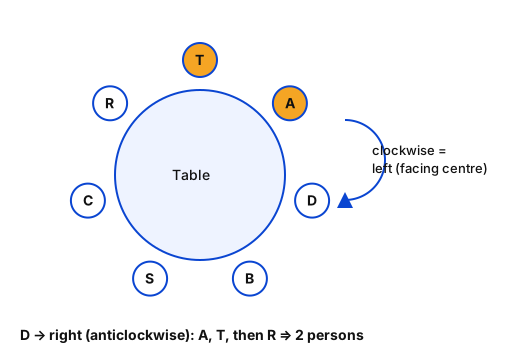
- Fix T; B is 3rd to the left (clockwise) of T.
- A and R are T's neighbours. If R were left of T, S (2nd right of R) would clash with A, so R is on T's right and A on T's left; then S is 2nd right of R.
- Remaining two seats: the one next to B is D (C cannot sit beside B), the other is C.
- Clockwise: T, A, D, B, S, C, R. From D going right: A, T, then R → 2 persons.
Trick: Place the fixed-distance clues (B–T, R–S) first; the neighbour clue then leaves only one arrangement.
Answer: (D) Two
अवधारणा: केंद्र की ओर मुख होने पर बायाँ = दक्षिणावर्त (clockwise), दायाँ = वामावर्त।
- T को स्थिर करें; B, T के बाएँ तीसरा।
- A और R, T के पड़ोसी हैं। R को T के बाएँ रखने पर S का स्थान A से टकराता है, अतः R, T के दाएँ और A बाएँ; S, R के दाएँ दूसरा।
- बचे दो स्थानों में B के पास वाला D (C, B का पड़ोसी नहीं), दूसरा C।
- क्रम (clockwise): T, A, D, B, S, C, R। D के दाएँ से: A, T, फिर R → 2 व्यक्ति।
ट्रिक: पहले निश्चित दूरी वाले संकेत (B–T, R–S) रखें; पड़ोसी संकेत से एक ही व्यवस्था बचती है।
उत्तर: (D) दो
RRB NTPC Graduate CBT 1General Intelligence and ReasoningCircular seating arrangementRRB NTPC Graduate CBT 1 2024 · 16 Jun Shift 2
Q2277.If 1 is added to each odd digit and 2 is subtracted from each even digit in the number 6753412, what will be the sum of the digits which are second from the left and second from the right in the new number thus formed?
यदि संख्या 6753412 में प्रत्येक विषम अंक में 1 जोड़ दिया जाए और प्रत्येक सम अंक में से 2 घटा दिया जाए, तो इस प्रकार बनी नई संख्या में बाएँ से दूसरे और दाएँ से दूसरे अंकों का योग क्या होगा?
- A11
- B10
- C9
- D8
Show answer
Concept: Change each digit by the rule, then read the required positions.
- 6753412: odd digits 7, 5, 3, 1 → +1 = 8, 6, 4, 2; even digits 6, 4, 2 → −2 = 4, 2, 0.
- New number: 4 8 6 4 2 2 0
- 2nd from left = 8, 2nd from right = 2; sum
Trick: Only transform the two digits you need: 7 → 8 and 1 → 2.
Answer: (B) 10
अवधारणा: नियम से हर अंक बदलें, फिर आवश्यक स्थान पढ़ें।
- 6753412: विषम अंक 7, 5, 3, 1 → +1 = 8, 6, 4, 2; सम अंक 6, 4, 2 → −2 = 4, 2, 0।
- नई संख्या: 4 8 6 4 2 2 0
- बाएँ से दूसरा = 8, दाएँ से दूसरा = 2; योग
ट्रिक: केवल आवश्यक दो अंक बदलें: 7 → 8 और 1 → 2।
उत्तर: (B) 10
RRB NTPC Graduate CBT 1General Intelligence and ReasoningNumber operations – digitsRRB NTPC Graduate CBT 1 2024 · 16 Jun Shift 2
Q2278.Based on the English alphabetical order, three of the following four letter-cluster pairs are alike in a certain way and thus form a group. Which letter-cluster pair DOES NOT belong to that group?
(Note: The odd one out is not based on the number of consonants/vowels or their position in the letter-cluster.)
अंग्रेज़ी वर्णमाला क्रम के आधार पर, निम्नलिखित चार अक्षर-समूह युग्मों में से तीन किसी निश्चित प्रकार से एक समान हैं और इस प्रकार एक समूह बनाते हैं। कौन-सा अक्षर-समूह युग्म उस समूह से संबंधित नहीं है?
(ध्यान दें: असंगत अक्षर-समूह, उस अक्षर-समूह में व्यंजनों/स्वरों की संख्या या उनके स्थान पर आधारित नहीं है।)
- ABU – GK
- BYR – DH
- CTN – YC
- DMF – RV
Show answer
Concept: Compare position changes of first letters and of second letters.
- BU – GK: B+5=G; U−10=K.
- YR – DH: Y+5=D; R−10=H. MF – RV: M+5=R; F−10=V (6−10 → 22).
- TN – YC: T+5=Y but N−11=C (not −10) → odd one.
Trick: First letters all move +5; check only the second letters for the break.
Answer: (C) TN – YC
अवधारणा: पहले और दूसरे अक्षरों के स्थान-परिवर्तन की तुलना करें।
- BU – GK: B+5=G; U−10=K।
- YR – DH: Y+5=D; R−10=H। MF – RV: M+5=R; F−10=V (6−10 → 22)।
- TN – YC: T+5=Y पर N−11=C (−10 नहीं) → विषम।
ट्रिक: पहले अक्षर सब +5; केवल दूसरे अक्षर जाँचें।
उत्तर: (C) TN – YC
RRB NTPC Graduate CBT 1General Intelligence and ReasoningOdd one out – letter pairsRRB NTPC Graduate CBT 1 2024 · 16 Jun Shift 2
Q2279.If ‘+’ means ‘subtraction’, ‘−’ means ‘multiplication’, ‘×’ means ‘division’ and ‘÷’ means ‘addition’, then what will come in place of the question mark (?) in the following equation?
96 × 6 − 8 ÷ 71 + 26 = ?
यदि '+' का अर्थ 'घटाना', '−' का अर्थ 'गुणा करना', '×' का अर्थ 'भाग देना' और '÷' का अर्थ 'जोड़ना' है, तो निम्नलिखित समीकरण में प्रश्न चिह्न (?) के स्थान पर क्या आएगा?
96 × 6 − 8 ÷ 71 + 26 = ?
- A181
- B194
- C173
- D186
Show answer
Concept: Swap the signs as told, then apply BODMAS.
- Replace:
- ;
Trick: Write the converted expression fully before calculating – most errors come from half-swapped signs.
Answer: (C) 173
अवधारणा: बताए अनुसार चिह्न बदलें, फिर BODMAS लगाएँ।
- प्रतिस्थापन:
- ;
ट्रिक: गणना से पहले पूरा बदला हुआ व्यंजक लिखें।
उत्तर: (C) 173
RRB NTPC Graduate CBT 1General Intelligence and ReasoningMathematical operationsRRB NTPC Graduate CBT 1 2024 · 16 Jun Shift 2
Q2280.Read the given statements and conclusions carefully. Assuming that the information given in the statements is true, even if it appears to be at variance with commonly known facts, decide which of the given conclusion(s) logically follow(s) from the statements.
Statements:
All cats are owls.
Some owls are rats.
No rat is bat.
Conclusions:
(I) Some rats are cats.
(II) Some bats can be cats.
दिए गए कथनों और निष्कर्षों को ध्यानपूर्वक पढ़िए। यह मानते हुए कि कथनों में दी गई जानकारी सत्य है, भले ही वह सामान्यतः ज्ञात तथ्यों से भिन्न प्रतीत होती हो, निर्णय कीजिए कि दिए गए निष्कर्षों में से कौन-सा/से निष्कर्ष तार्किक रूप से कथनों का अनुसरण करता है/करते हैं।
कथन:
सभी बिल्लियाँ, उल्लू हैं।
कुछ उल्लू, चूहे हैं।
कोई चूहा, चमगादड़ नहीं है।
निष्कर्ष:
(I) कुछ चूहे, बिल्लियाँ हैं।
(II) कुछ चमगादड़, बिल्लियाँ हो सकते हैं।
- AOnly conclusion (I) followsकेवल निष्कर्ष (I) अनुसरण करता है
- BNeither conclusion (I) nor conclusion (II) followsन तो निष्कर्ष (I) और न ही निष्कर्ष (II) अनुसरण करता है
- COnly conclusion (II) followsकेवल निष्कर्ष (II) अनुसरण करता है
- DBoth conclusions (I) and (II) followनिष्कर्ष (I) और (II) दोनों अनुसरण करते हैं
Show answer
Concept: Draw the minimum Venn diagram; a conclusion follows only if it is true in every possible diagram.
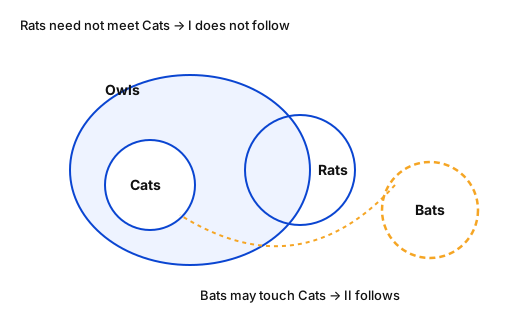
- All cats are inside owls; some owls are rats – but the rats may lie in the part of owls outside cats.
- So 'Some rats are cats' is not certain → (I) does not follow.
- Bats are only kept away from rats; nothing stops bats from touching cats, so 'Some bats can be cats' is a valid possibility → (II) follows.
Trick: 'Can be' conclusions follow unless a 'No' statement blocks that exact pair.
Answer: (C) Only conclusion (II) follows
अवधारणा: न्यूनतम वेन आरेख बनाएँ; निष्कर्ष तभी निकलता है जब हर संभव आरेख में सत्य हो।
- सभी cats, owls के अंदर; कुछ owls, rats हैं – पर rats, owls के उस भाग में हो सकते हैं जो cats से बाहर है।
- अतः 'कुछ rats, cats हैं' निश्चित नहीं → (I) नहीं निकलता।
- Bats केवल rats से अलग हैं; bats का cats से मिलना संभव है → (II) निकलता है।
ट्रिक: 'Can be' (संभावना) वाले निष्कर्ष तब तक सही हैं जब तक कोई 'No' कथन उसी युग्म को न रोके।
उत्तर: (C) केवल निष्कर्ष (II) अनुसरण करता है
RRB NTPC Graduate CBT 1General Intelligence and ReasoningSyllogismRRB NTPC Graduate CBT 1 2024 · 16 Jun Shift 2

