Q2561.2 times the present age of X is 7 years less than 6 times the present age of Y. At present, P is 2 times as old as X, and Y is 8 years younger than Q. If P is 50 years older than Q, then the present age (in years) of Y is:
X की वर्तमान आयु का 2 गुना, Y की वर्तमान आयु के 6 गुने से 7 वर्ष कम है। वर्तमान में, P की आयु X की आयु की 2 गुनी है, और Y, Q से 8 वर्ष छोटा है। यदि P, Q से 50 वर्ष बड़ा है, तो Y की वर्तमान आयु (वर्षों में) है:
- A18
- B13
- C5
- D12
Show answer
Concept: Write each statement as an equation and eliminate.
- … (i)
- … (ii)
- From (i) and (ii): .
- Check: ✓
Trick: Both statements give – equate them directly.
Answer: (B) 13
अवधारणा: हर कथन को समीकरण में लिखकर हल करें।
- … (i)
- … (ii)
- ।
- जाँच: ✓
ट्रिक: दोनों कथनों में है – सीधे बराबर करें।
उत्तर: (B) 13
RRB NTPC Graduate CBT 1MathematicsProblems on agesRRB NTPC Graduate CBT 1 2024 · 14 Jun Shift 1
Q2562.Anwar’s salary is ₹11,000 per month. He spends ₹6,000 on house rent and ₹3,000 on bills, and the rest of the amount is his monthly savings. Find his savings (in ₹) in a year, if in the month of his birthday, he spent all his monthly savings on birthday
celebrations.
अनवर का वेतन ₹11,000 प्रति माह है। वह ₹6,000 मकान किराए पर और ₹3,000 बिलों पर खर्च करता है, और शेष राशि उसकी मासिक बचत है। यदि अपने जन्मदिन वाले महीने में उसने अपनी पूरी मासिक बचत जन्मदिन के
उत्सव पर खर्च कर दी, तो एक वर्ष में उसकी बचत (₹ में) ज्ञात कीजिए।
- A24,000
- B18,000
- C20,000
- D22,000
Show answer
Concept: Monthly savings = income − expenses; one month’s savings is used up.
- Monthly savings .
- Savings are kept for months.
- Yearly savings .
Trick: Just multiply monthly savings by 11 instead of 12.
Answer: (D) ₹22,000
अवधारणा: मासिक बचत = आय − व्यय; जन्मदिन वाले महीने की बचत खर्च हो जाती है।
- मासिक बचत ।
- बचत महीनों की।
- वार्षिक बचत ।
ट्रिक: मासिक बचत × 11।
उत्तर: (D) ₹22,000
RRB NTPC Graduate CBT 1MathematicsIncome, expenditure and savingsRRB NTPC Graduate CBT 1 2024 · 14 Jun Shift 1
Q2563.A dealer marks his goods at 65% above the cost price and allows a discount of 59% on the marked price. What is his gain or loss percentage (correct to two decimal places)?
एक व्यापारी अपनी वस्तुओं पर क्रय मूल्य से 65% अधिक मूल्य अंकित करता है और अंकित मूल्य पर 59% की छूट देता है। उसका लाभ या हानि प्रतिशत (दो दशमलव स्थानों तक सही) क्या है?
- A33.53% loss33.53% हानि
- B33.88% gain33.88% लाभ
- C32.35% loss32.35% हानि
- D32.07% gain32.07% लाभ
Show answer
Concept: Take CP = 100; SP = MP × (1 − discount).
- MP .
- SP .
- Loss → loss.
Trick: Net effect (negative = loss).
Answer: (C) loss
अवधारणा: क्रय मूल्य = 100 मानें; विक्रय मूल्य = अंकित मूल्य × (1 − छूट)।
- अंकित मूल्य ।
- विक्रय मूल्य ।
- हानि → हानि।
ट्रिक: शुद्ध प्रभाव (ऋण = हानि)।
उत्तर: (C) हानि
RRB NTPC Graduate CBT 1MathematicsMarked price and discountRRB NTPC Graduate CBT 1 2024 · 14 Jun Shift 1
Q2564.The ratio of three numbers is 20 : 14 : 6. If 65 percent of the first number is 39, what would be 50 percent of the difference of the third and second number?
तीन संख्याओं का अनुपात 20 : 14 : 6 है। यदि पहली संख्या का 65 प्रतिशत 39 है, तो तीसरी और दूसरी संख्या के अंतर का 50 प्रतिशत क्या होगा?
- A11
- B14
- C12
- D10
Show answer
Concept: Find the value of one ratio unit from the given percentage.
- of first first .
- units unit ; second , third .
- Difference ; of .
Trick: Difference units ; half .
Answer: (C) 12
अवधारणा: दिए गए प्रतिशत से एक अनुपात-इकाई का मान निकालें।
- पहली संख्या ।
- इकाई ; दूसरी , तीसरी ।
- अंतर ; उसका ।
ट्रिक: अंतर इकाई ; आधा ।
उत्तर: (C) 12
RRB NTPC Graduate CBT 1MathematicsRatio and percentageRRB NTPC Graduate CBT 1 2024 · 14 Jun Shift 1
Q2565.A 250 m long train overtakes a man moving at a speed of 7 km/hr (in same direction) in 50 seconds. How much time (in seconds) will this train take to completely cross another 280 m long train, moving in the opposite direction at a speed of 28 km/hr?
250 m लंबी एक रेलगाड़ी 7 km/hr की चाल से (समान दिशा में) चल रहे एक व्यक्ति को 50 सेकंड में पार करती है। यह रेलगाड़ी विपरीत दिशा में 28 km/hr की चाल से चल रही 280 m लंबी दूसरी रेलगाड़ी को पूरी तरह से पार करने में कितना समय (सेकंड में) लेगी?
- A36
- B54
- C49
- D50
Show answer
Concept: Same direction → subtract speeds; opposite direction → add speeds; distance = sum of lengths.
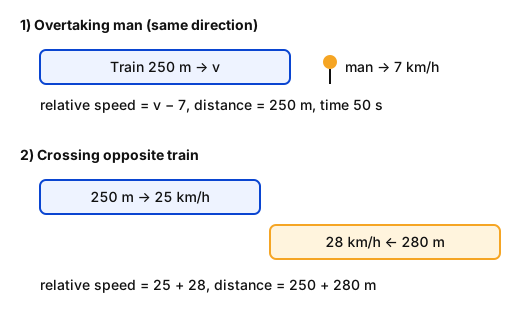
- Relative speed with man → train speed .
- Opposite train: relative speed .
- Time .
Trick: is – so time .
Answer: (A) 36
अवधारणा: समान दिशा → चाल घटाएँ; विपरीत दिशा → चाल जोड़ें; दूरी = दोनों लंबाइयों का योग।
- आदमी के सापेक्ष चाल → ट्रेन की चाल ।
- विपरीत दिशा: सापेक्ष चाल ।
- समय ।
ट्रिक: → समय ।
उत्तर: (A) 36
RRB NTPC Graduate CBT 1MathematicsTrains – relative speedRRB NTPC Graduate CBT 1 2024 · 14 Jun Shift 1
Q2566.A shopkeeper purchased 83 dozens of articles at the rate of ₹560 per dozen. He sold each one of them at the rate of ₹49. What percentage profit did he make?
एक दुकानदार ने ₹560 प्रति दर्जन की दर से 83 दर्जन वस्तुएँ खरीदीं। उसने उनमें से प्रत्येक को ₹49 की दर से बेचा। उसने कितने प्रतिशत लाभ अर्जित किया?
- A8%
- B3%
- C5%
- D7%
Show answer
Concept: (per dozen).
- CP of 1 dozen = ₹560.
- SP of 1 dozen .
- Profit% .
Trick: Number of dozens (83) does not matter – compare one dozen.
Answer: (C)
अवधारणा: (प्रति दर्जन)।
- 1 दर्जन का क्रय मूल्य = ₹560।
- 1 दर्जन का विक्रय मूल्य ।
- लाभ% ।
ट्रिक: 83 दर्जन का कोई महत्व नहीं – एक दर्जन से तुलना करें।
उत्तर: (C)
RRB NTPC Graduate CBT 1MathematicsProfit and lossRRB NTPC Graduate CBT 1 2024 · 14 Jun Shift 1
Q2567.What is the median of the following distribution?
| Class | 150-200 | 200-250 | 250-300 | 300-350 | 350-400 |
|---|
| Frequency | 20 | 19 | 32 | 27 | 12 |
निम्नलिखित बंटन की माध्यिका क्या है?
| वर्ग | 150-200 | 200-250 | 250-300 | 300-350 | 350-400 |
|---|
| बारंबारता | 20 | 19 | 32 | 27 | 12 |
- A261
- B286
- C293
- D275
Show answer
Concept: .
- , .
- Cumulative frequencies: 20, 39, 71 → median class 250–300 ().
- Median .
Trick: , so median is the midpoint of the class: 275.
Answer: (D) 275
अवधारणा: ।
- , ।
- संचयी बारंबारता: 20, 39, 71 → माध्यिका वर्ग 250–300 ()।
- माध्यिका ।
ट्रिक: → वर्ग का मध्य बिंदु 275।
उत्तर: (D) 275
RRB NTPC Graduate CBT 1MathematicsMedian of grouped dataRRB NTPC Graduate CBT 1 2024 · 14 Jun Shift 1
Q2568.The ratio of incomes of Seema and Darshan is 2 : 3. They save ₹15,000 and ₹9,000, respectively. If the ratio of their expenditures is 12 : 19, then what is the total
expenditure (in ₹) of Seema and Darshan?
सीमा और दर्शन की आय का अनुपात 2 : 3 है। वे क्रमशः ₹15,000 और ₹9,000 की बचत करते हैं। यदि उनके व्यय का अनुपात 12 : 19 है, तो सीमा और दर्शन का कुल
व्यय (₹ में) क्या है?
- A4,21,000
- B4,18,500
- C4,18,000
- D4,22,000
Show answer
Concept: Expenditure = income − savings; set up the expenditure ratio.
- Incomes and ; expenditures and .
- .
- Expenditures: and .
- Total .
Trick: Total expenditure = total income − total savings .
Answer: (B) ₹4,18,500
अवधारणा: व्यय = आय − बचत; व्यय का अनुपात बनाइए।
- आय व ; व्यय व ।
- ।
- व्यय: और ।
- कुल ।
ट्रिक: कुल व्यय ।
उत्तर: (B) ₹4,18,500
RRB NTPC Graduate CBT 1MathematicsRatio – income and expenditureRRB NTPC Graduate CBT 1 2024 · 14 Jun Shift 1
Q2569.Rohan has ₹ in his pocket. He spent ₹ out of it. How much money is left with Rohan?
रोहन की जेब में ₹ हैं। उसने उसमें से ₹ खर्च कर दिए। रोहन के पास कितने रुपये शेष बचे हैं?
- A₹
- B₹
- C₹
- D₹
Show answer
Concept: Money left = amount had − amount spent; subtract like terms.
- .
Trick: The terms cancel; watch that options with outer brackets squared are different expressions.
Answer: (B) ₹
अवधारणा: बचे पैसे = कुल राशि − खर्च; समान पद घटाएँ।
- ।
ट्रिक: पद कट जाते हैं; बाहरी कोष्ठक का वर्ग वाला विकल्प अलग है।
उत्तर: (B) ₹
RRB NTPC Graduate CBT 1MathematicsAlgebraic expressionsRRB NTPC Graduate CBT 1 2024 · 14 Jun Shift 1
Q2570.What is the median of the following data?
59, 34, 84, 70, 56, 99, 98, 49, 76, 19, 69
निम्नलिखित आँकड़ों की माध्यिका क्या है?
59, 34, 84, 70, 56, 99, 98, 49, 76, 19, 69
- A69.5
- B70
- C69
- D68.5
Show answer
Concept: For (odd) observations, median value after arranging in order.
- Ascending: 19, 34, 49, 56, 59, 69, 70, 76, 84, 98, 99.
- value .
Trick: Always sort first – the middle of the unsorted list (99) is a trap.
Answer: (C) 69
अवधारणा: (विषम) प्रेक्षणों में माध्यिका वाँ मान (क्रम में लगाने के बाद)।
- आरोही क्रम: 19, 34, 49, 56, 59, 69, 70, 76, 84, 98, 99।
- वाँ मान ।
ट्रिक: पहले क्रम में लगाएँ – बिना क्रम के बीच वाला (99) जाल है।
उत्तर: (C) 69
RRB NTPC Graduate CBT 1MathematicsMedianRRB NTPC Graduate CBT 1 2024 · 14 Jun Shift 1
Q2571.In a certain code language, ‘PANT’ is coded as ‘6129’ and ‘TAPE’ is coded as ‘2956’. What is the code for ‘E’ in the given code language?
एक निश्चित कूट भाषा में, ‘PANT’ को ‘6129’ लिखा जाता है और ‘TAPE’ को ‘2956’ लिखा जाता है। उसी कूट भाषा में ‘E’ के लिए कूट क्या है?
- A9
- B6
- C2
- D5
Show answer
Concept: Letters common to both words share the common digits; the leftover letter takes the leftover digit.
- PANT → 6129 and TAPE → 2956.
- Common letters P, A, T ↔ common digits 6, 2, 9.
- Left in TAPE: letter E; left in 2956: digit 5. So E = 5.
Trick: Cancel common letters and common digits – what remains pairs up directly.
Answer: (D) 5
अवधारणा: दोनों शब्दों के उभयनिष्ठ अक्षरों के कोड उभयनिष्ठ अंक होते हैं; बचा हुआ अक्षर बचे हुए अंक से मेल खाता है।
- PANT → 6129 और TAPE → 2956.
- उभयनिष्ठ अक्षर P, A, T ↔ उभयनिष्ठ अंक 6, 2, 9.
- TAPE में बचा अक्षर E और 2956 में बचा अंक 5, अतः E = 5.
ट्रिक: उभयनिष्ठ अक्षर व अंक काटें – जो बचे वही जोड़ी है।
उत्तर: (D) 5
RRB NTPC Graduate CBT 1General Intelligence and ReasoningCoding-DecodingRRB NTPC Graduate CBT 1 2024 · 14 Jun Shift 1
Q2572.A, B, C, D, E, F and G are sitting around a circular table facing the centre. C sits third to the left of B. A sits second to the left of G. G is not an immediate neighbour of C. D sits to the immediate left of E. How many people sit between A and E when counted from the left of A?
A, B, C, D, E, F और G एक वृत्ताकार मेज़ के चारों ओर केंद्र की ओर मुख करके बैठे हैं। C, B के बाईं ओर तीसरे स्थान पर बैठा है। A, G के बाईं ओर दूसरे स्थान पर बैठा है। G, C का निकटतम पड़ोसी नहीं है। D, E के ठीक बाईं ओर बैठा है। A के बाईं ओर से गिनने पर A और E के बीच कितने व्यक्ति बैठे हैं?
- AOneएक
- BTwoदो
- CNoneकोई नहीं
- DFourचार
Show answer
Concept: When everyone faces the centre, moving to a person’s left means moving clockwise.
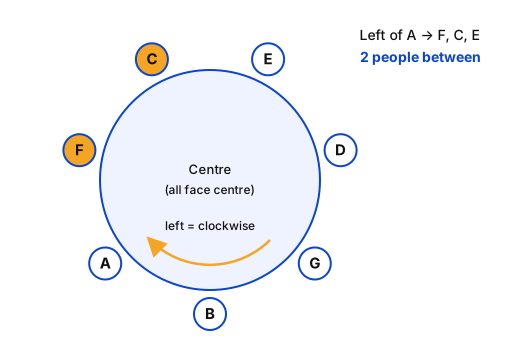
- Fix B; C is 3rd to the left of B.
- A is 2nd to the left of G, and G is not next to C → only G at the seat just right of B works, giving A at B’s immediate left.
- D is immediate left of E → E and D take the two seats after C; F sits between A and C.
- From A going left: F, C, then E → 2 people between.
Trick: Draw the circle first, place the fixed pair (B, C), then try each possible seat for G.
Answer: (B) Two
अवधारणा: केंद्र की ओर मुख होने पर किसी व्यक्ति का बायाँ = दक्षिणावर्त (clockwise) दिशा।
- B को स्थिर करें; C, B के बाएँ तीसरे स्थान पर।
- A, G के बाएँ दूसरे स्थान पर और G, C का पड़ोसी नहीं → G केवल B के ठीक दाएँ बैठ सकता है, तब A, B के ठीक बाएँ।
- D, E के ठीक बाएँ → C के बाद E फिर D; F, A और C के बीच।
- A के बाएँ से गिनें: F, C, फिर E → बीच में 2 व्यक्ति।
ट्रिक: पहले निश्चित जोड़ी (B, C) बैठाएँ, फिर G के सभी विकल्प जाँचें।
उत्तर: (B) Two
RRB NTPC Graduate CBT 1General Intelligence and ReasoningCircular Seating ArrangementRRB NTPC Graduate CBT 1 2024 · 14 Jun Shift 1
Q2573.Read the given statements and conclusions carefully. Assuming that the information given in the statements is true, even if it appears to be at variance with commonly known facts, decide which of the given conclusion(s) logically follow(s) from the statements.
Statements:
All fruit are bananas.
Some bananas are green.
All green are leaves.
Conclusions:
(I) Some fruits are bananas.
(II) Some green are leaves.
दिए गए कथनों और निष्कर्षों को ध्यानपूर्वक पढ़िए। यह मानते हुए कि कथनों में दी गई जानकारी सत्य है, भले ही वह सामान्य रूप से ज्ञात तथ्यों से भिन्न प्रतीत होती हो, निर्णय लीजिए कि दिए गए निष्कर्षों में से कौन-सा/कौन-से निष्कर्ष कथनों का तार्किक रूप से अनुसरण करता है/करते हैं।
कथन:
सभी फल, केले हैं।
कुछ केले, हरे हैं।
सभी हरे, पत्तियाँ हैं।
निष्कर्ष:
(I) कुछ फल, केले हैं।
(II) कुछ हरे, पत्तियाँ हैं।
- AOnly conclusion (I) followsकेवल निष्कर्ष (I) अनुसरण करता है
- BOnly conclusion (II) followsकेवल निष्कर्ष (II) अनुसरण करता है
- CBoth conclusions (I) and (II) followनिष्कर्ष (I) और (II) दोनों अनुसरण करते हैं
- DNeither conclusion (I) nor (II) followsन तो निष्कर्ष (I) और न ही (II) अनुसरण करता है
Show answer
Concept: Draw the least-overlap Venn diagram and check each conclusion.
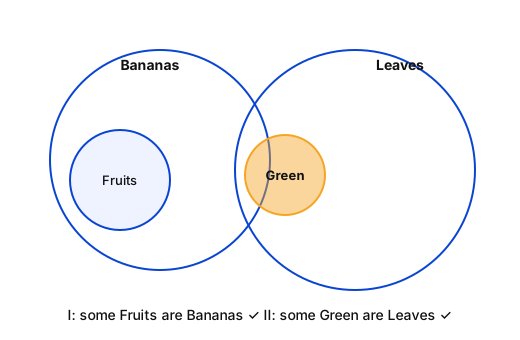
- “All fruits are bananas” → fruit circle lies inside banana circle, so “Some fruits are bananas” is definitely true (I follows).
- “All green are leaves” → green circle lies inside leaves, so “Some green are leaves” is definitely true (II follows).
Trick: “All A are B” always gives “Some A are B” and “Some B are A”.
Answer: (C) Both conclusions (I) and (II) follow
अवधारणा: न्यूनतम ओवरलैप वाला वेन आरेख बनाकर प्रत्येक निष्कर्ष जाँचें।
- “सभी फल केले हैं” → फल का वृत्त केले के अंदर, अतः “कुछ फल केले हैं” निश्चित सत्य (I अनुसरण करता है)।
- “सभी हरे पत्ते हैं” → हरा वृत्त पत्तों के अंदर, अतः “कुछ हरे पत्ते हैं” निश्चित सत्य (II अनुसरण करता है)।
ट्रिक: “सभी A, B हैं” से हमेशा “कुछ A, B हैं” और “कुछ B, A हैं” निकलता है।
उत्तर: (C) Both conclusions (I) and (II) follow
RRB NTPC Graduate CBT 1General Intelligence and ReasoningSyllogismRRB NTPC Graduate CBT 1 2024 · 14 Jun Shift 1
Q2574.If ‘+’ means ‘subtraction’, ‘−’ means ‘multiplication’, ‘×’ means ‘division’ and ‘÷’ means ‘addition’, then what will come in place of the question mark (?) in the following equation?
11 − 91 × 7 ÷ 83 + 27 = ?
यदि ‘+’ का अर्थ ‘घटाना’, ‘−’ का अर्थ ‘गुणा करना’, ‘×’ का अर्थ ‘भाग देना’ और ‘÷’ का अर्थ ‘जोड़ना’ है, तो निम्नलिखित समीकरण में प्रश्नचिह्न (?) के स्थान पर क्या आएगा?
11 − 91 × 7 ÷ 83 + 27 = ?
- A184
- B193
- C210
- D199
Show answer
Concept: Replace each sign with its meaning, then apply BODMAS.
- ,
Trick: Rewrite the whole expression with the new signs before calculating.
Answer: (D) 199
अवधारणा: हर चिह्न को उसके अर्थ से बदलें, फिर BODMAS लगाएँ।
- ,
ट्रिक: गणना से पहले पूरा व्यंजक नए चिह्नों के साथ दोबारा लिखें।
उत्तर: (D) 199
RRB NTPC Graduate CBT 1General Intelligence and ReasoningMathematical OperationsRRB NTPC Graduate CBT 1 2024 · 14 Jun Shift 1
Q2575.In a certain code language,
‘A + B’ means ‘A is the sister of B’
‘A – B’ means ‘A is the brother of B’
‘A × B’ means ‘A is the wife of B’
‘A ÷ B’ means ‘A is the father of B’.
Based on the above, how is M related to Q if ‘M + N − O × P ÷ Q’?
एक निश्चित कूट भाषा में,
‘A + B’ का अर्थ है ‘A, B की बहन है’
‘A – B’ का अर्थ है ‘A, B का भाई है’
‘A × B’ का अर्थ है ‘A, B की पत्नी है’
‘A ÷ B’ का अर्थ है ‘A, B का पिता है’।
उपरोक्त के आधार पर, यदि ‘M + N − O × P ÷ Q’ है, तो M का Q से क्या संबंध है?
- AMother's Sisterमाँ की बहन
- BFather's Sister's Sonपिता की बहन का पुत्र
- CFather's Sister's Husbandपिता की बहन का पति
- DMother's Sister's Husbandमाँ की बहन का पति
Show answer
Concept: Decode each symbol step by step and build a family tree.
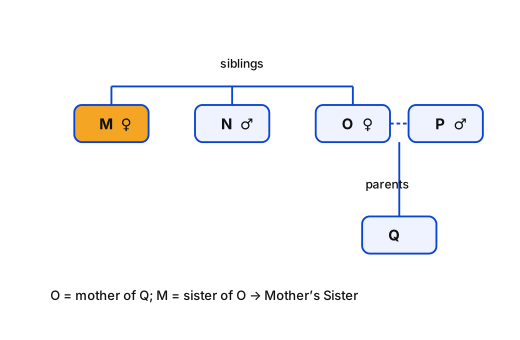
- M + N → M is sister of N (M female).
- N − O → N is brother of O.
- O × P → O is wife of P.
- P ÷ Q → P is father of Q, so O is mother of Q.
- M is sister of N, who is brother of O → M is O’s sister = Q’s mother’s sister.
Trick: Mark gender as soon as a relation reveals it (sister, wife → female).
Answer: (A) Mother’s Sister
अवधारणा: हर चिह्न को क्रम से डिकोड करें और वंश-वृक्ष बनाएँ।
- M + N → M, N की बहन है (M स्त्री)।
- N − O → N, O का भाई है।
- O × P → O, P की पत्नी है।
- P ÷ Q → P, Q का पिता है, अतः O, Q की माता है।
- M, N की बहन और N, O का भाई → M, O की बहन = Q की माँ की बहन (मौसी)।
ट्रिक: जैसे ही संबंध से लिंग पता चले (बहन, पत्नी → स्त्री), उसे चिह्नित करें।
उत्तर: (A) Mother’s Sister
RRB NTPC Graduate CBT 1General Intelligence and ReasoningBlood Relations – CodedRRB NTPC Graduate CBT 1 2024 · 14 Jun Shift 1
Q2576.P, Q, R, S, T, U and V have an exam on different days of the week starting on Monday and ending on Sunday. R has an exam on Wednesday. Exactly three people have an exam between R and Q. V has an exam immediately after S and T has an exam immediately before S. Only three people have an exam between P and S. Who has an exam on Sunday?
P, Q, R, S, T, U और V की सप्ताह के अलग-अलग दिनों में परीक्षा है, जो सोमवार से शुरू होकर रविवार को समाप्त होता है। R की परीक्षा बुधवार को है। R और Q के बीच ठीक तीन व्यक्तियों की परीक्षा है। V की परीक्षा S के ठीक बाद है और T की परीक्षा S के ठीक पहले है। P और S के बीच केवल तीन व्यक्तियों की परीक्षा है। रविवार को किसकी परीक्षा है?
- AS
- BQ
- CP
- DT
Show answer
Concept: Place fixed information first, then the blocks.
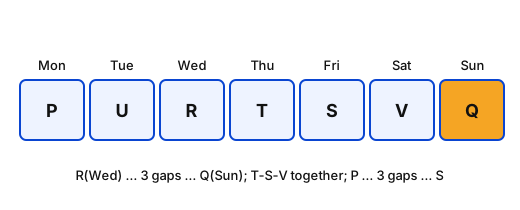
- R = Wednesday. Three people between R and Q → Q = Sunday (going back is impossible).
- T, S, V are consecutive (T-S-V). Free days: Mon, Tue, Thu, Fri, Sat → only Thu-Fri-Sat fits, so S = Friday.
- Three between P and S → P = Monday; U = Tuesday.
Trick: A 3-person block needs three consecutive free days – that usually fixes it at once.
Answer: (B) Q
अवधारणा: पहले निश्चित जानकारी रखें, फिर ब्लॉक।
- R = बुधवार। R और Q के बीच तीन → Q = रविवार (पीछे संभव नहीं)।
- T, S, V लगातार (T-S-V)। खाली दिन: सोम, मंगल, गुरु, शुक्र, शनि → केवल गुरु-शुक्र-शनि, अतः S = शुक्रवार।
- P और S के बीच तीन → P = सोमवार; U = मंगलवार।
ट्रिक: 3 व्यक्तियों के ब्लॉक को लगातार तीन खाली दिन चाहिए – यही स्थान तय कर देता है।
उत्तर: (B) Q
RRB NTPC Graduate CBT 1General Intelligence and ReasoningScheduling – Days of WeekRRB NTPC Graduate CBT 1 2024 · 14 Jun Shift 1
Q2577.This question is based on the five, three-digit numbers given below.
(Left) 205 712 237 862 578 (Right)
(Example- 697 – First digit = 6, second digit = 9 and third digit = 7)
(NOTE: All operations to be done from left to right.)
What will be the resultant if the third digit of the highest number is added to the first digit of the lowest number?
यह प्रश्न नीचे दी गई तीन अंकों की पाँच संख्याओं पर आधारित है।
(बाएँ) 205 712 237 862 578 (दाएँ)
(उदाहरण- 697 – पहला अंक = 6, दूसरा अंक = 9 और तीसरा अंक = 7)
(नोट: सभी संक्रियाएँ बाएँ से दाएँ की जानी हैं।)
यदि सबसे बड़ी संख्या के तीसरे अंक को सबसे छोटी संख्या के पहले अंक में जोड़ा जाए, तो परिणाम क्या होगा?
- A5
- B6
- C3
- D4
Show answer
Concept: Identify the highest and lowest numbers, then pick the asked digits.
- Highest = 862 → third digit = 2.
- Lowest = 205 → first digit = 2.
Trick: Compare first digits only to find highest (8) and lowest (2).
Answer: (D) 4
अवधारणा: सबसे बड़ी और सबसे छोटी संख्या पहचानें, फिर पूछे गए अंक लें।
- सबसे बड़ी = 862 → तीसरा अंक = 2.
- सबसे छोटी = 205 → पहला अंक = 2.
ट्रिक: सबसे बड़ी (8) और सबसे छोटी (2) के लिए केवल पहला अंक देखें।
उत्तर: (D) 4
RRB NTPC Graduate CBT 1General Intelligence and ReasoningNumber OperationsRRB NTPC Graduate CBT 1 2024 · 14 Jun Shift 1
Q2578.In a certain code language, ‘COAT’ is coded as ‘2486’ and ‘PALE’ is coded as ‘5712’. What is the code for ‘A’ in the given code language?
एक निश्चित कूट भाषा में, ‘COAT’ को ‘2486’ लिखा जाता है और ‘PALE’ को ‘5712’ लिखा जाता है। उसी कूट भाषा में ‘A’ के लिए कूट क्या है?
- A5
- B7
- C2
- D8
Show answer
Concept: A letter common to both words is coded by the digit common to both codes.
- COAT → 2486 and PALE → 5712.
- The only common letter is A.
- The only common digit in 2486 and 5712 is 2, so A = 2.
Trick: One common letter ↔ one common digit.
Answer: (C) 2
अवधारणा: दोनों शब्दों में उभयनिष्ठ अक्षर का कोड दोनों कोडों में उभयनिष्ठ अंक होता है।
- COAT → 2486 और PALE → 5712.
- केवल A उभयनिष्ठ अक्षर है।
- 2486 और 5712 में केवल 2 उभयनिष्ठ अंक है, अतः A = 2.
ट्रिक: एक उभयनिष्ठ अक्षर ↔ एक उभयनिष्ठ अंक।
उत्तर: (C) 2
RRB NTPC Graduate CBT 1General Intelligence and ReasoningCoding-DecodingRRB NTPC Graduate CBT 1 2024 · 14 Jun Shift 1
Q2579.Based on the English alphabetical order, three of the following four letter-clusters are alike in a certain way and thus form a group. Which letter-cluster DOES NOT belong to that group?
(Note: The odd one out is not based on the number of consonants/vowels or their position in the letter-cluster.)
अंग्रेज़ी वर्णमाला क्रम के आधार पर, निम्नलिखित चार अक्षर-समूहों में से तीन किसी निश्चित प्रकार से एकसमान हैं और इस प्रकार एक समूह बनाते हैं। कौन-सा अक्षर-समूह उस समूह से संबंधित नहीं है?
(नोट: असंगत अक्षर-समूह, उस अक्षर-समूह में व्यंजनों/स्वरों की संख्या या उनकी स्थिति पर आधारित नहीं है।)
- AMQL
- BRVQ
- CKOJ
- DOSM
Show answer
Concept: Find the gaps between consecutive letters using alphabet positions.
- MQL: M→Q (+4), Q→L (−5)
- RVQ: R→V (+4), V→Q (−5)
- KOJ: K→O (+4), O→J (−5)
- OSM: O→S (+4), S→M (−6) ✗
Trick: Pattern +4, −5 means the third letter is just one before the first (L before M, Q before R, J before K) – OSM breaks it.
Answer: (D) OSM
अवधारणा: अक्षरों की वर्णमाला स्थितियों से अंतर निकालें।
- MQL: M→Q (+4), Q→L (−5)
- RVQ: R→V (+4), V→Q (−5)
- KOJ: K→O (+4), O→J (−5)
- OSM: O→S (+4), S→M (−6) ✗
ट्रिक: +4, −5 का अर्थ है तीसरा अक्षर पहले अक्षर से ठीक एक पहले (L-M, Q-R, J-K) – OSM में नहीं।
उत्तर: (D) OSM
RRB NTPC Graduate CBT 1General Intelligence and ReasoningOdd One Out – Letter ClustersRRB NTPC Graduate CBT 1 2024 · 14 Jun Shift 1
Q2580.Bikash starts from Point A and drives 12 km towards East. He then takes a left turn, drives 9 km, turns left and drives 13 km. He then takes a left turn and drives 12 km. He takes a final left turn, drives 1 km and stops at Point P. How far (shortest distance) and towards which direction should he drive in order to reach Point A again? (All turns are 90° turns only, unless specified)
बिकाश बिंदु A से शुरू करता है और पूर्व की ओर 12 km गाड़ी चलाता है। फिर वह बाएँ मुड़ता है, 9 km गाड़ी चलाता है, बाएँ मुड़ता है और 13 km गाड़ी चलाता है। फिर वह बाएँ मुड़ता है और 12 km गाड़ी चलाता है। वह अंतिम बार बाएँ मुड़ता है, 1 km गाड़ी चलाता है और बिंदु P पर रुक जाता है। बिंदु A पर फिर से पहुँचने के लिए उसे कितनी दूर (न्यूनतम दूरी) और किस दिशा में गाड़ी चलानी चाहिए? (जब तक निर्दिष्ट न हो, सभी मोड़ केवल 90° के मोड़ हैं)
- A2 km to the northउत्तर की ओर 2 km
- B4 km to the northउत्तर की ओर 4 km
- C1 km to the northउत्तर की ओर 1 km
- D3 km to the northउत्तर की ओर 3 km
Show answer
Concept: Track net East–West and North–South movement from A.
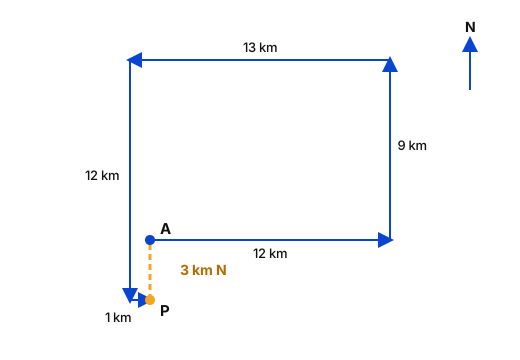
- East 12 → left (North) 9 → left (West) 13 → left (South) 12 → left (East) 1.
- East–West: → P is directly in line with A.
- North–South: → P is 3 km south of A.
- To return, drive 3 km towards the north.
Trick: Add east, subtract west; add north, subtract south.
Answer: (D) 3 km to the north
अवधारणा: A से कुल पूर्व–पश्चिम और उत्तर–दक्षिण विस्थापन निकालें।
- पूर्व 12 → बाएँ (उत्तर) 9 → बाएँ (पश्चिम) 13 → बाएँ (दक्षिण) 12 → बाएँ (पूर्व) 1.
- पूर्व–पश्चिम: → P, A की सीध में है।
- उत्तर–दक्षिण: → P, A से 3 km दक्षिण में।
- वापस पहुँचने के लिए 3 km उत्तर की ओर जाना होगा।
ट्रिक: पूर्व जोड़ें, पश्चिम घटाएँ; उत्तर जोड़ें, दक्षिण घटाएँ।
उत्तर: (D) 3 km to the north
RRB NTPC Graduate CBT 1General Intelligence and ReasoningDirection and DistanceRRB NTPC Graduate CBT 1 2024 · 14 Jun Shift 1

