Q261.X varies inversely as Y and Y varies inversely as Z. In a particular case, and . What will be the value of X when ?
X, Y के व्युत्क्रमानुपाती है और Y, Z के व्युत्क्रमानुपाती है। एक विशेष स्थिति में, और है। जब हो, तो X का मान कितना होगा?
- A259
- B262
- C260
- D257
Show answer
Concept: If and , then , i.e. .
- and give .
- When :
Trick: Two inverse variations make a direct variation: , so .
Answer: (A)
अवधारणा: यदि और , तो , अर्थात ।
- , से
- पर:
ट्रिक: दो व्युत्क्रम विचरण मिलकर प्रत्यक्ष विचरण बनाते हैं: ।
उत्तर: (A)
RRB NTPC Graduate CBT 1MathematicsVariationRRB NTPC Graduate CBT 1 2024 · 24 Jun Shift 1
Q262.What price should Kunal mark on a pair of pants which costs him ₹3,300, so as to gain 33% after allowing a successive discount of 25% and 30%?
कुणाल को एक पैंट का मूल्य ₹3,300 पड़ता है। 25% और 30% की क्रमिक छूट देने के बाद 33% लाभ प्राप्त करने के लिए उसे पैंट पर कितना मूल्य अंकित करना चाहिए?
- A₹8,310
- B₹8,360
- C₹8,256
- D₹8,290
Show answer
Concept: and .
- Required SP
- Net factor after discounts
Trick: Successive 25% and 30% = single discount of .
Answer: (B) ₹8,360
अवधारणा: तथा ।
- आवश्यक विक्रय मूल्य
- छूटों के बाद गुणक
ट्रिक: क्रमिक 25% और 30% = एकल छूट ।
उत्तर: (B) ₹8,360
RRB NTPC Graduate CBT 1MathematicsProfit, loss and discountRRB NTPC Graduate CBT 1 2024 · 24 Jun Shift 1
Q263.The LCM of 44, 86 and another number, x, is 7568. Which of the following can be the value of x?
44, 86 और एक अन्य संख्या x का LCM 7568 है। निम्नलिखित में से कौन-सा x का मान हो सकता है?
- A145
- B101
- C165
- D176
Show answer
Concept: Every factor of must divide the LCM, and the LCM must still be reached.
- , ,
- ; so must supply and have no other primes.
- ✔; 145, 165 contain 5, and 101 is prime – they do not divide 7568.
Trick: Quick test: the option must divide 7568 – only works.
Answer: (D)
अवधारणा: के सभी गुणनखंड LCM को विभाजित करें और LCM पूरा बने।
- , ,
- ; अतः में होना चाहिए और कोई अन्य अभाज्य नहीं।
- ✔; 145, 165 में 5 है, 101 अभाज्य है – ये 7568 को विभाजित नहीं करते।
ट्रिक: विकल्प 7568 को विभाजित करे – केवल ।
उत्तर: (D)
RRB NTPC Graduate CBT 1MathematicsLCMRRB NTPC Graduate CBT 1 2024 · 24 Jun Shift 1
Q264.By selling cloth at ₹344/m, a shopkeeper loses 57%. Find the rate (in ₹/m) at which it should be sold so as to earn a profit of 71%.
₹344/m की दर से कपड़ा बेचने पर एक दुकानदार को 57% की हानि होती है। 71% का लाभ अर्जित करने के लिए उसे किस दर (₹/m में) पर बेचा जाना चाहिए?
- A1,368
- B1,365
- C1,366
- D1,367
Show answer
Concept: At a loss of , .
- For 71% profit:
Trick: Direct ratio: .
Answer: (A)
अवधारणा: हानि पर ।
- 71% लाभ के लिए:
ट्रिक: सीधा अनुपात: ।
उत्तर: (A)
RRB NTPC Graduate CBT 1MathematicsProfit and lossRRB NTPC Graduate CBT 1 2024 · 24 Jun Shift 1
Q265.Evaluate .
का मान ज्ञात कीजिए।
- A
- B
- C
- D
Show answer
Concept:
Trick: 'cos cos minus sin sin' → cos of the sum; angles here add to .
Answer: (B)
अवधारणा:
ट्रिक: 'cos cos घटा sin sin' → योग का cos; यहाँ कोणों का योग है।
उत्तर: (B)
RRB NTPC Graduate CBT 1MathematicsTrigonometric identitiesRRB NTPC Graduate CBT 1 2024 · 24 Jun Shift 1
Q266.The simple interest (in ₹) on ₹2,200 at the rate of 7% per annum in 2 years is:
₹2,200 पर 7% वार्षिक दर से 2 वर्षों का साधारण ब्याज (₹ में) कितना है?
- A₹358
- B₹258
- C₹408
- D₹308
Show answer
Concept:
Trick: 1 year interest = 154; two years = 308.
Answer: (D) ₹308
अवधारणा:
ट्रिक: 1 वर्ष का ब्याज = 154; दो वर्ष = 308।
उत्तर: (D) ₹308
RRB NTPC Graduate CBT 1MathematicsSimple interestRRB NTPC Graduate CBT 1 2024 · 24 Jun Shift 1
Q267.If , then find value of z.
यदि है, तो z का मान ज्ञात कीजिए।
- A-49
- B-48
- C-51
- D-52
Show answer
Concept: Powers first, then ÷ and × from left to right, then + and −.
- ;
Trick: Do × and ÷ strictly left to right – never multiply before an earlier division.
Answer: (D)
अवधारणा: पहले घात, फिर ÷ और × बाएँ से दाएँ, फिर + और −।
- ;
ट्रिक: × और ÷ सख़्ती से बाएँ से दाएँ करें।
उत्तर: (D)
RRB NTPC Graduate CBT 1MathematicsSimplification (BODMAS)RRB NTPC Graduate CBT 1 2024 · 24 Jun Shift 1
Q268.The average weight of 5 students is 60 kg. After a new student joins the group, the average becomes 62 kg. What is the weight of the new student?
5 विद्यार्थियों का औसत भार 60 kg है। एक नए विद्यार्थी के समूह में शामिल होने के बाद, औसत 62 kg हो जाता है। नए विद्यार्थी का भार कितना है?
- A70 kg
- B62 kg
- C68 kg
- D72 kg
Show answer
Concept: Total = average × number of items.
- Total of 5 students
- Total of 6 students
- New student
Trick: New member = new average + (old count × rise) .
Answer: (D)
अवधारणा: योग = औसत × संख्या।
- 5 छात्रों का योग
- 6 छात्रों का योग
- नया छात्र
ट्रिक: नया सदस्य = नया औसत + (पुरानी संख्या × वृद्धि) ।
उत्तर: (D)
RRB NTPC Graduate CBT 1MathematicsAverageRRB NTPC Graduate CBT 1 2024 · 24 Jun Shift 1
Q269.What is the median of the following data?
46, 19, 87, 72, 80, 91, 82, 15, 53, 86, 26
निम्नलिखित आँकड़ों की माध्यिका (median) क्या है?
46, 19, 87, 72, 80, 91, 82, 15, 53, 86, 26
- A71.5
- B72
- C72.5
- D73
Show answer
Concept: For an odd number of observations, median = value after arranging in order.
- Ascending: 15, 19, 26, 46, 53, 72, 80, 82, 86, 87, 91
- value
- 6th value = 72
Trick: Always sort first; the unsorted middle value (91) is a trap.
Answer: (B)
अवधारणा: विषम प्रेक्षणों के लिए माध्यिका = क्रम में लगाने के बाद वाँ मान।
- आरोही क्रम: 15, 19, 26, 46, 53, 72, 80, 82, 86, 87, 91
- वाँ मान
- 6वाँ मान = 72
ट्रिक: पहले क्रम में लगाएँ; बिना क्रम का बीच का मान (91) जाल है।
उत्तर: (B)
RRB NTPC Graduate CBT 1MathematicsStatistics – medianRRB NTPC Graduate CBT 1 2024 · 24 Jun Shift 1
Q270.For a regular polygon, the sum of the interior angles is 200% more than the sum of its exterior angles. Each interior angle of the polygon measures x°. What is the value of x?
एक सम बहुभुज के लिए, अंतः कोणों का योग उसके बाह्य कोणों के योग से 200% अधिक है। बहुभुज का प्रत्येक अंतः कोण x° है। x का मान कितना है?
- A155
- B125
- C145
- D135
Show answer
Concept: Sum of exterior angles of any polygon ; sum of interior angles .
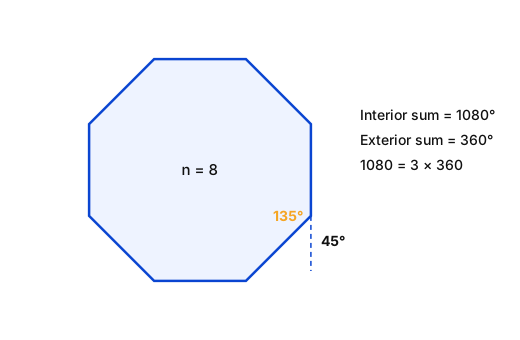
- 200% more than 360° means .
- Each interior angle
Trick: Each exterior angle , so interior .
Answer: (D)
अवधारणा: किसी भी बहुभुज के बाह्य कोणों का योग ; अंतः कोणों का योग ।
- 360° से 200% अधिक =
- प्रत्येक अंतः कोण
ट्रिक: प्रत्येक बाह्य कोण , अतः अंतः कोण ।
उत्तर: (D)
RRB NTPC Graduate CBT 1MathematicsGeometry – polygonsRRB NTPC Graduate CBT 1 2024 · 24 Jun Shift 1
Q271.If 1 is added to each odd digit and 2 is subtracted from each even digit in the number 8315476, which of the following digits will be third from the right?
यदि संख्या 8315476 में प्रत्येक विषम अंक में 1 जोड़ा जाए और प्रत्येक सम अंक में से 2 घटाया जाए, तो निम्नलिखित में से कौन-सा अंक दाएँ से तीसरा होगा?
- A4
- B6
- C8
- D2
Show answer
Concept: Change every digit by the given rule, then read the required position.
- Number: 8 3 1 5 4 7 6.
- Odd digits +1: 3→4, 1→2, 5→6, 7→8. Even digits −2: 8→6, 4→2, 6→4.
- New number: 6 4 2 6 2 8 4.
- From the right: 4 (1st), 8 (2nd), 2 (3rd).
Trick: For 'third from right' you only need the last three digits: 5476 → …2 8 4.
Answer: (D) 2
अवधारणा: दिए गए नियम से प्रत्येक अंक बदलें, फिर अभीष्ट स्थान पढ़ें।
- संख्या: 8 3 1 5 4 7 6।
- विषम अंक +1: 3→4, 1→2, 5→6, 7→8। सम अंक −2: 8→6, 4→2, 6→4।
- नई संख्या: 6 4 2 6 2 8 4।
- दाएँ से: 4 (पहला), 8 (दूसरा), 2 (तीसरा)।
ट्रिक: 'दाएँ से तीसरा' के लिए केवल अंतिम तीन अंक बदलें: 4 7 6 → 2 8 4।
उत्तर: (D) 2
RRB NTPC Graduate CBT 1General Intelligence and ReasoningNumber OperationsRRB NTPC Graduate CBT 1 2024 · 24 Jun Shift 1
Q272.Which of the following letter-clusters should replace # and % so that the pattern and relationship followed between the letter-cluster pair on the left side of :: is the same as that on the right side of :: ?
# : XTR :: LHF : %
निम्नलिखित में से कौन-से अक्षर-समूह # और % को प्रतिस्थापित करने चाहिए ताकि :: के बाईं ओर के अक्षर-समूह युग्म के बीच अनुसरण किया गया पैटर्न और संबंध वही हो जो :: के दाईं ओर के अक्षर-समूह युग्म के बीच है?
# : XTR :: LHF : %
- A# = DTX, % = FBZ
- B# = DZX, % = FBZ
- C# = UZX, % = FBZ
- D# = DZX, % = FBO
Show answer
Concept: Find the rule from the complete pair LHF : FBZ, then apply it backwards to get #.
- L(12)−6=F(6), H(8)−6=B(2), F(6)−6=Z (wrap-around). So the rule is: each letter −6.
- # → XTR means #−6 = XTR, so # = XTR + 6 each: X+6=D, T+6=Z, R+6=X → DZX.
- Check: D−6=X, Z−6=T, X−6=R ✓.
Trick: Backward 6 in the alphabet = forward 20; going past A, continue from Z.
Answer: (B) # = DZX, % = FBZ
अवधारणा: पूर्ण युग्म LHF : FBZ से नियम निकालें, फिर उल्टा लगाकर # ज्ञात करें।
- L(12)−6=F(6), H(8)−6=B(2), F(6)−6=Z (चक्रीय)। नियम: प्रत्येक अक्षर −6।
- # → XTR, अर्थात # = XTR के प्रत्येक अक्षर +6: X+6=D, T+6=Z, R+6=X → DZX।
- जाँच: D−6=X, Z−6=T, X−6=R ✓।
ट्रिक: A से पीछे जाने पर Z से गिनती जारी रखें।
उत्तर: (B) # = DZX, % = FBZ
RRB NTPC Graduate CBT 1General Intelligence and ReasoningLetter AnalogyRRB NTPC Graduate CBT 1 2024 · 24 Jun Shift 1
Q273.What should come in place of the question mark (?) in the given series?
4 7 13 24 42 ? 107
दी गई श्रृंखला में प्रश्न चिह्न (?) के स्थान पर क्या आना चाहिए?
4 7 13 24 42 ? 107
- A68
- B66
- C69
- D67
Show answer
Concept: Check differences, and then the differences of the differences.
- Differences: 7−4=3, 13−7=6, 24−13=11, 42−24=18.
- Second differences: 3, 5, 7 → next 9, 11.
- Next differences: 18+9=27, 27+11=38.
- ? = 42+27 = 69; check 69+38 = 107 ✓.
Trick: Second differences forming odd numbers 3, 5, 7, 9… is a very common RRB pattern.
Answer: (C) 69
अवधारणा: अंतर तथा अंतरों का अंतर देखें।
- अंतर: 3, 6, 11, 18।
- दूसरे अंतर: 3, 5, 7 → आगे 9, 11।
- अगले अंतर: 18+9=27, 27+11=38।
- ? = 42+27 = 69; जाँच 69+38 = 107 ✓।
ट्रिक: दूसरे अंतर विषम संख्याएँ 3, 5, 7, 9… — RRB का आम पैटर्न।
उत्तर: (C) 69
RRB NTPC Graduate CBT 1General Intelligence and ReasoningNumber SeriesRRB NTPC Graduate CBT 1 2024 · 24 Jun Shift 1
Q274.If 2 is added to each odd digit and 1 is subtracted from each even digit in the number 7156423, then how many digits will appear more than once in the new number thus formed?
यदि संख्या 7156423 में प्रत्येक विषम अंक में 2 जोड़ा जाए और प्रत्येक सम अंक में से 1 घटाया जाए, तो इस प्रकार बनी नई संख्या में कितने अंक एक से अधिक बार आएँगे?
- ATwoदो
- BThreeतीन
- COneएक
- DNoneकोई नहीं
Show answer
Concept: Apply the rule to each digit and count the digits that repeat.
- Number: 7 1 5 6 4 2 3.
- Odd +2: 7→9, 1→3, 5→7, 3→5. Even −1: 6→5, 4→3, 2→1.
- New number: 9 3 7 5 3 1 5.
- 3 appears twice and 5 appears twice; 9, 7, 1 appear once → two digits repeat.
Trick: Count distinct digits that repeat, not total repetitions.
Answer: (A) Two
अवधारणा: प्रत्येक अंक पर नियम लगाएँ और दोहराए गए अंक गिनें।
- संख्या: 7 1 5 6 4 2 3।
- विषम +2: 7→9, 1→3, 5→7, 3→5। सम −1: 6→5, 4→3, 2→1।
- नई संख्या: 9 3 7 5 3 1 5।
- 3 दो बार, 5 दो बार; 9, 7, 1 एक-एक बार → दो अंक।
ट्रिक: अलग-अलग दोहराए अंक गिनें, कुल दोहराव नहीं।
उत्तर: (A) दो (Two)
RRB NTPC Graduate CBT 1General Intelligence and ReasoningNumber OperationsRRB NTPC Graduate CBT 1 2024 · 24 Jun Shift 1
Q275.Mr. HIJ starts from Point A and drives 21 km towards the south. He then takes a right turn, drives 19 km, turns right and drives 26 km. He then takes a right turn and drives 19 km, turns right and drives 2 km. He then takes a left turn and drives 4 km. He takes a final right turn, drives 3 km and stops at Point P. How far (shortest distance) and in which direction should he drive in order to reach Point A again? (All turns are 90-degree turns only unless specified)
श्री HIJ बिंदु A से शुरू करते हैं और दक्षिण की ओर 21 km गाड़ी चलाते हैं। फिर वे दाएँ मुड़ते हैं, 19 km गाड़ी चलाते हैं, दाएँ मुड़ते हैं और 26 km गाड़ी चलाते हैं। फिर वे दाएँ मुड़ते हैं और 19 km गाड़ी चलाते हैं, दाएँ मुड़ते हैं और 2 km गाड़ी चलाते हैं। फिर वे बाएँ मुड़ते हैं और 4 km गाड़ी चलाते हैं। वे अंतिम बार दाएँ मुड़ते हैं, 3 km गाड़ी चलाते हैं और बिंदु P पर रुक जाते हैं। फिर से बिंदु A पर पहुँचने के लिए उन्हें कितनी दूरी (न्यूनतम दूरी) तक और किस दिशा में गाड़ी चलानी चाहिए? (जब तक निर्दिष्ट न किया जाए, सभी मोड़ केवल 90-डिग्री के मोड़ हैं)
- A7 km to the eastपूर्व की ओर 7 km
- B5 km to the southदक्षिण की ओर 5 km
- C6 km to the northउत्तर की ओर 6 km
- D4 km to the westपश्चिम की ओर 4 km
Show answer
Concept: Track the facing direction after each turn and add/subtract along each axis.
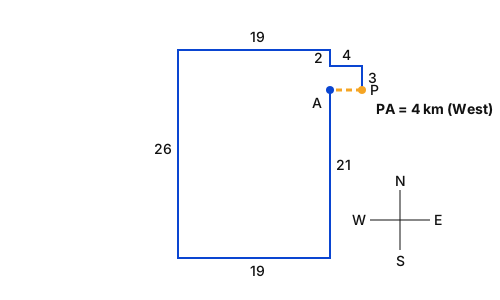
- South 21 (facing S); right → West 19; right → North 26; right → East 19.
- Net so far: 26−21 = 5 km north of A, 19−19 = 0 east-west.
- Right → South 2 (now 3 km N); left → East 4; right → South 3 (now 0 km N).
- P is exactly 4 km east of A, so he must drive 4 km to the west.
Trick: Right turn from S = W, from W = N, from N = E, from E = S — the clockwise order N→E→S→W.
Answer: (D) 4 km to the west
अवधारणा: हर मोड़ के बाद मुख की दिशा देखें और प्रत्येक अक्ष पर दूरी जोड़ें/घटाएँ।
- दक्षिण 21; दाएँ → पश्चिम 19; दाएँ → उत्तर 26; दाएँ → पूर्व 19।
- अब तक: A से 26−21 = 5 km उत्तर, पूर्व-पश्चिम में 0।
- दाएँ → दक्षिण 2 (3 km उत्तर); बाएँ → पूर्व 4; दाएँ → दक्षिण 3 (0 km उत्तर)।
- P, A से ठीक 4 km पूर्व में है, अतः 4 km पश्चिम जाना होगा।
ट्रिक: दायाँ मोड़ = घड़ी की दिशा: N→E→S→W।
उत्तर: (D) 4 km पश्चिम की ओर
RRB NTPC Graduate CBT 1General Intelligence and ReasoningDirection and DistanceRRB NTPC Graduate CBT 1 2024 · 24 Jun Shift 1
Q276.A group of numbers and symbols is coded using letter codes as per the codes given below and the conditions that follow. Study the given codes and conditions and answer the question that follows.
Note: If none of the conditions apply, then codes for the respective number/symbol are to be followed directly as given in the table.
| Number/Symbol | 1 | 8 | 6 | 7 | 4 | # | 2 | @ | & |
| Code | Y | A | L | B | S | D | E | Z | C |
Conditions:
(i) If the first element is a symbol and the last a number, the codes for these two (the first and the last elements) are to be interchanged.
(ii) If the first element is an odd number and the last an even number, the first and last elements are to be coded as ©.
(iii) If both second and third elements are perfect squares, the third element is to be coded as the code for the second element.
What will be the code for the following group?
# 6 @ 2
नीचे दिए गए कोड और उनके बाद दी गई शर्तों के अनुसार संख्याओं और प्रतीकों के एक समूह को अक्षर कोड का उपयोग करके कूटबद्ध किया गया है। दिए गए कोड और शर्तों का अध्ययन कीजिए और उसके बाद दिए गए प्रश्न का उत्तर दीजिए।
नोट: यदि कोई भी शर्त लागू नहीं होती है, तो संबंधित संख्या/प्रतीक के कोड का सीधे तालिका में दिए गए अनुसार ही अनुसरण किया जाना है।
| संख्या/प्रतीक | 1 | 8 | 6 | 7 | 4 | # | 2 | @ | & |
| कोड | Y | A | L | B | S | D | E | Z | C |
शर्तें:
(i) यदि पहला अवयव एक प्रतीक है और अंतिम अवयव एक संख्या है, तो इन दोनों (पहले और अंतिम अवयवों) के कोड आपस में बदल दिए जाने हैं।
(ii) यदि पहला अवयव एक विषम संख्या है और अंतिम अवयव एक सम संख्या है, तो पहले और अंतिम अवयवों को © के रूप में कूटबद्ध किया जाना है।
(iii) यदि दूसरा और तीसरा दोनों अवयव पूर्ण वर्ग हैं, तो तीसरे अवयव को दूसरे अवयव के कोड के रूप में कूटबद्ध किया जाना है।
निम्नलिखित समूह का कोड क्या होगा?
# 6 @ 2
- AELDZ
- BEZLD
- CELZD
- DDZLE
Show answer
Concept: Check the conditions in order; apply the one that fits, else use direct codes.
- Group: # 6 @ 2 → first is a symbol (#), last is a number (2): condition (i) applies.
- (ii) fails (first is not odd number); (iii) fails (6 and @ are not perfect squares).
- Direct codes: # = D, 6 = L, @ = Z, 2 = E.
- Interchange first and last codes: E L Z D.
Trick: Write the direct code first (DLZE), then just swap the ends → ELZD.
Answer: (C) ELZD
अवधारणा: शर्तें क्रम से जाँचें; जो लागू हो उसे लगाएँ, अन्यथा सीधे कूट लें।
- समूह: # 6 @ 2 → पहला प्रतीक (#), अंतिम संख्या (2): शर्त (i) लागू।
- (ii) लागू नहीं; (iii) भी नहीं (6 और @ पूर्ण वर्ग नहीं)।
- सीधे कूट: # = D, 6 = L, @ = Z, 2 = E।
- पहले और अंतिम कूट आपस में बदलें: E L Z D।
ट्रिक: पहले सीधा कूट लिखें (DLZE), फिर सिरे बदल दें → ELZD।
उत्तर: (C) ELZD
RRB NTPC Graduate CBT 1General Intelligence and ReasoningCoding with ConditionsRRB NTPC Graduate CBT 1 2024 · 24 Jun Shift 1
Q277.Read the given statements and conclusions carefully. Assuming that the information given in the statements is true, even if it appears to be at variance with commonly known facts, decide which of the given conclusion(s) logically follow(s) from the statements.
Statements:
All animals are deer.
All animals are bears.
All animals are cows.
Conclusions:
(I) All deer are cows.
(II) Some cows are bears.
दिए गए कथनों और निष्कर्षों को ध्यानपूर्वक पढ़िए। यह मानते हुए कि कथनों में दी गई जानकारी सत्य है, भले ही वह सामान्य रूप से ज्ञात तथ्यों से भिन्न प्रतीत होती हो, निर्णय लीजिए कि दिए गए निष्कर्षों में से कौन-सा/से निष्कर्ष कथनों का तार्किक रूप से अनुसरण करता है/करते हैं।
कथन:
सभी जानवर, हिरण हैं।
सभी जानवर, भालू हैं।
सभी जानवर, गाय हैं।
निष्कर्ष:
(I) सभी हिरण, गाय हैं।
(II) कुछ गाय, भालू हैं।
- AOnly conclusion (I) follows.केवल निष्कर्ष (I) अनुसरण करता है।
- BBoth conclusions (I) and (II) follow.निष्कर्ष (I) और (II) दोनों अनुसरण करते हैं।
- CNeither conclusion (I) nor (II) follows.न तो निष्कर्ष (I) और न ही (II) अनुसरण करता है।
- DOnly conclusion (II) follows.केवल निष्कर्ष (II) अनुसरण करता है।
Show answer
Concept: Draw the minimum Venn diagram: 'Animals' lies inside Deer, Bears and Cows together.
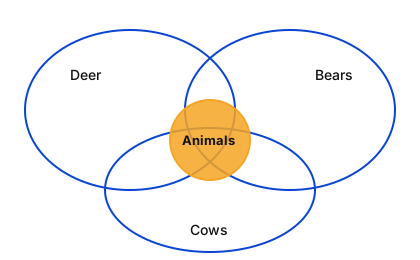
- Animals are both cows and bears, so the region of cows and bears overlaps → 'Some cows are bears' is definite. (II) follows.
- Deer and Cows only share the animals; some deer may lie outside Cows → 'All deer are cows' is not certain. (I) does not follow.
Trick: All A are B + All A are C ⇒ Some B are C (always). 'All B are C' never follows.
Answer: (D) Only conclusion (II) follows.
अवधारणा: न्यूनतम वेन आरेख बनाएँ: 'जानवर' (Animals) तीनों — हिरण, भालू, गाय — के अंदर है।
- जानवर गाय भी हैं और भालू भी, अतः 'कुछ गाय भालू हैं' निश्चित है → (II) अनुसरण करता है।
- हिरण और गाय केवल जानवरों वाले भाग में मिलते हैं; कुछ हिरण गाय से बाहर हो सकते हैं → (I) अनुसरण नहीं करता।
ट्रिक: सभी A, B हैं + सभी A, C हैं ⇒ कुछ B, C हैं (हमेशा)।
उत्तर: (D) केवल निष्कर्ष (II) अनुसरण करता है।
RRB NTPC Graduate CBT 1General Intelligence and ReasoningSyllogismRRB NTPC Graduate CBT 1 2024 · 24 Jun Shift 1
Q278.In this question, a group of number/symbol is coded using letter codes as per the codes given below and the conditions which follow. The correct combination of codes following the conditions is your answer.
Note: If none of the conditions apply, then codes for the respective number/symbol are to be followed directly as given in the table.
| Number/symbol | @ | 2 | 9 | 5 | $ | & | 3 | % | # | 7 | + | 4 | 8 | 6 |
| Code | A | C | D | J | F | E | W | Q | G | P | R | B | U | S |
Conditions:
(i) If the first element is a symbol and the last a number, the codes for these two (the first and the last elements) are to be interchanged.
(ii) If the first element is an odd number and the last an even number, the first and last elements are to be coded as ©.
(iii) If both second and third elements are perfect squares, the third element is to be coded as the code for the second element.
What is @9#7 coded as?
इस प्रश्न में, नीचे दिए गए कोड और उनके बाद दी गई शर्तों के अनुसार संख्या/प्रतीक के एक समूह को अक्षर कोड का उपयोग करके कूटबद्ध किया गया है। शर्तों का अनुसरण करने वाला कोडों का सही संयोजन आपका उत्तर है।
नोट: यदि कोई भी शर्त लागू नहीं होती है, तो संबंधित संख्या/प्रतीक के कोड का सीधे तालिका में दिए गए अनुसार ही अनुसरण किया जाना है।
| संख्या/प्रतीक | @ | 2 | 9 | 5 | $ | & | 3 | % | # | 7 | + | 4 | 8 | 6 |
| कोड | A | C | D | J | F | E | W | Q | G | P | R | B | U | S |
शर्तें:
(i) यदि पहला अवयव एक प्रतीक है और अंतिम अवयव एक संख्या है, तो इन दोनों (पहले और अंतिम अवयवों) के कोड आपस में बदल दिए जाने हैं।
(ii) यदि पहला अवयव एक विषम संख्या है और अंतिम अवयव एक सम संख्या है, तो पहले और अंतिम अवयवों को © के रूप में कूटबद्ध किया जाना है।
(iii) यदि दूसरा और तीसरा दोनों अवयव पूर्ण वर्ग हैं, तो तीसरे अवयव को दूसरे अवयव के कोड के रूप में कूटबद्ध किया जाना है।
@9#7 को किस प्रकार कूटबद्ध किया जाएगा?
- AADGP
- BGPDA
- CPDGA
- DPGDA
Show answer
Concept: Check each condition on the group @ 9 # 7.
- First element @ is a symbol, last 7 is a number → condition (i) applies.
- (ii) fails; (iii) fails because # is not a perfect square (only 9 is).
- Direct codes: @ = A, 9 = D, # = G, 7 = P → A D G P.
- Interchange first and last: P D G A.
Trick: In condition (iii) BOTH the 2nd and 3rd elements must be squares; one square is not enough.
Answer: (C) PDGA
अवधारणा: समूह @ 9 # 7 पर प्रत्येक शर्त जाँचें।
- पहला @ प्रतीक, अंतिम 7 संख्या → शर्त (i) लागू।
- (ii) लागू नहीं; (iii) भी नहीं क्योंकि # पूर्ण वर्ग नहीं (केवल 9 है)।
- सीधे कूट: @ = A, 9 = D, # = G, 7 = P → A D G P।
- पहले और अंतिम को बदलें: P D G A।
ट्रिक: शर्त (iii) में दूसरे और तीसरे — दोनों का पूर्ण वर्ग होना ज़रूरी है।
उत्तर: (C) PDGA
RRB NTPC Graduate CBT 1General Intelligence and ReasoningCoding with ConditionsRRB NTPC Graduate CBT 1 2024 · 24 Jun Shift 1
Q279.Each of the digits in the number 1673459 is arranged in ascending order from left to right. The position(s) of how many digits will remain unchanged as compared to that in the original number?
संख्या 1673459 के प्रत्येक अंक को बाएँ से दाएँ आरोही क्रम में व्यवस्थित किया जाता है। मूल संख्या की तुलना में कितने अंकों का/के स्थान अपरिवर्तित रहेगा/रहेंगे?
- AOneएक
- BNoneकोई नहीं
- CThreeतीन
- DTwoदो
Show answer
Concept: Write the original and the arranged numbers one below the other and compare place by place.
- Original: 1 6 7 3 4 5 9.
- Ascending: 1 3 4 5 6 7 9.
- Same place: 1st (1) and 7th (9); all others differ.
Trick: Smallest digit already first and largest already last — check these two quickly.
Answer: (D) Two
अवधारणा: मूल और व्यवस्थित संख्या को एक के नीचे एक लिखकर स्थान-दर-स्थान मिलाएँ।
- मूल: 1 6 7 3 4 5 9।
- आरोही: 1 3 4 5 6 7 9।
- समान स्थान: पहला (1) व सातवाँ (9); बाकी सब भिन्न।
ट्रिक: सबसे छोटा अंक पहले और सबसे बड़ा अंतिम पर पहले से है — इन्हें तुरंत जाँचें।
उत्तर: (D) दो (Two)
RRB NTPC Graduate CBT 1General Intelligence and ReasoningDigit ArrangementRRB NTPC Graduate CBT 1 2024 · 24 Jun Shift 1
Q280.B is the mother of A. C is the sister of A’s father D. E is the brother of C. How is B related to E?
B, A की माता है। C, A के पिता D की बहन है। E, C का भाई है। B का E से क्या संबंध है?
- ABrother’s wifeभाई की पत्नी
- BSisterबहन
- CWifeपत्नी
- DMotherमाता
Show answer
Concept: Draw the family tree with gender signs.
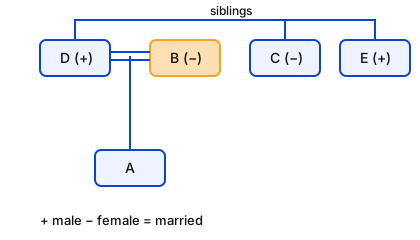
- D is A's father and B is A's mother, so B is D's wife.
- C is D's sister and E is C's brother, so E is D's brother.
- B is the wife of E's brother.
Trick: Sister's brother of a father = father's brother (or the father himself); here E ≠ D, so E is the uncle.
Answer: (A) Brother’s wife
अवधारणा: लिंग चिह्नों सहित वंश-वृक्ष बनाएँ।
- D, A का पिता और B, A की माँ है, अतः B, D की पत्नी है।
- C, D की बहन और E, C का भाई है, अतः E, D का भाई है।
- B, E के भाई की पत्नी (भाभी) है।
ट्रिक: पिता की बहन का भाई = पिता का भाई (चाचा); अतः माँ उसकी भाभी।
उत्तर: (A) भाई की पत्नी (Brother’s wife)
RRB NTPC Graduate CBT 1General Intelligence and ReasoningBlood RelationsRRB NTPC Graduate CBT 1 2024 · 24 Jun Shift 1

