Q21.Which of the following letter-number clusters will replace the question mark (?) in the given series to make it logically complete?
AAA 5, BCD 10, CEG 15, DGJ 20, ?
निम्नलिखित में से कौन-सा अक्षर-संख्या समूह दी गई श्रृंखला में प्रश्नचिह्न (?) के स्थान पर आकर इसे तार्किक रूप से पूर्ण करेगा?
AAA 5, BCD 10, CEG 15, DGJ 20, ?
- AEIM 25
- BEKM 25
- CETM 25
- DEGM 25
Show answer
Concept: First letter moves +1; within each cluster the gap between letters grows by 1 each term; the number increases by 5.
- AAA: gap 0; BCD: gap +1; CEG: gap +2; DGJ: gap +3.
- Next: start E, gap +4 → E(5), I(9), M(13) = EIM.
- Numbers: 5, 10, 15, 20, 25.
Trick: Use positions: E=5, I=9, M=13 (EJOTY: E5 J10 O15 T20 Y25).
Answer: (A) EIM 25
अवधारणा: पहला अक्षर +1 बढ़ता है; हर समूह में अक्षरों का अंतर हर पद में 1 बढ़ता है; संख्या 5 बढ़ती है।
- AAA: अंतर 0; BCD: +1; CEG: +2; DGJ: +3।
- अगला: E से शुरू, अंतर +4 → E(5), I(9), M(13) = EIM।
- संख्याएँ: 5, 10, 15, 20, 25।
ट्रिक: स्थान याद रखें: E=5, I=9, M=13 (EJOTY: E5 J10 O15 T20 Y25)।
उत्तर: (A) EIM 25
RRB NTPC Graduate CBT 1General Intelligence and ReasoningLetter-number seriesRRB NTPC Graduate CBT 1 2024 · 24 Jun Shift 3
Q22.If 1 is added to each even digit and 1 is subtracted from each odd digit in the number 7521432, what will be the sum of digits which are second from left and third from right in the new number thus formed?
यदि संख्या 7521432 के प्रत्येक सम अंक में 1 जोड़ा जाता है और प्रत्येक विषम अंक में से 1 घटाया जाता है, तो इस प्रकार बनी नई संख्या में बाएँ से दूसरे और दाएँ से तीसरे अंकों का योग क्या होगा?
- A9
- B6
- C10
- D8
Show answer
Concept: Change each digit (even +1, odd −1) and then read the required positions.
- 7521432 → 7−1, 5−1, 2+1, 1−1, 4+1, 3−1, 2+1 = 6430523.
- Second from left = 4.
- Third from right (3, 2, 5) = 5.
Trick: Only transform the two digits you need: 2nd digit 5 → 4; 3rd from right is 4 → 5.
Answer: (A)
अवधारणा: हर अंक बदलें (सम +1, विषम −1), फिर माँगे गए स्थान पढ़ें।
- 7521432 → 7−1, 5−1, 2+1, 1−1, 4+1, 3−1, 2+1 = 6430523।
- बाएँ से दूसरा = 4।
- दाएँ से तीसरा (3, 2, 5) = 5।
ट्रिक: केवल ज़रूरी दो अंक बदलें: दूसरा अंक 5 → 4; दाएँ से तीसरा 4 → 5।
उत्तर: (A)
RRB NTPC Graduate CBT 1General Intelligence and ReasoningDigit operationsRRB NTPC Graduate CBT 1 2024 · 24 Jun Shift 3
Q23.VBCD is related to MTTV in a certain way based on the English alphabetical order. In the same way, LVSX is related to CNJP. To which of the following options is KXRZ related, following the same logic?
अंग्रेज़ी वर्णमाला क्रम के आधार पर VBCD एक निश्चित प्रकार से MTTV से संबंधित है। उसी प्रकार, LVSX, CNJP से संबंधित है। समान तर्क का अनुसरण करते हुए, KXRZ निम्नलिखित में से किस विकल्प से संबंधित है?
- ABROP
- BBPIR
- CBPRI
- DBRIP
Show answer
Concept: Compare alphabet positions letter by letter (wrap around after Z).
- LVSX → CNJP: L(12)−9=C, V(22)−8=N, S(19)−9=J, X(24)−8=P → pattern −9, −8, −9, −8.
- Check VBCD: V−9=M, B−8=T, C−9=T, D−8=V ✔ (MTTV).
- KXRZ: K(11)−9=B, X(24)−8=P, R(18)−9=I, Z(26)−8=R → BPIR.
Trick: For wrap-around, −8 is the same as +18 and −9 is +17.
Answer: (B) BPIR
अवधारणा: अक्षरों की वर्णमाला स्थिति एक-एक कर तुलना करें (Z के बाद फिर A से)।
- LVSX → CNJP: L(12)−9=C, V(22)−8=N, S(19)−9=J, X(24)−8=P → पैटर्न −9, −8, −9, −8।
- VBCD जाँच: V−9=M, B−8=T, C−9=T, D−8=V ✔ (MTTV)।
- KXRZ: K(11)−9=B, X(24)−8=P, R(18)−9=I, Z(26)−8=R → BPIR।
ट्रिक: चक्र में −8 = +18 और −9 = +17।
उत्तर: (B) BPIR
RRB NTPC Graduate CBT 1General Intelligence and ReasoningLetter analogyRRB NTPC Graduate CBT 1 2024 · 24 Jun Shift 3
Q24.Each of the digits in the number 5123487 is arranged in ascending order from left to right. The position(s) of how many digits will remain unchanged as compared to that in the original number?
संख्या 5123487 के प्रत्येक अंक को बाएँ से दाएँ आरोही क्रम में व्यवस्थित किया जाता है। मूल संख्या की तुलना में कितने अंकों का/के स्थान अपरिवर्तित रहेगा/रहेंगे?
- ATwoदो
- BOneएक
- CNoneकोई नहीं
- DThreeतीन
Show answer
Concept: Write the number in ascending order and compare digit by digit.
- Original: 5 1 2 3 4 8 7
- Ascending: 1 2 3 4 5 7 8
- Position-wise: 5→1, 1→2, 2→3, 3→4, 4→5, 8→7, 7→8 — no digit stays in place.
Trick: Since 5 shifts every small digit one step left, positions 1–5 all change; 8 and 7 swap.
Answer: (C) None
अवधारणा: संख्या को आरोही क्रम में लिखें और अंक-दर-अंक तुलना करें।
- मूल: 5 1 2 3 4 8 7
- आरोही: 1 2 3 4 5 7 8
- स्थान-वार: 5→1, 1→2, 2→3, 3→4, 4→5, 8→7, 7→8 — कोई अंक अपनी जगह नहीं।
ट्रिक: 5 हटने से छोटे अंक एक स्थान खिसक जाते हैं; 8 और 7 आपस में बदलते हैं।
उत्तर: (C) कोई नहीं
RRB NTPC Graduate CBT 1General Intelligence and ReasoningDigit arrangementRRB NTPC Graduate CBT 1 2024 · 24 Jun Shift 3
Q25.In a certain code language, ‘CURE’ is coded as ‘5783’ and ‘RIGS’ is coded as ‘2179’. What is the code for ‘R’ in the given code language?
एक निश्चित कूट भाषा में, ‘CURE’ को ‘5783’ के रूप में कूटबद्ध किया जाता है और ‘RIGS’ को ‘2179’ के रूप में कूटबद्ध किया जाता है। दी गई कूट भाषा में ‘R’ के लिए कूट क्या है?
- A2
- B1
- C8
- D7
Show answer
Concept: Letters common to two words share the digit common to their codes (codes are jumbled).
- CURE = 5783 and RIGS = 2179.
- Common letter: R; common digit: 7.
- So R = 7.
Trick: Common letter ↔ common digit.
Answer: (D)
अवधारणा: दो शब्दों में उभयनिष्ठ अक्षर का कोड उनके कोडों में उभयनिष्ठ अंक होता है (कोड क्रम में नहीं)।
- CURE = 5783 और RIGS = 2179।
- उभयनिष्ठ अक्षर: R; उभयनिष्ठ अंक: 7।
- अतः R = 7।
ट्रिक: उभयनिष्ठ अक्षर ↔ उभयनिष्ठ अंक।
उत्तर: (D)
RRB NTPC Graduate CBT 1General Intelligence and ReasoningCoding-decodingRRB NTPC Graduate CBT 1 2024 · 24 Jun Shift 3
Q26.Based on the English alphabetical order, three of the following four letter-clusters are alike in a certain way and thus form a group. Which letter-cluster DOES NOT belong to that group?
(Note: The odd one out is not based on the number of consonants/vowels or their position in the letter-cluster.)
अंग्रेज़ी वर्णमाला क्रम के आधार पर, निम्नलिखित चार अक्षर-समूहों में से तीन किसी निश्चित प्रकार से एकसमान हैं और इस प्रकार एक समूह बनाते हैं। कौन-सा अक्षर-समूह उस समूह से संबंधित नहीं है?
(नोट: असंगत अक्षर-समूह, उस अक्षर-समूह में व्यंजनों/स्वरों की संख्या या उनके स्थान पर आधारित नहीं है।)
- APRL
- BIKE
- CHJD
- DPLO
Show answer
Concept: Find the gaps between alphabet positions in each cluster.
- PRL: P(16) +2 R(18) −6 L(12)
- IKE: I(9) +2 K(11) −6 E(5); HJD: H(8) +2 J(10) −6 D(4)
- PLO: P(16) −4 L(12) +3 O(15) — different pattern.
Trick: Three follow (+2, −6); the odd one breaks it.
Answer: (D) PLO
अवधारणा: हर समूह में अक्षरों की वर्णमाला स्थितियों का अंतर देखें।
- PRL: P(16) +2 R(18) −6 L(12)
- IKE: I(9) +2 K(11) −6 E(5); HJD: H(8) +2 J(10) −6 D(4)
- PLO: P(16) −4 L(12) +3 O(15) — भिन्न पैटर्न।
ट्रिक: तीन में (+2, −6); जो इसे तोड़े वही विषम।
उत्तर: (D) PLO
RRB NTPC Graduate CBT 1General Intelligence and ReasoningOdd one out (letters)RRB NTPC Graduate CBT 1 2024 · 24 Jun Shift 3
Q27.This question is based on the five, three-digit numbers given below.
(Left) 307 485 194 237 937 (Right)
(Example: 697 – First digit = 6, second digit = 9 and third digit = 7)
(Note: All operations to be done from left to right.)
What will be the resultant if the third digit of the highest number is subtracted from the first digit of the lowest number?
यह प्रश्न नीचे दी गई तीन-अंकीय पाँच संख्याओं पर आधारित है।
(बाएँ) 307 485 194 237 937 (दाएँ)
(उदाहरण: 697 – पहला अंक = 6, दूसरा अंक = 9 और तीसरा अंक = 7)
(नोट: सभी संक्रियाएँ बाएँ से दाएँ की जानी हैं।)
यदि सबसे बड़ी संख्या के तीसरे अंक को सबसे छोटी संख्या के पहले अंक में से घटाया जाए, तो परिणाम क्या होगा?
- A–6
- B–4
- C–5
- D–3
Show answer
Concept: Identify the highest and lowest numbers, then perform the operation in the stated order.
- Numbers: 307, 485, 194, 237, 937.
- Highest = 937 → third digit = 7; lowest = 194 → first digit = 1.
- "Third digit subtracted from first digit"
Trick: "X subtracted from Y" means — watch the order.
Answer: (A)
अवधारणा: सबसे बड़ी और सबसे छोटी संख्या पहचानें, फिर बताए क्रम में संक्रिया करें।
- संख्याएँ: 307, 485, 194, 237, 937।
- सबसे बड़ी = 937 → तीसरा अंक = 7; सबसे छोटी = 194 → पहला अंक = 1।
- "पहले अंक में से तीसरा अंक घटाएँ"
ट्रिक: "Y में से X घटाना" = — क्रम का ध्यान रखें।
उत्तर: (A)
RRB NTPC Graduate CBT 1General Intelligence and ReasoningNumber-digit operationsRRB NTPC Graduate CBT 1 2024 · 24 Jun Shift 3
Q28.Anu, Beena, Deepa, Heena, Kareena, Leena and Reena sit in a straight line, facing north. Kareena sits third to the right of Beena, who sits second to the right of Deepa. Reena sits to the immediate left of Leena. Anu sits second to the left of Heena. Three of the following four are alike in a certain way based on the given arrangement and thus form a group. Who among the following do NOT belong to that group?
अनु, बीना, दीपा, हीना, करीना, लीना और रीना एक सीधी पंक्ति में उत्तर की ओर मुख करके बैठी हैं। करीना, बीना के दाईं ओर तीसरे स्थान पर बैठी है, जो दीपा के दाईं ओर दूसरे स्थान पर बैठी है। रीना, लीना के ठीक बाईं ओर बैठी है। अनु, हीना के बाईं ओर दूसरे स्थान पर बैठी है। दी गई व्यवस्था के आधार पर निम्नलिखित चार में से तीन किसी निश्चित प्रकार से एकसमान हैं और इस प्रकार एक समूह बनाते हैं। निम्नलिखित में से कौन उस समूह से संबंधित नहीं है?
- AAnu and Deepaअनु और दीपा
- BHeena and Reenaहीना और रीना
- CLeena and Kareenaलीना और करीना
- DBeena and Reenaबीना और रीना
Show answer
Concept: All face north, so "right" means towards the right end of the row. Place fixed persons first and test cases.
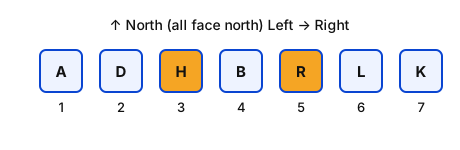
- Deepa _ Beena _ _ Kareena: with Deepa at 1 (B 3, K 6), the RL pair must take 4–5, leaving 2 and 7 for Anu–Heena — not possible.
- Deepa at 2 → Beena 4, Kareena 7; R–L at 5–6; Anu 1, Heena 3.
- Order: Anu, Deepa, Heena, Beena, Reena, Leena, Kareena.
- A–D, L–K, B–R are adjacent pairs; Heena–Reena have one person between them → odd.
Trick: Odd-pair questions usually test "sitting adjacent" vs "one gap".
Answer: (B) Heena and Reena
अवधारणा: सभी उत्तर की ओर मुख किए हैं, इसलिए "दाएँ" का अर्थ पंक्ति के दाहिने छोर की ओर। पहले निश्चित व्यक्ति रखें और स्थितियाँ जाँचें।
- दीपा _ बीना _ _ करीना: दीपा 1 पर (B 3, K 6) हो तो R–L 4–5 पर, अनु–हीना को 2 और 7 — संभव नहीं।
- दीपा 2 पर → बीना 4, करीना 7; R–L 5–6 पर; अनु 1, हीना 3।
- क्रम: अनु, दीपा, हीना, बीना, रीना, लीना, करीना।
- A–D, L–K, B–R आसन्न युग्म हैं; हीना–रीना के बीच एक व्यक्ति → विषम।
ट्रिक: विषम युग्म प्रश्न अक्सर "आसन्न" बनाम "एक अंतर" पर आधारित होते हैं।
उत्तर: (B) हीना और रीना
RRB NTPC Graduate CBT 1General Intelligence and ReasoningLinear seating arrangementRRB NTPC Graduate CBT 1 2024 · 24 Jun Shift 3
Q29.Based on the English alphabetical order, three of the following four letter-clusters are alike in a certain way and thus form a group. Which letter-cluster DOES NOT belong to that group?
(Note: The odd one out is not based on the number of consonants/vowels or their position in the letter-cluster.)
अंग्रेज़ी वर्णमाला क्रम के आधार पर, निम्नलिखित चार अक्षर-समूहों में से तीन किसी निश्चित प्रकार से एकसमान हैं और इस प्रकार एक समूह बनाते हैं। कौन-सा अक्षर-समूह उस समूह से संबंधित नहीं है?
(नोट: असंगत अक्षर-समूह, उस अक्षर-समूह में व्यंजनों/स्वरों की संख्या या उनके स्थान पर आधारित नहीं है।)
- AELH
- BJQM
- CGNI
- DLSO
Show answer
Concept: Check the gaps between alphabet positions in each cluster.
- ELH: E(5) +7 L(12) −4 H(8)
- JQM: J(10) +7 Q(17) −4 M(13); LSO: L(12) +7 S(19) −4 O(15)
- GNI: G(7) +7 N(14) −5 I(9) — different.
Trick: Pattern (+7, −4) in three; GNI breaks the second gap.
Answer: (C) GNI
अवधारणा: हर समूह में वर्णमाला स्थितियों का अंतर जाँचें।
- ELH: E(5) +7 L(12) −4 H(8)
- JQM: J(10) +7 Q(17) −4 M(13); LSO: L(12) +7 S(19) −4 O(15)
- GNI: G(7) +7 N(14) −5 I(9) — भिन्न।
ट्रिक: तीन में पैटर्न (+7, −4); GNI दूसरा अंतर तोड़ता है।
उत्तर: (C) GNI
RRB NTPC Graduate CBT 1General Intelligence and ReasoningOdd one out (letters)RRB NTPC Graduate CBT 1 2024 · 24 Jun Shift 3
Q30.GG 12 is related to CB 29 in a certain way. In the same way, IK 2 is related to EF 19. To which of the following is RN -6 related, following the same logic?
GG 12 एक निश्चित प्रकार से CB 29 से संबंधित है। उसी प्रकार, IK 2, EF 19 से संबंधित है। समान तर्क का अनुसरण करते हुए, RN -6 निम्नलिखित में से किससे संबंधित है?
- AMI 6
- BNH 11
- CNI 11
- DMH 6
Show answer
Concept: Compare each letter by position and the number separately.
- GG 12 → CB 29: G(7)−4=C, G(7)−5=B, .
- IK 2 → EF 19: I(9)−4=E, K(11)−5=F, ✔
- RN −6: R(18)−4=N, N(14)−5=I, → NI 11.
Trick: Rule: 1st letter −4, 2nd letter −5, number +17.
Answer: (C) NI 11
अवधारणा: हर अक्षर की स्थिति और संख्या की अलग-अलग तुलना करें।
- GG 12 → CB 29: G(7)−4=C, G(7)−5=B, ।
- IK 2 → EF 19: I(9)−4=E, K(11)−5=F, ✔
- RN −6: R(18)−4=N, N(14)−5=I, → NI 11।
ट्रिक: नियम: पहला अक्षर −4, दूसरा −5, संख्या +17।
उत्तर: (C) NI 11
RRB NTPC Graduate CBT 1General Intelligence and ReasoningLetter-number analogyRRB NTPC Graduate CBT 1 2024 · 24 Jun Shift 3
Q31.In this question, a group of number/symbol is coded using letter codes as per the codes given below and the conditions which follow. The correct combination of codes following the conditions is your answer.
Note: If none of the conditions apply, then codes for the respective number/symbol are to be followed directly as given in the table.
| Number/ symbol | 8 | 6 | * | % | 9 | & | 3 | + | @ | 5 | $ | 7 | 4 |
|---|
| Code | W | C | E | J | F | A | D | Q | G | P | R | B | U |
|---|
Conditions:
(I) If the first element is a number and the last a symbol, the codes for these two (the first and the last elements) are to be interchanged.
(II) If the first element is an odd number and the last an even number, the first and last elements are to be coded as ©.
(III) If the third element is a perfect cube, the second element is to be coded as the code for the third element.
What will %987 be coded as?
इस प्रश्न में, नीचे दिए गए कूटों और उसके बाद दी गई शर्तों के अनुसार संख्या/प्रतीक के एक समूह को अक्षर कूटों का उपयोग करके कूटबद्ध किया गया है। शर्तों का पालन करने वाले कूटों का सही संयोजन आपका उत्तर है।
नोट: यदि कोई भी शर्त लागू नहीं होती है, तो संबंधित संख्या/प्रतीक के लिए तालिका में दिए गए कूटों का सीधे पालन किया जाना है।
| संख्या/प्रतीक | 8 | 6 | * | % | 9 | & | 3 | + | @ | 5 | $ | 7 | 4 |
|---|
| कूट | W | C | E | J | F | A | D | Q | G | P | R | B | U |
|---|
शर्तें:
(I) यदि पहला अवयव एक संख्या है और अंतिम अवयव एक प्रतीक है, तो इन दोनों (पहले और अंतिम अवयव) के कूट आपस में बदल दिए जाने हैं।
(II) यदि पहला अवयव एक विषम संख्या है और अंतिम अवयव एक सम संख्या है, तो पहले और अंतिम दोनों अवयवों को © के रूप में कूटबद्ध किया जाना है।
(III) यदि तीसरा अवयव एक पूर्ण घन है, तो दूसरे अवयव को तीसरे अवयव के कूट के रूप में कूटबद्ध किया जाना है।
%987 को किस प्रकार कूटबद्ध किया जाएगा?
- AJFWB
- BJWFB
- CJWWB
- DBFWJ
Show answer
Concept: Check each condition in order; apply only those that fit, otherwise use the table codes.
- Elements: % 9 8 7 → table codes J F W B.
- (I) first is a symbol, not a number – no. (II) first is not an odd number – no.
- (III) third element 8 is a perfect cube → second element (9) takes the code of 8, i.e. W.
- Code: J W W B.
Trick: First see what type the first and last elements are – it eliminates (I) and (II) at once.
Answer: (C) JWWB
अवधारणा: शर्तों को क्रम से जाँचें; जो लागू हो वही लगाएँ, नहीं तो तालिका के कूट लें।
- अवयव: % 9 8 7 → तालिका कूट J F W B।
- (I) पहला अवयव प्रतीक है, संख्या नहीं – लागू नहीं। (II) पहला विषम संख्या नहीं – लागू नहीं।
- (III) तीसरा अवयव 8 पूर्ण घन है → दूसरे अवयव (9) को 8 का कूट W मिलेगा।
- कूट: J W W B।
ट्रिक: पहले पहला और अंतिम अवयव संख्या है या प्रतीक – यही देखें, (I) और (II) तुरंत हट जाती हैं।
उत्तर: (C) JWWB
RRB NTPC Graduate CBT 1General Intelligence and ReasoningCoding with ConditionsRRB NTPC Graduate CBT 1 2024 · 24 Jun Shift 2
Q32.Vinay starts from Point A and drives 3 km towards the North. He then takes a right turn, drives 2 km, turns left and drives 3 km. He then takes a left turn and drives 6 km. He takes a final left turn, drives 6 km and stops at Point P. How far (shortest distance) and towards which direction should he drive in order to reach Point A again? (All turns are 90 degrees turns only unless specified)
विनय बिंदु A से चलना शुरू करता है और उत्तर की ओर 3 km गाड़ी चलाता है। फिर वह दाएँ मुड़ता है, 2 km गाड़ी चलाता है, बाएँ मुड़ता है और 3 km गाड़ी चलाता है। फिर वह बाएँ मुड़ता है और 6 km गाड़ी चलाता है। वह अंतिम बार बाएँ मुड़ता है, 6 km गाड़ी चलाता है और बिंदु P पर रुक जाता है। फिर से बिंदु A पर पहुँचने के लिए उसे कितनी दूर (न्यूनतम दूरी) और किस दिशा में गाड़ी चलानी चाहिए? (जब तक निर्दिष्ट न किया जाए, सभी मोड़ केवल 90 डिग्री के मोड़ हैं)
- A6 km to the Eastपूर्व की ओर 6 km
- B4 km to the Westपश्चिम की ओर 4 km
- C4 km to the Eastपूर्व की ओर 4 km
- D5 km to the Eastपूर्व की ओर 5 km
Show answer
Concept: Plot each move on a grid taking A as origin, East = +x, North = +y.
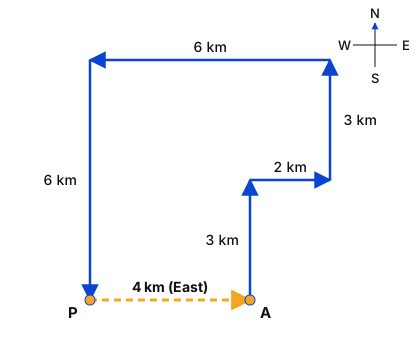
- 3 km North → (0, 3); right (East) 2 km → (2, 3).
- Left (North) 3 km → (2, 6); left (West) 6 km → (−4, 6).
- Left (South) 6 km → P(−4, 0).
- P is 4 km West of A, so he must drive 4 km towards East.
Trick: Net East–West: ; net North–South: .
Answer: (C) 4 km to the East
अवधारणा: A को मूल बिंदु मानकर हर चाल को ग्रिड पर लिखें (पूर्व = +x, उत्तर = +y)।
- उत्तर 3 km → (0, 3); दाएँ (पूर्व) 2 km → (2, 3)।
- बाएँ (उत्तर) 3 km → (2, 6); बाएँ (पश्चिम) 6 km → (−4, 6)।
- बाएँ (दक्षिण) 6 km → P(−4, 0)।
- P, A से 4 km पश्चिम में है, अतः 4 km पूर्व की ओर जाना होगा।
ट्रिक: पूर्व–पश्चिम: ; उत्तर–दक्षिण: ।
उत्तर: (C) 4 km पूर्व की ओर
RRB NTPC Graduate CBT 1General Intelligence and ReasoningDirection and DistanceRRB NTPC Graduate CBT 1 2024 · 24 Jun Shift 2
Q33.What should come in place of the question mark (?) in the given series?
4 10 19 34 58 ?
दी गई श्रृंखला में प्रश्न चिह्न (?) के स्थान पर क्या आना चाहिए?
4 10 19 34 58 ?
- A94
- B72
- C74
- D89
Show answer
Concept: Check the differences and then the second differences.
- Differences: , , , .
- Second differences: → next is .
- Next difference ; next term .
Trick: When first differences grow unevenly, look at the second-level difference.
Answer: (A) 94
अवधारणा: पहले अंतर, फिर अंतरों का अंतर देखें।
- अंतर: , , , ।
- दूसरे स्तर के अंतर: → अगला ।
- अगला अंतर ; अगला पद ।
ट्रिक: पहले अंतर अनियमित बढ़ें तो दूसरे स्तर के अंतर देखें।
उत्तर: (A) 94
RRB NTPC Graduate CBT 1General Intelligence and ReasoningNumber SeriesRRB NTPC Graduate CBT 1 2024 · 24 Jun Shift 2
Q34.Refer to the following number and symbol series and answer the question that follows. Counting to be done from left to right only.
(Note: All numbers are single digit numbers only.)
(Left) 3 3 & 7 * € 2 6 8 £ % 5 6 £ © 1 6 & % 8 # # (Right)
How many such numbers are there, each of which is immediately preceded by a number and also immediately followed by a symbol?
निम्नलिखित संख्या और प्रतीक श्रृंखला को देखें और उसके बाद दिए गए प्रश्न का उत्तर दें। गिनती केवल बाएँ से दाएँ की जानी है।
(नोट: सभी संख्याएँ केवल एक अंक वाली संख्याएँ हैं।)
(बाएँ) 3 3 & 7 * € 2 6 8 £ % 5 6 £ © 1 6 & % 8 # # (दाएँ)
ऐसी कितनी संख्याएँ हैं, जिनमें से प्रत्येक के ठीक पहले एक संख्या है और ठीक बाद एक प्रतीक भी है?
- A3
- B4
- C6
- D5
Show answer
Concept: Check every number: the element just before it must be a number and the element just after it must be a symbol.
- 3 3 & → 3 (preceded by 3, followed by &) ✓
- 6 8 £ → 8 ✓; 5 6 £ → 6 ✓
- 1 6 & → 6 ✓; other numbers fail (e.g. 7 is preceded by &).
- Total = 4.
Trick: Look for the pattern “number–number–symbol” and count the middle number.
Answer: (B) 4
अवधारणा: हर संख्या जाँचें: उससे ठीक पहले संख्या और ठीक बाद प्रतीक होना चाहिए।
- 3 3 & → 3 (पहले 3, बाद में &) ✓
- 6 8 £ → 8 ✓; 5 6 £ → 6 ✓
- 1 6 & → 6 ✓; बाकी संख्याएँ शर्त पूरी नहीं करतीं।
- कुल = 4।
ट्रिक: “संख्या–संख्या–प्रतीक” पैटर्न ढूँढें और बीच वाली संख्या गिनें।
उत्तर: (B) 4
RRB NTPC Graduate CBT 1General Intelligence and ReasoningNumber–Symbol SeriesRRB NTPC Graduate CBT 1 2024 · 24 Jun Shift 2
Q35.Amita, Babita, Geeta, Kavita, Meeta, Sarita, Vinita are sitting in a straight line, facing north. Geeta sits third to the right of Kavita. Sarita sits third to the left of Amita, who is third to the left of Meeta. Neither Sarita nor Babita sit immediately next to Kavita. Three of the following four are alike in a certain way based on the given arrangement and thus form a group. Which of the following does NOT belong to that group?
अमिता, बबीता, गीता, कविता, मीता, सरिता, विनीता एक सीधी पंक्ति में उत्तर की ओर मुख करके बैठी हैं। गीता, कविता के दाएँ से तीसरे स्थान पर बैठी है। सरिता, अमिता के बाएँ से तीसरे स्थान पर बैठी है, जो मीता के बाएँ से तीसरे स्थान पर बैठी है। न तो सरिता और न ही बबीता, कविता के ठीक बगल में बैठी है। दी गई व्यवस्था के आधार पर निम्नलिखित चार में से तीन किसी निश्चित प्रकार से एकसमान हैं और इस प्रकार एक समूह बनाते हैं। निम्नलिखित में से कौन-सा उस समूह से संबंधित नहीं है?
- AAmita and Babitaअमिता और बबीता
- BVinita and Amitaविनीता और अमिता
- CBabita and Meetaबबीता और मीता
- DSarita and Kavitaसरिता और कविता
Show answer
Concept: Fix the definite chain first, then use the “not next to” conditions.
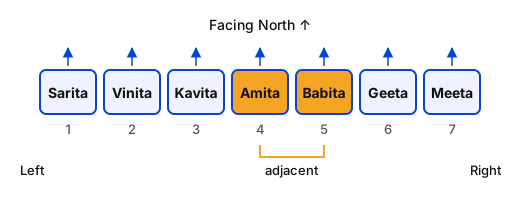
- Sarita _ _ Amita _ _ Meeta → positions 1, 4, 7.
- Kavita–Geeta (3 apart) can be 2–5 or 3–6; at 2 Kavita would be next to Sarita, so Kavita = 3, Geeta = 6.
- Babita cannot be at 2 (next to Kavita) → Babita = 5, Vinita = 2.
- Order: Sarita, Vinita, Kavita, Amita, Babita, Geeta, Meeta. Three pairs have one person between them; Amita–Babita sit together.
Trick: In odd-one-out pairs, compare the gap between the two people.
Answer: (A) Amita and Babita
अवधारणा: पहले निश्चित श्रृंखला बनाएँ, फिर “पास नहीं” वाली शर्तें लगाएँ।
- सरिता _ _ अमिता _ _ मीता → स्थान 1, 4, 7।
- कविता–गीता (3 का अंतर) 2–5 या 3–6; 2 पर कविता सरिता के पास होगी, अतः कविता = 3, गीता = 6।
- बबीता 2 पर नहीं (कविता के पास) → बबीता = 5, विनीता = 2।
- क्रम: सरिता, विनीता, कविता, अमिता, बबीता, गीता, मीता। तीन जोड़ों के बीच एक व्यक्ति है; अमिता–बबीता साथ बैठी हैं।
ट्रिक: विषम जोड़ी में दोनों के बीच का अंतर देखें।
उत्तर: (A) Amita and Babita
RRB NTPC Graduate CBT 1General Intelligence and ReasoningLinear Seating ArrangementRRB NTPC Graduate CBT 1 2024 · 24 Jun Shift 2
Q36.Refer to the following number and symbol series and answer the question that follows. Counting to be done from left to right only.
(Note: All numbers are single digit numbers only.)
(Left) 3 © 3 # 1 & & 5 £ 9 3 4 * & 2 2 % 2 2 7 © @ (Right)
How many such symbols are there, each of which is immediately preceded by a number and also immediately followed by a symbol?
निम्नलिखित संख्या और प्रतीक श्रृंखला को देखें और उसके बाद दिए गए प्रश्न का उत्तर दें। गिनती केवल बाएँ से दाएँ की जानी है।
(नोट: सभी संख्याएँ केवल एक अंक वाली संख्याएँ हैं।)
(बाएँ) 3 © 3 # 1 & & 5 £ 9 3 4 * & 2 2 % 2 2 7 © @ (दाएँ)
ऐसे कितने प्रतीक हैं, जिनमें से प्रत्येक के ठीक पहले एक संख्या है और ठीक बाद एक प्रतीक भी है?
- A4
- B5
- C3
- D2
Show answer
Concept: For each symbol, check: element before = number, element after = symbol.
- 1 & & → first & ✓
- 4 * & → * ✓
- 7 © @ → © ✓
- Others fail (e.g. # is followed by 1, % is followed by 2). Total = 3.
Trick: Search for the pattern “number–symbol–symbol”.
Answer: (C) 3
अवधारणा: हर प्रतीक के लिए जाँचें: पहले संख्या और बाद में प्रतीक हो।
- 1 & & → पहला & ✓
- 4 * & → * ✓
- 7 © @ → © ✓
- बाकी असफल (जैसे # के बाद 1, % के बाद 2)। कुल = 3।
ट्रिक: “संख्या–प्रतीक–प्रतीक” पैटर्न ढूँढें।
उत्तर: (C) 3
RRB NTPC Graduate CBT 1General Intelligence and ReasoningNumber–Symbol SeriesRRB NTPC Graduate CBT 1 2024 · 24 Jun Shift 2
Q37.Each of the digits in the number 4319286 is arranged in descending order from left to right. The position(s) of how many digits will remain unchanged as compared to that in the original number?
संख्या 4319286 के प्रत्येक अंक को बाएँ से दाएँ अवरोही क्रम में व्यवस्थित किया जाता है। मूल संख्या की तुलना में कितने अंकों का स्थान अपरिवर्तित रहेगा?
- AThreeतीन
- BOneएक
- CTwoदो
- DNoneकोई नहीं
Show answer
Concept: Write the new number below the original and compare place by place.
- Original: 4 3 1 9 2 8 6
- Descending: 9 8 6 4 3 2 1
- Places 1–7: 4 vs 9, 3 vs 8, 1 vs 6, 9 vs 4, 2 vs 3, 8 vs 2, 6 vs 1 – no place matches.
Trick: Only a digit already at its sorted position stays; check the middle digit first (2 vs 4 here).
Answer: (D) None
अवधारणा: नई संख्या को मूल संख्या के नीचे लिखकर स्थान-दर-स्थान तुलना करें।
- मूल: 4 3 1 9 2 8 6
- अवरोही: 9 8 6 4 3 2 1
- सातों स्थानों पर अंक अलग हैं – कोई मेल नहीं।
ट्रिक: जो अंक पहले से अपने क्रमित स्थान पर हो वही नहीं बदलता।
उत्तर: (D) None
RRB NTPC Graduate CBT 1General Intelligence and ReasoningDigit ArrangementRRB NTPC Graduate CBT 1 2024 · 24 Jun Shift 2
Q38.Seven people, A, B, C, D, S, T, and U are sitting in a row, facing north.
Only two people sit between T and C. Only D sits to the right of U. Only one person sits between C and U. B sits at some place to the right of S but at some place to the left of A.
How many people sit between A and S?
सात व्यक्ति, A, B, C, D, S, T और U एक पंक्ति में उत्तर की ओर मुख करके बैठे हैं।
T और C के बीच केवल दो व्यक्ति बैठे हैं। U के दाएँ केवल D बैठा है। C और U के बीच केवल एक व्यक्ति बैठा है। B, S के दाएँ किसी स्थान पर, लेकिन A के बाएँ किसी स्थान पर बैठा है।
A और S के बीच कितने व्यक्ति बैठे हैं?
- AOneएक
- BTwoदो
- CThreeतीन
- DFourचार
Show answer
Concept: Start with the clue that fixes an end position.
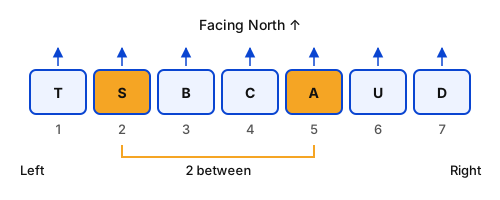
- “Only D sits to the right of U” → U = 6, D = 7.
- One person between C and U → C = 4.
- Two people between T and C → T = 1 (7 is taken).
- S, B, A fill 2, 3, 5 with S left of B left of A → S = 2, B = 3, A = 5.
- Between S (2) and A (5): B and C → 2 people.
Trick: “Only X to the right of Y” means Y is second from the right end.
Answer: (B) Two
अवधारणा: पहले वह संकेत लें जो किसी छोर का स्थान तय करता है।
- “U के दाएँ केवल D” → U = 6, D = 7।
- C और U के बीच एक → C = 4।
- T और C के बीच दो → T = 1 (7 भरा है)।
- S, B, A के लिए 2, 3, 5; S, B के बाएँ और B, A के बाएँ → S = 2, B = 3, A = 5।
- S (2) और A (5) के बीच: B और C → 2 व्यक्ति।
ट्रिक: “Y के दाएँ केवल X” का अर्थ – Y दाएँ छोर से दूसरा।
उत्तर: (B) Two
RRB NTPC Graduate CBT 1General Intelligence and ReasoningLinear Seating ArrangementRRB NTPC Graduate CBT 1 2024 · 24 Jun Shift 2
Q39.Based on the English alphabetical order, three of the following four letter-clusters are alike in a certain way and thus form a group. Which letter-cluster DOES NOT belong to that group?
(Note: The odd one out is not based on the number of consonants/vowels or their position in the letter-cluster.)
अंग्रेज़ी वर्णमाला क्रम के आधार पर, निम्नलिखित चार अक्षर-समूहों में से तीन किसी निश्चित प्रकार से एकसमान हैं और इस प्रकार एक समूह बनाते हैं। कौन-सा अक्षर-समूह उस समूह से संबंधित नहीं है?
(नोट: असंगत अक्षर-समूह, उस अक्षर-समूह में व्यंजनों/स्वरों की संख्या या उनके स्थान पर आधारित नहीं है।)
- AKQN
- BNTP
- CQWS
- DTZV
Show answer
Concept: Write alphabet positions and check the gaps.
- NTP: 14, 20, 16 → . QWS: 17, 23, 19 → . TZV: 20, 26, 22 → .
- KQN: 11, 17, 14 → – breaks the pattern.
Trick: Same first gap in all? Then the second gap decides.
Answer: (A) KQN
अवधारणा: अक्षरों के स्थानीय मान लिखकर अंतर जाँचें।
- NTP: 14, 20, 16 → । QWS: 17, 23, 19 → । TZV: 20, 26, 22 → ।
- KQN: 11, 17, 14 → – पैटर्न अलग।
ट्रिक: पहला अंतर सबमें समान हो तो दूसरा अंतर निर्णय करता है।
उत्तर: (A) KQN
RRB NTPC Graduate CBT 1General Intelligence and ReasoningOdd One Out – Letter ClustersRRB NTPC Graduate CBT 1 2024 · 24 Jun Shift 2
Q40.T is the wife of S. L is the daughter of T. K is the sister of S. W is the mother of L's father. P is the son of S.
How is P related to K?
T, S की पत्नी है। L, T की पुत्री है। K, S की बहन है। W, L के पिता की माँ है। P, S का पुत्र है।
P का K से क्या संबंध है?
- AHusband's brotherपति का भाई
- BHusband's fatherपति का पिता
- CDaughter's husbandपुत्री का पति
- DBrother's sonभाई का पुत्र
Show answer
Concept: Draw the family tree from the statements.
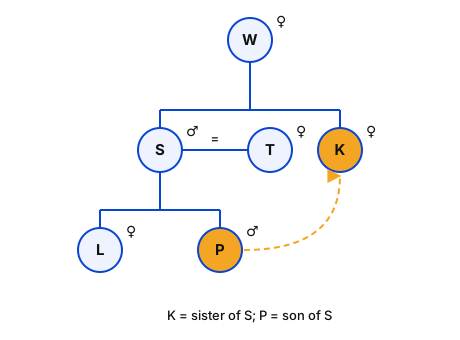
- T is the wife of S; L is the daughter of T, so S is L’s father.
- W is the mother of L’s father → W is the mother of S.
- K is the sister of S; P is the son of S.
- So P is the son of K’s brother.
Trick: Mark the common link (S) – K is his sister, P is his son.
Answer: (D) Brother’s son
अवधारणा: कथनों से परिवार वृक्ष बनाएँ।
- T, S की पत्नी है; L, T की बेटी है, अतः S, L का पिता।
- W, L के पिता की माँ → W, S की माँ।
- K, S की बहन है; P, S का बेटा है।
- अतः P, K के भाई का बेटा है।
ट्रिक: साझा कड़ी (S) पकड़ें – K उसकी बहन, P उसका बेटा।
उत्तर: (D) Brother’s son
RRB NTPC Graduate CBT 1General Intelligence and ReasoningBlood RelationsRRB NTPC Graduate CBT 1 2024 · 24 Jun Shift 2

