RRB NTPC Graduate CBT 1 · 4,700 questions

RRB NTPC Graduate CBT 1 2024 PYQs

Real previous year questions, subject-wise. Try the question, then open the answer and the explanation in Hindi & English – free, no login.

Courses – airGurukul

1,411 questions in Mathematics.

Q381.
A and B complete a work in 18 days. If A alone can do it in 24 days, then B alone can do one-fourth of the same work in ______________ days.
A और B मिलकर एक कार्य 18 दिनों में पूरा करते हैं। यदि A अकेले उसे 24 दिनों में कर सकता है, तो B अकेले उसी कार्य का एक-चौथाई भाग ______________ दिनों में कर सकता है।
  1. A18
  2. B72
  3. C36
  4. D54
Show answer

Concept: B’s one-day work =118−124.

  1. 118−124=4−372=172 → B alone takes 72 days.
  2. One-fourth work =724=18 days.

Trick: Total work =LCM(18,24)=72 units; A+B =4, A =3, so B =1 unit/day.

Answer: (A) 18

अवधारणा: B का एक दिन का कार्य =118−124।

  1. 118−124=172 → B अकेला 72 दिन।
  2. एक-चौथाई कार्य =724=18 दिन।

ट्रिक: कुल कार्य =72 इकाई; A+B =4, A =3 → B =1 इकाई/दिन।

उत्तर: (A) 18

RRB NTPC Graduate CBT 1MathematicsTime and workRRB NTPC Graduate CBT 1 2024 · 19 Jun Shift 3
Q382.
The speed of a boat in still water is 17 km/hr and the speed of the stream is 16 km/hr. A man rows to a place at a distance of 26.4 km and comes back to the starting point. Find the total time (in hours) taken by him.
शांत जल में एक नाव की चाल 17 km/hr है और धारा की चाल 16 km/hr है। एक व्यक्ति 26.4 km की दूरी पर स्थित एक स्थान तक नाव चलाकर जाता है और प्रारंभिक बिंदु पर वापस आता है। उसके द्वारा लिया गया कुल समय (घंटों में) ज्ञात कीजिए।
  1. A23.4
  2. B17.8
  3. C25.4
  4. D27.2
Show answer

Concept: Downstream speed =b+s, upstream speed =b−s; time =distancespeed.

  1. Downstream =17+16=33km/h; upstream =17−16=1km/h.
  2. Time =26.433+26.41=0.8+26.4=27.2 hours.

Trick: When b−s is tiny, the upstream trip dominates – the answer must exceed 26.4.

Answer: (D) 27.2

अवधारणा: अनुप्रवाह चाल =b+s, ऊर्ध्वप्रवाह चाल =b−s; समय =दूरीचाल।

  1. अनुप्रवाह =33km/h; ऊर्ध्वप्रवाह =1km/h।
  2. समय =26.433+26.41=0.8+26.4=27.2 घंटे।

ट्रिक: ऊर्ध्वप्रवाह चाल बहुत कम है, इसलिए उत्तर 26.4 से अधिक होगा।

उत्तर: (D) 27.2

RRB NTPC Graduate CBT 1MathematicsBoats and streamsRRB NTPC Graduate CBT 1 2024 · 19 Jun Shift 3
Q383.
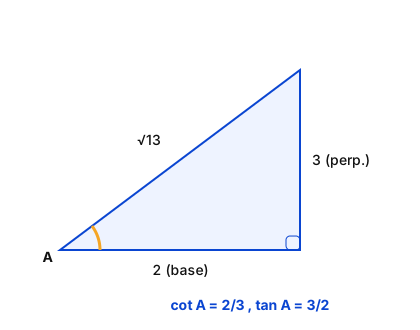
If 3cotA=2, then find the value of 3(csc2A−1)(sec2A−1).
यदि 3cotA=2 है, तो 3(csc2A−1)(sec2A−1) का मान ज्ञात कीजिए।
  1. A239
  2. B233
  3. C439
  4. D433
Show answer

Concept: Use csc2A−1=cot2A and sec2A−1=tan2A.

  1. 3cotA=2⇒cotA=23, tanA=32.
  2. 3cot2Atan2A=3cot4A=3cot2A.
  3. =3×49=439.

Trick: cot2Atan2A=cot4A – the root then just gives cot2A.

Answer: (C) 439

अवधारणा: csc2A−1=cot2A और sec2A−1=tan2A का प्रयोग करें।

  1. cotA=23, tanA=32।
  2. 3cot2Atan2A=3cot2A।
  3. =3×49=439।

ट्रिक: cot2Atan2A=cot4A, वर्गमूल से cot2A।

उत्तर: (C) 439

RRB NTPC Graduate CBT 1MathematicsTrigonometric identitiesRRB NTPC Graduate CBT 1 2024 · 19 Jun Shift 3
Q384.
Find the effective price percentage of the marked price after three consecutive discounts of 8%, 17% and 17%. (Rounded up to two decimal places.)
8%, 17% और 17% की तीन क्रमिक छूटों के बाद अंकित मूल्य का प्रभावी मूल्य प्रतिशत ज्ञात कीजिए। (दशमलव के दो स्थानों तक पूर्णांकित)
  1. A64.53%
  2. B64.71%
  3. C63.38%
  4. D64.51%
Show answer

Concept: Effective price =MP×(1−d1100)(1−d2100)(1−d3100).

  1. 0.92×0.83×0.83=0.92×0.6889.
  2. =0.633788≈63.38% of marked price.

Trick: Discounts cannot simply be added (42% would give 58%) – always multiply the remaining fractions.

Answer: (C) 63.38%

अवधारणा: प्रभावी मूल्य =MP×(1−d1100)(1−d2100)(1−d3100)।

  1. 0.92×0.83×0.83=0.92×0.6889।
  2. =0.633788≈63.38%।

ट्रिक: छूटें जोड़ी नहीं जातीं — शेष भागों का गुणा करें।

उत्तर: (C) 63.38%

RRB NTPC Graduate CBT 1MathematicsSuccessive discountsRRB NTPC Graduate CBT 1 2024 · 19 Jun Shift 3
Q385.
15 chairs and 3 tables cost ₹7,800 and 14 chairs and 6 tables cost ₹9,200. What is the cost of 17 chairs and 18 tables?
15 कुर्सियों और 3 मेज़ों का मूल्य ₹7,800 है तथा 14 कुर्सियों और 6 मेज़ों का मूल्य ₹9,200 है। 17 कुर्सियों और 18 मेज़ों का मूल्य कितना है?
  1. A₹17,598
  2. B₹17,604
  3. C₹17,600
  4. D₹17,596
Show answer

Concept: Let a chair cost c and a table t; solve the two equations.

  1. 15c+3t=7800 … (i), 14c+6t=9200 … (ii).
  2. 2×(i) − (ii): 30c−14c=15600−9200⇒16c=6400⇒c=400.
  3. 3t=7800−6000=1800⇒t=600.
  4. 17c+18t=6800+10800=17600.

Trick: Doubling (i) makes the table terms equal (6t), so subtract directly.

Answer: (C) ₹17,600

अवधारणा: कुर्सी का मूल्य c और मेज़ का t मानें।

  1. 15c+3t=7800 … (i), 14c+6t=9200 … (ii)।
  2. 2×(i) − (ii): 16c=6400⇒c=400।
  3. 3t=1800⇒t=600।
  4. 17c+18t=6800+10800=17600।

ट्रिक: (i) को दोगुना करने पर 6t बराबर हो जाता है।

उत्तर: (C) ₹17,600

RRB NTPC Graduate CBT 1MathematicsLinear equationsRRB NTPC Graduate CBT 1 2024 · 19 Jun Shift 3
Q386.
A man receives ₹7,915 per month as salary. He saves 20% of his salary every month. His expenditure per month is:
एक व्यक्ति को वेतन के रूप में प्रति माह ₹7,915 प्राप्त होते हैं। वह प्रत्येक माह अपने वेतन का 20% बचाता है। उसका प्रति माह व्यय है:
  1. A₹6,420
  2. B₹6,332
  3. C₹6,270
  4. D₹6,346
Show answer

Concept: Expenditure =(100−saving%) of income.

  1. Expenditure =80% of 7915.
  2. =45×7915=4×1583=6332.

Trick: 80%=45: divide by 5, multiply by 4.

Answer: (B) ₹6,332

अवधारणा: व्यय =(100−बचत%) आय का।

  1. व्यय =7915 का 80%।
  2. =45×7915=6332।

ट्रिक: 80%=45: 5 से भाग, 4 से गुणा।

उत्तर: (B) ₹6,332

RRB NTPC Graduate CBT 1MathematicsPercentage – savingsRRB NTPC Graduate CBT 1 2024 · 19 Jun Shift 3
Q387.
A man takes 13 hours to swim 91 km downstream. He swims 39 km upstream in the same time. What is the speed (in km/hr) of the boat in still water?
एक व्यक्ति को धारा की दिशा में 91 km तैरने में 13 घंटे लगते हैं। वह उतने ही समय में धारा की विपरीत दिशा में 39 km तैरता है। शांत जल में नाव की चाल (km/hr में) क्या है?
  1. A5
  2. B8
  3. C1
  4. D9
Show answer

Concept: Speed in still water =downstream+upstream2.

  1. Downstream speed =9113=7km/h.
  2. Upstream speed =3913=3km/h.
  3. Still-water speed =7+32=5km/h.

Trick: Stream speed =7−32=2 – useful if asked next.

Answer: (A) 5

अवधारणा: शांत जल में चाल =अनुप्रवाह+ऊर्ध्वप्रवाह2।

  1. अनुप्रवाह =9113=7km/h।
  2. ऊर्ध्वप्रवाह =3913=3km/h।
  3. शांत जल चाल =7+32=5km/h।

ट्रिक: धारा की चाल =7−32=2।

उत्तर: (A) 5

RRB NTPC Graduate CBT 1MathematicsBoats and streamsRRB NTPC Graduate CBT 1 2024 · 19 Jun Shift 3
Q388.
Let a be an odd positive integer. If the roots of a quadratic equation x2 − (a − 1)x + 4a + 7 = 0 are integers, then the least value of a is:
मान लीजिए a एक विषम धनात्मक पूर्णांक है। यदि द्विघात समीकरण x2 − (a − 1)x + 4a + 7 = 0 के मूल पूर्णांक हैं, तो a का न्यूनतम मान है:
  1. A25
  2. B19
  3. C21
  4. D23
Show answer

Concept: Integer roots need the discriminant D=b2−4ac to be a perfect square.

  1. D=(a−1)2−4(4a+7)=a2−18a−27=(a−9)2−108.
  2. Let D=k2: (a−9−k)(a−9+k)=108; both factors even → (2,54) or (6,18).
  3. (6,18): a−9=12⇒a=21; (2,54): a=37. Least odd positive a=21.
  4. Check: x2−20x+91=(x−7)(x−13) ✔.

Trick: Option test: put each option in (a−9)2−108; only a=21 gives 144−108=36, a perfect square.

Answer: (C) 21

अवधारणा: पूर्णांक मूलों के लिए विविक्तकर D=b2−4ac पूर्ण वर्ग होना चाहिए।

  1. D=(a−1)2−4(4a+7)=(a−9)2−108।
  2. D=k2: (a−9−k)(a−9+k)=108; दोनों गुणनखंड सम → (2,54) या (6,18)।
  3. (6,18) से a=21; (2,54) से a=37। न्यूनतम a=21।
  4. जाँच: x2−20x+91=(x−7)(x−13) ✔।

ट्रिक: विकल्प जाँच: a=21 पर (a−9)2−108=36 — पूर्ण वर्ग।

उत्तर: (C) 21

RRB NTPC Graduate CBT 1MathematicsQuadratic equationsRRB NTPC Graduate CBT 1 2024 · 19 Jun Shift 3
Q389.
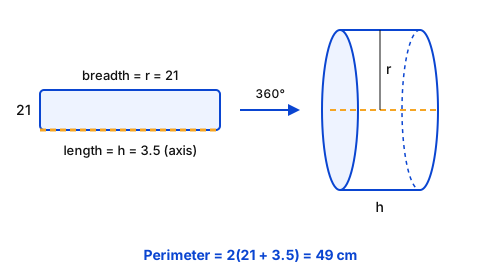
The volume of a right circular cylinder is 4851 cm3 and its curved surface area is 462 cm2. If this cylinder is generated by rotating a rectangle about its length by 360°, what will be the perimeter (in cm) of this rectangle?
Use π=227
एक लंब वृत्तीय बेलन का आयतन 4851 cm3 है और इसका वक्र पृष्ठीय क्षेत्रफल 462 cm2 है। यदि यह बेलन एक आयत को उसकी लंबाई के परितः 360° घुमाकर बनाया गया है, तो इस आयत का परिमाप (cm में) क्या होगा?
π=227 का प्रयोग कीजिए
  1. A53
  2. B49
  3. C43
  4. D47
Show answer

Concept: Rotating a rectangle about its length makes length =h and breadth =r; VCSA=πr2h2πrh=r2.

  1. r2=4851462=10.5⇒r=21cm.
  2. 2×227×21×h=462⇒132h=462⇒h=3.5cm.
  3. Perimeter =2(21+3.5)=49cm.

Trick: Divide volume by CSA to get r2 at once.

Answer: (B) 49

अवधारणा: आयत को लंबाई के परितः घुमाने पर लंबाई =h, चौड़ाई =r; VCSA=r2।

  1. r2=4851462=10.5⇒r=21cm।
  2. 132h=462⇒h=3.5cm।
  3. परिमाप =2(21+3.5)=49cm।

ट्रिक: आयतन ÷ वक्र पृष्ठ =r2।

उत्तर: (B) 49

RRB NTPC Graduate CBT 1MathematicsMensuration – cylinderRRB NTPC Graduate CBT 1 2024 · 19 Jun Shift 3
Q390.
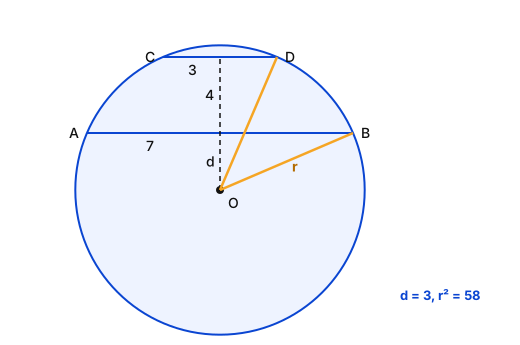
In a circle, two chords, AB and CD, measuring 14 cm and 6 cm, respectively, are parallel to each other on the same side of the centre. If the distance between them is 4 cm, find the length (in cm) of the diameter of the circle.
एक वृत्त में, दो जीवाएँ AB और CD, जिनकी माप क्रमशः 14 cm और 6 cm है, केंद्र के एक ही ओर एक-दूसरे के समांतर हैं। यदि उनके बीच की दूरी 4 cm है, तो वृत्त के व्यास की लंबाई (cm में) ज्ञात कीजिए।
  1. A229
  2. B258
  3. C58
  4. D29
Show answer

Concept: The perpendicular from the centre bisects a chord: r2=(half chord)2+(distance)2.

  1. Let AB be at distance d from O; CD (same side) is at d+4.
  2. r2=72+d2=32+(d+4)2⇒49=25+8d⇒d=3.
  3. r2=49+9=58⇒r=58; diameter =258.

Trick: Longer chord is nearer the centre, so on the same side the shorter chord is at d+4.

Answer: (B) 258

अवधारणा: केंद्र से लंब जीवा को समद्विभाजित करता है: r2=(आधी जीवा)2+(दूरी)2।

  1. AB की दूरी d; CD (उसी ओर) की दूरी d+4।
  2. 49+d2=9+(d+4)2⇒8d=24⇒d=3।
  3. r2=58⇒ व्यास =258।

ट्रिक: बड़ी जीवा केंद्र के अधिक पास होती है।

उत्तर: (B) 258

RRB NTPC Graduate CBT 1MathematicsCircle – chordsRRB NTPC Graduate CBT 1 2024 · 19 Jun Shift 3
Q391.
Three numbers are in the ratio 1 : 11 : 19, and their LCM is 8778. Their HCF is _____.
तीन संख्याएँ 1 : 11 : 19 के अनुपात में हैं, और उनका LCM 8778 है। उनका HCF _____ है।
  1. A42
  2. B36
  3. C54
  4. D50
Show answer

Concept: If numbers are x,11x,19x with 1,11,19 pairwise co-prime, then HCF =x and LCM =1×11×19×x.

  1. LCM =209x.
  2. 209x=8778⇒x=8778209=42.
  3. So HCF =42 (numbers 42, 462, 798).

Trick: For co-prime ratio terms, HCF =LCMproduct of ratio terms.

Answer: (A) 42

अवधारणा: संख्याएँ x,11x,19x हैं; 1,11,19 परस्पर सह-अभाज्य (co-prime) हैं, अतः HCF =x और LCM =1×11×19×x।

  1. LCM =209x।
  2. 209x=8778⇒x=8778209=42।
  3. अतः HCF =42 (संख्याएँ 42, 462, 798)।

ट्रिक: सह-अभाज्य अनुपात में HCF =LCMअनुपात पदों का गुणनफल।

उत्तर: (A) 42

RRB NTPC Graduate CBT 1MathematicsHCF and LCMRRB NTPC Graduate CBT 1 2024 · 19 Jun Shift 2
Q392.
The mode of the observations 35, 27, 27, 32, 25, 24, 27, 24, 32, 20, 31, 21, 29, 22, 27, 20 and 26 is:
प्रेक्षणों 35, 27, 27, 32, 25, 24, 27, 24, 32, 20, 31, 21, 29, 22, 27, 20 और 26 का बहुलक (mode) है:
  1. A35
  2. B25
  3. C27
  4. D32
Show answer

Concept: Mode is the observation that occurs most often.

  1. Frequencies: 27 occurs 4 times; 20, 24, 32 occur twice each; the rest once.
  2. Highest frequency is 4, for 27.

Trick: Just tally repeats — no calculation needed.

Answer: (C) 27

अवधारणा: बहुलक (Mode) वह मान है जो सबसे अधिक बार आता है।

  1. आवृत्ति: 27 चार बार; 20, 24, 32 दो-दो बार; बाकी एक-एक बार।
  2. सबसे अधिक आवृत्ति 4 है, जो 27 की है।

ट्रिक: बस दोहराव गिनें — कोई गणना नहीं।

उत्तर: (C) 27

RRB NTPC Graduate CBT 1MathematicsModeRRB NTPC Graduate CBT 1 2024 · 19 Jun Shift 2
Q393.
One-third of a journey is covered at a speed of 31 km/hr, the next one-third of the journey is covered at a speed of 4 km/hr, and the remaining journey is covered at a speed of 34 km/hr. The average speed (in km/hr, rounded off to one decimal place) for the entire journey is:
किसी यात्रा का एक-तिहाई भाग 31 km/hr की चाल से, अगला एक-तिहाई भाग 4 km/hr की चाल से, और शेष यात्रा 34 km/hr की चाल से तय की जाती है। संपूर्ण यात्रा की औसत चाल (km/hr में, दशमलव के एक स्थान तक पूर्णांकित) है:
  1. A3.1
  2. B7.1
  3. C6.3
  4. D9.6
Show answer

Concept: For equal distances at speeds a,b,c: average speed =31a+1b+1c.

  1. 131+14+134≈0.03226+0.25+0.02941=0.31167.
  2. Average speed =30.31167≈9.63.
  3. Rounded to one decimal: 9.6km/h.

Trick: The slow 4 km/h stretch dominates: time on it alone is 112 of the journey per km-unit, so the answer must be a little under 3×4=12 — only 9.6 fits sensibly.

Answer: (D) 9.6

अवधारणा: बराबर दूरियाँ चालों a,b,c से तय हों तो औसत चाल =31a+1b+1c।

  1. 131+14+134≈0.03226+0.25+0.02941=0.31167।
  2. औसत चाल =30.31167≈9.63।
  3. एक दशमलव तक: 9.6km/h।

ट्रिक: धीमी 4 km/h वाली दूरी समय पर हावी है, इसलिए उत्तर 12 से थोड़ा कम होगा — केवल 9.6 उपयुक्त है।

उत्तर: (D) 9.6

RRB NTPC Graduate CBT 1MathematicsAverage SpeedRRB NTPC Graduate CBT 1 2024 · 19 Jun Shift 2
Q394.
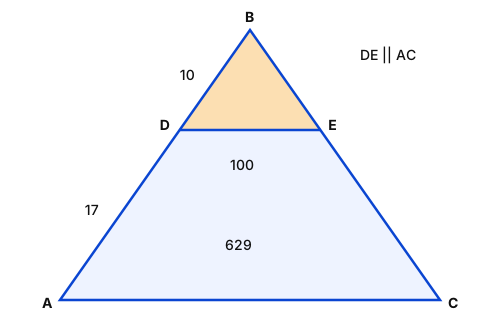
In △ABC, DE∥AC, where D and E are the points on sides AB and BC, respectively.
If BD = 10 cm and AD = 17 cm, then what is the ratio of the area of △BDE to the trapezium ADEC?
△ABC में, DE∥AC, जहाँ D और E क्रमशः भुजाओं AB और BC पर स्थित बिंदु हैं।
यदि BD = 10 cm और AD = 17 cm है, तो △BDE के क्षेत्रफल और समलंब ADEC के क्षेत्रफल का अनुपात क्या है?
  1. A344 : 415
  2. B629 : 100
  3. C406 : 383
  4. D100 : 629
Show answer

Concept: If DE∥AC, then △BDE~△BAC and the ratio of areas equals the square of the ratio of corresponding sides.

  1. BA=BD+AD=10+17=27.
  2. ar(BDE)ar(BAC)=(1027)2=100729.
  3. Trapezium ADEC=729−100=629 parts.
  4. Required ratio =100:629.

Trick: Square the side ratio, then subtract: 102:(272−102).

Answer: (D) 100:629

अवधारणा: DE∥AC होने से △BDE~△BAC; समरूप त्रिभुजों के क्षेत्रफलों का अनुपात संगत भुजाओं के अनुपात का वर्ग होता है।

  1. BA=BD+AD=10+17=27।
  2. ar(BDE)ar(BAC)=(1027)2=100729।
  3. समलंब ADEC=729−100=629 भाग।
  4. अभीष्ट अनुपात =100:629।

ट्रिक: भुजा अनुपात का वर्ग लें, फिर घटाएँ: 102:(272−102)।

उत्तर: (D) 100:629

RRB NTPC Graduate CBT 1MathematicsSimilar Triangles – Area RatioRRB NTPC Graduate CBT 1 2024 · 19 Jun Shift 2
Q395.
A sum, when invested at 20% simple interest per annum, amounts to ₹8,640 after 3 years. What is the simple interest (in ₹) on the same sum at the same rate in 2 years?
एक राशि, 20% वार्षिक साधारण ब्याज पर निवेश किए जाने पर 3 वर्षों में ₹8,640 हो जाती है। उसी राशि पर समान दर से 2 वर्षों में साधारण ब्याज (₹ में) कितना होगा?
  1. A4,320
  2. B2,160
  3. C8,640
  4. D1,080
Show answer

Concept: Amount A=P(1+RT100) and SI=PRT100.

  1. 3 years at 20% → SI =60% of P, so A=1.6P=8640.
  2. P=86401.6=5400.
  3. SI for 2 years =5400×40100=2160.

Trick: 160%→8640, so 40%→86404=2160.

Answer: (B) ₹2,160

अवधारणा: मिश्रधन A=P(1+RT100) तथा SI=PRT100।

  1. 3 वर्ष, 20% → SI =P का 60%, अतः A=1.6P=8640।
  2. P=86401.6=5400।
  3. 2 वर्ष का SI =5400×40100=2160।

ट्रिक: 160%→8640, अतः 40%→86404=2160।

उत्तर: (B) ₹2,160

RRB NTPC Graduate CBT 1MathematicsSimple InterestRRB NTPC Graduate CBT 1 2024 · 19 Jun Shift 2
Q396.
Ramesh purchased (4x−3y) dolls from a shop at the rate of ₹(x+y) per doll. Find the total money paid by Ramesh to the shopkeeper.
रमेश ने एक दुकान से (4x−3y) गुड़ियाँ ₹(x+y) प्रति गुड़िया की दर से खरीदीं। रमेश द्वारा दुकानदार को भुगतान की गई कुल राशि ज्ञात कीजिए।
  1. A₹(x2−xy+3y2)
  2. B₹(4x2+xy−3y2)
  3. C₹(4x2−xy+y2)
  4. D₹(x2−xy+y2)
Show answer

Concept: Total cost = number of dolls × rate per doll.

  1. Total =(4x−3y)(x+y).
  2. =4x2+4xy−3xy−3y2.
  3. =4x2+xy−3y2.

Trick: Check with x=y=1: dolls =1, rate ₹2, total ₹2; only 4+1−3=2 matches.

Answer: (B) ₹(4x2+xy−3y2)

अवधारणा: कुल राशि = गुड़ियों की संख्या × प्रति गुड़िया दर।

  1. कुल =(4x−3y)(x+y)।
  2. =4x2+4xy−3xy−3y2।
  3. =4x2+xy−3y2।

ट्रिक: x=y=1 रखें: 1 गुड़िया, दर ₹2, कुल ₹2; केवल 4+1−3=2 मेल खाता है।

उत्तर: (B) ₹(4x2+xy−3y2)

RRB NTPC Graduate CBT 1MathematicsAlgebra – Multiplication of PolynomialsRRB NTPC Graduate CBT 1 2024 · 19 Jun Shift 2
Q397.
A shopkeeper sold a book for ₹225 at a loss of 10%. At what price (in ₹) should he have to sell it to gain 24% on it?
एक दुकानदार ने एक पुस्तक 10% की हानि पर ₹225 में बेची। उस पर 24% का लाभ प्राप्त करने के लिए उसे इसे किस मूल्य (₹ में) पर बेचना चाहिए था?
  1. A310
  2. B307
  3. C311
  4. D308
Show answer

Concept: CP=SP×100100−Loss% and new SP=CP×100+Gain%100.

  1. CP=225×10090=250.
  2. For 24% gain: SP=250×1.24=310.

Trick: Directly: 225×12490=310.

Answer: (A) ₹310

अवधारणा: क्रय मूल्य=विक्रय मूल्य×100100−हानि%, नया विक्रय मूल्य=क्रय मूल्य×100+लाभ%100।

  1. CP=225×10090=250।
  2. 24% लाभ के लिए: SP=250×1.24=310।

ट्रिक: सीधे: 225×12490=310।

उत्तर: (A) ₹310

RRB NTPC Graduate CBT 1MathematicsProfit and LossRRB NTPC Graduate CBT 1 2024 · 19 Jun Shift 2
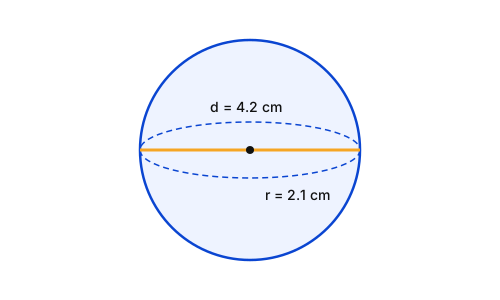
Q398.
Find the volume (in cm3) of a sphere having a diameter of 4.2 cm, giving your answer correct to two places of decimal.
Take π=227
4.2 cm व्यास वाले एक गोले का आयतन (cm3 में) ज्ञात कीजिए, अपना उत्तर दशमलव के दो स्थानों तक सही दीजिए।
π=227 लीजिए
  1. A18.8
  2. B188.8
  3. C38.8
  4. D168.8
Show answer

Concept: Volume of a sphere V=43πr3.

  1. r=4.22=2.1cm, r3=9.261.
  2. V=43×227×9.261=8821×9.261.
  3. =88×0.441=38.808≈38.8cm3.

Trick: 2.1=3×0.7, so 227 cancels neatly: 8821×9.261=88×0.441.

Answer: (C) 38.8

अवधारणा: गोले का आयतन V=43πr3।

  1. r=4.22=2.1cm, r3=9.261।
  2. V=43×227×9.261=8821×9.261।
  3. =88×0.441=38.808≈38.8cm3।

ट्रिक: 2.1=3×0.7, इसलिए 227 आसानी से कटता है: 88×0.441।

उत्तर: (C) 38.8

RRB NTPC Graduate CBT 1MathematicsMensuration – SphereRRB NTPC Graduate CBT 1 2024 · 19 Jun Shift 2
Q399.
A group of people consists of men, women and children. Among them, 20% are men, 30% are women and the rest are children, and their average weights are 50 kg, 40 kg and 40 kg, respectively. The average weight of the group (in kg) is:
लोगों के एक समूह में पुरुष, महिलाएँ और बच्चे हैं। इनमें से 20% पुरुष, 30% महिलाएँ और शेष बच्चे हैं, और उनका औसत भार क्रमशः 50 kg, 40 kg और 40 kg है। समूह का औसत भार (kg में) है:
  1. A39
  2. B37
  3. C42
  4. D38
Show answer

Concept: Average of groups =∑(share×average).

  1. Children =100−20−30=50%.
  2. Average =0.2×50+0.3×40+0.5×40.
  3. =10+12+20=42kg.

Trick: 80% weigh 40 kg; men add 0.2×10=2 extra → 40+2=42.

Answer: (C) 42

अवधारणा: समूह का औसत =∑(हिस्सा×औसत)।

  1. बच्चे =100−20−30=50%।
  2. औसत =0.2×50+0.3×40+0.5×40।
  3. =10+12+20=42kg।

ट्रिक: 80% का भार 40 kg; पुरुष 0.2×10=2 अतिरिक्त जोड़ते हैं → 40+2=42।

उत्तर: (C) 42

RRB NTPC Graduate CBT 1MathematicsWeighted AverageRRB NTPC Graduate CBT 1 2024 · 19 Jun Shift 2
Q400.
Simplify: [(24×6)×{2÷2×(18−122)}]
सरल कीजिए: [(24×6)×{2÷2×(18−122)}]
  1. A432
  2. B1435
  3. C872
  4. D1728
Show answer

Concept: Solve innermost brackets first, then division and multiplication from left to right.

  1. 18−122=18−6=12.
  2. 2÷2×12=1×12=12.
  3. (24×6)×12=144×12=1728.

Trick: 1728=123 — a familiar cube.

Answer: (D) 1728

अवधारणा: पहले सबसे भीतरी कोष्ठक, फिर भाग और गुणा बाएँ से दाएँ।

  1. 18−122=18−6=12।
  2. 2÷2×12=1×12=12।
  3. (24×6)×12=144×12=1728।

ट्रिक: 1728=123 — परिचित घन।

उत्तर: (D) 1728

RRB NTPC Graduate CBT 1MathematicsSimplification (BODMAS)RRB NTPC Graduate CBT 1 2024 · 19 Jun Shift 2