Q401.A group of numbers and symbols is coded using letter codes as per the codes given below and the conditions that follow. Study the given codes and conditions and answer the question that follows.
Note: If none of the conditions apply, then codes for the respective number/symbol are to be followed directly as given in the table.
| Number/symbol | 5 | 2 | 3 | 4 | $ | & | 6 | @ | # | % | + | 8 | 9 | 7 |
|---|
| Code | A | D | F | G | H | J | K | L | Z | X | C | V | B | M |
|---|
Conditions:
(i) If the first element is a symbol and the last a number, the codes for these two (the first and the last elements) are to be interchanged.
(ii) If the first element is an odd number and the last an even number, the first and last elements are to be coded as ©.
(iii) If both second and third elements are perfect squares, the third element is to be coded as the code for the second element.
What will be the code for the following group?
3 4 9 7
संख्याओं और प्रतीकों के एक समूह को नीचे दिए गए कूटों और उसके बाद दी गई शर्तों के अनुसार अक्षर कूटों का उपयोग करके कूटबद्ध किया गया है। दिए गए कूटों और शर्तों का अध्ययन कीजिए और उसके बाद दिए गए प्रश्न का उत्तर दीजिए।
ध्यान दें: यदि कोई भी शर्त लागू नहीं होती है, तो संबंधित संख्या/प्रतीक के लिए तालिका में दिए गए कूटों का सीधे अनुसरण किया जाना है।
| संख्या/प्रतीक | 5 | 2 | 3 | 4 | $ | & | 6 | @ | # | % | + | 8 | 9 | 7 |
|---|
| कूट | A | D | F | G | H | J | K | L | Z | X | C | V | B | M |
|---|
शर्तें:
(i) यदि पहला तत्व एक प्रतीक है और अंतिम तत्व एक संख्या है, तो इन दोनों (पहले और अंतिम तत्वों) के कूटों को आपस में बदल दिया जाना है।
(ii) यदि पहला तत्व एक विषम संख्या है और अंतिम तत्व एक सम संख्या है, तो पहले और अंतिम तत्वों को © के रूप में कूटबद्ध किया जाना है।
(iii) यदि दूसरा और तीसरा दोनों तत्व पूर्ण वर्ग हैं, तो तीसरे तत्व को दूसरे तत्व के कूट के रूप में कूटबद्ध किया जाना है।
निम्नलिखित समूह का कूट क्या होगा?
3 4 9 7
- AMGBF
- BFGBM
- CFGGM
- DFBBM
Show answer
Concept: Write the direct codes, then test each condition in order.
- Direct codes: 3 = F, 4 = G, 9 = B, 7 = M.
- Condition 1: first element is not a symbol — no. Condition 2: last element 7 is odd, not even — no.
- Condition 3: second (4) and third (9) are both perfect squares → third gets the code of the second, G.
- Code = F G G M.
Trick: Condition 3 makes two adjacent letters identical — look for a repeated letter among options.
Answer: (C) FGGM
अवधारणा: पहले सीधे कोड लिखें, फिर शर्तें क्रम से जाँचें।
- सीधे कोड: 3 = F, 4 = G, 9 = B, 7 = M।
- शर्त 1: पहला तत्व प्रतीक नहीं — लागू नहीं। शर्त 2: अंतिम 7 विषम है, सम नहीं — लागू नहीं।
- शर्त 3: दूसरा (4) और तीसरा (9) दोनों पूर्ण वर्ग → तीसरे को दूसरे का कोड G मिलेगा।
- कोड = F G G M।
ट्रिक: शर्त 3 से दो पास-पास के अक्षर समान होंगे — विकल्पों में दोहराया अक्षर देखें।
उत्तर: (C) FGGM
RRB NTPC Graduate CBT 1General Intelligence and ReasoningCoding with ConditionsRRB NTPC Graduate CBT 1 2024 · 19 Jun Shift 2
Q402.Which of the following letter-number clusters will replace the question mark (?) in the given series to make it logically complete?
QK15 OI26 MG37 KE48 ?
दी गई श्रृंखला को तार्किक रूप से पूर्ण करने के लिए निम्नलिखित में से कौन-सा अक्षर-संख्या समूह प्रश्न चिह्न (?) को प्रतिस्थापित करेगा?
QK15 OI26 MG37 KE48 ?
- AIC59
- BID58
- CIC58
- DID59
Show answer
Concept: Track each part of the term separately.
- First letter: Q, O, M, K → −2 each → I.
- Second letter: K, I, G, E → −2 each → C.
- Number: 15, 26, 37, 48 → +11 each → 59.
- Next term = IC59.
Trick: Numbers rise by 11 (tens and units both +1) — 59 eliminates options B and C immediately.
Answer: (A) IC59
अवधारणा: पद के हर भाग को अलग-अलग देखें।
- पहला अक्षर: Q, O, M, K → हर बार −2 → I।
- दूसरा अक्षर: K, I, G, E → −2 → C।
- संख्या: 15, 26, 37, 48 → +11 → 59।
- अगला पद = IC59।
ट्रिक: संख्या में +11 — 59 से B और C तुरंत बाहर।
उत्तर: (A) IC59
RRB NTPC Graduate CBT 1General Intelligence and ReasoningAlpha-Numeric SeriesRRB NTPC Graduate CBT 1 2024 · 19 Jun Shift 2
Q403.Based on the English alphabetical order, three of the following four letter-cluster pairs are alike in a certain way and thus form a group. Which letter-cluster pair DOES NOT belong to that group?
(Note: The odd one out is not based on the number of consonants/vowels or their position in the letter-cluster.)
अंग्रेज़ी वर्णमाला क्रम के आधार पर, निम्नलिखित चार अक्षर-समूह युग्मों में से तीन किसी निश्चित प्रकार से एकसमान हैं और इस प्रकार एक समूह बनाते हैं। कौन-सा अक्षर-समूह युग्म उस समूह से संबंधित नहीं है?
(ध्यान दें: असंगत अक्षर-समूह, उस अक्षर-समूह में व्यंजनों/स्वरों की संख्या या उनके स्थान पर आधारित नहीं है।)
- ATR – YP
- BVT – AR
- CYW – DV
- DGE – LC
Show answer
Concept: Compare the first letters of the two clusters and the second letters separately.
- TR – YP: T+5 = Y, R−2 = P.
- VT – AR: V+5 = A, T−2 = R; GE – LC: G+5 = L, E−2 = C.
- YW – DV: Y+5 = D but W−1 = V — breaks the rule.
Trick: Within each cluster the letters differ by −2 in all options, so check the cross-cluster shift.
Answer: (C) YW – DV
अवधारणा: दोनों क्लस्टर के पहले अक्षरों तथा दूसरे अक्षरों की अलग-अलग तुलना करें।
- TR – YP: T+5 = Y, R−2 = P।
- VT – AR: V+5 = A, T−2 = R; GE – LC: G+5 = L, E−2 = C।
- YW – DV: Y+5 = D पर W−1 = V — नियम टूटता है।
ट्रिक: क्लस्टर के भीतर सभी में −2 का अंतर है, अतः क्लस्टर के बीच का खिसकाव जाँचें।
उत्तर: (C) YW – DV
RRB NTPC Graduate CBT 1General Intelligence and ReasoningOdd One Out – Letter PairsRRB NTPC Graduate CBT 1 2024 · 19 Jun Shift 2
Q404.Each of P, Q, R, S, T, U and V has an exam on a different day of a week starting from Monday and ending on Sunday of the same week. Q has an exam on Saturday. Only 4 people have exams between T and U, neither of whom has an exam on Monday. P has an exam immediately after V, and R has an exam immediately before V. U has an exam after P. How many people have exams after R?
P, Q, R, S, T, U और V में से प्रत्येक की परीक्षा एक ही सप्ताह के सोमवार से प्रारंभ होकर रविवार को समाप्त होने वाले सप्ताह के एक अलग दिन है। Q की परीक्षा शनिवार को है। T और U के बीच केवल 4 व्यक्तियों की परीक्षा है, और इन दोनों में से किसी की भी परीक्षा सोमवार को नहीं है। P की परीक्षा V के ठीक बाद है, और R की परीक्षा V के ठीक पहले है। U की परीक्षा P के बाद है। R के बाद कितने व्यक्तियों की परीक्षा है?
- A2
- B3
- C1
- D4
Show answer
Concept: Fix the definite clues first, then the block R–V–P.
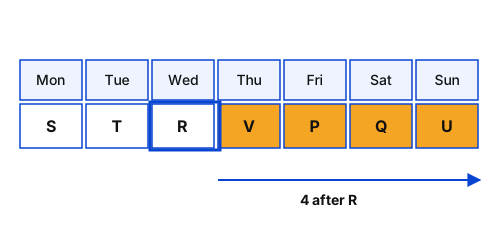
- 4 people between T and U → they are on (Mon, Sat) or (Tue, Sun); Monday is ruled out and Saturday is Q’s, so T/U = Tue/Sun.
- U is after P, so U = Sunday, T = Tuesday.
- R, V, P are consecutive → Wed, Thu, Fri; S gets Monday.
- After R (Wed): V, P, Q, U → 4 people.
Trick: A gap of 4 between two people in a 7-day week leaves only two placements — use it first.
Answer: (D) 4
अवधारणा: पहले निश्चित सुराग लगाएँ, फिर R–V–P का ब्लॉक।
- T और U के बीच 4 व्यक्ति → (सोम, शनि) या (मंगल, रवि); सोमवार वर्जित और शनिवार Q का, अतः T/U = मंगल/रवि।
- U, P के बाद है, अतः U = रविवार, T = मंगलवार।
- R, V, P लगातार → बुध, गुरु, शुक्र; S को सोमवार।
- R (बुध) के बाद: V, P, Q, U → 4 व्यक्ति।
ट्रिक: 7 दिनों में दो लोगों के बीच 4 का अंतर केवल दो स्थान देता है — इसे पहले लगाएँ।
उत्तर: (D) 4
RRB NTPC Graduate CBT 1General Intelligence and ReasoningScheduling PuzzleRRB NTPC Graduate CBT 1 2024 · 19 Jun Shift 2
Q405.A, B, C, D, R, S and T are sitting around a circular table facing the centre of the table. Only one person sits between D and T when counted from the left of T. S sits third to the right of R. C sits third to the left of A. S sits to the immediate right of C. B is not an immediate neighbour of C. How many people sit between B and T when counted from the right of B?
A, B, C, D, R, S और T एक वृत्ताकार मेज़ के चारों ओर मेज़ के केंद्र की ओर मुख करके बैठे हैं। T के बाईं ओर से गिनने पर D और T के बीच केवल एक व्यक्ति बैठा है। S, R के दाईं ओर तीसरे स्थान पर बैठा है। C, A के बाईं ओर तीसरे स्थान पर बैठा है। S, C के ठीक दाईं ओर बैठा है। B, C का निकटतम पड़ोसी नहीं है। B के दाईं ओर से गिनने पर B और T के बीच कितने व्यक्ति बैठे हैं?
- ATwoदो
- BFourचार
- CThreeतीन
- DOneएक
Show answer
Concept: Facing the centre: left = clockwise, right = anticlockwise.
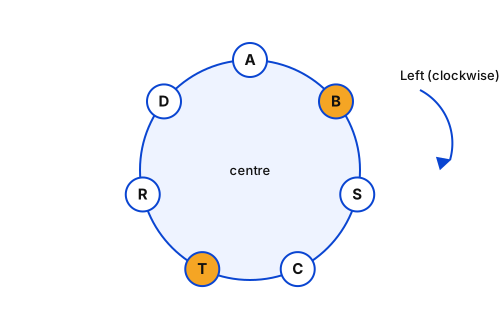
- C is third to the left of A; S is immediate right of C; S is third to the right of R.
- Taking A first, clockwise: A, _, S, C, _, R, _ .
- D is second to the left of T → T in 5th place and D in 7th; B (not beside C) takes the 2nd seat: A, B, S, C, T, R, D.
- From the right of B (anticlockwise): B → A, D, R → T: 3 people between.
Trick: Chain the “third to” clues (A–C–S–R) first; they fix four seats at once.
Answer: (C) Three
अवधारणा: केंद्र की ओर मुख: बाएँ = दक्षिणावर्त, दाएँ = वामावर्त।
- C, A के बाएँ तीसरे; S, C के ठीक दाएँ; S, R के दाएँ तीसरे स्थान पर।
- A से दक्षिणावर्त: A, _, S, C, _, R, _ ।
- D, T के बाएँ दूसरे → T पाँचवें, D सातवें; B (C का पड़ोसी नहीं) दूसरे स्थान पर: A, B, S, C, T, R, D।
- B के दाएँ से गिनें: B → A, D, R → T: बीच में 3 व्यक्ति।
ट्रिक: पहले “तीसरे स्थान” वाले सुराग (A–C–S–R) जोड़ें; चार सीटें एक साथ तय होती हैं।
उत्तर: (C) तीन
RRB NTPC Graduate CBT 1General Intelligence and ReasoningCircular Seating ArrangementRRB NTPC Graduate CBT 1 2024 · 19 Jun Shift 2
Q406.What will come in place of the question mark (?) in the following equation if '÷' and '–' are interchanged and '×' and '+' are interchanged?
612 ÷ 45 + 13 × 936 – 78 = ?
यदि '÷' और '–' को आपस में बदल दिया जाए तथा '×' और '+' को आपस में बदल दिया जाए, तो निम्नलिखित समीकरण में प्रश्न चिह्न (?) के स्थान पर क्या आएगा?
612 ÷ 45 + 13 × 936 – 78 = ?
- A39
- B15
- C106
- D112
Show answer
Concept: Swap the signs as told, then apply BODMAS.
- After swapping: .
- , .
- .
Trick: Do the swap in writing first — most errors come from swapping mentally.
Answer: (A) 39
अवधारणा: बताए अनुसार चिह्न बदलें, फिर BODMAS लगाएँ।
- बदलने के बाद: ।
- , ।
- ।
ट्रिक: पहले चिह्न बदलकर लिख लें — मन में बदलने से गलती होती है।
उत्तर: (A) 39
RRB NTPC Graduate CBT 1General Intelligence and ReasoningMathematical Operations – InterchangeRRB NTPC Graduate CBT 1 2024 · 19 Jun Shift 2
Q407.If 1 is added to each odd digit and 2 is subtracted from each even digit in the number 1836547, what will be the sum of the digits that are second from the left and second from the right in the new number thus formed?
यदि संख्या 1836547 में प्रत्येक विषम अंक में 1 जोड़ा जाए और प्रत्येक सम अंक में से 2 घटाया जाए, तो इस प्रकार बनी नई संख्या में बाएँ से दूसरे और दाएँ से दूसरे अंकों का योग क्या होगा?
- A12
- B8
- C10
- D14
Show answer
Concept: Change every digit as per the rule, then read the required positions.
- 1836547: odd digits +1 (1→2, 3→4, 5→6, 7→8), even digits −2 (8→6, 6→4, 4→2).
- New number: 2644628.
- Second from left = 6, second from right = 2; .
Trick: Only the 2nd and 6th digits matter: 8→6 and 4→2.
Answer: (B) 8
अवधारणा: हर अंक को नियम के अनुसार बदलें, फिर आवश्यक स्थान पढ़ें।
- 1836547: विषम अंक +1 (1→2, 3→4, 5→6, 7→8), सम अंक −2 (8→6, 6→4, 4→2)।
- नई संख्या: 2644628।
- बाएँ से दूसरा = 6, दाएँ से दूसरा = 2; ।
ट्रिक: केवल दूसरा और छठा अंक मायने रखते हैं: 8→6 और 4→2।
उत्तर: (B) 8
RRB NTPC Graduate CBT 1General Intelligence and ReasoningDigit OperationsRRB NTPC Graduate CBT 1 2024 · 19 Jun Shift 2
Q408.Select the set in which the numbers are related in the same way as are the numbers of the following sets.
(NOTE: Operations should be performed on the whole numbers, without breaking down the numbers into their constituent digits. E.g. 13 – Operations on 13 such as adding to/subtracting from/multiplying with 13 can be performed. Breaking down 13 into 1 and 3 and then performing mathematical operations on 1 and 3 is not allowed.)
(15, 18.2, 21.4)
(19, 22.2, 25.4)
उस समुच्चय का चयन कीजिए जिसमें संख्याएँ उसी प्रकार संबंधित हैं जिस प्रकार निम्नलिखित समुच्चयों की संख्याएँ संबंधित हैं।
(ध्यान दें: संख्याओं को उनके घटक अंकों में विभाजित किए बिना, संक्रियाएँ पूर्ण संख्याओं पर की जानी चाहिए। उदाहरण के लिए, 13 – 13 पर संक्रियाएँ जैसे 13 में जोड़ना/13 में से घटाना/13 से गुणा करना आदि की जा सकती हैं। 13 को 1 और 3 में विभाजित करके फिर 1 और 3 पर गणितीय संक्रियाएँ करने की अनुमति नहीं है।)
(15, 18.2, 21.4)
(19, 22.2, 25.4)
- A(43, 46.2, 48.4)
- B(28, 30.2, 32.4)
- C(36, 39.2, 41.4)
- D(24, 27.2, 30.4)
Show answer
Concept: Find how the 2nd and 3rd numbers come from the 1st.
- So each term is from the previous.
- Check (D): ✓. Others fail, e.g. (A) .
Trick: Same constant difference () twice — check both gaps in each option.
Answer: (D) (24, 27.2, 30.4)
अवधारणा: दूसरी और तीसरी संख्या पहली से कैसे बनती है, देखें।
- हर पद पिछले से है।
- (D): ✓। बाकी में दूसरा अंतर नहीं है।
ट्रिक: दोनों अंतर होने चाहिए — हर विकल्प में दोनों जाँचें।
उत्तर: (D) (24, 27.2, 30.4)
RRB NTPC Graduate CBT 1General Intelligence and ReasoningNumber set analogyRRB NTPC Graduate CBT 1 2024 · 19 Jun Shift 2
Q409.Read the given statements and conclusions carefully. Assuming that the information given in the statements is true, even if it appears to be at variance with commonly known facts, decide which of the given conclusion(s) logically follow(s) from the statements.
Statements:
Some protein are carbs.
Some protein are vitamin.
Some carbs are sugar.
Conclusions:
(I) Some protein are sugar.
(II) Some carbs are vitamin.
दिए गए कथनों और निष्कर्षों को ध्यानपूर्वक पढ़िए। कथनों में दी गई जानकारी को सत्य मानते हुए, भले ही वह सामान्यतः ज्ञात तथ्यों से भिन्न प्रतीत होती हो, निर्णय कीजिए कि दिए गए निष्कर्षों में से कौन-सा/से निष्कर्ष कथनों का तार्किक रूप से अनुसरण करता है/करते हैं।
कथन:
कुछ प्रोटीन, कार्ब्स हैं।
कुछ प्रोटीन, विटामिन हैं।
कुछ कार्ब्स, शर्करा हैं।
निष्कर्ष:
(I) कुछ प्रोटीन, शर्करा हैं।
(II) कुछ कार्ब्स, विटामिन हैं।
- AOnly conclusion (II) followsकेवल निष्कर्ष (II) अनुसरण करता है
- BOnly conclusion (I) followsकेवल निष्कर्ष (I) अनुसरण करता है
- CNeither conclusion (I) nor (II) followsन तो निष्कर्ष (I) और न ही (II) अनुसरण करता है
- DBoth conclusions (I) and (II) followनिष्कर्ष (I) और (II) दोनों अनुसरण करते हैं
Show answer
Concept: Two 'Some' statements linked through a common term give no definite conclusion.
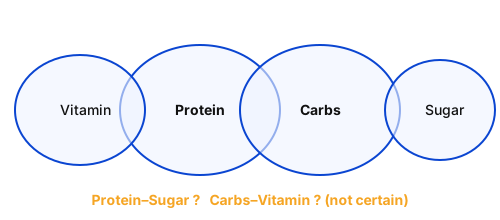
- Protein meets Carbs and Vitamin; Carbs meets Sugar.
- Protein and Sugar have no direct link → (I) Some protein are sugar is only possible, not certain.
- Carbs and Vitamin are linked only through Protein (Some + Some) → (II) not certain.
- Draw the circles apart as in the figure: both conclusions fail.
Trick: Some + Some = no conclusion.
Answer: (C) Neither conclusion (I) nor (II) follows
अवधारणा: दो 'कुछ' (Some) कथन किसी साझा पद से जुड़ें तो निश्चित निष्कर्ष नहीं निकलता।
- Protein, Carbs और Vitamin से मिलता है; Carbs, Sugar से।
- Protein–Sugar का सीधा संबंध नहीं → (I) केवल संभव, निश्चित नहीं।
- Carbs–Vitamin केवल Protein के माध्यम से (Some + Some) → (II) भी निश्चित नहीं।
- चित्र की तरह वृत्त अलग बनाएँ: दोनों निष्कर्ष असफल।
ट्रिक: Some + Some = कोई निष्कर्ष नहीं।
उत्तर: (C) Neither conclusion (I) nor (II) follows
RRB NTPC Graduate CBT 1General Intelligence and ReasoningSyllogismRRB NTPC Graduate CBT 1 2024 · 19 Jun Shift 2
Q410.Which of the following letter-clusters should replace # and % so that the pattern and relationship followed between the letter-cluster pair on the left side of :: is the same as that on the right side of :: ?
# : LNR :: MOS : %
निम्नलिखित में से कौन-से अक्षर-समूह # और % को प्रतिस्थापित करें ताकि :: के बाईं ओर के अक्षर-समूह युग्म के बीच अनुसरण किया गया पैटर्न और संबंध वही हो जो :: के दाईं ओर के अक्षर-समूह युग्म के बीच है?
# : LNR :: MOS : %
- A# = GIM , % = RTY
- B# = GIM , % = RTX
- C# = HIM , % = RTX
- D# = GIM , % = STX
Show answer
Concept: Find the letter-gap pattern inside a cluster and the shift between the two clusters.
- LNR: L→N (), N→R (). MOS: M→O (), O→S (). So # must also be .
- Left pair: # → LNR, so each letter of # is 5 behind: L−5=G, N−5=I, R−5=M → GIM.
- Right pair: MOS → % with : M+5=R, O+5=T, S+5=X → RTX.
Trick: Use the second pair's shift () for both blanks.
Answer: (B) # = GIM , % = RTX
अवधारणा: cluster के भीतर अक्षर-अंतर और दोनों cluster के बीच का अंतर खोजें।
- LNR: L→N (), N→R (); MOS भी ।
- बायाँ जोड़ा: # → LNR, अतः # के हर अक्षर में 5 पीछे: G, I, M → GIM।
- दायाँ जोड़ा: MOS → % में : R, T, X → RTX।
ट्रिक: दोनों रिक्त स्थान के लिए का नियम लगाएँ।
उत्तर: (B) # = GIM , % = RTX
RRB NTPC Graduate CBT 1General Intelligence and ReasoningLetter analogyRRB NTPC Graduate CBT 1 2024 · 19 Jun Shift 2
Q411.In a certain code language, ‘COIL’ is coded as ‘3457’ and ‘OPEN’ is coded as ‘1246’. What is the code for ‘O’ in the given code language?
एक निश्चित कूट भाषा में, ‘COIL’ को ‘3457’ के रूप में कूटबद्ध किया जाता है और ‘OPEN’ को ‘1246’ के रूप में कूटबद्ध किया जाता है। दी गई कूट भाषा में ‘O’ का कूट क्या है?
- A4
- B2
- C1
- D3
Show answer
Concept: A letter common to two words has the digit common to both codes.
- COIL → 3457; OPEN → 1246
- Common letter: O; common digit: 4
- So O = 4.
Trick: Match common letters with common digits.
Answer: (A) 4
अवधारणा: दो शब्दों में साझा अक्षर का कोड दोनों कोड में साझा अंक होता है।
- COIL → 3457; OPEN → 1246
- साझा अक्षर O; साझा अंक 4
- अतः O = 4।
ट्रिक: साझा अक्षर ↔ साझा अंक।
उत्तर: (A) 4
RRB NTPC Graduate CBT 1General Intelligence and ReasoningCoding – common lettersRRB NTPC Graduate CBT 1 2024 · 19 Jun Shift 2
Q412.Select the letter-cluster from among the given options that can replace the question mark (?) in the following series.
RLN PKP NJR ? JHV
दिए गए विकल्पों में से उस अक्षर-समूह का चयन कीजिए जो निम्नलिखित श्रृंखला में प्रश्न चिह्न (?) को प्रतिस्थापित कर सकता है।
RLN PKP NJR ? JHV
- ALIS
- BLIT
- CLJS
- DLHP
Show answer
Concept: Track each letter position separately.
- 1st letters: R, P, N, L, J ()
- 2nd letters: L, K, J, I, H ()
- 3rd letters: N, P, R, T, V ()
- Missing term = LIT
Trick: Split a three-letter series into three simple series.
Answer: (B) LIT
अवधारणा: हर स्थान के अक्षर अलग-अलग देखें।
- पहले अक्षर: R, P, N, L, J ()
- दूसरे: L, K, J, I, H ()
- तीसरे: N, P, R, T, V ()
- लुप्त पद = LIT
ट्रिक: तीन अक्षरों की श्रृंखला को तीन सरल श्रृंखलाओं में तोड़ें।
उत्तर: (B) LIT
RRB NTPC Graduate CBT 1General Intelligence and ReasoningLetter seriesRRB NTPC Graduate CBT 1 2024 · 19 Jun Shift 2
Q413.Each of P, Q, R, S, T, U and V has an exam on a different day of a week starting from Monday and ending on Sunday of the same week. R has an exam on Thursday. Exactly 4 people have their exam between U and T, neither of whom has an exam on Sunday. S has an exam immediately before Q. P does not have an exam on Friday. U does not have an exam after Q. How many people have an exam after Q?
P, Q, R, S, T, U और V में से प्रत्येक की परीक्षा एक ही सप्ताह के सोमवार से प्रारंभ होकर रविवार को समाप्त होने वाले सप्ताह के एक अलग दिन है। R की परीक्षा गुरुवार को है। U और T के बीच ठीक 4 व्यक्तियों की परीक्षा है, और इन दोनों में से किसी की भी परीक्षा रविवार को नहीं है। S की परीक्षा Q के ठीक पहले है। P की परीक्षा शुक्रवार को नहीं है। U की परीक्षा Q के बाद नहीं है। Q के बाद कितने व्यक्तियों की परीक्षा है?
- A1
- B3
- C4
- D2
Show answer
Concept: Place fixed clues first, then test cases.
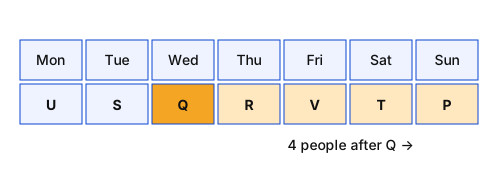
- 4 people between U and T and neither on Sunday → U, T are on Monday and Saturday.
- U is not after Q and S is just before Q; U = Saturday would force Q = Sunday, S = Saturday (clash). So U = Monday, T = Saturday.
- Free consecutive days for S–Q: Tuesday–Wednesday. P not Friday → P = Sunday, V = Friday.
- After Q (Wednesday): R, V, T, P = 4 people.
Trick: Gap of 4 in 7 days with Sunday excluded leaves only Mon–Sat.
Answer: (C) 4
अवधारणा: पहले निश्चित संकेत रखें, फिर स्थितियाँ जाँचें।
- U और T के बीच 4 लोग, कोई रविवार नहीं → U, T सोमवार और शनिवार पर।
- U, Q के बाद नहीं और S ठीक Q से पहले; U = शनिवार हो तो Q = रविवार, S = शनिवार (टकराव)। अतः U = सोमवार, T = शनिवार।
- S–Q के लिए लगातार खाली दिन: मंगल–बुध। P शुक्रवार नहीं → P = रविवार, V = शुक्रवार।
- Q (बुधवार) के बाद: R, V, T, P = 4।
ट्रिक: 7 दिनों में 4 का अंतर, रविवार वर्जित → केवल सोम–शनि।
उत्तर: (C) 4
RRB NTPC Graduate CBT 1General Intelligence and ReasoningScheduling puzzleRRB NTPC Graduate CBT 1 2024 · 19 Jun Shift 2
Q414.Mr. Filix starts from Point A and drives 19 km towards the South. He then takes a left turn, drives 5 km, turns left and drives 33 km. He then takes a left turn and drives 9 km. He takes a final left turn, drives 14 km and stops at Point P. How far (shortest distance) and towards which direction should he drive in order to reach Point A again? (All turns are 90 degrees turns only unless specified.)
श्री फिलिक्स बिंदु A से प्रारंभ करते हैं और दक्षिण की ओर 19 km गाड़ी चलाते हैं। फिर वे बाएँ मुड़ते हैं, 5 km गाड़ी चलाते हैं, बाएँ मुड़ते हैं और 33 km गाड़ी चलाते हैं। फिर वे बाएँ मुड़ते हैं और 9 km गाड़ी चलाते हैं। वे अंतिम बार बाएँ मुड़ते हैं, 14 km गाड़ी चलाते हैं और बिंदु P पर रुकते हैं। बिंदु A पर पुनः पहुँचने के लिए उन्हें कितनी दूरी (न्यूनतम दूरी) तक और किस दिशा में गाड़ी चलानी चाहिए? (जब तक निर्दिष्ट न हो, सभी मोड़ केवल 90 डिग्री के मोड़ हैं।)
- A1 km to the Westपश्चिम की ओर 1 km
- B8 km to the Northउत्तर की ओर 8 km
- C4 km to the Eastपूर्व की ओर 4 km
- D2 km to the Southदक्षिण की ओर 2 km
Show answer
Concept: Plot each move; with a left turn, South → East → North → West → South.
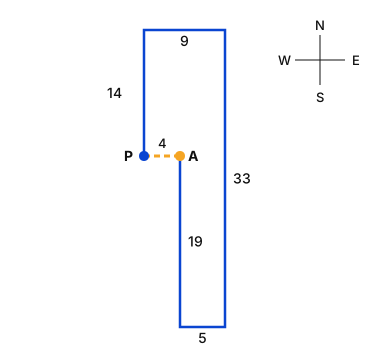
- 19 km South, then left (East) 5 km.
- Left (North) 33 km → 14 km north of A's level; left (West) 9 km → 4 km west of A's line.
- Left (South) 14 km → back on A's level, 4 km West of A.
- To return, drive 4 km to the East.
Trick: Net N–S: ; net E–W: (West).
Answer: (C) 4 km to the East
अवधारणा: हर चाल का चित्र बनाएँ; बाएँ मुड़ने पर दक्षिण → पूर्व → उत्तर → पश्चिम → दक्षिण।
- 19 km दक्षिण, फिर बाएँ (पूर्व) 5 km।
- बाएँ (उत्तर) 33 km; बाएँ (पश्चिम) 9 km।
- बाएँ (दक्षिण) 14 km → P, A से 4 km पश्चिम में।
- वापस जाने हेतु 4 km पूर्व दिशा में।
ट्रिक: उत्तर–दक्षिण: ; पूर्व–पश्चिम: (पश्चिम)।
उत्तर: (C) 4 km to the East
RRB NTPC Graduate CBT 1General Intelligence and ReasoningDirection and distanceRRB NTPC Graduate CBT 1 2024 · 19 Jun Shift 2
Q415.What should come in place of the question mark (?) in the given series?
512 520 510 522 ? 524 506
दी गई श्रृंखला में प्रश्न चिह्न (?) के स्थान पर क्या आना चाहिए?
512 520 510 522 ? 524 506
- A520
- B505
- C521
- D508
Show answer
Concept: Two series are interleaved.
- Odd positions: 512, 510, ?, 506 → decreases by 2 → ? = 508
- Even positions: 520, 522, 524 → increases by 2 (confirms the pattern).
Trick: Up–down jumps → split into alternate terms.
Answer: (D) 508
अवधारणा: दो श्रृंखलाएँ एक के बाद एक मिली हैं।
- विषम स्थान: 512, 510, ?, 506 → 2 घटता → ? = 508
- सम स्थान: 520, 522, 524 → 2 बढ़ता।
ट्रिक: उछलती संख्याएँ → एकांतर पद अलग करें।
उत्तर: (D) 508
RRB NTPC Graduate CBT 1General Intelligence and ReasoningNumber series – alternateRRB NTPC Graduate CBT 1 2024 · 19 Jun Shift 2
Q416.Seven boxes, D, E, F, G, S, T and U, are kept one over the other but not necessarily in the same order. Only three boxes are kept above G. Only one box is kept between T and G. Only three boxes are kept between T and S. S is kept at some place above G. E is kept immediately below S. F is kept at one of the places above D. U is not kept immediately above or below T. Which box is kept at the lowermost position?
सात बक्से, D, E, F, G, S, T और U, एक के ऊपर एक रखे गए हैं, परंतु आवश्यक नहीं कि इसी क्रम में हों। G के ऊपर केवल तीन बक्से रखे गए हैं। T और G के बीच केवल एक बक्सा रखा गया है। T और S के बीच केवल तीन बक्से रखे गए हैं। S, G के ऊपर किसी स्थान पर रखा गया है। E, S के ठीक नीचे रखा गया है। F, D के ऊपर के स्थानों में से किसी एक पर रखा गया है। U, T के ठीक ऊपर या ठीक नीचे नहीं रखा गया है। सबसे नीचे के स्थान पर कौन-सा बक्सा रखा गया है?
- AF
- BU
- CT
- DD
Show answer
Concept: Number positions 1 (top) to 7 (bottom).
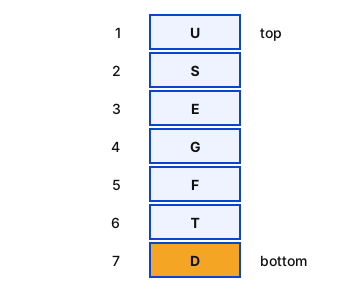
- Three above G → G = 4. One between T and G → T = 2 or 6.
- Three between T and S with S above G → T = 6, S = 2; E just below S → E = 3.
- U not next to T (5, 7) → U = 1. F above D → F = 5, D = 7.
- Lowermost box = D.
Trick: Fix the box with an exact count first (G = 4).
Answer: (D) D
अवधारणा: स्थान 1 (ऊपर) से 7 (नीचे) तक मानें।
- G के ऊपर तीन → G = 4। T और G के बीच एक → T = 2 या 6।
- T और S के बीच तीन, S, G से ऊपर → T = 6, S = 2; E ठीक S के नीचे → E = 3।
- U, T के पास नहीं (5, 7) → U = 1। F, D से ऊपर → F = 5, D = 7।
- सबसे नीचे = D।
ट्रिक: पहले सटीक संख्या वाला डिब्बा (G = 4) तय करें।
उत्तर: (D) D
RRB NTPC Graduate CBT 1General Intelligence and ReasoningBox stacking puzzleRRB NTPC Graduate CBT 1 2024 · 19 Jun Shift 2
Q417.In a certain code language, ‘JAIL’ is coded as ‘3457’ and ‘ARCS’ is coded as ‘1265’. What is the code for ‘A’ in the given code language?
एक निश्चित कूट भाषा में, ‘JAIL’ को ‘3457’ के रूप में कूटबद्ध किया जाता है और ‘ARCS’ को ‘1265’ के रूप में कूटबद्ध किया जाता है। दी गई कूट भाषा में ‘A’ का कूट क्या है?
- A4
- B1
- C5
- D6
Show answer
Concept: Common letter ↔ common digit.
- JAIL → 3457; ARCS → 1265
- Common letter: A; common digit: 5
- So A = 5.
Trick: Compare only the shared letters and digits.
Answer: (C) 5
अवधारणा: साझा अक्षर ↔ साझा अंक।
- JAIL → 3457; ARCS → 1265
- साझा अक्षर A; साझा अंक 5
- अतः A = 5।
ट्रिक: केवल साझा अक्षर व अंक मिलाएँ।
उत्तर: (C) 5
RRB NTPC Graduate CBT 1General Intelligence and ReasoningCoding – common lettersRRB NTPC Graduate CBT 1 2024 · 19 Jun Shift 2
Q418.What will come in the place of the question mark (?) in the following equation, if ‘+’ is replaced by ‘−’ and ‘×’ and ‘÷’ are interchanged?
55 ÷ 7 + 9 × 3 + 1 = ?
यदि ‘+’ को ‘−’ से प्रतिस्थापित कर दिया जाए तथा ‘×’ और ‘÷’ को आपस में बदल दिया जाए, तो निम्नलिखित समीकरण में प्रश्न चिह्न (?) के स्थान पर क्या आएगा?
55 ÷ 7 + 9 × 3 + 1 = ?
- A385
- B378
- C381
- D390
Show answer
Concept: Substitute the signs, then apply BODMAS.
- becomes
Trick: Change signs carefully before calculating.
Answer: (C) 381
अवधारणा: चिह्न बदलकर BODMAS लगाएँ।
- बनता है
ट्रिक: गणना से पहले चिह्न ध्यान से बदलें।
उत्तर: (C) 381
RRB NTPC Graduate CBT 1General Intelligence and ReasoningMathematical operationsRRB NTPC Graduate CBT 1 2024 · 19 Jun Shift 2
Q419.This question is based on the five, three-digit numbers given below.
(Left) 103 678 217 111 537 (Right)
(Example: 697 – First digit = 6, second digit = 9 and third digit = 7)
(Note: All operations to be done from left to right.)
What will be the resultant if the second digit of the highest number is added to the first digit of the lowest number?
यह प्रश्न नीचे दी गई पाँच, तीन-अंकीय संख्याओं पर आधारित है।
(बाएँ) 103 678 217 111 537 (दाएँ)
(उदाहरण: 697 – पहला अंक = 6, दूसरा अंक = 9 और तीसरा अंक = 7)
(ध्यान दें: सभी संक्रियाएँ बाएँ से दाएँ की जानी हैं।)
यदि सबसे बड़ी संख्या के दूसरे अंक को सबसे छोटी संख्या के पहले अंक में जोड़ा जाए, तो परिणाम क्या होगा?
- A9
- B8
- C11
- D7
Show answer
Concept: Identify highest and lowest numbers first.
- Highest = 678 → second digit 7
- Lowest = 103 → first digit 1
Trick: Read 'highest/lowest' on whole numbers, digits afterwards.
Answer: (B) 8
अवधारणा: पहले सबसे बड़ी और सबसे छोटी संख्या पहचानें।
- सबसे बड़ी = 678 → दूसरा अंक 7
- सबसे छोटी = 103 → पहला अंक 1
ट्रिक: पहले पूरी संख्या, फिर अंक।
उत्तर: (B) 8
RRB NTPC Graduate CBT 1General Intelligence and ReasoningThree-digit number operationsRRB NTPC Graduate CBT 1 2024 · 19 Jun Shift 2
Q420.If 1 is added to each odd digit and 2 is subtracted from each even digit in the number 7418536, how many digits will appear more than once in the new number thus formed?
यदि संख्या 7418536 में प्रत्येक विषम अंक में 1 जोड़ा जाए और प्रत्येक सम अंक में से 2 घटाया जाए, तो इस प्रकार बनी नई संख्या में कितने अंक एक से अधिक बार आएँगे?
- ATwoदो
- BThreeतीन
- CNoneकोई नहीं
- DOneएक
Show answer
Concept: Odd digits , even digits .
- 7418536 → 7→8, 4→2, 1→2, 8→6, 5→6, 3→4, 6→4
- New number: 8226644
- Repeated digits: 2, 6, 4 → three digits.
Trick: Write the new number fully before counting repeats.
Answer: (B) Three
अवधारणा: विषम अंक , सम अंक ।
- 7418536 → 8, 2, 2, 6, 6, 4, 4
- नई संख्या: 8226644
- दोहराए अंक: 2, 6, 4 → तीन।
ट्रिक: नई संख्या पूरी लिखकर ही गिनें।
उत्तर: (B) Three
RRB NTPC Graduate CBT 1General Intelligence and ReasoningDigit manipulationRRB NTPC Graduate CBT 1 2024 · 19 Jun Shift 2

