Q461.A, B, C, D, E, F, and G are sitting around a circular table facing the centre.
A sits to the immediate left of G. D sits to the immediate left of B. B sits second to the left of F. E sits third to the left of G.
How many people sit between C and F when counted from the left of C?
A, B, C, D, E, F और G एक वृत्ताकार मेज़ के चारों ओर केंद्र की ओर मुख करके बैठे हैं।
A, G के ठीक बाएँ बैठा है। D, B के ठीक बाएँ बैठा है। B, F के बाएँ से दूसरे स्थान पर बैठा है। E, G के बाएँ से तीसरे स्थान पर बैठा है।
C के बाएँ से गिनने पर C और F के बीच कितने व्यक्ति बैठे हैं?
- ATwoदो
- BOneएक
- CThreeतीन
- DFourचार
Show answer
Concept: For people facing the centre, 'left' means the clockwise direction.
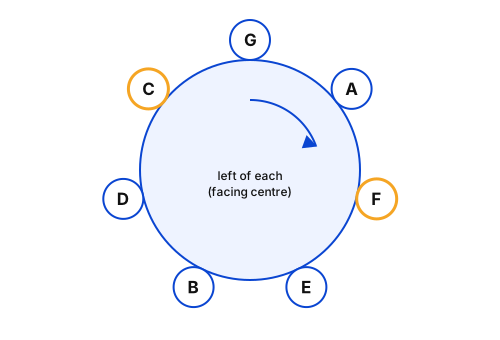
- Fix G. A is immediately left of G; E is third to the left of G.
- B is second left of F and D is immediately left of B → F, _, B, D occupy consecutive clockwise seats.
- Only free run: F next to A, then E, B, D; C takes the last seat (right of G).
- Clockwise order: G, A, F, E, B, D, C.
- From C going left: G, A, then F → 2 people between.
Trick: F–B–D form a block of 'skip one, then two together'; fit it into the free seats.
Answer: (A) Two
अवधारणा: केंद्र की ओर मुख वाले व्यक्तियों के लिए 'बायाँ' = घड़ी की सुई की दिशा (clockwise)।
- G को स्थिर करें। A, G के ठीक बाएँ; E, G के बाएँ तीसरे स्थान पर।
- B, F के बाएँ दूसरे तथा D, B के ठीक बाएँ → F, _, B, D लगातार clockwise सीटें।
- एकमात्र स्थान: A के बाद F, फिर E, B, D; C अंतिम सीट (G के दाएँ) पर।
- Clockwise क्रम: G, A, F, E, B, D, C।
- C से बाईं ओर: G, A, फिर F → बीच में 2 व्यक्ति।
ट्रिक: F–B–D ब्लॉक ('एक छोड़कर फिर दो साथ') को खाली सीटों में बैठाएँ।
उत्तर: (A) दो
RRB NTPC Graduate CBT 1General Intelligence and ReasoningCircular seating arrangementRRB NTPC Graduate CBT 1 2024 · 18 Jun Shift 3
Q462.What should come in place of the question mark (?) in the given series?
319, 296, 263, ?, 167, 104
दी गई शृंखला में प्रश्न चिह्न (?) के स्थान पर क्या आना चाहिए?
319, 296, 263, ?, 167, 104
- A220
- B200
- C210
- D230
Show answer
Concept: Look at the differences between consecutive terms.
- , → differences grow by 10.
- Next difference 43: .
- Check: , ✓.
Trick: Differences: .
Answer: (A) 220
अवधारणा: क्रमागत पदों के अंतर देखें।
- , → अंतर 10-10 बढ़ता है।
- अगला अंतर 43: ।
- जाँच: , ✓।
ट्रिक: अंतर: ।
उत्तर: (A) 220
RRB NTPC Graduate CBT 1General Intelligence and ReasoningNumber seriesRRB NTPC Graduate CBT 1 2024 · 18 Jun Shift 3
Q463.In a certain code language, ‘NEAR’ is coded as ‘3571’ and ‘WINK’ is coded as ‘2346’. What is the code for ‘N’ in the given code language?
एक निश्चित कूट भाषा में, ‘NEAR’ को ‘3571’ और ‘WINK’ को ‘2346’ के रूप में कूटबद्ध किया जाता है। दी गई कूट भाषा में ‘N’ का कूट क्या है?
- A7
- B4
- C1
- D3
Show answer
Concept: A letter common to both words gets the digit common to both codes.
- NEAR → {3, 5, 7, 1}; WINK → {2, 3, 4, 6}.
- Common letter: N; common digit: 3.
- So N = 3.
Trick: Common letter ↔ common digit.
Answer: (D) 3
अवधारणा: दोनों शब्दों में उभयनिष्ठ अक्षर का कोड दोनों कोडों में उभयनिष्ठ अंक होता है।
- NEAR → {3, 5, 7, 1}; WINK → {2, 3, 4, 6}।
- उभयनिष्ठ अक्षर: N; उभयनिष्ठ अंक: 3।
- अतः N = 3।
ट्रिक: उभयनिष्ठ अक्षर ↔ उभयनिष्ठ अंक।
उत्तर: (D) 3
RRB NTPC Graduate CBT 1General Intelligence and ReasoningCoding-decodingRRB NTPC Graduate CBT 1 2024 · 18 Jun Shift 3
Q464.What will come in the place of the question mark (?) in the following equation, if ‘+’ and ‘−’ are interchanged and ‘×’ and ‘÷’ are interchanged?
117 ÷ 7 + 426 × 6 − 66 = ?
यदि ‘+’ और ‘−’ को आपस में बदल दिया जाए तथा ‘×’ और ‘÷’ को आपस में बदल दिया जाए, तो निम्नलिखित समीकरण में प्रश्न चिह्न (?) के स्थान पर क्या आएगा?
117 ÷ 7 + 426 × 6 − 66 = ?
- A811
- B804
- C809
- D814
Show answer
Concept: Interchange the signs first, then solve using BODMAS.
- After interchange: .
- ; .
- .
Trick: Swap signs on paper before calculating — most errors come from mixing old and new signs.
Answer: (D) 814
अवधारणा: पहले चिह्न बदलें, फिर BODMAS से हल करें।
- बदलने के बाद: ।
- ; ।
- ।
ट्रिक: गणना से पहले चिह्न बदलकर लिख लें — अधिकतर गलतियाँ पुराने-नए चिह्न मिलाने से होती हैं।
उत्तर: (D) 814
RRB NTPC Graduate CBT 1General Intelligence and ReasoningMathematical operationsRRB NTPC Graduate CBT 1 2024 · 18 Jun Shift 3
Q465.This question is based on the five, three-digit numbers given below.
(Left) 853 628 981 217 132 (Right)
(Example- 697 – First digit = 6, second digit = 9 and third digit = 7)
(NOTE: All operations to be done from left to right.)
What will be the resultant if the second digit of the highest number is added to the first digit of the lowest number?
यह प्रश्न नीचे दी गई तीन अंकों वाली पाँच संख्याओं पर आधारित है।
(बाएँ) 853 628 981 217 132 (दाएँ)
(उदाहरण- 697 – पहला अंक = 6, दूसरा अंक = 9 और तीसरा अंक = 7)
(नोट: सभी संक्रियाएँ बाएँ से दाएँ की जानी हैं।)
यदि सबसे बड़ी संख्या के दूसरे अंक को सबसे छोटी संख्या के पहले अंक में जोड़ा जाए, तो परिणाम क्या होगा?
- A12
- B9
- C8
- D10
Show answer
Concept: Identify the highest and lowest numbers, then pick the required digits.
- Highest number = 981 → second digit = 8.
- Lowest number = 132 → first digit = 1.
- .
Trick: Compare the hundreds digits first: 9 is highest, 1 is lowest.
Answer: (B) 9
अवधारणा: सबसे बड़ी और सबसे छोटी संख्या पहचानें, फिर अपेक्षित अंक लें।
- सबसे बड़ी संख्या = 981 → दूसरा अंक = 8।
- सबसे छोटी संख्या = 132 → पहला अंक = 1।
- ।
ट्रिक: पहले सैकड़े के अंक की तुलना करें: 9 सबसे बड़ा, 1 सबसे छोटा।
उत्तर: (B) 9
RRB NTPC Graduate CBT 1General Intelligence and ReasoningNumber operationsRRB NTPC Graduate CBT 1 2024 · 18 Jun Shift 3
Q466.Which of the following letter-number clusters will replace the question mark (?) in the given series to make it logically complete?
KDG 19 LEH 30 MFI 41 NGJ 52 ?
निम्नलिखित में से कौन-सा अक्षर-संख्या समूह दी गई शृंखला में प्रश्न चिह्न (?) का स्थान लेकर उसे तार्किक रूप से पूर्ण करेगा?
KDG 19 LEH 30 MFI 41 NGJ 52 ?
- AOHL 64
- BOHK 64
- COHK 63
- DOHL 63
Show answer
Concept: Each letter moves +1 and the number increases by 11.
- First letters: K, L, M, N → O; second: D, E, F, G → H; third: G, H, I, J → K.
- Numbers: (each ) → .
- Next term = OHK 63.
Trick: Check the number first: only options with 63 survive, then the third letter K.
Answer: (C) OHK 63
अवधारणा: हर अक्षर +1 आगे बढ़ता है और संख्या 11 बढ़ती है।
- पहला अक्षर: K, L, M, N → O; दूसरा: D, E, F, G → H; तीसरा: G, H, I, J → K।
- संख्याएँ: (हर बार ) → ।
- अगला पद = OHK 63।
ट्रिक: पहले संख्या जाँचें: 63 वाले विकल्प बचे, फिर तीसरा अक्षर K।
उत्तर: (C) OHK 63
RRB NTPC Graduate CBT 1General Intelligence and ReasoningLetter-Number SeriesRRB NTPC Graduate CBT 1 2024 · 18 Jun Shift 3
Q467.Which of the following letter-clusters should replace # and % so that the pattern and relationship followed between the letter-cluster pair on the left side of :: is the same as that on the right side of :: ?
# : IKO :: TVZ : %
निम्नलिखित में से कौन-से अक्षर-समूह # और % का स्थान लेंगे, ताकि :: के बाईं ओर के अक्षर-समूह युग्म के बीच का पैटर्न और संबंध वही हो जो :: के दाईं ओर के अक्षर-समूह युग्म के बीच है?
# : IKO :: TVZ : %
- A# = EGK , % = XZD
- B# = FGK , % = XZD
- C# = ELK , % = XZD
- D# = EGK , % = YZD
Show answer
Concept: Find the rule from the complete pair: each letter moves +4.
- Test (A): E = I, G = K, K = O → EGK : IKO ✓.
- Same rule on right side: T = X, V = Z, Z = D (wrap-around) → TVZ : XZD ✓.
- Also EGK and TVZ both have gaps , matching IKO.
Trick: Z + 4 wraps to D (Z→A→B→C→D).
Answer: (A) # = EGK , % = XZD
अवधारणा: पूरे युग्म से नियम निकालें: हर अक्षर +4 आगे।
- (A) जाँचें: E = I, G = K, K = O → EGK : IKO ✓।
- दाईं ओर वही नियम: T = X, V = Z, Z = D (घूमकर) → TVZ : XZD ✓।
- EGK और TVZ दोनों में अंतर है, जैसा IKO में।
ट्रिक: Z + 4 घूमकर D बनता है (Z→A→B→C→D)।
उत्तर: (A) # = EGK , % = XZD
RRB NTPC Graduate CBT 1General Intelligence and ReasoningLetter AnalogyRRB NTPC Graduate CBT 1 2024 · 18 Jun Shift 3
Q468.In a certain code language, ‘BEAR’ is coded as ‘4567’ and ‘RUIN’ is coded as ‘1234’. What is the code for ‘R’ in the given code language?
एक निश्चित कूट भाषा में, ‘BEAR’ को ‘4567’ और ‘RUIN’ को ‘1234’ के रूप में कूटबद्ध किया जाता है। दी गई कूट भाषा में ‘R’ का कूट क्या है?
- A4
- B7
- C2
- D1
Show answer
Concept: A letter common to two words gets the digit common to their codes.
- BEAR → 4567 and RUIN → 1234.
- Common letter: R only. Common digit: 4 only.
- Hence R = 4.
Trick: Common letter ↔ common digit – no need to fix the order.
Answer: (A) 4
अवधारणा: दो शब्दों में उभयनिष्ठ अक्षर का कोड, उनके कोड का उभयनिष्ठ अंक होता है।
- BEAR → 4567 और RUIN → 1234।
- उभयनिष्ठ अक्षर: केवल R; उभयनिष्ठ अंक: केवल 4।
- अतः R = 4।
ट्रिक: उभयनिष्ठ अक्षर ↔ उभयनिष्ठ अंक – क्रम देखने की ज़रूरत नहीं।
उत्तर: (A) 4
RRB NTPC Graduate CBT 1General Intelligence and ReasoningCoding-DecodingRRB NTPC Graduate CBT 1 2024 · 18 Jun Shift 3
Q469.What will come in the place of the question mark (?) in the following equation, if ‘+’ is replaced by ‘−’ and ‘×’ and ‘÷’ are interchanged?
44 ÷ 8 + 5 × 1 + 7 = ?
यदि ‘+’ को ‘−’ से बदल दिया जाए तथा ‘×’ और ‘÷’ को आपस में बदल दिया जाए, तो निम्नलिखित समीकरण में प्रश्न चिह्न (?) के स्थान पर क्या आएगा?
44 ÷ 8 + 5 × 1 + 7 = ?
- A340
- B300
- C400
- D250
Show answer
Concept: Replace the signs first, then apply BODMAS.
- becomes .
Trick: Rewrite the whole expression with new signs before calculating.
Answer: (A) 340
अवधारणा: पहले चिह्न बदलें, फिर BODMAS लगाएँ।
- बनता है ।
ट्रिक: गणना से पहले पूरा व्यंजक नए चिह्नों के साथ लिख लें।
उत्तर: (A) 340
RRB NTPC Graduate CBT 1General Intelligence and ReasoningMathematical OperationsRRB NTPC Graduate CBT 1 2024 · 18 Jun Shift 3
Q470.If 2 is added to each odd digit and 1 is subtracted from each even digit in the number 5634812, how many digits will appear more than once in the new number thus formed?
यदि संख्या 5634812 में प्रत्येक विषम अंक में 2 जोड़ दिया जाए और प्रत्येक सम अंक में से 1 घटा दिया जाए, तो इस प्रकार बनी नई संख्या में कितने अंक एक से अधिक बार आएँगे?
- A1
- B3
- C2
- D0
Show answer
Concept: Odd digit → , even digit → .
- 5634812: , , , , , , .
- New number = 7553731.
- 7 appears twice, 5 twice, 3 twice; 1 once → 3 digits repeat.
Trick: Write the new digits in a row and tally – avoid mental shortcuts.
Answer: (B) 3
अवधारणा: विषम अंक → , सम अंक → ।
- 5634812: , , , , , , ।
- नई संख्या = 7553731।
- 7 दो बार, 5 दो बार, 3 दो बार; 1 एक बार → 3 अंक दोहराए गए।
ट्रिक: नए अंक एक पंक्ति में लिखकर गिनें – मन में गणना न करें।
उत्तर: (B) 3
RRB NTPC Graduate CBT 1General Intelligence and ReasoningNumber OperationsRRB NTPC Graduate CBT 1 2024 · 18 Jun Shift 3
Q471.Seven boxes, A, B, C, D, E, F and G, are kept one over the other, but not necessarily in the same order. Only four boxes are kept between C and D. Only E is kept above C. Only two boxes are kept between F and A. G is kept immediately above B. A is not kept immediately above G. How many boxes are kept above F?
सात डिब्बे, A, B, C, D, E, F और G, एक के ऊपर एक रखे गए हैं, परंतु आवश्यक नहीं कि इसी क्रम में हों। C और D के बीच केवल चार डिब्बे रखे गए हैं। C के ऊपर केवल E रखा गया है। F और A के बीच केवल दो डिब्बे रखे गए हैं। G, B के ठीक ऊपर रखा गया है। A, G के ठीक ऊपर नहीं रखा गया है। F के ऊपर कितने डिब्बे रखे गए हैं?
- A4
- B1
- C2
- D3
Show answer
Concept: Number positions 1 (top) to 7 (bottom) and place the fixed clues first.
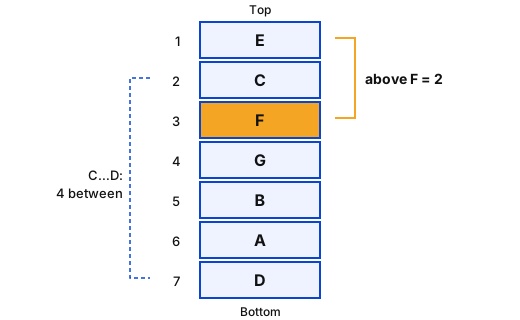
- Only E above C → E = 1, C = 2. Four boxes between C and D → D = 7.
- G immediately above B: (G, B) can be (4, 5) only, since F and A need two boxes between them in the remaining slots 3 and 6.
- A is not immediately above G (G = 4) → A ≠ 3, so A = 6, F = 3.
- Above F: E and C → 2 boxes.
Trick: Fix "only one above" type clues first – they lock the top positions.
Answer: (C) 2
अवधारणा: स्थान 1 (ऊपर) से 7 (नीचे) तक मानें और पहले निश्चित संकेत रखें।
- केवल E, C के ऊपर → E = 1, C = 2। C और D के बीच चार बॉक्स → D = 7।
- G ठीक B के ऊपर: (G, B) केवल (4, 5) हो सकते हैं, क्योंकि F और A के बीच दो बॉक्स चाहिए – शेष स्थान 3 और 6।
- A ठीक G (4) के ऊपर नहीं → A ≠ 3, अतः A = 6, F = 3।
- F के ऊपर: E और C → 2 बॉक्स।
ट्रिक: "केवल एक ऊपर" जैसे संकेत पहले लगाएँ – वे ऊपरी स्थान तय कर देते हैं।
उत्तर: (C) 2
RRB NTPC Graduate CBT 1General Intelligence and ReasoningBox ArrangementRRB NTPC Graduate CBT 1 2024 · 18 Jun Shift 3
Q472.GF 7 is related to EA -10 in a certain way. In the same way, UG 14 is related to SB -3. To which of the given options is LN 2 related, following the same logic?
GF 7 एक निश्चित प्रकार से EA -10 से संबंधित है। उसी प्रकार, UG 14, SB -3 से संबंधित है। समान तर्क का अनुसरण करते हुए, LN 2 दिए गए विकल्पों में से किससे संबंधित है?
- AII -13
- BJJ -14
- CIJ -15
- DJI -15
Show answer
Concept: First letter , second letter , number .
- GF 7 → EA : G=E, F=A, .
- UG 14 → SB : U=S, G=B, .
- LN 2 → L=J, N=I, → JI .
Trick: Number part alone gives ; then pick J first, I second.
Answer: (D) JI
अवधारणा: पहला अक्षर , दूसरा अक्षर , संख्या ।
- GF 7 → EA : G=E, F=A, ।
- UG 14 → SB : U=S, G=B, ।
- LN 2 → L=J, N=I, → JI ।
ट्रिक: केवल संख्या से मिलता है; फिर पहले J, फिर I चुनें।
उत्तर: (D) JI
RRB NTPC Graduate CBT 1General Intelligence and ReasoningLetter-Number AnalogyRRB NTPC Graduate CBT 1 2024 · 18 Jun Shift 3
Q473.Based on the English alphabetical order, three of the following four letter-cluster pairs are alike in a certain way and thus form a group. Which letter-cluster pair DOES NOT belong to that group?
(Note: The odd one out is not based on the number of consonants/vowels or their position in the letter-cluster.)
अंग्रेज़ी वर्णमाला क्रम के आधार पर, निम्नलिखित चार अक्षर-समूह युग्मों में से तीन किसी निश्चित प्रकार से एक समान हैं और इस प्रकार एक समूह बनाते हैं। कौन-सा अक्षर-समूह युग्म उस समूह से संबंधित नहीं है?
(नोट: असंगत अक्षर-समूह, अक्षर-समूह में व्यंजनों/स्वरों की संख्या या उनके स्थान पर आधारित नहीं है।)
- AVP – DX
- BZT – HB
- CDX – LE
- DHB – PJ
Show answer
Concept: In each pair, every letter of the first cluster moves to give the second cluster.
- VP – DX: V=D, P=X ✓; ZT – HB: Z=H, T=B ✓.
- HB – PJ: H=P, B=J ✓.
- DX – LE: D=L but X=F, not E ✗ → odd one.
Trick: Use wrap-around: X(24) = F.
Answer: (C) DX – LE
अवधारणा: हर युग्म में पहले समूह का प्रत्येक अक्षर आगे जाकर दूसरा समूह बनाता है।
- VP – DX: V=D, P=X ✓; ZT – HB: Z=H, T=B ✓।
- HB – PJ: H=P, B=J ✓।
- DX – LE: D=L पर X=F, E नहीं ✗ → विषम।
ट्रिक: घुमाव (wrap-around): X(24) = F।
उत्तर: (C) DX – LE
RRB NTPC Graduate CBT 1General Intelligence and ReasoningLetter-Cluster Odd One OutRRB NTPC Graduate CBT 1 2024 · 18 Jun Shift 3
Q474.This question is based on the five, three-digit numbers given below.
(Left) 441 317 999 155 444 (Right)
(Example- 697 – First digit = 6, second digit = 9 and third digit = 7)
(NOTE: All operations to be done from left to right.)
What will be the resultant if the third digit of the highest number is subtracted from the first digit of the lowest number?
यह प्रश्न नीचे दी गई तीन अंकों वाली पाँच संख्याओं पर आधारित है।
(बाएँ) 441 317 999 155 444 (दाएँ)
(उदाहरण- 697 – पहला अंक = 6, दूसरा अंक = 9 और तीसरा अंक = 7)
(नोट: सभी संक्रियाएँ बाएँ से दाएँ की जानी हैं।)
यदि सबसे बड़ी संख्या के तीसरे अंक को सबसे छोटी संख्या के पहले अंक में से घटाया जाए, तो परिणाम क्या होगा?
- A−8
- B−9
- C−5
- D−7
Show answer
Concept: Identify the highest and lowest numbers, then pick the asked digits.
- Highest number = 999 → third digit = 9.
- Lowest number = 155 → first digit = 1.
- "Third digit of highest subtracted from first digit of lowest" .
Trick: "A subtracted from B" means .
Answer: (A)
अवधारणा: सबसे बड़ी और सबसे छोटी संख्या पहचानें, फिर पूछे गए अंक लें।
- सबसे बड़ी संख्या = 999 → तीसरा अंक = 9।
- सबसे छोटी संख्या = 155 → पहला अंक = 1।
- "सबसे बड़ी का तीसरा अंक, सबसे छोटी के पहले अंक में से घटाएँ" ।
ट्रिक: "A को B में से घटाना" अर्थात ।
उत्तर: (A)
RRB NTPC Graduate CBT 1General Intelligence and ReasoningNumber PuzzleRRB NTPC Graduate CBT 1 2024 · 18 Jun Shift 3
Q475.LIQM is related to JGOK in a certain way based on the English alphabetical order. In the same way, IFNJ is related to GDLH. To which of the given options is OLTP related, following the same logic?
अंग्रेज़ी वर्णमाला क्रम के आधार पर LIQM एक निश्चित प्रकार से JGOK से संबंधित है। उसी प्रकार, IFNJ, GDLH से संबंधित है। समान तर्क का अनुसरण करते हुए, OLTP दिए गए विकल्पों में से किससे संबंधित है?
- AJMRN
- BJMNR
- CMJNR
- DMJRN
Show answer
Concept: Each letter moves 2 steps back.
- LIQM → JGOK: L=J, I=G, Q=O, M=K.
- IFNJ → GDLH: same rule ✓.
- OLTP → O=M, L=J, T=R, P=N → MJRN.
Trick: Only option starting with M and ending with N in order MJ_N: MJRN.
Answer: (D) MJRN
अवधारणा: हर अक्षर 2 स्थान पीछे जाता है।
- LIQM → JGOK: L=J, I=G, Q=O, M=K।
- IFNJ → GDLH: वही नियम ✓।
- OLTP → O=M, L=J, T=R, P=N → MJRN।
ट्रिक: M से शुरू और N पर खत्म, क्रम MJ_N: MJRN।
उत्तर: (D) MJRN
RRB NTPC Graduate CBT 1General Intelligence and ReasoningLetter AnalogyRRB NTPC Graduate CBT 1 2024 · 18 Jun Shift 3
Q476.A, B, C, D, R, S and T are sitting around a circular table facing the centre of the table. Only one person sits between T and S when counted from the right of T. Only one person sits between S and C. Only one person sits between T and R. Only two people sit between A and C. Only one person sits between B and R. Who sits third to the right of D?
A, B, C, D, R, S और T एक वृत्ताकार मेज़ के चारों ओर मेज़ के केंद्र की ओर मुख करके बैठे हैं। T के दाएँ से गिनने पर T और S के बीच केवल एक व्यक्ति बैठा है। S और C के बीच केवल एक व्यक्ति बैठा है। T और R के बीच केवल एक व्यक्ति बैठा है। A और C के बीच केवल दो व्यक्ति बैठे हैं। B और R के बीच केवल एक व्यक्ति बैठा है। D के दाएँ से तीसरे स्थान पर कौन बैठा है?
- AC
- BA
- CT
- DS
Show answer
Concept: Facing the centre, "right" means anticlockwise. Number seats 0–6 anticlockwise.
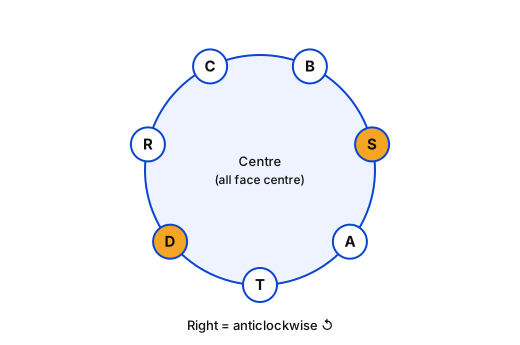
- T = 0; one between T and S from T's right → S = 2. One between S and C → C = 4.
- One between T and R → R = 5 (seat 2 is taken). Two between A and C → A = 1.
- One between B and R → B = 3; remaining D = 6.
- Third to the right of D: seats 0, 1, 2 → S.
Trick: In a 7-seat circle, "one between" means a gap of 2 seats either way.
Answer: (D) S
अवधारणा: केंद्र की ओर मुख होने पर "दाएँ" = वामावर्त (anticlockwise)। सीटें 0–6 वामावर्त क्रम में मानें।
- T = 0; T के दाएँ से T और S के बीच एक → S = 2। S और C के बीच एक → C = 4।
- T और R के बीच एक → R = 5 (सीट 2 भरी)। A और C के बीच दो → A = 1।
- B और R के बीच एक → B = 3; शेष D = 6।
- D के दाएँ तीसरा: सीट 0, 1, 2 → S।
ट्रिक: 7 सीटों के वृत्त में "बीच में एक" = किसी भी ओर 2 सीट का अंतर।
उत्तर: (D) S
RRB NTPC Graduate CBT 1General Intelligence and ReasoningCircular Seating ArrangementRRB NTPC Graduate CBT 1 2024 · 18 Jun Shift 3
Q477.What will come in place of the question mark (?) in the following equation if '÷' and '–' are interchanged and '×' and '+' are interchanged?
522 × 708 – 59 + 19 ÷ 17 = ?
यदि '÷' और '–' को आपस में बदल दिया जाए तथा '×' और '+' को आपस में बदल दिया जाए, तो निम्नलिखित समीकरण में प्रश्न चिह्न (?) के स्थान पर क्या आएगा?
522 × 708 – 59 + 19 ÷ 17 = ?
- A733
- B567
- C379
- D768
Show answer
Concept: Interchange the signs, then apply BODMAS.
- becomes .
- ; .
- .
Trick: Do ÷ and × left to right before + and −.
Answer: (A) 733
अवधारणा: चिह्न आपस में बदलें, फिर BODMAS लगाएँ।
- बनता है ।
- ; ।
- ।
ट्रिक: + और − से पहले ÷ और × बाएँ से दाएँ करें।
उत्तर: (A) 733
RRB NTPC Graduate CBT 1General Intelligence and ReasoningMathematical OperationsRRB NTPC Graduate CBT 1 2024 · 18 Jun Shift 3
Q478.Based on the English alphabetical order, three of the following four letter-clusters are alike in a certain way and thus form a group. Which letter-cluster DOES NOT belong to that group?
(Note: The odd one out is not based on the number of consonants/vowels or their position in the letter-cluster.)
अंग्रेज़ी वर्णमाला क्रम के आधार पर, निम्नलिखित चार अक्षर-समूहों में से तीन किसी निश्चित प्रकार से एक समान हैं और इस प्रकार एक समूह बनाते हैं। कौन-सा अक्षर-समूह उस समूह से संबंधित नहीं है?
(नोट: असंगत अक्षर-समूह, अक्षर-समूह में व्यंजनों/स्वरों की संख्या या उनके स्थान पर आधारित नहीं है।)
- ANJGB
- BTPMH
- CAWTO
- DEAYS
Show answer
Concept: Check the backward gaps between consecutive letters.
- NJGB: N→J , J→G , G→B .
- TPMH: ✓; AWTO: A→W (wrap), W→T , T→O ✓.
- EAYS: E→A , A→Y , Y→S ✗ → odd one.
Trick: Pattern ; break it once and you have the answer.
Answer: (D) EAYS
अवधारणा: लगातार अक्षरों के बीच पीछे की ओर अंतर देखें।
- NJGB: N→J , J→G , G→B ।
- TPMH: ✓; AWTO: A→W (घुमाव), W→T , T→O ✓।
- EAYS: E→A , A→Y , Y→S ✗ → विषम।
ट्रिक: पैटर्न ; जो इसे तोड़े वही उत्तर।
उत्तर: (D) EAYS
RRB NTPC Graduate CBT 1General Intelligence and ReasoningLetter-Cluster Odd One OutRRB NTPC Graduate CBT 1 2024 · 18 Jun Shift 3
Q479.What should come in place of the question mark (?) in the given series?
12 29 63 131 267 ?
दी गई शृंखला में प्रश्न चिह्न (?) के स्थान पर क्या आना चाहिए?
12 29 63 131 267 ?
- A531
- B543
- C521
- D539
Show answer
Concept: Each term .
- , , .
- .
- .
Trick: Differences 17, 34, 68, 136 double each time → next difference 272.
Answer: (D) 539
अवधारणा: प्रत्येक पद ।
- , , ।
- ।
- ।
ट्रिक: अंतर 17, 34, 68, 136 हर बार दोगुने → अगला अंतर 272।
उत्तर: (D) 539
RRB NTPC Graduate CBT 1General Intelligence and ReasoningNumber SeriesRRB NTPC Graduate CBT 1 2024 · 18 Jun Shift 3
Q480.Select the set in which the numbers are related in the same way as are the numbers of the following sets.
(NOTE: Operations should be performed on the whole numbers, without breaking down the numbers into their constituent digits. E.g. 13 – Operations on 13 such as adding to/subtracting from/multiplying with 13 can be performed. Breaking down 13 into 1 and 3 and then performing mathematical operations on 1 and 3 is not allowed.)
(88, 76, 64)
(71, 59, 47)
उस समुच्चय का चयन कीजिए जिसमें संख्याएँ उसी प्रकार संबंधित हैं जिस प्रकार निम्नलिखित समुच्चयों की संख्याएँ संबंधित हैं।
(नोट: संख्याओं को उनके घटक अंकों में तोड़े बिना, पूर्ण संख्याओं पर संक्रियाएँ की जानी चाहिए। उदाहरण के लिए 13 – 13 पर संक्रियाएँ जैसे 13 में जोड़ना/13 में से घटाना/13 से गुणा करना आदि की जा सकती हैं। 13 को 1 और 3 में तोड़कर फिर 1 और 3 पर गणितीय संक्रियाएँ करने की अनुमति नहीं है।)
(88, 76, 64)
(71, 59, 47)
- A(40, 38, 36)
- B(64, 52, 40)
- C(99, 77, 55)
- D(58, 46, 24)
Show answer
Concept: In each set the numbers decrease by 12 each time.
- (88, 76, 64): , ; (71, 59, 47): , .
- (64, 52, 40): , ✓.
- (40, 38, 36) is ; (99, 77, 55) is ; (58, 46, 24) is , then ✗.
Trick: Check both gaps – (D) matches only the first one.
Answer: (B) (64, 52, 40)
अवधारणा: हर समुच्चय में संख्याएँ हर बार 12 घटती हैं।
- (88, 76, 64): , ; (71, 59, 47): , ।
- (64, 52, 40): , ✓।
- (40, 38, 36) में ; (99, 77, 55) में ; (58, 46, 24) में , फिर ✗।
ट्रिक: दोनों अंतर जाँचें – (D) केवल पहले से मेल खाता है।
उत्तर: (B) (64, 52, 40)
RRB NTPC Graduate CBT 1General Intelligence and ReasoningNumber Analogy (Sets)RRB NTPC Graduate CBT 1 2024 · 18 Jun Shift 3

