Q501.A and B complete a work in 6 days. If A alone can do it in 7 days, then B alone can do it in ______________ days.
A और B मिलकर एक कार्य 6 दिनों में पूरा करते हैं। यदि A अकेले उसे 7 दिनों में कर सकता है, तो B अकेले उसे ______________ दिनों में कर सकता है।
- A44
- B42
- C43
- D41
Show answer
Concept: One-day work of B = (A + B)'s one-day work − A's one-day work.
- .
- So B alone takes 42 days.
Trick: B's time days.
Answer: (B) 42
अवधारणा: B का एक दिन का काम = (A + B) का एक दिन का काम − A का एक दिन का काम।
- ।
- अतः B अकेला 42 दिन लेगा।
ट्रिक: B का समय दिन।
उत्तर: (B) 42
RRB NTPC Graduate CBT 1MathematicsTime and workRRB NTPC Graduate CBT 1 2024 · 18 Jun Shift 2
Q502.The mean proportional between 0.09 and 16 is:
0.09 और 16 के बीच मध्यानुपाती है:
- A120
- B12
- C1.2
- D0.12
Show answer
Concept: Mean proportional of and .
- .
- .
Trick: .
Answer: (C) 1.2
अवधारणा: और का मध्यानुपाती ।
- ।
- ।
ट्रिक: ।
उत्तर: (C) 1.2
RRB NTPC Graduate CBT 1MathematicsRatio – mean proportionalRRB NTPC Graduate CBT 1 2024 · 18 Jun Shift 2
Q503.The average of 6 numbers is 18. If each number is increased by 5, what will be the new average?
6 संख्याओं का औसत 18 है। यदि प्रत्येक संख्या में 5 की वृद्धि कर दी जाए, तो नया औसत क्या होगा?
- A20
- B25
- C23
- D18
Show answer
Concept: If every number is increased by the same amount, the average increases by that amount.
- Old average = 18.
- Each number + 5 → new average .
- Check: sum , new sum , .
Trick: Add / subtract / multiply every item by → do the same to the average.
Answer: (C) 23
अवधारणा: हर संख्या में समान मान जोड़ने पर औसत भी उतना ही बढ़ता है।
- पुराना औसत = 18।
- हर संख्या + 5 → नया औसत ।
- जाँच: योग , नया योग , ।
ट्रिक: हर पद पर जो क्रिया (, ) हो, वही औसत पर करें।
उत्तर: (C) 23
RRB NTPC Graduate CBT 1MathematicsAverageRRB NTPC Graduate CBT 1 2024 · 18 Jun Shift 2
Q504.A boat takes 18 minutes to go 59.4 km upstream. The ratio of the speed of the boat in still water to that of the stream is 3 : 2. How much total time (in hours) will the boat take to go 29.3 km upstream and 51.5 km downstream?
एक नाव धारा के प्रतिकूल 59.4 km जाने में 18 मिनट लेती है। शांत जल में नाव की चाल और धारा की चाल का अनुपात 3 : 2 है। नाव को धारा के प्रतिकूल 29.3 km और धारा के अनुकूल 51.5 km जाने में कुल कितना समय (घंटों में) लगेगा?
- A3.5
- B2.6
- C4.5
- D0.2
Show answer
Concept: Upstream speed , downstream speed .
- Upstream speed .
- → upstream part , downstream parts .
- Time .
Trick: Write both times over 990: upstream distance × 5 + downstream distance .
Answer: (D) 0.2
अवधारणा: , ।
- विपरीत चाल ।
- → विपरीत भाग , अनुकूल भाग ।
- समय ।
ट्रिक: दोनों समय का हर 990 करें: ।
उत्तर: (D) 0.2
RRB NTPC Graduate CBT 1MathematicsBoats and streamsRRB NTPC Graduate CBT 1 2024 · 18 Jun Shift 2
Q505.The larger of two supplementary angles is 60° more than the smaller one. The smaller angle (in degree) is:
दो संपूरक कोणों में से बड़ा कोण छोटे कोण से 60° अधिक है। छोटा कोण (डिग्री में) है:
- A67°
- B65°
- C60°
- D64°
Show answer
Concept: Supplementary angles add up to .
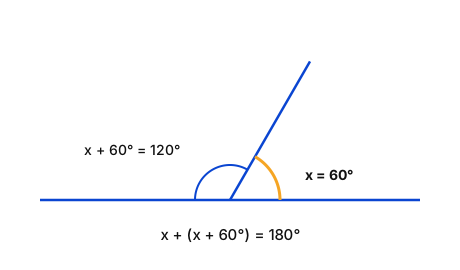
- Let smaller angle , larger .
- .
- (larger ).
Trick: Smaller .
Answer: (C)
अवधारणा: संपूरक कोणों का योग होता है।
- छोटा कोण , बड़ा ।
- ।
- (बड़ा )।
ट्रिक: छोटा ।
उत्तर: (C)
RRB NTPC Graduate CBT 1MathematicsGeometry – supplementary anglesRRB NTPC Graduate CBT 1 2024 · 18 Jun Shift 2
Q506.Find the sum of roots for the equation 2x3 + 7x2− 9x + 12.
समीकरण 2x3 + 7x2− 9x + 12 के मूलों का योग ज्ञात कीजिए।
- A
- B
- C
- D
Show answer
Concept: For , sum of roots .
- Here , .
- Sum of roots .
Trick: Sum , product for a cubic; options or come from using wrong coefficients.
Answer: (C)
अवधारणा: में मूलों का योग ।
- यहाँ , ।
- मूलों का योग ।
ट्रिक: त्रिघात में योग , गुणनफल ।
उत्तर: (C)
RRB NTPC Graduate CBT 1MathematicsPolynomials – sum of rootsRRB NTPC Graduate CBT 1 2024 · 18 Jun Shift 2
Q507.If the mode of the following data is 125, then what is the value of x?
| Class | 110-115 | 115-120 | 120-125 | 125-130 | 130-135 |
|---|
| Frequency | 13 | 31 | 39 | x | 15 |
यदि निम्नलिखित आँकड़ों का बहुलक 125 है, तो x का मान क्या है?
| वर्ग | 110-115 | 115-120 | 120-125 | 125-130 | 130-135 |
|---|
| बारंबारता | 13 | 31 | 39 | x | 15 |
- A48
- B40
- C31
- D39
Show answer
Concept: .
- Mode 125 lies at the boundary; take modal class 120-125: , , , , .
- .
- .
Trick: Mode = upper limit needs , i.e. , so .
Answer: (D) 39
अवधारणा: ।
- बहुलक 125 वर्ग सीमा पर है; बहुलक वर्ग 120-125: , , , , ।
- ।
- ।
ट्रिक: बहुलक वर्ग की ऊपरी सीमा पर हो तो , अतः ।
उत्तर: (D) 39
RRB NTPC Graduate CBT 1MathematicsStatistics – mode of grouped dataRRB NTPC Graduate CBT 1 2024 · 18 Jun Shift 2
Q508.Find the simplified value of .
का सरलीकृत मान ज्ञात कीजिए।
- A102
- B441
- C561
- D321
Show answer
Concept: Solve innermost brackets first; ÷ and × are done left to right.
- .
- .
- .
Trick: : write 5, (5+1), 1 → 561.
Answer: (C) 561
अवधारणा: सबसे भीतरी कोष्ठक पहले; ÷ और × बाएँ से दाएँ।
- ।
- ।
- ।
ट्रिक: : 5, (5+1), 1 → 561।
उत्तर: (C) 561
RRB NTPC Graduate CBT 1MathematicsSimplification – BODMASRRB NTPC Graduate CBT 1 2024 · 18 Jun Shift 2
Q509.The sum of the ages of Ramesh and Mahesh is years. Age of Ramesh is years. Find the age of Mahesh.
रमेश और महेश की आयु का योग वर्ष है। रमेश की आयु वर्ष है। महेश की आयु ज्ञात कीजिए।
- A years वर्ष
- B years वर्ष
- C years वर्ष
- D years वर्ष
Show answer
Concept: Mahesh's age = (sum of ages) − (Ramesh's age); subtract like terms.
- .
- terms: ; terms: .
- and cancel. Result: years.
Trick: Only the unlike-sign terms survive – look for , which rules out options with .
Answer: (A) years
अवधारणा: महेश की आयु = (आयु का योग) − (रमेश की आयु); समान पद घटाएँ।
- ।
- पद: ; पद: ।
- और कट जाते हैं। परिणाम: वर्ष।
ट्रिक: उत्तर में पद होगा, अतः वाले विकल्प हट जाते हैं।
उत्तर: (A) वर्ष
RRB NTPC Graduate CBT 1MathematicsAlgebra – subtraction of expressionsRRB NTPC Graduate CBT 1 2024 · 18 Jun Shift 2
Q510.A person who spends 55% of his monthly income is able to save ₹6,408 per month. His monthly expenses (in ₹) are:
एक व्यक्ति जो अपनी मासिक आय का 55% खर्च करता है, प्रति माह ₹6,408 बचा पाता है। उसका मासिक व्यय (₹ में) है:
- A7,832
- B7,834
- C7,873
- D7,843
Show answer
Concept: Savings % .
- Savings of income = ₹6,408.
- Income ₹14,240.
- Expenses ₹7,832.
Trick: Expenses ₹7,832.
Answer: (A) 7,832
अवधारणा: ।
- बचत आय = ₹6,408।
- आय ₹14,240।
- व्यय ₹7,832।
ट्रिक: व्यय ₹7,832।
उत्तर: (A) 7,832
RRB NTPC Graduate CBT 1MathematicsPercentage – income and savingsRRB NTPC Graduate CBT 1 2024 · 18 Jun Shift 2
Q511.Amit had invested same amount of sums at simple as well as compound interest, compounded annually. The time period of both the sums was 2 years and rate of interest too was the same, 4% per annum. At the end, he found a difference of ₹45 in both the interests received. What were the sums (in ₹) invested?
अमित ने साधारण ब्याज तथा वार्षिक रूप से संयोजित चक्रवृद्धि ब्याज पर समान राशि निवेश की। दोनों राशियों की समयावधि 2 वर्ष थी और ब्याज दर भी समान, 4% वार्षिक थी। अंत में, उसने प्राप्त दोनों ब्याजों में ₹45 का अंतर पाया। निवेश की गई राशियाँ (₹ में) कितनी थीं?
- A27,375
- B28,125
- C27,225
- D28,475
Show answer
Concept: For 2 years: .
Trick: For 2 years, difference = ; with , = .
Answer: (B) ₹28,125
अवधारणा: 2 वर्ष के लिए: ।
ट्रिक: 2 वर्ष में अंतर = ; पर = ।
उत्तर: (B) ₹28,125
RRB NTPC Graduate CBT 1MathematicsCI and SI DifferenceRRB NTPC Graduate CBT 1 2024 · 18 Jun Shift 1
Q512.Three numbers are in the ratio 1 : 3 : 5, and their LCM is 285. Their HCF is ____.
तीन संख्याएँ 1 : 3 : 5 के अनुपात में हैं और उनका LCM 285 है। उनका HCF ____ है।
- A19
- B15
- C17
- D24
Show answer
Concept: If numbers are (ratio terms co-prime), HCF and LCM .
- HCF
Trick: HCF = LCM ÷ (LCM of ratio terms) = .
Answer: (A) 19
अवधारणा: यदि संख्याएँ हों (अनुपात के पद सह-अभाज्य), तो HCF और LCM ।
- HCF
ट्रिक: HCF = LCM ÷ (अनुपात पदों का LCM) = ।
उत्तर: (A) 19
RRB NTPC Graduate CBT 1MathematicsHCF and LCMRRB NTPC Graduate CBT 1 2024 · 18 Jun Shift 1
Q513.The fourth proportion to 9, 3 and 27 is the same as the third proportion to A and 24. What is the value of A?
9, 3 और 27 का चतुर्थानुपाती, A और 24 के तृतीयानुपाती के समान है। A का मान क्या है?
- A61
- B63
- C62
- D64
Show answer
Concept: Fourth proportional to is ; third proportional to is .
- Fourth proportional to 9, 3, 27
- Third proportional to A, 24
Trick: , so .
Answer: (D) 64
अवधारणा: का चतुर्थानुपाती ; का तृतीयानुपाती ।
- 9, 3, 27 का चतुर्थानुपाती
- A, 24 का तृतीयानुपाती
ट्रिक: , अतः ।
उत्तर: (D) 64
RRB NTPC Graduate CBT 1MathematicsProportionRRB NTPC Graduate CBT 1 2024 · 18 Jun Shift 1
Q514.The length of the diagonals of a rhombus are m and m, respectively. Find the area of the rhombus, if and .
एक समचतुर्भुज के विकर्णों की लंबाई क्रमशः m और m है। यदि और है, तो समचतुर्भुज का क्षेत्रफल ज्ञात कीजिए।
- A27 m2
- B18 m2
- C21 m2
- D24 m2
Show answer
Concept: Area of a rhombus .
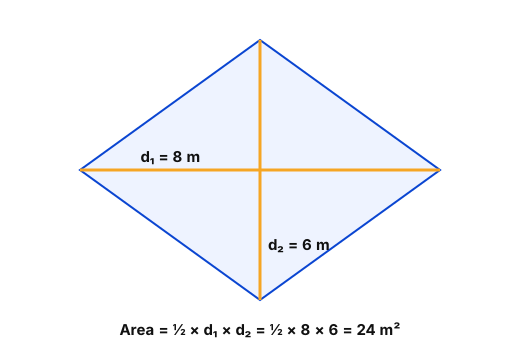
- Area
Trick: Substitute first, then use half the product of diagonals.
Answer: (D)
अवधारणा: समचतुर्भुज का क्षेत्रफल ।
- क्षेत्रफल
ट्रिक: पहले मान रखें, फिर विकर्णों के गुणनफल का आधा।
उत्तर: (D)
RRB NTPC Graduate CBT 1MathematicsMensuration – RhombusRRB NTPC Graduate CBT 1 2024 · 18 Jun Shift 1
Q515.A salesman marks his good 20% above the cost price and gives a discount of 25% on them. Find the percentage of this gain or loss.
एक विक्रेता अपनी वस्तुओं पर क्रय मूल्य से 20% अधिक मूल्य अंकित करता है और उन पर 25% की छूट देता है। लाभ या हानि का प्रतिशत ज्ञात कीजिए।
- A9% gain9% लाभ
- B10% loss10% हानि
- C11% loss11% हानि
- D12% loss12% हानि
Show answer
Concept: Successive change: .
- Let CP ; MP .
- SP
- Loss , i.e. loss.
Trick: Net effect → 10% loss.
Answer: (B) 10% loss
अवधारणा: क्रमागत परिवर्तन: ।
- माना CP ; MP ।
- SP
- हानि , अर्थात हानि।
ट्रिक: शुद्ध प्रभाव → 10% हानि।
उत्तर: (B) 10% हानि
RRB NTPC Graduate CBT 1MathematicsProfit and Loss – Marked PriceRRB NTPC Graduate CBT 1 2024 · 18 Jun Shift 1
Q516.A shopkeeper fixes the marked price of an item 50% above its cost price. What percentage of discount on the marked price should be allowed to gain 14%?
एक दुकानदार किसी वस्तु का अंकित मूल्य उसके क्रय मूल्य से 50% अधिक निर्धारित करता है। 14% लाभ प्राप्त करने के लिए अंकित मूल्य पर कितने प्रतिशत की छूट दी जानी चाहिए?
- A21%
- B27%
- C26%
- D24%
Show answer
Concept: .
- Let CP ; MP .
- For 14% gain, SP .
- Discount ;
Trick: Discount % .
Answer: (D) 24%
अवधारणा: ।
- माना CP ; MP ।
- 14% लाभ के लिए SP ।
- छूट ;
ट्रिक: छूट % ।
उत्तर: (D) 24%
RRB NTPC Graduate CBT 1MathematicsDiscountRRB NTPC Graduate CBT 1 2024 · 18 Jun Shift 1
Q517.If the median of a data is 71.24 less than its mode, then the median of the data exceeds its mean by _____. (Use the empirical formula)
यदि किसी आँकड़े की माध्यिका उसके बहुलक से 71.24 कम है, तो आँकड़े की माध्यिका उसके माध्य से _____ अधिक है। (आनुभविक सूत्र का प्रयोग कीजिए)
- A34.14
- B35.62
- C41.97
- D33.91
Show answer
Concept: Empirical relation: , so .
Trick: Median sits between mean and mode, twice as far from the mode: just halve the gap.
Answer: (B) 35.62
अवधारणा: आनुभविक संबंध: , अतः ।
ट्रिक: माध्यिका, बहुलक से दोगुनी दूरी पर – बस अंतर को आधा करें।
उत्तर: (B) 35.62
RRB NTPC Graduate CBT 1MathematicsStatistics – Mean, Median, ModeRRB NTPC Graduate CBT 1 2024 · 18 Jun Shift 1
Q518.A and B can do a piece of work in 12 days and 18 days, respectively. Both work for 2 days and then A goes away and B completed the remaining work alone. The whole work was completed in ______________ days.
A और B किसी कार्य को क्रमशः 12 दिन और 18 दिन में कर सकते हैं। दोनों 2 दिन तक कार्य करते हैं और फिर A चला जाता है तथा B शेष कार्य को अकेले पूरा करता है। पूरा कार्य ______________ दिनों में पूरा हुआ।
- A13
- B14
- C15
- D16
Show answer
Concept: Take total work = LCM of days and work in units per day.
- Total work units; A , B units/day.
- In 2 days together: units.
- Remaining units by B: days.
- Total days
Trick: LCM method avoids fractions completely.
Answer: (C) 15
अवधारणा: कुल कार्य = दिनों का LCM लें और प्रतिदिन इकाइयाँ निकालें।
- कुल कार्य इकाई; A , B इकाई/दिन।
- 2 दिन साथ में: इकाई।
- शेष इकाई B अकेला: दिन।
- कुल दिन
ट्रिक: LCM विधि से भिन्नों से बचें।
उत्तर: (C) 15
RRB NTPC Graduate CBT 1MathematicsTime and WorkRRB NTPC Graduate CBT 1 2024 · 18 Jun Shift 1
Q519.Chords AB and CD of a circle intersect externally at P. If AB = 7 cm, CD = 1 cm and PD = 5 cm, then the length of PB (in cm) is:
एक वृत्त की जीवाएँ AB और CD बाह्य रूप से P पर प्रतिच्छेद करती हैं। यदि AB = 7 cm, CD = 1 cm और PD = 5 cm है, तो PB की लंबाई (cm में) है:
- A3
- B4
- C2
- D5
Show answer
Concept: If two chords AB and CD meet externally at P, then (secant–secant theorem).
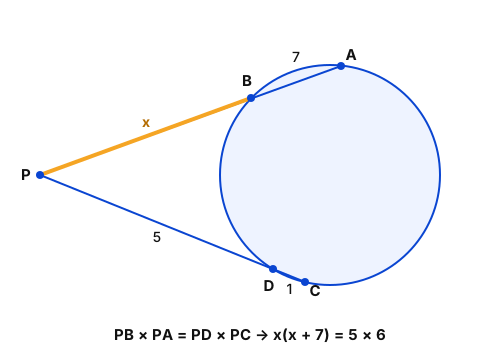
- Let , so ; , .
- cm
Trick: Outside part × whole = outside part × whole. Try options: ✓.
Answer: (A) 3
अवधारणा: यदि जीवाएँ AB और CD बाहर बिंदु P पर मिलें, तो (छेदक–छेदक प्रमेय)।
- माना , तो ; , ।
- cm
ट्रिक: बाहरी भाग × पूरा = बाहरी भाग × पूरा। विकल्प जाँचें: ✓।
उत्तर: (A) 3
RRB NTPC Graduate CBT 1MathematicsGeometry – Secants of a CircleRRB NTPC Graduate CBT 1 2024 · 18 Jun Shift 1
Q520.A train is 591 m and it crosses a platform in 1.7 minutes running at the speed of 36 km/hr. Find the difference between the length of the train and the platform.
एक रेलगाड़ी 591 m लंबी है और यह 36 km/hr की चाल से चलते हुए एक प्लेटफ़ॉर्म को 1.7 मिनट में पार करती है। रेलगाड़ी और प्लेटफ़ॉर्म की लंबाई का अंतर ज्ञात कीजिए।
- A162 m
- B171 m
- C170 m
- D159 m
Show answer
Concept: To cross a platform, a train covers (train length + platform length).
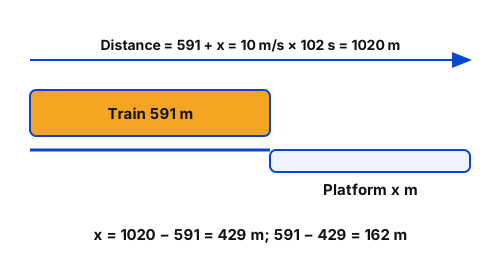
- Speed ; time
- Distance
- Platform
- Difference
Trick: 36 km/h = 10 m/s, so distance in metres = 10 × seconds.
Answer: (A) 162 m
अवधारणा: प्लेटफ़ॉर्म पार करने में ट्रेन (ट्रेन की लंबाई + प्लेटफ़ॉर्म की लंबाई) तय करती है।
- चाल ; समय
- दूरी
- प्लेटफ़ॉर्म
- अंतर
ट्रिक: 36 km/h = 10 m/s, अतः दूरी (m) = 10 × सेकंड।
उत्तर: (A) 162 m
RRB NTPC Graduate CBT 1MathematicsSpeed – Train and PlatformRRB NTPC Graduate CBT 1 2024 · 18 Jun Shift 1

