Q561.Select the letter-cluster from among the given options that can replace the question mark (?) in the following series.
ELX IJT MHP ? UDH
दिए गए विकल्पों में से उस अक्षर-समूह का चयन कीजिए जो निम्नलिखित श्रृंखला में प्रश्न चिह्न (?) को प्रतिस्थापित कर सकता है।
ELX IJT MHP ? UDH
- AQGK
- BQFK
- CQGL
- DQFL
Show answer
Concept: Check each position of the clusters separately.
- 1st letters: E, I, M, Q, U → each.
- 2nd letters: L, J, H, F, D → each.
- 3rd letters: X, T, P, L, H → each.
- Missing cluster = QFL.
Trick: Write the alphabet positions (E=5, I=9, M=13…) – the steps become obvious.
Answer: (D) QFL
अवधारणा: क्लस्टर के हर स्थान को अलग-अलग जाँचें।
- पहला अक्षर: E, I, M, Q, U → हर बार ।
- दूसरा अक्षर: L, J, H, F, D → हर बार ।
- तीसरा अक्षर: X, T, P, L, H → हर बार ।
- लुप्त क्लस्टर = QFL।
ट्रिक: अक्षरों के स्थानांक (E=5, I=9, M=13…) लिखें – अंतर तुरंत दिखेगा।
उत्तर: (D) QFL
RRB NTPC Graduate CBT 1General Intelligence and ReasoningLetter SeriesRRB NTPC Graduate CBT 1 2024 · 17 Jun Shift 3
Q562.Each of P, Q, R, S, T, U and V has an exam on a different day of a week starting from Monday and ending on Sunday of the same week. V has an exam on Friday. Exactly 3 people have exams between Q and S, neither of whom has on exam on Sunday. P has an exam immediately after U. T has an exam immediately before S. How many people have exams before U?
P, Q, R, S, T, U और V में से प्रत्येक की परीक्षा एक सप्ताह के अलग-अलग दिन है, जो सोमवार से शुरू होकर उसी सप्ताह के रविवार को समाप्त होता है। V की परीक्षा शुक्रवार को है। Q और S के बीच ठीक 3 व्यक्तियों की परीक्षाएँ हैं, जिनमें से किसी की भी परीक्षा रविवार को नहीं है। P की परीक्षा U के ठीक बाद है। T की परीक्षा S के ठीक पहले है। U से पहले कितने व्यक्तियों की परीक्षाएँ हैं?
- A2
- B3
- C4
- D1
Show answer
Concept: Fix the definite clue first, then place the pairs.
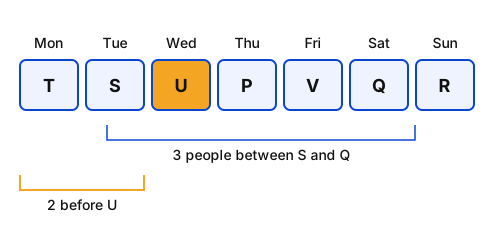
- V = Friday. Q and S have 3 people between them and neither is on Sunday, so they are on Tue & Sat (Mon & Fri is blocked by V).
- T is immediately before S: S = Sat would need T = Fri (V) ✗, so S = Tue, T = Mon, Q = Sat.
- U–P consecutive in the free days Wed, Thu, Sun → U = Wed, P = Thu; R = Sun.
- Before U: T and S → 2 people.
Trick: "3 between" in 7 days gives only 3 placements – test them quickly.
Answer: (A) 2
अवधारणा: पहले निश्चित सूचना रखें, फिर जोड़ियाँ बैठाएँ।
- V = शुक्रवार। Q और S के बीच 3 लोग हैं और दोनों रविवार को नहीं, अतः वे मंगल व शनि को हैं (सोम-शुक्र V के कारण संभव नहीं)।
- T ठीक S से पहले: S = शनि हो तो T = शुक्र (V) ✗, अतः S = मंगल, T = सोम, Q = शनि।
- U–P लगातार, खाली दिन बुध, गुरु, रवि → U = बुध, P = गुरु; R = रवि।
- U से पहले: T और S → 2 लोग।
ट्रिक: 7 दिनों में "बीच में 3" के केवल 3 स्थान बनते हैं – जल्दी जाँच लें।
उत्तर: (A) 2
RRB NTPC Graduate CBT 1General Intelligence and ReasoningScheduling PuzzleRRB NTPC Graduate CBT 1 2024 · 17 Jun Shift 3
Q563.Read the given statements and conclusions carefully. Assuming that the information given in the statements is true, even if it appears to be at variance with commonly known facts, decide which of the given conclusion(s) logically follow(s) from the statements.
Statements:
Some hens are pigeons.
All pigeons are crows.
All crows are mynahs.
Conclusions:
(I) Some hens are mynahs.
(II) Some mynahs are pigeons.
दिए गए कथनों और निष्कर्षों को ध्यानपूर्वक पढ़िए। यह मानते हुए कि कथनों में दी गई जानकारी सत्य है, भले ही वह सामान्यतः ज्ञात तथ्यों से भिन्न प्रतीत होती हो, निर्णय कीजिए कि दिए गए निष्कर्षों में से कौन-सा/से निष्कर्ष तार्किक रूप से कथनों का अनुसरण करता है/करते हैं।
कथन:
कुछ मुर्गियाँ, कबूतर हैं।
सभी कबूतर, कौवे हैं।
सभी कौवे, मैना हैं।
निष्कर्ष:
(I) कुछ मुर्गियाँ, मैना हैं।
(II) कुछ मैना, कबूतर हैं।
- ANeither conclusion (I) nor conclusion (II) followsन तो निष्कर्ष (I) और न ही निष्कर्ष (II) अनुसरण करता है
- BOnly conclusion (I) followsकेवल निष्कर्ष (I) अनुसरण करता है
- COnly conclusion (II) followsकेवल निष्कर्ष (II) अनुसरण करता है
- DBoth conclusions (I) and (II) followनिष्कर्ष (I) और (II) दोनों अनुसरण करते हैं
Show answer
Concept: Draw the minimum-overlap Venn diagram.
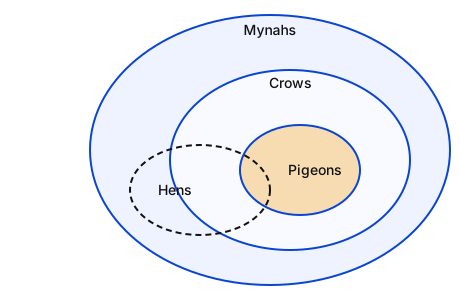
- Pigeons ⊂ Crows ⊂ Mynahs, and Hens overlap Pigeons.
- (I) The hens that are pigeons are also mynahs → "Some hens are mynahs" follows.
- (II) All pigeons are mynahs, so some mynahs are surely pigeons → follows.
Trick: "All A are B" always gives "Some B are A" (conversion).
Answer: (D) Both conclusions (I) and (II) follow
अवधारणा: न्यूनतम संभावित वेन आरेख बनाएँ।
- कबूतर ⊂ कौवे ⊂ मैना, और मुर्गियाँ कबूतरों से आंशिक रूप से मिलती हैं।
- (I) जो मुर्गियाँ कबूतर हैं वे मैना भी हैं → "कुछ मुर्गियाँ मैना हैं" अनुसरण करता है।
- (II) सभी कबूतर मैना हैं, अतः कुछ मैना निश्चित रूप से कबूतर हैं → अनुसरण करता है।
ट्रिक: "सभी A, B हैं" से सदा "कुछ B, A हैं" निकलता है।
उत्तर: (D) निष्कर्ष (I) और (II) दोनों अनुसरण करते हैं
RRB NTPC Graduate CBT 1General Intelligence and ReasoningSyllogismRRB NTPC Graduate CBT 1 2024 · 17 Jun Shift 3
Q564.Select the pair that follows the same pattern as that followed by the two pairs given below. Both pairs follow the same pattern.
HLF : JOH
UYR : WBT
उस युग्म का चयन कीजिए जो उसी पैटर्न का अनुसरण करता है जिसका अनुसरण नीचे दिए गए दो युग्म करते हैं। दोनों युग्म एक ही पैटर्न का अनुसरण करते हैं।
HLF : JOH
UYR : WBT
- ASFJ : UIL
- BSEK : VRT
- CMPQ : RMT
- DMFL : XRL
Show answer
Concept: Find the shift applied to each letter.
- HLF → JOH: H=J, L=O, F=H.
- UYR → WBT: U=W, Y=B (wraps), R=T.
- SFJ → UIL: S=U, F=I, J=L ✓
- Others fail, e.g. SEK → VRT: S=V ✗.
Trick: Check only the first letter () – it removes options B, C, D at once.
Answer: (A) SFJ : UIL
अवधारणा: हर अक्षर पर लगे खिसकाव को ज्ञात करें।
- HLF → JOH: H=J, L=O, F=H।
- UYR → WBT: U=W, Y=B (चक्रीय), R=T।
- SFJ → UIL: S=U, F=I, J=L ✓
- अन्य असफल, जैसे SEK → VRT: S=V ✗।
ट्रिक: केवल पहला अक्षर () जाँचें – B, C, D तुरंत हट जाते हैं।
उत्तर: (A) SFJ : UIL
RRB NTPC Graduate CBT 1General Intelligence and ReasoningLetter AnalogyRRB NTPC Graduate CBT 1 2024 · 17 Jun Shift 3
Q565.HL 17 is related to KM −4 in a certain way. In the same way, LN 12 is related to OO −9. To which of the given options is UR 4 related, following the same logic?
HL 17 एक निश्चित प्रकार से KM −4 से संबंधित है। उसी प्रकार, LN 12, OO −9 से संबंधित है। समान तर्क का अनुसरण करते हुए, UR 4 दिए गए विकल्पों में से किससे संबंधित है?
- AIX −15
- BVR 16
- CXS −17
- DOZ −18
Show answer
Concept: Apply the same change to letters and the number.
- HL 17 → KM : H=K, L=M, .
- LN 12 → OO : L=O, N=O, ✓
- UR 4 → U=X, R=S, → XS .
Trick: The number part alone () picks the answer.
Answer: (C) XS
अवधारणा: अक्षरों और संख्या पर समान परिवर्तन लगाएँ।
- HL 17 → KM : H=K, L=M, ।
- LN 12 → OO : L=O, N=O, ✓
- UR 4 → U=X, R=S, → XS ।
ट्रिक: केवल संख्या भाग () से ही उत्तर मिल जाता है।
उत्तर: (C) XS
RRB NTPC Graduate CBT 1General Intelligence and ReasoningAnalogy – Letters and NumbersRRB NTPC Graduate CBT 1 2024 · 17 Jun Shift 3
Q566.Based on the English alphabetical order, three of the following four letter-cluster pairs are alike in a certain way and thus form a group. Which letter-cluster pair DOES NOT belong to that group?
(Note: The odd one out is not based on the number of consonants/vowels or their position in the letter-cluster.)
अंग्रेज़ी वर्णमाला क्रम के आधार पर, निम्नलिखित चार अक्षर-समूह युग्मों में से तीन किसी निश्चित प्रकार से एकसमान हैं और इस प्रकार एक समूह बनाते हैं। कौन-सा अक्षर-समूह युग्म उस समूह से संबंधित नहीं है?
(नोट: असंगत अक्षर-समूह, व्यंजनों/स्वरों की संख्या या अक्षर-समूह में उनके स्थान पर आधारित नहीं है।)
- ABK – EY
- BYH – CV
- CJS – NG
- DKT – OH
Show answer
Concept: Compare the 1st letters and the 2nd letters of each pair (with wrap-around).
- YH – CV: Y=C, H=V.
- JS – NG: J=N, S=G.
- KT – OH: K=O, T=H.
- BK – EY: B=E, K=Y → first shift is , not . Odd one.
Trick: The second letter rule () is common to all, so check the first letters – only BK breaks the .
Answer: (A) BK – EY
अवधारणा: हर युग्म के पहले-पहले और दूसरे-दूसरे अक्षरों की तुलना करें (चक्रीय क्रम)।
- YH – CV: Y=C, H=V।
- JS – NG: J=N, S=G।
- KT – OH: K=O, T=H।
- BK – EY: B=E, K=Y → पहला खिसकाव है, नहीं। यही विषम।
ट्रिक: दूसरे अक्षर का नियम () सब में समान है, इसलिए पहले अक्षर जाँचें – केवल BK में नहीं।
उत्तर: (A) BK – EY
RRB NTPC Graduate CBT 1General Intelligence and ReasoningOdd One Out – Letter PairsRRB NTPC Graduate CBT 1 2024 · 17 Jun Shift 3
Q567.In a certain code language, ‘LIFE’ is coded as ‘4268’ and ‘FUND’ is coded as ‘3527’. What is the code for ‘F’ in the given code language?
एक निश्चित कूट भाषा में, ‘LIFE’ को ‘4268’ और ‘FUND’ को ‘3527’ के रूप में कूटबद्ध किया जाता है। दी गई कूट भाषा में ‘F’ के लिए कूट क्या है?
- A6
- B3
- C2
- D7
Show answer
Concept: A letter common to both words takes the digit common to both codes.
- LIFE → 4268 and FUND → 3527.
- Common letter: F.
- Common digit: 2.
- So F = 2.
Trick: Match common letters with common digits – order of digits does not matter.
Answer: (C) 2
अवधारणा: दोनों शब्दों में उभयनिष्ठ अक्षर का कोड दोनों कोडों में उभयनिष्ठ अंक होगा।
- LIFE → 4268 और FUND → 3527।
- उभयनिष्ठ अक्षर: F।
- उभयनिष्ठ अंक: 2।
- अतः F = 2।
ट्रिक: उभयनिष्ठ अक्षर ↔ उभयनिष्ठ अंक – अंकों का क्रम मायने नहीं रखता।
उत्तर: (C) 2
RRB NTPC Graduate CBT 1General Intelligence and ReasoningCoding–DecodingRRB NTPC Graduate CBT 1 2024 · 17 Jun Shift 3
Q568.R is the wife of A. F is the son of A. G is the sister of T. T is the brother of F. How is T related to R?
R, A की पत्नी है। F, A का पुत्र है। G, T की बहन है। T, F का भाई है। T का R से क्या संबंध है?
- ASonपुत्र
- BSister's sonबहन का पुत्र
- CBrother's sonभाई का पुत्र
- DBrotherभाई
Show answer
Concept: Draw the family tree from the given links.
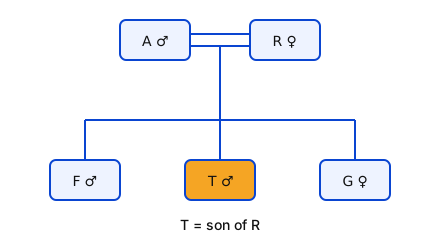
- R is the wife of A; F is the son of A (and R).
- T is the brother of F, so T is also a son of A and R.
- G is the sister of T – another child of the couple.
- Hence T is the son of R.
Trick: Brother of one's son = one's son (gender of T is given by "brother").
Answer: (A) Son
अवधारणा: दिए गए संबंधों से वंश-वृक्ष बनाएँ।
- R, A की पत्नी है; F, A (और R) का पुत्र है।
- T, F का भाई है, अतः T भी A और R का पुत्र है।
- G, T की बहन है – दंपति की एक और संतान।
- अतः T, R का पुत्र है।
ट्रिक: अपने पुत्र का भाई = अपना पुत्र ("भाई" से T का लिंग पुरुष तय)।
उत्तर: (A) पुत्र
RRB NTPC Graduate CBT 1General Intelligence and ReasoningBlood RelationsRRB NTPC Graduate CBT 1 2024 · 17 Jun Shift 3
Q569.This question is based on the five, three-digit numbers given below.
(Left) 941 915 741 807 776 (Right)
(Example- 697 – First digit = 6, second digit = 9 and third digit = 7)
(NOTE: All operations to be done from left to right.)
What will be the resultant if the third digit of the highest number is added to the first digit of the lowest number?
यह प्रश्न नीचे दी गई तीन अंकों वाली पाँच संख्याओं पर आधारित है।
(बाएँ) 941 915 741 807 776 (दाएँ)
(उदाहरण- 697 – पहला अंक = 6, दूसरा अंक = 9 और तीसरा अंक = 7)
(नोट: सभी संक्रियाएँ बाएँ से दाएँ की जानी हैं।)
यदि सबसे बड़ी संख्या के तीसरे अंक को सबसे छोटी संख्या के पहले अंक में जोड़ा जाए, तो परिणाम क्या होगा?
- A11
- B7
- C8
- D9
Show answer
Concept: Identify the highest and lowest numbers, then pick the required digits.
- Numbers: 941, 915, 741, 807, 776.
- Highest = 941 → third digit = 1.
- Lowest = 741 → first digit = 7.
Trick: Compare by the first digit first – 9-starters for highest, 7-starters for lowest.
Answer: (C) 8
अवधारणा: सबसे बड़ी और सबसे छोटी संख्या पहचानें, फिर अंक चुनें।
- संख्याएँ: 941, 915, 741, 807, 776।
- सबसे बड़ी = 941 → तीसरा अंक = 1।
- सबसे छोटी = 741 → पहला अंक = 7।
ट्रिक: पहले अंक से तुलना करें – सबसे बड़ी के लिए 9 वाले, सबसे छोटी के लिए 7 वाले।
उत्तर: (C) 8
RRB NTPC Graduate CBT 1General Intelligence and ReasoningNumber OperationsRRB NTPC Graduate CBT 1 2024 · 17 Jun Shift 3
Q570.What should come in place of the question mark (?) in the given series?
4 10 22 46 94 190 ?
दी गई श्रृंखला में प्रश्न चिह्न (?) के स्थान पर क्या आना चाहिए?
4 10 22 46 94 190 ?
- A390
- B380
- C384
- D382
Show answer
Concept: Each term .
- , ,
- ,
Trick: Differences 6, 12, 24, 48, 96 double each time → next difference 192, so .
Answer: (D) 382
अवधारणा: हर पद ।
- , ,
- ,
ट्रिक: अंतर 6, 12, 24, 48, 96 हर बार दुगुने → अगला अंतर 192, अतः ।
उत्तर: (D) 382
RRB NTPC Graduate CBT 1General Intelligence and ReasoningNumber SeriesRRB NTPC Graduate CBT 1 2024 · 17 Jun Shift 3
Q571.In a certain code language, ‘CART’ is coded as ‘4268’ and ‘RISE’ is coded as ‘3527’. What is the code for ‘R’ in the given code language?
एक निश्चित कूट भाषा में, ‘CART’ को ‘4268’ और ‘RISE’ को ‘3527’ के रूप में कूटबद्ध किया जाता है। दी गई कूट भाषा में ‘R’ का कूट क्या है?
- A2
- B6
- C7
- D3
Show answer
Concept: When two words share a letter, the digit common to both codes is the code of that letter.
- CART → 4268 and RISE → 3527.
- The only common letter is R.
- The only common digit in the two codes is 2.
Trick: Common letter ↔ common digit; ignore order of digits.
Answer: (A) 2
अवधारणा: जब दो शब्दों में एक अक्षर समान हो, तो दोनों कोड में समान अंक उसी अक्षर का कोड होता है।
- CART → 4268 और RISE → 3527।
- दोनों शब्दों में केवल R समान है।
- दोनों कोड में केवल 2 समान अंक है।
ट्रिक: समान अक्षर ↔ समान अंक; अंकों का क्रम मायने नहीं रखता।
उत्तर: (A) 2
RRB NTPC Graduate CBT 1General Intelligence and ReasoningCoding-DecodingRRB NTPC Graduate CBT 1 2024 · 17 Jun Shift 2
Q572.A is married to E. E is the sister of R. R is married to D. D is the only brother of Z. B is the only daughter of R. How is A related to B?
A का विवाह E से हुआ है। E, R की बहन है। R का विवाह D से हुआ है। D, Z का एकमात्र भाई है। B, R की एकमात्र पुत्री है। A का B से क्या संबंध है?
- AMother’s sister's husbandमाँ की बहन का पति
- BFather's sister's husbandपिता की बहन का पति
- CMother's sister's fatherमाँ की बहन का पिता
- DMother's brother's wifeमाँ के भाई की पत्नी
Show answer
Concept: Fix genders from marriages and 'brother' clues, then trace the path from B to A.
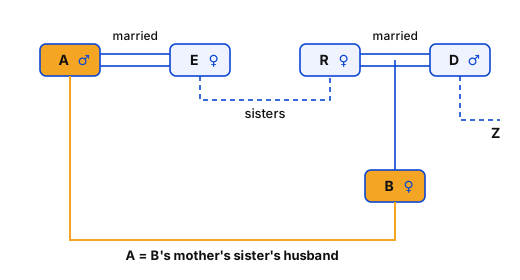
- D is a brother (male), so his wife R is female – B's mother.
- E is R's sister, so E is B's mother's sister (maasi).
- A is married to E, so A is the husband of B's mother's sister.
Trick: Mother's sister's husband = maasa (मौसा).
Answer: (A) Mother's sister's husband
अवधारणा: विवाह और 'भाई' वाले कथनों से लिंग तय करें, फिर B से A तक का रास्ता देखें।
- D भाई (पुरुष) है, अतः उसकी पत्नी R महिला है – B की माँ।
- E, R की बहन है, अतः E = B की मौसी।
- A का विवाह E से है, अतः A = B की माँ की बहन का पति (मौसा)।
ट्रिक: माँ की बहन का पति = मौसा।
उत्तर: (A) माँ की बहन का पति
RRB NTPC Graduate CBT 1General Intelligence and ReasoningBlood RelationRRB NTPC Graduate CBT 1 2024 · 17 Jun Shift 2
Q573.In a certain code language, ‘HUNT’ is coded as ‘6438’ and ‘USER’ is coded as ‘5723’. What is the code for ‘U’ in the given code language?
एक निश्चित कूट भाषा में, ‘HUNT’ को ‘6438’ और ‘USER’ को ‘5723’ के रूप में कूटबद्ध किया जाता है। दी गई कूट भाषा में ‘U’ का कूट क्या है?
- A3
- B5
- C7
- D4
Show answer
Concept: A letter common to two words takes the digit common to both codes.
- HUNT → 6438 and USER → 5723.
- Common letter: U.
- Common digit: 3.
Trick: Match common letter with common digit.
Answer: (A) 3
अवधारणा: दो शब्दों में समान अक्षर का कोड दोनों कोड में समान अंक होता है।
- HUNT → 6438 और USER → 5723।
- समान अक्षर: U।
- समान अंक: 3।
ट्रिक: समान अक्षर = समान अंक।
उत्तर: (A) 3
RRB NTPC Graduate CBT 1General Intelligence and ReasoningCoding-DecodingRRB NTPC Graduate CBT 1 2024 · 17 Jun Shift 2
Q574.Refer to the following number and symbol series and answer the question that follows. Counting to be done from left to right only.
(NOTE: All numbers are single digit numbers only.)
(Left) © © 4 3 5 6 7 # * 1 3 % 9 2 7 5 9 & £ @ 7 * (Right)
How many such numbers are there each of which is immediately preceded by a number and also immediately followed by a number?
निम्नलिखित संख्या और प्रतीक श्रृंखला को देखें और उसके बाद दिए गए प्रश्न का उत्तर दें। गणना केवल बाएँ से दाएँ की जानी है।
(नोट: सभी संख्याएँ केवल एक अंक वाली संख्याएँ हैं।)
(बाएँ) © © 4 3 5 6 7 # * 1 3 % 9 2 7 5 9 & £ @ 7 * (दाएँ)
ऐसी कितनी संख्याएँ हैं जिनमें से प्रत्येक के ठीक पहले एक संख्या है और ठीक बाद भी एक संख्या है?
- A5
- B6
- C8
- D7
Show answer
Concept: Check each number: the element just before it and just after it must both be numbers.
- Run 4 3 5 6 7: inside numbers 3, 5, 6 → 3 qualify.
- Run 9 2 7 5 9 (after %): inside numbers 2, 7, 5 → 3 qualify.
- 1 3 (between * and %) and lone 7 have a symbol on one side.
Trick: In a run of k consecutive numbers, exactly qualify: .
Answer: (B) 6
अवधारणा: प्रत्येक संख्या के ठीक पहले और ठीक बाद दोनों ओर संख्या होनी चाहिए।
- क्रम 4 3 5 6 7: बीच की संख्याएँ 3, 5, 6 → 3।
- क्रम 9 2 7 5 9 (% के बाद): बीच की 2, 7, 5 → 3।
- 1 3 और अकेला 7 – एक ओर प्रतीक है, गिनती नहीं।
ट्रिक: k लगातार संख्याओं के समूह में संख्याएँ योग्य: ।
उत्तर: (B) 6
RRB NTPC Graduate CBT 1General Intelligence and ReasoningNumber-Symbol SeriesRRB NTPC Graduate CBT 1 2024 · 17 Jun Shift 2
Q575.Refer to the following number and symbol series and answer the question that follows. Counting to be done from left to right only.
(NOTE: All numbers are single digit numbers only.)
(Left) @ 9 7 8 2 @ @ 9 3 * 2 6 2 © # 9 & 7 8 9 @ 4 (Right)
How many such symbols are there each of which is immediately preceded by a number and also immediately followed by a number?
निम्नलिखित संख्या और प्रतीक श्रृंखला को देखें और उसके बाद दिए गए प्रश्न का उत्तर दें। गणना केवल बाएँ से दाएँ की जानी है।
(नोट: सभी संख्याएँ केवल एक अंक वाली संख्याएँ हैं।)
(बाएँ) @ 9 7 8 2 @ @ 9 3 * 2 6 2 © # 9 & 7 8 9 @ 4 (दाएँ)
ऐसे कितने प्रतीक हैं जिनमें से प्रत्येक के ठीक पहले एक संख्या है और ठीक बाद भी एक संख्या है?
- A2
- B4
- C5
- D3
Show answer
Concept: Look only at symbols; each must have a number immediately on both sides.
- 3 * 2 → * qualifies.
- 9 & 7 → & qualifies.
- 9 @ 4 → last @ qualifies; other @, © and # touch another symbol or the end.
Trick: Scan for the pattern number–symbol–number.
Answer: (D) 3
अवधारणा: केवल प्रतीकों को देखें; हर प्रतीक के दोनों ओर तुरंत संख्या होनी चाहिए।
- 3 * 2 → * योग्य।
- 9 & 7 → & योग्य।
- 9 @ 4 → अंतिम @ योग्य; अन्य @, © व # किसी प्रतीक या किनारे से सटे हैं।
ट्रिक: संख्या–प्रतीक–संख्या पैटर्न खोजें।
उत्तर: (D) 3
RRB NTPC Graduate CBT 1General Intelligence and ReasoningNumber-Symbol SeriesRRB NTPC Graduate CBT 1 2024 · 17 Jun Shift 2
Q576.Select the set in which the numbers are related in the same way as are the numbers of the following sets.
(NOTE: Operations should be performed on the whole numbers, without breaking down the numbers into their constituent digits. E.g. 13 – Operations on 13 such as adding to/subtracting from/multiplying with 13 can be performed. Breaking down 13 into 1 and 3 and then performing mathematical operations on 1 and 3 is not allowed.)
(22, 28, 31)
(39, 45, 48)
उस समुच्चय का चयन कीजिए जिसमें संख्याएँ उसी प्रकार संबंधित हैं जिस प्रकार निम्नलिखित समुच्चयों की संख्याएँ संबंधित हैं।
(नोट: संक्रियाएँ संख्याओं को उनके घटक अंकों में विभाजित किए बिना, पूर्ण संख्याओं पर की जानी चाहिए। उदाहरण के लिए 13 – 13 पर संक्रियाएँ जैसे 13 में जोड़ना/घटाना/गुणा करना आदि की जा सकती हैं। 13 को 1 और 3 में विभाजित करना और फिर 1 और 3 पर गणितीय संक्रियाएँ करना वर्जित है।)
(22, 28, 31)
(39, 45, 48)
- A(53, 59, 65)
- B(44, 47, 50)
- C(17, 20, 26)
- D(27, 33, 36)
Show answer
Concept: Find the step pattern inside each set.
- (22, 28, 31):
- (39, 45, 48):
- (27, 33, 36): ✓; others fail (e.g. 53, 59, 65 is +6, +6).
Trick: Pattern +6, +3 → also first and third differ by 9.
Answer: (D) (27, 33, 36)
अवधारणा: हर समूह में अंतर का पैटर्न देखें।
- (22, 28, 31):
- (39, 45, 48):
- (27, 33, 36): ✓; बाकी विकल्प मेल नहीं खाते।
ट्रिक: पहली व तीसरी संख्या का अंतर 9 होना चाहिए।
उत्तर: (D) (27, 33, 36)
RRB NTPC Graduate CBT 1General Intelligence and ReasoningNumber AnalogyRRB NTPC Graduate CBT 1 2024 · 17 Jun Shift 2
Q577.Read the given statements and conclusions carefully. Assuming that the information given in the statements is true, even if it appears to be at variance with commonly known facts, decide which of the given conclusion(s) logically follow(s) from the statements.
Statements:
All sparrows are parrots.
All parrots are macau.
Some sparrows are dove.
Conclusions:
(I) Some sparrows are macau.
(II) Some doves are parrots.
दिए गए कथनों और निष्कर्षों को ध्यानपूर्वक पढ़िए। कथनों में दी गई जानकारी को सत्य मानते हुए, भले ही वह सामान्यतः ज्ञात तथ्यों से भिन्न प्रतीत होती हो, निर्णय लीजिए कि दिए गए निष्कर्षों में से कौन-सा/कौन-से निष्कर्ष तार्किक रूप से कथनों का अनुसरण करता है/करते हैं।
कथन:
सभी गौरैया, तोते हैं।
सभी तोते, मकाउ हैं।
कुछ गौरैया, कबूतर हैं।
निष्कर्ष:
(I) कुछ गौरैया, मकाउ हैं।
(II) कुछ कबूतर, तोते हैं।
- ABoth conclusions (I) and (II) followनिष्कर्ष (I) और (II) दोनों अनुसरण करते हैं
- BOnly conclusion (I) followsकेवल निष्कर्ष (I) अनुसरण करता है
- COnly conclusion (II) followsकेवल निष्कर्ष (II) अनुसरण करता है
- DNeither conclusion (I) nor conclusion (II) followsन तो निष्कर्ष (I) और न ही निष्कर्ष (II) अनुसरण करता है
Show answer
Concept: Draw the minimum Venn diagram consistent with all statements.
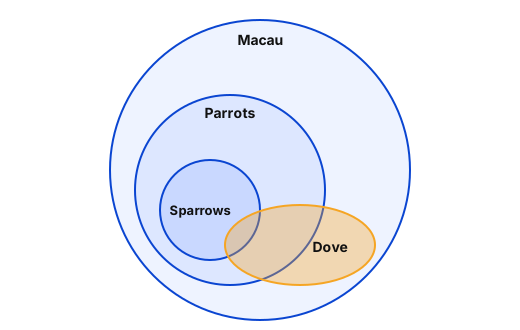
- Sparrows ⊂ Parrots ⊂ Macau, so every sparrow is a macau → I follows.
- Some sparrows are doves; those sparrows are parrots, so some doves are parrots → II follows.
Trick: 'All A are B' + 'Some A are C' → 'Some C are B' is always definite.
Answer: (A) Both conclusions (I) and (II) follow
अवधारणा: सभी कथनों के अनुरूप न्यूनतम वेन आरेख बनाएँ।
- गौरैया ⊂ तोता ⊂ मकाउ, अतः हर गौरैया मकाउ है → I सही।
- कुछ गौरैया कबूतर (dove) हैं; वे गौरैया तोते भी हैं, अतः कुछ कबूतर तोते हैं → II सही।
ट्रिक: 'सभी A, B हैं' + 'कुछ A, C हैं' → 'कुछ C, B हैं' निश्चित।
उत्तर: (A) I और II दोनों अनुसरण करते हैं
RRB NTPC Graduate CBT 1General Intelligence and ReasoningSyllogismRRB NTPC Graduate CBT 1 2024 · 17 Jun Shift 2
Q578.Which of the following letter-clusters should replace # and % so that the pattern and relationship followed between the letter-cluster pair on the left side of :: is the same as that on the right side of :: ?
# : RWS :: INJ : %
निम्नलिखित में से कौन-से अक्षर-समूह # और % को प्रतिस्थापित करने चाहिए ताकि :: के बाईं ओर के अक्षर-समूह युग्म के बीच अनुसरित पैटर्न और संबंध वही हो जो :: के दाईं ओर है?
# : RWS :: INJ : %
- A# = NGV, % = FLP
- B# = PIV, % = MJU
- C# = UZV, % = FKG
- D# = CDR, % = KJI
Show answer
Concept: Find the shift from the right pair's rule and test the options.
- Take # = UZV: U−3 = R, Z−3 = W, V−3 = S → RWS ✓
- Apply the same −3 to INJ: I−3 = F, N−3 = K, J−3 = G → FKG
- So # = UZV and % = FKG.
Trick: Positions: U(21)→R(18), I(9)→F(6): a uniform −3.
Answer: (C) # = UZV, % = FKG
अवधारणा: दाएँ जोड़े का नियम निकालकर विकल्प जाँचें।
- # = UZV: U−3 = R, Z−3 = W, V−3 = S → RWS ✓
- INJ पर −3: I→F, N→K, J→G → FKG
- अतः # = UZV, % = FKG।
ट्रिक: स्थान: U(21)→R(18), I(9)→F(6): हर अक्षर −3।
उत्तर: (C) # = UZV, % = FKG
RRB NTPC Graduate CBT 1General Intelligence and ReasoningLetter AnalogyRRB NTPC Graduate CBT 1 2024 · 17 Jun Shift 2
Q579.Dhiraj starts from Point Y and drives 22 km towards the east. He then takes a right turn, drives 33 km, turns left and drives 25 km. He then takes a left turn and drives 51 km. He takes a left turn, drives 47 km. He then turns left, drives 23 km and stops at Point Z. How far (shortest distance) and towards which direction should he drive in order to reach Point Y again? (All turns are 90-degree turns only unless specified.)
धीरज बिंदु Y से चलना शुरू करता है और पूर्व की ओर 22 km गाड़ी चलाता है। फिर वह दाएँ मुड़ता है, 33 km गाड़ी चलाता है, बाएँ मुड़ता है और 25 km गाड़ी चलाता है। फिर वह बाएँ मुड़ता है और 51 km गाड़ी चलाता है। वह बाएँ मुड़ता है, 47 km गाड़ी चलाता है। फिर वह बाएँ मुड़ता है, 23 km गाड़ी चलाता है और बिंदु Z पर रुक जाता है। बिंदु Y पर फिर से पहुँचने के लिए उसे कितनी दूरी (न्यूनतम दूरी) और किस दिशा में गाड़ी चलानी चाहिए? (जब तक निर्दिष्ट न हो, सभी मोड़ केवल 90 डिग्री के मोड़ हैं।)
- A5 km towards the northउत्तर की ओर 5 km
- B5 km towards the eastपूर्व की ओर 5 km
- C7 km towards the northउत्तर की ओर 7 km
- D7 km towards the southदक्षिण की ओर 7 km
Show answer
Concept: Track coordinates (east +x, north +y) after every turn.
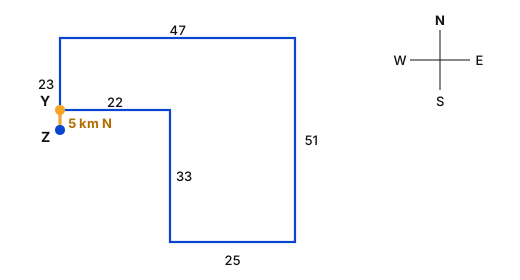
- Y(0, 0) → E 22 → (22, 0); right = S 33 → (22, −33); left = E 25 → (47, −33)
- Left = N 51 → (47, 18); left = W 47 → (0, 18); left = S 23 → Z(0, −5)
- Z is 5 km directly south of Y, so he must go 5 km north.
Trick: Net E–W: ; net N–S: → 5 km north to return.
Answer: (A) 5 km towards the north
अवधारणा: हर मोड़ के बाद निर्देशांक (पूर्व +x, उत्तर +y) लिखें।
- Y(0, 0) → पूर्व 22 → (22, 0); दाएँ = दक्षिण 33 → (22, −33); बाएँ = पूर्व 25 → (47, −33)
- बाएँ = उत्तर 51 → (47, 18); बाएँ = पश्चिम 47 → (0, 18); बाएँ = दक्षिण 23 → Z(0, −5)
- Z, Y से 5 km दक्षिण में है, अतः 5 km उत्तर जाना होगा।
ट्रिक: पूर्व–पश्चिम: ; उत्तर–दक्षिण: ।
उत्तर: (A) 5 km उत्तर की ओर
RRB NTPC Graduate CBT 1General Intelligence and ReasoningDirection & DistanceRRB NTPC Graduate CBT 1 2024 · 17 Jun Shift 2
Q580.Seven boxes, D, E, F, G, S, T and U, are kept one over the other but not necessarily in the same order. Only two boxes are kept below T. Only one box is kept above U. Only one box is kept between U and D. G is kept immediately above S. F is kept at some place below E. How many boxes are kept between E and G?
सात बक्से D, E, F, G, S, T और U एक के ऊपर एक रखे गए हैं, लेकिन आवश्यक नहीं कि इसी क्रम में हों। T के नीचे केवल दो बक्से रखे गए हैं। U के ऊपर केवल एक बक्सा रखा गया है। U और D के बीच केवल एक बक्सा रखा गया है। G को S के ठीक ऊपर रखा गया है। F को E के नीचे किसी स्थान पर रखा गया है। E और G के बीच कितने बक्से रखे गए हैं?
- ATwoदो
- BOneएक
- CThreeतीन
- DFourचार
Show answer
Concept: Number positions 1 (bottom) to 7 (top) and place fixed boxes first.
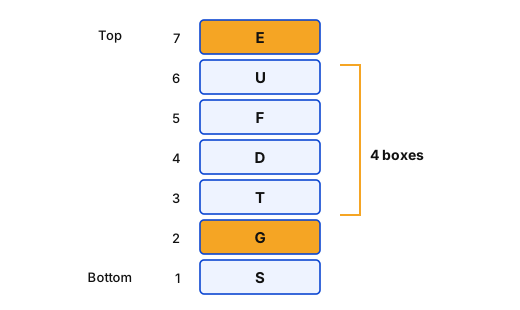
- Two below T → T = 3; one above U → U = 6; one box between U and D → D = 4.
- Free: 1, 2, 5, 7. G just above S → only S = 1, G = 2 works.
- F below E → F = 5, E = 7.
- Between E (7) and G (2): U, F, D, T → four boxes.
Trick: Boxes between positions p and q .
Answer: (D) Four
अवधारणा: स्थान 1 (नीचे) से 7 (ऊपर) तक संख्या दें और निश्चित डिब्बे पहले रखें।
- T के नीचे दो → T = 3; U के ऊपर एक → U = 6; U और D के बीच एक → D = 4।
- खाली: 1, 2, 5, 7। G ठीक S के ऊपर → S = 1, G = 2।
- F, E के नीचे → F = 5, E = 7।
- E (7) और G (2) के बीच: U, F, D, T → चार।
ट्रिक: बीच के डिब्बे ।
उत्तर: (D) चार
RRB NTPC Graduate CBT 1General Intelligence and ReasoningVertical ArrangementRRB NTPC Graduate CBT 1 2024 · 17 Jun Shift 2

