Q41.Seven boxes D, E, F, G, I, J and K are kept one over the other but not necessarily in the same order. No box is kept above F. Only three boxes are kept between F and K. Only one box is kept between D and E. E is kept immediately above K. Only four boxes are kept between D and G. J is kept at some place above I. Which box is kept second below J?
सात बक्से D, E, F, G, I, J और K एक के ऊपर एक रखे गए हैं, लेकिन ज़रूरी नहीं कि इसी क्रम में हों। F के ऊपर कोई बक्सा नहीं रखा गया है। F और K के बीच केवल तीन बक्से रखे गए हैं। D और E के बीच केवल एक बक्सा रखा गया है। E को K के ठीक ऊपर रखा गया है। D और G के बीच केवल चार बक्से रखे गए हैं। J को I के ऊपर किसी स्थान पर रखा गया है। J के नीचे दूसरे स्थान पर कौन-सा बक्सा रखा गया है?
- AF
- BG
- CK
- DD
Show answer
Concept: Number the positions 1 (top) to 7 (bottom) and place the fixed boxes first.
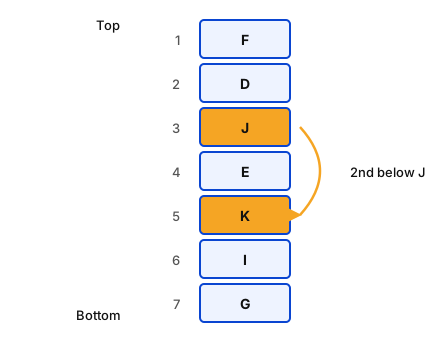
- No box above F → F = 1. Three boxes between F and K → K = 5; E immediately above K → E = 4.
- One box between D and E → D = 2 or 6. Four between D and G: D = 2 gives G = 7; D = 6 would need G = 1 (taken). So D = 2, G = 7.
- J above I in the empty places 3 and 6 → J = 3, I = 6.
- Second below J (3) → position 5 = K.
Trick: Fill the definite chain (F, K, E) before the either–or cases.
Answer: (C) K
अवधारणा: स्थान 1 (ऊपर) से 7 (नीचे) तक मानें और पहले निश्चित बॉक्स रखें।
- F के ऊपर कोई नहीं → F = 1। F और K के बीच तीन → K = 5; E, K के ठीक ऊपर → E = 4।
- D और E के बीच एक → D = 2 या 6। D और G के बीच चार: D = 2 से G = 7; D = 6 पर G = 1 (भरा)। अतः D = 2, G = 7।
- खाली स्थान 3 और 6; J, I के ऊपर → J = 3, I = 6।
- J (3) से दूसरा नीचे → स्थान 5 = K।
ट्रिक: पहले निश्चित श्रृंखला (F, K, E), फिर विकल्प वाले मामले।
उत्तर: (C) K
RRB NTPC Graduate CBT 1General Intelligence and ReasoningBox ArrangementRRB NTPC Graduate CBT 1 2024 · 24 Jun Shift 2
Q42.Steve starts from Point A and drives 10 km towards north. He then takes a right turn, drives 7 km, turns right and drives 3 km. He then takes a left turn and drives 5 km. He takes a final right turn, drives 7 km and stops at Point P. How far (shortest distance) and towards which direction should he drive in order to reach Point A again? (All turns are 90 degrees turns only unless specified)
स्टीव बिंदु A से चलना शुरू करता है और उत्तर की ओर 10 km गाड़ी चलाता है। फिर वह दाएँ मुड़ता है, 7 km गाड़ी चलाता है, दाएँ मुड़ता है और 3 km गाड़ी चलाता है। फिर वह बाएँ मुड़ता है और 5 km गाड़ी चलाता है। वह अंतिम बार दाएँ मुड़ता है, 7 km गाड़ी चलाता है और बिंदु P पर रुक जाता है। फिर से बिंदु A पर पहुँचने के लिए उसे कितनी दूर (न्यूनतम दूरी) और किस दिशा में गाड़ी चलानी चाहिए? (जब तक निर्दिष्ट न किया जाए, सभी मोड़ केवल 90 डिग्री के मोड़ हैं)
- A12 km towards westपश्चिम की ओर 12 km
- B10 km towards southदक्षिण की ओर 10 km
- C12 km towards eastपूर्व की ओर 12 km
- D10 km towards westपश्चिम की ओर 10 km
Show answer
Concept: Plot each move with A as origin, East = +x, North = +y.
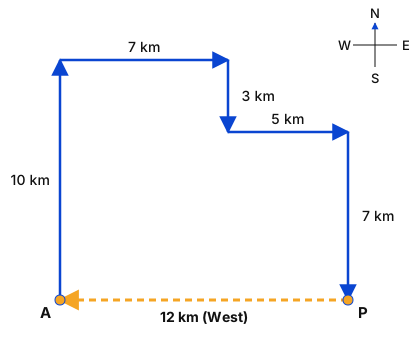
- North 10 km → (0, 10); right (East) 7 km → (7, 10).
- Right (South) 3 km → (7, 7); left (East) 5 km → (12, 7).
- Right (South) 7 km → P(12, 0).
- P is 12 km East of A → drive 12 km towards West.
Trick: Net East ; net North .
Answer: (A) 12 km towards west
अवधारणा: A को मूल बिंदु मानकर हर चाल लिखें (पूर्व = +x, उत्तर = +y)।
- उत्तर 10 km → (0, 10); दाएँ (पूर्व) 7 km → (7, 10)।
- दाएँ (दक्षिण) 3 km → (7, 7); बाएँ (पूर्व) 5 km → (12, 7)।
- दाएँ (दक्षिण) 7 km → P(12, 0)।
- P, A से 12 km पूर्व में → 12 km पश्चिम की ओर जाना होगा।
ट्रिक: कुल पूर्व ; कुल उत्तर ।
उत्तर: (A) 12 km पश्चिम की ओर
RRB NTPC Graduate CBT 1General Intelligence and ReasoningDirection and DistanceRRB NTPC Graduate CBT 1 2024 · 24 Jun Shift 2
Q43.Based on the English alphabetical order, three of the following four letter-clusters are alike in a certain way and thus form a group. Which is the letter-cluster that DOES NOT belong to that group?
(Note: The odd one out is not based on the number of consonants/vowels or their position in the letter-cluster.)
अंग्रेज़ी वर्णमाला क्रम के आधार पर, निम्नलिखित चार अक्षर-समूहों में से तीन किसी निश्चित प्रकार से एकसमान हैं और इस प्रकार एक समूह बनाते हैं। वह कौन-सा अक्षर-समूह है जो उस समूह से संबंधित नहीं है?
(नोट: असंगत अक्षर-समूह, उस अक्षर-समूह में व्यंजनों/स्वरों की संख्या या उनके स्थान पर आधारित नहीं है।)
- AUZW
- BNSP
- CIGL
- DSXU
Show answer
Concept: Write alphabet positions and compare the gaps.
- UZW: 21, 26, 23 → . NSP: 14, 19, 16 → . SXU: 19, 24, 21 → .
- IGL: 9, 7, 12 → – different.
Trick: Check the first gap: only IGL goes backward.
Answer: (C) IGL
अवधारणा: अक्षरों के स्थानीय मान लिखकर अंतर देखें।
- UZW: 21, 26, 23 → । NSP: 14, 19, 16 → । SXU: 19, 24, 21 → ।
- IGL: 9, 7, 12 → – अलग।
ट्रिक: पहला अंतर देखें: केवल IGL पीछे जाता है।
उत्तर: (C) IGL
RRB NTPC Graduate CBT 1General Intelligence and ReasoningOdd One Out – Letter ClustersRRB NTPC Graduate CBT 1 2024 · 24 Jun Shift 2
Q44.This question is based on the five, three-digit numbers given below.
(Left) 617 335 930 459 571 (Right)
(Example: 697 – First digit = 6, second digit = 9 and third digit = 7)
(Note: All operations to be done from left to right.)
What will be the resultant if the first digit of the highest number is added to the third digit of the lowest number?
यह प्रश्न नीचे दी गई तीन अंकों वाली पाँच संख्याओं पर आधारित है।
(बाएँ) 617 335 930 459 571 (दाएँ)
(उदाहरण: 697 – पहला अंक = 6, दूसरा अंक = 9 और तीसरा अंक = 7)
(नोट: सभी संक्रियाएँ बाएँ से दाएँ की जानी हैं।)
यदि सबसे बड़ी संख्या के पहले अंक को सबसे छोटी संख्या के तीसरे अंक में जोड़ा जाए, तो परिणाम क्या होगा?
- A13
- B12
- C14
- D15
Show answer
Concept: Arrange the five numbers to find the highest and the lowest, then pick the asked digits.
- Numbers: 617, 335, 930, 459, 571.
- Highest = 930 → first digit = 9.
- Lowest = 335 → third digit = 5.
- .
Trick: For highest/lowest just compare first digits: 9 is biggest, 3 is smallest.
Answer: (C) 14
अवधारणा: पाँचों संख्याओं में सबसे बड़ी और सबसे छोटी ढूँढकर पूछे गए अंक लें।
- संख्याएँ: 617, 335, 930, 459, 571।
- सबसे बड़ी = 930 → पहला अंक = 9।
- सबसे छोटी = 335 → तीसरा अंक = 5।
- ।
ट्रिक: सबसे बड़ी/छोटी के लिए केवल पहले अंक की तुलना करें: 9 सबसे बड़ा, 3 सबसे छोटा।
उत्तर: (C) 14
RRB NTPC Graduate CBT 1General Intelligence and ReasoningNumber Operations – DigitsRRB NTPC Graduate CBT 1 2024 · 24 Jun Shift 2
Q45.Read the given statements and conclusions carefully. Assuming that the information given in the statements is true, even if it appears to be at variance with commonly known facts, decide which of the given conclusion(s) logically follow(s) from the statements.
Statements:
All cats are bills.
No snakes are bills.
All snakes are dolls.
Conclusions:
(I) Some dolls are not cats.
(II) No bills are dolls.
दिए गए कथनों और निष्कर्षों को ध्यानपूर्वक पढ़िए। यह मानते हुए कि कथनों में दी गई जानकारी सत्य है, भले ही वह सामान्य रूप से ज्ञात तथ्यों से भिन्न प्रतीत होती हो, निर्णय कीजिए कि दिए गए निष्कर्षों में से कौन-सा/कौन-से निष्कर्ष तार्किक रूप से कथनों का अनुसरण करता है/करते हैं।
कथन:
सभी बिल्लियाँ, बिल हैं।
कोई साँप, बिल नहीं है।
सभी साँप, गुड़िया हैं।
निष्कर्ष:
(I) कुछ गुड़िया, बिल्लियाँ नहीं हैं।
(II) कोई बिल, गुड़िया नहीं है।
- ABoth conclusions (I) and (II) follow.निष्कर्ष (I) और (II) दोनों अनुसरण करते हैं।
- BOnly conclusion (I) follows.केवल निष्कर्ष (I) अनुसरण करता है।
- COnly conclusion (II) follows.केवल निष्कर्ष (II) अनुसरण करता है।
- DNeither conclusion (I) nor (II) follows.न तो निष्कर्ष (I) और न ही (II) अनुसरण करता है।
Show answer
Concept: Draw the least-overlap Venn diagram that satisfies all statements and test each conclusion.
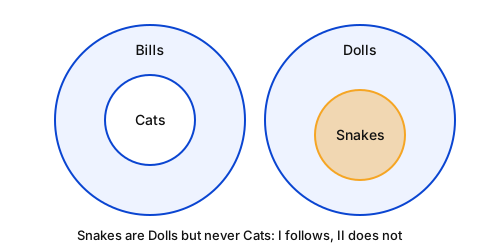
- All cats are bills and no snake is a bill ⇒ no snake is a cat.
- All snakes are dolls ⇒ those dolls which are snakes are definitely not cats ⇒ 'Some dolls are not cats' – follows.
- Bills and dolls may or may not overlap; 'No bills are dolls' is not certain – does not follow.
Trick: 'Some A are not B' follows when a part of A (here snakes) is fully separated from B.
Answer: (B) Only conclusion (I) follows.
अवधारणा: सभी कथनों को संतुष्ट करने वाला न्यूनतम-मेल वाला वेन आरेख बनाकर निष्कर्ष जाँचें।
- सभी cats, bills हैं और कोई snake, bill नहीं ⇒ कोई snake, cat नहीं।
- सभी snakes, dolls हैं ⇒ जो dolls snakes हैं, वे निश्चित रूप से cats नहीं ⇒ 'कुछ dolls, cats नहीं हैं' – अनुसरण करता है।
- Bills और dolls का मेल हो भी सकता है, नहीं भी; 'कोई bill, doll नहीं' निश्चित नहीं – अनुसरण नहीं करता।
ट्रिक: 'कुछ A, B नहीं' तब निकलता है जब A का कोई भाग (यहाँ snakes) B से पूरी तरह अलग हो।
उत्तर: (B) Only conclusion (I) follows.
RRB NTPC Graduate CBT 1General Intelligence and ReasoningSyllogismRRB NTPC Graduate CBT 1 2024 · 24 Jun Shift 2
Q46.Which of the following letter-clusters should replace # and % so that the pattern and relationship followed between the letter-cluster pair on the left side of :: is the same as that on the right side of :: ?
# : QLO :: QLO : %
निम्नलिखित में से कौन-से अक्षर-समूह # और % को प्रतिस्थापित करेंगे, ताकि :: के बाईं ओर के अक्षर-समूह युग्म के बीच का पैटर्न और संबंध वही हो, जो :: के दाईं ओर के अक्षर-समूह युग्म के बीच है?
# : QLO :: QLO : %
- A# = LGJ, % = VQT
- B# = LPU, % = VPY
- C# = LLP, % = VOY
- D# = KJJ, % = MYT
Show answer
Concept: Find a constant letter shift that maps # to QLO and apply the same to QLO.
- Try option (A): L+5 = Q, G+5 = L, J+5 = O ⇒ LGJ → QLO (each letter +5).
- Apply +5 to QLO: Q+5 = V, L+5 = Q, O+5 = T ⇒ VQT.
- Both parts match option (A).
Trick: Check only the first letter of each option first: L→Q→V (+5,+5) fits instantly.
Answer: (A) # = LGJ, % = VQT
अवधारणा: ऐसा स्थिर अक्षर-अंतर खोजें जो # को QLO में बदले, फिर वही QLO पर लगाएँ।
- विकल्प (A) जाँचें: L+5 = Q, G+5 = L, J+5 = O ⇒ LGJ → QLO (हर अक्षर +5)।
- QLO पर +5: Q+5 = V, L+5 = Q, O+5 = T ⇒ VQT।
- दोनों भाग विकल्प (A) से मेल खाते हैं।
ट्रिक: पहले हर विकल्प का पहला अक्षर देखें: L→Q→V (+5,+5) तुरंत मेल खाता है।
उत्तर: (A) # = LGJ, % = VQT
RRB NTPC Graduate CBT 1General Intelligence and ReasoningLetter AnalogyRRB NTPC Graduate CBT 1 2024 · 24 Jun Shift 2
Q47.In the following triads, each group of letters is related to the subsequent one following a certain logic. Select from the given options, the one that follows the same logic. SAME - AEMS - EMAS
GOAL - OLAG - LAOG
निम्नलिखित त्रयों में, अक्षरों का प्रत्येक समूह एक निश्चित तर्क का अनुसरण करते हुए अगले समूह से संबंधित है। दिए गए विकल्पों में से उस विकल्प का चयन कीजिए, जो उसी तर्क का अनुसरण करता है। SAME - AEMS - EMAS
GOAL - OLAG - LAOG
- ALEAN - ELAN - NEAL
- BSINK - IKNS - KNIS
- CYEAK - YAEK - KAEY
- DRIPE - IRPE - EIPR
Show answer
Concept: Note how the letter positions are shuffled from one group to the next.
- SAME → AEMS: letters taken in order 2, 4, 3, 1 (A, E, M, S). Same for GOAL → O, L, A, G = OLAG.
- AEMS → EMAS: order 2, 3, 1, 4 (E, M, A, S). OLAG → L, A, O, G = LAOG.
- Option (B): SINK → I, K, N, S = IKNS; IKNS → K, N, I, S = KNIS ✓.
Trick: Write position numbers (1234) under the first word once – then just read the pattern.
Answer: (B) SINK - IKNS - KNIS
अवधारणा: देखें कि एक समूह से अगले समूह में अक्षरों के स्थान कैसे बदलते हैं।
- SAME → AEMS: अक्षर क्रम 2, 4, 3, 1 (A, E, M, S)। GOAL → O, L, A, G = OLAG।
- AEMS → EMAS: क्रम 2, 3, 1, 4 (E, M, A, S)। OLAG → L, A, O, G = LAOG।
- विकल्प (B): SINK → I, K, N, S = IKNS; IKNS → K, N, I, S = KNIS ✓।
ट्रिक: पहले शब्द के नीचे स्थान संख्या (1234) लिखें – फिर पैटर्न पढ़ लें।
उत्तर: (B) SINK - IKNS - KNIS
RRB NTPC Graduate CBT 1General Intelligence and ReasoningLetter Triads – Position RearrangementRRB NTPC Graduate CBT 1 2024 · 24 Jun Shift 2
Q48.VAGL is related to PUAF in a certain way based on the English alphabetical order. In the same way, XCIN is related to RWCH. To which of the following options is FKQV related, following the same logic?
अंग्रेज़ी वर्णमाला क्रम के आधार पर VAGL एक निश्चित प्रकार से PUAF से संबंधित है। उसी प्रकार, XCIN, RWCH से संबंधित है। समान तर्क का अनुसरण करते हुए, FKQV निम्नलिखित में से किस विकल्प से संबंधित है?
- AZPEK
- BZEKP
- CZPKE
- DZEPK
Show answer
Concept: Each letter is moved a fixed number of places in the alphabet.
- VAGL → PUAF: V−6 = P, A−6 = U (wrap-around), G−6 = A, L−6 = F.
- Check: XCIN → RWCH is also −6 for each letter.
- FKQV −6: F→Z, K→E, Q→K, V→P ⇒ ZEKP.
Trick: −6 with wrap: A→U, B→V, … F→Z (add 20 instead of subtracting 6 for early letters).
Answer: (B) ZEKP
अवधारणा: हर अक्षर वर्णमाला में एक निश्चित संख्या से खिसकाया गया है।
- VAGL → PUAF: V−6 = P, A−6 = U (चक्रीय), G−6 = A, L−6 = F।
- जाँच: XCIN → RWCH में भी हर अक्षर −6 है।
- FKQV −6: F→Z, K→E, Q→K, V→P ⇒ ZEKP।
ट्रिक: शुरुआती अक्षरों में −6 के बजाय +20 करें: F+20 = Z।
उत्तर: (B) ZEKP
RRB NTPC Graduate CBT 1General Intelligence and ReasoningLetter Coding – ShiftRRB NTPC Graduate CBT 1 2024 · 24 Jun Shift 2
Q49.A group of numbers/symbols is coded using letter codes as per the codes given below and the conditions that follow. If none of the conditions apply, then codes for the respective number/symbol are to be followed directly as given in the table.
| Number/Symbol | 2 | 9 | 6 | 7 | 4 | # | 3 | @ | 1 |
|---|
| Code | Y | A | L | B | S | D | E | Z | C |
|---|
Conditions –
(i) If the first element is a symbol and the last a number, the codes for these two (the first and the last elements) are to be interchanged.
(ii) If the first element is an odd number and the last an even number, the first and last elements are to be coded as ©
(iii) If both second and third elements are perfect squares, the third element is to be coded as the code for the second element.
What will be the code for the following group?
9 4 @ 1
नीचे दिए गए कूटों और उसके बाद दी गई शर्तों के अनुसार संख्याओं/प्रतीकों के एक समूह को अक्षर कूटों का उपयोग करके कूटबद्ध किया गया है। यदि कोई भी शर्त लागू नहीं होती है, तो संबंधित संख्या/प्रतीक के लिए तालिका में दिए गए कूटों का सीधे पालन किया जाना है।
| संख्या/प्रतीक | 2 | 9 | 6 | 7 | 4 | # | 3 | @ | 1 |
|---|
| कूट | Y | A | L | B | S | D | E | Z | C |
|---|
शर्तें –
(i) यदि पहला अवयव एक प्रतीक है और अंतिम अवयव एक संख्या है, तो इन दोनों (पहले और अंतिम अवयव) के कूट आपस में बदल दिए जाने हैं।
(ii) यदि पहला अवयव एक विषम संख्या है और अंतिम अवयव एक सम संख्या है, तो पहले और अंतिम दोनों अवयवों को © के रूप में कूटबद्ध किया जाना है।
(iii) यदि दूसरा और तीसरा दोनों अवयव पूर्ण वर्ग हैं, तो तीसरे अवयव को दूसरे अवयव के कूट के रूप में कूटबद्ध किया जाना है।
निम्नलिखित समूह का कूट क्या होगा?
9 4 @ 1
- AASZC
- B©SZ©
- CLZSC
- DAZSC
Show answer
Concept: Check each condition in turn; if none applies, code each element directly from the table.
- Group: 9 4 @ 1. (i) First element 9 is not a symbol – not applicable.
- (ii) First 9 is odd but last 1 is odd, not even – not applicable.
- (iii) Second 4 is a perfect square but third '@' is not – not applicable.
- Direct codes: 9 = A, 4 = S, @ = Z, 1 = C ⇒ ASZC.
Trick: Eliminate fast: (B) needs condition (ii); (C)/(D) change the order of S and Z – so only (A) is possible.
Answer: (A) ASZC
अवधारणा: हर शर्त बारी-बारी से जाँचें; कोई लागू न हो तो तालिका से सीधे कोड लिखें।
- समूह: 9 4 @ 1। (i) पहला तत्व 9 प्रतीक नहीं – लागू नहीं।
- (ii) पहला 9 विषम है पर अंतिम 1 भी विषम है, सम नहीं – लागू नहीं।
- (iii) दूसरा 4 पूर्ण वर्ग है पर तीसरा '@' नहीं – लागू नहीं।
- सीधे कोड: 9 = A, 4 = S, @ = Z, 1 = C ⇒ ASZC।
ट्रिक: तेज़ी से हटाएँ: (B) के लिए शर्त (ii) चाहिए; (C)/(D) में S और Z का क्रम बदला है – केवल (A) संभव।
उत्तर: (A) ASZC
RRB NTPC Graduate CBT 1General Intelligence and ReasoningCoding with ConditionsRRB NTPC Graduate CBT 1 2024 · 24 Jun Shift 2
Q50.Seven boxes, G, H, I, J, O, P and Q, are kept one over the other but not necessarily in the same order. Only G is kept above J. Only Q is kept between J and H. Only I is kept below P. How many boxes are kept between O and I?
सात बक्से, G, H, I, J, O, P और Q, एक के ऊपर एक रखे गए हैं, लेकिन ज़रूरी नहीं कि इसी क्रम में हों। J के ऊपर केवल G रखा गया है। J और H के बीच केवल Q रखा गया है। P के नीचे केवल I रखा गया है। O और I के बीच कितने बक्से रखे गए हैं?
- AFourचार
- BTwoदो
- COneएक
- DThreeतीन
Show answer
Concept: 'Only X is above Y' fixes positions at the ends of the stack – start from those clues.
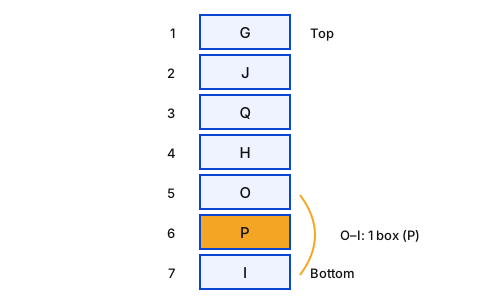
- Only G is above J ⇒ G at 1 (top), J at 2.
- Only Q between J and H ⇒ Q at 3, H at 4.
- Only I is below P ⇒ I at 7 (bottom), P at 6.
- Remaining O goes to 5. Between O (5) and I (7) there is only P ⇒ one box.
Trick: 'Only one above' = 2nd from top; 'only one below' = 2nd from bottom.
Answer: (C) One
अवधारणा: 'केवल X, Y के ऊपर है' जैसे संकेत ढेर के सिरों पर स्थान तय करते हैं – इन्हीं से शुरू करें।
- केवल G, J के ऊपर ⇒ G स्थान 1 (सबसे ऊपर), J स्थान 2 पर।
- J और H के बीच केवल Q ⇒ Q स्थान 3, H स्थान 4।
- केवल I, P के नीचे ⇒ I स्थान 7 (सबसे नीचे), P स्थान 6।
- बचा O स्थान 5 पर। O (5) और I (7) के बीच केवल P ⇒ एक बॉक्स।
ट्रिक: 'केवल एक ऊपर' = ऊपर से दूसरा; 'केवल एक नीचे' = नीचे से दूसरा।
उत्तर: (C) One
RRB NTPC Graduate CBT 1General Intelligence and ReasoningBox ArrangementRRB NTPC Graduate CBT 1 2024 · 24 Jun Shift 2
Q51.In a certain code language, ‘shirt mile vow’ is coded as 'sh dx rk' and ‘pie vow fork’ is coded as ‘gg ne sh’. How is ‘vow’ coded in the given language?
एक निश्चित कूट भाषा में, ‘shirt mile vow’ को 'sh dx rk' के रूप में कूटबद्ध किया जाता है और ‘pie vow fork’ को ‘gg ne sh’ के रूप में कूटबद्ध किया जाता है। दी गई भाषा में ‘vow’ को किस प्रकार कूटबद्ध किया जाता है?
- Ark
- Bgg
- Csh
- Ddx
Show answer
Concept: A word common to two sentences has the code common to both codes.
- 'shirt mile vow' → 'sh dx rk'.
- 'pie vow fork' → 'gg ne sh'.
- Only common word = vow; only common code = sh ⇒ vow = sh.
Trick: Common word ↔ common code.
Answer: (C) sh
अवधारणा: दो वाक्यों में उभयनिष्ठ शब्द का कोड दोनों कोडों में उभयनिष्ठ होता है।
- 'shirt mile vow' → 'sh dx rk'।
- 'pie vow fork' → 'gg ne sh'।
- उभयनिष्ठ शब्द = vow; उभयनिष्ठ कोड = sh ⇒ vow = sh।
ट्रिक: उभयनिष्ठ शब्द ↔ उभयनिष्ठ कोड।
उत्तर: (C) sh
RRB NTPC Graduate CBT 1General Intelligence and ReasoningCoding–Decoding (Common Word)RRB NTPC Graduate CBT 1 2024 · 24 Jun Shift 2
Q52.Which of the following letter-clusters should replace # and % so that the pattern and relationship followed between the letter-cluster pair on the left side of :: is the same as that on the right side of :: ?
# : YFI :: LSV : %
निम्नलिखित में से कौन-से अक्षर-समूह # और % को प्रतिस्थापित करेंगे, ताकि :: के बाईं ओर के अक्षर-समूह युग्म के बीच का पैटर्न और संबंध वही हो, जो :: के दाईं ओर के अक्षर-समूह युग्म के बीच है?
# : YFI :: LSV : %
- A# = UBE, % = BWZ
- B# = UBE, % = PWO
- C# = VBE, % = PWZ
- D# = UBE, % = PWZ
Show answer
Concept: Find the letter shift from # to YFI and apply it to LSV.
- Options give # = UBE (or VBE). UBE → YFI: U+4 = Y, B+4 = F, E+4 = I (each +4).
- Apply +4 to LSV: L+4 = P, S+4 = W, V+4 = Z ⇒ PWZ.
- So # = UBE and % = PWZ.
Trick: VBE fails (V+4 = Z, not Y); among UBE options only PWZ is +4 of LSV.
Answer: (D) # = UBE, % = PWZ
अवधारणा: # से YFI तक अक्षर-अंतर निकालें और वही LSV पर लगाएँ।
- विकल्पों में # = UBE (या VBE)। UBE → YFI: U+4 = Y, B+4 = F, E+4 = I (हर अक्षर +4)।
- LSV पर +4: L+4 = P, S+4 = W, V+4 = Z ⇒ PWZ।
- अतः # = UBE और % = PWZ।
ट्रिक: VBE गलत (V+4 = Z, Y नहीं); UBE वाले विकल्पों में केवल PWZ, LSV का +4 है।
उत्तर: (D) # = UBE, % = PWZ
RRB NTPC Graduate CBT 1General Intelligence and ReasoningLetter AnalogyRRB NTPC Graduate CBT 1 2024 · 24 Jun Shift 2
Q53.Each of the digits in the number 1538672 is arranged in ascending order from left to right. What will the sum of the digits which are second from the left and second from the right in the new number thus formed be?
संख्या 1538672 के प्रत्येक अंक को बाएँ से दाएँ आरोही क्रम में व्यवस्थित किया जाता है। इस प्रकार बनी नई संख्या में बाएँ से दूसरे और दाएँ से दूसरे अंकों का योग क्या होगा?
- A12
- B8
- C11
- D9
Show answer
Concept: Rewrite the digits in ascending order and read positions carefully.
- 1538672 → ascending: 1 2 3 5 6 7 8.
- Second from left = 2; second from right = 7.
- Sum .
Trick: Second from right in a 7-digit number = 6th from left.
Answer: (D) 9
अवधारणा: अंकों को आरोही क्रम में लिखें और स्थान ध्यान से पढ़ें।
- 1538672 → आरोही: 1 2 3 5 6 7 8।
- बाएँ से दूसरा = 2; दाएँ से दूसरा = 7।
- योग ।
ट्रिक: 7 अंकों की संख्या में दाएँ से दूसरा = बाएँ से छठा।
उत्तर: (D) 9
RRB NTPC Graduate CBT 1General Intelligence and ReasoningDigit ArrangementRRB NTPC Graduate CBT 1 2024 · 24 Jun Shift 2
Q54.Lokesh ranked 24th from the top and 34th from the bottom in his class. How many students are there in his class?
लोकेश की अपनी कक्षा में ऊपर से 24वीं और नीचे से 34वीं रैंक है। उसकी कक्षा में कितने विद्यार्थी हैं?
- A57
- B58
- C56
- D59
Show answer
Concept: Total = rank from top + rank from bottom − 1 (the person is counted twice).
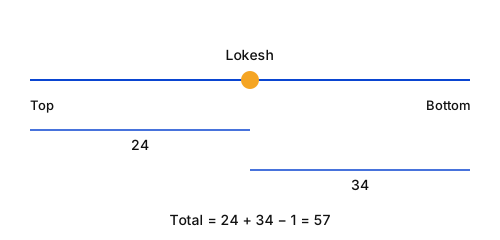
- Rank from top = 24, from bottom = 34.
- Total .
Trick: Always subtract 1 – Lokesh is in both counts.
Answer: (A) 57
अवधारणा: कुल = ऊपर से रैंक + नीचे से रैंक − 1 (व्यक्ति दो बार गिना जाता है)।
- ऊपर से रैंक = 24, नीचे से = 34।
- कुल ।
ट्रिक: हमेशा 1 घटाएँ – लोकेश दोनों गिनती में है।
उत्तर: (A) 57
RRB NTPC Graduate CBT 1General Intelligence and ReasoningRankingRRB NTPC Graduate CBT 1 2024 · 24 Jun Shift 2
Q55.Which of the following letter-number clusters will replace the question mark (?) in the given series to make it logically complete?
AZB 3, ZYA 9, YXZ 27, XWY 81, ?
दी गई श्रृंखला को तार्किक रूप से पूर्ण करने के लिए निम्नलिखित में से कौन-सा अक्षर-संख्या समूह प्रश्न चिह्न (?) को प्रतिस्थापित करेगा?
AZB 3, ZYA 9, YXZ 27, XWY 81, ?
- AWVX 729
- BVWX 729
- CWWX 729
- DWVX 243
Show answer
Concept: Track each letter position and the number separately.
- 1st letters: A, Z, Y, X → W (−1, cyclic). 2nd: Z, Y, X, W → V. 3rd: B, A, Z, Y → X ⇒ WVX.
- Numbers: 3, 9, 27, 81 (×3) → .
- Next term: WVX 243.
Trick: Letters fix the choice between (A)/(D); the ×3 rule gives 243, not 729.
Answer: (D) WVX 243
अवधारणा: हर अक्षर-स्थान और संख्या को अलग-अलग देखें।
- पहले अक्षर: A, Z, Y, X → W (−1, चक्रीय)। दूसरे: Z, Y, X, W → V। तीसरे: B, A, Z, Y → X ⇒ WVX।
- संख्याएँ: 3, 9, 27, 81 (×3) → ।
- अगला पद: WVX 243।
ट्रिक: अक्षरों से (A)/(D) बचते हैं; ×3 नियम से 243 आता है, 729 नहीं।
उत्तर: (D) WVX 243
RRB NTPC Graduate CBT 1General Intelligence and ReasoningLetter-Number SeriesRRB NTPC Graduate CBT 1 2024 · 24 Jun Shift 2
Q56.Each of the digits in the number 3178456 is arranged in ascending order from left to right. What will be the sum of the digits which are first from the left and second from the right in the new number thus formed?
संख्या 3178456 के प्रत्येक अंक को बाएँ से दाएँ आरोही क्रम में व्यवस्थित किया जाता है। इस प्रकार बनी नई संख्या में बाएँ से पहले और दाएँ से दूसरे अंकों का योग क्या होगा?
- A14
- B8
- C10
- D4
Show answer
Concept: Arrange digits in ascending order and pick the required positions.
- 3178456 → ascending: 1 3 4 5 6 7 8.
- First from left = 1; second from right = 7.
- Sum .
Trick: First from left in ascending order = smallest digit.
Answer: (B) 8
अवधारणा: अंकों को आरोही क्रम में लिखकर अभीष्ट स्थान चुनें।
- 3178456 → आरोही: 1 3 4 5 6 7 8।
- बाएँ से पहला = 1; दाएँ से दूसरा = 7।
- योग ।
ट्रिक: आरोही क्रम में बाएँ से पहला = सबसे छोटा अंक।
उत्तर: (B) 8
RRB NTPC Graduate CBT 1General Intelligence and ReasoningDigit ArrangementRRB NTPC Graduate CBT 1 2024 · 24 Jun Shift 2
Q57.If ‘A’ stands for ‘÷’, ‘B’ stands for ‘×’, ‘C’ stands for ‘+’ and ‘D’ stands for ‘−’, what will come in place of the question mark (?) in the following equation?
63 D 19 C 6 B 9 D (56 A 4) = ?
यदि ‘A’ का अर्थ ‘÷’, ‘B’ का अर्थ ‘×’, ‘C’ का अर्थ ‘+’ और ‘D’ का अर्थ ‘−’ है, तो निम्नलिखित समीकरण में प्रश्न चिह्न (?) के स्थान पर क्या आएगा?
63 D 19 C 6 B 9 D (56 A 4) = ?
- A96
- B84
- C62
- D120
Show answer
Concept: Replace letters by signs, then apply BODMAS.
- A = , B = , C = , D = .
- .
- .
Trick: Solve the bracket and first: and .
Answer: (B) 84
अवधारणा: अक्षरों को चिह्नों से बदलें, फिर BODMAS लगाएँ।
- A = , B = , C = , D = ।
- ।
- ।
ट्रिक: पहले कोष्ठक और : और ।
उत्तर: (B) 84
RRB NTPC Graduate CBT 1General Intelligence and ReasoningMathematical Operations – Symbol SubstitutionRRB NTPC Graduate CBT 1 2024 · 24 Jun Shift 2
Q58.What should come in place of the question mark (?) in the given series based on the English alphabetical order?
QTM ORK MPI KNG ?
अंग्रेज़ी वर्णमाला क्रम के आधार पर दी गई श्रृंखला में प्रश्न चिह्न (?) के स्थान पर क्या आना चाहिए?
QTM ORK MPI KNG ?
- AIKF
- BIKE
- CILF
- DILE
Show answer
Concept: Each letter position follows its own step.
- 1st letters: Q, O, M, K (−2) → I.
- 2nd letters: T, R, P, N (−2) → L.
- 3rd letters: M, K, I, G (−2) → E.
- Next term = ILE.
Trick: All three positions move −2; only (D) has I, L, E.
Answer: (D) ILE
अवधारणा: हर अक्षर-स्थान अपना अलग क्रम मानता है।
- पहले अक्षर: Q, O, M, K (−2) → I।
- दूसरे अक्षर: T, R, P, N (−2) → L।
- तीसरे अक्षर: M, K, I, G (−2) → E।
- अगला पद = ILE।
ट्रिक: तीनों स्थान −2 चलते हैं; केवल (D) में I, L, E है।
उत्तर: (D) ILE
RRB NTPC Graduate CBT 1General Intelligence and ReasoningLetter SeriesRRB NTPC Graduate CBT 1 2024 · 24 Jun Shift 2
Q59.What should come in place of the question mark (?) in the given series?
28, 39, 61, 94, 138, ?
दी गई श्रृंखला में प्रश्न चिह्न (?) के स्थान पर क्या आना चाहिए?
28, 39, 61, 94, 138, ?
- A183
- B193
- C173
- D163
Show answer
Concept: Check the differences between consecutive terms.
- Differences: , , , .
- Differences are multiples of 11 ⇒ next difference .
- .
Trick: 11, 22, 33, 44, 55 – the table of 11.
Answer: (B) 193
अवधारणा: क्रमागत पदों के अंतर देखें।
- अंतर: , , , ।
- अंतर 11 के गुणज ⇒ अगला अंतर ।
- ।
ट्रिक: 11, 22, 33, 44, 55 – 11 का पहाड़ा।
उत्तर: (B) 193
RRB NTPC Graduate CBT 1General Intelligence and ReasoningNumber SeriesRRB NTPC Graduate CBT 1 2024 · 24 Jun Shift 2
Q60.Two sets of numbers are given below. In each set of numbers, certain mathematical operation(s) on the first number results in the second number. Similarly, certain mathematical operation(s) on the second number results in the third number and so on. Which of the given options follows the same set of operations as in the given sets? (NOTE: Operations should be performed on the whole numbers, without breaking down the numbers into their constituent digits. E.g. 13 – Operations on 13 such as adding / subtracting / multiplying to 13 can be performed. Breaking down 13 into 1 and 3 and then performing mathematical operations on 1 and 3 is not allowed.)
10 - 20 - 25 - 50; 3 - 6 - 11 - 22
नीचे संख्याओं के दो समुच्चय दिए गए हैं। संख्याओं के प्रत्येक समुच्चय में, पहली संख्या पर कुछ गणितीय संक्रिया/संक्रियाएँ करने पर दूसरी संख्या प्राप्त होती है। इसी प्रकार, दूसरी संख्या पर कुछ गणितीय संक्रिया/संक्रियाएँ करने पर तीसरी संख्या प्राप्त होती है और इसी तरह आगे भी। दिए गए विकल्पों में से कौन-सा विकल्प दिए गए समुच्चयों के समान संक्रियाओं के समुच्चय का अनुसरण करता है? (नोट: संख्याओं को उनके घटक अंकों में विभाजित किए बिना, पूर्ण संख्याओं पर संक्रियाएँ की जानी चाहिए। उदाहरण 13 – 13 पर संक्रियाएँ जैसे 13 में जोड़ना/घटाना/गुणा करना आदि की जा सकती हैं। 13 को 1 और 3 में विभाजित करना और फिर 1 और 3 पर गणितीय संक्रियाएँ करना वर्जित है।)
10 - 20 - 25 - 50; 3 - 6 - 11 - 22
- A13 - 15 - 30 - 35
- B19 - 21 - 22 - 44
- C5 - 10 - 15 - 30
- D6 - 12 - 14 - 16
Show answer
Concept: Find the operation chain from both given sets and test each option.
- (), (), ().
- (), (), () – same chain.
- Option (C): , , ✓.
Trick: First step must double: only (C) and (D) start with ; (D) then fails at .
Answer: (C) 5 - 10 - 15 - 30
अवधारणा: दोनों दिए गए समूहों से संक्रिया-क्रम निकालें और विकल्प जाँचें।
- (), (), ()।
- (), (), () – वही क्रम।
- विकल्प (C): , , ✓।
ट्रिक: पहला चरण दोगुना: केवल (C) और (D) से शुरू; (D) पर विफल।
उत्तर: (C) 5 - 10 - 15 - 30
RRB NTPC Graduate CBT 1General Intelligence and ReasoningNumber Set OperationsRRB NTPC Graduate CBT 1 2024 · 24 Jun Shift 2

