Q621.What will come in place of the question mark (?) in the given series?
832 830 826 820 812 ?
दी गई श्रृंखला में प्रश्न चिह्न (?) के स्थान पर क्या आएगा?
832 830 826 820 812 ?
- A803
- B800
- C801
- D802
Show answer
Concept: Check differences between consecutive terms.
- , , ,
- Next difference
Trick: Differences rise by 2: −2, −4, −6, −8, −10.
Answer: (D) 802
अवधारणा: क्रमागत पदों का अंतर देखें।
- , , ,
- अगला अंतर
ट्रिक: अंतर 2-2 बढ़ रहे हैं: −2, −4, −6, −8, −10।
उत्तर: (D) 802
RRB NTPC Graduate CBT 1General Intelligence and ReasoningNumber seriesRRB NTPC Graduate CBT 1 2024 · 17 Jun Shift 1
Q622.Select the triad that follows the same pattern as that followed by the two triads given below. Both triads follow the same pattern.
EB-GD-IF
BY-DA-FC
उस त्रिक का चयन कीजिए जो उसी पैटर्न का अनुसरण करता है जिसका अनुसरण नीचे दिए गए दोनों त्रिक करते हैं। दोनों त्रिक एक ही पैटर्न का अनुसरण करते हैं।
EB-GD-IF
BY-DA-FC
- AGD-JF-KH
- BUR-WT-YV
- CPM-RO-SQ
- DKH-MI-OL
Show answer
Concept: Find the rule inside each pair and between the pairs (A = 1 … Z = 26).
- EB-GD-IF: in each pair second letter = first − 3 (E→B, G→D, I→F); first letters go +2 (E, G, I).
- BY-DA-FC: B→Y, D→A, F→C (−3 with wrap); first letters B, D, F (+2).
- UR-WT-YV: U→R, W→T, Y→V (−3); first letters U, W, Y (+2). ✓
- GD-JF-KH fails (G→J is +3); PM-RO-SQ fails (R→S is +1); KH-MI-OL fails (M→I is −4).
Trick: Check the easy “−3 inside each pair” rule first; it removes (A)’s JF and (D)’s MI immediately.
Answer: (B) UR-WT-YV
अवधारणा: हर युग्म के अंदर और युग्मों के बीच नियम खोजें (A = 1 … Z = 26)।
- EB-GD-IF: हर युग्म में दूसरा अक्षर = पहला − 3 (E→B, G→D, I→F); पहले अक्षर +2 (E, G, I)।
- BY-DA-FC: B→Y, D→A, F→C (−3, घूमकर); पहले अक्षर B, D, F (+2)।
- UR-WT-YV: U→R, W→T, Y→V (−3); पहले अक्षर U, W, Y (+2)। ✓
- GD-JF-KH (G→J +3), PM-RO-SQ (R→S +1), KH-MI-OL (M→I −4) नियम तोड़ते हैं।
ट्रिक: पहले “युग्म के अंदर −3” वाला नियम जाँचें; (A) और (D) तुरंत हट जाते हैं।
उत्तर: (B) UR-WT-YV
RRB NTPC Graduate CBT 1General Intelligence and ReasoningLetter triadsRRB NTPC Graduate CBT 1 2024 · 17 Jun Shift 1
Q623.In a certain code language,
‘A + B’ means ‘A is the son of B’
‘A – B’ means ‘A is the brother of B’
‘A x B’ means ‘A is the wife of B’
‘A ÷ B’ means ‘A is the father of B’
Based on the above, how is M related to Q if ‘M + N – O ÷ P × Q’?
एक निश्चित कूट भाषा में,
‘A + B’ का अर्थ है ‘A, B का पुत्र है’
‘A – B’ का अर्थ है ‘A, B का भाई है’
‘A x B’ का अर्थ है ‘A, B की पत्नी है’
‘A ÷ B’ का अर्थ है ‘A, B का पिता है’
उपर्युक्त के आधार पर, यदि ‘M + N – O ÷ P × Q’ है, तो M का Q से क्या संबंध है?
- AWife's Father's Brother's Sonपत्नी के पिता के भाई का पुत्र
- BWife's Mother's Sister's Sonपत्नी की माता की बहन का पुत्र
- CWife's Mother's Brother's Sonपत्नी की माता के भाई का पुत्र
- DWife's Father's Sister's Sonपत्नी के पिता की बहन का पुत्र
Show answer
Concept: Decode each symbol from left to right and draw the family tree.
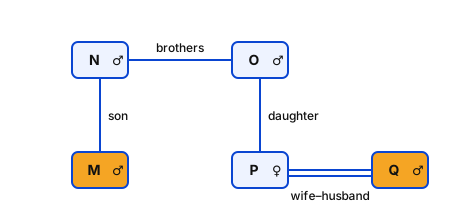
- M + N: M is the son of N.
- N – O: N is the brother of O.
- O ÷ P: O is the father of P.
- P × Q: P is the wife of Q.
- From Q: wife (P) → her father (O) → his brother (N) → his son (M).
Trick: Read the chain backwards starting from Q to build the relation.
Answer: (A) Wife's Father's Brother's Son
अवधारणा: बाएँ से दाएँ प्रत्येक चिह्न का अर्थ निकालें और वंश-वृक्ष बनाएँ।
- M + N: M, N का पुत्र है।
- N – O: N, O का भाई है।
- O ÷ P: O, P का पिता है।
- P × Q: P, Q की पत्नी है।
- Q से: पत्नी (P) → उसके पिता (O) → उनके भाई (N) → उनका पुत्र (M)।
ट्रिक: Q से शुरू करके श्रृंखला उल्टी पढ़ें।
उत्तर: (A) पत्नी के पिता के भाई का पुत्र
RRB NTPC Graduate CBT 1General Intelligence and ReasoningCoded blood relationsRRB NTPC Graduate CBT 1 2024 · 17 Jun Shift 1
Q624.Which of the following letter-clusters should replace # and % so that the pattern and relationship followed between the letter-cluster pair on the left side of :: is the same as that on the right side of :: ?
# : DFJ :: LNR : %
निम्नलिखित में से कौन-से अक्षर-समूह # और % को प्रतिस्थापित करें, ताकि :: के बाईं ओर के अक्षर-समूह युग्म के बीच का पैटर्न और संबंध, :: के दाईं ओर के अक्षर-समूह युग्म के समान हो?
# : DFJ :: LNR : %
- A# = ACG , % = OQP
- B# = BCG , % = OQU
- C# = ACG , % = OQU
- D# = ACG , % = MQU
Show answer
Concept: Find the rule from the left pair and apply it to the right pair: # → DFJ means LNR → %.
- ACG → DFJ: A+3 = D, C+3 = F, G+3 = J, so # = ACG.
- Apply +3 to LNR: L+3 = O, N+3 = Q, R+3 = U, so % = OQU.
Trick: Both pairs must follow the same direction of change (here +3 to each letter).
Answer: (C) # = ACG , % = OQU
अवधारणा: बाएँ युग्म का नियम दाएँ युग्म पर लगाएँ: # → DFJ, अतः LNR → %।
- ACG → DFJ: A+3 = D, C+3 = F, G+3 = J, अतः # = ACG।
- LNR पर +3: L+3 = O, N+3 = Q, R+3 = U, अतः % = OQU।
ट्रिक: दोनों युग्मों में बदलाव की दिशा समान हो (यहाँ हर अक्षर +3)।
उत्तर: (C) # = ACG , % = OQU
RRB NTPC Graduate CBT 1General Intelligence and ReasoningLetter analogyRRB NTPC Graduate CBT 1 2024 · 17 Jun Shift 1
Q625.Select the pair that follows the same pattern as that followed by the two pairs given below. Both pairs follow the same pattern.
MGP : NIS
SVB : TXE
उस युग्म का चयन कीजिए जो उसी पैटर्न का अनुसरण करता है जिसका अनुसरण नीचे दिए गए दोनों युग्म करते हैं। दोनों युग्म एक ही पैटर्न का अनुसरण करते हैं।
MGP : NIS
SVB : TXE
- ACTR : DVU
- BDNP : CPT
- CDMR : CMP
- DCDP : DUV
Show answer
Concept: Compare each letter of the first cluster with the corresponding letter of the second.
- MGP → NIS: M+1, G+2, P+3.
- SVB → TXE: S+1, V+2, B+3.
- CTR → DVU: C+1, T+2, R+3. ✓
Trick: Pattern +1, +2, +3 — check only the first letter (+1) to eliminate (B) and (C) quickly.
Answer: (A) CTR : DVU
अवधारणा: पहले समूह के प्रत्येक अक्षर की तुलना दूसरे समूह के संगत अक्षर से करें।
- MGP → NIS: M+1, G+2, P+3।
- SVB → TXE: S+1, V+2, B+3।
- CTR → DVU: C+1, T+2, R+3। ✓
ट्रिक: नियम +1, +2, +3 — पहले अक्षर (+1) से ही (B) और (C) हट जाते हैं।
उत्तर: (A) CTR : DVU
RRB NTPC Graduate CBT 1General Intelligence and ReasoningLetter-pair analogyRRB NTPC Graduate CBT 1 2024 · 17 Jun Shift 1
Q626.Refer to the following number and symbol series and answer the question that follows. Counting to be done from left to right only.
(NOTE: All numbers are single digit numbers only.)
(Left) 6 3 £ $ % 3 $ 9 8 1 8 * % 2 6 € $ £ # 8 & $ (Right)
How many such symbols are there each of which is immediately preceded by a number and also immediately followed by a symbol?
निम्नलिखित संख्या और प्रतीक श्रृंखला को देखिए और उसके बाद आने वाले प्रश्न का उत्तर दीजिए। गिनती केवल बाएँ से दाएँ की जानी है।
(नोट: सभी संख्याएँ केवल एक अंक वाली संख्याएँ हैं।)
(बाएँ) 6 3 £ $ % 3 $ 9 8 1 8 * % 2 6 € $ £ # 8 & $ (दाएँ)
ऐसे कितने प्रतीक हैं, जिनमें से प्रत्येक के ठीक पहले एक संख्या है और ठीक बाद में एक प्रतीक है?
- A6
- B4
- C5
- D3
Show answer
Concept: Look for the pattern Number – Symbol – Symbol, and count the middle symbol.
- 3 £ $ → £ ✓
- 8 * % → * ✓
- 6 € $ → € ✓
- 8 & $ → & ✓
- Other symbols fail (e.g. 3 $ 9 — followed by a number). Total = 4.
Trick: Scan only symbols that come right after a digit, then check the next item.
Answer: (B) 4
अवधारणा: संख्या – प्रतीक – प्रतीक वाला क्रम खोजें और बीच का प्रतीक गिनें।
- 3 £ $ → £ ✓
- 8 * % → * ✓
- 6 € $ → € ✓
- 8 & $ → & ✓
- अन्य प्रतीक नहीं (जैसे 3 $ 9 — बाद में संख्या है)। कुल = 4।
ट्रिक: केवल अंक के ठीक बाद आने वाले प्रतीकों को देखें, फिर उनके अगले पद की जाँच करें।
उत्तर: (B) 4
RRB NTPC Graduate CBT 1General Intelligence and ReasoningSymbol-number seriesRRB NTPC Graduate CBT 1 2024 · 17 Jun Shift 1
Q627.Select the letter-cluster from among the given options that can replace the question mark (?) in the following series.
VDU RGS NJQ ? FPM
दिए गए विकल्पों में से उस अक्षर-समूह का चयन कीजिए जो निम्नलिखित श्रृंखला में प्रश्न चिह्न (?) को प्रतिस्थापित कर सकता है।
VDU RGS NJQ ? FPM
- AJMP
- BJMN
- CJLN
- DJMO
Show answer
Concept: Track each position of the clusters separately.
- 1st letters: V, R, N, J, F (−4 each).
- 2nd letters: D, G, J, M, P (+3 each).
- 3rd letters: U, S, Q, O, M (−2 each).
- Missing term = JMO.
Trick: Use the last term FPM to check: J−4 = F, M+3 = P, O−2 = M ✓.
Answer: (D) JMO
अवधारणा: हर स्थान के अक्षर अलग-अलग देखें।
- पहले अक्षर: V, R, N, J, F (−4)।
- दूसरे अक्षर: D, G, J, M, P (+3)।
- तीसरे अक्षर: U, S, Q, O, M (−2)।
- लुप्त पद = JMO।
ट्रिक: अंतिम पद FPM से जाँचें: J−4 = F, M+3 = P, O−2 = M ✓।
उत्तर: (D) JMO
RRB NTPC Graduate CBT 1General Intelligence and ReasoningLetter seriesRRB NTPC Graduate CBT 1 2024 · 17 Jun Shift 1
Q628.What should come in place of the question mark (?) in the given series?
86 97 73 82 60 67 47 52 ?
दी गई श्रृंखला में प्रश्न चिह्न (?) के स्थान पर क्या आना चाहिए?
86 97 73 82 60 67 47 52 ?
- A40
- B34
- C32
- D37
Show answer
Concept: The series is made of two interleaved series.
- Odd places: 86, 73, 60, 47, ? (−13 each).
- Even places: 97, 82, 67, 52 (−15 each).
- Next odd-place term .
Trick: When terms rise and fall alternately, split into odd/even positions.
Answer: (B) 34
अवधारणा: यह दो एकांतर श्रृंखलाओं से बनी है।
- विषम स्थान: 86, 73, 60, 47, ? (हर बार −13)।
- सम स्थान: 97, 82, 67, 52 (हर बार −15)।
- अगला विषम-स्थान पद ।
ट्रिक: पद बारी-बारी से बढ़ें-घटें तो विषम/सम स्थानों में बाँटें।
उत्तर: (B) 34
RRB NTPC Graduate CBT 1General Intelligence and ReasoningAlternating number seriesRRB NTPC Graduate CBT 1 2024 · 17 Jun Shift 1
Q629.Based on the English alphabetical order, three of the following four letter-cluster pairs are alike in a certain way and thus form a group. Which letter-cluster pair DOES NOT belong to that group?
(Note: The odd one out is not based on the number of consonants/vowels or their position in the letter-cluster.)
अंग्रेज़ी वर्णमाला क्रम के आधार पर, निम्नलिखित चार अक्षर-समूह युग्मों में से तीन किसी निश्चित प्रकार से समान हैं और इस प्रकार एक समूह बनाते हैं। कौन-सा अक्षर-समूह युग्म उस समूह से संबंधित नहीं है?
(नोट: असंगत अक्षर-समूह, उस अक्षर-समूह में व्यंजनों/स्वरों की संख्या या उनके स्थान पर आधारित नहीं है।)
- AXV – FZ
- BBZ – JD
- CHF – PJ
- DYX – GA
Show answer
Concept: Check the gaps inside each cluster (A = 1 … Z = 26, with wrap-around).
- XV: X−2 = V; FZ: F−6 = Z.
- BZ: B−2 = Z; JD: J−6 = D.
- HF: H−2 = F; PJ: P−6 = J.
- YX: Y−1 = X (not −2); GA: G−6 = A. So YX – GA is odd.
Trick: Also the first letters jump +8 between clusters (X→F, B→J, H→P, Y→G); the odd gap is inside YX.
Answer: (D) YX – GA
अवधारणा: प्रत्येक समूह के अंदर अंतर देखें (A = 1 … Z = 26, घूमते हुए)।
- XV: X−2 = V; FZ: F−6 = Z।
- BZ: B−2 = Z; JD: J−6 = D।
- HF: H−2 = F; PJ: P−6 = J।
- YX: Y−1 = X (−2 नहीं); GA: G−6 = A। अतः YX – GA विषम है।
ट्रिक: पहले अक्षर भी +8 बढ़ते हैं (X→F, B→J, H→P, Y→G); गड़बड़ी YX के अंदर है।
उत्तर: (D) YX – GA
RRB NTPC Graduate CBT 1General Intelligence and ReasoningOdd one out – letter pairsRRB NTPC Graduate CBT 1 2024 · 17 Jun Shift 1
Q630.A group of numbers and symbols is coded using letter codes as per the codes given below and the conditions that follow. Study the given codes and conditions and answer the question that follows.
Note: If none of the conditions apply, then codes for the respective number/symbol are to be followed directly as given in the table.
| Number/symbol | 9 | 7 | 8 | 6 | $ | & | 3 | @ | # | % | + | 4 | 9 | 5 |
|---|
| Code | R | F | A | L | K | C | W | Q | D | P | R | D | U | V |
|---|
Conditions:
If the first element is a symbol and the last a number, the codes for these two (the first and the last elements) are to be interchanged.
If the first element is an odd number and the last an even number, the first and last elements are to be coded as ©.
If both second and third elements are perfect squares, the third element is to be coded as the code for the second element.
What will be the code for the following group?
9 7 8 6
संख्याओं और प्रतीकों के एक समूह को नीचे दिए गए कूटों और उसके बाद दी गई शर्तों के अनुसार अक्षर कूटों का प्रयोग करके कूटबद्ध किया जाता है। दिए गए कूटों और शर्तों का अध्ययन कीजिए और उसके बाद आने वाले प्रश्न का उत्तर दीजिए।
नोट: यदि कोई भी शर्त लागू नहीं होती है, तो संबंधित संख्या/प्रतीक के लिए तालिका में दिए गए कूटों का सीधे अनुसरण किया जाना है।
| संख्या/प्रतीक | 9 | 7 | 8 | 6 | $ | & | 3 | @ | # | % | + | 4 | 9 | 5 |
|---|
| कूट | R | F | A | L | K | C | W | Q | D | P | R | D | U | V |
|---|
शर्तें:
यदि पहला अवयव एक प्रतीक है और अंतिम अवयव एक संख्या है, तो इन दोनों (पहले और अंतिम अवयवों) के कूटों को आपस में बदल दिया जाना है।
यदि पहला अवयव एक विषम संख्या है और अंतिम अवयव एक सम संख्या है, तो पहले और अंतिम अवयवों को © के रूप में कूटबद्ध किया जाना है।
यदि दूसरा और तीसरा दोनों अवयव पूर्ण वर्ग हैं, तो तीसरे अवयव को दूसरे अवयव के कूट के रूप में कूटबद्ध किया जाना है।
निम्नलिखित समूह के लिए कूट क्या होगा?
9 7 8 6
- ARFFL
- B©FA©
- CLFAR
- DRFAL
Show answer
Concept: Code each element from the table, then check which condition applies.
- Direct codes: 9 → R, 7 → F, 8 → A, 6 → L.
- Condition 1: first element is not a symbol — not applicable.
- Condition 2: first = 9 (odd), last = 6 (even) — applies: first and last become ©.
- Condition 3: 7 and 8 are not perfect squares — not applicable.
- Code = © F A ©.
Trick: Check the conditions in order before writing direct codes — options (C) and (D) are the traps.
Answer: (B) ©FA©
अवधारणा: तालिका से प्रत्येक तत्व का कूट लिखें, फिर देखें कौन-सी शर्त लागू है।
- सीधे कूट: 9 → R, 7 → F, 8 → A, 6 → L।
- शर्त 1: पहला तत्व प्रतीक नहीं — लागू नहीं।
- शर्त 2: पहला = 9 (विषम), अंतिम = 6 (सम) — लागू: पहला और अंतिम © बनेंगे।
- शर्त 3: 7 और 8 पूर्ण वर्ग नहीं — लागू नहीं।
- कूट = © F A ©।
ट्रिक: सीधे कूट लिखने से पहले शर्तें क्रम से जाँचें — विकल्प (C) और (D) जाल हैं।
उत्तर: (B) ©FA©
RRB NTPC Graduate CBT 1General Intelligence and ReasoningCoding with conditionsRRB NTPC Graduate CBT 1 2024 · 17 Jun Shift 1
Q631.In a certain code language, ‘BEST’ is coded as ‘4568’ and ‘STAB’ is coded as ‘8965’. What is the code for ‘A’ in the given code language?
एक निश्चित कूट भाषा में, ‘BEST’ को ‘4568’ लिखा जाता है और ‘STAB’ को ‘8965’ लिखा जाता है। उस कूट भाषा में ‘A’ के लिए क्या कूट है?
- A6
- B5
- C9
- D8
Show answer
Concept: Letters common to both words share the common digits; the leftover letter gets the leftover digit.
- BEST → 4, 5, 6, 8 and STAB → 8, 9, 6, 5.
- Common letters: S, T, B → common digits 5, 6, 8.
- STAB has the extra letter A, and its extra digit is 9.
- So A = 9.
Trick: Cancel common letters and common digits – what remains matches.
Answer: (C) 9
अवधारणा: दोनों शब्दों के सामान्य अक्षरों के कोड भी सामान्य अंक होते हैं; बचे अक्षर का कोड बचा अंक है।
- BEST → 4, 5, 6, 8 और STAB → 8, 9, 6, 5।
- सामान्य अक्षर S, T, B → सामान्य अंक 5, 6, 8।
- STAB में बचा अक्षर A और बचा अंक 9।
- अतः A = 9।
ट्रिक: सामान्य अक्षर और सामान्य अंक काटें – जो बचे वही जोड़ी है।
उत्तर: (C) 9
RRB NTPC Graduate CBT 1General Intelligence and ReasoningCoding-DecodingRRB NTPC Graduate CBT 1 2024 · 16 Jun Shift 3
Q632.What will come in place of the question mark (?) in the following equation, if ‘+’ and ‘–’ are interchanged, and ‘×’ and ‘÷’ are interchanged?
34 + 43 − 17 ÷ 121 × 11 = ?
यदि ‘+’ और ‘–’ को आपस में बदल दिया जाए तथा ‘×’ और ‘÷’ को आपस में बदल दिया जाए, तो निम्नलिखित समीकरण में प्रश्न चिह्न (?) के स्थान पर क्या आएगा?
34 + 43 − 17 ÷ 121 × 11 = ?
- A181
- B164
- C156
- D178
Show answer
Concept: Swap the signs first, then apply BODMAS.
- After interchange: .
- , so .
- .
Trick: Rewrite the whole expression with new signs before calculating.
Answer: (D) 178
अवधारणा: पहले चिह्न बदलें, फिर BODMAS लगाएँ।
- बदलने के बाद: ।
- , अतः ।
- ।
ट्रिक: गणना से पहले पूरा व्यंजक नए चिह्नों के साथ लिख लें।
उत्तर: (D) 178
RRB NTPC Graduate CBT 1General Intelligence and ReasoningMathematical OperationsRRB NTPC Graduate CBT 1 2024 · 16 Jun Shift 3
Q633.Which of the following letter-clusters should replace # and % so that the pattern and relationship followed between the letter-cluster pair on the left side of :: is the same as that on the right side of :: ?
# : MRN :: HMI : %
निम्नलिखित में से कौन-से अक्षर-समूह # और % को प्रतिस्थापित करने चाहिए ताकि :: के बाईं ओर के अक्षर-समूह युग्म के बीच का पैटर्न और संबंध वही हो जो :: के दाईं ओर है?
# : MRN :: HMI : %
- A# = JIQ, % = FDJ
- B# = KLJ, % = KHI
- C# = LPR, % = JHG
- D# = PUQ, % = EJF
Show answer
Concept: Find the rule on the right pair (HMI → %) and apply the same rule to # → MRN.
- Option D: P − 3 = M, U − 3 = R, Q − 3 = N → PUQ : MRN.
- H − 3 = E, M − 3 = J, I − 3 = F → HMI : EJF.
- Both pairs use −3 on every letter.
Trick: Test each option with one letter first; only D gives −3 on both sides.
Answer: (D) # = PUQ, % = EJF
अवधारणा: दाएँ जोड़े में जो नियम है वही बाएँ जोड़े (# → MRN) पर लगाएँ।
- विकल्प D: P − 3 = M, U − 3 = R, Q − 3 = N → PUQ : MRN।
- H − 3 = E, M − 3 = J, I − 3 = F → HMI : EJF।
- दोनों में हर अक्षर में −3।
ट्रिक: हर विकल्प को पहले एक अक्षर से जाँचें; केवल D में दोनों ओर −3 है।
उत्तर: (D) # = PUQ, % = EJF
RRB NTPC Graduate CBT 1General Intelligence and ReasoningLetter AnalogyRRB NTPC Graduate CBT 1 2024 · 16 Jun Shift 3
Q634.Select the triad that follows the same pattern as that followed by the two triads given below. Both triads follow the same pattern.
GB-IE-LN
KF-MI-PR
उस त्रिक का चयन कीजिए जो उसी पैटर्न का अनुसरण करता है जिसका अनुसरण नीचे दिए गए दो त्रिक करते हैं। दोनों त्रिक एक ही पैटर्न का अनुसरण करते हैं।
GB-IE-LN
KF-MI-PR
- APJ-QM-TU
- BOJ-QM-TV
- COJ-QM-TU
- DPJ-QN-TU
Show answer
Concept: Track first letters and second letters separately using place values.
- GB-IE-LN: G(7)→I(9)→L(12) is +2, +3; B(2)→E(5)→N(14) is +3, +9.
- KF-MI-PR: K→M→P (+2, +3); F→I→R (+3, +9).
- OJ-QM-TV: O(15)→Q(17)→T(20) is +2, +3; J(10)→M(13)→V(22) is +3, +9. ✓
Trick: Option A/C fail on the last letter: U = M + 8, not +9.
Answer: (B) OJ-QM-TV
अवधारणा: पहले अक्षरों और दूसरे अक्षरों को स्थानीय मान से अलग-अलग जाँचें।
- GB-IE-LN: G(7)→I(9)→L(12) = +2, +3; B(2)→E(5)→N(14) = +3, +9।
- KF-MI-PR: K→M→P (+2, +3); F→I→R (+3, +9)।
- OJ-QM-TV: O(15)→Q(17)→T(20) = +2, +3; J(10)→M(13)→V(22) = +3, +9 ✓।
ट्रिक: विकल्प A/C अंतिम अक्षर पर गलत: U = M + 8 है, +9 नहीं।
उत्तर: (B) OJ-QM-TV
RRB NTPC Graduate CBT 1General Intelligence and ReasoningLetter TriadsRRB NTPC Graduate CBT 1 2024 · 16 Jun Shift 3
Q635.Barun starts from Point A and drives 8 km towards West. He then takes a left turn, drives 9 km, turns left and drives 12 km. He then takes a left turn and drives 13 km. He takes a final left turn, drives 4 km and stops at Point P. How far (shortest distance) and towards which direction should he drive in order to reach Point A again? (All turns are 90° turns only, unless specified.)
बरुण बिंदु A से शुरू करता है और पश्चिम की ओर 8 km गाड़ी चलाता है। फिर वह बाएँ मुड़ता है, 9 km गाड़ी चलाता है, बाएँ मुड़ता है और 12 km गाड़ी चलाता है। फिर वह बाएँ मुड़ता है और 13 km गाड़ी चलाता है। वह अंतिम बार बाएँ मुड़ता है, 4 km गाड़ी चलाता है और बिंदु P पर रुक जाता है। पुनः बिंदु A पर पहुँचने के लिए उसे कितनी दूरी (न्यूनतम दूरी) तक और किस दिशा में गाड़ी चलानी चाहिए? (जब तक निर्दिष्ट न हो, सभी मोड़ केवल 90° के मोड़ हैं।)
- A3 km to the southदक्षिण की ओर 3 km
- B5 km to the southदक्षिण की ओर 5 km
- C4 km to the southदक्षिण की ओर 4 km
- D2 km to the southदक्षिण की ओर 2 km
Show answer
Concept: Place A at the origin and track each move (left turn: West→South→East→North→West).
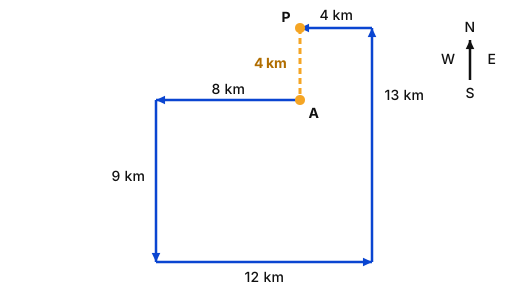
- West 8 → ; left (South) 9 → .
- Left (East) 12 → ; left (North) 13 → .
- Left (West) 4 → P .
- P is 4 km directly north of A, so he must drive 4 km south.
Trick: Net East–West: ; net North–South: North.
Answer: (C) 4 km to the south
अवधारणा: A को मूल बिंदु मानें और हर चाल लिखें (बाएँ मुड़ना: पश्चिम→दक्षिण→पूर्व→उत्तर→पश्चिम)।
- पश्चिम 8 → ; बाएँ (दक्षिण) 9 → ।
- बाएँ (पूर्व) 12 → ; बाएँ (उत्तर) 13 → ।
- बाएँ (पश्चिम) 4 → P ।
- P, A से 4 km उत्तर में है, अतः 4 km दक्षिण जाना होगा।
ट्रिक: शुद्ध पूर्व–पश्चिम: ; उत्तर–दक्षिण: उत्तर।
उत्तर: (C) 4 km to the south
RRB NTPC Graduate CBT 1General Intelligence and ReasoningDirection and DistanceRRB NTPC Graduate CBT 1 2024 · 16 Jun Shift 3
Q636.Karuna, Jyoti, Shiv, Ram, Puran, Om and Luv are sitting around a circular table, facing the centre. Shiv sits third to the left of Luv. Karuna sits second to the left of Shiv. Jyoti sits third to the right of Puran. Ram sits second to the right of Jyoti. Ram is not an immediate neighbour of Shiv. Who sits to the immediate left of Ram?
करुणा, ज्योति, शिव, राम, पूरन, ओम और लव एक वृत्ताकार मेज़ के चारों ओर केंद्र की ओर मुख करके बैठे हैं। शिव, लव के बाईं ओर तीसरे स्थान पर बैठा है। करुणा, शिव के बाईं ओर दूसरे स्थान पर बैठी है। ज्योति, पूरन के दाईं ओर तीसरे स्थान पर बैठी है। राम, ज्योति के दाईं ओर दूसरे स्थान पर बैठा है। राम, शिव का निकटतम पड़ोसी नहीं है। राम के ठीक बाईं ओर कौन बैठा है?
- ALuvलव
- BKarunaकरुणा
- COmओम
- DPuranपूरन
Show answer
Concept: Facing the centre, "left" means clockwise and "right" means anticlockwise.
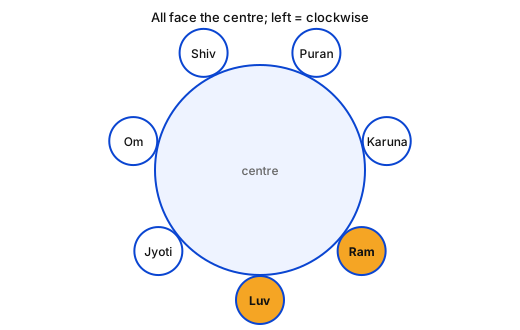
- Fix Luv; Shiv is 3rd to his left and Karuna 2nd to the left of Shiv.
- Jyoti is 3rd to the right of Puran and Ram is 2nd to the right of Jyoti, so Ram is 2nd to the left of Puran.
- Only one fit keeps Ram away from Shiv: Puran, Ram, Luv consecutive with Om and Jyoti on the other side (see figure).
- Ram sits between Karuna and Luv; going left (clockwise) from Ram we reach Luv.
Trick: Draw the fixed pair first (Luv–Shiv–Karuna) and test the free chain.
Answer: (A) Luv
अवधारणा: केंद्र की ओर मुख हो तो "बाएँ" = दक्षिणावर्त (clockwise) और "दाएँ" = वामावर्त।
- लव को स्थिर करें; शिव उसके बाएँ तीसरे और करुणा शिव के बाएँ दूसरे स्थान पर।
- ज्योति, पूरन के दाएँ तीसरे और राम, ज्योति के दाएँ दूसरे – अर्थात राम, पूरन के बाएँ दूसरे।
- राम को शिव से दूर रखने वाली केवल एक व्यवस्था बनती है (चित्र देखें)।
- राम, करुणा और लव के बीच है; राम के ठीक बाएँ लव है।
ट्रिक: पहले स्थिर समूह (लव–शिव–करुणा) बनाएँ, फिर बाकी जाँचें।
उत्तर: (A) Luv
RRB NTPC Graduate CBT 1General Intelligence and ReasoningCircular Seating ArrangementRRB NTPC Graduate CBT 1 2024 · 16 Jun Shift 3
Q637.Two sets of numbers are given below. In each set of numbers, certain mathematical operation(s) on the first number results in the second number. Similarly, certain mathematical operation(s) on the second number results in the third number and so on. Which of the given options follows the same set of operations as in the given sets? (NOTE: Operations should be performed on the whole numbers, without breaking down the numbers into their constituent digits. E.g. 13 – Operations on 13 such as adding / subtracting / multiplying to 13 can be performed. Breaking down 13 into 1 and 3 and then performing mathematical operations on 1 and 3 is not allowed.)
13 - 26 - 30 - 60; 5 - 10 - 14 - 28
नीचे संख्याओं के दो समुच्चय दिए गए हैं। संख्याओं के प्रत्येक समुच्चय में, पहली संख्या पर कुछ निश्चित गणितीय संक्रिया/संक्रियाएँ करने पर दूसरी संख्या प्राप्त होती है। इसी प्रकार, दूसरी संख्या पर कुछ निश्चित गणितीय संक्रिया/संक्रियाएँ करने पर तीसरी संख्या प्राप्त होती है और इसी तरह आगे भी। दिए गए विकल्पों में से कौन-सा विकल्प दिए गए समुच्चयों की तरह संक्रियाओं के समान समुच्चय का अनुसरण करता है? (नोट: संख्याओं को उनके घटक अंकों में विभाजित किए बिना, पूर्ण संख्याओं पर संक्रियाएँ की जानी चाहिए। उदाहरण 13 – 13 पर संक्रियाएँ जैसे 13 में जोड़ना/घटाना/गुणा करना आदि किया जा सकता है। 13 को 1 और 3 में विभाजित करके फिर 1 और 3 पर गणितीय संक्रियाएँ करने की अनुमति नहीं है।)
13 - 26 - 30 - 60; 5 - 10 - 14 - 28
- A3 - 6 - 10 - 30
- B7 - 14 - 18 - 22
- C10 - 20 - 24 - 48
- D2 - 4 - 8 - 12
Show answer
Concept: Find the operations between consecutive numbers.
- .
- .
- Pattern: .
- Option C: . ✓
Trick: Check the last step: only fits among the options.
Answer: (C) 10 - 20 - 24 - 48
अवधारणा: क्रमागत संख्याओं के बीच संक्रियाएँ खोजें।
- ।
- ।
- नियम: ।
- विकल्प C: ✓।
ट्रिक: अंतिम चरण जाँचें: केवल नियम पर खरा उतरता है।
उत्तर: (C) 10 - 20 - 24 - 48
RRB NTPC Graduate CBT 1General Intelligence and ReasoningNumber Series – OperationsRRB NTPC Graduate CBT 1 2024 · 16 Jun Shift 3
Q638.Read the given statements and conclusions carefully. Assuming that the information given in the statements is true, even if it appears to be at variance with commonly known facts, decide which of the given conclusion(s) logically follow(s) from the statements.
Statements:
All lions are tigers.
Some tigers are leopard.
No leopard is giraffe.
Conclusions:
(I) Some leopards are lions.
(II) Some giraffe can be tigers.
दिए गए कथनों और निष्कर्षों को ध्यानपूर्वक पढ़िए। कथनों में दी गई जानकारी को सत्य मानते हुए, भले ही वह सामान्यतः ज्ञात तथ्यों से भिन्न प्रतीत होती हो, निर्णय लीजिए कि दिए गए निष्कर्षों में से कौन-सा/से निष्कर्ष कथनों का तार्किक रूप से अनुसरण करता है/करते हैं।
कथन:
सभी शेर, बाघ हैं।
कुछ बाघ, तेंदुए हैं।
कोई तेंदुआ, जिराफ़ नहीं है।
निष्कर्ष:
(I) कुछ तेंदुए, शेर हैं।
(II) कुछ जिराफ़, बाघ हो सकते हैं।
- ABoth conclusions (I) and (II) followनिष्कर्ष (I) और (II) दोनों अनुसरण करते हैं
- BOnly conclusion (I) followsकेवल निष्कर्ष (I) अनुसरण करता है
- CEither conclusion (I) or conclusion (II) followsया तो निष्कर्ष (I) या निष्कर्ष (II) अनुसरण करता है
- DOnly conclusion (II) followsकेवल निष्कर्ष (II) अनुसरण करता है
Show answer
Concept: Draw the least possible Venn diagram and test each conclusion.
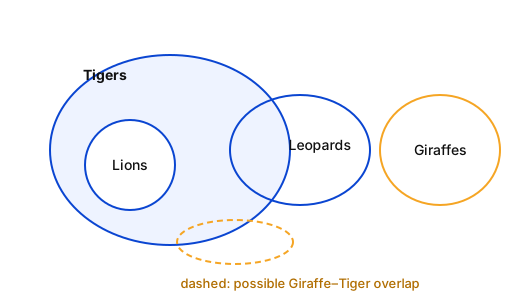
- Lions lie inside Tigers; Leopards only partly overlap Tigers.
- (I) Lions and Leopards need not meet → not definite → does not follow.
- (II) Giraffes are separated only from Leopards, not from Tigers, so a Giraffe–Tiger overlap is possible → follows.
Trick: "Can be" conclusions follow whenever no statement forbids them.
Answer: (D) Only conclusion (II) follows
अवधारणा: न्यूनतम वेन आरेख बनाकर प्रत्येक निष्कर्ष जाँचें।
- Lions पूरी तरह Tigers के अंदर; Leopards का Tigers से आंशिक मेल।
- (I) Lions और Leopards का मिलना निश्चित नहीं → अनुसरण नहीं करता।
- (II) Giraffe केवल Leopard से अलग है, Tiger से नहीं; अतः Giraffe–Tiger संभव → अनुसरण करता है।
ट्रिक: "हो सकता है" वाले निष्कर्ष तब सही होते हैं जब कोई कथन उन्हें रोकता न हो।
उत्तर: (D) Only conclusion (II) follows
RRB NTPC Graduate CBT 1General Intelligence and ReasoningSyllogismRRB NTPC Graduate CBT 1 2024 · 16 Jun Shift 3
Q639.Each of P, Q, R, S, T, U and V has an exam on a different day of a week starting from Monday and ending on Sunday of the same week. V has an exam on Thursday. Exactly 4 people have their exams between U and Q, neither of whom has an exam on Sunday. T has an exam immediately before S. R does not have an exam on Friday. U does not have an exam after S. How many people have exams after Q?
P, Q, R, S, T, U और V में से प्रत्येक की परीक्षा एक ही सप्ताह के सोमवार से शुरू होकर रविवार को समाप्त होने वाले सप्ताह के अलग-अलग दिन है। V की परीक्षा गुरुवार को है। U और Q के बीच ठीक 4 लोगों की परीक्षाएँ हैं, इन दोनों में से किसी की भी परीक्षा रविवार को नहीं है। T की परीक्षा S से ठीक पहले है। R की परीक्षा शुक्रवार को नहीं है। U की परीक्षा S के बाद नहीं है। Q के बाद कितने लोगों की परीक्षाएँ हैं?
- A3
- B1
- C4
- D2
Show answer
Concept: Fix the definite clues first: V on Thursday and the U–Q gap.
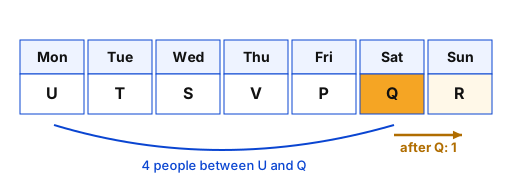
- 4 people between U and Q → (Mon, Sat) or (Tue, Sun); none on Sunday → U, Q on Mon and Sat.
- If U were Saturday, S would need Sunday and T Saturday – clash. So U = Mon, Q = Sat.
- T immediately before S → Tue, Wed. R not Friday → R = Sun, P = Fri.
- After Q (Saturday) only R (Sunday) → 1 person.
Trick: "Exactly 4 between" in a 7-day week means positions 1 & 6 or 2 & 7.
Answer: (B) 1
अवधारणा: पहले निश्चित सूचनाएँ रखें: V गुरुवार और U–Q का अंतर।
- U और Q के बीच 4 लोग → (सोम, शनि) या (मंगल, रवि); रविवार नहीं → सोम और शनि।
- U शनिवार हो तो S रविवार व T शनिवार – टकराव। अतः U = सोम, Q = शनि।
- T, S से ठीक पहले → मंगल, बुध। R शुक्रवार नहीं → R = रवि, P = शुक्र।
- Q (शनिवार) के बाद केवल R → 1 व्यक्ति।
ट्रिक: 7 दिनों में "ठीक 4 बीच में" = स्थान 1 व 6 या 2 व 7।
उत्तर: (B) 1
RRB NTPC Graduate CBT 1General Intelligence and ReasoningScheduling PuzzleRRB NTPC Graduate CBT 1 2024 · 16 Jun Shift 3
Q640.This question is based on the five, three-digit numbers given below.
(Left) 190 735 494 761 781 (Right)
(Example- 697 – First digit = 6, second digit = 9 and third digit = 7)
(NOTE: All operations to be done from left to right.)
What will be the resultant if the second digit of the highest number is subtracted from the second digit of the lowest number?
यह प्रश्न नीचे दी गई पाँच, तीन अंकों वाली संख्याओं पर आधारित है।
(बाएँ) 190 735 494 761 781 (दाएँ)
(उदाहरण- 697 – पहला अंक = 6, दूसरा अंक = 9 और तीसरा अंक = 7)
(नोट: सभी संक्रियाएँ बाएँ से दाएँ की जानी हैं।)
यदि सबसे बड़ी संख्या के दूसरे अंक को सबसे छोटी संख्या के दूसरे अंक में से घटाया जाए, तो परिणाम क्या होगा?
- A0
- B4
- C2
- D1
Show answer
Concept: Pick the highest and lowest numbers, then take their second digits.
- Highest = 781 → second digit 8; lowest = 190 → second digit 9.
- Second digit of highest subtracted from that of lowest: .
Trick: "A subtracted from B" means .
Answer: (D) 1
अवधारणा: सबसे बड़ी और सबसे छोटी संख्या चुनकर उनके दूसरे अंक लें।
- सबसे बड़ी = 781 → दूसरा अंक 8; सबसे छोटी = 190 → दूसरा अंक 9।
- सबसे बड़ी का दूसरा अंक, सबसे छोटी के दूसरे अंक में से घटाएँ: ।
ट्रिक: "A को B में से घटाना" = ।
उत्तर: (D) 1
RRB NTPC Graduate CBT 1General Intelligence and ReasoningNumber ArrangementRRB NTPC Graduate CBT 1 2024 · 16 Jun Shift 3

