Q661.If ‘A’ stands for ‘÷’, ‘B’ stands for ‘×’, ‘C’ stands for ‘+’ and ‘D’ stands for ‘−’, then what will come in place of the question mark (?) in the following equation?
19 B 4 D 7 B 8 C 32 D 11 B 2 = ?
यदि 'A' का अर्थ '÷', 'B' का अर्थ '×', 'C' का अर्थ '+' और 'D' का अर्थ '−' है, तो निम्नलिखित समीकरण में प्रश्न चिह्न (?) के स्थान पर क्या आएगा?
19 B 4 D 7 B 8 C 32 D 11 B 2 = ?
- A48
- B22
- C30
- D16
Show answer
Concept: Replace the letters by the signs and solve using BODMAS.
- Replace:
- Multiplications first:
- Left to right:
Trick: Do all × and ÷ first, then add all positives () and subtract all negatives (): .
Answer: (C) 30
अवधारणा: अक्षरों के स्थान पर चिह्न रखकर BODMAS से हल करें।
- प्रतिस्थापन:
- पहले गुणा:
- बाएँ से दाएँ:
ट्रिक: पहले × और ÷, फिर सभी धनात्मक जोड़ें () और सभी ऋणात्मक घटाएँ (): ।
उत्तर: (C) 30
RRB NTPC Graduate CBT 1General Intelligence and ReasoningMathematical operationsRRB NTPC Graduate CBT 1 2024 · 16 Jun Shift 2
Q662.In a certain code language, ‘ROME’ is coded as ‘7245’ and ‘TURN’ is coded as ‘5689’. What is the code for ‘R’ in the given code language?
एक निश्चित कूट भाषा में, 'ROME' को '7245' के रूप में कूटबद्ध किया जाता है और 'TURN' को '5689' के रूप में कूटबद्ध किया जाता है। दी गई कूट भाषा में 'R' के लिए कूट क्या है?
- A9
- B5
- C2
- D7
Show answer
Concept: A letter common to two words gets the digit common to both codes.
- ROME → 7245 and TURN → 5689.
- The only letter common to both words is R.
- The only digit common to both codes is 5, so R = 5.
Trick: Match common letter with common digit – no need to decode the other letters.
Answer: (B) 5
अवधारणा: दो शब्दों में उभयनिष्ठ अक्षर को दोनों कोडों में उभयनिष्ठ अंक मिलता है।
- ROME → 7245 और TURN → 5689।
- दोनों शब्दों में केवल R उभयनिष्ठ है।
- दोनों कोडों में केवल 5 उभयनिष्ठ है, अतः R = 5।
ट्रिक: उभयनिष्ठ अक्षर ↔ उभयनिष्ठ अंक; बाकी अक्षर खोलने की ज़रूरत नहीं।
उत्तर: (B) 5
RRB NTPC Graduate CBT 1General Intelligence and ReasoningCoding-decoding – common lettersRRB NTPC Graduate CBT 1 2024 · 16 Jun Shift 2
Q663.Select the triad that follows the same pattern as that followed by the two triads given below. Both triads follow the same pattern.
CX-GB-KF
GB-KF-OJ
उस त्रिक का चयन कीजिए जो उसी पैटर्न का अनुसरण करता है जिसका अनुसरण नीचे दिए गए दो त्रिक करते हैं। दोनों त्रिक एक ही पैटर्न का अनुसरण करते हैं।
CX-GB-KF
GB-KF-OJ
- APK-TO-WS
- BWR-AV-EZ
- CLG-PK-SO
- DFA-JE-NJ
Show answer
Concept: Each letter moves +4 from one cluster to the next.
- CX → GB → KF: C+4=G, G+4=K; X+4=B, B+4=F.
- WR → AV → EZ: W+4=A, A+4=E; R+4=V, V+4=Z ✓
- Others fail, e.g. FA-JE-NJ: E+4=I, not J.
Trick: Check just the second letters: X→B→F (+4); only R→V→Z also goes +4.
Answer: (B) WR-AV-EZ
अवधारणा: हर अक्षर अगले समूह में +4 आगे बढ़ता है।
- CX → GB → KF: C+4=G, G+4=K; X+4=B, B+4=F।
- WR → AV → EZ: W+4=A, A+4=E; R+4=V, V+4=Z ✓
- अन्य गलत, जैसे FA-JE-NJ: E+4=I, J नहीं।
ट्रिक: केवल दूसरे अक्षर देखें: X→B→F (+4); R→V→Z भी +4।
उत्तर: (B) WR-AV-EZ
RRB NTPC Graduate CBT 1General Intelligence and ReasoningLetter triads – analogyRRB NTPC Graduate CBT 1 2024 · 16 Jun Shift 2
Q664.In a certain code language, ‘ROPE’ is coded as ‘5391’ and ‘OILY’ is coded as ‘2458’. What is the code for ‘O’ in the given code language?
एक निश्चित कूट भाषा में, 'ROPE' को '5391' के रूप में कूटबद्ध किया जाता है और 'OILY' को '2458' के रूप में कूटबद्ध किया जाता है। दी गई कूट भाषा में 'O' के लिए कूट क्या है?
- A8
- B5
- C3
- D2
Show answer
Concept: A letter common to two words gets the digit common to both codes.
- ROPE → 5391 and OILY → 2458.
- The only common letter is O.
- The only common digit is 5, so O = 5.
Trick: Common letter ↔ common digit.
Answer: (B) 5
अवधारणा: दो शब्दों में उभयनिष्ठ अक्षर को दोनों कोडों में उभयनिष्ठ अंक मिलता है।
- ROPE → 5391 और OILY → 2458।
- केवल O उभयनिष्ठ अक्षर है।
- केवल 5 उभयनिष्ठ अंक है, अतः O = 5।
ट्रिक: उभयनिष्ठ अक्षर ↔ उभयनिष्ठ अंक।
उत्तर: (B) 5
RRB NTPC Graduate CBT 1General Intelligence and ReasoningCoding-decoding – common lettersRRB NTPC Graduate CBT 1 2024 · 16 Jun Shift 2
Q665.Which of the following letter-clusters should replace # and % so that the pattern and relationship followed between the letter-cluster pair on the left side of :: is the same as that on the right side of :: ?
# : LIN :: DAF : %
निम्नलिखित में से कौन-से अक्षर-समूह # और % को प्रतिस्थापित करेंगे ताकि :: के बाईं ओर के अक्षर-समूह युग्म के बीच अनुसरण किया गया पैटर्न और संबंध वही हो जो :: के दाईं ओर के अक्षर-समूह युग्म के बीच है?
# : LIN :: DAF : %
- A# = PBG, % = DER
- B# = PLQ, % = MHU
- C# = OLQ, % = AXC
- D# = POQ, % = ALK
Show answer
Concept: Find the rule in the complete pair DAF : % from the first pair and apply.
- Test option (C): OLQ → LIN: O−3=L, L−3=I, Q−3=N (each letter −3).
- Same rule on DAF: D−3=A, A−3=X, F−3=C → AXC.
- Both pairs follow −3, so # = OLQ and % = AXC.
Trick: Work backward from LIN (+3 gives OLQ) and forward from DAF (−3 gives AXC).
Answer: (C) # = OLQ, % = AXC
अवधारणा: पहले युग्म से नियम खोजकर दूसरे पर लागू करें।
- विकल्प (C) जाँचें: OLQ → LIN: O−3=L, L−3=I, Q−3=N (हर अक्षर −3)।
- DAF पर वही नियम: D−3=A, A−3=X, F−3=C → AXC।
- दोनों में −3, अतः # = OLQ, % = AXC।
ट्रिक: LIN से +3 = OLQ, DAF से −3 = AXC।
उत्तर: (C) # = OLQ, % = AXC
RRB NTPC Graduate CBT 1General Intelligence and ReasoningLetter-cluster analogyRRB NTPC Graduate CBT 1 2024 · 16 Jun Shift 2
Q666.A, B, C, D, R, S and T are sitting around a circular table facing the centre of the table. B sits third to the left of T. R sits second to the left of S. Only T sits between A and R. C is not an immediate neighbour of B. How many people sit between D and R when counted from the right of D?
A, B, C, D, R, S और T एक वृत्ताकार मेज़ के चारों ओर मेज़ के केंद्र की ओर मुख करके बैठे हैं। B, T के बाएँ से तीसरे स्थान पर बैठा है। R, S के बाएँ से दूसरे स्थान पर बैठा है। केवल T, A और R के बीच बैठा है। C, B का निकटतम पड़ोसी नहीं है। D के दाएँ से गिनने पर D और R के बीच कितने व्यक्ति बैठे हैं?
- AThreeतीन
- BFourचार
- COneएक
- DTwoदो
Show answer
Concept: Facing the centre, a person's left is clockwise and right is anticlockwise.
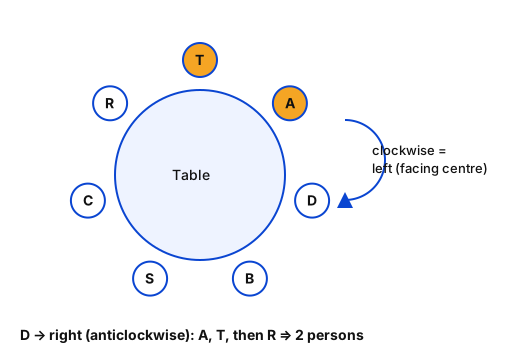
- Fix T; B is 3rd to the left (clockwise) of T.
- A and R are T's neighbours. If R were left of T, S (2nd right of R) would clash with A, so R is on T's right and A on T's left; then S is 2nd right of R.
- Remaining two seats: the one next to B is D (C cannot sit beside B), the other is C.
- Clockwise: T, A, D, B, S, C, R. From D going right: A, T, then R → 2 persons.
Trick: Place the fixed-distance clues (B–T, R–S) first; the neighbour clue then leaves only one arrangement.
Answer: (D) Two
अवधारणा: केंद्र की ओर मुख होने पर बायाँ = दक्षिणावर्त (clockwise), दायाँ = वामावर्त।
- T को स्थिर करें; B, T के बाएँ तीसरा।
- A और R, T के पड़ोसी हैं। R को T के बाएँ रखने पर S का स्थान A से टकराता है, अतः R, T के दाएँ और A बाएँ; S, R के दाएँ दूसरा।
- बचे दो स्थानों में B के पास वाला D (C, B का पड़ोसी नहीं), दूसरा C।
- क्रम (clockwise): T, A, D, B, S, C, R। D के दाएँ से: A, T, फिर R → 2 व्यक्ति।
ट्रिक: पहले निश्चित दूरी वाले संकेत (B–T, R–S) रखें; पड़ोसी संकेत से एक ही व्यवस्था बचती है।
उत्तर: (D) दो
RRB NTPC Graduate CBT 1General Intelligence and ReasoningCircular seating arrangementRRB NTPC Graduate CBT 1 2024 · 16 Jun Shift 2
Q667.If 1 is added to each odd digit and 2 is subtracted from each even digit in the number 6753412, what will be the sum of the digits which are second from the left and second from the right in the new number thus formed?
यदि संख्या 6753412 में प्रत्येक विषम अंक में 1 जोड़ दिया जाए और प्रत्येक सम अंक में से 2 घटा दिया जाए, तो इस प्रकार बनी नई संख्या में बाएँ से दूसरे और दाएँ से दूसरे अंकों का योग क्या होगा?
- A11
- B10
- C9
- D8
Show answer
Concept: Change each digit by the rule, then read the required positions.
- 6753412: odd digits 7, 5, 3, 1 → +1 = 8, 6, 4, 2; even digits 6, 4, 2 → −2 = 4, 2, 0.
- New number: 4 8 6 4 2 2 0
- 2nd from left = 8, 2nd from right = 2; sum
Trick: Only transform the two digits you need: 7 → 8 and 1 → 2.
Answer: (B) 10
अवधारणा: नियम से हर अंक बदलें, फिर आवश्यक स्थान पढ़ें।
- 6753412: विषम अंक 7, 5, 3, 1 → +1 = 8, 6, 4, 2; सम अंक 6, 4, 2 → −2 = 4, 2, 0।
- नई संख्या: 4 8 6 4 2 2 0
- बाएँ से दूसरा = 8, दाएँ से दूसरा = 2; योग
ट्रिक: केवल आवश्यक दो अंक बदलें: 7 → 8 और 1 → 2।
उत्तर: (B) 10
RRB NTPC Graduate CBT 1General Intelligence and ReasoningNumber operations – digitsRRB NTPC Graduate CBT 1 2024 · 16 Jun Shift 2
Q668.Based on the English alphabetical order, three of the following four letter-cluster pairs are alike in a certain way and thus form a group. Which letter-cluster pair DOES NOT belong to that group?
(Note: The odd one out is not based on the number of consonants/vowels or their position in the letter-cluster.)
अंग्रेज़ी वर्णमाला क्रम के आधार पर, निम्नलिखित चार अक्षर-समूह युग्मों में से तीन किसी निश्चित प्रकार से एक समान हैं और इस प्रकार एक समूह बनाते हैं। कौन-सा अक्षर-समूह युग्म उस समूह से संबंधित नहीं है?
(ध्यान दें: असंगत अक्षर-समूह, उस अक्षर-समूह में व्यंजनों/स्वरों की संख्या या उनके स्थान पर आधारित नहीं है।)
- ABU – GK
- BYR – DH
- CTN – YC
- DMF – RV
Show answer
Concept: Compare position changes of first letters and of second letters.
- BU – GK: B+5=G; U−10=K.
- YR – DH: Y+5=D; R−10=H. MF – RV: M+5=R; F−10=V (6−10 → 22).
- TN – YC: T+5=Y but N−11=C (not −10) → odd one.
Trick: First letters all move +5; check only the second letters for the break.
Answer: (C) TN – YC
अवधारणा: पहले और दूसरे अक्षरों के स्थान-परिवर्तन की तुलना करें।
- BU – GK: B+5=G; U−10=K।
- YR – DH: Y+5=D; R−10=H। MF – RV: M+5=R; F−10=V (6−10 → 22)।
- TN – YC: T+5=Y पर N−11=C (−10 नहीं) → विषम।
ट्रिक: पहले अक्षर सब +5; केवल दूसरे अक्षर जाँचें।
उत्तर: (C) TN – YC
RRB NTPC Graduate CBT 1General Intelligence and ReasoningOdd one out – letter pairsRRB NTPC Graduate CBT 1 2024 · 16 Jun Shift 2
Q669.If ‘+’ means ‘subtraction’, ‘−’ means ‘multiplication’, ‘×’ means ‘division’ and ‘÷’ means ‘addition’, then what will come in place of the question mark (?) in the following equation?
96 × 6 − 8 ÷ 71 + 26 = ?
यदि '+' का अर्थ 'घटाना', '−' का अर्थ 'गुणा करना', '×' का अर्थ 'भाग देना' और '÷' का अर्थ 'जोड़ना' है, तो निम्नलिखित समीकरण में प्रश्न चिह्न (?) के स्थान पर क्या आएगा?
96 × 6 − 8 ÷ 71 + 26 = ?
- A181
- B194
- C173
- D186
Show answer
Concept: Swap the signs as told, then apply BODMAS.
- Replace:
- ;
Trick: Write the converted expression fully before calculating – most errors come from half-swapped signs.
Answer: (C) 173
अवधारणा: बताए अनुसार चिह्न बदलें, फिर BODMAS लगाएँ।
- प्रतिस्थापन:
- ;
ट्रिक: गणना से पहले पूरा बदला हुआ व्यंजक लिखें।
उत्तर: (C) 173
RRB NTPC Graduate CBT 1General Intelligence and ReasoningMathematical operationsRRB NTPC Graduate CBT 1 2024 · 16 Jun Shift 2
Q670.Read the given statements and conclusions carefully. Assuming that the information given in the statements is true, even if it appears to be at variance with commonly known facts, decide which of the given conclusion(s) logically follow(s) from the statements.
Statements:
All cats are owls.
Some owls are rats.
No rat is bat.
Conclusions:
(I) Some rats are cats.
(II) Some bats can be cats.
दिए गए कथनों और निष्कर्षों को ध्यानपूर्वक पढ़िए। यह मानते हुए कि कथनों में दी गई जानकारी सत्य है, भले ही वह सामान्यतः ज्ञात तथ्यों से भिन्न प्रतीत होती हो, निर्णय कीजिए कि दिए गए निष्कर्षों में से कौन-सा/से निष्कर्ष तार्किक रूप से कथनों का अनुसरण करता है/करते हैं।
कथन:
सभी बिल्लियाँ, उल्लू हैं।
कुछ उल्लू, चूहे हैं।
कोई चूहा, चमगादड़ नहीं है।
निष्कर्ष:
(I) कुछ चूहे, बिल्लियाँ हैं।
(II) कुछ चमगादड़, बिल्लियाँ हो सकते हैं।
- AOnly conclusion (I) followsकेवल निष्कर्ष (I) अनुसरण करता है
- BNeither conclusion (I) nor conclusion (II) followsन तो निष्कर्ष (I) और न ही निष्कर्ष (II) अनुसरण करता है
- COnly conclusion (II) followsकेवल निष्कर्ष (II) अनुसरण करता है
- DBoth conclusions (I) and (II) followनिष्कर्ष (I) और (II) दोनों अनुसरण करते हैं
Show answer
Concept: Draw the minimum Venn diagram; a conclusion follows only if it is true in every possible diagram.
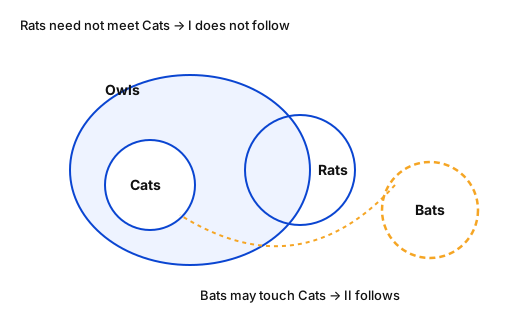
- All cats are inside owls; some owls are rats – but the rats may lie in the part of owls outside cats.
- So 'Some rats are cats' is not certain → (I) does not follow.
- Bats are only kept away from rats; nothing stops bats from touching cats, so 'Some bats can be cats' is a valid possibility → (II) follows.
Trick: 'Can be' conclusions follow unless a 'No' statement blocks that exact pair.
Answer: (C) Only conclusion (II) follows
अवधारणा: न्यूनतम वेन आरेख बनाएँ; निष्कर्ष तभी निकलता है जब हर संभव आरेख में सत्य हो।
- सभी cats, owls के अंदर; कुछ owls, rats हैं – पर rats, owls के उस भाग में हो सकते हैं जो cats से बाहर है।
- अतः 'कुछ rats, cats हैं' निश्चित नहीं → (I) नहीं निकलता।
- Bats केवल rats से अलग हैं; bats का cats से मिलना संभव है → (II) निकलता है।
ट्रिक: 'Can be' (संभावना) वाले निष्कर्ष तब तक सही हैं जब तक कोई 'No' कथन उसी युग्म को न रोके।
उत्तर: (C) केवल निष्कर्ष (II) अनुसरण करता है
RRB NTPC Graduate CBT 1General Intelligence and ReasoningSyllogismRRB NTPC Graduate CBT 1 2024 · 16 Jun Shift 2
Q671.Which of the following letter-clusters should replace # and % so that the pattern and relationship followed between the letter-cluster pair on the left side of :: is the same as that on the right side of :: ?
# : DTF :: URQ : %
निम्नलिखित में से कौन-से अक्षर-समूह # और % को प्रतिस्थापित करेंगे ताकि :: के बाईं ओर के अक्षर-समूह युग्म के बीच अनुसरण किया गया पैटर्न और संबंध वही हो जो :: के दाईं ओर के अक्षर-समूह युग्म के बीच है?
# : DTF :: URQ : %
- A# = DTU, % = VWP
- B# = DSG, % = VWM
- C# = CQG, % = VUP
- D# = CPH, % = UPN
Show answer
Concept: Find a letter-wise rule from # to DTF and apply it to URQ.
- Option (C): CQG → DTF: C+1=D, Q+3=T, G−1=F.
- Apply to URQ: U+1=V, R+3=U, Q−1=P → VUP.
- Both pairs follow (+1, +3, −1).
Trick: Reverse the rule on DTF (−1, −3, +1) to get # = CQG directly.
Answer: (C) # = CQG, % = VUP
अवधारणा: # से DTF का अक्षरवार नियम खोजकर URQ पर लगाएँ।
- विकल्प (C): CQG → DTF: C+1=D, Q+3=T, G−1=F।
- URQ पर: U+1=V, R+3=U, Q−1=P → VUP।
- दोनों में (+1, +3, −1)।
ट्रिक: DTF पर उल्टा नियम (−1, −3, +1) लगाने से सीधे # = CQG।
उत्तर: (C) # = CQG, % = VUP
RRB NTPC Graduate CBT 1General Intelligence and ReasoningLetter-cluster analogyRRB NTPC Graduate CBT 1 2024 · 16 Jun Shift 2
Q672.What should come in place of the question mark (?) in the given series based on the English alphabetical order?
UNP SLN QJL OHJ ?
अंग्रेज़ी वर्णमाला क्रम के आधार पर दी गई श्रृंखला में प्रश्न चिह्न (?) के स्थान पर क्या आना चाहिए?
UNP SLN QJL OHJ ?
- AMEH
- BMFH
- CMFG
- DMEG
Show answer
Concept: Track each position of the clusters separately.
- 1st letters: U, S, Q, O → −2 each → M
- 2nd letters: N, L, J, H → −2 → F
- 3rd letters: P, N, L, J → −2 → H; answer MFH
Trick: All three letters drop by 2 – just subtract 2 from each letter of OHJ.
Answer: (B) MFH
अवधारणा: हर स्थान के अक्षरों को अलग-अलग देखें।
- पहले अक्षर: U, S, Q, O → −2 → M
- दूसरे अक्षर: N, L, J, H → −2 → F
- तीसरे अक्षर: P, N, L, J → −2 → H; उत्तर MFH
ट्रिक: तीनों अक्षर 2 घटते हैं – OHJ के हर अक्षर से 2 घटाएँ।
उत्तर: (B) MFH
RRB NTPC Graduate CBT 1General Intelligence and ReasoningLetter seriesRRB NTPC Graduate CBT 1 2024 · 16 Jun Shift 2
Q673.What should come in place of the question mark (?) in the given series?
273 224 180 141 107 ?
दी गई श्रृंखला में प्रश्न चिह्न (?) के स्थान पर क्या आना चाहिए?
273 224 180 141 107 ?
- A73
- B78
- C61
- D90
Show answer
Concept: Look at the differences between consecutive terms.
- Differences: , , ,
- They decrease by 5 each time, so next difference
- Next term
Trick: Second-level difference constant (−5) → continue the pattern.
Answer: (B) 78
अवधारणा: क्रमागत पदों के अंतर देखें।
- अंतर: 49, 44, 39, 34
- हर बार 5 घटता है, अगला अंतर
- अगला पद
ट्रिक: दूसरे स्तर का अंतर स्थिर (−5) है।
उत्तर: (B) 78
RRB NTPC Graduate CBT 1General Intelligence and ReasoningNumber seriesRRB NTPC Graduate CBT 1 2024 · 16 Jun Shift 2
Q674.A, B, C, D, E, F and G are sitting around a circular table facing the centre. A sits third to the right of F. C sits second to the left of G. G is not an immediate neighbour of F. D sits to the immediate right of E. What is the position of C with respect to A?
A, B, C, D, E, F और G एक वृत्ताकार मेज़ के चारों ओर केंद्र की ओर मुख करके बैठे हैं। A, F के दाएँ से तीसरे स्थान पर बैठा है। C, G के बाएँ से दूसरे स्थान पर बैठा है। G, F का निकटतम पड़ोसी नहीं है। D, E के ठीक दाएँ बैठा है। A के सापेक्ष C का स्थान क्या है?
- ATo the immediate rightठीक दाएँ
- BSecond to the leftबाएँ से दूसरा
- CThird to the leftबाएँ से तीसरा
- DTo the immediate leftठीक बाएँ
Show answer
Concept: When people face the centre, moving clockwise is to their left and anticlockwise is to their right.
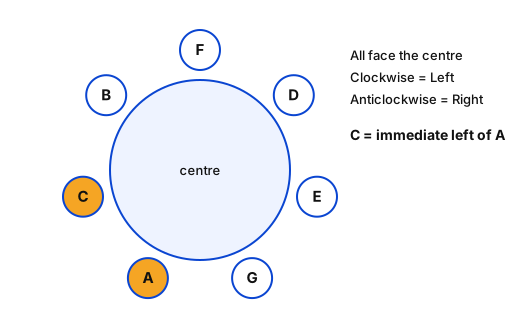
- Fix F; A is third to the right of F.
- G cannot sit next to F. Testing G's remaining seats, only G just right of A works (C then sits second to the left of G, i.e. next to A); E and D take the two seats between F and G with D to the right of E.
- Order clockwise: F, D, E, G, A, C, B.
- C sits next to A in the clockwise direction, i.e. to A's immediate left.
Trick: Facing centre: Left = clockwise; place the fixed person first and test only the conditions that lock seats.
Answer: (D) To the immediate left
अवधारणा: केंद्र की ओर मुख होने पर दक्षिणावर्त (clockwise) जाना बाएँ और वामावर्त जाना दाएँ होता है।
- F को स्थिर करें; A, F के दाएँ तीसरे स्थान पर है।
- G, F का पड़ोसी नहीं हो सकता। G के शेष स्थानों को जाँचने पर केवल A के ठीक दाएँ G संभव है (तब C, G के बाएँ दूसरे स्थान पर A के बगल में आता है); E और D, F व G के बीच बैठते हैं, D, E के दाएँ।
- दक्षिणावर्त क्रम: F, D, E, G, A, C, B।
- C, A से दक्षिणावर्त दिशा में ठीक बगल में है, अर्थात् A के ठीक बाएँ।
ट्रिक: केंद्र की ओर मुख: बायाँ = दक्षिणावर्त; पहले स्थिर व्यक्ति रखें।
उत्तर: (D) ठीक बाएँ
RRB NTPC Graduate CBT 1General Intelligence and ReasoningCircular Seating ArrangementRRB NTPC Graduate CBT 1 2024 · 16 Jun Shift 2
Q675.What should come in place of the question mark (?) in the given series based on the English alphabetical order?
DJP GMS JPV MSY ?
अंग्रेज़ी वर्णमाला क्रम के आधार पर दी गई श्रृंखला में प्रश्न चिह्न (?) के स्थान पर क्या आना चाहिए?
DJP GMS JPV MSY ?
- APVB
- BPBV
- CBPV
- DBVP
Show answer
Concept: Write the positions of letters and find the jump within and between terms.
- DJP = 4, 10, 16 (each letter +6).
- Each next term shifts every letter by +3: DJP → GMS → JPV → MSY.
- MSY + 3 = P(16), V(22), B(25+3 = 28 − 26 = 2).
Trick: After Z, wrap around: Y + 3 = B.
Answer: (A) PVB
अवधारणा: अक्षरों की स्थिति लिखें और पदों के भीतर तथा पदों के बीच का अंतर देखें।
- DJP = 4, 10, 16 (हर अक्षर +6)।
- अगले पद में हर अक्षर +3: DJP → GMS → JPV → MSY।
- MSY + 3 = P(16), V(22), B(25 + 3 = 28 − 26 = 2)।
ट्रिक: Z के बाद फिर A से गिनें: Y + 3 = B।
उत्तर: (A) PVB
RRB NTPC Graduate CBT 1General Intelligence and ReasoningLetter SeriesRRB NTPC Graduate CBT 1 2024 · 16 Jun Shift 2
Q676.Each of P, Q, R, S, T, U and V has an exam on a different day of a week starting from Monday and ending on Sunday of the same week. V has an exam on Tuesday. Exactly 2 people have an exam between V and P. S has an exam immediately before T, and Q has an exam immediately after R. Only 1 person has an exam between T and R
How many people have an exam before S?
P, Q, R, S, T, U और V में से प्रत्येक की परीक्षा एक ही सप्ताह के सोमवार से शुरू होकर रविवार को समाप्त होने वाले सप्ताह के एक अलग दिन पर है। V की परीक्षा मंगलवार को है। V और P के बीच ठीक 2 व्यक्तियों की परीक्षा है। S की परीक्षा T से ठीक पहले है, और Q की परीक्षा R के ठीक बाद है। T और R के बीच केवल 1 व्यक्ति की परीक्षा है
S से पहले कितने व्यक्तियों की परीक्षा है?
- A1
- B3
- C4
- D2
Show answer
Concept: Place the fixed person first, then use 'exactly n between' clues to lock positions.
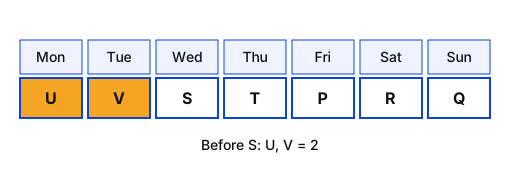
- V = Tuesday; 2 people between V and P → P = Friday.
- S–T and R–Q are consecutive pairs in Mon, Wed, Thu, Sat, Sun.
- S–T = Wed–Thu, R–Q = Sat–Sun gives one person (P) between T and R ✓; the other way gives 3 ✗.
- U = Monday. Before S (Wed): U, V → 2 people.
Trick: Pairs (S–T, R–Q) can only sit in back-to-back free days – test the two slots.
Answer: (D) 2
अवधारणा: पहले निश्चित व्यक्ति रखें, फिर 'ठीक n बीच में' वाले संकेतों से स्थान तय करें।
- V = मंगलवार; V और P के बीच 2 लोग → P = शुक्रवार।
- S–T और R–Q लगातार जोड़े हैं; खाली दिन: सोम, बुध, गुरु, शनि, रवि।
- S–T = बुध–गुरु, R–Q = शनि–रवि लेने पर T और R के बीच एक (P) ✓; उल्टा लेने पर 3 ✗।
- U = सोमवार। S (बुध) से पहले: U, V → 2 लोग।
ट्रिक: जोड़े (S–T, R–Q) केवल लगातार खाली दिनों में आ सकते हैं – दोनों विकल्प जाँचें।
उत्तर: (D) 2
RRB NTPC Graduate CBT 1General Intelligence and ReasoningScheduling Puzzle – DaysRRB NTPC Graduate CBT 1 2024 · 16 Jun Shift 2
Q677.SS 14 is related to WP −4 in a certain way. In the same way, CE 10 is related to GB −8. To which of the given options is QG 1 related, following the same logic?
SS 14 एक निश्चित प्रकार से WP −4 से संबंधित है। उसी प्रकार, CE 10, GB −8 से संबंधित है। समान तर्क का अनुसरण करते हुए, QG 1 दिए गए विकल्पों में से किससे संबंधित है?
- ANR −23
- BUD −17
- CIJ −21
- DUM −19
Show answer
Concept: Check each part separately: the two letters and the number.
- SS 14 → WP −4: S + 4 = W, S − 3 = P, 14 − 18 = −4.
- CE 10 → GB −8: C + 4 = G, E − 3 = B, 10 − 18 = −8.
- QG 1 → Q + 4 = U, G − 3 = D, 1 − 18 = −17 → UD −17.
Trick: Pattern: (+4, −3, −18).
Answer: (B) UD −17
अवधारणा: हर भाग अलग से जाँचें: दोनों अक्षर और संख्या।
- SS 14 → WP −4: S + 4 = W, S − 3 = P, 14 − 18 = −4।
- CE 10 → GB −8: C + 4 = G, E − 3 = B, 10 − 18 = −8।
- QG 1 → Q + 4 = U, G − 3 = D, 1 − 18 = −17 → UD −17।
ट्रिक: नियम: (+4, −3, −18)।
उत्तर: (B) UD −17
RRB NTPC Graduate CBT 1General Intelligence and ReasoningLetter-Number AnalogyRRB NTPC Graduate CBT 1 2024 · 16 Jun Shift 2
Q678.This question is based on the five, three-digit numbers given below.
(Left) 951 474 717 497 127 (Right)
(Example- 697 – First digit = 6, second digit = 9 and third digit = 7)
(NOTE: All operations to be done from left to right.)
What will be the resultant if the first digit of the highest number is subtracted from the third digit of the lowest number?
यह प्रश्न नीचे दी गई तीन अंकों वाली पाँच संख्याओं पर आधारित है।
(बाएँ) 951 474 717 497 127 (दाएँ)
(उदाहरण- 697 – पहला अंक = 6, दूसरा अंक = 9 और तीसरा अंक = 7)
(ध्यान दें: सभी संक्रियाएँ बाएँ से दाएँ की जानी हैं।)
यदि सबसे बड़ी संख्या का पहला अंक, सबसे छोटी संख्या के तीसरे अंक में से घटाया जाए, तो परिणाम क्या होगा?
- A−1
- B−3
- C1
- D−2
Show answer
Concept: Identify the highest and lowest numbers, then pick the required digits.
- Highest = 951 → first digit 9.
- Lowest = 127 → third digit 7.
- Third digit of lowest − first digit of highest = 7 − 9 = −2.
Trick: Read the order carefully: 'A subtracted from B' means B − A.
Answer: (D) −2
अवधारणा: सबसे बड़ी और सबसे छोटी संख्या पहचानें, फिर आवश्यक अंक लें।
- सबसे बड़ी = 951 → पहला अंक 9।
- सबसे छोटी = 127 → तीसरा अंक 7।
- सबसे छोटी का तीसरा अंक − सबसे बड़ी का पहला अंक = 7 − 9 = −2।
ट्रिक: 'A को B में से घटाया' का अर्थ B − A।
उत्तर: (D) −2
RRB NTPC Graduate CBT 1General Intelligence and ReasoningNumber Operations – Three-digit NumbersRRB NTPC Graduate CBT 1 2024 · 16 Jun Shift 2
Q679.If 1 is added to each odd digit and 2 is subtracted from each even digit in the number 5214637, how many digits will appear more than once in the new number thus formed?
यदि संख्या 5214637 में प्रत्येक विषम अंक में 1 जोड़ दिया जाए और प्रत्येक सम अंक में से 2 घटा दिया जाए, तो इस प्रकार बनी नई संख्या में कितने अंक एक से अधिक बार आएँगे?
- AFourचार
- BThreeतीन
- CTwoदो
- DOneएक
Show answer
Concept: Apply the rule digit by digit: odd → +1, even → −2.
- 5214637 → 5+1=6, 2−2=0, 1+1=2, 4−2=2, 6−2=4, 3+1=4, 7+1=8.
- New number: 6022448.
- Repeated digits: 2 (twice) and 4 (twice) → two digits.
Trick: Odd + 1 always becomes even; just track repeats at the end.
Answer: (C) Two
अवधारणा: हर अंक पर नियम लगाएँ: विषम → +1, सम → −2।
- 5214637 → 5+1=6, 2−2=0, 1+1=2, 4−2=2, 6−2=4, 3+1=4, 7+1=8।
- नई संख्या: 6022448।
- दोहराए गए अंक: 2 (दो बार) और 4 (दो बार) → दो अंक।
ट्रिक: विषम + 1 हमेशा सम बनता है; अंत में दोहराव गिनें।
उत्तर: (C) दो
RRB NTPC Graduate CBT 1General Intelligence and ReasoningDigit OperationsRRB NTPC Graduate CBT 1 2024 · 16 Jun Shift 2
Q680.F is the brother of G. G is the husband of H. H is the daughter of I. I is the husband of J. How is F related to J?
F, G का भाई है। G, H का पति है। H, I की पुत्री है। I, J का पति है। F का J से क्या संबंध है?
- AHusband's fatherपति के पिता
- BDaughter's husband's fatherपुत्री के पति के पिता
- CHusband's brotherपति के भाई
- DDaughter's husband's brotherपुत्री के पति के भाई
Show answer
Concept: Draw a family tree: ♂/♀ for gender, horizontal line for marriage, vertical line for children.
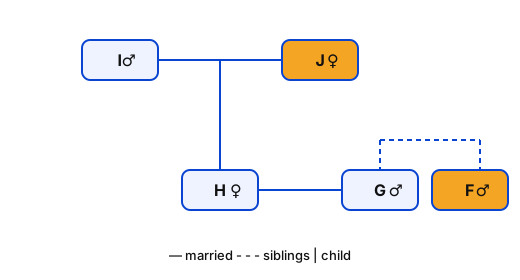
- I is the husband of J, and H is their daughter.
- G is H's husband, i.e. J's daughter's husband (son-in-law).
- F is G's brother → F is J's daughter's husband's brother.
Trick: Start from the person in the answer (J) and walk to F: daughter → her husband → his brother.
Answer: (D) Daughter's husband's brother
अवधारणा: परिवार वृक्ष बनाएँ: लिंग के लिए ♂/♀, विवाह के लिए क्षैतिज रेखा, संतान के लिए ऊर्ध्वाधर रेखा।
- I, J का पति है और H उनकी पुत्री है।
- G, H का पति है, अर्थात् J की पुत्री का पति (दामाद)।
- F, G का भाई है → F, J की पुत्री के पति का भाई है।
ट्रिक: J से F तक चलें: पुत्री → उसका पति → उसका भाई।
उत्तर: (D) पुत्री के पति का भाई
RRB NTPC Graduate CBT 1General Intelligence and ReasoningBlood RelationsRRB NTPC Graduate CBT 1 2024 · 16 Jun Shift 2

