Q721.Arpan starts from Point A and drives 12 km towards East. He then takes a right turn, drives 8 km, turns right and drives 14 km. He then takes a right turn and drives 12 km. He takes a final right turn, drives 2 km and stops at Point P. How far (shortest distance) and towards which direction should he drive in order to reach Point A again? (All turns are 90° turns only, unless specified)
अर्पण बिंदु A से शुरू करता है और पूर्व की ओर 12 km गाड़ी चलाता है। फिर वह दाएँ मुड़ता है, 8 km गाड़ी चलाता है, दाएँ मुड़ता है और 14 km गाड़ी चलाता है। फिर वह दाएँ मुड़ता है और 12 km गाड़ी चलाता है। वह अंतिम बार दाएँ मुड़ता है, 2 km गाड़ी चलाता है और बिंदु P पर रुक जाता है। फिर से बिंदु A पर पहुँचने के लिए उसे कितनी दूर (न्यूनतम दूरी) और किस दिशा में गाड़ी चलानी चाहिए? (जब तक निर्दिष्ट न हो, सभी मोड़ केवल 90° के मोड़ हैं)
- A4 km to the southदक्षिण की ओर 4 km
- B3 km to the southदक्षिण की ओर 3 km
- C2 km to the southदक्षिण की ओर 2 km
- D1 km to the southदक्षिण की ओर 1 km
Show answer
Concept: Take A as origin, East = +x, North = +y; a right turn from East faces South, from South faces West, and so on.
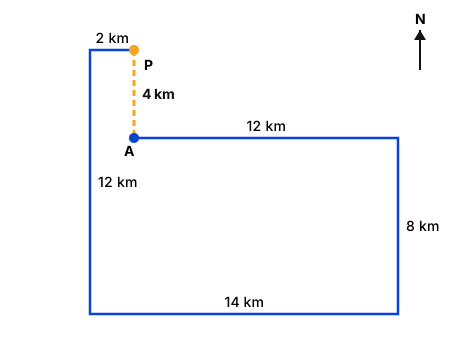
- 12 km East → (12, 0); right turn, 8 km South → (12, −8).
- Right turn, 14 km West → (−2, −8); right turn, 12 km North → (−2, 4).
- Right turn, 2 km East → P (0, 4). P is exactly 4 km north of A, so he must drive 4 km south.
Trick: East-West: 12 − 14 + 2 = 0; North-South: −8 + 12 = +4 (north). Go back 4 km south.
Answer: (A) 4 km to the south
अवधारणा: A को मूल बिंदु मानें, पूर्व = +x, उत्तर = +y; पूर्व से दाएँ मुड़ने पर दक्षिण, दक्षिण से दाएँ मुड़ने पर पश्चिम।
- 12 km पूर्व → (12, 0); दाएँ, 8 km दक्षिण → (12, −8)।
- दाएँ, 14 km पश्चिम → (−2, −8); दाएँ, 12 km उत्तर → (−2, 4)।
- दाएँ, 2 km पूर्व → P (0, 4)। P, A से ठीक 4 km उत्तर में है, अतः 4 km दक्षिण जाना होगा।
ट्रिक: पूर्व-पश्चिम: 12 − 14 + 2 = 0; उत्तर-दक्षिण: −8 + 12 = +4 (उत्तर)। वापसी 4 km दक्षिण।
उत्तर: (A) 4 km दक्षिण की ओर
RRB NTPC Graduate CBT 1General Intelligence and ReasoningDirection and DistanceRRB NTPC Graduate CBT 1 2024 · 14 Jun Shift 2
Q722.Ganesh starts from point A and drives 11 km towards the south. He then takes a right turn, drives 8 km, turns right and drives 15 km. He then takes a right turn and drives 12 km. He takes a final right turn, drives 4 km and stops at point P. How far (shortest distance) and towards which direction should he drive in order to reach point A again? (All turns are 90-degree turns only unless specified.)
गणेश बिंदु A से शुरू करता है और दक्षिण की ओर 11 km गाड़ी चलाता है। फिर वह दाएँ मुड़ता है, 8 km गाड़ी चलाता है, दाएँ मुड़ता है और 15 km गाड़ी चलाता है। फिर वह दाएँ मुड़ता है और 12 km गाड़ी चलाता है। वह अंतिम बार दाएँ मुड़ता है, 4 km गाड़ी चलाता है और बिंदु P पर रुक जाता है। फिर से बिंदु A पर पहुँचने के लिए उसे कितनी दूर (न्यूनतम दूरी) और किस दिशा में गाड़ी चलानी चाहिए? (जब तक निर्दिष्ट न हो, सभी मोड़ केवल 90 डिग्री के मोड़ हैं।)
- A4 km to the westपश्चिम की ओर 4 km
- B3 km to the westपश्चिम की ओर 3 km
- C3 km to the eastपूर्व की ओर 3 km
- D4 km to the eastपूर्व की ओर 4 km
Show answer
Concept: Take A as origin; a right turn from South faces West, from West faces North, from North faces East, from East faces South.
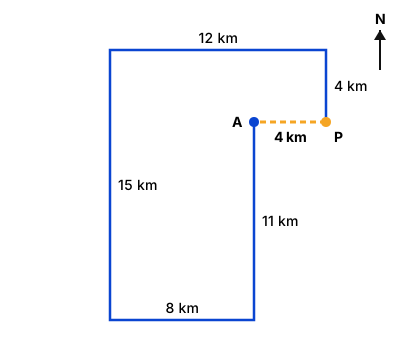
- 11 km South → (0, −11); right, 8 km West → (−8, −11).
- Right, 15 km North → (−8, 4); right, 12 km East → (4, 4).
- Right, 4 km South → P (4, 0). P is 4 km east of A, so he must drive 4 km west.
Trick: North-South: −11 + 15 − 4 = 0; East-West: −8 + 12 = +4 (east). Return 4 km west.
Answer: (A) 4 km to the west
अवधारणा: A को मूल बिंदु मानें; दक्षिण से दाएँ = पश्चिम, पश्चिम से दाएँ = उत्तर, उत्तर से दाएँ = पूर्व, पूर्व से दाएँ = दक्षिण।
- 11 km दक्षिण → (0, −11); दाएँ, 8 km पश्चिम → (−8, −11)।
- दाएँ, 15 km उत्तर → (−8, 4); दाएँ, 12 km पूर्व → (4, 4)।
- दाएँ, 4 km दक्षिण → P (4, 0)। P, A से 4 km पूर्व में है, अतः 4 km पश्चिम जाना होगा।
ट्रिक: उत्तर-दक्षिण: −11 + 15 − 4 = 0; पूर्व-पश्चिम: −8 + 12 = +4 (पूर्व)। वापसी 4 km पश्चिम।
उत्तर: (A) 4 km पश्चिम की ओर
RRB NTPC Graduate CBT 1General Intelligence and ReasoningDirection and DistanceRRB NTPC Graduate CBT 1 2024 · 14 Jun Shift 2
Q723.In a certain code language, ‘WILD’ is coded as ‘5391’ and ‘DOGS’ is coded as ‘2458’. What is the code for ‘D’ in the given code language?
एक निश्चित कूट भाषा में, ‘WILD’ को ‘5391’ के रूप में कूटबद्ध किया जाता है और ‘DOGS’ को ‘2458’ के रूप में कूटबद्ध किया जाता है। दी गई कूट भाषा में ‘D’ के लिए कूट क्या है?
- A1
- B4
- C2
- D5
Show answer
Concept: A letter common to both words gets the digit common to both codes (codes may be jumbled).
- WILD = 5391 and DOGS = 2458.
- Common letter: D. Common digit: 5.
- So D = 5.
Trick: Common letter ↔ common digit.
Answer: (D) 5
अवधारणा: दोनों शब्दों में उभयनिष्ठ अक्षर को दोनों कोड में उभयनिष्ठ अंक मिलता है (क्रम बदला हो सकता है)।
- WILD = 5391 तथा DOGS = 2458।
- उभयनिष्ठ अक्षर: D; उभयनिष्ठ अंक: 5।
- अतः D = 5।
ट्रिक: उभयनिष्ठ अक्षर ↔ उभयनिष्ठ अंक।
उत्तर: (D) 5
RRB NTPC Graduate CBT 1General Intelligence and ReasoningCoding-DecodingRRB NTPC Graduate CBT 1 2024 · 14 Jun Shift 2
Q724.P, Q, R, S, T, U and V have an exam on different days of the week starting on Monday and ending on Sunday.
V has an exam on Thursday. Exactly 4 people have their exam between S and U, neither of whom has an exam on Sunday. R has an exam immediately before P. T does not have an exam on Friday. S does not have an exam after P. Who among the following has an exam on Tuesday?
P, Q, R, S, T, U और V की परीक्षा सप्ताह के अलग-अलग दिनों में है, जो सोमवार से शुरू होकर रविवार को समाप्त होता है।
V की परीक्षा गुरुवार को है। S और U के बीच ठीक 4 लोगों की परीक्षा है, इन दोनों में से किसी की भी परीक्षा रविवार को नहीं है। R की परीक्षा P से ठीक पहले है। T की परीक्षा शुक्रवार को नहीं है। S की परीक्षा P के बाद नहीं है। निम्नलिखित में से किसकी परीक्षा मंगलवार को है?
- AU
- BT
- CR
- DS
Show answer
Concept: Place the fixed person first, then the gap condition, then the pairs.
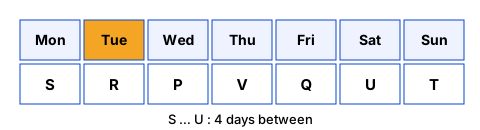
- V = Thursday. Exactly 4 between S and U → they are on Mon/Sat or Tue/Sun; neither on Sunday → S and U are on Mon and Sat.
- If S = Sat, P (not before S) would be Sun and R (just before P) Sat — clash. So S = Mon, U = Sat.
- R just before P: only Tue–Wed is free → R = Tue, P = Wed.
- T not on Friday → T = Sun, Q = Fri.
Trick: Gap of 4 between two people in 7 days → they sit at the ends: (1,6) or (2,7).
Answer: (C) R
अवधारणा: पहले निश्चित व्यक्ति, फिर अंतर वाली शर्त, फिर जोड़ियाँ रखें।
- V = गुरुवार। S और U के बीच ठीक 4 → सोम/शनि या मंगल/रवि; कोई भी रविवार नहीं → S, U सोमवार और शनिवार पर।
- यदि S = शनि, तो P = रवि और R = शनि — टकराव। अतः S = सोम, U = शनि।
- R ठीक P से पहले: केवल मंगल–बुध खाली → R = मंगल, P = बुध।
- T शुक्रवार नहीं → T = रवि, Q = शुक्र।
ट्रिक: 7 दिनों में 4 का अंतर → दोनों लगभग सिरों पर: (1,6) या (2,7)।
उत्तर: (C) R
RRB NTPC Graduate CBT 1General Intelligence and ReasoningScheduling PuzzleRRB NTPC Graduate CBT 1 2024 · 14 Jun Shift 2
Q725.Refer to the following number and symbol series and answer the question that follows. Counting to be done from left to right only.
(NOTE: All numbers are single digit numbers only.)
(Left) 3 % 2 % 2 £ £ & © £ 1 1 8 5 $ 9 9 5 2 & 5 6 (Right)
How many such numbers are there each of which is immediately preceded by a symbol and also immediately followed by a symbol?
निम्नलिखित संख्या और प्रतीक श्रृंखला को देखिए और उसके बाद दिए गए प्रश्न का उत्तर दीजिए। गिनती केवल बाएँ से दाएँ की जानी है।
(नोट: सभी संख्याएँ केवल एक अंक वाली संख्याएँ हैं।)
(बाएँ) 3 % 2 % 2 £ £ & © £ 1 1 8 5 $ 9 9 5 2 & 5 6 (दाएँ)
ऐसी कितनी संख्याएँ हैं जिनमें से प्रत्येक के ठीक पहले एक प्रतीक है और ठीक बाद भी एक प्रतीक है?
- A2
- B3
- C1
- D4
Show answer
Concept: Check every number: the element just before and just after it must both be symbols.
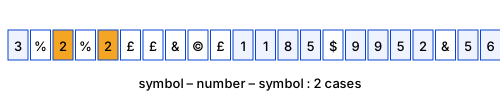
- Series: 3 % 2 % 2 £ £ & © £ 1 1 8 5 $ 9 9 5 2 & 5 6.
- % 2 % ✓ and % 2 £ ✓.
- Others fail: £ 1 1, $ 9 9, & 5 6 have a number on one side.
Trick: Scan only numbers that sit inside a symbol cluster.
Answer: (A) 2
अवधारणा: हर संख्या जाँचें: उसके ठीक पहले और ठीक बाद दोनों प्रतीक होने चाहिए।
- श्रृंखला: 3 % 2 % 2 £ £ & © £ 1 1 8 5 $ 9 9 5 2 & 5 6।
- % 2 % ✓ तथा % 2 £ ✓।
- शेष असफल: £ 1 1, $ 9 9, & 5 6 में एक ओर संख्या है।
ट्रिक: केवल प्रतीकों के समूह के बीच फँसी संख्याएँ देखें।
उत्तर: (A) 2
RRB NTPC Graduate CBT 1General Intelligence and ReasoningNumber-Symbol SeriesRRB NTPC Graduate CBT 1 2024 · 14 Jun Shift 2
Q726.If 2 is added to each even digit and 2 is added to each odd digit in the number 7153246, what will be the sum of all the odd digits in the new number thus formed?
यदि संख्या 7153246 में प्रत्येक सम अंक में 2 जोड़ा जाए और प्रत्येक विषम अंक में 2 जोड़ा जाए, तो इस प्रकार बनी नई संख्या में सभी विषम अंकों का योग क्या होगा?
- A28
- B21
- C19
- D24
Show answer
Concept: Here 2 is added to every digit (even and odd alike); then pick the odd digits of the new number.
- 7153246 → 9 3 7 5 4 6 8.
- Odd digits: 9, 3, 7, 5.
- Sum = 9 + 3 + 7 + 5 = 24.
Trick: Adding 2 keeps parity: odd stays odd. So simply add 2 to each original odd digit: (7+1+5+3) + 4×2 = 24.
Answer: (D) 24
अवधारणा: यहाँ हर अंक (सम और विषम दोनों) में 2 जोड़ा जाता है; फिर नई संख्या के विषम अंक लें।
- 7153246 → 9 3 7 5 4 6 8।
- विषम अंक: 9, 3, 7, 5।
- योग = 9 + 3 + 7 + 5 = 24।
ट्रिक: 2 जोड़ने से सम-विषम नहीं बदलता: (7+1+5+3) + 4×2 = 24।
उत्तर: (D) 24
RRB NTPC Graduate CBT 1General Intelligence and ReasoningDigit OperationsRRB NTPC Graduate CBT 1 2024 · 14 Jun Shift 2
Q727.Based on the English alphabetical order, three of the following four letter-cluster pairs are alike in a certain way and thus form a group. Which is the letter-cluster pair that DOES NOT belong to that group?
(Note: The odd one out is not based on the number of consonants/vowels or their position in the letter-cluster.)
अंग्रेज़ी वर्णमाला क्रम के आधार पर, निम्नलिखित चार अक्षर-समूह युग्मों में से तीन किसी निश्चित प्रकार से समान हैं और इस प्रकार एक समूह बनाते हैं। वह अक्षर-समूह युग्म कौन-सा है जो उस समूह से संबंधित नहीं है?
(नोट: असंगत, अक्षर-समूह में व्यंजनों/स्वरों की संख्या या उनके स्थान पर आधारित नहीं है।)
- AJN - HL
- BLP - JK
- CNR - LP
- DOS - MQ
Show answer
Concept: Check the gap between the letters within each cluster.
- JN: J+4 = N; HL: H+4 = L ✓.
- NR: +4, LP: +4 ✓; OS: +4, MQ: +4 ✓.
- LP: +4 but JK: J+1 = K ✗ → odd one.
Trick: In the group, both clusters have a +4 gap and the second starts 2 letters before the first.
Answer: (B) LP - JK
अवधारणा: हर समूह के भीतर अक्षरों का अंतर देखें।
- JN: J+4 = N; HL: H+4 = L ✓।
- NR: +4, LP: +4 ✓; OS: +4, MQ: +4 ✓।
- LP: +4 पर JK: J+1 = K ✗ → विषम।
ट्रिक: समूह में दोनों क्लस्टर का अंतर +4 है और दूसरा क्लस्टर 2 अक्षर पहले से शुरू होता है।
उत्तर: (B) LP - JK
RRB NTPC Graduate CBT 1General Intelligence and ReasoningLetter Analogy – Odd OneRRB NTPC Graduate CBT 1 2024 · 14 Jun Shift 2
Q728.What should come in place of the question mark (?) in the given series?
113 137 106 130 99 123 ?
दी गई श्रृंखला में प्रश्न चिह्न (?) के स्थान पर क्या आना चाहिए?
113 137 106 130 99 123 ?
- A116
- B96
- C92
- D110
Show answer
Concept: Look at the differences — an alternating pattern.
- 113 → 137 (+24) → 106 (−31) → 130 (+24) → 99 (−31) → 123 (+24).
- Next: 123 − 31 = 92.
Trick: Alternate terms also fall by 7: 113, 106, 99, 92.
Answer: (C) 92
अवधारणा: अंतर देखें — एकांतर (alternating) पैटर्न।
- 113 → 137 (+24) → 106 (−31) → 130 (+24) → 99 (−31) → 123 (+24)।
- अगला: 123 − 31 = 92।
ट्रिक: एकांतर पद 7 से घटते हैं: 113, 106, 99, 92।
उत्तर: (C) 92
RRB NTPC Graduate CBT 1General Intelligence and ReasoningNumber SeriesRRB NTPC Graduate CBT 1 2024 · 14 Jun Shift 2
Q729.Select the triad that follows the same pattern as that followed by the two triads given below. Both triads follow the same pattern.
QV-SX-UW
NS-PU-RT
उस त्रिक का चयन कीजिए जो उसी पैटर्न का अनुसरण करता है जिसका अनुसरण नीचे दिए गए दो त्रिक करते हैं। दोनों त्रिक समान पैटर्न का अनुसरण करते हैं।
QV-SX-UW
NS-PU-RT
- AKP-MR-OQ
- BLP-MR-OS
- CKP-MR-OS
- DLP-NR-OS
Show answer
Concept: Find the letter-gap rule inside and between the pairs.
- QV-SX-UW: Q+5 = V; S = Q+2, X = V+2; U = S+2, W = X−1.
- NS-PU-RT follows the same: N+5 = S, P, U (+2 each), R (+2), T = U−1.
- KP-MR-OQ: K+5 = P; M, R (+2 each); O (+2), Q = R−1 ✓.
Trick: Quickest check: last letter = previous last letter − 1 (W after X, T after U, Q after R).
Answer: (A) KP-MR-OQ
अवधारणा: जोड़ियों के भीतर और बीच अक्षर-अंतर का नियम खोजें।
- QV-SX-UW: Q+5 = V; S = Q+2, X = V+2; U = S+2, W = X−1।
- NS-PU-RT में भी यही: N+5 = S, P, U (+2), R (+2), T = U−1।
- KP-MR-OQ: K+5 = P; M, R (+2); O (+2), Q = R−1 ✓।
ट्रिक: सबसे तेज़ जाँच: अंतिम अक्षर = पिछली जोड़ी का अंतिम अक्षर − 1।
उत्तर: (A) KP-MR-OQ
RRB NTPC Graduate CBT 1General Intelligence and ReasoningLetter TriadsRRB NTPC Graduate CBT 1 2024 · 14 Jun Shift 2
Q730.This question is based on the five, three-digit numbers given below.
(Left) 823 664 309 431 175 (Right)
(Example- 697 – First digit = 6, second digit = 9 and third digit = 7)
(NOTE: All operations to be done from left to right.)
What will be the resultant if the first digit of the highest number is added to the third digit of the lowest number?
यह प्रश्न नीचे दी गई तीन अंकों वाली पाँच संख्याओं पर आधारित है।
(बाएँ) 823 664 309 431 175 (दाएँ)
(उदाहरण- 697 – पहला अंक = 6, दूसरा अंक = 9 और तीसरा अंक = 7)
(नोट: सभी संक्रियाएँ बाएँ से दाएँ की जानी हैं।)
यदि सबसे बड़ी संख्या के पहले अंक को सबसे छोटी संख्या के तीसरे अंक में जोड़ा जाए, तो परिणाम क्या होगा?
- A16
- B11
- C13
- D14
Show answer
Concept: Identify the highest and lowest numbers first.
- Highest = 823 → first digit 8.
- Lowest = 175 → third digit 5.
- 8 + 5 = 13.
Trick: Compare hundreds digits only: 8 is largest, 1 is smallest.
Answer: (C) 13
अवधारणा: पहले सबसे बड़ी और सबसे छोटी संख्या पहचानें।
- सबसे बड़ी = 823 → पहला अंक 8।
- सबसे छोटी = 175 → तीसरा अंक 5।
- 8 + 5 = 13।
ट्रिक: केवल सैकड़े के अंक तुलना करें: 8 सबसे बड़ा, 1 सबसे छोटा।
उत्तर: (C) 13
RRB NTPC Graduate CBT 1General Intelligence and ReasoningNumber OperationsRRB NTPC Graduate CBT 1 2024 · 14 Jun Shift 2
Q731.If 1 is added to each odd digit and 2 is subtracted from each even digit in the number 7452183, then what will the difference between the highest and lowest digits in the new number thus formed be?
यदि संख्या 7452183 में प्रत्येक विषम अंक में 1 जोड़ा जाए और प्रत्येक सम अंक में से 2 घटाया जाए, तो इस प्रकार बनी नई संख्या में सबसे बड़े और सबसे छोटे अंकों के बीच का अंतर क्या होगा?
- A6
- B9
- C8
- D7
Show answer
Concept: Apply +1 to odd digits and −2 to even digits, then compare.
- 7452183 → 7→8, 4→2, 5→6, 2→0, 1→2, 8→6, 3→4.
- New number: 8 2 6 0 2 6 4.
- Highest 8 − lowest 0 = 8.
Trick: The 2 becomes 0 and 7 becomes 8 — the extremes are clear at once.
Answer: (C) 8
अवधारणा: विषम अंकों में +1 और सम अंकों में −2 करें, फिर तुलना करें।
- 7452183 → 7→8, 4→2, 5→6, 2→0, 1→2, 8→6, 3→4।
- नई संख्या: 8 2 6 0 2 6 4।
- सबसे बड़ा 8 − सबसे छोटा 0 = 8।
ट्रिक: 2 → 0 और 7 → 8 — चरम मान तुरंत दिखते हैं।
उत्तर: (C) 8
RRB NTPC Graduate CBT 1General Intelligence and ReasoningDigit OperationsRRB NTPC Graduate CBT 1 2024 · 14 Jun Shift 2
Q732.What should come in place of the question mark (?) in the given series based on the English alphabetical order?
FKP DIN BGL ZEJ ?
अंग्रेज़ी वर्णमाला क्रम के आधार पर दी गई श्रृंखला में प्रश्न चिह्न (?) के स्थान पर क्या आना चाहिए?
FKP DIN BGL ZEJ ?
- AXCH
- BCXH
- CXHC
- DCHX
Show answer
Concept: Track each position separately.
- 1st letters: F, D, B, Z, X (−2 each, wrapping B → Z).
- 2nd letters: K, I, G, E, C (−2).
- 3rd letters: P, N, L, J, H (−2). Answer: XCH.
Trick: Every letter moves 2 steps back; wrap around after A.
Answer: (A) XCH
अवधारणा: हर स्थान को अलग से देखें।
- पहला अक्षर: F, D, B, Z, X (−2, B के बाद Z)।
- दूसरा: K, I, G, E, C (−2)।
- तीसरा: P, N, L, J, H (−2)। उत्तर: XCH।
ट्रिक: हर अक्षर 2 कदम पीछे; A के बाद Z पर लौटें।
उत्तर: (A) XCH
RRB NTPC Graduate CBT 1General Intelligence and ReasoningAlphabet SeriesRRB NTPC Graduate CBT 1 2024 · 14 Jun Shift 2
Q733.Read the given statements and conclusions carefully. Assuming that the information given in the statements is true, even if it appears to be at variance with commonly known facts, decide which of the given conclusion(s) logically follow(s) from the statements.
Statements:
Some houses are small.
Some small are forks.
All forks are knives.
Conclusions:
(I) Some small are houses.
(II) Some forks are small.
दिए गए कथनों और निष्कर्षों को ध्यानपूर्वक पढ़िए। यह मानते हुए कि कथनों में दी गई जानकारी सत्य है, भले ही वह सामान्यतः ज्ञात तथ्यों से भिन्न प्रतीत होती हो, निर्णय कीजिए कि दिए गए निष्कर्षों में से कौन-सा/से निष्कर्ष कथनों का तार्किक रूप से अनुसरण करता है/करते हैं।
कथन:
कुछ घर, छोटे हैं।
कुछ छोटे, काँटे हैं।
सभी काँटे, चाकू हैं।
निष्कर्ष:
(I) कुछ छोटे, घर हैं।
(II) कुछ काँटे, छोटे हैं।
- ANeither conclusion (I) nor (II) followsन तो निष्कर्ष (I) और न ही (II) अनुसरण करता है
- BOnly conclusion (II) followsकेवल निष्कर्ष (II) अनुसरण करता है
- CBoth conclusions (I) and (II) followनिष्कर्ष (I) और (II) दोनों अनुसरण करते हैं
- DOnly conclusion (I) followsकेवल निष्कर्ष (I) अनुसरण करता है
Show answer
Concept: 'Some A are B' can always be converted to 'Some B are A'.
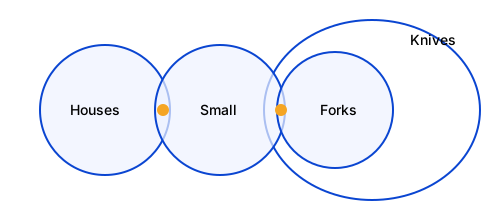
- Some houses are small → Some small are houses: I follows.
- Some small are forks → Some forks are small: II follows.
- 'All forks are knives' is not needed here.
Trick: Conclusions that are just converses of 'Some' statements always follow.
Answer: (C) Both conclusions (I) and (II) follow
अवधारणा: 'कुछ A, B हैं' का परिवर्तन 'कुछ B, A हैं' हमेशा सही होता है।
- कुछ घर छोटे हैं → कुछ छोटे घर हैं: I अनुसरण करता है।
- कुछ छोटे काँटे हैं → कुछ काँटे छोटे हैं: II अनुसरण करता है।
- 'सभी काँटे चाकू हैं' की यहाँ आवश्यकता नहीं।
ट्रिक: 'कुछ' वाले कथन का उलटा (converse) हमेशा सही।
उत्तर: (C) निष्कर्ष (I) और (II) दोनों अनुसरण करते हैं
RRB NTPC Graduate CBT 1General Intelligence and ReasoningSyllogismRRB NTPC Graduate CBT 1 2024 · 14 Jun Shift 2
Q734.JR 11 is related to MV 2 in a certain way. In the same way, KL 7 is related to NP -2. To which of the given options is WO 2 related, following the same logic?
JR 11 एक निश्चित प्रकार से MV 2 से संबंधित है। उसी प्रकार, KL 7, NP -2 से संबंधित है। समान तर्क का अनुसरण करते हुए, WO 2 दिए गए विकल्पों में से किससे संबंधित है?
- AZT -7
- BAT -7
- CAS -5
- DZS -7
Show answer
Concept: Find the change in each letter and in the number.
- JR 11 → MV 2: J+3 = M, R+4 = V, 11 − 9 = 2.
- KL 7 → NP −2: K+3 = N, L+4 = P, 7 − 9 = −2 ✓.
- WO 2 → W+3 = Z, O+4 = S, 2 − 9 = −7 → ZS −7.
Trick: Rule: (+3, +4, −9). Check the number first: only A and D have −7, then O+4 = S picks D.
Answer: (D) ZS -7
अवधारणा: हर अक्षर और संख्या में परिवर्तन देखें।
- JR 11 → MV 2: J+3 = M, R+4 = V, 11 − 9 = 2।
- KL 7 → NP −2: K+3 = N, L+4 = P, 7 − 9 = −2 ✓।
- WO 2 → W+3 = Z, O+4 = S, 2 − 9 = −7 → ZS −7।
ट्रिक: नियम: (+3, +4, −9)। O+4 = S से सही विकल्प तुरंत मिलता है।
उत्तर: (D) ZS -7
RRB NTPC Graduate CBT 1General Intelligence and ReasoningAlpha-Numeric AnalogyRRB NTPC Graduate CBT 1 2024 · 14 Jun Shift 2
Q735.In a certain code language,
‘A + B’ means ‘A is the sister of B’
‘A – B’ means ‘A is the brother of B’
‘A × B’ means ‘A is the wife of B’
‘A ÷ B’ means ‘A is the father of B’.
Based on the above, how is M related to Q if ‘M ÷ N + O − P × Q’?
एक निश्चित कूट भाषा में,
‘A + B’ का अर्थ है ‘A, B की बहन है’
‘A – B’ का अर्थ है ‘A, B का भाई है’
‘A × B’ का अर्थ है ‘A, B की पत्नी है’
‘A ÷ B’ का अर्थ है ‘A, B का पिता है’।
उपरोक्त के आधार पर, यदि ‘M ÷ N + O − P × Q’ है, तो M, Q से किस प्रकार संबंधित है?
- ABrotherभाई
- BWife's Brotherपत्नी का भाई
- CFatherपिता
- DWife's Fatherपत्नी का पिता
Show answer
Concept: Decode each symbol from left to right and draw the family tree.
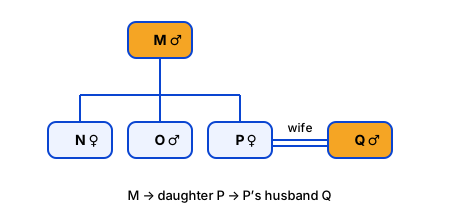
- M ÷ N: M is father of N. N + O: N is sister of O.
- O − P: O is brother of P, so P is also M's child.
- P × Q: P is wife of Q → P is M's daughter.
- M is the father of Q's wife.
Trick: Chain: M → daughter P → her husband Q ⇒ wife's father (father-in-law).
Answer: (D) Wife's Father
अवधारणा: बाएँ से दाएँ हर चिह्न को डिकोड करें और वंश-वृक्ष बनाएँ।
- M ÷ N: M, N का पिता है। N + O: N, O की बहन है।
- O − P: O, P का भाई है, अतः P भी M की संतान है।
- P × Q: P, Q की पत्नी है → P, M की बेटी है।
- M, Q की पत्नी का पिता है।
ट्रिक: श्रृंखला: M → बेटी P → उसका पति Q ⇒ पत्नी के पिता (ससुर)।
उत्तर: (D) पत्नी के पिता
RRB NTPC Graduate CBT 1General Intelligence and ReasoningCoded Blood RelationsRRB NTPC Graduate CBT 1 2024 · 14 Jun Shift 2
Q736.What will come in the place of the question mark ‘(?)’ in the following equation, if ‘+’ and ‘−’ are interchanged and ‘×’ and ‘÷’ are interchanged?
116 ÷ 5 − 423 × 3 + 13 = ?
यदि ‘+’ और ‘−’ को आपस में बदल दिया जाए तथा ‘×’ और ‘÷’ को आपस में बदल दिया जाए, तो निम्नलिखित समीकरण में प्रश्न चिह्न ‘(?)’ के स्थान पर क्या आएगा?
116 ÷ 5 − 423 × 3 + 13 = ?
- A508
- B808
- C708
- D608
Show answer
Concept: Swap the signs first, then solve using BODMAS.
- After interchange:
Trick: Rewrite the whole expression with new signs before calculating — never mix old and new signs.
Answer: (C) 708
अवधारणा: पहले चिह्न बदलें, फिर BODMAS से हल करें।
- चिह्न बदलने पर:
ट्रिक: गणना से पहले पूरा व्यंजक नए चिह्नों के साथ दोबारा लिखें।
उत्तर: (C) 708
RRB NTPC Graduate CBT 1General Intelligence and ReasoningMathematical OperationsRRB NTPC Graduate CBT 1 2024 · 14 Jun Shift 2
Q737.In a certain code language, ‘FIRE’ is coded as ‘5371’ and ‘ACID’ is coded as ‘8247’. What is the code for ‘I’ in the given code language?
एक निश्चित कूट भाषा में, ‘FIRE’ को ‘5371’ के रूप में कूटबद्ध किया जाता है और ‘ACID’ को ‘8247’ के रूप में कूटबद्ध किया जाता है। दी गई कूट भाषा में ‘I’ के लिए कूट क्या है?
- A3
- B2
- C4
- D7
Show answer
Concept: When two words share a letter and their codes share a digit, that digit is the code of the common letter.
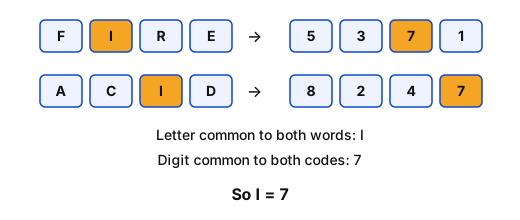
- FIRE and ACID have only one common letter: I.
- 5371 and 8247 have only one common digit: 7.
- So I = 7.
Trick: Match common letters with common digits — no need to decode the full words.
Answer: (D) 7
अवधारणा: जब दो शब्दों में एक अक्षर समान हो और उनके कूट में एक अंक समान हो, तो वही अंक उस अक्षर का कूट है।
- FIRE और ACID में केवल एक अक्षर समान है: I
- 5371 और 8247 में केवल एक अंक समान है: 7
- अतः I = 7
ट्रिक: समान अक्षर ↔ समान अंक मिलाएँ — पूरा शब्द डिकोड करने की ज़रूरत नहीं।
उत्तर: (D) 7
RRB NTPC Graduate CBT 1General Intelligence and ReasoningCoding-DecodingRRB NTPC Graduate CBT 1 2024 · 14 Jun Shift 2
Q738.Based on the English alphabetical order, three of the following four letter-cluster pairs are alike in a certain way and thus form a group. Which letter-cluster pair DOES NOT belong to that group?
(Note: The odd one out is not based on the number of consonants/vowels or their position in the letter-cluster.)
अंग्रेज़ी वर्णमाला क्रम के आधार पर, निम्नलिखित चार अक्षर-समूह युग्मों में से तीन किसी निश्चित प्रकार से समान हैं और इस प्रकार एक समूह बनाते हैं। कौन-सा अक्षर-समूह युग्म उस समूह से संबंधित नहीं है?
(नोट: असंगत, अक्षर-समूह में व्यंजनों/स्वरों की संख्या या उनके स्थान पर आधारित नहीं है।)
- ABK – IF
- BHQ – OL
- CTC – AY
- DPY – WT
Show answer
Concept: Compare the alphabet positions of corresponding letters in each pair.
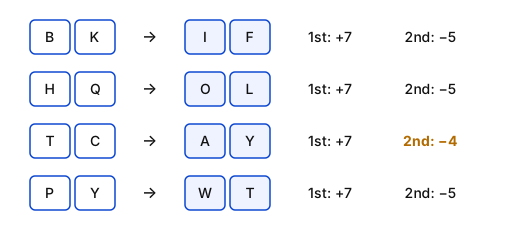
- BK – IF: , ; similarly HQ – OL and PY – WT follow .
- TC – AY: (cyclic) but is (cyclic), not .
- So TC – AY is the odd one.
Trick: Check the second letter only: from C gives X, not Y.
Answer: (C) TC – AY
अवधारणा: प्रत्येक युग्म में संगत अक्षरों की वर्णमाला स्थिति की तुलना करें।
- BK – IF: , ; इसी प्रकार HQ – OL और PY – WT में .
- TC – AY: (चक्रीय) पर में है, नहीं।
- अतः TC – AY विषम है।
ट्रिक: केवल दूसरा अक्षर जाँचें: C से = X होना चाहिए, Y नहीं।
उत्तर: (C) TC – AY
RRB NTPC Graduate CBT 1General Intelligence and ReasoningOdd One Out – Letter PairsRRB NTPC Graduate CBT 1 2024 · 14 Jun Shift 2
Q739.Each of P, Q, R, S, T, U and V has an exam on a different day of a week starting from Monday and ending on Sunday of the same week. U has an exam on Tuesday. Only two people have exams between P and U. V has an exam immediately before R but not on Saturday. T has an exam after P but before Q. How many people have exams between S and Q?
P, Q, R, S, T, U और V में से प्रत्येक की परीक्षा एक ही सप्ताह के अलग-अलग दिन है, जो सोमवार से शुरू होकर उसी सप्ताह के रविवार को समाप्त होता है। U की परीक्षा मंगलवार को है। P और U के बीच केवल दो लोगों की परीक्षा है। V की परीक्षा R से ठीक पहले है, लेकिन शनिवार को नहीं। T की परीक्षा P के बाद लेकिन Q से पहले है। S और Q के बीच कितने लोगों की परीक्षा है?
- AThreeतीन
- BFourचार
- CTwoदो
- DFiveपाँच
Show answer
Concept: Fix the definite clue first, then place others around it (Mon = 1 … Sun = 7).
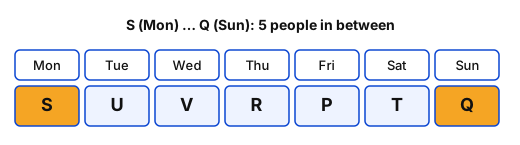
- U = Tue (2). Two people between P and U ⇒ P = Fri (5).
- T after P and before Q ⇒ T = Sat, Q = Sun.
- Left: Mon, Wed, Thu. V just before R (V not Sat) ⇒ V = Wed, R = Thu; S = Mon.
- Between S (Mon) and Q (Sun): U, V, R, P, T = 5.
Trick: Between Mon and Sun there are always 5 days.
Answer: (D) Five
अवधारणा: पहले निश्चित संकेत रखें, फिर बाकी (सोम = 1 … रवि = 7)।
- U = मंगल (2)। P और U के बीच दो ⇒ P = शुक्र (5)।
- T, P के बाद और Q से पहले ⇒ T = शनि, Q = रवि।
- बचे: सोम, बुध, गुरु। V ठीक R से पहले (V शनि नहीं) ⇒ V = बुध, R = गुरु; S = सोम।
- S (सोम) और Q (रवि) के बीच: U, V, R, P, T = 5।
ट्रिक: सोमवार और रविवार के बीच हमेशा 5 दिन होते हैं।
उत्तर: (D) Five
RRB NTPC Graduate CBT 1General Intelligence and ReasoningScheduling PuzzleRRB NTPC Graduate CBT 1 2024 · 14 Jun Shift 2
Q740.MS 14 is related to OV 8 in a certain way. In the same way, NN 5 is related to PQ −1. To which of the given options is SR 6 related, following the same logic?
MS 14 एक निश्चित प्रकार से OV 8 से संबंधित है। उसी प्रकार, NN 5, PQ −1 से संबंधित है। समान तर्क का अनुसरण करते हुए, SR 6 दिए गए विकल्पों में से किससे संबंधित है?
- AOO 4
- BUU 0
- CKP 3
- DOI 6
Show answer
Concept: Find the rule from both given pairs and apply it.
- MS 14 → OV 8: , ,
- NN 5 → PQ −1: , ,
- SR 6 → , , ⇒ UU 0
Trick: Rule: , , .
Answer: (B) UU 0
अवधारणा: दोनों युग्मों से नियम निकालें और लागू करें।
- MS 14 → OV 8: , ,
- NN 5 → PQ −1: , ,
- SR 6 → , , ⇒ UU 0
ट्रिक: नियम: , , .
उत्तर: (B) UU 0
RRB NTPC Graduate CBT 1General Intelligence and ReasoningAnalogy – Letters & NumbersRRB NTPC Graduate CBT 1 2024 · 14 Jun Shift 2

