Q761.A pipe can fill a tank in 27 hours. Another pipe can empty the filled tank in 28 hours. If both the pipes are opened simultaneously, then the time (in hours) in which the tank will be one-fourth filled, is:
एक पाइप किसी टंकी को 27 घंटे में भर सकता है। दूसरा पाइप भरी हुई टंकी को 28 घंटे में खाली कर सकता है। यदि दोनों पाइप एक साथ खोल दिए जाएँ, तो टंकी कितने समय (घंटों में) में एक-चौथाई भर जाएगी?
- A567
- B378
- C756
- D189
Show answer
Concept: Net filling rate = filling rate − emptying rate.
- Net rate tank per hour.
- Full tank takes 756 hours.
- One-fourth tank hours.
Trick: For consecutive numbers : net time ; here .
Answer: (D) 189
अवधारणा: शुद्ध भरने की दर = भरने की दर − खाली करने की दर।
- शुद्ध दर टंकी प्रति घंटा।
- पूरी टंकी 756 घंटे में भरेगी।
- एक-चौथाई टंकी घंटे।
ट्रिक: क्रमागत संख्याओं के लिए शुद्ध समय ; यहाँ ।
उत्तर: (D) 189
RRB NTPC Graduate CBT 1MathematicsPipes and CisternRRB NTPC Graduate CBT 1 2024 · 21 Jun Shift 2
Q762.The population of a village was 1,20,000. It increased by 10% in the first year and increased by 30% in the second year. Its population after two years is _______.
एक गाँव की जनसंख्या 1,20,000 थी। पहले वर्ष में इसमें 10% की वृद्धि हुई और दूसरे वर्ष में 30% की वृद्धि हुई। दो वर्ष बाद इसकी जनसंख्या _______ है।
- A1,68,000
- B1,32,000
- C1,71,600
- D1,56,000
Show answer
Concept: Successive percentage increases are applied one after another as multipliers.
- After year 1: .
- After year 2: .
Trick: Net change ; .
Answer: (C) 1,71,600
अवधारणा: क्रमिक प्रतिशत वृद्धि को गुणकों के रूप में एक के बाद एक लगाएँ।
- पहले वर्ष के बाद: ।
- दूसरे वर्ष के बाद: ।
ट्रिक: कुल वृद्धि ; ।
उत्तर: (C) 1,71,600
RRB NTPC Graduate CBT 1MathematicsPopulation GrowthRRB NTPC Graduate CBT 1 2024 · 21 Jun Shift 2
Q763.The percentage profit earned by selling a table lamp for ₹863 is equal to the percentage loss incurred by selling the same table lamp for ₹433. At what price (in ₹) should the table lamp be sold to make 25% profit?
एक टेबल लैंप को ₹863 में बेचने पर अर्जित प्रतिशत लाभ, उसी टेबल लैंप को ₹433 में बेचने पर हुई प्रतिशत हानि के बराबर है। 25% लाभ प्राप्त करने के लिए टेबल लैंप को किस मूल्य (₹ में) पर बेचा जाना चाहिए?
- A812
- B810
- C811
- D813
Show answer
Concept: If profit % at one SP equals loss % at another SP, the cost price is the average of the two SPs.
- .
- SP for profit .
Trick: Equal profit% and loss% → .
Answer: (B) ₹810
अवधारणा: यदि एक विक्रय मूल्य पर लाभ% दूसरे पर हानि% के बराबर हो, तो क्रय मूल्य दोनों SP का औसत होता है।
- ।
- लाभ हेतु SP ।
ट्रिक: लाभ% = हानि% → ।
उत्तर: (B) ₹810
RRB NTPC Graduate CBT 1MathematicsProfit and LossRRB NTPC Graduate CBT 1 2024 · 21 Jun Shift 2
Q764.The mean of a data is 76 and its median is 100. The mode (using empirical relation) of the data is:
किसी आँकड़े का माध्य 76 है और इसका माध्यिका 100 है। आँकड़े का बहुलक (आनुभविक संबंध का उपयोग करके) कितना है?
- A148
- B60
- C174
- D77
Show answer
Concept: Empirical relation: .
- .
- .
Trick: Remember '3 Median minus 2 Mean'.
Answer: (A) 148
अवधारणा: आनुभविक संबंध: ।
- ।
- ।
ट्रिक: याद रखें: '3 माध्यिका − 2 माध्य'।
उत्तर: (A) 148
RRB NTPC Graduate CBT 1MathematicsStatistics – Mean, Median, ModeRRB NTPC Graduate CBT 1 2024 · 21 Jun Shift 2
Q765.If , then is:
यदि , तो का मान कितना है?
- A119
- B129
- C114
- D112
Show answer
Concept: , so the given condition fixes directly; also .
- .
- .
- is not among the options (119, 129, 114, 112), so no option is correct.
- If the condition had been , then , option (A).
Note: Read the fraction carefully: is not the same as . In the exam, every candidate gets full marks (bonus) for such a question.
Answer: Bonus – no option is correct as printed; full marks to all.
अवधारणा: , अतः दी गई शर्त से सीधे मिल जाता है; साथ ही ।
- ।
- ।
- विकल्पों (119, 129, 114, 112) में नहीं है, इसलिए कोई विकल्प सही नहीं।
- यदि शर्त होती, तो , विकल्प (A) होता।
नोट: भिन्न को ध्यान से पढ़ें: और एक समान नहीं हैं। परीक्षा में ऐसे प्रश्न पर सभी अभ्यर्थियों को पूरे अंक (बोनस) दिए जाते हैं।
उत्तर: बोनस – छपे प्रश्न के अनुसार कोई विकल्प सही नहीं; सभी को पूरे अंक।
RRB NTPC Graduate CBT 1MathematicsAlgebraic IdentitiesRRB NTPC Graduate CBT 1 2024 · 21 Jun Shift 2
Q766.The sum of nine times the present age of A and eight times the present age of B is 29 years. Two times the present age of B exceeds two times the present age of A by 20 years. What will be the sum of the ages (in years) of A and B, 6 years from now?
A की वर्तमान आयु के नौ गुने और B की वर्तमान आयु के आठ गुने का योग 29 वर्ष है। B की वर्तमान आयु का दोगुना, A की वर्तमान आयु के दोगुने से 20 वर्ष अधिक है। अब से 6 वर्ष बाद A और B की आयु का योग (वर्षों में) कितना होगा?
- A14
- B10
- C16
- D12
Show answer
Concept: Form two linear equations from the statements and solve.
- and .
- .
- Present sum .
- Sum after 6 years years.
Trick: Sum of two ages after n years = present sum + 2n.
Answer: (C) 16
अवधारणा: कथनों से दो रैखिक समीकरण बनाकर हल करें।
- तथा ।
- ।
- वर्तमान योग ।
- 6 वर्ष बाद योग वर्ष।
ट्रिक: n वर्ष बाद दो व्यक्तियों की आयु का योग = वर्तमान योग + 2n।
उत्तर: (C) 16
RRB NTPC Graduate CBT 1MathematicsProblems on AgesRRB NTPC Graduate CBT 1 2024 · 21 Jun Shift 2
Q767.At what rate (in percentage) per annum will ₹1,250 give ₹500 as simple interest in 10 years?
₹1,250 पर 10 वर्षों में ₹500 साधारण ब्याज कितनी वार्षिक दर (प्रतिशत में) पर प्राप्त होगा?
- A6%
- B4%
- C3%
- D7%
Show answer
Concept: .
- .
- .
Trick: Interest is in 10 years → per year.
Answer: (B)
अवधारणा: ।
- ।
- ।
ट्रिक: 10 वर्षों में ब्याज → प्रति वर्ष ।
उत्तर: (B)
RRB NTPC Graduate CBT 1MathematicsSimple InterestRRB NTPC Graduate CBT 1 2024 · 21 Jun Shift 2
Q768.Two trains having lengths of 100 m and 500 m are running at speeds of 100 km/hr and 110 km/hr, respectively, in the same direction. The time taken (in minutes) by the faster train, coming from behind, to completely cross the other train is:
100 m और 500 m लंबाई वाली दो रेलगाड़ियाँ एक ही दिशा में क्रमशः 100 km/hr और 110 km/hr की चाल से चल रही हैं। पीछे से आ रही तेज़ रेलगाड़ी द्वारा दूसरी रेलगाड़ी को पूरी तरह पार करने में लिया गया समय (मिनट में) कितना है?
- A9.3
- B1.4
- C3.6
- D6
Show answer
Concept: Overtaking in the same direction: time = (sum of lengths) ÷ (difference of speeds).
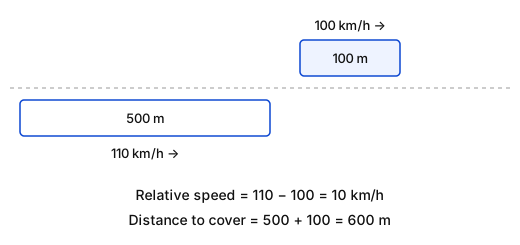
- Relative speed .
- Distance .
- Time minutes.
Trick: In km and hours: min.
Answer: (C) 3.6
अवधारणा: समान दिशा में आगे निकलना: समय = (लंबाइयों का योग) ÷ (चालों का अंतर)।
- सापेक्ष चाल ।
- दूरी ।
- समय मिनट।
ट्रिक: km और घंटे में: मिनट।
उत्तर: (C) 3.6
RRB NTPC Graduate CBT 1MathematicsTrains – Same DirectionRRB NTPC Graduate CBT 1 2024 · 21 Jun Shift 2
Q769.In covering a distance of 90 km, Anirudh takes 3 hours more than Burhan. If Anirudh doubles his speed, then he would take 2 hours less than Burhan. Anirudh's initial speed is:
90 km की दूरी तय करने में अनिरुद्ध, बुरहान से 3 घंटे अधिक लेता है। यदि अनिरुद्ध अपनी चाल दोगुनी कर ले, तो वह बुरहान से 2 घंटे कम लेगा। अनिरुद्ध की प्रारंभिक चाल कितनी है?
- A18 km/hr
- B6 km/hr
- C9 km/hr
- D2 km/hr
Show answer
Concept: Express both conditions in terms of Burhan's time and subtract.
- Let Anirudh's speed , Burhan's time . Then and .
- Subtract: .
- (check: 10 h normally, 5 h at double speed; Burhan 7 h ✓).
Trick: Doubling speed halves the time: half of Anirudh's time = 3 + 2 = 5 h, so time = 10 h, speed = 9 km/h.
Answer: (C) 9 km/hr
अवधारणा: दोनों शर्तों को बुरहान के समय के रूप में लिखकर घटाएँ।
- अनिरुद्ध की चाल , बुरहान का समय । तब और ।
- घटाने पर: ।
- (जाँच: सामान्यतः 10 घंटे, दोगुनी चाल पर 5 घंटे; बुरहान 7 घंटे ✓)।
ट्रिक: चाल दोगुनी → समय आधा: अनिरुद्ध के समय का आधा = 3 + 2 = 5 घंटे, अतः समय 10 घंटे, चाल 9 km/h।
उत्तर: (C) 9 km/hr
RRB NTPC Graduate CBT 1MathematicsSpeed, Time and DistanceRRB NTPC Graduate CBT 1 2024 · 21 Jun Shift 2
Q770.If , then find the value of .
यदि , तो का मान ज्ञात कीजिए।
- A656
- B820
- C720
- D756
Show answer
Concept: and .
- .
- .
Trick: If , then .
Answer: (D) 756
अवधारणा: तथा ।
- ।
- ।
ट्रिक: यदि , तो ।
उत्तर: (D) 756
RRB NTPC Graduate CBT 1MathematicsAlgebraic IdentitiesRRB NTPC Graduate CBT 1 2024 · 21 Jun Shift 2
Q771.Mr. Helux starts from Point A and drives 18 km towards the West. He then takes a left turn, drives 6 km, turns right and drives 21 km. He then takes a right turn and drives 18 km. He takes a final right turn, drives 39 km and stops at Point P. How far (shortest distance) and towards which direction should he drive in order to reach Point A again? (All turns are 90 degrees turns only unless specified.)
श्री हेलक्स बिंदु A से चलना शुरू करते हैं और पश्चिम की ओर 18 km गाड़ी चलाते हैं। फिर वे बाएँ मुड़ते हैं, 6 km गाड़ी चलाते हैं, दाएँ मुड़ते हैं और 21 km गाड़ी चलाते हैं। फिर वे दाएँ मुड़ते हैं और 18 km गाड़ी चलाते हैं। वे अंतिम बार दाएँ मुड़ते हैं, 39 km गाड़ी चलाते हैं और बिंदु P पर रुक जाते हैं। पुनः बिंदु A तक पहुँचने के लिए उन्हें कितनी दूरी (न्यूनतम दूरी) तक और किस दिशा में गाड़ी चलानी चाहिए? (जब तक निर्दिष्ट न किया जाए, सभी मोड़ केवल 90 डिग्री के मोड़ हैं।)
- A12 km to the Southदक्षिण की ओर 12 km
- B16 km to the Eastपूर्व की ओर 16 km
- C19 km to the Northउत्तर की ओर 19 km
- D10 km to the Westपश्चिम की ओर 10 km
Show answer
Concept: Track the position with East–West and North–South totals; a left turn while facing West means facing South, a right turn means facing North.
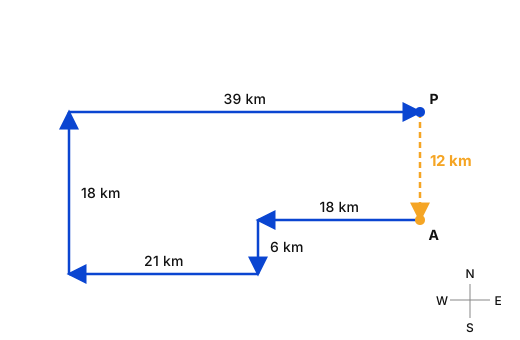
- West 18, left (South) 6, right (West) 21 → he is 39 km West and 6 km South of A.
- Right (North) 18 → 6 km South becomes 12 km North; right (East) 39 → East–West offset becomes 0.
- So P is exactly 12 km North of A; to return he must drive 12 km towards the South.
Trick: Net E–W: ; net N–S: North → go back South.
Answer: (A) 12 km to the South
अवधारणा: पूर्व–पश्चिम और उत्तर–दक्षिण की कुल दूरी अलग-अलग जोड़ें; पश्चिम की ओर मुँह हो तो बायाँ मोड़ = दक्षिण, दायाँ मोड़ = उत्तर।
- पश्चिम 18, बाएँ (दक्षिण) 6, दाएँ (पश्चिम) 21 → वह A से 39 km पश्चिम और 6 km दक्षिण में है।
- दाएँ (उत्तर) 18 → अब 12 km उत्तर; दाएँ (पूर्व) 39 → पूर्व–पश्चिम दूरी 0।
- अतः P, A से ठीक 12 km उत्तर में है; वापस जाने के लिए 12 km दक्षिण की ओर जाना होगा।
ट्रिक: शुद्ध E–W: ; शुद्ध N–S: उत्तर → वापसी दक्षिण की ओर।
उत्तर: (A) 12 km दक्षिण की ओर
RRB NTPC Graduate CBT 1General Intelligence and ReasoningDirection and DistanceRRB NTPC Graduate CBT 1 2024 · 21 Jun Shift 2
Q772.Read the given statements and conclusions carefully. Assuming that the information given in the statements is true, even if it appears to be at variance with commonly known facts, decide which of the given conclusion(s) logically follow(s) from the statements.
Statements:
All induction are stove.
Some stove are oven.
Some oven are tandoor.
Conclusions:
(I) Some tandoor are induction.
(II) Some oven are induction.
दिए गए कथनों और निष्कर्षों को ध्यानपूर्वक पढ़िए। यह मानते हुए कि कथनों में दी गई जानकारी सत्य है, भले ही वह सामान्यतः ज्ञात तथ्यों से भिन्न प्रतीत होती हो, निर्णय कीजिए कि दिए गए निष्कर्षों में से कौन-सा/से निष्कर्ष कथनों का तार्किक रूप से अनुसरण करता है/करते हैं।
कथन:
सभी इंडक्शन, स्टोव हैं।
कुछ स्टोव, ओवन हैं।
कुछ ओवन, तंदूर हैं।
निष्कर्ष:
(I) कुछ तंदूर, इंडक्शन हैं।
(II) कुछ ओवन, इंडक्शन हैं।
- ANeither conclusion (I) nor (II) followsन तो निष्कर्ष (I) और न ही (II) अनुसरण करता है
- BBoth conclusions (I) and (II) followनिष्कर्ष (I) और (II) दोनों अनुसरण करते हैं
- COnly conclusion (I) followsकेवल निष्कर्ष (I) अनुसरण करता है
- DOnly conclusion (II) followsकेवल निष्कर्ष (II) अनुसरण करता है
Show answer
Concept: A conclusion follows only if it is true in every possible Venn diagram of the statements.
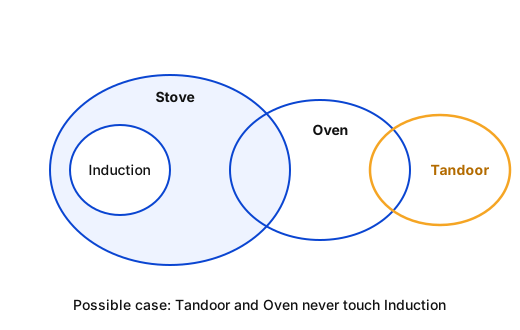
- Induction lies inside Stove; Oven meets Stove only in “some” part – that part may lie outside Induction.
- Tandoor meets Oven only in “some” part, so it need not touch Induction → (I) Some tandoor are induction: not certain.
- Oven may overlap only the non-induction part of Stove → (II) Some oven are induction: not certain.
Trick: “Some + Some” or “All + Some” never gives a definite “some” link to the first term.
Answer: (A) Neither conclusion (I) nor (II) follows
अवधारणा: निष्कर्ष तभी अनुसरण करता है जब वह कथनों के हर संभव वेन आरेख में सत्य हो।
- Induction पूरा Stove के अंदर है; Oven केवल Stove के “कुछ” भाग से मिलता है – वह भाग Induction के बाहर भी हो सकता है।
- Tandoor केवल Oven के “कुछ” भाग से मिलता है, Induction को छूना ज़रूरी नहीं → (I) निश्चित नहीं।
- Oven केवल Stove के non-induction भाग से मिल सकता है → (II) भी निश्चित नहीं।
ट्रिक: “कुछ + कुछ” या “सभी + कुछ” से पहले पद के साथ कोई निश्चित “कुछ” संबंध नहीं बनता।
उत्तर: (A) न तो (I) और न ही (II) अनुसरण करता है
RRB NTPC Graduate CBT 1General Intelligence and ReasoningSyllogismRRB NTPC Graduate CBT 1 2024 · 21 Jun Shift 2
Q773.What should come in place of the question mark (?) in the given series?
6 13 25 42 64 ?
दी गई श्रृंखला में प्रश्न चिह्न (?) के स्थान पर क्या आना चाहिए?
6 13 25 42 64 ?
- A86
- B96
- C91
- D81
Show answer
Concept: Check the differences between consecutive terms.
- Differences: , , ,
- The differences rise by 5: next difference
Trick: Second differences constant (5) → keep adding 5 to the last gap.
Answer: (C)
अवधारणा: क्रमागत पदों का अंतर देखें।
- अंतर: , , ,
- अंतर 5-5 बढ़ रहा है: अगला अंतर
ट्रिक: दूसरा अंतर स्थिर (5) → अंतिम अंतर में 5 जोड़ते जाएँ।
उत्तर: (C)
RRB NTPC Graduate CBT 1General Intelligence and ReasoningNumber SeriesRRB NTPC Graduate CBT 1 2024 · 21 Jun Shift 2
Q774.In a certain code language,
'A + B' means ‘A is the father of B’
'A – B' means ‘A is the daughter of B’
'A x B' means ‘A is the son of B’
'A ÷ B' means ‘A is the wife of B’
Based on the above, how is P related to T if ‘P + Q x R – S ÷ T’?
एक निश्चित कूट भाषा में,
'A + B' का अर्थ है ‘A, B का पिता है’
'A – B' का अर्थ है ‘A, B की पुत्री है’
'A x B' का अर्थ है ‘A, B का पुत्र है’
'A ÷ B' का अर्थ है ‘A, B की पत्नी है’
उपर्युक्त के आधार पर, यदि ‘P + Q x R – S ÷ T’ है, तो P का T से क्या संबंध है?
- ADaughter's husbandपुत्री का पति
- BSon's wife's brotherपुत्र की पत्नी का भाई
- CWife's brother's sonपत्नी के भाई का पुत्र
- DDaughter's sonपुत्री का पुत्र
Show answer
Concept: Decode each symbol step by step and draw the family tree.
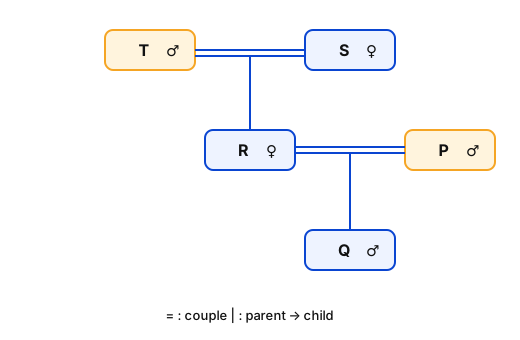
- P + Q: P is the father of Q. Q × R: Q is the son of R, so R is Q’s mother (wife of P).
- R – S: R is the daughter of S. S ÷ T: S is the wife of T, so T is R’s father.
- R is T’s daughter and P is R’s husband → P is T’s daughter’s husband (son-in-law).
Trick: Go from T downwards: T → daughter R → her husband P.
Answer: (A) Daughter's husband
अवधारणा: प्रत्येक चिह्न का अर्थ क्रम से लगाएँ और परिवार वृक्ष बनाएँ।
- P + Q: P, Q का पिता है। Q × R: Q, R का पुत्र है, अतः R, Q की माँ (P की पत्नी) है।
- R – S: R, S की पुत्री है। S ÷ T: S, T की पत्नी है, अतः T, R का पिता है।
- R, T की पुत्री है और P उसका पति → P, T की पुत्री का पति (दामाद) है।
ट्रिक: T से नीचे चलें: T → पुत्री R → उसका पति P।
उत्तर: (A) पुत्री का पति (Daughter's husband)
RRB NTPC Graduate CBT 1General Intelligence and ReasoningBlood Relation – CodedRRB NTPC Graduate CBT 1 2024 · 21 Jun Shift 2
Q775.In a certain code language, ‘talk to him’ is coded as ‘yd hp mu’ and ‘when you talk’ is coded as ‘nc mu bt’. How is ‘talk’ coded in the given language?
एक निश्चित कूट भाषा में, ‘talk to him’ को ‘yd hp mu’ के रूप में कूटबद्ध किया जाता है और ‘when you talk’ को ‘nc mu bt’ के रूप में कूटबद्ध किया जाता है। उसी भाषा में ‘talk’ को किस प्रकार कूटबद्ध किया जाता है?
- Ayd
- Bnc
- Cbt
- Dmu
Show answer
Concept: A word common to two sentences has the code common to both coded sentences.
- ‘talk to him’ → ‘yd hp mu’; ‘when you talk’ → ‘nc mu bt’
- Common word: talk; common code: mu
- So talk = mu.
Trick: Match the common word with the common code – order of codes does not matter.
Answer: (D) mu
अवधारणा: दो वाक्यों में उभयनिष्ठ शब्द का कोड दोनों कोडित वाक्यों में उभयनिष्ठ होता है।
- ‘talk to him’ → ‘yd hp mu’; ‘when you talk’ → ‘nc mu bt’
- उभयनिष्ठ शब्द: talk; उभयनिष्ठ कोड: mu
- अतः talk = mu।
ट्रिक: उभयनिष्ठ शब्द ↔ उभयनिष्ठ कोड – कोड का क्रम मायने नहीं रखता।
उत्तर: (D) mu
RRB NTPC Graduate CBT 1General Intelligence and ReasoningCoding–Decoding (Words)RRB NTPC Graduate CBT 1 2024 · 21 Jun Shift 2
Q776.Which of the following letter-number clusters will replace the question mark (?) in the given series to make it logically complete?
JN28 IM40 HL52 GK64 ?
निम्नलिखित में से कौन-सा अक्षर-संख्या समूह दी गई श्रृंखला में प्रश्न चिह्न (?) का स्थान लेकर उसे तार्किक रूप से पूर्ण करेगा?
JN28 IM40 HL52 GK64 ?
- AFI76
- BFJ77
- CFI77
- DFJ76
Show answer
Concept: Treat the first letter, second letter and number as three separate series.
- First letters: J, I, H, G → each −1 → F
- Second letters: N, M, L, K → each −1 → J
- Numbers: 28, 40, 52, 64 → each →
Trick: Both letters move back 1; number → FJ76.
Answer: (D) FJ76
अवधारणा: पहला अक्षर, दूसरा अक्षर और संख्या – तीनों को अलग श्रृंखला मानें।
- पहले अक्षर: J, I, H, G → हर बार −1 → F
- दूसरे अक्षर: N, M, L, K → हर बार −1 → J
- संख्याएँ: 28, 40, 52, 64 → हर बार →
ट्रिक: दोनों अक्षर 1 पीछे; संख्या → FJ76।
उत्तर: (D) FJ76
RRB NTPC Graduate CBT 1General Intelligence and ReasoningLetter–Number SeriesRRB NTPC Graduate CBT 1 2024 · 21 Jun Shift 2
Q777.What will come in place of the question mark (?) in the following equation if '÷' and '−' are interchanged and '×' and '+' are interchanged?
4320 − 96 × 37 + 21 ÷ 372 = ?
यदि '÷' और '−' को आपस में बदल दिया जाए तथा '×' और '+' को आपस में बदल दिया जाए, तो निम्नलिखित समीकरण में प्रश्न चिह्न (?) के स्थान पर क्या आएगा?
4320 − 96 × 37 + 21 ÷ 372 = ?
- A822
- B450
- C1350
- D733
Show answer
Concept: Swap the signs first, then solve using BODMAS.
- Swap ÷ ↔ − and × ↔ +:
- ,
Trick: Write the new expression fully before calculating – most errors come from half-swapped signs.
Answer: (B)
अवधारणा: पहले चिह्न बदलें, फिर BODMAS से हल करें।
- ÷ ↔ − और × ↔ + बदलने पर:
- ,
ट्रिक: गणना से पहले नया व्यंजक पूरा लिख लें – आधे बदले चिह्नों से ही गलती होती है।
उत्तर: (B)
RRB NTPC Graduate CBT 1General Intelligence and ReasoningMathematical OperationsRRB NTPC Graduate CBT 1 2024 · 21 Jun Shift 2
Q778.Which of the given letter-clusters should replace # and % so that the pattern and relationship followed between the letter-cluster pair on the left side of :: is the same as that on the right side of ::?
# : QVS :: GLI : %
दिए गए अक्षर-समूहों में से कौन-सा # और % को प्रतिस्थापित करेगा, ताकि :: के बाईं ओर के अक्षर-समूह युग्म के बीच जो पैटर्न और संबंध है, वही :: के दाईं ओर के अक्षर-समूह युग्म के बीच भी हो?
# : QVS :: GLI : %
- A# = LPQ, % = LKP
- B# = LQN, % = LQN
- C# = PMN, % = PJY
- D# = KOJ, % = HGT
Show answer
Concept: Find the letter-shift that turns the left term into the right term in each pair.
- GLI → %: try +5 on each letter: G+5 = L, L+5 = Q, I+5 = N → % = LQN.
- Then # → QVS must also be +5: L+5 = Q, Q+5 = V, N+5 = S → # = LQN.
- Only option (B) gives # = LQN and % = LQN.
Trick: Check one option at a time with the same +5 rule on both sides.
Answer: (B) # = LQN, % = LQN
अवधारणा: हर जोड़ी में बाएँ पद को दाएँ पद में बदलने वाला अक्षर-अंतर खोजें।
- GLI → %: हर अक्षर में +5: G+5 = L, L+5 = Q, I+5 = N → % = LQN।
- तब # → QVS में भी +5: L+5 = Q, Q+5 = V, N+5 = S → # = LQN।
- केवल विकल्प (B) में # = LQN और % = LQN है।
ट्रिक: दोनों ओर एक ही +5 नियम से विकल्प जाँचें।
उत्तर: (B) # = LQN, % = LQN
RRB NTPC Graduate CBT 1General Intelligence and ReasoningLetter AnalogyRRB NTPC Graduate CBT 1 2024 · 21 Jun Shift 2
Q779.Refer to the number and symbol series given below and answer the question that follows. Counting to be done from left to right only.
(NOTE: All numbers are single digit numbers only.)
(Left) 9 # 2 6 7 © 6 8 & © $ & 3 9 1 7 $ 5 # @ * 4 (Right)
How many such numbers are there, each of which is immediately preceded by a symbol and also immediately followed by a symbol?
नीचे दी गई संख्या और प्रतीक श्रृंखला को देखिए और उसके बाद दिए गए प्रश्न का उत्तर दीजिए। गिनती केवल बाएँ से दाएँ की जानी है।
(नोट: सभी संख्याएँ केवल एकल अंक वाली संख्याएँ हैं।)
(बाएँ) 9 # 2 6 7 © 6 8 & © $ & 3 9 1 7 $ 5 # @ * 4 (दाएँ)
ऐसी कितनी संख्याएँ हैं, जिनमें से प्रत्येक के ठीक पहले एक प्रतीक है और ठीक बाद भी एक प्रतीक है?
- A0
- B2
- C3
- D1
Show answer
Concept: Look for the pattern symbol – number – symbol.
- Series: 9 # 2 6 7 © 6 8 & © $ & 3 9 1 7 $ 5 # @ * 4
- # 2 6 (6 is a number), & 3 9 (9 is a number) – not valid.
- Only $ 5 # fits → count = 1.
Trick: Scan only the numbers that come right after a symbol, then check the next element.
Answer: (D) 1
अवधारणा: प्रतीक – संख्या – प्रतीक का पैटर्न खोजें।
- श्रृंखला: 9 # 2 6 7 © 6 8 & © $ & 3 9 1 7 $ 5 # @ * 4
- # 2 6 (6 संख्या), & 3 9 (9 संख्या) – मान्य नहीं।
- केवल $ 5 # सही → संख्या = 1।
ट्रिक: केवल प्रतीक के ठीक बाद आने वाली संख्याएँ देखें, फिर अगला तत्व जाँचें।
उत्तर: (D) 1
RRB NTPC Graduate CBT 1General Intelligence and ReasoningNumber–Symbol SeriesRRB NTPC Graduate CBT 1 2024 · 21 Jun Shift 2
Q780.Mr C starts from Point A and drives 5 km towards the West. He then takes a right turn, drives 11 km, turns right and drives 3 km. He then takes a left turn and drives 4 km. He then takes a right turn, drives 3 km. He then takes a final right turn drives 15 km and stops at Point B. How far (shortest distance) and towards which direction should he drive in order to reach Point A again? (All turns are 90 degrees turns only unless specified)
श्री C बिंदु A से चलना शुरू करते हैं और पश्चिम की ओर 5 km गाड़ी चलाते हैं। फिर वे दाएँ मुड़ते हैं, 11 km गाड़ी चलाते हैं, दाएँ मुड़ते हैं और 3 km गाड़ी चलाते हैं। फिर वे बाएँ मुड़ते हैं और 4 km गाड़ी चलाते हैं। फिर वे दाएँ मुड़ते हैं, 3 km गाड़ी चलाते हैं। फिर वे अंतिम बार दाएँ मुड़ते हैं, 15 km गाड़ी चलाते हैं और बिंदु B पर रुक जाते हैं। पुनः बिंदु A तक पहुँचने के लिए उन्हें कितनी दूरी (न्यूनतम दूरी) तक और किस दिशा में गाड़ी चलानी चाहिए? (जब तक निर्दिष्ट न किया जाए, सभी मोड़ केवल 90 डिग्री के मोड़ हैं)
- A1 km towards the Westपश्चिम की ओर 1 km
- B1 km towards the Eastपूर्व की ओर 1 km
- C1 km towards the Northउत्तर की ओर 1 km
- D3 km towards the Southदक्षिण की ओर 3 km
Show answer
Concept: Add up East–West and North–South movements separately.
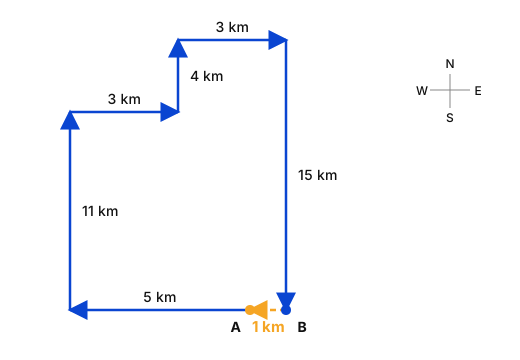
- West 5, right (North) 11, right (East) 3, left (North) 4, right (East) 3, right (South) 15.
- East–West: → 1 km East. North–South: .
- B is 1 km East of A, so he must drive 1 km towards the West.
Trick: North–South cancels () → only the East–West gap of 1 km remains.
Answer: (A) 1 km towards the West
अवधारणा: पूर्व–पश्चिम और उत्तर–दक्षिण गतियों को अलग-अलग जोड़ें।
- पश्चिम 5, दाएँ (उत्तर) 11, दाएँ (पूर्व) 3, बाएँ (उत्तर) 4, दाएँ (पूर्व) 3, दाएँ (दक्षिण) 15।
- पूर्व–पश्चिम: → 1 km पूर्व। उत्तर–दक्षिण: ।
- B, A से 1 km पूर्व में है, अतः 1 km पश्चिम की ओर जाना होगा।
ट्रिक: उत्तर–दक्षिण कट जाता है () → केवल 1 km का पूर्व–पश्चिम अंतर बचता है।
उत्तर: (A) 1 km पश्चिम की ओर
RRB NTPC Graduate CBT 1General Intelligence and ReasoningDirection and DistanceRRB NTPC Graduate CBT 1 2024 · 21 Jun Shift 2

