Q61.A number when increased by , gives 378. The number is:
एक संख्या में की वृद्धि करने पर 378 प्राप्त होता है। वह संख्या है:
- A240
- B200
- C400
- D100
Show answer
Concept: If a number increases by , new value .
- , so new value .
Trick: Check: ✔
Answer: (A)
अवधारणा: यदि कोई संख्या बढ़े, तो नया मान ।
- , अतः नया मान ।
ट्रिक: जाँच: ✔
उत्तर: (A)
RRB NTPC Graduate CBT 1MathematicsPercentageRRB NTPC Graduate CBT 1 2024 · 24 Jun Shift 3
Q62.The length of each of the two equal sides of an isosceles triangle is 41 cm and the length of its base is 18 cm. The area (in cm2) of the triangle is:
एक समद्विबाहु त्रिभुज की दोनों समान भुजाओं में से प्रत्येक की लंबाई 41 cm है और उसके आधार की लंबाई 18 cm है। त्रिभुज का क्षेत्रफल (cm2 में) है:
- A351
- B355
- C360
- D365
Show answer
Concept: The altitude to the base of an isosceles triangle bisects the base; .
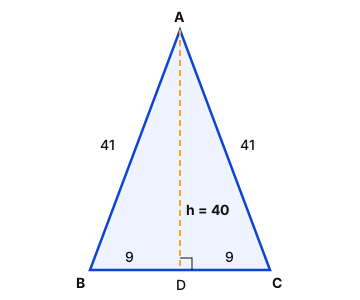
- Half base
Trick: (9, 40, 41) is a Pythagorean triplet. Or use .
Answer: (C)
अवधारणा: समद्विबाहु त्रिभुज में आधार पर डाला गया लंब आधार को समद्विभाजित करता है; ।
- आधा आधार
ट्रिक: (9, 40, 41) पाइथागोरस त्रिक है। या सूत्र ।
उत्तर: (C)
RRB NTPC Graduate CBT 1MathematicsMensuration – isosceles triangleRRB NTPC Graduate CBT 1 2024 · 24 Jun Shift 3
Q63.Which smallest number should be added to 22938 so that the sum is completely divisible by 7?
22938 में कौन-सी सबसे छोटी संख्या जोड़ी जानी चाहिए ताकि योगफल 7 से पूर्णतः विभाज्य हो?
- A5
- B6
- C1
- D2
Show answer
Concept: Least number to be added .
- : , remainder
- Number to add
- ✔
Trick: Divide by 7, find remainder; add (7 − remainder).
Answer: (C)
अवधारणा: जोड़ी जाने वाली न्यूनतम संख्या ।
- : , शेषफल
- जोड़ें
- ✔
ट्रिक: 7 से भाग देकर शेषफल निकालें; (7 − शेषफल) जोड़ें।
उत्तर: (C)
RRB NTPC Graduate CBT 1MathematicsDivisibilityRRB NTPC Graduate CBT 1 2024 · 24 Jun Shift 3
Q64.A hollow spherical shell is made of a metal of density 7 g/cm3. Its internal and external radii are 0 cm and 3 cm, respectively. What is the approximate weight (in kg) of the shell?
(Take , )
एक खोखला गोलीय कोश 7 g/cm3 घनत्व वाली धातु से बना है। इसकी आंतरिक और बाह्य त्रिज्याएँ क्रमशः 0 cm और 3 cm हैं। कोश का अनुमानित भार (kg में) क्या है?
(, लीजिए)
- A2.208
- B2.14
- C0.792
- D2.15
Show answer
Concept: Volume of shell and .
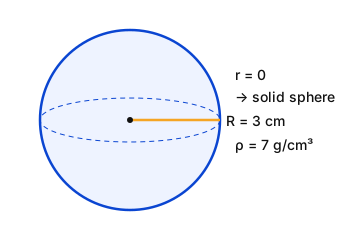
- With , :
Trick: The density 7 cancels the 7 of : mass g.
Answer: (C)
अवधारणा: खोल का आयतन और ।
- , :
ट्रिक: घनत्व 7, के 7 को काट देता है: द्रव्यमान g।
उत्तर: (C)
RRB NTPC Graduate CBT 1MathematicsMensuration – sphereRRB NTPC Graduate CBT 1 2024 · 24 Jun Shift 3
Q65.Find the value of K, for which the quadratic equation has equal roots.
K का वह मान ज्ञात कीजिए, जिसके लिए द्विघात समीकरण के मूल समान हैं।
- A3
- B5
- C4
- D6
Show answer
Concept: A quadratic has equal roots when the discriminant .
- Here , , .
Trick: Equal roots → perfect square: , so .
Answer: (C)
अवधारणा: द्विघात समीकरण के मूल बराबर होते हैं जब विविक्तकर (discriminant) ।
- यहाँ , , ।
ट्रिक: बराबर मूल → पूर्ण वर्ग: , अतः ।
उत्तर: (C)
RRB NTPC Graduate CBT 1MathematicsQuadratic equationsRRB NTPC Graduate CBT 1 2024 · 24 Jun Shift 3
Q66.The average height of 15 boys out of a class of 50 is 160 cm. If the average height of the remaining boys is 168 cm, the average height (in cm) of all the boys of the class is:
50 लड़कों की एक कक्षा में से 15 लड़कों की औसत ऊँचाई 160 cm है। यदि शेष लड़कों की औसत ऊँचाई 168 cm है, तो कक्षा के सभी लड़कों की औसत ऊँचाई (cm में) है:
- A165
- B165.6
- C166.6
- D164
Show answer
Concept: .
- Sum of 15 boys
- Remaining boys:
- Average
Trick: Deviation method: .
Answer: (B)
अवधारणा: ।
- 15 लड़कों का योग
- शेष लड़के:
- औसत
ट्रिक: विचलन विधि: ।
उत्तर: (B)
RRB NTPC Graduate CBT 1MathematicsAverageRRB NTPC Graduate CBT 1 2024 · 24 Jun Shift 3
Q67.If A's salary is 12% more than that of B, then by what percentage is B's salary less than that of A (correct to two decimal places)?
यदि A का वेतन B के वेतन से 12% अधिक है, तो B का वेतन A के वेतन से कितने प्रतिशत कम है (दशमलव के दो स्थानों तक सही)?
- A13.26%
- B10.71%
- C11.73%
- D12.47%
Show answer
Concept: If A is more than B, then B is less than A.
- Let B = 100, then A = 112.
- B is less than A by 12.
Trick: : .
Answer: (B)
अवधारणा: यदि A, B से अधिक है, तो B, A से कम है।
- माना B = 100, तो A = 112।
- B, A से 12 कम है।
ट्रिक: : ।
उत्तर: (B)
RRB NTPC Graduate CBT 1MathematicsPercentage comparisonRRB NTPC Graduate CBT 1 2024 · 24 Jun Shift 3
Q68.The median of the observations 54, 65, 77, 34, 68, 66, 60, 70, 33, 71 and 15 is:
प्रेक्षणों 54, 65, 77, 34, 68, 66, 60, 70, 33, 71 और 15 की माध्यिका है:
- A61
- B66
- C68
- D65
Show answer
Concept: Arrange the data in order; for odd, median value.
- Ascending: 15, 33, 34, 54, 60, 65, 66, 68, 70, 71, 77
- , median value
- value
Trick: 5 values below and 5 above: 15, 33, 34, 54, 60 | 65 | 66, 68, 70, 71, 77.
Answer: (D)
अवधारणा: आँकड़ों को क्रम में लगाएँ; विषम हो तो माध्यिका पद।
- आरोही क्रम: 15, 33, 34, 54, 60, 65, 66, 68, 70, 71, 77
- , माध्यिका पद
- 6वाँ पद
ट्रिक: 5 मान नीचे, 5 ऊपर: 15, 33, 34, 54, 60 | 65 | 66, 68, 70, 71, 77।
उत्तर: (D)
RRB NTPC Graduate CBT 1MathematicsMedianRRB NTPC Graduate CBT 1 2024 · 24 Jun Shift 3
Q69.Tejas gets double the amount in 11 years when invested at compound interest, compounded annually. In how many years will the amount become four times itself?
तेजस को वार्षिक रूप से संयोजित चक्रवृद्धि ब्याज पर निवेश करने पर 11 वर्षों में दोगुनी राशि प्राप्त होती है। कितने वर्षों में राशि स्वयं की चार गुनी हो जाएगी?
- A21
- B44
- C43
- D22
Show answer
Concept: At compound interest, if money becomes 2 times in years, it becomes times in years.
- So time years.
Trick: Doubling time multiplies: 2× in 11 → 4× in 22 → 8× in 33.
Answer: (D)
अवधारणा: चक्रवृद्धि ब्याज पर यदि धन वर्ष में 2 गुना हो, तो वर्ष में गुना होता है।
- अतः समय वर्ष।
ट्रिक: 2 गुना 11 में → 4 गुना 22 में → 8 गुना 33 में।
उत्तर: (D)
RRB NTPC Graduate CBT 1MathematicsCompound interestRRB NTPC Graduate CBT 1 2024 · 24 Jun Shift 3
Q70.Sohit and Rohit have a certain sum of money in the ratio of 17 : 14 and they spend their money on purchasing books in the ratio of 12 : 8. After purchasing books each of them has ₹3,392. Find the amount of money that Sohit initially had.
सोहित और रोहित के पास 17 : 14 के अनुपात में एक निश्चित धनराशि है और वे अपना धन 12 : 8 के अनुपात में पुस्तकें खरीदने पर खर्च करते हैं। पुस्तकें खरीदने के बाद उनमें से प्रत्येक के पास ₹3,392 बचते हैं। सोहित के पास प्रारंभ में कितनी धनराशि थी, ज्ञात कीजिए।
- A₹7,274
- B₹7,208
- C₹7,256
- D₹7,218
Show answer
Concept: Write initial money and spending in ratio form; equal remaining amounts give an equation.
- Money: and ; spending ratio , i.e. and .
- and
- From the second: ; then
- Sohit
Trick: Check: ; Sohit spends , ✔
Answer: (B) ₹7,208
अवधारणा: प्रारंभिक धन और व्यय को अनुपात रूप में लिखें; बचा धन बराबर होने से समीकरण बनता है।
- धन: और ; व्यय अनुपात , अर्थात् और ।
- और
- दूसरे से: ; तब
- सोहित
ट्रिक: जाँच: ; सोहित का व्यय , ✔
उत्तर: (B) ₹7,208
RRB NTPC Graduate CBT 1MathematicsRatio and proportionRRB NTPC Graduate CBT 1 2024 · 24 Jun Shift 3
Q71.Which of the following letter-number clusters will replace the question mark (?) in the given series to make it logically complete?
DJ26 EK37 FL48 GM59 ?
निम्नलिखित में से कौन-सा अक्षर-संख्या समूह दी गई श्रृंखला में प्रश्नचिह्न (?) के स्थान पर आकर इसे तार्किक रूप से पूर्ण करेगा?
DJ26 EK37 FL48 GM59 ?
- AHM71
- BHN70
- CHM70
- DHN71
Show answer
Concept: Each part of the cluster follows its own pattern.
- First letters: D, E, F, G, H (+1).
- Second letters: J, K, L, M, N (+1).
- Numbers: 26, 37, 48, 59, 70 ().
Trick: Split cluster into 3 columns and solve each separately.
Answer: (B) HN70
अवधारणा: हर भाग अपना अलग पैटर्न मानता है।
- पहला अक्षर: D, E, F, G, H (+1)।
- दूसरा अक्षर: J, K, L, M, N (+1)।
- संख्या: 26, 37, 48, 59, 70 ()।
ट्रिक: Cluster को 3 कॉलम में तोड़ें और अलग-अलग हल करें।
उत्तर: (B) HN70
RRB NTPC Graduate CBT 1General Intelligence and ReasoningLetter-number seriesRRB NTPC Graduate CBT 1 2024 · 24 Jun Shift 3
Q72.What should come in place of the question mark (?) in the given series?
187, 173, 160, 148, 137, ?
दी गई श्रृंखला में प्रश्नचिह्न (?) के स्थान पर क्या आना चाहिए?
187, 173, 160, 148, 137, ?
- A127
- B117
- C131
- D129
Show answer
Concept: Look at the differences between consecutive terms.
- , , ,
- Next:
Trick: Differences fall by 1 each time: 14, 13, 12, 11, 10.
Answer: (A) 127
अवधारणा: क्रमागत पदों का अंतर देखें।
- , , ,
- अगला:
ट्रिक: अंतर हर बार 1 घटता है: 14, 13, 12, 11, 10।
उत्तर: (A) 127
RRB NTPC Graduate CBT 1General Intelligence and ReasoningNumber seriesRRB NTPC Graduate CBT 1 2024 · 24 Jun Shift 3
Q73.Seven people, A, B, C, D, S, T, and U are sitting in a row, facing north.
No one sits to the right of D. Only three people sit between D and S. Only two people sit between S and T. C sits third to the left of U. A sits to the immediate right of U. How many people sit between B and T?
सात व्यक्ति A, B, C, D, S, T और U एक पंक्ति में उत्तर की ओर मुख करके बैठे हैं।
D के दाईं ओर कोई नहीं बैठा है। D और S के बीच केवल तीन व्यक्ति बैठे हैं। S और T के बीच केवल दो व्यक्ति बैठे हैं। C, U के बाईं ओर तीसरे स्थान पर बैठा है। A, U के ठीक दाईं ओर बैठा है। B और T के बीच कितने व्यक्ति बैठे हैं?
- AFourचार
- BThreeतीन
- COneएक
- DTwoदो
Show answer
Concept: Facing north, right = east end. Fix the person at an end first.
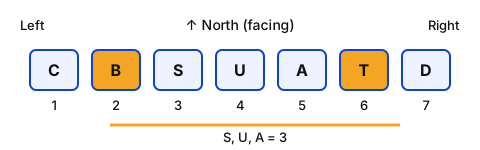
- No one right of D ⇒ D at position 7. Three between D and S ⇒ S at 3.
- Two between S and T ⇒ T at 6.
- U, A adjacent (A right of U) with C third to left of U ⇒ U = 4, A = 5, C = 1; B gets 2.
- Order: C B S U A T D. Between B and T: S, U, A = 3.
Trick: Start with “no one to the right/left” clue — it fixes an end seat.
Answer: (B) Three
अवधारणा: उत्तर की ओर मुख होने पर दायाँ = पूर्वी छोर। पहले छोर वाला व्यक्ति तय करें।
- D के दाएँ कोई नहीं ⇒ D स्थान 7 पर। D और S के बीच तीन ⇒ S स्थान 3।
- S और T के बीच दो ⇒ T स्थान 6।
- U के ठीक दाएँ A और U के तीसरे बाएँ C ⇒ U = 4, A = 5, C = 1; B = 2।
- क्रम: C B S U A T D. B और T के बीच: S, U, A = 3।
ट्रिक: “किसी के दाएँ/बाएँ कोई नहीं” वाला संकेत पहले लगाएँ — छोर तय हो जाता है।
उत्तर: (B) Three
RRB NTPC Graduate CBT 1General Intelligence and ReasoningLinear seating arrangementRRB NTPC Graduate CBT 1 2024 · 24 Jun Shift 3
Q74.Two sets of numbers are given below. In each set of numbers, certain mathematical operation(s) on the first number results in the second number. Similarly, certain mathematical operation(s) on the second number results in the third number and so on. Which of the given options follows the same set of operations as in the given sets? (NOTE: Operations should be performed on the whole numbers, without breaking down the numbers into their constituent digits. E.g. 13 – Operations on 13 such as adding / subtracting / multiplying to 13 can be performed. Breaking down 13 into 1 and 3 and then performing mathematical operations on 1 and 3 is not allowed.)
10 - 20 - 30 - 60; 2 - 4 - 14 - 28
नीचे संख्याओं के दो समुच्चय दिए गए हैं। संख्याओं के प्रत्येक समुच्चय में, पहली संख्या पर कुछ गणितीय संक्रिया/संक्रियाएँ करने पर दूसरी संख्या प्राप्त होती है। इसी प्रकार, दूसरी संख्या पर कुछ गणितीय संक्रिया/संक्रियाएँ करने पर तीसरी संख्या प्राप्त होती है और इसी प्रकार आगे भी। दिए गए विकल्पों में से कौन-सा विकल्प दिए गए समुच्चयों के समान संक्रियाओं के समुच्चय का अनुसरण करता है? (नोट: संक्रियाएँ संख्याओं को उनके घटक अंकों में विभाजित किए बिना, पूर्ण संख्याओं पर की जानी चाहिए। उदाहरण 13 – 13 पर संक्रियाएँ जैसे 13 में जोड़ना / घटाना / गुणा करना आदि की जा सकती हैं। 13 को 1 और 3 में विभाजित करना और फिर 1 और 3 पर गणितीय संक्रियाएँ करना वर्जित है।)
10 - 20 - 30 - 60; 2 - 4 - 14 - 28
- A12 - 24 - 34 - 64
- B8 - 10 - 20 - 40
- C5 - 10 - 20 - 40
- D15 - 30 - 35 - 60
Show answer
Concept: Find the operations from the given sets and test each option.
- , ,
- , , ⇒ rule: , ,
- Option C: , , ✔
Trick: Check the middle step (+10) first — it eliminates options quickly.
Answer: (C) 5 - 10 - 20 - 40
अवधारणा: दिए गए सेट से संक्रियाएँ ज्ञात करें और विकल्प जाँचें।
- , ,
- , , ⇒ नियम: , ,
- विकल्प C: , , ✔
ट्रिक: बीच वाला चरण (+10) पहले जाँचें — विकल्प जल्दी हटते हैं।
उत्तर: (C) 5 - 10 - 20 - 40
RRB NTPC Graduate CBT 1General Intelligence and ReasoningNumber operations patternRRB NTPC Graduate CBT 1 2024 · 24 Jun Shift 3
Q75.A group of numbers and symbols is coded using letter codes as per the codes given below and the conditions that follow. Study the given codes and conditions and answer the question that follows.
Note: If none of the conditions apply, then codes for the respective number/symbol are to be followed directly as given in the table.
| Number/symbol | 9 | 7 | 6 | - | 8 | @ | # | + | 2 | % | ÷ | 3 | 1 | & |
|---|
| Code | C | R | J | Z | L | F | I | Y | Q | P | V | S | U | E |
|---|
Conditions:
If the fourth element is a number, then it is to be coded as γ.
If the first element is a multiple of 3, then it is to be coded as β.
If the second and the fifth elements are symbols, then the codes for these two (the second and the fifth elements) are to be interchanged.
What will be the code for the following group?
9 # @ 2 7
संख्याओं और प्रतीकों के एक समूह को नीचे दिए गए कूटों और उसके बाद दी गई शर्तों के अनुसार अक्षर कूटों का उपयोग करके कूटबद्ध किया जाता है। दिए गए कूटों और शर्तों का अध्ययन कीजिए और नीचे दिए गए प्रश्न का उत्तर दीजिए।
नोट: यदि कोई भी शर्त लागू नहीं होती है, तो संबंधित संख्या/प्रतीक के लिए तालिका में दिए गए कूटों का सीधे अनुसरण किया जाना है।
| संख्या/प्रतीक | 9 | 7 | 6 | - | 8 | @ | # | + | 2 | % | ÷ | 3 | 1 | & |
|---|
| कूट | C | R | J | Z | L | F | I | Y | Q | P | V | S | U | E |
|---|
शर्तें:
यदि चौथा तत्व एक संख्या है, तो उसे γ के रूप में कूटबद्ध किया जाना है।
यदि पहला तत्व 3 का गुणज है, तो उसे β के रूप में कूटबद्ध किया जाना है।
यदि दूसरा और पाँचवाँ तत्व प्रतीक हैं, तो इन दोनों (दूसरे और पाँचवें तत्वों) के कूटों को आपस में बदल दिया जाना है।
निम्नलिखित समूह के लिए कूट क्या होगा?
9 # @ 2 7
- AγIFβR
- BβIFQR
- CCIFQR
- DβIFγR
Show answer
Concept: Write the direct codes, then apply every condition that holds.
- Direct: 9 = C, # = I, @ = F, 2 = Q, 7 = R.
- Fourth element 2 is a number ⇒ coded γ.
- First element 9 is a multiple of 3 ⇒ coded β.
- Fifth element 7 is a number ⇒ condition 3 does not apply. Code: β I F γ R.
Trick: Check each condition separately; two conditions can apply together.
Answer: (D) βIFγR
अवधारणा: पहले सीधे कोड लिखें, फिर लागू होने वाली हर शर्त लगाएँ।
- सीधे कोड: 9 = C, # = I, @ = F, 2 = Q, 7 = R।
- चौथा तत्व 2 संख्या है ⇒ γ।
- पहला तत्व 9, 3 का गुणज है ⇒ β।
- पाँचवाँ तत्व 7 संख्या है ⇒ शर्त 3 लागू नहीं। कोड: β I F γ R।
ट्रिक: हर शर्त अलग से जाँचें; दो शर्तें एक साथ लागू हो सकती हैं।
उत्तर: (D) βIFγR
RRB NTPC Graduate CBT 1General Intelligence and ReasoningCoding with conditionsRRB NTPC Graduate CBT 1 2024 · 24 Jun Shift 3
Q76.In a certain code language, ‘LIKE’ is coded as ‘5738’ and ‘TASK’ is coded as ‘2819’. What is the code for ‘K’ in the given code language?
एक निश्चित कूट भाषा में, ‘LIKE’ को ‘5738’ के रूप में कूटबद्ध किया जाता है और ‘TASK’ को ‘2819’ के रूप में कूटबद्ध किया जाता है। दी गई कूट भाषा में ‘K’ के लिए कूट क्या है?
- A8
- B9
- C2
- D3
Show answer
Concept: A letter common to two words gets the digit common to both codes.
- LIKE → 5738 and TASK → 2819.
- Common letter: K; common digit: 8.
- So K = 8.
Trick: Common letter ↔ common digit (order may be jumbled).
Answer: (A) 8
अवधारणा: दो शब्दों में समान अक्षर का कोड दोनों कोडों में समान अंक होता है।
- LIKE → 5738 और TASK → 2819।
- समान अक्षर: K; समान अंक: 8।
- अतः K = 8।
ट्रिक: समान अक्षर ↔ समान अंक (क्रम बदला हो सकता है)।
उत्तर: (A) 8
RRB NTPC Graduate CBT 1General Intelligence and ReasoningCoding–decodingRRB NTPC Graduate CBT 1 2024 · 24 Jun Shift 3
Q77.What should come in place of the question mark (?) in the given series?
4 8 15 27 46 ? 113
दी गई श्रृंखला में प्रश्नचिह्न (?) के स्थान पर क्या आना चाहिए?
4 8 15 27 46 ? 113
- A72
- B68
- C76
- D74
Show answer
Concept: Take first and second differences.
- Differences: 4, 7, 12, 19, ?, ?
- Second differences: 3, 5, 7, 9, 11 ⇒ next differences 28 and 39.
- ; check ✔
Trick: If first differences are irregular, look for odd-number second differences.
Answer: (D) 74
अवधारणा: पहला और दूसरा अंतर लें।
- अंतर: 4, 7, 12, 19, ?, ?
- दूसरा अंतर: 3, 5, 7, 9, 11 ⇒ अगले अंतर 28 और 39।
- ; जाँच ✔
ट्रिक: पहला अंतर अनियमित हो तो दूसरे अंतर में विषम संख्याएँ देखें।
उत्तर: (D) 74
RRB NTPC Graduate CBT 1General Intelligence and ReasoningNumber seriesRRB NTPC Graduate CBT 1 2024 · 24 Jun Shift 3
Q78.Each of the digits in the number 7416385 is arranged in ascending order from left to right. The position(s) of how many digits will remain unchanged as compared to that/those in the original number?
संख्या 7416385 के प्रत्येक अंक को बाएँ से दाएँ आरोही क्रम में व्यवस्थित किया जाता है। मूल संख्या की तुलना में कितने अंकों का/के स्थान अपरिवर्तित रहेगा/रहेंगे?
- ANoneकोई नहीं
- BThreeतीन
- CTwoदो
- DOneएक
Show answer
Concept: Write the number and its ascending form one below the other.
- Original: 7 4 1 6 3 8 5
- Ascending: 1 3 4 5 6 7 8
- Compare place by place: no position matches.
Trick: Just compare digit by digit — no calculation needed.
Answer: (A) None
अवधारणा: मूल संख्या और आरोही क्रम को एक के नीचे एक लिखें।
- मूल: 7 4 1 6 3 8 5
- आरोही: 1 3 4 5 6 7 8
- स्थान-दर-स्थान तुलना: कोई भी अंक अपनी जगह पर नहीं।
ट्रिक: केवल अंक-दर-अंक तुलना करें।
उत्तर: (A) None
RRB NTPC Graduate CBT 1General Intelligence and ReasoningDigit arrangementRRB NTPC Graduate CBT 1 2024 · 24 Jun Shift 3
Q79.Read the given statements and conclusions carefully. Assuming that the information given in the statements is true, even if it appears to be at variance with commonly known facts, decide which of the given conclusion(s) logically follow(s) from the statements.
Statements:
All tanks are figs.
No eagles are tanks.
Some mugs are eagles.
Conclusions:
(I) Some figs are not eagles.
(II) Some mugs are not tanks.
दिए गए कथनों और निष्कर्षों को ध्यानपूर्वक पढ़िए। यह मानते हुए कि कथनों में दी गई जानकारी सत्य है, भले ही वह सामान्यतः ज्ञात तथ्यों से भिन्न प्रतीत होती हो, निर्णय कीजिए कि दिए गए निष्कर्षों में से कौन-सा/से निष्कर्ष तार्किक रूप से कथनों का अनुसरण करता है/करते हैं।
कथन:
सभी टैंक, अंजीर हैं।
कोई भी चील, टैंक नहीं है।
कुछ मग, चील हैं।
निष्कर्ष:
(I) कुछ अंजीर, चील नहीं हैं।
(II) कुछ मग, टैंक नहीं हैं।
- AOnly conclusion (I) follows.केवल निष्कर्ष (I) अनुसरण करता है।
- BBoth conclusions (I) and (II) follow.निष्कर्ष (I) और (II) दोनों अनुसरण करते हैं।
- CNeither conclusion (I) nor (II) follows.न तो निष्कर्ष (I) और न ही (II) अनुसरण करता है।
- DOnly conclusion (II) follows.केवल निष्कर्ष (II) अनुसरण करता है।
Show answer
Concept: Draw the least-overlap diagram and test each conclusion.
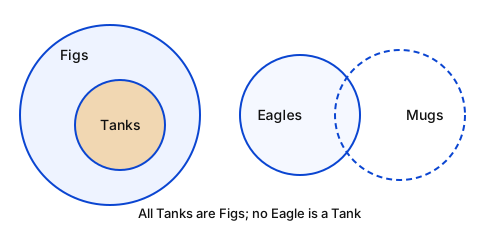
- All tanks are figs and no eagle is a tank ⇒ the figs that are tanks are not eagles ⇒ Some figs are not eagles — (I) follows.
- Some mugs are eagles, and no eagle is a tank ⇒ those mugs are not tanks ⇒ Some mugs are not tanks — (II) follows.
- So both conclusions follow.
Trick: “Some A are B” + “No B is C” ⇒ “Some A are not C” always follows.
Answer: (B) Both conclusions (I) and (II) follow.
अवधारणा: न्यूनतम ओवरलैप वाला चित्र बनाकर हर निष्कर्ष जाँचें।
- सभी tanks figs हैं और कोई eagle tank नहीं ⇒ जो figs tanks हैं वे eagles नहीं ⇒ कुछ figs eagles नहीं हैं — (I) सही।
- कुछ mugs eagles हैं और कोई eagle tank नहीं ⇒ वे mugs tanks नहीं ⇒ कुछ mugs tanks नहीं हैं — (II) सही।
- अतः दोनों निष्कर्ष अनुसरण करते हैं।
ट्रिक: “कुछ A, B हैं” + “कोई B, C नहीं” ⇒ “कुछ A, C नहीं हैं” हमेशा सही।
उत्तर: (B) Both conclusions (I) and (II) follow.
RRB NTPC Graduate CBT 1General Intelligence and ReasoningSyllogismRRB NTPC Graduate CBT 1 2024 · 24 Jun Shift 3
Q80.If ‘P’ stands for ‘×’, ‘Q’ stands for ‘÷’, ‘R’ stands for ‘−’ and ‘S’ stands for ‘+’, then what will come in place of the question mark (?) in the following equation?
(110 R 32) Q 2 S 9 P 4 R 21 = ?
यदि ‘P’ का अर्थ ‘×’, ‘Q’ का अर्थ ‘÷’, ‘R’ का अर्थ ‘−’ और ‘S’ का अर्थ ‘+’ है, तो निम्नलिखित समीकरण में प्रश्नचिह्न (?) के स्थान पर क्या आएगा?
(110 R 32) Q 2 S 9 P 4 R 21 = ?
- A36
- B22
- C54
- D48
Show answer
Concept: Replace letters and follow BODMAS.
Trick: Bracket first, then and , then and .
Answer: (C) 54
अवधारणा: अक्षरों को चिह्नों से बदलें और BODMAS लगाएँ।
ट्रिक: पहले कोष्ठक, फिर व , फिर व ।
उत्तर: (C) 54
RRB NTPC Graduate CBT 1General Intelligence and ReasoningMathematical operationsRRB NTPC Graduate CBT 1 2024 · 24 Jun Shift 3

