Q861.Refer to the following number and symbol series and answer the question that follows. Counting to be done from left to right only.
(Left) 3 € & £ @ * # 1 $ € @ © € © & 1 € 4 1 2 4 © (Right)
How many such symbols are there each of which is immediately preceded by a number and also immediately followed by a symbol?
निम्नलिखित संख्या और प्रतीक श्रृंखला का संदर्भ लीजिए और उसके बाद दिए गए प्रश्न का उत्तर दीजिए। गिनती केवल बाएँ से दाएँ की जानी है।
(बाएँ) 3 € & £ @ * # 1 $ € @ © € © & 1 € 4 1 2 4 © (दाएँ)
ऐसे कितने प्रतीक हैं जिनमें से प्रत्येक के ठीक पहले एक संख्या है और ठीक बाद एक प्रतीक भी है?
- A3
- B1
- C4
- D2
Show answer
Concept: Look for the pattern Number – Symbol – Symbol and count the middle symbol.
- 3 € & → € preceded by 3, followed by & ✓
- 1 $ € → $ preceded by 1, followed by € ✓
- 1 € 4 → followed by a number ✗; 4 © at the end → nothing follows ✗
- Count = 2
Trick: List every number, then check the next two places: symbol + symbol.
Answer: (D)
अवधारणा: संख्या – प्रतीक – प्रतीक का क्रम खोजें और बीच वाला प्रतीक गिनें।
- 3 € & → € से पहले 3, बाद में & ✓
- 1 $ € → $ से पहले 1, बाद में € ✓
- 1 € 4 → बाद में संख्या ✗; अंत का 4 © → बाद में कुछ नहीं ✗
- कुल = 2
ट्रिक: हर संख्या के बाद के दो स्थान देखें: प्रतीक + प्रतीक।
उत्तर: (D)
RRB NTPC Graduate CBT 1General Intelligence and ReasoningNumber-Symbol SeriesRRB NTPC Graduate CBT 1 2024 · 13 Jun Shift 1
Q862.Rituraj starts from Point A and drives 11 km towards South. He then takes a right turn, drives 9 km, turns right and drives 12 km. He then takes a right turn and drives 12 km. He takes a final right turn, drives 1 km and stops at Point P. How far (shortest distance) and towards which direction should he drive in order to reach Point A again? (All turns are 90° turns only, unless specified)
रितुराज बिंदु A से चलना शुरू करता है और दक्षिण की ओर 11 km गाड़ी चलाता है। फिर वह दाएँ मुड़ता है, 9 km गाड़ी चलाता है, दाएँ मुड़ता है और 12 km गाड़ी चलाता है। फिर वह दाएँ मुड़ता है और 12 km गाड़ी चलाता है। वह अंतिम बार दाएँ मुड़ता है, 1 km गाड़ी चलाता है और बिंदु P पर रुक जाता है। पुनः बिंदु A पर पहुँचने के लिए उसे कितनी दूर (न्यूनतम दूरी) और किस दिशा में गाड़ी चलानी चाहिए? (जब तक निर्दिष्ट न हो, सभी मोड़ केवल 90° के हैं)
- A3 km to the westपश्चिम की ओर 3 km
- B1 km to the westपश्चिम की ओर 1 km
- C4 km to the westपश्चिम की ओर 4 km
- D2 km to the westपश्चिम की ओर 2 km
Show answer
Concept: Track the position on a grid (East +x, North +y); a right turn while facing South points West.
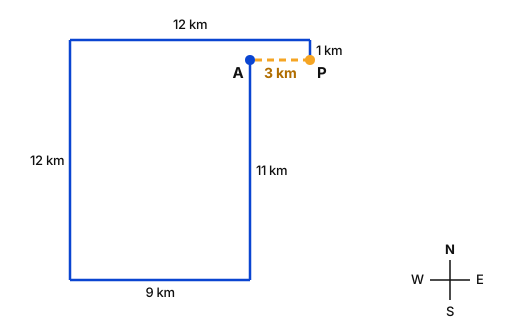
- A(0, 0) → 11 km South → (0, −11)
- Right (West) 9 km → (−9, −11); right (North) 12 km → (−9, 1)
- Right (East) 12 km → (3, 1); right (South) 1 km → P(3, 0)
- P is 3 km East of A, so he must drive 3 km to the West.
Trick: Net East = 12 − 9 = 3 km; net North = 12 − 11 − 1 = 0 → move 3 km West.
Answer: (A) 3 km to the west
अवधारणा: ग्रिड पर स्थिति देखें (पूर्व +x, उत्तर +y); दक्षिण की ओर मुख करके दाएँ मुड़ने पर पश्चिम।
- A(0, 0) → 11 km दक्षिण → (0, −11)
- दाएँ (पश्चिम) 9 km → (−9, −11); दाएँ (उत्तर) 12 km → (−9, 1)
- दाएँ (पूर्व) 12 km → (3, 1); दाएँ (दक्षिण) 1 km → P(3, 0)
- P, A से 3 km पूर्व में है, अतः उसे 3 km पश्चिम जाना होगा।
ट्रिक: शुद्ध पूर्व = 12 − 9 = 3 km; शुद्ध उत्तर = 12 − 11 − 1 = 0 → 3 km पश्चिम।
उत्तर: (A) 3 km पश्चिम की ओर
RRB NTPC Graduate CBT 1General Intelligence and ReasoningDirection and DistanceRRB NTPC Graduate CBT 1 2024 · 13 Jun Shift 1
Q863.In a certain code language, ‘GIVE’ is coded as ‘6482’ and ‘VOLT’ is coded as ‘3671’. What is the code for ‘V’ in the given code language?
एक निश्चित कूट भाषा में, ‘GIVE’ को ‘6482’ के रूप में और ‘VOLT’ को ‘3671’ के रूप में कूटबद्ध किया जाता है। दी गई कूट भाषा में ‘V’ का कूट क्या है?
- A3
- B6
- C8
- D7
Show answer
Concept: A letter common to two words takes the digit common to both codes.
- GIVE → 6482 and VOLT → 3671
- Common letter: V; common digit: 6
- So V = 6.
Trick: Match common letters with common digits – order inside the code does not matter.
Answer: (B)
अवधारणा: दो शब्दों में समान अक्षर का कोड दोनों कोडों में समान अंक होता है।
- GIVE → 6482 और VOLT → 3671
- समान अक्षर: V; समान अंक: 6
- अतः V = 6।
ट्रिक: समान अक्षर ↔ समान अंक – कोड में क्रम का महत्व नहीं।
उत्तर: (B)
RRB NTPC Graduate CBT 1General Intelligence and ReasoningCoding-DecodingRRB NTPC Graduate CBT 1 2024 · 13 Jun Shift 1
Q864.What should come in place of the question mark (?) in the given series?
892 890 886 880 872 ?
दी गई श्रृंखला में प्रश्न चिह्न (?) के स्थान पर क्या आना चाहिए?
892 890 886 880 872 ?
- A862
- B863
- C860
- D861
Show answer
Concept: Find the differences between consecutive terms.
- , , ,
- Differences grow by 2: next is
Trick: Subtracting consecutive even numbers – the next difference is 10.
Answer: (A)
अवधारणा: क्रमागत पदों का अंतर निकालें।
- , , ,
- अंतर 2-2 बढ़ रहा है: अगला
ट्रिक: क्रमागत सम संख्याएँ घट रही हैं – अगला अंतर 10।
उत्तर: (A)
RRB NTPC Graduate CBT 1General Intelligence and ReasoningNumber SeriesRRB NTPC Graduate CBT 1 2024 · 13 Jun Shift 1
Q865.Based on the English alphabetical order, three of the following four letter-cluster pairs are alike in a certain way and thus form a group. Which letter-cluster pair DOES NOT belong to that group?
(Note: The odd one out is not based on the number of consonants/vowels or their position in the letter-cluster.)
अंग्रेज़ी वर्णमाला क्रम के आधार पर, निम्नलिखित चार अक्षर-समूह युग्मों में से तीन किसी निश्चित प्रकार से एक समान हैं और इस प्रकार एक समूह बनाते हैं। कौन-सा अक्षर-समूह युग्म उस समूह से संबंधित नहीं है?
(नोट: असंगत युग्म, अक्षर-समूह में व्यंजनों/स्वरों की संख्या या उनके स्थान पर आधारित नहीं है।)
- AJO – QM
- BLQ – SP
- CUZ – BY
- DEJ – LI
Show answer
Concept: Write letter positions and compare the two clusters of each pair.
- LQ–SP: ; ,
- UZ–BY: ; , ; EJ–LI: ; ,
- JO–QM: , , but ✗
Trick: Check the last letters: second letter in three pairs; only JO–QM breaks it.
Answer: (A) JO – QM
अवधारणा: अक्षरों की स्थिति लिखें और हर युग्म के दोनों समूहों की तुलना करें।
- LQ–SP: ; ,
- UZ–BY: ; , ; EJ–LI: ; ,
- JO–QM: , , पर ✗
ट्रिक: अंतिम अक्षर देखें: तीन युग्मों में दूसरा अक्षर ; केवल JO–QM अलग।
उत्तर: (A) JO – QM
RRB NTPC Graduate CBT 1General Intelligence and ReasoningOdd One Out – Letter PairsRRB NTPC Graduate CBT 1 2024 · 13 Jun Shift 1
Q866.A, B, C, D, E and F live on six different floors of the same building. The lowermost floor in the building is numbered 1, the floor above it, number 2 and so on, till the topmost floor is numbered 6. A lives on an odd numbered floor but not 3. The sum of floors on which C and A live is 4. Only 3 people live between E and F. B lives immediately above D. The sum of floors on which D and E live is 10. How many people live below F?
A, B, C, D, E और F एक ही इमारत की छह अलग-अलग मंज़िलों पर रहते हैं। इमारत की सबसे निचली मंज़िल की संख्या 1 है, उसके ऊपर वाली मंज़िल की संख्या 2 है और इसी प्रकार सबसे ऊपरी मंज़िल की संख्या 6 है। A एक विषम संख्या वाली मंज़िल पर रहता है, परंतु 3 पर नहीं। जिन मंज़िलों पर C और A रहते हैं उनका योग 4 है। E और F के बीच केवल 3 व्यक्ति रहते हैं। B, D के ठीक ऊपर रहता है। जिन मंज़िलों पर D और E रहते हैं उनका योग 10 है। F के नीचे कितने व्यक्ति रहते हैं?
- A3
- B1
- C4
- D2
Show answer
Concept: Place the fixed clues first, then fill the rest.
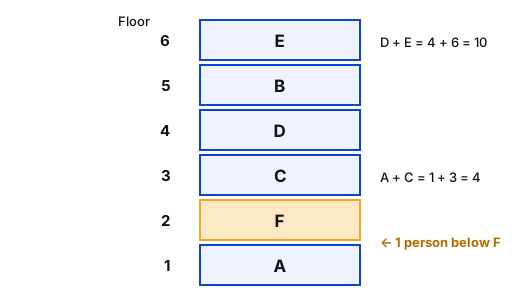
- A odd, not 3 → 1 or 5; → A = 1, C = 3
- → (4, 6) or (6, 4); B just above D → D = 4, B = 5, so E = 6
- F gets the only free floor, 2; check: between E(6) and F(2) are 3 people ✓
- Below F: only A → 1 person
Trick: Sum clues with small totals (A + C = 4) fix positions fastest.
Answer: (B)
अवधारणा: पहले निश्चित संकेत रखें, फिर बाकी भरें।
- A विषम, 3 नहीं → 1 या 5; → A = 1, C = 3
- → (4, 6) या (6, 4); B ठीक D के ऊपर → D = 4, B = 5, अतः E = 6
- F को एकमात्र खाली मंज़िल 2 मिली; जाँच: E(6) और F(2) के बीच 3 लोग ✓
- F के नीचे केवल A → 1 व्यक्ति
ट्रिक: छोटे योग वाले संकेत (A + C = 4) सबसे जल्दी स्थान तय करते हैं।
उत्तर: (B)
RRB NTPC Graduate CBT 1General Intelligence and ReasoningFloor PuzzleRRB NTPC Graduate CBT 1 2024 · 13 Jun Shift 1
Q867.In a certain code language, ‘smooth long drive’ is coded as ‘zi ma tu’ and ‘challenging mountain drive’ is coded as ‘fo se zi’. How is ‘drive’ coded in the given language?
एक निश्चित कूट भाषा में, ‘smooth long drive’ को ‘zi ma tu’ के रूप में और ‘challenging mountain drive’ को ‘fo se zi’ के रूप में कूटबद्ध किया जाता है। दी गई भाषा में ‘drive’ को किस प्रकार कूटबद्ध किया जाता है?
- Ase
- Bfo
- Czi
- Dma
Show answer
Concept: A word common to two sentences takes the code common to both.
- smooth long drive → zi ma tu
- challenging mountain drive → fo se zi
- Common word "drive" ↔ common code "zi".
Trick: Common word ↔ common code; position in the sentence is irrelevant.
Answer: (C) zi
अवधारणा: दो वाक्यों में समान शब्द का कोड दोनों में समान कोड होता है।
- smooth long drive → zi ma tu
- challenging mountain drive → fo se zi
- समान शब्द "drive" ↔ समान कोड "zi"।
ट्रिक: समान शब्द ↔ समान कोड; वाक्य में स्थान का महत्व नहीं।
उत्तर: (C) zi
RRB NTPC Graduate CBT 1General Intelligence and ReasoningCoding-DecodingRRB NTPC Graduate CBT 1 2024 · 13 Jun Shift 1
Q868.A, B, C, D, G, H and I are sitting around a circular table facing the centre of the table. Only three people sit between I and H when counted from the left of I. Only three people sit between A and G when counted from the right of G. C sits to the immediate right of A. B is an immediate neighbour of G as well as H. Who sits to the second to the left of D?
A, B, C, D, G, H और I एक वृत्ताकार मेज़ के चारों ओर मेज़ के केंद्र की ओर मुख करके बैठे हैं। I के बाईं ओर से गिनने पर I और H के बीच केवल तीन व्यक्ति बैठे हैं। G के दाईं ओर से गिनने पर A और G के बीच केवल तीन व्यक्ति बैठे हैं। C, A के ठीक दाईं ओर बैठा है। B, G और H दोनों का निकटतम पड़ोसी है। D के बाईं ओर दूसरे स्थान पर कौन बैठा है?
- AG
- BB
- CI
- DA
Show answer
Concept: For people facing the centre, left = clockwise and right = anticlockwise.
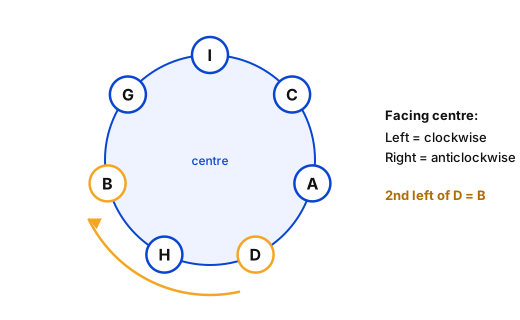
- Fix I; counting to I's left, H is the 4th seat (3 between).
- Number seats clockwise from I (I = 0, H = 4). B sits between G and H. If B = 3, G = 2, then A = 5 and C = 4 = H ✗. So B = 5 and G = 6.
- A is 4th to G's right (seat 2), C is just right of A (seat 1), and D takes the last seat: clockwise I, C, A, D, H, B, G.
- Two seats to D's left (clockwise): H, then B.
Trick: Draw the circle and mark arrows for "left" before placing anyone.
Answer: (B) B
अवधारणा: केंद्र की ओर मुख वाले व्यक्तियों के लिए बायाँ = दक्षिणावर्त, दायाँ = वामावर्त।
- I को स्थिर करें; I के बाएँ गिनने पर H चौथी सीट पर (बीच में 3)।
- I से दक्षिणावर्त सीट क्रमांक दें (I = 0, H = 4)। B, G और H के बीच है। यदि B = 3 तो G = 2, फिर A = 5 और C = 4 = H ✗। अतः B = 5, G = 6।
- G के दाएँ चौथी सीट A (सीट 2), A के ठीक दाएँ C (सीट 1), और D अंतिम सीट पर: दक्षिणावर्त I, C, A, D, H, B, G।
- D के बाएँ (दक्षिणावर्त) दो सीट: H, फिर B।
ट्रिक: किसी को बैठाने से पहले वृत्त बनाकर "बाएँ" की दिशा का तीर लगाएँ।
उत्तर: (B) B
RRB NTPC Graduate CBT 1General Intelligence and ReasoningCircular Seating ArrangementRRB NTPC Graduate CBT 1 2024 · 13 Jun Shift 1
Q869.Two sets of numbers are given below. In each set of numbers, certain mathematical operation(s) on the first number results in the second number. Similarly, certain mathematical operation(s) on the second number results in the third number and so on. Which of the given options follows the same set of operations as in the given sets? (NOTE: Operations should be performed on the whole numbers, without breaking down the numbers into their constituent digits. E.g. 13 – Operations on 13 such as adding / subtracting / multiplying to 13 can be performed. Breaking down 13 into 1 and 3 and then performing mathematical operations on 1 and 3 is not allowed.)
6 - 12 - 15 - 30; 4 - 8 - 11 - 22
नीचे संख्याओं के दो समुच्चय दिए गए हैं। संख्याओं के प्रत्येक समुच्चय में, पहली संख्या पर कुछ गणितीय संक्रिया/संक्रियाएँ करने पर दूसरी संख्या प्राप्त होती है। इसी प्रकार, दूसरी संख्या पर कुछ गणितीय संक्रिया/संक्रियाएँ करने पर तीसरी संख्या प्राप्त होती है, और इसी प्रकार आगे भी। दिए गए विकल्पों में से कौन-सा विकल्प दिए गए समुच्चयों के समान संक्रियाओं के समुच्चय का अनुसरण करता है? (नोट: संक्रियाएँ संख्याओं को उनके घटक अंकों में विभाजित किए बिना, पूर्ण संख्याओं पर की जानी चाहिए। उदाहरण- 13 – 13 पर संक्रियाएँ जैसे 13 में जोड़ना/घटाना/गुणा करना आदि किया जा सकता है। 13 को 1 और 3 में विभाजित करना और फिर 1 और 3 पर गणितीय संक्रियाएँ करना वर्जित है।)
6 - 12 - 15 - 30; 4 - 8 - 11 - 22
- A1 - 2 - 4 - 16
- B12 - 14 - 28 - 30
- C11 - 22 - 25 - 50
- D8 - 16 - 19 - 36
Show answer
Concept: Find the operations from the given sets.
- ;
- (C): ✓
- (D) fails: ; (A), (B) fail at the first step.
Trick: Pattern → the last term must be even and twice the third.
Answer: (C) 11 - 22 - 25 - 50
अवधारणा: दिए गए समूहों से संक्रियाएँ ज्ञात करें।
- ;
- (C): ✓
- (D) गलत: ; (A), (B) पहले ही चरण में गलत।
ट्रिक: पैटर्न → अंतिम पद तीसरे पद का दोगुना होना चाहिए।
उत्तर: (C) 11 - 22 - 25 - 50
RRB NTPC Graduate CBT 1General Intelligence and ReasoningNumber Set OperationsRRB NTPC Graduate CBT 1 2024 · 13 Jun Shift 1
Q870.Seven boxes, A, B, C, D, E, F and G, are kept one above the other but not necessarily in the same order. Only two boxes are kept below C. Only one box is kept above A. Only one box is kept between A and E. B is kept immediately above F. D is kept at some place below G. How many boxes are kept above B?
सात बक्से, A, B, C, D, E, F और G, एक के ऊपर एक रखे गए हैं, परंतु आवश्यक नहीं कि इसी क्रम में हों। C के नीचे केवल दो बक्से रखे गए हैं। A के ऊपर केवल एक बक्सा रखा गया है। A और E के बीच केवल एक बक्सा रखा गया है। B, F के ठीक ऊपर रखा गया है। D, G के नीचे किसी स्थान पर रखा गया है। B के ऊपर कितने बक्से रखे गए हैं?
- A4
- B5
- C3
- D2
Show answer
Concept: Number the positions 1 (bottom) to 7 (top) and place the definite boxes first.
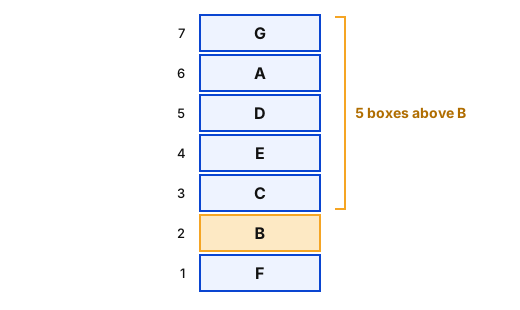
- Two below C → C = 3; one above A → A = 6
- One box between A and E → E = 4
- B just above F: the only adjacent free pair is 1–2 → F = 1, B = 2
- D below G → D = 5, G = 7. Order (bottom→top): F, B, C, E, D, A, G
- Boxes above B = 7 − 2 = 5
Trick: Boxes above position p = 7 − p.
Answer: (B)
अवधारणा: स्थानों को 1 (नीचे) से 7 (ऊपर) तक क्रमांकित करें और पहले निश्चित बॉक्स रखें।
- C के नीचे दो → C = 3; A के ऊपर एक → A = 6
- A और E के बीच एक बॉक्स → E = 4
- B ठीक F के ऊपर: एकमात्र खाली क्रमागत जोड़ी 1–2 → F = 1, B = 2
- D, G के नीचे → D = 5, G = 7। क्रम (नीचे→ऊपर): F, B, C, E, D, A, G
- B के ऊपर बॉक्स = 7 − 2 = 5
ट्रिक: स्थान p के ऊपर बॉक्स = 7 − p।
उत्तर: (B)
RRB NTPC Graduate CBT 1General Intelligence and ReasoningBox Stacking PuzzleRRB NTPC Graduate CBT 1 2024 · 13 Jun Shift 1
Q871.What should come in place of the question mark (?) in the given series?
982 980 976 970 962 ?
दी गई श्रृंखला में प्रश्न चिह्न (?) के स्थान पर क्या आना चाहिए?
982 980 976 970 962 ?
- A952
- B954
- C948
- D950
Show answer
Concept: Check the differences between consecutive terms.
- , , , .
- Differences are even numbers increasing by 2, so the next difference is .
- .
Trick: Subtract consecutive even numbers: .
Answer: (A) 952
अवधारणा: क्रमागत पदों का अंतर देखें।
- , , , ।
- अंतर सम संख्याएँ हैं जो 2-2 बढ़ रही हैं, अतः अगला अंतर होगा।
- ।
ट्रिक: क्रमागत सम संख्याएँ घटाएँ: ।
उत्तर: (A) 952
RRB NTPC Graduate CBT 1General Intelligence and ReasoningNumber SeriesRRB NTPC Graduate CBT 1 2024 · 12 Jun Shift 3
Q872.If 2 is added to each even digit and 3 is subtracted from each odd digit in the number 596432, what will be the sum of the greatest and smallest digits in the new number thus formed?
यदि संख्या 596432 में प्रत्येक सम अंक में 2 जोड़ा जाए और प्रत्येक विषम अंक में से 3 घटाया जाए, तो इस प्रकार बनी नई संख्या में सबसे बड़े और सबसे छोटे अंक का योग क्या होगा?
- A8
- B12
- C6
- D10
Show answer
Concept: Apply the rule digit by digit.
- 596432: odd digits become ; even digits become .
- New number: 2 6 8 6 0 4.
- Greatest digit , smallest digit , sum .
Trick: Only the extreme digits matter: largest even digit and odd digit .
Answer: (A) 8
अवधारणा: प्रत्येक अंक पर नियम लगाएँ।
- 596432 में विषम अंक बनते हैं ; सम अंक बनते हैं ।
- नई संख्या: 2 6 8 6 0 4।
- सबसे बड़ा अंक , सबसे छोटा , योग ।
ट्रिक: केवल सबसे बड़ा और सबसे छोटा अंक देखें: और ।
उत्तर: (A) 8
RRB NTPC Graduate CBT 1General Intelligence and ReasoningNumber OperationsRRB NTPC Graduate CBT 1 2024 · 12 Jun Shift 3
Q873.If ‘A’ stands for ‘÷’, ‘B’ stands for ‘×’, ‘C’ stands for ‘+’ and ‘D’ stands for ‘−’, then what will come in place of question mark (?) in the following equation?
43 D 15 C 7 B 9 D (28 A 2) = ?
यदि 'A' का अर्थ '÷', 'B' का अर्थ '×', 'C' का अर्थ '+' और 'D' का अर्थ '−' है, तो निम्नलिखित समीकरण में प्रश्न चिह्न (?) के स्थान पर क्या आएगा?
43 D 15 C 7 B 9 D (28 A 2) = ?
- A83
- B92
- C64
- D77
Show answer
Concept: Replace the letters by signs, then use BODMAS.
- Expression: .
- Bracket: ; multiplication: .
- .
Trick: Write the sign-converted expression first, then solve bracket → ×/÷ → +/−.
Answer: (D) 77
अवधारणा: अक्षरों को चिह्नों से बदलें, फिर BODMAS लगाएँ।
- व्यंजक: ।
- कोष्ठक: ; गुणा: ।
- ।
ट्रिक: पहले चिह्न बदलकर पूरा व्यंजक लिखें, फिर कोष्ठक → ×/÷ → +/−।
उत्तर: (D) 77
RRB NTPC Graduate CBT 1General Intelligence and ReasoningMathematical OperationsRRB NTPC Graduate CBT 1 2024 · 12 Jun Shift 3
Q874.Seven people, I, J, K, L, O, P and Q are sitting in a row, facing north. No one sits to the left of J. Only four people sit between J and K. Only three people sit to the right of O. I sits to the immediate left of L. P is not an immediate neighbour of O. Who sits at the rightmost end of the line?
सात व्यक्ति, I, J, K, L, O, P और Q एक पंक्ति में उत्तर की ओर मुख करके बैठे हैं। J के बाईं ओर कोई नहीं बैठा है। J और K के बीच केवल चार व्यक्ति बैठे हैं। O के दाईं ओर केवल तीन व्यक्ति बैठे हैं। I, L के ठीक बाईं ओर बैठा है। P, O का निकटतम पड़ोसी नहीं है। पंक्ति के सबसे दाएँ छोर पर कौन बैठा है?
- AP
- BJ
- CI
- DL
Show answer
Concept: Fix definite positions first (number the seats 1–7 from left).
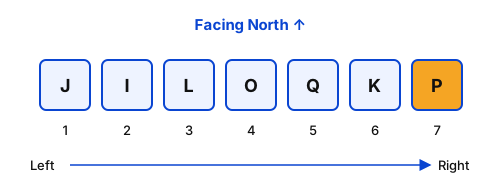
- No one to the left of J → J at 1; four people between J and K → K at 6.
- Three people to the right of O → O at 4.
- I immediately left of L: only free adjacent pair is 2–3 → I at 2, L at 3.
- P and Q take 5 and 7; P is not next to O → P at 7, Q at 5.
Trick: 'No one to the left' = extreme left end; use the count clues next.
Answer: (A) P
अवधारणा: पहले निश्चित स्थान तय करें (बाएँ से सीटें 1–7)।
- J के बाएँ कोई नहीं → J स्थान 1 पर; J और K के बीच चार व्यक्ति → K स्थान 6 पर।
- O के दाएँ तीन व्यक्ति → O स्थान 4 पर।
- I, L के ठीक बाएँ: खाली सटी जोड़ी केवल 2–3 → I = 2, L = 3।
- P और Q के लिए 5 व 7; P, O का पड़ोसी नहीं → P = 7, Q = 5।
ट्रिक: 'बाएँ कोई नहीं' = सबसे बायाँ सिरा; फिर गिनती वाले संकेत लगाएँ।
उत्तर: (A) P
RRB NTPC Graduate CBT 1General Intelligence and ReasoningSeating ArrangementRRB NTPC Graduate CBT 1 2024 · 12 Jun Shift 3
Q875.Shaan starts from Point A and drives 6 km towards North. He then takes a right turn, drives 7 km, turns right and drives 12 km. He then takes a right turn and drives 8 km. He takes a final right turn, drives 6 km and stops at Point P. How far (shortest distance) and towards which direction should he drive in order to reach Point A again? (All turns are 90° turns only unless specified)
शान बिंदु A से शुरू करता है और उत्तर की ओर 6 km गाड़ी चलाता है। फिर वह दाएँ मुड़ता है, 7 km गाड़ी चलाता है, दाएँ मुड़ता है और 12 km गाड़ी चलाता है। फिर वह दाएँ मुड़ता है और 8 km गाड़ी चलाता है। वह अंतिम बार दाएँ मुड़ता है, 6 km गाड़ी चलाता है और बिंदु P पर रुक जाता है। बिंदु A पर फिर से पहुँचने के लिए उसे कितनी दूरी (न्यूनतम दूरी) और किस दिशा में गाड़ी चलानी चाहिए? (जब तक निर्दिष्ट न किया जाए, सभी मोड़ केवल 90° के मोड़ हैं)
- A2 km to the eastपूर्व की ओर 2 km
- B3 km to the eastपूर्व की ओर 3 km
- C4 km to the eastपूर्व की ओर 4 km
- D1 km to the eastपूर्व की ओर 1 km
Show answer
Concept: Track the position on a coordinate grid, taking A as .
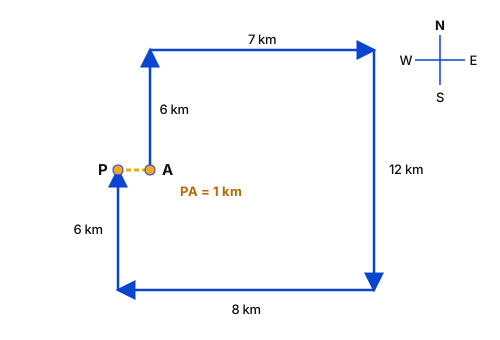
- 6 km North → ; right turn = East 7 km → .
- Right = South 12 km → ; right = West 8 km → .
- Right = North 6 km → P .
- P is 1 km west of A, so he must drive 1 km towards the East.
Trick: Net East–West ; net North–South .
Answer: (D) 1 km to the east
अवधारणा: A को मानकर निर्देशांक से स्थिति ट्रैक करें।
- 6 km उत्तर → ; दाएँ मुड़कर पूर्व 7 km → ।
- दाएँ = दक्षिण 12 km → ; दाएँ = पश्चिम 8 km → ।
- दाएँ = उत्तर 6 km → P ।
- P, A से 1 km पश्चिम में है, अतः उसे 1 km पूर्व की ओर जाना होगा।
ट्रिक: शुद्ध पूर्व–पश्चिम ; शुद्ध उत्तर–दक्षिण ।
उत्तर: (D) 1 km पूर्व की ओर
RRB NTPC Graduate CBT 1General Intelligence and ReasoningDirection and DistanceRRB NTPC Graduate CBT 1 2024 · 12 Jun Shift 3
Q876.In a certain code language, ‘FARE’ is coded as ‘8432’ and ‘FEAT’ is coded as ‘3287’. What is the code for ‘R’ in the given code language?
एक निश्चित कूट भाषा में, 'FARE' को '8432' और 'FEAT' को '3287' के रूप में कूटबद्ध किया जाता है। दी गई कूट भाषा में 'R' के लिए कूट क्या है?
- A2
- B3
- C8
- D4
Show answer
Concept: Match common letters with common digits.
- FARE → 8, 4, 3, 2 and FEAT → 3, 2, 8, 7.
- Common letters F, A, E ↔ common digits 8, 3, 2.
- Letter only in FARE is R; digit only in its code is 4. So R = 4 (and T = 7).
Trick: Uncommon letter ↔ uncommon digit in the same word.
Answer: (D) 4
अवधारणा: उभयनिष्ठ अक्षरों को उभयनिष्ठ अंकों से मिलाएँ।
- FARE → 8, 4, 3, 2 तथा FEAT → 3, 2, 8, 7।
- उभयनिष्ठ अक्षर F, A, E ↔ उभयनिष्ठ अंक 8, 3, 2।
- केवल FARE में R है और उसके कोड में केवल 4 बचा है। अतः R = 4 (और T = 7)।
ट्रिक: एक शब्द का बचा अक्षर ↔ उसी कोड का बचा अंक।
उत्तर: (D) 4
RRB NTPC Graduate CBT 1General Intelligence and ReasoningCoding-DecodingRRB NTPC Graduate CBT 1 2024 · 12 Jun Shift 3
Q877.Refer to the following number and symbol series and answer the question that follows. Counting to be done from left to right only.
(Left) 1 @ 2 2 7 © & 8 6 * # 9 3 6 & 6 # & * © @ 8 (Right)
How many such numbers are there each of which is immediately preceded by a number and also immediately followed by a number?
निम्नलिखित संख्या और प्रतीक श्रृंखला को देखिए और उसके बाद आने वाले प्रश्न का उत्तर दीजिए। गिनती केवल बाएँ से दाएँ की जानी है।
(बाएँ) 1 @ 2 2 7 © & 8 6 * # 9 3 6 & 6 # & * © @ 8 (दाएँ)
ऐसी कितनी संख्याएँ हैं जिनमें से प्रत्येक के ठीक पहले एक संख्या है और ठीक बाद भी एक संख्या है?
- A1
- B3
- C2
- D4
Show answer
Concept: Look for the pattern number–number–number.
- 2 2 7: the second 2 is preceded by 2 and followed by 7 ✔.
- 9 3 6: 3 is preceded by 9 and followed by 6 ✔.
- Others fail (e.g. 8 6 *: 6 is followed by a symbol; 3 6 &: 6 is followed by a symbol).
Trick: Find runs of 3 or more consecutive numbers; each run of length gives answers.
Answer: (C) 2
अवधारणा: संख्या–संख्या–संख्या का पैटर्न खोजें।
- 2 2 7: दूसरे 2 से पहले 2 और बाद में 7 ✔।
- 9 3 6: 3 से पहले 9 और बाद में 6 ✔।
- बाकी असफल (जैसे 8 6 *: 6 के बाद चिह्न; 3 6 &: 6 के बाद चिह्न)।
ट्रिक: लगातार 3 या अधिक संख्याओं के समूह खोजें; लंबाई का समूह उत्तर देता है।
उत्तर: (C) 2
RRB NTPC Graduate CBT 1General Intelligence and ReasoningAlphanumeric SeriesRRB NTPC Graduate CBT 1 2024 · 12 Jun Shift 3
Q878.This question is based on the five, three-digit numbers given below.
(Left) 325 503 158 391 144 (Right)
(Example- 697 – First digit = 6, second digit = 9 and third digit = 7)
(NOTE: All operations to be done from left to right.)
What will be the resultant if the second digit of the highest number is added to the first digit of the lowest number?
यह प्रश्न नीचे दी गई तीन अंकों वाली पाँच संख्याओं पर आधारित है।
(बाएँ) 325 503 158 391 144 (दाएँ)
(उदाहरण- 697 – पहला अंक = 6, दूसरा अंक = 9 और तीसरा अंक = 7)
(नोट: सभी संक्रियाएँ बाएँ से दाएँ की जानी हैं।)
यदि सबसे बड़ी संख्या के दूसरे अंक को सबसे छोटी संख्या के पहले अंक में जोड़ा जाए, तो परिणाम क्या होगा?
- A2
- B0
- C4
- D1
Show answer
Concept: Identify the highest and lowest numbers, then pick the required digits.
- Highest number → second digit .
- Lowest number → first digit .
- .
Trick: Compare the hundreds digits first: 5 is highest, 1 lowest (144 is less than 158).
Answer: (D) 1
अवधारणा: सबसे बड़ी और सबसे छोटी संख्या पहचानें, फिर अंक चुनें।
- सबसे बड़ी संख्या → दूसरा अंक ।
- सबसे छोटी संख्या → पहला अंक ।
- ।
ट्रिक: पहले सैकड़े का अंक देखें: 5 सबसे बड़ा; 1 वाले में 144, 158 से छोटा।
उत्तर: (D) 1
RRB NTPC Graduate CBT 1General Intelligence and ReasoningNumber PuzzleRRB NTPC Graduate CBT 1 2024 · 12 Jun Shift 3
Q879.In this question, a group of letters is coded by using numbers and symbols as per the table given below and the conditions which follow.
Conditions:
1. If the 1
st letter is a vowel and the 3
rd letter is a consonant, both are to be coded as the code for that 3
rd letter consonant.
2. If the 1
st and last letters are vowels, both are to be coded as ‘N’.
3. If the 2
nd and last letters are vowels, their codes are to be interchanged.
What is the correct combination of codes (by following only the applicable condition(s)) for the following letters?
AJSPT
इस प्रश्न में, नीचे दी गई तालिका और उसके बाद दी गई शर्तों के अनुसार अक्षरों के एक समूह को संख्याओं और प्रतीकों का उपयोग करके कूटबद्ध किया गया है।
शर्तें:
1. यदि पहला अक्षर स्वर है और तीसरा अक्षर व्यंजन है, तो दोनों को उस तीसरे अक्षर (व्यंजन) के कूट के रूप में कूटबद्ध किया जाना है।
2. यदि पहला और अंतिम अक्षर स्वर हैं, तो दोनों को 'N' के रूप में कूटबद्ध किया जाना है।
3. यदि दूसरा और अंतिम अक्षर स्वर हैं, तो उनके कूट आपस में बदल दिए जाने हैं।
निम्नलिखित अक्षरों के लिए कूटों का सही संयोजन (केवल लागू शर्त/शर्तों का पालन करते हुए) क्या है?
AJSPT
- A3 $ % @ *
- B3 $ @ % *
- C3 $ 3 % *
- D@ $ @ % *
Show answer
Concept: Check each condition against AJSPT, then code letter by letter.
- Condition 1: 1st letter A is a vowel and 3rd letter S is a consonant → applies; both A and S get the code of S, i.e. @.
- Condition 2: last letter T is not a vowel → not applicable. Condition 3: 2nd letter J is not a vowel → not applicable.
- Codes: A → @, J → $, S → @, P → %, T → *.
Trick: Test the conditions first; only then use the table.
Answer: (D) @ $ @ % *
अवधारणा: AJSPT पर हर शर्त जाँचें, फिर अक्षरवार कोड लिखें।
- शर्त 1: पहला अक्षर A स्वर और तीसरा S व्यंजन → लागू; A और S दोनों को S का कोड @ मिलेगा।
- शर्त 2: अंतिम अक्षर T स्वर नहीं → लागू नहीं। शर्त 3: दूसरा अक्षर J स्वर नहीं → लागू नहीं।
- कोड: A → @, J → $, S → @, P → %, T → *।
ट्रिक: पहले शर्तें जाँचें, फिर तालिका देखें।
उत्तर: (D) @ $ @ % *
RRB NTPC Graduate CBT 1General Intelligence and ReasoningCoding with ConditionsRRB NTPC Graduate CBT 1 2024 · 12 Jun Shift 3
Q880.M, N, O, S, T and U live on six different floors of the same building. The lowermost floor in the building is numbered 1, the floor above it, number 2 and so on till the topmost floor is numbered 6. S lives on floor numbered 5. O lives on a floor above S. Only T lives below N. U lives on an even numbered floor. How many people live below M?
M, N, O, S, T और U एक ही इमारत की छह अलग-अलग मंज़िलों पर रहते हैं। इमारत की सबसे निचली मंज़िल की संख्या 1 है, उसके ऊपर वाली मंज़िल की संख्या 2 है और इसी प्रकार आगे सबसे ऊपरी मंज़िल की संख्या 6 है। S मंज़िल संख्या 5 पर रहता है। O, S के ऊपर वाली किसी मंज़िल पर रहता है। N के नीचे केवल T रहता है। U एक सम संख्या वाली मंज़िल पर रहता है। M के नीचे कितने व्यक्ति रहते हैं?
- AThreeतीन
- BOneएक
- CTwoदो
- DFourचार
Show answer
Concept: Place the fixed persons first, then use the remaining clues.
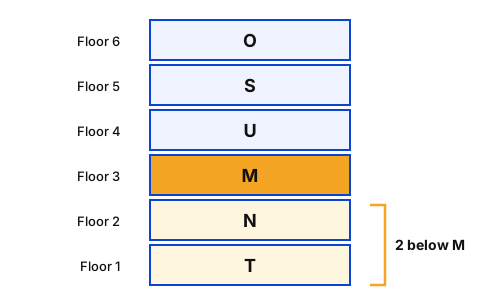
- S on floor 5; O above S → O on floor 6.
- Only T lives below N → T on floor 1, N on floor 2.
- U on an even floor; only 4 is left even → U on floor 4, so M on floor 3.
- Below M: T and N → two people.
Trick: 'Only X lives below Y' fixes X at the bottom and Y just above it.
Answer: (C) Two
अवधारणा: पहले निश्चित व्यक्तियों को रखें, फिर बाकी संकेत लगाएँ।
- S मंज़िल 5 पर; O, S से ऊपर → O मंज़िल 6 पर।
- केवल T, N से नीचे → T मंज़िल 1, N मंज़िल 2।
- U सम मंज़िल पर; केवल 4 बची → U मंज़िल 4, M मंज़िल 3।
- M से नीचे: T और N → दो व्यक्ति।
ट्रिक: 'केवल X, Y से नीचे' → X सबसे नीचे, Y उसके ठीक ऊपर।
उत्तर: (C) दो
RRB NTPC Graduate CBT 1General Intelligence and ReasoningFloor PuzzleRRB NTPC Graduate CBT 1 2024 · 12 Jun Shift 3

