Q881.Seven friends, A, B, C, D, E, F and O, are sitting in a row facing north. Only two people sit to the left of F. Only three people sit between F and A. Only one person sits between A and O. D sits to the immediate left of C. E is not an immediate neighbour of A. How many people sit to the right of B?
सात मित्र, A, B, C, D, E, F और O, एक पंक्ति में उत्तर की ओर मुख करके बैठे हैं। F के बाईं ओर केवल दो व्यक्ति बैठे हैं। F और A के बीच केवल तीन व्यक्ति बैठे हैं। A और O के बीच केवल एक व्यक्ति बैठा है। D, C के ठीक बाईं ओर बैठा है। E, A का निकटतम पड़ोसी नहीं है। B के दाईं ओर कितने व्यक्ति बैठे हैं?
- AFourचार
- BOneएक
- CTwoदो
- DThreeतीन
Show answer
Concept: All face north, so left and right are the viewer's left and right. Place F first.
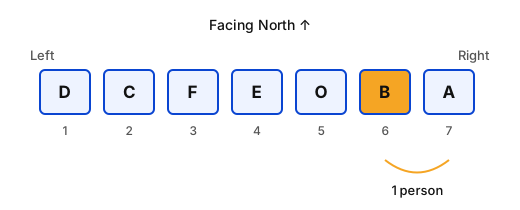
- Only two people left of F → F at position 3.
- Three people between F and A → A at 7.
- One person between A and O → O at 5.
- D immediately left of C → D at 1, C at 2. E not a neighbour of A → E at 4, B at 6.
- Row: D C F E O B A; only A is to the right of B.
Trick: "Only two to the left" fixes an exact position (3rd from left); start with such clues.
Answer: (B) One
अवधारणा: सभी उत्तर की ओर मुख किए हैं, इसलिए बायाँ-दायाँ हमारे बाएँ-दाएँ जैसा ही है। पहले F को रखें।
- F के बाईं ओर केवल दो → F स्थान 3।
- F और A के बीच तीन → A स्थान 7।
- A और O के बीच एक → O स्थान 5।
- D, C के ठीक बाएँ → D 1, C 2। E, A का पड़ोसी नहीं → E 4, B 6।
- पंक्ति: D C F E O B A; B के दाईं ओर केवल A है।
ट्रिक: "केवल दो बाईं ओर" जैसा संकेत सटीक स्थान देता है; उसी से शुरू करें।
उत्तर: (B) एक
RRB NTPC Graduate CBT 1General Intelligence and ReasoningLinear seating arrangementRRB NTPC Graduate CBT 1 2024 · 21 Jun Shift 1
Q882.What should come in place of the question mark (?) in the given series based on the English alphabetical order?
GUR QEB AOL KYV ?
अंग्रेज़ी वर्णमाला क्रम के आधार पर दी गई श्रृंखला में प्रश्नचिह्न (?) के स्थान पर क्या आना चाहिए?
GUR QEB AOL KYV ?
- AFIU
- BUFI
- CFUI
- DUIF
Show answer
Concept: Track the first, second and third letters of each cluster separately (positions A = 1 … Z = 26).
- First letters: G, Q, A, K → each +10 (cyclic) → next K+10 = U.
- Second letters: U, E, O, Y → +10 → Y+10 = I.
- Third letters: R, B, L, V → +10 → V+10 = F.
- Next cluster: UIF.
Trick: +10 cyclic is the same as −16; e.g. Y(25)+10 = 35 − 26 = 9 = I.
Answer: (D) UIF
अवधारणा: प्रत्येक समूह के पहले, दूसरे और तीसरे अक्षर को अलग-अलग देखें (A = 1 … Z = 26)।
- पहले अक्षर: G, Q, A, K → हर बार +10 (चक्रीय) → K+10 = U।
- दूसरे अक्षर: U, E, O, Y → +10 → Y+10 = I।
- तीसरे अक्षर: R, B, L, V → +10 → V+10 = F।
- अगला समूह: UIF।
ट्रिक: +10 चक्रीय = −16; जैसे Y(25)+10 = 35 − 26 = 9 = I।
उत्तर: (D) UIF
RRB NTPC Graduate CBT 1General Intelligence and ReasoningLetter seriesRRB NTPC Graduate CBT 1 2024 · 21 Jun Shift 1
Q883.SUZD is related to ZBGK in a certain way based on the English alphabetical order. In the same way, UWBF is related to BDIM. To which of the following options is PRWA related, following the same logic?
अंग्रेज़ी वर्णमाला क्रम के आधार पर SUZD एक निश्चित तरीके से ZBGK से संबंधित है। उसी प्रकार, UWBF, BDIM से संबंधित है। समान तर्क का अनुसरण करते हुए, PRWA निम्नलिखित में से किस विकल्प से संबंधित है?
- AWDHY
- BWYHD
- CWDUH
- DWYDH
Show answer
Concept: Compare letter by letter.
- S→Z, U→B, Z→G, D→K: each letter +7.
- Check: U→B, W→D, B→I, F→M ✓ (+7).
- PRWA: P+7 = W, R+7 = Y, W+7 = D, A+7 = H → WYDH.
Trick: Options A and C fail at the second letter (R+7 = Y); B fails at the third.
Answer: (D) WYDH
अवधारणा: अक्षर-दर-अक्षर तुलना करें।
- S→Z, U→B, Z→G, D→K: हर अक्षर +7।
- जाँच: U→B, W→D, B→I, F→M ✓ (+7)।
- PRWA: P+7 = W, R+7 = Y, W+7 = D, A+7 = H → WYDH।
ट्रिक: विकल्प A और C दूसरे अक्षर (R+7 = Y) पर, B तीसरे अक्षर पर गलत है।
उत्तर: (D) WYDH
RRB NTPC Graduate CBT 1General Intelligence and ReasoningAnalogy (letter shift)RRB NTPC Graduate CBT 1 2024 · 21 Jun Shift 1
Q884.Taran ranked 28th from the top and 64th from the bottom in his class. How many students are there in his class?
तरन की अपनी कक्षा में ऊपर से 28वीं और नीचे से 64वीं रैंक है। उसकी कक्षा में कितने विद्यार्थी हैं?
- A90
- B92
- C93
- D91
Show answer
Concept: Total = rank from top + rank from bottom − 1 (the person is counted twice).
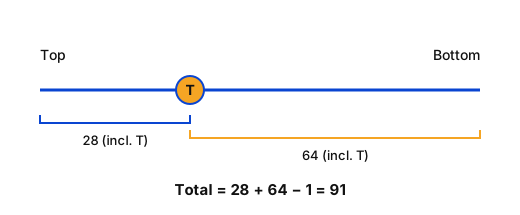
- Rank from top = 28, rank from bottom = 64.
- Total .
Trick: Add both ranks and subtract 1.
Answer: (D) 91
अवधारणा: कुल = ऊपर से रैंक + नीचे से रैंक − 1 (व्यक्ति दो बार गिना जाता है)।
- ऊपर से रैंक 28, नीचे से 64।
- कुल ।
ट्रिक: दोनों रैंक जोड़कर 1 घटाएँ।
उत्तर: (D) 91
RRB NTPC Graduate CBT 1General Intelligence and ReasoningRankingRRB NTPC Graduate CBT 1 2024 · 21 Jun Shift 1
Q885.In a certain code language,
A + B means ‘A is the son of B’,
A – B means ‘A is the sister of B’,
A x B means ‘A is the wife of B’ and
A ÷ B means ‘A is the father of B’.
Based on the above, how is E related to K if ‘E ÷ F x G + H – K’?
एक निश्चित कूट भाषा में,
A + B का अर्थ है 'A, B का पुत्र है',
A – B का अर्थ है 'A, B की बहन है',
A x B का अर्थ है 'A, B की पत्नी है' और
A ÷ B का अर्थ है 'A, B का पिता है'।
उपर्युक्त के आधार पर, यदि 'E ÷ F x G + H – K' है, तो E, K से किस प्रकार संबंधित है?
- ASister's son's wife's brotherबहन के पुत्र की पत्नी का भाई
- BBrother's son's wife's fatherभाई के पुत्र की पत्नी का पिता
- CBrother's son's wife's brotherभाई के पुत्र की पत्नी का भाई
- DSister's son's wife's fatherबहन के पुत्र की पत्नी का पिता
Show answer
Concept: Decode each symbol from left to right and build the family tree.
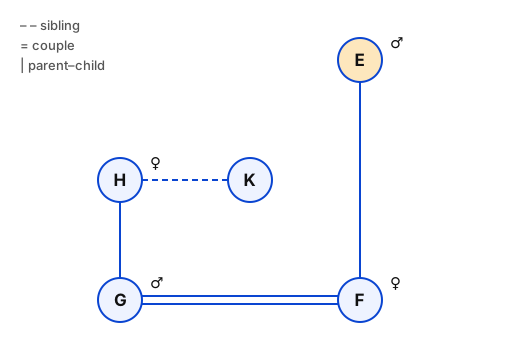
- E ÷ F: E is the father of F.
- F × G: F is the wife of G (F is female).
- G + H: G is the son of H. H – K: H is the sister of K.
- So from K: sister (H) → her son (G) → his wife (F) → her father (E).
Trick: Read the chain backwards from K: K's sister's son's wife's father.
Answer: (D) Sister's son's wife's father
अवधारणा: प्रत्येक चिह्न को बाएँ से दाएँ डिकोड कर वंश-वृक्ष बनाएँ।
- E ÷ F: E, F का पिता है।
- F × G: F, G की पत्नी है (F महिला)।
- G + H: G, H का पुत्र है। H – K: H, K की बहन है।
- K से: बहन (H) → उसका पुत्र (G) → उसकी पत्नी (F) → उसके पिता (E)।
ट्रिक: K से पीछे की ओर पढ़ें: बहन के पुत्र की पत्नी के पिता।
उत्तर: (D) Sister's son's wife's father (बहन के पुत्र की पत्नी के पिता)
RRB NTPC Graduate CBT 1General Intelligence and ReasoningBlood relations – codedRRB NTPC Graduate CBT 1 2024 · 21 Jun Shift 1
Q886.Each of the digits in the number 31879452 is arranged in the ascending order from left to right. Which of the following digits will be third from the left in the new number thus formed?
संख्या 31879452 के प्रत्येक अंक को बाएँ से दाएँ आरोही क्रम में व्यवस्थित किया जाता है। इस प्रकार बनी नई संख्या में बाएँ से तीसरा अंक निम्नलिखित में से कौन-सा होगा?
- A3
- B7
- C4
- D2
Show answer
Concept: Arrange all the digits in ascending order and count from the left.
- Digits of 31879452: 3, 1, 8, 7, 9, 4, 5, 2.
- Ascending: 1 2 3 4 5 7 8 9.
- Third from left = 3.
Trick: With no repeated digits, the 3rd from left in ascending order is simply the 3rd smallest digit.
Answer: (A) 3
अवधारणा: सभी अंकों को आरोही क्रम में लगाकर बाएँ से गिनें।
- 31879452 के अंक: 3, 1, 8, 7, 9, 4, 5, 2।
- आरोही क्रम: 1 2 3 4 5 7 8 9।
- बाएँ से तीसरा = 3।
ट्रिक: अंक दोहराए नहीं हैं, इसलिए बाएँ से तीसरा = तीसरा सबसे छोटा अंक।
उत्तर: (A) 3
RRB NTPC Graduate CBT 1General Intelligence and ReasoningDigit arrangementRRB NTPC Graduate CBT 1 2024 · 21 Jun Shift 1
Q887.What should come in place of the question mark (?) in the given series?
982 980 988 986 994 992 ?
दी गई श्रृंखला में प्रश्नचिह्न (?) के स्थान पर क्या आना चाहिए?
982 980 988 986 994 992 ?
- A996
- B1000
- C1002
- D998
Show answer
Concept: The series alternately subtracts 2 and adds 8.
- ,
- ,
- ,
Trick: Net change every two terms is : (every 3rd term) also rise by 6.
Answer: (B)
अवधारणा: श्रृंखला में बारी-बारी से 2 घटाया और 8 जोड़ा गया है।
- ,
- ,
- ,
ट्रिक: हर दो पदों में कुल बदलाव : भी 6-6 से बढ़ रहे हैं।
उत्तर: (B)
RRB NTPC Graduate CBT 1General Intelligence and ReasoningNumber SeriesRRB NTPC Graduate CBT 1 2024 · 21 Jun Shift 1
Q888.If ‘A’ stands for ‘÷’, ‘B’ stands for ‘×’, ‘C’ stands for ‘+’ and ‘D’ stands for ‘−’, then what will come in place of the question mark (?) in the following equation?
89 D 7 B 5 C (78 A 6) C 22 = ?
यदि 'A' का अर्थ '÷', 'B' का अर्थ '×', 'C' का अर्थ '+' और 'D' का अर्थ '−' है, तो निम्नलिखित समीकरण में प्रश्नचिह्न (?) के स्थान पर क्या आएगा?
89 D 7 B 5 C (78 A 6) C 22 = ?
- A105
- B74
- C89
- D97
Show answer
Concept: Replace the letters by signs, then apply BODMAS (bracket, division/multiplication, then addition/subtraction).
- Expression:
- Bracket: ; multiplication:
Trick: Write the converted expression fully before solving – most errors come from a wrong sign swap.
Answer: (C)
अवधारणा: अक्षरों की जगह चिह्न रखें और BODMAS (कोष्ठक, भाग/गुणा, फिर जोड़/घटाव) लगाएँ।
- व्यंजक:
- कोष्ठक: ; गुणा:
ट्रिक: हल करने से पहले पूरा बदला हुआ व्यंजक लिख लें – अधिकतर गलती चिह्न बदलने में होती है।
उत्तर: (C)
RRB NTPC Graduate CBT 1General Intelligence and ReasoningMathematical OperationsRRB NTPC Graduate CBT 1 2024 · 21 Jun Shift 1
Q889.This question is based on the five, three-digit numbers given below.
(Left) 917 782 549 557 539 (Right)
(Example- 697 – First digit = 6, second digit = 9 and third digit = 7)
(NOTE: All operations to be done from left to right.)
What will be the resultant if the first digit of the highest number is added to the second digit of the lowest number?
यह प्रश्न नीचे दी गई तीन अंकों वाली पाँच संख्याओं पर आधारित है।
(बाएँ) 917 782 549 557 539 (दाएँ)
(उदाहरण- 697 – पहला अंक = 6, दूसरा अंक = 9 और तीसरा अंक = 7)
(नोट: सभी संक्रियाएँ बाएँ से दाएँ की जानी हैं।)
यदि सबसे बड़ी संख्या के पहले अंक को सबसे छोटी संख्या के दूसरे अंक में जोड़ा जाए, तो परिणाम क्या होगा?
- A13
- B12
- C11
- D15
Show answer
Concept: Find the highest and lowest numbers first, then pick the required digits.
- Highest number: → first digit
- Lowest number: → second digit
Trick: Compare 549, 557, 539 by the middle digit: , so 539 is lowest.
Answer: (B)
अवधारणा: पहले सबसे बड़ी और सबसे छोटी संख्या पहचानें, फिर आवश्यक अंक लें।
- सबसे बड़ी संख्या: → पहला अंक
- सबसे छोटी संख्या: → दूसरा अंक
ट्रिक: 549, 557, 539 में बीच वाले अंक की तुलना करें: , अतः 539 सबसे छोटी है।
उत्तर: (B)
RRB NTPC Graduate CBT 1General Intelligence and ReasoningNumber OperationsRRB NTPC Graduate CBT 1 2024 · 21 Jun Shift 1
Q890.Select the set in which the numbers are related in the same way as are the numbers of the following sets.
(NOTE: Operations should be performed on the whole numbers, without breaking down the numbers into their constituent digits. E.g. 13 – Operations on 13 such as adding to/subtracting from/multiplying with 13 can be performed. Breaking down 13 into 1 and 3 and then performing mathematical operations on 1 and 3 is not allowed.)
(57, 41, 32)
(65, 49, 40)
उस समुच्चय का चयन कीजिए जिसमें संख्याएँ उसी प्रकार संबंधित हैं, जिस प्रकार निम्नलिखित समुच्चयों की संख्याएँ संबंधित हैं।
(नोट: संख्याओं को उनके घटक अंकों में तोड़े बिना, पूर्ण संख्याओं पर संक्रियाएँ की जानी चाहिए। उदाहरण के लिए 13 – 13 पर संक्रियाएँ जैसे 13 में जोड़ना/13 में से घटाना/13 से गुणा करना आदि किया जा सकता है। 13 को 1 और 3 में तोड़ना और फिर 1 और 3 पर गणितीय संक्रियाएँ करने की अनुमति नहीं है।)
(57, 41, 32)
(65, 49, 40)
- A(51, 35, 16)
- B(72, 56, 47)
- C(89, 83, 74)
- D(96, 80, 61)
Show answer
Concept: In each set, second first and third second .
- : ,
- : ,
- : , ✓
- Others fail: e.g. :
Trick: Check the differences between consecutive numbers: they must be 16 and 9.
Answer: (B)
अवधारणा: हर समुच्चय में दूसरी संख्या पहली और तीसरी दूसरी ।
- : ,
- : ,
- : , ✓
- बाकी गलत: जैसे :
ट्रिक: क्रमागत संख्याओं का अंतर देखें: 16 और 9 होना चाहिए।
उत्तर: (B)
RRB NTPC Graduate CBT 1General Intelligence and ReasoningNumber Analogy (Sets)RRB NTPC Graduate CBT 1 2024 · 21 Jun Shift 1
Q891.A, B, L, M, S, T and Z are sitting around a circular table facing the centre. Only four people sit between M and T when counted from the right of M. M sits third to the left of L. S sits third to the left of Z. B is an immediate neighbour of both T and L. How many people sit between A and B when counted from the right of A?
A, B, L, M, S, T और Z एक वृत्ताकार मेज़ के चारों ओर केंद्र की ओर मुख करके बैठे हैं। M के दाईं ओर से गिनने पर M और T के बीच केवल चार व्यक्ति बैठे हैं। M, L के बाईं ओर तीसरे स्थान पर बैठा है। S, Z के बाईं ओर तीसरे स्थान पर बैठा है। B, T और L दोनों का निकटतम पड़ोसी है। A के दाईं ओर से गिनने पर A और B के बीच कितने व्यक्ति बैठे हैं?
- A2
- B1
- C3
- D4
Show answer
Concept: When people face the centre, 'left' is clockwise and 'right' is anticlockwise.
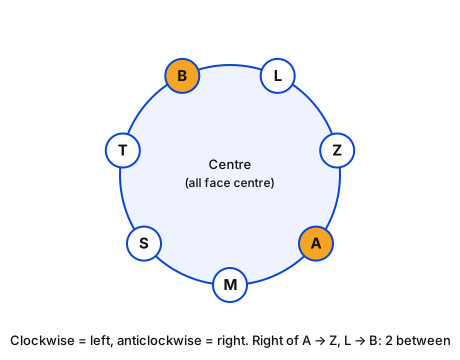
- M third to the left of L and four people between M and T (from M's right) fix M, T, L with B between T and L.
- S third to the left of Z places S next to M and Z next to L; A takes the last seat.
- Clockwise order: M, S, T, B, L, Z, A.
- From the right of A (anticlockwise): Z, L, then B → 2 people.
Trick: Draw the circle and fix the person with the most clues (M) first.
Answer: (A)
अवधारणा: जब सभी केंद्र की ओर मुख करें, तो 'बाएँ' = दक्षिणावर्त और 'दाएँ' = वामावर्त।
- M, L के बाएँ तीसरे स्थान पर और M के दाएँ से M व T के बीच चार लोग → M, T, L तय; B, T और L के बीच।
- S, Z के बाएँ तीसरे → S, M के पास और Z, L के पास; A अंतिम सीट पर।
- दक्षिणावर्त क्रम: M, S, T, B, L, Z, A।
- A के दाएँ (वामावर्त) से: Z, L, फिर B → 2 व्यक्ति।
ट्रिक: वृत्त बनाएँ और सबसे अधिक संकेत वाले व्यक्ति (M) को पहले बैठाएँ।
उत्तर: (A)
RRB NTPC Graduate CBT 1General Intelligence and ReasoningCircular Seating ArrangementRRB NTPC Graduate CBT 1 2024 · 21 Jun Shift 1
Q892.Which of the following letter-number clusters will replace the question mark (?) in the given series to make it logically complete?
JCH34 KDI43 LEJ52 MFK61 ?
निम्नलिखित में से कौन-सा अक्षर-संख्या समूह दी गई श्रृंखला में प्रश्नचिह्न (?) को प्रतिस्थापित करके उसे तार्किक रूप से पूर्ण करेगा?
JCH34 KDI43 LEJ52 MFK61 ?
- ANGK71
- BNGK70
- CNGL71
- DNGL70
Show answer
Concept: Each letter moves one step forward and the number increases by 9 every time.
- First letters: J, K, L, M → N
- Second letters: C, D, E, F → G
- Third letters: H, I, J, K → L
- Numbers: (+9 each) →
Trick: All three letters move +1; number +9 → NGL70.
Answer: (D) NGL70
अवधारणा: हर अक्षर एक-एक आगे बढ़ता है और संख्या हर बार 9 बढ़ती है।
- पहले अक्षर: J, K, L, M → N
- दूसरे अक्षर: C, D, E, F → G
- तीसरे अक्षर: H, I, J, K → L
- संख्याएँ: (+9) →
ट्रिक: तीनों अक्षर +1, संख्या +9 → NGL70।
उत्तर: (D) NGL70
RRB NTPC Graduate CBT 1General Intelligence and ReasoningAlphanumeric SeriesRRB NTPC Graduate CBT 1 2024 · 21 Jun Shift 1
Q893.Mr. IJK starts from Point A and drives 23 km towards the south. He then takes a right turn, drives 3 km, turns right and drives 27 km. He then takes a right turn and drives 7 km. He takes a final right turn, drives 4 km and stops at Point P. How far (shortest distance) and in which direction should he drive in order to reach Point A again? (All turns are 90-degree turns only unless specified)
श्री IJK बिंदु A से चलना शुरू करते हैं और दक्षिण की ओर 23 km ड्राइव करते हैं। फिर वह दाएँ मुड़ते हैं, 3 km ड्राइव करते हैं, दाएँ मुड़ते हैं और 27 km ड्राइव करते हैं। फिर वह दाएँ मुड़ते हैं और 7 km ड्राइव करते हैं। वह अंतिम बार दाएँ मुड़ते हैं, 4 km ड्राइव करते हैं और बिंदु P पर रुक जाते हैं। फिर से बिंदु A पर पहुँचने के लिए उन्हें कितनी दूर (न्यूनतम दूरी) और किस दिशा में ड्राइव करना चाहिए? (जब तक निर्दिष्ट न किया जाए, सभी मोड़ केवल 90 डिग्री के मोड़ हैं)
- A2 km to the eastपूर्व की ओर 2 km
- B4 km to the westपश्चिम की ओर 4 km
- C1 km to the northउत्तर की ओर 1 km
- D3 km to the southदक्षिण की ओर 3 km
Show answer
Concept: Track position with east–west and north–south totals; a right turn while facing south means facing west, and so on.
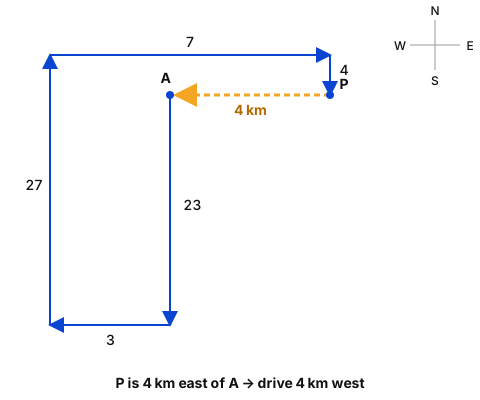
- South 23 km; right → west 3 km; right → north 27 km.
- Right → east 7 km; right → south 4 km to P.
- East–west: km east; north–south: .
- P is 4 km east of A, so he must drive 4 km west.
Trick: Net north–south is zero, so the answer is only the east–west difference .
Answer: (B) 4 km to the west
अवधारणा: पूर्व–पश्चिम और उत्तर–दक्षिण का कुल अलग-अलग जोड़ें; दक्षिण की ओर मुख करके दाएँ मुड़ने पर पश्चिम, आदि।
- दक्षिण 23 km; दाएँ → पश्चिम 3 km; दाएँ → उत्तर 27 km।
- दाएँ → पूर्व 7 km; दाएँ → दक्षिण 4 km, P पर।
- पूर्व–पश्चिम: km पूर्व; उत्तर–दक्षिण: ।
- P, A से 4 km पूर्व में है, अतः 4 km पश्चिम जाना होगा।
ट्रिक: उत्तर–दक्षिण का कुल शून्य है, इसलिए उत्तर केवल है।
उत्तर: (B) 4 km पश्चिम की ओर
RRB NTPC Graduate CBT 1General Intelligence and ReasoningDirection and DistanceRRB NTPC Graduate CBT 1 2024 · 21 Jun Shift 1
Q894.If 1 is added to each even digit and 2 is subtracted from each odd digit in the number 72384596, how many digits will appear more than once in the new number thus formed?
यदि संख्या 72384596 में प्रत्येक सम अंक में 1 जोड़ दिया जाए और प्रत्येक विषम अंक में से 2 घटा दिया जाए, तो इस प्रकार बनी नई संख्या में कितने अंक एक से अधिक बार आएँगे?
- AFourचार
- BOneएक
- CThreeतीन
- DTwoदो
Show answer
Concept: Change every digit as per the rule, then count digits that repeat.
- Odd , even :
- Repeated digits: 5, 3 and 7 → three
Trick: Write the new digit directly under each old digit to avoid skipping one.
Answer: (C) Three
अवधारणा: हर अंक को नियम के अनुसार बदलें और दोहराए गए अंक गिनें।
- विषम , सम :
- दोहराए अंक: 5, 3 और 7 → तीन
ट्रिक: हर पुराने अंक के नीचे नया अंक लिखें, कोई अंक नहीं छूटेगा।
उत्तर: (C) तीन
RRB NTPC Graduate CBT 1General Intelligence and ReasoningDigit OperationsRRB NTPC Graduate CBT 1 2024 · 21 Jun Shift 1
Q895.In a certain code language, ‘BACK’ is coded as ‘5314’ and ‘CARB’ is coded as ‘1524’. What is the code for ‘R’ in the given code language?
एक निश्चित कूट भाषा में, 'BACK' को '5314' के रूप में कूटबद्ध किया जाता है और 'CARB' को '1524' के रूप में कूटबद्ध किया जाता है। दी गई कूट भाषा में 'R' के लिए कूट क्या है?
- A1
- B2
- C5
- D4
Show answer
Concept: Letter codes are jumbled; match common letters with common digits.
- BACK → 5, 3, 1, 4; CARB → 1, 5, 2, 4
- Common letters B, A, C ↔ common digits 5, 1, 4
- BACK's extra letter K ↔ extra digit 3; CARB's extra letter R ↔ extra digit 2
- So R
Trick: Unique letter ↔ unique digit.
Answer: (B)
अवधारणा: अक्षरों के कोड क्रम में नहीं हैं; समान अक्षरों को समान अंकों से मिलाएँ।
- BACK → 5, 3, 1, 4; CARB → 1, 5, 2, 4
- समान अक्षर B, A, C ↔ समान अंक 5, 1, 4
- BACK का अलग अक्षर K ↔ अलग अंक 3; CARB का अलग अक्षर R ↔ अलग अंक 2
- अतः R
ट्रिक: अलग अक्षर ↔ अलग अंक।
उत्तर: (B)
RRB NTPC Graduate CBT 1General Intelligence and ReasoningCoding-DecodingRRB NTPC Graduate CBT 1 2024 · 21 Jun Shift 1
Q896.Read the given statements and conclusions carefully. Assuming that the information given in the statements is true, even if it appears to be at variance with commonly known facts, decide which of the given conclusion(s) logically follow(s) from the statements.
Statements:
All terraces are lawns.
All lawns are grounds.
No ground is a field.
Conclusions:
(I) No terrace is a field.
(II) Some grounds are terraces.
दिए गए कथनों और निष्कर्षों को ध्यानपूर्वक पढ़िए। यह मानते हुए कि कथनों में दी गई जानकारी सत्य है, भले ही वह सामान्य रूप से ज्ञात तथ्यों से भिन्न प्रतीत होती हो, निर्णय कीजिए कि दिए गए निष्कर्षों में से कौन-सा/से निष्कर्ष तार्किक रूप से कथनों का अनुसरण करता है/करते हैं।
कथन:
सभी छतें, लॉन हैं।
सभी लॉन, मैदान हैं।
कोई मैदान, खेत नहीं है।
निष्कर्ष:
(I) कोई छत, खेत नहीं है।
(II) कुछ मैदान, छतें हैं।
- AOnly conclusion (I) follows.केवल निष्कर्ष (I) अनुसरण करता है।
- BBoth conclusions (I) and (II) follow.निष्कर्ष (I) और (II) दोनों अनुसरण करते हैं।
- CNeither conclusion (I) nor (II) follows.न तो निष्कर्ष (I) और न ही (II) अनुसरण करता है।
- DOnly conclusion (II) follows.केवल निष्कर्ष (II) अनुसरण करता है।
Show answer
Concept: Draw the smallest possible Venn diagram satisfying all statements.
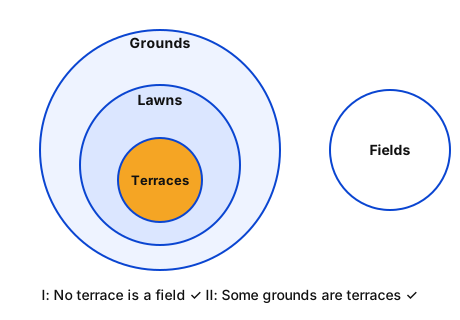
- Terraces lie inside Lawns, Lawns inside Grounds.
- Fields lie completely outside Grounds, so outside Terraces too → I: No terrace is a field ✓.
- All terraces are grounds → Some grounds are terraces ✓ (conversion).
Trick: All A are B + No B is C ⇒ No A is C; All A are B ⇒ Some B are A.
Answer: (B) Both conclusions (I) and (II) follow.
अवधारणा: सभी कथनों को संतुष्ट करने वाला वेन आरेख बनाएँ।
- Terraces, Lawns के अंदर और Lawns, Grounds के अंदर।
- Fields पूरी तरह Grounds के बाहर, अतः Terraces के भी बाहर → I: कोई terrace field नहीं ✓।
- सभी terraces grounds हैं → कुछ grounds terraces हैं ✓ (परिवर्तन)।
ट्रिक: सभी A, B हैं + कोई B, C नहीं ⇒ कोई A, C नहीं; सभी A, B ⇒ कुछ B, A हैं।
उत्तर: (B) निष्कर्ष (I) और (II) दोनों अनुसरण करते हैं।
RRB NTPC Graduate CBT 1General Intelligence and ReasoningSyllogismRRB NTPC Graduate CBT 1 2024 · 21 Jun Shift 1
Q897.Mr. O starts from Point U and drives 1 km towards the west. He then takes a left turn, drives 2 km, turns right and drives 3 km. He then takes a left turn and drives 4 km. He then takes a left turn, drives 4 km. He takes a final left turn, drives 4 km and stops at Point V. How far (shortest distance) and towards which direction should he drive in order to reach Point U again? (All turns are 90-degree turns only unless specified.)
श्री O बिंदु U से चलना शुरू करते हैं और पश्चिम की ओर 1 km ड्राइव करते हैं। फिर वह बाएँ मुड़ते हैं, 2 km ड्राइव करते हैं, दाएँ मुड़ते हैं और 3 km ड्राइव करते हैं। फिर वह बाएँ मुड़ते हैं और 4 km ड्राइव करते हैं। फिर वह बाएँ मुड़ते हैं, 4 km ड्राइव करते हैं। वह अंतिम बार बाएँ मुड़ते हैं, 4 km ड्राइव करते हैं और बिंदु V पर रुक जाते हैं। फिर से बिंदु U पर पहुँचने के लिए उन्हें कितनी दूर (न्यूनतम दूरी) और किस दिशा की ओर ड्राइव करना चाहिए? (जब तक निर्दिष्ट न किया जाए, सभी मोड़ केवल 90 डिग्री के मोड़ हैं।)
- A2 km towards the westपश्चिम की ओर 2 km
- B4 km towards the eastपूर्व की ओर 4 km
- C4 km towards the southदक्षिण की ओर 4 km
- D2 km towards the northउत्तर की ओर 2 km
Show answer
Concept: Find each new facing direction after every turn and add the east–west and north–south moves.
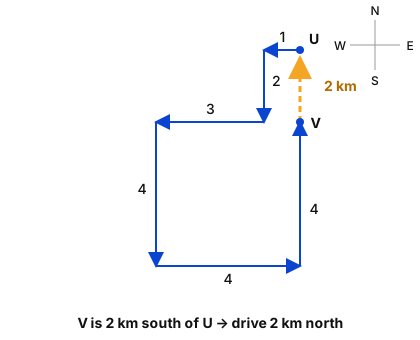
- West 1; left → south 2; right → west 3.
- Left → south 4; left → east 4; left → north 4 to V.
- East–west: ; north–south: .
- V is 2 km south of U → drive 2 km north.
Trick: East–west cancels out, so only the vertical gap (2 km) matters.
Answer: (D) 2 km towards the north
अवधारणा: हर मोड़ के बाद नई दिशा निकालें और पूर्व–पश्चिम व उत्तर–दक्षिण की दूरी अलग जोड़ें।
- पश्चिम 1; बाएँ → दक्षिण 2; दाएँ → पश्चिम 3।
- बाएँ → दक्षिण 4; बाएँ → पूर्व 4; बाएँ → उत्तर 4, V पर।
- पूर्व–पश्चिम: ; उत्तर–दक्षिण: ।
- V, U से 2 km दक्षिण में → 2 km उत्तर जाना होगा।
ट्रिक: पूर्व–पश्चिम कट जाता है, केवल ऊर्ध्व अंतर (2 km) बचता है।
उत्तर: (D) 2 km उत्तर की ओर
RRB NTPC Graduate CBT 1General Intelligence and ReasoningDirection and DistanceRRB NTPC Graduate CBT 1 2024 · 21 Jun Shift 1
Q898.Each of P, Q, R, S, T, U and V has an exam on a different day of a week, starting from Monday and ending on Sunday of the same week. T has an exam on Thursday. U has an exam immediately before T and P has an exam immediately after T. Only 3 people have exams between Q and V. R has an exam immediately after V. How many people have exams before Q?
P, Q, R, S, T, U और V में से प्रत्येक की एक ही सप्ताह के सोमवार से शुरू होकर रविवार को समाप्त होने वाले सप्ताह के अलग-अलग दिन परीक्षा है। T की परीक्षा गुरुवार को है। U की परीक्षा T से ठीक पहले है और P की परीक्षा T के ठीक बाद है। Q और V के बीच केवल 3 व्यक्तियों की परीक्षाएँ हैं। R की परीक्षा V के ठीक बाद है। Q से पहले कितने व्यक्तियों की परीक्षाएँ हैं?
- A3
- B4
- C2
- D1
Show answer
Concept: Fix the definite clues first, then test the remaining days.
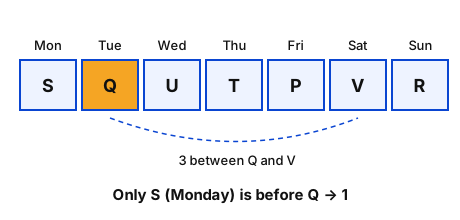
- T – Thursday, U – Wednesday, P – Friday.
- Left: Mon, Tue, Sat, Sun. V and R are consecutive with 3 people between Q and V.
- V–R on Mon–Tue would need Q on Friday (taken); so V Saturday, R Sunday, Q Tuesday, S Monday.
- Only S is before Q → 1.
Trick: For '3 between', the two days are 4 apart – Tue and Sat.
Answer: (D)
अवधारणा: पहले निश्चित संकेत लगाएँ, फिर बचे दिनों को जाँचें।
- T – गुरुवार, U – बुधवार, P – शुक्रवार।
- बचे: सोम, मंगल, शनि, रवि। V और R लगातार; Q और V के बीच 3 लोग।
- V–R सोम–मंगल पर हों तो Q शुक्रवार (भरा) होगा; अतः V शनिवार, R रविवार, Q मंगलवार, S सोमवार।
- Q से पहले केवल S → 1।
ट्रिक: 'बीच में 3' का अर्थ दिनों में 4 का अंतर – मंगल और शनि।
उत्तर: (D)
RRB NTPC Graduate CBT 1General Intelligence and ReasoningScheduling PuzzleRRB NTPC Graduate CBT 1 2024 · 21 Jun Shift 1
Q899.Which of the following letter-clusters should replace # and % so that the pattern and relationship followed between the letter-cluster pair on the left side of :: is the same as that on the right side of :: ?
# : PZL :: AKW : %
निम्नलिखित में से कौन-से अक्षर-समूह # और % को प्रतिस्थापित करेंगे, ताकि :: के बाईं ओर के अक्षर-समूह युग्म के बीच अनुसरित पैटर्न और संबंध वही हो, जो :: के दाईं ओर है?
# : PZL :: AKW : %
- A# = URD, % = ISE
- B# = HRD, % = LSE
- C# = HRD, % = ISE
- D# = HRD, % = ISO
Show answer
Concept: Find the letter shift in a pair and apply the same shift to the other pair.
- Try # = HRD: H=P, R=Z, D=L → PZL ✓
- Apply to AKW: A→I, K→S, W→E (wrap after Z)
- So % = ISE
Trick: Positions: H(8)→P(16), W(23)=E.
Answer: (C) # = HRD, % = ISE
अवधारणा: एक जोड़ी में अक्षरों का खिसकाव निकालें और वही दूसरी जोड़ी पर लगाएँ।
- # = HRD लें: H=P, R=Z, D=L → PZL ✓
- AKW पर : A→I, K→S, W→E (Z के बाद फिर A से)
- अतः % = ISE
ट्रिक: स्थान: H(8)→P(16), W(23)=E।
उत्तर: (C) # = HRD, % = ISE
RRB NTPC Graduate CBT 1General Intelligence and ReasoningLetter AnalogyRRB NTPC Graduate CBT 1 2024 · 21 Jun Shift 1
Q900.Based on the English alphabetical order, three of the following four letter-cluster pairs are alike in a certain way and thus form a group. Which letter-cluster pair DOES NOT belong to that group?
(Note: The odd one out is not based on the number of consonants/vowels or their position in the letter-cluster.)
अंग्रेज़ी वर्णमाला क्रम के आधार पर, निम्नलिखित चार अक्षर-समूह युग्मों में से तीन किसी निश्चित तरीके से एकसमान हैं और इस प्रकार एक समूह बनाते हैं। कौन-सा अक्षर-समूह युग्म उस समूह से संबंधित नहीं है?
(नोट: असंगत युग्म, व्यंजनों/स्वरों की संख्या या अक्षर-समूह में उनके स्थान पर आधारित नहीं है।)
- AGK - JN
- BEI - HL
- CML - KJ
- DLP - OS
Show answer
Concept: Compare each letter of the first cluster with the matching letter of the second.
- GK - JN: G=J, K=N
- EI - HL: , ; LP - OS: ,
- ML - KJ: M=K, L=J → different
Trick: Three pairs move forward by 3; ML - KJ moves backward by 2.
Answer: (C) ML - KJ
अवधारणा: पहले समूह के हर अक्षर की तुलना दूसरे समूह के संगत अक्षर से करें।
- GK - JN: G=J, K=N
- EI - HL: , ; LP - OS: ,
- ML - KJ: M=K, L=J → अलग
ट्रिक: तीन जोड़े 3 आगे; ML - KJ 2 पीछे।
उत्तर: (C) ML - KJ
RRB NTPC Graduate CBT 1General Intelligence and ReasoningOdd One Out – LettersRRB NTPC Graduate CBT 1 2024 · 21 Jun Shift 1

