Q901.Refer to the following number and symbol series and answer the question that follows. Counting to be done from left to right only.
(Left) £ @ 5 6 3 © & 4 9 % * $ $ % 6 & # & € © 5 8 (Right)
How many such numbers are there each of which is immediately preceded by a symbol and also immediately followed by a symbol?
निम्नलिखित संख्या और प्रतीक श्रृंखला को देखिए और उसके बाद दिए गए प्रश्न का उत्तर दीजिए। गिनती केवल बाएँ से दाएँ की जानी है।
(बाएँ) £ @ 5 6 3 © & 4 9 % * $ $ % 6 & # & € © 5 8 (दाएँ)
ऐसी कितनी संख्याएँ हैं जिनमें से प्रत्येक के ठीक पहले एक प्रतीक है और ठीक बाद भी एक प्रतीक है?
- A3
- B2
- C0
- D1
Show answer
Concept: Check every number: the element just before it and just after it must both be symbols.
- Numbers in order: 5, 6, 3, 4, 9, 6, 5, 8.
- 5 (after @) is followed by 6 – no; 3 and 9 are preceded by numbers – no; 4 is followed by 9 – no.
- 6 in '% 6 &' has symbols on both sides – yes; 5 in '© 5 8' is followed by 8 – no; 8 is the last element.
Trick: Scan only numbers that start a number-run of length 1 – a single number sandwiched between symbols.
Answer: (D) 1
अवधारणा: हर संख्या के ठीक पहले और ठीक बाद वाला तत्व देखें – दोनों प्रतीक होने चाहिए।
- संख्याएँ क्रम से: 5, 6, 3, 4, 9, 6, 5, 8।
- @ के बाद वाला 5, आगे 6 – नहीं; 3 और 9 से पहले संख्या – नहीं; 4 के बाद 9 – नहीं।
- '% 6 &' वाला 6 दोनों ओर प्रतीक – हाँ; '© 5 8' में 5 के बाद 8 – नहीं; 8 अंतिम है।
ट्रिक: केवल वही संख्या गिनें जो अकेली हो और दोनों तरफ प्रतीक से घिरी हो।
उत्तर: (D) 1
RRB NTPC Graduate CBT 1General Intelligence and ReasoningNumber–symbol seriesRRB NTPC Graduate CBT 1 2024 · 12 Jun Shift 2
Q902.A, B, C, D, E and F live on six different floors of the same building. The lowermost floor in the building is numbered 1, the floor above it, number 2 and so on, till the topmost floor is numbered 6. B lives on a floor that is a prime number. The product of floors on which B and D live is 3. Only 2 people live above C. F lives immediately below A. How many people live between A and C?
A, B, C, D, E और F एक ही इमारत की छह अलग-अलग मंज़िलों पर रहते हैं। इमारत की सबसे निचली मंज़िल की संख्या 1 है, उसके ऊपर वाली मंज़िल की संख्या 2 है और इसी प्रकार सबसे ऊपरी मंज़िल की संख्या 6 है। B उस मंज़िल पर रहता है जो एक अभाज्य संख्या है। B और D जिन मंज़िलों पर रहते हैं, उनका गुणनफल 3 है। C के ऊपर केवल 2 व्यक्ति रहते हैं। F, A के ठीक नीचे रहता है। A और C के बीच कितने व्यक्ति रहते हैं?
- A2
- B1
- C3
- D4
Show answer
Concept: Fix the sure clues first (product, 'only 2 above'), then place the pair clue.
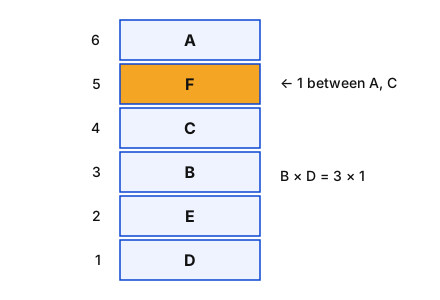
- B is on a prime floor and , so .
- Only 2 people above C → C is on floor 4.
- F immediately below A: free floors are 2, 5, 6 → F = 5, A = 6; E = 2.
- Between A (6) and C (4) only F lives → 1 person.
Trick: Product clues like fix two people at once – always start there.
Answer: (B) 1
अवधारणा: पहले पक्के संकेत (गुणनफल, 'ऊपर केवल 2') लगाएँ, फिर जोड़ी वाला संकेत।
- B अभाज्य मंज़िल पर और , अतः ।
- C के ऊपर केवल 2 लोग → C मंज़िल 4 पर।
- F, A के ठीक नीचे: खाली मंज़िल 2, 5, 6 → F = 5, A = 6; E = 2।
- A (6) और C (4) के बीच केवल F → 1 व्यक्ति।
ट्रिक: जैसे गुणनफल संकेत एक साथ दो लोगों को तय कर देते हैं – वहीं से शुरू करें।
उत्तर: (B) 1
RRB NTPC Graduate CBT 1General Intelligence and ReasoningFloor-based puzzleRRB NTPC Graduate CBT 1 2024 · 12 Jun Shift 2
Q903.Which of the following letter-number clusters will replace the question mark (?) in the given series to make it logically complete?
GM17, IO25, KQ33, MS41, ?
निम्नलिखित में से कौन-सा अक्षर-संख्या समूह दी गई श्रृंखला में प्रश्न चिह्न (?) के स्थान पर आकर उसे तार्किक रूप से पूर्ण करेगा?
GM17, IO25, KQ33, MS41, ?
- AOU49
- BOU48
- COV49
- DOV48
Show answer
Concept: Track the first letter, second letter and number separately.
- 1st letters: G, I, K, M → +2 each → O.
- 2nd letters: M, O, Q, S → +2 each → U.
- Numbers: 17, 25, 33, 41 → +8 each → 49.
Trick: Three independent +2, +2, +8 patterns – check the number first to eliminate options fast.
Answer: (A) OU49
अवधारणा: पहला अक्षर, दूसरा अक्षर और संख्या अलग-अलग देखें।
- पहले अक्षर: G, I, K, M → +2 → O।
- दूसरे अक्षर: M, O, Q, S → +2 → U।
- संख्याएँ: 17, 25, 33, 41 → +8 → 49।
ट्रिक: तीन स्वतंत्र पैटर्न +2, +2, +8 – पहले संख्या से विकल्प हटाएँ।
उत्तर: (A) OU49
RRB NTPC Graduate CBT 1General Intelligence and ReasoningLetter-number seriesRRB NTPC Graduate CBT 1 2024 · 12 Jun Shift 2
Q904.Read the given statements and conclusions carefully. Assuming that the information given in the statements is true, even if it appears to be at variance with commonly known facts, decide which of the given conclusion(s) logically follow(s) from the statements.
Statements:
Some trees are flowers.
All flowers are beautiful.
Some beautiful are girls.
Conclusions:
(I) Some flowers are trees.
(II) Some beautiful are flowers.
दिए गए कथनों और निष्कर्षों को ध्यानपूर्वक पढ़िए। कथनों में दी गई जानकारी को सत्य मानते हुए, भले ही वह सामान्य रूप से ज्ञात तथ्यों से भिन्न प्रतीत होती हो, निर्णय कीजिए कि दिए गए निष्कर्षों में से कौन-सा/कौन-से निष्कर्ष कथनों का तार्किक रूप से अनुसरण करता है/करते हैं।
कथन:
कुछ पेड़, फूल हैं।
सभी फूल, सुंदर हैं।
कुछ सुंदर, लड़कियाँ हैं।
निष्कर्ष:
(I) कुछ फूल, पेड़ हैं।
(II) कुछ सुंदर, फूल हैं।
- AOnly conclusion (I) follows.केवल निष्कर्ष (I) अनुसरण करता है।
- BOnly conclusion (II) follows.केवल निष्कर्ष (II) अनुसरण करता है।
- CBoth conclusions (I) and (II) follow.निष्कर्ष (I) और (II) दोनों अनुसरण करते हैं।
- DNeither conclusion (I) nor (II) follows.न तो निष्कर्ष (I) और न ही (II) अनुसरण करता है।
Show answer
Concept: A 'Some' statement and an 'All' statement both give valid 'Some' conversions.
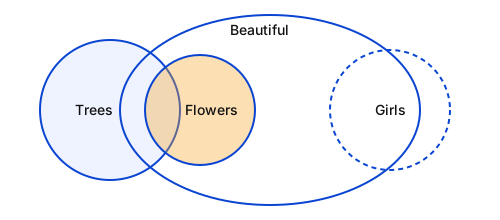
- 'Some trees are flowers' converts to 'Some flowers are trees' → (I) follows.
- 'All flowers are beautiful' → 'Some beautiful are flowers' → (II) follows.
- The 'girls' statement is not needed.
Yaad rakhein: Some A are B ⇔ Some B are A; All A are B ⇒ Some B are A.
Answer: (C) Both conclusions (I) and (II) follow.
अवधारणा: 'कुछ' कथन और 'सभी' कथन – दोनों से वैध 'कुछ' रूपांतरण बनता है।
- 'कुछ पेड़ फूल हैं' → 'कुछ फूल पेड़ हैं' → (I) अनुसरण करता है।
- 'सभी फूल सुंदर हैं' → 'कुछ सुंदर फूल हैं' → (II) अनुसरण करता है।
- 'लड़कियाँ' वाला कथन आवश्यक नहीं।
ट्रिक: कुछ A, B हैं ⇔ कुछ B, A हैं; सभी A, B हैं ⇒ कुछ B, A हैं।
उत्तर: (C) निष्कर्ष (I) और (II) दोनों
RRB NTPC Graduate CBT 1General Intelligence and ReasoningSyllogismRRB NTPC Graduate CBT 1 2024 · 12 Jun Shift 2
Q905.Refer to the following number and symbol series and answer the question that follows. Counting to be done from left to right only.
(Left) £ % * 3 6 £ 1 © & 8 1 5 5 3 * # © 7 1 7 3 @ (Right)
How many such symbols are there each of which is immediately preceded by a number and also immediately followed by a number?
निम्नलिखित संख्या और प्रतीक श्रृंखला को देखिए और उसके बाद दिए गए प्रश्न का उत्तर दीजिए। गिनती केवल बाएँ से दाएँ की जानी है।
(बाएँ) £ % * 3 6 £ 1 © & 8 1 5 5 3 * # © 7 1 7 3 @ (दाएँ)
ऐसे कितने प्रतीक हैं जिनमें से प्रत्येक के ठीक पहले एक संख्या है और ठीक बाद भी एक संख्या है?
- A1
- B0
- C3
- D2
Show answer
Concept: For each symbol, both neighbours must be numbers.
- '6 £ 1' → £ has numbers on both sides – yes.
- '1 © &', '3 * #', '# © 7' → one neighbour is a symbol – no.
- Leading '£ % *' and final '@' fail.
Trick: Look only for the pattern number–symbol–number.
Answer: (A) 1
अवधारणा: हर प्रतीक के दोनों पड़ोसी संख्याएँ होनी चाहिए।
- '6 £ 1' → £ के दोनों ओर संख्या – हाँ।
- '1 © &', '3 * #', '# © 7' → एक ओर प्रतीक – नहीं।
- शुरुआत के '£ % *' और अंतिम '@' भी नहीं।
ट्रिक: केवल 'संख्या–प्रतीक–संख्या' पैटर्न खोजें।
उत्तर: (A) 1
RRB NTPC Graduate CBT 1General Intelligence and ReasoningNumber–symbol seriesRRB NTPC Graduate CBT 1 2024 · 12 Jun Shift 2
Q906.What will come in the place of ‘?’ in the following equation, if ‘+’ and ‘−‘ are
interchanged and ‘×’ and ‘÷’ are interchanged?
45 ÷ 12 − 75 × 5 + 13 = ?
यदि '+' और '−' को आपस में बदल दिया जाए तथा '×' और '÷' को आपस में
बदल दिया जाए, तो निम्नलिखित समीकरण में '?' के स्थान पर क्या आएगा?
45 ÷ 12 − 75 × 5 + 13 = ?
- A546
- B542
- C545
- D544
Show answer
Concept: Swap the signs first, then apply BODMAS.
- After swapping:
Trick: Rewrite the whole expression with new signs before calculating – avoids mixing old and new signs.
Answer: (B) 542
अवधारणा: पहले चिह्न बदलें, फिर BODMAS लगाएँ।
- बदलने के बाद:
ट्रिक: गणना से पहले पूरा व्यंजक नए चिह्नों से लिख लें।
उत्तर: (B) 542
RRB NTPC Graduate CBT 1General Intelligence and ReasoningMathematical operationsRRB NTPC Graduate CBT 1 2024 · 12 Jun Shift 2
Q907.Shubham ranked 19th from the top and 46th from the bottom in his class. How many students are there in his class?
शुभम की अपनी कक्षा में ऊपर से 19वाँ और नीचे से 46वाँ स्थान है। उसकी कक्षा में कितने विद्यार्थी हैं?
- A62
- B65
- C63
- D64
Show answer
Concept: Total = rank from top + rank from bottom − 1.
Trick: Subtract 1 because the person is counted twice.
Answer: (D) 64
अवधारणा: कुल = ऊपर से रैंक + नीचे से रैंक − 1।
ट्रिक: व्यक्ति दो बार गिना जाता है, इसलिए 1 घटाएँ।
उत्तर: (D) 64
RRB NTPC Graduate CBT 1General Intelligence and ReasoningRankingRRB NTPC Graduate CBT 1 2024 · 12 Jun Shift 2
Q908.Which of the following letter-number-clusters will replace the question mark (?) in the given series to make it logically complete?
VRO 6, UQN 11, TPM 16, SOL 21, ?
निम्नलिखित में से कौन-सा अक्षर-संख्या समूह दी गई श्रृंखला में प्रश्न चिह्न (?) के स्थान पर आकर उसे तार्किक रूप से पूर्ण करेगा?
VRO 6, UQN 11, TPM 16, SOL 21, ?
- ARPM 25
- BPQM 25
- CRNK 26
- DPRN 26
Show answer
Concept: Each letter moves back by 1; the number rises by 5.
- 1st letters V, U, T, S → R.
- 2nd letters R, Q, P, O → N.
- 3rd letters O, N, M, L → K.
- Numbers 6, 11, 16, 21 → 26.
Trick: Option check by number first: only RNK 26 and PRN 26 have 26; letters −1 give RNK.
Answer: (C) RNK 26
अवधारणा: हर अक्षर 1 पीछे जाता है; संख्या 5 बढ़ती है।
- पहले अक्षर V, U, T, S → R।
- दूसरे अक्षर R, Q, P, O → N।
- तीसरे अक्षर O, N, M, L → K।
- संख्याएँ 6, 11, 16, 21 → 26।
ट्रिक: पहले संख्या से जाँचें: 26 वाले दो विकल्प; अक्षर −1 से RNK।
उत्तर: (C) RNK 26
RRB NTPC Graduate CBT 1General Intelligence and ReasoningLetter-number seriesRRB NTPC Graduate CBT 1 2024 · 12 Jun Shift 2
Q909.Select the triad that follows the same pattern as that followed by the two triads given below. Both triads follow the same pattern.
EA-GC-JL
GC-IE-LN
उस त्रिक का चयन कीजिए जो उसी पैटर्न का अनुसरण करता है जिसका अनुसरण नीचे दिए गए दो त्रिक करते हैं। दोनों त्रिक एक ही पैटर्न का अनुसरण करते हैं।
EA-GC-JL
GC-IE-LN
- ALG-MJ-PS
- BKG-MI-PS
- CKG-MI-PR
- DLG-MI-PS
Show answer
Concept: Find the letter shifts between the three pairs.
- EA → GC: each letter +2; GC → JL: 1st +3, 2nd +9.
- Check GC-IE-LN: +2, +2; then I+3 = L, E+9 = N ✓.
- KG-MI-PR: K+2 = M, G+2 = I; M+3 = P, I+9 = R ✓.
Trick: Option B fails only at the last letter (I+9 = R, not S) – check the final step carefully.
Answer: (C) KG-MI-PR
अवधारणा: तीनों जोड़ों के बीच अक्षरों का खिसकाव देखें।
- EA → GC: हर अक्षर +2; GC → JL: पहला +3, दूसरा +9।
- GC-IE-LN: +2, +2; फिर I+3 = L, E+9 = N ✓।
- KG-MI-PR: K+2 = M, G+2 = I; M+3 = P, I+9 = R ✓।
ट्रिक: विकल्प B केवल अंतिम अक्षर पर गलत (I+9 = R, S नहीं)।
उत्तर: (C) KG-MI-PR
RRB NTPC Graduate CBT 1General Intelligence and ReasoningLetter triads analogyRRB NTPC Graduate CBT 1 2024 · 12 Jun Shift 2
Q910.RR 14 is related to UN 3 in a certain way. In the same way, BV 10 is related to ER −1. To which of the given options is PE 1 related, following the same logic?
RR 14 एक निश्चित प्रकार से UN 3 से संबंधित है। उसी प्रकार, BV 10, ER −1 से संबंधित है। समान तर्क का अनुसरण करते हुए, PE 1 दिए गए विकल्पों में से किससे संबंधित है?
- ARI 8
- BSA −10
- CVS −9
- DPV 2
Show answer
Concept: Find the rule for each part from both examples.
- RR 14 → UN 3: R+3 = U, R−4 = N, .
- BV 10 → ER −1: B+3 = E, V−4 = R, ✓.
- PE 1 → P+3 = S, E−4 = A, → SA −10.
Trick: The number part () alone eliminates three options.
Answer: (B) SA −10
अवधारणा: दोनों उदाहरणों से हर भाग का नियम निकालें।
- RR 14 → UN 3: R+3 = U, R−4 = N, ।
- BV 10 → ER −1: B+3 = E, V−4 = R, ✓।
- PE 1 → P+3 = S, E−4 = A, → SA −10।
ट्रिक: केवल संख्या () से ही तीन विकल्प हट जाते हैं।
उत्तर: (B) SA −10
RRB NTPC Graduate CBT 1General Intelligence and ReasoningLetter-number analogyRRB NTPC Graduate CBT 1 2024 · 12 Jun Shift 2
Q911.Refer to the following number and symbol series and answer the question that follows. Counting to be done from left to right only.
(Left) 2 @ % * 2 7 4 8 € @ % © $ 7 6 6 * $ 7 £ 7 6 (Right)
How many such numbers are there each of which is immediately preceded by a number and also immediately followed by a symbol?
निम्नलिखित संख्या और प्रतीक श्रृंखला को देखिए और उसके बाद दिए गए प्रश्न का उत्तर दीजिए। गिनती केवल बाएँ से दाएँ की जानी है।
(बाएँ) 2 @ % * 2 7 4 8 € @ % © $ 7 6 6 * $ 7 £ 7 6 (दाएँ)
ऐसी कितनी संख्याएँ हैं जिनमें से प्रत्येक के ठीक पहले एक संख्या है और ठीक बाद एक प्रतीक है?
- A4
- B1
- C2
- D3
Show answer
Concept: Pattern needed: number – NUMBER – symbol.
- '4 8 €' → 8 qualifies.
- '6 6 *' → second 6 qualifies.
- Others: '2 7 4' (7 followed by number), '£ 7 6' (6 is last) – no.
Trick: Find the last number of each run of 2+ numbers that is followed by a symbol.
Answer: (C) 2
अवधारणा: चाहिए पैटर्न: संख्या – संख्या – प्रतीक।
- '4 8 €' → 8 योग्य।
- '6 6 *' → दूसरा 6 योग्य।
- बाकी: '2 7 4' (7 के बाद संख्या), '£ 7 6' (6 अंतिम) – नहीं।
ट्रिक: 2 या अधिक संख्याओं के समूह की अंतिम संख्या, जिसके बाद प्रतीक हो।
उत्तर: (C) 2
RRB NTPC Graduate CBT 1General Intelligence and ReasoningNumber–symbol seriesRRB NTPC Graduate CBT 1 2024 · 12 Jun Shift 2
Q912.In the following triads, each group of letters is related to the subsequent one following a certain logic. Select from the given options, the one that follows the same logic. REAL - LRAE - RLEA
MAKE - EMKA - MEAK
निम्नलिखित त्रिकों में, अक्षरों का प्रत्येक समूह एक निश्चित तर्क के अनुसार अपने बाद वाले समूह से संबंधित है। दिए गए विकल्पों में से उस विकल्प का चयन कीजिए जो समान तर्क का अनुसरण करता है। REAL - LRAE - RLEA
MAKE - EMKA - MEAK
- APOUR - RPUO - PORU
- BHUGS - UHGS - SUGH
- CKEYS - SKEY - EYSK
- DCOPE - ECPO - CEOP
Show answer
Concept: Track positions: word 1234 → 4132 → swap adjacent pairs.
- REAL (R1 E2 A3 L4) → L R A E = 4,1,3,2; LRAE → RLEA (swap 1–2 and 3–4).
- MAKE → EMKA → MEAK follows the same rule.
- COPE → ECPO (4,1,3,2) → CEOP (pair swap) ✓.
Trick: Check option D's middle word first; the others break the 4,1,3,2 order.
Answer: (D) COPE - ECPO - CEOP
अवधारणा: स्थान देखें: शब्द 1234 → 4132 → पास-पास के जोड़े बदलें।
- REAL (R1 E2 A3 L4) → L R A E = 4,1,3,2; LRAE → RLEA (1–2 और 3–4 अदला-बदली)।
- MAKE → EMKA → MEAK भी यही नियम।
- COPE → ECPO (4,1,3,2) → CEOP (जोड़ा अदला-बदली) ✓।
ट्रिक: पहले बीच वाला शब्द जाँचें; बाकी विकल्प 4,1,3,2 क्रम तोड़ते हैं।
उत्तर: (D) COPE - ECPO - CEOP
RRB NTPC Graduate CBT 1General Intelligence and ReasoningLetter rearrangementRRB NTPC Graduate CBT 1 2024 · 12 Jun Shift 2
Q913.M, N, O, P, Y and Z live on six different floors of the same building. The lowermost floor in the building is numbered 1, the floor above it, number 2 and so on till the topmost floor is numbered 6. Only three people live between Y and Z, where Y lives below Z. P lives on an odd numbered floor and immediately above Y. O lives on one of the floors below M and on one of the floors above N. Who lives on floor numbered 4?
M, N, O, P, Y और Z एक ही इमारत की छह अलग-अलग मंज़िलों पर रहते हैं। इमारत की सबसे निचली मंज़िल की संख्या 1 है, उसके ऊपर वाली मंज़िल की संख्या 2 है और इसी प्रकार सबसे ऊपरी मंज़िल की संख्या 6 है। Y और Z के बीच केवल तीन व्यक्ति रहते हैं, जहाँ Y, Z के नीचे रहता है। P एक विषम संख्या वाली मंज़िल पर और Y के ठीक ऊपर रहता है। O, M के नीचे की किसी एक मंज़िल पर और N के ऊपर की किसी एक मंज़िल पर रहता है। मंज़िल संख्या 4 पर कौन रहता है?
- AM
- BZ
- CP
- DO
Show answer
Concept: Use the gap clue for Y–Z, then the odd-floor clue for P.
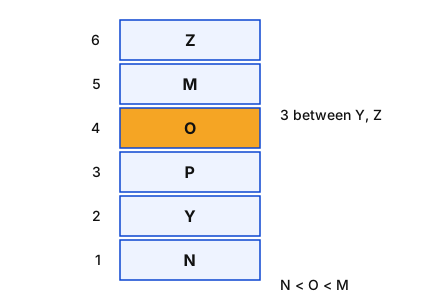
- 3 people between Y and Z, Y below: (Y1, Z5) or (Y2, Z6).
- P is on an odd floor just above Y → Y2, P3, Z6.
- N < O < M among floors 1, 4, 5 → N1, O4, M5.
Trick: P odd & immediately above Y forces Y on an even floor – this kills the (Y1, Z5) case.
Answer: (D) O
अवधारणा: Y–Z के अंतर वाले संकेत से शुरू करें, फिर P का विषम मंज़िल संकेत।
- Y और Z के बीच 3 लोग, Y नीचे: (Y1, Z5) या (Y2, Z6)।
- P विषम मंज़िल पर, Y के ठीक ऊपर → Y2, P3, Z6।
- बची मंज़िलें 1, 4, 5 पर N < O < M → N1, O4, M5।
ट्रिक: P विषम और Y के ठीक ऊपर ⇒ Y सम मंज़िल पर – (Y1, Z5) हट जाता है।
उत्तर: (D) O
RRB NTPC Graduate CBT 1General Intelligence and ReasoningFloor-based puzzleRRB NTPC Graduate CBT 1 2024 · 12 Jun Shift 2
Q914.Mr. O starts from Point L and drives 3 km towards the south. He then takes a left turn, drives 3 km, turns right and drives 4 km. He then takes a left turn and drives 4 km. He takes a final left turn, drives 7 km and stops at Point M. How far (shortest distance) and towards which direction should he drive in order to reach Point L again? (All turns are 90 degree turns only unless specified.)
श्री O बिंदु L से चलना शुरू करते हैं और दक्षिण की ओर 3 km गाड़ी चलाते हैं। फिर वे बाएँ मुड़ते हैं, 3 km गाड़ी चलाते हैं, दाएँ मुड़ते हैं और 4 km गाड़ी चलाते हैं। फिर वे बाएँ मुड़ते हैं और 4 km गाड़ी चलाते हैं। वे अंतिम बार बाएँ मुड़ते हैं, 7 km गाड़ी चलाते हैं और बिंदु M पर रुक जाते हैं। पुनः बिंदु L पर पहुँचने के लिए उन्हें कितनी दूरी (न्यूनतम दूरी) तक और किस दिशा में गाड़ी चलानी चाहिए? (जब तक निर्दिष्ट न किया जाए, सभी मोड़ केवल 90 डिग्री के मोड़ हैं।)
- A3 km towards the northउत्तर की ओर 3 km
- B7 km towards the eastपूर्व की ओर 7 km
- C7 km towards the westपश्चिम की ओर 7 km
- D4 km towards the southदक्षिण की ओर 4 km
Show answer
Concept: Plot each leg with coordinates (L at origin).
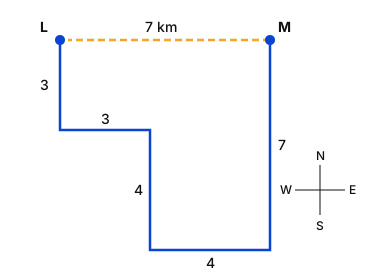
- South 3 → ; left (east) 3 → .
- Right (south) 4 → ; left (east) 4 → .
- Left (north) 7 → M , on the same level as L, 7 km east of it.
- So he must drive 7 km west.
Trick: Net south = and the final 7 km north cancels it, leaving only the east shift .
Answer: (C) 7 km towards the west
अवधारणा: हर चरण को निर्देशांक से लिखें (L मूल बिंदु पर)।
- दक्षिण 3 → ; बाएँ (पूर्व) 3 → ।
- दाएँ (दक्षिण) 4 → ; बाएँ (पूर्व) 4 → ।
- बाएँ (उत्तर) 7 → M , L से 7 km पूर्व।
- अतः उसे 7 km पश्चिम जाना होगा।
ट्रिक: कुल दक्षिण को अंतिम 7 km उत्तर काट देता है; बचता है पूर्व ।
उत्तर: (C) 7 km पश्चिम की ओर
RRB NTPC Graduate CBT 1General Intelligence and ReasoningDirection and distanceRRB NTPC Graduate CBT 1 2024 · 12 Jun Shift 2
Q915.Based on the English alphabetical order, three of the following four letter-cluster pairs are alike in a certain way and thus form a group. Which letter-cluster pair DOES NOT belong to that group?
(Note: The odd one out is not based on the number of consonants/vowels or their position in the letter-cluster.)
अंग्रेज़ी वर्णमाला क्रम के आधार पर, निम्नलिखित चार अक्षर-समूह युग्मों में से तीन किसी निश्चित प्रकार से एकसमान हैं और इस प्रकार एक समूह बनाते हैं। कौन-सा अक्षर-समूह युग्म उस समूह से संबंधित नहीं है?
(ध्यान दें: असंगत अक्षर-समूह, उस अक्षर-समूह में व्यंजनों/स्वरों की संख्या या उनके स्थान पर आधारित नहीं है।)
- AKC – PT
- BIA – NR
- CBT – GK
- DDV – IN
Show answer
Concept: Compare letter positions within each pair.
- KC – PT: K+5 = P, C+17 = T.
- IA – NR: +5, +17 ✓; BT – GK: B+5 = G, T+17 = K (20+17−26 = 11) ✓.
- DV – IN: D+5 = I but V+17 = M, not N → odd.
Trick: Check the second shift with 'reverse' too: +17 = −9 (T−9 = K, V−9 = M).
Answer: (D) DV – IN
अवधारणा: हर युग्म में अक्षरों के स्थान की तुलना करें।
- KC – PT: K+5 = P, C+17 = T।
- IA – NR: +5, +17 ✓; BT – GK: B+5 = G, T+17 = K (20+17−26 = 11) ✓।
- DV – IN: D+5 = I पर V+17 = M, N नहीं → विषम।
ट्रिक: +17 को −9 मानकर भी जाँच सकते हैं (T−9 = K, V−9 = M)।
उत्तर: (D) DV – IN
RRB NTPC Graduate CBT 1General Intelligence and ReasoningOdd one out – letter pairsRRB NTPC Graduate CBT 1 2024 · 12 Jun Shift 2
Q916.DG 24 is related to WT 20 in a certain way based on the English alphabetical order. In the same way, IL 18 is related to BY 14. To which of the following is QT 30 related, following the same logic?
अंग्रेज़ी वर्णमाला क्रम के आधार पर DG 24 एक निश्चित प्रकार से WT 20 से संबंधित है। उसी प्रकार, IL 18, BY 14 से संबंधित है। समान तर्क का अनुसरण करते हुए, QT 30 निम्नलिखित में से किससे संबंधित है?
- ARU 26
- BJG 34
- CHF 28
- DJG 26
Show answer
Concept: Find the shift of each letter and the change in the number.
- DG 24 → WT 20: D−7 = W, G+13 = T, .
- IL 18 → BY 14: I−7 = B, L+13 = Y, ✓.
- QT 30: Q−7 = J, T+13 = G, → JG 26.
Trick: Number rule () leaves RU 26 and JG 26; letters decide JG.
Answer: (D) JG 26
अवधारणा: हर अक्षर का खिसकाव और संख्या का बदलाव देखें।
- DG 24 → WT 20: D−7 = W, G+13 = T, ।
- IL 18 → BY 14: I−7 = B, L+13 = Y, ✓।
- QT 30: Q−7 = J, T+13 = G, → JG 26।
ट्रिक: संख्या () से RU 26 और JG 26 बचते हैं; अक्षर से JG।
उत्तर: (D) JG 26
RRB NTPC Graduate CBT 1General Intelligence and ReasoningLetter-number analogyRRB NTPC Graduate CBT 1 2024 · 12 Jun Shift 2
Q917.Town N is to the east of Town O. Town P is to the north of Town N. Town Q is to the south of Town P. Town R is to the west of Town Q. Town O is to the north-east of Town R. What is the position of Town N with respect to Town Q?
नगर N, नगर O के पूर्व में है। नगर P, नगर N के उत्तर में है। नगर Q, नगर P के दक्षिण में है। नगर R, नगर Q के पश्चिम में है। नगर O, नगर R के उत्तर-पूर्व में है। नगर Q के सापेक्ष नगर N की स्थिति क्या है?
- AEastपूर्व
- BWestपश्चिम
- CNorthउत्तर
- DSouthदक्षिण
Show answer
Concept: Place the towns step by step on a sketch.
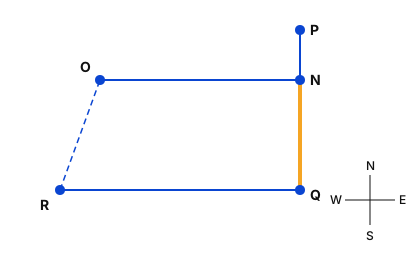
- O—N on one east–west line; P north of N; Q south of P, so N and Q are both on the vertical line through P.
- R is west of Q, and O is north-east of R, so the O–N line is north of the R–Q line.
- Hence N is north of Q.
Trick: N and Q share a vertical line; the diagonal O–R decides which is higher.
Answer: (C) North
अवधारणा: चित्र बनाकर कस्बों को क्रम से रखें।
- O—N एक पूर्व–पश्चिम रेखा पर; P, N के उत्तर में; Q, P के दक्षिण में – N और Q दोनों P वाली ऊर्ध्व रेखा पर।
- R, Q के पश्चिम में और O, R के उत्तर-पूर्व में – अतः O–N रेखा R–Q रेखा से उत्तर में।
- इसलिए N, Q के उत्तर में है।
ट्रिक: N और Q एक ऊर्ध्व रेखा पर; विकर्ण O–R तय करता है कि कौन ऊपर है।
उत्तर: (C) उत्तर
RRB NTPC Graduate CBT 1General Intelligence and ReasoningDirection senseRRB NTPC Graduate CBT 1 2024 · 12 Jun Shift 2
Q918.In a certain code language,
'A + B' means 'A is the sister of B'
'A – B' means 'A is the brother of B'
'A × B' means 'A is the wife of B'
'A ÷ B' means 'A is the father of B'.
Based on the above, how is M related to Q if 'M ÷ N × O − P + Q'?
एक निश्चित कूट भाषा में,
'A + B' का अर्थ है 'A, B की बहन है'
'A – B' का अर्थ है 'A, B का भाई है'
'A × B' का अर्थ है 'A, B की पत्नी है'
'A ÷ B' का अर्थ है 'A, B का पिता है'।
उपर्युक्त के आधार पर, यदि 'M ÷ N × O − P + Q' है, तो M, Q से किस प्रकार संबंधित है?
- ABrother's Wife's Brotherभाई की पत्नी का भाई
- BWife's Fatherपत्नी का पिता
- CBrother's Wife's Fatherभाई की पत्नी का पिता
- DWife's Brotherपत्नी का भाई
Show answer
Concept: Decode each symbol left to right and build the tree.
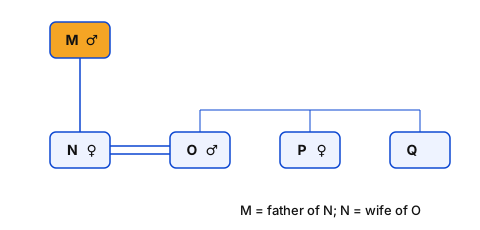
- M ÷ N: M is father of N.
- N × O: N is wife of O.
- O − P: O is brother of P; P + Q: P is sister of Q → O, P, Q are siblings.
- So O is Q's brother, N is his wife and M is her father.
Trick: Read the chain backwards from Q: brother (O) → wife (N) → father (M).
Answer: (C) Brother's Wife's Father
अवधारणा: हर चिह्न को बाएँ से दाएँ खोलें और वंश-वृक्ष बनाएँ।
- M ÷ N: M, N का पिता।
- N × O: N, O की पत्नी।
- O − P: O, P का भाई; P + Q: P, Q की बहन → O, P, Q भाई-बहन।
- अतः O, Q का भाई; N उसकी पत्नी; M उसका पिता।
ट्रिक: Q से उल्टा पढ़ें: भाई (O) → पत्नी (N) → पिता (M)।
उत्तर: (C) भाई की पत्नी के पिता
RRB NTPC Graduate CBT 1General Intelligence and ReasoningCoded blood relationsRRB NTPC Graduate CBT 1 2024 · 12 Jun Shift 2
Q919.What should come in place of the question mark (?) in the given series?
43 27 43 41 43 55 43 ?
दी गई श्रृंखला में प्रश्न चिह्न (?) के स्थान पर क्या आना चाहिए?
43 27 43 41 43 55 43 ?
- A69
- B77
- C73
- D43
Show answer
Concept: Alternate series: odd positions and even positions follow separate rules.
- Odd positions: – constant.
- Even positions: – each .
- Next even term .
Trick: When one number keeps repeating, split the series into two alternate series.
Answer: (A)
अवधारणा: एकांतर श्रृंखला: विषम और सम स्थानों के पद अलग-अलग नियम से चलते हैं।
- विषम स्थान: – स्थिर।
- सम स्थान: – हर बार ।
- अगला सम पद ।
ट्रिक: जब कोई संख्या बार-बार दोहराई जाए, तो श्रृंखला को दो एकांतर श्रृंखलाओं में तोड़ें।
उत्तर: (A)
RRB NTPC Graduate CBT 1General Intelligence and ReasoningNumber SeriesRRB NTPC Graduate CBT 1 2024 · 12 Jun Shift 2
Q920.If ‘W’ stands for ‘÷’, ‘X’ stands for ‘×’, ‘Y’ stands for ‘+’ and ‘Z’ stands for ‘−’, then the resultant of which of the following would be 908?
यदि 'W' का अर्थ '÷', 'X' का अर्थ '×', 'Y' का अर्थ '+' और 'Z' का अर्थ '−' है, तो निम्नलिखित में से किसका परिणाम 908 होगा?
- A128 X 32 Y 120 Z 64 W 16
- B128 W 32 Z 120 Y 64 X 16
- C128 Y 32 Z 120 X 64 W 16
- D128 Z 32 X 120 Y 64 Z 16
Show answer
Concept: Replace letters by signs (W , X , Y , Z ) and apply BODMAS.
- (B): .
- ✓.
- (A) , so not 908.
Trick: Check the option where a big product (like ) appears near 908.
Answer: (B) 128 W 32 Z 120 Y 64 X 16
अवधारणा: अक्षरों को चिह्नों से बदलें (W , X , Y , Z ) और BODMAS लगाएँ।
- (B): ।
- ✓।
- (A) , अतः 908 नहीं।
ट्रिक: उस विकल्प को पहले जाँचें जिसमें बड़ा गुणनफल () 908 के पास हो।
उत्तर: (B) 128 W 32 Z 120 Y 64 X 16
RRB NTPC Graduate CBT 1General Intelligence and ReasoningMathematical OperationsRRB NTPC Graduate CBT 1 2024 · 12 Jun Shift 2

