Q81.Anish starts from Point A and drives 3 km towards the East. He then takes a right turn, drives 5 km, turns right and drives 2 km. He then takes a left turn and drives 4 km. He then takes a right turn and drives 7 km. He takes a final right turn, drives 9 km and stops at Point P. How far (shortest distance) and towards which direction should he drive in order to reach Point A again? (All turns are 90 degrees turns only unless specified.)
अनीश बिंदु A से शुरू करता है और पूर्व की ओर 3 km गाड़ी चलाता है। फिर वह दाएँ मुड़ता है, 5 km गाड़ी चलाता है, दाएँ मुड़ता है और 2 km गाड़ी चलाता है। फिर वह बाएँ मुड़ता है और 4 km गाड़ी चलाता है। फिर वह दाएँ मुड़ता है और 7 km गाड़ी चलाता है। वह अंतिम बार दाएँ मुड़ता है, 9 km गाड़ी चलाता है और बिंदु P पर रुक जाता है। फिर से बिंदु A पर पहुँचने के लिए उसे कितनी दूरी (न्यूनतम दूरी) तक और किस दिशा में गाड़ी चलानी चाहिए? (जब तक निर्दिष्ट न किया जाए, सभी मोड़ केवल 90 डिग्री के मोड़ हैं।)
- A3 km to the Westपश्चिम की ओर 3 km
- B6 km to the Eastपूर्व की ओर 6 km
- C6 km to the Westपश्चिम की ओर 6 km
- D5 km to the Eastपूर्व की ओर 5 km
Show answer
Concept: Track the coordinates of every move, taking A as origin (East , North ).
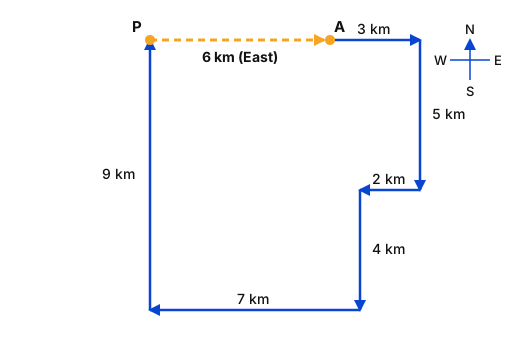
- East 3 → ; right (South) 5 → ; right (West) 2 → .
- Left (South) 4 → ; right (West) 7 → ; right (North) 9 → = P.
- P is 6 km due West of A, so he must drive 6 km towards the East.
Trick: Net East–West: ; net North–South: → P is 6 km West of A.
Answer: (B) 6 km to the East
अवधारणा: A को मूल बिंदु मानकर हर चाल के निर्देशांक लिखें (पूर्व , उत्तर )।
- पूर्व 3 → ; दाएँ (दक्षिण) 5 → ; दाएँ (पश्चिम) 2 →
- बाएँ (दक्षिण) 4 → ; दाएँ (पश्चिम) 7 → ; दाएँ (उत्तर) 9 → = P
- P, A से 6 km पश्चिम में है, अतः उसे 6 km पूर्व की ओर जाना होगा।
ट्रिक: पूर्व–पश्चिम: ; उत्तर–दक्षिण: → P, A से 6 km पश्चिम।
उत्तर: (B) 6 km पूर्व की ओर
RRB NTPC Graduate CBT 1General Intelligence and ReasoningDirection and distanceRRB NTPC Graduate CBT 1 2024 · 24 Jun Shift 1
Q82.Select the pair which follows the same pattern as that followed by the two set of pairs given below. Both pairs follow the same pattern.
PBW : RDV
NDS : PFR
उस युग्म का चयन कीजिए जो उसी पैटर्न का अनुसरण करता है जिसका अनुसरण नीचे दिए गए दो युग्मों द्वारा किया गया है। दोनों युग्म समान पैटर्न का अनुसरण करते हैं।
PBW : RDV
NDS : PFR
- AJMM : LON
- BPWR : RZQ
- CLSO : NUN
- DUIK : WKL
Show answer
Concept: Find the change from each letter of the first group to the second.
- PBW : RDV → P+2=R, B+2=D, W−1=V.
- NDS : PFR → N+2=P, D+2=F, S−1=R. Pattern .
- LSO : NUN → L+2=N, S+2=U, O−1=N ✔ (others fail: JMM→LON has M+2=O but M+1=N; PWR→RZQ has W+3; UIK→WKL has K+1).
Trick: Check the last letter first (); it eliminates options quickly.
Answer: (C) LSO : NUN
अवधारणा: पहले समूह के हर अक्षर से दूसरे समूह तक का परिवर्तन देखें।
- PBW : RDV → P+2=R, B+2=D, W−1=V
- NDS : PFR → N+2=P, D+2=F, S−1=R. पैटर्न
- LSO : NUN → L+2=N, S+2=U, O−1=N ✔ (JMM→LON में अंतिम M+1; PWR→RZQ में W+3; UIK→WKL में K+1)
ट्रिक: पहले अंतिम अक्षर () जाँचें, विकल्प जल्दी हटते हैं।
उत्तर: (C) LSO : NUN
RRB NTPC Graduate CBT 1General Intelligence and ReasoningLetter analogyRRB NTPC Graduate CBT 1 2024 · 24 Jun Shift 1
Q83.12 is related to 8 following a certain logic. Following the same logic, 56 is related to 52. To which of the following is 49 related, following the same logic?
(NOTE: Operations should be performed on the whole numbers, without breaking down the numbers into their constituent digits. E.g. 13 – Operations on 13 such as
adding/subtracting/multiplying to 13 can be performed. Breaking down 13 into 1 and 3 and then performing mathematical operations on 1 and 3 is not allowed.)
एक निश्चित तर्क का अनुसरण करते हुए 12, 8 से संबंधित है। उसी तर्क का अनुसरण करते हुए, 56, 52 से संबंधित है। उसी तर्क का अनुसरण करते हुए, 49 निम्नलिखित में से किससे संबंधित है?
(नोट: संख्याओं को उनके घटक अंकों में विभक्त किए बिना, पूर्ण संख्याओं पर संक्रियाएँ की जानी चाहिए। उदाहरण के लिए, 13 – 13 पर संक्रियाएँ जैसे 13 में
जोड़ना/घटाना/गुणा करना आदि किया जा सकता है। 13 को 1 और 3 में विभक्त करना और फिर 1 और 3 पर गणितीय संक्रियाएँ करना वर्जित है।)
- A45
- B36
- C50
- D40
Show answer
Concept: Find one operation that works for both example pairs.
Trick: Same gap (4) in both pairs → simple subtraction.
Answer: (A)
अवधारणा: एक ऐसी संक्रिया खोजें जो दोनों उदाहरणों पर लागू हो।
ट्रिक: दोनों जोड़ों में अंतर 4 → सीधा घटाना।
उत्तर: (A)
RRB NTPC Graduate CBT 1General Intelligence and ReasoningNumber analogyRRB NTPC Graduate CBT 1 2024 · 24 Jun Shift 1
Q84.This question is based on the five, three-digit numbers given below.
(Left) 853 628 981 217 132 (Right)
(Example: 697 – First digit = 6, second digit = 9 and third digit = 7)
(Note: All operations to be done from left to right.)
What will be the resultant if the second digit of the highest number is added to the first digit of the lowest number?
यह प्रश्न नीचे दी गई तीन-अंकीय पाँच संख्याओं पर आधारित है।
(बाएँ) 853 628 981 217 132 (दाएँ)
(उदाहरण: 697 – पहला अंक = 6, दूसरा अंक = 9 और तीसरा अंक = 7)
(नोट: सभी संक्रियाएँ बाएँ से दाएँ की जानी हैं।)
यदि सबसे बड़ी संख्या के दूसरे अंक को सबसे छोटी संख्या के पहले अंक में जोड़ा जाए, तो परिणाम क्या होगा?
- A7
- B9
- C13
- D11
Show answer
Concept: Identify the highest and lowest numbers, then pick the asked digits.
- Numbers: 853, 628, 981, 217, 132.
- Highest = 981 → second digit = 8.
- Lowest = 132 → first digit = 1.
Trick: Compare hundreds digits first: 9 is highest, 1 is lowest.
Answer: (B)
अवधारणा: सबसे बड़ी और सबसे छोटी संख्या पहचानकर माँगे गए अंक लें।
- संख्याएँ: 853, 628, 981, 217, 132
- सबसे बड़ी = 981 → दूसरा अंक = 8
- सबसे छोटी = 132 → पहला अंक = 1
ट्रिक: पहले सैकड़े के अंक की तुलना करें: 9 सबसे बड़ा, 1 सबसे छोटा।
उत्तर: (B)
RRB NTPC Graduate CBT 1General Intelligence and ReasoningNumber arrangementRRB NTPC Graduate CBT 1 2024 · 24 Jun Shift 1
Q85.Seven boxes, G, H, I, J, O, P and Q, are kept one over the other but not necessarily in the same order. Only two boxes are kept between I and P. Only O is kept above Q. No box is kept below P. J is kept at some place below H but at some place above G. Which box is kept third above G?
सात बक्से G, H, I, J, O, P और Q एक के ऊपर एक रखे गए हैं, परंतु आवश्यक नहीं कि इसी क्रम में हों। I और P के बीच केवल दो बक्से रखे गए हैं। Q के ऊपर केवल O रखा गया है। P के नीचे कोई बक्सा नहीं रखा गया है। J, H के नीचे किसी स्थान पर परंतु G के ऊपर किसी स्थान पर रखा गया है। G के ऊपर तीसरे स्थान पर कौन-सा बक्सा रखा गया है?
- AQ
- BH
- CJ
- DO
Show answer
Concept: Number positions 1 (bottom) to 7 (top) and place the fixed boxes first.
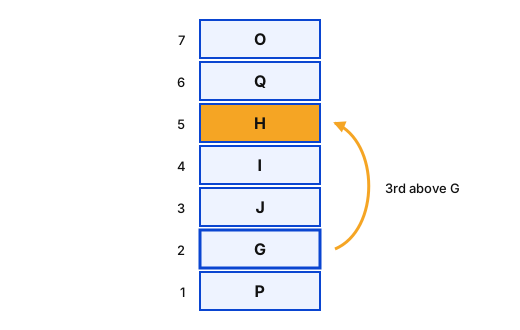
- Only O is above Q → O = 7, Q = 6. No box below P → P = 1.
- Two boxes between I and P → I = 4.
- J below H but above G with free positions 2, 3, 5 → H = 5, J = 3, G = 2.
- Third above G (2) is position 5 = H.
Trick: Lock the top and bottom first; the middle then has only one fit.
Answer: (B) H
अवधारणा: स्थान 1 (नीचे) से 7 (ऊपर) तक मानें और पहले निश्चित बक्से रखें।
- केवल O, Q के ऊपर → O = 7, Q = 6. P के नीचे कोई नहीं → P = 1
- I और P के बीच दो बक्से → I = 4
- J, H के नीचे और G के ऊपर; खाली स्थान 2, 3, 5 → H = 5, J = 3, G = 2
- G (2) से तीसरा ऊपर = स्थान 5 = H
ट्रिक: पहले सबसे ऊपर और नीचे तय करें; बीच का क्रम अपने-आप बनता है।
उत्तर: (B) H
RRB NTPC Graduate CBT 1General Intelligence and ReasoningBox stackingRRB NTPC Graduate CBT 1 2024 · 24 Jun Shift 1
Q86.Seven people, A, B, C, D, Q, R and S are sitting in a row, facing north. Only three people sit between A and B. R sits to the immediate left of B. No one sits to the right of D. Only two people sit between D and R. C sits to the immediate right of S. How many people sit between Q and C?
सात व्यक्ति A, B, C, D, Q, R और S एक पंक्ति में उत्तर की ओर मुख करके बैठे हैं। A और B के बीच केवल तीन व्यक्ति बैठे हैं। R, B के ठीक बाएँ बैठा है। D के दाएँ कोई नहीं बैठा है। D और R के बीच केवल दो व्यक्ति बैठे हैं। C, S के ठीक दाएँ बैठा है। Q और C के बीच कितने व्यक्ति बैठे हैं?
- AFourचार
- BOneएक
- CThreeतीन
- DTwoदो
Show answer
Concept: Facing north, left to right = seats 1 to 7.
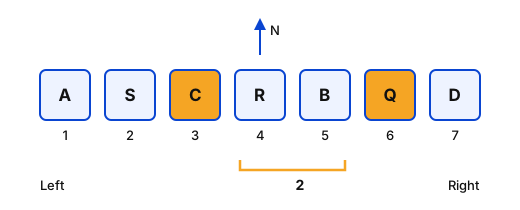
- No one right of D → D = 7. Two between D and R → R = 4. R immediate left of B → B = 5.
- Three between A and B → A = 1.
- C immediate right of S needs two adjacent free seats: 2, 3 → S = 2, C = 3; Q = 6.
- Between C (3) and Q (6): R and B → two people.
Trick: Start from the end person (D) and chain the 'immediate' clues.
Answer: (D) Two
अवधारणा: उत्तर की ओर मुख: बाएँ से दाएँ सीट 1 से 7।
- D के दाएँ कोई नहीं → D = 7. D और R के बीच दो → R = 4. R, B के ठीक बाएँ → B = 5
- A और B के बीच तीन → A = 1
- C, S के ठीक दाएँ; साथ-साथ खाली सीटें 2, 3 → S = 2, C = 3; Q = 6
- C (3) और Q (6) के बीच: R और B → दो व्यक्ति
ट्रिक: किनारे वाले व्यक्ति (D) से शुरू करें और 'ठीक बगल' वाले संकेत जोड़ें।
उत्तर: (D) दो
RRB NTPC Graduate CBT 1General Intelligence and ReasoningLinear seating arrangementRRB NTPC Graduate CBT 1 2024 · 24 Jun Shift 1
Q87.What should come in place of the question mark (?) in the given series?
223, 174, 132, 97, 69, ?
दी गई श्रृंखला में प्रश्न चिह्न (?) के स्थान पर क्या आना चाहिए?
223, 174, 132, 97, 69, ?
- A64
- B59
- C48
- D53
Show answer
Concept: Check the differences between consecutive terms.
- , , ,
- Differences fall by 7 each time (multiples of 7): next difference = 21.
Trick: 49, 42, 35, 28, 21 – descending table of 7.
Answer: (C)
अवधारणा: क्रमागत पदों के अंतर देखें।
- , , ,
- अंतर हर बार 7 घटता है (7 के गुणज): अगला अंतर = 21
ट्रिक: 49, 42, 35, 28, 21 – 7 का उल्टा पहाड़ा।
उत्तर: (C)
RRB NTPC Graduate CBT 1General Intelligence and ReasoningNumber seriesRRB NTPC Graduate CBT 1 2024 · 24 Jun Shift 1
Q88.Refer to the following number and symbol series and answer the question that follows. Counting to be done from left to right only.
(Note: All numbers are single digit numbers only.)
(Left) € & % 6 2 1 € 9 4 5 @ £ $ 4 5 4 & & # 7 £ 7 (Right)
How many such symbols are there, each of which is immediately preceded by a number and also immediately followed by a symbol?
निम्नलिखित संख्या और प्रतीक श्रृंखला को देखिए और उसके बाद दिए गए प्रश्न का उत्तर दीजिए। गिनती केवल बाएँ से दाएँ की जानी है।
(नोट: सभी संख्याएँ केवल एक-अंकीय संख्याएँ हैं।)
(बाएँ) € & % 6 2 1 € 9 4 5 @ £ $ 4 5 4 & & # 7 £ 7 (दाएँ)
ऐसे कितने प्रतीक हैं, जिनमें से प्रत्येक के ठीक पहले एक संख्या है और ठीक बाद में भी एक प्रतीक है?
- A4
- B3
- C5
- D2
Show answer
Concept: Pattern needed: Number – Symbol – Symbol.
- Series: € & % 6 2 1 € 9 4 5 @ £ $ 4 5 4 & & # 7 £ 7
- Check each symbol that comes right after a number: 1 € 9 (next is a number ✘), 5 @ £ ✔, 4 & & ✔, 7 £ 7 ✘.
- Count = 2.
Trick: Scan only the number→symbol junctions and look one step ahead.
Answer: (D)
अवधारणा: आवश्यक पैटर्न: संख्या – प्रतीक – प्रतीक।
- श्रृंखला: € & % 6 2 1 € 9 4 5 @ £ $ 4 5 4 & & # 7 £ 7
- संख्या के तुरंत बाद आने वाले प्रतीक जाँचें: 1 € 9 (आगे संख्या ✘), 5 @ £ ✔, 4 & & ✔, 7 £ 7 ✘
- गिनती = 2
ट्रिक: केवल संख्या→प्रतीक वाले जोड़ देखें और एक कदम आगे जाँचें।
उत्तर: (D)
RRB NTPC Graduate CBT 1General Intelligence and ReasoningSymbol-number seriesRRB NTPC Graduate CBT 1 2024 · 24 Jun Shift 1
Q89.F, G, H, K, L, and M live on six different floors of the same building. The lowermost floor in the building is numbered 1, the floor above it is numbered 2, and so on till the topmost floor, which is numbered 6. K lives on the topmost floor. Only three people live between K and G. F lives on a floor below G. L lives on an even numbered floor. H lives on an odd numbered floor but not on floor number 5.
How many people live between M and G?
F, G, H, K, L और M एक ही इमारत की छह अलग-अलग मंज़िलों पर रहते हैं। इमारत की सबसे निचली मंज़िल की संख्या 1 है, उसके ऊपर की मंज़िल की संख्या 2 है, और इसी प्रकार सबसे ऊपरी मंज़िल तक, जिसकी संख्या 6 है। K सबसे ऊपरी मंज़िल पर रहता है। K और G के बीच केवल तीन व्यक्ति रहते हैं। F, G से नीचे की किसी मंज़िल पर रहता है। L एक सम संख्या वाली मंज़िल पर रहता है। H एक विषम संख्या वाली मंज़िल पर रहता है, परंतु मंज़िल संख्या 5 पर नहीं।
M और G के बीच कितने व्यक्ति रहते हैं?
- ATwoदो
- BThreeतीन
- CFourचार
- DOneएक
Show answer
Concept: Floors 1 (bottom) to 6 (top); place definite clues first.
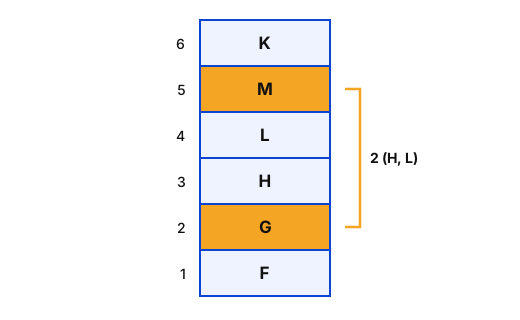
- K = 6. Three people between K and G → G = 2.
- F below G → F = 1. L on an even floor (2 and 6 taken) → L = 4.
- H on an odd floor, not 5 → H = 3. Remaining M = 5.
- Between M (5) and G (2): H and L → two people.
Trick: 'Only three between' from the top floor fixes G immediately: .
Answer: (A) Two
अवधारणा: मंज़िल 1 (नीचे) से 6 (ऊपर); पहले निश्चित संकेत रखें।
- K = 6. K और G के बीच तीन → G = 2
- F, G के नीचे → F = 1. L सम मंज़िल पर (2, 6 भरे) → L = 4
- H विषम मंज़िल पर, 5 नहीं → H = 3. शेष M = 5
- M (5) और G (2) के बीच: H और L → दो व्यक्ति
ट्रिक: शीर्ष मंज़िल से 'केवल तीन बीच में' → G तुरंत: ।
उत्तर: (A) दो
RRB NTPC Graduate CBT 1General Intelligence and ReasoningFloor-based puzzleRRB NTPC Graduate CBT 1 2024 · 24 Jun Shift 1
Q90.Refer to the following number and symbol series and answer the question that follows. Counting to be done from left to right only.
(Note: All numbers are single digit numbers only.)
(Left) # 8 2 * 3 & % # £ 2 € 3 5 @ 3 5 * & % @ 3 € (Right)
How many such numbers are there, each of which is immediately preceded by a number and also immediately followed by a symbol?
निम्नलिखित संख्या और प्रतीक श्रृंखला को देखिए और उसके बाद दिए गए प्रश्न का उत्तर दीजिए। गिनती केवल बाएँ से दाएँ की जानी है।
(नोट: सभी संख्याएँ केवल एक-अंकीय संख्याएँ हैं।)
(बाएँ) # 8 2 * 3 & % # £ 2 € 3 5 @ 3 5 * & % @ 3 € (दाएँ)
ऐसी कितनी संख्याएँ हैं, जिनमें से प्रत्येक के ठीक पहले एक संख्या है और ठीक बाद में एक प्रतीक है?
- A3
- B5
- C2
- D7
Show answer
Concept: Pattern needed: Number – Number – Symbol.
- Series: # 8 2 * 3 & % # £ 2 € 3 5 @ 3 5 * & % @ 3 €
- Look for two numbers in a row followed by a symbol: 8 2 * ✔, 3 5 @ ✔, 3 5 * ✔.
- Other numbers are preceded by a symbol. Count = 3.
Trick: Find number-pairs first; then check the next item is a symbol.
Answer: (A)
अवधारणा: आवश्यक पैटर्न: संख्या – संख्या – प्रतीक।
- श्रृंखला: # 8 2 * 3 & % # £ 2 € 3 5 @ 3 5 * & % @ 3 €
- लगातार दो संख्याएँ जिनके बाद प्रतीक हो: 8 2 * ✔, 3 5 @ ✔, 3 5 * ✔
- बाकी संख्याओं से पहले प्रतीक है। गिनती = 3
ट्रिक: पहले संख्या-जोड़े खोजें, फिर अगला पद प्रतीक है या नहीं देखें।
उत्तर: (A)
RRB NTPC Graduate CBT 1General Intelligence and ReasoningSymbol-number seriesRRB NTPC Graduate CBT 1 2024 · 24 Jun Shift 1
Q91.What will come in place of the question mark (?) in the following equation, if ‘+’ and ‘−’ are interchanged and ‘×’ and ‘÷’ are interchanged?
35 − 112 × 84 ÷ 48 + 75 = ?
यदि '+' और '−' को आपस में बदल दिया जाए तथा '×' और '÷' को आपस में बदल दिया जाए, तो निम्नलिखित समीकरण में प्रश्न चिह्न (?) के स्थान पर क्या आएगा?
35 − 112 × 84 ÷ 48 + 75 = ?
- A24
- B174
- C86
- D46
Show answer
Concept: First swap the signs as told, then solve using BODMAS (÷, × before +, −).
- Swap:
- , and
Trick: Rewrite the whole expression with the new signs first – mistakes happen when swapping in your head.
Answer: (A)
अवधारणा: पहले चिह्न आपस में बदलें, फिर BODMAS (÷, × पहले, फिर +, −) से हल करें।
- बदलने पर:
- , और
ट्रिक: नए चिह्नों के साथ पूरा व्यंजक पहले लिख लें – मन में बदलने पर गलती होती है।
उत्तर: (A)
RRB NTPC Graduate CBT 1General Intelligence and ReasoningMathematical OperationsRRB NTPC Graduate CBT 1 2024 · 23 Jun Shift 3
Q92.F, G, H, K, L, and M live on six different floors of the same building. The lowermost floor in the building is numbered 1, the floor above it is numbered 2, and so on till the topmost floor, which is numbered 6. L lives on floor number 5. H lives on a floor above L. Only K lives below M. F lives on an even numbered floor. How many people live below G?
F, G, H, K, L और M एक ही इमारत की छह अलग-अलग मंज़िलों पर रहते हैं। इमारत की सबसे निचली मंज़िल की संख्या 1 है, उसके ऊपर वाली मंज़िल की संख्या 2 है, और इसी प्रकार सबसे ऊपरी मंज़िल तक, जिसकी संख्या 6 है। L मंज़िल संख्या 5 पर रहता है। H, L से ऊपर वाली मंज़िल पर रहता है। केवल K, M से नीचे रहता है। F एक सम संख्या वाली मंज़िल पर रहता है। G से नीचे कितने व्यक्ति रहते हैं?
- ATwoदो
- BThreeतीन
- CFourचार
- DOneएक
Show answer
Concept: Place the fixed clues first (L, H), then the "only K below M" clue.
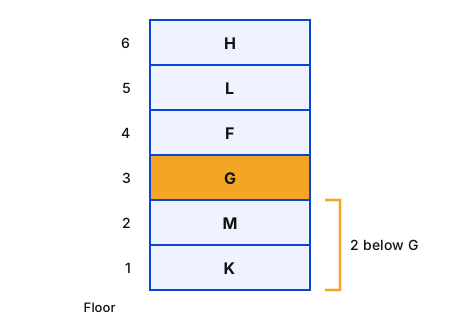
- L = floor 5; H is above L, so H = 6.
- Only K lives below M → K = 1, M = 2.
- F is on an even floor; 2 and 6 are taken → F = 4. Remaining: G = 3.
- Below G: K and M = two persons.
Trick: "Only X below Y" always means X is on floor 1 and Y on floor 2.
Answer: (A) Two
अवधारणा: पहले निश्चित सूचनाएँ (L, H) रखें, फिर "केवल K, M से नीचे" वाली शर्त।
- L = मंज़िल 5; H, L से ऊपर → H = 6।
- केवल K, M के नीचे रहता है → K = 1, M = 2।
- F सम (even) मंज़िल पर; 2 और 6 भरी हैं → F = 4। बचा G = 3।
- G से नीचे: K और M = दो व्यक्ति।
ट्रिक: "केवल X, Y के नीचे" का अर्थ हमेशा X = मंज़िल 1 और Y = मंज़िल 2।
उत्तर: (A) दो
RRB NTPC Graduate CBT 1General Intelligence and ReasoningFloor PuzzleRRB NTPC Graduate CBT 1 2024 · 23 Jun Shift 3
Q93.If 2 is added to each odd digit and 1 is subtracted from each even digit in the number 75246183, how many digits will appear more than once in the new number thus formed?
यदि संख्या 75246183 में प्रत्येक विषम अंक में 2 जोड़ दिया जाए और प्रत्येक सम अंक में से 1 घटा दिया जाए, तो इस प्रकार बनी नई संख्या में कितने अंक एक से अधिक बार आएँगे?
- AThreeतीन
- BTwoदो
- CNoneकोई नहीं
- DOneएक
Show answer
Concept: Change every digit by the rule (odd , even ), then count digits that repeat.
- Number: 7 5 2 4 6 1 8 3
- New: 9 7 1 3 5 3 7 5
- Repeated digits: 7 (twice), 3 (twice), 5 (twice) → three digits.
Trick: Write the new digit directly under each old digit – no digit gets skipped.
Answer: (A) Three
अवधारणा: हर अंक को नियम (विषम , सम ) से बदलें, फिर दोहराए अंक गिनें।
- संख्या: 7 5 2 4 6 1 8 3
- नई: 9 7 1 3 5 3 7 5
- दोहराए अंक: 7, 3, 5 (प्रत्येक दो बार) → तीन अंक।
ट्रिक: हर पुराने अंक के नीचे नया अंक लिखें – कोई अंक छूटेगा नहीं।
उत्तर: (A) तीन
RRB NTPC Graduate CBT 1General Intelligence and ReasoningNumber OperationsRRB NTPC Graduate CBT 1 2024 · 23 Jun Shift 3
Q94.What should come in place of the question mark (?) in the given series?
1412 1420 1430 1442 1456 ?
दी गई श्रृंखला में प्रश्न चिह्न (?) के स्थान पर क्या आना चाहिए?
1412 1420 1430 1442 1456 ?
- A1474
- B1470
- C1468
- D1472
Show answer
Concept: Check the differences between consecutive terms.
- Differences: – they rise by .
- Next difference
Trick: When differences are consecutive even numbers, the next difference is just more.
Answer: (D)
अवधारणा: क्रमागत पदों का अंतर देखें।
- अंतर: – हर बार बढ़ रहा है।
- अगला अंतर
ट्रिक: अंतर क्रमागत सम संख्याएँ हों तो अगला अंतर अधिक होगा।
उत्तर: (D)
RRB NTPC Graduate CBT 1General Intelligence and ReasoningNumber SeriesRRB NTPC Graduate CBT 1 2024 · 23 Jun Shift 3
Q95.Seven people D, E, F, G, L, M and N are sitting in a row, facing north. Only two people sit to the left of L. Only three people sit between L and E. G sits second to the right of L. Only two people sit between G and M. D sits at some place to the right of N but at some place to the left of F. How many people sit to the right of D?
सात व्यक्ति D, E, F, G, L, M और N एक पंक्ति में उत्तर की ओर मुख करके बैठे हैं। L के बाईं ओर केवल दो व्यक्ति बैठे हैं। L और E के बीच केवल तीन व्यक्ति बैठे हैं। G, L के दाईं ओर दूसरे स्थान पर बैठा है। G और M के बीच केवल दो व्यक्ति बैठे हैं। D, N के दाईं ओर किसी स्थान पर, परंतु F के बाईं ओर किसी स्थान पर बैठा है। D के दाईं ओर कितने व्यक्ति बैठे हैं?
- AFourचार
- BTwoदो
- CThreeतीन
- DOneएक
Show answer
Concept: Facing north, left and right are the solver's own left and right. Number seats 1–7 from the left.
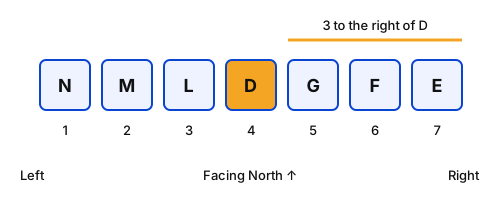
- Only two people left of L → L = 3. Three between L and E → E = 7.
- G second to the right of L → G = 5. Two between G and M → M = 2.
- Seats 1, 4, 6 remain for N, D, F with N < D < F → N = 1, D = 4, F = 6.
- Right of D: G, F, E = three.
Trick: People to the right of seat in a row of 7 .
Answer: (C) Three
अवधारणा: उत्तर की ओर मुख होने पर बाएँ-दाएँ हमारे अपने बाएँ-दाएँ होते हैं। बाएँ से सीट 1–7 मानें।
- L के बाएँ केवल दो → L = 3; L और E के बीच तीन → E = 7।
- G, L के दाएँ दूसरे स्थान पर → G = 5; G और M के बीच दो → M = 2।
- बची सीट 1, 4, 6 पर N < D < F → N = 1, D = 4, F = 6।
- D के दाएँ: G, F, E = तीन।
ट्रिक: 7 की पंक्ति में सीट के दाएँ व्यक्ति।
उत्तर: (C) तीन
RRB NTPC Graduate CBT 1General Intelligence and ReasoningLinear Seating ArrangementRRB NTPC Graduate CBT 1 2024 · 23 Jun Shift 3
Q96.Select the pair which follows the same pattern as that followed by the two set of pairs given below. Both pairs follow the same pattern.
ICK : KEF
HDW : JFR
उस युग्म का चयन कीजिए जो उसी पैटर्न का अनुसरण करता है जिसका अनुसरण नीचे दिए गए दो युग्मों द्वारा किया जाता है। दोनों युग्म एक ही पैटर्न का अनुसरण करते हैं।
ICK : KEF
HDW : JFR
- ARFM : TIH
- BVJF : XLA
- CKLR : MNN
- DGGP : IJK
Show answer
Concept: Find the position change of each letter (A = 1 … Z = 26).
- ICK → KEF: I = K, C = E, K = F.
- HDW → JFR: H = J, D = F, W = R. Pattern: .
- VJF → XLA: V = X, J = L, F = A ✓
- RFM → TIH ( in middle), KLR → MNN (), GGP → IJK () fail.
Trick: Check only the middle letter first () – it removes A and D at once.
Answer: (B) VJF : XLA
अवधारणा: हर अक्षर का स्थानीय मान (A = 1 … Z = 26) में बदलाव देखें।
- ICK → KEF: I = K, C = E, K = F।
- HDW → JFR: H = J, D = F, W = R। पैटर्न: ।
- VJF → XLA: V = X, J = L, F = A ✓
- RFM → TIH (बीच में ), KLR → MNN (), GGP → IJK () गलत।
ट्रिक: पहले केवल बीच का अक्षर () जाँचें – A और D तुरंत हट जाते हैं।
उत्तर: (B) VJF : XLA
RRB NTPC Graduate CBT 1General Intelligence and ReasoningLetter AnalogyRRB NTPC Graduate CBT 1 2024 · 23 Jun Shift 3
Q97.Select the set in which the numbers are related in the same way as are the numbers of the following sets.
(NOTE: Operations should be performed on the whole numbers, without breaking down the numbers into their constituent digits. E.g. 13 – Operations on 13 such as
adding/subtracting/multiplying to 13 can be performed. Breaking down 13 into 1 and 3 and then performing mathematical operations on 1 and 3 is not allowed.)
(7, 80, 22)
(43, 143, 19)
उस समुच्चय का चयन कीजिए जिसमें संख्याएँ उसी प्रकार संबंधित हैं जिस प्रकार निम्नलिखित समुच्चयों की संख्याएँ संबंधित हैं।
(ध्यान दें: संख्याओं को उनके घटक अंकों में विभाजित किए बिना, संक्रियाएँ पूर्ण संख्याओं पर की जानी चाहिए। उदाहरण के लिए 13 – 13 पर संक्रियाएँ जैसे
13 में जोड़ना/घटाना/गुणा करना आदि की जा सकती हैं। 13 को 1 और 3 में विभाजित करना और फिर 1 और 3 पर गणितीय संक्रियाएँ करना वर्जित है।)
(7, 80, 22)
(43, 143, 19)
- A(25, 91, 15)
- B(11, 63, 15)
- C(13, 89, 21)
- D(49, 139, 15)
Show answer
Concept: Find one rule linking first, second and third numbers that works for both sets.
- : ✓
- : ✓ → Rule:
- : ✓
- Others: ; ; .
Trick: The middle number is largest → it is built from the other two; try , , quickly.
Answer: (C)
अवधारणा: ऐसा एक नियम खोजें जो दोनों समूहों में पहली, दूसरी और तीसरी संख्या को जोड़ता हो।
- : ✓
- : ✓ → नियम:
- : ✓
- अन्य: ; ; ।
ट्रिक: बीच की संख्या सबसे बड़ी है → वह अन्य दो से बनी है; , , जल्दी आज़माएँ।
उत्तर: (C)
RRB NTPC Graduate CBT 1General Intelligence and ReasoningNumber Set RelationshipRRB NTPC Graduate CBT 1 2024 · 23 Jun Shift 3
Q98.Refer to the following number and symbol series and answer the question that follows. Counting to be done from left to right only.
(Left) 6 @ $ 1 8 # 9 % ≺ 2 4 ⋟ 3 ^ 5 & 7 (Right)
If all the numbers are dropped from the series, which of the following will be sixth from the right?
निम्नलिखित संख्या और प्रतीक श्रृंखला को देखिए और उसके बाद आने वाले प्रश्न का उत्तर दीजिए। गिनती केवल बाएँ से दाएँ की जानी है।
(बाएँ) 6 @ $ 1 8 # 9 % ≺ 2 4 ⋟ 3 ^ 5 & 7 (दाएँ)
यदि श्रृंखला से सभी संख्याएँ हटा दी जाएँ, तो निम्नलिखित में से कौन-सा दाएँ से छठा होगा?
- A%
- B$
- C#
- D≺
Show answer
Concept: Remove all numbers, rewrite only the symbols, then count from the right.
- Symbols left (left → right): @ $ # % ≺ ⋟ ^ &
- From right: & (1), ^ (2), ⋟ (3), ≺ (4), % (5), # (6).
Trick: 8 symbols remain, so 6th from right = 3rd from left (8 − 6 + 1 = 3) = #.
Answer: (C) #
अवधारणा: सभी संख्याएँ हटाकर केवल प्रतीक लिखें, फिर दाएँ से गिनें।
- बचे प्रतीक (बाएँ → दाएँ): @ $ # % ≺ ⋟ ^ &
- दाएँ से: & (1), ^ (2), ⋟ (3), ≺ (4), % (5), # (6)।
ट्रिक: 8 प्रतीक बचे, अतः दाएँ से 6वाँ = बाएँ से तीसरा (8 − 6 + 1 = 3) = #।
उत्तर: (C) #
RRB NTPC Graduate CBT 1General Intelligence and ReasoningSymbol-Number SeriesRRB NTPC Graduate CBT 1 2024 · 23 Jun Shift 3
Q99.Mr. XYZ starts from Point A and drives 15 km towards the west. He then takes a left turn, drives 11 km, turns left and drives 19 km. He then takes a left turn and drives 16 km. He takes a final left turn, drives 4 km and stops at Point P. How far (shortest distance) and in which direction should he drive in order to reach Point A again? (All turns are 90-degree turns only unless specified)
श्री XYZ बिंदु A से चलना शुरू करते हैं और पश्चिम की ओर 15 km गाड़ी चलाते हैं। फिर वे बाएँ मुड़ते हैं, 11 km गाड़ी चलाते हैं, बाएँ मुड़ते हैं और 19 km गाड़ी चलाते हैं। फिर वे बाएँ मुड़ते हैं और 16 km गाड़ी चलाते हैं। वे अंतिम बार बाएँ मुड़ते हैं, 4 km गाड़ी चलाते हैं और बिंदु P पर रुक जाते हैं। पुनः बिंदु A पर पहुँचने के लिए उन्हें कितनी दूर (न्यूनतम दूरी) और किस दिशा में गाड़ी चलानी चाहिए? (जब तक निर्दिष्ट न हो, सभी मोड़ केवल 90 डिग्री के हैं)
- A5 km to the westपश्चिम की ओर 5 km
- B5 km to the southदक्षिण की ओर 5 km
- C3 km to the eastपूर्व की ओर 3 km
- D3 km to the northउत्तर की ओर 3 km
Show answer
Concept: Track the facing direction after each left turn (W → S → E → N → W) and add net displacements.
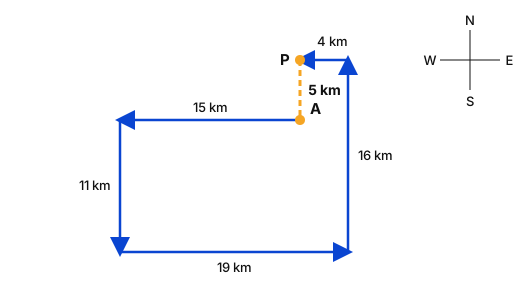
- West 15, left → South 11, left → East 19, left → North 16, left → West 4.
- East–West: → P is directly in line with A.
- North–South: km north of A.
- To return: 5 km towards south.
Trick: Net E–W , net N–S – no need for Pythagoras.
Answer: (B) 5 km to the south
अवधारणा: हर बाएँ मोड़ के बाद दिशा (W → S → E → N → W) लिखें और कुल विस्थापन जोड़ें।
- पश्चिम 15, बाएँ → दक्षिण 11, बाएँ → पूर्व 19, बाएँ → उत्तर 16, बाएँ → पश्चिम 4।
- पूर्व–पश्चिम: → P, A की सीध में है।
- उत्तर–दक्षिण: km, A के उत्तर में।
- वापस आने के लिए: 5 km दक्षिण की ओर।
ट्रिक: कुल E–W , कुल N–S – पाइथागोरस की ज़रूरत नहीं।
उत्तर: (B) 5 km दक्षिण की ओर
RRB NTPC Graduate CBT 1General Intelligence and ReasoningDirection and DistanceRRB NTPC Graduate CBT 1 2024 · 23 Jun Shift 3
Q100.This question is based on the five, three-digit numbers given below.
(Left) 815 497 460 637 147 (Right)
(Example- 697 – First digit = 6, second digit = 9 and third digit = 7)
(NOTE: All operations to be done from left to right.)
What will be the resultant if the second digit of the highest number is subtracted from the third digit of the lowest number?
यह प्रश्न नीचे दी गई तीन अंकों वाली पाँच संख्याओं पर आधारित है।
(बाएँ) 815 497 460 637 147 (दाएँ)
(उदाहरण- 697 – पहला अंक = 6, दूसरा अंक = 9 और तीसरा अंक = 7)
(ध्यान दें: सभी संक्रियाएँ बाएँ से दाएँ की जानी हैं।)
यदि सबसे बड़ी संख्या के दूसरे अंक को सबसे छोटी संख्या के तीसरे अंक में से घटाया जाए, तो परिणाम क्या होगा?
- A6
- B8
- C9
- D7
Show answer
Concept: Identify the highest and lowest numbers first, then pick the asked digits.
- Highest = 815 → second digit = 1.
- Lowest = 147 → third digit = 7.
Trick: Read the order carefully: "A subtracted from B" means .
Answer: (A)
अवधारणा: पहले सबसे बड़ी और सबसे छोटी संख्या पहचानें, फिर माँगे गए अंक लें।
- सबसे बड़ी = 815 → दूसरा अंक = 1।
- सबसे छोटी = 147 → तीसरा अंक = 7।
ट्रिक: "A को B में से घटाना" = ।
उत्तर: (A)
RRB NTPC Graduate CBT 1General Intelligence and ReasoningThree-Digit Number OperationsRRB NTPC Graduate CBT 1 2024 · 23 Jun Shift 3

