Q1001.Which of the following letter-number clusters will replace the question mark (?) in the given series to make it logically complete?
EK19, GM28, IO37, KQ46, ?
निम्नलिखित में से कौन-सा अक्षर-संख्या समूह दी गई श्रृंखला को तार्किक रूप से पूर्ण करने के लिए प्रश्न चिह्न (?) को प्रतिस्थापित करेगा?
EK19, GM28, IO37, KQ46, ?
- AMR56
- BMR55
- CMS55
- DMS56
Show answer
Concept: Treat the first letter, second letter and number as three separate series.
- 1st letter: E, G, I, K → ⇒ M.
- 2nd letter: K, M, O, Q → ⇒ S.
- Number: 19, 28, 37, 46 → ⇒ 55.
- Next term: MS55.
Trick: Number part rules out 56; second letter Q + 2 = S rules out MR.
Answer: (C) MS55
अवधारणा: पहला अक्षर, दूसरा अक्षर और संख्या – तीनों को अलग श्रृंखला मानें।
- पहला अक्षर: E, G, I, K → ⇒ M।
- दूसरा अक्षर: K, M, O, Q → ⇒ S।
- संख्या: 19, 28, 37, 46 → ⇒ 55।
- अगला पद: MS55।
ट्रिक: संख्या से 56 कटता है; Q + 2 = S से MR कटता है।
उत्तर: (C) MS55
RRB NTPC Graduate CBT 1General Intelligence and ReasoningAlpha-Numeric SeriesRRB NTPC Graduate CBT 1 2024 · 11 Jun Shift 2
Q1002.Which of the following letter-clusters should replace # and % so that the pattern and relationship followed between the letter-cluster pair on the left side of :: is the same as that on the right side of :: ?
# : LIE :: SPL : %
निम्नलिखित में से कौन-से अक्षर-समूह # और % को प्रतिस्थापित करेंगे ताकि :: के बाईं ओर के अक्षर-समूह युग्म के बीच अनुसरित पैटर्न और संबंध वही हो जो :: के दाईं ओर है?
# : LIE :: SPL : %
- A# = OLH, % = PMI
- B# = PQH, % = GVI
- C# = OLT, % = OAI
- D# = OOI, % = PDF
Show answer
Concept: Find the shift that turns the first cluster into the second and apply it to both pairs.
- Try option A: OLH → LIE: O−3=L, L−3=I, H−3=E ✔.
- SPL → PMI: S−3=P, P−3=M, L−3=I ✔.
- Same rule () on both sides.
Trick: % comes from SPL by the rule; S−3 = P and only option A starts % with P and also fits #.
Answer: (A) # = OLH, % = PMI
अवधारणा: पहले समूह से दूसरा बनाने वाला shift ज्ञात करें और दोनों युग्मों पर लगाएँ।
- विकल्प A: OLH → LIE: O−3=L, L−3=I, H−3=E ✔।
- SPL → PMI: S−3=P, P−3=M, L−3=I ✔।
- दोनों ओर एक ही नियम ()।
ट्रिक: % = SPL पर नियम; S−3 = P, और केवल विकल्प A में % P से शुरू होकर # भी फिट बैठता है।
उत्तर: (A) # = OLH, % = PMI
RRB NTPC Graduate CBT 1General Intelligence and ReasoningLetter AnalogyRRB NTPC Graduate CBT 1 2024 · 11 Jun Shift 2
Q1003.Refer to the following number and symbol series and answer the question that follows. Counting to be done from left to right only.
(Left) 1 6 $ 1 * 6 5 9 6 % % 1 * * £ 2 * 6 5 $ @ 6 (Right)
How many such numbers are there each of which is immediately preceded by a number and also immediately followed by a symbol?
निम्नलिखित संख्या और प्रतीक श्रृंखला को देखें और उसके बाद दिए गए प्रश्न का उत्तर दें। गिनती केवल बाएँ से दाएँ की जानी है।
(बाएँ) 1 6 $ 1 * 6 5 9 6 % % 1 * * £ 2 * 6 5 $ @ 6 (दाएँ)
ऐसी कितनी संख्याएँ हैं जिनमें से प्रत्येक के ठीक पहले एक संख्या है और ठीक बाद एक प्रतीक भी है?
- A3
- B4
- C2
- D5
Show answer
Concept: Look for the pattern: number – number – symbol; count the middle number.
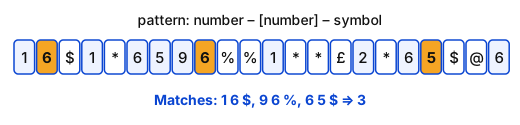
- Scan left to right: "1 6 $" ✔, "9 6 %" ✔, "6 5 $" ✔.
- Other numbers fail (e.g. "6 5 9" – followed by a number; "* 2 *" – preceded by a symbol).
- Total = 3.
Trick: First mark every symbol, then check the two places just before it.
Answer: (A) 3
अवधारणा: पैटर्न खोजें: संख्या – संख्या – प्रतीक; बीच वाली संख्या गिनें।
- बाएँ से दाएँ: "1 6 $" ✔, "9 6 %" ✔, "6 5 $" ✔।
- बाकी संख्याएँ शर्त पूरी नहीं करतीं (जैसे "6 5 9" – बाद में संख्या; "* 2 *" – पहले प्रतीक)।
- कुल = 3।
ट्रिक: पहले हर प्रतीक पर निशान लगाएँ, फिर उसके ठीक पहले के दो स्थान देखें।
उत्तर: (A) 3
RRB NTPC Graduate CBT 1General Intelligence and ReasoningNumber–Symbol SeriesRRB NTPC Graduate CBT 1 2024 · 11 Jun Shift 2
Q1004.What will come in the place of the question mark (?) in the following equation, if ‘+’ and ‘−’ are interchanged and ‘×’ and ‘÷’ are interchanged?
151 ÷ 3 + 168 × 8 − 145 = ?
यदि ‘+’ और ‘−’ को आपस में बदल दिया जाए तथा ‘×’ और ‘÷’ को आपस में बदल दिया जाए, तो निम्नलिखित समीकरण में प्रश्न चिह्न (?) के स्थान पर क्या आएगा?
151 ÷ 3 + 168 × 8 − 145 = ?
- A577
- B557
- C547
- D567
Show answer
Concept: Interchange the signs, then solve using BODMAS.
- becomes .
- .
- .
Trick: Do and first ( and ), then add/subtract left to right.
Answer: (A)
अवधारणा: चिह्न आपस में बदलें, फिर BODMAS से हल करें।
- बदलकर ।
- ।
- ।
ट्रिक: पहले और ( और ), फिर बाएँ से दाएँ जोड़-घटाव।
उत्तर: (A)
RRB NTPC Graduate CBT 1General Intelligence and ReasoningMathematical OperationsRRB NTPC Graduate CBT 1 2024 · 11 Jun Shift 2
Q1005.What will come in place of the question mark (?) in the following equation if '÷' and '–' are interchanged and '×' and '+' are interchanged?
56 + 41 ÷ 12054 – 123 × 891 = ?
यदि ‘÷’ और ‘–’ को आपस में बदल दिया जाए तथा ‘×’ और ‘+’ को आपस में बदल दिया जाए, तो निम्नलिखित समीकरण में प्रश्न चिह्न (?) के स्थान पर क्या आएगा?
56 + 41 ÷ 12054 – 123 × 891 = ?
- A811
- B3089
- C1307
- D1557
Show answer
Concept: Interchange the signs as told, then solve using BODMAS (÷ and × first, then + and −).
- After swapping ÷↔– and ×↔+: .
- and .
- .
Trick: Rewrite the whole expression first with new signs, then do division/multiplication before addition/subtraction.
Answer: (B) 3089
अवधारणा: चिह्नों को बदलकर BODMAS नियम से हल करें (पहले ÷ और ×, फिर + और −)।
- ÷↔– तथा ×↔+ बदलने पर: ।
- तथा ।
- ।
ट्रिक: पहले पूरा व्यंजक नए चिह्नों के साथ लिखें, फिर भाग/गुणा पहले करें।
उत्तर: (B) 3089
RRB NTPC Graduate CBT 1General Intelligence and ReasoningMathematical operationsRRB NTPC Graduate CBT 1 2024 · 11 Jun Shift 2
Q1006.What should come in place of the question mark (?) in the given series?
99 92 105 98 111 104 ? 110
दी गई श्रृंखला में प्रश्न चिह्न (?) के स्थान पर क्या आना चाहिए?
99 92 105 98 111 104 ? 110
- A117
- B92
- C125
- D97
Show answer
Concept: Check differences between consecutive terms.
- Differences: , , , , .
- Pattern repeats, so next is .
- Check: ✓ (last term).
Trick: Alternate up-down series → look for two alternating differences.
Answer: (A) 117
अवधारणा: क्रमागत पदों का अंतर देखें।
- अंतर: ।
- अगला अंतर : ।
- जाँच: ✓।
ट्रिक: ऊपर-नीचे चलती श्रृंखला में दो वैकल्पिक अंतर खोजें।
उत्तर: (A) 117
RRB NTPC Graduate CBT 1General Intelligence and ReasoningNumber seriesRRB NTPC Graduate CBT 1 2024 · 11 Jun Shift 2
Q1007.In a certain code language, ‘LATE’ is coded as ‘8054’ and ‘TEAM’ is coded as ‘4087’. What is the code for ‘M’ in the given code language?
एक निश्चित कूट भाषा में, ‘LATE’ को ‘8054’ के रूप में कूटबद्ध किया जाता है और ‘TEAM’ को ‘4087’ के रूप में कूटबद्ध किया जाता है। दी गई कूट भाषा में ‘M’ के लिए कूट क्या है?
- A4
- B8
- C0
- D7
Show answer
Concept: Letters common to both words share the common digits; the leftover letter gets the leftover digit.
- LATE = {8,0,5,4}; TEAM = {4,0,8,7}.
- Common letters T, E, A ↔ common digits 4, 0, 8.
- Left over: L ↔ 5 and M ↔ 7.
Trick: Cancel common letters and common digits; the unique letter matches the unique digit.
Answer: (D) 7
अवधारणा: दोनों शब्दों के उभयनिष्ठ अक्षरों के कोड भी उभयनिष्ठ अंक होते हैं।
- LATE = {8,0,5,4}; TEAM = {4,0,8,7}।
- उभयनिष्ठ T, E, A ↔ 4, 0, 8।
- शेष: L ↔ 5, M ↔ 7।
ट्रिक: समान अक्षर व समान अंक काटें; बचा अक्षर = बचा अंक।
उत्तर: (D) 7
RRB NTPC Graduate CBT 1General Intelligence and ReasoningCoding-decodingRRB NTPC Graduate CBT 1 2024 · 11 Jun Shift 2
Q1008.35 is related to 70 following a certain logic. Following the same logic, 24 is related to 48. To which of the following is 11 related, following the same logic?
(NOTE: Operations should be performed on the whole numbers, without breaking down the numbers into their constituent digits. E.g. 13 – Operations on 13 such as
adding/subtracting/multiplying to 13 can be performed. Breaking down 13 into 1 and 3 and then performing mathematical operations on 1 and 3 is not allowed.)
एक निश्चित तर्क के अनुसार 35 का संबंध 70 से है। उसी तर्क के अनुसार 24 का संबंध 48 से है। उसी तर्क का अनुसरण करते हुए, 11 का संबंध निम्नलिखित में से किससे है?
(नोट: संख्याओं को उनके घटक अंकों में विभाजित किए बिना, पूर्ण संख्याओं पर संक्रियाएँ की जानी चाहिए। उदाहरण 13 – 13 पर संक्रियाएँ जैसे
13 में जोड़ना/घटाना/गुणा करना आदि किया जा सकता है। 13 को 1 और 3 में विभाजित करके फिर 1 और 3 पर गणितीय संक्रियाएँ करने की अनुमति नहीं है।)
- A23
- B20
- C21
- D22
Show answer
Concept: Find one operation that works for both given pairs.
- .
- .
- So .
Trick: When the second number is exactly double, the rule is ×2.
Answer: (D) 22
अवधारणा: ऐसा नियम खोजें जो दोनों युग्मों पर लागू हो।
- ।
- ।
- अतः ।
ट्रिक: दूसरी संख्या ठीक दोगुनी हो तो नियम ×2 है।
उत्तर: (D) 22
RRB NTPC Graduate CBT 1General Intelligence and ReasoningNumber analogyRRB NTPC Graduate CBT 1 2024 · 11 Jun Shift 2
Q1009.VBDP is related to ZWHK in a certain way based on the English alphabetical order. In the same way, DRLF is related to HMPA. To which of the following is LHTV related, following the same logic?
अंग्रेज़ी वर्णमाला क्रम के आधार पर VBDP एक निश्चित तरीके से ZWHK से संबंधित है। उसी प्रकार, DRLF, HMPA से संबंधित है। उसी तर्क का अनुसरण करते हुए, LHTV निम्नलिखित में से किससे संबंधित है?
- AOCWR
- BQBYR
- CQDYP
- DPCXQ
Show answer
Concept: Find the shift applied to each letter position.
- VBDP→ZWHK: V=Z, B=W, D=H, P=K.
- DRLF→HMPA follows the same .
- LHTV: L=P, H=C, T=X, V=Q → PCXQ.
Trick: Write position numbers (V=22, Z=26) to get shifts quickly.
Answer: (D) PCXQ
अवधारणा: प्रत्येक अक्षर पर लगा खिसकाव (shift) खोजें।
- VBDP→ZWHK: V=Z, B=W, D=H, P=K।
- DRLF→HMPA में भी ।
- LHTV: L=P, H=C, T=X, V=Q → PCXQ।
ट्रिक: अक्षरों के स्थानीय मान (V=22, Z=26) लिखकर अंतर जल्दी निकालें।
उत्तर: (D) PCXQ
RRB NTPC Graduate CBT 1General Intelligence and ReasoningLetter analogyRRB NTPC Graduate CBT 1 2024 · 11 Jun Shift 2
Q1010.Mr. T starts from Point D and drives 3 km towards the east. He then takes a right turn, drives 7 km, turns right and drives 6 km. He then takes a right turn and drives 4 km, and then turns right and drives 3 km. He takes a final left turn, drives 1 km and stops at Point H. How far (shortest distance) and towards which direction should he drive in order to reach Point D again? (All turns are 90 degree turns only unless specified.)
श्री T बिंदु D से चलना शुरू करते हैं और पूर्व की ओर 3 km गाड़ी चलाते हैं। फिर वे दाएँ मुड़ते हैं, 7 km गाड़ी चलाते हैं, दाएँ मुड़ते हैं और 6 km गाड़ी चलाते हैं। फिर वे दाएँ मुड़ते हैं और 4 km गाड़ी चलाते हैं, और फिर दाएँ मुड़ते हैं और 3 km गाड़ी चलाते हैं। वे अंतिम बार बाएँ मुड़ते हैं, 1 km गाड़ी चलाते हैं और बिंदु H पर रुक जाते हैं। फिर से बिंदु D पर पहुँचने के लिए उन्हें कितनी दूर (न्यूनतम दूरी) और किस दिशा में गाड़ी चलानी चाहिए? (जब तक निर्दिष्ट न हो, सभी मोड़ केवल 90 डिग्री के मोड़ हैं।)
- A2 km towards the southदक्षिण की ओर 2 km
- B7 km towards the westपश्चिम की ओर 7 km
- C5 km towards the eastपूर्व की ओर 5 km
- D2 km towards the northउत्तर की ओर 2 km
Show answer
Concept: Track coordinates with D at origin (east +x, north +y).
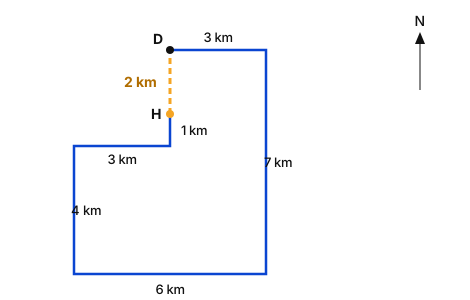
- 3 km E → ; right, 7 km S → ; right, 6 km W → .
- Right, 4 km N → ; right, 3 km E → ; left, 1 km N → H .
- H is 2 km directly south of D, so he must drive 2 km north.
Trick: Facing east, a right turn = south; facing north, a left turn = west.
Answer: (D) 2 km towards the north
अवधारणा: D को मूल बिन्दु मानकर निर्देशांक लिखें (पूर्व +x, उत्तर +y)।
- 3 km पूर्व → ; दाएँ, 7 km दक्षिण → ; दाएँ, 6 km पश्चिम → ।
- दाएँ, 4 km उत्तर → ; दाएँ, 3 km पूर्व → ; बाएँ, 1 km उत्तर → H ।
- H, D से 2 km दक्षिण में है, अतः 2 km उत्तर जाना होगा।
ट्रिक: पूर्व की ओर मुख हो तो दायाँ मोड़ = दक्षिण।
उत्तर: (D) 2 km उत्तर की ओर
RRB NTPC Graduate CBT 1General Intelligence and ReasoningDirection senseRRB NTPC Graduate CBT 1 2024 · 11 Jun Shift 2
Q1011.In a certain code language,
'A + B' means 'A is the mother of B',
'A – B' means 'A is the brother of B',
'A × B' means 'A is the wife of B' and
'A ÷ B' means 'A is the father of B'.
Based on the above, how is M related to Q if 'M – N ÷ O + P × Q'?
एक निश्चित कूट भाषा में,
‘A + B’ का अर्थ है ‘A, B की माँ है’,
‘A – B’ का अर्थ है ‘A, B का भाई है’,
‘A × B’ का अर्थ है ‘A, B की पत्नी है’ और
‘A ÷ B’ का अर्थ है ‘A, B का पिता है’।
उपर्युक्त के आधार पर, यदि ‘M – N ÷ O + P × Q’ है, तो M, Q से किस प्रकार संबंधित है?
- AWife's Father's Brotherपत्नी के पिता का भाई
- BWife's Mother's Fatherपत्नी की माँ के पिता
- CWife's Father's Fatherपत्नी के पिता के पिता
- DWife's Mother's Father's Brotherपत्नी की माँ के पिता का भाई
Show answer
Concept: Decode each symbol from left to right and build the family tree.
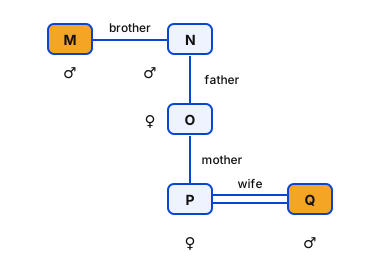
- M – N: M is brother of N; N ÷ O: N is father of O.
- O + P: O is mother of P; P × Q: P is wife of Q.
- From Q: wife (P) → her mother (O) → her father (N) → his brother (M).
Trick: Read the chain backwards from the person asked about (Q).
Answer: (D) Wife's Mother's Father's Brother
अवधारणा: प्रत्येक चिह्न को बाएँ से दाएँ डिकोड करके वंश-वृक्ष बनाएँ।
- M – N: M, N का भाई; N ÷ O: N, O का पिता।
- O + P: O, P की माता; P × Q: P, Q की पत्नी।
- Q से: पत्नी (P) → उसकी माता (O) → उसके पिता (N) → उनके भाई (M)।
ट्रिक: जिसके सापेक्ष पूछा गया (Q) उससे शृंखला उल्टी पढ़ें।
उत्तर: (D) पत्नी की माता के पिता का भाई (Wife's Mother's Father's Brother)
RRB NTPC Graduate CBT 1General Intelligence and ReasoningBlood relations (coded)RRB NTPC Graduate CBT 1 2024 · 11 Jun Shift 2
Q1012.Read the given statements and conclusions carefully. Assuming that the information given in the statements is true, even if it appears to be at variance with commonly known facts, decide which of the given conclusion(s) logically follow(s) from the statements.
Statements:
Some water is pink.
All pink are buildings.
All buildings are tall.
Conclusions:
(I) Some pink is water.
(II) Some buildings are pink.
दिए गए कथनों और निष्कर्षों को ध्यानपूर्वक पढ़िए। यह मानते हुए कि कथनों में दी गई जानकारी सत्य है, भले ही वह सामान्यतः ज्ञात तथ्यों से भिन्न प्रतीत होती हो, निर्णय कीजिए कि दिए गए निष्कर्षों में से कौन-सा/से निष्कर्ष कथनों का तार्किक रूप से अनुसरण करता है/करते हैं।
कथन:
कुछ पानी गुलाबी हैं।
सभी गुलाबी इमारतें हैं।
सभी इमारतें ऊँची हैं।
निष्कर्ष:
(I) कुछ गुलाबी पानी हैं।
(II) कुछ इमारतें गुलाबी हैं।
- ABoth conclusions (I) and (II) follow.निष्कर्ष (I) और (II) दोनों अनुसरण करते हैं।
- BNeither conclusion (I) nor (II) follows.न तो निष्कर्ष (I) और न ही (II) अनुसरण करता है।
- COnly conclusion (II) follows.केवल निष्कर्ष (II) अनुसरण करता है।
- DOnly conclusion (I) follows.केवल निष्कर्ष (I) अनुसरण करता है।
Show answer
Concept: Draw the least-overlap Venn diagram and test each conclusion.
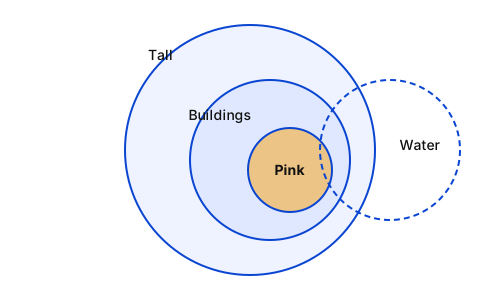
- Pink lies inside Buildings, which lie inside Tall; Water overlaps Pink.
- (I) 'Some water is pink' converts to 'Some pink is water' – follows.
- (II) 'All pink are buildings' gives 'Some buildings are pink' – follows.
Trick: Some A are B ⇔ Some B are A; All A are B ⇒ Some B are A.
Answer: (A) Both conclusions (I) and (II) follow.
अवधारणा: न्यूनतम ओवरलैप वाला वेन आरेख बनाकर निष्कर्ष जाँचें।
- Pink, Buildings के अंदर और Buildings, Tall के अंदर; Water, Pink को काटता है।
- (I) 'कुछ water pink हैं' ⇔ 'कुछ pink water हैं' – अनुसरण करता है।
- (II) 'सभी pink buildings हैं' ⇒ 'कुछ buildings pink हैं' – अनुसरण करता है।
ट्रिक: कुछ A, B हैं ⇔ कुछ B, A हैं; सभी A, B हैं ⇒ कुछ B, A हैं।
उत्तर: (A) दोनों निष्कर्ष (I) और (II) अनुसरण करते हैं।
RRB NTPC Graduate CBT 1General Intelligence and ReasoningSyllogismRRB NTPC Graduate CBT 1 2024 · 11 Jun Shift 2
Q1013.Seven boxes, D, E, F, G, S, T and U, are kept one over the other but not necessarily in the same order. Only two boxes are kept between T and E. Only S is kept above G. No box is kept below E. D is kept at some place below F but at some place above U. Which box is kept third above U?
सात डिब्बे, D, E, F, G, S, T और U, एक के ऊपर एक रखे गए हैं, परंतु आवश्यक नहीं कि इसी क्रम में हों। T और E के बीच केवल दो डिब्बे रखे गए हैं। G के ऊपर केवल S रखा गया है। E के नीचे कोई डिब्बा नहीं रखा गया है। D, F के नीचे किसी स्थान पर परंतु U के ऊपर किसी स्थान पर रखा गया है। U के ऊपर तीसरे स्थान पर कौन-सा डिब्बा रखा गया है?
- AG
- BD
- CT
- DF
Show answer
Concept: Number positions 1 (bottom) to 7 (top) and place fixed boxes first.
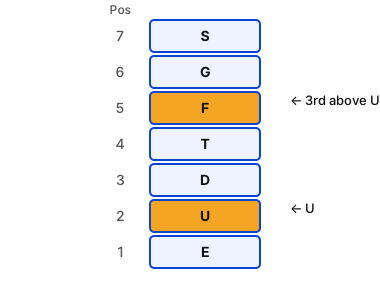
- No box below E → E = 1; two boxes between T and E → T = 4.
- Only S above G → S = 7, G = 6.
- Positions 2, 3, 5 left for D, F, U with F above D above U → U = 2, D = 3, F = 5.
- Third above U (2) is position 5 = F.
Trick: Start with 'no box below/above' clues – they fix ends.
Answer: (D) F
अवधारणा: स्थिति 1 (नीचे) से 7 (ऊपर) मानें, पहले निश्चित बॉक्स रखें।
- E के नीचे कोई नहीं → E = 1; T और E के बीच दो → T = 4।
- केवल S, G के ऊपर → S = 7, G = 6।
- शेष 2, 3, 5 में F > D > U → U = 2, D = 3, F = 5।
- U (2) से तीसरा ऊपर = 5 = F।
ट्रिक: 'नीचे/ऊपर कोई नहीं' वाले संकेत सिरों को तय करते हैं।
उत्तर: (D) F
RRB NTPC Graduate CBT 1General Intelligence and ReasoningBox arrangementRRB NTPC Graduate CBT 1 2024 · 11 Jun Shift 2
Q1014.Based on the English alphabetical order, three of the following four letter-clusters are alike in a certain way and thus form a group. Which letter-cluster DOES NOT belong to that group?
(Note: The odd one out is not based on the number of consonants/vowels or their position in the letter-cluster.)
अंग्रेज़ी वर्णमाला क्रम के आधार पर, निम्नलिखित चार अक्षर-समूहों में से तीन किसी निश्चित प्रकार से एकसमान हैं और इस प्रकार एक समूह बनाते हैं। कौन-सा अक्षर-समूह उस समूह से संबंधित नहीं है?
(नोट: असंगत अक्षर-समूह, उस अक्षर-समूह में व्यंजनों/स्वरों की संख्या या उनके स्थान पर आधारित नहीं है।)
- ALKP
- BQRU
- CEFI
- DMNQ
Show answer
Concept: Find the gap pattern between letters of each cluster.
- QRU: ; EFI: ; MNQ: .
- LKP: – different.
Trick: Write letter positions: Q17 R18 U21 → .
Answer: (A) LKP
अवधारणा: प्रत्येक समूह में अक्षरों का अंतर देखें।
- QRU: ; EFI: ; MNQ: ।
- LKP: – भिन्न।
ट्रिक: स्थानीय मान लिखें: Q17 R18 U21 → ।
उत्तर: (A) LKP
RRB NTPC Graduate CBT 1General Intelligence and ReasoningOdd one out – lettersRRB NTPC Graduate CBT 1 2024 · 11 Jun Shift 2
Q1015.Which of the following letter-clusters should replace # and % so that the pattern and relationship followed between the letter-cluster pair on the left side of :: is the same as that on the right side of :: ?
# : NHO :: SMT : %
निम्नलिखित में से कौन-से अक्षर-समूह # और % को प्रतिस्थापित करेंगे ताकि :: के बाईं ओर के अक्षर-समूह युग्म के बीच अनुसरित पैटर्न और संबंध वही हो जो :: के दाईं ओर है?
# : NHO :: SMT : %
- A# = PJQ, % = QKR
- B# = PJQ, % = QLR
- C# = PJO, % = QKR
- D# = PJQ, % = QKS
Show answer
Concept: The left pair and the right pair must follow the same letter shift.
- Try # = PJQ: P=N, J=H, Q=O → each letter .
- Apply to SMT: S→Q, M→K, T→R → QKR.
- Only option A gives PJQ and QKR together.
Trick: Find the rule from the complete pair after testing an option.
Answer: (A) # = PJQ, % = QKR
अवधारणा: बाएँ और दाएँ युग्म में समान अक्षर-खिसकाव होना चाहिए।
- # = PJQ लें: P=N, J=H, Q=O → हर अक्षर ।
- SMT पर : S→Q, M→K, T→R → QKR।
- केवल विकल्प A में PJQ व QKR दोनों हैं।
ट्रिक: एक विकल्प मानकर नियम निकालें, फिर दूसरे पर लगाएँ।
उत्तर: (A) # = PJQ, % = QKR
RRB NTPC Graduate CBT 1General Intelligence and ReasoningLetter analogyRRB NTPC Graduate CBT 1 2024 · 11 Jun Shift 2
Q1016.C, O, U, N, T, and Y live on six different floors of the same building. The lowermost floor in the building is numbered 1, the floor above it, number 2 and so on, till the topmost floor is numbered 6. Only two people live above C. Only two people live between C and T. Only N lives between C and U. Y lives immediately below C. Who lives on the floor, numbered 2?
C, O, U, N, T और Y एक ही इमारत की छह अलग-अलग मंज़िलों पर रहते हैं। इमारत की सबसे निचली मंज़िल की संख्या 1 है, उसके ऊपर वाली मंज़िल की संख्या 2 है और इसी प्रकार सबसे ऊपरी मंज़िल की संख्या 6 है। C के ऊपर केवल दो व्यक्ति रहते हैं। C और T के बीच केवल दो व्यक्ति रहते हैं। C और U के बीच केवल N रहता है। Y, C के ठीक नीचे रहता है। मंज़िल संख्या 2 पर कौन रहता है?
- AT
- BN
- CU
- DO
Show answer
Concept: Floors 1 (bottom) to 6 (top); place fixed people first.
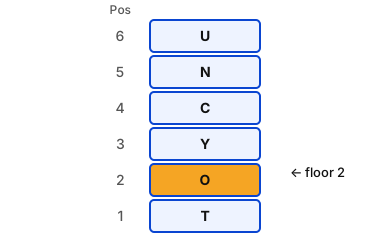
- Only two above C → C = 4; Y immediately below C → Y = 3.
- Two between C and T → T = 1.
- Only N between C and U → N = 5, U = 6 (floor 3 is taken by Y).
- Remaining O → floor 2.
Trick: 'Only two above' in 6 floors → floor 4.
Answer: (D) O
अवधारणा: मंज़िल 1 (नीचे) से 6 (ऊपर); पहले निश्चित व्यक्ति रखें।
- C के ऊपर केवल दो → C = 4; Y ठीक नीचे → Y = 3।
- C और T के बीच दो → T = 1।
- C और U के बीच केवल N → N = 5, U = 6 (मंज़िल 3 पर Y है)।
- शेष O → मंज़िल 2।
ट्रिक: 6 मंज़िलों में 'ऊपर केवल दो' → मंज़िल 4।
उत्तर: (D) O
RRB NTPC Graduate CBT 1General Intelligence and ReasoningFloor puzzleRRB NTPC Graduate CBT 1 2024 · 11 Jun Shift 2
Q1017.Seven boxes, A, B, C, D, E, F and G, are kept one over the other but not necessarily in the same order. Only three boxes are kept below B. Only two boxes are kept between B and G. Only A is kept immediately above E. F is kept in some place below D and in some place above C. How many boxes are kept below C?
सात डिब्बे, A, B, C, D, E, F और G, एक के ऊपर एक रखे गए हैं, परंतु आवश्यक नहीं कि इसी क्रम में हों। B के नीचे केवल तीन डिब्बे रखे गए हैं। B और G के बीच केवल दो डिब्बे रखे गए हैं। E के ठीक ऊपर केवल A रखा गया है। F, D के नीचे किसी स्थान पर और C के ऊपर किसी स्थान पर रखा गया है। C के नीचे कितने डिब्बे रखे गए हैं?
- A2
- B4
- C1
- D3
Show answer
Concept: Number the positions 1 (bottom) to 7 (top), fix the certain boxes first, then check whether the clues give one unique stack.
- Three boxes below B B = 4. Two boxes between B and G G = 1 or 7.
- A is immediately above E, and C is below F which is below D.
- Several stacks satisfy every clue (bottom to top): C, E, A, B, F, D, G gives 0 boxes below C; G, C, F, B, D, E, A gives 1; E, A, C, B, F, D, G gives 2; G, E, A, B, C, F, D gives 4.
- Options 1, 2 and 4 are all possible, so the answer is not unique as printed.
Note: In "how many" arrangement questions, try to build a second valid stack; if it gives a different count, the answer is not unique. In the exam, every candidate gets full marks (bonus) for such a question.
Answer: Bonus – no option is correct as printed; full marks to all.
अवधारणा: स्थानों को 1 (सबसे नीचे) से 7 (सबसे ऊपर) तक क्रमांकित करें, पहले निश्चित बॉक्स रखें, फिर देखें कि शर्तों से एक ही व्यवस्था बनती है या नहीं।
- B के नीचे तीन बॉक्स B = 4। B और G के बीच दो बॉक्स G = 1 या 7।
- A, E के ठीक ऊपर है; C, F के नीचे और F, D के नीचे है।
- कई व्यवस्थाएँ सभी शर्तें पूरी करती हैं (नीचे से ऊपर): C, E, A, B, F, D, G में C के नीचे 0 बॉक्स; G, C, F, B, D, E, A में 1; E, A, C, B, F, D, G में 2; G, E, A, B, C, F, D में 4।
- विकल्प 1, 2 और 4 तीनों संभव हैं, इसलिए छपे प्रश्न का उत्तर अद्वितीय नहीं है।
नोट: "कितने" वाले व्यवस्था-प्रश्न में दूसरी मान्य व्यवस्था बनाकर देखें; अलग गिनती आए तो उत्तर अद्वितीय नहीं। परीक्षा में ऐसे प्रश्न पर सभी अभ्यर्थियों को पूरे अंक (बोनस) दिए जाते हैं।
उत्तर: बोनस – छपे प्रश्न के अनुसार कोई विकल्प सही नहीं; सभी को पूरे अंक।
RRB NTPC Graduate CBT 1General Intelligence and ReasoningBox ArrangementRRB NTPC Graduate CBT 1 2024 · 11 Jun Shift 2
Q1018.Town P is to the east of Town Q. Town Q is to the south of Town R. Town R is to the east of Town S. Town S is to the west of Town T. Town P is to the south-west of Town T. What is the position of Town R with respect to Town T?
नगर P, नगर Q के पूर्व में है। नगर Q, नगर R के दक्षिण में है। नगर R, नगर S के पूर्व में है। नगर S, नगर T के पश्चिम में है। नगर P, नगर T के दक्षिण-पश्चिम में है। नगर T के सापेक्ष नगर R की स्थिति क्या है?
- AWestपश्चिम
- BSouthदक्षिण
- CEastपूर्व
- DNorthउत्तर
Show answer
Concept: Place towns step by step on a grid.
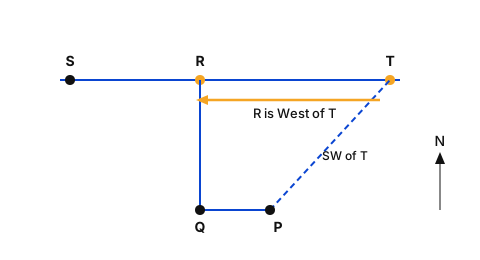
- S is west of T and R is east of S – S, R, T on the same east-west line.
- Q is south of R, P is east of Q; P is south-west of T, so P (and hence R above Q) lies to the west of T.
- So R is between S and T: R is West of T.
Trick: Draw a quick sketch – direction questions become one look.
Answer: (A) West
अवधारणा: कस्बों को चरणबद्ध ग्रिड पर रखें।
- S, T के पश्चिम में और R, S के पूर्व में – S, R, T एक ही पूर्व-पश्चिम रेखा पर।
- Q, R के दक्षिण में, P, Q के पूर्व में; P, T के दक्षिण-पश्चिम में, अतः R भी T के पश्चिम में।
- इसलिए R, T के पश्चिम में है।
ट्रिक: एक छोटा चित्र बनाएँ – दिशा प्रश्न तुरंत हल।
उत्तर: (A) पश्चिम
RRB NTPC Graduate CBT 1General Intelligence and ReasoningDirection senseRRB NTPC Graduate CBT 1 2024 · 11 Jun Shift 2
Q1019.If 1 is added to each odd digit and 2 is subtracted from each even digit in the number 3816427, how many digits will appear more than once in the new number thus formed?
यदि संख्या 3816427 में प्रत्येक विषम अंक में 1 जोड़ा जाए और प्रत्येक सम अंक में से 2 घटाया जाए, तो इस प्रकार बनी नई संख्या में कितने अंक एक से अधिक बार आएँगे?
- AFourचार
- BOneएक
- CTwoदो
- DThreeतीन
Show answer
Concept: Change each digit as instructed, then count repeated digits.
- 3816427: odd 3, 1, 7 → 4, 2, 8; even 8, 6, 4, 2 → 6, 4, 2, 0.
- New number: 4 6 2 4 2 0 8.
- 4 appears twice and 2 appears twice → two digits repeat.
Trick: Write the new digits directly below the old ones to avoid slips.
Answer: (C) Two
अवधारणा: निर्देशानुसार हर अंक बदलें, फिर दोहराए अंक गिनें।
- 3816427: विषम 3, 1, 7 → 4, 2, 8; सम 8, 6, 4, 2 → 6, 4, 2, 0।
- नई संख्या: 4 6 2 4 2 0 8।
- 4 दो बार और 2 दो बार → दो अंक दोहराए गए।
ट्रिक: पुराने अंकों के ठीक नीचे नए अंक लिखें।
उत्तर: (C) दो
RRB NTPC Graduate CBT 1General Intelligence and ReasoningNumber operationsRRB NTPC Graduate CBT 1 2024 · 11 Jun Shift 2
Q1020.Based on the English alphabetical order, three of the following four letter-cluster pairs are alike in a certain way and thus form a group. Which letter-cluster pair DOES NOT belong to that group?
(Note: The odd one out is not based on the number of consonants/vowels or their position in the letter-cluster.)
अंग्रेज़ी वर्णमाला क्रम के आधार पर, निम्नलिखित चार अक्षर-समूह युग्मों में से तीन किसी निश्चित प्रकार से एकसमान हैं और इस प्रकार एक समूह बनाते हैं। कौन-सा अक्षर-समूह युग्म उस समूह से संबंधित नहीं है?
(नोट: असंगत अक्षर-समूह, उस अक्षर-समूह में व्यंजनों/स्वरों की संख्या या उनके स्थान पर आधारित नहीं है।)
- ANK−LI
- BTQ−RO
- CKH−HH
- DYV−WT
Show answer
Concept: Check the shift inside each cluster and between the clusters.
- NK–LI: N=K, L=I, N=L.
- TQ–RO and YV–WT follow the same , , pattern.
- KH–HH: second cluster H=H – breaks the pattern.
Trick: Check both clusters internally; the odd pair fails one of them.
Answer: (C) KH−HH
अवधारणा: प्रत्येक समूह के अंदर और समूहों के बीच अंतर देखें।
- NK–LI: N=K, L=I, N=L।
- TQ–RO और YV–WT में भी , , ।
- KH–HH: दूसरे समूह में H=H – पैटर्न टूटता है।
ट्रिक: दोनों समूहों को अलग-अलग जाँचें।
उत्तर: (C) KH−HH
RRB NTPC Graduate CBT 1General Intelligence and ReasoningOdd one out – letter pairsRRB NTPC Graduate CBT 1 2024 · 11 Jun Shift 2

